什邡抗议The Shifang Protest
Background: A city still rebuilding after an earthquake: Shifang is a county-level city administered by Deyang in Sichuan Province, on the northwestern edge of the Chengdu Plain. In the 2008 Wenchuan earthquake it was among the hardest-hit places in China: school buildings, factories and homes collapsed across the city and casualties were severe, and for years afterwards reconstruction was the overriding task of local life. Shifang was not short of industry. Built on phosphate and other mineral resources, chemicals and non-ferrous metals had long been pillars of the local economy, and Sichuan Hongda Co., Ltd., a listed company headquartered in Shifang, had grown out of lead-zinc smelting and phosphate chemicals. In the official narrative, a molybdenum-copper smelting project worth more than ten billion yuan landing in Shifang was the largest industrial investment of the reconstruction era, promising thousands of jobs, major tax revenue and a transformation for an established local firm. In the feelings of many residents, the order was exactly reversed: the city had only just steadied itself after a natural disaster, people's sensitivity about air, water and their children's health was far higher than usual, and a heavy-metal smelting project that almost nobody had heard discussed was suddenly about to break ground. Panic and anger accumulated far faster than official explanations. To understand the Shifang protest, that background comes first: this was not an abstract environmental debate in a wealthy metropolis, but the direct reaction of ordinary families in a post-earthquake city to a new source of pollution proposed at their doorstep.
The project itself: Conflicting figures for investment and capacity: The project that triggered the protest was formally the Molybdenum-Copper Polymetallic Resource Deep-Processing Comprehensive Utilization Project, to be built by Sichuan Hongda Molybdenum-Copper Co., Ltd., a wholly owned subsidiary of the Shanghai-listed Sichuan Hongda Co., Ltd., on a site in the Shifang Economic Development Zone. Under Hongda's private-placement plan published at the end of 2011, total investment was 10.188 billion yuan, for smelting systems designed to produce 40,000 tonnes of molybdenum (metal content) and 400,000 tonnes of cathode copper a year, together with auxiliary facilities and recovery of several other valuable metals; the company projected about 34.686 billion yuan in new annual sales and about 1.382 billion yuan in annual net profit once the plant was complete, and planned to put about 3.958 billion yuan of the placement proceeds into it. In later statistical and self-examination materials, Shifang officials used a different figure: total investment of 10.4 billion yuan, of which 6.7 billion was construction cost, with projected annual sales of 50 billion yuan and tax revenue of 4 billion yuan. Some Chinese and English reporting put the investment at 13.7 billion yuan, or about US$2.2 billion, while British and American outlets commonly wrote US$1.6 to 1.7 billion. This site's handling is to print the figures side by side: 10.188 billion yuan as the original figure in the company's own placement plan, 10.4 billion as the Shifang official figure, and 13.7 billion labelled as a figure used by some reporting, with none impersonating the others. On any of these figures, one point is undisputed: this was the first project in Shifang's history with investment above ten billion yuan, and it was the project on which Hongda had staked its transformation.
Fully approved, yet the public knew almost nothing: Procedurally, this was not a case of building before approval. Public records show preparations beginning around 2010, and between November 18, 2010 and July 6, 2011 the Sichuan provincial authorities for work safety, development and reform, water resources and health issued a series of approvals covering production safety, soil and water conservation and occupational-disease prevention, while the environmental impact assessment went through the environmental authorities' approval process. In its open letter of July 2, 2012, the Shifang government stressed that the project had been approved by multiple national ministries and that its production processes were scientific. But between complete paperwork and an informed public there was a gulf. Investigations by several outlets afterwards found that, right up to the start of construction at the end of June 2012, many Shifang residents knew almost nothing about the project — not what molybdenum and copper smelting was, not how far the site was from homes and schools, and not what wastes smelting would produce. Ma Jun, director of the Institute of Public and Environmental Affairs, told Britain's Guardian that the government had published only a short version of the environmental report, which gave no information on solid waste or wastewater; he added that heavy-metal projects are inherently highly polluting, so public worry was entirely understandable. This procedural history is what sets the Shifang protest apart from an ordinary not-in-my-backyard dispute: residents were opposing not only a factory, but a way of deciding — completing every approval and scheduling the groundbreaking ceremony first, and letting the people affected find out last.
The environmental dispute: Heavy metals, wastewater and an uncheckable pollution list: The substance of residents' fears was strikingly consistent across contemporary reporting and public discussion. Molybdenum and copper smelting and refining produce a range of toxic by-products, and the substances named again and again in public materials included mercury, sulphur dioxide and arsenic. Residents feared these pollutants entering the air and the city's water supply, feared where smelting slag would be piled, and feared that the site lay near earthquake fault lines — whether plant buildings and pollution-control facilities could withstand the next quake. Shifang's geography and experience magnified every fear: its groundwater and surface water connect to the Chengdu Plain, chemical plants in Shifang had leaked during the earthquake, and residents had first-hand memories of chemical accidents. The official response, meanwhile, repeated conclusions rather than data: the project used the most internationally advanced smelting technology, pollution was controllable, and the environmental assessment had passed. The problem was that when only a summary environmental report was public and monitoring data and discharge lists were not fully open, the word controllable could not be verified by residents themselves; they could only choose to believe or not believe. In the summer of 2012, most people in Shifang chose not to believe. Shifang's own later reflection conceded the point: in 2013 the city's Party secretary, Li Zhuo, said in an interview that the incident could have been avoided, and that the fault lay in the local government's failure to make the whole planning process transparent and to communicate adequately with residents. That retrospective admission amounts to an official confirmation of the procedural cause of the explosion.
The groundbreaking: June 29, 2012: What ignited discontent was the start of construction itself. On June 29, 2012, Sichuan Hongda held a groundbreaking ceremony for the molybdenum-copper project in the Shifang Economic Development Zone, and construction formally began. Once news and photographs of the ceremony spread on local networks, previously scattered discussion rapidly became a concrete agenda for action: the project was not something that might be built someday — work was about to start. For many residents, this was the first time they learned the project's scale, and it was also their last window of opportunity: once the plant was standing, further opposition would be meaningless. It was at this point that discussions on online forums, QQ groups and Weibo began to carry times and places for gathering, and students passed word among themselves at school. It should be recorded that this site has found no reliable evidence that any organized group planned this protest. Chinese and international reporting consistently depicts a citizens' action that converged spontaneously through online information and word of mouth, with students — on summer holiday, quick with information, and seeing themselves as those who would live longest with the pollution — at the front. On the morning of June 30, some residents already came to the city government gate demanding that the project be stopped: the earliest offline gathering that public reporting can confirm.
The evening of July 1: Students and residents at the Party committee gate: On the evening and night of July 1, 2012, the protest took shape. According to later investigations by outlets including NetEase, nearly a thousand residents and students gathered that night at two places — the gate of the Shifang municipal Party committee and Hongda Square — to petition for the project to be halted. Caixin's timeline records several hundred students gathering first in front of the city government offices. The most conspicuous presence was secondary-school students, many of them the so-called post-90s generation, alongside university students home for the holidays, parents with children and watching residents. From the start the crowd's demand was singular and concrete: not compensation, not relocation, but that this project must not be built. There was no unified organizer and no banner of any party or group; people held hand-written banners and placards, chanted slogans, sang the national anthem and sat waiting for an answer at the compound gate. The government's response that night, by report, was mainly persuasion and a promise to study the matter, with no clear answer on stopping construction. The fruitlessness of that night gave the next day's gathering a different atmosphere: people widely believed that only if enough of them came, and their voices were loud enough, could a project that had already broken ground be called off. At this point this site links a comparable record: the Wukan village protest in Lufeng, Guangdong, in 2011 — half a year earlier and different in nature, but belonging to the same period's pattern of grassroots gatherings forcing official concessions; the two cases were later listed side by side in the same official casebook, as recorded below.
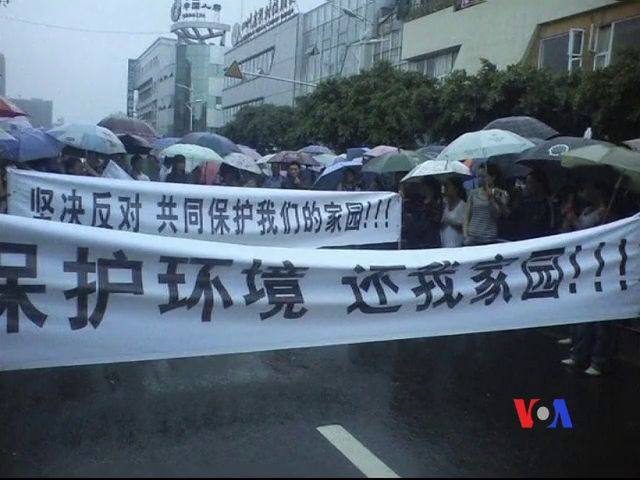
"We can sacrifice ourselves — we are the post-90s generation": The sentence the Shifang protest left deepest in public memory came from a banner carried by students: "We can sacrifice ourselves; we are the post-90s generation." The line was quoted repeatedly by media and later commentators; essays by Hu Ping, Sun Wenguang and others published by the Independent Chinese PEN Center took it as their theme, with Hu Ping writing that the Shifang incident marked the splendid debut of the post-90s generation. Other slogans on site are equally documented: summaries in public reporting record banners reading "Unite to protect the environment for the next generation" and "Defend our homeland, oppose the chemical plant." What these slogans share is that none of them targets an official or a political system; all point to concrete environmental consequences and to the next generation — one reason the Shifang protest won such broad public sympathy, since it was hard to portray as a movement with political demands. The versions of the slogans require care: several more emotive versions circulated online that this site could not trace to any reliable media report, and they are not included, only noted in the verification notes. The post-90s label itself was double-edged: it was the students' own badge of honour, but officials and some media later used it to imply the protesters were young, ignorant of science and easily incited — the Shifang government's open letter of July 2 warned residents to be scientific and not be used by foreign forces. The same group is protagonist in one narrative and excuse in another; this site files both narratives side by side and draws no conclusion for the reader.
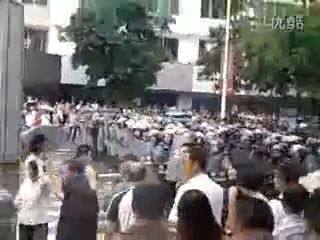
The morning of July 2: Through the cordon, into the Party committee compound: On the morning of July 2, the crowd grew further to several thousand, joined by students from nearby Guanghan, marching and petitioning in the streets and in front of government offices. The official account of that morning is the most detailed. In the Shifang government's later situation notice, residents came in succession to the gates of the Party committee and the city government on the morning of July 2 to oppose the project; a small number, emotionally agitated, forced their way through the cordon into the Party committee offices and smashed eight display-case windows in the first-floor hall, three publicity boards and four exhibition panels; after persuasion by Party and government leaders and staff on site, most onlooking residents left in succession, though a minority kept gathering and blocking the area. Foreign and Hong Kong reporting added that protesters overturned police vehicles and threw bricks and bottles at the government building, and that nearly ten vehicles were damaged. This site's handling sets the official details beside outside reporting: the specific numbers of smashed windows, boards and panels come from the official notice, while overturned police cars and thrown objects are corroborated by Reuters photographs and multiple reports — the two do not contradict each other, and together they form two sides of one picture, a gathering whose overall purpose was petitioning that partially spun out of control on the morning of July 2. This is also the starting point of the later dispute in which the official narrative characterised the whole incident as a smashing and looting affair while protesters and their supporters stressed that it was the police who first used force to disperse; both characterisations are presented in what follows.
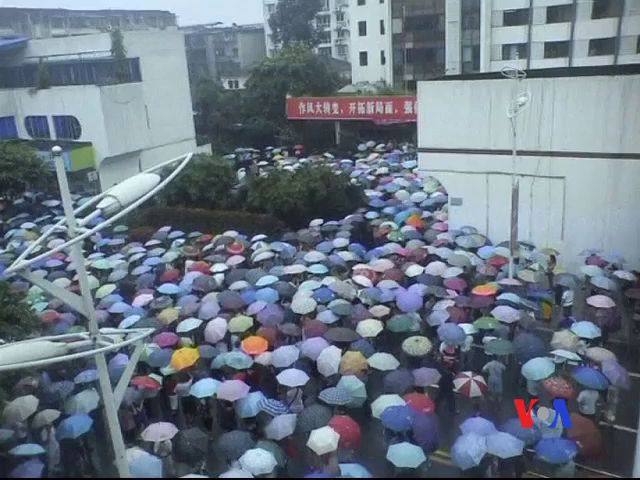
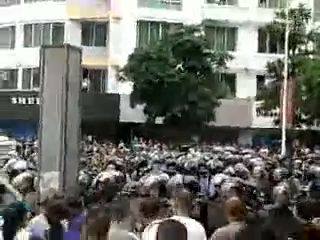
The afternoon of July 2: Tear gas, stun grenades and batons: On the afternoon of July 2, the dispersal began. According to the BBC, Reuters, the Associated Press and other outlets, and Shifang's own official notices, police used tear gas and stun grenades at around 2 p.m. to disperse the crowd. Photographs and video from the scene show riot police advancing in formation with batons, tear gas hanging over the streets, crowds scattering, and some people beaten until they bled. The official account acknowledged the use of tear gas and placed it after the crowd's storming and throwing of objects; the English edition of the Global Times adopted the same sequence. Eyewitnesses and the South China Morning Post stressed instead that the injured included secondary-school students and elderly people, that onlookers and passers-by were also hurt, and one witness told the Post that about 8,000 police were deployed along the city's main roads — a figure resting on a single eyewitness source, which this site marks as not independently verified. After the dispersal, the Shifang Public Security Bureau issued a further notice warning residents not to use the internet or mobile phones to organize gatherings, and requiring those who had organized to turn themselves in within three days or face severe punishment — a warning the Associated Press singled out in its reporting, and which many commentators read as continued pressure on residents even after the project had been halted. The picture of July 2 must therefore be recorded in two layers: on that day the project was announced suspended, which was the protest achieving its aim; and on that day the petitioning crowd was dispersed with tear gas and batons, with people bloodied and detained, which was the price of the protest.
The injury figures: Three counts, and an unverified death rumour: The Shifang protest has no casualty list accepted by all sides, and this site prints every count it could find side by side, without merging or averaging them. Count one, the official figure: the Shifang government said 13 protesters were injured and sent to hospital on July 2, that a number of police officers were also injured, and stated explicitly that nobody had died. The BBC relayed that figure in its July 3 report, and a 2013 hearing submission to the U.S. Congressional-Executive Commission on China also used the figure of 13 injured protesters. Count two, a hospital figure: foreign reporting quoted a staff member answering the telephone at Shifang No. 2 Hospital as saying more than 30 people, police and protesters together, had been treated for minor injuries and discharged — a count of all minor-injury treatments on both sides, which does not directly contradict the official 13 but is plainly broader. Count three, eyewitness and Hong Kong media accounts: witnesses quoted by the South China Morning Post said the number of injured protesters was far higher than the official figure, and photographs circulating online showed students with bandaged heads and bloodied clothes. The death question must be handled separately: Hong Kong's Ming Pao and one local resident said at the time that a high-school student had died, and the rights group Chinese Human Rights Defenders, as reported by AFP, said two people had been killed; Shifang officials consistently denied that anyone had died. This site's finding is that no death claim has been confirmed by any independent source, the official denial is on record, and this entry records only the fact that such rumours existed, were officially denied and remain unverified — no death figure enters the conclusions of this entry. On July 9 the rumour, in a version about a 14-year-old girl beaten to death, briefly brought people out again, as recorded below.
The first official step on July 2: A halt order and an open letter: On the very day the protest erupted, the Shifang government issued two documents that formed the first step of its response. The first was the Notice on Matters Concerning Construction of the Molybdenum-Copper Project, issued by the Shifang municipal government on July 2: it stated that some residents had recently expressed differing views on the Hongda Group's project and that, in order to protect the people's lawful interests and ensure overall social stability, and given that the public did not understand, was not clear about and did not support the project, the Party committee and government had decided to order the enterprise to stop construction from that day; it also announced work teams of cadres would be sent to towns, subdistricts, work units, schools, villages and communities to hear residents' views. The wording matters: that day's decision was to stop construction, on the stated ground that the public did not understand, was unclear and did not support — in the official framing, the problem was defined as insufficient explanation, not as any defect in the project itself. The second document, posted the same day on the government website, was an Open Letter Concerning the Collective Petition by Some Students and Residents: it appealed for calm, declared that the project had been approved by multiple national ministries, that its production was scientific and would not harm the environment, warned residents to be scientific and not be used by foreign forces, and even appended identity and credential information for several testing personnel. Read together, the two documents show a classic two-track response: halting the works to calm the situation, while insisting the project itself was blameless and the fault lay in public misunderstanding. But the crowd wanted not a pause but a no; the first concession therefore did not disperse the July 3 crowds, and instead pushed the measure of the demand up to permanent cancellation.
July 3: From "stop construction" to "will not be built": On July 3 the official position moved a step further. The information office of the Shifang municipal government announced through its official microblog that the Party committee and government had decided that the molybdenum-copper project would not be built in Shifang in the future. Li Chengjin, then the city's Party secretary, said in his statement that the project would have brought Shifang jobs and economic benefits, but given the public's strong opposition and the government's failure to explain the project's benefits adequately, Shifang would not build the project from that day forward. On July 4, staff of the city's publicity department confirmed to media that the halt was permanent. The corporate procedure kept pace: Hongda announced that its wholly owned subsidiary, Sichuan Hongda Molybdenum-Copper, had on July 3 received a notice from the Shifang municipal government stating that, because some residents did not understand or support the project and had reacted strongly over its environmental impact, and in order to preserve overall social stability, the company's molybdenum-copper project was to stop construction from that day. From the groundbreaking on June 29, to stop construction on July 2, to will not be built on July 3 took five days in all: a project prepared for more than two years, with investment above ten billion yuan, was halted by citizens gathering in the streets. That speed is the first reason the Shifang protest is cited again and again in later histories of Chinese environmental protest. The Xiamen PX Walk already filed on this site took months of brewing and a one-day stroll to win relocation of a project; Shifang completed the whole arc from groundbreaking to cancellation in three days, and the two cases are often paired as the northern and southern exemplars of environmental protest in this period.
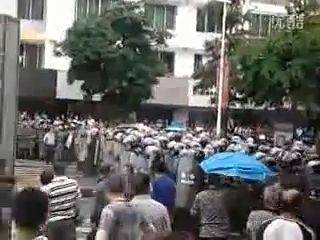
Release and detention: Twenty-seven, twenty-one and six: With the project cancelled, the fate of those taken away became the direct reason crowds stayed on July 3. By the official account, consistently reported by multiple outlets, police took away 27 people in total during the incident. Through the day on July 3, a core demand of the continuing crowds was the release of those held, most of whom were students. That night the authorities announced the outcome: 21 of them, after receiving criticism and education and admitting and repenting their mistakes, were released at 11 p.m. on July 3; six remained in custody. Summaries of the official information by the Associated Press and the University of Hong Kong's China Media Project record that, of those six, three were placed under administrative detention and three under criminal detention, accused of acts including overturning a police vehicle and throwing objects at police and government staff. The Shifang Public Security Bureau stated in its notices that people were taken away for specific acts during the incident, not for petitioning as such. This site records the figures in three distinct layers — 27 taken away, 21 released late on July 3, six held under administrative or criminal detention — each with its source, and does not turn taken away into arrested without qualification, nor treat the six detainees as convicted: in public reporting this site found no complete, reliable record of any later trial outcome for the six, and their fate is recorded as no public record, as detailed in the verification notes. After the project's cancellation and the release of most detainees were confirmed, the crowds dispersed over the evening of July 3, and the three-day Shifang protest came to an end.
July 9: The death rumour resurfaces, and the city goes quiet: After the protest ended, Shifang experienced one brief aftershock. On July 9, an unverified rumour circulated among residents that a 14-year-old girl had been beaten to death during the demonstrations, and some members of the public briefly gathered again. Shifang officials denied it once more, saying nobody had died in the incident, that only a small number of residents and police had been injured, and that police had acted with great restraint in handling the protest. Around the same date, a Sichuan Hongda executive told Caijing magazine that whether the molybdenum-copper smelter would ever be built in future, and whether it would still be located in Sichuan Province, were both unclear — the company's frankest statement after the cancellation, and a sign that the never-build promise still left room for reinterpretation at the time. Two months later, a New York Times reporter revisited Shifang and residents said there was no sign of the Hongda project reviving, and that the city had been calm since the demonstrations ended. With that, the street chapter of the Shifang protest closed entirely; but the accounts it left in corporate books, local politics and national public opinion were only beginning to be settled.
The corporate and civic ledger: Hongda, and Shifang the "island": For Hongda, termination meant a transformation plan falling through and its early outlays at risk. In its announcement of July 5, 2012, the company explained that the project had at that point only held a groundbreaking ceremony and had not formally begun construction; its early spending consisted mainly of feasibility studies, environmental and safety assessments and other specialist fees, staff salaries, fixed-asset purchases and land prepayments, and that termination would affect the company's operating results. Financial media noted at the time that Hongda's 2011 net profit had been only a little over 50 million yuan, with its main businesses in a trough, and that it had counted on this ten-billion-yuan project for its transformation; with the project unable to proceed, the early investment risked being money down the drain. Later public filings show how that account ended: Hongda's 2012 annual report recorded that the private placement tied to the molybdenum-copper project had made no substantive progress and that the scheme lapsed automatically when its validity period expired. For the city of Shifang, the reckoning lasted longer. A 2014 retrospective by Dialogue Earth described Shifang in the two years after the July 2 incident as almost an island: no provincial leaders or department heads visited, economic development suffered, and the city Party secretary Li Zhuo called it a perplexity for the whole country. In June 2014, a casebook edited and published by the central leading group for the Party's Mass Line education campaign, Analysis of Typical Cases of Harming the People's Interests, included an essay on the Shifang incident under the title of why a project meant to benefit the people won no popular support; Shifang took its place beside the Weng'an incident in Guizhou and the Wukan incident in Guangdong as a negative exemplar warning the whole Party. A project that called itself beneficial to the people ended up written into an official collection as a negative teaching case for the entire Party — the most formal entry the Shifang protest left inside the system.
The 2013 "restart" episode and the project's final state: The promise that the project would never be built faced a public test a year later. In 2013, an investigation by the Oriental Morning Post disclosed that from April to July that year Shifang had organized cadres and residents to visit molybdenum and copper production projects outside the province, and in August had carried out a citywide mobilization publicizing the benefits of the project and the controllability of its pollution, as part of Shifang's campaign to implement the four accounts and build a happy Shifang. In many residents' eyes, the substance of these moves was to lay public-opinion groundwork for restarting the project, and one resident told the reporter directly that Shifang was preparing to build the molybdenum-copper project again. The official response left a door open: the Organization Department official guiding the campaign explained that it was to draw lessons from the July 2 incident and improve the development environment, and that reflecting on the incident could not avoid the molybdenum-copper project; a publicity official said that if the public understood and demanded the project's restart in Shifang, the authorities would follow the legal procedure; Party secretary Li Zhuo answered the restart question by saying it depended on public opinion and collective wisdom. But no restart happened: the report's conclusion stated plainly that the project had still not landed, facing the triple obstacles of a government that would break its word, public resistance and environmental debts. The latest status this site can state on verifiable information is that, as of its last check, there is no public record of the Hongda molybdenum-copper project ever being built or put into production in Shifang, and Shifang officials have not since formally announced any resumption of its construction; the 2013 round of study tours and publicity was the last restart-related move in public reporting. Of the ordinary participants and individual students of 2012, this site has no reliable public information about their later circumstances to record — they are inside China, this site records no identifiable personal information about them, and this section is honestly entered as no public record.
A lineage of environmental protest: Xiamen, Dalian, Shifang, Qidong, Ningbo: Only by placing Shifang back in its lineage can the weight of the summer of 2012 be seen. The lineage is usually traced to 2007, when in June of that year Xiamen residents took a stroll to oppose the Haicang PX project, which was eventually relocated to Zhangzhou; the Xiamen PX Walk became the emblematic event of Chinese environmental protest and has its own entry on this site. In August 2011, Dalian residents took to the streets against the Fujia Dahua PX plant after a typhoon breached a seawall near the plant and exposed the safety hazards of its PX tanks; the Dalian government promised on the spot to relocate the project. Then came 2012: within a single month, Shifang in early July and Qidong on July 28 erupted in succession. The Qidong protest targeted the sea-discharge project of the Japanese paper maker Oji Paper's Nantong mill — a scheme to discharge papermaking wastewater through a pipeline of about 110 kilometres into the sea near Qidong — with residents fearing toxic effluent would harm health and traditional fishing grounds. On the morning of July 28, tens of thousands of Qidong residents took to the streets and briefly occupied the city government building, and at about 10:55 that morning the Nantong municipal government announced the permanent cancellation of the Oji sea-discharge project. Coming less than a month apart, with the same environmental demands and the same outcome of cancellation, Shifang and Qidong were almost always paired in mainland media commentary, with the comparison focusing on the difference in how the two cities' police handled the crowds. In October the same year, Ningbo's Zhenhai district erupted over the PX unit in the Zhenhai refining-chemical integration project; police cleared the streets with tear gas, and the Ningbo government ultimately promised not to build the PX project and halted the entire integration project. Xiamen 2007, Dalian 2011, Shifang and Qidong 2012, Ningbo 2012: within five years, environmental protest had grown from single-city events into a reproducible grammar of action shared by ordinary citizens.
Media and public opinion: Foreign headlines, domestic commentary and deleted photographs: The Shifang protest is among the most fully documented Chinese environmental protests in international media. Reuters filed on July 3 and July 4, recording the whole sequence from the suspension announcement to the formal cancellation, and its stringers' photographs of marching in Shifang's streets were used worldwide. The Associated Press report of July 3 highlighted the public security bureau's three-day surrender warning and the detail of student participation. The BBC reported on July 3 under a headline about a Chinese factory halted amid violent protests, relaying the official figure of 13 injured. The New York Times, the Guardian, the Wall Street Journal and AFP all followed the story; AFP's July 4 report on the cancellation quoted Chinese Human Rights Defenders on deaths while noting the official denial — the same juxtaposition of claim and denial that this site adopts for the death rumours. Domestic public discussion ran on two levels. On one level, print and portal commentary: several outlets published editorials and commentaries aiming at opaque environmental assessment and decision procedures, arguing that with proper prior disclosure and consultation the street clashes could have been avoided, while the University of Hong Kong's China Media Project documented day by day how mainland newspapers wrote Shifang as a business story to skirt the protest itself. On the other level, on-the-scene circulation on Weibo: photographs of armed police beating students with batons and of bloodied students were forwarded in huge numbers on July 2 and 3, and deleted in huge numbers; a commentary on the Shifang incident by the writer Han Han is cited in academic research as a specimen of the online reaction. Photographs can be deleted and figures revised, but in those days of July 2012 the name of Shifang spread across the whole country — a fact of transmission that no side's figures can deny.
What Shifang left behind: The outcome of the Shifang protest belongs to the rare won category in contemporary Chinese protest history: a single demand, a concrete target, cancellation within three days, and most of those taken away released the same night. But a complete accounting must also register the limits of the victory. First, the victory came through street pressure, not institutional channels: the procedural defects in environmental disclosure, hearings and information openness were not systematically repaired because of Shifang, and PX protests in Kunming, Maoming and elsewhere afterwards repeated the same script. Second, the costs were real: 13 injured by the official count, six people administratively or criminally detained, a city pinned as a negative exemplar in an official casebook, and years of stalled development afterwards — the protesters wanted clean water and air, not to turn their own city into an island; that outcome is morally a debt owed by a local government that handled things badly, yet it was borne by all of Shifang's residents together. Third, the names of the ordinary participants have almost all vanished: beyond slogans and photographs, no student or resident left a public record that later generations can consult — which is both protection and oblivion. This site files Shifang under Resistance with all three layers of that ledger intact: a body of ordinary citizens led by secondary-school students, in a post-earthquake city, stopped a ten-billion-yuan polluting project in three days; their method was to take to the streets, their price was blood and detention, and the result is that the project has never been built. The episode needs no inflation into myth, and it should not be edited into non-existence either.
Sources for this entry: Materials behind this entry include the Shifang municipal government's Notice on Matters Concerning Construction of the Molybdenum-Copper Project of July 2, 2012, its Open Letter Concerning the Collective Petition by Some Students and Residents issued the same day, the July 3 announcement by the city government's information office that the project would not be built in the future, and public relays of the Shifang Public Security Bureau's notices; Sichuan Hongda's 2011 private-placement plan disclosing total investment of 10.188 billion yuan and design capacity of 40,000 tonnes of molybdenum and 400,000 tonnes of cathode copper a year, the company's July 2012 announcements on the halt, and the record in its 2012 annual report that the placement had lapsed; reporting and investigations by Caixin, NetEase, the Oriental Morning Post's 2013 investigation of the restart episode, and financial outlets including the Investor Journal; on-the-scene and follow-up reporting by Reuters, the Associated Press, the BBC, AFP, the New York Times, the Guardian and the Wall Street Journal in July 2012; eyewitness reporting by the South China Morning Post; the University of Hong Kong China Media Project's record of mainland coverage and Weibo deletions; a 2013 hearing submission to the U.S. Congressional-Executive Commission on China summarizing the incident's figures; Dialogue Earth's 2014 retrospective on the aftermath in Shifang; and public reporting on the inclusion of the Shifang case in the official 2014 casebook Analysis of Typical Cases of Harming the People's Interests. Dates, numbers and amounts in this entry were written only after cross-checking across the sources above; where sources disagree, the handling is itemized in the verification notes that follow.
Verification notes: Six points in this entry require the reader's attention. First, investment: the company's placement plan gives 10.188 billion yuan, Shifang's official figure is 10.4 billion yuan, and some reporting gives 13.7 billion yuan or about US$2.2 billion; this site prints the three side by side and treats none as the sole settled figure. A circulating description of capacity as 40,000 tonnes of molybdenum-copper is also inaccurate: the plan's wording is 40,000 tonnes of molybdenum and 400,000 tonnes of cathode copper a year. Second, injuries: officials said 13 protesters were injured and sent to hospital and a number of police were injured; a hospital staff member put total minor-injury treatments on both sides at more than 30; South China Morning Post witnesses said the true number was far higher — the three counts are printed side by side and not merged. Third, death rumours: Ming Pao and individual residents said a high-school student had died, and Chinese Human Rights Defenders, via AFP, said two had been killed, while officials consistently denied any death; this site found no independent confirmation, and no death figure enters this entry's conclusions; the July 9 story of a 14-year-old girl beaten to death is likewise unverified. Fourth, crowd and police scale: official and Global Times accounts say several thousand protesters, the South China Morning Post said tens of thousands, and the figure of about 8,000 police rests on a single eyewitness; all are attributed to their sources. Fifth, slogans: some emotive versions circulating online, including a version invoking acne and youth, could not be traced by this site to any reliable media source and are not included; the text uses only versions supported by reporting summaries, such as We can sacrifice ourselves — we are the post-90s generation. Sixth, the six detainees: public reporting stops at the summarized position of three administrative and three criminal detentions, their later trial or release has no public record, and the same is true of ordinary participants; this site does not speculate and records no identifiable personal information about participants inside China. Every other fact in this entry was written only after corroboration by at least two sources.
视频证据Video Evidence
以下为2012年什邡抗议的市民实拍。Citizen footage of the 2012 Shifang protest.
2012年什邡万人上街抗议钼铜厂,遭催泪弹与警棍驱散(市民实拍)|2012年|中文原声,无中文字幕轨Thousands protest a molybdenum-copper plant in Shifang, dispersed with tear gas and batons, 2012 (citizen footage) | 2012 | In Mandarin; no Chinese subtitle track
《污染项目暂停抗议仍未停 什邡周边民众加入声援》(自由亚洲电台)|2012年|中文原声"Protests continue after the polluting project is halted, as residents around Shifang join in" (Radio Free Asia) | 2012 | In Chinese
《中國當局稱要"嚴厲懲罰"什邡市示威者》:市民雨中游行抗议钼铜项目(美国之音粤语)|2012年|粤语原声"Authorities vow to severely punish Shifang demonstrators": residents march in the rain against the molybdenum-copper plant (Voice of America Cantonese) | 2012 | In Cantonese