
第132案 | 吴淦Case 132 | Wu Gan
吴淦,网名「超级低俗屠夫」,福建福清人,退伍军人出身、做过十余年厦门机场保安,2009年因邓玉娇案投身维权,以围观、恶搞、募捐与「三大宝典」闻名网络。2015年5月,他在南昌江西省高级人民法院门前声援乐平冤案的律师阅卷抗议、辱骂院长张忠厚,先被行政拘留十日,继而被福建警方以寻衅滋事、诽谤刑事拘留(2015年5月27日),7月3日被厦门检察院以煽动颠覆国家政权等罪批准逮捕,2016年1月移送天津并入709系列案件。羁押十九个月后他才首次会见律师燕薪、葛永喜,并指控遭受剥夺睡眠、工字镣、疲劳审讯等酷刑;当局据其自述曾开价「认罪判三缓三」换取认罪与配合宣传,被他拒绝。2016年12月23日,天津市检察院第二分院以颠覆国家政权罪起诉,起诉书以其2010年以来参与的十二起维权事件与大量网络言论为「犯罪事实」。2017年8月14日天津市第二中级人民法院以涉及国家秘密为由不公开审理,同年12月26日以颠覆国家政权罪判处其有期徒刑八年、剥夺政治权利五年——为709系列案件中最重判决;同日认罪的谢阳在长沙被免予刑事处罚。2018年4月17日天津市高级人民法院驳回上诉维持原判。他在福建三明清流监狱服刑,饱受天津酷刑后遗症折磨,2023年5月18日刑满获释,回到厦门家中。其父徐孝顺亦两度因其案被关押、最终以证据不足撤案。Wu Gan, known online as the 'Super Vulgar Butcher,' was a rights activist from Fuqing, Fujian — a military veteran who worked for over a decade as a security guard at Xiamen airport before rising to fame in 2009 over the Deng Yujiao case with a repertoire of on-site spectating, mockery, fundraising and samizdat 'classics' on resisting official abuse. In May 2015 he protested outside the Jiangxi Provincial High People's Court in Nanchang in support of lawyers demanding access to the files of the Leping wrongful-conviction case, insulting court president Zhang Zhonghou; he was administratively detained for ten days, then criminally detained by Fujian police on 27 May 2015 for picking quarrels and defamation, formally arrested on 3 July 2015 on charges including inciting subversion, and in January 2016 transferred to Tianjin and folded into the 709 Crackdown cases. He was denied a meeting with his own lawyers, Yan Xin and Ge Yongxi, for nineteen months, and alleged torture including sleep deprivation, 'I-bar' shackles and exhausting interrogations; by his own account the authorities offered him a three-year suspended sentence in exchange for a guilty plea and propaganda cooperation, which he refused. Indicted on 23 December 2016 for subversion of state power on the basis of twelve rights-defense incidents since 2010 and a mass of online speech, he was tried behind closed doors by the Tianjin No. 2 Intermediate People's Court on 14 August 2017 and on 26 December 2017 sentenced to eight years' imprisonment plus five years' deprivation of political rights — the heaviest sentence in any 709-related case, handed down the same day a Changsha court exempted the confessed lawyer Xie Yang from punishment. The Tianjin High People's Court rejected his appeal on 17 April 2018. He served his term at Qingliu Prison in Sanming, Fujian, suffering lasting effects of the Tianjin torture, and was released on 18 May 2023, returning to his home in Xiamen. His father Xu Xiaoshun was twice imprisoned in connected proceedings that ended with the charges withdrawn for insufficient evidence.
1. The man: from airport security guard to "Super Vulgar Butcher"
Wu Gan came from Fuqing, in China's southeastern Fujian province. Even his date of birth cannot be stated with certainty from public sources: the English-language Wikipedia gives 14 February 1972, the Chinese-language Wikipedia gives 14 February 1973, and the criminal judgment of the Tianjin No. 2 Intermediate People's Court — the single most authoritative document in this case — redacts the defendant's birth date and birthplace entirely in its published text, printing them as "xxxx." This archive therefore records both years in parallel and merges neither. According to the case reporting of Chinese Human Rights Defenders (CHRD), Wu was a military veteran who then worked for more than a decade as a security guard at Xiamen Gaoqi International Airport. One circulating description of him as a former "airport police" employee is not supported by that reporting: he was a security guard, not a policeman. In 2008 he resigned from the airport job and turned to blogging and street-level activism, a decision that set the course of the rest of his life.
His famous online name grew out of his own writings. In Wu's vocabulary, corrupt and abusive officials were "pigs," and "butchering pigs" meant pinning named officials down under public scrutiny — through exposure, ridicule, complaints and relentless on-site "spectating" — until the cost of wrongdoing rose higher than wrongdoers could comfortably pay. He set the method down in a samizdat manual usually rendered as "The Classic on Butchering Pigs." After repeated complaints about the crudity of his language, he added a defiant prefix to his own handle, and "Super Vulgar Butcher" — in Chinese, 超级低俗屠夫 — became the name under which Chinese internet users knew him; his Twitter handle was @tufuwugan, and he also wrote under other names, including "the bandit who chases the wind." The judgment against him, ironically, preserves the most complete official inventory of his many accounts: investigators retrieved from Sina Weibo, Tencent Weibo and WeChat a string of profiles attributed to him, among them "The Guy Who Kills Pigs," "Super Vulgar tufu-eoE," "Doctor Butcher," "Butchers Love to Kill Pigs" and "The Super Vulgar Butcher Is Active." A man who spoke in many voices was, in the end, archived by the state in all of them.
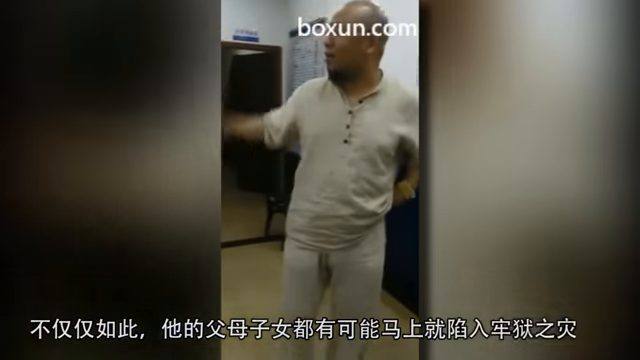
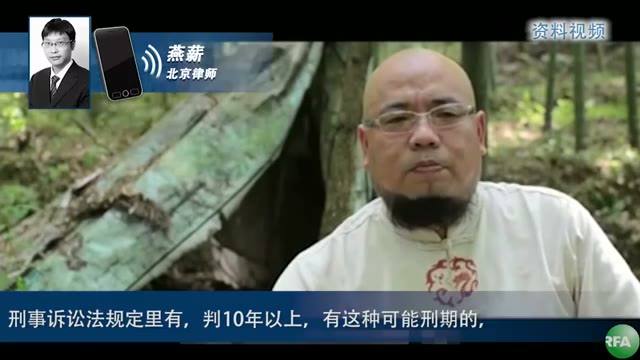
Wu's style made him singular in China's rights-defense (weiquan) movement. Where others filed briefs, Wu staged spectacles: he camped in tents outside detention centers, carried grotesque placards, pasted a Hitler moustache onto a chief judge's photograph and demanded to know what bribe the judge would accept, issued mock "wanted posters" and "commendations" for abusive officials, raised money online for the families and lawyers in the cases he adopted, and narrated everything, post by post, to a growing online audience. His admirers saw a genius of mobilization who understood, earlier than most, how online attention could be converted into offline pressure. The state saw a dangerous inciter. Both descriptions run through this archive side by side, because the 2017 judgment devotes an entire section to cataloguing his microblog posts, WeChat messages and tweets as proof of criminal intent: the verdict is itself an official biography of Wu Gan, written from the opposite pole of his own self-understanding.
2. Rise to prominence: Deng Yujiao and the age of "spectating"
Wu entered public view in 2009. That May, in Badong County, Hubei, a young pedicurist named Deng Yujiao stabbed to death a township official who had demanded sex from her and assaulted her, wounding another man; she was detained on suspicion of murder. The case ignited a national outcry, and Wu was among its most energetic organizers, traveling to Badong, helping to raise funds and driving the online campaign. Deng was ultimately found to have acted in excessive self-defense and was exempted from criminal punishment. One correction belongs here: the English Wikipedia's statement that Wu had supported Deng "since May 2008" misdates the episode by a year — the Deng Yujiao incident occurred in May 2009, and CHRD and China Change both date the start of Wu's activism to 2009.
In the years that followed, Wu materialized at case after case that seized national attention: the Fujian "three netizens" case of 2010; the death of village chief Qian Yunhui in Yueqing, Zhejiang, at the end of 2010; the case of Shenyang street vendor Xia Junfeng, who killed two urban-management officers in what he maintained was self-defense; the 2013 case in Hainan of an elementary-school principal and a government employee who took schoolgirls to a hotel. His repertoire hardened into a system: arrive at the scene, stake out the courthouse or government compound, hang banners, publish the responsible officials' names and histories, organize donations, and keep the story alive online day after day. In his own phrase, it was "pushing the wall" in his own way. A WeChat post later quoted in his judgment captures his self-image with uncomfortable precision: pushing the wall, he wrote, is not the work of a day or two; one must keep a happy and healthy frame of mind, take care of one's body, outlive "them," and wait for the day of burying them with one's own hands.
An editorial choice inside the prosecution's case deserves permanent record. The indictment listed twelve incidents as the factual basis of Wu's alleged subversion — yet it pointedly omitted the Deng Yujiao case, the Xia Junfeng case, the Qian Yunhui case and the Hainan schoolgirls case, the very episodes in which his role had been largest and public sympathy for his side strongest. China Change, in its pre-trial analysis, argued that the prosecution steered around those cases precisely because they displayed, in the starkest form, the injustices of the system Wu opposed. That observation is archived here alongside the indictment itself, as a commentary on the indictment's own construction.
3. The indictment's twelve incidents, I: 2010–2012
On 23 December 2016, the Second Branch of the Tianjin Municipal People's Procuratorate issued indictment No. 10001 of 2016, charging Wu Gan with subversion of state power. The charge rested on twelve incidents. They are archived below one by one, in each case with the prosecution's characterization first and the publicly documented background of the underlying case second — because the distance between the two is the heart of this file.
Incident one: the Fujian three netizens, April 2010. In February 2009 a young woman, Yan Xiaoling, died in Minqing, Fujian; her mother, Lin Xiuying, insisted her daughter had been gang-raped and murdered and petitioned for justice. The rights defender Fan Yanqiong wrote up the mother's account; You Jingyou filmed an interview with her; Wu Huaying helped spread it online. On 24 June 2009 Fuzhou police criminally detained all three, later prosecuted for "false accusation." Wu Gan took up the case in February 2010: he camped in a tent outside Fuzhou's No. 1 Detention Center, streaming updates to build attention, and on the opening day of trial, 16 April 2010, more than a hundred netizens from across the country gathered outside the Mawei District People's Court in Fuzhou with banners and slogans while video of the scene went up online. The episode is often credited with inventing the Chinese model of the trial as public spectacle. The indictment alleged that Wu "engaged in malicious instigation on the Internet," inciting others to gather at the court and "confront and oppose the country's judiciary," seriously affecting the court's work and smearing its image. The three netizens were sentenced to two years, one year and one year. Wu's own explanation of his involvement was plain: the three were ordinary internet users, and if they could be turned into criminals for posting, then anyone who posted anything could be next.
Incident two: a forced-demolition dispute in Jin'an District, Fuzhou, April to August 2012. A resident who refused the compensation offered for his home found the developer cutting his water and electricity, stacking construction materials around the house and beginning foundation work to force him out. Wu came back to Fuzhou to help: he filed government information-disclosure requests, demonstrated that the developer lacked permission to build, posted notices, camped outside the Fuzhou Urban and Rural Construction Commission, and attacked the Jin'an district chief online. The indictment charged that he organized banner protests and tent camps, posted slogans at the house and insulted the district chief, "seriously damaging the image of the government and state officials." China Change's background account preserves a characteristic episode: Wu bought a naked mannequin and attached to its head the face of a female local cadre for a more eye-catching protest march; after angry police warnings, he dropped the plan — a detail that shows both the deliberately humiliating register of his performance art and that it had limits he sometimes observed.
Incident three: defending his own father, September 2012. That month, police in Fuqing opened an embezzlement investigation and took Wu's father, Xu Xiaoshun, into custody. Wu demonstrated outside the Fuqing Public Security Bureau, denounced its chief and the handling officers online, and described a bureau officer who had died in the line of duty as a "protector of organized crime." The indictment cited this as proof that Wu had "seriously damaged the image of the public security agency and the people's police" and provoked hatred toward state organs. The other half of this incident belongs in the record too: the case against Xu Xiaoshun was eventually withdrawn and closed with a decision not to prosecute (see section 9 below) — and a son's placard protest outside the police station that had seized his father was entered into a subversion indictment as its third factual pillar.
4. The indictment's twelve incidents, II: 2014–2015
Incident four: Jiansanjiang, March 2014. On 20 March 2014, rights lawyers Tang Jitian, Jiang Tianyong, Wang Cheng and Zhang Junjie, with nine family members of detainees, went to the Qinglongshan Farm "legal education base" in Heilongjiang — an extralegal detention site, a "black jail" in common parlance — to demand the release of Falun Gong practitioners held there. The next day the four lawyers were seized, administratively detained and beaten so severely in custody that all four suffered broken ribs. As supporters converged on Jiansanjiang, Wu helped organize a "Citizens' Solidarity Rescue Group," published its fundraising appeal and served as fundraising contact and supervisor; on 26 March 2014 he posted a reward notice offering 50,000 yuan for evidence of illegal conduct by Liu Guofeng, chief of the Jiansanjiang Agricultural Reclamation Public Security Bureau. The indictment charged that he published police officers' personal information, called for an online "human flesh search," issued "wanted reward posters" and incited confrontation with the state, causing "pernicious political influence at home and abroad."
Incident five: the Mayang land case, Hunan, May 2014. From 2009, the government of Mayang Miao Autonomous County in Huaihua had compulsorily acquired more than ten thousand mu of farmland from the Huang clan of Dalilin village at suppressed prices and resold it to developers; villagers who refused to sign clashed with demolition crews, and in August 2012 at least five Huang family members were arrested and sentenced for "gathering a crowd to disturb public order." After the Huang sisters appealed for help online, lawyers Li Heping, Li Chunfu and Xie Yang and the activist Wu Gan took up the case: they sued, filed information-disclosure requests, delivered a complaint against county party secretary Hu Jiawu to the Huaihua People's Procuratorate, and held placards outside the county party committee and government. When the second-instance trial opened in May 2014, independent reporter Zhu Ruifeng traveled to Mayang to investigate and was refused access by the party secretary. The indictment charged Wu with placarding, complaining and "malicious sensationalizing" that incited dissatisfaction with the socialist system; of the legality of the land seizures themselves, it said nothing at all.
Incident six: the "Zhengzhou Ten," May to July 2014. In February 2014, Yu Shiwen, Chen Wei and others organized a public memorial for the late reformist leaders Hu Yaobang and Zhao Ziyang near Zhao's ancestral home in Hua County, Henan. In May, a number of participants were criminally detained for "picking quarrels," in what became known as the Zhengzhou Ten case. Supporters from around China gathered outside the Zhengzhou detention centers — unfurling banners, shouting slogans, demanding the detainees' release and their right to see lawyers — at one point numbering around seventy people. Wu, with Zhai Yanmin and others, planned support actions, issued repeated online fundraising appeals, published mock "citations" and "wanted posters," and performed insulting "performance art" aimed at the public security chief outside the detention center. In the end the detainees were released one by one; Yu Shiwen, the only one formally charged, was released on probation in February 2017 without ever being prosecuted. The indictment nevertheless recorded Wu's Zhengzhou support work as conduct that "encouraged some people who did not know the truth to hate organs of the State regime."
Incident seven: lawyer Cheng Hai's administrative hearing, Beijing, September 2014. Cheng Hai, a Beijing rights lawyer, had walked out of a courtroom in protest at procedural violations and complained against the judge; the Changping District Justice Bureau answered by suspending his license for a year. Nearly 190 lawyers across China jointly petitioned for the punishment to be rescinded. On 5 September 2014 more than a hundred lawyers and citizens traveled to Changping for the bureau's public hearing on the punishment — and were intercepted by police and plainclothes officers and kept out. Wu held up placards protesting the obstruction; he and others were taken to a police station and held for hours; the punishment was upheld. The indictment charged that Wu incited people online to gather illegally, displayed slogans denigrating the justice bureau and the bar association, abused on-duty police and blocked doors in an affray. Why police prevented citizens from attending a hearing that a government agency had convened as a public hearing, the indictment nowhere explains.
Incident eight: a civil appeal in Dali, Yunnan, December 2014 to January 2015. Lu Yong had leased a courtyard house on Erhai Lake in Shuanglang, Dali, for twenty years, paying in full in advance; when tourism boomed, the landlord reneged, and after Lu won his house back through two trials, a judge of the Dali Intermediate Court, Bao Kang, was alleged to have taken a bribe and issued a legally baseless retrial ruling ordering Lu to give the house back. Lu hired the Beijing Fengrui Law Firm. In January 2015 Wu — by then working with Fengrui — traveled to Dali with lawyer Xie Yuandong and Lu Yong, submitting their evidence and a formal complaint against Judge Bao to the Dali procuratorate, the Yunnan High Court, the provincial procuratorate and the provincial discipline-inspection commission; they posted big-character posters at the prefecture government, procuratorate and intermediate court and drove a poster-covered car around the court for roughly an hour, drawing a handful of onlookers. In the indictment, this evidence-backed complaint against a judge accused of selling a ruling became the claim that Wu "attacked judicial organs, besmirched the judicial system, and maliciously stirred up trouble on the internet," attempting to incite resentment of China's judicial system. The inferential steps between the complaint and the subversion are nowhere supplied.
Incident nine: the Fan Mugen case in Suzhou. On 3 December 2013, Fan Mugen, a Suzhou resident who had been evading forced relocation, returned home to find armed demolition men beating his wife and son; he seized a knife in self-defense and stabbed two of the attackers to death, and was later sentenced to eight years for intentional injury. In January 2014 Wu attended a Beijing seminar on urbanization and demolition in Suzhou and spoke critically of the national system in connection with the case; in January and February 2015, as related cases approached trial, he organized online fundraising and publicity for Fan's defense. The indictment charged that he "actively organized fundraising on the Internet, maliciously sensationalized," and incited people to gather illegally in Suzhou to oppose the government.
Incident ten: the Baoding extortion case, March 2015. Li Jie, chief of Shenzhuang village in Baoding, Hebei, was detained for extortion in August 2013 and sentenced at first instance to fifteen years; the second-instance court concluded the case was a grave miscarriage of justice but its judge did not dare defy the Baoding municipal party politico-legal committee and declare him innocent. While Fengrui handled the appeal, Wu posted on Twitter on 13 March 2015 that Baoding's politico-legal leadership was running a vanity "image project" and had no compunctions about convicting the innocent, and he called for public attention to the case. The indictment recast this as fabricating the rumor that "leaders of the Baoding Municipal Party Committee Political and Legal Commission committed an injustice for the sake of a vanity project," maliciously sensationalizing the case and provoking dissatisfaction with the judicial system.
Incident eleven: the Qing'an shooting, May 2015. On 2 May 2015, in the waiting room of the railway station in Qing'an County, Heilongjiang, police officer Li Lebin stopped the petitioner Xu Chunhe — traveling with his elderly mother and three children — from boarding a train and beat him; in the struggle Xu grabbed the officer's baton, and Li shot him dead in front of his family. Official propaganda moved at once to declare the shooting lawful. Lawyers Xie Yanyi, Li Zhongwei, Xie Yang and Liu Shuqing traveled to Qing'an for the family; Wu obtained the surveillance video of the incident and published it online, where it spread virally, while activists converged on Qing'an and lawyers who followed were administratively detained. The indictment charged that Wu published microblog posts "distorting facts," fabricated the "rumor" that the dead man was a petitioner and the shooting an act of petitioner-interception, and spread falsehoods through a "Qing'an Incident Investigation Report," inciting the masses to oppose state organs. A clarification is required against the case brief supplied for this archive: the Qing'an episode — indictment incident eleven, concerning the shooting of Xu Chunhe — is a different matter from the Nanchang trip on which Wu was seized, which concerned the Leping wrongful-conviction case, incident twelve below. The brief's reference to a "Qing'an Zhao Zhifa shooting case" matches no source found: the man shot at Qing'an was Xu Chunhe, and the officer who shot him was Li Lebin.
Incident twelve: the Leping wrongful convictions, May 2015 — Wu Gan's last stop as a free man, told in the next section.
5. May 2015: Nanchang, outside the Jiangxi Provincial High Court
The twelfth incident is the one that cost Wu Gan his freedom. The Leping case began in 2000, in Leping, Jiangxi, with a kidnapping, rape and dismemberment murder. In 2002 local police arrested four men from Zhongdian village — Huang Zhiqiang, Fang Chunping, Cheng Fagen and Cheng Li — who, under torture, "confessed"; they were twice sentenced to death and by 2015 had spent more than thirteen years in prison. In 2011, a suspect in another case, Fang Linzai, confessed to having committed the 2000 murder himself. Lawyers for the four men demanded a reinvestigation, but the Jiangxi Provincial High People's Court refused to let the defense lawyers even read the case files. Lawyers Zhang Weiyu, Wang Fei, Yan Huafeng, Zhang Kai and others kept vigil outside the court for days, holding placards demanding access. When Wu Gan arrived in May 2015, the lawyers had already been waiting eight days and still had not seen the original files.
On 18 and 19 May 2015, Wu staged his protest at the court. He shouted insults at its president, Zhang Zhonghou, in front of the building, and set up two retractable display banners: one read, in effect, "President Zhang Zhonghou of the Jiangxi High Court — just name your price!"; the other declared the court "lawless, immoral, inhuman: violating the law, violating conscience, violating Party discipline, and violating Heaven's principles." He posted related material online. The judgment's version is heavier: it finds that he insulted the court's president in front of the court and set up a "mourning hall" to discredit the judiciary. An Associated Press photograph from 19 May 2015, later published worldwide, shows Wu behind the bars of a police station in Nanchang. Several days afterward, the state news agency Xinhua reported that Wu had been administratively detained for ten days for "disrupting the order of a work unit and publicly humiliating others." The penalty was imposed by the Donghu branch of the Nanchang Public Security Bureau; Amnesty International's urgent-action file renders the grounds as "disturbing order in a work place" and "insulting people."
The ending of the Leping case supplies an irony that this archive is obliged to preserve at full strength. On 22 December 2016, the Jiangxi Provincial High People's Court retried the case and declared Huang Zhiqiang and the other three men not guilty; they were released immediately. The very case Wu had protested outside that courthouse was, in the end, adjudged a wrongful conviction by the same court — while Wu's protest in front of it remained in his indictment and judgment as one of the twelve stones of a subversion conviction. China Change's commentary was blunt: the episode showed China's judicial system to be "not only unjust, but also absurd."
6. Escalation: from ten days' administrative detention to subversion
Wu's legal jeopardy climbed in documented steps. On 20 May 2015, Nanchang police placed him in administrative detention for ten days. Before that term had run, police from his home province of Fujian took over. According to the judgment and to CHRD, on 27 May 2015 Wu was criminally detained on suspicion of "picking quarrels and provoking trouble" and "defamation," and was held at the Yongtai County Detention Center in Fujian. Amnesty International's urgent-action file gives 28 May as the date the measure was changed to criminal detention. The one-day discrepancy is recorded in parallel; the judgment and the majority of sources support 27 May, and that is the criminal-detention date used in this archive's chronology and sort date.
On 3 July 2015 the Xiamen Municipal People's Procuratorate approved his formal arrest. The charges at arrest are not recorded identically: Amnesty International and CHRD give "inciting subversion of state power" and "picking quarrels and provoking trouble"; the judgment text gives "inciting subversion of state power" and "defamation"; lawyer Yan Xin, who received the procuratorate's notification by telephone, likewise reported inciting subversion and picking quarrels to other trackers at the time. All versions are archived unmerged. What is certain is that by 3 July 2015 the case had left the Nanchang protest far behind and entered the track of state-security crime. A chronology carried by the English Wikipedia — formal arrest on 7 July, a subversion charge added on 16 August — matches neither the judgment nor Amnesty International and is preserved here only as a superseded variant.
The context of the escalation was the "709 Crackdown," the nationwide sweep that began on 9 July 2015 and in which more than two hundred rights lawyers and activists were detained, summoned or disappeared; the Beijing Fengrui Law Firm was its epicenter. Wu, seized seven weeks earlier, has been called the crackdown's "inaugural prisoner" — its prisoner zero. His start date at Fengrui is itself disputed across sources: the judgment states that he joined the firm in October 2014 and builds its core narrative of a subversion ring on his association with director Zhou Shifeng, Zhai Yanmin and Li Heping; English Wikipedia and CHRD say he began working at Fengrui in the spring of 2015; China Change describes him as a Fengrui consultant already in January 2015, when he traveled to Dali with lawyer Xie Yuandong. All three versions are archived. Whichever is correct, when the July sweep came, Wu had already been in a cell for nearly two months, and his case was folded wholesale into the 709 series.
7. Transfer to Tianjin: nineteen months without a lawyer
In January 2016 the case was transferred to Tianjin. The Chinese Wikipedia, citing family notifications, dates the Xiamen Public Security Bureau's notice to 28 January 2016; Xu Xiaoshun's open letter says the family learned on 1 February 2016 that Wu had been handed to Tianjin police as part of the 709 case and was held at the Tianjin No. 2 Detention Center. Tianjin investigators restarted the investigation clock on the ground that new evidence had emerged. A note on the detention site is required: the judgment states expressly that Wu was held at the Tianjin No. 2 Detention Center, and his father's letter agrees; Amnesty International's urgent-action appeals were nevertheless addressed to the director of the Tianjin No. 1 Detention Centre. Both designations are archived; the judgment is treated as controlling.
After the transfer, Wu vanished from contact. His chosen lawyers, Yan Xin and Ge Yongxi, applied repeatedly to meet him and were refused on the ground that the case involved state secrets. Not until 9 December 2016 — nineteen months after he was taken — were the two lawyers permitted a first meeting with him in Tianjin; by his father's account, seventeen months had passed since the family's lawyers last saw him in Fujian, and in that interval neither family nor counsel knew anything of his condition. The timeline of the proceedings that followed is itself part of the record: arrested in July 2015, indicted only on 23 December 2016, tried only on 14 August 2017 — by the trial he had been in custody twenty-seven months, and Amnesty International counted more than twenty-eight months of pre-trial detention without a single family visit. CHRD called the prolonged pre-trial detention "unreasonably prolonged." What Wu told his lawyers at that December 2016 meeting is the subject of the next section.
8. The torture allegations and the confession bargain
At the long-delayed meeting of 9 December 2016, Wu described what had been done to him. As relayed by his father, citing the lawyers, Wu said that in Tianjin he had been brutally tortured: deprived of sleep; cuffed hand and foot in "I-bar" irons, shackled together in the manner used for death-row prisoners; hospitalized and subjected to "excessive and exaggerated" medical treatment; and denied any time outdoors for more than two hundred days. CHRD's summary of the formal complaint the lawyers then lodged with Tianjin prosecutors adds: exposure to extreme cold; extended, exhausting interrogations; restrictions on leaving his cell and on fresh air; an officer who threatened to drive to Wu's daughter's school to harass her and turn his family against him; veiled death threats against his family by an investigator; and hospitalization that the complaint alleged was unnecessary and intended to "create psychological pressure." When Ge Yongxi met Wu again on 24 March 2017, he learned that a back injury sustained in custody and Wu's high blood pressure were not being adequately treated, and that psychologists had been sent to give him "counseling" whose apparent purpose, in the lawyer's assessment, was to persuade him to plead guilty.
Wu's own post-sentencing statement supplies the other side of the bargain. The authorities, he wrote, had tried to make him plead guilty and cooperate in producing their propaganda in exchange for leniency: "they even said that as long as I plead guilty, they'll give me a three-year sentence suspended for three years. I rejected it all." In the same statement he named thirteen officials whom he accused of torturing him during detention. Amnesty International's urgent action of 5 January 2018 confirmed that detail and concluded that Wu remained at risk of torture and ill-treatment even in prison. Wu maintained that his eight-year sentence was the price of refusal, and his lawyers said the same to the press: Yan Xin told Agence France-Presse that the sentence was meant to set an example, so that other accused activists would plead guilty when charged with crimes against the state.
The control case arrived on the same day. On 26 December 2017, the Changsha Intermediate People's Court convicted rights lawyer Xie Yang of "inciting subversion of state power" — and then exempted him from punishment altogether, citing his admission of guilt and expression of regret. CHRD placed the two verdicts side by side: on one day, in two cities, the man who confessed walked out without a prison term, and the man who refused received eight years. Wu had predicted his own outcome in his pretrial statement: "I will be convicted not because I am guilty, but because of my refusal to accept a government-appointed lawyer, to plead guilty in a televised propaganda confession, and because I exposed torture, mistreatment, violence, and prosecutorial misconduct."
9. Collective punishment: the two imprisonments of Xu Xiaoshun
No honest archive of this case can stop at the defendant. Wu's father, Xu Xiaoshun, was imprisoned twice in matters intertwined with his son's. On 13 September 2012, authorities in Fuqing criminally detained the elder Xu on an embezzlement charge that the father, in his open letter, describes as fabricated by the local government to order. He was held until 23 May 2013 (CHRD's account has him detained in Fuzhou in 2013 and held seven months before release on bail; the variants are archived in parallel). It was this arrest that brought Wu Gan to the gates of the Fuqing Public Security Bureau with a placard — the protest that became incident three of the subversion indictment.
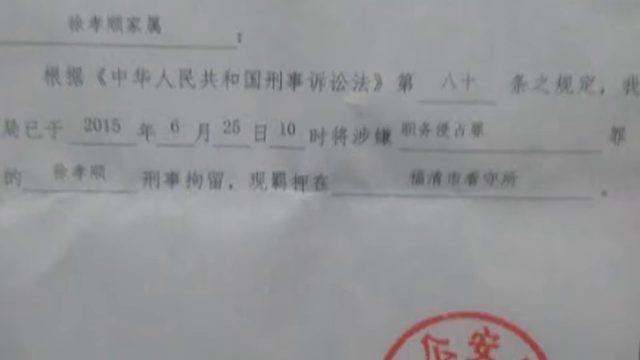
The day after Wu's formal arrest, his father was seized again. Xu's open letter dates his second detention to 25 June 2015, on the same charge; China Change's case summary dates it to 4 July 2015; CHRD says only that he was seized a month after Wu's detention. The two specific dates are archived side by side. In March 2016 Xu was put on trial (CHRD describes the charge as "evading official duties"). On 19 January 2017 he was released on bail pending trial; on 17 April 2017 the Fuqing Municipal Court ruled to permit the procuratorate to withdraw the charges; on 3 May 2017 he received the Fuqing procuratorate's decision of non-prosecution. From detention to withdrawal, the father had spent the better part of two years in custody in a case that ended, officially, for insufficiency of evidence. In his open letter of 22 May 2017, Xu admitted frankly that he had never supported his son's activism — "we argued about it every time we met" — but that he knew his son to be "a man full of enthusiasm, truth, and kindness," and that after reading an indictment which had rewritten his son's defense of victims as subversion of state power, he was, "deep inside, very proud of my son."
The pressure reached further into the family. CHRD records the threat, delivered by an officer, to drive to the school of Wu's daughter and harass her. And in August 2017, Xu Xiaoshun — who as the defendant's father should have been in a courtroom seat in Tianjin — was instead effectively placed under arrest by Fujian state-security police on 10 August and forcibly taken back to his home town of Fuqing, forbidden to travel to the trial. Dozens of other lawyers and defenders across the country were warned in the days before the hearing not to "go where you shouldn't go"; as China Change noted, the officials issuing the warnings did not even pronounce the word "Tianjin," as though the city's name had itself become a state secret.
10. The indictment's logic: an anatomy of a subversion charge
On 3 January 2017 the Tianjin No. 2 Intermediate People's Court publicly confirmed that Wu had been indicted; the indictment itself was filed on 23 December 2016, and the court docketed the case on 30 December 2016 pursuant to a designated-jurisdiction decision of the Supreme People's Court. The indictment's overarching theory was that Wu, "influenced by the infiltration of anti-China forces over a long period of time," had gradually formed the idea of overthrowing China's political and judicial systems; that since 2010 he had used the internet to publish subversive statements and texts such as "The Classic on Butchering Pigs," "The Classic on Drinking Tea" and "The Classic on Petitioning Against Forced Demolitions and Land Appropriations"; that he had accepted foreign-media interviews and posted audio lectures propagating the ideology of "pushing the wall"; and that after joining Fengrui in October 2014 he had "colluded" with Zhou Shifeng, Zhai Yanmin, Li Heping and others to "further strengthen an ideology that subverted state power," specializing in the sensationalization of hot-button cases and incidents.
The judgment's evidence section preserves the flavor of the speech for which he was convicted. From his microblogs: "Everyone can push against the wall in their own way"; "When facing totalitarianism, the only thing we can do is push the wall and criticize." From a foreign radio interview of October 2014 about Hong Kong's Occupy Central: "Every day that the mainland centralizes power, it will not bring peace and civilization to the world, but will only bring barbarity, pollution, and disaster." From an April 2015 online lecture on Lizhi FM, "The Current Situation of Human Rights and Social Issues in China": "In the final analysis, all the problems are the problems of the system and the political system." The judgment groups his three manuals as the "Three Great Classics," finding that they "focused on attacking the State's judicial and petitioning systems, and on teaching methods and means to confront and oppose the State regime." None of the quoted material advocates violence; the offense, as constructed, lies in advocating the end of the political order itself and in teaching ordinary people techniques — exposure, ridicule, siege by spectators — for raising the cost of official abuse.
The defense's three core arguments were entered into the judgment itself and are archived here in full outline, because they frame everything that followed. First: Wu had been tortured to extract confessions and interrogated to exhaustion while held in Beijing; some interrogation transcripts recorded detention locations that did not match reality; some interrogators lacked investigative authority — and the defense therefore applied to exclude all of Wu's statements from 5 July 2015 to 8 January 2016. Second: none of the electronic data in the case had been collected by the investigating organ itself, there was no record of any lawful entrustment of collection or of the collection process, some of the online articles and audio could not be shown to have been posted by Wu personally, most witnesses had interests adverse to Wu and contradicted one another, and witnesses such as Zhai Yanmin and Zhou Shifeng may themselves have been tortured — so their testimony could not ground a conviction. Third: the evidence proved neither a subjective intent to subvert nor any objective act of subversion; each of the twelve incidents had its own legitimate occasion, everything Wu posted was factual, other participants in the same incidents had gone unpunished or been convicted of lesser offenses, and his "Classics," his spectating and his sensationalizing were a citizen's legitimate exercise of constitutional rights, directed at no state regime and producing no subversion. The court rejected all three arguments. Its answer to the third contains the doctrinal core of the case: subversion of state power, the court held, does not require any actual harmful consequence of subversion; any attempt to subvert state power and overthrow the socialist system "by various means, regardless of the success or failure, constitutes that crime." That passage is preserved verbatim in the judgment and is, for any future student of how Article 105(1) operates in practice, the most instructive paragraph in the file.
11. 14 August 2017: a trial behind closed doors
Pre-trial conferences were held on 7 and 8 August 2017. On 14 August, the Tianjin No. 2 Intermediate People's Court tried Wu Gan in a session closed to the public on the stated ground that the case involved state secrets. The prosecution was conducted by procurator Gong Ning and acting procurators Sheng Guowen and Cao Jiyuan of the Tianjin procuratorate's Second Branch; Wu appeared with his defense lawyers Ge Yongxi and Yan Xin. The judgment records a nuance that this archive insists on preserving: Wu admitted having done the acts set out in the indictment, while he and his counsel contested — through the three arguments archived above — that those acts constituted any crime. Against this record stands the court's own post-trial announcement on its official microblog, which stated that Wu had "recognized" in court that his behavior was a crime and that his lawyers had fully presented their defense. Wu's pretrial statement, the defense opinions reproduced in the judgment, and everything he said afterward tell the other version: he admitted the deeds and denied the crime. The distance between "admitting the facts" and "pleading guilty" is one word in Chinese and English alike, and on that distance the sentencing narrative of this case turns.
Outside the courtroom there is a second record. Security around the courthouse on 14 August was heavy. Twenty-one supporters, including Zhu Chengzhu and Wang Lihong, were taken away by plainclothes police before the hearing and held at a nearby police station; more than a dozen people were detained; foreign diplomats and journalists were barred not only from the courtroom but even from standing outside the building, and an AFP reporter was blocked by more than a dozen officers. In the days before the hearing, activists and lawyers across the country had been warned off traveling to Tianjin. CHRD further documented that both the August trial and the December sentencing were closed, and that police questioned and briefly detained people who traveled to Tianjin for the sentencing, forcibly returning many to their home towns and keeping them under watch to prevent a second attempt. It was in that courtroom, and in that city, that Wu Gan spent the twenty-seventh month of his detention.
12. 26 December 2017: eight years
On 26 December 2017 — the day after Christmas, while Western media and diplomatic missions were still in the holiday trough — the Tianjin No. 2 Intermediate People's Court announced its verdict. The written judgment is dated 21 December 2017 and signed by presiding judge Cai Shuying, judge Lin Kun, acting judge Liu Yi and clerk Li Zhanqiang. The court found that Wu, "with the goal of subverting state power and overthrowing the socialist order," had used methods including disseminating subversive speech and sensationalizing hot-button incidents on information networks to attack the state regime and the national system established by the Constitution, seriously jeopardizing national security and social stability, and that his actions constituted the crime of subversion of state power. It added that his conduct was deliberate, the circumstances pernicious, the social harm great and the subjective malice deep, warranting severe punishment. The sentence: eight years' fixed-term imprisonment and five years' deprivation of political rights. The judgment credited his administrative detention against the term and fixed the sentence period as running from 19 May 2015 to 18 May 2023.
Eight years was the heaviest sentence known at that time in any case tied to the 709 Crackdown. CHRD's statement of 4 January 2018 said so expressly, setting Wu's term against the seven years given to Fengrui director Zhou Shifeng and the seven and a half years given to activist Hu Shigen, both convicted in August 2016. The Associated Press called it "the harshest sentence handed down in a sweeping crackdown on rights campaigners"; AFP carried lawyer Yan Xin's assessment that the punishment was intended as an unmistakable signal. A correction to a widely copied secondary source belongs here: the Chinese Wikipedia's summary states that Wu was sentenced on a charge of "inciting subversion of state power." That is wrong, and the error matters. He was convicted of subversion of state power under Article 105(1) of the Criminal Law — the completed offense of organizing, plotting or carrying out subversion — not of the lesser, speech-focused offense of incitement under Article 105(2); the two provisions carry different sentencing frameworks, and conflating them understates what the court actually did. The court's official summary of the verdict, published the same day, said that Wu had used "'rights defense' and 'performance art' as a ploy" and had "used the internet to disseminate voluminous statements attacking state power and the constitutionally established state order." In Changsha that day, Xie Yang, who had confessed, was exempted from punishment; in Tianjin, Wu Gan, who had not, received eight years.
13. The statement after sentencing, and the appeal
Shortly after sentencing, Wu released a statement through his lawyers that China Change translated and that traveled around the world. Its best-known passage runs: "For those living under a dictatorship, being given the honorable label of one who 'subverts state power' is the highest form of affirmation for a citizen. It's proof that the citizen wasn't an accomplice or a slave, and that at the very least he went out and defended, and fought for, human rights." Invoking Liang Qichao, he added: "I say: If I don't oppose dictatorship, am I still a man?" Of the bargain he had refused — a guilty plea and cooperation with official propaganda in exchange, he wrote, for "a three-year sentence suspended for three years" — he said simply: "I rejected it all." And of the sentence itself: "My eight-year sentence doesn't make me indignant or hopeless. This was what I chose for myself: when you oppose the dictatorship, it means you are already walking on the path to jail." In the same statement he named the thirteen officials he accused of torturing him and called on the international community to attend to China's torture and its abuse of state-security charges.
The appeal was nearly strangled by the calendar. Amnesty International records that Wu's lawyers were permitted to meet him only on 5 January 2018 — one day before the statutory deadline for filing an appeal expired. On 4 January 2018 Ge Yongxi confirmed to the Associated Press that Wu had appealed; Global Voices and China Change record that the written appeal was filed on 8 January. The appeal argued that the exercise of citizens' rights of expression and supervision had nothing to do with subversion of state power. Beyond his own case, Wu also petitioned the judiciary with a proposal that the National People's Congress amend or abolish the subversion provisions of Article 105 of the Criminal Law. On 17 April 2018 the Tianjin Municipal High People's Court heard and rejected the appeal, upholding the eight-year sentence in full. The conviction was final. Wu was transferred to Fujian to serve his term.
14. Qingliu Prison: the sequelae of torture and the family's petition
Wu served his sentence at Qingliu Prison in Sanming, Fujian — a fact confirmed jointly by CHRD's prisoner database, as carried in reference works, and by contemporaneous reporting of family visits. In early March 2019 his father Xu Xiaoshun visited him there and reported afterward that Wu was in poor health, with a possible spinal injury attributable to the mistreatment and torture of his pre-trial detention. On Friday 19 April 2019, a visiting day, Wu's wife traveled from Beijing to Qingliu and was allowed roughly half an hour with him. As reported by Rights Defense Network (Weiquanwang) on 23 April 2019 and followed up by Voice of America, Wu was suffering lasting effects of the torture and abuse inflicted in Tianjin: pain in his waist, cervical spine, shoulders and arms so severe that even raising a hand was difficult. He also told his wife that life had improved since his transfer to Qingliu — that the prison had not deliberately made things hard for him or bullied and abused him, and that apart from harsh conditions and cramped cells, things were, in his assessment, roughly bearable. The family resolved to hire a lawyer and file a formal petition (shensu) against the conviction. His friend You Jingyou told VOA, with a candor the archive preserves: everyone knew such a petition was meaningless, because the persecution was systemic and no individual official could alter it. Xu Xiaoshun nonetheless declared himself determined to petition for a son who had been tortured and heavily sentenced merely for speaking for rights. Of Wu's later prison years, 2020 to 2023 — his health, any sentence reduction, the circumstances of his final months inside — there is no public record, and this archive invents none.
15. 18 May 2023: release at the end of the full term
On 18 May 2023 — the terminal date printed in the judgment itself — Wu Gan's eight years expired. He was released from Qingliu Prison and returned to his home in Xiamen. The release and the return home were reported by Voice of America on 19 May 2023 and are carried in CHRD's prisoner record. He had been taken in mid-May 2015 (his credited term began on 19 May 2015, counting the administrative detention), and he walked out on 18 May 2023: eight years, less not a day. Release did not end the sentence's tail. The supplementary punishment of five years' deprivation of political rights runs by law from the completion of the prison term, and so extends to May 2028. Since his release, Wu's public footprint has been minimal: he has not resumed the dense, daily online presence that once defined him, and no public reporting records a return to case-by-case advocacy. Beyond the bare facts of release and return to Xiamen, his present life is a matter of no public record. This archive records that silence as a fact in itself: one of the loudest voices of the Chinese internet of the early 2010s came home from eight years in prison and, so far as the public record shows, has not raised his voice again.
16. The 30,277 deleted tweets
This case has a digital epilogue that belongs in the archive in its own right. Between November 2009 and his arrest in May 2015, Wu Gan posted 30,277 tweets. On 8 November 2018, while he was in Qingliu Prison, those thirty thousand posts were deleted in a single automated sweep by a bot. Cao Yaxue of China Change, writing on 11 November 2018, drew the lesson: the tweets were a first-hand record of six years of rights-defense history, and their destruction — carried out while their author sat in a cell, unable to consent, object or preserve them — exposed the urgent, unaddressed problem of "data ownership" for Chinese activists whose archives live on platforms they do not control. The irony is structural and worth stating flatly: the most complete surviving official anthology of Wu Gan's speech is the judgment that imprisoned him for it. Investigators' remote-survey records, entered into evidence, catalogued his Twitter output from October 2011 to October 2014 post by post and preserved extracts in the court file. The state, in the act of criminalizing his words, archived them more durably than the platform did. A section of this archive is devoted to that fact because it belongs not only to the biography of one activist but to the media history of the era: who keeps the record, when the record-keeper is in prison, is a political question.
17. Archived in parallel: where the sources disagree
Under this archive's rules, disagreements among sources are recorded unmerged. (1) Year of birth: 14 February 1972 (English Wikipedia) versus 14 February 1973 (Chinese Wikipedia); the judgment redacts the date, so the point cannot be settled from public records. (2) Date of criminal detention: 27 May 2015 (the judgment; CHRD) versus 28 May 2015 (Amnesty International); this archive sorts by 27 May and flags the variant. (3) Charges at approved arrest: "inciting subversion" plus "picking quarrels" (Amnesty International; CHRD) versus "inciting subversion" plus "defamation" (judgment text). (4) Detention site in Tianjin: No. 2 Detention Center (judgment; Xu Xiaoshun's letter) versus the No. 1 Detention Centre, to whose director Amnesty International addressed its urgent-action appeals; the same letter records an initial detention at Yongtai County Detention Center in Fujian, a detail carried only by family and China Change accounts. (5) Start at the Fengrui Law Firm: October 2014 (judgment) versus spring 2015 (English Wikipedia; CHRD) versus consultancy by January 2015 (China Change). (6) Date of Xu Xiaoshun's second detention: 25 June 2015 (his own letter) versus 4 July 2015 (China Change), with CHRD giving only "a month after" Wu's detention. (7) The court's post-trial microblog statement said Wu "recognized" his conduct as criminal at trial; the defense opinions reproduced in the judgment and Wu's pretrial and post-sentencing statements show him admitting the acts and denying the crime. (8) Date of formal arrest: 3 July 2015 (judgment; Amnesty International; lawyer Yan Xin's contemporaneous notification) versus 7 July 2015 with a subversion charge added on 16 August (English Wikipedia), which matches no primary source located. (9) The Deng Yujiao incident occurred in May 2009; the English Wikipedia's "since May 2008" is an error, corrected here. (10) Of Wu's final prison years (2020–2023), the circumstances of the day of his release, and his life since, beyond the items cited above, there is no public record.
18. Verification and sources
The core facts of this entry were cross-checked across the following independent sources: the full text of the criminal judgment of the Tianjin No. 2 Intermediate People's Court (English translation with the Chinese original appended, published by Fei Chang Dao), including the indictment number, the panel, the sentence dates and the full text of the twelve incidents; Chinese Human Rights Defenders' statement of 4 January 2018 and its prisoner database entry (criminal-detention date, transfer to Tianjin, the torture complaint, the comparison of 709 sentences, Qingliu Prison and the 18 May 2023 release); Amnesty International's urgent action UA 129/15 and its four updates from June 2015 to April 2018 (administrative detention, arrest, the closed trial, the upheld appeal and the thirteen named officials); the Associated Press report of the 26 December 2017 sentencing; Agence France-Presse reporting carried by The Globe Post and other outlets, including the statements of lawyers Yan Xin and Ge Yongxi; BBC News reporting of the August 2017 trial and the December 2017 sentence; Voice of America's reporting on the January 2018 appeal, the April 2019 family petition and the May 2023 release; China Change's "The Twelve 'Crimes' of Wu Gan the Butcher" of 13 August 2017, its publication of Xu Xiaoshun's open letter of 22 May 2017, its translations of Wu's pretrial and post-sentencing statements and of the appeal, and its report on the deletion of his tweets; Global Voices' report of 10 January 2018; and Rights Defense Network's April 2019 report on the Qingliu Prison visit. The English and Chinese Wikipedias were used as leads and for cross-checking peripheral details only; where they conflict with the primary and institutional sources above, the conflicts are set out in section 17 rather than silently resolved, and neither encyclopedia is the sole source for any key fact in this entry.
19. Our Take
This site's commentary is confined strictly to the facts of this case. First, what eight years were imposed for: when the indictment is stripped to its evidentiary core, it consists of speech and of solidarity — twelve incidents containing no act of violence, no weapon, no funds for overthrow, no clandestine organization, but the record of one citizen running, again and again, toward other people's disasters: toward the dispossessed facing demolition crews, toward the families of men shot or crushed, toward lawyers beaten in a black jail, toward four men on death row for a murder another man had confessed to — men whom the courts themselves later declared innocent, in the very case outside whose courthouse Wu was seized. Second, the sentencing logic of the case was written out by the state itself in a same-day control experiment: in Changsha, a defendant who confessed was exempted from punishment; in Tianjin, a defendant who refused received eight years; and the price quoted for mercy, on Wu's own account, was a suspended three-year sentence in exchange for a plea and cooperation with propaganda. The difference between zero years and eight was not conduct but submission. Third, the procedure was squeezed at every joint: nineteen months before a first meeting with his own lawyers, twenty-seven months of pre-trial detention, a trial closed as a "state secret," a father physically intercepted a thousand kilometers from the courtroom, a verdict announced on the day after Christmas. Fourth, the punishment ran through the family: a father twice imprisoned and held the better part of two years before his case collapsed for want of evidence, and an officer's threat aimed at a schoolgirl. A state confident in its verdict does not need to do these things to a defendant's family. This archive preserves the Wu Gan case not only for the man himself but as the most complete surviving specimen of a method: how a citizen armed with ridicule and spectatorship was written, document by document, each step "in accordance with the law," into a subverter of state power — and how the judgment that did it accidentally became the most durable anthology of his words, including the tweets that no longer exist.
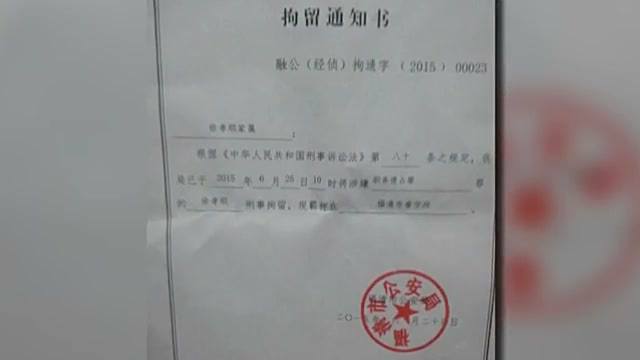
视频证据Video Evidence
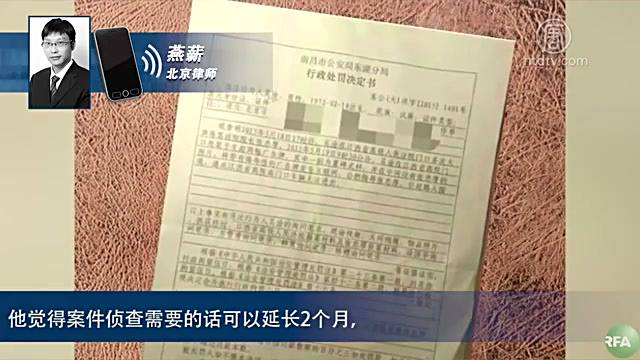
《「屠夫」吴淦侦查羁押期限再被延长两月》(自由亚洲电台)|2015年|中文原声“Detention of ‘Butcher’ Wu Gan extended by two more months” (Radio Free Asia) | 2015 | In Chinese
《屠夫父亲遭株连 被以「职务侵占罪」刑拘》(自由亚洲电台)|2015年|中文原声“Wu Gan's father detained on ‘embezzlement’ charges in collective punishment” (Radio Free Asia) | 2015 | In Chinese