林昭Lin Zhao
Background: A woman who would not confess:Lin Zhao, born Peng Lingzhao in Suzhou, Jiangsu, in 1932, entered the journalism program of Peking University's Chinese Department in 1954. Her life falls into two campaigns of resistance. In 1957, during Peking University's May 19 movement, she publicly defended fellow students, was branded a rightist, and then refused to admit error or write self-criticism, becoming famous among the university's rightist students as the one who would not confess even unto death. In 1960 she was arrested for publishing long poems in the underground journal Spark, and spent the next eight years in a Shanghai detention house and in Tilanqiao Prison, where, deprived of paper and pen, shackled and repeatedly abused, she wrote hundreds of thousands of characters of appeals, poems and political essays in her own blood, until on April 29, 1968 her sentence was changed to death and she was shot the same day, aged thirty-six. This site files her under Resistance on the strength of that whole line: her resistance was no momentary impulse, but eleven consecutive years of speech in defiance — public debate, refusal to plead guilty, writing in blood in prison, hunger strikes, and shouting against the gag — that stopped only with her death. Twelve years later the courts took two separate steps to declare her innocent; her writings, her grave and those who commemorate her remain under control to this day.
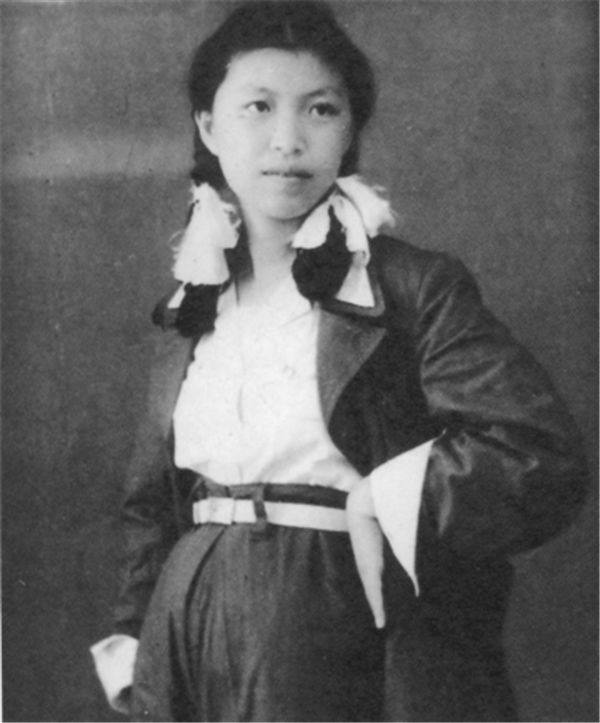
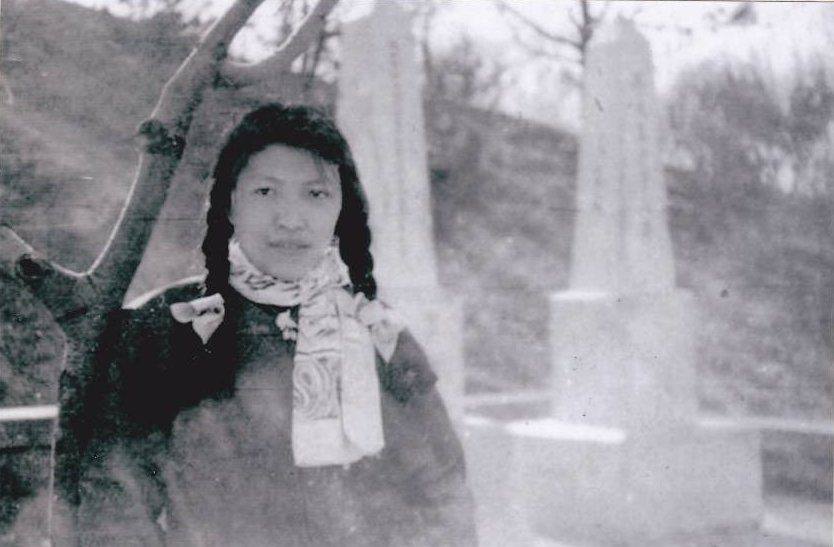
A Suzhou family: A county magistrate's daughter, a resistance fighter's daughter:Lin Zhao's father, Peng Guoyan, was an official of the Republican era: in 1928 he placed at the top of the Nationalist government's first county-magistrate examination and served as magistrate of Wu County, Suzhou, known for incorruptible uprightness. Her mother, Xu Xianmin, was an activist of the war years: imprisoned during the war against Japan, general manager of Suzhou's Dahua newspaper, a member of the China Democratic League who secretly funded Communist underground work and sheltered an underground radio station, and after 1949 a member of Suzhou's Revolutionary Committee of the Kuomintang and of the municipal People's Political Consultative Conference. Her eldest maternal uncle, Xu Jinyuan, was an early Communist killed in the 1927 purge. This family gave her two things: a literary formation steeped in poetry and books from childhood, and what her younger sister Peng Lingfan later called an inherited political gene — an obsession with politics. Most biographies and Wikipedia date her birth to January 23, 1932; alternative dates arise from lunar-calendar conversions, handled in the verification notes at the end of this entry. She attended Suzhou's Cuiying Middle School and then the missionary Jinghai Girls' School, where she was baptized a Christian. That faith, abandoned when she threw herself into revolution, returned to her in prison and became, in her final years, what she called the path of God's servant.
The girl who joined the revolution: The South Jiangsu Journalism School:In 1949, at seventeen, Lin Zhao entered the South Jiangsu Journalism School. The step amounted to a break with her family: several biographies record that she left home with words close to a severance — no contact in life, no mourning in death — and denounced her father's alleged faults. She joined a land-reform work team in the villages of southern Jiangsu, full of ardor for the new regime. This episode must be recorded plainly, because it is the key to her later life: Lin Zhao did not begin as an opponent of the regime; she was once a sincere believer. Precisely because she had believed, her later reckoning was so thorough — what she indicted was not a system foreign to her, but the system for which she had once broken with her parents, and which then crushed her together with countless innocents. In 1954 she entered Peking University's Chinese Department journalism program with the highest total score in Jiangsu Province. The classical-literature professor You Guoen prized her talent and urged her to switch to literature; she edited the university journal, joined the poetry society, and was recognized as a brilliant young writer. At Peking University she read Du Fu and Lu Xun alongside Western political philosophy, and the ground color of her thinking quietly changed in those years.
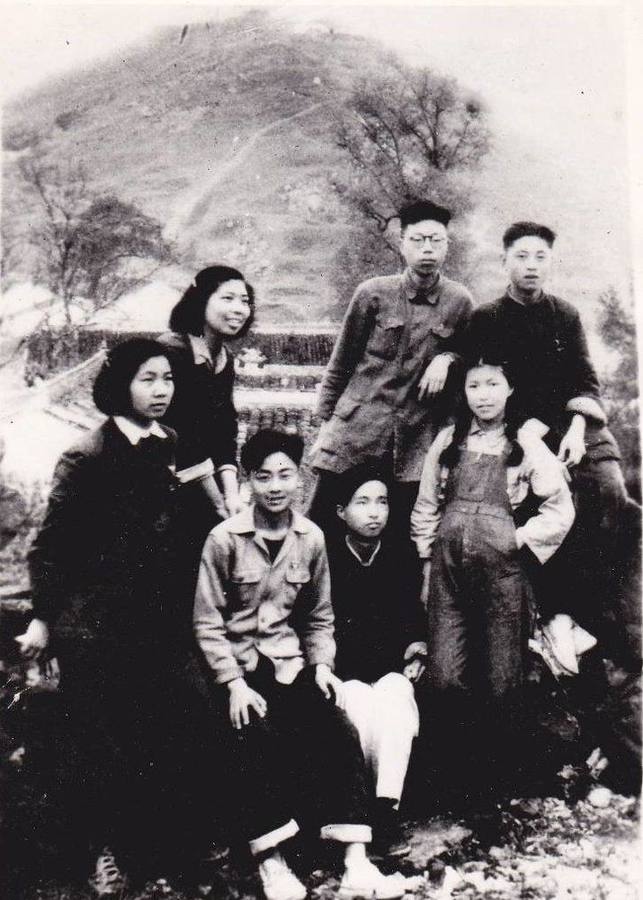
1957: The May 19 movement and The Square:In the spring of 1957 the Communist Party called for a great blooming and contending — speak out, and help the Party rectify its style. On the evening of May 19, Peking University students put up the first big-character posters, in what became known as the May 19 movement. The long-poem poster It Is Time, by Chinese Department students Shen Zeyi and Zhang Yuanxun, had the widest reach and drew the first attacks, denounced as rightist and as counter-revolutionary incitement. The next day Lin Zhao wrote the long poem What Song Is This in support of Zhang and his fellows, and at the plaza debate of May 22 she stood up publicly to rebut the escalating charges. Zhang Yuanxun's later memoir preserves one detail: when someone in the debate demanded a speaker's name, Lin Zhao gave hers on the spot and broke the character Zhao apart as a knife over the character for day, saying that having come, she would not think about where the knife was. At the end of the month students founded the Hundred Flowers Society and its journal The Square (Guangchang), with Zhang as editor; Lin Zhao took part and published under the pen name Ren Feng. For the movement as a whole, see this site's file on the Anti-Rightist Campaign. One judgment should be fixed here: everything Lin Zhao did in 1957 fell inside the window the regime itself had opened when it invited criticism — not one word of hers exceeded the scope of that public invitation. The catastrophe landed on her only after the invitation was withdrawn.
Branded a rightist: Suicide in protest, and 'dead but unconfessing':After June 1957 the blooming was reclassified as a rightist offensive. Lin Zhao, Zhang Yuanxun and others were branded rightists. According to several biographies and studies, Lin Zhao protested with her life, swallowing a large dose of sleeping pills; she was revived, and the act was treated as defiance of the organization and a vicious attitude, bringing a heavier punishment. Sources differ on the punishment's form: one account says she was sentenced to three years of re-education through labor and, only because journalism teacher Luo Lie and others pleaded for her frail health at personal risk, was instead kept in the department's data room under supervised labor; another account, resting on annotated archival editions, gives the punishment as retention of student status with labor under observation. This site sets both side by side. The shared fact is that she was not sent to a labor camp but kept in a university data room, working under mass supervision, stripped of a normal graduation and future. From June 1958 she was moved to the data room of Renmin University's journalism department, where she fell in love with Gan Cui, another rightist student; when they applied to marry, superiors denounced the romance as resisting reform and refused permission, and Gan Cui was exiled to a labor camp in Xinjiang for twenty-two years. Her stance hardened in these years: Peking University classmates said decades later, in one voice, that after the Anti-Rightist Campaign everyone wrote confessions and passed, except her — she would not admit error even unto death. Told that one sentence of admission would free her, she answered always: I did nothing wrong. She also wrote to the Central Committee of the Youth League demanding to know: when Cai Yuanpei was president of Peking University, he dared to bail out May Fourth students arrested by the warlord government — now the university's leaders deliver students in themselves; where is their conscience?
The famine and Spark: The case that two long poems brought:From 1959, ill health took Lin Zhao from Beijing to recuperate in Shanghai and Suzhou. By then the famine caused by the Great Leap Forward was spreading, news of people starving kept arriving, and she wrote to the leaders in anguish, trying to stop the tragedy. Meanwhile a group of rightist students and teachers undergoing labor reform in Gansu — Zhang Chunyuan of Lanzhou University's history department among them — were linking up around Wushan to seek a way to save country and people, and through Gu Yan, a Lanzhou University graduate student in Shanghai, made contact with Lin Zhao. Zhang traveled to Shanghai to meet her; she gave him a copy of the Program of the Yugoslav Communists and her new long poems. The group went on to write The Present Situation and Our Tasks, proposing a peaceful, democratic and free socialism for China, and founded the mimeographed journal Spark, whose first issue carried Lin Zhao's long poems Song of the Seagull and Prometheus Suffers a Day; the Seagull poem was also printed separately as a leaflet. The journal produced very few copies and circulated narrowly. But in the political air of 1960, rightists founding a journal and drafting a program was itself classified as organized crime. In July 1960 Zhang Chunyuan and others were arrested in Gansu; in the end thirty-nine people connected with Spark were arrested, together with dozens of local peasants and cadres who had sympathized with or aided them. Lin Zhao's case began with those two poems.
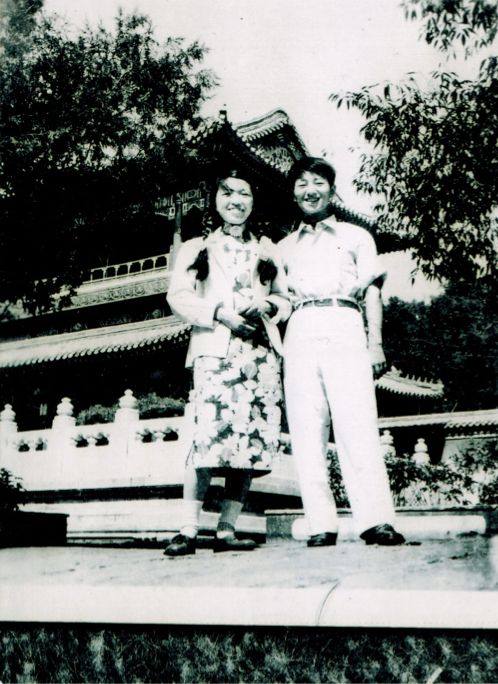
October 24, 1960: The first arrest, and her father's death:On October 24, 1960, Lin Zhao was arrested in Suzhou — a date corroborated by the Independent Chinese PEN Center's chronicle of literary prisoners and by annotated editions of her manuscripts, while some narratives give only October or December 1960 in general terms; this site follows October 24. The charges later formulated against her included conspiring to overthrow the people's democratic dictatorship and organizing a counter-revolutionary clique. She was first held in Shanghai's No. 1 Detention House. Her father, Peng Guoyan, had by then been branded a historical counter-revolutionary and was living by pasting matchboxes; about a month after her arrest he killed himself by swallowing rat poison. The Republican county magistrate had first been denounced by his daughter and broken with her when she joined the revolution, then reconciled with her after she became a rightist, and finally died under the blow of her imprisonment. During her 1962 medical release Lin Zhao wore a small white flower in her hair; asked for whom she was mourning, she said: for my father. From the very start of her imprisonment she began filing appeals and writing, and from the very start she refused to plead guilty — interrogators wanted an attitude of confession; she gave them a challenge to the legality of the case itself. She kept that posture for eight years, until she was shot.
1962: Medical release, and prison again:On March 5, 1962, Lin Zhao was released for medical treatment of tuberculosis and other illness — the precise date appears in annotated editions of her manuscripts, while most popular accounts give early 1962 or March. She recuperated around Suzhou and Shanghai, and in those few months she did not fall silent: with Huang Zheng, a young man she met in Shanghai, and others, she drafted a program of reform for China whose contents, as later scholars reconstructed them, included dissolving the people's communes, permitting private business, opening to the outside world and local self-government — proposals shocking at the time that later mostly became reality. She also entrusted friends with carrying essays such as We Are Innocent and her letter to Peking University president Lu Ping abroad for publication. On November 8, 1962, she was taken back into custody — a date supported by case-file annotations by the scholar Ai Xiaoming and others, while many narratives give December 1962; this site follows the case-file date of November 8 and records the December version alongside. On December 23 that year she was transferred to Shanghai's Tilanqiao Prison — a prison for sentenced convicts, into which placing an unsentenced detainee was itself a deliberate handling. From that day until April 29, 1968, she never again left the prison walls.
The main line of her prison resistance: Refusing to confess:In Tilanqiao Prison, Lin Zhao's first form of resistance was refusal. Keepers and family alike repeatedly offered her the same exit: admit error, and you can go out. Classmates and relatives recalled that when someone said to her face that one sentence of admission would free her, she answered flatly: No. I did nothing wrong, and I will never bow to evil. Her mother Xu Xianmin pleaded with her too: Child, just admit you were wrong, or they will kill you. She answered: How can I admit error? I have done nothing wrong. In her prison writing she described this temperament herself: when invasion and suppression come from outside, the first thing she ever thought of was resistance — grind Lin Zhao to powder, and every grain of her bone would still be a seed of resistance. Paired with refusal went appeal: she wrote to Ke Qingshi, then mayor of Shanghai, to the editors of the People's Daily and elsewhere, presenting her case and her political views, again and again, and never received a reply. She also staged repeated hunger strikes and made attempts on her own life. In the language of the prison files, all of this was summed up in four characters — dead and unrepentant — which later became the core ground for aggravating her punishment step by step up to a death sentence. In other words, she was put to death not for any action she had accomplished, but for eight years of refusing to bow her head. This site places that point at the center of the page: the Lin Zhao case is, in substance, the escalating punishment a state machine inflicted on a refuser, after a bargain conditioned on confession had been refused.
Writing in blood: Hairpins, bamboo splinters and a white sheet:For long stretches in prison Lin Zhao was given no paper and no pen. According to her sister Peng Lingfan's recollections and multiple studies, she pricked her fingers and skin with hairpins and bamboo splinters to draw blood, and wrote on white sheets, on her shirt, on cell walls and on newspaper margins, reopening wounds before they healed, day after day. The prison authorities unwittingly testified to it themselves: Tilanqiao Prison's report recommending a heavier sentence stated that during her confinement she had pierced her flesh hundreds and thousands of times with hairpins and bamboo splinters and written several hundred thousand characters of letters, notes and diaries in blood, styling herself a freedom fighter against tyranny. The prison works whose titles can be confirmed today include her long letter to the editors of the People's Daily, the celebrated Letter of 140,000 Characters; the long work Conversations of the Paired Spirits (Ling'ou Xuyu), which the authorities' own indictment postscript lists as written from May to December 1965 at some 180,000 characters; To Mankind, begun on March 23, 1965; the Statement After the Verdict, written in blood after her sentencing on May 31, 1965; and A Lament from the Prison Cell, Christ Is Still in the World, blood poems inscribed on clothing, prefaces to a blood-written shirt, and diaries in blood. Totals for her prison writing diverge widely: Hu Jie's documentary narration says more than 200,000 characters; the authorities' own lists already add up to several hundred thousand; and folk-archive institutions have recently spoken of roughly 500,000. This site sets the three figures side by side and adopts none, because the file has never been fully opened and any single number would exceed what can be verified. One blood-written shirt she wore for more than nine months; the four blood characters on its back asked: Where is heaven's justice?!
Shackles, solitary confinement and the gag: The instruments of suppression:The price of refusal is written in her own blood letters. She described the variations played with handcuffs: one pair of reverse cuffs, two pairs, now parallel, now crossed, with scars still on her arms and elbows. What enraged her most was that whether she was on hunger strike, writhing with gastritis, or menstruating, the cuffs were never removed and never even loosened. She was held in solitary confinement, given designated reading, placed under a dedicated discipline officer, and repeatedly beaten. Because she kept shouting protests in the women's prison, a fellow prisoner recalled, the authorities moved her to solitary confinement on the fifth floor of the men's No. 3 block, an entire empty floor; when she shouted there, she was fitted with a rubber hood exposing only eyes and nose — fellow inmates called it the Monkey King hat — until her eyes were bloodshot from suffocation. At the final sentencing rally, according to an account passed from a fellow prisoner to her family, she was brought onto the stage with a rubber gag in her mouth — a gag that expanded as the mouth opened, made to stop prisoners shouting slogans — and a cord tightened around her throat. This site marks the source level of this passage honestly: the shackles passage comes from her own prison writing, while the hood and the gag rest on fellow prisoners' and relatives' relayed accounts, cross-referenced against interviews in Hu Jie's documentary Searching for Lin Zhao's Soul, but not confirmed by the original prison file. The straitjacket that appears in some circulating accounts could not be found in any reliable source consulted, and is therefore not written into this entry, to avoid passing error on as fact.
May 31, 1965: Twenty years, and the Statement After the Verdict:On May 31, 1965, Lin Zhao's case came to trial. The court sentenced her to twenty years' imprisonment as the principal of the alleged counter-revolutionary clique the China Free Youth Battle League and on related charges. (Note by this site: some popular accounts attach the sentencing to 1960 or 1962; both are wrong. She was arrested in 1960 and taken back into custody in 1962; the formal judgment was May 31, 1965, a date consistently corroborated by annotated editions of her manuscripts, the Independent Chinese PEN chronicle and multiple studies.) After the verdict she wrote in blood her Statement After the Verdict: this is a shameful judgment, but I listened to it with pride; it is the enemy's appraisal of my personal combat, and I should do more to live up to your appraisal. That same month her old classmate Zhang Yuanxun, released after serving his own term, visited her at Tilanqiao Prison and recorded her words: death is the most it can be; their intent to kill is set, and begging and denouncing come to exactly the same result. Thereafter she formally began serving her sentence, and went on writing inside Tilanqiao: in the second half of 1965 she wrote to the People's Daily for a third time; in 1966 she wrote poems such as Flowers Bloom in the Tragic Red May and diaries in blood. For a woman with tuberculosis whose weight kept falling, twenty years was already close to a life sentence — and she plainly foresaw that even this would not be the final number.
The Cultural Revolution: From banned visits to a death sentence:After the Cultural Revolution began in 1966, Lin Zhao's position worsened further. Still held at Tilanqiao, she was found by the authorities to be continuing counter-revolutionary activity during the Cultural Revolution through the diaries and poems she wrote in her cell. From May 1967 family visits were banned: on May 1 that year Zhang Yuanxun accompanied Xu Xianmin to Tilanqiao Prison to ask for a visit and was told at the gate office that the prison was under military control and all visits had stopped. In a letter home dated November 1, 1967, she summed up her prison resistance herself, saying that over the previous half year she had repeatedly written in blood and added hunger strikes in protest. By then her body was at its limit: a prison doctor interviewed in Hu Jie's documentary recalled that when she was carried into the prison hospital she weighed under seventy pounds and was coughing up blood; a sympathetic doctor whispered, why do you put yourself through this, and she answered softly: rather a jade shattered. A line she had written years earlier now became her own verdict: freedom is priceless, life is finite; rather be shattered jade, to die for China. In April 1968 Shanghai's military-control organs for public security, prosecution and courts decided on resentencing: a death judgment from the Shanghai Higher People's Court, in its military-control period, was delivered into the prison — her twenty years were changed to death, on the same grounds as before, her prison writing and her refusal to confess. The procedural fact deserves emphasis: the death sentence answered no new act, but the words she had written in shackles and the attitude of non-confession themselves.
April 29, 1968: Execution at Longhua, and the five-cent bullet fee:On April 29, 1968, Lin Zhao was told in prison that her sentence had been changed to death, and she was executed forthwith. On the place of execution, the mainstream record is Longhua airfield in Shanghai: both the Chinese and English Wikipedia entries, the Independent Chinese PEN chronicle and most studies give this, naming the executors as the Military Control Commission of the Shanghai public security, prosecution and court organs under the People's Liberation Army; one fellow prisoner's relayed account instead places the shooting in a small yard behind the prison auditorium. This site records the discrepancy and follows the mainstream account in its text. From what the family pieced together from a prison doctor and fellow inmates, she was dragged directly from her prison-hospital ward, not allowed to change, still in hospital clothes. A teenage odd-job worker at Longhua airfield, in an account relayed in Huang Heqing's Telling of Lin Zhao, recalled that something seemed stuffed in her mouth, that she was kicked to her knees and shot, rose struggling after falling, and was shot again — a single-source relayed account, marked here as such and not treated as settled. She was thirty-six. The family received no formal notification of the death sentence. On May 1, 1968, a public-security officer came to her mother's home and said three sentences in all: I am from the Shanghai Public Security Bureau; Lin Zhao was shot on April 29; the family must pay a five-cent bullet fee. One bullet, five cents — the only official accounting this family ever received for its daughter's death, later mentioned in the 1981 account The Trial of History of the Gang of Four trials and now widely known.
Her family: Her father already dead, her mother driven mad:The blow to the family came in sequence. Her father Peng Guoyan had already killed himself in 1960 after her arrest. Her mother Xu Xianmin suffered a devastating shock at the bullet-fee notification and thereafter lost her mind. According to her sister Peng Lingfan's recollections, the mother's last years were wretched, with hospitals refusing to admit her; in 1975 she was found dead on the street at the Shanghai Bund. Sources disagree on the cause: some say suicide, some sudden illness, some that she was beaten to death. This site sets the three versions side by side and adopts none, confirming only the two documented facts — that she lost her sanity after her daughter's death, and that she died on a Shanghai street in 1975, without living to see her daughter exonerated. Her younger sister Peng Lingfan became the family's last archivist: she preserved her sister's manuscripts, hunted for the case file, retold her sister's story over and over for decades, and finally, in 2009, sent the original archive abroad. Public records of her younger brother and other relatives are sparse. Looked at whole, the family's timeline — an uncle killed in the 1927 purge, a father dead by suicide in 1960 after his daughter's arrest, the daughter shot in 1968, the mother dead insane in 1975 — is a complete cross-section of what this country's political campaigns did as they rolled over one ordinary Suzhou family of standing.
Rehabilitation in two steps: 'Innocent by reason of mental illness' in 1980, both judgments revoked in 1981:Lin Zhao's rehabilitation came in two steps, and the difference between them is exactly what this page must make clear. Step one: on August 22, 1980, the Shanghai Higher People's Court issued a review judgment (Hu Gao Xing Fu Zi No. 435) revoking the death judgment of the military-control period, declaring Lin Zhao innocent and calling the case a wrongful killing of an innocent — but the ground on which it declared her innocent was a finding that she had suffered from mental illness. That is, while restoring her innocence, the court left her with a diagnosis: in the logic of that judgment, her eight years of resistance were the words and deeds of a patient, not the political resistance of a citizen. Step two: on December 30, 1981, the Shanghai Higher People's Court reviewed the case again, held that revoking the original judgment on grounds of mental illness was inappropriate, revoked both the 1980 judgment and the 1968 original judgment, and declared Lin Zhao innocent anew. This time the judgment did not rest on illness — she was innocent because she had always been innocent. This site's handling is to write the two steps separately, with their dates and document number marked separately, and to state plainly that the commonly invoked rehabilitation of Lin Zhao in 1980 completed only the first step, and that rehabilitation itself carried a humiliating rider; a clean exoneration waited until the end of 1981. As to whether her conduct should be recognized as resistance rather than illness, that is not for a court to decide — the hundreds of thousands of characters of rigorously argued political essays and appeals she wrote in prison are themselves the answer.
Her writings, the archive, and Hu Jie's documentary:After Lin Zhao's death, her writings passed through a sequence of being sealed, being sought, and being sent abroad. In the early 1980s her file was briefly opened: Chen Weisi, a journalist with Democracy and Law, wrote The Death of Lin Zhao from the file, published in 1981 — but the file was soon sealed again, and the press kept silent about her case for a long time. From 1999, Hu Jie, a former Xinhua journalist turned independent filmmaker, resigned his job to search for her, spending years interviewing some eighty people who had known her and filming her prison manuscripts obtained through special channels, completing the documentary Searching for Lin Zhao's Soul in 2003–2004. The film has never been publicly released inside China and circulates only through private screenings among the concerned, yet it became the main door through which a generation came to know her. The Collected Writings of Lin Zhao, edited by her surviving friends, gathers nearly a hundred of her essays, poems, criticism and reportage from her middle-school years onward, together with part of her prison manuscripts and letters, and was published overseas. In April 2009 Peng Lingfan donated the originals of Lin Zhao's archive — prison writings in blood, open letters, private letters and family photographs — to the Hoover Institution Library and Archives at Stanford University in the United States, and on October 26, 2009 an electronic version of the archive was made public for the first time, with its catalogue searchable online. Thus her most important legacy is preserved in an American university archive open to the whole world, while in her own country public publication and public commemoration remain restricted. In 2018, the fiftieth anniversary of her death, the American organization ChinaAid established the Lin Zhao Freedom Award, honoring those who advance Chinese civil society and rule of law in her spirit.
A grave of clothes, Lingyan Mountain, and commemoration under restriction:Lin Zhao's body has never been found. Her grave is a cenotaph: according to Wikipedia and several accounts, it holds one garment she wore in life and a lock of her hair; another account says her ashes once rested in a Shanghai columbarium, the box containing hair wrapped in old newspaper. On April 22, 2004, her family buried her at the Anxi Cemetery on Lingyan Mountain in Mudu, Suzhou, with a line she wrote in 1964 carved on the back of the headstone: Freedom is priceless, life is finite; rather be shattered jade, to die for China. For years afterward a stream of mourners visited. But commemoration began to tighten in 2008 — the fortieth anniversary of her death and the year of the Beijing Olympics: folk-archive institutions and overseas reporting describe surveillance cameras installed above the grave, later an iron gate, and on each April 29 anniversary the area sealed and closely monitored, with gathered mourners dispersed or detained. The editors' note of the China Unofficial Archives records that public commemoration of Lin Zhao remained possible until the mid-2010s, after which the authorities prohibited visits to her grave. An overseas scholar further recounts that in 2018 a mourner who climbed the cemetery gate to lay flowers at her grave was later sentenced to prison — a single scholar's relayed account, sourced as such here and not independently verified. She is often named together with Yu Luoke, another young person executed for words and posthumously declared innocent. The difference is that Yu Luoke's resistance was concentrated in the Cultural Revolution years, while Lin Zhao's began eleven years before the Cultural Revolution — and was carried out mainly inside a single prison cell.
Sources for this entry:Materials behind this entry include Lin Zhao's prison writings themselves and their annotated editions, including the Letter to the Editors of the People's Daily (the Letter of 140,000 Characters), Conversations of the Paired Spirits, the authorities' list quoted in the indictment postscript, and the published texts of To Mankind and the Statement After the Verdict; her sister Peng Lingfan's memoir of the case file's history and her 2009 donation account; the Lin Zhao case in the Independent Chinese PEN Center's Free Pen chronicle of literary prisoners and research essays by Zhang Min, Sha Guang, Chen Kuide and others; Sun Yat-sen University scholar Ai Xiaoming's research on Lin Zhao's manuscripts and her years in Tilanqiao; Peking University classmate Zhang Yuanxun's recollections of the university years and of visiting her in prison; Hu Jie's documentary Searching for Lin Zhao's Soul (2003–2004) and the full text of its narration; the catalogue of the Lin Zhao papers, 1934–1982, at Stanford University's Hoover Institution; the Lin Zhao entries and commemorative notes of the China Unofficial Archives; ChinaAid's successive accounts of the two retrials of 1980 and 1981 and of the Lin Zhao Freedom Award; and scholarly studies of the Letter to the People's Daily by Qian Liqun and others. Dates, document numbers and figures in this entry were written only after cross-checking at least two sources; where sources disagree, the handling is itemized in the verification notes that follow.
Verification notes:Eight discrepancies in this entry require the reader's attention, with their handling. First, the birth date: Wikipedia gives January 23, 1932, noting Zhang Yuanxun's explanation that the lunar date December 16, 1932 converts to January 23; Hu Jie's documentary narration and several biographies give December 16, 1932 directly, and there are further theories of 1931 and even 1934, the latter inferred from an age she annotated herself. The text gives only born in Suzhou in 1932, follows Wikipedia for the date, and preserves the rest here. Second, the form of the 1957 punishment — three years of re-education through labor commuted on pleading to supervised labor in the data room, versus retention of student status with labor under observation — is presented in both versions in the text. Third, the first arrest follows October 24, 1960 (the PEN chronicle and annotated editions); sources giving a general October or December are not followed. Fourth, the return to custody: case-file annotations give November 8, 1962 (Ai Xiaoming's note, with transfer to Tilanqiao on December 23), while most popular accounts give December 1962; the text follows November 8 and notes the divergence, and the medical release follows March 5, 1962 (annotated editions) against popular early-1962 or March. Fifth, the judgment was May 31, 1965, twenty years; retellings that sentence her in 1960 are errors. Sixth, the total of her prison writing is given in three versions — over 200,000 characters (the documentary), several hundred thousand (the authorities' own list in sum), and roughly 500,000 (folk-archive institutions) — and titles follow the authorities' indictment-postscript list: the circulating title Song of the Prison Cell does not appear in that list, whose corresponding work is A Lament from the Prison Cell, which the text follows. Seventh, on instruments of suppression: the shackles come from her own writing; the rubber hood and the rubber gag at sentencing come from fellow prisoners' and relatives' relayed accounts, not confirmed by the original file; no reliable source consulted mentions a straitjacket, and it is not used. Eighth, the execution site follows the mainstream record of Shanghai's Longhua airfield, with the fellow prisoner's small-yard-behind-the-auditorium version preserved alongside; her age at death is given as thirty-six, the thirty-five found in some sources reflecting the birth-date discrepancy and differing age reckonings. Her mother Xu Xianmin's cause of death — suicide, sudden illness, beaten to death — is presented in all three versions, the text confirming only her insanity and her death on a Shanghai Bund street in 1975. In addition, sources phrase the time and form of her Christian recommitment in the 1960s differently; the text records only her own phrase, the path of God's servant, without precise dating. Every other fact in this entry was written only after corroboration by at least two sources.
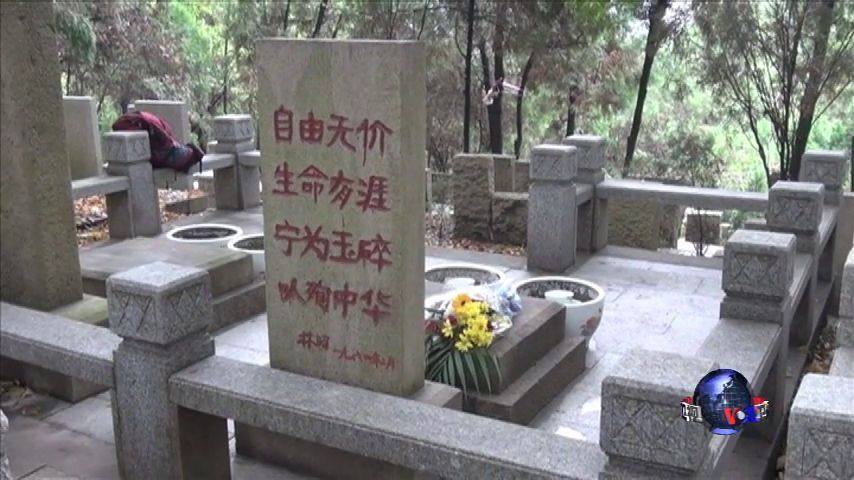
视频证据Video Evidence
以下为林昭纪念活动的影像资料。Video records of commemorations of Lin Zhao.
《北大才女林昭遇难周年祭 当局警力空前如临大敌》:2014年4月29日,林昭遇难46周年,苏州灵岩山墓地一带警力密布,祭扫者遭盘查、驱赶(美国之音中文网)|2014年|中文原声"On the anniversary of Lin Zhao’s death, police out in force": on 29 April 2014, the 46th anniversary of her execution, police blanketed Lin Zhao’s grave on Suzhou’s Lingyan Hill, checking and dispersing mourners (Voice of America Chinese) | 2014 | In Chinese