
第147案 | 果洛久美Case 147 | Golog Jigme
果洛久美,藏族僧人,甘肃甘南拉卜楞寺僧人、纪录片工作者,出生年份各源作1969年与1972年两说(并列存档)。2006年他与藏族电影人当知项欠共同起意,2007年8月至2008年3月用一台廉价摄像机在安多藏区采访一百零八名藏人,素材送出境后在瑞士剪成二十五分钟纪录片《不再恐惧》,2008年8月6日在北京秘密放映给外国记者。2008年3月23日(其本人作证口径;英文维基另作3月28日,并列存档),他在拉卜楞一带抗议之后首次被拘,羁押约七个月。据其2016年提交美国国会及行政当局中国委员会(CECC)的书面证词,他从未被正式逮捕、起诉或审判,两份拘留证都是获释后才补发,寺院与家人从未被告知其下落;第一次羁押中他被连续酷刑五十一至五十二天,日夜被固定在老虎椅上,双脚肿胀至趾甲全部脱落,并被倒悬、吊挂、殴打至肋骨骨折、膝关节脱位,审讯者索要的始终是一百零八名受访者与2008年抗议者的名单,他一个名字都没有供出。2009年4月他再被以涉嫌泄露国家秘密羁押数月并遭殴打。2012年9月他第三次被拘,被诬为自焚抗议的主要煽动者,又被知会将转送兰州军区医院『体检』并打『必要的针』,他判断对方意在灭口,于9月30日夜挣脱锁链逃脱;两个月后,甘肃省公安厅以涉嫌谋杀对他发出通缉并悬赏二十万元——该指控在他羁押期间从未被提及。他在高原山林间藏匿二十个月,2014年5月抵达印度达兰萨拉,2015年1月抵瑞士并获政治庇护。此后他先后在联合国禁止酷刑委员会审查、英国议会、欧洲议会人权小组委员会、CECC听证与联合国人权理事会场边活动公开作证;最近一次有公开记录的活动为2024年1月在新西兰奥克兰演讲。Golog Jigme is a Tibetan Buddhist monk of Labrang Monastery in Kanlho, Gansu, and a documentary filmmaker; sources give his birth year as 1969 or 1972, archived here in parallel. In 2006 he and the Tibetan filmmaker Dhondup Wangchen conceived a documentary together, and from August 2007 to March 2008, with a single cheap camera, they interviewed 108 Tibetans across the Amdo region. The tapes were smuggled out and edited in Switzerland into the 25-minute film Leaving Fear Behind, secretly screened to foreign journalists in Beijing on 6 August 2008. On 23 March 2008 — his own consistent testimony, with English Wikipedia's 28 March version archived alongside — he was detained for the first time after the Labrang protests and held for about seven months. By his 2016 written statement to the US Congressional-Executive Commission on China, he was never formally arrested, charged, or tried; his detention warrants were issued only after his release; and neither his monastery nor his family was ever told where he was. In that first custody he was tortured continuously for fifty-one to fifty-two days, fixed day and night in a tiger chair until his feet swelled and all his toenails fell off, suspended upside down, hung, and beaten until ribs broke and knees dislocated — while interrogators demanded one thing above all: the names of the 108 interviewees and of the 2008 protesters. He gave up not one name. In April 2009 he was detained again for several months on an accusation of disclosing state secrets and beaten. In September 2012 he was detained a third time, accused of instigating the self-immolation protests, and told he would be transferred to a Lanzhou military hospital for an examination and 'necessary injections'; judging that he was to be killed, he freed himself from his chains and escaped on the night of 30 September. Two months later the Gansu Provincial Public Security Bureau issued a warrant accusing him of murder — a charge never raised while he was in custody — with a reward of 200,000 yuan. He hid in the mountains for twenty months, reached Dharamsala, India, in May 2014, and arrived in Switzerland in January 2015, where he was granted political asylum. He has since testified before the UN Committee Against Torture review, the UK Parliament, the European Parliament's Subcommittee on Human Rights, a CECC hearing, and a UN Human Rights Council side event; his most recent publicly recorded activity is a January 2024 talk in Auckland, New Zealand.
1. The man: a nomad's son, a Labrang monk, and four names for one person
Golog Jigme was born into a Tibetan nomadic family in eastern Tibet and joined Labrang Monastery in Sangchu County, Kanlho, in what is now Gansu Province, as a teenager. That frame comes from his own mouth: he stated it in his 2016 written testimony to the CECC and again before the European Parliament. At Labrang he did far more than chant scripture. By his own account he taught children about Tibetan culture, promoted the Tibetan language, and did social welfare work. A 2024 Central Tibetan Administration (CTA) report on his New Zealand visit adds an earlier chapter: his covert political activity began in the 1990s, distributing the Dalai Lama's 10 March statements, and by 2004–2005 he had become more determined and active; local people in Tibet described him as a monk of moral integrity and a sincere social worker. That passage is a single-source report relaying his own account, and this page archives it at that grade. In April 2010, after the Yushu (Jyekundo) earthquake, he joined the relief effort — a detail carried in Tibet Watch's interview introduction and consistent with his own testimony that he took part in Yushu earthquake relief work.
His names need archival untangling first, because the English-language record uses at least four for the same man: Golog Jigme (果洛久美, "Golog" marking his tribal origin), Jigme Gyatso, Jigme Lobsang, and the secular birth name Lotra. English Wikipedia notes that the latter two derive from the Gansu Public Security Bureau's warrant for his arrest — which is to say, some of his names entered the public record through the documents of the people hunting him. His birth year is likewise disputed: the CTA's 2012 warrant report said he was born in 1969 at Serthar; Free Tibet's case page says 1972; Indian media reporting his arrival in Dharamsala in May 2014 called him 44 years old, roughly consistent with the 1969–1970 range. This page does not force a choice: it archives 1969 and 1972 in parallel, marks the Serthar birthplace as single-source and unverified, and rests only on what his own testimony supports — a nomad family, and Labrang Monastery from his teens.
In the records of the international human rights network he carries three labels: monk, documentary filmmaker, human rights defender. The International Tibet Network named him a "Tibetan Hero," and Reporters Without Borders listed him among its "100 Information Heroes." Those titles came after his escape; they are the outside world's filing of him. Inside China, between 2008 and 2012, his name appeared only in detention, interrogation, and wanted documents. This page exists to put the two files back onto the same person.
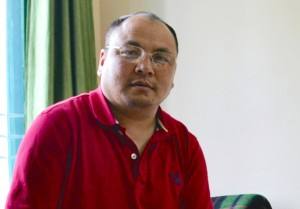
2. Leaving Fear Behind: 108 Tibetans speaking to one cheap camera
In 2006, Golog Jigme and the Tibetan filmmaker Dhondup Wangchen together conceived the idea of a documentary — the Committee to Protect Journalists (CPJ) and the film's own materials both date the idea to 2006. Dhondup Wangchen's life and sentence have their own page on this site (en/persecution/dhondup-wangchen.html); this page keeps only what touches Golog Jigme directly. Their plan was simple: before the Beijing Olympics, travel through Tibet and ask ordinary Tibetans three things — what do you think of the Dalai Lama, of the Chinese government, and of Beijing hosting the Games. Filming ran from August 2007 to March 2008 (the dating used by the International Campaign for Tibet and Filming for Tibet). With a single cheap camera, in the pastures, monasteries, and remote villages of Amdo, they interviewed 108 Tibetans — nomads, elders, monks, and people in far-flung areas — every one of whom agreed to appear on camera with their face shown. The total footage is given differently by different sources: Tibet Watch and the film's official materials say 35 hours; The New York Times and English Wikipedia say 40 hours. This page archives both figures without merging them.
Once shot, the tapes were smuggled out of the country to Dhondup Wangchen's cousin Gyaljong Tsetrin in Switzerland, where Filming for Tibet edited them into the 25-minute film Leaving Fear Behind (Tibetan title: Jigdrel). On 6 August 2008 the film was secretly screened to foreign journalists in Beijing, two days before the Olympics opened. The New York Times called it "an unadorned indictment of the Chinese government." It went on to screen in more than thirty countries. But on the day of that Beijing screening, both filmmakers were already gone: within days of sending the tapes out, both had been detained. Testifying later before the European Parliament, Golog Jigme compressed the whole relationship into one line of causation: because of this film, the Chinese authorities arrested and tortured him. That is not rhetoric. The sections below are simply that sentence, unfolded.
One fact has to be held firmly to understand this case: there was nothing secret in Leaving Fear Behind. It filmed no military installation, no document, no organization — only 108 faces and what they said out loud. The manner of the official response — secret detention, torture aimed at extracting the interviewees' names, a six-year sentence for his partner, and a nationwide manhunt for him — measures exactly what the authorities feared. The danger was never the footage. The danger was Tibetans opening their mouths. In custody, interrogators returned to one demand above all others: give us the names of everyone who spoke. He never gave one. At the Geneva Summit in 2018 he told the hall plainly that he had not revealed the identity of a single Tibetan who had courageously spoken out. That refusal is the footnote to every torture record that follows.
3. March 2008: the Labrang protests, the first detention, and a disputed date
In March 2008, protests swept the Tibetan plateau. Golog Jigme took part in the peaceful protests around Labrang — he confirmed this himself in his European Parliament testimony, which states that he was arrested and tortured for making Leaving Fear Behind and for participating in the March 2008 peaceful protest in Labrang. Then he was seized. On the exact date of the first detention, the sources diverge, and this page archives the divergence rather than smoothing it over. His own line of testimony gives 23 March 2008: Tibet Watch's interview introduction uses it, and so did he at a UN Human Rights Council side event in 2022, dating his ordeal from the day he was held on 23 March 2008. English Wikipedia, drawing on early Front Line Defenders and TCHRD reporting, says he and Dhondup Wangchen were detained together on 28 March at Tongde in Qinghai Province. This page uses 23 March as its sort date and main text date, for two stated reasons: it is the date the man himself has used consistently in formal testimony, and the 28 March Tongde account very likely conflates his detention with Dhondup Wangchen's own late-March detention in the Tongde area. The 28 March version is preserved here, not deleted.
The scale of the arrest, as he described it at the 2016 Geneva Summit, was that of a military operation: more than sixty policemen and over three hundred military personnel, two rifles pointed at his head, rifle butts beating him until he fell to the ground covered in blood, military vehicles all over the village. That passage is his own testimony and is archived at that grade; but a show of force of that order against one monk is consistent with the documented scale of the March 2008 crackdown across the Tibetan areas. In custody, according to his CECC statement, he was accused of shooting Leaving Fear Behind, of being a member of the Tibetan Youth Congress, and of refusing to denounce the Dalai Lama; reporting of his 2014 Dharamsala press conference adds that he was accused of taking part in violent protests against the Chinese government. The interrogation had three objects, and they never changed: hand over the interviewees' names, hand over the names of the 2008 protesters, and publicly denounce the Dalai Lama. He did none of the three.
The first detention lasted about seven months. On its legal character, the sources flatly conflict, and honesty requires laying them side by side. The Times of London, relayed by English Wikipedia, reported that he was "sentenced to seven months" in Linxia prison and that he returned to his monastery on 2 May 2009. CPJ reported that on his release in October 2008 it emerged that both he and Dhondup Wangchen had undergone severe interrogation and torture in detention, including electrocution. Against both stands the man's own sworn account. In his 2016 CECC written statement, Golog Jigme declared that he was never formally arrested; that across his three detentions he was never given any document setting forth formal charges; that he was never given a trial; that he had no access to a lawyer and received no medical treatment; that neither his monastery nor his family was informed of his whereabouts; and that the two detention warrants he eventually received were handed to him only after he had been released. A subject's sworn testimony and a second-hand report of a "sentence" cannot both be true. This page follows the subject: the first detention is recorded as seven months of custody without charge or trial; the "sentenced to seven months in Linxia prison" version is archived as a conflicting second-hand account, and "Linxia" as a place of custody has no second source and is marked unverified. Of the roughly six months between his October 2008 release (per CPJ) and his reported return to Labrang on 2 May 2009 (per The Times), where he was and under what controls, there is no public record.
4. The torture record: fifty-one (or fifty-two) days in the tiger chair
This section rests solely on Golog Jigme's own testimony in formal settings: his Dharamsala press conference of 28 May 2014, his Geneva Summit speeches of 2016 and 2018, his testimony to the European Parliament's Subcommittee on Human Rights on 16 March 2016, his written statement to the CECC of 14 April 2016, and his testimony at a UN Human Rights Council side event on 30 September 2022. The accounts interlock in detail; small numerical discrepancies are flagged where they occur. This is his own injury file, not this site's embellishment.
The first detention in 2008 was the worst. By his CECC statement, he was tortured continuously for one month and twenty-two days, forced to sit day and night in the "tiger chair" (also called the iron chair): his arms handcuffed in front of him on a small metal table, his legs bent beneath the seat and strapped to the chair with iron cuffs, until his joints were in agony and his feet swelled so badly that all his toenails fell off. He was turned backwards in the chair and suspended from the ceiling for hours at a time, leaving scars on his wrists and ankles that he still carried years later. At the Geneva Summit he gave the duration as one month and twenty-one days and said he had been hung on the chair nine times; European Parliament reporting gives fifty-one days. The one-day spread is a counting difference, archived here as fifty-one to fifty-two days. At Dharamsala he added another set of figures: on his first arrest his hands and feet were shackled and he was hung for ten hours, and similar hangings followed seven times, each lasting between two and five hours. He was deprived of sleep, given very little food, and — because of blood loss — tormented by thirst on a cruelly small ration of water; he called that thirst the second-worst torture after the chair itself.
The beatings and implements are likewise itemized in his testimony. In the first and second detentions he was severely beaten and kicked; some of his ribs were broken and his knee joints dislocated — the Dharamsala account adds a dislocated shoulder and damaged knees. Officers beat his back with small metal sticks, applied electric shocks including to his mouth, and burned his face, eyes, and lips when he was tied to a hot stove; Free Tibet's case page describes him chained to the chimney of a burning stove and to an iron chair under beatings and shocks. A group of five officials trampled all over his body. Testifying in 2016, he reported that the back pain persisted, that his knees, ribs, and eyes still hurt from the injuries, and that his knee dislocated whenever his body got cold. In 2022 he added that, from the day he was first held, sixteen different prison staff had tortured him — a figure from that single testimony, archived as his own statement. Throughout, he received no medical treatment whatsoever. The evidence structure must be stated plainly: the primary source for these torture details is the victim's own repeated, mutually consistent testimony; the Chinese government has never publicly answered the allegations in his individual case (Reuters, seeking comment from the State Council Information Office for its reporting on his treatment at the UN, received no response on his arrest or torture claims). In November 2015 he appeared in Geneva before the UN Committee Against Torture during its review of China and told the Committee his story; the Committee put pointed questions about the tiger chair to the Chinese delegation. His testimony thereby entered the formal UN review record.
The purpose of the torture, in every version he has given, was never to establish a crime of his own. It was to extract two lists and one sentence: the names of the interviewees, the names of the 2008 protesters, and a public denunciation of the Dalai Lama. That is why, in his European Parliament appearance, he began by stating who he was — a non-violent freedom fighter, a human rights defender, a filmmaker — before stating what had been done to him.
5. April 2009: the second detention — "disclosing state secrets"
Release back to the monastery did not mean freedom. Tibet Watch's introduction records that after his release he lived under constant surveillance, harassment, and repeated detention for six years. In April 2009 he was detained a second time. By his CECC statement, the accusation this time was disclosing state secrets; he was held for several months and subjected to severe beatings, though not tortured as brutally as in 2008. In his 2018 Geneva Summit speech he gave the precise date: arrested for the second time on 10 April 2009. Free Tibet's case page phrases the second charge slightly differently — allegedly sharing information with the outside world about the 2008 Tibetan uprising — which points at the same conduct, transmitting information abroad, and is archived in parallel. One further wrinkle is recorded rather than resolved: CPJ issued a statement on 18 March 2009 reporting that security officials had re-arrested him, some three weeks before his own April dating; whether that reflects a reporting lag or a separate short detention cannot be determined from public sources. The place of the second detention, the unit that handled it, and the date of his release are matters of no public record.
Between and after the detentions, the social worker kept working. In April 2010, when the Yushu earthquake struck, he joined the relief team — a man who had just spent months in custody for "disclosing state secrets" went to carry stretchers in a disaster zone. That contrast is a key to the man: in the police file he was a dangerous element; in the memory of his own community he was the person who shows up when the ground shakes. The double identity held until 2012, when the authorities moved a third time — and found that a man with his standing among Tibetans could not be made to disappear quietly. The nationwide warrant and the cash reward that followed his escape would prove the point from the other side.
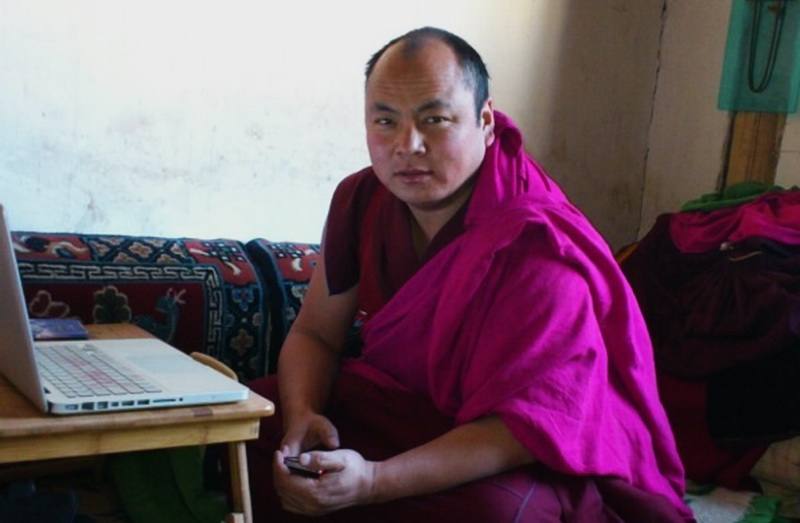
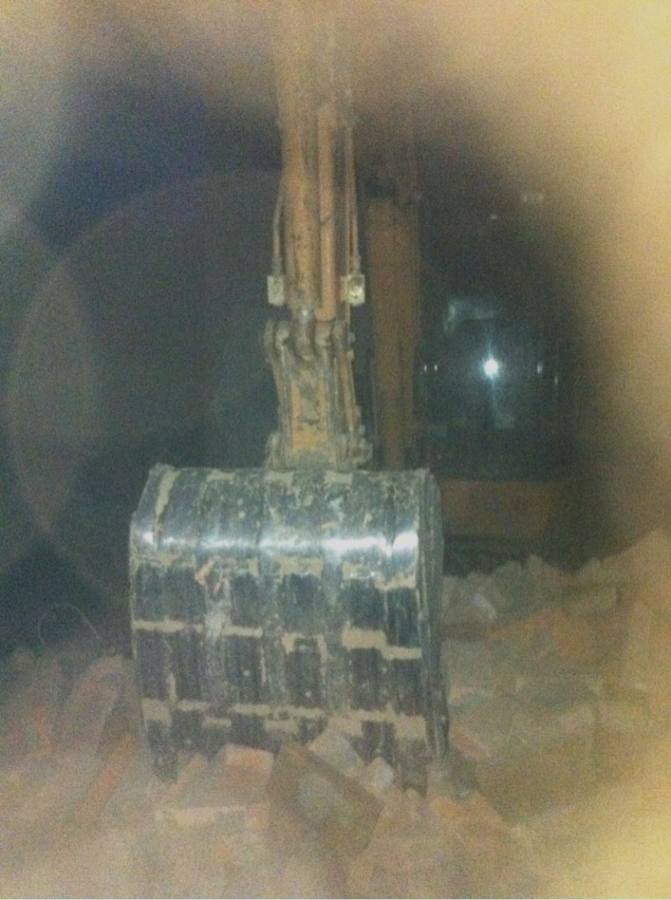
6. September 2012: the third detention, the death trap, and the escape of 30 September
In September 2012 Golog Jigme was detained for the third time. The date chain in the sources runs as follows. The CTA reported at the time that he had been missing since 20 September, when he travelled from Labrang Monastery to Tsoe (Hezuo), the prefectural capital; his CECC statement and Geneva speeches both date the third detention to September 2012. English Wikipedia and Phayul, by contrast, report that he was arrested on 5 November 2012 by the Gansu Public Security Department on arriving in Hezuo from Lanzhou. That November date cannot stand alongside the September disappearance and the 30 September escape that his own testimony describes; this page follows his testimony and the CTA's missing-person reporting, and archives the 5 November version as a discrepancy — late November was when the warrant became public, and the date is likely a garbled transplant from that news cycle. The accusation this time, by his account, was that he was the main instigator of the wave of self-immolation protests across Tibet, together with other baseless allegations; Free Tibet phrases it as a charge of inciting Tibetan self-immolations.
What made him run was what he was told in custody. By his CECC statement, security officers informed him that he would be transferred to a military hospital in Lanzhou for a medical examination to see whether he had any diseases, and that if anything was found he would be given "necessary injections." He protested the transfer; the officers insisted. He concluded that the plan was to kill him in the hospital by injecting him with a drug. That conclusion is the detainee's inference from his situation, and this page archives it as his testimony, not as a verified official document. But the inference deserves its weight: a prisoner who chooses a desperate escape over a "medical examination" has delivered his own verdict on the place holding him. At his Dharamsala press conference he described the night in detail. On 30 September — 2012, by the sequence of his account — he went to sleep at eight; of his two guards, one had to leave early on an urgent matter and the other fell asleep at midnight; the remaining guards were busy playing mahjong. After praying to the Dalai Lama, he worked himself free of his chains, walked to the main gate, found it open, and ran. The vividness of those details cannot be independently verified, and they are archived as his own account. What can be verified is the result: from that night on, the Chinese state never caught him again.
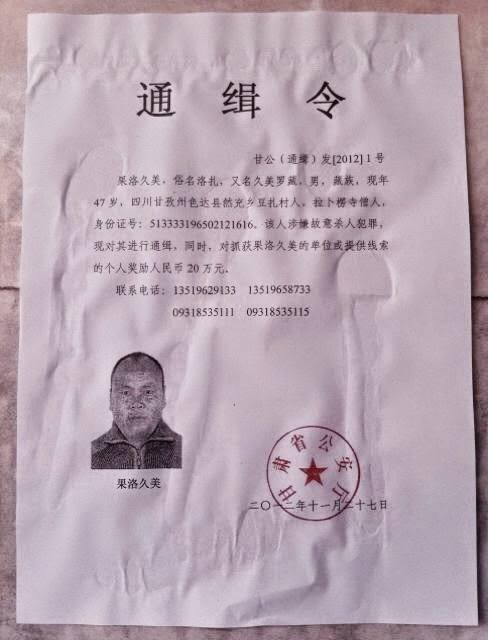
7. The warrant: a murder charge invented after the escape, and 200,000 yuan for his whereabouts
About two months into hiding, he learned that the government had accused him of murder. The CTA's November 2012 reporting pins the document down: on 28 November the Public Security Bureau of Gansu Province issued an arrest warrant against him on alleged murder charges, announcing a cash reward of 200,000 yuan for informers, and reporting that he faced a possible death sentence. On 30 November 2012 Filming for Tibet issued a statement contesting the arrest order — the very document from which English Wikipedia's note on his alternate names derives. Golog Jigme has stated publicly and repeatedly that he was never questioned about any murder while in custody, that the charge appeared only after his escape, and that he never killed anyone or intended to. At Dharamsala he added that when he first heard of the murder allegation, he considered setting himself on fire at a police station in Gansu or Sichuan to protest the false charge — and decided instead to live, escape, and testify. This page records that passage as he gave it, because it marks the warrant's real function: the murder charge and the 200,000 yuan were not tools for solving a homicide. They were tools for turning every pair of eyes in Tibet into a manhunt, and for raising the price of sheltering him beyond what anyone could safely pay.
People paid it anyway. For one year and eight months — twenty months — he hid across the mountains, rivers, and forests of the plateau, a duration on which the Dharamsala reporting and the institutional accounts agree. The route he took and the identities of those who helped him are matters of no public record; as those helpers are in all likelihood still inside the country, this page states the obvious: their identities should not be sought. His CECC statement contains a single sentence of thanks — that his safe escape was a collective effort by people who risked a great deal. The archival rule yields here to human safety, deliberately.
8. May 2014: Dharamsala — the end of twenty months in hiding
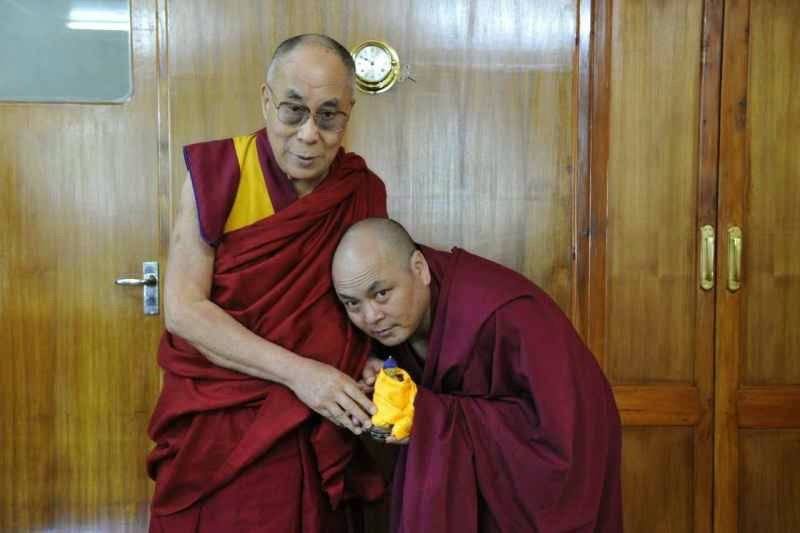
In May 2014 Golog Jigme crossed the border in secret and reached Dharamsala in northern India, seat of the Central Tibetan Administration and the landing place of generations of Tibetan exiles. Reporters Without Borders said it was extremely relieved to learn that he had resurfaced safe and sound, noting that there had been no news of him since his arbitrary arrest in September 2012. On 28 May 2014 he held a press conference in Dharamsala, organized by the Tibetan Centre for Human Rights and Democracy together with Filming for Tibet, and laid out the full account: the three detentions, the injuries (broken ribs, a dislocated shoulder, damaged knees, continuing pain in his back and ribs, a knee that dislocated when his body got cold), the escape, the warrant, and the twenty months on the run. He used the platform to call for the release of Dhondup Wangchen, still in prison, and of other Tibetan political prisoners. Eight days later, on 5 June 2014, Dhondup Wangchen completed his six-year sentence and walked free. The two filmmakers — one just escaped across a border, the other just out of a cell — were free in the same season for the first time since March 2008, though one was in India and the other still in Tibet, and their paths had permanently diverged. Dhondup Wangchen himself escaped to the United States in December 2017; see his page.
The Dharamsala press conference is the hinge of this record. For six years, every public fact about Golog Jigme had come from other people: human rights alerts, a wanted poster, missing-person reports. From that day forward he told the story himself, and over the following decade he carried the same set of facts into the formal records of the United Nations, the European Parliament, the British Parliament, and the United States Congress. Tibet Watch's introduction notes that he is not a man who ordinarily talks about his own suffering; he worried about his friends' safety, kept a bright voice and a smiling round face, and gave no outward sign of a man tortured nearly to death. Testimony, for him, was a duty rather than a catharsis — which explains the common style of everything he later said on the record: name and identity first, then the instruments, the day counts, and the injuries, item by item, without a wasted sentence of denunciation.
9. Asylum in Switzerland and the road of testimony: from the tiger chair to the United Nations
In January 2015 Golog Jigme arrived in Switzerland; that same year the Swiss authorities granted him political asylum — the dating given both in his CECC statement and in European Parliament reporting. Exile did not quiet him; it handed him an itinerary of institutions, which this page archives in order. Around June 2015 he demonstrated at the International Olympic Committee's venue in Lausanne, presenting himself as a witness of Chinese repression in Tibet; in July 2015 he wrote personally to IOC members asking them to reject Beijing's bid for the 2022 Winter Olympics (Free Tibet's case page). In November 2015 he attended the UN Committee Against Torture's review of China in Geneva and told the Committee his story. There, a Chinese official told the Committee that the tiger chair existed for the protection and safety of detainees, and the Chinese delegation maintained that there were no political prisoners in China. He later answered both claims line by line in his CECC statement, recording that the Committee had put tough questions to the Chinese delegation and held it to account.
The year 2016 was his most intensive year of testimony. On 27 January 2016 he gave a public talk at the UK Parliament, arranged by the Tibet Society, testifying about the tiger chair and other instruments, and about China's false claim that such chairs had been abolished. In February he addressed the eighth Geneva Summit for Human Rights and Democracy. On 16 March 2016 he testified in Brussels before the European Parliament's Subcommittee on Human Rights, opening with his self-introduction — born in a nomad's family in eastern Tibet, a non-violent freedom fighter, a human rights defender, a filmmaker — and setting out the three imprisonments, the fifty-one days of torture, the beatings with tiny metal sticks, the kicks, and the electric shocks in his mouth. On the same trip he met the chairs of the Council of the EU's human rights and Asia working parties and officials of the European External Action Service, and held a detailed meeting with Amnesty International, Human Rights Watch, and the International Federation for Human Rights. Also in March 2016, during the UN Human Rights Council session, an episode later documented in a Reuters investigation occurred: a senior Chinese diplomat photographed him with a phone in a café inside the UN complex in Geneva, in breach of the UN's photography rules. His comment at the time was a joke with a warrant inside it: perhaps the diplomat wanted the 200,000 yuan reward. On 14 April 2016 he submitted his written statement — the document cited throughout this page — to the CECC hearing on "China's Pervasive Use of Torture," closing with concrete requests: press China to invite the UN Special Rapporteur on Torture for a follow-up visit, keep raising Dhondup Wangchen's case, and release all Tibetans detained for peaceful views. In February 2018 he returned to the Geneva Summit for its tenth edition, restated that he had never revealed a single interviewee, and noted that Dhondup Wangchen had escaped Tibet a few months earlier.
On 30 September 2022, at a side event of the 51st session of the UN Human Rights Council titled "Human Rights in China: Tibetan and Uyghur Survivors Tell Their Stories," organized by the Society for Threatened Peoples with the Tibet Bureau in Geneva and the World Uyghur Congress, he testified alongside Uyghur camp survivors including Gulbahar Haitiwaji, describing how sixteen different Chinese prison staff had tortured him from the day he was first held on 23 March 2008 (CTA reporting). Placing a Tibetan monk and Uyghur survivors on the same panel in 2022 carried a plain meaning: two peoples' survivors, one stage, and the same machinery of detention and torture behind both stories. In January 2024 he visited New Zealand, where the Auckland Tibetan community received him at the airport on 10 January, held a reception on 12 January, and hosted his public talk — his most recent publicly recorded activity. From then until this page's verification date, 11 November 2026, there is no public record of his further activities; of his home, daily life, and health in Switzerland there is likewise no public record, and this page does not go looking for it.
10. Family and monastery: six years of being told nothing
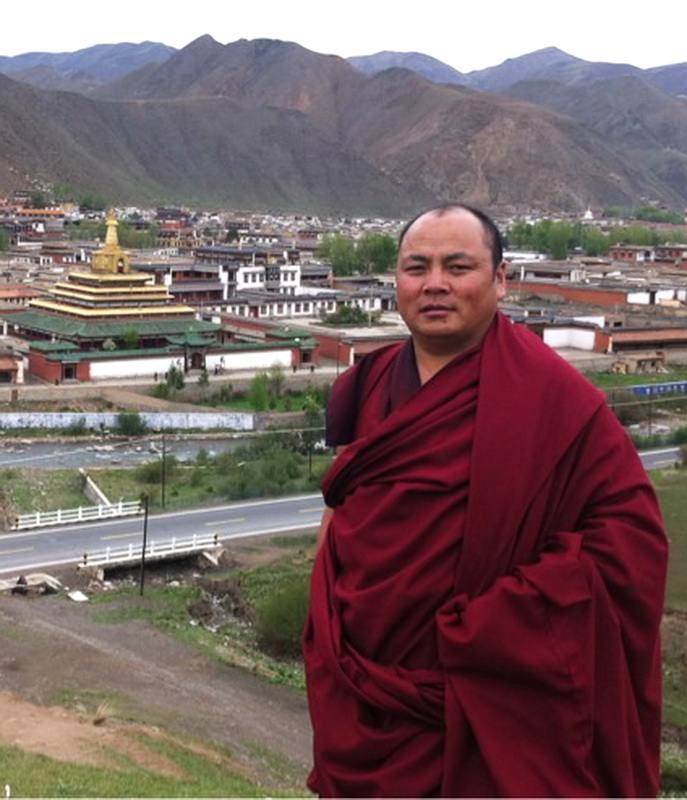
Of the impact on his family, exactly one fact is documented, and it is heavy enough on its own. By his CECC statement, through all three detentions neither his monastery nor his family was informed of his whereabouts; he was held incommunicado throughout. Translated into the experience of Labrang Monastery and of his family in eastern Tibet, the six years contained three vanishings: seven months in 2008, several months in 2009, and then, in 2012, first a disappearance and then a wanted poster accusing him of murder. Beyond that single documented fact, the public record is silent. What became of his parents and siblings, whether the family was raided, questioned, or punished by association, what pressure Labrang Monastery came under during his detentions and the manhunt, whether he was expelled from the monastic community — of all of this there is no public record, and this page records the silence rather than filling it. The blank is itself an archival fact about the density of information control in the Tibetan areas: even the question of what a monastery did, or suffered, for one of its own monks cannot be answered from open sources.
11. Discrepancies and unverified items, archived in parallel
Under this site's archival rules, the divergences among sources are listed, not harmonized. (1) Date of the first detention: his own testimony and Tibet Watch give 23 March 2008; English Wikipedia, following early Front Line Defenders and TCHRD reporting, gives 28 March at Tongde, Qinghai, together with Dhondup Wangchen. This page sorts and dates by 23 March; the 28 March version is retained and is suspected of conflating his detention with Dhondup Wangchen's. (2) Legal character of the first detention: The Times via English Wikipedia reports a "sentence of seven months" served in Linxia prison; his CECC statement says he was never formally arrested, charged, or tried, and that his detention warrants were issued only after release. This page follows the subject's testimony; the Times version is archived as conflicting, and "Linxia" as a place of custody has no second source and is unverified. (3) Release and return: CPJ gives release in October 2008; The Times gives return to Labrang on 2 May 2009; the intervening six months are a matter of no public record. (4) Duration of the worst torture: one month and twenty-two days (CECC statement), one month and twenty-one days (Geneva speech), fifty-one days (European Parliament reporting) — archived as fifty-one to fifty-two days. (5) Total footage: 35 hours (Tibet Watch, film materials) versus 40 hours (The New York Times, English Wikipedia), archived in parallel. (6) Second detention date: April 2009 in his testimony, 10 April 2009 in his 2018 speech; CPJ reported a re-arrest on 18 March 2009, some three weeks earlier; both are retained. (7) Third detention date: his testimony and the CTA's missing-person chain give September 2012, missing after 20 September, escape on the night of 30 September; English Wikipedia and Phayul give 5 November 2012 at Hezuo, which conflicts with the escape chain; this page follows the former and archives the latter. (8) Birth year: 1969 at Serthar (CTA), 1972 (Free Tibet), age 44 in May 2014 (Indian media); no single version is adopted, and the Serthar birthplace is single-source and unverified. (9) The 1990s distribution of the Dalai Lama's statements rests on the CTA's 2024 report relaying his own account, archived at relay grade. (10) The specific facilities of the three detentions (apart from the unverified Linxia reference), the names of interrogators, the release date after the second detention, his hiding route and his helpers' identities, and the pressure borne by his family and monastery are all matters of no public record — the hiding route and helpers, for reasons of personal safety, should not be pursued.
12. Verification and sources
The core facts of this entry were cross-checked against the following independent sources. Primary subject documents: Golog Jigme's written statement of 14 April 2016 to the CECC hearing on "China's Pervasive Use of Torture" (birth and monastic background, the filming, the three detentions with their dates and accusations, never formally arrested, charged, or tried, detention warrants issued only after release, incommunicado custody, no lawyer and no medical treatment, the full tiger-chair torture record of one month and twenty-two days, the fallen toenails and suspension scars, broken ribs and dislocated knees, the 2012 hospital-injection fear and escape, the murder warrant and reward, arrival in Switzerland in January 2015 and grant of asylum, attendance at the November 2015 UN Committee Against Torture review); his own public testimony — the Dharamsala press conference of 28 May 2014 (CTA and TCHRD reporting: the ten-hour hanging and seven hangings, the injuries, the escape of 30 September, the 200,000 yuan reward, twenty months in hiding), testimony to the European Parliament's Subcommittee on Human Rights on 16 March 2016 (CTA reporting: fifty-one days of torture, metal sticks and shocks to the mouth, the EU institution meetings), and his Geneva Summit speeches of 2016 and 2018 (the arrest show of force, one month and twenty-one days in the iron chair and nine hangings, the second arrest on 10 April 2009, the refusal to name any interviewee). Institutional records: Tibet Watch's interview introduction (first arrest on 23 March 2008, 35 hours of footage and 108 interviewees, Yushu relief work, the Reporters Without Borders Information Heroes and International Tibet Network listings); Free Tibet's case page (the 1972 birth year, the burning-stove chimney and iron chair, the 2009 and 2012 charge formulations, the 2015 move to Switzerland, the Lausanne demonstration and the letter to IOC members); the International Campaign for Tibet's material on the film's European Parliament screening (the 35-hour footage figure); CPJ's long account of Dhondup Wangchen and the film (the 2006 conception, the October 2008 release and the electrocution reporting, screenings in more than thirty countries) and its March 2009 re-arrest statement; Reporters Without Borders' May 2014 statement (his resurfacing in Dharamsala after nearly two years); the Tibet Society's announcement of his 27 January 2016 UK Parliament talk; the CTA's November 2012 warrant reporting (missing since 20 September, the Gansu warrant of 28 November, the 200,000 yuan reward, born 1969 at Serthar), its reporting of the 30 September 2022 UN Human Rights Council side event (sixteen torturers, the 23 March 2008 starting point), and its January 2024 New Zealand report (the 1990s activity, the Auckland talk). Media reporting: Reuters' investigation of Chinese intimidation tactics at the UN (the March 2016 photographing incident in Geneva), The New York Times' characterization of the film, and Indian media reporting from Dharamsala in May 2014 (the age of 44). Evidence grading: the filming, the year of the first arrest, the three detentions, the main heads of torture, the escape, the warrant and reward, the arrival in Dharamsala, the Swiss asylum, and the 2015–2022 testimony itinerary are each supported by at least two independent sources or by the subject's own formal testimony and are graded verified; the torture details rest on the victim's repeated and consistent testimony, to which the Chinese government has never publicly responded, and the evidence structure is stated in the text; date and characterization divergences are archived in the preceding section; single-source items are graded in place; the places of custody and the family's and monastery's experience are graded as no public record. No single source is quoted at more than fifty words; this entry is a synthesis, not a copy of any one report. This page and this site's page on Dhondup Wangchen (en/persecution/dhondup-wangchen.html) are cross-referenced companions: the film's production and his partner's sentence and later escape are treated principally there, and his biography is not repeated here.
13. Our Take
This site's assessment is confined strictly to the facts of this case. First, lay out the complete list of what the state did to this man across six years: three detentions without charge or trial; fifty-one to fifty-two days and nights without break in a tiger chair; broken ribs; toenails torn away by swelling; a burned face; detention warrants backdated into his hands only after release; and a murder warrant that materialized only after he escaped. Not one link in that chain can carry the words "lawful process." Detention needed no charge, release needed no paperwork, and a manhunt needed no corpse — whatever was required was manufactured on the spot. Second, count what the torture was buying. The interrogators never principally wanted a confession to his own "crimes"; they wanted lists — the names of 108 interviewees, the names of the 2008 protesters — people whose only offense was speaking truthfully into a camera. Through fifty-one to fifty-two days in the chair and seven hangings, Golog Jigme surrendered not one name. The full machinery of torture was applied, and it extracted nothing; and that nothing is the reason more than a hundred ordinary Tibetans kept their safety. Archival writing rarely gets to record arithmetic of this kind: one man's body, held across a machine, on behalf of a hundred people he refused to sell. Third, the "medical examination" in Lanzhou is the coldest passage in this file. On his testimony, the killing did not even require a fresh charge — only a transfer order and a "necessary injection." He ran. The machine then changed faces without pausing: a murder warrant, a 200,000 yuan bounty, a possible death sentence. The same apparatus that would have used a hospital ward as an execution room used an outlaw's bounty as a dragnet an hour later, and at no point owed anyone an explanation. Fourth, notice what he did with exile. He did not turn his testimony into a denunciation; he turned it into an inventory — the chair's construction, where the straps bite, the day counts, the injuries, and the dates and rooms in which he had said it all before. He carried the same facts into the UN Committee Against Torture's review, into the European Parliament, and into the US congressional record, so that the Chinese delegate's claim that the tiger chair exists to protect detainees now sits permanently beside the record of his fallen toenails. That is how lies are answered: not with slogans, but with measurements. Finally, return to the twenty-five minutes of film. One hundred and eight Tibetans spoke into a cheap camera, and the state's answer was a six-year sentence for one filmmaker and, for the other, torture, a fabricated murder charge, twenty months hiding in high mountains, and a life in exile. The fear a regime feels toward ordinary people speaking can be measured by the resources it spends to punish the speaking — and by that measure, Leaving Fear Behind is the most honest confession in the history of CCP rule in Tibet, except that the confession was made not by the Tibetans, but by the men who handled this case. This site archives it all here: his four names, the dimensions of the iron chair, the warrants issued after the fact, and the murder charge invented out of thin air.