
第154案 | 余杰Case 154 | Yu Jie
余杰,1973年生于成都的作家、批评家与北京方舟教会创会长老之一,畅销书《火与冰》作者,2004年起著作在中国内地被全面禁绝,2010年12月9日晚在刘晓波诺贝尔和平奖颁奖典礼前夜被北京国保以黑头套秘密带走,按其本人公开声明遭数小时酷刑至昏死送医,此后被软禁、监控约一年,2012年1月11日携妻儿流亡美国,其香港出版人姚文田其后因编辑他的《中国教父习近平》被以走私罪判刑十年。Yu Jie, a writer, critic and founding elder of Beijing's Ark Church born in Chengdu in 1973 and author of the bestseller Fire and Ice, was banned across mainland China from 2004; on the night of 9 December 2010, the eve of Liu Xiaobo's Nobel Peace Prize ceremony, Beijing state security hooded and abducted him and, by his own published account, tortured him for hours until he lost consciousness and was rushed to hospital; after about a year of house arrest and surveillance he fled to the United States with his wife and son on 11 January 2012, and his Hong Kong publisher Yao Wentian was later sentenced to ten years for smuggling after editing Yu's book on Xi Jinping.
1. First, pin down two dates: 9 December, or 10 December?
The first nail this archive has to drive is the date of that night, because the public record contains two dates fighting each other. Yu Jie's own departure statement of 18 January 2012, his press conference remarks that day, and his later Civil Courage Prize acceptance speech consistently give 9 December 2010. The Committee to Protect Journalists' statement of 13 January 2012, the BBC's reporting at the time, and William Wan's Washington Post report of 18 January 2012 also give 9 December, and spell out that it was the night before the Nobel Peace Prize ceremony. On the other side, the Oslo ceremony itself fell on 10 December, and some secondary summaries compress "abduction and torture" and "ceremony" into a single day and write 10 December; this archive's own case brief and sort date also use 10 December 2010. Which side is the subject's own testimony needs no verdict from us: the first-person statement, his repeated public tellings, and three independent organisations' contemporary records all say the night of 9 December, and that is the date this page adopts, with the 10 December version archived alongside. That second date is the day the medal sat on an empty chair in Oslo — it is the reason for that night's violence, not the date it happened. Keeping the two days separate is precisely the key to the case: Beijing's state security chose the eve of the ceremony to move, so that the author of Liu Xiaobo's biography could not utter a word while the whole world was looking at that empty chair.
The second small nail is his birthday. That he was born in Chengdu in 1973 is corroborated by his own interviews, a University of Southern California event biography and the SOPA biography of the time, among others. But the precise "3 October" appears, as far as we could find, only in Wikipedia entries in several languages, with no second independent source; it is recorded as unverified, and this page uses "born in Chengdu in 1973." Likewise, his self-description as being of Mongol descent, a descendant of Genghis Khan, appears in Wikipedia and in his own self-descriptive writing, with no independent genealogical source; we archive it as his self-description, not as an established fact (see section 19).
2. A Chengdu boyhood and the Peking University years: an awakening at sixteen
Yu Jie was born in Chengdu, Sichuan, in 1973. In his long interviews with Plough magazine in 2016 and 2017, he dated his political awakening very early: in 1989 he was sixteen, at high school in Chengdu, and the protests in Tiananmen Square in Beijing and the massacre that ended them were the moment his eyes opened. Three years later he entered Peking University, where he studied for eight years, taking a bachelor's degree in 1997 and a master's in 2000, in modern Chinese literature. While still a graduate student, his name travelled beyond the campus before his degree did. The dates are mutually corroborated: USC's October 2010 event biography gives the 1997 bachelor's and 2000 master's, and he told Plough the same story of eight years at the university. After graduating he worked at the China Modern Literature Museum, and was later dismissed and turned to full-time writing. The dismissal is mentioned in the biographical note to the English translation of his 2012 statement and in several rights organisations' profiles, but what year it happened and on what stated grounds is a matter of no public record, and we do not guess (see section 19).
To understand Yu Jie, start with the line he draws through his own life: a man who stopped believing at sixteen. Among the generation of intellectuals who grew up after 1989, many treat that year as an origin point and return to it for the rest of their lives; fewer wired that single line into literature, faith and political action all at once. That is also why his books grew more direct, one after another — for him, writing was never a desk-bound occupation.
3. A writing career: from the bestseller Fire and Ice to the seizure of December 2004
In 1998 Yu Jie published Fire and Ice, a collection of essays whose biting social and cultural criticism made his name overnight. China Aid Association's 2006 biographical note on him says the book had sold more than a million copies by 2000; a religious news agency report of the period put its circulation at more than two million. The two figures measure different things — sales versus circulation — and we archive them in parallel rather than merging or choosing. What is certain is this: a graduate student in his twenties became a nationally bestselling author on the strength of one essay collection, and by the time he went into exile in 2012 he had published more than thirty books, a total consistently attested by the New York Times, the New York Review of Books and multiple organisations; the Review in 2012 called him one of China's most prominent essayists and critics. It was also around 1998 that he met Liu Xiaobo. By his own account the friendship lasted twelve years — and in the end it put him on the edge of an emergency-room resuscitation.
Being a bestseller bought him no safety. By his own account, the propaganda department and the police had him in their sights from Fire and Ice onward; after the Hu Jintao–Wen Jiabao leadership settled in, in 2003–04, he was, in his word, totally blocked: no books on the mainland, no articles in its press. In 2004 he published "Apologies to Tibet," an essay expressing regret for China's rule of Tibet and praising an exiled Tibetan monk, which drew furious attacks on the Chinese internet. On the afternoon of 13 December 2004, Beijing state security officers took him and Liu Xiaobo from their respective homes; Zhang Zuhua was taken the same day. PEN America's statement of 14 December 2004 recorded that Liu and Yu were co-founders of the Independent Chinese PEN Centre, that police raided their homes, and that Yu's family reported an arrest warrant for "participating in activities harmful to the state." The Committee to Protect Journalists' statement of the same day recorded that the two were questioned on suspicion of "endangering state security" and released the next morning; Yu told Reuters that his interrogators said his essays attacked the Party, the government and the leadership, and warned him that police were preparing a case against him. Police remained posted outside their homes after the release. The triggers, PEN America assessed, were their advocacy for arrested journalists such as Shi Tao and the PEN Centre's award honouring the banned writer Zhang Yihe. There was no indictment and no verdict, but a rule had been laid down: keep writing, and next time it may not be a conversation.
4. Conversion and the Ark: a church that would not register
In 2003 Yu Jie was baptised a Christian. His road to faith and his road as a writer are intertwined, and in Baptist Press's long 2008 profile of him, the Beijing Ark Church is the other main thread of his life. The church began very small: in 2001 his wife Liu Min and two friends started a Bible study group; it began as the gatherings of three couples, grew, rented an apartment to meet in, gained a pastor, and became a church open to the public, named the Beijing Ark. Baptist Press reported that by 2008 the Ark had more than forty members, mostly young professionals, and that Yu was one of its three founding elders. The Ark's defining trait was that it was not underground: it met openly and without hiding, but refused to register with the state and refused the oversight of the Three-Self Patriotic Movement. Yu explained the position in that interview: a church answers to Christ, not to a regime's filing system. The people who joined the Ark included dissident writers, relatives of Tiananmen victims and rights lawyers — which, as Yu told Plough, is exactly what made the authorities so uneasy about a congregation of forty-odd people: its membership list read like a roster of sensitive persons.
For the authorities, Yu Jie's problem was that one man occupied three "sensitive" boxes at once: bestselling critic, friend of Liu Xiaobo, and house-church elder. When Baptist Press reporters visited his home on the eve of the Beijing Olympics in 2008, he was already living under a form of house arrest: police watched his home around the clock, he could travel only in a police car, and he was expressly forbidden to go anywhere near the Olympic venues. That detail is worth archiving because it shows that the night of December 2010 was not a sudden loss of control; it was the end of a ratchet. In 2008 the method was watching. In July 2010 it was warning. In December 2010 it was hands.
5. PEN, Charter 08 and the human-rights writing
There was a further layer to Yu Jie's public identity: organiser. He co-founded the Independent Chinese PEN Centre and served as its vice president from 2005 to 2007, when Liu Xiaobo was its president. The Centre campaigned for imprisoned writers and honoured banned books — the direct background to the December 2004 seizure. In 2008, when Liu Xiaobo and others drafted Charter 08, Yu Jie's name stands in the original list of the first 303 signatories — the charter's signature list can be checked for "Yu Jie (Beijing, writer)." Custodians of the circulated drafts, and Yu himself, say he read drafts and commented on them, and some English book jackets go further and call him a co-author. These are claims of different weight: the signature is documented in the original list; the draft comments rest on his and the custodians' accounts; the "co-author" label is not adopted here, only archived (see section 19). On 8 December 2008 Liu Xiaobo was taken away, two days before the charter's release; in December 2009 he was sentenced to eleven years for "inciting subversion of state power." After Liu's arrest, Liu Xia authorised Yu Jie to write Liu's biography — the single most consequential causal chain in this case. It was that book, in progress and destined for publication overseas, that put Yu Jie on the list of people Beijing's state security decided, in the autumn of 2010, had to be "dealt with."
6. The ratchet: bans, travel limits and daily surveillance
Lay the six years from 2004 to 2010 out flat and a clear line of escalation appears. Book after book banned on the mainland, publishable only in Hong Kong and Taiwan. A designated state security contact: in his own 2010 account, a Chaoyang District officer was assigned to him, accompanied him to bookshops and libraries, and periodically "invited him to tea." Watched travel: during the 2008 Olympics, round-the-clock guarding and a ban on approaching the venues. It was not that he lacked chances to leave — quite the opposite. Before 2010 he had travelled to the United States more than a dozen times, for fellowships, lectures and conferences, and Radio Free Asia's February 2012 interview with him stressed the point: every single time, he went back to China; he had never intended to stay. On 7 October 2010 he was still on a stage at the University of Southern California, presenting the Wen Jiabao book just published in Hong Kong. Nobody in that audience could have guessed that the speaker would fly home four days later, step off the plane straight into house arrest, and never again walk Beijing's streets as a free man. The point of the ratchet matters: when December 2010 came, it was not a writer who had carelessly caused offence. It was a machine that had been running for six years deciding to speak in a different way.
7. The 2006 White House meeting: a one-hour conversation, a six-year bill
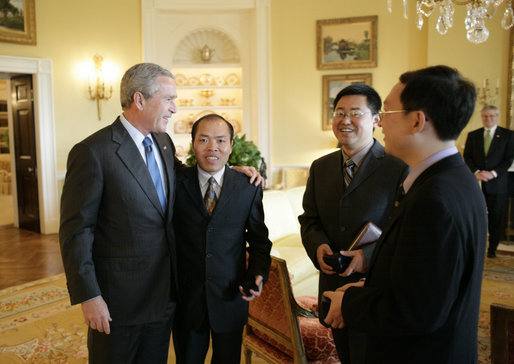
On the morning of 11 May 2006, Yu Jie walked into the Yellow Oval Room of the White House with Chengdu legal scholar Wang Yi and rights advocate Li Baiguang, and was received by President George W. Bush. China Aid Association's record of the meeting, issued the same day and afterwards, shows Bush attended with Vice President Dick Cheney, National Security Advisor Stephen Hadley, Chief of Staff Josh Bolton and others; a meeting scheduled for thirty minutes ran for an hour, and ended with Bush praying for the three Chinese guests and for the Chinese people. It was the first time a sitting U.S. president had received Chinese house-church members at the White House. The official White House photograph shows Yu Jie standing at Bush's side — that U.S. government photograph is this case's most compliant and least disputable image source (see the image note in the metadata). In the conversation Yu described the real state of religious freedom in China and proposed that the U.S. Embassy regularly invite persecuted Christians, dissident writers and rights lawyers as a sign of support; Bush agreed on the spot.
The bill arrived promptly. China Aid's bulletin of 18 May 2006 recorded that when Yu and Wang Yi landed back in Beijing that afternoon, a U.S. Embassy official was sent to the airport to meet them — an arrangement that itself shows Washington had priced in the risk. The same bulletin reported that Beijing was furious about the White House meeting, and that Yu's wife Liu Min had been interrogated by state security agents and pressed to stop attending the Ark Church. A Hong Kong seminary that had invited Yu for that June cancelled the invitation by email after the meeting, saying in so many words that the timing was not appropriate. From then on, Yu's file carried a line that could not be washed out: this man has been inside the White House and talked to an American president about religious persecution in China. When state security moved on him in 2010, that six-year-old entry was certainly in the dossier.
8. China's Best Actor: Wen Jiabao: the "tea" of 5 July 2010
In the summer of 2010 Yu Jie delivered to Hong Kong's New Century Press the book he had spent years writing, China's Best Actor: Wen Jiabao, scheduled for publication on 16 August. Its core argument was that Premier Wen Jiabao's warm, people-loving public image was a performance, and that on restricting civil liberties he was no different from the rest of the system. On the afternoon of 5 July, Beijing state security took him in for a talk. The China Media Project published his own account of that session at the time, and Agence France-Presse and others followed: the officers told him to his face that the book "harmed state security and the national interest," that if it were published he would in all likelihood be imprisoned for many years, and they held up Liu Xiaobo's fate as the comparison. The session lasted about four hours (one account says four and a half; both are archived). Yu's answer was quoted by multiple outlets: criticising a national leader is a citizen's constitutional right, and he would not submit. On 16 August the book was published in Hong Kong as planned. Publisher Bao Pu told AFP he had asked Yu to think long and hard before deciding; Yu decided to go ahead. The book was of course unavailable on the mainland, but sold out quickly in Hong Kong. State security had stated the heart of the matter plainly in that room: what they wanted was not the editing of a passage but the non-existence of a whole book. If a writer must price "writing about the premier" in decades of prison, then in that country no word is written for free. Yu published anyway — and three months later, they changed the method of pricing.
9. October 2010: the Nobel is announced, and he steps off the plane into a house he cannot leave
On 8 October 2010 the Norwegian Nobel Committee announced that the Peace Prize would go to the imprisoned Liu Xiaobo. Yu Jie was visiting the United States that day. By his own account in his 2012 departure statement, he returned to Beijing on 13 October and was placed under house arrest by Beijing state security the moment he stepped off the plane. In the weeks that followed, plainclothes officers guarded his door around the clock; reporting and his statement agree that police wedged a table against the door and installed six cameras and infrared detectors around the house. His wife Liu Min was under house arrest with him. His statement records one detail: Liu Min at one point ran a fever above 40°C and was nearly unconscious, and the guards at first refused to let her go to hospital; only after a friend saw Yu's appeal on Twitter and called an ambulance was she taken in. Through the run-up to the Oslo ceremony, Beijing's lockdown of Liu Xiaobo's circle was total: Liu Xia was held incommunicado under house arrest, the Yus were shut inside their home, telephones and internet cut or monitored. And all the while Yu was racing to finish the Liu Xiaobo biography — the only biography authorised by Liu Xia. In the eyes of state security, that book had to be stopped: in October, the way to stop it was to lock the author in his home. In December, the method changed.
10. The night of 9 December 2010: the black hood, the naked body and the hands — archived as his own account
Everything in this section comes from Yu Jie's own departure statement of 18 January 2012, his later public interviews and speeches; international media reports all relay it expressly as "according to Yu." The Chinese authorities have never confirmed it, never specifically denied it, and never announced any investigation. This page archives it on the standard of: the subject's allegation, relayed contemporaneously by multiple independent outlets, with no official response — not as a judicially established fact.
By his statement: on the afternoon of 9 December, the Chaoyang District state security officer who was his regular contact came to his home and took him away. A black hood was pulled over his head and he was driven to a secret site on Beijing's outskirts. Plainclothes officers stripped off all his clothes, forced him to kneel on the ground, beat and kicked him about the head and body, slapped him more than a hundred times, and forced him to slap himself; as they worked they took photographs, threatening to post the naked pictures online. They bent his ten fingers back one by one, telling him as they did it that they would break the hands that had written articles attacking the Communist Party. The officer in charge said the words many outlets quoted: if the order came from above, they could dig a pit and bury him alive in half an hour, and no one would ever know. He also alleged cigarette burns — a detail carried in the BBC's and the Washington Post's relays of his statement. On duration, his own accounts differ: the New York Times' February 2012 profile says three hours; he later told Plough six hours. Both are archived; we do not merge them. In the end he convulsed and lost consciousness. Police took him to hospital, lied to the staff that he was having "epileptic seizures," and registered him under a false name, "Li Li" (as transliterated in the English translation of his statement). He says the first hospital refused him, saying his injuries were too severe and he would die there; at a larger hospital he was resuscitated over several hours, and a doctor told him another half hour would have killed him. On 13 December 2010 he was released home.
Is there corroboration? What can be checked is indirect: the timeline fits (the eve of the ceremony; multiple members of Liu Xiaobo's circle were controlled in the same period, in contemporary reporting); the long house arrest and travel ban that followed are independently documented by the Committee to Protect Journalists, the Wall Street Journal and others; and his wife's five days of total isolation, not knowing whether her husband was alive, is in his later telling (see section 15). But the torture itself happened in a place with no lawyer, no family and no paperwork, and there will never be a second transcript. Our position is stated openly: because the men who did it chose a black hood and an unnamed site, the sentence "cannot be independently verified" is itself a product of their method — not an acquittal.
11. The year after release: house arrests, a bribe, and a guarantee letter written under duress
Walking out of the hospital and the place of detention on 13 December did not bring freedom back. By his statement and his repeated interviews, for about a year afterwards house arrests, surveillance, tailing and being taken on forced "trips" became his daily routine: he could not go to church, could not attend Bible study, and was deliberately cut off from his brothers and sisters in the congregation. State security also tried the other face: by his account to Plough, after the torture they offered him a bargain — stop criticising the regime, and they would give him a platform to write popular literature and make him rich. He refused. In the summer of 2011 he asked state security for permission for the family to go abroad, and was told "the superiors do not agree." The Committee to Protect Journalists, citing the Wall Street Journal, reported that the authorities refused him permission to leave several times before finally relenting. After Christmas he bought tickets to the United States himself and let it be known that even if they stopped him at the airport, he would tell everything. On 9 January 2012 state security informed him that the Beijing Public Security Bureau's new deputy director, who also headed its state security brigade, wanted to see him; on 10 January he was taken to a hotel suite, where the official required him to write a letter of guarantee before they would "consider" letting him go. On 18 January in Washington he publicly declared that what he had said under interrogation, and that guarantee letter, were produced under torture and coercion, and he withdrew them all. A writer who must sign a confession of error to leave his own country, and then tear the paper up in public at a press conference in another country — that sequence is this case's most complete metaphor.
12. 11 January 2012: a flight "seen off" by five state security officers
On the afternoon of 11 January 2012, Yu Jie, Liu Min and their young son boarded a flight to the United States at Beijing Capital Airport. By his statement, five state security officers escorted the family from their home all the way to the departure gate, demanded a photograph with him before leaving, which he allowed, and then stalked off. The Chinese Wikipedia gives his arrival in Washington as 12 January, while Western media generally give departure on 11 January and arrival in Washington that week; the discrepancy is one of time zones and of "departure" versus "arrival," and both are archived, with his own statement as the basis for "boarded and departed on 11 January." A week after landing, on 18 January, at a press conference hosted by the Laogai Research Foundation in Washington, he gave his first full account of the night of December 2010 and issued his departure statement, "Exposing CPC Tyranny and Running to the Free World." The New York Times reported it the same day, and William Wan's long relay of his account appeared in the Washington Post the same day. According to the English Wikipedia's citation chain, he also submitted a nine-page torture report to the U.S. State Department and the UN Human Rights Council — we found that detail only in that one chain of transmission, and it is marked unverified (see section 19). On 13 February, Radio Free Asia broadcast its interview with him, in which he said he had come to America more than a dozen times before and never wanted to stay; this time he had been "backed into a corner." On 25 February the New York Times published Edward Wong's profile of him settled in a church friend's house in Fairfax, Virginia, still writing the Liu Xiaobo biography — the book that Beijing had once tried to stop with torture.
13. Writing and life in exile: a study in Fairfax
Exile did not stop Yu Jie's pen; if anything, he entered a prolific decade in America. In 2012 the Liu Xiaobo biography authorised by Liu Xia was finally published in Taiwan as I Am Not Guilty: A Biography of Liu Xiaobo; its English edition appeared in 2015 as Steel Gate to Freedom. The same year he published Hu Jintao: River Crab Emperor. In the springs of 2013 and 2014 he spent long periods in Taiwan, travelling the island to lecture, and wrote extensively about Taiwan, Hong Kong and China's democratisation; his "rightist and pro-independence" position, supporting Taiwan independence and independence movements elsewhere, is fully set out in his Taiwan-published books — those political positions are part of his exile writing and are archived here objectively, without elaboration. He settled in rural Virginia, and wrote in his own essays about the cherry trees in his new home's front yard and living less than an hour's drive from Washington. On his U.S. status, the timeline must be kept apart: on his arrival in 2012, multiple outlets reported that he was seeking political asylum in the United States. The Chinese Wikipedia states that he was formally naturalised in 2018 and posted on Facebook about his new resolve after taking citizenship, and the author biography in his 2019 Taiwan book I Am a Rightist, I Am Pro-Independence calls him a Chinese-American writer. "Naturalised" thus has the corroboration of a Taiwanese publisher's biography; but the specific year "2018" was found in only one source, the Chinese Wikipedia, and is marked unverified rather than adopted (see section 19). He has said that he will not return to China while the Communist tyranny stands; the China he returns to will be a free and democratic one.
14. The books and the bans: a publisher's ten-year sentence
Yu Jie's bibliography is a chronicle of Chinese publishing censorship in itself: banned across the mainland from 2004, every one of his books since could only appear first in Hong Kong or Taiwan, and then be carried into the mainland by readers as a "banned book." The sharpest of the exile books was China's Godfather: Xi Jinping. By his own account and Radio Free Asia's reporting: in the autumn of 2013 he completed the book and delivered it to Yao Wentian, head of Hong Kong's Morning Bell Press, to edit; the text was finalised and about to go to print. On 27 October 2013 the 73-year-old Yao was lured to Shenzhen and detained on "smuggling" allegations involving industrial chemicals. Yu said publicly that Yao had earlier received a telephone call from Beijing warning that the book was "extremely sensitive and absolutely must not be published," on pain of threats to his personal safety and his family's. In 2014 the Shenzhen Intermediate People's Court sentenced Yao Wentian to ten years for "smuggling ordinary goods" — the date of sentencing and the fine are reported in two versions, archived in parallel: the Dui Hua Foundation's 2023 release bulletin gives conviction and sentencing on 30 April 2014 with a fine of 250,000 yuan, and the Guangdong High People's Court's rejection of his appeal on 18 July that year; the Committee to Protect Journalists and the International Federation of Journalists reported sentencing on 7 May with a fine of 25,000 yuan. We keep both, treating Dui Hua's as the later systematic judicial record without deleting the other. Yao served nearly ten years in Dongguan Prison and was released on 26 February 2023, rejoining his family in Hong Kong the next day. And China's Godfather: Xi Jinping was in the end published in Hong Kong in May 2014 by Open Books; according to the Sankei Shimbun as relayed by Radio Free Asia, copies were confiscated from travellers at mainland customs, whose staff refused to state any legal basis. The author was safe in America; his editor spent the decade from 73 to 83 in a Shenzhen court's prison. That book's "publication history" says more about how that system prices words than the book itself.
15. The family's share: Liu Min's five days and the hair she lost
This case's account cannot be kept in Yu Jie's name alone. His wife Liu Min, a founder of the Ark Church's Bible study group, was a joint bearer of the persecution from start to finish: after the 2006 White House meeting she was interrogated by state security and pressed to leave the church; in October 2010 she was held under house arrest with her husband and at one point, running a fever above 40°C, was blocked from hospital care; after her husband was taken on 9 December 2010 she remained under house arrest with the telephone lines and internet cut, and for five full days did not know whether he was alive or dead. Yu later told Plough that the terror of those five days cost Liu Min half her hair — that is his one-sided telling, with no medical record to check it against, and it is archived as his account with its source named (see section 19). Their son Yu Guangyi was barely two at the time: Baptist Press reported in 2008 that he had been born in the United States (in March 2008), which later gave the family a channel of status in America, but the first years of a child raised between police cars and surveillance cameras appear in no judgment anywhere. Talking about the decision to leave, Yu said he looked into his son's eyes and asked himself what kind of father he could be if they stayed in China in that situation. Of the situation of Yu's parents and other relatives inside China there is no public record, and we do not guess and do not write.
16. The international response: from PEN's protest to the Civil Courage Prize
The international response to Yu Jie's case spans eight years. In December 2004 PEN America and the Committee to Protect Journalists issued statements the day after his first seizure, naming its connection to the writers' advocacy for imprisoned colleagues. In May 2006 the reception by a U.S. president at the White House was itself the highest-level statement the American government made on religious freedom in China at that time. After his January 2012 departure, the CPJ issued a statement calling his forced exile a sign of how far conditions for Chinese dissidents had deteriorated; the New York Times, the Washington Post, the BBC, Reuters and Radio Free Asia all reported his torture allegations intensively in the same week. On 17 October 2012 the Train Foundation presented him in New York with the Civil Courage Prize; in his acceptance speech, "The Oak and the Calf," he described himself as the prize's first Chinese recipient — that "first Chinese" claim comes from his own speech and is archived as his statement. In that speech he retold the night of 9 December 2010 and warned Western countries not to tolerate China's human-rights abuses in exchange for cheap goods and labour. He also said he was under the protection of the U.S. government for his safety — the specific arrangements are a matter of no public record, and we archive only his claim. What these responses achieved must be written honestly: they did not make Beijing answer, did not unbann his books on the mainland, and did not shorten Yao Wentian's sentence by a day. What they did was put what happened that night into the archives of multiple independent institutions, where it can no longer be deleted.
17. The Chinese official position: no response — only dispositions
The Chinese authorities' position on Yu Jie's torture allegations can be summarised in one honest phrase: no public record. We searched the published transcripts of Foreign Ministry regular press conferences and the main state media; on the abduction and torture allegations he made publicly in Washington in January 2012, neither the Foreign Ministry nor any official body made any specific response — no admission, no denial, no announced investigation (for the search scope, see section 21). Every official "response" to him took the form of a disposition: the total ban from 2004 that erased his name and books from mainland public space; the July 2010 warning talk, the house arrest from October that year, and the secret seizure in December, all police and administrative acts without court documents; and, for his Hong Kong publisher Yao Wentian, a ten-year sentence in a case nominally about "smuggling ordinary goods" in which no public prosecutorial or court document ever mentioned the book — while the Dui Hua Foundation's 2023 bulletin stated plainly that Yao's publishing activity was "almost certainly" the real reason for his imprisonment. As for the smear pieces against Yu in certain pro-official self-media (alleging, for instance, that he fabricated an ethnic identity to obtain citizenship), those are unsourced self-media claims, not an official position; we register their existence here and adopt none of their content (see section 19). A system that never answers an allegation, and a system that answers a book with ten years in prison, are two faces of one stance: it does not need to persuade you. It only needs you to disappear.
18. Current status: the man is not in prison, the books are still banned, the case is not closed
As of this archive's verification in November 2026, Yu Jie lives in Virginia, United States, and continues to write, publish and speak publicly under his own name; he is not in custody and, on the public record, has no pending case against him. His exile books keep appearing in Taiwan and elsewhere, and his political positions are outspoken and much disputed; we record them and endorse none. Three things can be confirmed as unresolved. First, his December 2010 torture allegation has never received any official investigation or account. Second, none of his books can to this day be legally published or sold on the Chinese mainland, and after the reported customs seizures of copies carried in by travellers there is no checkable sign of any loosening of the mainland's erasure of his name. Third, he finished the biography of Liu Xiaobo — but Liu Xiaobo himself died in custody on 13 July 2017. The biographer walked out of that country alive; his subject did not. This case has no courtroom ending, because it never entered a courtroom; its ending can only be written by history.
19. Disputes and unverified items
This section gathers the case's conflicting versions and single-source items in one place, rather than padding the main text with them. (1) Date of the seizure: Yu's own statement and multiple contemporary reports give 9 December 2010; this archive's case brief and some secondary summaries give 10 December, the day of the ceremony; the main text adopts 9 December and archives both (see section 1). (2) Duration of the torture: three hours (the New York Times' February 2012 profile) versus six hours (his Plough interview). (3) Fire and Ice: publication year 1998 (multiple institutional biographies) versus 1999 (the English Wikipedia work list); sales of "more than a million copies" (China Aid, 2006) versus "more than two million" (a religious news report) — possibly a sales-versus-circulation difference. (4) The paperwork of the December 2004 seizure: PEN America recorded a family report of an arrest warrant for "activities harmful to the state," while the CPJ recorded questioning on suspicion of "endangering state security" followed by release; both wordings stand. (5) Arrival in the United States: boarding and departure on 11 January (his statement) versus arrival in Washington on 12 January (Chinese Wikipedia). (6) Year of naturalisation: 2018 appears only in the Chinese Wikipedia and its chain; his status as a U.S. citizen has the corroboration of a Taiwanese publisher's biography, but the year is marked unverified. (7) The nine-page torture report said to have been submitted to the U.S. State Department and the UN Human Rights Council appears only in the English Wikipedia's citation chain; unverified. (8) The 3 October birthday and the self-description of Mongol descent as a descendant of Genghis Khan appear only in Wikipedia entries and his own self-description, with no independent source; unverified. (9) Details such as Liu Min losing half her hair and the doctor's warning that another half hour would have killed him are Yu's own one-sided accounts, with no medical documents to check; archived as his accounts. (10) The cigarette burns are attested at the level of British and American media relays of his allegations; the widely circulated English translation summary of his statement does not spell them out word for word. (11) The year and grounds of his dismissal from the China Modern Literature Museum: no public record. (12) The situation of his parents and other relatives in China: no public record. Should new public information appear on any of these items, this archive will update them one by one, with the verification date.
20. Full timeline
1973: born in Chengdu, Sichuan (the 3 October birthday is unverified). 1989: aged sixteen in Chengdu, lives through the June Fourth crackdown; by his account, the year of his political awakening. 1992: enters Peking University's Chinese department. 1997: bachelor's degree. 1998: publishes Fire and Ice and becomes famous; meets Liu Xiaobo. 2000: master's degree from Peking University; afterwards works at the China Modern Literature Museum (year of dismissal not on public record). 2001: the Bible study group founded by his wife Liu Min and others later grows into the Beijing Ark Church. 2003: baptised a Christian; co-signs with Liu Xiaobo and others a call to remove Mao Zedong's body from its mausoleum. 2004: publishes "Apologies to Tibet"; his books are banned across the mainland; on 13 December he is taken away and questioned on the same day as Liu Xiaobo and Zhang Zuhua, and released the next day. 2005–2007: vice president of the Independent Chinese PEN Centre. 11 May 2006: received by President Bush at the White House; 18 May 2006: lands back in Beijing; his wife Liu Min is interrogated by state security. 2008: signs Charter 08; kept under house-arrest-style guarding during the Olympics; his son Yu Guangyi is born in the United States (per Baptist Press). 2009: Liu Xiaobo is sentenced to eleven years; Yu, authorised by Liu Xia, begins the Liu Xiaobo biography. 5 July 2010: summoned by police for about four hours and threatened with prison over the Wen Jiabao book; 16 August 2010: China's Best Actor: Wen Jiabao is published in Hong Kong. 7 October 2010: lectures at the University of Southern California; 8 October: Liu Xiaobo is awarded the Nobel Peace Prize; 13 October: returns to Beijing and is placed under house arrest on landing. Night of 9 December 2010: hooded and taken away; by his account tortured until he lost consciousness and was rushed to hospital; 13 December 2010: released. 2011: intermittent house arrest and surveillance continue; requests to leave the country refused. 10 January 2012: required to write a letter of guarantee; 11 January 2012: boards a flight to the United States with his wife and son; 18 January 2012: issues his departure statement and holds a press conference in Washington; 25 February 2012: the New York Times publishes its Fairfax profile; the same year, I Am Not Guilty: A Biography of Liu Xiaobo and Hu Jintao: River Crab Emperor are published; 17 October 2012: receives the Civil Courage Prize in New York. 27 October 2013: his publisher Yao Wentian is detained in Shenzhen. 2014: Yao is sentenced to ten years for smuggling (date and fine reported in two versions); May 2014: China's Godfather: Xi Jinping is published in Hong Kong. 13 July 2017: Liu Xiaobo dies in custody. 2018: naturalised as a U.S. citizen (unverified; the year rests on the Chinese Wikipedia alone). 26 February 2023: Yao Wentian is released at the end of his sentence. November 2026: this archive verifies that Yu Jie is still living and writing in the United States, and that his books remain banned on the mainland.
21. Sources and verification note
Principal sources for this case: Yu Jie's own departure statement of 18 January 2012, "Exposing CPC Tyranny and Running to the Free World" (English translation by Human Rights in China — the first-hand source for the torture and house-arrest details; every allegation drawn from it is attributed in the text); his 2012 Civil Courage Prize acceptance speech, "The Oak and the Calf" (carried by Human Rights in China), and his long Plough interviews of 2016–2017 (the sources for his conversion, the Ark, the post-torture bribe offer and Liu Min's five days of isolation); the New York Times report of 18 January 2012 and Edward Wong's Fairfax profile of 25 February 2012 (departure, the start of the house arrest, the three-hour torture version, his place of settlement); William Wan's Washington Post report of 18 January 2012 (checked via Wikipedia's citations and multiple relays; one of the sources for the cigarette-burn detail); BBC reporting of January 2012 (taken on 9 December, released on 13 December); Committee to Protect Journalists statements of 14 December 2004, 13 January 2012 and 8 May 2014 (the 2004 seizure, the Wall Street Journal's reporting of repeated refusals of permission to leave, relayed by the CPJ, and the Yao Wentian case); PEN America's statement of 14 December 2004 (the arrest-warrant wording and the PEN background); China Aid Association's 11 and 18 May 2006 bulletins and meeting record (the full White House meeting, Liu Min's interrogation after their return, and the one-million sales figure for Fire and Ice); the White House official photograph caption (Yellow Oval Room, 11 May 2006, official photographer Eric Draper); Baptist Press's two 2008 Ark Church features (founding elder, congregation size, Olympic-period house arrest, his son's U.S. birth); the China Media Project's August 2010 publication of Yu's own account (the 5 July talk); AFP's report of 5 August 2010 (publisher Bao Pu's testimony and the publication date); Radio Free Asia's interview of 13 February 2012 and its Yao Wentian reporting (the warning call from Beijing); the Dui Hua Foundation's March 2023 bulletin on Yao Wentian's release (the 30 April conviction date and 250,000-yuan fine version, and the 26 February 2023 release) and the International Federation of Journalists' 2014 bulletin (the 7 May sentencing and 25,000-yuan fine version); The Diplomat's review (the May 2014 Hong Kong publication of China's Godfather: Xi Jinping); and the University of Southern California's October 2010 event biography (degree years and the 7 October lecture). The English and Chinese Wikipedias were used as leads only; every item resting solely on Wikipedia (the birthday's month and day, the year of naturalisation, the nine-page report, the arrival date) is marked unverified in section 19. For the Chinese official position, we searched published Foreign Ministry press-conference records and major state media and found no specific response to Yu Jie's torture allegations; that part is archived as no public record.
Our Take
What deserves to be nailed into the archive in Yu Jie's case is not the cruelty of that one night but the completeness of the chain: a bestselling writer was first deprived of the right to publish, then of the right to leave his home, then of the integrity of his body, and finally "permitted" to leave his country. Four steps, and not one of them involved a court, a verdict, or a single document against which he could appeal. The care state security took with him is the most instructive part: a conversation in 2004, pressure on his wife in 2006, watching in 2008, a warning in July 2010, the home as a cell in October, and only in December the black hood. Even before letting him go, they made him write a guarantee letter — not because they believed he would honour it, but to bank a token of "he admitted fault," to be produced whenever needed. And the first thing Yu Jie did at his Washington press conference was to withdraw that paper in public. This case also carries another man's ten years: Yao Wentian did not write a word, he merely edited a book, and he sat in a Shenzhen court's prison from the age of 73 to 83. When a system answers a writer with a black hood and an editor with a "smuggling" charge, it is in fact admitting something: in its ledger, words have a price, and it is willing to pay any price to set it. This page of the archive exists so that the price stays on the record, verifiable, forever.