
第122案 | 唐荆陵Case 122 | Tang Jingling
广州维权律师唐荆陵发起非暴力公民不服从运动、印制散发夏普等人的非暴力抗争著作,2014年六四25周年前夕被捕,2016年以煽动颠覆国家政权罪判刑5年;联合国任意拘留问题工作组第49/2014号意见认定其拘留属任意拘留,他拒绝上诉,2019年刑满获释。Guangzhou rights lawyer Tang Jingling founded a nonviolent civil disobedience movement and printed books on nonviolent resistance by Gene Sharp and others. Detained in the sweep before the 25th anniversary of June Fourth in 2014, he was sentenced in 2016 to five years for inciting subversion. The UN Working Group on Arbitrary Detention, in Opinion No. 49/2014, found his detention arbitrary; he refused to appeal and was released in 2019 on completion of his sentence.
What Happened
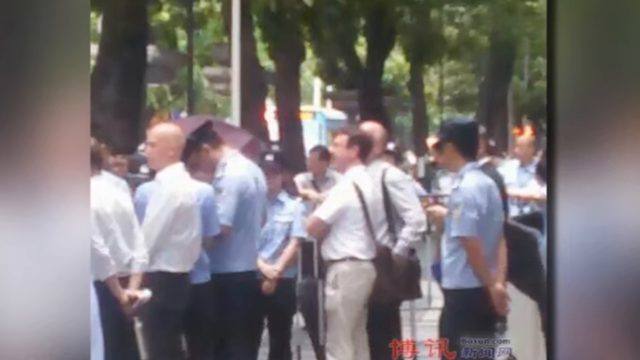
On 16 May 2014, Guangzhou police went separately to the homes of Tang Jingling, Yuan Chaoyang (pen name Yuan Xinting) and Wang Qingying and took all three men away. According to the account of the arrests set out in Opinion No. 49/2014 of the UN Working Group on Arbitrary Detention, Tang was arrested at his home by officers of the Baiyun District branch of the Guangzhou Public Security Bureau, who produced a search warrant and a criminal detention notice issued under Article 80 of China's Criminal Procedure Law, searched his home and confiscated computers, mobile phones and books. Wang Qingying was taken by state security officers of the Guangzhou Public Security Bureau who, together with officers from the Baiyun and Panyu district branches, searched his home without producing any warrant and confiscated laptop computers and mobile phones. Yuan Xinting was likewise arrested at home by Guangzhou Public Security Bureau officers who showed no warrant. The charge on which all three were initially held was "picking quarrels and provoking trouble" (rendered in some English reporting as "creating a disturbance"). The arrests came in the nationwide sweep that preceded the 25th anniversary of the June Fourth crackdown of 1989, in which large numbers of activists and dissidents across China were detained, disappeared or placed under restriction; the Guangzhou case became one of the most closely watched internationally.
The three men were first held at the Guangzhou Baiyun District Detention Centre. The UN opinion also records what their lawyers learned in the first days. On 21 May 2014, Tang's lawyer met him at Baiyun and was told that a discipline officer had tried to force Tang to squat, that Tang had refused, and that the enraged officer had violently kicked him; that the detention centre had refused to let his family send him the glasses he needed for severe near-sightedness; and that his family had not been allowed to meet him at all since his arrest. On 23 May 2014, Wang Qingying's lawyer learned that Wang had allegedly been repeatedly slapped in the face for refusing to fabricate evidence against Tang and Yuan, forced to work long hours, and held in a cell of about 20 square metres with 30 other inmates on very poor food. After a further visit on 10 June 2014, the lawyer reported that Wang had been interrogated at least 20 times, sometimes for 12 to 13 hours at a stretch, until he confessed under duress — and that after confessing he had been moved to a larger cell and was no longer beaten. These accounts of detention conditions come from the submission made to the UN Working Group by the source in the case; the Working Group noted expressly that the Chinese government had not replied to its communication of 18 September 2014 and had not rebutted any of the allegations.
On 19 June 2014 the three men were transferred to Guangzhou No. 1 Detention Centre. On 20 June 2014 the Guangzhou Municipal People's Procuratorate formally arrested them on the far more serious charge of "inciting subversion of state power." (Some Chinese-language reports give the formal arrest date as 21 June; this page follows the date in the UN opinion and in most English-language human rights reporting, and notes the discrepancy.) The jump from a public-order charge to a state-security charge was the first great turning point of the case. Tang's wife told Radio Free Asia at the time that the subversion charge against her husband was highly unlikely to stand, because he followed a policy of peaceful non-cooperation.
The case then sat in the procuratorate for a long time. According to Tang's wife, speaking to Radio Free Asia, the prosecution twice sent the file back to the police for supplementary investigation, without producing new evidence. On 29 April 2015 the Guangzhou Municipal People's Procuratorate filed its indictment — indictment No. Sui Jian Gong Yi Xing Su (2014) 604 — with the Guangzhou Intermediate People's Court. By then the three men had been in custody for nearly a year without seeing a judge.
The trial opened on 19 June 2015 at the Guangzhou Intermediate People's Court and stopped on its first day. Human Rights Watch reported that the proceedings were suspended after the defence protested against procedural violations; other reporting, carried by the Independent Chinese PEN Center from Radio Free Asia, said the hearing was adjourned after the three defendants dismissed their defence team when the court refused to let them call witnesses. The two accounts point to the same fact: the first hearing was never completed. The trial resumed on 23 July 2015 and concluded on 24 July, with no verdict announced. Front Line Defenders recorded that in a statement in court in July 2015 Tang said that he and his co-defendants had not been permitted to go outside, or to send or receive letters or books. Wang Qingying's side also described in court the torture he said he had suffered; contemporary trial reporting carried that account. During the proceedings the defence also raised the composition of the adjudicating panel — which included Communist Party functionaries — as a ground for recusal, without success; the underlying application and ruling documents are not publicly available, and this page records the point at that level of detail.
From arrest on 16 May 2014 to verdict on 29 January 2016, the three men spent more than twenty months in pre-trial and pre-verdict detention. On the morning of 29 January 2016 the Guangzhou Intermediate People's Court delivered its judgment: Tang Jingling, guilty of inciting subversion of state power, five years; Yuan Chaoyang (Yuan Xinting), three years and six months; Wang Qingying, two years and six months. In its statement that day, Human Rights Watch put the substance of the convictions plainly: the three men had been convicted for promoting the ideas of nonviolent civil disobedience and for advocating a peaceful transformation to democratic rule at gatherings of activists.
On the day of the verdict Tang issued a written statement titled "I Will Not Give Up — I Appeal Only to the People and God." He refused to appeal, for a reason he stated without adornment: he would not appeal to a court he regarded as illegitimate. Human Rights in China published the full English translation of the statement on 29 January 2016. Yuan Xinting and Wang Qingying did appeal. On 31 May 2016 the South China Morning Post reported that the Guangdong Higher People's Court was due to issue its decision on the appeal that day; Tang's lawyer, Ge Yongxi, said he expected no change, that there would be no hearing to announce the result, that the written ruling would be handed directly to the three men, and that although a court clerk was already at the detention centre with the written verdict, the clerk would not hand it to Tang in the lawyer's presence — Ge said he did not yet know its contents. The Chinese Wikipedia entry on Tang Jingling records that the Guangdong Higher People's Court upheld the original sentences on 31 May 2016; that record currently rests on a single source and is flagged as such on this page. What can be confirmed is that all three sentences were thereafter served in full exactly as imposed at first instance, and no report of any alteration on appeal has ever appeared.
Tang served his sentence at Sihui Prison in Zhaoqing, Guangdong, according to the South China Morning Post's 2019 reporting. Counting from his initial custody in 2014, his term was due to expire on 29 April 2019. On Monday 29 April 2019 he was released from Sihui Prison in the morning and returned that evening to his hometown in Jingzhou, Hubei. Interviewed by the South China Morning Post the next day, he said that five years in prison had confirmed his beliefs, and that he would continue to fight for human rights and democracy in China through nonviolent civil disobedience. His wife told reporters that he was in good spirits but that his physical condition still needed proper checking, and that she feared he would, like other released rights lawyers, remain under surveillance and restriction after leaving prison.
The Man: Who Tang Jingling Is
Tang Jingling was born in 1971 in Hubei. Public sources give two different versions of his birth date and birthplace, and this page records them in layers rather than blending them. The first comes from a translated summary of the Guangzhou court's judgment, published by the Fei Chang Dao blog, which gives Tang as born on 28 October 1971, from Jiangling County, Hubei, with household registration in Longhu District, Shantou, Guangdong. The second, found in Chinese rights-defender directories and in Chinese Wikipedia, gives 15 December 1971, born in Mishi Town, Jingzhou, Hubei (formerly part of Jiangling County). The UN opinion records only the year, 1971. Both versions agree on 1971 and on the Jiangling/Jingzhou area of Hubei; the exact date is in conflict between sources, and this page accordingly gives "born 1971, from Jiangling (Jingzhou), Hubei," flagging the precise date as unresolved.
By Tang's own account in his January 2016 statement, he obtained his legal professional qualification certificate in the summer of 1998 and then began to practise; other reporting says he passed the bar examination in 1997. He practised mainly in Guangdong. His casework included labour rights and victims of faulty vaccines, and the case that defined his career was Taishi Village in 2005, where villagers in Panyu, Guangzhou, sought to use legal procedures to remove a village chief they accused of corruption, and Tang and other lawyers advised them; the Guangdong authorities crushed the campaign. The end of Tang's practising career followed directly from Taishi, but the mechanism is described three different ways in the sources, and this page keeps them separate. Human Rights in China states that his lawyer's licence was revoked in 2005 after his participation in the Taishi Village case. The UN Working Group's opinion, summarising its source, states that in 2006 the Chinese authorities did not renew Tang's attorney licence as a consequence of his work on the Taishi recall case. Human Rights Watch's 2015 reporting says he was dismissed from his law firm after providing legal aid to the Taishi villagers in 2005. The South China Morning Post's 2019 report says he lost his licence in 2006. The fact common to all four accounts, and the one this page treats as established, is this: after the Taishi case, in 2005–2006, Tang lost the ability to practise law normally, and thereafter worked as a "citizen agent," continuing to give legal help on rights cases without a licence. Whether the administrative instrument was revocation, non-renewal at annual registration, or dismissal by his firm is not something the public sources settle, and this page does not pretend otherwise.
Losing his licence did not remove Tang from the rights-defence world. A United States consular cable from 2006, later published by WikiLeaks, records that on 6 September 2006 Tang was detained at Guangzhou East railway station while passing through passport control for a train to Hong Kong, because police in his hometown of Shantou had cancelled his passport; the cable also noted a February 2006 report that he had been attacked by four men after visiting the home of fellow activist Guo Feixiong, who was likewise involved in the Taishi affair. These early records show that by 2006 Tang was already on the Guangdong authorities' list of people to be watched and controlled.
Tang is a Christian. According to a January 2017 report by International Christian Concern (ICC), based on an interview with his wife, he became a Christian in 2009 and became involved in church life. His faith runs through his 2016 refusal-to-appeal statement, which quotes "Blessed are those who are persecuted for righteousness' sake" and addresses his appeal "to the people and God." To understand his method, this layer matters: for Tang, nonviolence was not only a tactic but a practice of faith.
The Nonviolent Civil Disobedience Movement: What He Advocated
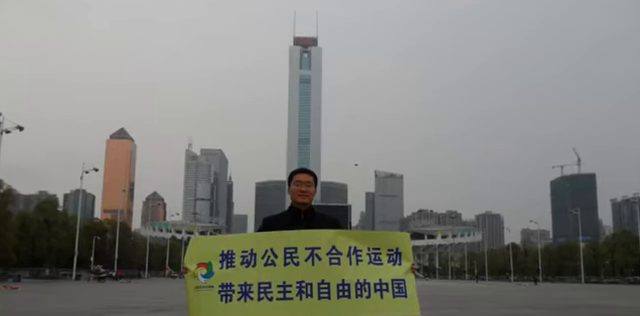
In 2006 Tang founded the Nonviolent Civil Disobedience Movement (the UN opinion calls it the Nonviolent Citizens' Disobedience Movement; the indictment's own terminology also speaks of a "Non-Cooperation Movement"). This is the key to the whole case: the "criminal conduct" at the heart of the prosecution was founding, promoting and taking part in this movement. In the indictment's logic, from 2006 onwards Tang, dissatisfied with China's existing democratic and electoral systems and social conditions, advocated and spread the concept of nonviolent civil disobedience in order to bring about peaceful transformation. The specific acts the indictment and judgment treated as criminal included compiling, printing and distributing a series of "Non-Cooperation Movement" books; speaking about nonviolent resistance at gatherings; and taking part in activities such as commemorating June Fourth, commemorating Lin Zhao, and signing Charter 08. Amnesty International made the point that deserves emphasis: the three defendants were not even accused of having carried out a single act of civil disobedience. They were accused of promoting the ideas of civil disobedience.
In December 2008 Tang was among the original signatories of Charter 08. His co-defendants Yuan Xinting and Wang Qingying were also signatories — Chinese rights-defender directories describe all three as original signatories. Charter 08 called for an end to one-party rule, an independent judiciary and freedom of expression. Signing it became a shared entry on all three men's files, and it cost two of them their jobs well before 2014: according to the UN opinion, Wang Qingying was fired by Guangdong University of Technology in 2009 under official pressure after signing Charter 08, and Yuan Xinting was likewise fired by his publishing employer in 2009 after signing. One signature, three careers damaged — the price the three men had already paid before the 2014 arrests.
The movement's practical form can be partly reconstructed from the indictment itself: they printed books, organised study and discussion meetings, and travelled to exchange ideas with activists. In early April 2014, to make gatherings, study and discussion easier, they rented a flat in Guangzhou; around 10 April 2014 Tang commissioned a print shop in Baiyun District to print more than 500 copies of the "Non-Cooperation Movement" book series (as alleged in the translated indictment summary). Those books later became the target of the police search and the central physical evidence at trial. As for the movement's programmatic documents in full — detailed action plans or a charter text — no verifiable complete text is available in public sources, and this page does not reconstruct them speculatively; where the record is silent, it says so.
2011: Secret Detention in the Jasmine-Era Sweep
The imprisonment of 2014 was not the first time Tang Jingling had been made to disappear. In February 2011, as the authorities moved pre-emptively against any Chinese echo of the Middle East's "Jasmine" uprisings, large numbers of lawyers and activists were seized; Tang was one of them. In his own statement of 29 January 2016, published by Human Rights in China, Tang wrote that in 2011 he was secretly held at the Guangzhou Police Training Center on Nanda Road, in the Panyu District of Guangzhou, and subjected to torture. A second account in his own words — a testimony written in detention in December 2014 and published by China Aid — adds the detail. In February 2011, shortly after he and his wife returned to Guangzhou from their home in Hubei, he and several friends were secretly detained on suspicion of "inciting subversion of state power," at the same Police Training Center on South Panyu Road. Under threat of torture, he wrote a confession and a statement of guarantees, and was forced to make an oral confession admitting the crime of inciting subversion. He was held there until August 2011, when he was released and escorted back to Hubei. The same testimony says that his wife was detained at the same time; that the detention drove her into depression; and that instead of treating or releasing her, the authorities brought his mother-in-law from Wuhan to Guangzhou and locked mother and daughter together in the couple's own home. Chinese Wikipedia's account broadly matches his: taken away on 22 February 2011, subjected to torture, forcibly returned to his Hubei hometown in August, his wife confined at home over the same period.
One further single-source claim must be kept in its own layer. A September 2011 South China Morning Post report on lawyers describing their detention ordeals, republished by China Aid, stated that Tang Jingling was fed medicine in detention that resulted in temporary memory loss. That claim appears in that one report only; this page records it as single-source and unverified, not as established fact.
This page's handling of the 2011 episode follows a fixed rule: the place and period of the secret detention, and the fact that Tang says he was tortured there, are stated consistently in two of his own accounts written at different times, and are recorded here as his testimony. Beyond his own written phrase — that under threat of torture he was forced to confess — public sources provide no further cross-verifiable detail about the methods used, and that gap is recorded as a matter of no public record. On 16 December 2011, Tang travelled to Wukan in Guangdong to observe the villagers' protest there and was questioned again by the authorities after returning to Guangzhou (Chinese Wikipedia; single source). In September 2012 he was detained for six days for investigating the suspicious death of Hunan labour activist Li Wangyang: Human Rights in China reported that he was held from 5 to 10 September 2012 in Shaoyang and in Shaoguan, that Guangzhou state security officers told him one reason for the detention was that Hong Kong's Legislative Council elections fell on 9 September, and that when he was released his laptop and camera had been damaged beyond use. Taken together, these episodes draw the picture before 2014: whenever a sensitive date approached, Tang Jingling was dealt with in advance.
231 Books: A Trial Built on Publications
The detail of this case that most deserves to survive in an archive is the structure of the prosecution's evidence. According to Front Line Defenders, citing the indictment, police searching the flat the three men had rented found, in total, 231 copies of books: Gene Sharp's From Dictatorship to Democracy; Mark Palmer's Breaking the Real Axis of Evil: How to Oust the World's Last Dictators by 2025; Si Kahn's Organizing: A Guide for Grassroots Leaders; Robert L. Helvey's On Strategic Nonviolent Conflict: Thinking about the Fundamentals; and Gene Sharp's Self-Liberation. The indictment characterised Sharp's From Dictatorship to Democracy as containing "serious political mistakes." Human Rights Watch noted that the crimes listed in the indictment included "publicly inciting others to participate in [the] non-violent civil disobedience movement" — that is, the distribution of, and discussion about, publications on ending dictatorship by peaceful means, and the publicising of those ideas at activists' gatherings, were themselves treated as the act of inciting subversion.
The nature of these books needs to be stated plainly. From Dictatorship to Democracy is a short work the American scholar Gene Sharp wrote in 1993 for Burma's democracy movement; it has since been translated into dozens of languages, published and sold openly worldwide, and become a standard text in the study of nonviolent movements. Helvey is a retired United States Army colonel whose book is an openly published academic work. Kahn's book is a manual of community organising in the United States. Palmer is a former United States ambassador to Hungary. Every one of these books can be legally obtained from university libraries and bookshops across the world. In a rented flat in Guangzhou, they acquired a different identity: the physical exhibits in a state-security prosecution. The number 231 was written into the indictment by the prosecution itself, and it measures the case precisely: not weapons, not explosives, not money trails — 231 openly published books.
The indictment also folded almost a decade of the men's peaceful activities into the criminal facts, including commemorating the victims of the 1989 crackdown, commemorating Lin Zhao, the dissident executed in the Mao era, and signing Charter 08. Amnesty International observed that all of these activities were forms of peaceful expression. In other words, the document the prosecution offered to prove "subversion" was a list of nearly ten years of peaceful activity.
Procedure: From a Changed Charge to Twenty Months Without a Verdict
The most authoritative legal assessment of this case's procedure is Opinion No. 49/2014 of the UN Working Group on Arbitrary Detention. The opinion was adopted at the Working Group's seventy-first session, held from 17 to 21 November 2014 (adoption date 20 November 2014), carries the document symbol A/HRC/WGAD/2014/49, and was issued on 11 February 2015. Its conclusions have two layers. First, the three men's detention resulted from their legitimate exercise of the rights to freedom of opinion and expression and to peaceful assembly guaranteed by Articles 19 and 20 of the Universal Declaration of Human Rights, and so fell within category II of arbitrary detention. Second, the detention violated Articles 9, 10 and 11 of the Universal Declaration — Wang and Yuan were arrested without warrants being shown and were not told the exact charges until four days after arrest; the charge was changed to one carrying far heavier punishment; Wang's confession was allegedly extracted under torture; and pre-trial detention was prolonged — and so fell within category III. The Working Group requested the Chinese government to release the three men immediately and to grant them reparation for the harm suffered, and it referred the torture allegations to the UN Special Rapporteur on torture. The Chinese government never replied to the Working Group's communication. And the opinion freed no one: all three men remained in custody for more than another year after it was adopted, until the verdict came.
The procedural problems continued into the trial phase. On access to counsel, Human Rights Watch recorded that Tang was unable to meet one of his lawyers for at least two months after being taken into custody, and that all three men's lawyers were repeatedly denied regular access; Amnesty International recorded that police first denied and then arbitrarily restricted both lawyer access and family visits. On family access, the UN opinion recorded that Tang's family had never been permitted to meet him from the moment of his arrest, and that the detention centre would not even accept the glasses they tried to send him. A further claim rests on a single source: Chinese Wikipedia records that Tang's mother died on 23 September 2014 and that the authorities did not allow him home for the funeral; this page flags that as single-source. On the trial itself, before the resumed hearing in July 2015 the authorities placed dozens of would-be supporters under surveillance, and Tang's wife was taken on a forced out-of-town "vacation" by state security police ahead of the June hearing, according to reporting carried by the Independent Chinese PEN Center. A nominally public trial, at which the defendant's wife is removed from the city and his supporters are watched into staying away, keeps the outward form of procedure after its content has been dealt with in advance.
One further primary document survives from inside the detention centre. In a testimony Tang wrote on 8–14 December 2014 in Cell 1504 of Guangzhou No. 1 Detention Centre, he described the conditions in his own words: a cell of just over 20 square metres holding more than 20 inmates, who ate, drank, used the toilet, walked, sat and slept in that single space twenty-four hours a day, seven days a week; watery porridge three times a week, and on the other four days two small steamed buns or an equivalent amount of wheat food a day. These details are Tang's own testimony and are recorded as such; the detention centre has never publicly responded to his description, and that absence is a matter of no public record.
The Family: The Price Paid by His Wife
The spelling of Tang's wife's name varies between public sources, and this page records the variants in layers. Radio Free Asia and Independent Chinese PEN reporting from 2014–2015 names her Wang Yanfang (王燕芳). International Christian Concern's 2017 report likewise gives Wang Yanfang (王艳芳). Chinese Wikipedia writes the name as 汪艳芳. The variants plainly refer to the same person; this page uses Wang Yanfang, the form in most English-language human rights reporting, and notes the alternative rendering; her name as it appears on identity documents cannot be settled from public sources.
Her role in this case was not that of a bystander. On the day her husband was taken, 16 May 2014, she sat with him on the sofa at home for two hours while officers searched through their belongings, according to ICC's account. She then became the family's public voice: she explained to Radio Free Asia why her husband could not have incited subversion, published the arrest notice on social media, told the outside world that the case had twice been sent back for supplementary investigation, and was taken out of town by state security before the trial. In ICC's January 2017 interview she said, in her own words as reported, that she had been harassed, tracked and detained for five months, and had lost her job. The time layers need care: in 2011 she was detained and confined at home for months (see Tang's testimony above); which period the "five months" in the ICC report refers to is not broken down in that report, and this page records her statement as her own account without assigning it to a specific episode on her behalf.
According to ICC, across the whole of 2016 she was permitted to visit her husband in prison only twice; at the visits she was surrounded by police officers, and she saw that he had grown pale from lack of sunlight and weak from lack of exercise. Between the day he was taken in May 2014 and those two 2016 visits, the previous time she had seen him was the arrest itself. After his release in April 2019 she told reporters she feared he would remain under surveillance and restriction. Beyond this, public sources contain no further verifiable material on the family's finances, on any children — no public source consulted mentions children — or on her circumstances today; those matters are of no public record.
Wang Qingying's family was also drawn in: the UN opinion records that Wang's wife was harassed and threatened by state security officers. As for the impact on Yuan Xinting's family in this case, public sources contain no specific account; no public record.
The International Response
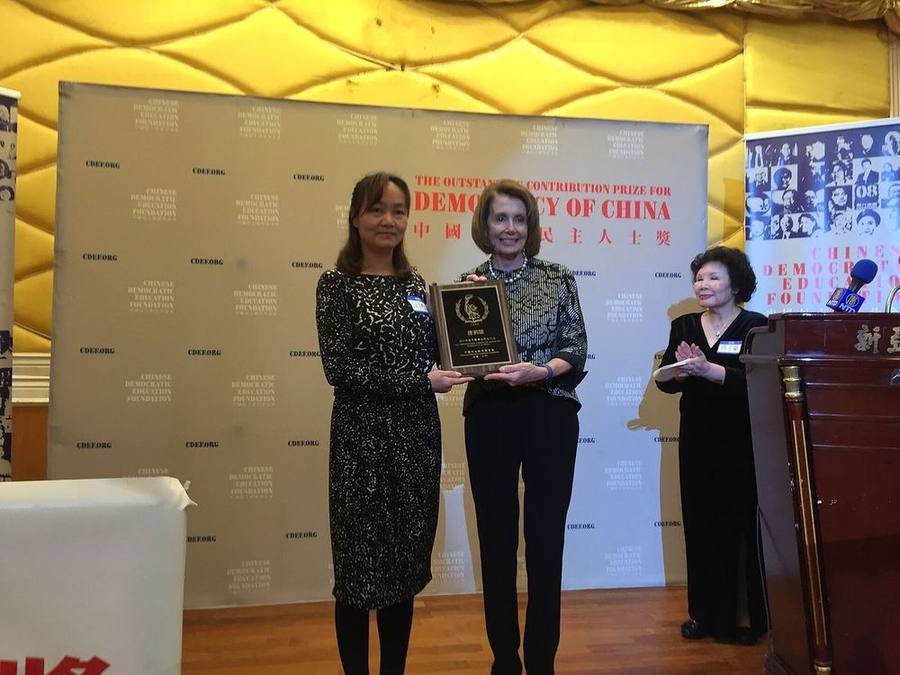
The documented international response to this case is substantial. Before the trial, in June 2015, Human Rights Watch called for the three men to be released immediately and the charges dropped, observing that the government's overbroad interpretation of subversion conflicted directly with the freedom of expression guaranteed by Article 35 of China's own Constitution. On the day of the verdict, 29 January 2016, Human Rights Watch called for the verdicts to be quashed and placed the prosecution within the broader crackdown on civil society launched after Xi Jinping formally assumed power in March 2013. Amnesty International, before the trial, stated that the three men faced state-security charges merely for publishing books on democracy and activism, and demanded their release. Front Line Defenders followed the case throughout and condemned the sentences as motivated directly by the men's legitimate and peaceful human rights work. The UN Working Group's Opinion No. 49/2014, set out above, remains the weightiest international legal document in the case. After Tang's release, the Council of Bars and Law Societies of Europe (CCBE) wrote to the Chinese authorities on 27 September 2019 about his reported disappearance on 31 August 2019, urging a full and impartial investigation and measures to ensure his safety — a footnote to the phrase "release is not freedom." In July 2019 Tang received the second China Human Rights Lawyer Award (Chinese Wikipedia; single source, pending corroboration). This site has found no verifiable record of a separate statement on this case by the United States State Department or by European Union institutions in the public sources consulted; that is recorded here as no public record, not filled in by guesswork.
After Prison: 2019 to the Present
After Tang's release on 29 April 2019 and his public statement the following day, news of him thins out rapidly. Only two later items can be verified. The first is an honour: in July 2019 he received the second China Human Rights Lawyer Award (single source, above). The second is a warning sign: the CCBE's letter of 27 September 2019 states that, according to information it had received, Tang Jingling had gone missing on 31 August 2019, only four months after leaving prison. The letter does not say where, why or for how long, and this site has found no later reporting that explains how that disappearance ended. Beyond that, repeated searches in Chinese and English for the years 2020 to 2026 have produced no verifiable reporting of any public activity by Tang Jingling, any new arrest, any interview, or any departure from China. The same is true of his co-defendants: no verifiable reporting on the post-release activities of Yuan Xinting or Wang Qingying has been found; no public record.
The most honest statement of his current status is therefore this: Tang Jingling completed his sentence and walked free on 29 April 2019; he returned to Jingzhou, Hubei, and said he would continue nonviolent advocacy; at the end of August 2019 he was reported missing, and the outcome of that episode is of no public record; reporting then stops, and as of this page's verification on 5 November 2026 his living circumstances, health and activities are all matters of no public record. For a man whose name once appeared in human rights reporting every year, disappearance from the public record is itself a datum. It is the commonest ending to cases of this kind: no new sentence is required — sustained surveillance and uncertainty are enough to retire a person from public life. This page will be updated if new verifiable information appears.
Timeline
- 1971 — Tang Jingling is born in the Jiangling/Jingzhou area of Hubei (exact date in conflict between sources: 28 October in the translated judgment summary; 15 December in rights-defender directories).
- Summer 1998 — Tang obtains his legal professional qualification certificate and begins to practise (his own account; other reporting dates his passing the bar exam to 1997).
- 2005 — Tang provides legal help to the villagers of Taishi, Panyu, seeking to remove their village chief; the campaign is suppressed.
- 2005–2006 — Tang loses his ability to practise (mechanism described variously as revocation, non-renewal, or dismissal by his firm; see text); he continues as a citizen agent.
- 2006 — Tang founds the Nonviolent Civil Disobedience Movement; on 6 September 2006 he is detained at Guangzhou East station after Shantou police cancel his passport (US consular cable).
- December 2008 — Tang signs Charter 08 (original signatory); Yuan Xinting and Wang Qingying are also signatories.
- 2009 — Yuan Xinting and Wang Qingying are each fired by their employers after signing Charter 08 (UN opinion); Tang becomes a Christian (ICC reporting).
- February–August 2011 — In the Jasmine-era sweep, Tang is secretly held at the Guangzhou Police Training Center on Nanda Road, Panyu; by his own testimony he is tortured and forced to confess; his wife is detained and confined over the same period. Released in August and returned to Hubei.
- 16 December 2011 — Tang travels to Wukan to observe the villagers' protest and is questioned on his return to Guangzhou (single source).
- 5–10 September 2012 — Tang is held for six days in Shaoyang and Shaoguan over his investigation of Li Wangyang's death; his laptop and camera are returned damaged (Human Rights in China).
- April 2014 — The three men rent a Guangzhou flat for meetings and study; Tang commissions the printing of more than 500 copies of the "Non-Cooperation Movement" book series (as alleged in the indictment).
- 16 May 2014 — Tang, Yuan and Wang are criminally detained in the pre-June Fourth sweep on suspicion of "picking quarrels and provoking trouble," and held at Baiyun District Detention Centre.
- 19 June 2014 — The three are transferred to Guangzhou No. 1 Detention Centre.
- 20 June 2014 — The three are formally arrested on suspicion of inciting subversion of state power (some Chinese reports give 21 June).
- 20 November 2014 — The UN Working Group on Arbitrary Detention adopts Opinion No. 49/2014, finding the detention arbitrary (categories II and III) and requesting immediate release and reparation; China does not reply.
- 29 April 2015 — The Guangzhou Municipal People's Procuratorate files its indictment with the Guangzhou Intermediate People's Court.
- 19 June 2015 — The trial opens and is interrupted the same day amid procedural disputes.
- 23–24 July 2015 — The trial resumes and concludes; no verdict is announced.
- 29 January 2016 — First-instance verdict: Tang five years, Yuan three years and six months, Wang two years and six months. Tang publishes his refusal to appeal.
- 31 May 2016 — The Guangdong Higher People's Court issues its decision on Yuan's and Wang's appeals; Chinese Wikipedia records the original sentences as upheld (single source); all three sentences are thereafter served in full.
- 29 April 2019 — Tang is released from Sihui Prison on completion of his sentence and returns to Jingzhou that evening; the next day he says publicly that he will continue nonviolent advocacy.
- July 2019 — Tang receives the second China Human Rights Lawyer Award (single source, pending corroboration).
- 31 August 2019 — Tang is reported missing; the CCBE writes in concern on 27 September 2019; the outcome is of no public record.
- 2020 to the present — No verifiable reporting on Tang's public activities; his present circumstances are of no public record.
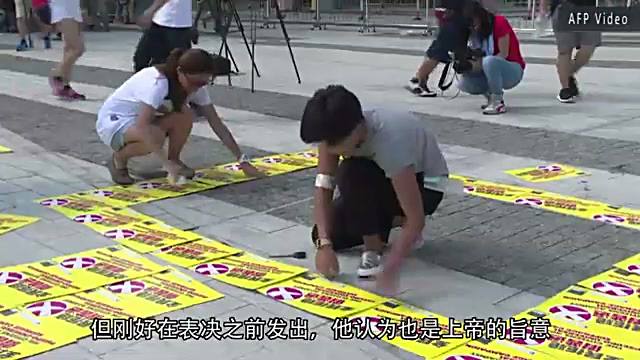
视频证据Video Evidence
以下视频与本页人物、事件直接相关,为公开发布的影像记录。The following videos are publicly released visual records directly related to the person and events on this page.
以下为自由亚洲电台关于唐荆陵等三人「煽动颠覆」案在广州开庭的报道,含街头声援画面。An RFA report on the Guangzhou trial of Tang Jingling and two others for "inciting subversion", with footage of street solidarity actions.
▲ 自由亚洲电台:唐荆陵等三人「煽动颠覆」案在广州开庭(实拍报道)|普通话原声▲ RFA: Tang Jingling and two others tried in Guangzhou for "inciting subversion" (report) | Mandarin audio
Our Take
What should be remembered first about this case is the 231 books. A lawyer printed 231 copies of books that are published openly all over the world — Sharp, Helvey, Kahn, Palmer, authors whose names sit on the shelves of university libraries on every continent — and those 231 copies were written into an indictment as the core physical evidence that sent him to prison for five years. The prosecution did not even accuse him of carrying out a single act of disobedience; Amnesty International saw it clearly: he was accused of promoting ideas. When a regime has to define reading, printing and discussing books as the subversion of state power, it has admitted something about itself: what it fears is not violence but precisely nonviolence — because nonviolence gives it no excuse to shoot, only a mirror to look into.
The second detail that should be remembered is Tang Jingling's refusal to appeal. In Chinese political cases, appeals almost never change anything, and defendants usually file them only to complete the procedure. Tang would not complete even that. His reason was that appealing to a court he considered illegitimate would concede that it had the right to judge him. He turned his notice of appeal into a statement, addressed "only to the people and God." One may disagree with his judgment, but its inner consistency is hard to deny: a man who had spent a lifetime studying nonviolent resistance used his last procedural right to perform one final act of non-cooperation — no guilty plea, no appeal, no playing along — and then calmly went to serve the full five years. That was not passivity. It was the last practice of the thing he had advocated all his life.
Third, the chain of punishment in this case was tightened link by link long before 2014: take the Taishi case in 2005, lose your licence; around 2009, his future co-defendants lose their jobs for signing a charter; in 2011, secret detention, torture, a forced confession, a wife confined at home into depression; in 2014, a formal sentence. Taken one at a time, the authorities can call each step an individual measure; laid end to end, they form a complete, graduated garrotte applied to a peaceful advocate. The UN Working Group said it in plain language: arbitrary detention, release them immediately, grant reparation. The Chinese government did not even reply. The opinion rescued no one — but it left a record. So does this page. Those who imposed the sentence may be counting on time to blur everything; but the number 231, the opinion number 49/2014, and the date 29 January 2016 will remain.
Verification Note
This page was verified on 5 November 2026. Sources are graded as follows. Tier one: the text of Opinion No. 49/2014 of the UN Working Group on Arbitrary Detention (A/HRC/WGAD/2014/49), which governs this page's account of the arrests, the places of detention, the date of the change of charge and the finding of arbitrary detention; and Tang Jingling's own words — his statement of 29 January 2016 published by Human Rights in China and his December 2014 detention testimony published by China Aid — which are used as the testimony of the person concerned: matters resting on his account alone, such as the torture he describes, are attributed to him in the text rather than presented as independently established fact. Tier two: Human Rights Watch (statements of June 2015 and January 2016), Amnesty International's pre-trial statement, Front Line Defenders' case histories, South China Morning Post reporting (as republished by China Aid and by the Central Tibetan Administration's website), Radio Free Asia reporting (as carried by the Independent Chinese PEN Center), and International Christian Concern's interview with Tang's wife. Tier three (single-source) items are flagged one by one in the text: the Guangdong High Court's upholding of the sentences and the 2019 China Human Rights Lawyer Award (Chinese Wikipedia); the claim that Tang was fed medicine causing temporary memory loss in 2011 (South China Morning Post, via China Aid); his mother's death in September 2014 without permission for him to attend the funeral (Chinese Wikipedia); and his questioning after the December 2011 Wukan trip (Chinese Wikipedia).
Four conflicts between sources have been identified and are handled in layers, never blended. (1) Yuan Xinting's name: his legal name is Yuan Chaoyang and his pen name is Yuan Xinting (袁新亭) — the judgment, the UN opinion and the indictment agree. Some reports write the pen name with a different final character (袁新婷); checked against the judgment and multiple institutional records, that rendering is an error, and this page uses Yuan Xinting throughout, noting the variant here. The same applies to the name of Tang's wife, which appears as Wang Yanfang in two different Chinese spellings and as Wang with a different surname character in Chinese Wikipedia. (2) Tang's birth date: 28 October 1971 in the translated judgment summary, 15 December 1971 in rights-defender directories; this page confirms only the year 1971. (3) The mechanism and year of the loss of his licence: revocation in 2005 (HRIC), non-renewal in 2006 (UN opinion), dismissal by his firm in 2005 (Human Rights Watch), loss of licence in 2006 (South China Morning Post); this page confirms the layer common to all of them — that after the Taishi case he lost his practising status in 2005–2006. (4) The formal arrest date: 20 June 2014 (UN opinion and most English-language sources) alongside 21 June in some Chinese reporting; this page uses 20 June and notes the divergence. Matters on which public sources are silent — the full text of the movement's programme, any children of Tang Jingling, the impact of the case on Yuan Xinting's family, the outcome of the August 2019 reported disappearance, and all three men's detailed present circumstances — are expressly marked "no public record" in this page and are not filled in by conjecture. Direct quotation from any single source does not exceed 50 words.
Sources
- UN Human Rights Council, Working Group on Arbitrary Detention, Opinion No. 49/2014 (A/HRC/WGAD/2014/49), adopted 20 November 2014, issued 11 February 2015
- Human Rights in China (HRIC): "Statement by Lawyer Tang Jingling on Why He Refuses to Appeal His Conviction," 29 January 2016
- Human Rights Watch: "Release Advocates of Nonviolence," June 2015; "China: Unjust Sentences for Guangzhou Activists," 30 January 2016
- Amnesty International: "China: Rights activists face five years in prison for publishing books on democracy," June 2015
- Front Line Defenders: case histories of Yuan Xinting and Wang Qingying
- China Aid: Tang Jingling's prison testimony "Lilies in the Millet" (December 2014); South China Morning Post appeal report, republished 31 May 2016
- South China Morning Post: "Freed lawyer Tang Jingling vows to continue fight for human rights, democracy in China," April 2019 (as republished by the Central Tibetan Administration)
- International Christian Concern: "Being Married to an Imprisoned Christian in China," 6 January 2017
- Human Rights in China: "Lawyer Retained by Li Wangyang Family Unlawfully Held for Six Days," 2012
- Council of Bars and Law Societies of Europe (CCBE): letter on the disappearance of Tang Jingling, 27 September 2019
- United States diplomatic cable 06GUANGZHOU29575 (published by WikiLeaks), 2006
- Translated summary of the Guangzhou Intermediate People's Court judgment (Fei Chang Dao blog); Chinese Wikipedia entry "Tang Jingling" (used only for single-source-flagged items)