
第143案 | 吕耿松Case 143 | Lü Gengsong
吕耿松,1956年1月7日生于杭州,杭州大学历史系毕业,原浙江省公安高等专科学校教师,1993年因参与民主活动被开除,此后以自由撰稿为生,著有《中共贪官污吏》,为中国民主党浙江委员会成员。2007年8月24日他被抄家拘捕,2008年2月5日被杭州市中级人民法院以煽动颠覆国家政权罪判刑四年、剥夺政治权利一年——法院的定罪证据是他十九篇文章中摘出的四百七十个字;2011年8月23日刑满出狱后他拒绝签署遵守剥夺政治权利规定的保证。出狱后他持续受到监控、抄家与短期拘留,妻子进京上访被拘、女儿被阻止出境。2014年7月7日他第二次被抄家刑拘,8月13日以颠覆国家政权罪被批捕,2015年9月29日受审时宣读辩护意见被法官打断,2016年6月17日被杭州中院判刑十一年,同年11月1日二审维持且律师不得出席。他在湖州长湖监狱服刑期间患糖尿病、高血压、心脏病与胆囊坏死,牙齿大半脱落,2017年保外就医申请被拒;因拒绝认罪被列入严管,2023年3月探视时他在口罩内侧写下「救救我」,随后家属会见被停三个月。2025年7月6日,他六十九岁刑满出狱,随即被当局与妻子一同临时安置于临安乡村住所与外界隔绝;此后状况无可靠公开记录。Lü Gengsong, born on 7 January 1956 in Hangzhou, graduated from Hangzhou University's history department and taught at the Zhejiang Higher Professional School of Public Security until he was dismissed in 1993 for his pro-democracy activities; he then lived as a freelance writer, author of A History of Chinese Communist Party Corrupt Officials and a member of the China Democracy Party's Zhejiang Committee. Taken after a home raid on 24 August 2007, he was sentenced by the Hangzhou Intermediate People's Court on 5 February 2008 to four years plus one year's deprivation of political rights for inciting subversion — the evidence of his crime being 470 words excerpted from nineteen of his articles. Released on 23 August 2011, he refused to sign a guarantee to abide by the deprivation conditions. Under continuing surveillance, raids and brief detentions — his wife detained on a petitioning trip to Beijing, his daughter barred from leaving the country — he was seized again on 7 July 2014, formally arrested for subversion on 13 August, interrupted by the presiding judge when he tried to read his defense statement at his 29 September 2015 trial, and sentenced on 17 June 2016 to eleven years, upheld on 1 November 2016 at an appeal his lawyer was barred from attending. At Changhu Prison in Huzhou he developed diabetes, hypertension, heart disease and a necrotic gallbladder and lost most of his teeth; a 2017 application for medical parole was denied. Placed under strict control for refusing to confess, he wrote 'help me' inside his mask at a March 2023 visit, after which family visits were suspended for three months. On 6 July 2025, aged sixty-nine, he was released at the end of the full term and immediately relocated by the authorities with his wife to a rural residence in Lin'an, cut off from the outside world; there is no reliable public record of his situation since.
1. The man: from a police college lectern to a freelance writer's desk
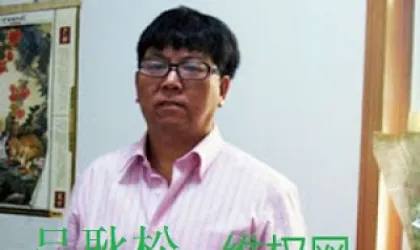
Lü Gengsong was born on 7 January 1956 in Hangzhou, Zhejiang province. In 1983 he graduated from the history department of Hangzhou University — today part of Zhejiang University — and went on to teach at the Zhejiang Higher Professional School of Public Security, a college that trains personnel for the public security system. His teaching career ended in 1993. According to the 2019 opinion of the United Nations Working Group on Arbitrary Detention, he had taken part in the 1989 pro-democracy movement while teaching, continued his activism afterward, and was dismissed in 1993. The files of the Committee to Protect Journalists and of Chinese Human Rights Defenders phrase it slightly differently — "lost his teaching post," "expelled" — but they point to the same event: he lost his job because of his political stance. The brief supplied to this archive described him as a teacher at a Zhejiang radio and television university; no source supports that, and this archive corrects it: his school was the police college. A man who once taught at a police academy became a repeat target of police raids for the rest of his life; that arc is itself the first document of this case.
After losing his post, Lü earned his living as a freelance writer. He wrote about corruption, about organized crime, about forced demolitions; he wrote reportage and commentary that spoke for petitioners, and he published on overseas Chinese-language websites. His best-known book is A History of Chinese Communist Party Corrupt Officials (中共贪官污吏), published in Hong Kong in 2000 by the Culture and Arts Studio — a book that named corrupt officials one by one. He also wrote pieces aimed directly at the political-legal apparatus, among them an article on the Political and Legal Affairs Commission published in the overseas democracy journal Beijing Spring in March 2007. He was an active member of the Zhejiang Committee of the China Democracy Party — a party founded in 1998 and banned the same year; a profile in the party-linked magazine The Opposition describes him as a former chairman of that committee, a title this archive records as single-source. In October 2013 he co-signed an open letter and petition opposing China's presence on the United Nations Human Rights Council. Assembled, his life before arrest is clear: a history teacher expelled by the system, who spent more than two decades doing one thing with a pen — writing down what power had done.
2. 24 August 2007: the first arrest
On 24 August 2007, Hangzhou police summoned Lü and took him away; his home was searched. That day the Xihu District branch of the Hangzhou Public Security Bureau delivered a criminal detention notice to his wife, and he was placed in the Xihu District Detention Center. His wife was herself taken to a police station and questioned for three hours as a "criminal suspect"; according to the questionnaire she later submitted through Chinese Human Rights Defenders to the UN Working Group, police told her plainly that her husband had been seized because his articles "attacked the Communist Party." The initial suspicions were two: inciting subversion of state power, and illegally possessing (obtaining) state secrets. On 29 September 2007 he was formally arrested on the inciting-subversion charge alone; the state-secrets suspicion never entered the indictment — so records the appeal judgment of the Zhejiang Provincial High People's Court, whose full text the U.S. Congressional-Executive Commission on China (CECC) translated and preserved.
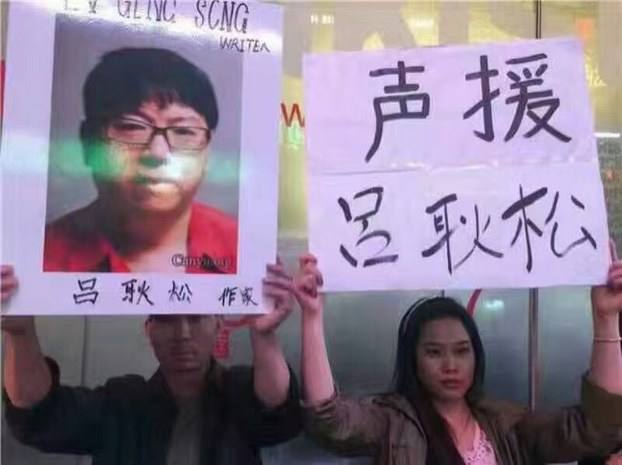
His family and friends had a specific guess about the trigger at the time: his recent articles had covered housing-compensation and demolition cases in Hangzhou and had criticized the local authorities. His wife and friends hoped that raising the profile of the case might push Beijing to intervene and order the local government to release him. Whether that reading was right cannot be verified, but it identifies the structure of such cases: the articles offend the locality, while the charge is laid in the name of state power. Three days after the arrest, on 27 August 2007, more than one thousand Chinese intellectuals and rights defenders addressed an open letter to Hu Jintao and to the delegates of the approaching Seventeenth Party Congress, demanding the release of Lü Gengsong and of other detained activists across the country. That letter later surfaced in U.S. State Department cables — the starting point of this case's international record (Section 12).
3. A thousand signatures, and Wang Xue'e's campaign
During the first detention, the person who spoke to the outside world was his wife. Wang Xue'e — her surname appears in Chinese sources in two written forms, one read as Wang and one as a homophonous character, and this archive follows the majority rendering as Wang Xue'e while archiving the variant in Section 13 — did the following after her husband was taken: around 29 August, she had their daughter travel to Beijing to sign a retainer with the Beijing lawyer Mo Shaoping on her father's behalf; on 3 September she applied to the Xihu District branch for release on bail pending trial, and was refused; thereafter she went to the Public Security Bureau almost every other day to ask about the case, fed developments to the media, gave interviews, and, before the Seventeenth Party Congress, petitioned the Party leadership directly for his release. Her words to Agence France-Presse were quoted by many outlets, in substance: the charges were groundless, and the provincial and city governments simply wanted him to shut up (paraphrased here, not a verbatim quotation). According to Human Rights in China, police pressured her, warning her not to travel to Beijing to petition for her husband and threatening her job; a U.S. State Department cable records that a local official told her explicitly she could not go to Beijing to lobby for his release. Around the opening of the 2008 Beijing Olympics, Human Rights in China reported that police were keeping the wife and daughter of the jailed writer under close watch. A housewife was treated as a subject of surveillance not because of anything she had done, but because she refused to be quiet.
4. 2008: a three-hour trial and a four-year sentence
According to Human Rights in China's case updates at the time, Lü was indicted around 11 January 2008. On 22 January 2008 the Hangzhou Intermediate People's Court completed the trial in a single day: the hearing lasted about three hours, was held behind closed doors, and only family members and two close friends were allowed to attend. Beijing lawyers Mo Shaoping and Ding Xikui defended him and entered a plea of not guilty; Lü himself maintained his innocence. The Committee to Protect Journalists issued a statement the same day condemning the closed trial. On 5 February 2008 the court delivered judgment (2008) Hang Criminal Preliminary No. 29: from 2004 onward, it found, Lü had at home submitted articles by email and used encrypted proxy software to reach overseas websites, openly publishing his writings on Duowei Blog, Boxun, the Future China Forum and other overseas sites, and this constituted inciting subversion of state power. The sentence was four years' imprisonment and one year's deprivation of political rights, with the instrument of the crime — one Seagate computer hard drive — confiscated. As Human Rights in China summarized the judgment, the evidence of the crime consisted of nineteen articles he had posted on overseas websites, and a total of four hundred and seventy words excerpted from them. Reduced to paper, the material basis of a four-year sentence was four hundred and seventy words.
Lü appealed. The Zhejiang Provincial High People's Court formed a collegial panel and decided not to hold a hearing at all: it reviewed the file, questioned the defendant, heard the defense's written opinions, and upheld the original verdict. The date of that ruling differs by a week between sources — 7 April 2008 in the CECC's published translation and Human Rights in China's link directory, 14 April 2008 in the Chinese Wikipedia — and both are archived (Section 13). The ruling endorsed the first court's facts and sentence. Its reasoning deserves archiving: the court held that his essays amounted to "slander" and "incitement," yet, as the CECC noted in publishing its translation, the court never explained how the writings constituted slander, nor what actual harm they had done to state power. Harm did not need to be proved; it needed only to be found. Eight years later, the same pattern returned in the second judgment, with a sentence nearly three times as long.
5. Xijiao Prison, an imprisoned-writer award, and a refusal to sign in 2011
Lü served the full four years at Xijiao Prison in Hangzhou. In 2008, from inside prison, he received the Imprisoned Writer Award of the Independent Chinese PEN Center — recorded both in the UN Working Group's opinion and in PEN's files. On 23 August 2011 he was released at the end of his term, aged fifty-five. The year of deprivation of political rights that followed carried restrictions including bans on publishing and on accepting interviews. According to a source relayed by Human Rights in China, after his release neighborhood committee officials asked him to sign a written guarantee that he would abide by the conditions of that deprivation; he refused to sign. He also recorded one more loss: Xijiao Prison never returned the six diaries he had kept in prison, or the manuscript of a book he had written there. A writer walked out of prison; his words stayed inside the wall.
6. 2011–2014: surveillance, raids, a detained wife and a daughter stopped at the airport
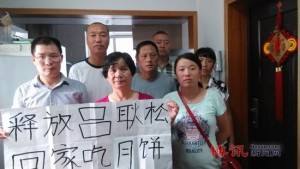
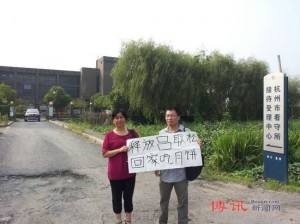
Release did not buy him peace. The UN Working Group's opinion records that after his 2011 release, police harassed, intimidated and briefly detained him because of his continuing pro-democracy activities; his home was searched repeatedly, computers and documents confiscated, and he was kept under close surveillance. Front Line Defenders' case history gives a cumulative figure: over the years, at least eight of his computers were seized by the authorities. In March 2013 his wife traveled to Beijing to petition the National People's Congress — over a forced-demolition grievance — and was detained there; Hangzhou police then came to Lü's door and pressured him to make his wife leave Beijing, and he refused. In July 2013 his daughter was prevented from boarding a flight to Hong Kong at Hangzhou Xiaoshan Airport; he told Radio Free Asia that this was because of his own political activities — a daughter's freedom to travel had become one more lever against the father. In November 2013 he was taken away again, his home searched and his computers confiscated, on suspicions similar to those that followed. From February to July 2014 the authorities restricted his movement and kept a constant watch outside his home. The net closed gradually: first correspondence and exit, then movement and home, and finally the person himself.
7. 7 July 2014: the second arrest
At about 8 a.m. on 7 July 2014, Hangzhou state security officers surrounded Lü's home, entered and searched it, and confiscated a computer and a mobile phone; that evening he was taken to the Hangzhou City Detention Center and criminally detained on suspicion of subversion of state power. The search inventory in the UN Working Group's opinion is more specific: more than twenty officers searched the home and seized seven computer hard drives, six USB drives and five mobile phones. At 2 p.m. on 8 July, officers from the Caiyuan police station and state security delivered the formal detention papers to Wang Xue'e. For the first weeks his lawyer was refused access to him — cases classified as endangering state security could then be used to justify denying lawyer visits. According to the source material recorded in the Working Group's opinion, because the charge fell into the state-security category, he was denied even the ordinary safeguard of seeing counsel within forty-eight hours. On 13 August 2014 he was formally arrested for subversion of state power under Article 105, paragraph 1 of the Criminal Law — one grade above the "inciting subversion" of paragraph 2 used in the first case: no longer inciting others to subvert, but organizing, plotting and carrying out subversion itself. And the acts of "carrying out," as the Working Group summarized the verdict, were these: he had published numerous articles on overseas websites, and he had gathered together members of the Zhejiang Committee of the China Democracy Party. Writing and meeting — that was the "subversion" in the judgment.
8. Indictment, postponement, and the trial of 29 September 2015
Between April and August 2014, besides Lü, Hangzhou police summoned or detained six other members of the China Democracy Party's Zhejiang organization — the arrests came in batches, and the cases of Lü and his party colleague Chen Shuqing were the heaviest of them. Chen was taken in September 2014, in part precisely because he had documented and published the fact that Lü was being denied access to his lawyer in detention: the man who recorded a procedural violation committed against someone else went into a detention center himself. Both cases were indicted on 17 February 2015. The court first set a trial date of 23 July 2015, then postponed it without any explanation to the lawyers or the families. On 29 September 2015 the Hangzhou Intermediate People's Court tried the two cases separately on the same day — Chen's in the morning, Lü's in the afternoon, each lasting roughly two and a half to three hours. Both men pleaded not guilty. According to Radio Free Asia's reporting, relayed by the Independent Chinese PEN Center and Human Rights in China, when Lü began reading his defense statement in court, the presiding judge interrupted him and forbade him to finish, on the ground that its content endangered state security; the defense's request to call witnesses was also refused. Each defendant's wife was allowed to attend her own husband's hearing; other supporters were kept outside. The court announced it would deliver its verdicts on a later date — and that "later date" made the two men wait nearly nine more months.
9. 17 June 2016: eleven years, upheld on appeal
On 17 June 2016 the Hangzhou Intermediate People's Court delivered its verdicts separately: eleven years for Lü Gengsong, ten and a half years for Chen Shuqing. Both rejected the verdicts. The "crimes" found by the court, pieced together from the reporting of the Committee to Protect Journalists, Radio Free Asia and the New York Times, consisted of the following: Lü had published a series of articles on overseas Chinese-language websites exposing corruption and organized crime; he had reported the trials and sentencing of rights activists; in October 2013 he had co-signed the open letter opposing China's seat on the UN Human Rights Council; and he had taken part in gatherings of Democracy Party members and in a condolence event. No violence. No weapons. No money trail. No identifiable person concretely harmed by any of these writings. Eleven years corresponded to words, a signature, and meetings. On 1 November 2016 the Zhejiang Provincial High People's Court dismissed the appeal and upheld the verdict — and the UN Working Group noted pointedly that his lawyer had not been permitted to meet him or to attend the appeal proceedings. After sentencing, Chen Shuqing was sent to Qiaosi Prison in Hangzhou to serve his term; Lü was sent to Changhu Prison in Huzhou. By the day of sentencing he had already been locked up for nearly two years since his seizure in July 2014, and more than eight months had passed since the September 2015 trial. From arrest to a final judgment took twenty-three months, most of them spent by the defendant waiting in a detention center cell.
10. Changhu Prison: collapsing health and a denied medical parole
During the eleven years of his second term, Lü's body gave way. The conditions listed in the UN Working Group's 2019 opinion, on the basis of source material, were: diabetes, high blood pressure, heart disease, and necrosis of the gallbladder with gallstones, along with oral ulceration that cost him teeth; because the prison food was poor and his damaged teeth made eating difficult, he lost a great deal of weight. The prison had planned gallbladder surgery for him; it was never performed — reportedly a prison doctor recommended postponement because the gallbladder still partly functioned. His requests for medical treatment outside prison were not approved; only his medication for blood pressure and diabetes was consistently supplied. In 2017 his lawyer applied for medical parole on the grounds of his diabetes, hypertension and failing gallbladder; the application was denied. In May 2021 prison authorities in Zhejiang informed his family that prisoners who had not pleaded guilty would be subject to stricter controls, and that Lü was among them; the family reported at the same time that his physical and mental condition was poor and that he had lost most of his teeth. After a visit on 22 May 2021, Wang Xue'e told the Committee to Protect Journalists that he looked fragile, had lost a large amount of weight, that many of his teeth had fallen out and that he could not handle the cold; apart from his diabetes and blood-pressure medication, doctors refused to examine him further, let alone treat anything else. Without proper examinations, she said, the family could not even tell what was wrong with him.
The other face of his treatment is set out in detail in the UN Working Group's opinion, which notes that the Chinese government did not rebut these specific prima facie allegations in its reply: because he refused to admit guilt, he was at first kept under constant monitoring, his shoes were confiscated at night to restrict his movement, he was exposed to the cold with only a thin blanket, his family was initially not allowed to give him clothing or food, he was deprived of reading and writing materials, and he was blocked from spending his own money on daily necessities; those restrictions were later eased. This archive grades that passage as it stands in the source: allegations submitted to the United Nations, not denied by the government, and not independently verified. One fact, however, is corroborated by multiple sources: medical parole was refused, and he served all eleven years, ill, without a single day's reduction.
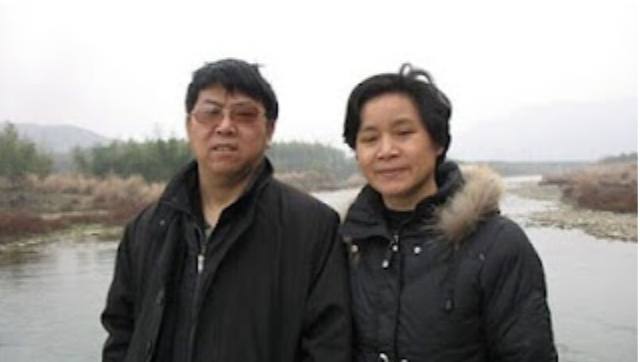
11. "Help me" inside a mask in 2023, and release at the end of the full term in 2025
On 18 March 2023 Wang Xue'e made her monthly visit to Changhu Prison. The meeting took place through glass, by telephone; an officer stood beside Lü, and an officer stood beside her as well — a point the open letter subsequently sent by the Independent Chinese PEN Center, PEN America and PEN International to the director of the Zhejiang Prison Administration stressed, because other prisoners' families did not receive this doubled escort. During the visit, Lü turned over his mask. Inside it were written three Chinese characters: "Save me" — "help me." When his wife asked what was wrong, the telephone line suddenly went silent; only after the officers spoke to each other by mobile phone was the call restored. Lü told his wife that an officer in Changhu Prison's No. 6 section (the PEN letter names Zhang Fan, a deputy head of the section; another source gives the name as Yang Fan — see Section 13) had, without warning, thrown into the trash the hot-water bag, hot-water bottle and blanket he used to keep warm at night, and he believed this was deliberate harassment that violated his right to health. Ten days later, on 28 March, the prison stopped his monthly family visits; according to Radio Free Asia, visiting rights were suspended for three months on the ground that by asking his wife for help he had violated the visiting rules. Wang Xue'e complained twice to the Zhejiang Prison Administration and received no response of any kind. In December 2023 she told the Committee to Protect Journalists that he was fine physically and that she was allowed to visit once a month — that "fine" is archived alongside the earlier record, without reconciliation. On 6 July 2025 the eleven-year term expired and Lü Gengsong walked out of Changhu Prison, aged sixty-nine; adding the two terms together, he had spent fifteen years of his life in prison. Release was not the whole of freedom: according to ChinaAid's bulletin of 10 July 2025, the authorities temporarily relocated him and his wife to a rural residence in Lin'an, Hangzhou, isolated from friends and the outside world in order to "avoid" public attention. Where he has been since, how his health is, and whether he remains under surveillance are matters of no reliable public record within the scope of this archive's search, and are recorded here as such.
12. The international record and response
Lü Gengsong's case is among the most completely documented of any Chinese speech case. In 2007 the Writers in Prison Committee of International PEN issued a rapid-action appeal, and Chinese Human Rights Defenders submitted his wife's questionnaire to the UN Working Group on Arbitrary Detention. The Committee to Protect Journalists condemned the arrest in 2007 and the closed trial in 2008, and continued through to its demands for release in 2016 and for immediate release with medical care in 2021. The Congressional-Executive Commission on China translated and published the full texts of his first case's trial judgment and appeal ruling, and has carried his case in its Political Prisoner Database ever since. U.S. State Department cables from 2007 recorded in detail the thousand-signature letter, the family's campaigning and the lawyers' engagement — cables since made public, and evidence that the United States government tracked this case at the diplomatic level from the start. On 21 November 2019 the UN Working Group on Arbitrary Detention adopted Opinion No. 76/2019: the deprivation of liberty of Lü Gengsong and Chen Shuqing contravened multiple articles of the Universal Declaration of Human Rights and was arbitrary under categories I, II, III and V; the Working Group requested the Chinese government to release both men without delay and to accord them an enforceable right to compensation, and it referred the case to the UN Special Rapporteur on torture. China's reply arrived twenty-two days late; neither man was released a single day early. The New York Times, Reuters and Agence France-Presse reported the case at its key junctures in 2007, 2008 and 2016. PEN America carried him in its Writers at Risk database and, after his release in 2025, updated his status to "released." The limits of the response are archived with equal honesty: within this archive's search, no dedicated statement by Amnesty International or Human Rights Watch on this individual case could be found — both organizations' annual reporting on China routinely condemns the imprisonment of dissidents on subversion charges, but a case-specific action document for Lü Gengsong is a matter of no public record we could cite. The response did not change his fate. What it changed is the speed of forgetting.
13. Discrepancies and unverified items, archived in parallel
Under this archive's rules, the discrepancies among sources in this case are listed without merging. (1) The written form of his wife's surname: the Chinese text of the PEN centers' 2023 open letter uses two different surname characters for her within a single document; the profile in The Opposition uses one of them; English-language sources uniformly write Wang Xue'e. This archive's text follows the English transliteration and the majority of Chinese renderings as Wang Xue'e, and preserves the variant here without presuming to settle it. (2) The name of the offense in the second conviction: the detention notice, the indictment and the trial reporting (Human Rights in China, the English service of Front Line Defenders, the UN Working Group's opinion) all give "subversion of state power" under Article 105, paragraph 1, and the eleven-year sentence corresponds to that paragraph's sentencing band of ten years or more for ringleaders and those whose crimes are major; but the Chinese Wikipedia, the Chinese service of Front Line Defenders and ChinaAid's English bulletin render the conviction as "inciting subversion of state power." This archive adopts subversion as its main text and archives the variant. (3) The date of the first appeal ruling: the CECC's published translation and Human Rights in China's link directory give 7 April 2008; the Chinese Wikipedia gives 14 April; this archive writes "April 2008" and preserves both. (4) Whether the second sentence carried an additional five years' deprivation of political rights: this appears only in The Opposition's profile of Lü and in the introduction to its interview with him, with no second source; it is marked unverified and excluded from the sentence as stated in the main text. (5) The name of the officer in the 2023 harassment episode: the joint open letter of the three PEN centers gives Zhang Fan, deputy head of Changhu Prison's No. 6 section; The Opposition's profile gives Yang Fan; both are archived. (6) Graduation year: most sources give 1983, from Hangzhou University's history department; a few retellings give 1982; this archive follows the majority. (7) The teaching institution: the brief supplied to this archive said a Zhejiang radio and television university; every source checked gives the Zhejiang Higher Professional School of Public Security; the brief's version is unsupported and has been corrected. (8) Position: the title "chairman of the Zhejiang Committee of the China Democracy Party" appears only in party-linked publications; institutional sources mostly describe him as an active member or a member of the Zhejiang Committee, and the main text follows the latter. (9) His wife's December 2023 remark that he was "fine physically" coexists with the 2021–2023 record of deteriorating health; the two may reflect different moments or a family's outward phrasing, and this archive preserves both without reconciliation.
14. Verification and sources
The core facts of this entry were cross-checked against the following independent sources: the Committee to Protect Journalists' prisoner file and its statements over the years (the 2007 arrest and the questioning of his wife; the closed trial of 22 January 2008 and the 5 February 2008 sentencing; the 2016 sentence; the 2017 denial of medical parole; the wife's account of his health in May 2021; the three-month suspension of visits after the March 2023 mask episode; the December 2023 visit; the place of imprisonment at Changhu); UN Working Group on Arbitrary Detention Opinion No. 76/2019 (the 2014 search inventory; the formal arrest date; the indictment of 17 February 2015; the interrupted defense statement at trial; the dismissal of the appeal on 1 November 2016 with counsel barred from meeting him or attending; the family's exclusion from visits until December 2016; the health and treatment details; the finding of arbitrary detention and the demand for release and compensation); the full translation and analysis of the appeal judgment published by the Congressional-Executive Commission on China (detention on 24 August 2007; arrest on 29 September; the content of the first-instance judgment; the confiscated hard drive); the case materials of Human Rights in China and Chinese Human Rights Defenders (the refused bail application; the pressure against petitioning and the job threat; the nineteen articles and four hundred seventy words; the refusal to sign on release and the withheld diaries and manuscript; the conduct of the 2015 trial); Radio Free Asia's reporting from 2007 to 2023 (the daughter's blocked departure in 2013; the 2015 trial; the 2016 sentencing; the 2023 suspension of visits); ChinaAid's July 2025 bulletin (release on 6 July at the end of the full term; the Lin'an relocation); the April 2023 joint open letter of the Independent Chinese PEN Center, PEN America and PEN International to the Zhejiang Prison Administration (the full account of the 18 March 2023 visit, the "help me" mask, the unanswered complaints); PEN America's Writers at Risk database (his status as released in July 2025); U.S. State Department cables from 2007 (the thousand-signature letter; the family's situation); and reporting by the New York Times, Reuters and Agence France-Presse at the case's turning points. The Chinese Wikipedia and The Opposition's profile were used for leads and comparison only, and every formulation resting on them alone is marked in the text or in Section 13. Evidence grading: both arrests, both sentences, both appeals, the places of imprisonment, the denial of medical parole, the 2025 release and the Lin'an relocation are each corroborated by two or more sources and are graded verified; the treatment details in Section 10 are graded as source allegations and labeled as such; the additional five years of deprivation of political rights, the chairmanship, and certain individual dates are graded unverified or archived as discrepancies. No single source is quoted at more than fifty words; the text is a synthesis in this archive's own words.
15. Our Take
Our comment on this case is confined strictly to its own facts. First, the number this case should be remembered by is four hundred and seventy. The first four-year sentence rested on four hundred and seventy words excerpted from nineteen articles. The second sentence — eleven years — rested, as written in the judgment, on articles, meetings, and a signature on a letter opposing China's seat on the UN Human Rights Council. A history teacher who once taught at a police college received fifteen years in total, across two cases, in exchange for that. Second, procedure in this case never functioned as protection: the first time, a closed three-hour trial and a family barred from visiting; the second time, a lawyer kept away for weeks after the arrest, a family kept away for two and a half years, a defendant stopped mid-sentence in court for "endangering state security" with his own defense, and an appeal heard without his lawyer in the room. When the defense itself is treated as a danger, what remains of a trial is the reading aloud of a conclusion written in advance. Third, the denial of medical parole is the coldest page of this file: diabetes, hypertension, heart disease, a necrotic gallbladder, teeth gone, weight collapsing — the lawyer applied through the lawful channel, and the prison refused with a paper. Because he would not confess, he was placed on the strict-control list, and at night even his shoes were taken away. The door the law leaves open for the sick was, for a man who would not plead guilty, welded shut. Fourth, the collective punishment runs through all eighteen years: a wife questioned, threatened with the loss of her job, and detained on a petitioning trip to Beijing; a daughter stopped at an airport; and on the day of release, husband and wife delivered together to a nameless rural address in Lin'an. The sentence named Lü Gengsong; it was executed on his whole family. Fifth, the manner of his release says everything by itself: the first stop for a man who had served eleven full years was not home, but an isolated temporary residence, and the reason was fear that the public might pay attention. A regime that fears being seen in the company of a sixty-nine-year-old man with a ruined body and a handful of teeth is not afraid of strength. It is afraid of memory itself. This archive preserves his name, those four hundred and seventy words, the three characters inside the mask, and the addressless lodging in Lin'an — together, in the record: as long as the record stands, forgetting will not come so easily.