
第159案 | 梁國雄Case 159 | Leung Kwok-hung
梁國雄,香港人叫了近五十年的「長毛」:女佣的兒子,1979年第一次入獄,抬棺材、穿捷古華拉T恤抗爭半生,2004年被選民以六萬票送進立法會,2017年被人大釋法後的訴訟追溯取消議席,2020年11月剛在終審法院贏了男囚犯剪髮的平等官司,四十天後就在國安法大搜捕中被捕。他不認罪、受審、罪成,2024年11月19日因一場六十一萬人投票的初選被判監六年九個月;法庭在判詞裏以他的刑事紀錄為由,拒絕把他一生為基層的工作算作減刑理由。2026年2月上訴被駁回,他仍在獄中,他創立的社民連已在他缺席時解散。Leung Kwok-hung — 'Long Hair', as Hong Kong has called him for nearly fifty years — is an amah's son who was first jailed in 1979, spent a lifetime protesting with a mock coffin and a Che Guevara T-shirt, and was sent into the Legislative Council by 60,925 voters in 2004. Beijing's 2016 interpretation of the Basic Law was used to strip his seat retrospectively in 2017; in November 2020 he won a sex-discrimination case over prisoners' haircuts at the Court of Final Appeal, and forty days later he was arrested in the National Security Law dawn raids. He pleaded not guilty, stood trial, and on 19 November 2024 was sentenced to six years and nine months for a primary election in which 610,000 people voted — the court refusing, because of his criminal record, to count his life's work for the grassroots in mitigation. His appeals were dismissed in February 2026, he remains in prison, and the party he founded has been dissolved in his absence.
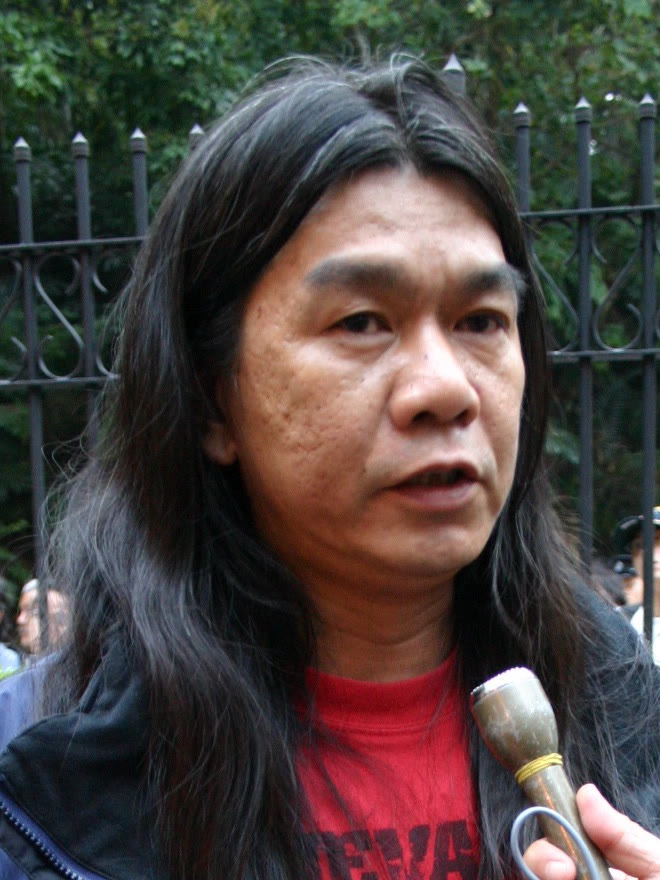
1. A childhood in Shau Kei Wan: an amah's son, first a Maoist, then a Trotskyist
Leung Kwok-hung was born on 27 March 1956 in Shau Kei Wan, Hong Kong, into a family that had come from Guangdong. When he was six his father left home. His mother worked as an amah — a live-in domestic servant — in a British household to keep the family going, and the boy was lodged with relatives in Shau Kei Wan who had seven children of their own, later moving into public housing in Chai Wan. He was educated at Clementi Secondary School. That upbringing is not archival decoration. The programme he carried for the rest of his life — a liveable minimum wage, a universal pension, welfare for the poor, taxes on speculation and on conglomerates — can be traced back to that crowded borrowed room. By his own account, his political awakening came from the Cultural Revolution and Hong Kong's 1967 riots. As a teenager he joined the Maoist student movement; he and his mother both belonged to the Hong Kong Federation of Trade Unions, then the pro-communist left-wing union federation. The fall of Lin Biao and then of the Gang of Four shattered the Maoist ideal for him, and under the influence of older activists such as Ng Chung-yin he moved to Trotskyism. In 1975, aged nineteen, he co-founded the Revolutionary Marxist League. A young man who had once believed in Mao spent the next half-century standing opposite the regime in Beijing — a trajectory that, like that of many Hong Kong activists of his generation, begins in disillusion.
His record of protest starts long before his legislative career. After Beijing's April Fifth movement of 1976 he took part in solidarity protests and was arrested repeatedly. In 1979 came his first prosecution, over protests for the Yau Ma Tei boat people; later that year he was charged over a protest in Victoria Park and jailed for a month for unlawful assembly. On release he worked as a construction worker from 1981 to 1986, then as an overnight vehicle cleaner for Kowloon Motor Bus. In the late 1980s, as the Revolutionary Marxist League wound up, he built the group known as April Fifth Action, named directly for the 1976 movement. The group became known for aggressive civil disobedience: when state leaders visited Hong Kong or official ceremonies were held, April Fifth Action turned up carrying a mock coffin, which became its trademark prop. In 1989 he supported the Tiananmen protests and was a member of the Hong Kong Alliance in Support of Patriotic Democratic Movements of China. According to his published biographies, the mainland authorities denied him a Home Return Permit after 1989; he set foot on the mainland only twice thereafter, in about 2003 travelling with his mother and in 2005 with a delegation of legislators. The hair, too, dates from those years as his public image. A persistent legend says he vowed not to cut it until Beijing apologised for Tiananmen; he has denied that story repeatedly — and this archive records both the legend and the denial, and adopts neither as fact beyond that.
2. From the street to the chamber: 60,925 votes send "Long Hair" into LegCo in 2004
Leung first stood for the Legislative Council in New Territories East in 2000, won 18,235 votes, and lost. The same year, he and fellow activist Koo Sze-yiu were prosecuted for shouting from the Legislative Council's public gallery and disrupting a meeting, and were jailed for 14 days — on the published record, the first dissidents to be jailed in Hong Kong after the 1997 handover. In 2003, the year half a million people marched against Article 23 national security legislation, he challenged the pro-Beijing incumbent Choy So-yuk in a District Council race and lost by only 284 votes. In 2004 he ran for New Territories East again and won with 60,925 votes, more than three times his 2000 tally. The swearing-in told the city who had arrived: while other members wore suits, he wore a T-shirt with Tiananmen Square on the front and Che Guevara on the back, a black wristband on his left wrist in memory of those killed in 1989, and added his own words around the oath — demanding vindication for the Tiananmen dead, the release of political prisoners and an end to one-party rule, and shouting for democracy and for the people. A judge had warned him beforehand that altering the oath itself would bar him from office, so the protest was wrapped around the oath rather than written into it. The legislature had acquired a member it would have to get used to.
In 2005, during the protests against the WTO ministerial conference in Hong Kong, he was injured and arrested with some 900 demonstrators; like almost all of those rounded up, he was released shortly afterwards and not prosecuted. On 1 October 2006 he co-founded the League of Social Democrats with legislator Albert Chan and radio host Wong Yuk-man. The LSD stood on the radical left of the pro-democracy spectrum: against government-business collusion, for grassroots welfare, fighting inside and outside the chamber at once. He was re-elected in New Territories East in 2008, when the LSD briefly held three seats and ranked as the camp's third party. That July, when legislators organised a visit to the Sichuan earthquake zone, his travel arrangements were refused at the last minute — Sichuan officials said internet reports suggested he planned activities unrelated to the trip's purpose. His reply was that people said the Olympics would open China up, and he thought it was going backwards. The Home Return Permit door had been essentially closed to him since 1989; even as a legislator on an official earthquake-relief visit, he could not pass through it.
3. Resignations, filibusters and the chairmanship: Long Hair inside the legislature
In 2010 Leung joined four other pro-democracy legislators in the Five Constituencies Referendum: all five resigned to trigger territory-wide by-elections as a de facto referendum on universal suffrage. He resigned in January 2010 and was returned for New Territories East in May with 108,927 votes. The pro-Beijing camp's boycott kept turnout low and the exercise failed in its object; the government then moved to plug the resignation "loophole" in law, and Leung joined Albert Chan and Wong Yuk-man in a filibuster of 1,306 amendments against the amendment bill — the opening act of the radical democrats' filibustering tradition. In 2011 Wong and Chan quit the LSD with hundreds of members over strategic disputes; Leung was the party's only legislator who stayed, and he took over as chairman, serving from 12 February 2012 to 21 February 2016. In the 2012 Legislative Council election he was re-elected in New Territories East with 48,295 votes. In 2013 he and his allies filibustered the Appropriation Bill with 710 amendments over 55 hours of debate, demanding a universal pension and a cash handout; the president finally cut the debate short. Across those years his legislative persona set hard: the Che Guevara T-shirt, bananas hurled in protest at officials, the mock coffin, the oath-day theatre — a political language his opponents derided as showmanship and his supporters read as refusal to compromise.
One scene from those years is usually left out of the caricature, and this archive restores it. On the night the Umbrella Movement erupted in September 2014, as students and Occupy Central launched the occupation and the crowd at Admiralty surged and wavered, Leung dropped to his knees in front of the protesters and begged them to stay. He told reporters afterwards that a long-term goal like true democracy required uniting everyone fighting for it and building a platform on which all could take part. Inside the movement he was criticised by more militant radicals for his doctrine of non-violence. The correction matters: the man famous for charging was, on questions of movement strategy, a believer in organisation and non-violence. It also explains his presence in the 2020 primaries — coordination, voting, and selecting the strongest slate by agreed rules was exactly the politics he believed in.
4. The hair case: he fought for his own hair to the Court of Final Appeal, and won
Long before the Hong Kong 47 case, Leung's name was written into Hong Kong's case law. In 2012 a magistrates' court convicted him of criminal damage and disorderly behaviour and sentenced him to two months; on appeal one criminal-damage conviction was quashed and the total fell to four weeks, which he served in June 2014 at Lai Chi Kok Reception Centre. On admission, the Correctional Services Department cut his roughly 80-centimetre hair under Standing Order 41-05, which required male prisoners' hair to be kept short while female prisoners could keep the style they arrived with. After his release he sought judicial review. The case climbed: the Court of First Instance found for him, the Court of Appeal reversed in the Department's favour, and on 27 November 2020 the Court of Final Appeal, in Leung Kwok Hung v Commissioner of Correctional Services ([2020] HKCFA 37), unanimously allowed his appeal. The judgment, written by Chief Justice Geoffrey Ma, held that the differential haircut requirement was direct sex discrimination under the Sex Discrimination Ordinance and violated the equality guarantee in Article 25 of the Basic Law; the Department's reliance on conventional standards of appearance did not hold up. The timing deserves to be fixed in the record: the final judgment was handed down on 27 November 2020, forty days before his arrest in the Hong Kong 47 case. A man about to be charged with subverting the state had just won, at the city's highest court, a case about his own body and dignity — and won it on the ground of equality. This is not an anecdote. It is a key to the structure of his life: his method, for fifty years, was always the same — refuse, and argue the point in court, in the street and in the chamber — and the system had, at least on the small matter of a haircut, conceded that he was right.
5. The 2016 oath and the 2017 disqualification: accepted by the clerk, undone retrospectively after Beijing's interpretation
In the 2016 Legislative Council election, Leung took the ninth and last seat in New Territories East with 35,595 votes, just 1,051 ahead of the defeated Christine Fong. At the inaugural meeting on 12 October 2016 he turned the oath into a protest platform, as he had at every swearing-in since 2004: he wore a black T-shirt bearing the words "civil disobedience", held an opened yellow umbrella inscribed with slogans including "ending one-party rule", held up a paper board marked "NPC 831 decision" with a cross through it, paused repeatedly while reading the oath, and tore up the paper bearing the 831 decision. The Clerk to the Legislative Council ruled his oath valid. The turn came through others. When the oaths of Youngspiration's Sixtus Leung and Yau Wai-ching were invalidated and challenged in court by Chief Executive Leung Chun-ying and Secretary for Justice Rimsky Yuen, the NPC Standing Committee on 7 November 2016 issued an interpretation of Article 104 of the Basic Law prescribing the manner of oath-taking; the pair were disqualified. On 2 December 2016 the government launched a second action against four more legislators: Leung, Nathan Law, Edward Yiu and Lau Siu-lai. On 14 July 2017, Justice Thomas Au of the Court of First Instance held (HCAL 223/2016 and related proceedings) that the four had, objectively viewed, failed the requirements of solemnity and sincerity and had therefore declined or neglected to take the oath; all four were disqualified from 12 October 2016 and could not retake it. His appeal was dismissed by the Court of Appeal on 15 February 2019 ([2019] HKCA 173). The Legislative Council then pursued the four for the salaries and allowances already paid to them; the Legislative Council Commission put the sums involved at roughly HK$2.7 million to HK$3.1 million per person.
The archival significance of this node is stated plainly. His manner of oath-taking in 2016 did not differ in substance from 2004 onwards — the same protest wrapped around the oath, accepted each time. What changed was not his conduct but a standard that arrived after the conduct, and litigation that applied that standard retrospectively to an oath already taken and accepted. Two other events complete his July 2017. In February he had tested a bid for Chief Executive through "civil nomination", requiring himself first to win 37,790 public nominations — one per cent of registered voters — before seeking the Election Committee's; on 25 February he withdrew with 20,234, saying that twenty thousand nominations with real personal particulars themselves proved civil nomination workable. Then, on 31 July 2017, seventeen days after his disqualification, District Court judge Alex Lee acquitted him in the ICAC's misconduct in public office case (DCCC 546/2016): the prosecution had alleged that, through Jimmy Lai's aide Mark Simon, he had received HK$250,000 from Lai without declaring it to the Legislative Council; the judge held the prosecution could not exclude the reasonable possibility that the money was a donation received on behalf of the LSD, and gave him the benefit of the doubt, while recording his suspicions about the conduct. The Department of Justice's statement of 1 February 2018 confirms that reasoning. In a single month he was retrospectively stripped of his seat and acquitted in a long-running criminal prosecution. Both halves belong in the record.
6. 2019–2020: stabbed, arrested, and a queue of protest cases
During the 2019 anti-extradition movement, Leung was among the oldest regular presences on the street. Two of the cases that later produced prison terms began that year. On 18 August 2019, after police authorised a rally in Victoria Park but banned the march, an estimated 1.7 million people drained out of the park in a "flow-style" dispersal that became a march across Hong Kong Island; Leung walked behind the banner with Jimmy Lai, Martin Lee, Margaret Ng, Albert Ho, Lee Cheuk-yan and Cyd Ho. On 1 October 2019 he took part in a banned National Day march. On 16 April 2020, while protesting outside Beijing's Liaison Office in support of legislator Dennis Kwok, then under heavy pro-Beijing attack, he was stabbed with a sharp object by an 81-year-old man; he was taken to hospital and discharged himself. The attacker was later tried; the magistrate's courtroom praise of the man for "loving society" drew controversy, and in October 2020 the attacker was jailed for three months and six days. Two days after the stabbing, on 18 April 2020, police arrested fifteen leading pro-democracy figures over the organisation, promotion or taking part in unauthorised assemblies between August and October 2019; Leung was one of them. His arrests accumulated through that year: he attended the banned Victoria Park Tiananmen vigil on 4 June 2020 and was charged; he was arrested on 6 September 2020 protesting the postponement of the Legislative Council election; and he was arrested again on 8 December 2020 over the 1 July 2020 protest against the National Security Law. Most of those cases then allowed him bail. But they were queuing, in order, on the road to 2021.
7. The 2020 primaries: the veteran of New Territories East makes his last run
On 11–12 July 2020 the pro-democracy camp held its "35+" primaries, and more than 610,000 people voted in a pandemic. Leung stood as the LSD's candidate in New Territories East — the constituency that had returned him four times since 2004. He was not an initiator of the primaries and not a coordinator. He was a candidate, and what he did had no new element beside his four previous campaigns: enter, canvass, debate, await the count. The primary was held eleven days after the National Security Law took effect. The court's later characterisation was that the open vote was a step in a scheme under which elected candidates would, by agreement, indiscriminately veto budgets and force the Chief Executive to resign. At his mitigation, his counsel put his position precisely: he should be placed in the "other participant" category because his involvement was not substantial, and letters from social workers, trade union officers and friends described his decades of work for the underprivileged and the grassroots. The court did not accept that placement; the arithmetic of conviction and sentence is set out in Section 10. One contrast is fixed here. In 2016, voters returned him to the legislature by a margin of 1,051 votes. In 2020 he was asking, through the primary, only to stand before voters once more. The election was then postponed and the system replaced; he has never appeared on a ballot again.
8. January 2021: a wedding, and the dawn arrest of 6 January
In the early hours of 6 January 2021, the Hong Kong Police Force's National Security Department deployed roughly a thousand officers and arrested 53 pro-democracy figures. Leung, then 64, was among them. He was released on bail on 7 January. That same month he did something forty-five years in the making: he registered his marriage to Chan Po-ying, his partner of forty-five years and his comrade in the Revolutionary Marxist League, April Fifth Action and the LSD. As the BBC and other outlets later recorded in their Hong Kong 47 profiles, the couple said openly that one consideration was that, if one of them were jailed, a spouse would hold fuller prison-visiting rights. About forty days after the wedding, the charge arrived. On 25 July 2021 Chan was elected chair of the LSD at a special general meeting; for nearly four years after that she ran the last pro-democracy party still holding street booths under the National Security Law while walking the prison-visiting road as a wife. An Associated Press profile in 2024 recorded the terms of those visits: fifteen minutes a day, through a plexiglass barrier, in a heavily guarded visiting regime. The archival point of this marriage is not romance. It is the concrete fact that a couple who had been together for nearly half a century had to write their relationship into a legal document, between an arrest and a charge, so that they could later speak for fifteen minutes through a screen.
On 28 February 2021 the 47 were charged with conspiracy to commit subversion, Leung among them, and remanded immediately. His bail applications then failed in sequence, and the nodes are fixed here. He remained in custody after the Chief Magistrate's bail proceedings of 4 March; he was refused again on 12 March; and on 29 March 2021 Justice Esther Toh of the High Court refused his application (HCCP 136/2021), in reasons published on 13 May 2021. Counsel Hectar Pun SC had submitted that Leung had complied fully with his reporting conditions since 7 January, that he had reported to the police station on 28 February knowing he would most likely be charged, that he was newly married and suffered from coronary heart disease, and that he would not abscond. The court was not satisfied that he would not continue to commit acts endangering national security if bailed; the reported reasons pointed to his determined opposition to the government and to the National Security Law, the foreign and international support behind him, and a high risk of reoffending. From that day he has not spent a single day out of custody.
9. Sentenced in relays on remand: eighteen months for 18 August, and a row of protest terms
While the Hong Kong 47 case waited for trial, the queue of 2019–2020 protest cases reached him first. On 1 April 2021 the District Court convicted him, with Jimmy Lai, Martin Lee and others, of organising and knowingly taking part in an unauthorised assembly in the 18 August 2019 case (DCCC 536/2020); on 16 April 2021 he was sentenced to 18 months' imprisonment, the heaviest term in that case. That outcome was later partly undone: in August 2023 the Court of Appeal quashed the "organising" convictions of seven of the defendants, Leung included — walking at the front of a march did not amount to organising it — while the "taking part" convictions stood; the prosecution's challenge to the organising acquittals was dismissed by the Court of Final Appeal in February 2024, and on 12 August 2024 the Court of Final Appeal dismissed the seven's final appeal against the taking-part convictions. On 28 May 2021 came sentence in the 1 October 2019 march case: he had pleaded guilty to organising and incitement counts and was sentenced to 18 months, to run with his other terms — contemporary reporting put the aggregate he then faced at 22 months — while telling the court in mitigation that although he pleaded guilty, he believed he had done nothing wrong. On 15 September 2021 the banned 2020 Tiananmen vigil case was sentenced: he had pleaded guilty to taking part in an unauthorised assembly and received six months, concurrent with the term he was already serving. On 16 October 2021 the 1 July 2020 protest against the National Security Law brought a further eight months. In March 2022 two weeks were added for a contempt conviction dating from his Legislative Council service. On 18 October 2022 his appeal, with seven other democrats, against conviction and sentence for breaching COVID gathering restrictions at the 2020 Labour Day protest was dismissed. These figures are set out one by one because they are half the picture of his present position: before the Hong Kong 47 sentence existed, he was already a man serving relay sentences for peaceful marches. The 81 months were added on top of that row. As to the precise totality — how the concurrent and consecutive elements and his remand time finally net out — the public sources contain no itemised account, and this page records that item as: no public record, rather than assembling an estimate of its own.
10. Trial, conviction and sentence: a 7-year starting point, 3 months off — how 81 months was reached
On 5 September 2022 Leung pleaded not guilty in the Hong Kong 47 case. The trial opened in the High Court on 6 February 2023 before the three designated judges — Johnny Chan, Alex Lee and Amanda Woodcock — sitting without a jury, and ran, with closing stages, to 4 December 2023; the appeal judgment records a trial of 118 days. On 30 May 2024 the court convicted fourteen of the sixteen defendants who had stood trial and acquitted two; Leung was among the convicted. Mitigation was heard in batches in the summer of 2024, and the Reasons for Sentence preserve his counsel's points: his involvement was not substantial and he belonged in the "other participant" category; mitigation letters from social workers, trade union officers and friends attested to his dedication to the underprivileged and the grassroots; and the court was asked to credit his positive good character and his contribution to the community. The court's answer is equally preserved: given his criminal record, it could not describe him as being of positive good character, and it could grant no discount for past contribution — while acknowledging that such credit had been given to him in the past.
Sentence was passed on 19 November 2024. Paragraphs 304 to 308 of the Reasons for Sentence ([2024] HKCFI 3298) record him as aged 68, a Legislative Councillor from 2004 to 2016, a radio programme host before his arrest, with 24 convictions involving 38 offences. For his role in the scheme the court adopted a starting point of 7 years (84 months); it gave 3 months for his ignorance of the law; and because he had been convicted after trial there was no plea discount and no further reduction. The result was 81 months — 6 years and 9 months. Counting this conviction itself, published tallies of his record by the end of 2024 stand at 25 convictions. Two juxtapositions in the arithmetic repay attention. First, the defence said his participation was slight and belonged in the lowest band; the court disagreed, and gave this candidate the same 7-year starting point as most candidates in the case. Second, the court imprisoned him for subversion while recording in the same document that his ignorance of the law merited a three-month reduction — the same quiet contradiction this archive noted in Claudia Mo's sentencing reasons, examined in Section 20. He had not pleaded guilty, and there was no letter of remorse from him; the mitigation letters were written by others, about a lifetime's work for the grassroots — and the court refused to count that work toward his sentence precisely because of the record that doing it had earned him. A man who had spent forty-five years protesting found his protest history read back to him as the reason his life's work could not mitigate. The judgment states that logic plainly, and this archive preserves it as written.
11. The prison years: a heart condition, fifteen-minute visits, and the hair he kept
He has been in custody continuously since 28 February 2021. The institution in which he is held is not stated in the public sources checked: no public record. The public material on his life inside is as thin as it is for all of Hong Kong's imprisoned dissidents, and what can be fixed is the following. First, health: in early May 2022 his wife told media that he had been making frequent trips to hospital from custody because of a heart condition, that his mental state had seen upheavals, and she dismissed rumours that he was seriously ill with COVID-19. There has been no further public health bulletin since, and this page does not speculate. Second, visits: the Associated Press's 2024 profile records that Chan Po-ying was permitted fifteen-minute daily visits, through a plexiglass barrier, under a heavily guarded regime. Third, the hair: the judgment he won at the Court of Final Appeal in November 2020 had declared the compulsory haircut rule for male prisoners unlawful; year-by-year detail of his hair in custody is not publicly reported, and this page does not invent it. Fourth, his voice: there is no published collection of prison letters or memoir from him; his public utterances survive only as courtroom positions — a not-guilty plea, an appeal — and the few sentences relayed by his wife (see Section 13). Beyond that, the sources checked contain nothing on his work assignments, disciplinary record, reading or religious life.
12. The appeal: heard in July 2025, dismissed on 23 February 2026
In December 2024 Hong Kong Free Press reported that Leung had filed appeals against both his conviction and his sentence in the Hong Kong 47 case. The appeals were grouped as CACC 253/2024, heard together with CACC 263/2024 and CACC 268/2024, and were argued before the Court of Appeal over four days, 14 to 17 July 2025; Leung was one of twelve appellants, listed in the proceedings as D41, the twelfth applicant. On 23 February 2026 the Court of Appeal handed down its judgment ([2026] HKCA 284): the conviction appeals of the eleven defendants convicted after trial were dismissed, the sentence appeals were dismissed, and the Department of Justice's appeal against the acquittal of Lawrence Lau was also dismissed, leaving his acquittal intact. Reuters and the Associated Press reported the ruling the same day: the appeal court upheld the trial court's characterisation of the primary scheme as one intended to paralyse the government and force the Chief Executive from office, and held that the trial court's sentencing starting points were not manifestly excessive. Outside the court, Chan Po-ying asked the question that wire services carried around the world, in nine words: "What crimes have they committed?" Amnesty International responded the same day that the dismissal was a missed opportunity to start restoring justice, and that none of the twelve appellants had committed an internationally recognised crime — that they were serving long sentences for exercising the rights to expression, association and participation in public affairs. Whether Leung has since sought leave to take the case to the Court of Final Appeal is not clearly reported in the sources checked as of verification, and this page marks that item unverified. His conviction and sentence stand, and he remains in prison.
13. The end of the LSD: dissolved on 29 June 2025, with his agreement given through a prison screen
On 29 June 2025, on the eve of the fifth anniversary of the National Security Law, Chan Po-ying held a press conference and announced the dissolution of the League of Social Democrats, the party Leung had co-founded in 2006. She said the decision arose from immense political pressure, taken after careful deliberation and with particular regard to the consequences for members and comrades, and that she could not elaborate further. Reporting of the announcement recorded that she had discussed the decision with Leung in prison beforehand, and that his wish was that the members stay safe. The LSD was, by then, the last pro-democracy party in Hong Kong still periodically holding street booths and small street protests; its dissolution, alongside the Democratic Party's move to disband the same year, was recorded by Reuters, the Associated Press and the British government's six-monthly report on Hong Kong as the end of the era of opposition parties in the city — the British report noting by name that LSD co-founder Leung Kwok-hung is serving six years and nine months. The chronology is left here without embroidery: in 1975 he helped found the Revolutionary Marxist League; in 2006 he co-founded the LSD; in 2025 the last party he built was wound up while he was in prison, and he could not attend its final press conference — he consented to its ending from the other side of a visiting-room screen. From 1975 to 2025 is fifty years: his organisational life was as long as his protesting life, and it ended outside a room he was not allowed to enter.
14. Family: Chan Po-ying — partner of 45 years, chair for the party's last four
The family record of this case is centred on Chan Po-ying. The two met around 1975 in the Revolutionary Marxist League and were together for forty-five years, comrades in April Fifth Action and in the LSD. Chan had been married before; she and Leung registered their marriage in January 2021, after his arrest by the national security police and before he was charged, with spousal visiting rights among the stated considerations (see Section 8). After he was remanded she took the chair of the LSD on 25 July 2021, kept its street booths running through the party's besieged final years, spoke for it, and stood outside courts in support. In the Associated Press's 2024 profile she said that 2021 had been suffocating — that after his bail was refused she would find herself crying, for no particular reason, on her commutes. In June 2025 she wound up the party he had founded. On 23 February 2026, after the appeal judgment, she asked her nine-word question outside the court. Beyond Chan, the public sources checked contain no reporting on the post-2021 circumstances of his other family — his late mother, relatives or any children — and this page records that item plainly: no public record. One structural fact is left standing: the marriage is, in law, a little over five years old, and in life it is fifty; and most of its legal lifetime has been spent as prison visits.
15. International response: condemnation at sentencing, and statements after the appeal
The international reaction to Leung's case has run mostly along the track of the Hong Kong 47 case as a whole, as recorded on this site's case page: on sentencing day, 19 November 2024, the US State Department condemned the sentences in strong terms, demanded the unconditional release of all 45 and announced new visa restrictions on Hong Kong officials; the British government said the sentences showed the National Security Law being used to criminalise political dissent; the European Union called them another unprecedented blow to fundamental freedoms in Hong Kong; the UN human rights office expressed grave concern; and Canada's foreign minister called the prosecutions and long sentences troubling. As an individual, he figures in the BBC, Associated Press and Agence France-Presse profiles of the 47 as the case's emblematic veteran — the former legislator who once described himself as a Marxist revolutionary, known for the yellow umbrella and the hurled bananas. The British government's six-monthly report on Hong Kong for January to June 2025 names him as serving six years and nine months. After the appeal dismissal of 23 February 2026, Amnesty International issued its statement (Section 12), and Reuters and the Associated Press reported the ruling the same day. None of it has shortened his sentence by a day. What this archive wrote in Claudia Mo's page holds here too: outside pressure does not move the calendar; only the legal process itself can change a prisoner's position — and his legal process, on 23 February 2026, completed its appeal stage.
16. Current status: in prison, with a projected — not an official — release date
As of this site's last verification, on 14 November 2026, the documented facts of Leung Kwok-hung's situation are these. He is serving the Hong Kong 47 sentence of 6 years and 9 months, his appeals against conviction and sentence having been dismissed on 23 February 2026. He has been in custody continuously since 28 February 2021 and has never been released in that time. The party he co-founded was dissolved on 29 June 2025. His wife continues to visit him and to speak publicly in Hong Kong. His health was last publicly reported in May 2022 — the heart condition and frequent hospital trips — with no bulletin since. The institution holding him is not publicly recorded. On release: neither the courts nor the Correctional Services Department has published an expected release date for him. Hong Kong Watch's Hong Kong Repression Monitor series, in its end-of-2025 update, projects March 2029 by expiry of sentence; this page registers that projection as single-source and unverified — remand credit, the sequencing of his other sentences, and the removal in principle of good-behaviour early release for national security prisoners under the 2024 Safeguarding National Security Ordinance all bear on the real date, and it cannot be reverse-engineered precisely from public material. His situation in one sentence: a seventy-year-old man who has protested for half a century is in prison for a primary election in which more than 610,000 people voted, on a sentence that runs to the threshold of the next decade.
17. Disputes and unverified material
This section logs what this site does not adopt, and why. First, the release date: the March 2029 figure appears only as a projection in Hong Kong Watch's Hong Kong Repression Monitor series, and a companion compilation in the same series says only "expected 2029". Both are projections, not official announcements; the main text registers them as such and states neither as fact. Second, the conviction count: the Reasons for Sentence of November 2024 record 24 convictions involving 38 offences; tallies that include the Hong Kong 47 conviction itself reach 25 by the end of 2024. The two figures belong to different dates and are logged in parallel, neither overwriting the other. Third, the story that he vowed never to cut his hair until Beijing apologised for Tiananmen is widely repeated, but he has publicly denied it on multiple occasions; this page records the legend and the denial and treats the legend as no more than that. Fourth, the founding year of April Fifth Action is given as 1988 in some sources and 1991 in others (1991 being the date commonly used in the group's party-lineage records); the main text therefore says "late 1980s", and the discrepancy is registered here. Fifth, the magistrate's praise of his stabbing attacker as a man who "loved society" is attested in The Standard and Hong Kong Free Press reporting; this page uses that attested formulation and does not reconstruct a fuller courtroom quotation. Sixth, scattered online claims about his present circumstances in prison — a named institution, cell arrangements, deteriorating health — are supported by no reliable public source and are treated throughout as unverified and excluded from the main text. Seventh, his wife's name appears in some English-language reporting as "Vanessa Chan"; this page uses the name under which she acts publicly, Chan Po-ying, and registers the variant here.
18. Full timeline
27 March 1956: born in Shau Kei Wan, Hong Kong, to a Guangdong immigrant family. Around 1962: his father leaves home; his mother works as an amah. 1975: co-founds the Revolutionary Marxist League. 1976: takes part in solidarity protests for Beijing's April Fifth movement; arrested repeatedly. 1979: first prosecution, over the Yau Ma Tei boat people protests; later that year jailed for one month for unlawful assembly over a Victoria Park protest. 1981–1986: works as a construction worker; from 1986, as an overnight bus cleaner for Kowloon Motor Bus. Late 1980s: builds April Fifth Action. 1989: supports the Tiananmen protests and joins the Hong Kong Alliance; thereafter denied a Home Return Permit (per published biographies). 2000: loses his first Legislative Council bid in New Territories East; jailed for 14 days with Koo Sze-yiu for disrupting a Legislative Council meeting. 2003: loses a District Council race by 284 votes. 1 October 2004: elected to the Legislative Council for New Territories East with 60,925 votes; swears his oath in a Tiananmen-and-Che-Guevara T-shirt. 2005: arrested in the anti-WTO protests, released without charge. 1 October 2006: co-founds the League of Social Democrats with Albert Chan and Wong Yuk-man. 2008: re-elected; in July, refused permission to join the legislators' Sichuan earthquake visit. January 2010: resigns for the Five Constituencies Referendum; 17 May 2010: returned in the by-election with 108,927 votes. 12 February 2012: becomes LSD chairman (to 21 February 2016); re-elected to LegCo the same year with 48,295 votes. 2014: stays at Admiralty through the Umbrella Movement; kneels to beg protesters to remain. 2016: narrowly re-elected with 35,595 votes; 12 October 2016: takes his oath holding a yellow umbrella and tearing up the "NPC 831 decision" paper; the oath is initially accepted. 7 November 2016: the NPC Standing Committee interprets Article 104 of the Basic Law. 25 February 2017: withdraws his civil-nomination Chief Executive bid short of the threshold. 14 July 2017: the Court of First Instance rules his oath invalid and disqualifies him, retrospectively to 12 October 2016. 31 July 2017: acquitted in the District Court of misconduct in public office. 15 February 2019: his disqualification appeal is dismissed by the Court of Appeal. 16 April 2020: stabbed outside the Liaison Office by an 81-year-old man. 18 April 2020: arrested with fourteen other pro-democracy figures. 27 November 2020: the Court of Final Appeal rules unanimously for him in the prisoners' haircut case. 6 January 2021: arrested in the National Security Law dawn raids; bailed on 7 January; marries Chan Po-ying the same month. 28 February 2021: charged with conspiracy to commit subversion, remanded, bail refused. 16 April 2021: sentenced to 18 months in the 18 August 2019 case (the "organising" conviction later quashed by the Court of Appeal in 2023; the "taking part" conviction upheld through the Court of Final Appeal in 2024). 28 May 2021: sentenced to 18 months in the 1 October 2019 march case. 15 September 2021: sentenced to six months, concurrent, in the Tiananmen vigil case. 16 October 2021: sentenced to eight months in the 1 July 2020 protest case. March 2022: two weeks added on a contempt conviction. 5 September 2022: pleads not guilty in the Hong Kong 47 case. 6 February – 4 December 2023: the Hong Kong 47 trial (118 days). 30 May 2024: convicted of conspiracy to commit subversion. 19 November 2024: sentenced to 6 years and 9 months (81 months). December 2024: files appeals against conviction and sentence. 29 June 2025: the LSD is dissolved under Chan Po-ying's chairmanship. 14–17 July 2025: the appeal hearing. 23 February 2026: the Court of Appeal dismisses his conviction and sentence appeals ([2026] HKCA 284). He remains in prison; no release date has been officially published.
19. Sources and verification
Principal sources for this page: the Court of First Instance's Reasons for Sentence, [2024] HKCFI 3298 (19 November 2024), paragraphs 304–308 and the accompanying sentencing summary (the D41 calculation, the 24 convictions involving 38 offences, the defence submissions and the court's refusal of a community-contribution discount); the Court of Appeal's judgment in CACC 253/2024, [2026] HKCA 284 (23 February 2026; applicant list and outcome); the Court of First Instance judgment of 14 July 2017 in the oath proceedings (HCAL 223/2016 and related cases, Justice Thomas Au) and the Court of Appeal's [2019] HKCA 173; the Court of Final Appeal in Leung Kwok Hung v Commissioner of Correctional Services, [2020] HKCFA 37 (27 November 2020, Ma CJ); the High Court's bail reasons in HCCP 136/2021, [2021] HKCFI 1227 (reasons published 13 May 2021); the Department of Justice statement of 1 February 2018 (the reasoning of the acquittal in DCCC 546/2016); the District Court record in the 18 August 2019 case, the Court of Appeal's August 2023 quashing of the "organising" convictions, and the Court of Final Appeal's dismissal on 12 August 2024 of the final appeal on the "taking part" convictions, as reported; Reuters reporting of the appeal dismissal of 23 February 2026 and of the LSD's dissolution on 29 June 2025; Associated Press profiles of the Hong Kong 47 (the fifteen-minute plexiglass visits; the marriage and its visiting-rights rationale) and its report of the LSD dissolution; the BBC's Hong Kong 47 profile (the self-described Marxist revolutionary; the wedding forty days before the charge); the British government's six-monthly report on Hong Kong for January–June 2025 (naming him as serving six years and nine months); Amnesty International's statements of 23 February 2026 (appeal dismissal) and 15 September 2021 (vigil-case sentencing); Hong Kong Free Press reporting of his appeal filing (17 December 2024) and of the haircut judgment (27 November 2020); Hong Kong Watch's Hong Kong Repression Monitor end-of-2025 update (release-date projection, registered as a projection only); and the English and Chinese Wikipedia entries for Leung Kwok-hung, Chan Po-ying and the League of Social Democrats (secondary compilations for biographical detail, used only where not contradicted by the sources above, with vote figures and dates cross-checked against reporting). Method: the sentence calculation was verified both ways between the full Reasons for Sentence and the court's sentencing summary (84-month starting point, 3 months off, 81 months); the disqualification date and its retrospective effect were checked against the oath judgment and Legislative Council records; the appeal outcome was cross-checked between the [2026] HKCA 284 judgment and Reuters' same-day report; the marriage timing was fixed by reconciling the BBC's "forty days before the charge" with the Chan Po-ying entry's January 2021 marriage. Single-source items are logged in Section 17. Last verified: 14 November 2026.
20. Our Take
Leung Kwok-hung's page reads differently from every other page in the Hong Kong 47 case, because he is the one defendant for whom protest was not an episode but a life's occupation — a first jail term in 1979, a final arrest in 2021, and a criminal record that grew across forty-five years to the 24 convictions the sentencing court counted. Where the other defendants' stories ask what happens when ordinary people are suddenly swept into a national security law, his asks a different question: how does a machine deal with a man it has been dealing with, unsuccessfully, for four decades? The record supplies the answer in procedural instalments. First, an interpretation from Beijing retrospectively invalidated his oath and took his seat. Then a relay of march cases put him through sentence after sentence while he awaited trial. Finally, a primary election gave him eighty-one months. Each step arrives in its own legal packaging. Laid end to end, they describe a man being stripped, layer by layer, of the street, the chamber and his liberty.
This site fixes, separately, one passage of the sentencing reasons. The defence laid before the court letters from social workers, trade union officers and friends describing his life's work for the underprivileged and the grassroots, and asked for the discount that past contribution to the community ordinarily earns. The court refused, because his criminal record meant it could not call him a man of positive good character. The logic of that sentence is worth reading slowly. He was asked to produce his "contribution" in mitigation — and his "record" is precisely the price list of having made it: the boat people, the Tiananmen vigils, the marches, each entered in the convictions column. The court did not say it did not know what he had done. It decided that the way he had done those things disqualified them from counting. So a man who spent forty-five years working for the grassroots stands in the sentencing document as a man with no good character and no community contribution to his name. The archive simply lays the judgment's own reasoning on the page, and lets the reader reach the conclusion.
Two further contrasts are, in this site's view, the spine of the page. On 27 November 2020 the Court of Final Appeal said, unanimously, that he was right: cutting his hair had been sex discrimination and a breach of his right to equality. Forty days later he was arrested for subverting the state. The same system vindicated his judgment at its highest level, and then took the man himself into custody on its gravest charge. And on 29 June 2025 the party he founded was dissolved in his absence, his wife reporting that his wish was for the members to stay safe; on 23 February 2026 her nine-word question outside the appeal court — what crimes have they committed? — stands as the shortest defence speech this case has produced. This site files that sentence with the whole record: born in Shau Kei Wan in 1956; first jailed in 1979; sent into the legislature by voters in 2004; stripped of his seat retrospectively in 2017; vindicated on the hair in 2020; arrested in 2021; sentenced in 2024 to six years and nine months for a primary election; appeal dismissed in 2026; still inside. Hong Kong has called this man "Long Hair" for nearly fifty years. The archive's duty is to make sure that readers fifty years from now can find out why he is there.
视频证据Video Evidence
《香港社民连七一前夕宣布解散,昔日民主派第三大政党成历史》(BBC News 中文)|2025|普通话新闻报道;梁国雄创立的社民连在其因47人案入狱期间解散"Hong Kong's League of Social Democrats Disbands Ahead of July 1" (BBC News Chinese) | 2025 | Mandarin news report; the party Leung Kwok-hung co-founded dissolved while he was jailed in the Hong Kong 47 case