
第124案 | 陈建芳Case 124 | Chen Jianfang
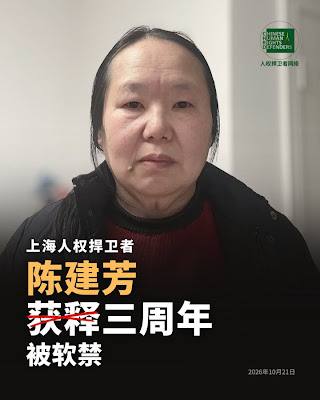
陈建芳(1970年1月23日生,上海浦东航头镇沉香村农民),因自家土地在2000年代初被征占走上维权路,被关黑监狱、于2010至2011年被劳动教养十五个月。她自2008年前后与曹顺利密切合作,要求民间社会参与中国普遍定期审议国家报告;2013年9月13日在广州白云机场被拦赴日内瓦同一培训,机票被撕,曹顺利同日在北京被带走、半年后死亡(拦截日期另有9月14日一说)。2018年3月14日她与李小玲共同获得第四届曹顺利人权捍卫者纪念奖。2019年3月14日,曹顺利逝世五周年,她发表纪念文章谴责当局不作独立调查;3月19日夜至20日,她与丈夫被上海警方从家中带走、强迫失踪,先被指定居所监视居住约两个月,其间自述被故意剥夺睡眠。正式逮捕(2019年5月22日,中方给联合国回复之说;另有5月23日说)与起诉(8月30日与9月3日两说)的日期和罪名在官方与律师消息之间反复变动,起诉阶段罪名作更重的颠覆国家政权罪。近两年她见不到自己预先委托的律师张磊,首次会见迟至2021年3月2日;3月19日开庭时她认不出张磊、要求由「真正的张磊」辩护,张磊退庭,案件在没有其选定律师的情况下审理。2022年8月5日,上海市第一中级人民法院以煽动颠覆国家政权罪判处她有期徒刑四年六个月、没收个人财产三万元、剥夺政治权利四年,判决所据包括参加国际培训、闵行街头横幅抗议与接受人权经费;上海市高级人民法院维持原判。2023年10月21日她刑满回家,出狱即被严密监视;联合国秘书长关于因与联合国合作遭报复的年度报告两度收录此案。Chen Jianfang (born 23 January 1970; a farmer of Chenxiang Village, Hangtou Town, Pudong, Shanghai) became a rights defender after her family's land was seized in the early 2000s; she was held in black jails and served fifteen months of re-education through labour in 2010-11. From around 2008 she worked closely with Cao Shunli for civil-society participation in China's Universal Periodic Review national reports; on 13 September 2013 she was stopped at Guangzhou Baiyun Airport en route to the same Geneva training — her tickets torn up — while Cao was seized in Beijing and died in custody (a parallel account dates the stop to 14 September). On 14 March 2018 she and Li Xiaoling received the fourth Cao Shunli Memorial Award. On 14 March 2019, five years after Cao's death, she published a tribute essay denouncing the absence of any independent investigation; on the night of 19-20 March 2019 Shanghai police seized her and her husband and disappeared them. She spent about two months under residential surveillance at a designated location, during which, by her own later account, she was deliberately deprived of sleep. The dates and labels of her formal arrest (22 May 2019 in the government's reply to the UN; a parallel account gives 23 May) and indictment (30 August versus 3 September) shifted between official and lawyer channels, and the indictment-stage charge was the heavier 'subversion of state power.' For almost two years she could not meet Zhang Lei, the lawyer she had retained in advance; her first meeting came only on 2 March 2021. At trial on 19 March 2021 she did not recognise Zhang Lei and demanded 'the real Zhang Lei'; he withdrew, and the case was tried without her chosen counsel. On 5 August 2022 the Shanghai No. 1 Intermediate People's Court sentenced her to four years and six months for 'inciting subversion of state power,' confiscation of RMB 30,000 and four years' deprivation of political rights, on evidence including international trainings, Minhang street banner protests and human rights funding; the Shanghai High People's Court upheld the verdict. She went home on completing her sentence on 21 October 2023 and was immediately placed under strict surveillance. The UN Secretary-General's annual reprisals reports included her case twice.
What Happened
The causal line in Chen Jianfang's case is unusually clear — clear enough that this page does not need to argue it, only to lay out the dates. She was a farmer in Pudong, Shanghai. Her family's land was seized in the early 2000s, and she became a petitioner. From petitioning for her own family she moved to petitioning for others, and then to working alongside Cao Shunli in Beijing on a single demand: that the Chinese government listen to civil society when it writes the national report it submits to the United Nations. In September 2013 the two women set out for the same training in Geneva. Cao Shunli was seized at Beijing Capital International Airport, reappeared in a detention centre five weeks later, and died in hospital six months after that. Chen Jianfang was stopped at Guangzhou Baiyun Airport, her ticket was torn up, and she was sent back to Shanghai the same day. That one interception split two lives in two: one woman died, and the other lived on and spent the next decade commemorating her.
On 14 March 2018, the fourth anniversary of Cao Shunli's death, Chen Jianfang and Li Xiaoling of Guangdong were named co-recipients of the Cao Shunli Memorial Award for Human Rights Defenders. One year later, on 14 March 2019, the fifth anniversary, she published a tribute essay denouncing the government's continuing failure to open an independent investigation into Cao's death, writing that she would turn her grief into a force to carry on Cao Shunli's unfinished work (the sentence as quoted on the CHRD case profile; see below). The same day, several UN independent experts issued a statement renewing their call for an investigation into Cao's death. Five days later, on the night of 19–20 March 2019, Shanghai police took her and her husband from their home. Her friends' last online contact with her was at 23:15 on 19 March; neighbours said about seven police cars stood outside her home on the morning of 20 March (CHRD case profile). For months afterwards, nobody knew where she was, what she was accused of, or whether she was alive.
The procedure that was later pieced together runs as follows. She was first placed under "residential surveillance at a designated location" for about two months — nominally a form of residential surveillance, in practice a secret, incommunicado place of detention — during which, by her own later account, she was deliberately deprived of sleep (CHRD case profile, updated 2023, reporting her account at a June 2023 meeting with lawyer Liu Shihui). The dates and labels of her formal arrest and indictment differ between the official version and the version her lawyer received; a full section below archives them side by side. The stable skeleton is this: she was formally arrested in late May 2019; in late August or early September 2019 the Shanghai No. 1 Procuratorate indicted her on a national-security charge and the case went to the Shanghai No. 1 Intermediate People's Court; she was held at the Shanghai Detention Center — a fact the outside world learned only in October 2019. From the night she was seized until 2 March 2021, a span of almost two years, she never once met the lawyer of her choice. The trial took place on 19 March 2021. Eleven days before it, she met Zhang Lei for the first time. Before the hearing, the court conveyed word that she "wished to dismiss" him; when Zhang Lei checked with her face to face, she said the man in front of her was not the "real Zhang Lei" she had retained — after two years of isolation, she could not recognise the lawyer she had engaged in advance by letter. Zhang Lei withdrew from the courtroom, and the case was tried without the defence counsel she had chosen (Front Line Defenders, trial report of 29 March 2021).
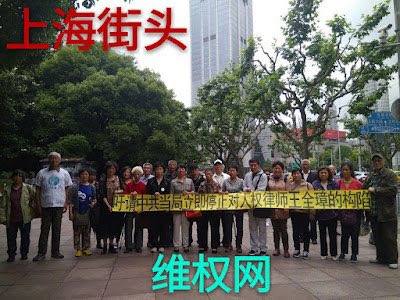
Another seventeen months passed. On 5 August 2022 the Shanghai No. 1 Intermediate People's Court delivered its verdict: guilty of "inciting subversion of state power," four years and six months in prison, confiscation of RMB 30,000 of personal assets, and four years' deprivation of political rights. The "evidence," as the judgment is reported, consisted of her participation in trainings run by international human rights organisations, banners and street protests in Shanghai's Minhang District, placards she made and carried, articles and photographs of the protests circulated online, and human rights funding she had applied for and received from international organisations (Front Line Defenders, verdict summary; Radio Free Asia, 1 December 2022, reporting the judgment's contents). The verdict stayed secret for an unusually long time: her family was extremely reluctant to reveal any information, her lawyer disclosed the sentence on social media only in late November 2022, and the exact sentencing date became public only on 16 June 2023 (CHRD case profile). The Shanghai High People's Court upheld the verdict on appeal. On 21 October 2023 she completed her sentence and went home — four years and seven months after she was taken. Release was not the restoration of freedom: in the first days back, her home was watched by plain-clothes agents and she was kept under strict surveillance (Front Line Defenders, 14 November 2023), and the four years' deprivation of political rights ran on. The sections below take each link of that chain apart and check it.
Beginning in Chenxiang Village: How a Farmer Became a Rights Defender
Chen Jianfang was born on 23 January 1970 in Shanghai and was a farmer, living in Chenxiang Village, Hangtou Town, Pudong New Area (CHRD case profile; Amnesty International Urgent Action UA 102/19 describes her as a farmer in Chenxiang Village). According to the detailed report published by Civil Rights & Livelihood Watch (Minsheng Guancha) on 2 April 2020, in 2005 the Shanghai authorities seized and demolished her family's land and home — the land the family lived on — without the family's signature and without lawful procedures, and no land compensation, resettlement or minimum livelihood guarantee had been provided since. A note on evidence levels: the details of the 2005 seizure rest, for now, on this one Chinese-language report; the CHRD and Front Line Defenders profiles say in general terms that she began defending rights after she and her family lost land without adequate compensation. The two layers agree in direction and differ in detail; this page uses the Minsheng Guancha version for detail, marked as single-source, and the multi-source general version as the established frame.
Her petitioning then ran for well over a decade. Amnesty International's urgent action summarises those years as relentless persecution: she was beaten by police and thugs, arbitrarily detained, and sentenced to fifteen months of re-education through labour (Amnesty International UA 102/19, 31 July 2019). The CHRD profile agrees: she was locked up in "black jails" — makeshift detention sites with no legal basis — and police held her for fifteen months in a re-education-through-labour camp in 2010–11 (CHRD case profile). The Minsheng Guancha report gives a fuller and heavier list: on 27 March 2009 she was beaten and injured — the injury was assessed as minor injury — by a man who said he had been sent by the Pudong New Area government, while she was handing out human rights survey forms, and the attacker was never brought to justice; over her years of activism she was given one year and three months of re-education through labour, was criminally, administratively and judicially detained nine times in total, was released on bail twice, and was kidnapped and illegally detained — held in black jails — at least three hundred times; officials even openly threatened her that she would be "run over by a car in the street" (Minsheng Guancha, 2 April 2020). Those figures — "at least three hundred times" above all — come from this one source; this page archives them as a single-source account, marked unverified, and does not present them as cross-checked fact. The layer beneath them — repeated black-jail detention and fifteen months of labour camp — is supported by two independent sources, CHRD and Amnesty International, and can stand.
To understand this early history, it helps to see what Shanghai's development model looked like at her doorstep. Her fellow defender Gu Guoping, a retired teacher, told Radio Free Asia that she began as a victim of forced eviction in her rural home area, came from an underprivileged background, and went from petitioning for her own rights to being a human rights activist (RFA, 1 December 2022). CHRD's award citation puts it most completely: starting from land and housing rights, she expanded her work to expose the systemic causes behind abuses, to defend vulnerable groups, and to push for civil-society participation in international human rights mechanisms and monitoring of the government's compliance (CHRD award announcement, 2018, and case profile). In other words, before the state prosecuted her for "subversion" in 2019, she had already done grassroots human rights work for well over a decade, and the state's way of answering her had been beatings, detention, black jails and a labour camp from the very beginning. The 2019 felony case was not a rupture; it was the peak of a fifteen-year curve.
Alongside Cao Shunli: Demanding a Civil-Society Voice at the UN
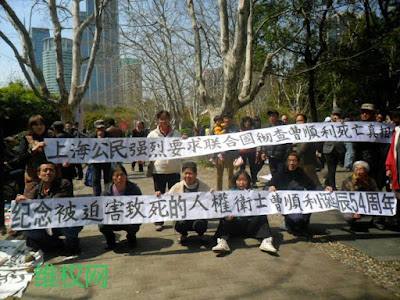
Chen Jianfang's collaboration with Cao Shunli began around 2008–09. CHRD records that about a decade before its 2019 profile she began working closely with Cao on advocating a role for civil society in China's national report for the country's first Universal Periodic Review, held in 2009; at that time the authorities refused to accept any such information from activists and retaliated against them instead (CHRD case profile). The Universal Periodic Review is the UN Human Rights Council's mechanism for reviewing every state's human rights record, and UN guidance asks governments to consult civil society when drafting their national reports. Cao Shunli fixed on that door in Beijing; Chen Jianfang did the same work in Shanghai. In June 2013 she and fellow activists took to the streets of Shanghai handing out copies of the UPR recommendations that UN member states had made to China in the 2009 review — carrying a Geneva document into the hands of Shanghai residents (CHRD case profile). According to that profile, some residents, on learning of the recommendations, expressed hope that more countries would encourage the Chinese government to improve its policies and practices.
This history matters because it determines how her case is classified in international law documents. Each year the UN Secretary-General reports to the Human Rights Council on reprisals against people who cooperate with the United Nations. Chen Jianfang's case is in that report — in the 2019 report (A/HRC/42/30, 2 August 2019), whose Annex II follow-up list includes her name, and again in the report of 8 September 2020 (the document list appended to the CHRD profile). In the UN's own filing system, in other words, she is not an ordinary "subversion" defendant but a person punished for trying to cooperate with the United Nations — a classification made not by advocacy rhetoric but by the Secretary-General's office. UN experts called Cao Shunli's case "deadly reprisals." Chen Jianfang's case is the surviving link of the same chain of reprisal: the same circle of people, the same issue, the same method — first stop the flight, then make the person disappear into detention.
One more element of her everyday work belongs here, so that she is not misread as an activist who only did "international advocacy." Front Line Defenders' profile says she worked at grassroots level for land and housing rights, helped vulnerable social groups and exposed the root causes of systemic abuses, while pushing for civil-society participation in international human rights mechanisms (Front Line Defenders case profile). The October 2019 joint statement describes her as a vocal advocate who used both public protests and litigation against social injustice in Shanghai (joint NGO statement, 21 October 2019). Protest and litigation, the street and Geneva, were two faces of one person's work. The verdict later wrote both faces into the "evidence": street protests were evidence, attending trainings was evidence, receiving funding was evidence. This section establishes the facts; the verdict section sets them side by side.
September 2013: The Torn-Up Ticket at Guangzhou Airport
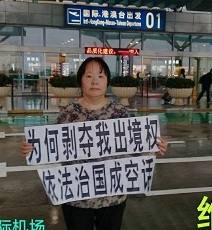
In September 2013 Chen Jianfang and Cao Shunli were invited to Geneva, Switzerland, for human rights training arranged by the International Service for Human Rights and partner organisations, and to observe a session of the Human Rights Council. Before departure she spoke about the trip on the phone and in group chats; her fellow defender Gu Guoping later judged that rights defenders' phones are monitored around the clock, that her talk of the trip was overheard by state security police, and that she was therefore intercepted in Guangzhou (RFA, 1 December 2022, quoting Gu Guoping — a fellow activist's judgment, archived at hearsay level). CHRD's profile records the interception in detail: she was stopped at Guangzhou Baiyun International Airport and prevented from boarding; she demanded that the airport security agents produce legal documents barring her from leaving the country, and they refused; they reportedly told her that the Shanghai police had told them to do it and that she was barred from travelling abroad for life; one officer threatened that they would resort to "armed violence" if she tried to force her way past security; another officer tore her plane tickets to pieces; when she protested the loss of her freedom to travel, airport police issued her an administrative warning for "disrupting public order" at the airport; she was then forcibly returned to Shanghai, where she was detained, interrogated for about ten hours, and closely monitored by police (CHRD case profile). The date of the stop is given as 13 September 2013 in CHRD's Chen Jianfang profile; in the framing in which the two women were stopped for the same journey — Cao Shunli seized on 14 September — a parallel account dates Chen's stop to 14 September as well. Both are archived; the text follows the dedicated CHRD profile's 13 September.
The Beijing end of the same interception ended far more heavily: Cao Shunli, seized at the capital's airport, disappeared for five weeks and was dead within six months (Case 120 on this site). Chen Jianfang was sent home to Shanghai, but the interception did not end there. In November 2013 — a week before the Human Rights Council election at which China would be voted onto the body for a second term — she disappeared again for a time (CHRD case profile; the length of that disappearance and the circumstances of her release are matters of no public record). On 19 September 2013 CHRD filed a dedicated submission to the UN about her treatment (CHRD document list). In October 2017 she was again prevented from travelling abroad, when she was to take part in a human rights forum in Ireland (CHRD case profile, single chain). From 2013 to 2017, "no exit" was a standing punishment imposed on her — it needed no judgment and no document ever had to be shown; a torn-up ticket at an airport was the entire procedure. This history explains why the authorities moved against her with full force in 2019: in the official file she was the Shanghai activist who had twice pushed at the Geneva door and who was closest to the woman who had died at that door.
2018: The Cao Shunli Memorial Award
On 14 March 2018, the fourth anniversary of Cao Shunli's death, Chinese Human Rights Defenders, Civil Rights & Livelihood Watch and the Human Rights Campaign in China announced that the fourth Cao Shunli Memorial Award for Human Rights Defenders would go jointly to Chen Jianfang and Li Xiaoling (CHRD announcement, 14 March 2018). The announcement introduced her as a Shanghai defender, aged forty-eight, who had engaged in human rights activism for a decade; the award recognises those who carry on Cao's grassroots advocacy in the face of threats and risks — promoting human rights, protecting vulnerable groups, pushing for civil-society participation in international mechanisms, and monitoring the government's implementation of its obligations (ibid.). Speaking to Radio Free Asia about Cao Shunli, she called Cao her spiritual teacher, said she had learned some of the highest ideals from her, and said her own rights work was indivisible from what Cao taught her (RFA, 1 December 2022, reporting her words to the station at the time of the award; paraphrased here, not quoted in full).
The award's place in this timeline deserves marking: it was both the summit of her standing and a measure of her risk. Gu Guoping told RFA that it was precisely the planned 2013 Geneva trip and the 2018 award that made her a thorn in the side of the Shanghai authorities (RFA, 1 December 2022, Gu's assessment, archived as such). One year later, on 14 March 2019, she published her essay marking the fifth anniversary of Cao Shunli's death — the date, the person commemorated, and the commemorator's own identity as an award recipient in Cao's name all stacked together in the final picture before the authorities moved.
14 March 2019: The Essay Marking Five Years Since Cao Shunli's Death
On 14 March 2019, five years after Cao Shunli died, Chen Jianfang posted a tribute essay online. In it she denounced the government's failure ever to set up a fair and independent investigation into Cao's death, and she wrote that she would use her grief as a force to carry on Ms. Cao Shunli's unfinished work and go on defending human rights until China achieves genuine freedom and democracy, never taking a break (the sentence as quoted, in excerpt, on the CHRD case profile; the full quoted sentence runs to fewer than fifty words). The same day, several UN independent human rights experts released a statement renewing their call for China to investigate Cao Shunli's death (CHRD case profile; OHCHR statement of 14 March 2019). Front Line Defenders and the other organisations that followed the case consistently identify the essay as the immediate background to her seizure: days after she posted it, she was taken (Front Line Defenders case profile; joint statement of 21 October 2019). This page keeps its wording strictly to what chronology and institutional assessment support: the essay was posted on 14 March, she was seized on the night of 19–20 March, five days later; "seized for the commemorative essay" is the shared assessment of the international organisations that documented the case, which this page adopts with attribution — but no public police document has ever acknowledged that motive, and the motive chain rests on the tightness of the timing and on institutional assessment, not on any fabricated documentary proof.
One detail is often missed: she was not taken alone. Her husband was seized the same night (Amnesty International UA 102/19; CHRD case profile). He was released on bail on 3 April 2019 (multiple sources agree). After his release their home was guarded by plain-clothes officers, and the authorities put pressure on her daughter and the neighbours not to speak publicly about her situation (Amnesty International UA 102/19; CHRD case profile). The family's silence was manufactured from the first week of the arrest — a fact that matters for understanding why the family later refused for so long to reveal even the verdict, as the family section below sets out.
Two Months of Designated-Location Surveillance: Deliberate Sleep Deprivation
Where she was taken remained unknown to the outside world for a long time. The form her first detention took is now known from her own later account: in June 2023, at a meeting with lawyer Liu Shihui before her release, she said that after being seized she was placed under "residential surveillance at a designated location" for two months, and that during that period she was deliberately deprived of sleep (CHRD case profile, 2023 update). Front Line Defenders' post-release update gives a matching timetable: she was placed under residential surveillance at a designated location — which the organisation expressly calls a form of incommunicado detention under Chinese law — until she was formally arrested (Front Line Defenders case profile, November 2023 update; that update dates the arrest to 23 May, layered below). The location of the designated site has never been disclosed; this page records it as a matter of no public record.
"Residential surveillance at a designated location" (RSDL) needs explaining, because it is the key to the first two months of this case. Under China's Criminal Procedure Law it is nominally a non-custodial measure; but in cases labelled as endangering state security, the police may hold a person at a police-designated site instead of their home, and may, citing the needs of the case, neither notify the family nor allow access to a lawyer. UN experts have long held that the system in effect legalises enforced disappearance. Chen Jianfang's case is a textbook instance of that criticism: a woman is taken from her home by police, and for two months her family does not know where she is, her lawyer's papers are refused at the door, and Amnesty International's urgent action of 31 July 2019 can only record that, four months after she was taken, the authorities had still given no reason for her detention and no word of where she was held (Amnesty International UA 102/19). Her allegation of deliberate sleep deprivation is recorded on this page at the level of the detainee's own testimony — she is the only eyewitness, and the detaining authority has published neither confirmation nor rebuttal. This page neither promotes her account to institutionally confirmed fact nor deletes it for want of corroboration: sleep deprivation leaves no marks, and it pairs precisely with the secrecy of RSDL, which is exactly why the system draws the criticism it does.
After the two months of RSDL came formal arrest and the detention centre. Only in October 2019 did the outside world learn that she was being held at the Shanghai Detention Center (CHRD case profile; Front Line Defenders urgent appeal of October 2019). From 20 March to October — a full seven months — her place of detention was blank to her family, her lawyer and the public. Front Line Defenders' appeal of 21 October 2019 is headed by the phrase "seven months incommunicado detention." That number is not rhetoric; it is a count of the days from 20 March to 20 October.
The Chain of Charges: From a "June Arrest" to the Indictment Label to the Verdict
The charge and the key dates in this case differ systematically across sources. This page's method, the same as in its Cao Shunli case, is to archive every version side by side — who said it, and when — and never to blend them into one clean story. The versions, in the order they surfaced: First, the version orally given to the lawyer — on 2 July 2019 Shanghai authorities orally informed Zhang Lei that Chen Jianfang had been formally arrested "on some date in June" on the charge of inciting subversion of state power; they would not tell the lawyer where she was held, nor the exact date of arrest (CHRD case profile). Second, the procedural version in the Minsheng Guancha report — she was arrested by Shanghai police on 22 May on suspicion of subversion of state power; on 30 August she was transferred, on the same charge, to the procuratorate for review and prosecution; in September the case was transferred to the Shanghai No. 1 Intermediate People's Court (Minsheng Guancha, 2 April 2020). Third, the version in the Chinese government's reply to the UN — on 19 August 2019 four UN Special Procedures wrote to the Chinese government about her arbitrary detention, enforced disappearance and denial of access to lawyer and family; the government replied on 10 October that she had been arrested on 22 May and indicted on 30 August (UN Special Procedures communications archive, as cited on the CHRD case profile). Fourth, the version the lawyer received in October 2019 — the Shanghai No. 1 Procuratorate had indicted her on 3 September on the heavier charge of subversion of state power, the case had been transferred to the Shanghai No. 1 Intermediate People's Court, and she was being held at the Shanghai Detention Center (CHRD case profile; Front Line Defenders' October 2019 appeal carries the same version). Fifth, the verdict version — the first-instance judgment of August 2022 convicted her of inciting subversion of state power (Front Line Defenders verdict summary; RFA, 1 December 2022; the updated CHRD profile states that the Shanghai High People's Court upheld the original verdict "on the charge of inciting subversion of state power"). The header of CHRD's case profile, however, still lists the charge as "subversion of state power" to this day — a header that was never updated to match the body of the page. This page records that internal inconsistency as it stands.
Two points in this thicket need singling out. First, the date of formal arrest: the government's reply to the UN and the Minsheng Guancha report both give 22 May, while Front Line Defenders' November 2023 release update writes that she was held under RSDL "until she was formally arrested on 23 May 2019" — one day later. This page takes 22 May as its main line (two earlier, independent sources) and archives 23 May as pending verification. Second, how the indictment date matches the procedure: the date 30 August is, in the government's reply, the day she was "indicted," while in the Minsheng Guancha procedural narrative the same date is the day the case was "transferred for review and prosecution," with the lawyer's information fixing the formal indictment at 3 September, on the subversion charge. One technically possible reading is that 30 August marks a transfer completed by the police or within the procuratorate and 3 September the procuratorate's formal filing with the court — two different procedural acts. But no indictment document is public, and this page does not present that reading as fact; it archives the three dates with their own procedural labels. What can be established as common ground is this: in the autumn of 2019 the case entered the Shanghai No. 1 Intermediate People's Court under a Criminal Law Article 105 national-security charge, and the charge as indicted was framed more heavily than the charge as finally convicted — the prosecution phase ran on the "subversion" wording of Article 105, paragraph 1, and the judgment came back down to "inciting subversion" under paragraph 2.
The difference between those labels is not word-play. Subversion of state power, for ringleaders or major offences, carries up to life imprisonment, and the joint statement of 21 October 2019 stressed that she stood indicted on a charge that could bring exactly that (joint statement of 21 October 2019; Front Line Defenders appeal). The same statement cited the UN Working Group on Arbitrary Detention's view that the Chinese authorities' frequent use of the "subversion" crime against peaceful dissent and rights advocacy is neither necessary nor proportionate (ibid.). From "inciting" up to "subversion" and back down to "inciting," the label rose and fell on paper while the woman's detention never changed: under whichever paragraph was written at the top of the file, she sat in the same detention centre, unable to see her own lawyer. That is why this page insists on layered archiving. Take only the final verdict version, and a reader would think this was an "incitement" case; lay the indictment-stage "subversion" framing beside it, and the full operation becomes visible — the ceiling of punishment raised to life, then "lowered," at judgment, to four years and six months.
Two Years Without Seeing the Lawyer She Chose
Before she was seized, Chen Jianfang did one thing that shows she had fully reckoned with the risk: she signed an entrustment letter in advance, engaging rights lawyer Zhang Lei to act as her defence counsel in the event of her arrest and prosecution (CHRD case profile; Front Line Defenders' trial report of 29 March 2021 confirms the letter's existence). That letter opened no doors for two years. The timeline: on 11 June 2019 Zhang Lei and several of her friends tried to visit her parents in Hangtou Town, Pudong, and were blocked by a young male relative who kept threatening to call the police; the elderly parents appeared worried about their daughter and afraid of involving lawyers, and the visitors judged that the parents might have been intimidated by police in the three months since her disappearance; as the group left, they found a police car parked outside. Zhang Lei then went to the Pudong Public Security Bureau to file his credentials as her counsel; after a call with the state-security department, the bureau refused to accept them; Zhang Lei filed a complaint with the bureau's petition office and applied to the Pudong Procuratorate to investigate the refusal (CHRD case profile). On 2 July 2019, at the same meeting at which the arrest was orally announced, the authorities rejected Zhang Lei as her counsel on the ground that the entrustment letter was signed but not dated, and therefore "invalid" (ibid.).
The experience of a second lawyer, Wu Li, completes the picture. Wu Li applied for a meeting and was not granted one. In early June 2020 she went to the detention centre and demanded a meeting; she was refused under an internal rule — attributed to the pandemic — that a lawyer may visit only once per investigation stage, and she was told that Chen had already had a visit from a lawyer at that stage, on 26 September. Who that lawyer was, nobody knows (CHRD case profile). This page's handling of that item: the 26 September visit exists only in the reason the detention centre gave for refusing Wu Li; the visitor's identity, the stage referred to and even the year are incomplete in the source, and the item is archived as it stands, uncompleted. It does not contradict the fact that she first met the lawyer of her own choosing only on 2 March 2021 — a visit by an unidentified lawyer is exactly the usual shape of a state-appointed arrangement — but this page has no evidence with which to draw that equation outright, and so sets the two facts side by side. In January 2020 her lawyers filed a formal complaint over the denial of meeting rights; by 2 April 2020, when Minsheng Guancha published, more than two months had passed with no reply at all (Minsheng Guancha, 2 April 2020).
Set this line next to the international reaction and the sequence sharpens. On 31 July 2019 Amnesty International issued Urgent Action UA 102/19: she had been held incommunicado since 20 March, denied access to her family and to a lawyer of her choice, at grave risk of torture and other ill-treatment; Amnesty named her a prisoner of conscience and demanded her immediate and unconditional release (Amnesty International UA 102/19). On 19 August 2019 four UN Special Procedures experts wrote to the Chinese government about her arbitrary detention, enforced disappearance and denial of legal help (UN Special Procedures communications archive, appended to the CHRD profile). None of those appeals produced a single meeting. Only on 2 March 2021 — the 713th day after she was taken — did she finally meet Zhang Lei at the Shanghai Detention Center (Front Line Defenders, March 2021 updates). What nearly two years without a lawyer does to a person facing a felony charge needs no embroidery from this page: she knew nothing of the case's progress, nothing of the outside world, nothing of her family. And the courtroom scene in the next sections — a defendant unable to recognise her own lawyer — is the direct product of those two years of isolation.
October 2020: The "Three-Year Sentence" That Never Happened
On 1 October 2020 her friend Liu Shihui posted on social media that he had received information that Chen Jianfang had been convicted and sentenced to three years in prison (CHRD case profile). The Rights Defence Network (Weiquanwang) reported on that basis that it had learned on 2 October that she had been secretly sentenced to three years for inciting subversion of state power, that the term would run until 18 February 2022, and that she was still held at the Shanghai Detention Center, the authorities never having allowed her to meet a defence lawyer (CHRD bulletin of 5 October 2020, relaying Weiquanwang and Liu Shihui). The report was widely republished by rights organisations at the time. This page must now state its nature plainly: it was an erroneous report, since falsified. The reason is a matter of hard chronology: the trial in this case took place on 19 March 2021 and the verdict on August 2022 — in October 2020 there had been neither a hearing nor a judgment, and a "three-year term ending 18 February 2022" cannot be fitted into the complete procedural chain that followed. This page's handling is not to delete the record but to archive it as a superseded erroneous report, with its source chain (Liu Shihui's post, then Weiquanwang, then CHRD's bulletin), its circulation, and the grounds of its falsification. In a case sealed by systematic secrecy — family ordered to be silent, lawyers unable to meet the detainee, the court publishing no notices — the outside world could only piece fragments together, and piecing them together wrongly is a by-product of that secrecy. Recording the error and marking it falsified is the archive's correct answer to secrecy; pretending the error never happened is what would distort the archive.
March 2021: "The Real Zhang Lei" in the Courtroom
On 2 March 2021 Zhang Lei met Chen Jianfang at the Shanghai Detention Center — her first meeting with the lawyer of her choice in almost two years (Front Line Defenders, March 2021 updates). Less than a week later, on 8 March 2021, the Shanghai No. 1 Intermediate People's Court informed Zhang Lei that Chen Jianfang wished to dismiss him. The court's message survives in two wordings across the sources, archived here in parallel: one account says she wished to dismiss Zhang Lei in favour of a government-appointed lawyer; the detailed trial record published by Front Line Defenders on 29 March 2021 says she wished to dismiss the man before her and to appoint "the real lawyer Zhang Lei" (Front Line Defenders, 29 March 2021). The common ground of the two versions is the important part: eleven days before the trial, and less than a week after the first meeting in two years, the court unilaterally conveyed a wish to dismiss that could not be verified on the spot.
Zhang Lei chose to verify it face to face. On 15 March he visited the detention centre again. Chen Jianfang told him that the man in front of her was not the Zhang Lei she had wanted to retain. Zhang Lei showed her the entrustment letter she had left with trusted contacts before her seizure, which stated that lawyer Zhang Lei was to be retained as her defence counsel in the event of her arrest and prosecution. Her next request was that rights lawyer Wang Yu accompany him to the detention centre to authenticate his identity. But Wang Yu had already been disbarred, and under the applicable rules a disbarred lawyer may neither represent a criminal defendant nor meet a detained one (Front Line Defenders, 29 March 2021). Stop at this scene for a moment. A woman held incommunicado for two years is asked, in a courtroom, to identify a lawyer she had met only while free and had since known only through a paper letter. The "Zhang Lei" in her memory does not match the man in front of her. The one verification she can think of is to ask another lawyer she trusts to vouch for him — and that lawyer has herself been stripped of her licence by the same authorities. Failing to recognise her lawyer was not a failure of her memory; it was the predictable yield of two years of isolation: isolation first manufactures the distrust, and the court then records the distrust as a "voluntary dismissal."
On the morning of 19 March 2021 the case was tried at the Shanghai No. 1 Intermediate People's Court. Wang Yu had travelled to Shanghai ahead of the trial, but that morning Zhang Lei could not reach her — he learned afterwards that police had taken her from her hotel room at about six in the morning, taken her to a local police station, and were bringing her back to the hotel as they spoke. Zhang Lei went to court alone. When Chen Jianfang saw him in the courtroom she became agitated and asked the court to ensure that the "real Zhang Lei" represent her; despite the court's verification of his identity, she refused to recognise him. Zhang Lei asked the court to find Wang Yu and let her come to authenticate his identity; the judge refused. Zhang Lei then asked Chen Jianfang whether she wanted to dismiss him; she confirmed that she did, and the court allowed him to withdraw from the case (Front Line Defenders, 29 March 2021). Whether the trial then proceeded that day without any defence counsel was, in Front Line Defenders' contemporary record, unclear. The organisation's later summaries and Wang Yu's account to Radio Free Asia converge: she was tried without a lawyer, and she stood alone in court when the verdict was pronounced, with neither family members nor defence counsel present (Front Line Defenders case profile summaries; RFA, 1 December 2022). This page's layering is therefore: Zhang Lei's mid-hearing withdrawal on 19 March 2021 is established fact; how the proceedings continued after he left is a matter of no public trial record, archived on the strength of two organisations' later summaries.
The Verdict: Four Years and Six Months, RMB 30,000 Confiscated, Four Years Without Political Rights
After the hearing, the case went quiet for another year and five months. On 5 August 2022 the Shanghai No. 1 Intermediate People's Court delivered its first-instance verdict: Chen Jianfang was guilty of inciting subversion of state power and was sentenced to four years and six months in prison, confiscation of RMB 30,000 of personal assets, and four years' deprivation of political rights (Front Line Defenders verdict summary; the header of CHRD's case profile dates the sentencing to 5 August 2022). One one-day discrepancy must be archived: a passage in the 2023-updated body of the CHRD profile says she was "sentenced to 4 years and 6 months in prison on August 6, 2022," while the profile's header and the verdict information made public on 16 June 2023 both give 5 August. This page takes 5 August as its main line and keeps the 6 August reading in parallel. The route by which the verdict became known is itself news: her family was extremely reluctant to reveal any information, including the verdict; her lawyer disclosed the sentence on social media only in late November 2022; and the exact sentencing date became public only on 16 June 2023 (CHRD case profile). That is to say, for four months the outside world did not know even the outcome of an August 2022 judgment, and its full date surfaced ten months later.
The composition of the "evidence" found in the verdict is the most archivally valuable part of this case. Drawing the Front Line Defenders verdict summary and the judgment contents reported by RFA together, item by item with attribution: first, the public protests she had taken part in, the banners and placards she produced and used at them, and the online circulation of articles and photographs of those activities (Front Line Defenders verdict summary); the judgment singled out her use of banners and street protests in Shanghai's Minhang District to protest CCP rule and support constitutional democracy (CHRD case profile, 2023 update). Second, her participation in human rights trainings and conferences outside China, and her applications for and receipt of human rights funding from international organisations (Front Line Defenders verdict summary); RFA's report of the judgment adds that she had taken part in trainings run by foreign organisations and had "slandered China's leaders in a number of ways," including sending photographs to overseas media and WeChat groups (RFA, 1 December 2022). Third, the court's characterisation of all this: that the activities distorted, damaged, denigrated and slandered the leadership of the Chinese Communist Party and discredited the government, and so constituted harm to national security (the judgment's reasoning as paraphrased in the Front Line Defenders verdict summary). Lay the three items side by side and the verdict's logic is plain: attending trainings was an offence, carrying a banner was an offence, sending photographs was an offence, receiving funding was an offence — and every one of those acts is a peaceful activity with a corresponding right written into the Universal Declaration of Human Rights and into the text of China's own constitution. In its post-verdict statement Front Line Defenders answered item by item: assembling peacefully, using social media to document and report on protests, attending human rights events, and seeking and receiving funding to conduct human rights work are all legitimate activities in defence of human rights, which should never be stigmatised or criminalised (Front Line Defenders, December 2022 update).
The closing facts on appeal and sentence are these. She told the court she would appeal (RFA, 1 December 2022). The Shanghai High People's Court upheld the original verdict (CHRD case profile) — the date of the appeal ruling and whether it was heard in court or decided on paper are both matters of no public record; and although the header of the CHRD profile lists "appeal" and "sentencing" together under 5 August 2022, this page judges that to be the header reusing the judgment date, does not adopt it as the appeal date, and notes the point here for the record. The place of imprisonment: no source has published the name of the prison in which she served her term; this page records it as a matter of no public record. Her term expired on 21 October 2023 (Front Line Defenders update) — four years and seven months after she was taken on 20 March 2019, roughly a month longer than the four-and-a-half-year sentence, a relationship consistent in direction with the rules for crediting designated-location surveillance time against a sentence; but the judgment's crediting breakdown has never been published, and this page records the dates without drawing a computed conclusion. She had relayed through her daughter a wish to engage Wang Yu as her appeal lawyer, but Wang Yu's licence had been revoked and she had not at that point been able to take up the appeal (RFA, 1 December 2022, reporting Wang Yu). Who in the end represented her on appeal is a matter of no public record.
The Family: A Husband Released on Bail, a Daughter Pressured, Parents in Pudong
The pressure on the family in this case began on the first night and never truly stopped. Her husband was seized with her, likewise forcibly disappeared, and released on bail on 3 April 2019 (Amnesty International UA 102/19; CHRD case profile). Bail was not the end of it: the couple's home was guarded by plain-clothes officers, and the authorities put pressure on her daughter and the neighbours not to speak publicly about her situation (Amnesty International UA 102/19). The Minsheng Guancha report puts it more heavily: the husband was implicated and detained without cause, the daughter's work and life were seriously affected, and the whole family was threatened by police not to have contact with the outside world and not to discuss her case with anyone (Minsheng Guancha, 2 April 2020 — single-source detail). In Hangtou Town, Pudong, her parents were ringed in the same way: on 11 June 2019 Zhang Lei and friends who came to visit the elderly couple were blocked by a relative and threatened with a police call, the parents visibly both worried and afraid (CHRD case profile).
The family's silence reached its height in 2022–23, and it is the easiest thing in this case to misread. CHRD records that family members were extremely reluctant to reveal any information, including the verdict (CHRD case profile). Wang Yu explained to RFA how word of the sentence finally leaked out: Chen's husband was "perhaps a little more cooperative," so the authorities let him know the verdict, and the family learned of the sentencing only recently (RFA, 1 December 2022, reporting Wang Yu, including her speculative phrasing, preserved here as such). This page writes about the family under the same rule it uses in every case: the family are not public figures, and their silence is a manufactured condition, not material for consumption. This section therefore records only the documented pressure facts — seized together, released on bail, home kept under guard, daughter and neighbours pressured, the lawyer's visit to her parents blocked, a verdict the family dared not reveal for months. The rest of the family's life is a matter of no public record, and this page does not invent it. One judgment alone belongs on the record: a case that has detained a defendant's husband, disrupted her daughter's work and life, and frightened her elderly parents out of meeting a lawyer is punishing more than one person.
International Reaction: A Page in the UN's Reprisals File
The international engagement with this case is among the densest for cases of its kind, for a simple reason: the case carries the UN's own imprint, since one of the core acts she was prosecuted for was cooperation with UN mechanisms. In chronological order: on 16 April 2019 CHRD filed a submission to the UN on her case (CHRD document list). On 31 July 2019 Amnesty International issued its urgent action naming her a prisoner of conscience. On 19 August 2019 four UN Special Procedures experts wrote to the Chinese government about her arbitrary detention, enforced disappearance, denial of access to lawyer and family, and treatment in custody; the government replied on 10 October that she had been arrested on 22 May and indicted on 30 August (UN Special Procedures communications archive). In September 2019 the UN Secretary-General's annual report on reprisals for cooperation with the United Nations included her case (cited in the October 2019 statements of Front Line Defenders and the International Service for Human Rights; the report itself, A/HRC/42/30, lists Chen Jianfang in its Annex II follow-up cases), and the next annual report, dated 8 September 2020, included it again (document list appended to the CHRD profile). At the Human Rights Council's forty-fifth session in September 2020, the United Kingdom and other states raised her case by name in the dialogue on reprisals as an example of retaliation for engagement with the UN (ISHR's report of the session, 2020).
The joint institutional action came on 21 October 2019: Chinese Human Rights Defenders, Front Line Defenders, the International Service for Human Rights, and FIDH and the World Organisation Against Torture acting through the Observatory for the Protection of Human Rights Defenders, among others, issued a joint statement demanding that the "subversion" charge be dropped and that she be released immediately and unconditionally. The statement observed that indictment on a national-security offence handed the authorities broad discretion to deny her access to legal counsel, and that she had not been allowed a single meeting with the lawyer of her choice since March (joint statement of 21 October 2019, published by ISHR and Front Line Defenders). On 14 March 2024, the tenth anniversary of Cao Shunli's death, more than thirty human rights organisations published a joint statement that again placed her case inside the story of "deadly reprisals": it records that she was forcibly disappeared under RSDL on 19–20 March 2019 after paying tribute to Cao on the fifth anniversary of her death, that she was sentenced to four years and six months, that she left prison on 21 October 2023 and was then subjected by the authorities to strict surveillance, and that UN experts have raised the reprisals against her with the Chinese government (joint statement of 14 March 2024, published by Front Line Defenders). Beyond the above, any separate sanctions or accountability measures by foreign governments directed at this case are a matter of no public record; and the full text of the Chinese government's reply of 10 October 2019 — beyond the arrest and indictment dates relayed by CHRD — has not been obtained by this page in a public version, and is recorded as a matter of no public record.
After Release: Sentence Completed, Surveillance Not Ended
On 21 October 2023 Chen Jianfang completed her sentence, left prison and returned to her home in Shanghai (Front Line Defenders, 14 November 2023 update). According to reports by independent human rights monitors, in the days following her return she was placed under strict surveillance and her residence was guarded by plain-clothes agents (ibid.). The four years' deprivation of political rights ran from the completion of the sentence — covering the rights to vote and stand for election and the freedoms of speech, publication, assembly, association, procession and demonstration — until about October 2027. That is a statement of her legal status, not the whole of her lived one.
The most recent record of her lived status comes through a relay chain that must be labelled with care: a late-October 2026 issue of Human Rights in China's Weekly Brief, relaying the Rights Defence Network (Weiquanwang), reports that she has remained under house arrest since her release, that she has been prevented from seeking hospital treatment and from attending church, that friends attempting to visit have been turned away or taken to a police station, and that she lost fourteen teeth as a result of torture and abuse during her imprisonment (HRIC Weekly Brief, relaying Weiquanwang, October 2026; read by this page at its verification on 6 November 2026). This page's handling of that bundle: the broad direction of continuing house arrest and guarding is consistent with Front Line Defenders' independent November 2023 record of strict surveillance from the moment she came home, and can serve as a reference for a continuing state of affairs; the specific items — being barred from hospital and church, visitors taken to a police station, and the loss of fourteen teeth — rest for now on the single Weiquanwang source, relayed by the HRIC brief, and are marked on this page as single-source and unverified — neither promoted to established fact nor deleted. If they are true, they mean that three years after completing her sentence she is still living inside a detention without documents, in which even medical care and worship require a watcher's permission. Beyond this one relay, this page found no independent public record of her health, life or movements for 2024–26, and records that as a matter of no public record. As of this page's verification date, nothing in the public record shows that she has resumed a normal life, and no one has been held accountable for this case.
Our Take
To judge Chen Jianfang's case, start not with ideology but with the paperwork. Lay the authorities' own documents out in time order. A lawyer's entrustment letter, signed by the defendant before her arrest, is declared invalid for want of a date. A reply to the United Nations concedes two dates — arrest, indictment — and not one word about where she is held. A trial at which the defendant says the man before her is not her lawyer; the court verifies his identity, records her words as a dismissal all the same, lets counsel withdraw, and then runs the procedure to completion in a courtroom with no defence. A verdict that lines up four peaceful acts — attending trainings, carrying a banner, sending photographs, receiving funding — and welds them into a chain of evidence for "subversion." Each document, taken alone, has its forms, its citations and its seal. Taken together, they do one thing: they close, one by one, every channel through which the outside world might see this case — lawyer, family, hearing, publication of the judgment — and then complete the conviction inside the fully sealed room. That is not a judicial procedure suffering defects. It is procedure used as soundproofing.
The second account is kept in days. Her essay commemorating Cao Shunli was posted on 14 March; she was taken on the night of the 19th. Five days. The authorities' position on Cao Shunli's death has never changed in a decade: no investigation, no accountability, no moment of silence permitted. Chen Jianfang's essay contained no new accusation — only the old request, for an independent investigation. For that she was put under designated-location surveillance, deprived of sleep, and held for four years and seven months. That five-day interval shows what the authorities set out to punish: not a sentence in an article, but the act of commemoration itself. As long as someone writes Cao Shunli's name on 14 March, the Cao Shunli case is not closed, and the authorities need it closed. So the commemorator becomes a new case — and the new case is then written into the next 14 March joint statement by another circle of organisations, exactly as the 2024 statement did. Suppressing commemoration manufactures new objects of commemoration; the authorities built that cycle themselves.
The third account is kept on the word "evidence." The verdict says she attended trainings abroad, accepted funding from abroad, carried banners in Minhang protesting CCP rule, and supported constitutional democracy. Leave aside whether any of that was right or wrong, and look only at the logic of conviction: the trainings taught how UN human rights mechanisms work, the funding came from public human rights organisations, the banners were raised on a Shanghai street, the articles were posted on the open internet — not one of those acts was secret, and not one was violent. A Shanghai farmer sentenced at fifty-two had no army, no organisation of violence, no plan of action; her entire toolkit for "subverting state power" was banners, placards, a training certificate and a commemorative essay. If those suffice for subversion, what has been subverted is not the security of the state but the meaning of the word: it has swollen until it can hold anyone who refuses to be silent. This page places her case immediately after Cao Shunli's, as Case 124 on this site, because the two cases are a pair. Cao Shunli proved that asking to take part in a review can be fatal. Chen Jianfang proved that remembering Cao Shunli can mean prison. And if the relayed reports of her life since release are true — house arrest without documents, medical care and worship subject to a watcher's leave — the pair of cases carries a third meaning: the sentence has an end, the control does not. This page will go on tracking the expiry of her deprivation of political rights and any change in her house arrest, verifying one item at a time as records appear.
Verification Note
This page was last verified on 6 November 2026. Evidence is graded in four tiers. Tier A, UN institutional documents: the communication of four Special Procedures to the Chinese government dated 19 August 2019 and the government's reply of 10 October 2019 (UN Special Procedures communications archive); the Secretary-General's and High Commissioner's annual reports on cooperation with the United Nations and reprisals, the report of 2 August 2019 (A/HRC/42/30) and that of 8 September 2020. Tier B, contemporaneous bulletins and case files of international human rights organisations: the CHRD case profile on Chen Jianfang (opened 31 May 2019, updated through 15 August 2023), its award announcement of 14 March 2018 and bulletin of 5 October 2020; the Front Line Defenders case profile and its successive updates, including the trial report of 29 March 2021, the verdict update of December 2022 and the release update of 14 November 2023; Amnesty International Urgent Action UA 102/19 of 31 July 2019; the joint statement of 21 October 2019 by ISHR and partner organisations; and the joint statement of 14 March 2024 on the tenth anniversary of Cao Shunli's death. Tier C, public statements by the person concerned and by participants: her own account of sleep deprivation under RSDL, relayed by CHRD after Liu Shihui's June 2023 meeting with her; accounts by Zhang Lei, Wang Yu and Gu Guoping given to Front Line Defenders and Radio Free Asia. Tier D, single-source reports in Chinese rights media: the early-years and family detail in Minsheng Guancha's long report of 2 April 2020, and Weiquanwang's account of her post-release condition as relayed by HRIC's Weekly Brief. Key facts are given two or more independent sources wherever possible; single-source claims are attributed at the point of use and marked unverified.
The known conflicts in this case, and how this page handles each, are listed in full. (1) The date of the 2013 interception: CHRD's Chen Jianfang profile gives 13 September 2013 at Guangzhou Baiyun Airport, which this page follows; in the shared-journey framing in which Cao Shunli was seized on 14 September, a parallel account dates Chen's stop to 14 September as well. Both are archived. (2) The moment of the 2019 seizure: friends' last online contact at 23:15 on 19 March; neighbours' sighting of police cars on the morning of 20 March; Amnesty's "early morning of 20 March" for the couple's removal from their home; CHRD's "night of 19–20 March." This page writes "the night of 19–20 March" throughout and takes 20 March 2019 as the case's sort date. (3) The date of formal arrest: the government's reply to the UN and Minsheng Guancha give 22 May, followed here; the Front Line Defenders update of November 2023 gives 23 May, archived in parallel; the version orally given to the lawyer on 2 July spoke only of "some date in June, on inciting subversion," which agrees with neither, and is archived as it stands — the oral version may reflect a paperwork or notification discrepancy, but no document is public with which to reconcile it, and this page does not attempt one. (4) The indictment date and its procedural label: the government's reply calls 30 August the day she was "indicted"; Minsheng Guancha calls 30 August the day of "transfer for review and prosecution," with transfer to the court in September; the information the lawyer received in October fixes the formal indictment at 3 September, on the subversion charge. The three versions are archived in parallel; the only common ground asserted is that in autumn 2019 the case entered the Shanghai No. 1 Intermediate People's Court under a Criminal Law Article 105 charge. (5) The chain of charges: multiple prosecution-stage sources say subversion of state power, and the header of CHRD's profile still lists "subversion of state power" today, while both the conviction and the upheld appeal verdict rest on inciting subversion of state power. This page takes the verdict charge as its main line and archives the indictment-stage framing and the stale header in parallel, flagging the within-page contradiction expressly. (6) The first-instance sentencing date: the profile header and the verdict information published on 16 June 2023 give 5 August 2022, followed here; one passage of the profile's 2023-updated body gives 6 August 2022, archived in parallel. (7) The October 2020 report of a completed "three-year sentence running to 18 February 2022" is falsified by the later chain of trial (19 March 2021) and verdict (August 2022), and is archived on this page as a superseded erroneous report, with its chain of transmission noted. (8) The two versions of the message conveyed by the court on 8 March 2021: one account has her switching to a government-appointed lawyer; the detailed Front Line Defenders record has her asking for "the real Zhang Lei." Both are archived; their common core — that the court unilaterally conveyed a wish to dismiss days after the first lawyer meeting in two years — is treated as established. (9) The arithmetic of the term: expiry on 21 October 2023 falls four years and seven months after she was taken, about a month beyond the four-and-a-half-year sentence. This page records the relationship between the dates and notes that it may be connected with the crediting rules for RSDL time; the judgment's crediting breakdown is a matter of no public record, and no computed conclusion is drawn. (10) Her age: the birth date of 23 January 1970 is documented in the CHRD profile; the 2018 award announcement's "forty-eight" and the 2020 bulletin's "forty-nine" agree with it. RFA's report of 1 December 2022 gives her age as fifty-one, one year less than the fifty-two computed from the birth date. This page follows the birth date and archives the discrepancy here. (11) The framing of RFA's 1 December 2022 report: its headline calls this her "second jail term," and its text says she was arrested "earlier this year" shortly after serving a three-year term on the same charge. That framing conflicts directly with the full chronology established by CHRD and Front Line Defenders — one seizure in 2019, one trial, one sentence — and this page does not adopt it. Only the judgment contents and the interviews with Wang Yu and Gu Guoping quoted in that report are used, with the conflict flagged here. Her only earlier deprivation of liberty of that kind on record is the fifteen months of re-education through labour in 2010–11; re-education through labour was not a criminal sentence, and the "three-year term" is the residue of the erroneous report at item (7).
Matters of no public record: the location of, and the decision document for, her residential surveillance at a designated location; the original full texts of the arrest warrant, the indictment and the judgment (the judgment's contents are known only through institutional paraphrase); the date of the appeal ruling and whether the appeal was heard in open court or on paper; the identity of her counsel at the appeal stage; the name of the prison in which she served her sentence; her complete medical records from the detention centre and the prison; the identity of the lawyer said by the detention centre to have visited her on "26 September"; the names of her husband and daughter and the family's full circumstances after 2019; the complete text of the Chinese government's reply of 10 October 2019; the length and release circumstances of her brief disappearance in November 2013; and her precise state of health as of November 2026. Each of these is recorded on this page as "no public record," and none is filled in by conjecture. One further note: the Minsheng Guancha report published the full house number of her home; to protect a person living under surveillance, this page writes only to village level.
Sources
Chinese Human Rights Defenders (CHRD): case profile "Chen Jianfang" (page opened 31 May 2019, updated through 15 August 2023; covering the seizure, the arrest and indictment messages, the refusal of Wu Li's visit, the 2023 disclosures and the publication history of the verdict); "Chen Jianfang & Li Xiaoling Named 2018 Recipients of Cao Shunli Memorial Award for Human Rights Defenders," 14 March 2018; "Shanghai Court Jails Award-Winning Rights Activist For Three Years," 5 October 2020 (relaying Weiquanwang and Liu Shihui; identified on this page as an erroneous report); Cao Shunli Memorial Award programme page.
Front Line Defenders: Chen Jianfang case profile and its successive updates — urgent appeal "Seven months incommunicado detention," 21 October 2019; the first lawyer meeting of 2 March 2021, the dismissal notice of 8 March 2021, and the trial report "Chen Jianfang dismisses lawyer, tried in Shanghai," 29 March 2021; "Chen Jianfang sentenced to 4.5 years," December 2022 (verdict summary); "Chen Jianfang returns home after completing prison sentence," 14 November 2023; and, with partner organisations, the joint statement on the tenth anniversary of the "deadly reprisals" against Cao Shunli, 14 March 2024.
International Service for Human Rights (ISHR), Chinese Human Rights Defenders, Front Line Defenders, FIDH and the World Organisation Against Torture (OMCT), the latter two through the Observatory for the Protection of Human Rights Defenders: "Drop 'Subversion' Charge & Release Woman Human Rights Defender Chen Jianfang," joint statement, 21 October 2019; ISHR's report of the Human Rights Council's forty-fifth session (the United Kingdom and other states raising this case in the dialogue on reprisals), 2020.
Amnesty International: Urgent Action UA 102/19 (ASA 17/0778/2019), "China: Grassroots women activist held incommunicado: Chen Jianfang," 31 July 2019.
United Nations: Special Procedures communications archive — the four mandate holders' letter to the Chinese government of 19 August 2019 and the government's reply of 10 October 2019; the Secretary-General's and High Commissioner's annual reports on cooperation with the United Nations (the reprisals reports) of 2 August 2019 (A/HRC/42/30) and 8 September 2020; OHCHR, "China: UN experts renew calls for probe into death of Cao Shunli," 14 March 2019.
Radio Free Asia (RFA): "Prominent Shanghai housing rights advocate given second jail term by Chinese court," report by Gao Feng, 1 December 2022. This page uses the judgment contents and the interviews with Wang Yu and Gu Guoping quoted in that report; its "second jail term / arrested earlier this year" headline and framing conflict with the full chronology and are not adopted — see item (11) of the Verification Note.
Civil Rights & Livelihood Watch (Minsheng Guancha): "Woman human rights defender Chen Jianfang held over a year on a 'subversion' charge and never allowed a lawyer's visit," 2 April 2020 (including the long background account of her land case, labour camp, detentions and family circumstances); Human Rights in China (HRIC), Weekly Brief, late-October 2026 issue, relaying the Rights Defence Network (Weiquanwang) on her post-release house arrest, obstruction of medical care and visits, and dental injuries (single relayed chain; each item marked unverified on this page). No more than fifty words have been quoted from any single source on this page; facts are presented by paraphrase with attribution.