
第120案 | 曹顺利Case 120 | Cao Shunli
曹顺利(1961年3月28日—2014年3月14日,北京人,法学硕士,人权捍卫者),原在劳动部门系统研究机构工作,2002年前后因揭露本单位分房腐败被开除(另有2001年说)。2008年起主导要求民间社会参与中国普遍定期审议国家报告:2009年4月与2010年4月两次被劳动教养(国际特赦文件另有一套整体晚一年的日期,并列存档);2012年外交部称审议筹备属「国家秘密」,法院以「外交行为」驳回诉讼;2013年6月18日起在外交部门前静坐。2013年9月14日,她在北京首都国际机场赴日内瓦参加国际人权服务组织与中国人权捍卫者合办培训途中被带走,强迫失踪五周,家属未获通知;10月21日被批准逮捕,关押于朝阳区看守所,罪名有寻衅滋事、聚众扰乱公共场所秩序、先非法集会后改寻衅滋事三套说法并列。羁押中自带药被收走,2013年11月18日经律师力争才体检出双肺结核、肝积液等重病,多次申请保外就医被口头拒绝;2014年2月中旬昏迷送医(入院日期16日与19日两说),约2月27日才获保外,3月14日在解放军第309医院因多器官衰竭死亡,终年52岁,从未受审。联合国专家2014年、2019年、2024年三度要求全面调查,至今无人被追责。Cao Shunli (28 March 1961 – 14 March 2014; Beijing-born holder of a master's degree in law and human rights defender) worked at a research body in the labour-ministry system until she was dismissed, around 2002 (one source gives 2001), after exposing corruption in her unit's housing allocations. From 2008 she led the campaign for civil-society participation in China's Universal Periodic Review national reports: she was sent to re-education through labour in April 2009 and again in April 2010 (an Amnesty document gives a parallel set of dates shifted one year later; both are archived). In 2012 the Foreign Ministry declared the review preparations a 'state secret' and a court dismissed the activists' lawsuit as concerning a 'diplomatic act'; from 18 June 2013 she sat in outside the Ministry. On 14 September 2013 she was seized at Beijing Capital International Airport en route to ISHR/CHRD training in Geneva and forcibly disappeared for five weeks, her family never notified; her arrest was approved on 21 October 2013 and she was held at Chaoyang District Detention Center, the charge given in three parallel accounts — 'picking quarrels,' 'gathering a crowd to disrupt order of a public place,' or 'unlawful assembly' later changed to 'picking quarrels.' Her own medication was confiscated; only on 18 November 2013, after her lawyer's insistence, was she examined and found to have tuberculosis in both lungs and liver effusion, among other grave conditions; repeated applications for medical bail were refused orally. Hospitalised comatose in mid-February 2014 (admission dated 16 February in one source, 19 February in others), granted medical parole only around 27 February, she died of multiple organ failure at PLA No. 309 Hospital on 14 March 2014, aged 52, never tried. UN experts called for a full investigation in 2014, 2019 and 2024; no one has ever been held accountable.
What Happened
The whole of the Cao Shunli case can be reduced to one absurd contrast. What she spent five years demanding is written, in so many words, in the United Nations' own rules for its review process: before a state submits its human rights report to the Human Rights Council, it should consult its own civil society. Everything she did — filing applications, bringing an administrative lawsuit, sitting outside the Foreign Ministry waiting for an answer, submitting material to the UN, buying a plane ticket to Geneva to attend a training course — was, taken one item at a time, inside the space of a citizen invoking published procedures. The state's answer was a complete chain: first, the review preparations were declared a "state secret"; then a court ruled the matter a "diplomatic act" that citizens could not sue over; then she was twice sent, without any court trial, to re-education through labour; finally she was stopped at an airport, made to vanish for five weeks, and held — a woman who entered detention with liver disease — until she was comatose and her organs were failing before she was taken to an emergency room. Six months after the airport, she was dead. Ten years after her death, UN experts were still asking for an investigation, and there was still no answer.
First, the skeleton. Cao Shunli was born in Beijing in 1961, trained in law, and worked at a research body in the labour-ministry system. Around 2002 she lost her job after exposing corruption in her work unit's housing allocations (one source gives 2001; both are archived below), and moved from being an insider to being a petitioner — and from petitioning for herself to drafting materials and finding remedies for other petitioners. In 2008 she learned of a UN mechanism called the Universal Periodic Review: China was to undergo its first review in February 2009, the government first had to file a national report, and UN guidance said the report should be prepared in consultation with civil society. From then on she and her fellow activists fixed on one thing: the report had to contain the voices of ordinary people, above all of people like her who had been locked up under the re-education-through-labour system (International Service for Human Rights, #EndReprisals case page; Martin Ennals Foundation joint statement, 14 March 2024).
In 2009 China underwent its first review. That April, Cao Shunli was seized at a protest and ordered to serve re-education through labour — no indictment, no court, a police decision. In RTL, by her own account given to Boxun after her release, she refused to obey the camp discipline and refused to accept being treated as a criminal, and was punished by being denied food for five days and force-fed (China Change, "The Life and Death of Cao Shunli," 18 March 2014, quoting her own account). Ten days after her release in April 2010 she was seized again and given a second RTL term of fifteen months (same source; rights lawyer Teng Biao is recorded there as having defended her). The precise years of the two RTL terms are given in one Amnesty International urgent-action document in a set of dates shifted one year later across the board; this page archives both sets in parallel and does not merge them, as the dedicated section below and the Verification Note explain.
The second review fell on 22 October 2013, and this time she prepared earlier. In October 2012 she and fellow defenders, victims of forced eviction, former RTL inmates and democracy activists wrote to the Ministry of Foreign Affairs asking how the public could take part in drafting the national report, and requesting that the drafting process be made public. The Ministry replied in November 2012 first that drafting had not yet begun; its formal position later became that information about the UPR preparations and process involved "state secrets" (CHRD bulletin, 20 February 2014; Amnesty International Urgent Action UA 282/13, 8 October 2013). Dozens of activists sued; on 23 August 2013 the Beijing No. 2 Intermediate People's Court refused to accept the case, on the ground that submitting a national human rights report to the UN is a "diplomatic act" that citizens cannot litigate — a rationale the Chinese government itself restated verbatim in its reply to UN Special Procedures dated 7 January 2014 (as quoted in CHRD's point-by-point rebuttal, 20 March 2014). With the courthouse door closed, only the doorway was left. On 18 June 2013 Cao Shunli and her companions began a sit-in outside the Ministry of Foreign Affairs with a single demand: receive them, and hear their request to take part in drafting the report (Amnesty International UA 282/13).
The sit-in continued, on and off, until October; reported peak participation ranges from about 200 to about 400 people, and police broke it up at least four times (the layering of the numbers is set out below). While the sit-in was still going on, Cao Shunli had already submitted a report, through the mainland-based Human Rights Campaign in China, to the seventeenth session of the UPR Working Group; the submission is dated 1 March 2013 (Human Rights in China, "Cao Shunli: UPR Submission and other Documents"). She left one sentence that captures her whole strategy, quoted in the Martin Ennals Foundation's joint statement of 14 March 2024: she had expressed the hope that if they could get even one hundred words into a UN report, many of their problems could start to be addressed. One hundred words. That was the measure of everything she asked for.
On 14 September 2013 she arrived at Beijing Capital International Airport to fly to Geneva, where she was to take part in a human rights training co-organised by the International Service for Human Rights and CHRD ahead of the review, and to observe the review itself. She was stopped in the exit-and-entry area and taken away, and she disappeared (OHCHR press release, 18 March 2014; ISHR case page). That same day, Shanghai activist Chen Jianfang was stopped at Guangzhou Baiyun Airport — her boarding pass and passport taken, released the same day, then questioned again by police — two women travelling to the same training, one sent home in Guangzhou, one vanished in Beijing for five weeks (HRIC case documents; the Chinese government's reply of 7 January 2014 confirms that Chen was stopped by the Shanghai police at border control, though it dates the stop to 3 September 2013 — both versions are archived in the Verification Note). Cao Shunli's family received no detention notice. For five weeks there was no official word of where she was, or whether she was alive. Only around 21 October did the outline surface: her arrest had been approved and she was held at Beijing's Chaoyang District Detention Center. On 30 October her lawyer Wang Yu, after repeated refusals, was allowed a first meeting of one hour, and found her visibly emaciated and seriously ill (CHRD, China Human Rights Briefing, 24–31 October 2013, republished by Amnesty International UK).
She had entered detention with liver disease and medication she carried for it. According to the appeal issued by her lawyers and fellow activists on 24 February 2014, the detention centre confiscated the medicine she had brought, refused her treatment, and skipped the routine intake health examination; only on 18 November 2013, after her lawyer emphatically demanded it, was she examined, and the examination found tuberculosis in both lungs, liver effusion, and uterine fibroids and cysts (the lawyers' appeal, published by HRIC; the same findings are recorded in the Special Procedures communication of 4 March 2014). Her lawyer and family applied repeatedly for release on medical bail; according to the Special Procedures communication, the applications were refused orally by the detention centre. In its reply to the UN dated 24 January 2014, the Chinese government stated that she had access to medical care in detention and that doctors had diagnosed "no serious liver disease" (as quoted in CHRD's rebuttal of 20 March 2014). The two accounts collide head-on in the archive, and this page does not smooth the collision away for either side — the only thing that can be verified outright is the outcome: when she was taken to an emergency centre in February 2014 she had already been in a coma for four days and was on a ventilator (the lawyers' appeal, relaying her brother's account). The hospitalisation date is given as 16 February in one source and 19 February in others (layered below); her transfer to PLA No. 309 Hospital on 20 February is consistent across sources. Bail came only after the family was summoned to apply for it and her condition was already beyond saving: on HRIC's and Radio Free Asia's account, a detention-centre official asked the family to apply for medical parole on 20 February and the authorities approved it a week later, on 27 February. On 14 March 2014 she died at the 309 Hospital, of multiple organ failure (Martin Ennals Foundation joint statement, 14 March 2024; ISHR case page). When her family reached the hospital, she was already gone. Her brother told HRIC that he took one look and could not look again (HRIC statement, 14 March 2014).
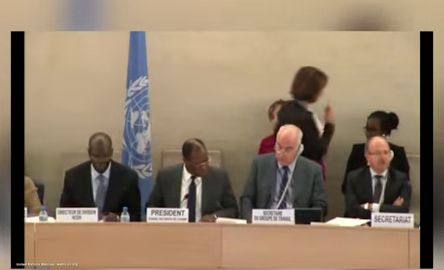
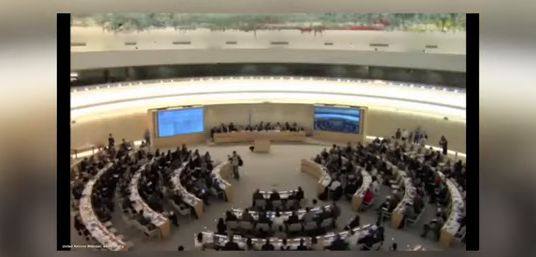
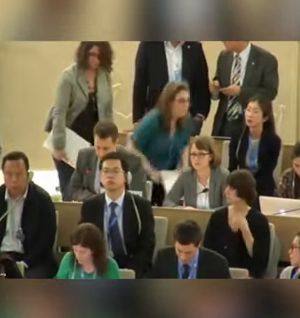
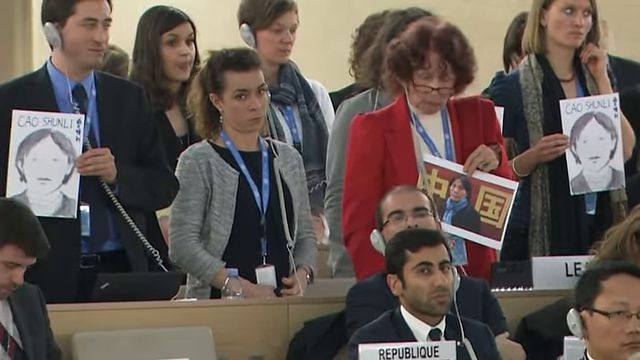
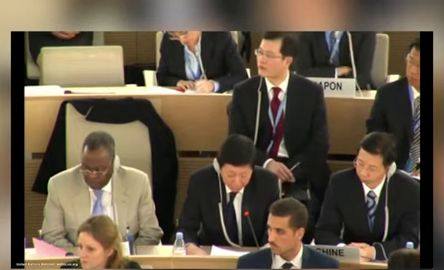
Six days after her death, on 20 March 2014 in Geneva, the Human Rights Council met to adopt the outcome of China's second UPR. A representative of the International Service for Human Rights proposed using part of the organisation's allocated speaking time to observe a moment of silence for Cao Shunli. The Chinese delegation immediately raised a point of order, insisting that non-governmental organisations could use their "speaking time" only to speak, not to do anything else. The ensuing debate among states lasted an hour and a half, and the moment of silence was eventually refused (ISHR #EndReprisals case page; Human Rights Watch, "The Costs of International Advocacy," 2017). At the end of the session, many representatives of international NGOs stood up and silently held up photographs of Cao Shunli (same sources). A woman who had asked for one hundred words in a report was not allowed, after her death, one minute of silence. That is the skeleton of this case. The sections that follow take each bone out and check it separately.
Early Life: A Beijing Workers' Family, Banishment in the Cultural Revolution, and Legal Training
What is known of Cao Shunli's early life comes mainly from her younger brother Cao Yunli, who recounted it to the overseas Chinese-language website Boxun after her death; the account was relayed in China Change's long biographical article "The Life and Death of Cao Shunli" (18 March 2014, by Yaxue Cao). This page grades that material as family testimony and does not mix it with institutional records. On that account: she was born in Beijing in 1961 to a worker's family, one of five siblings; in 1971, when she was ten, the family was forcibly deported to her father's ancestral home in Zhaoyuan, Shandong, because her father's family had been landowners before 1949 — one of the designated "enemy classes"; only after Mao Zedong's death in 1976 were the Caos allowed to return to Beijing (China Change, quoting Cao Yunli). Her date of birth is given by the English Wikipedia, with cited sources, as 28 March 1961; HRIC's posthumous materials note that she died two weeks before her fifty-third birthday, which fits a 28 March birth and a 14 March death exactly. The two items corroborate each other, and this page adopts 28 March 1961 while noting that most institutional biographies (ISHR, the Martin Ennals Foundation) record only the year 1961.
Her education has to be read in two layers, not collapsed into a single line about a famous university. China Change's biographical article records that in 1979 she entered the Beijing College of Political Science and Law (now the China University of Political Science and Law); after her bachelor's degree she became a graduate student in the Department of Law at Peking University; three years later she was assigned to work at a research centre under the Ministry of Labour and Human Resources (the predecessor system of today's Ministry of Human Resources and Social Security). The lawyers' appeal published by HRIC (24 February 2014) describes her as a graduate of Peking University's law school holding a master's degree, who had held a post in the PRC Ministry of Labour and Personnel. The two accounts do not contradict each other — a bachelor's degree at the Beijing College of Political Science and Law and a master's at Peking University — but quoting either alone distorts the record. This page records: bachelor's degree, Beijing College of Political Science and Law; master's degree, Department of Law, Peking University; employer, a research body in the labour-administration system. The ministry's name appears across sources in several translated and successive forms — Ministry of Labour and Personnel, Ministry of Labour and Human Resources, Ministry of Human Resources — all pointing to the same labour-administration system, and this page does not pin down a single translated name.
The turning point of her life was housing. During China's housing reform around 2002, Cao Shunli exposed corruption in her work unit's distribution of housing, and then lost her job as a result of reprisals by her supervisors (China Change; IFEX's Cao Shunli profile likewise records that in 2002 she was fired after exposing corruption in her work unit around housing distribution). ISHR's #EndReprisals case page gives different years: it records administrative detentions in 1999 and 2001, and the loss of her job and social-security benefits in 2001. The 2001 and 2002 versions are archived in parallel: they may correspond to different nodes of the same process — a sanction decision and an actual departure — but no published document aligns the two years, and this page does not reconcile them by fiat. From an insider who exposed corruption to a person expelled by the system, she had taken the first step towards becoming a petitioner. Thereafter, on China Change's account, she petitioned for years and was subjected to frequent surveillance and house arrest and to administrative detention more than once — broadly consistent with ISHR's record of administrative detentions in 1999 and 2001, beyond which there is no public record in detail.
The second turn was from petitioning for herself to working for others. Between 2006 and 2008 she collected a large number of petitioners' cases (China Change). Petitioners sit at the very bottom of China's grievance system: people who bring local grievances to Beijing mostly receive not answers but interception, black jails and labour camp. She had been sent to RTL herself; what she later documented most was precisely the RTL system's use against other people. That is the key to why, in 2008, she fixed on a mechanism that sounds remote from petitioners — the Universal Periodic Review. In her judgement, materials that could not be handed in through any door in China might be handed in through a door in Geneva.
2008–2009: The First Review, the National Human Rights Action Plan, and the Door She Found
The Universal Periodic Review (UPR) is the mechanism, established by the UN Human Rights Council in 2006, under which every UN member state undergoes a peer review of its human rights record roughly every four and a half years; one of the foundation documents of the review is the national report filed by the state under review itself. UN guidance expressly expects states, in preparing their national reports, to consult broadly with their own civil society and human rights defenders (ISHR's explanation of the mechanism on its case page; OHCHR's statement of 18 March 2014 records that Cao Shunli had campaigned since 2008 for transparency and civil-society participation in the review). China's first review was scheduled for February 2009. CHRD's bulletin confirms that from late 2008 Cao Shunli played a leading role in the campaign to demand that the government allow civil-society participation in China's UPR preparations, for both the February 2009 and the October 2013 cycles (CHRD bulletin, 20 February 2014).
A parallel track was China's National Human Rights Action Plan. The Chinese government published its first such plan, for 2009–2010, on 13 April 2009. Cao Shunli and her companions submitted numerous "human rights action proposals" for the plan to the Ministry of Foreign Affairs, asking that the situation of petitioners and rights-defence groups be written into it (the lawyers' appeal published by HRIC). HRIC preserves an archive spanning nearly five years — "Cao Shunli: UPR Submission and other Documents" — containing her submissions and case documents from 2008 to 2013 (HRIC archive page). Those papers prove something easily overlooked: from the very beginning she worked the paper route — applications, proposals, submissions, lawsuits — every step left a paper trail, and every step used procedures the authorities themselves had published.
In February 2009 China underwent its first review in Geneva. The review left no seat for the Cao Shunlis of the country. Two months later, on 10 April 2009, she was detained while protesting outside Peking University, her alma mater; on 12 April — the day before the National Human Rights Action Plan was announced — she was ordered to serve twelve months of re-education through labour, on the stated ground of "picking quarrels to create disturbances" in a police station (China Change). Note the arrangement of dates, because it is not this page's rhetoric but the calendar's: on one side, the state publishes a national human rights action plan; one day earlier, a woman who demanded a part in drafting human rights plans is sent to a labour camp. Beyond the biographical article, no first-hand instrument of that RTL decision is in the public record, and this page grades the detail accordingly.
One piece of background has to be stated plainly. Re-education through labour (laodong jiaoyang, RTL) was an administrative punishment: the police could lock a person up for one to three years, extendable by a year, with no prosecution and no court. It was formally abolished by the Standing Committee of the National People's Congress only in December 2013 — which means that both times Cao Shunli was sent to RTL, the system was still "lawful" on paper; and when she was seized for the last time, in September 2013, abolition was three months away. She documented the system, was confined by the system, and began her final campaign in the last autumn of the system's legal existence. That line runs through the last five years of her life.
Two RTL Terms: Why There Are Two Sets of Dates, and How This Page Archives Them
Cao Shunli's RTL history is where the layering of this case's sources is most visible. The conclusion first: every source agrees that she was sent to RTL twice, for a total of more than two years; the disagreement concerns only the years of each term, and it has a peculiar shape — one set of materials is later than the other by exactly one year throughout, as if a copyist had pushed the year forward one notch. This page's method is to set both sets out, name the source and the evidential grade of each, and neither average them, merge them, nor choose silently.
The first set (Version A in this page's usage): the urgent appeal issued by lawyer Wang Yu and fellow lawyers and activists, published by HRIC on 24 February 2014, states expressly that on 10 April 2009 and on 29 April 2010 the authorities twice subjected her to re-education through labour on groundless charges and without trial by a court, in reprisal for her work. China Change's biographical article fits it exactly: first term — detained on 10 April 2009 outside Peking University, ordered on 12 April to serve twelve months; released in April 2010; detained again ten days after her release; second term, fifteen months; the article also records rights lawyer Teng Biao as having defended her, with a neighbour's testimony cited in that connection (the detail is not further developed in the published text). On Version A, the second term ended around the middle of 2011. The summary accounts of the Martin Ennals Award and IFEX — "two long stints in RTL camps between 2009 and 2011" — fit Version A's year range (IFEX profile; the Martin Ennals case page also records "four additional known cases of detention"). ISHR's case page likewise records that she was detained in April 2009 during a rally and subsequently sentenced to RTL, where she experienced denial of food and torture — matching Version A's first term and her account of five days' food denial (see the previous section).
The second set (Version B): Amnesty International's Urgent Action UA 282/13 (8 October 2013) states that she "was sent to Re-education Through Labour for one year in April 2010, and for one year and three months in April 2011 because of her peaceful activism and human rights work." Version B's structure of durations — one year, then one year and three months — is identical to Version A's twelve months and fifteen months; only the years are one year later throughout. If Version B were correct, her second term would have ended only in mid-2012, which is not impossible to square with her leading the October 2012 letter to the Foreign Ministry and her March 2013 submission to the UN — but it collides directly with the two day-precise dates in the lawyers' own appeal (10 April 2009; 29 April 2010). The urgent action was issued in October 2013, while she was disappeared and information was under extreme pressure, and a year-slip in drafting is a real possibility; but this page has no authority to declare an Amnesty International document "wrong." It records instead: Version B derives from a single document, its years conflict with the lawyers' instrument, and it is archived as unverified on that point. The narrative order of this page follows Version A, because Version A has two independent sources (the lawyers' appeal and the biographical article) and dates precise to the day; wherever Version B is relied on, the text says so.
What the two RTL terms did to her body is preserved in her own words. After her first release she told Boxun that in the camp she had refused to obey the discipline and refused to accept being treated as a criminal, and that as punishment she was denied food for five days and force-fed (China Change, quoting her account). ISHR's summary agrees: in RTL she experienced denial of food and torture. The names and locations of the camps where she served are a matter of no public record — neither of her RTL decisions has ever been published, and this page does not guess at facilities. RTL also left lasting damage to her health: on the common account of multiple sources she had suffered from liver disease for years (the lawyers' appeal: a liver disorder, her health "never very good"; Radio Free Asia's reporting: cirrhosis of the liver; the Special Procedures communication: a liver disorder, recording that the medication she carried for it was taken away). The precision of the diagnosis varies across sources — liver disease, cirrhosis, and later liver effusion — and this page quotes each source in its own words rather than unifying them into one diagnosis. Carrying that body, she resumed her work after 2011, and chose the same objective: the next review.
The Woman Who Documented RTL: Petitioners' Files and the "One Hundred Words"
After the labour camps, what Cao Shunli did struck many observers as close to stubbornness: she systematically collected petitioners' cases — above all the cases of former RTL inmates — and worked to get those materials into the UN's review documents. ISHR's summary records that, working with fellow activists, she documented abuses, "especially in extrajudicial Re-education through Labour (RTL) camps" (ISHR case page). HRIC's archive of her 2008–2013 submissions shows that the material she filed with the Human Rights Council included the rights abuses suffered by the group of petitioners, and the reprisals against those who sought participation in the UPR (ISHR's description of the submissions' content).
She left one sentence that best explains her strategy. The Martin Ennals Foundation's joint statement of 14 March 2024 quotes her expressed hope: "if we could get even 100 words" into a UN report, "many of our problems could start to get addressed." The full context of that sentence is not in any public record, and this page archives it at the grade of the joint statement's quotation. It earns its own section because it fixes the proportions of this case: what she wanted was not to overthrow anything, not to emigrate, not compensation — one hundred words. The state machine's answer to those one hundred words was labour camp, disappearance, death in pre-trial custody, and a procedural siege against a moment of silence. The commentary section returns to those proportions; here the sentence is simply put on the record.
Her other widely quoted sentence comes from ISHR's record: "Our impact may be large, may be small, and may be nothing. But we must try. It is our duty to the dispossessed and it is the right of civil society" (ISHR #EndReprisals case page, epigraph). That sentence later supplied the title of the 2024 Geneva commemoration — "But we must try!" (ISHR's 2024 event page). This page quotes both sentences as archival quotations, not as slogans.
2012–2013: "State Secrets," a Lost Lawsuit, and the Threshold of the Second Review
For the second review cycle, Cao Shunli's campaign had three steps, each of them documented. Step one: ask. In October 2012 she and a group of human rights defenders, victims of forced evictions, former RTL inmates and democracy activists wrote to the Ministry of Foreign Affairs enquiring about public participation in the drafting of the state report for the UPR, and requesting that the details of the process be made public (Amnesty International UA 282/13). The Ministry replied in November 2012 that the work of compiling the state report had not started yet (same source); subsequently the Ministry formally declared that information about the UPR preparations was a "state secret" — CHRD's bulletin of 20 February 2014 confirms that in November 2012 the Ministry declared UPR preparation information a state secret, a decision upheld by the courts after Cao and other activists sued the Ministry over it.
Step two: sue. Dozens of activists brought an administrative lawsuit over the state-secrets designation and the refusal of disclosure. On 23 August 2013 the Beijing No. 2 Intermediate People's Court ruled the suit unacceptable: under Article 12(1) of the Administrative Procedure Law, people's courts cannot accept citizens' lawsuits over state acts such as defence and diplomacy, and the Foreign Ministry's submission of a national human rights report to the UN, on behalf of the Chinese government, was a state diplomatic action. That ruling's reasoning was restated and confirmed by the Chinese government itself in its reply to UN Special Procedures dated 7 January 2014 (CHRD's rebuttal of 20 March 2014, quoting point three of the government's reply). CHRD's rebuttal identifies the closed loop: the government first classified "civil-society participation in drafting the report" as diplomacy, then used "diplomacy cannot be sued over" to defeat the lawsuit demanding participation — the classification was the government's own, and the dismissal rested on the classification. This page records the loop not because it is legally intricate but because it establishes a fact: by August 2013, every avenue open to Cao Shunli within the domestic legal framework had been walked to its end and closed. After that, two actions remained to her: sitting outside the Foreign Ministry, and going to Geneva. She did both.
Step three: file the material. On 1 March 2013, through the mainland-based Human Rights Campaign in China, she submitted a report to the seventeenth session of the UPR Working Group of the Human Rights Council (HRIC, "Cao Shunli: UPR Submission and other Documents," noting the submission date of 1 March 2013). The submission covered the situation of the petitioner community and the reprisals against those seeking to participate in the review. It matters evidentially: it proves that her "cooperation" with the UN was not a spur-of-the-moment decision to attend a training in September 2013, but a years-long, formally documented engagement. When the UN later characterised her case as a reprisal for cooperation with the UN, this March 2013 submission is among the hardest paper evidence of that cooperation.
The review calendar should also be recorded: China's second UPR was set for 22 October 2013 in Geneva, and the national report was due by 22 July 2013 (the schedule note appended to HRIC's 2013 sit-in reporting). In its 2013 reporting HRIC set out her specific demands, which included that, before submitting the state report to the Office of the UN High Commissioner for Human Rights, the Ministry allow petitioners and human rights defenders to participate in drafting it, and that the report give priority to the situation of petitioners, to corruption, and to stability maintenance (HRIC's report of 1 July 2013 on the clearing of the sit-in, quoting the demands in translation). Not one of those demands concerned her personal interest. Her own RTL case, her lost post, her housing — none of them appears on the list of demands.
Outside the Foreign Ministry: The Sit-In of the Summer of 2013
On 18 June 2013 Cao Shunli and her companions began their sit-in in front of the Ministry of Foreign Affairs (Amnesty International UA 282/13 gives 18 June as the start; CHRD says the sit-in was initiated in mid-June; HRIC's reporting says "since late June" — this page takes Amnesty's 18 June as the spine and archives the other two formulations alongside). The participants included human rights defenders, victims of forced eviction, former RTL inmates and ordinary petitioners. Their demand never changed: disclose the review preparations, and let civil society take part in drafting and consulting on the national report (consistent across sources).
The sit-in's scale and duration are reported differently, and this page layers them. Numbers: Amnesty's urgent action records the participants' own account that numbers reached approximately 400 at times — some 200 from Beijing and 200 from elsewhere in China; ISHR's summary says the sit-in attracted, at times, as many as 200 participants. Both are archived: 400 is the participants' self-reported peak, 200 the figure in the human rights organisation's summary, and this page takes no average. Duration: HRIC, CHRD and the lawyers' appeal repeatedly call it a "two-month sit-in" beginning in June 2013; ISHR says the sit-in persisted for nearly five months, was disbanded four times, and saw its final clearance in October, just before the review; CHRD's bulletin records that between June and October police repeatedly broke up the sit-ins outside the Ministry, detaining and harassing participants. Stacked together, the verifiable common core is: the sit-in ran from June into early October 2013 and was cleared at least four times; the gap between "two months" and "nearly five months" may reflect different ways of counting a core encampment period versus an intermittent persistence, and this page does not adjudicate between them — every reference to the sit-in's length in this text names its source. Known clearance points include the morning of 1 July 2013, when all participants at the sit-in were taken away by police and Cao Shunli, one of the organisers, lost contact with the group before being reported en route home that evening (HRIC report, 1 July 2013); and 3 October 2013, when police took away petitioners still sitting in front of the Ministry and reportedly told some of them that Cao Shunli had been criminally detained — by then she had been disappeared for nearly three weeks, and this was the first word of her whereabouts to come out of a police mouth (HRIC case-documents page, entry for 3 October 2013).
One further episode from the sit-in period was later entered into CHRD's rebuttal of the government's account: a fellow activist questioned by police about the sit-ins was told by police that Cao Shunli had been detained on the orders of the Ministry of Foreign Affairs. According to the China Human Rights Briefing for 26 September–2 October 2013, police told a questioned activist that Cao had been criminally detained on 28 September on the Ministry's order, to prevent her leaving China for Geneva to attend a training on UN human rights mechanisms. This is a police statement relayed by an activist — a hearsay-grade item — and this page archives it expressly as "a police statement as relayed by a fellow activist (no first-hand instrument verified)." It cannot be written up as a proven chain of command; but it sits flush with the timing of the detention — on the eve of the Geneva training, with the sit-in undispersed and the review imminent — and this page places the two side by side and leaves the judgement to the reader.
14 September 2013: The Airport, Five Weeks of Disappearance, and Chen Jianfang's Same-Day Interception
On 14 September 2013 Cao Shunli arrived at Beijing Capital International Airport to fly to Geneva, Switzerland. She had been invited by the International Service for Human Rights to take part in a human rights training co-organised by ISHR and CHRD, in preparation for the review of China to be held that October, and planned also to observe the review (IFEX profile; OHCHR's statement of 18 March 2014 describes "a human rights seminar and observe China's UPR"; ISHR records the training as organised by ISHR and CHRD). She was stopped and taken away in the airport's exit-and-entry area (China Change: she "disappeared in the Exit & Entry area of Beijing Capital International Airport"). No instrument shown at the scene has ever been published, and no notice was given to her family. For five weeks her family had no information about her whereabouts (OHCHR statement, 14 March 2019: her "whereabouts remained unknown for five weeks, until she resurfaced in custody").
The same day, Shanghai's Chen Jianfang was travelling to the same training. On HRIC's case documents: Chen was stopped at the exit-and-entry frontier inspection counter at Guangzhou Baiyun Airport and prevented from boarding; police took her boarding pass and passport without giving any reason; she was released the same day with her passport returned; the next day police took her to the airport police station and served her an administrative penalty notice for "forcing her way into the airport's restricted area" and "disrupting public order"; after returning to Shanghai she was taken in and questioned by police (HRIC case-documents page). The Chinese government's reply to the UN dated 7 January 2014 tells Chen's story differently: it states that on 3 September 2013 the Shanghai Municipality Public Security Bureau stopped her at border control pursuant to Article 12 of the Exit and Entry Administration Law, and that the penalty imposed on her had a legal basis (the government's reply as preserved in the Special Procedures communications archive). The date (14 September versus 3 September) and the framing of the place (Guangzhou versus a border-control stop by the Shanghai police) are archived in parallel. On either version, one fact is common ground: in September 2013 the Chinese authorities systematically intercepted Chinese activists travelling to UN training in Geneva, and Cao Shunli was not the only one. Chen Jianfang's later fate is recorded elsewhere on this site; it belongs in this page because it bears directly on how UN documents discuss the RSDL system (see below): after she paid tribute to Cao Shunli on the fifth anniversary of her death, Chen was forcibly disappeared under Residential Surveillance in a Designated Location (RSDL) from 19–20 March 2019 (note appended to the UN experts' joint statement of 14 March 2024; CHRD reporting).
During Cao Shunli's disappearance, the international response was not silence. On 8 October 2013 Amnesty International issued Urgent Action UA 282/13, treating her as an arbitrarily detained human rights defender and calling for her release (Amnesty International). On 16 October 2013 a group of UN human rights experts issued a public statement expressing alarm at reprisals against activists linked to China's international human rights review, and transmitted urgent appeals to the Chinese government (OHCHR statement of 16 October 2013, as cited in the statement of 18 March 2014). The Chinese government's reply to the experts, dated 23 September 2013, asserted that in handling the case the authorities had "strictly followed legal procedures, notified the suspects and their families of their rights and obligations, met their reasonable requirements of meeting with lawyers and family members and accessing medical treatment," and that there had been "no illegal detention, physical attacks, abuses and corporal punishment during the whole process" (the government's reply, as quoted in CHRD's rebuttal of 20 March 2014). CHRD's point-by-point rebuttal answers: the family was never given a detention notice; she was held incommunicado for weeks after being secretly taken away; her lawyer's repeated attempts to visit were delayed, with a first one-hour meeting achieved only on 3 October (note: CHRD's own contemporaneous briefing gives 30 October for the first successful meeting — the conflict is layered in the next section); and she told her lawyer repeatedly that she was receiving no treatment. The government's account and the rebuttal are set out in full, side by side, on this page. It is the first of three such collisions of accounts in this case, and the pattern never varies: the government says everything was lawful and medical care was assured; the lawyers and family say there was no notice, the medicine was confiscated, and the woman was dying. In the end it was the second account that events verified.
The legal characterisation of those five weeks needs care, because secondary retellings often overstate it. The UN experts' statement of 14 March 2019, discussing her case, notes that China's system of Residential Surveillance in a Designated Location (RSDL) "de facto legalises enforced disappearance," exposing individuals to greater risks of torture and ill-treatment and denial of access to medical care (OHCHR statement, 14 March 2019, footnote). That is the experts' general characterisation of the RSDL system, set in the context of her case; but no published document shows that Cao Shunli herself was ever formally placed under RSDL in September–October 2013 — her formal record is criminal detention followed by custody at Chaoyang District Detention Center. This page's formulation is therefore precise: she was forcibly disappeared for five weeks (the shared wording of the UN experts and ISHR); the UN experts used her case to flag the risks of the RSDL system; whether she herself was ever formally subjected to RSDL is a matter of no public record. Writing a systemic critique up as her personal legal status is an error this page refuses to commit. The person documented as forcibly disappeared under RSDL is Chen Jianfang, in 2019 (see above). The two cases must not be conflated.
Three Accounts of the Charge: Unlawful Assembly, Gathering a Crowd, Picking Quarrels
What, exactly, was Cao Shunli arrested for? The archive does not yield one answer; it yields three accounts from different sources whose timelines interlock and whose substance diverges. That makes this the core terrain of this page's verification work, and the rule of treatment is single and simple: all three accounts are set out in parallel, each attributed to who said it and when, and they are never kneaded into one "official charge."
Account A (the Chinese government's formal reply to the UN): the government's reply of 7 January 2014 states that Cao Shunli, a woman of 52, had "disrupted social administrative order on many occasions"; that on 14 September 2013 she was detained by the Chaoyang Branch of the Beijing Public Security Bureau "on the charge of the crime of provocation"; and that on 21 October 2013 a warrant was issued by the Chaoyang District Procuratorate and she was arrested (the government's reply, in translation, preserved in the Special Procedures archive, dated 7 January 2014). On Account A, the charge was "picking quarrels and provoking trouble" from the first day and never changed, and the paperwork of detention and approved arrest is complete and precisely dated.
Account B (CHRD's contemporaneous bulletin): CHRD's bulletin of 20 February 2014 states that she was "held incommunicado for weeks before being arrested in October on charges of 'gathering a crowd to disrupt order of a public place.'" Other CHRD materials take the same line. Account B's divergence from A is in the charge itself: gathering a crowd to disrupt order in a public place (Article 291 of the Criminal Law) and picking quarrels and provoking trouble (Article 293) are different offences, and the former tracks the logic of an accusation aimed at the Foreign Ministry sit-in more closely.
Account C (the "first A, then B" narrative of the lawyers and human rights organisations): the lawyers' appeal published by HRIC (24 February 2014) states that, on information received when the lawyers took the case on 22 October 2013, she had been arrested on suspicion of the crime of "unlawful assembly," and that this was later modified to "picking quarrels and provoking trouble." Human Rights Watch's commentary of 14 March 2014 uses the same sequence: she was formally charged in October first with "illegal assembly" and then with "picking quarrels and provoking troubles." The English Wikipedia's summary likewise gives both charges for October 2013. CHRD's rebuttal of 20 March 2014 states that she was formally arrested on 21 October on a charge rendered as "creating a disturbance," and that she refused to sign the arrest warrant — a date that matches Account A's approval-of-arrest date, while its charge wording differs from Account B.
What the three accounts can be aligned on is this: around 21 October 2013 she was formally arrested, and her place of custody was Chaoyang District Detention Center; and on 22 October, China's second UPR took place in Geneva — the approval of her arrest fell on the eve of the review, a juxtaposition Human Rights Watch drew attention to expressly (HRW statement, 14 September 2015: only on 21 October 2013, a day before China's UPR took place in Geneva, did it become clear that she had been put under criminal detention for "unlawful assembly"). What cannot be aligned is the chain of charges: "picking quarrels" from the start (A), "gathering a crowd to disrupt order of a public place" (B), or "unlawful assembly" first and "picking quarrels" after (C). A technical explanation — that the criminal-detention notice, the arrest-approval decision and the external talking points used different formulations at different stages — is possible, but it is speculation: no original arrest instrument in her case has ever been published for inspection, and this page makes no ruling. Neither the original of her arrest warrant nor any photograph of a detention notice in her case is in any public record. The "charges" field of this page's metadata therefore records the three accounts and their sources, and draws no conclusion.
The procedural end point must also be recorded exactly: in its reply of 24 January 2014 the government told the UN that Cao Shunli had been charged with the crime of "provocation" and that her case had been referred to the People's Procuratorate of Chaoyang District, Beijing, "for further review and prosecution" (the government's reply as cited in the Special Procedures communication of 4 March 2014). From then until her death there is no public record of any indictment or hearing notice. In legal status, she died an untried pre-trial detainee. That point is essential to the nature of her death: the state never proved her guilty of anything by any judgment, yet ended her life with six months of custody and delayed treatment.
Two dating details are layered and archived here. First, the date of the lawyer's first meeting: CHRD's rebuttal of 20 March 2014 states that, after several attempts, the lawyer was finally allowed an hour-long visit with her on 3 October; but CHRD's own China Human Rights Briefing for 24–31 October 2013 records that lawyer Wang Yu went to Chaoyang District Detention Center several times before finally being allowed an hour-long visit with Cao on 30 October, the first since she was seized in mid-September. The two dates, 3 October and 30 October, stand in parallel — the former from a systematic rebuttal document written months later, the latter from the briefing of the very week it happened; this page takes the contemporaneous briefing's 30 October as its spine and archives 3 October as unverified between the two. Second, the date of her criminal detention: an item in HRIC's case-documents archive records that activist Qin Yongmin stated on 30 September 2013 that Cao Shunli had been criminally detained on 28 September — which cross-matches the relayed police statement, noted in the sit-in section, that she was detained on 28 September; it remains a useful reference node, still at the grade of relayed report.
Five Months in Chaoyang Detention Center: Confiscated Medicine, a Delayed Examination, and Orally Refused Bail
From surfacing in October 2013 to hospitalisation in February 2014, Cao Shunli spent about five months in Chaoyang District Detention Center. The record of those months is assembled from three bodies of material: the lawyers' public appeal; the correspondence between UN Special Procedures and the Chinese government; and the human rights organisations' point-by-point rebuttals of the government's claims after her death. Where the three corroborate each other, they form this section's factual spine; where they conflict, this page marks the conflict.
Admission and medication. On the account of the urgent appeal issued by Wang Yu and fellow lawyers and activists on 24 February 2014: she suffered from a liver disorder and her health had never been very good; after she was detained at Chaoyang District Detention Center on 14 September (the appeal takes that date as the start of the custody), the centre refused her medical treatment, and even forcibly took away the medicine she carried for her existing condition and would not let her use it. The Special Procedures communication of 4 March 2014 records the same information: she was refused medical treatment, and her medication for her liver condition was taken away. The centre also omitted a routine step: no routine health examination was conducted at intake. Only on 18 November 2013, after she met her lawyer, who emphatically requested it, did the centre conduct an examination, which found tuberculosis in both lungs, liver effusion, and uterine myomas and cysts (the lawyers' appeal; the Special Procedures communication records the same findings in the same terms). The diagnosis vocabulary needs layering: Human Rights Watch's 2015 retrospective says that in November 2013 she was diagnosed by a detention doctor with illnesses including pneumonia in both lungs; Radio Free Asia's reporting gives tuberculosis, cirrhosis of the liver and uterine fibroids; CHRD gives tuberculosis and liver ascites. Pneumonia, tuberculosis, liver effusion, liver ascites, cirrhosis — the words drift across sources, and this page's rule is to take as its spine the original relay of the November examination on which the lawyers' appeal and the UN communication agree (tuberculosis in both lungs, liver effusion, uterine myomas and cysts), archiving the other formulations with their sources alongside. On any version, there is no disagreement about the common core: a woman who entered detention with liver disease was found, two months in, to be gravely ill in several organs at once.
The bail applications. The lawyers' appeal and multiple institutional accounts agree: after the examination, her lawyer applied several times for release on medical bail (medical parole), and her family repeatedly requested medical release; the applications were refused or met with no response. The Special Procedures communication of 4 March 2014 puts it most precisely: following the examination, her lawyer applied for medical parole several times, and the request "was allegedly denied orally by the detention centre" — not even a sheet of paper stating reasons for refusal. The government's reply of 24 January 2014 paints the opposite picture: the family had been duly informed in accordance with the regulations; during detention she had access to medical care as provided by the detention centre; and, according to the doctors' assessment, "no serious liver disease was diagnosed" (the government's reply, as quoted in CHRD's rebuttal of 20 March 2014). On 24 February 2014 Wang Yu and other lawyers and activists issued their urgent appeal, demanding that the Beijing police make public the information on Cao Shunli's condition and investigate liability (the appeal's full text, published by HRIC). On 5 March 2014 Wang Yu and a second lawyer, Liu Weiguo, filed eight separate open-government-information requests pressing Chaoyang District Detention Center to disclose how it had handled her medical condition throughout her detention (HRIC statement, 14 March 2014). What became of those eight requests is a matter of no public record.
Throughout those five months, the outside world's right to know about her condition was also blocked. On CHRD's bulletin of 10 March 2014: her lawyer was not notified that she had been taken to hospital; the authorities would not disclose her condition to the lawyer, nor negotiate treatment with the lawyer and the family; and while she was at the Qinghe Emergency Center, the authorities hindered the family's requests to have her transferred to a specialist hospital. In other words, until she was comatose, the only party holding her medical information was the detaining authority itself. Lined up in a row, the facts of this section form a complete chain: admitted while ill; medicine confiscated; treatment refused; no intake examination; an examination forced by the lawyer; grave illness found; repeated applications for medical bail; oral refusal; no written reasons; and, to the UN, the assurance that there was "no serious liver disease." The last two links of the chain are in the next section.
February 2014: Coma, the Qinghe 999 Emergency Centre, No. 309 Hospital, and Bail Granted a Week Too Late
February 2014 is the month with the densest dating conflicts in this case. This page first pins down what the sources agree on, then sets out the conflicts. The agreement: she was taken first to the intensive care unit of the Qinghe 999 Emergency Centre in Beijing's Haidian District (rendered in reporting as the Qinghe Emergency Center or Qinghe 999 Emergency Care Center); she was then transferred to PLA No. 309 Hospital; and she died at the 309 Hospital. Her lawyer Wang Yu told Radio Free Asia that she was unconscious and on a ventilator, could not talk, and was in an extremely serious condition, while the hospital would give no details and "just mumble something" when asked (RFA's February 2014 reporting, archived by ecoi.net).
The conflict is over the admission date, and there are three versions. Version one, 19 February: OHCHR's statements of 18 March 2014 and 14 March 2024 both record that she was transferred or admitted to hospital in critical condition on 19 February 2014; CHRD's rebuttal likewise records that on 19 February she was taken to the intensive care unit of the Qinghe Emergency Center, fell into a coma due to organ failure, and on 20 February was transferred to No. 309 Military Hospital. Version two, 16 February: CHRD's bulletin of 10 March 2014 states that she was taken to intensive care on 16 February, and records that by the time the authorities took her to an emergency facility she was in a coma — which dovetails with the lawyers' appeal relaying her brother's account that, when the family learned the news on 20 February, she had already been in a coma for four days; four days back from 20 February lands on 16 February. Version three, 20 February: HRIC's and the Martin Ennals Foundation's biographical materials record that she was finally transferred out of the detention centre to an emergency medical unit on 20 February, barely responsive and on life support — a version that may refer to the transfer into the 309 Hospital or to the formal completion of her release-from-custody paperwork. This page's treatment: the narrative is layered as "hospitalised in critical condition in mid-February 2014; 19 February is the admission date carried by the UN documents; 16 February is the date, in CHRD's bulletin, of her being taken into intensive care; 20 February is the transfer date to No. 309 Hospital on which the sources agree" — the three dates are not merged into one. By any version, some three months separate the discovery of her grave illness (18 November 2013) from her arrival in an emergency room.
The granting of bail was just as late, and its dates deserve day-by-day recording. On HRIC's account and RFA's relay: on 20 February 2014 — with Cao Shunli already comatose for days — an official of Chaoyang District Detention Center at last asked her family to apply for medical parole; the authorities approved it one week later, which computes to about 27 February. The Tibetan Centre for Human Rights and Democracy's relay states it expressly: she received medical parole on 27 February and died fifteen days later (TCHRD statement, 17 March 2014). ISHR's formulation is that she was granted bail on medical grounds "only days before her death." In other words, the door the law left her — release for medical treatment — was opened only after she could no longer walk through it, or even open her eyes. Her lawyer Wang Yu afterwards told Radio Free Asia that they would hold the detention centre, the police bureau, the procuratorate and the hospital accountable (RFA, March 2014). Was there ever any sequel to that pledge? No public record shows any of those bodies ever being held accountable in any way.
During the hospitalisation, the ward was sealed. On the CHRD and HRIC accounts: there was a heavy police presence at the hospital; supporters were blocked at the door; her lawyer was refused entry and refused any involvement; and her close associate Liu Xiaofang — one of the few people who had spoken publicly about her condition — disappeared on 11 March, three days before her death, and was believed detained by police (CHRD rebuttal, 20 March 2014). On information relayed by CHRD's sources, up to ten activists were criminally detained for trying to visit her at No. 309 Hospital: Shan Yajuan was taken into custody on 14 March while trying to reach the hospital and held at a Haidian District police station before release; Li Yingzhi was criminally detained on 4 March on charges of "unlawful assembly"; Wang Ling and Chen Shufeng were criminally detained on 21 February on charges of "disrupting order of a public place" (same source, with its footnote references). The later outcomes for most of these supporters, beyond the individual release noted, are a matter of no public record, and this page does not speculate on them one by one. What is verified is this: a woman lay dying in an intensive care unit, and those who came to see her first had to get past the police — and some of them ended up in police stations for trying.
14 March 2014: Death, the Body, and the Refused Medical Records
On the afternoon of 14 March 2014 Cao Shunli died at PLA No. 309 Hospital, aged 52, two weeks short of her fifty-third birthday. The institutional formulation of the cause of death is multiple organ failure (Martin Ennals Foundation joint statement, 14 March 2024; ISHR case page). The details of the notification and the viewing were told by her brother Cao Yunli to HRIC (HRIC statement, 14 March 2014): at about 3 p.m. that day he received a call from a Dr. Su at the 309 Hospital; when he reached the intensive care unit at about 4 p.m., his sister had already passed away. "I took one look and couldn't look again," he said, and asked what heinous crimes she had committed to have been tormented this way. Her lawyer Wang Yu told HRIC that the hospital initially refused to allow her and the family members to view the body, but later allowed only the family to do so; she also said a number of Cao's supporters were taken away by police while attempting to enter the hospital that afternoon.
What was on the body is recorded consistently and specifically by the family and several organisations. Amnesty International records that the family said her body was covered in black and purple marks when she died (Amnesty International statement, 26 March 2014). CHRD records that family members were allowed only a very brief moment to view the body, in which they noticed emaciation, bedsores and bruises; and that doctors at No. 309 Military Hospital spoke anonymously to family members of their disbelief and complaint at the condition in which she had been brought in — the doctors said her condition indicated she had received no care or treatment for a long period and must simply have been left to die in the detention cell, with nobody even turning her over or washing her (CHRD rebuttal, 20 March 2014; the doctors' remarks are archived here at the grade of CHRD's relay from its sources). Activist Hu Jia relayed to Deutsche Welle that when she died she was in a state of cachexia — dramatic weight loss and muscle atrophy — that her body was covered in black patches and her skin showed scale-like cracks, and that doctors at the 309 Hospital were shocked at her bedsores (China Change, quoting Hu Jia's account to Deutsche Welle). These accounts of the body's condition come from family observation and relays; none of them is an autopsy report — and the fact is that no autopsy report in this case has ever been published. That absence is itself part of the case.
After her death, the body itself became the next object of contention. On 26 March 2014 Amnesty International issued a statement headlined by the fear of a cover-up as the body went missing: that day, her brother Cao Yunli and the family's lawyer Wang Yu went to the 309 Military Hospital and were prevented from seeing her body; hospital staff claimed the body was no longer being held there and refused to disclose any further details; officials also rejected the family's requests for copies of her medical records. Amnesty's China researcher commented that it had "all the markings of a cover-up," and demanded that the family be given immediate access to the body and the medical records, and that the authorities must not cremate the body without the family's explicit permission (Amnesty International statement, 26 March 2014). CHRD's rebuttal of 20 March 2014 had already recorded that where the authorities had moved her body since her death was unclear. Thereafter — whether the body was cremated, when and where, and where her ashes rest — this page has found no reliable public record, and records the matter as no public record. The same applies to a complete medical record of her last six months: the refusal of the family's request for copies of the records is documented by Amnesty; the records themselves have never been published.
The family's public voice is concentrated in February and March 2014: her brother Cao Yunli spoke repeatedly to HRIC, Radio Free Asia and Boxun about his sister's illness, the state of her body and what the family went through (as cited throughout this page). After that, public reporting about the Cao family quickly becomes sparse. Beyond the pressure on family members noted during the hospitalisation (CHRD's rebuttal, explaining the difficulty of verifying her hospital treatment, records that family members were under pressure from the authorities) and the dispute over the body and the records, this page has found no other reliable first-hand account of the family's later situation; anything about their subsequent circumstances is recorded here as no public record, and unattributed rumour is not relayed. That is the archive's discipline: her family are not public figures, and their silence is to be recorded respectfully as silence, not filled in.
The Minute in Geneva: The Blocked Moment of Silence and the International Response
When news of Cao Shunli's death reached Geneva, the twenty-fifth session of the Human Rights Council was under way. On 18 March 2014 the Chinese government delegation addressed her death in a general debate, to the effect that she had been sick for a long time, had been sent to hospital for diagnosis, her illness had worsened, and she had ultimately died in hospital (CHRD rebuttal, 20 March 2014, recording the Chinese statement). The same day, a group of UN experts issued a statement expressing dismay at her death, extending condolences to her family and friends, and urging the Chinese authorities to investigate promptly the circumstances leading to her death (OHCHR press release, 18 March 2014). The experts called her death "a tragic example of the results of criminalization of the activities of human rights defenders in China and reprisals against them," and said it was unacceptable that civil-society activists pay the ultimate price for peaceful and legitimate interaction with the United Nations and its human rights mechanisms. The signatory mandates included the Special Rapporteurs on torture; on the rights to freedom of peaceful assembly and of association; on freedom of opinion and expression; on the situation of human rights defenders; and on the right to health; together with the Working Groups on Enforced or Involuntary Disappearances and on Arbitrary Detention (same source). UN Secretary-General Ban Ki-moon and several governments also expressed concern over her death (as recorded in Amnesty International's statement of 26 March 2014); high-level statements deploring her death and calling for an investigation were made by the United States, the United Kingdom, the European Union and Germany, among others (ISHR's March 2014 reporting roundup).
On 20 March the Council met to adopt the outcome report of China's second UPR. In that session occurred the most widely known scene of this case. The International Service for Human Rights' representative proposed, in its statement, to use part of the organisation's allocated speaking time to observe a moment of silence for Cao Shunli. A Chinese delegate immediately interrupted with a point of order, insisting that NGOs could only use their "speaking time" to speak, not to do anything else. That ignited a debate among states lasting an hour and a half, disrupted the Council's session, drew global media attention, and the moment of silence was eventually refused (ISHR #EndReprisals case page; Human Rights Watch's 2017 report "The Costs of International Advocacy" records the same episode and notes in particular that the Chinese delegation challenged and blocked a ruling by the Council's president that would have allowed the moment of silence). Amnesty International issued a public statement the same day (AI Index ASA 17/016/2014, 21 March 2014) regretting that China had gone to such lengths to block efforts to observe a minute of silence in her memory. At the end of the session, many representatives of international NGOs stood up and silently held up photographs of Cao Shunli (ISHR case page). The incident was broadcast online, and the Martin Ennals Award's memorial film about her includes the footage of the Chinese delegation quashing the silence at the UN (IFEX profile).
Ten years later, the same chamber produced a sequel. On 22 March 2024, during the Council's fifty-fifth session, a human rights defender from mainland China read out a joint statement in the Council on behalf of ISHR and sixteen organisations with consultative status plus twenty without, and called for a moment of silence in Cao Shunli's memory; despite attempts by China and its allies to interrupt, the tribute was completed — ISHR's headline was that China had failed in disrupting the tribute at the UN to Cao Shunli, ten years after her death in custody (ISHR report, 22 March 2024; IFEX's profile likewise records that in March 2024 civil-society representatives were able to pay tribute despite the Chinese delegation's attempt to interrupt the session). The same act, drowned in procedure in 2014, was completed in 2024. Between the two sessions lie ten full years, and in those ten years the Chinese authorities' investigation into Cao Shunli's death did not move one step. This page records that contrast without comment; the comment is reserved for the section set aside for it.
Ten Years of Calls: 2014, 2019, 2024
The Cao Shunli case has a rare feature in the international human rights archive: it did not close with its subject's death, but has been raised again by UN mechanisms at an almost fixed rhythm. This section records that line of calls in chronological order, because it is itself part of the case's current status — the number of times, and the level at which, a case is raised is the measure of how unresolved it remains.
In 2013–2014, UN Special Procedures corresponded formally with the Chinese government about her case at least three times: an urgent appeal of 17 July 2013 (before the airport seizure, concerning the treatment of the sit-in participants); an urgent appeal of 14 November 2013; and the communication of 4 March 2014 on her deteriorating health (Special Procedures communications archive, reference CHN 2/2014 and related files); plus the two public statements of 16 October 2013 and 18 March 2014. The Chinese government replied in writing three times (23 September 2013; 7 January 2014; 24 January 2014), and the replies' content has been set out point by point above: everything was lawful, medical care was assured, the review preparations were diplomacy and state secrets. The experts expressly questioned the reply's assurance that she had no serious health problems and had access to medical care (OHCHR press release, 18 March 2014). Her death is the cruellest annotation to that correspondence: the reply of 24 January 2014 had assured the UN that doctors had diagnosed "no serious liver disease"; less than a month later, she lay comatose in intensive care.
On 14 March 2019, the fifth anniversary of her death, the UN experts spoke again, in a statement headlined "UN experts renew calls for probe into death of Cao Shunli" (OHCHR, 14 March 2019). She had paid the ultimate price for her work, the experts said, and they renewed their call for an independent, impartial and comprehensive investigation into her death, with a view to bringing those responsible to justice; the statement notes that human rights defenders in China face risks of enforced disappearance, arbitrary detention and ill-treatment in custody for their work, and carries the footnote on the RSDL system quoted in the airport section above (the footnote's systemic characterisation, and its exact relation to her case, are layered there). The signatories included the mandate holders for human rights defenders, freedom of expression, health, torture, arbitrary detention, extrajudicial executions, enforced disappearances, violence against women, and peaceful assembly and association (same source). That same month, her companion Chen Jianfang was forcibly disappeared under RSDL for commemorating her — the accountability statement and a fresh reprisal landed almost simultaneously.
On 14 March 2024, the tenth anniversary, the experts spoke a third time, under the headline of accountability (OHCHR press release, 14 March 2024). They regretted that no action appeared to have been taken over the previous five years, since the last call for an independent, impartial and comprehensive investigation; they again urged the Chinese authorities to fully and fairly investigate the circumstances that led to her death and hold those responsible to account; and they stated that failure to properly investigate a potentially unlawful death may itself amount to a violation of the right to life. The statement confirms two institutional facts: first, that her case was included in the Secretary-General's subsequent annual reports on reprisals for cooperation with the UN in the field of human rights and "remains a priority" for the experts' mandates; second, that China was mentioned in twelve of the fourteen Secretary-General's reports on reprisals, with a high number of cases (same source). The joint civil-society statement of 14 March 2024, signed by thirty-one organisations on the Martin Ennals Foundation's version of the list (ISHR's parallel statement gives thirty human rights organisations — the count is layered in the Verification Note), put it more bluntly: her case is "one of the longest-standing unresolved cases in the UN Secretary-General's annual reports on reprisals" (Martin Ennals Foundation joint statement, 14 March 2024; joint statement of ISHR and thirty human rights organisations, same date). The European human rights ambassadors of nine countries — Estonia, Finland, France, Germany, Luxembourg, the Netherlands, Spain, Sweden and the United Kingdom — also issued a joint statement that day on Cao Shunli and other defenders who were victims of deadly reprisals (noted in the 2024 joint-statement materials).
As of this page's last verification, on 5 November 2026, the end of that line of calls is still blank: no investigation findings, no person held responsible, no public record of compensation, and no substantive public response by China to the experts' three calls. Her case still lies in the Secretary-General's reprisals file, restated year after year. What an archive site can do is record the line completely — including the date of every raising of her name, and the fact that after every raising, nothing happened.
Remembrance: The Martin Ennals Award, the Award in Her Name, and the Geneva Bust
In April 2014 an international jury of ten human rights organisations announced that Cao Shunli had been selected as one of the three finalists for the 2014 Martin Ennals Award for Human Rights Defenders; she was nominated by Human Rights in China, and she was the first person in the award's history to receive the honour posthumously (HRIC's award statement, 2014, as relayed by Radio Free Asia and others). The award ceremony was held in Geneva on 7 October 2014 (same source). The award recognises defenders who have shown deep commitment to human rights in the face of great personal risk — by the time the jury announced her selection, she had been dead for a month. The Martin Ennals Award maintains a case page and a memorial film about her; the film documents her life and the quashing of the moment of silence in March 2014 (IFEX profile). One detail requires a note: the body text of the Martin Ennals Award's own case page gives her death date in one place as 13 March 2014, in conflict with every other source including the Foundation's own 2024 joint statement (14 March); this page treats the 13 March date as a typographical error on that page, archives the point in the Verification Note, and uses 14 March throughout.
The memorial award in her name has travelled further. On 12 March 2016 CHRD published the page of the Cao Shunli Memorial Award for Human Rights Defenders, announcing that three Chinese human rights organisations — Human Rights Campaign in China, Civil Rights & Livelihood Watch, and the Rights Defense Network — would bestow an award on a Chinese human rights defender every 14 March, a date some Chinese activists have designated "Human Rights Defenders Day" (CHRD memorial-award page, 12 March 2016). The roll of recipients is continuously checkable in CHRD's annual announcements: in 2015 the first recipient, disability and labour rights activist Zhou Weilin; in 2016, housing rights activist Jia Lingmin; in 2017, women's and housing rights activist Su Changlan; in 2018, Chen Jianfang and Li Xiaoling jointly — the same Chen Jianfang who had been stopped at the airport on the same day as Cao in 2013; in 2019, "barefoot lawyer" Ji Sizun, who died months later in a police-guarded hospital bed; in 2020, Xu Qin and Wang Heying; in 2022, health rights campaigner He Fangmei and human rights lawyer Chang Weiping (CHRD award announcements of 2018, 2020 and 2022). The founding year carries a small discrepancy in the materials: the 2022 announcement says several human rights organisations established the award in 2014, while the formal launch page is dated 2016 and the first recipient reaches back to 2015 — this page records: the award arose from her death in 2014, was first presented in 2015, and was publicly archived by the three founding organisations' joint page in 2016; the "2014" founding formulation and the 2015 first presentation stand in parallel and are not forcibly unified. A woman who demanded that petitioners' voices be let into a report has become, after death, an award that passes her name each year to the next defender.
In 2024, Geneva. ISHR and fifteen (in another of ISHR's reports, sixteen — layered in the Verification Note) civil-society organisations launched a petition for a memorial to Cao Shunli in Geneva: they commissioned a bust of her from the Czech artist Marie Šeborová (bronze; photographed in her Prague studio in December 2023) and, in September 2023, initiated the formal petition for its placement as a public monument in Geneva (ISHR's 2024 petition reporting). On 14 March 2024, the tenth anniversary of her death, the bust and the petition were unveiled in front of the UN office in Geneva, alongside a photo exhibition about her at the Place des Nations, opposite the Palais des Nations (ISHR's 2024 event and petition reporting). The petition gathered more than one thousand signatures, in person and online, and was delivered to the Geneva authorities on 16 April 2024 (same sources). On 25 April 2024 Geneva's Administrative Council — the city's executive body — announced that the city would host a public monument paying tribute to "the memory of human rights activists and the universal causes they embody"; the Council explained that it would not be possible to host individual monuments for all defenders who have suffered persecution, and that it would instead erect a memorial collectively honouring the actions of persons whose commitment to human rights must be highlighted and hailed, citing Cao Shunli and Iran's Mahsa Amini as examples of victims of the repression in their respective countries, China and Iran (ISHR report, 25 April 2024). This page's record stops there: the collective monument's final design, site and completion date are matters of no public record, and writing "the city announced it would erect" up into "the monument has been built" is a leap this page does not permit itself. The same sculptor later made a bust of Liu Xiaobo (noted in ISHR's report of September 2024); that work is not part of this case and is recorded here in one line only, to keep the sources straight.
Remembrance has one more layer: her own words in circulation. The umbrella title of the 2024 Geneva commemorations was taken from the second half of her sentence: "But we must try!" (ISHR's 2024 event page). From one hundred words, to one minute of silence, to a bust — everything she ever asked for was small in size; and everything had to be achieved, partially, years after her death, by many people, at great effort. That observation belongs to the next section; this one is responsible only for getting the facts down in full.
Timeline
28 March 1961: born in Beijing to a worker's family (the exact date follows the English Wikipedia's cited sources; most institutional biographies give only 1961). 1971: aged ten, the family is deported to Zhaoyuan, Shandong, over her father's class background (family testimony, relayed by China Change). After 1976: the family is permitted to return to Beijing. 1979: enters the Beijing College of Political Science and Law (now the China University of Political Science and Law); afterwards takes a master's degree in the Department of Law at Peking University (China Change biography; the lawyers' appeal describes a Peking University law master's). On graduation she is assigned to a research body in the labour-ministry system.
Around 2002 (ISHR gives the loss of her job as 2001; both archived): dismissed from her post in reprisal for exposing corruption in her unit's housing allocations; begins petitioning; subjected to administrative detention more than once (ISHR records administrative detentions in 1999 and 2001). 2006–2008: collects a large number of petitioners' cases. From late 2008: leads the campaign for civil-society participation in China's UPR preparations and submits human rights action proposals to the Foreign Ministry (CHRD bulletin; HRIC archive).
February 2009: China undergoes its first Universal Periodic Review. 10 April 2009: detained while protesting outside Peking University; 12 April 2009: ordered to serve twelve months of re-education through labour (China Change; the lawyers' appeal confirms 10 April 2009 as the first RTL node). In RTL she is denied food for five days and force-fed (her own post-release account). April 2010: released from the first term; detained again ten days later; 29 April 2010: ordered to serve a second RTL term of fifteen months (the lawyers' appeal; China Change). On Amnesty International UA 282/13's parallel account, the two terms are given as one year in April 2010 and one year and three months in April 2011 — the years shifted one year later throughout — archived in parallel. Around mid-2011: the second term ends (computed on Version A; the exact release date is not in any public record).
October 2012: with fellow activists, writes to the Ministry of Foreign Affairs requesting participation in drafting the second-cycle national report and disclosure of the process. November 2012: the Ministry first replies that drafting has not begun, then declares UPR preparation information a "state secret" (Amnesty International; CHRD). 1 March 2013: submits a report, through Human Rights Campaign in China, to the seventeenth session of the UPR Working Group (HRIC archive page). 18 June 2013: with companions, begins the sit-in outside the Ministry of Foreign Affairs demanding participation in the drafting (Amnesty gives 18 June as the start); the sit-in continues intermittently into early October and is cleared at least four times, the 1 July clearance being a documented node (HRIC reporting; ISHR summary). 23 August 2013: the Beijing No. 2 Intermediate People's Court refuses to accept Cao Shunli and others' administrative lawsuit against the Ministry, on the ground that submitting the national report is a "diplomatic act" (as restated in the government's own reply of 7 January 2014).
14 September 2013: seized at Beijing Capital International Airport en route to training in Geneva; forcibly disappeared for five weeks; her family receives no detention notice; the same day, Chen Jianfang is stopped at Guangzhou Baiyun Airport from travelling to the same training (multiple sources; the government's reply gives a different date and framing for Chen, archived in parallel). 23 September 2013: the Chinese government replies to the UN experts that the case was handled lawfully and medical care assured (the government's reply, as quoted in CHRD's rebuttal). 3 October 2013: police tell Foreign Ministry sit-in petitioners that she has been criminally detained (HRIC case documents); 8 October: Amnesty International issues Urgent Action UA 282/13; 16 October: UN experts issue a statement expressing alarm at reprisals linked to the review. 21 October 2013: her arrest is approved (the date is confirmed by the government's reply; the charge is given in three parallel accounts — see the dedicated section); the next day, China's second UPR takes place in Geneva. 30 October 2013: lawyer Wang Yu is allowed a first meeting (the contemporaneous briefing; the later rebuttal document gives 3 October — archived in parallel); Cao is visibly emaciated and gravely ill. 18 November 2013: an examination, emphatically demanded by her lawyer, finds tuberculosis in both lungs, liver effusion, and uterine myomas and cysts (the lawyers' appeal; the UN communication). Thereafter her lawyer applies repeatedly for medical bail and is reportedly refused orally (Special Procedures communication, 4 March 2014).
7 and 24 January 2014: the Chinese government replies to the UN that she had access to medical care in detention, that no serious liver disease was diagnosed, and that her case has been referred to the Chaoyang District Procuratorate for review and prosecution (the government's replies, as cited in the UN communication and CHRD's rebuttal). Mid-February 2014: she is hospitalised in critical condition — the date of her being taken into intensive care at the Qinghe 999 Emergency Centre is given as 16 February and as 19 February in parallel accounts; on 20 February she is transferred to PLA No. 309 Hospital, comatose and on a ventilator (multiple sources). 20 February 2014: the detention centre asks her family to apply for medical parole; approval follows about a week later, around 27 February (HRIC; TCHRD's relay). 24 February 2014: Wang Yu and fellow lawyers and activists issue an urgent appeal demanding disclosure of her condition and an investigation of liability (published by HRIC). 5 March 2014: lawyers Wang Yu and Liu Weiguo file eight open-government-information requests with Chaoyang District Detention Center (HRIC statement). 11 March 2014: her associate Liu Xiaofang disappears (CHRD rebuttal).
14 March 2014: she dies at the 309 Hospital, aged 52, of multiple organ failure (consistent across sources). 18 March 2014: the Chinese delegation tells the Human Rights Council she died in hospital after long illness; the same day, UN experts issue a statement demanding a prompt investigation (OHCHR). 20 March 2014: CHRD publishes its point-by-point rebuttal; the same day, at the Council session adopting China's review outcome, the moment of silence proposed for her is blocked by the Chinese delegation's point of order and, after an hour and a half of debate, refused; afterwards, NGO representatives hold up her photographs (ISHR case page). 26 March 2014: Amnesty International issues its statement on the missing body and the refused medical records (Amnesty International).
April 2014: she is named one of three finalists for the Martin Ennals Award for Human Rights Defenders, the award's first posthumous finalist (HRIC); 7 October 2014: the award ceremony is held in Geneva. 2015: the Cao Shunli Memorial Award for Human Rights Defenders is presented for the first time (first recipient Zhou Weilin); 12 March 2016: the three founding organisations' memorial-award page is published (CHRD). 14 March 2019: UN experts issue their fifth-anniversary statement renewing the call for an independent investigation (OHCHR); the same month, Chen Jianfang is forcibly disappeared under RSDL for commemorating her (note to the experts' 2024 statement). 14 March 2024, the tenth anniversary: UN experts demand a full and fair investigation and accountability for a third time; more than thirty human rights organisations issue a joint statement; her bust is unveiled opposite the Palais des Nations in Geneva and the petition gathers over one thousand signatures (ISHR; OHCHR). 22 March 2024: at the Council's fifty-fifth session, the moment-of-silence tribute to her is completed despite China's attempt to interrupt (ISHR). 16 April 2024: the petition signatures are delivered to the Geneva authorities; 25 April 2024: Geneva's Administrative Council announces a public monument to human rights defenders, naming Cao Shunli (ISHR). As of 5 November 2026, no responsible person has been held accountable, and the monument's completion is a matter of no public record.
视频证据 Video Evidence
联合国人权理事会为曹顺利举行的纪念与默哀——中方代表多次打断(国际人权服务社 ISHR)|2014年|英文原声The UN Human Rights Council's tribute and moment of silence for Cao Shunli, repeatedly interrupted by China's delegate (ISHR)|2014|In English
Our Take
This site's commentary on this case is tied strictly to this case's facts; it does not free-associate. First, proportion. What she asked for was one hundred words in a report, one plane ticket to Geneva, and one meeting with the officials drafting the report. What the state answered with was a state-secrets designation, a diplomatic-act ruling, two terms of labour camp, five weeks of disappearance, five months of pre-trial detention, confiscated medicine, orally refused bail, and, after her death, a procedural siege against one minute of silence. A regime confident in its own report does not fear one hundred words. What it feared was never Cao Shunli the person — every document she filed was written inside the authorities' own procedural formats — but the precedent she was demonstrating: that ordinary people may invoke international rules and demand a part in the process. That is why she had to be stopped at the airport, and why, after her death, she still had to be stopped outside a minute of silence.
Second, the mechanism of the death. This case has no death sentence on paper, and no single act of beating has been proved against an identified hand. What killed her was delay. The medicine was confiscated; the examination was delayed two months; after grave illness was found, bail was delayed three months; when it was approved, she was already comatose — every link, taken alone, can be dressed up as "procedure," "assessment," or "an oral reply." Strung together, they are a line along which an execution was carried out by administrative latency. Set the sentence in the Chinese government's reply to the UN — doctors had diagnosed "no serious liver disease" — beside the news of her death one month later, and you have the starkest juxtaposition in this archive: the document denying the illness is still on file in the UN system, and the woman the document was denying no longer exists. Judging this case means looking not only for whether someone ordered her killed, but at what the holder of the decision did at every node where she could have been saved: the examination was forced out of them by her lawyer; the hospitalisation was forced by her coma; the bail was granted only when she was at death's door. At not one node did the detaining side do the right thing of its own motion.
Third, that minute in Geneva. On 20 March 2014 the Chinese delegation argued in the Human Rights Council that "speaking time" cannot be used for silence, and argued it for an hour and a half. The episode is often quoted as a joke; this site points to its serious side. A diplomatic machine of permanent-member weight was willing to pay an hour and a half of conference time, and the attention of the world's media, for one minute of silence — because in its judgement that minute of silence was more dangerous than the adoption of a report. A report can be rebutted; silence cannot. People standing up holding photographs cannot be answered. And China ultimately paid no price for that victory either: later the same year it sat securely in its seat as a member of the Human Rights Council. That is the coldest footnote this case leaves in the archive: stopping a woman from travelling to a meeting, and letting her die in a detention centre, did not affect the standing of the state that stopped her to go on sitting in judgement on others. That the moment of silence was finally completed in 2024 was not because the rules changed, but because for ten years people kept saying her name again. This page exists as part of that same act.
Verification Note
Last verified: 5 November 2026. Evidence grading: the facts on this page are cited in four grades — Grade A, documents and formal communications of UN bodies (OHCHR statements of 16 October 2013, 18 March 2014, 14 March 2019 and 14 March 2024; the Special Procedures communications archive; and the Chinese government's three replies to Special Procedures, in the original); Grade B, contemporaneous bulletins and archives of international human rights organisations (Amnesty International Urgent Action UA 282/13 and its statement of 26 March 2014; CHRD's bulletins and its rebuttal of 20 March 2014; HRIC's case archive and statements; ISHR's case page and its 2024 reports; Human Rights Watch statements and reports); Grade C, public statements of her lawyers and family (the urgent appeal of Wang Yu and others, 24 February 2014; Cao Yunli's accounts to HRIC, Radio Free Asia and Boxun); Grade D, secondary biographical compilations (China Change's "The Life and Death of Cao Shunli," whose family-testimony portions are treated as Grade C and whose authorial narration as Grade D). Key facts are given at least two independent sources wherever possible; single-source claims are attributed in the text where they stand; anything that cannot be verified is recorded as no public record.
The known conflicts of account in this case, and this page's treatment of each, are listed in full. (1) The years of the two RTL terms: the lawyers' appeal and the biographical article give April 2009 (twelve months) and April 2010 (fifteen months), and this page follows them as its spine; Amnesty International UA 282/13 gives April 2010 (one year) and April 2011 (one year and three months), the years shifted one year later throughout — archived in parallel and flagged as in conflict, unverified. The structure of the durations agrees in both versions. (2) The chain of charges: the government's reply gives "picking quarrels" from the outset; CHRD's bulletin gives "gathering a crowd to disrupt order of a public place"; the lawyers' appeal and Human Rights Watch give "unlawful assembly" first, later changed to "picking quarrels." All three are archived in parallel and never merged; the original arrest instrument is not in any public record. (3) The date of the lawyer's first meeting: the contemporaneous briefing gives 30 October 2013, which this page follows; the later rebuttal document gives 3 October — archived in parallel. (4) The hospitalisation dates: UN documents and the rebuttal give 19 February 2014 for her being taken to the Qinghe Emergency Center; CHRD's bulletin of 10 March 2014 gives 16 February for her being taken into intensive care, consistent with the "comatose for four days" back-count relayed by the family; the transfer to No. 309 Hospital on 20 February is agreed across sources. The three dates are recorded in layers. (5) Diagnostic vocabulary: the November 2013 examination follows the version on which the lawyers' appeal and the UN communication agree (tuberculosis in both lungs, liver effusion, uterine myomas and cysts) as the spine; pneumonia, liver ascites and cirrhosis in other sources are archived alongside with their attributions. (6) The year she lost her job: the biographical article and IFEX give 2002; ISHR gives 2001 — archived in parallel. (7) The sit-in's scale and duration: the peak figure of some 400 (the participants' own account, as cited by Amnesty) and about 200 (ISHR) stand in parallel; the durations "two months" (several Chinese-language sources) and "nearly five months, cleared four times" (ISHR) stand in parallel; the common core — June into early October, at least four clearances — is the verified fact. (8) The date and place of Chen Jianfang's interception: HRIC's case documents give 14 September 2013 at Guangzhou Baiyun Airport; the government's reply gives 3 September, stopped by the Shanghai police — archived in parallel. (9) The date of death: all major sources give 14 March 2014; the body text of the Martin Ennals Award's own case page gives 13 March in one place, which this page judges to be a typographical error on that page and archives here only. (10) The number of signatory organisations to the 2024 joint statement: the Martin Ennals Foundation's version lists thirty-one organisations including the Foundation itself; ISHR's parallel statement gives thirty human rights organisations; the text therefore says "more than thirty" and pins down no figure. (11) The number of organisations behind the Geneva petition: ISHR's different reports give fifteen and sixteen civil-society organisations; both are noted in the text. (12) Cao Yunli's name: the Chinese name follows HRIC's 曹云立 (Cao Yunli); the English translation of the lawyers' appeal gives "Cao Liyun" in one place, a transcription variant, archived for reference. (13) Her professional title: UN and NGO documents call her a "lawyer"; her legal education (a Peking University law master's) is documented, but whether she held a Chinese practising certificate is a matter of no public record; the text accordingly records her as a legal professional and human rights defender, preserves source wording where quoted, and notes the point here. (14) RSDL and her case: the UN experts' 2019 statement carries a footnote characterising the RSDL system in general terms; no document shows that she herself was ever formally placed under that measure, and the text layers the point accordingly; the person documented as forcibly disappeared under RSDL is Chen Jianfang, in 2019, and the two are not conflated.
Matters of no public record: the names of the facilities where she served her two RTL terms and the originals of the RTL decisions; the original of the 2013 arrest instrument; Chaoyang Detention Center's internal medical records and her complete medical file (the family's request for copies was refused, as Amnesty documents); any autopsy report (none has ever been published, and no source shows that an independent autopsy was ever performed); the final disposition of her body and the whereabouts of her ashes; the outcome of the eight open-government-information requests; any record of investigation, accountability or compensation directed at any institution or individual; the completion of the Geneva collective monument; and the family's circumstances after March 2014. Each of these is recorded on this page as "no public record," exactly as it stands, and none is filled in by conjecture.
Sources
Office of the UN High Commissioner for Human Rights (OHCHR): "Deadly reprisals: UN experts deplore the events leading to the death of Chinese human rights defender Cao Shunli, and ask for full investigation," 18 March 2014; "China: UN experts renew calls for probe into death of Cao Shunli," 14 March 2019; "China: UN experts renew calls for accountability for Cao Shunli's death," 14 March 2024; the experts' statement of 16 October 2013 (as cited in the 2014 statement). UN Special Procedures communications archive: communication CHN 2/2014 and related files (4 March 2014), and the Chinese government's replies (23 September 2013; 7 January 2014, including its translation; 24 January 2014). Chinese Human Rights Defenders (CHRD): bulletin of 20 February 2014, "Detained Activist Cao Shunli in Intensive Care After Authorities Repeatedly Deny Treatment"; bulletin of 10 March 2014, "Activist Cao Shunli in Critical Condition, Hospitalized in Beijing"; "Rebuttal to Chinese Authorities' Claims About Death of Cao Shunli," 20 March 2014; China Human Rights Briefing, issues of 26 September–2 October 2013 and 24–31 October 2013 (republished by Amnesty International UK); "Cao Shunli Memorial Award for Human Rights Defenders" page (12 March 2016) and the award announcements of 2018, 2020 and 2022.
Human Rights in China (HRIC): "Lawyers and Activists Urge Police to Make Public Cao Shunli's Condition" (including the full text of the urgent appeal by Wang Yu and others, 24 February 2014); "Rights Defender Cao Shunli Died in Hospital in Beijing, Lawyer Barred from Viewing Body" (statement, 14 March 2014); "International Human Rights Award Honors Cao Shunli" (2014, on the Martin Ennals Award finalist selection); "Cao Shunli: UPR Submission and other Documents" archive page (submission dated 1 March 2013); "Cao Shunli Bio"; report of 1 July 2013 on the clearing of the Foreign Ministry sit-in. International Service for Human Rights (ISHR): "Cao Shunli • #EndReprisals" case page; "UN Human Rights Council must demand accountability for death of Cao Shunli" (March 2014); "China interrupts moment of silence for Cao Shunli at the UN Human Rights Council" (20 March 2014); "'But we must try!': Cao Shunli, the unsilenceable legacy" (2024); "ISHR submits over 1,000 signatures for Cao Shunli memorial in Geneva" (2024); "Geneva to erect monument in honour of persecuted human rights defenders, including Cao Shunli" (25 April 2024); "HRC55: China fails in disrupting tribute at UN to Cao Shunli, ten years after her death in custody" (22 March 2024); "ISHR's 2024 highlights" (20 December 2024).
Amnesty International: Urgent Action UA 282/13 (ASA 17/033/2013, 8 October 2013); public statement ASA 17/016/2014 (21 March 2014, on the blocked moment of silence); "China: Fear of cover-up as Cao Shunli's body goes missing" (26 March 2014). Human Rights Watch: "Dispatches: The Death of a Defender in China" (14 March 2014); "China: Government Should Account for Activist's Detention, Death" (14 September 2015); "The Costs of International Advocacy: China's Interference in United Nations Human Rights Mechanisms" (2017 report) and "Ending China's Retaliation Against Activists at the UN" (21 September 2017). Martin Ennals Foundation: the Cao Shunli case page; "Joint statement on the 10-year anniversary of 'deadly reprisals' against Chinese activist Cao Shunli" (14 March 2024, English and Chinese versions). China Change (Yaxue Cao): "The Life and Death of Cao Shunli (1961–2014)" (18 March 2014). IFEX: Cao Shunli profile (updated 7 June 2024). Radio Free Asia: "Chinese Rights Activist Cao Shunli Dies After Being Denied Medical Care" and "China U.N. Rights Activist in Intensive Care, Denied Visits" (February–March 2014, archived by ecoi.net). Tibetan Centre for Human Rights and Democracy: "Cao Shunli's death huge blow to human rights movement" (17 March 2014). English Wikipedia, "Cao Shunli" (used only for cross-checking basic data such as the date of birth). No more than fifty words have been quoted from any single source on this page; facts are presented by paraphrase with attribution.