
Teng Haiqing (1909–1997)
A lieutenant general out of the Fourth Front Army whose war record was real: guerrillas in 1929, the Red Army in 1930, the Party in 1931; the Long March, brigade command in the New Fourth Army's 4th Division in the war against Japan, the Huaihai campaign; first commander of the 21st Army in 1949; lieutenant general in 1955; deputy commander of the Beijing Military Region in 1961. This site tags him with 4 February 1968: received that day in Beijing by Jiang Qing and Kang Sheng, Kang instructed him to 'dig a bit wide — don't be afraid'; back in Inner Mongolia he reinvented, under the name 'New PRP', a party that had dissolved itself into the CCP in 1947 — the Inner Mongolian People's Revolutionary Party: region-wide deployment on 18 February 1968, a general-offensive order on 13 April, the Opinions of 20 July circulated to the whole region as Document No. 351, and Registration Notices urging members to register, the lists snowballing by torture. The victim scale is layered by source: the 1980 indictment records 346,000 imprisoned, 16,222 persecuted to death and 81,808 disabled (75 per cent of the imprisoned Mongols, out of a total Mongol population of only about 1.5 million); the regional Party Committee's summary puts those branded at over 480,000; A History of the Inner Mongolia Autonomous Region records 27,900 dead and over 120,000 disabled, with scholarly acceptance at deaths in the twenty-to-thirty thousands and about 500,000 imprisoned; an unofficial source cited by Song Yongyi gives at least 40,000 dead and nearly 700,000 persecuted; Ba He's estimates run from 50,000 to nearly 100,000 deaths; and the Thirty-Two Widows' petition group counted over 40,000 dead themselves — six ledgers shelved side by side, never merged. On the disabled, one correction is mandatory: the circulating '22,900 disabled' appears in no source; the correct official figure is 81,808. On 22 May 1969 Mao annotated that the campaign had 'already over-expanded' and wasu was halted; in June–July Teng made self-criticisms at denunciation rallies, but on 13 September Zhou Enlai halted criticism of him on the spot ('Comrade Teng Haiqing need make no more self-criticisms'), and on 18 December Zhou announced to him the Mao-approved military-control decision and he was removed — transferred, not investigated. In April 1978 the Centre instructed the complete overturning of the PRP wrong case, and Teng wrote a self-examination admitting 'it was entirely a fabricated case'; in November 1979 and June 1980 the Inner Mongolia Party Committee twice petitioned for him to be 'severely sanctioned under party discipline and state law', and the Centre twice replied that responsibility lay with Lin Biao, the Gang of Four, Kang Sheng and Chen Boda, that he was merely an executor, and that in view of his war service he would not be held criminally responsible (The Biography of Huang Kecheng, pp. 574–575). He was a deputy commander of the Jinan Military Region from 1975 to 1980, received the First-Class Red Star Merit Medal in 1988, and died in Beijing on 26 October 1997 (an early draft brief gave 1986; corrected), with a centenary meeting held in Beijing in 2009. The only person sentenced in the entire case was Wulan Bagan, the Mongol cadre who had fabricated the 127 dossiers for him (15 years, 1987), whose defence lawyer asked the court how it was that the makers went unsanctioned while a participant stood trial, and what crime Teng Haiqing and the others had been convicted of — no one answered. The sanctions cell is inapplicable as a category: he died in 1997, before every modern targeted-sanctions regime; the domestic-accountability cell is full, and what it records is how accountability was formally refused.
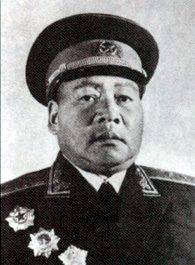
1. 2 March 1909, Jinzhai: a lieutenant general whose war record was real (1909–1955)
Teng Haiqing's birth and death are consistent across the Chinese and English records: born 2 March 1909 in Jinzhai County, Anhui, died 26 October 1997 in Beijing, aged 88. Jinzhai was a core county of the Eyuwan Soviet and a county the Red Army marched out of; the career shape of its generals of his generation is much the same — poor peasant family, guerrillas and the Red Army as a teenager, promotion rung by rung on combat merit. Chinese web-biographical materials record that his family was poor and that he herded cattle for a landlord from the age of seven (registered here at a low evidential grade, and not relied on for any argument). He joined a guerrilla unit in 1929, the Chinese Red Army in 1930 and the Party in 1931 (Chinese Wikipedia, "Teng Haiqing"). His Red Army career ran on the twin military-political track — squad leader, deputy company commander, company commander, battalion political instructor, regimental political commissar. From March 1935 he made the Long March with the Fourth Front Army as political instructor of the 1st Battalion, 33rd Regiment, 11th Division; by late 1936 he was political commissar of the 28th Regiment, 10th Division, Red 4th Army (ibid.).
His record in the wars against Japan and in the civil war is the key to why the Centre handed him Inner Mongolia in 1967. In 1937 he served in the 770th Regiment of the 385th Brigade, 129th Division, Eighth Route Army, then commanded the brigade's training detachment; in March 1938 he studied at the Anti-Japanese Military and Political University in Yan'an, and in August travelled south via Wuhan to Zhugou, Queshan County, where Peng Xuefeng, commanding the New Fourth Army Guerrilla Detachment, made him commander and political commissar of its 2nd Detachment. In 1941 he took command of the 11th Brigade of the New Fourth Army's 4th Division, moving to the 9th Brigade in November 1944 — he fought the whole anti-Japanese war under Peng Xuefeng, who was killed in action in 1944 and remained the most consequential superior of his military life. In January 1946 the 4th, 5th and 9th Brigades were combined into the 2nd Column of the Shandong Field Army, Teng still commanding the 9th Brigade; in January 1947, with the formation of the East China Field Army, the brigade became the 6th Division under his command; in October 1947 he became deputy commander of the 13th Column; in February 1948 he returned to command the 2nd Column, with Kang Zhiqiang as political commissar, and fought in the Huaihai campaign that September. In February 1949 the column was redesignated the 21st Army and he became its first commander, leading it across the Yangtze, taking Hangzhou and advancing into eastern Zhejiang on 6 May 1949 (Chinese Wikipedia, career section).
This record is written in full, and written straight, because it is the entire factual basis of the Centre's later formula "in view of his past service, he shall not be held responsible": a man who fought from squad leader to army commander and was made a lieutenant general has a thick ledger in this system's book of merit. In November 1950 he entered the PLA Military Academy's senior course among its first intake, graduated in August 1952 and stayed on staff — deputy head of Senior Course Class 1 and its party branch secretary, then deputy head of the senior department from June 1954. In September 1955 he was made lieutenant general, with the Second-Class Order of Bayi and the First-Class Orders of Independence and Freedom and of Liberation (ibid.). From 1955 to 1961 his public postings are academic — the one stretch of his career without blood on it. This site records that stretch deliberately, because it is what makes the later accounting stand: this file does not deny his war service, exactly as the Centre in its day did not deny his responsibility — its own words were that he bore "direct leadership responsibility for the New PRP case, with grave consequences", and only then "in view of his service and contributions, lenient handling". Merit is merit and crime is crime; this file keeps both ledgers, and lets neither swallow the other.
Sources: Chinese Wikipedia, "Teng Haiqing" (born 2 March 1909 in Jinzhai, died 26 October 1997 in Beijing; guerrillas 1929, Red Army 1930, Party 1931; Fourth Front Army posts; the Long March; Eighth Route Army and New Fourth Army posts; the 2nd Column and 21st Army; the Military Academy; lieutenant general and three orders in 1955); English Wikipedia, "Teng Haiqing" (corroborating birth/death dates and age 88); Chinese web-biographical materials (herding cattle as a child — registered at a low grade).
2. The Inner Mongolia seat: from deputy commander of the Beijing Military Region to acting commander and Revolutionary Committee chairman (1961–1967)
In October 1961 Teng Haiqing became a deputy commander of the Beijing Military Region (Chinese Wikipedia, "Teng Haiqing"). The Beijing region was the capital-garrison region, and Inner Mongolia lay inside its remit — the channel by which he travelled to Hohhot in 1967 ran from there. Before he arrived, Inner Mongolia's political foundations had already been overturned by the Cultural Revolution: the campaign was launched on 16 May 1966; from 20 May the CCP North China Bureau met at the Qianmen Hotel in Beijing, and Ulanhu, First Secretary of the Inner Mongolia Party Committee, was denounced at the meeting from 7 June to 20 July 1966. On 2 July 1966 Liu Shaoqi and Deng Xiaoping, for the Centre, told Ulanhu to his face that he had committed grave errors of local nationalism and revisionism. On 16 August 1966 the CCP Centre approved the removal of Ulanhu as Inner Mongolia First Secretary and as second secretary of the North China Bureau; Ulanhu was held under house arrest in Beijing and forbidden to return to Inner Mongolia (Chinese Wikipedia, "Inner Mongolia incident", background section, citing Hao Weimin's Xinhua-hosted account and Cheng Tiejun's essay). Ulanhu was the founder of the autonomous region — chairman of the autonomous government from its creation in 1947, the highest-ranking Mongol in the CCP system, a figure of state vice-chairman rank. With a man of that weight brought down, the region's party-government system was left headless: in February 1967 the Inner Mongolia Military District clashed bloodily with the rebel organisation Hu San Si, a university student was killed, and the Centre summoned all sides to Beijing for four-party talks; on 13 April 1967 the CCP Centre issued its Decision on Handling the Inner Mongolia Question, criticising regional leaders Wang Duo and Wang Yilun as the backstage of the conservatives (ibid.).
It was into this power vacuum that Teng Haiqing was inserted. Three nodes of the timeline must be fixed, and one discrepancy of months registered. Node one: after the North China Bureau meeting of May 1967, the Inner Mongolia Military District was downgraded to a provincial-level district and Teng, a deputy commander of the Beijing Military Region, became its (acting) commander — the Chinese Wikipedia biography gives "acting commander", the incident article "transferred as acting commander of the Inner Mongolia Military District"; Teng's own 1978 self-examination says "in April 1967 the Centre decided that I should go to Inner Mongolia to support the left" — an April decision and a May arrival can coexist, and this file takes arrival as acting commander in May 1967 as correct, registering his April self-dating here. His first act on arrival was to place the regional Public Security Department and the public security organs of the leagues and banners under military control (Teng Haiqing entry) — the police system was taken over by the army first, and the torture machine of the wasu campaign was later mounted on that military-control skeleton. Node two: on 18 June 1967 a preparatory group for the Inner Mongolia Revolutionary Committee was formed; on 27 July 1967 the North China Bureau of the CCP Centre issued its Report on Ulanhu's Errors, listing five major crimes — opposing Mao Zedong Thought, opposing class struggle and socialist revolution, grovelling before revisionism, taking the 1935 Soviet Central Government's Declaration to the Inner Mongolian People as his programme for national separatism and an independent kingdom, and planting cronies to usurp leadership (incident article, citing the Centre's document Zhongfa [67] No. 31 system). That report was the political foundation of wasu: once Ulanhu was fixed as "chief of a separatist conspiracy", digging down his line could produce an entire "anti-Party traitor clique". Node three: on 1 November 1967 the Inner Mongolia Autonomous Region Revolutionary Committee was formally established, Teng as chairman, Li Shude, Wu Tao and Gao Jinming as vice-chairmen (ibid.). From then on the region's military power (acting commander), government power (Revolutionary Committee chairman) and, shortly after, party power (head of the Revolutionary Committee core group formed 13 February 1968) were concentrated in one man; the English list of Inner Mongolia's leaders simply enters him as the region's Party secretary for 1968–1969. A Han general holding, at once, the gun, the seal and the party ticket in a Mongol autonomous region — that was the power structure on the eve of wasu.
One further piece of the personnel background cannot be omitted: Ulanhu's expulsion did not mean Mongol cadres vanished from the scene — on the contrary, the single most important cog in the wasu machine was the "Liaison Station for Exposing the Traitor Clique" (the "exposure station"), run by the Mongol cadre Wulan Bagan. In the second half of 1967 the nationwide hunt for "traitors" and "spies" reached Inner Mongolia; the exposure station and its case teams dug out the historical archives of the Inner Mongolian People's Revolutionary Party. Tegus, a former deputy head of the regional Party propaganda department who had once been introduced into the old PRP by Ha Fenga, was kidnapped to an office at the Hohhot suburban racecourse and interrogated through the night, and on that basis branded a "live agent" of a parallel apparatus infiltrated into the government. Teng's recorded verdict on the Tegus catch was that it had fired "the first shot" of the deepened criticism of Ulanhu's black line and pushed the Cultural Revolution to a new stage (incident article, citing Gao Shuhua and Cheng Tiejun's oral history, The Cultural Revolution in Inner Mongolia). That sentence belongs on his personal ledger: the "New PRP" did not descend first from a central document; Teng first caught, in a tortured man's confession, the thing he needed — and personally pronounced it a new stage of the movement. The next section sets out what the party being dug for actually was, before the chain of command is taken up again.
Sources: Chinese Wikipedia, "Teng Haiqing" (deputy commander, Beijing Military Region, October 1961; acting commander in May 1967 and military control of public security; chairman of the Revolutionary Committee from 1 November 1967; "in April 1967 the Centre decided I should go to Inner Mongolia to support the left" — 1978 self-examination); Chinese Wikipedia, "Inner Mongolia incident" (Ulanhu denounced 7 June – 20 July 1966; the Liu–Deng talk of 2 July; Centre-approved removal of 16 August; the February 1967 bloodshed; the Centre's 13 April 1967 decision; the North China Bureau's five-crimes report of 27 July 1967; the preparatory group of 18 June; the Revolutionary Committee of 1 November 1967 and its vice-chairmen; the exposure station and Tegus; the "first shot" remark); English Wikipedia, "List of leaders of Inner Mongolia" (Teng entered as Party secretary 1968–1969, government chairman 1967–1971).
3. A party twenty years dead: the real history of the PRP and the manufacture of the "New PRP" (1925–1967)
To see the absurdity of wasu clearly, one first has to see what the "PRP" actually was. The Inner Mongolian People's Revolutionary Party was founded in Zhangjiakou in October 1925, a Mongol nationalist party advocating Inner Mongolian autonomy and national self-determination, with ties at various times to the Kuomintang and the Comintern (this site's event file, "The 'Inner People's Party' Purge in Inner Mongolia (1967–1969)", synthesis). After Japan's defeat in 1945 a second-generation PRP was briefly active in eastern Inner Mongolia (Ha Fenga among its organisers), advocating the union of the eastern and western Mongols under autonomy. On 1 May 1947 the Inner Mongolian Autonomous Government was founded at Ulanhot under Ulanhu's chairmanship, and that same month the PRP announced its dissolution, its members merging into the Chinese Communist Party (ibid.). That is to say: when wasu began in 1967, the party had not existed for a full twenty years — and it had not been suppressed out of existence; it had dissolved itself inside a CCP-led autonomy settlement, its people passing into the CCP. A party dead for twenty years then became, in 1968, the largest "active counterrevolutionary organisation" in all Inner Mongolia. The whole secret lies in how the "New PRP" was manufactured.
The manufacture proceeded in three steps, each on the record. Step one: dig the historical archives to build the charge. The exposure station and its case teams mined the PRP's historical files and, by selective quotation, constructed an underground organisation headed by Ulanhu — in the words of the 1987 indictment in the Wulan Bagan case itself, the station fabricated 127 dossiers, "proposing that there existed a 'New PRP' counterrevolutionary clique, reporting it to the core group of the Inner Mongolia Revolutionary Committee, and manufacturing the great fabricated case of the 'New PRP'" (Hohhot Intermediate People's Court indictment in the Wulan Bagan case, as quoted in the Chinese Wikipedia incident article — note that this is the official judicial system's own admission of the fabrication process, the highest grade of evidence). Step two: propaganda fixed the "New PRP" as fact. The publicity of the day asserted that over the years, "especially since 1960, PRP activity has been extremely rampant; it has held several congresses and recruited new members" (publicity line carried in a December 1967 Cultural Revolution materials compilation against Tegus, quoted in the incident article) — a party "revived" in the 1960s thus first came alive on paper. Step three: unlimited multiplication of variant organisations. In the denunciation articles and big-character posters that followed, the "New PRP" spawned a string of wholly imaginary offshoots — a "Unification Party", an "Independence Party", a "Wicker Party", a "Well-Eye Party", a "Sandpit Party", a "Black Tiger Hall", a "White Tiger Hall" (incident article, citing Hao Weimin). An infinitely extensible list of organisations means an infinitely extensible arrest list: that was the machine's design — the charge first, the members afterwards, and the number of members set by the intensity of torture.
The ethnic dimension must be fixed here, because it is the core of why this page exists in the site's ethnic-persecution archive. Wasu nominally dug for a "party"; in practice it sieved a people. Those branded PRP members were overwhelmingly Mongols — of the 346,000 imprisoned in the indictment's count, about 75 per cent were Mongols (English Wikipedia incident article, citing the indictment system of figures); and Inner Mongolia's total Mongol population at the time was only about 1.5 million (Yang Haiying, The Truth about the Mongolian Genocide: at the outbreak of the Cultural Revolution the region's Mongol population was slightly under 1.5 million). Do the arithmetic: on the indictment's count, some 260,000 imprisoned Mongols amount to roughly one in every six Mongols alive. On the regional Party Committee's "over 480,000 branded" count, the proportion is higher still. During the campaign Mongolian-language publication was banned, and Mongols were criminalised as "the sons and heirs of Genghis Khan" (English Wikipedia incident article, citing Kerry Brown, 2007). The family-side record around Ha Fenga puts it more bluntly: official statistics of 16,222 dead, 87,188 disabled and 346,220 implicated made the incident "an unprecedented catastrophe in the history of the Mongol people" (the Ha Fenga entry's cited count; for the figure variants see Section 7). One in six of an autonomous region's titular people imprisoned is not an ordinary campaign's "over-expansion"; it is a purge aimed at a nation. This file therefore books Teng Haiqing inside the ethnic-persecution record: the "party" he dug for was fake; the people he sieved were real.
Sources: this site's event file, "The 'Inner People's Party' Purge in Inner Mongolia (1967–1969)" (PRP founded in Zhangjiakou, October 1925; dissolution and merger into the CCP, May 1947); Chinese Wikipedia, "Inner Mongolia incident" (the 127 dossiers and "manufacturing the great fabricated case" — 1987 Wulan Bagan indictment; the "extremely rampant since 1960" publicity line; the variant-organisation list); English Wikipedia, "Inner Mongolia incident" (75 per cent of the imprisoned were Mongols; Mongolian-language publication banned; "sons and heirs of Genghis Khan", citing Kerry Brown, Asian Affairs, 2007); Yang Haiying, The Truth about the Mongolian Genocide during the Chinese Cultural Revolution, Asian Studies Special Issue 6, Shizuoka University, 2017 (Mongol population slightly under 1.5 million); Chinese Wikipedia, "Ha Fenga" (one count: 16,222 dead, 87,188 disabled, 346,220 implicated).
4. The upper chain of command: Beijing's authorisation — Kang Sheng, Jiang Qing, Lin Biao and Chen Boda, graded one by one
Wasu was not something Teng Haiqing cooked up behind closed doors in Inner Mongolia. Above him stood Beijing, and Beijing's names must be pinned one by one, with the evidential grade of each attribution written separately — this is the most important discipline of the whole page: whose words survive in contemporary record, and whose responsibility exists only in the post-Cultural Revolution official transfer of blame, are written apart, never stewed into one generic "authorised by the Centre". The two figures with the highest-grade evidence are Kang Sheng and Jiang Qing, because a contemporary record of their reception survives. On 4 February 1968 Teng Haiqing and Revolutionary Committee vice-chairman Li Shude were received in Beijing by leaders of the Central Cultural Revolution Group. Jiang Qing told them that the literary and art circles in Beijing had not got moving, but Inner Mongolia had, and that through deepened struggle in the cultural sphere they had dug out a great many bad elements (Jiang Qing, as recorded in Bai Yintai's "The PRP Case, Before and After", quoted via the Chinese Wikipedia incident article — a relayed short quotation, within limits). Kang Sheng's instruction mattered more: the Inner Mongolia region, he said, had no shortage of Soviet-revisionist, Mongolian-revisionist and Japanese agents; the PRP was still active; and they might "dig a bit wide at first — don't be afraid" (Kang Sheng, ibid.). A Politburo Standing Committee member and adviser to the Central Cultural Revolution Group, telling a regional military commander to "dig wide, don't be afraid", is not acquiescence; it is an instruction to press the accelerator of a torture machine. This site's sort date is taken from that day: on 4 February 1968 the Centre's endorsement landed in Teng's hands; twelve days later he convened the region-wide deployment meeting in Hohhot (see Section 5).
Kang Sheng's authorisation did not occur only once. On 26 April 1968, after a Report on the Treason Case of the "Inner Mongolian People's Revolutionary Party" — drafted by Li Dechen and issued under Gao Jinming's signature — was sent up to the CCP Centre, Kang Sheng instructed Teng further, to the effect that the comrades of Inner Mongolia had no sense of the enemy in their heads; with a counterrevolutionary organisation this large in front of them, what were they asking the Centre's permission for — "dig as many as there are; the more the better" (Kang Sheng, Bai Yintai via the incident article; short quotation within limits). That sentence lays bare the shape of the whole chain: the subordinate reported the case upward, and the Centre's answer was not verification but a complaint that the digging was not extensive enough. A dedicated book was published inside the system after the Cultural Revolution: Kang Sheng and the PRP Case by Tumen and Zhu Dongli (Nationalities Publishing House, 1995) — post-purge official publishing puts Kang Sheng first in central responsibility for the case, corroborating the contemporary reception records. Standing: Kang Sheng is the first authoriser of wasu at the central level, on a chain of contemporary reception records plus a post-facto monograph — grade one. Chen Boda, next, must be graded lower: the Centre's own post-facto characterisation held that the PRP case was caused by "the instigation and direction of Kang Sheng and Chen Boda" (the Centre's handling decision as carried in The Biography of Huang Kecheng, via the Teng Haiqing entry's citation) — but within the range this site searched, there is no public contemporary record of any personal instruction by Chen Boda concerning Inner Mongolia. His name currently appears only in the post-Cultural Revolution central characterisation; his grade is therefore below Kang Sheng's, and this file keeps them separate: Kang Sheng has contemporary record; Chen Boda has only post-facto naming; neither may borrow the other's grade.
The attributions to Lin Biao and the Jiang Qing group need the same layering. English-language scholarship's synthesis (Kerry Brown's 2007 Asian Affairs article, via the English Wikipedia incident article) records that Teng launched wasu with the support of Lin Biao, Jiang Qing and Kang Sheng. Jiang Qing's support is underwritten by the 4 February reception record (above). Of any specific instruction by Lin Biao personally, there is, within the range this site searched, no public record — his name appears chiefly in the post-Cultural Revolution official characterisation: the 1980 judgment of the Supreme People's Court's Special Court held that "Kang Sheng, Xie Fuzhi and others, in digging out the so-called Inner Mongolian People's Revolutionary Party, caused grave consequences", booking the harm to "the Lin Biao and Jiang Qing counterrevolutionary cliques" (Special Court judgment, via the incident article). Note that the judgment adds a further name: Xie Fuzhi — then Minister of Public Security and a member of the Central Cultural Revolution Group. Of any specific instruction by Xie in wasu there is likewise no public record within this site's search range; only the judgment's collective attribution. Mao Zedong's place must be stated on its own, because without him the chain does not close: the Cultural Revolution was his launch; Ulanhu's removal and the circulation of the North China Bureau's five-crimes report (the Zhongfa [67] No. 31 document system) passed through the Centre, that is, through him; the "May 22 Directive" that halted wasu in 1969 was his annotation, and the December 1969 military-control decision was approved by him (see Section 8). Yang Haiying further asserts that Mao himself issued an order-like instruction concerning Inner Mongolia at the campaign's launch in May 1966 — that is Yang's scholarly argument, registered here as an academic claim, unverified, and not stated as fact. The full chain thus reads: Mao launched and eventually halted; Kang Sheng pressed the accelerator twice at the decisive nodes; Jiang Qing endorsed publicly; the Lin Biao side endorsed as a group (of personal instructions, no public record); Chen Boda and Xie Fuzhi appear in post-facto characterisations (of contemporary instructions, no public record) — and the man who caught all of that authorisation, amplified it and executed it as a region-wide torture campaign was Teng Haiqing. The next section books his segment of the chain.
Sources: Chinese Wikipedia, "Inner Mongolia incident" (the reception of 4 February 1968 and the words of Jiang Qing and Kang Sheng; the report of 26 April 1968 and Kang Sheng's "dig as many as there are" instruction — both citing Bai Yintai, "The PRP Case, Before and After", Yanhuang Chunqiu, no. 8, 2009); Chinese Wikipedia, "Teng Haiqing" (the Centre's characterisation "instigated and directed by Kang Sheng and Chen Boda", citing The Biography of Huang Kecheng, Contemporary China Publishing House, 2012, pp. 574–575); English Wikipedia, "Inner Mongolia incident" (support of Lin Biao, Jiang Qing and Kang Sheng, citing Kerry Brown, 2007); judgment of the Supreme People's Court Special Court ("Kang Sheng, Xie Fuzhi and others", via the incident article); Tumen and Zhu Dongli, Kang Sheng and the PRP Case, Nationalities Publishing House, 1995; Yang Haiying's book on Mao's instruction (academic claim, marked unverified).
5. The lower chain of command: Teng Haiqing's own deployments — the deployment meeting, the general-offensive order, the registration notices and "cruelty as the foundation" (February–November 1968)
Twelve days after returning from Beijing, Teng Haiqing pressed the accelerator to the floor. On 13 February 1968 the core group of the Inner Mongolia Revolutionary Committee was formed, with Teng at its head — the region's party, government and military powers were now institutionally his as well. On 18 February the Revolutionary Committee convened the leaders of every league and city revolutionary committee for a deployment meeting; from that point wasu was a uniformly deployed, region-wide campaign (Chinese Wikipedia incident article). On 13 April 1968, at a mass rally, Teng issued the order for a general offensive against the "New PRP" (ibid.) — this site considered that day as an alternative sort date and kept 4 February, because without the Beijing endorsement of that day there would have been no general offensive of 13 April; but the offensive order itself came out of Teng Haiqing's mouth, and that is booked on the first line of his personal ledger. From 14 to 26 April, Batu, deputy Party secretary of Inner Mongolia University, under torture named sixteen leading cadres, among them Bao Yinzhabu, as PRP backbone members; the sixteen were arrested at once and, under torture in their turn, named a fresh batch (ibid., citing Hasgele's account) — the snowball mechanism is clearest here: every person broken had to produce new names, so the lists grew geometrically. On 23 April the Inner Mongolia Daily published the editorial "Launch the General Offensive, Win the Decisive Battle"; regional leaders Wang Zaitian, Ha Fenga, Pengsike and Temur Bagana were branded members of an "Ulanhu anti-Party traitor clique" (ibid.).
The paperwork of persecution was completed in July 1968. On 5 July the Revolutionary Committee held its third plenary (enlarged) session; on 20 July it adopted the Opinions on Handling the Inner Mongolian People's Revolutionary Party — a document which held that after the founding of the autonomous government in 1947 the "old PRP", with Ulanhu as its overall chief, had gone underground, and which prescribed that backbone members below branch-committee level be treated as counterrevolutionaries, ordinary members surrender within a time limit, and resistance be punished severely (incident article). The Opinions were then circulated to the whole region as "Revolutionary Committee Document No. 351" (Nei Ge Fa 351) — a formal regional-level document delivering the "handling method" for a non-existent party to every banner and county. Teng then issued Registration Notices Nos. 1 and 2, Urging PRP Members to Register, together with his Slogans and Watchwords for Encirclement and Suppression of the PRP and Its Variant Organisations: registration was the last process fitted to the machine — those who would not confess to being PRP were detained and tortured; those who confessed had to name new members (ibid.). Guilt either way; the registration form was an arrest list. His speeches were later systematically collected in print: Yang Haiying (ed.), Collected Speeches of General Teng Haiqing Concerning the Inner Mongolian People's Revolutionary Party (Inner Mongolia Cultural Revolution Archives series, Taiwan, 2020; held by Japan's National Diet Library) — the complete speeches of a persecutor, reproduced volume by volume by a scholarly editor; there are few parallels in Cultural Revolution cases, and this file registers the book's existence as an archive-grade source for his personal deployment utterances.
The showcase figure from under his own hand comes from his own headquarters: in the 200 staff of the Political Department of the Inner Mongolia Military District, Teng dug out 180 PRP members, 10 of whom were persecuted to death (Bai Yintai, via the incident article) — in a 200-person political organ, nine in ten branded members of an enemy party and one in twenty beaten to death. That proportion was not loss of control; it was demonstration. If the commander's own headquarters dug to ninety per cent, what league, banner or county below would dare dig less? On 24 November 1968 the Inner Mongolia Daily published the editorial "Cruelty as the Foundation", proclaiming openly that the struggle had entered its deep-digging stage, that "without cruelty it will not do", and that of the three characters steadiness, accuracy and cruelty, "cruelty is the foundation" (editorial text, short quotation, via the incident article). A regional Party organ newspaper, by editorial, fixing "cruelty" as a campaign's foundational principle — that cap fits no head but the Revolutionary Committee that ran the paper: Teng's. On 2 December the head of the military control committee of the regional Public Security Department reported that inside the department itself a PRP command headquarters, security department and Soviet intelligence department had been dug out — twelve party branches, 68 backbone members and over 200 followers (ibid.) — even the police headquarters under military control had been "dug" into a complete underground party apparatus. By that point the machine was eating itself, and from the general-offensive order, through the handling document, to the registration notices, there was exactly one man at the top of every signature chain: Teng Haiqing. This file therefore fixes his responsibility in these terms: he was not simply "an executor of policy" — the Centre supplied authorisation and accelerator; the campaign's entire operational text issued from his Revolutionary Committee and his mouth.
Sources: Chinese Wikipedia, "Inner Mongolia incident" (core group formed 13 February 1968; deployment meeting of 18 February; general-offensive order of 13 April; Batu's naming of sixteen, 14–26 April; the editorial of 23 April and the "Ulanhu anti-Party traitor clique" branding; the third plenary of 5 July; the Opinions of 20 July and Document No. 351; Registration Notices Nos. 1 and 2 and the encirclement slogans; 180 of 200 in the Military District Political Department, 10 dead; the "Cruelty as the Foundation" editorial of 24 November; the Public Security Department military control report of 2 December — citing Bai Yintai and Hasgele, Yanhuang Chunqiu, no. 8, 2009); Yang Haiying (ed.), Collected Speeches of General Teng Haiqing Concerning the Inner Mongolian People's Revolutionary Party, 2020 (National Diet Library catalogue record, NDL Bib ID 031278783).
6. Execution on the ground: the catalogue of tortures, the named dead, and the families' account (second half of 1967 – 1969)
The methods by which wasu was executed on the ground are recorded with striking consistency across the sources, because the methods themselves were an open secret. The catalogue of tortures synthesised in the lead of the Chinese Wikipedia incident article includes: pressing with the lever-bar, the tiger bench, being fed furnace slag, burning with fire-pillars, piercing the fingernails, scooping out livers, the oil-press board, the "pulling the river", hanging, pounding with rammers, cutting tongues and cutting noses; the article's section on methods adds freezing on ice, stuffing into trousers, the swing, the "monkey picks teeth", poking the nose, squeezing the breasts, wooden rods thrust into vaginas, and hot salt water poured into wounds (incident article, citing Ba Yantai's Record of the Wasu Catastrophe and Yang Jisheng's Heaven and Earth Turned Upside Down). The English Wikipedia catalogue corresponds: branding with hot irons, feeding furnace waste, removing livers, hanging, cutting tongues and noses, piercing nails, piercing vaginas, pouring hot saline water into wounds (English article, citing Bai Yintai and Yang Jisheng). This file reproduces the catalogue without adjectives — the catalogue is itself the definition of the word "campaign": this was not interrogation but systematic bodily destruction aimed at extracting confessions, and the torturers' purpose was never to establish facts (the facts were fixed in advance) but to force out lists. Every person who broke under torture supplied a batch of new names; new names brought new arrests and new torture — Batu's sixteen-man chain of April 1968 (Section 5) is the standard component of that mechanism. The campaign rolled from Hohhot to every league, banner, county and commune in eighteen months on exactly this self-reproducing chain of confessions.
Among the dead with names and posts stands a whole layer of Inner Mongolia's Mongol elite. The incident article's list of notable victims records: Ji Yatai, vice-chairman of the regional government (China's first ambassador to Mongolia, in post 1950–1953); vice-chairmen Ha Fenga and Darijaya; Temur Bagana, president of the Regional High People's Court; Garubsengge, deputy secretary-general of the regional Party Committee; Zuo Zhi, president of Inner Mongolia Normal College; He Zhi, head of the History Department at Inner Mongolia University; and Yongfu, director of the Inner Mongolia History Research Institute (incident article, notable victims list). Ha Fenga's death carries its own dated record: seized by the "Ha exposure station" from Beijing in July 1967 and brought back to Inner Mongolia, he was held and abused for over three years and died in custody in Hohhot on 29 November 1970, aged 62 (Chinese Wikipedia, "Ha Fenga"). Hold that date in view: November 1970 — the campaign had nominally been halted by the Centre for a year and a half, military control was itself nearing its end, and a vice-chairman of the region was still dying in a cell. Once manufactured, the inertia of persecution could not be recalled even by those who had halted it; this file flags the point for the reader because it matters to the accounting: Teng left in 1969, but the machine he released ran on by itself for a long time after. Ulanhu himself, protected at the top, was not brought back to Inner Mongolia and did not die in wasu — that is fact, and this file records it as such; but the cadres of his system and the elite of his people died in batches in a campaign named after him.
The families' account survives only in fragments in the sources; this file pins down everything found, and leaves the rest blank as found. From March 1969, victims and their families travelling to Beijing to petition carried letters of complaint, appeal papers, the suicide notes of the dead, bloodied clothing and the instruments of torture themselves, and filled Beijing Railway Station, Zhongshan Park, the State Ethnic Affairs Commission, the Palace of National Culture and the approaches to Zhongnanhai (incident article) — a suicide note, a bloodied shirt and a torture implement: those were the three forms of evidence a family could produce. At the denunciation rallies of June–July 1969, Teng's accusers were "orphans, widows and the disabled persecuted" (ibid.). The victims' widows later formed a petition group known as the "Thirty-Two Widows", whose own door-to-door count produced over 40,000 dead, over 140,000 disabled and some 700,000 arrested, dug out or persecuted (ibid., citing Hasgele) — a bereaved families' self-count ranks below the official and academic counts in evidential grade, and Section 7 queues it accordingly; but the group's existence is itself an archival fact: a body of Mongol widows who spent decades counting house by house against the shrinking of the official numbers. Beyond that, the family-level detail — how many households were ruined because one member was branded, how children were stigmatised, what became of herders' livestock and property — survives in the sources this site searched only as the aggregate figure of "over a million people implicated", on which the sources agree; of itemised family-impact records, there is no public record, and this file leaves that blank visible rather than filling it with literary invention.
Sources: Chinese Wikipedia, "Inner Mongolia incident" (both torture catalogues; the notable victims list; the March 1969 petitioners with suicide notes, bloodied clothing and torture instruments; the orphans and widows at the denunciation rallies; the Thirty-Two Widows' count — citing Ba Yantai, Record of the Wasu Catastrophe; Yang Jisheng, Heaven and Earth Turned Upside Down; Hasgele, Yanhuang Chunqiu, no. 8, 2009); English Wikipedia, "Inner Mongolia incident" (corresponding torture catalogue; Ji Yatai's ambassador years); Chinese Wikipedia, "Ha Fenga" (brought back July 1967; died in custody 29 November 1970).
7. The numbers ledger: six ledgers queued by source and method, never merged
The figures of the PRP case are among the most disputed in all Cultural Revolution research — disputed to this extent: the death toll runs from a low of 16,222 to claims of 300,000, a spread of nearly twentyfold. This file's discipline is the same as on its other people pages: queue every ledger, name its source and method, never merge them, never take the largest, never take the smallest. One premise is shared by all the figures: the period covered is broadly the second half of 1967 to 1969 (some counts run into the military-control period) and the territory the whole autonomous region; but the counts define "persecuted" differently — some count only formal imprisonment, others everyone struggled against, held in isolation for investigation, or branded a PRP member — and different definitions yield naturally different numbers. That is the root reason they cannot be merged.
Ledger one, the official judicial ledger — the highest evidential grade and the lowest numbers: the 1980 indictment of the Special Procuratorate of the Supreme People's Procuratorate (in the case of the Lin Biao and Jiang Qing counterrevolutionary cliques) records that in Inner Mongolia, because of the PRP fabricated case, 346,000 people were imprisoned (a variant tradition gives the precise figure of 346,220 people implicated, the count cited in the Ha Fenga entry), 16,222 were persecuted to death and 81,808 were permanently disabled (the indictment, corroborated across the Chinese and English Wikipedia incident articles). Supplements in the same system: about 75 per cent of those imprisoned were Mongols (English article, citing the indictment system), and a regional-system variant gives the disabled as 87,188 (the Ha Fenga entry's cited count, registered alongside 81,808 as an intra-official variant). The nature of this ledger must be understood: it is the indictment in the 1980 trial of Lin Biao and the Gang of Four, compiled to charge those defendants, counting only what could be attached to concrete cases — it is a floor, not the whole picture, but it is the only figure ever written into an indictment through judicial process. Ledger two, the regional Party Committee's own post-facto summary: the Inner Mongolia Party Committee's summary report stated that Teng Haiqing and others had in all "branded over 480,000 people as New PRP members" (regional Party Committee summary report, via the incident article) — 480,000 is the total "branded", a wider definition than formal imprisonment, hence larger than 346,000; the two do not contradict each other, they measure different things. From the same system comes the letter of Ting Mao, former second secretary of the regional Party Committee, to Huang Kecheng of 1 August 1981: over 20,000 dead, 170,000 injured and disabled, over a million implicated (Ting Mao letter, via the incident article) — the region's number-two's internal post-facto count, already above the indictment on deaths, and more than double it on the disabled.
Ledger three, the scholarly ledger — the one most cited by the field today: A History of the Inner Mongolia Autonomous Region (1991), compiled under the Inner Mongolia University scholar Hao Weimin, records 27,900 persecuted to death and over 120,000 disabled (the History, relayed by many Chinese and English sources). Yang Haiying's edited volume The Inner Mongolian People's Revolutionary Party (and his English monograph) uses the same set: of 1.5 million Mongols in 1967–1969, at least 346,000 arrested, 27,900 killed and 120,000 crippled (Yang's book, via the incident article); the Mongol historian Lhamjab A. Borjigin's count is the same — at least 27,900 killed, 346,000 imprisoned and tortured (Borjigin, via Radio Free Asia and the English Wikipedia). The synthesis in the Chinese Wikipedia Teng Haiqing entry judges the figures most widely accepted in scholarship to be: deaths in the twenty-to-thirty thousands, 120,000 disabled, roughly 500,000 imprisoned (Teng Haiqing entry synthesis, citing Yang Jisheng) — the 500,000 imprisoned sits between the indictment's 346,000 and the Party summary's 480,000 "branded", a scholarly middle figure that estimates in those held in isolation without formal imprisonment. Ledger four, the accumulated official-edge counts: Zhou Hui (regional Party secretary from 1981) stated that 790,000 people were imprisoned or held incommunicado under investigation (Zhou Hui, relayed by Amulan, 2010, and cited in Yang Haiying's book — a long relay chain, registered at grade three); and statistics published in 1989 by the General Office of the regional Party Committee gave total victims as 480,000 (1989 General Office statistics, relayed by Altandeleihei, 1999, and cited by Yang — likewise grade three; this 480,000 is close to, and possibly from the same root as, the Party summary's "over 480,000 branded", and the two are registered side by side, not merged).
Ledger five, the victims' and exiled scholars' ledger — the highest numbers and the coarsest methods, which must nonetheless be registered, with their grades marked: (i) the unofficial source cited by Song Yongyi (California State University, Los Angeles): at least 40,000 dead, 140,000 disabled to the point of deformity, nearly 700,000 persecuted (Song Yongyi's chronology of Cultural Revolution mass killings, published via Sciences Po and relayed by the English Wikipedia). (ii) The Thirty-Two Widows' self-count: over 40,000 dead, over 140,000 disabled, some 700,000 arrested, dug out or persecuted (see Section 6) — strikingly close to Song's cited figures; the two may share a root in the victims' community's own canvassing, and are registered side by side. (iii) The Mongol scholar Ba He's estimates exist in several versions: one gives 800,000 arrested and imprisoned, 500,000 disabled and 50,000 persecuted to death (Ba He's writings, via the Teng Haiqing entry); another gives nearly 100,000 persecuted to death, 700,000–800,000 arrested and imprisoned and over a million implicated (Ba He, Beijing Spring, 2003) — two versions by the same author coexist, and this file registers both without unifying them for him. (iv) Gao Shuhua and Cheng Tiejun's The Cultural Revolution in Inner Mongolia (2007) estimates about 500,000 arrested and 20,000–30,000 killed — this one, by contrast, falls inside the scholarly middle range, a reminder that participant oral history does not always estimate high. (v) Independent overseas research (Jankowiak, 1988; Sneath, 1994) estimates about 500,000 arrested and about 100,000 dead (cited in Yang Haiying's book). (vi) The most extreme ledger: Sirabjamsu (2006), counting in those who died a "delayed death" after release and return home, puts total deaths at the order of 300,000 (cited in Yang's book) — a count that stretches attribution of cause to its limit; this file registers its existence and method only, and adopts it for no conclusion. Ledger six, the regional breakdown (incomplete): the incident article carries partial league-level statistics — Jerim League: 48,500 dug out, 3,900 dead, 14,000 injured or disabled; Hulunbuir League: 47,500 dug out, 14,329 imprisoned, 2,307 dead; Xilingol League: 1,863 dead; Ulanqab League: 1,686 dead, 8,628 injured, 4,650 disabled; Yeke Juu League: 150,000 dug out (21 per cent of its 740,000 population), 1,260 dead; Bayannur League: 8,415 dug out, 363 dead, 3,608 gravely disabled — with the express note that Alxa League, Juu Uda League, Xing'an League, the cities of Hohhot and Baotou and the military district are not included (league statistics, via the incident article, citing Hasgele). The incomplete sum of just these six leagues already exceeds ten thousand dead — the regional ledger underwrites the indictment's floor of 16,222 from below, and shows at the same time that anything below 16,222 cannot stand, while every ledger above it differs only in how large the uncounted remainder was.
Three sentences close this section. First, the defensible range for deaths, after queuing by evidence: a judicial floor of 16,222; scholarly acceptance at 20,000–30,000 (the History's 27,900 as anchor); victims' and some scholars' estimates of 40,000–100,000; and the 300,000 claim as an extreme singleton, not adopted. Second, the disabled count requires the correction of a circulating version: an early draft brief for this file gave "over 22,900 disabled" — in this round of research, the number 22,900 appears in no source at all; the disabled counts run, in order, 81,808 (indictment), 87,188 (official-system variant), over 120,000 (the History and Yang Haiying), 140,000 (Song's cited source and the widows), 170,000 (Ting Mao's letter, an injured-and-disabled combined count) and 500,000 (Ba He's highest version) — the brief's 22,900 appears to be a copying error accumulated in relay (closest real figure: the 27,900 deaths), and this file takes 81,808 as the official headline figure, registering the rest in layers and the error in the Verification Note. Third, on the victims' ethnic composition every ledger points the same way: the victims were overwhelmingly Mongols (75 per cent of the imprisoned on the indictment's count) out of a Mongol population of only about 1.5 million — on any ledger, a demographically catastrophic purge of one people. Those three sentences are the whole of the numbers account under Teng Haiqing's name: the floor is nailed down by a court, the ceiling is still owed by history, and every layer between carries its source on its face.
Sources: the 1980 indictment of the Special Procuratorate of the Supreme People's Procuratorate (346,000 imprisoned, 16,222 dead, 81,808 disabled, 75 per cent Mongols — corroborated across the Chinese and English Wikipedia incident articles); the regional Party Committee summary report (over 480,000 branded, via the incident article); Ting Mao's letter to Huang Kecheng of 1 August 1981 (over 20,000 dead, 170,000 injured and disabled, over a million implicated, via the incident article); Hao Weimin (ed.), A History of the Inner Mongolia Autonomous Region, 1991 (27,900 dead, over 120,000 disabled); Yang Haiying (ed.), The Inner Mongolian People's Revolutionary Party, and his English monograph (346,000 arrested, 27,900 killed, 120,000 crippled; Zhou Hui's 790,000 and the General Office's 1989 figure of 480,000 cited in his book — grade three); Borjigin's count (via Radio Free Asia and the English Wikipedia); Song Yongyi, Chronology of Mass Killings during the Chinese Cultural Revolution (unofficial source: at least 40,000 dead, 140,000 disabled, nearly 700,000 persecuted; Sciences Po); Ba He's writings (800,000 imprisoned, 500,000 disabled, 50,000 dead in one version; nearly 100,000 dead and 700,000–800,000 imprisoned in another; Beijing Spring, 2003); Gao Shuhua and Cheng Tiejun, The Cultural Revolution in Inner Mongolia, 2007 (about 500,000 arrested, 20,000–30,000 killed, cited in Yang's book); Jankowiak (1988) and Sneath (1994) (about 500,000 arrested, about 100,000 dead, cited in Yang's book); Sirabjamsu, 2006 (the 300,000 "delayed deaths" count, cited in Yang's book — extreme count registered only); the league-level statistics (via the incident article, citing Hasgele); the Chinese Wikipedia Teng Haiqing entry synthesis (scholarly acceptance: deaths in the twenty-to-thirty thousands, 120,000 disabled, about 500,000 imprisoned).
8. 1969: the petitioners in Beijing, the May 22 Directive, and the Centre's two reversals over Teng Haiqing
Wasu reached its peak from November 1968 to May 1969 (Chinese Wikipedia incident article) — that is, the fire burned hottest more than half a year after Kang Sheng pressed the accelerator in February. The force that turned it came from the ground: from March 1969 ever more Inner Mongolians travelled to Beijing to petition, carrying the suicide notes of the dead, bloodied clothing and instruments of torture, filling Beijing Railway Station, Zhongshan Park, the State Ethnic Affairs Commission, the Palace of National Culture and the approaches to Zhongnanhai (ibid.; see Section 6). At the same time the Ninth Party Congress was to meet in April 1969, and Mao judged that the Cultural Revolution needed cooling; the Inner Mongolian petition wave thus entered the Centre's field of vision. At that congress in April 1969, Teng Haiqing was elected to the 9th Central Committee — the detail that unlocks everything that followed: on the eve of the Centre's decision to halt wasu, its commander-in-chief had just been voted into the Central Committee. From 13 to 19 May 1969, members of the Politburo received the Inner Mongolia leaders and Teng was criticised. On 22 May the CCP Centre issued Document No. 24 — the "May 22 Directive" — with Mao's annotation to the effect that in the cleansing of the class ranks Inner Mongolia had already over-expanded; the document required thorough rehabilitation of the wrongly harmed and the immediate release of all detainees except those under grave suspicion (incident article). The three characters "already over-expanded" were Mao's characterisation of the entire campaign: not a fabricated case, not a massacre — "over-expansion". That characterisation has lasted into the official language of the present day, and this file registers its original position exactly.
After the May 22 Directive, Inner Mongolia did not calm; it split into two armed camps, a "denounce-Teng faction" and a "protect-Teng faction". The victims demanded Teng's punishment, while the cadres who had executed wasu turned round and accused the Centre of reversing itself overnight and making the grassroots the scapegoat, and joined the petitioning themselves; the army was near paralysis, government offices were besieged and weapons seized (incident article). In June and July 1969 several "denounce-Teng rallies" were held, at which Teng made self-criticisms before the accusations of orphans, widows and the disabled (ibid.) — the closest moment of his life to "accountability", and its form was still only a rally self-criticism: not an investigation, still less a trial. Then the Centre reversed a second time — this time to protect him. On 13 September 1969 Zhou Enlai, with Li Zuopeng and Li Desheng, received the members of the region's core group, and Zhou stated plainly that "Comrade Teng Haiqing need make no more self-criticisms", on grounds of war preparedness and unity against the enemy (Collected Talks of Central Leaders Receiving the Inner Mongolia Mao Zedong Thought Study Class, printed by that study class in September 1969, via the incident article's note — a contemporary printed item, high evidential grade). A premier, with the victims' families' accusations still hanging in the air, personally calling a halt to criticism of the purge's commander: that entry is booked to Zhou Enlai, separately from Section 4's authorisation chain — of any personal authorising instruction by Zhou during wasu's launch phase there is, within this site's search range, no public record (some accounts say he expressed restraining views; single-source, unverified — see the Verification Note); but his protective act of September 1969 and his announcement of military control that December are both on contemporary record. On 19 July 1969 the Centre had first met to partition Inner Mongolia: Hulunbuir League was transferred to Heilongjiang, Jerim League to Jilin, Juu Uda League to Liaoning, and the Alxa area split between Ningxia and Gansu (incident article note; the original boundaries were restored in 1979) — an autonomous region broken up among its neighbours because of a persecution, an event without a second example in the administrative history of the People's Republic. On 18 December 1969 Teng Haiqing, Wu Tao, Gao Jinming, Quan Xingyuan, Li Shude, Li Zhi and others were urgently summoned to Beijing, where Zhou Enlai announced to them in person the Mao-approved Decision of the CCP Centre on Implementing Partitioned, Comprehensive Military Control in Inner Mongolia; on 19 December Beijing Military Region commander Zheng Weishan led troops in, forming the Inner Mongolia Front Command to lead the region as one (incident article, citing the Xinhua-hosted Inner Mongolia chronicle). Teng's two years and seven months of rule in Inner Mongolia ended there — and the manner of its ending was transfer, not investigation.
Of what followed under military control, this file records only the layer directly tied to Teng's responsibility chain: Zheng Weishan's Front Command did not in fact carry out the May 22 Directive's rehabilitation, but suppressed victims who demanded it, and under military control the digging for the "New PRP" went on and lives continued to be treated as grass (incident article) — Ha Fenga's death in custody in November 1970 (Section 6) belongs to this period. In December 1970 Zheng Weishan was suspended for his part in the Chen Boda affair and You Taizhong took over; in May 1971 comprehensive military control ended and You formally succeeded Teng as chairman of the Revolutionary Committee and commander of the military district, Teng's nominal posts being replaced only then (ibid.; the Teng Haiqing entry's office table). An early draft brief for this file had Teng "transferred to the Beijing Military Region in 1969" — on checking, no source supports any Beijing Military Region appointment for him in 1969: in December 1969 he was summoned to Beijing to hear the military-control decision announced, and left real power from that point; his next formal posting was deputy commander of the Jinan Military Region in 1975. Of his postings between 1969 and 1975 there is, within this site's search range, no public record, and the blank is left visible (the brief's error is registered in the Verification Note). From the general-offensive order to the summons to Beijing, the entire price Teng Haiqing paid for wasu was a few self-criticisms and one transfer order. This file sets that sentence down without comment, because the Centre's written handling decision in the next section carries more weight than any comment could.
Sources: Chinese Wikipedia, "Inner Mongolia incident" (the peak of November 1968 – May 1969; the petition wave of March 1969; the Politburo reception and criticism of 13–19 May; Document No. 24 of 22 May and Mao's "over-expanded" annotation; the denounce-Teng and protect-Teng factions; the rallies of June–July; the partition meeting of 19 July 1969 and its transfers; Zhou's announcement of the military-control decision, with Mao's approval, on 18 December; Zheng Weishan's Front Command of 19 December; continued digging under military control; Zheng's suspension in December 1970 and You Taizhong's succession; the end of military control in May 1971); Collected Talks of Central Leaders Receiving the Inner Mongolia Mao Zedong Thought Study Class, printed September 1969 (Zhou Enlai on 13 September 1969: "Comrade Teng Haiqing need make no more self-criticisms", via the incident article's note); Chinese Wikipedia, "Teng Haiqing" (office table: Revolutionary Committee chairman and military district commander April 1967 – May 1971, succeeded by You Taizhong — the April start month conflicts with the May arrival of the text and is registered there).
9. The rehabilitation years: the regional Party Committee twice demanded severe punishment; the Centre twice answered no (1978–1980)
Rehabilitation of the PRP case came almost a decade after wasu was halted. Mao died in September 1976 and the Gang of Four was arrested that October, ending the Cultural Revolution. On 15 April 1978 the CCP Centre, on the regional Party Committee's report, issued its instruction thoroughly overturning the so-called "New PRP" historical wrong case; on 20 April 1978 Hu Yaobang, head of the Centre's Organisation Department, sought Hua Guofeng's approval for a decision to rehabilitate the PRP case completely as a major wrong case (Chinese Wikipedia incident article, rehabilitation section, citing People's Daily Online materials). From 1979 the victims were rehabilitated in the course of Boluan Fanzheng, and the region's partitioned boundaries were restored the same year (ibid.). It was also in 1978 that Teng Haiqing wrote his self-examination — the text is reproduced in full in the Chinese Wikipedia Teng Haiqing entry, and this file, under its quotation discipline, extracts only its substance: he admitted that the "New PRP" question "was entirely a fabricated case", that he had committed "a grave error of over-expansion" in the cleansing of the class ranks, that the fabricated case had produced the most extreme extortion of confessions by torture, with not a few comrades killed and disabled, and that he had "done no personal investigation, lightly believing some people's opinions". The attribution part of the examination rests wholly on subjective understanding: carried away by victory, conceited and complacent, afraid of countering rightism, afraid of letting enemies slip away, his subjective world unreformed. In the self-examination of the commander-in-chief of a wrong case that killed at least sixteen thousand people, not one word mentions the general-offensive order he issued, Document No. 351 circulated under his rule, or the registration notices he promulgated — error is written as a problem of understanding, and orders as a problem of mood. What that self-examination purchased was the outcome of the confrontation of 1979–1980 that follows.
On 13 November 1979 the Inner Mongolia Autonomous Region Party Committee submitted to the CCP Centre its Report on the Grave Crimes Committed by Teng Haiqing in Inner Mongolia and Opinions on Handling; in June 1980 it submitted a second report to the Central Commission for Discipline Inspection. The report's language, shortly quoted within limits: the catastrophe Inner Mongolia suffered in the digging for the PRP was appalling; Lin Biao, Kang Sheng and the Gang of Four were the chief culprits of the disaster; and Teng Haiqing, Wu Tao, Gao Jinming, Quan Xingyuan, Li Shude, Guo Yiqing and others were the criminals who had caused the tragedy, their crimes grave and the popular anger enormous — "they should be severely sanctioned under party discipline and state law" (regional Party Committee reports, via the incident article). The reader should register how rare this document is: a regional Party Committee twice formally petitioning the Centre to punish a founding lieutenant general under party discipline and state law — in CCP history there is almost no precedent for a subordinate committee naming a senior general (then a serving deputy commander of the Jinan Military Region) in this way. The Centre's reply is likewise on formal record: central leaders would be handled administratively by the Centre; Teng, because of his past war service, and because the PRP case had been caused by the direct intervention of Lin Biao and the Gang of Four and the instigation of Kang Sheng and Chen Boda, Teng being merely an executor of policy, would not be held responsible for the PRP affair; Wu Tao would be transferred back to the Beijing Military Region as a deputy political commissar and should not remain in Inner Mongolia; Gao Jinming, Quan Xingyuan and Li Shude had already received demotion, labour training and other punishments after wasu and should not be pursued further (the Centre's reply, via the incident article, sourced to the Inner Mongolia Political and Legal Committee meeting record in the Wulan Bagan case files and related archives). The Biography of Huang Kecheng corroborates: the Centre held that although Teng bore direct leadership responsibility for the New PRP case with grave consequences, in view of his past service and contributions he would be handled leniently and not held criminally responsible (The Biography of Huang Kecheng, Contemporary China Publishing House, 2012, pp. 574–575). The only man the regional committee was left empowered to handle itself was Guo Yiqing, who had fallen from power as early as August 1968 — expelled from the Party, expelled from public office, three years in prison (incident article).
This section offers no commentary; it lays out the structure. The demand for severe punishment was made twice, by the Party Committee of the victims' own region. The refusal also came from the Centre, and the reasons given on paper are exactly two: first, that responsibility lay above (Lin Biao, Kang Sheng, Chen Boda — three dead or already fallen men); second, the status of a meritorious veteran. What weight the 16,222 dead (at the lowest count) and 81,808 disabled carried in the arithmetic of "lenient handling", the Centre's reply does not say. In 1980 the Special Procuratorate's indictment wrote the figures 346,000, 16,222 and 81,808 into the charges against the Lin Biao and Gang of Four cliques, and the Supreme People's Court's Special Court judgment declared that Kang Sheng, Xie Fuzhi and others, in digging out the PRP case, had "caused grave consequences" — the judicial system confirmed the scale of the wrong case, but used it only as evidence against men already fallen, and never opened a case against Teng Haiqing on its basis. The numbers entered an indictment; the man never entered a dock. That is the whole distance, in this case, between "rehabilitation" and "accountability" — and the next section, a trial twenty years late, measures that distance to the end.
Sources: Chinese Wikipedia, "Inner Mongolia incident" (the Centre's instruction of 15 April 1978; Hu Yaobang's submission to Hua Guofeng of 20 April; the substance of the regional Party Committee's reports of 13 November 1979 and June 1980; the substance of the Centre's reply; Guo Yiqing's handling; the Special Court judgment's "Kang Sheng, Xie Fuzhi and others"); Chinese Wikipedia, "Teng Haiqing" (the substance of the 1978 self-examination; the Centre's handling decision in The Biography of Huang Kecheng, pp. 574–575); the 1980 indictment of the Special Procuratorate of the Supreme People's Procuratorate (figures in Section 7).
10. The only man tried: the Wulan Bagan case, and the defence lawyer's question in open court (1978–1987)
The judicial end-point of the PRP case was a trial this file calls the scapegoat trial. Wulan Bagan, a Mongol writer and cadre, had from September 1967 run the exposure station, assembling and fabricating for wasu the 127 dossiers on the "New PRP", and was deeply favoured by Teng Haiqing for it (Hohhot Intermediate People's Court indictment in the Wulan Bagan case, via the Chinese Wikipedia incident article). He was arrested in 1978. On 3 October 1987 — the twentieth anniversary of the incident — the Hohhot Intermediate People's Court held a public trial rally with him in the dock; on 4 November 1987 the court sentenced him at final instance to fifteen years' imprisonment, his detention since 1978 counting against the term (ibid.). From head of the exposure station to prisoner, he was the only person in the entire PRP case ever sentenced by a court. The indictment against him in substance admitted that the "New PRP" had been fabricated: the exposure station had quoted out of context, fabricated and distorted, "manufacturing the great fabricated case of the 'New PRP'" (indictment wording, short quotation within limits).
What that trial provoked in Inner Mongolia was not closure but greater anger; local opinion called it a "muddle-headed case" (Radio Free Asia reporting, 2017, via the incident article). The reason is written in the defence statement. Wulan Bagan's defence counsel (Sukeruri and Liu Yahua, Defence Statement, preserved in the Wulan Bagan archives) put two layers of question to the court: first, that the Cultural Revolution was a political movement launched by the CCP Centre itself and the defendant had answered the Centre's call, so that under Article 9 of the 1980 Criminal Law — the principle of applying the law of the time — conduct not criminal under the policy of the time could not be prosecuted; and second, the question this file pins into the archive — that the makers went unsanctioned by law while a participant stood trial twenty years later: "what exactly is going on here?"; that the constitution provides that all citizens are equal before the law, so "what crime were Teng Haiqing, Gao Jinming, Quan Xingyuan and Li Shude convicted of in the PRP matter?"; and whether a minority-nationality writer, an ordinary member of the masses, was to be made the sacrifice and scapegoat of this enormous wrong case (Defence Statement, via the incident article; substance extracted, short quotations within limits). The court did not answer the question; the sentence was read as usual. This file keeps that defence statement on Teng Haiqing's people page, and not only in Wulan Bagan's case file, for a simple reason: it is the closest a formal utterance in the Chinese judicial record has ever come to "Teng Haiqing should stand trial" — spoken in a court, by a defence lawyer, unanswered, and on the record.
After that trial, the reckoning closed for good. In the forty years since, no judicial organ at any level has opened a case on the PRP affair; Teng's name continued to appear in official publications under the title "General" (see Section 11). Set against it is what happened at the memory end of the ledger: the Mongol historian Lhamjab A. Borjigin spent twenty years interviewing survivors and in 2006 completed, in Mongolian, China's Cultural Revolution, an oral history of wasu, published underground at his own expense. On 11 July 2018 he was placed under residential surveillance by the local public security; on 4 April 2019 he was tried behind closed doors at the Shiliin-hot City Court on charges including "national separatism"; on 3 July 2019 he was sentenced to one year's imprisonment, suspended for two years, and 836 copies of his book were confiscated (the Shiliin-hot court's decision and community-correction notice, published by the Southern Mongolian Human Rights Information Center; PEN America statement). In March 2023 he escaped to Ulaanbaatar, Mongolia; on 3 May 2023 Chinese police took him from his exile residence and carried him back to China, since when he has been in Chinese custody and his family harassed (PEN America statement of May 2023 and its Writers at Risk database). The man who wrote about wasu was sentenced and cross-border seized; the man who ordered wasu was never indicted in his life. This file sets those two records side by side at the end of this section not because they form a rhetorical contrast, but because they are two faces of one ledger: the absence of accountability and the punishment of memory are a single policy's obverse and reverse.
Sources: Chinese Wikipedia, "Inner Mongolia incident" (Wulan Bagan arrested 1978; public trial 3 October 1987; sentenced to 15 years on 4 November 1987; the indictment's 127 dossiers and "manufacturing the great fabricated case"; the two layers of the defence; the "muddle-headed case" verdict — citing the Wulan Bagan case files, the Defence Statement and Radio Free Asia, 2017); Southern Mongolian Human Rights Information Center (Borjigin judgment published: Shiliin-hot City People's Court decision of 3 July 2019 — one year suspended for two years, 836 copies confiscated; residential surveillance from 11 July 2018); PEN America, press release of 12 May 2023 and Writers at Risk database entry "Lhamjab A. Borjigin" (taken from Ulaanbaatar on 3 May 2023 and returned to China; in custody).
11. The late years: deputy commander of the Jinan Military Region, a merit medal, a centenary — and death on 26 October 1997 (1975–2009)
Teng Haiqing's record after he left Inner Mongolia is calm, as if nothing had happened. From 1975 to 1980 he was a deputy commander of the Jinan Military Region (Chinese Wikipedia, "Teng Haiqing") — Chinese web-biographical materials say his portfolio covered militia building, military mobilisation and civil air defence (a web-biography line, registered at a low grade). That is: when the Inner Mongolia Party Committee reported to the Centre in November 1979 demanding his severe punishment, he was sitting securely in a great-region deputy commander's seat; when the Committee filed its second report in June 1980, he was still in post. He concurrently sat as a deputy to the 4th National People's Congress (1975–1978). After 1980 his postings fade from the record; in 1988 he received the First-Class Red Star Merit Medal (Teng Haiqing entry) — a place in the army's honours sequence for retired senior generals, unconnected with wasu, whose conferral itself shows that in the army's honours system his file never carried any stain from the PRP case. On 26 October 1997 Teng Haiqing died of illness in Beijing, aged 88 (corroborated by the Chinese and English Wikipedias). Of his wife Wang Bin (original name Wang Shijun), whom he married in 1942 (family section of the Teng Haiqing entry), this file records one line only; family detail unconnected with the responsibility events is not expanded.
The posthumous commemoration sequence must also be recorded, because it is the plainest evidence of the accountability that never came. On 21 February 2009 China News Service reported that a meeting marking the centenary of General Teng Haiqing's birth had been held in Beijing (China News Service, 21 February 2009, cited in the Teng Haiqing entry). A general whom a regional Party Committee twice petitioned to have "severely sanctioned under party discipline and state law" was commemorated at his centenary by official media under the title "General" — not an editor's oversight but the system's final attitude to this ledger: the merit stays in the book of merit, the crime dissolves into the three characters "over-expansion", and the man is commemorated with a general's honours. Beside that record stands Section 10's: Lhamjab A. Borjigin, the Mongol historian who researched him, sentenced in 2019 and seized from Ulaanbaatar in 2023. This file registers the two side by side without commentary — that is how archives are written: the facts stand together, the conclusion is the reader's, and this site's duty is to make sure neither fact is missing.
Sources: Chinese Wikipedia, "Teng Haiqing" (deputy commander, Jinan Military Region, 1975–1980; deputy to the 4th National People's Congress; First-Class Red Star Merit Medal, 1988; died in Beijing on 26 October 1997; wife Wang Bin, married 1942; China News Service report of 21 February 2009 on the centenary meeting, cited there); English Wikipedia, "Teng Haiqing" (corroborating death on 26 October 1997, aged 88); Chinese web-biographical materials (the Jinan portfolio of militia, mobilisation and civil defence — registered at a low grade).
12. Three ledgers: the personal, the post, and the no-public-record
Everything this file records about Teng Haiqing is gathered into three ledgers, item by item, with no crossing between the columns. Ledger one, the personal ledger — acts shown by contemporary record to be his own words and deeds: (1) in 1967 he pronounced the catching of Tegus "the first shot" of the deepened criticism of Ulanhu's black line and a new stage of the Cultural Revolution (his speech, recorded in the Cultural Revolution in Inner Mongolia system of materials); (2) on 4 February 1968 he received Kang Sheng's "dig a bit wide, don't be afraid" instruction in Beijing, and on 18 February personally chaired the region-wide deployment meeting (reception record and meeting record); (3) on 13 April 1968, at a mass rally, he issued the order for a general offensive against the "New PRP"; (4) on 20 July 1968 the Opinions were adopted in the name of the Revolutionary Committee he headed and circulated region-wide as Document No. 351, and he issued Registration Notices Nos. 1 and 2 and the encirclement slogans — the top of the signature chain of those documents was his Revolutionary Committee and core group; (5) in the 200 staff of his own Military District Political Department he dug out 180 PRP members, 10 persecuted to death (Bai Yintai); (6) his wasu speeches were later published as a collected volume (Yang Haiying (ed.), 2020), the archival deposit of his personal deployment utterances; (7) in 1978 he wrote a self-examination admitting the fabricated case and the error of "over-expansion" — registered here as an archival fact about the man: he admitted an "error" and never a "crime", and the system asked of him only the "error".
Ledger two, the ledger of post and institution — where his office is the premise and the organs he led the actors: the wasu campaign across Inner Mongolia from the second half of 1967 to 1969 (for the six ledgers of victim scale see Section 7; the judicial floor is 346,000 imprisoned, 16,222 dead, 81,808 disabled); the regional public security system's becoming the skeleton of the torture machine after he placed it under military control on arrival; the persecution inside the Military District system (the Political Department's 200-person case is the one example left on record); the Inner Mongolia Daily's publication, under his Revolutionary Committee, of the "Cruelty as the Foundation" editorial; and the continuation of the persecution's inertia after military control in December 1969 (Ha Fenga's death in 1970 falls in the military-control period and its executors were no longer Teng himself — this file books it under "the machine he released", not under his direct orders). Ledger three, the no-public-record and unverified cells, listed together to prevent filling: of any direct instruction by Mao Zedong to Teng Haiqing personally concerning wasu — no public record. Of contemporary records of specific instructions on wasu by Lin Biao, Chen Boda or Xie Fuzhi — no public record (post-facto characterisations and collective attributions only). The claim that Zhou Enlai expressed restraining views during wasu's launch phase — unverified, single-source, not adopted as fact by this file (this site's event file marks it the same way). Of any personal disposal order by Teng in any individual death case — no public record; what this file can nail down is the system, the documents and the office, not a sentence spoken in a particular torture room. Of his postings between December 1969 and 1975 — no public record. Of any party disciplinary sanction against him — no public record (the Centre's handling decision contains only "not to be held criminally responsible"; the discipline cell is blank). Of a complete list of the wasu victims and household-level files — never published. Last, the sanctions cell, stated in its fixed form: he died in 1997, and every modern targeted-sanctions mechanism postdates his death by well over a decade to several decades; "was he sanctioned" is, for him, a question that does not arise, and this file records only that non-arising. The domestic-accountability cell, by contrast, is full — it records not his being held to account but how accountability was formally refused: the regional Party Committee twice demanded severe punishment, and the Centre twice replied that there would be none (Section 9). On a people page, sometimes the most important cell of all is precisely the record of accountability refused.
Sources: this section is this file's classified summary of the sources cited in Sections 1–11 — the personal ledger items rest respectively on Bai Yintai, "The PRP Case, Before and After", Hao Weimin's Xinhua-hosted account, The Cultural Revolution in Inner Mongolia (oral history), Yang Haiying's edited volume of Teng's speeches and the 1978 self-examination text; the institutional ledger on the 1980 indictment, the regional Party Committee summary and the Centre's handling decision (The Biography of Huang Kecheng, pp. 574–575); the no-public-record cells are negative results within the range this site searched on 7 November 2026, whose scope is set out in the Verification Note.
13. Verification Note
Verification date: 7 November 2026. The facts of this page are fixed at three grades. Grade one (contemporary and judicial documents): the figures of the 1980 indictment of the Special Procuratorate of the Supreme People's Procuratorate (346,000; 16,222; 81,808); the record of the reception of Teng Haiqing by Kang Sheng and Jiang Qing on 4 February 1968 (Bai Yintai, "The PRP Case, Before and After", Yanhuang Chunqiu, no. 8, 2009, transcribing the reception talks); Zhou Enlai's reception talk of 13 September 1969 (printed by the Inner Mongolia Revolutionary Committee's Mao Zedong Thought Study Class, September 1969); the 1987 Wulan Bagan indictment and defence statement (the Wulan Bagan case files and archives); the regional Party Committee's two reports of 1979–1980 and the Centre's reply (sourced to the Inner Mongolia Political and Legal Committee meeting record and The Biography of Huang Kecheng, pp. 574–575). Grade two (scholarly research): Kerry Brown, The Cultural Revolution in Inner Mongolia 1967–1969 (2004 monograph and 2007 Asian Affairs article); Yang Haiying, No Graves on the Grassland and his English monograph (Shizuoka University, 2017); Hao Weimin (ed.), A History of the Inner Mongolia Autonomous Region (1991); Yang Jisheng, Heaven and Earth Turned Upside Down (2017); Gao Shuhua and Cheng Tiejun, The Cultural Revolution in Inner Mongolia (2007); Tumen and Zhu Dongli, Kang Sheng and the PRP Case (1995); Cheng Tiejun, Uradyn Bulag and Mark Selden, A Chinese Rebel beyond the Great Wall; Song Yongyi's chronology of mass killings. Grade three (encyclopaedic syntheses and long relay chains): Teng's birth, death and career skeleton are corroborated across the Chinese and English Wikipedias; Zhou Hui's 790,000, the General Office's 1989 figure of 480,000 and Sirabjamsu's 300,000 are long-chain relays, registered only and not relied on.
The corrections register has five items, all directed at this file's early draft brief and at circulating versions. Correction one, the death year: the brief gave "died in Beijing in 1986"; checked against the Chinese and English Wikipedias, the list of Inner Mongolia leaders, and the fourfold corroboration of his Jinan deputy command in 1975–1980, his 1988 medal and the 2009 centenary commemoration, the correct date is 26 October 1997, and the title years are accordingly 1909–1997. Correction two, the 1969 destination: the brief gave "transferred to the Beijing Military Region in 1969"; no source supports it — the fact is that he was summoned to Beijing on 18 December 1969 to hear the military-control decision announced and left real power then, his nominal posts running to May 1971 and his next formal posting being the Jinan Military Region deputy command in 1975; of postings in 1969–1975 there is no public record. Correction three, the disabled count: the brief gave "over 22,900 disabled"; the number 22,900 appears in no source found in this round (the closest real figure is the 27,900 deaths); the correct headline figure is the indictment's 81,808, the variants layered in Section 7. Correction four, the office description: the brief gave "deputy commander, then commander, of the Inner Mongolia Military District"; checked, his preceding post was deputy commander of the Beijing Military Region (1961–1967), and he came to Inner Mongolia as acting commander (May 1967); the office table's dating of the formal command from April 1967 is registered alongside the text's May arrival. Correction five, the meaning of 346,000: the indictment's wording is "imprisoned" (a variant tradition reads "framed and persecuted"; a precise tradition gives 346,220 "implicated"), while the brief's "persecuted/branded" wording belongs to the 480,000 of the Party summary — two definitions, kept apart in Section 7. A further discrepancies register has three items: (i) the month of his taking up post — his own self-examination dates the Centre's decision to April 1967, the entries' text to arrival after the May North China Bureau meeting; both registered. (ii) The title "regional Party secretary" — the English leaders' list enters him as Party secretary for 1968–1969, while a Chinese office-table template gives a First Secretary tenure from May 1971 (conflicting with You Taizhong's succession); this file adopts only the uncontested "head of the Revolutionary Committee core group from 13 February 1968" as correct, registering both variants. (iii) The two official-system disabled figures, 87,188 and 81,808, are registered side by side. Unused materials register: Yang Haiying's claim that Mao issued an order-like instruction on Inner Mongolia in 1966 is marked unverified and not relied on; Sirabjamsu's 300,000 "delayed deaths" count is registered for method and provenance only; Teng's childhood cattle-herding and his Jinan portfolio are web-biography lines, registered at a low grade. The numbers discipline is restated: six ledgers stand side by side, never merged; the reasons for this file's title years and its sort date (4 February 1968) are given in the date line. The sanctions section is fixed as "category inapplicable", for the same reason as on this site's other pages for the deceased: the man died in 1997, before every modern targeted-sanctions mechanism, and this site has performed — and does not pretend to have performed — any list-checking act.
Sources
- Chinese Wikipedia, "Teng Haiqing" (birth and death, 2 March 1909 – 26 October 1997; early life and military career; the Military Academy; lieutenant general in 1955; deputy commander of the Beijing Military Region from 1961; acting commander in 1967 and military control of public security; Revolutionary Committee chairman from 1 November 1967; the 1978 self-examination text; the three-figure synthesis; the Centre's no-prosecution decision citing The Biography of Huang Kecheng; deputy commander of the Jinan Military Region, 1975–1980; the 1988 medal; family): https://zh.wikipedia.org/wiki/滕海清
- English Wikipedia, "Teng Haiqing" (birth/death and age 88; Party secretary and chairman of Inner Mongolia): https://en.wikipedia.org/wiki/Teng_Haiqing
- Chinese Wikipedia, "Inner Mongolia incident" (the whole course: Ulanhu's fall and the five crimes; the exposure station and Tegus; the reception of 4 February 1968; the deployment meeting and the general-offensive order; Document No. 351 and the registration notices; the 200-man Political Department case; the "Cruelty as the Foundation" editorial; the May 22 Directive; the partition of the region; military control; the rehabilitation confrontation; the Wulan Bagan case; the torture catalogues; the notable victims; the six figure-sets and the league statistics — citing Hao Weimin, Bai Yintai, Hasgele, Yang Jisheng and others): https://zh.wikipedia.org/wiki/内人党事件
- English Wikipedia, "Inner Mongolia incident" (the indictment figures and the 75 per cent Mongols; the torture catalogue; the support of Lin Biao, Jiang Qing and Kang Sheng; Teng untried, with apologies and re-education at the end of 1969; Wulan Bagan's 15 years — citing Kerry Brown 2007, Song Yongyi's chronology and Yang Jisheng): https://en.wikipedia.org/wiki/Inner_Mongolia_incident
- Bai Yintai (Ba Yintai), "The PRP Case, Before and After", Yanhuang Chunqiu, no. 8, 2009 (the reception of 4 February 1968 and the words of Kang Sheng and Jiang Qing; Kang Sheng's "dig as many as there are" instruction; the 200-man Political Department case; archived via the Chinese University of Hong Kong and the Southern Mongolian Human Rights Information Center)
- Hao Weimin, "Inner Mongolia during the Ten Years of Catastrophe" (Xinhua-hosted, archived 4 December 2018; Ulanhu's denunciation and removal; the founding of the Revolutionary Committee)
- Hao Weimin (ed.), A History of the Inner Mongolia Autonomous Region, Inner Mongolia University Press, 1991 (27,900 persecuted to death; over 120,000 disabled)
- The Biography of Huang Kecheng, editorial group, Contemporary China Publishing House, 2012, pp. 574–575 (the Centre's handling decision: "in view of his service, lenient handling; not to be held criminally responsible")
- The 1980 Indictment of the Special Procuratorate of the Supreme People's Procuratorate (case of the Lin Biao and Jiang Qing counterrevolutionary cliques: 346,000 imprisoned, 16,222 persecuted to death, 81,808 disabled) and the Judgment of the Supreme People's Court Special Court ("Kang Sheng, Xie Fuzhi and others, in digging out the so-called Inner Mongolian People's Revolutionary Party, caused grave consequences")
- The Wulan Bagan case files and archives (Hohhot Intermediate People's Court indictment, 1987: the 127 dossiers "manufacturing the great fabricated case of the New PRP"; Sukeruri and Liu Yahua, Defence Statement; the Centre's reply as carried in the Inner Mongolia Political and Legal Committee meeting record of May 1987)
- Collected Talks of Central Leaders Receiving the Inner Mongolia Mao Zedong Thought Study Class, printed by the Study Class, September 1969 (Zhou Enlai on 13 September 1969: "Comrade Teng Haiqing need make no more self-criticisms")
- Yang Haiying, The Truth about the Mongolian Genocide during the Chinese Cultural Revolution, Asian Studies Special Issue 6, Shizuoka University, March 2017 (Mongol population slightly under 1.5 million; Zhou Hui's 790,000; the General Office's 1989 figure of 480,000; the Jankowiak and Sneath estimates; Sirabjamsu's 300,000; the Gao Shuhua–Cheng Tiejun estimates): https://shizuoka.repo.nii.ac.jp/record/8206/files/S6-0001.pdf
- Kerry Brown, "The Cultural Revolution in Inner Mongolia 1967–1969: The Purge of the 'Heirs of Genghis Khan'", Asian Affairs 38(2), 2007, pp. 173–187; and his monograph The Purge of the Inner Mongolian People's Party in the Chinese Cultural Revolution, 1967–69, Global Oriental, 2004 (reviewed in Journal of Asian Studies 67(2), 2008)
- Song Yongyi, "Chronology of Mass Killings during the Chinese Cultural Revolution (1966–1976)", Sciences Po, 2011 (unofficial source: at least 40,000 dead, 140,000 disabled, nearly 700,000 persecuted)
- Ba He, "A Glimpse of the Cultural Revolution 'PRP' Incident", Beijing Spring, 25 January 2003 (nearly 100,000 dead, 700,000–800,000 imprisoned, over a million implicated; a further version — 800,000 imprisoned, 500,000 disabled, 50,000 dead — relayed via the Teng Haiqing entry)
- Ba Yantai, Record of the Wasu Catastrophe, archived by the Southern Mongolian Human Rights Information Center (torture catalogue and record of the persecution)
- Yang Haiying (ed.), Collected Speeches of General Teng Haiqing Concerning the Inner Mongolian People's Revolutionary Party (Inner Mongolia Cultural Revolution Archives 2), 2020 (National Diet Library catalogue, NDL Bib ID 031278783)
- Tumen and Zhu Dongli, Kang Sheng and the PRP Case, Nationalities Publishing House, 1995
- Chinese Wikipedia, "Ha Fenga" (brought back to Inner Mongolia in July 1967; died in custody on 29 November 1970; one count: 16,222 dead, 87,188 disabled, 346,220 implicated): https://zh.wikipedia.org/wiki/哈丰阿
- Southern Mongolian Human Rights Information Center (SMHRIC): publication of the Borjigin judgment (Shiliin-hot City People's Court decision of 3 July 2019: one year suspended for two years, 836 copies confiscated): https://www.smhric.org/news_657.htm
- PEN America, press release of 12 May 2023 and Writers at Risk database entry "Lhamjab A. Borjigin" (taken from Ulaanbaatar on 3 May 2023 and returned to China; in custody): https://pen.org/press-release/pen-america-condemns-chinas-arrest-of-exiled-mongolian-writer-and-historian-lhamjab-a-borjigin/
- This site's event file, "The 'Inner People's Party' Purge in Inner Mongolia (1967–1969)" (the PRP's founding in 1925 and dissolution in 1947; the deciders and rehabilitation synthesis; the Zhou Enlai restraint claim marked unverified): endccpworld.com event archive
Contact: endccpworld@proton.me