
Leung Chun-ying (1954– )
Leung Chun-ying, born in Hong Kong on 12 August 1954 to Shandong-born parents and a chartered surveyor by profession, joined the Basic Law Consultative Committee in 1985 and became its secretary-general in 1988, served as convenor of the Executive Council from 1999 to 2011, and was elected fourth Chief Executive on 25 March 2012 with 689 votes, serving from 1 July 2012 to 30 June 2017. The most consequential documentary act of his tenure was his report to the NPC Standing Committee of 15 July 2014, which triggered the '31 August Decision': universal suffrage for the 2017 Chief Executive election, but only for two or three candidates nominated by a committee modelled on the Election Committee, each needing the support of more than half of all its members. The decision detonated the Umbrella Movement: on 28 September 2014 police fired 87 tear-gas canisters, and occupations spread across Admiralty, Mong Kok and Causeway Bay for 79 days until the final clearance on 15 December. This page layers the evidence: the tear-gas firing was an operational decision by police commanders on the ground, and no public evidence shows Leung personally ordered it; but he refused to resign, refused any withdrawal of the decision, publicly alleged 'external forces' without ever producing evidence, argued to foreign media against public nomination on the ground that half of Hong Kong earned less than US$1,800 a month, and publicly endorsed the tear-gas decision afterwards — the political responsibility is his. Two further archival affairs mark his tenure: under the UGL agreement he received about HK$50 million in 2012–2013 without declaring it to the Executive Council, and after an ICAC investigation of about four years the Department of Justice decided on 12 December 2018 not to prosecute for insufficient evidence — a decision the Bar Association criticized because no independent outside legal advice had first been sought; and the Causeway Bay Books affair, in which five booksellers were held on the mainland between October and December 2015 and Lee Bo vanished inside Hong Kong with no exit record, on which Leung said on 4 January 2016 that mainland enforcement in Hong Kong would be unacceptable, while his government for months could not explain how Lee Bo had left — recorded here as governing responsibility, not as an evidence-free allegation that he directed it. On Moral and National Education this page attributes precisely: the subject was proposed by the Tsang government in 2010 and consulted on in 2011; Leung's responsibility covers his insistence on proceeding after July 2012 and his shelving of compulsory implementation on 8 September 2012. On 9 December 2016 he announced he would not seek a second term, and on 13 March 2017 he was elected a CPPCC vice-chairman, a post he still holds. After office he founded 803 Funds in 2019 to offer rewards for leads on anti-extradition-movement offences, publicly named charged teachers and litigated for disclosure of teachers' identities in 2020, and that May publicly pressed HSBC to support the National Security Law. His sanctions status was verified name by name: the eleven officials sanctioned by the US Treasury on 7 August 2020, beginning with Carrie Lam, do not include him, and as of verification he appears on no public sanctions list.
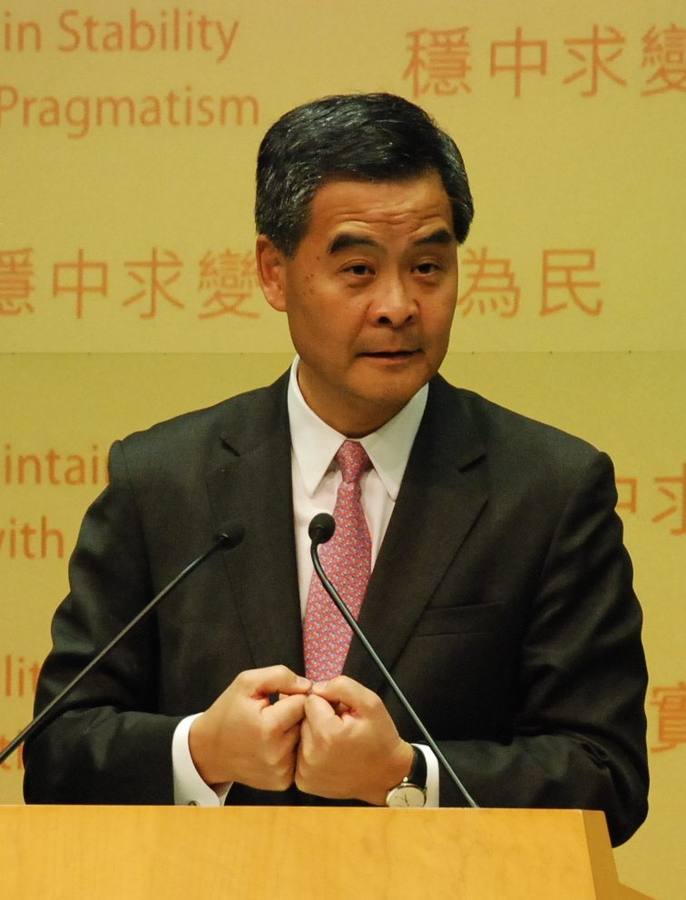
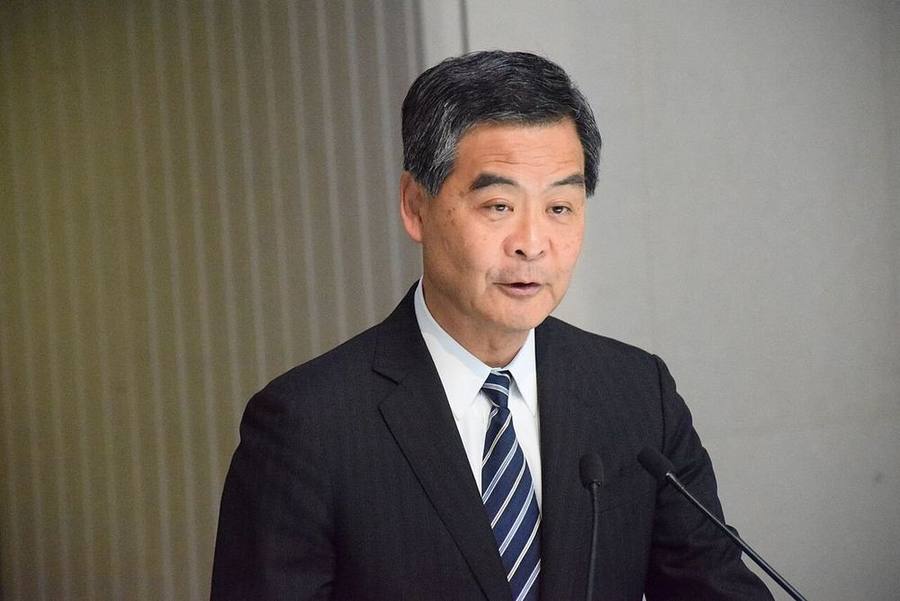
1. A Shandong Police Family, a Surveyor's Career (1954–1985)
Leung Chun-ying was born on 12 August 1954 at Queen Mary Hospital in Pok Fu Lam, Hong Kong. Both his parents were from Shandong; his father, Leung Zung-Jan, had come to Hong Kong and joined the police, and the family lived in police quarters. The detail is worth recording because it captures the two halves of his formation. He was a local boy raised inside British Hong Kong's grassroots order-keeping system; at the same time, his Shandong household background and Mandarin placed him, earlier than most Hong Kong professionals, within reach of Beijing's united-front and consultative networks. Public biographies say little about his childhood in the quarters, and this page records only what can be verified: secondary schooling in Hong Kong, surveying studies at Hong Kong Polytechnic, then valuation and estate management at Bristol Polytechnic in England, and on his return a career in the surveying firm that became DTZ, where he rose to lead its Asia-Pacific business. Surveying was the core profession of Hong Kong's property age — land auctions, valuations and development consultancy all passed through surveyors' hands. Half of Leung's later political capital came from that professional record; the other half came from how early he was drawn into the machinery preparing the transfer of sovereignty.
A house rule for this page should be stated at the outset. Leung was not a soldier or policeman who rose by repression, nor an ideology official. He was a technocratic, pro-Beijing politician. His responsibility therefore cannot be assessed with an "ordered the shooting" template; it has to be itemized — which documents bear his signature, what he said at which press conference, and in which events he merely held office while others acted. Throughout, this page enforces that distinction. Where a document, recording or public transcript exists, the entry is written as a decision or a statement. Where only simultaneity exists, it is written as "occurred during his tenure," with the limit of the evidence stated. This is not leniency; it is archival discipline. Writing association up into orders, and writing orders down into association, are both falsifications.
2. Basic Law Secretary-General and Executive Council Convenor (1985–2011)
In 1985 Leung joined the Hong Kong Basic Law Consultative Committee, and in 1988, aged thirty-four, he became its secretary-general. The committee gathered opinion during the drafting of Hong Kong's mini-constitution, and its secretary-general answered simultaneously to Hong Kong society and to the drafting authorities in Beijing. The post made him one of the very few Hong Kong professionals admitted to Beijing's inner circle on Hong Kong affairs in the 1980s. Around the 1997 handover he served on the preparatory bodies, and in 1999 the first Chief Executive, Tung Chee-hwa, appointed him convenor of the non-official members of the Executive Council — the body that advises the Chief Executive, whose convenor is the most senior of those advisers. Leung held that seat for twelve years, until he resigned in 2011 to run for Chief Executive. From 1993 he also sat on the CPPCC, China's national political advisory body, later joining its Standing Committee. In his election campaign that Beijing portfolio was both credential and liability: critics said he was too close to the Central Government; supporters said the closeness was exactly what implementing "one country, two systems" required.
Those twelve years spanned the 2003 Article 23 crisis and the half-million-strong march that followed it, Tung Chee-hwa's resignation in 2005, Donald Tsang's succession, and the 2010 electoral reform package. As ExCo convenor Leung was a collective participant in those decisions, but the public record attaches few signature personal positions to him from this period. The archival value of the years is continuity: by 2011 he was almost alone in Hong Kong's establishment in combining professional standing, Executive Council seniority and Beijing's trust. That combination explains the structure of the 2012 contest — not an open race before the public, but a competition inside a 1,200-member Election Committee in which Beijing's preference was decisive, and in which Leung emerged once Henry Tang's campaign collapsed under scandal.
3. Elected with 689 Votes, Nicknamed "689" and "the Wolf" (2011–2012)
Leung declared his candidacy in November 2011, against former Chief Secretary Henry Tang and the democrat Albert Ho. Tang's campaign was crippled by revelations about an unauthorized basement at his home; Leung campaigned on livelihood and housing issues and led Tang in opinion polls, though his support never commanded a majority and suspicion of his closeness to the Communist Party never lifted. On 25 March 2012 the Election Committee voted: Leung 689, Tang 285, Ho 76. The figure 689 — just above the 601 needed — became his permanent nickname among opponents, shorthand for the charge that his mandate came from a small circle rather than from Hong Kong's citizens. Leung's consistent reply was that the election followed the Basic Law and was lawful. He was sworn in on 1 July 2012, with Hu Jintao, then China's party general secretary and president, in Hong Kong to administer the oath. In the days around the inauguration, reports of unauthorized building works at Leung's own home forced a public apology and demolition — his government began, in its first week, under a cloud of integrity questions.
The other durable nickname, "the Wolf," came from commentators who used the animal to describe a tough, acquisitive political style; this page records it as naming history, not as a verdict on character. What can be judged from the public record is governing style: repeated hard-line responses to protests and press questions, persistently strained relations with the Legislative Council, academia and the media, and approval ratings that, in the rolling surveys of several universities, settled at the low end for any Hong Kong Chief Executive and fell further after the Umbrella Movement. Individual poll numbers differ by house and method, and this page draws no conclusion from any single survey; the downward trend itself is supported by the long-running series of multiple institutions, including the University of Hong Kong's Public Opinion Programme, and is recorded as a multi-source fact.
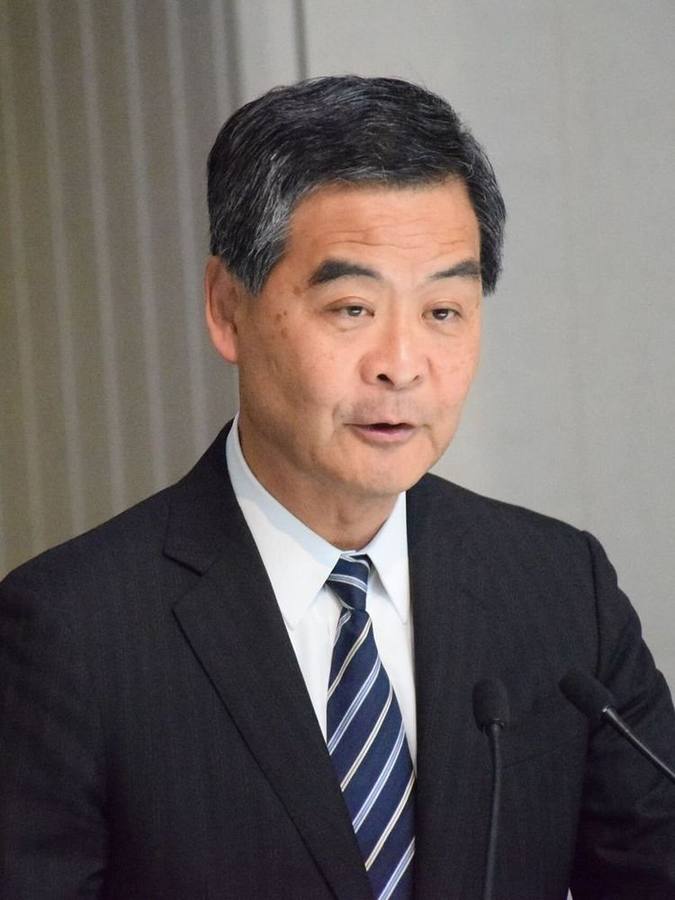
4. Moral and National Education: Getting the Attribution Right (2010–2012)
The first mass movement of Leung's term was the revolt against Moral and National Education in the summer of 2012, and this section exists to assign responsibility precisely, because popular shorthand often credits — or blames — Leung with inventing the subject. He did not. Its ancestor was the moral and civic education strand of the 2001 curriculum reform. The decision to make national education a standalone subject was announced by Chief Executive Donald Tsang in his Policy Address of 13 October 2010; the government consulted for four months in 2011 and planned to introduce it in primary schools in 2012 and secondary schools in 2013. The proposal and the consultation were therefore completed under Tsang. Leung took office only on 1 July 2012. But the final curriculum guide appeared in the spring of 2012, the launch date fell in the first school term of Leung's term, and the protest movement crested entirely on his watch: the student group Scholarism rose to prominence, more than ten thousand marched at the end of July 2012, and in early September students and citizens occupied the forecourt of government headquarters, some on hunger strike, in crowds reported at around one hundred thousand.
Leung's government's response is a matter of public record. At first it held to the timetable, offering schools a three-year "initiation period" before the subject became compulsory. As the headquarters occupation grew, Leung announced on 8 September 2012 that the deadline would be scrapped and the decision whether to teach the subject left to schools — in substance, the shelving of compulsory implementation. The movement then wound down and Scholarism left the headquarters forecourt. The archival entry should therefore read: the course criticized as brainwashing originated with the Tsang government; Leung's personal responsibility covers the two months of insistence after he took office and the shelving decision taken once a hundred thousand people surrounded his headquarters. Crediting him with the subject's invention is a misattribution; writing him out of the affair erases his documented role as the decision-maker of July to September 2012. This page does neither.
5. The Reform Report of 15 July 2014 and the 31 August Decision (2013–2014)
The most consequential documentary act of Leung's tenure was his report to the Standing Committee of the National People's Congress on 15 July 2014 — his formal submission on whether Hong Kong's methods for selecting the Chief Executive in 2017 and forming the Legislative Council in 2016 needed amendment, the first of the "five steps" of constitutional reform. The report's language was careful — mainstream opinion, it said, held that universal suffrage for the Chief Executive could be implemented in 2017 and that the nominating committee should be modelled on the Election Committee — but its procedural function was irreplaceable: without the Chief Executive's report, the NPC Standing Committee would not have ruled when it did. On 31 August 2014 the Standing Committee adopted the decision known ever after as the "31 August Decision": from 2017 the Chief Executive could be chosen by universal suffrage, but candidates — only two or three — would be nominated by a committee modelled on the Election Committee, each candidate would need the endorsement of more than half of all its members, and the Chief Executive must be a person who "loves the country and loves Hong Kong."
The more-than-half threshold was the detonator. Under the old Election Committee rules a candidate needed one-eighth of the members — 150 votes — to enter the race. The 31 August framework raised the bar to a majority of the whole committee, which meant no candidate unacceptable to Beijing could ever reach the ballot; democrats and many legal scholars condemned the result as screening first, voting afterwards. Leung's stance is extensively documented: he welcomed the decision as a major step for Hong Kong democracy and repeated for the rest of the affair that any reform had to rest on the Basic Law and the Standing Committee's decision, and that withdrawal of the decision was impossible. The layering must be exact. The decision was made by the NPC Standing Committee, not by Leung. But the man who filed the report that set the process in motion was Leung, and the man who defended the decision and treated it as the immovable premise for handling everything that followed was also Leung. An archive of the decision chain needs both links.
6. The Umbrella Movement Erupts; Tear Gas on 28 September 2014
On 22 September 2014 the Hong Kong Federation of Students and Scholarism launched a class boycott against the 31 August Decision. On the evening of 26 September students retook Civic Square, the forecourt beside government headquarters, and student leaders including Joshua Wong were arrested. In the early hours of 28 September, Occupy Central with Love and Peace declared its civil disobedience campaign under way ahead of schedule, and crowds converged on Admiralty. That evening, police fired tear gas to disperse them. The figure carried consistently by media and academic accounts is eighty-seven canisters of tear gas fired that day, alongside pepper spray. The images of unarmed protesters shielding themselves with umbrellas circled the world and gave the Umbrella Movement its name. Far from dispersing the crowds, the gas brought far larger numbers onto the streets; the occupation spread from Admiralty to Mong Kok and Causeway Bay, with peak crowds counted in the hundreds of thousands across sites, and over one hundred thousand at peak by common estimates.
This page's most important act of layering concerns that day. The publicly available evidence — including Leung's own later statements — consistently indicates that firing tear gas was an operational decision taken by police commanders on the ground on the basis of their assessment. Asked on 12 October 2014 whether the use of tear gas on 28 September had been proportionate, Leung said on television that he believed the commander in charge had decided according to the police's professional judgment and training, and that an appropriate amount of force had been used. There is, accordingly, no public evidence that Leung personally ordered the tear gas, and any text stating "Leung ordered the tear gas" as fact goes beyond the record. The other half of political responsibility is equally clear: as Chief Executive and head of the government, he neither criticized the decision nor ordered any inquiry into its proportionality; he publicly underwrote it. Media retrospectives have reported that his government weighed a harsher response that night before holding back in view of the crowds and international attention; this page archives that as media reporting, not as established fact. What is established can be stated in one sentence that must be kept whole: the operational decision belonged to the police; the political endorsement belonged to Leung Chun-ying.
Video Evidence
Inside the Umbrella Movement, which erupted under Leung Chun-ying.
VICE News 'Hong Kong Rising': inside the Umbrella Movement | 2014 | In English, with French, Japanese and Spanish subtitle tracks (no Chinese subtitles)
7. No Resignation, "External Forces," and the Poor-Voters Argument (October–November 2014)
The movement's two core demands were withdrawal of the 31 August Decision and Leung's resignation. His answers to both are fully on the record. On resignation: on 12 October 2014 he said in a television interview that he would not step down, arguing that resignation would not help resolve the situation and that the Occupy movement had spun out of control. On the decision: he repeated that the Standing Committee could not and would not withdraw it, and in mid-October he put the protesters' chance of winning genuine universal suffrage at close to zero. On causation: on 19 October 2014 he said on television that "external forces" were participating in the movement — people and organizations from different countries — while refusing to name any country or organization and never, then or later, producing evidence. The claim exactly matched Beijing's official line; the United States Consulate in Hong Kong publicly rejected any suggestion of American involvement. This page records his words verbatim in substance and their evidential status plainly: as of this page's verification, the "external forces" allegation was never publicly substantiated by him.
Fourth, and most quoted against him ever since, came the argument about poor voters. On 20 October 2014, in an interview with the New York Times and other foreign media, Leung explained why public nomination of candidates was unacceptable: if nomination became purely a numbers game, he said, politics and policy would be skewed toward the half of Hong Kong's people earning less than US$1,800 a month — around the median income — and "broadly representative," in his reading, did not mean numerically representative. His purpose was to defend the nominating committee's sectoral design. The remark was widely heard, at home and abroad, as a statement that universal suffrage was objectionable in part because it would give the poor a dominant political voice. The New York Times, the Associated Press and other international outlets carried it prominently, and Hong Kong reaction was furious. This page reproduces the structure of his argument without cosmetic editing and without exaggeration: it was an institutional-design argument, delivered in public, in which the political dominance of the lower-income half of the population was named as an outcome to be avoided. That is enough to explain why it remains among the most cited sentences of his career. On 21 October his government held its single formal dialogue with the student federation, led on the government side by Chief Secretary Carrie Lam; Leung did not attend. The government offered a report on public sentiment to Beijing and discussion of the nominating committee's composition; the students judged there was no substantive concession, and no second dialogue ever took place.
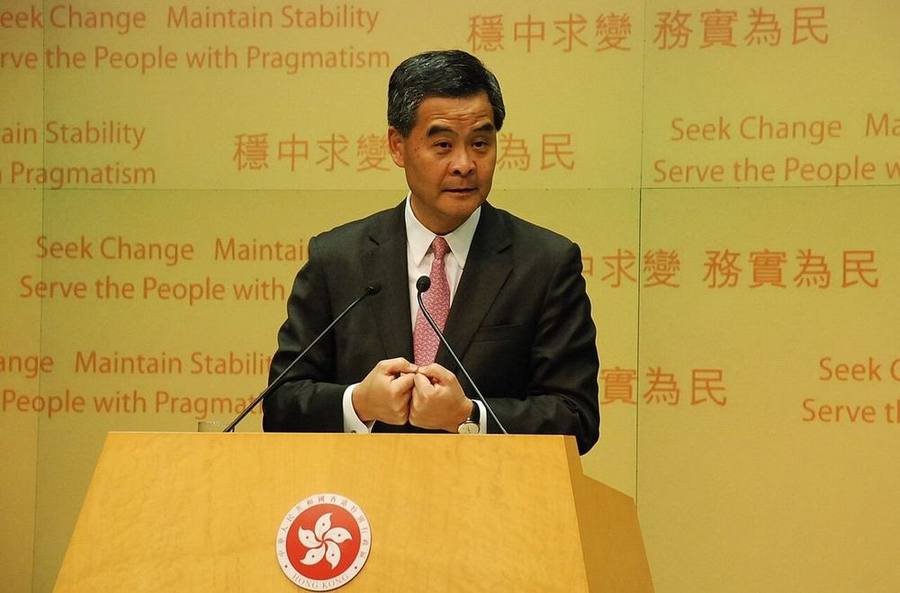
8. Mong Kok Clashes, the Beating of Ken Tsang, and the Injunction Route (October–December 2014)
While the occupation lasted, the Mong Kok site saw repeated violence. From 3 October, anti-Occupy groups attacked the Mong Kok and Causeway Bay camps, tearing down tents and barricades and fighting with occupiers, and the police response drew criticism. Leung and his government condemned violence and urged the occupiers to leave. Reports by multiple media outlets and human-rights organizations described participants with suspected triad backgrounds among the attackers; this page archives that at reporting level. There is no public evidence that Leung or his government directed the attacks, and the page does not adopt that claim. In the early hours of 15 October, during a police operation on Lung Wo Road, Civic Party member and social worker Ken Tsang was carried by seven police officers to a dark corner of Tamar Park and punched and kicked, in footage captured by TVB news cameras and seen worldwide. The seven officers were suspended and prosecuted, and in February 2017 they were convicted of assault occasioning actual bodily harm and sentenced to two years' imprisonment each, with outcomes later varied on appeal. Two facts must be kept separate: the officers' individual criminal liability is established by judgment; no evidence ties Leung personally to the individual assault. But as head of government, his public posture toward the force's conduct throughout the movement remained one of support.
The way the movement ended bears his government's clearest personal imprint: not political negotiation, and not a Tiananmen-style armed clearance, but civil injunctions. From late October, taxi, minibus and bus trade groups applied to the High Court for injunctions against the occupation of stretches of Mong Kok and Admiralty; with injunctions granted, bailiffs enforced them with police assistance. Mong Kok was cleared on 25–26 November amid clashes and arrests. Admiralty was cleared peacefully on 11 December with police assisting the bailiffs, and the last site, Causeway Bay, on 15 December. Counting from 26 September, the occupation had lasted seventy-nine days. The injunction route clothed clearance in court orders and procedural legitimacy, and it meant holdouts faced not only the police but contempt of court. The applicants were nominally trade bodies; the government publicly supported resolving the occupation through the injunctions. Leung's position after the clearances never changed: the occupation had been unlawful, and his government had handled it properly. Both halves of the balance belong in the record. No lethal force was used in seventy-nine days — that is fact. It is equally fact that none of the movement's political demands was met, and that in the years that followed its leading figures were prosecuted in sequence: between 2017 and 2019 the "Occupy Nine" and related cases concluded with prison sentences for several founders and participants. This page records the sequence without attributing the later prosecutions to Leung personally — charging decisions institutionally belonged to the Department of Justice, and he left office in June 2017 — while noting that the political climate of systematic prosecution began with his government's definition of the movement as simply unlawful.
9. The UGL HK$50 Million: Agreement, Exposure, and the Decision Not to Prosecute (2011–2018)
At the height of the Umbrella Movement, a second front opened. On 8 October 2014 Fairfax Media of Australia — the Sydney Morning Herald and The Age — revealed that in 2011 Leung had signed an agreement with the Australian engineering firm UGL under which, in connection with UGL's acquisition of DTZ, the property firm where Leung had been a director, UGL would pay him £4 million — about HK$50 million — in two instalments in 2012 and 2013, in return among other things for his support of the acquisition, help in retaining the management team, and an undertaking not to join a competitor. The explosive overlap was timing: the payment period fell after he became Chief Executive, and he had never declared the arrangement to the Executive Council. Leung replied the same day that the money arose from his departure from DTZ, involved no future service, and required no declaration under the existing system. Opposition legislators alleged conflict of interest and concealment, filed complaints, and discussed impeachment. The Independent Commission Against Corruption investigated for an unusually long four years. Mid-investigation, in July 2016, the acting head of the ICAC's Operations Department, Rebecca Li, had her acting appointment terminated and resigned; outside observers questioned a connection to the UGL case, which the ICAC and the government denied — archived here as chronology established, causation unproven. The Legislative Council set up a select committee in November 2016; in May 2017 its vice-chairman, Holden Chow, was revealed to have privately revised the committee's terms of investigation on the basis of input from Leung's side, provoking accusations of interference, and Chow resigned from the committee.
The ending came after Leung had left office. On 12 December 2018 the Department of Justice announced that, having considered the ICAC's investigation, the evidence was insufficient to support a reasonable prospect of conviction, and Leung would not be prosecuted. The Department had not followed its practice in earlier sensitive cases involving a former Chief Executive, such as Donald Tsang's, of first obtaining independent outside legal advice; the Hong Kong Bar Association, in a statement of 21 December 2018, criticized the departure from precedent and its implications for public accountability. A decision not to prosecute is a legal decision; it is neither a conviction nor a certificate that the payment was proper, and this page keeps the three layers apart: the agreement and the payments are firmly documented and multiply sourced; the non-declaration is factually clear, with the dispute confined to whether the system required it; the non-prosecution is real, and its procedural propriety remains under published professional criticism. Leung has throughout maintained that the payment was lawful and proper and has taken legal action over some coverage. Any account that writes the UGL affair either as proven corruption or as a complete vindication misstates at least one of these layers.
10. The Causeway Bay Booksellers: The Gravest Cross-Border Crisis of His Term (2015–2016)
Between October and December 2015, five men associated with Causeway Bay Books — a Hong Kong bookshop known for political titles banned on the mainland — disappeared one after another. Lui Bo and Cheung Chi-ping went missing in Shenzhen; Gui Minhai disappeared in Thailand; Lam Wing-kee disappeared on 24 October after crossing into Shenzhen; and shareholder Lee Bo disappeared in Hong Kong itself on 30 December — with no record at Hong Kong's Immigration Department of Lee ever leaving the territory. In February 2016 Guangdong public security authorities confirmed that all five were in custody on the mainland. Lee Bo's disappearance inside Hong Kong, without an exit record, was widely treated as the most serious suspected case of cross-border law enforcement of the post-handover era; Britain's foreign secretary, Philip Hammond, in his early-2016 report to Parliament, called the incident a serious breach of the Sino-British Joint Declaration. This page phrases the rendition question with care: Lee Bo later said on the mainland that he had returned voluntarily to assist an investigation, and his wife withdrew the Hong Kong missing-person report; but the tension between his account and the objective absence of any exit record has never received an official explanation. Both are archived here, unmerged.
Leung's personal record in the affair consists of his public statements and his government's response. On 4 January 2016 he told a press conference that mainland law-enforcement action in Hong Kong would be unacceptable and a breach of the Basic Law — and appealed for anyone, "especially Lee Bo himself," to provide information about the disappearance. That appeal was widely derided: it asked a missing man to report his own whereabouts. On 16 June 2016 Lam Wing-kee, back in Hong Kong, gave a long press conference describing eight months of detention on the mainland and a scripted confession, stunning the city. Days later Leung announced that he would write to the central authorities relaying Hong Kong people's concern and that the notification mechanism between the mainland and Hong Kong would be reviewed. The layered conclusion is this: that the five men were held by mainland authorities is multiply confirmed; the detentions were mainland operations, and no public evidence shows that Leung planned or knew of them in advance; his responsibility, as Chief Executive, lies in the months in which his government could not tell its own citizens how a resident who vanished inside Hong Kong had left it, and in a public response widely judged slow and inadequate. That is a record in the register of governing responsibility. It is categorically different from an accusation that he directed an abduction, which, absent evidence, this page does not make.
11. Final Years, the Decision Not to Seek Re-election, and the CPPCC Vice-Chairmanship (2015–2017)
After the Umbrella Movement, Leung's term ran out amid continuing confrontation. In June 2015 the Legislative Council rejected the reform package built on the 31 August framework by twenty-eight votes to eight, after a botched pro-establishment walkout collapsed the yes vote — the end of the reform he had promoted for two years. During the Lunar New Year unrest in Mong Kok in February 2016, his government swiftly labelled the riot "a riot," and dozens of participants were later prosecuted for rioting and jailed. In the September 2016 Legislative Council election, young localist and self-determination candidates won seats; Leung's government then brought election petitions and judicial reviews that unseated six pro-democracy and localist legislators, including Sixtus Leung and Yau Wai-ching, and he publicly welcomed the NPC Standing Committee's November 2016 interpretation of Basic Law Article 104 on oath-taking. The common thread is documented consistency: in every confrontation he stood on the establishment and Beijing side, and never pretended otherwise. The details of each episode belong to the event files; the continuity of the government's stance belongs to this one.
On 9 December 2016 Leung announced that, for family reasons, he would not seek a second term — the first Hong Kong Chief Executive since the handover not to do so. In March 2017 he was added as a CPPCC member, and on 13 March 2017, at the closing meeting of the CPPCC's annual session, he was elected a vice-chairman of its National Committee — while still serving as Chief Executive, which he did until 30 June 2017. Holding a state-level advisory post while still running Hong Kong drew criticism about blurred roles under "one country, two systems"; the establishment read it as Beijing's commendation. On 1 July 2017 he handed the Chief Executiveship to Carrie Lam and received the Grand Bauhinia Medal. The trajectory — retiring Chief Executive elevated to CPPCC vice-chairman — matched that of the first Chief Executive, Tung Chee-hwa: it is Beijing's standard arrangement for former Hong Kong leaders, symbolic more than powerful, but it fixes Leung's place in the centre's system of evaluation. He did not leave office under accountability pressure; he left it rewarded. That fact is essential context for everything he has done since.
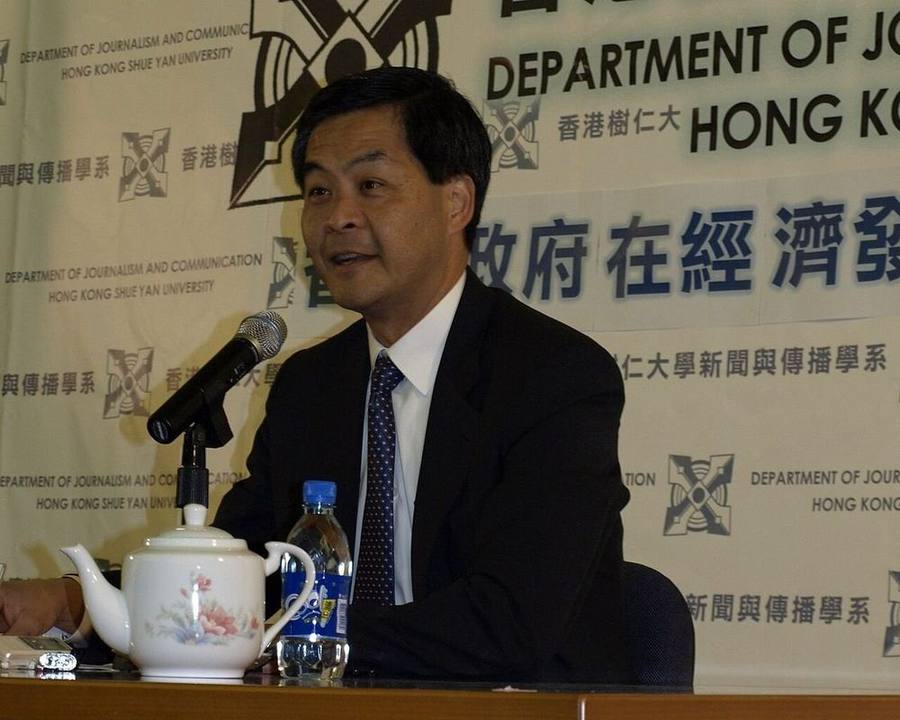
12. After Office: 803 Funds, the Naming of Teachers, and the National Security Law (2019– )
When the anti-extradition movement erupted in 2019, Leung had been out of office for two years. He did not retire from the field. As a CPPCC vice-chairman he became one of the establishment camp's most active voices. In 2019 he founded 803 Funds Limited, which offered cash rewards for leads on offences linked to the movement — including damage to facilities associated with the national anthem law and desecration of the national flag — operating a website and hotline for tip-offs. The University of Toronto's Citizen Lab, in its 2023 forensic study of the HKLeaks doxxing operation, situated "a bounty campaign run by a former Hong Kong Chief Executive" within the broader support network surrounding the doxxing ecosystem. The citation must be used precisely: Citizen Lab described the bounty campaign as part of a mutually reinforcing network environment; it did not accuse 803 Funds of running the doxxing site, and the two must not be conflated. The fund then turned to education. In October 2020 Leung publicly released details of eighteen teachers and tutors who had been charged in connection with the 2019–2020 protests, naming some of their schools, and 803 Funds sought judicial review to compel the Education Bureau to identify teachers found guilty of professional misconduct. The Bureau refused on privacy and related grounds, and the litigation proceeded in the High Court. Teachers' groups and rights commentators criticized the naming campaign as public shaming designed to chill the profession; Leung's side argued it served parents' right to know and public protection.
In May 2020, as the National People's Congress moved to impose a national security law on Hong Kong, Leung publicly demanded that HSBC — headquartered in London but founded and still emblematically present in Hong Kong — declare its support for the law, criticizing the bank for not having done so; HSBC subsequently expressed support. The episode's archival significance is the demonstration that a former Chief Executive with no executive office, armed only with a CPPCC vice-chairmanship and a public megaphone, could be treated as capable of moving a global bank's public positioning — a measure both of his personal standing and of how sharply Hong Kong's speech environment tightened in 2020. In recent years he has continued to comment frequently on Hong Kong affairs through social media, including criticism of court sentences and running commentary on media and education — a level of day-to-day combativeness unmatched among former Chief Executives. This page samples only those post-office interventions with institutional consequences or wide reporting; it does not catalogue daily posts. As of this page's verification he remains a vice-chairman of the CPPCC National Committee, re-elected to the fourteenth CPPCC in 2023, within the ranks of national leaders, publicly active in Hong Kong and on the mainland, with no sign of retirement.
13. Sanctions Status, Verified: He Is on No Public List (2020– )
This section answers a frequently garbled question: has Leung Chun-ying been sanctioned by the United States? He has not, and the comparison set matters. After the Hong Kong National Security Law was imposed on 30 June 2020, the US President signed Executive Order 13936 on 14 July 2020. On 7 August 2020 the Treasury Department's Office of Foreign Assets Control sanctioned eleven Chinese and Hong Kong officials for undermining Hong Kong's autonomy and restricting freedoms of expression and assembly. The eleven were: Chief Executive Carrie Lam; Police Commissioner Chris Tang; former Police Commissioner Stephen Lo; Secretary for Security John Lee Ka-chiu; Secretary for Justice Teresa Cheng; Secretary for Constitutional and Mainland Affairs Erick Tsang; Director of the Hong Kong and Macao Affairs Office Xia Baolong; his deputy Zhang Xiaoming; Director of the Liaison Office Luo Huining; Director of the Office for Safeguarding National Security Zheng Yanxiong; and Secretary General of Hong Kong's national security committee Eric Chan. The list targeted the National Security Law's implementers and office-holders of the day; Leung had left the Chief Executiveship three years earlier and is not on it. Nor, in the further public sanctions and designation measures adopted since by the United States, the United Kingdom, the European Union, Canada or Australia over Hong Kong — as of this page's verification — does his name appear on any legally operative sanctions list.
Why devote a section to a negative? Because Chinese-language commentary has carried both of two opposite claims — that Leung "was sanctioned by the US," which is false, and that he was "the one former Chief Executive not sanctioned," freighted with inferences no document supports. This page rests only on the lists themselves: designation is a question that can be checked name by name, and the check is recorded above. Why he was not designated — because he was out of office, because the list was scoped to incumbent implementers, or for other reasons — is explained in no official document and is recorded here as no public record, without speculation. The reverse inference must also be refused: absence from a sanctions list does not mean his tenure escaped international criticism. United States State Department and congressional reporting on Hong Kong, and the British Foreign Office's six-monthly reports, criticized the handling of the Umbrella Movement and the booksellers affair during his tenure by name. Sanctions are a legal instrument; diplomatic criticism is a separate record. This page files them separately.
14. Verification and Sources
The facts on this page were cross-checked across multiple sources. Life and posts: the English Wikipedia entry on Leung Chun-ying and the entry in The Statesman's Yearbook Companion (Palgrave Macmillan) agree on his birth date (12 August 1954), Shandong ancestry, Chief Executive tenure (1 July 2012 – 30 June 2017), election by 689 votes, and assumption of the CPPCC vice-chairmanship in March 2017; the last was independently verified against Xinhua's report of 13 March 2017. The Umbrella Movement: the English Wikipedia entries on the 2014 Hong Kong protests and the Umbrella Movement (dates 26 September – 15 December 2014; sites and clearance dates); academic studies recording the eighty-seven tear-gas canisters of 28 September and the seventy-nine-day occupation; the Hong Kong government news service record of 12 October 2014 for Leung's refusal to resign and his endorsement of the tear-gas decision; and Human Rights Watch's open letter to Leung of 5 October 2014. Public statements: Associated Press reporting of 19–21 October 2014 carried by US public radio outlets, for the "external forces" remarks and the income argument made to the New York Times and other foreign media, and the New York Times report of 21 October 2014. National education: the English Wikipedia entry on the Moral and National Education controversy, for the Tsang proposal of 2010, the 2011 consultation, and Leung's 8 September 2012 shelving announcement. The 31 August Decision: the full text of the NPC Standing Committee decision (Xinhua text, recording Leung's report of 15 July 2014, the more-than-half nomination threshold and the two-to-three candidates), and the Congressional Research Service brief of 5 September 2014. The UGL affair: the Oxford Human Rights Hub commentary and the Global Anticorruption Blog for the Department of Justice decision of 12 December 2018 and the Hong Kong Bar Association statement of 21 December 2018; the English Wikipedia entry on the Leung Chun-ying–UGL agreement for the £4 million (HK$50 million) figure, the 2011 agreement, the Fairfax disclosure of 8 October 2014, the four-year ICAC investigation, and the Rebecca Li chronology. The booksellers: the English Wikipedia entry on the Causeway Bay Books disappearances for the five men's timeline and Leung's 4 January 2016 press conference, and the Hong Kong government news record of 20 June 2016 for his letter to the central authorities and the notification-mechanism review. The Ken Tsang case: the English Wikipedia entry and Agence France-Presse's report of 17 February 2017 on the seven officers' two-year sentences. Life after office: the English Wikipedia entry for the CPPCC, 803 Funds, the October 2020 release of teachers' details and the judicial review; Citizen Lab's 2023 HKLeaks report for the bounty campaign's place in the support network; and law-firm reporting on the 803 Funds litigation. Sanctions: the US Treasury press release of 7 August 2020 and law-firm client alerts reproducing the complete list of eleven designees, checked name by name to confirm that Leung Chun-ying is not among them.
Two corrections and one clarification are recorded against the original brief. First, Leung was born in Hong Kong, at Queen Mary Hospital in Pok Fu Lam; Shandong is his family's place of origin, not his birthplace — "1954, Shandong" must be read as year and ancestry, two separate fields. Second, Moral and National Education was proposed and consulted on by the Tsang government; Leung's responsibility covers his insistence on proceeding after taking office in July 2012 and his shelving of compulsory implementation that September, and this page writes the chronology that way rather than assigning him the subject's invention. Third, the clarification on sanctions: the occasionally repeated claim that Leung was sanctioned by the United States is incorrect; name-by-name checking of the 7 August 2020 list of eleven confirms he is not on it. The following claims were not supported by sufficient public evidence and are not stated as fact anywhere on this page: that Leung personally ordered the firing of tear gas (the available evidence points to a police operational decision; this page records only his political endorsement of it); that Leung or his government directed the anti-Occupy attacks (no public evidence); that Leung participated in the detention operation against the five booksellers (no public evidence); and the specific referent of the "external forces" said to be behind the Umbrella Movement (never publicly substantiated by Leung himself). Each is flagged at its place in the text with its evidential grade. This page will be revised as new archives and new lists are published.
Contact: endccpworld@proton.me