The Henan Rural Bank Depositors' Protests
Background: Deposits that vanished overnight: On the morning of April 18, 2022, depositors at four rural banks in Henan Province opened their phones and found they could not withdraw their money. The banks had announced the night before that online and mobile banking were suspended for a system upgrade. The "upgrade" never ended: money deposited online could not be withdrawn at physical branches either, hotlines went unanswered, and the banks offered no timetable. Most of these depositors did not live anywhere near the banks. They were ordinary people across China who had put retirement savings, house-purchase funds and small-business working capital into tiny banks they had never visited, through the internet, drawn by slightly higher interest rates and by the word "bank" itself. Over three months their campaign escalated step by step: they travelled to Zhengzhou in groups to demand answers, held placards outside the regulator's offices, were stopped en route when their COVID health codes were remotely turned red, and finally, on July 10, 2022, more than a thousand of them gathered outside the Zhengzhou branch of the People's Bank of China and were dragged and beaten by unidentified men in white. The next evening, authorities announced a phased advance repayment of deposits. This site files the case under Resistance because its demand was the plainest imaginable — give us back the money we deposited — while the response it met stacked four things onto one timeline: financial fraud, failed local supervision, epidemic-control tools turned to stability maintenance, and street violence.
The banks involved: Four in Henan, two in Anhui: The four Henan banks were Yuzhou Xinminsheng Village Bank, Shangcai Huimin Village Bank, Zhecheng Huanghuai Village Bank and the New Oriental Country Bank of Kaifeng. Two banks in neighbouring Anhui Province — Guzhen Xinhuaihe Village Bank and Yixian Xinhuaihe Village Bank — were hit at almost the same time. Village and township banks are small rural lenders created after 2006 to serve counties and agriculture, each sponsored and managed by a larger "initiating" bank. According to Caixin, of the six banks all but the Kaifeng bank had Xuchang Rural Commercial Bank as their largest shareholder, and Xuchang Rural Commercial Bank itself was, in turn, alleged to be deeply entangled with the Henan Xincaifu (New Fortune) Group at the centre of the case. The online systems of the Yuzhou, Shangcai and Zhecheng banks closed on April 18, and the Kaifeng bank followed on April 19. One regulatory background fact matters from the start: local incorporated banks were not permitted to take deposits across regions through the internet, and in 2021 the banking regulator and the central bank had issued rules specifically governing internet deposit-taking. Yet a large share of these small banks' deposits came from savers in other provinces — a fact that later accountability could not avoid.
How the money was pulled in: Third-party platforms, a private platform and fund brokers: Deposits arrived by three channels. The first was third-party internet finance platforms: according to multiple media reports, large platforms including Du Xiaoman and JD Finance had at one time listed deposit products of these village banks, so a saver could tap a few buttons in a familiar app and send money to a tiny bank a thousand kilometres away, on pages labelled as deposits paying slightly more than the big banks. The second channel was the banks' own apps, mini-programs and branches. The third was named by police only after the collapse: a self-operated platform built by Junzheng Zhida Technology, a company under the Henan Xincaifu Group, plus a corps of fund brokers. The Xuchang police notice of July 10, 2022 was unusually specific: since 2011, a criminal gang led by Lü Yi had, through Henan Xincaifu and other companies, taken actual control of several village banks by affiliated and cross shareholding, capital increases and manipulation of bank executives; it had used third-party internet platforms, the Junzheng Zhida platform and fund brokers to solicit deposits and sell financial products; it had moved funds out illegally through fabricated loans; and it had set up a dedicated company, Chenyu Information Technology, to alter data and block reporting. A follow-up police notice on August 29 added the key mechanism: beyond normal deposit interest, the gang used part of the illegally obtained money to lure funds with interest subsidies at annualised rates of 13 to 18 percent, skimmed layer by layer by brokers and captured in part by large depositors — the sentence that later became the official reason some large depositors' repayments were deferred.
Lü Yi and the Xincaifu Group: The central figure is Lü Yi, the actual controller of Henan Xincaifu Group Investment Holdings. Investigations by Caixin, Yicai and other outlets describe a man born in 1974, originally from Nanyang in Henan, who had taken Cypriot nationality and presented himself abroad under titles such as chairman of a Cyprus investment group. He rarely appeared in corporate registrations in his own name; instead, through more than a hundred affiliated companies spread across the country, he took stakes in, or control of, multiple city commercial banks, rural commercial banks and village banks, surrounded by a circle of bank executives that included figures from Xuchang Rural Commercial Bank, the sponsoring bank of several of the lenders involved. Xuchang police opened a criminal case against Xincaifu Group on April 19, 2022; their first public notice on June 18 still referred to "a suspect surnamed Lü," while later notices named Lü Yi directly. By the time the case broke, Lü Yi was already outside China, according to multiple media reports; police notices continued to describe a criminal gang "headed by suspect Lü Yi" suspected of a series of grave crimes. As of this entry's most recent verification, there is no public record of Lü Yi being arrested, charged or tried. Xincaifu's Zhengzhou offices stood empty after the collapse, and the group's assets were sealed, seized and frozen, becoming one source of the money later used for advance repayments. A controller in flight, a core company under criminal investigation and bank executives taken away in batches formed the permanent backdrop to the depositors' campaign: the money they were demanding sat, precisely, in the accounts of a gang under investigation.
Amounts and numbers: The estimates side by side: This entry uses no single figure for the money involved or the number of depositors affected, because public sources never converged on one. Caixin reported in May 2022 that the sums tied to Xincaifu exceeded 10 billion yuan. As the investigation widened, Caixin's later reconstructions and reporting by Reuters and Bloomberg generally settled on an estimate of about 40 billion yuan (roughly 5.8 to 6 billion US dollars) involving more than 400,000 depositors. A retrospective by the Association of Certified Fraud Examiners put the accounts frozen in the first weeks at at least 1.5 billion dollars, the earliest spring 2022 estimate. Official statements, by contrast, never published a certified total: the banking regulator confirmed only that Xincaifu had absorbed public funds through internal-external collusion, third-party platforms and fund brokers in suspected violation of the law, and the Xuchang police notice of August 29 spoke only of 234 arrests and "major progress" in recovering assets. The one official figure that can be checked against the estimates comes from the repayment side: according to Henan figures relayed by media, by August 11, 2022 a cumulative 18.04 billion yuan had been advanced to 436,000 customers — noting that customers were counted per bank and per person, so one saver with deposits at two banks counted twice, a different basis from the roughly 400,000 individuals estimated elsewhere; the two numbers cannot simply be subtracted. This site's rule for this entry: every total in the text carries its source and its basis, and anything officials never certified is labelled a media estimate.
The first official response: A criminal case, and four loaded words: A week after the freeze, on April 25, 2022, the People's Bank of China replied to a depositor's online message that it was following the matter closely and that departments had opened investigations. On May 18 the banking regulator stated publicly that the banks' shareholder, Henan Xincaifu Group, had absorbed public funds through internal-external collusion, third-party platforms and fund brokers, was suspected of crimes, and was under police investigation; it added that the four banks' branches were operating normally and that all business conducted "in accordance with laws and regulations" was protected by law. On June 18 the Henan banking regulator, the provincial financial regulator and Xuchang police spoke on the same day, confirming that the crime of Xincaifu manipulating the banks' online transaction systems had been preliminarily established. Depositors seized on the qualifying phrase: their money had gone in through the banks' official apps, mini-programs and well-known third-party platforms, in the name of deposits, with electronic certificates and interest paid on schedule — why, when the music stopped, should savers have to prove their own compliance? And the "normal" branch operations covered, in practice, only part of the over-the-counter local business; out-of-town depositors presenting online deposit records at counters were still refused, on grounds that systems were closed and the nature of funds was under review, as multiple outlets reported in sequence. The gap between regulatory language and depositor experience is what sent wave after wave of savers to Zhengzhou from May onward.
The campaign: Zhengzhou, May 2022: From May 2022, depositors began travelling to Zhengzhou in batches — first to the banks' city outlets and the provincial rural credit union, then to the regulators. On May 23, several hundred depositors gathered outside the Henan office of the banking regulator holding placards reading "Give back our savings" and demanding a clear statement. Videos circulated online show Yang Huajun, a deputy head of the Henan bureau, telling the crowd through a loudspeaker that funds deposited lawfully would be protected by law; police later dispersed the gathering. Drawing on multiple outlets and depositors' own accounts, there were more gatherings in this period: placards and sit-ins near the provincial government and the central bank's Zhengzhou branch, and savers who rented rooms in Zhengzhou to stay on, taking turns delivering materials at government gates. At one gathering in late June, according to reports, dozens of depositors outside the regulator's office were surrounded by police and forced onto buses and taken away; no official notice of that episode has been published, and this site records it as media reporting. The depositors themselves deserve a line in the file: they came from Henan, Anhui, Jiangsu, Guangdong and many other provinces; many were middle-aged or elderly people who had concentrated a family's savings in one place, alongside small traders who kept their business turnover in high-interest accounts. Strangers to one another, they organised through depositor chat groups — carpooling, compiling lists and dividing up evidence. May in Zhengzhou produced no repayment timetable. What pushed the case onto the national stage was something else that happened in June.
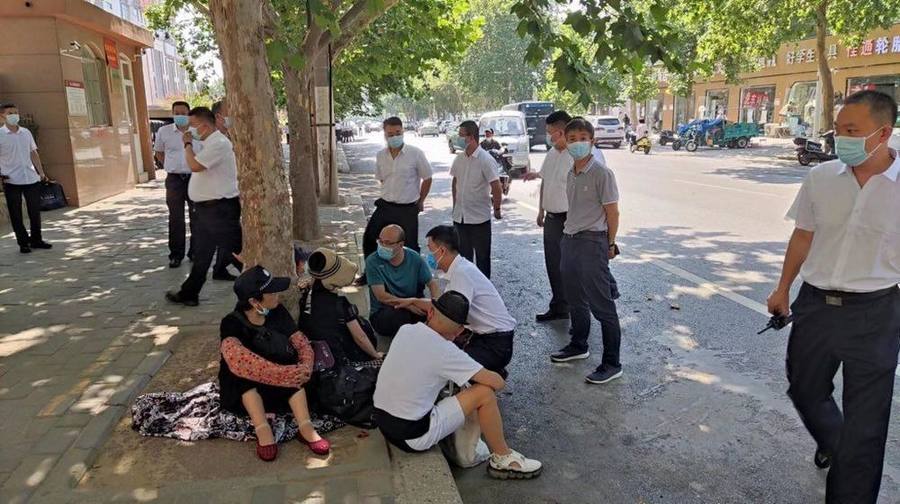
Red codes: A health app turned into an interception tool: In mid-June 2022, depositors preparing to travel to Zhengzhou began finding that their Henan health codes had turned red. Some turned red the moment they scanned a venue code at Zhengzhou railway station on arrival; others were nowhere near Zhengzhou and turned red after scanning an image of a Zhengzhou venue code sent by someone else; some reported that family members travelling with them were coded red as well. Under the COVID rules then in force, a red code meant no public transport, no entry to public venues, and compulsory isolation or observation — a red code, in effect, kept a person away from the protest site. Several depositors told media they were turned back, taken to isolation points, or held at stations for hours. The episode ignited because it answered a question many had privately feared: a health-code system built for epidemic control, holding everyone's movements and identity, could be casually repurposed against ordinary people demanding their savings back. The other core question — where the list of depositors' identities came from, and how bank customer information entered the code-assignment chain — was never officially answered. On June 17 the Zhengzhou discipline inspection authorities opened an investigation into the red-code affair. In late June, after the accountability notice, media still reported depositors' codes turning red again when scanning Zhengzhou venue codes, and the city big-data bureau at one point blamed a technical problem during a system upgrade; these follow-up details vary by account, and this site records only that they were publicly reported, without treating them as proof of a fresh assignment decision.
The red-code accountability notice of June 22, 2022, item by item: On June 22, 2022, the Zhengzhou discipline inspection and supervision authorities published their notice on the investigation and accountability for the red-coding of village-bank depositors — one of the few official documents in this whole case that can be quoted word for word. The notice found that Feng Xianbin, executive deputy secretary of the Zhengzhou Political and Legal Affairs Commission and head of the social-control division of the city's COVID command, and Zhang Linlin, secretary of the city's Communist Youth League and deputy head of that division, had on their own authority decided to assign red codes to some village-bank depositors coming to Zhengzhou, and had arranged for Zhao Yong, director of the stability-maintenance guidance office of the Political and Legal Affairs Commission, Chen Chong, a section member of the city Big Data Bureau who led the health-code management team, and Yang Yaohuan, deputy general manager of Zhengzhou Big Data Development Co., to carry out the assignment on depositors scanning venue codes in Zhengzhou. The notice's own count: 1,317 depositors were given red codes, of whom 446 were coded on scanning venue codes after entering Zhengzhou and 871 were coded without being in Zhengzhou at all, after scanning Zhengzhou venue-code images sent by others. The notice characterised the conduct as a weak sense of law and rules, a violation of the health-code management measures and coding rules, and "a typical case of reckless action," calling for strict and severe accountability. The sanctions were listed person by person: Feng Xianbin was removed from his Party post and his government post; Zhang Linlin received a serious Party warning and a demotion; Chen Chong a major demerit; Yang Yaohuan and Zhao Yong demerits. None of the five faced criminal liability. The notice did not say whether any higher level knew of or authorised the decision, nor who supplied the list of the 1,317. Domestic commentary widely judged the accountability far below public expectations — "a penalty of three cups of wine" was a common phrase — while other commentators noted that the notice at least confirmed officially that the coding was a human decision, not a system fault or an epidemic necessity. This site stops where the notice stops: what stands confirmed is that officials of the political-legal system ordered it, stability-maintenance and big-data staff executed it, and a defined group of rights defenders was targeted; the unanswered questions are also part of the file.
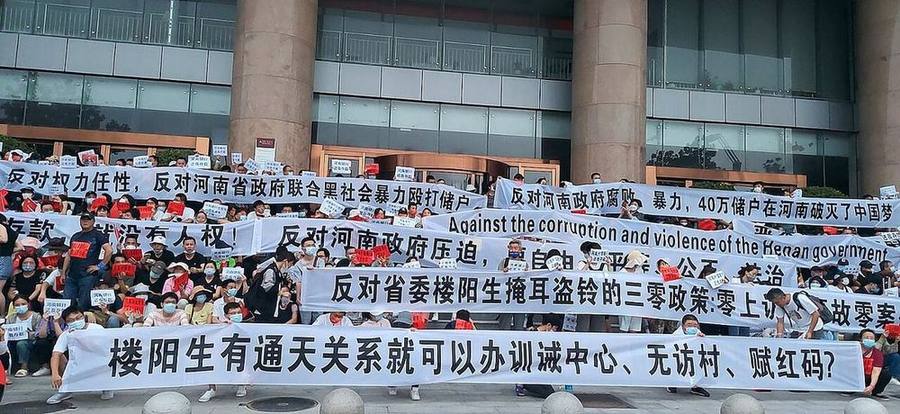
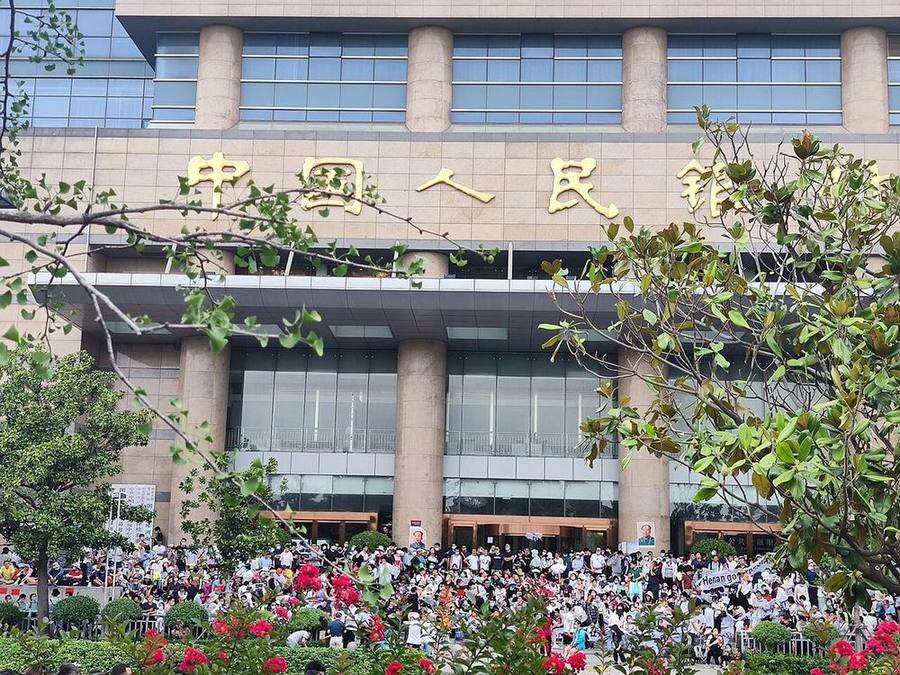
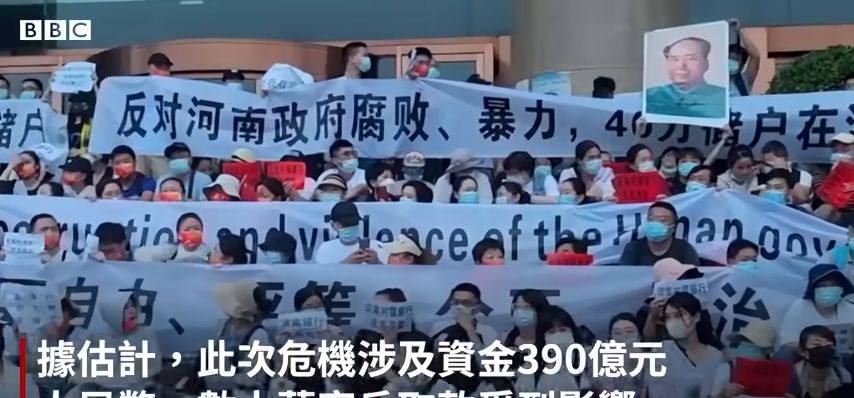
July 10, 2022: Outside the People's Bank of China in Zhengzhou: The red codes did not stop everyone. From early morning on July 10, 2022, depositors from many provinces converged on the steps and plaza outside the Zhengzhou Central Sub-branch of the People's Bank of China, and the crowd kept growing. Photographs from the scene and reports by multiple outlets show banners reading "Henan banks, return our lawful deposits" and "Oppose the abuse of power," alongside placards demanding action against corruption and protection of human rights. In the midsummer heat the crowd sat for hours, demanding to speak to officials in charge and to be given a repayment plan. Attendance figures must be given in parallel: Reuters, the BBC and Bloomberg generally reported more than a thousand people; some Chinese-language reports and participants' accounts said several thousand, close to three thousand; officials never published a figure, and this site adopts none. The day was very hot, and some depositors were reported overcome by the heat. Protesters and the police and security personnel present faced off for hours, the crowd at times chanting in unison for its money back. It was the largest gathering of the four-month campaign, and the turning point: the way it ended turned a local banking case into international news.
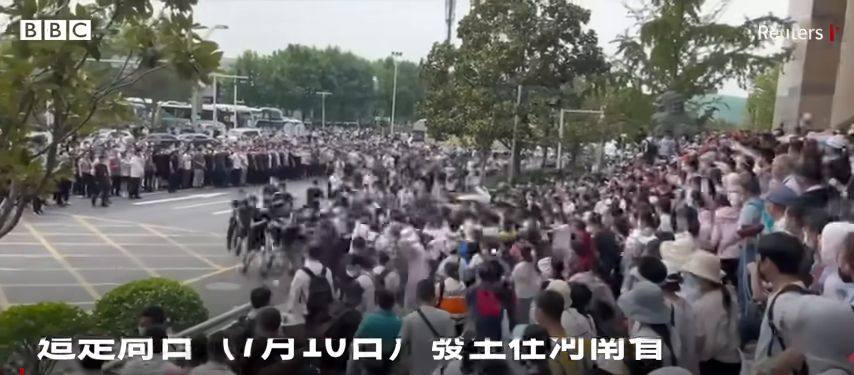
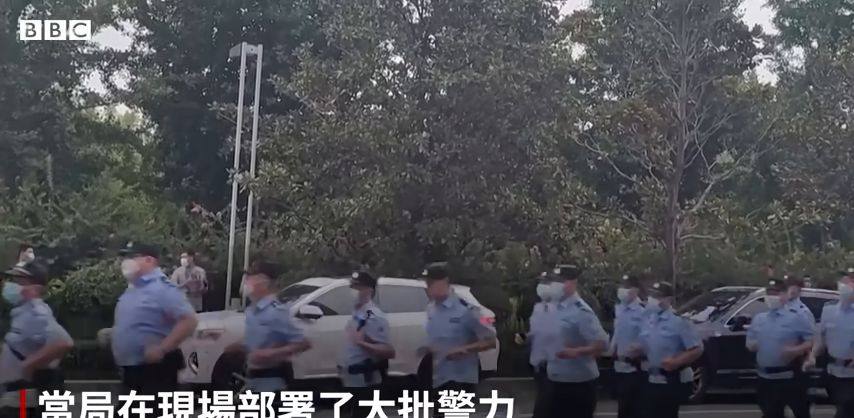
The men in white: The clearing, the dragging and the beatings: Around midday on July 10, the clearing began. Videos from the scene and reporting by multiple international outlets present a broadly consistent picture: large numbers of unidentified men in white tops moved into the crowd together with uniformed police, dragging and shoving depositors down the steps; some people were forced to the ground, carried off and put onto buses waiting nearby; those who resisted were beaten, women and the elderly among them; afterwards a number of depositors showed injuries to reporters and described being hit, and some reports mentioned eye injuries. Who the men in white were has never been officially explained: no agency claimed them, no organiser of the clearing operation was named, no count of those taken away or injured was published, and there is no public record of any assailant being held to account. Depositors and commentators widely believed the men in white were plainclothes police or organised security; this site records that as the participants' identification and public inference, not as an official finding — and the absence of an official finding is itself a fact this file must state plainly. That same evening, officials of the Henan banking regulator and the provincial financial regulator said they were speeding up verification of the four banks' customer funds and would publish a handling plan soon. Domestic media carried essentially no independent reporting of the July 10 violence; the visual record survived mainly through social media and international outlets.
Advance repayments: Seven notices, from 50,000 to 500,000 yuan: The day after the July 10 violence, a handling plan materialised. On the evening of July 11, 2022, the Henan banking regulator and the provincial financial regulator issued Notice No. 1: in light of the investigation and asset recovery, advance repayment of principal would begin in classified batches for the four banks' "off-book business" customers — from July 15, first for customers whose combined balance at a single bank was 50,000 yuan or less, with larger amounts to follow; the provincial rural credit union would administer the payments through a WeChat mini-program. Anhui's Guzhen Xinhuaihe bank began its own advances the same day. Notice then followed notice, the threshold rising step by step; by the notices and media tallies: from July 25 the 50,000–100,000 yuan band, from August 1 the 100,000–150,000 band, from August 8 the 150,000–250,000 band, from August 15 the 250,000–350,000 band, from August 22 the 350,000–400,000 band, and from August 30 the 400,000–500,000 band, with balances above 500,000 yuan advanced at 500,000 and the remainder's rights reserved, to be handled according to asset recovery. The money, CCTV reported, came from disposing of part of the Xincaifu Group assets that had been sealed, seized and frozen. In September 2022 Henan announced that the concentrated advance-repayment work was basically complete and that follow-up matters would be handled by the four banks. Most small and medium depositors got their principal back within two months — the direct reason the affair did not spread further. But the phrase "off-book business customers" in the notices planted another dispute.
Those left unpaid: "Off-book business" and the fight over a definition: The dispute turns on a definition. The official logic ran: the money had been siphoned through off-book channels by a criminal gang and never truly entered the banks' booked business, so it was not deposit-insurance-protected deposits; the remedy was advance payment following criminal asset recovery, not a deposit-insurance payout, and it covered principal only, not the promised interest. The notices also named two categories temporarily excluded: funds that had earned high interest through extra channels, and funds suspected of involvement in crimes — which, combined with the police account of 13-to-18-percent interest subsidies, shut out some large depositors who had come in through fund brokers and taken large subsidies, many of whom insisted they had simply believed the banks' and platforms' marketing and knew nothing of where the money went. The depositors' logic is equally complete: the money went in under a bank's name, in the name of deposits, with certificates and interest paid; "off-book" was the product of collusion between the banks and the gang, and its consequences should not fall on the victims — and if this precedent stood, any failing bank could first redefine its deposits as off-book business. For balances above 500,000 yuan, the notices said only that rights in the unadvanced remainder were reserved. From January 9, 2023, the four banks began appointment-based handling for customers with funds above 500,000 yuan; Beijing Business Today and other outlets reported afterwards that individual depositors still said they had not recovered everything or that accounts remained restricted — claims this site cannot verify person by person and records as media reporting. Interest losses, the costs of cross-province campaigning, and the knock-on losses of a months-long freeze never entered any official plan.
Accountability I: 234 arrests, and a core case with no public sequel: The public record of criminal accountability mostly stops in the summer of 2022. On August 29, 2022, Xuchang police announced that the gang headed by Lü Yi had illegally controlled the four village banks and illegally taken in funds, that a large batch of suspects had been caught, that 234 people had been arrested, that asset recovery had made major progress, and that investigation was deepening in accordance with the law. After that, for a case widely described as one of China's largest-ever bank frauds, this site has found no public indictment, no hearing announcement and no judgment: who was prosecuted, how charges were framed, how the sum involved was assessed, and how the principal organisers other than Lü Yi were sentenced are all matters of no public record. That Lü Yi himself remains at large comes from media reporting; official notices have not confirmed his whereabouts, and no follow-up to any wanted notice has been published. This site's verification conclusion is one sentence: as of its most recent check in November 2026, the trial status of the core criminal case in the Henan village bank affair is not publicly documented. The gap between 234 arrests and zero public judgments is a key footnote to how the affair was handled: money was returned through an administrative scheme in batches, while guilt proceeded at an internal pace, and the only documents the public ever saw were repayment notices.
Accountability II: A purge of bank executives and regulators: Running parallel to the criminal case was a personnel earthquake inside the financial system. Caixin reported that by the end of June 2022, seventy to eighty grassroots staff in Henan's rural credit system had already been taken away to assist investigations, many of them connected to Xincaifu; in early July the directors, supervisors and senior executives of the four banks were replaced wholesale. Regulatory officials then fell one after another, in notices that can still be checked: on July 24, 2022, Li Huanting, a senior inspector at the Henan banking regulator who had long overseen rural small and medium financial institutions, was placed under investigation; on July 29, Xia Jun, head of the regulator's Kaifeng office, Guo Qin, a division head at the Henan bureau, and Zhao Dewang, head of the financial stability division at the central bank's Zhengzhou branch, were announced under investigation on the same day; in early to mid-August, Guan Qifeng, a former deputy head of the provincial rural credit union, and regulator officials Du Qiwen and Jiang Honghua followed. On the sponsoring-bank side, Sun Zhenfu, a vice-president of Xuchang Rural Commercial Bank, had already been the subject of a police wanted notice with a 100,000-yuan reward in March 2022, reported to involve grave economic crimes. The final sanctions and judicial outcomes for most of these people were never publicly announced; this site records the investigations themselves as the fact. Set the two lines side by side: the officials who red-coded depositors were sanctioned in a notice within two weeks; the officials responsible for supervising bank risk were investigated a month later; and the gang leader who created the risk remained in flight with no public trial — the speed and transparency of accountability declining precisely along the gradient of distance from power.
International coverage: What broke was trust that deposits are absolutely safe: From the June red-code affair onward, the case stayed in the international media's field of vision. Bloomberg reported in late May that depositors had gone to Zhengzhou demanding back tens of billions of yuan; on July 12, after the violence, it reported that China would repay victims of the bank scam to defuse the situation; and in late August it published a long retrospective on an "epic bank scandal," arguing that the core lesson was a regulatory system that had failed to enforce its own rules. Reuters filed in sequence through July: the Zhengzhou protest and the repayment decision, an analysis putting the rural-bank sector's tail risk in the region of 300 billion dollars, and reports of regulators being investigated and repayments widened. The BBC's July 12 report laid out the full chain from freeze to red codes to street violence, while the New York Times and others examined the red-code episode within the frame of digital epidemic governance. The international consensus was broadly one: 40 billion yuan is not large against the total assets of Chinese banking; what actually broke were two other things — ordinary savers' trust that deposits are absolutely safe, and the credibility of local supervision facing networks of insiders and capital groups. Human Rights Watch and other rights organisations publicly criticised the use of health codes to restrict rights defenders, and the red-code affair has since become the emblematic case in international discussion of epidemic technology repurposed for stability maintenance. Analysts also noted the timing: the affair unfolded in the months before the Communist Party's 20th Congress, and the rhythm of rapid repayment and rapid cooling of public attention showed stability maintenance taking priority.
Domestic opinion, deletions and two narratives: China's domestic opinion space produced two parallel versions. Financial media were the main domestic source: from late April, Caixin traced Xincaifu's shareholding maze, profiled Lü Yi and followed the rural credit system's internal purge, and Yicai investigated Lü's capital network — reporting that remains the most solid Chinese-language material on the case. Against that stood a shrinking public-opinion space: the affair repeatedly surged onto Weibo's trending lists and cooled just as quickly; videos of July 10 and depositors' own accounts were deleted or throttled in large numbers on domestic platforms; many outlets stayed silent about that day's violence or carried only official notices; and depositors repeatedly described their groups and accounts being shut down — recorded here on the basis of participants' accounts and international reporting, not adjudicated case by case. The official narrative finally fixed the affair as one criminal gang plus one round of regulatory handling: the fraud was the gang's crime, the repayment the notices' achievement, while why depositors had to take to the streets, why health codes turned red, and how deposits came to be defined as off-book were treated as a passing episode. This site records the contrast itself because it determines how the affair survives in Chinese public memory: much of the video and text preserved by the participants exists only on overseas platforms and in international reporting.
Why this counts as resistance: The Henan depositors had no organisation, no programme and no leader; their entire demand fits on one banner: give back our deposits. But resistance has never depended on how grand a demand is — it depends on whether ordinary people insist on their rights in front of the state machine. When withdrawal windows closed, hotlines rang unanswered, regulatory statements shrank to a four-word qualification, and a health code could turn a creditor into a person to be quarantined overnight, these people still went back to Zhengzhou again and again, raised their placards at the doors of the regulator and the central bank, and on July 10 paid for it by being dragged and beaten. The result was equally concrete: on the evening after the bloodshed, the handling plan that had stalled for nearly three months appeared as Notice No. 1, and within two months most depositors had their principal back. Together with the Foxconn workers' long walk home from Zhengzhou and the White Paper Movement, it forms a single chain of popular resistance within 2022: in the last year of the COVID order, people of very different stations discovered in turn that silence guaranteed nothing — not their money, not their jobs, not their lives. The Henan depositors' distinction is that what they won back was money that was already legally theirs; that recovering it required resistance at all is exactly what this file exists to hand down.
The latest verifiable status: As of this entry's most recent verification in November 2026, the confirmable position is as follows. Repayments: the concentrated advance programme was announced basically complete by Henan in September 2022, with follow-up matters transferred to the four banks; customers above 500,000 yuan entered appointment-based handling from January 2023, and no new round of concentrated advances has been announced since; individual depositors claiming less-than-full recovery appear sporadically in media reports and online posts, but this site cannot verify identities or amounts, records no identifying information, and keeps all depositors still inside China anonymous. Judicial: no public indictment, hearing or judgment has been found for the core Xincaifu criminal case, and there is no public record of Lü Yi's arrest; this entry records that honestly as no public record, without filling the gap with speculation. Institutional: Henan's rural credit reform proceeded afterwards, the Henan Rural Commercial Union Bank was formed and inaugurated in 2023, and the subsequent risk disposal and restructuring arrangements for the banks involved have not been fully disclosed in public. Red codes: no later notice has changed the five officials' sanctions, and there is no public record of criminal liability for the code assignments. In one sentence: the money received an administrative ending; the crimes and the responsibility never received a public one.
Sources for this entry: Materials behind this entry include the full text of the Zhengzhou discipline inspection authorities' accountability notice of June 22, 2022 on the red-coding of depositors (released via the authorities' official channel and republished in full by multiple outlets); the three Xuchang police notices of June 18, July 10 and August 29, 2022; the banking regulator's May 18, 2022 press remarks on the Henan village banks; the series of advance-repayment notices (Nos. 1 to 7) issued by the Henan banking regulator and the provincial financial regulator from July 11, 2022, with the corresponding Anhui notices; Caixin's investigative series from April to September 2022 on Xincaifu, Lü Yi, the replacement of the banks' executives and the rural credit investigations, and Yicai's investigation of Lü Yi's capital network; discipline-inspection notices on the investigations of regulatory officials including Li Huanting, Xia Jun, Guo Qin, Zhao Dewang and Guan Qifeng; reporting and analysis by Reuters, Bloomberg, the BBC and the New York Times from May to August 2022 on the freeze, the red codes, the July 10 violence and the repayments; and follow-up reporting including Beijing Business Today on the January 2023 appointment-based handling of deposits above 500,000 yuan. Every date, sanction, arrest count and repayment band in this entry was checked against the original notices and announcements before being written; any figure officials never published is labelled with its media source.
Verification notes: Six points require the reader's attention. First, the name of the red-code decision-maker: the Zhengzhou discipline notice gives Feng Xianbin, executive deputy secretary of the municipal Political and Legal Affairs Commission; the rendering "Feng Huming" found in some retellings does not match the notice, and this site follows the original text. Second, totals: the roughly 40 billion yuan and more than 400,000 depositors are media estimates used by Caixin's reconstructions and by Reuters and Bloomberg; officials never published a certified total, and the cumulative repayment figure of 18.04 billion yuan to 436,000 customers as of August 11, 2022 is counted per bank and per person, a different basis from a count of individuals — the text labels each accordingly. Third, the July 10 crowd: international outlets generally said more than a thousand, some Chinese-language reports and participants said several thousand, and officials published no figure; this site presents them in parallel and adopts none. Fourth, details such as Lü Yi's nationality and whereabouts and the wanted notice for Sun Zhenfu come from investigations and reporting by Caixin, Yicai and others; police notices confirm only the formulation of a gang headed by Lü Yi, and the text marks the reporting basis at each point. Fifth, the identity of the men in white has no official explanation at all; this site records scene videos, multiple outlets' reporting and participants' identifications, and does not write inference as finding. Sixth, individual claims of less-than-full repayment appear in media reports and personal accounts whose identities and amounts cannot be independently verified; this site records only that such claims exist, without citing case details. Every other fact in this entry rests on original official notices and announcements, or on corroboration by at least two reliable sources.
视频证据Video Evidence
以下为河南村镇银行储户郑州维权的现场影像。Henan depositors protesting in Zhengzhou.
河南村镇银行储户在郑州维权,白衣人当街打人(BBC中文报道)|2022年|中文原声,无字幕轨Henan rural-bank depositors protest in Zhengzhou and are attacked by men in white (BBC Chinese) | 2022 | In Mandarin; no subtitle track