
第175案 | 甄江华Case 175 | Zhen Jianghua
甄江华,1985年12月12日生于广东江门,职高读计算机,2005年到珠海做程序员,在数据中心亲眼看着审查关停普通人的论坛,转行做红十字会与家暴服务社工,2011年因联署声援艾未未被从单位带走问话后辞职;他网名「客人甄」,创办教人突破防火墙的ATGFW.org(翻墙网),2015年10月接手「权利运动」任执行主任,专做全中国最不起眼也最要紧的活:核实每一条抓捕消息、第一时间发布、为被捕者家属搭起支持网络,709大抓捕后更成为替律师家属传消息、陪她们过年的人;2016年9月他赴乌坎声援村民两次被带走问话,婚姻也在那一年走到尽头;2017年9月1日深夜,警察在珠海破门把他带走,只留下一句托前妻传信的暗号,次日以涉嫌煽动颠覆国家政权罪刑事拘留,家属六天后才收到通知,其后指定居所监视居住、自选律师始终见不到人,2018年3月29日正式逮捕,8月10日在珠海市中级人民法院秘密开庭、家属律师均未获通知,12月28日在圣诞假期中被以煽动颠覆国家政权罪判处有期徒刑二年;2019年5月1日联合国任意拘留问题工作组认定对他的拘留属第一、二、三、五类任意拘留,要求立即释放并赔偿;2019年11月8日,他在广东英德一所监狱刑满获释,家人迎接,返回珠海家中——此后七年,公开记录里再没有他的任何消息。Zhen Jianghua, born 12 December 1985 in Jiangmen, Guangdong, trained in computing at vocational school and went to Zhuhai in 2005 as a programmer, watching from inside a data centre as censorship shut down ordinary people's forums; he retrained as a social worker for the Red Cross and for victims of domestic violence, resigning in 2011 after police took him from his office for questioning over an online signature in support of Ai Weiwei. Under the name 'Guests Zhen' he founded ATGFW.org — Across the Great Firewall — teaching people to bypass censorship, and in October 2015 he took over Human Rights Campaign in China as executive director, doing the least visible and most essential work in China's rights ecosystem: verifying every arrest report, publishing it first, and building a support network around every detainee's family, becoming after the 709 crackdown the man who carried news for the lawyers' wives and spent New Year with them. In September 2016 he was twice taken away for questioning after going to Wukan in support of protesting villagers, and his marriage ended that year. Late on 1 September 2017 police burst into his Zhuhai home and took him away, leaving only a coded message for his former wife to spread the news; he was criminally detained the next day on suspicion of inciting subversion of state power, his family was notified six days late, he was held under RSDL and never once saw the lawyers his family chose, he was formally arrested on 29 March 2018, tried in secret at the Zhuhai Intermediate People's Court on 10 August 2018 with neither family nor family lawyers notified, and on 28 December 2018, in the Christmas holidays, was sentenced to two years for inciting subversion of state power. On 1 May 2019 the UN Working Group on Arbitrary Detention found his detention arbitrary under categories I, II, III and V and demanded his immediate release and compensation. On 8 November 2019 he was released from a prison in Yingde, Guangdong, on completion of his sentence, was welcomed by his family and returned home to Zhuhai — and in the seven years since, the public record has carried no further word of him at all.
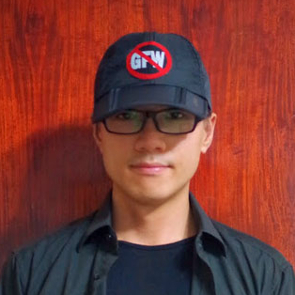
1. First, three corrections: not an HRIC network, and ATGFW is not "ATD Fourth World"
This file opens with corrections, because the second-hand literature on Zhen Jianghua contains three hard errors. First, organisational affiliation: he is sometimes described as executive director of a network related to Human Rights in China (HRIC), the New York-based organisation. There is no record of any such thing. The organisation he directed is Human Rights Campaign in China — HRC China, Quanli Yundong (权利运动) — a grassroots rights-information and solidarity platform founded in October 2008, rooted inside mainland China and later registered in Hong Kong. It is an entirely different organisation from HRIC; the names are merely similar, and in this site's check HRIC issued no case-specific statement on Zhen at all. Conflating the two credits a decade of mainland grassroots work to an overseas institution's account, and this file does not adopt it. Second, the meaning of ATGFW: the initials stand for Across the Great Firewall — the Chinese "Climb the Wall Net" (翻墙网) that Zhen founded, publishing cyber-security information and detailed tutorials on bypassing censorship. It has nothing whatsoever to do with the international movement ATD Fourth World; ATD is simply another set of initials, and reading them into Zhen's biography tangles two unrelated lines. This file fixes the point: no public record connects Zhen Jianghua to ATD Fourth World in any way. Third, the year of his release: some accounts hedge it as "2019/2020". Front Line Defenders' update of 11 November 2019 is precise — on 8 November 2019 he was released from a prison in Yingde, Guangdong, after serving his sentence, was welcomed by his family and returned to his family home in Zhuhai. No record connects any release to 2020, and this file adopts 8 November 2019. One further warning belongs at the head of the file: paragraph 75 of the UN Working Group's Opinion No. 20/2019 mistakenly attributes to Zhen Jianghua the thirteen-year sentence and three years' deprivation of political rights imposed in the same joint opinion's other case, that of Qin Yongmin. That is an error inside the UN document itself — thirteen years plus three years' deprivation of political rights was Qin's sentence, per the Wuhan Intermediate People's Court as recited elsewhere in the same opinion. Zhen's actual sentence was two years' imprisonment, imposed by the Zhuhai Intermediate People's Court, on the consistent accounts of Amnesty International and Front Line Defenders. This file cites the UN opinion for its legal findings only, never for the paragraph-75 figures, and records the error here for the archive: the archivist's rule is that when even an authoritative source gets a fact wrong, the mistake is flagged, not copied.
2. A Jiangmen schoolboy and a Zhuhai programmer: the censorship machine first taught him sympathy
Zhen Jianghua was born on 12 December 1985 in Jiangmen, Guangdong. He studied computing on the vocational track at school and went straight to work, joining an internet data centre in Zhuhai in 2005 and rising to a managerial position. What redirected his life was the daily routine of censorship itself. According to the long Initium Media profile by Huang Yu, translated by China Change, an elderly man who painted for a living came to the company with his daughter: the old man ran a small bulletin board on the company's servers, where he had posted a few pieces about Mao Zedong, and the board was suddenly shut down. Zhen's first thought was that this was normal — the subject was sensitive, after all — but he also felt sorry for the old fellow and wanted to help. When the company later bought servers in Hong Kong, Zhen moved that board and others like it across, so they would survive a little longer; in the end, none escaped closure. Meanwhile the censors' calls to his company multiplied; the celebrated campus forums of Nanjing University and Tsinghua University were blocked to off-campus access; and his own company began top-down self-censorship, developing a program that scanned server content and shut down "bad traffic" automatically. In his spare time Zhen took part in the Chinese Wikipedia and in Google developer community events, met grassroots netizens and taught them to use the internet to advocate for their own interests. Business trips to Hong Kong taught him about the annual June 4 candlelight vigil in Victoria Park; he admired the Tiananmen Mothers — "those people emit radiance," he said — and began travelling to the vigil every year. One year he brought a mainland friend to help hand out leaflets; back home, the friend was questioned by state security, got into trouble at work and was banned from leaving China for five years. The sourcing level of this section is marked as found: the biographical detail rests chiefly on the Initium profile, which interviewed Zhen himself before his arrest and many of his friends and family, and remains the fullest contemporary record of his life; this file adopts its framework facts and takes from it only details relevant to the case. His date of birth is anchored independently by the UN Working Group's opinion.
3. The social-work years inside the system: delivering rice and oil, and the question that could not be asked
After leaving programming, Zhen tried doing "safe" work inside the system. He became a full-time social worker for the Zhuhai Municipal Red Cross, visiting the "hard-pressed masses" and delivering rice, cooking oil and noodles — later, washing detergent — with a job description that required him to stay in contact with the recipients and "keep their emotions stable". He was also the lead social worker at Nanqingcun, serving women who suffered domestic violence, where the most he could do was advise them to file for divorce; and he worked as a project officer on the Hong Kong AIDS Foundation's HIV/AIDS prevention education project in Zhuhai, on the consistent accounts of Front Line Defenders and Amnesty International. The job did not last. In 2011 he added his signature to an online appeal in support of the artist Ai Weiwei, and police took him away for questioning from the Red Cross office, in front of his colleagues. He resigned of his own accord, "to protect the Red Cross from any negative impact". He later said that social work in China is a debilitating job: you have to sing the Party's praises morning to night, put on events, and studiously avoid every sensitive topic — such as why the villagers are poor in the first place — and you certainly cannot teach the people you serve what their rights are. Delivering rice and oil never addressed the fundamental problems, and working inside the system made it impossible even to think about them. This section is written at length because it explains every choice that followed. Zhen was not a man who never tried working within the rules; the rules pushed him out first. A social worker taken from his office for signing his name had only one direction left. After resigning he joined prisoner-of-conscience support work in a personal capacity: collecting signatures and spreading information for Zhao Lianhai, the Beijing father whose son was poisoned by melamine-tainted milk formula, and paying the phone bill of the feminist activist Ye Haiyan, neither of whom he had ever met. When the rights lawyer Jiang Tianyong met him for the first time, Zhen introduced himself by his online name — "I'm Guests Zhen" — and Jiang replied that he remembered him: he was the one who had sent so many messages of encouragement years before.
4. Exposure, and the "Climb the Wall Net": from backstage technician to a man working under his real name
In late 2010, after Liu Xiaobo won the Nobel Peace Prize, a group of like-minded netizens planned a celebration, to be coordinated over Twitter. One activist who was routinely monitored made the mistake of telephoning Zhen to invite him — and the authorities for the first time connected the online "guest" persona with the real Zhen Jianghua. From then on the police called him in regularly, took him on forced "travel" whenever a sensitive date approached, and he could no longer attend the Victoria Park vigil. But once exposed, rather than backing off, he went all in, under his real name. The projects he launched were mostly about recording and technical support: a "Big Brother" project tracking citizens placed under state surveillance; a "Drink Tea Net" collecting ordinary citizens' testimony about being questioned by police under the euphemism of "drinking tea"; and the "Climb the Wall Net" — ATGFW.org — giving netizens technical help to circumvent the Great Firewall. In 2013 a student group at the Zhuhai campus of the Beijing Institute of Technology invited him to lecture on circumvention technology; the students posted notices around campus for an event teaching "how to use the internet scientifically". The event was shut down and the university's Party leadership called the students in: "Do you have any idea what kind of person this Zhen Jianghua is?" Zhen did not mind state security harassing him, but when the university threatened to deny graduation to the students who had invited him, he was furious. He tracked down the officers in charge and told them: I can leave the area if that is what is required; if there is an issue, come to me — do not bother the students, who are about to graduate and whose whole lives would be affected. The officers accepted, on condition he never set foot on campus again. He later laughed that in fact he went back often — a lot of people there were into internet technology. This section likewise rests on the Initium profile and is archived with its source marked. It fixes the core of Zhen's method: technology was his trade, but what he actually did was turn technology into a self-protection tool for ordinary people — and in a system that treats the circulation of information itself as a threat, teaching people to climb the wall and organising resistance sit only one article of the Criminal Law apart.
5. The years of evictions: state security, landlords, and a life in one suitcase
From 2010, Zhen was repeatedly driven out of his rented homes in Zhuhai: each time he settled somewhere new, state security officers would telephone the landlord, and the frightened landlord would ask him to leave. The source cited by the UN Working Group agrees: from 2010 the authorities forced him to change residence roughly once a year, pressuring landlords not to rent to him, and on several occasions he was also prohibited from travelling overseas. Sharing the upheaval was his wife at the time, Xiao Li. They had met through their shared habit of taking in stray cats and dogs. Their life together was never stable, but for a while it was very romantic: every New Year's Eve they travelled to a seaside lighthouse to watch the sun go down, kept watch through the night, and watched it rise on New Year's Day; at Christmas they walked around handing out candy and encouraging people to donate blood — between them they had donated blood more than a hundred times; they took in over twenty stray cats and, unable to afford a vet, learned to perform the sterilisation surgery themselves. The harassment eventually drove the couple to Macau, where they worked for the Fu Hong Society serving people with autism — a precious, temporary peace that lasted until 9 July 2015. His daily preparations belong in this section too, because they show how he judged his own future. For years he wore only black — two black T-shirts and two pairs of black shoes in rotation. Every night before bed he did fifty push-ups, fifty squats and fifty chin-ups. He ate vegetarian, sometimes subsisting on meal-replacement powder. He signed multiple blank powers of attorney and gave them to friends. His Google account was set to purge everything automatically if he did not log in for two days, and he wiped his computer and phone data on a strict schedule. He also deliberately kept his distance from others in the small rights-defence community — "there is nowhere safe in China; you never know who will sell you out" — reasoning that if everyone could see what the others were doing, there was no need for contact, and that if he were ever interrogated he could honestly say "I don't know". A man doing human-rights documentation in his own country, living every day as if preparing for prison: that, in itself, is testimony.
6. After the 709 crackdown: the man who cleaned up afterwards takes over Human Rights Campaign in China
Beginning on 9 July 2015, more than three hundred rights lawyers and activists in twenty-three provinces and cities were detained, summoned or disappeared — the "709 Crackdown". The couple's peace in Macau ended there. Human Rights Campaign in China had been founded in October 2008; in October 2015 Zhen took it over, registered it in Hong Kong, and became its executive director. His daily work was to aggregate, verify and publish the latest news of human-rights events across China, to liaise with foreign media, and to coordinate aid efforts — and sometimes protests — for defenders who had been sent to prison. After 709 he did three things at once: respond rapidly to abuses, visiting families in his capacity as a social worker and building a support network for everyone taken into custody; teach family members that people arrested for political reasons are guilty of nothing; and, drawing on experience, publicise arrests, mobilise social media and contact foreign human-rights officials to press the authorities. In early June 2016, Wang Qiaoling and Li Wenzu, the wives of the disappeared lawyers Li Heping and Wang Quanzhang, were taken to the Guajiasi police station in Tianjin. Before being taken in, Wang Qiaoling sent out word; Zhen's HRC China verified and published the news at once — whereupon an officer at the station pulled out his phone, switched on his VPN, opened the HRC China website and held it up to her: "Look. You've been here less than an hour, and the news is everywhere." Friends describe how he worked: every day he followed two or three cases — verifying what had first been reported, writing it up, publishing it, then contacting people about it — powering through without rest, "like his life depended on it", often working through the night and sleeping little in the day; if someone was suddenly arrested and the family needed support, he would buy a train ticket and go at once, and for safety could tell neither friends nor family where he was going or why. He had originally given himself two years to set HRC China up and hand it over; in August 2017 he was still joking to a friend, "I can't get rid of it right now — no one is willing to take it on." The writer Li Xuewen observed that Zhen's decade traced the typical trajectory of Chinese rights defenders: from behind-the-scenes support and broadcasting, step by step onto the front line — because once everyone on the front line has been arrested, it is the turn of those behind the scenes. At Chinese New Year 2017, instead of going home, Zhen went alone to Beijing to spend the holiday with the 709 families; Li Wenzu remembered him leaving on the third day of the new year, a lonely figure.
7. Wukan 2016: twice taken away, and the end of a marriage
In early September 2016, Zhen travelled to Wukan village in Lufeng, Guangdong, in support of villagers protesting the local government's illegal land seizures and the detention of village chief Lin Zuluan. Amnesty International's account runs: he arrived in Wukan on 3 September and, as he was about to leave, was detained and questioned by police for over twenty-four hours on suspicion of inciting the Wukan protest; after his release he published an online statement about the detention on 7 September, and that same night was detained again and interrogated until the following day on suspicion of "inciting participation in illegal rallies, marches and demonstrations". Front Line Defenders' action page gives a different count — released by police in Chaoyang on 8 September after five days of interrogation. The two organisations' day counts do not fully agree; this file records both, taking Amnesty's staged account as its main line and archiving the Front Line Defenders version alongside, without merging them. Reporters Without Borders summarised it as detention "for several days" in September 2016. It is the clearest pre-2017 record of Zhen being detained for a specific act of solidarity. The personal cost is recorded on the same page: after his Wukan release, he and Xiao Li began divorce proceedings — a seven-year marriage had reached its end. Xiao Li had not wanted the divorce at first; it was Zhen who would not drag her down further. All his energy went into the work; he had no time for the household chores they used to share, and he would disappear for days without saying where. Xiao Li suffered depression; at its worst she would walk the seven kilometres home from work rather than take the bus, because she did not want to sit alone in an empty flat — leaving at eight in the evening and reaching the door around eleven. Both families had been harassed by state security. The couple never lived anywhere for more than two years, and each move left them with fewer belongings, until everything they owned fitted into a single suitcase. A few months into running HRC China full time, Xiao Li found him suffering insomnia, depression and constant fatigue that exercise did not help; he would not see a counsellor and would not open up to anyone around him. Their last contact was in August 2017, when he called to ask whether she had time to look after his cats; she declined. This file includes the section because an archive must record more than charges: the marks left on a rights defender by the state machine appear first in his marriage, his sleep and his one suitcase, and only afterwards in a judgment.
8. The night of 1 September 2017: the coded message left with a roommate
Late on 1 September 2017, before Zhen had gone to bed, police burst into his apartment, handcuffed him and led him away. The Initium profile, carried by China Change, records that as he was taken out he was unperturbed and said only one thing to his roommate: "Make sure you tell Xiao Li to check Taobao and pick up my packages." Xiao Li was his former wife; the sentence was code — she was to spread the news of his arrest. That night some twenty officers brought him back to the residence and confiscated his mobile phones and computers, per the source cited by the UN Working Group. Reporters Without Borders adds that his partner was taken away the same night and released six hours later, and that the apartment was searched twice and electronic equipment removed. On 2 September police searched the home a second time, taking promotional materials and documents of Human Rights Campaign in China (per the UN opinion's source); on the accounts of several organisations, neither search produced a search warrant or detention document. On 2 September the Zhuhai Public Security Bureau criminally detained him on suspicion of inciting subversion of state power, at Zhuhai No. 1 Detention Centre. The first procedural violation is fixed here: his family received the detention notice only on 7 September — the UN Working Group noted that this breaches Article 83 of China's Criminal Procedure Law, which requires a detainee's family to be informed within twenty-four hours, and the Chinese government, in its reply to the Working Group, did not contest the point. On 14 September one of his lawyers went to the detention centre to request a meeting; the police told him explicitly not to return and not to "spread speculation" about the case on social media, and the authorities warned Zhen's family members and supporters not to speak publicly about it (per the UN opinion's source). Meanwhile his sister Zhen Chunyan wrote an article recalling their childhood together; it was quickly deleted from the internet, and around 29 September she was summoned by the Jiangmen Public Security Bureau, where state security officers warned her that her article was affecting the police's evidence-gathering — per the CECC's 2018 Annual Report, citing Human Rights Campaign in China's report of 29 September 2017. Late on the night of 29 September, Xiao Li found herself outside the walls of Zhuhai No. 1 Detention Centre and wrote in her diary: "We were separated by a mere wall. I thought I had mentally prepared myself well enough, but the reality crushed me all the same."
9. RSDL and formal arrest: a "handwritten" letter dismissing his own lawyers
On 29 September 2017, after twenty-eight days of criminal detention, Zhen was placed under residential surveillance at a designated location — the date on which Front Line Defenders, Amnesty International and the Chinese government's own reply to the UN Working Group all agree; the government's reply states it expressly. But neither his family nor his lawyers were told for a long time: Ren Quanniu travelled repeatedly from Henan to Zhuhai demanding a meeting, and only on 13 December did he receive a telephone call informing him that Zhen had been placed under RSDL and still could not see a lawyer. The source cited in the UN Working Group's opinion dates the transfer itself to "mid-December" — a discrepancy with the otherwise consistent 29 September date which this file reads as the source mistaking the date of notification for the date of the measure; the main text follows the three-way consensus of 29 September and archives the discrepancy here. The RSDL location was never communicated to the family; Front Line Defenders noted in particular that even under Chinese law the authorities were obliged to notify the family of his whereabouts, and no such notification was ever received. On 29 March 2018, at the expiry of the six months of incommunicado detention, the Zhuhai People's Procuratorate approved his formal arrest (Amnesty International, citing one of his lawyers); on 30 March the lawyer notified friends, and Human Rights Watch issued its statement the same day. After the arrest he is believed to have been transferred to Zhuhai No. 2 Detention Centre, but neither family nor lawyers received any formal notification (per the UN opinion's source). On 13 July 2018 another lawyer went to Zhuhai No. 2 Detention Centre to request a meeting and was stopped by a national security officer, who said the case had already been sent to the prosecutor's office with a recommendation for indictment. A detention-centre officer then produced a letter supposedly handwritten by Zhen, stating that before 2 September 2017 he had dismissed the counsel his family had appointed. The lawyer was refused permission to copy or photograph it, and since Zhen remained incommunicado, its authenticity could never be checked with him. The UN Working Group later wrote, in terms, that it "does not understand the reason for the dismissal of family-appointed lawyers under questionable circumstances" in Zhen's case. From his seizure to his trial he never once saw a lawyer of his family's choosing, and never saw his family; the authorities' stated reason, throughout, was "national security".
10. A secret trial and a Christmas-season verdict: the news of the hearing survived only hours
On 10 August 2018 the Zhuhai Intermediate People's Court held the first-instance trial of Zhen Jianghua. The proceedings were closed, and neither his family nor the lawyers his family had hired received any advance notice — they learned that the trial had already happened only afterwards: on 23 August a document appeared on a Chinese procuratorial website mentioning that he had stood trial on 10 August, and was later deleted; the news also surfaced briefly in Baidu search results before being deleted there too (on the consistent accounts of PEN America and the source cited by the UN Working Group). The Chinese government, in its reply to the Working Group, confirmed the 10 August first-instance trial and that a verdict would be announced later, but did not respond to the allegation that family and lawyers had not been notified. On 28 December 2018 — in the middle of the Western Christmas holidays, when international attention is at its thinnest — the Zhuhai Intermediate People's Court convicted Zhen Jianghua of inciting subversion of state power and sentenced him to two years' imprisonment. According to Amnesty International, his father was present at the sentencing; but neither the family nor the state-appointed defence lawyer disclosed any detail of the indictment, the verdict or the proceedings, and how the evidence was presented or tested remains unknown. Front Line Defenders made the timing point expressly: Chinese judicial authorities frequently stage trials and sentencings of sensitive figures during the Christmas holiday season to limit international monitoring and coverage, citing the Wang Quanzhang case as a parallel. The remaining elements of the judgment are recorded here one by one, as found: whether any additional deprivation of political rights was imposed has no public record — the "thirteen years plus three years' deprivation of political rights" in paragraph 75 of the UN opinion is the misattributed Qin Yongmin sentence (see Section 1) and must never be attached to Zhen Jianghua; whether he appealed, or the procuratorate protested the verdict, has no public record; the full text of the judgment has no public record; any remission of his sentence has no public record. The computation of the term also requires an archivist's note: he was criminally detained from 2 September 2017, and time under RSDL counts toward a sentence (two days of RSDL counting as one day of imprisonment), so a two-year term would nominally have expired in the autumn of 2019, while the release date reported by Front Line Defenders is 8 November 2019; the roughly two-month difference is explained by no source found, and this file archives the two dates side by side without speculative filling.
11. The international response: prisoner of conscience, a joint letter from four UN rapporteurs, and an arbitrary-detention opinion
The international response, laid out in time order, is sourced at every step. In September 2017 Reporters Without Borders issued a statement describing Zhen as a respected activist and journalist, known by the pen name "Guests Zhen", who had recently organised an activity commemorating Liu Xiaobo, the Nobel Peace Prize laureate who had died in detention that July, and demanded his release. Amnesty International launched Urgent Action UA 235/17, recognising him as a prisoner of conscience detained solely for exercising his rights to freedom of expression and association and calling for his immediate and unconditional release. On 24 January 2018 four UN special-procedures mandate holders wrote jointly to the Chinese government (AL CHN 2/2018) — the Working Group on Arbitrary Detention and the Special Rapporteurs on freedom of opinion and expression, on the situation of human rights defenders, and on the independence of judges and lawyers — expressing serious concern at the warrantless arrest, the incommunicado detention and the denial of access to a lawyer, and asking Beijing to state the specific facts and evidence behind the accusation; the Chinese government replied on 7 March 2018, as recited in the Working Group's opinion. In February 2018 Reporters Without Borders spoke again as his six months of RSDL ran out — calling the measure an official euphemism for detention at a "black site" — and demanded that China respect its own regulations and free him on completion of the six months. On 3 April 2018 Human Rights Watch issued its statement: its China director Sophie Richardson said that by formally arresting Zhen the authorities were demonstrating their intent to eradicate human rights monitoring in China, that "the case against Zhen is an attack on all rights reporting", and that he had been detained for over seven months for exercising his right to free speech and put at grave risk of torture. When news of the secret trial emerged in September 2018, PEN America called it an unjustified and abusive effort to punish a human rights advocate for his work; its deputy director for free expression, Summer Lopez, said Zhen had been detained for over a year, subjected to a secret trial and denied the lawyer of his choice, all because of his human-rights and free-expression work. Front Line Defenders tracked the case throughout, repeatedly demanding his immediate release. Institutionally, the U.S. Congressional-Executive Commission on China entered him in its Political Prisoner Database as record 2017-00360, named the case in the civil-society, free-expression and criminal-justice chapters of its 2018 Annual Report, and recommended urging Chinese officials to release or confirm the release of Zhen Jianghua and others. The legally weightiest item came last: on 1 May 2019, at its eighty-fourth session, the UN Working Group on Arbitrary Detention adopted Opinion No. 20/2019 (considering Zhen's case jointly with Qin Yongmin's), holding that Zhen's deprivation of liberty contravened articles 2, 3, 6, 7, 8, 9, 10, 11, 18, 19, 20 and 25 of the Universal Declaration of Human Rights and was arbitrary under category I (no legal basis), category II (resulting from the exercise of fundamental rights), category III (grave violations of fair-trial norms) and category V (discrimination on grounds of political opinion and status as a human rights defender). The Working Group requested the Chinese government to release him immediately, accord him an enforceable right to compensation and other reparations, conduct a full and independent investigation and take measures against those responsible, and referred the case to the Special Rapporteurs on human rights defenders, on freedom of expression, and on the independence of judges and lawyers. The opinion was adopted while he was still serving his sentence; whether China ever acted on any part of it has no public record. The negative checks are recorded with equal plainness: no case-specific statement by Human Rights in China (HRIC) was found in this check, and no standalone case page by the Network of Chinese Human Rights Defenders (CHRD) was retrieved — CHRD's 2017 annual report on defenders was cited by the CECC in describing the situation of defenders that year. Both are recorded as searched, not filled in by conjecture.
12. The official Chinese position: "handled according to law", and one deleted document
This site's practice is to give the official Chinese position its own section. Three items can be found in this case. First, the Chinese government's reply of 21 September 2018 to the UN Working Group on Arbitrary Detention: Zhen Jianghua, accused of inciting subversion of state power, was criminally detained in accordance with the law by Guangdong public security on 1 September 2017 (the reply's date differs by one day from the sequence recorded by the organisations — taken away late on 1 September, criminally detained on 2 September — and is archived here as the government's own formulation), placed under residential surveillance at a designated location on 29 September 2017, and tried at first instance by the Zhuhai Intermediate People's Court on 10 August 2018, with a verdict to be announced later. Second, the same reply's characterisation: the case is unrelated to human rights; China is a country ruled by law; anyone who breaks the law, whatever their identity, is punished according to law, and there has been no retaliation for human-rights activity. Third, the document posted on the Zhuhai People's Procuratorate's website on 23 August 2018 mentioning the 10 August trial — which appeared, was noticed, and was deleted, and which constitutes the sum total of this case's "public judicial documents". This file's treatment of the official position is quotation plus comparison. Beijing says "according to law", yet the detention notice reached the family six days late, in breach of Article 83 of China's own Criminal Procedure Law — a point the government's reply did not contest, as the Working Group recorded. Beijing confirms a first-instance trial, yet does not answer the charges that the family and lawyers were never notified and that the defendant never saw a lawyer of his own choosing. Beijing says the case has nothing to do with human rights; the UN Working Group answered with findings of arbitrary detention in four categories. The judgment has never been published, and the specific conduct underlying the charge — what exactly he published, whom exactly he supported, which sentence of which circumvention tutorial amounted to "inciting subversion" — has never been explained to the public in a single word. A man convicted of "incitement" whose inciting words the state will not even display: the persuasiveness of this trial ends where that deleted document ends.
13. 8 November 2019: released at Yingde, home again — and then the public record goes blank
On 8 November 2019 Zhen Jianghua was released from a prison in Yingde, Guangdong, after serving his full sentence (Front Line Defenders, 11 November 2019). He was welcomed by his family and returned to his home in Zhuhai. The specific name of the prison, his health and treatment in custody, and any record of prison visits have no public record. What follows must be written more cautiously than any other section of this file, because almost the only sentence the evidence supports is this one: there is no public record. For this check, the post-November 2019 materials of Front Line Defenders, Amnesty International, Human Rights Watch, Reporters Without Borders, PEN America and the CECC were each searched; no report was found of any post-release surveillance, summons, exit ban or prohibition on speaking — and equally, no report was found of his resuming public activity, giving an interview, or leaving China. Under this site's criteria for its Ongoing page, only those "released but still monitored or wanted" are listed; Zhen Jianghua's is a straightforward case of a sentence fully served and a case closed, with no public evidence of continuing surveillance. This file therefore determines: the case is NOT ongoing, and the ongoing flag is not applicable. The determination's limit is stated in the same breath: absence of reporting is not proof of absence. Given a pre-arrest decade of annual evictions and forced "travel" on sensitive dates, some form of official attention after his release would surprise no one experienced in these cases — but an archive writes evidence, not experiential inference, and this file fixes itself to the evidence boundary: as of 18 November 2026, his post-release circumstances have no public record, and his latest verifiable status remains his release on completion of sentence on 8 November 2019 and his return home to Zhuhai. Seven years have passed since then without a word of him in the public world. He is forty years old now. The man about whom a police officer once marvelled, phone in hand, that "in less than an hour the news is everywhere" has himself generated, since walking out of prison, exactly two lines of reporting from one organisation — and then silence. Whether that silence is chosen convalescence, enforced quiet, or simply that no one asks any more, this file does not know and will not answer for him.
14. The family's page: parents coached to pressure their son, a sister summoned for an article
Zhen Jianghua's family appears in the public record in three groups. His parents, in their Jiangmen hometown: whenever he went back, state security officers were never far away, sitting his parents down to urge their son to abandon his activism and "turn over a new leaf"; in time he could not stand the harassment and simply stopped going home. After his arrest, according to the Initium profile, the authorities put pressure on his parents: if they insisted on the lawyers he had pre-commissioned, he would be given a life sentence; if they accepted a government-appointed lawyer, he might get a light verdict. This file marks that passage as resting on the profile's single source chain, uncorroborated by a second source — and notes that it fits the procedural facts that followed with grim precision: the family lawyers never saw him, the family was not notified of the trial, and the father who attended the sentencing disclosed nothing of the case afterwards (per Amnesty International). His sister, Zhen Chunyan: she wrote an article recalling their growing up together, and it was swiftly deleted; around 29 September 2017 the Jiangmen Public Security Bureau summoned her, and state security officers warned her that her article was affecting the police's evidence-gathering. His former wife, Xiao Li: she shared the years of eviction during the marriage, was the person named in his coded message on the night of his arrest, and stood alone outside the detention centre late on 29 September. Read together with the case itself, this page shows what the family paid for his work: parents turned into a loudspeaker for surrender talks, a sister's memoir treated as obstruction of an investigation, a wife worn down across a seven-year marriage. And the whole of his alleged criminality was this: recording other people's arrests, teaching other people to climb a firewall, speaking up for other people. When the man whose job was carrying messages for other families was himself taken, his own family could not publish even one article without a summons and a warning. That is not collateral damage; it is a standard component of how such cases are run — silence the family first, and the case can then be handled in secret.
15. Full timeline
On 12 December 1985 Zhen Jianghua is born in Jiangmen, Guangdong (per the UN Working Group's opinion). After vocational school in computing, he joins a Zhuhai internet data centre in 2005 and rises to a managerial post; at work he watches censorship shut down ordinary people's forums, joins the Chinese Wikipedia and technical communities, teaches grassroots netizens to use the internet for their own advocacy, and travels yearly to Hong Kong for the Victoria Park June 4 vigil. He then works as a full-time social worker for the Zhuhai Municipal Red Cross and as lead social worker for domestic-violence victims at Nanqingcun, and on the Hong Kong AIDS Foundation's HIV/AIDS prevention education project in Zhuhai. In 2011, after signing an online appeal for Ai Weiwei, he is taken from the Red Cross office by police for questioning and resigns, thereafter supporting prisoners of conscience in a personal capacity. After the Liu Xiaobo Nobel episode of late 2010 his "Guests Zhen" identity is matched to his real name; he is thereafter regularly summoned, taken on forced "travel" around sensitive dates, and from 2010 is driven from his rented home roughly once a year by police pressure on landlords. In 2013 his circumvention-technology lecture at the Beijing Institute of Technology's Zhuhai campus triggers the questioning of the inviting students, and he demands that state security leave the students alone. After the 709 crackdown of July 2015, he takes over Human Rights Campaign in China (founded October 2008) in October 2015 as executive director, registering it in Hong Kong, publishing rights news, liaising with foreign media and coordinating support for detainees and their families. In June 2016 HRC China rapidly publishes the news of Wang Qiaoling's and Li Wenzu's detention in Tianjin. On 3 September 2016 he goes to Wukan in support of the villagers and is detained and questioned for over twenty-four hours; after his release he publishes a public statement on 7 September and is detained again that night for questioning until the next day (Front Line Defenders' version: five days of interrogation, released 8 September — the two accounts coexist in the record); the same year, he and his wife Xiao Li go through divorce proceedings. At Chinese New Year 2017 he spends the holiday alone in Beijing with the 709 families. Late on 1 September 2017 police take him without a warrant from his Zhuhai home; he leaves a coded message asking his former wife to spread the news; that night about twenty officers bring him back to seize his phones and computers, and his partner is taken away at the same time and released six hours later; on 2 September the home is searched again and he is criminally detained on suspicion of inciting subversion of state power at Zhuhai No. 1 Detention Centre; his family receives the detention notice only on 7 September; on 14 September a lawyer's request to meet him is flatly refused, with a warning against posting on social media; on 29 September he is placed under RSDL (his family lawyer Ren Quanniu is told only by telephone on 13 December), and at about the same time his sister Zhen Chunyan is summoned and warned by Jiangmen police over her article about him. On 24 January 2018 four UN special-procedures mandate holders write jointly to the Chinese government. On 29 March 2018 the Zhuhai People's Procuratorate approves his formal arrest (a lawyer notifies friends on 30 March); he is believed transferred to Zhuhai No. 2 Detention Centre, with no formal notification to family or lawyers. On 13 July 2018 a lawyer is blocked by a state security officer at No. 2 Detention Centre and shown a supposedly handwritten letter, dated before 2 September 2017, in which Zhen purportedly dismissed his family-appointed counsel; copying or photographing it is refused. On 10 August 2018 the Zhuhai Intermediate People's Court tries him in closed proceedings, without notifying his family or his family's lawyers; on 23 August a procuratorial website document briefly discloses the hearing before being deleted. On 21 September 2018 the Chinese government replies to the UN Working Group that the case was handled according to law and is unrelated to human rights. On 28 December 2018 the Zhuhai Intermediate People's Court sentences him to two years' imprisonment for inciting subversion of state power, his father reportedly present; whether political rights were additionally deprived, and whether there was any appeal, has no public record. On 1 May 2019 the UN Working Group on Arbitrary Detention adopts Opinion No. 20/2019, finding his detention arbitrary under categories I, II, III and V and requesting his immediate release and compensation. On 8 November 2019 he is released from a prison in Yingde, Guangdong, on completion of his sentence, is welcomed by his family and returns to his home in Zhuhai. From then until this site's check on 18 November 2026, no public record has been found of any renewed detention, public activity, surveillance or departure from China; his latest verifiable status remains his release on completion of sentence and his return home.
16. Our Take
What earns Zhen Jianghua's case its place in this archive is the nature of his post. China's rights ecosystem has never lacked people willing to stand at the front; what it scarcest has is people like him — verifying news without credit, publishing without sleep, building a family-support network for every person arrested, teaching ordinary people to climb the wall and protect themselves. In his own words, people like him are signposts: passers-by will see the pits they fell into, pits with corpses stacked in them. Nothing he did, taken alone, "subverts" anything: publishing one verified news item, helping one family find a lawyer, writing one circumvention tutorial, spending one New Year with the wives of the 709 detainees. But the Zhuhai Intermediate People's Court, with a two-year sentence, gave this body of work its legal characterisation: documenting persecution is itself incitement to subversion. That is the weight of the case. What the authorities struck at was not a viewpoint but a function — the function of making persecution visible. The police officer in the Tianjin station who held up his phone and marvelled that "in less than an hour, the news is everywhere" wrote, without meaning to, the summary of the indictment. The second thing this file fixes is the wholesale failure of procedure: a warrantless seizure, a detention notice six days late, RSDL imposed without telling the family where he was, chosen counsel who never saw him once, a "handwritten dismissal letter" of unverifiable authenticity replacing his defence, a trial of which no one was notified, news of that trial surviving only in a deleted document, sentencing scheduled into the Christmas holidays, and a judgment that has never been published. This is not one link in the chain giving way; it is every link giving way in the same direction. The UN Working Group said it in full, with its four categories of arbitrary detention, and this file adds nothing rhetorical to that. The last word concerns his ending. He served his sentence, was released, went home to Zhuhai — and in the seven years since, the public record has been blank. This file does not write that blank as surveillance, and does not write it as freedom. It leaves it exactly as found, and records the contrast: before his arrest, he was the person in China most diligent at breaking silence on behalf of others; after his release, it is his own silence that no one can break — and no one even knows whether it should be broken. A man who lived for a decade by "getting the news out" has left, as the last news of himself, two lines. This site enlarges those two lines for the archive: Zhen Jianghua, 8 November 2019, released on completion of his sentence, welcomed by his family, returned to his home in Zhuhai. Thereafter, no public record — and "no public record" is itself the standard ending this state reserves for people of his kind.