
第153案 | 却尔宾努尔·斯迪克Case 153 | Qelbinur Sidik
却尔宾努尔·斯迪克,乌鲁木齐第二十四小学教了二十八年语文的乌兹别克族教师,2017年被一纸保密令征召进新疆集中营教汉语——先在仓房沟男子营六个月,再在头宫女子营,亲眼见过抽血、消失的人和被担架抬出的少女遗体;她自己被强上节育器、被迫提前退休、2019年被强制绝育,才换得一本去荷兰看女儿的护照,此后在维吾尔法庭、美国国会与CECC接连作证,丈夫则被推上镜头否认她、被迫离婚后失联至今。Qelbinur Sidik, an ethnic Uzbek teacher who taught Chinese for 28 years at Urumqi's No. 24 Primary School, was conscripted under a secrecy order in 2017 to teach inside Xinjiang's internment camps — six months in the Cangfanggou men's camp, then the Tugong women's camp — where she witnessed weekly blood draws, disappearing detainees and a dead girl carried out on a stretcher; she was herself fitted with a forced IUD, pushed into early retirement and forcibly sterilised in 2019 before being allowed a passport to visit her daughter in the Netherlands, and she has since testified before the Uyghur Tribunal, the U.S. Congress and the CECC, while her husband was put on camera to deny her story, forced to divorce her, and has not been heard from since.
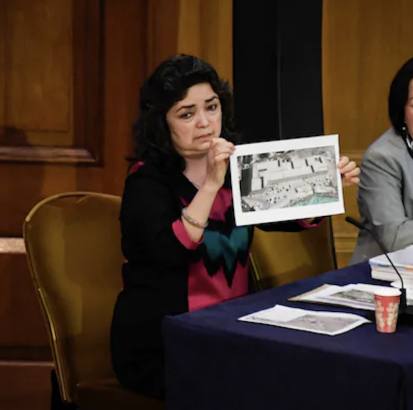
1. Two things to fix first: she is Uzbek, and her birth year can only be inferred from her own words
The easiest things to get wrong in Qelbinur Sidik's file are not the camp details but the woman herself. First, she is not Uyghur. In her 2021 Uyghur Tribunal statement, her 2023 written testimony to the U.S. House Select Committee, and her 2026 CECC testimony, she writes the same sentence three times: she is ethnically Uzbek. Her husband is Uyghur; her daughter left for the Netherlands in 2011 to study medicine. A good number of English-language reports label her a Uyghur teacher, and even the page of a project devoted to her life has called her a Uyghur woman; this archive follows her own repeated self-description. The distinction is not a nicety: answering a panel question at the Tribunal, she explained that in 2019 she was allowed to leave China precisely because she is Uzbek, while her husband, being Uyghur, was told not even to think of going abroad.
Second, her exact birth date is a matter of no public record. No official biography, tribunal file or congressional volume gives it. What can be assembled is her own statement: paragraph 58 of her Tribunal statement says 5 May is her birthday and that she turned fifty on 5 May 2019 — from which a birth date of 5 May 1969 can be inferred, but it remains an inference and is flagged as such. The surrounding evidence roughly converges: Radio Free Asia described her as 51 in October 2020, consistent with a 1969 birth; Leiden University's Mare magazine described her as 55 in November 2025, when a May 1969 birth would have made her 56 — a one-year discrepancy archived in parallel rather than silently resolved. Her name is similarly unstable across official documents — Qelbinur, Kalbinur, Kelbinur and Qalbinur all appear; she signed her 2026 congressional testimony "Kalbinur Sidik." This archive standardises on Qelbinur Sidik.
2. Twenty-eight years at the No. 24 Primary School, and the screening examinations of autumn 2016
According to her Tribunal statement, she was born and raised in Urumqi, attended college there, and was assigned to teach Chinese at Urumqi No. 24 Primary School, where she stayed for 28 years. She was more than a classroom teacher: by her account she handled the school's cadre (personnel) work and its archives, headed the Chinese-language teaching-research group, and taught two classes. Radio Free Asia reported in 2020 that she began at the school in 1990 — and 1990 plus 28 years lands exactly on 2018, the year she was forced out, so the two accounts mesh; the English Wikipedia and the Geneva Summit biography instead say she has taught Mandarin "since 1999," which cannot be squared with 28 years, and this archive does not adopt it (see section 18). Her daughter left for medical studies in the Netherlands in May 2011 — a detail that later hung over her: by her account, the neighbourhood committee and the education bureau repeatedly required her to report which Dutch city her daughter lived in and what she studied, and demanded a copy of her daughter's passport.
The turn began in autumn 2016. By her Tribunal statement, that September every school in Urumqi abruptly subjected all teachers to Chinese-language examinations and evaluated "open lessons": seven or eight Han Chinese teachers sat in on classes and graded them, and over the autumn term teachers sat more than ten examinations, Uyghur-language teachers included — a semester, in her words, of "screening, testing, evaluating and eliminating" teachers. That was the year Chen Quanguo took over as Xinjiang's Party secretary — a matter of public historical record, not of her testimony. The spring term opened on 26 February 2017. On the morning of 28 February the principal called her into his office and told her only this: at 1:30 that afternoon she was to go to the Party committee office of the Saybagh District Education Bureau; there was an important meeting. She asked what meeting. He said he did not know. She later recalled that, handling cadre and archive work, her habit was to bring the notebook matching a meeting's subject — and this time, nobody would tell her the subject.
3. 28 February 2017: the secrecy forms, the fingerprints, and the remark about her daughter
According to her Tribunal statement, the bureau's Party secretary — Song Liying, whom staff called "Secretary Song" — was waiting with two assistants, seven or eight Han Chinese teachers, and one other Uyghur teacher, from the No. 88 Primary School. The meeting took minutes. A number of "illiterates" had been gathered, she was told; from tomorrow, 1 March, those present would teach them the national language at designated locations. Each teacher was handed a three-volume "Special Textbook on Bilingual Education." The condition: whatever you see, hear or learn there, you tell no one — not school leaders, not colleagues, not friends, not family. Then came four or five pages to sign; she says everyone signed and pressed inked fingerprints, and she glimpsed a line to the effect that anyone who disclosed information would himself become a victim, and his relatives would be implicated too. She remembers Secretary Song's words: because time was short, the contents of the forms would not be explained.
Before they left there was an exchange she preserved in all three of her major testimonies. "Teacher Qelbinur, your daughter is in the Netherlands, right?" She answered that her daughter was studying medicine there, about to graduate, hoping to become a doctor. Secretary Song said: "Okay. The Netherlands and China have very close relations. We can bring your daughter here." At the Tribunal she said she felt at once that something was wrong — it was a warning. The next day each teacher was given a police driver's phone number; police would drive them to and from work. And so a woman who had taught primary-school children for 28 years was delivered, without being told where she was going, into a camp. Her 2023 testimony to Congress adds one detail: the principal who summoned her mentioned her daughter in the Netherlands several times, which made her suspect she had been chosen because of her.
4. The Cangfanggou men's camp: the first lesson, 1 March 2017
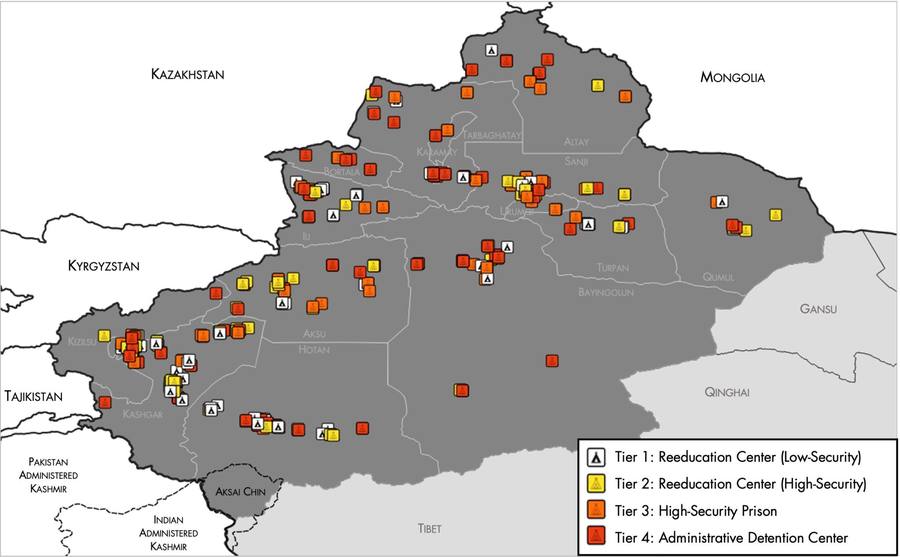
By her Tribunal statement, on 1 March she called the police driver and was driven up a mountain — the camp stood at Village No. 5, Cangfanggou (transliterated Sangfanggou in some sources), and it had no name; nobody told her what the place was called. A four-storey older building, an armed-police base beside it, walls topped with barbed wire, electric gates, and three doors to pass on entry: a wire door, a barred door, a metal door. After she registered her name, ID number and phone number, she was taken to the "classroom." The first group brought in numbered about 97 people. By her description they wore chains on hands and feet, some still bearded; she recognised religious figures and scholars among them — men people on the street would ordinarily greet with respect. Ten people were held in each cell, and as they filed past, their eyes fixed on her as if she had come to rescue them. She has said the four hours that followed were the longest and most frightening lesson of her teaching life: she wrote pinyin on the board with her back to the class, heard sobbing behind her, and did not dare turn around.
The details of the following weeks, as set down in her Tribunal statement, are archived here in her terms: by about 10 March the men's heads had been shaved and the women's hair cut, and everyone wore grey two-piece pyjama-like clothes with an orange numbered vest — names were not to be asked; people were their numbers. Between 20 March and 1 April a flood of new detainees arrived, mostly young men around eighteen, and offices on the second to fourth floors were converted into cells overnight. In the monitoring room she was shown screens covering every cell: thirty to fifty people per cell, sleeping in three-hour rotations at night. Detainees could use the toilet three times a day for one minute each time, with no toilet paper. There was nowhere to wash in the entire six months; lice infested everyone, and in the yard she watched police soaking detainees' clothes in basins of boiling water to kill the lice, laughing that Uyghurs "won't die however you torture them — even their lice run out of boiling water alive." That insult appears again, in her 2023 congressional testimony, as a policeman's remark that Uyghurs "die hard, like lice under boiling water" — two tellings of the same scene that corroborate each other. Food was watery rice soup and two steamed buns; on her first day she gave two elderly men an extra bun each and nearly triggered an incident — "the buns are short" — before a community worker covered for her and warned her: everything here is counted; do not help again tomorrow.
She recognised one sixteen-year-old: a boy who had just graduated from her school and won a place at a sports school for his long-distance running. The reason for his detention, the registering worker told her, was a banned app found on his phone. Through the worker the boy begged her to tell his brother, who worked at the Saybagh education bureau, where he was. She says there was nothing she could do — nobody knew where these people were held, and families who asked at the community office were told: come and ask again tomorrow, and you will go where they went. She taught six to seven hours a day, eight on inspection days — basic Chinese first, then "red songs," the national anthem and songs praising China and the Communist Party. In six months, by her account to the Tribunal, the "students" were never once assessed: "It was called education, but we never assessed them." On 27 August 2017 she went to the camp director's office to say her contract was ending; he wrote an appraisal on her form, and she glimpsed words to the effect that she had kept secrets well, and was reliable and serious. On 28 August she returned to the No. 24 Primary School. The school sign at the gate was now Chinese only. Nowhere in the building could a single Uyghur letter be found, and the bilingual archives she had built up over years, she was told, would be burned and redone in Chinese alone.
5. What she saw herself in the men's camp: Monday blood draws, white pills, and men who vanished
This site's organ-harvesting dossier already cites this part of her testimony; it is archived here in full, under the same discipline, with the line between eyewitness fact and hearsay drawn exactly where she draws it. According to her 2026 CECC written testimony and her Tribunal statement: every Monday, classes stopped for two hours while two Han Chinese nurses drew blood from the detainees, gave unknown injections, and issued one small white pill. She asked a nurse what was being injected and was told the detainees never saw the sun, so the government had ordered vitamins and calcium supplements for them. In her testimony she says she did not believe it — a government that imprisoned, starved, tortured and humiliated these people would not suddenly care about their vitamins. That sentence records her judgement, not something she could prove, and it is labelled as such here. What belongs to her first-hand evidence is narrower: Monday blood draws, injections and white pills; detainees wasting away; and people disappearing.
Of the disappeared, the man she remembers most clearly is Osman. By her account he was a Urumqi wholesale merchant whose "Jinlong" grocery business supplied restaurants across the city — tall, powerfully built, the keenest student in class, his Chinese already good. At the end of May 2017 he was gone. She asked a worker and was told he had high blood pressure and diabetes, had fallen ill one night, and had died on the way to hospital. Another hard-working man from the front row, a restaurateur, also vanished; the explanation was "kidney poisoning" — he had begged for medicine in pain and not received it, and had likewise died on the way to hospital. In her 2026 testimony she says she believed neither explanation. What she can attest is only this: healthy men she knew by sight from her classroom were gone; the explanations came from the camp; and nobody — a guard told Congress's witness in 2023 — knew what happened to the bodies. The interrogation room sat in the basement near the classrooms; men called out by number were taken away, and their screams carried through the building; many did not return to class for months. Nowhere in this part of her testimony does she claim to have seen any surgery or any organ removed — that boundary is dealt with in section 12.
6. The Tugong women's camp: 1 September 2017, a six-storey building carved with the words "Old People's Home"
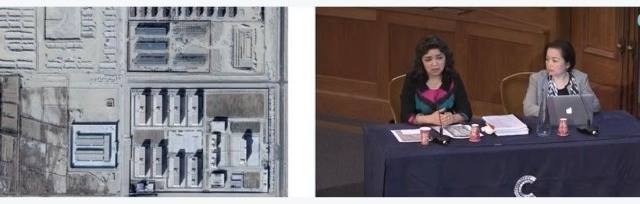
After two days back at her school, the principal called her in again: Secretary Song was waiting, with cadres, to tell her that this happiness with her children could last only two days — tomorrow she would go to Tugong. By her Tribunal statement, on 1 September 2017 a second police driver took her to a grey six-storey building in Tugong, Saybagh District, with the words "Old People's Home" carved across its front and residential blocks around it; from outside, nothing suggested a place of detention. Inside, each floor held more than twenty cells and a hall-classroom for two to three hundred students, and every floor meant another security check. Radio Free Asia's 2020 report likewise describes the site as a former nursing home in the Tugong district. The numbers in her accounts diverge: in Tribunal questioning she inferred from the vest numbers "at least 8,000, perhaps 9,000" detainees; her written statement puts the highest numbers she saw at 7,000–8,000 and her conclusion at at least 8,000; Radio Free Asia relayed her estimate as around 10,000 women. This archive takes her Tribunal figure of roughly 8,000 as the main record and keeps the 10,000 in parallel (see section 18).
Here, unlike the men's camp, she taught from inside a cage: the teacher was locked into the cage first, and only then were the students brought in through another door. By her account the whole building stank of urine and excrement — each cell had one bucket — and Han Chinese staff wore masks at all times, while teachers had to enter classrooms unmasked. Ninety per cent of the detainees were women aged eighteen to forty; the rest were older women, some in their seventies and eighties. All had shaved heads and wore grey uniforms with numbered vests. She says she first assumed their halting movements came from the cold rooms and small stools, and only later understood they moved like people whose bodies hurt. Per her 2026 testimony, the women's camp too ran a Monday routine of medication, injections and blood draws, after which many women stopped menstruating entirely. She was contracted to teach there for six months, until 1 March 2018; in fact she lasted about two. In Tribunal questioning she said she fell very ill at the end of October; her written statement dates to November a fifteen-day haemorrhage, a morning when she could not get out of bed, hospital admission with blood pressure of 45/65, and removal of her IUD during treatment. The camp telephoned the hospital the same day to demand why she had not come to work, and that afternoon sent two cadres to her ward — their question was not about her health but about who could replace her. The two datings (end of October / November) are archived in parallel. She never went back to the women's camp.
7. Sexual violence in the women's camp: what she saw, and what a policewoman friend told her
This section is written in three layers because that is how she herself testified. First, what she saw with her own eyes: on her first day at the women's camp she saw two soldiers carry out a girl of eighteen to twenty on a stretcher, her face like a corpse's. At noon, a Han Chinese policewoman friend working in the camp told her the girl was already dead — she had bled for over a month and a half without ever being taken to hospital, and had died of blood loss. In her 2026 CECC testimony Sidik repeated this: she personally witnessed the young woman's body being carried past, and later heard she had bled to death. Second, what she observed directly in class: the way the women walked and sat, as if in pain; their silent tears; and the sentence-making exercise in which, forced to compose sentences with "I love my motherland," they smuggled out their own stories — a woman taken while breastfeeding a fifteen-day-old baby; a woman whose wedding invitations had already been sent, whose fiancé was seized a week before the wedding and who was taken days later; many seized at the airport the moment they landed back from studying abroad. Third, relayed testimony, with its source named: the policewoman friend had been sent to "investigate" rape complaints in the camp. She told Sidik that male officers competed to serve in the women's camp and boasted of rapes when drunk, which was how the reports had surfaced; and that the investigation itself was theatre — questioning women inside surveilled cells and corridors, and asking victims to sign statements was, as Sidik put it to her, asking them to sign their own death sentences. The specific methods the friend described — groups of four or five officers raping one girl in interrogation rooms without cameras, electric rods inserted into vaginas and rectums — entered the Tribunal record and the U.S. congressional record through Sidik's relaying of them, and CNN's February 2021 investigation reported on that basis. This archive's rule: the girl's death is her eyewitness testimony plus her friend's account of its cause; the forms of rape are her relayed testimony from a named-type source, not her own observation — she never blurred the two layers, and neither does this page.
8. The birth control imposed on her own body: the IUD, the hospital, and the sterilisation of May 2019
Beyond the pills and injections inside the camps, the same birth-control machinery was applied to her own body — and her accounts of its timing do not agree with each other, so both are archived here without reconciliation. The version in her 2023 House testimony: in April 2017 she was called to a local medical facility for a mandatory IUD, despite being nearly fifty, with an adult daughter and no intention of having children; the requirement covered Muslim minority women aged 18 to 50; in July 2017 she underwent the procedure; the pain and bleeding were so severe that she persuaded a Uyghur doctor to remove the device; within a month the age ceiling was raised to 55, and she was forced to have it fitted again, on pain of being reported to the neighbourhood watch committee. The version in her Tribunal statement places the IUD notification in July 2018 and the hospital removal during her time at the women's camp in November — a full year apart from the congressional version; the two cannot both be right, and both are recorded with their sources. She had one child, though the law allowed Uyghurs two, and held a one-child certificate; at the Tribunal she said none of that was even considered.
The sterilisation date, by contrast, is consistent. Paragraphs 58–59 of her Tribunal statement: on 5 May 2019 she had just turned fifty; on 20 May the young woman from the neighbourhood committee telephoned to say she had to go to hospital to be sterilised, that there was no way around it, and that if she objected she could go to the Bahuliang police station and talk to Officer Li Wenjiang — who would tell her the same thing. At Changleyuan she queued with lines of other women (in Tribunal questioning she said she was sterilised "along with many other" women; the transcript records 112 women in her batch — a figure found in that one place only, and flagged here as single-source). Afterwards she was so dizzy she could not stand; she was told, without concern, that she had lost a lot of blood; her paper was stamped to show she had been sterilised. Handing that certificate back to the committee was the precondition for her passport: by her Tribunal statement she received it on 15 September 2019. Her 2023 congressional testimony compresses this to "on my 50th birthday, I received an order to be sterilized" — broadly consistent with turning fifty in May 2019 and being notified that month. Her 2026 CECC testimony supplies the place: under pressure from neighbourhood committees and assigned officers, the sterilisation was performed at Changleyuan Hospital in Tianshan District. The Geneva Summit biography likewise dates her tubal ligation to 2019.
9. The "relative" moved into her home: Becoming Family, one week at a time
Outside the camp walls stood another instrument of surveillance — inside her own home. By her Tribunal statement and her 2023 congressional testimony, from May 2017 the "Becoming Family" (paired relatives) programme assigned her a "relative": her husband's work-unit leader, a senior cadre. He first came with his wife and child for a week; thereafter, by the Tribunal questioning account, he stayed at least one week in every month. The programme's document prescribed "five togethers" — cook together, eat together, study together, travel together, sleep together. During his solo stays, by her consistent account in both testimonies: he sat in her living room in his underwear; learning to chop vegetables became a pretext to grip her hand; he brought liquor to test the household — she does not drink and her husband was an alcoholic, but refusing alcohol could brand them religious extremists, so neither dared refuse; at night he demanded she sleep with him, complained she had not "treated him well," and threatened that he would write it in his notebook. Her husband, present in the room, was too frightened to intervene and urged her to endure it — it was only short-term. She told the Tribunal that one night she warned her husband: if this man rapes me tonight, I will kill him and then kill myself, and two people will die in this house. Her 2023 testimony adds that the man sometimes took video calls from colleagues paired with households in the south, who showed off on camera how the girls under their supervision would "oblige" them — a detail resting on her testimony alone, archived as such. The cadre's notebook recorded everything about the week, including whether the family prayed, whether her husband attended mosque, and what they thought of the police on every street; every answer she gave walked a rope.
10. Outside the camps, a cage all the same: ID checks, the medicine by her bed, and a "voluntary" retirement on 10 February 2018
By her Tribunal statement, 2017–2018 was the peak of the arrests: late at night, around eleven or twelve, people could be seen taken away with black hoods over their heads; she and her husband slept in their clothes, because many were taken in their pyjamas. Entering any building meant ID and phone checks; people carried two bags, one for documents and one for the phone. Police searched homes at least once a month, sometimes knocking at midnight, walking in with dirty shoes and shining a red torch into every corner for Qur'ans and prayer mats. Committee notices warned that those who did not cooperate would sit in the iron chair at the police station. What she feared most was that her daughter would be brought back from the Netherlands and thrown into a camp — she had seen the girls inside. In 2018, for several months, she kept medicine by her bed: if the police ever knocked with her daughter in their hands, she meant to die by overdose rather than watch her daughter suffer that.
At work, returning after her illness, she found everything inverted: at a full staff meeting her name was called first, and her posts — personnel officer, archivist, teaching-research group leader — were publicly reassigned one by one. Uyghur pupils were split up and seated in mixed pairs with Han pupils; Uyghur teachers were reduced to substitute teaching and helping the security guards at the gate. She says she was simply glad they did not send her back to a camp for failing to finish the assignment. Days later she was ordered to write a request for "voluntary" early retirement. She begged to stay two more years, to reach thirty years of service and retire normally; she was refused. Twelve teachers "volunteered" with her. By her Tribunal statement, the date of her forced early retirement was 10 February 2018. Twenty-eight years at the No. 24 Primary School ended with the word "voluntary" written under duress.
11. The way out: Urumqi left behind on 14 September 2019, Schiphol at dawn on 9 October
The door out was bought with the sterilisation certificate. By the Tribunal questioning record, in January 2019 her daughter sent an invitation from the Netherlands; once it had been translated into Chinese, husband and wife took the documents to the relevant office, and the answer split cleanly along ethnic lines: she, being Uzbek, could go; her husband, being Uyghur, should not even think of going abroad. Radio Free Europe/Radio Liberty reported that obtaining the passport took some nine months in all; her Tribunal statement says she received it on 15 September 2019, and that handing in the sterilisation certificate was the precondition. The Diplomat's 2023 profile gives the fullest itinerary: she left Urumqi for Beijing for the last time on 14 September 2019, waited three weeks for the Dutch visa, and in the early morning of 9 October 2019 her plane landed at Amsterdam Schiphol — matching her Tribunal statement's date of 9 October 2019 exactly. Her stated grounds for travel were visiting her daughter and medical care for the after-effects of the procedures performed on her; Mare reported in 2025 that she was granted permission to travel for one month. She never went back. Passport and sterilisation sit so tightly together in the record that this archive simply lays them side by side: a fifty-year-old woman had first to be cut, and to prove she had "met the government's demand," before she was allowed a passport to go and see her daughter.
12. The line she drew on organs: blood she saw drawn, and a "halal organ trade" she only heard about
On 14 May 2026 the CECC held its hearing on forced organ harvesting, and she was one of the witnesses; the printed volume is U.S. Government Publishing Office volume 63-846. This site's organ-harvesting dossier has read that volume in full and cites her testimony; this page is strictly consistent with it. Her organ-related evidence falls into two grades, and nobody policed the boundary more carefully than she did. Grade one, what she witnessed: classes suspended every Monday while blood was drawn from detainees, who were given unidentified injections and small white pills that nurses called vitamins or calcium; healthy men she had taught disappeared, and the explanations offered — high blood pressure and diabetes; "kidney poisoning" — she did not believe. Blood collection is a precondition for organ matching, not proof of matching; that is the limit this site has always applied, and her 2026 testimony does not cross it. Grade two, what she said in terms was hearsay: the special-police driver who drove her and the accompanying officer talked between themselves about a booming "halal organ trade" and said the detoxification centre in Miquan, Urumqi, had become an organ transplant centre; and later a relative in Europe, speaking on condition of anonymity, told her that during pre-departure medical examinations at that centre in 2018 she had seen young detainees in prison uniforms queuing under police guard while doctors carried unusual containers out of rooms. That account reaches this page at two removes, one of them anonymous: it is entered as an unverified lead, not as a finding about Miquan — exactly as this site's organ dossier treats it. Her own words on the hearing record were: "I did not witness the surgeries. I did not personally see organs being removed." Asked whether she believed the camps had been turned into a source of profit through a so-called "halal organ trade," she answered, "Yes. A hundred times yes." That is a statement of belief, and it is labelled here as belief, not as eyewitness fact.
13. The road of testimony: from Radio Free Asia in 2020 to the CECC witness chair in 2026
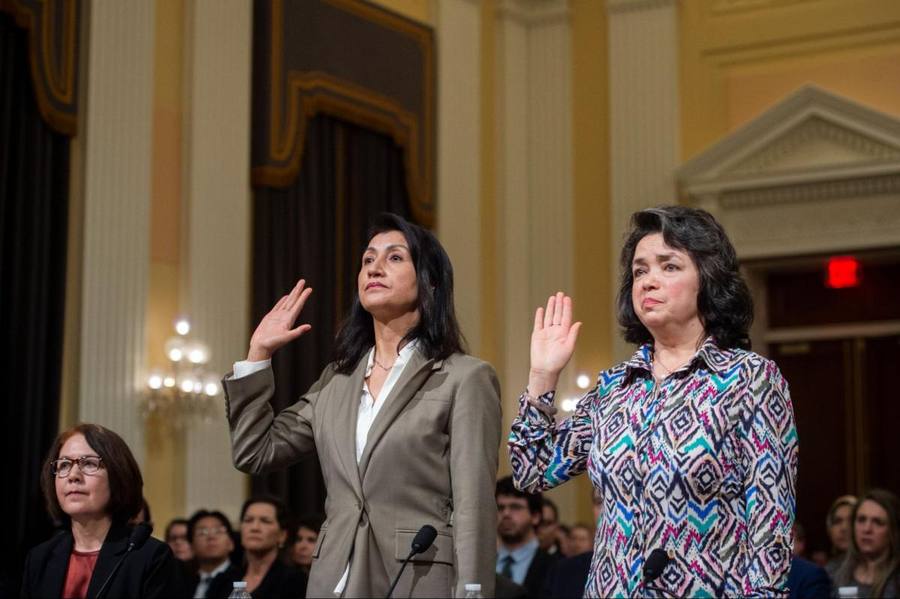
Her public record after reaching the Netherlands runs in a straight line. On 5 October 2020 Radio Free Asia's Uyghur Service aired its long interview with her (reported by Gulchehra Hoja); the English version ran under the headline "I Wish I Could Wipe My Heart and Mind Clean" — the earliest systematic publication of her identity and of the details of both camps. On 19 February 2021 CNN published its investigation "Allegations of shackled students and gang rape inside China's detention camps," for which she was one of the core sources. On 4 June 2021 she testified before the Uyghur Tribunal in London (witness UTFW-005): an 82-paragraph written statement and nearly an hour of questioning, the recording forming part of the Tribunal's public archive. On 22 March 2023 The Diplomat carried an article co-authored by her; on 23 March 2023 she testified before the U.S. House Select Committee on the Chinese Communist Party, at its hearing on the CCP's ongoing Uyghur genocide, alongside Gulbahar Haitiwaji; the Associated Press and the Guardian covered the hearing, and AP photographs of her testimony were distributed worldwide. On 17 May 2023 she addressed the 15th Geneva Summit for Human Rights and Democracy; that year she also appeared at The Hague's human rights film festival, and the Oslo Freedom Forum's speaker page records that she has briefed policymakers in Australia and Japan (no public dates). In November 2025 the documentary Eyes of the Machine, in which her story is central, screened at IDFA in Amsterdam; she attended as a guest and gave a long interview to Leiden University's Mare magazine, which also reported she would speak at a symposium on the Uyghur genocide in the university's Kamerlingh Onnes Building. On 14 May 2026 she testified before the CECC on forced organ harvesting (see section 12). Her memoir, Heart Full of Light — the title reflects the meaning of her name — was reported by The Diplomat as published; this archive found no independent record of its exact publication date and flags it as such. A second, volunteer-produced autobiography drawn from hundreds of hours of interviews and her Uyghur diary is in preparation, per the Ummah Project's page.
14. China's denials: a blanket refusal to name her, and one video that did
Beijing's general line on the camps is well known: the facilities were lawfully established vocational education and training centres, and in December 2019 Xinjiang officials announced that all "trainees" had graduated; the Foreign Ministry has called the Uyghur Tribunal a "lie machine" and its witnesses actors. As for Sidik personally, this check found no Chinese official document that rebuts her by name — a negative result recorded honestly in section 19. But one denial was aimed at her directly, and we know of it from her own mouth, in the closing minutes of her Tribunal questioning: since she began giving evidence she had been harassed, even by local police, and "even since yesterday, they released a video where my husband and the secretary of the school claimed that I never taught in a camp and was never sterilised." She said that on 4 June 2021 — within a day or so of her appearance. The official answer to her testimony, in other words, was not a press conference but her own husband and her school's Party secretary in front of a camera. One detail must be pinned down carefully: Mare reported in 2025 that the Chinese government forced her husband to record a video condemning her and saying he had divorced her. The video she described at the Tribunal carried a different script — never taught in a camp, never sterilised. Whether these were the same video or two separate productions, the public record does not settle; both are archived in parallel and flagged unverified. She finished her testimony after reporting the video to the panel.
15. The family's price: February 2021, the last contact
She got out. The bill was presented to the man left behind. Radio Free Asia reported in 2020 that after reaching the Netherlands she could not contact her family in Xinjiang, apart from one phone call from her husband in February 2021 asking for a divorce, shortly before he disappeared. Mare's 2025 account completes the picture: the Chinese government forced her husband to record a video condemning her actions and saying he had divorced her — "that was our last contact, in February 2021." Radio Free Europe/Radio Liberty reported that a Chinese police officer contacted her by WeChat in the Netherlands and put the bargain plainly: stop this, listen to us, and we will help your husband leave the country — or come back, and you will be together again. She says her husband was forced to divorce her, and she has had no contact with him since. A further conflict must be recorded rather than resolved: RFE/RL's report states that she "received asylum after arriving in the Netherlands in 2019," while the Oslo Freedom Forum's speaker page (circa 2023) describes her asylum request as still pending. The Dutch immigration service does not comment on individual cases; this archive cannot verify her current status and marks it unverified (see section 18). Of her parents and other relatives in Xinjiang there is no independent public record at all, and this page writes none. Whether her husband Tursun has since been detained, released or anything else is likewise nowhere on the public record — in 2023 she asked Congress to "do more to rescue survivors," and offered no new word about him.
16. International response and current status: in exile in the Netherlands, still adding testimony
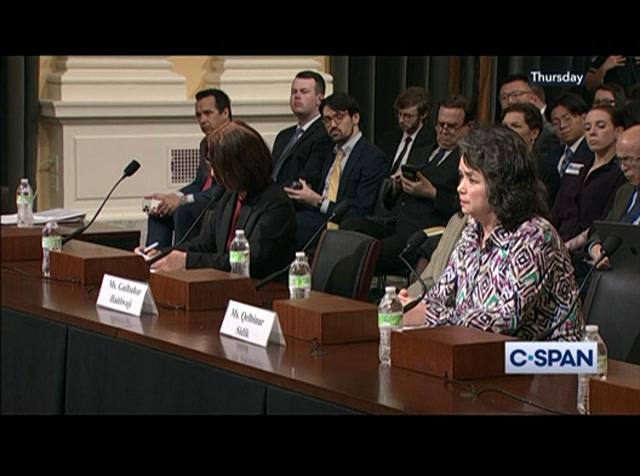
Her testimony has entered the international record by accumulation. The Uyghur Tribunal's judgment of 9 December 2021 found that the People's Republic of China had committed torture and crimes against humanity against Uyghurs (the Tribunal held the genocide charge not proven to its standard — recorded here as it stands); her evidence formed part of its fact-witness record. The United States government had determined in January 2021 that Xinjiang amounted to genocide, and the parliaments of Canada, the Netherlands, the United Kingdom and others passed similar motions — background facts not attributable to her alone, though her name recurs throughout the evidence base of those proceedings. The UN High Commissioner for Human Rights' Xinjiang report of August 2022 found serious human rights violations that may constitute crimes against humanity; it does not cite her by name, and this page does not pretend otherwise. As to her present situation: as of the most recent reporting this check could find — the November 2025 Mare interview and the May 2026 CECC hearing — she remains in exile in the Netherlands, living with her daughter, son-in-law and grandchildren, learning Dutch, and still testifying before parliaments, summits and festivals. What she said on a U.S. congressional witness stand in May 2026 is the same body of fact she laid before a London tribunal in June 2021, without a single material change. The case is nowhere near closed: her husband's fate is unknown, she cannot go home, and every fresh testimony she gives is filed against her own safety — a calculation she plainly understands.
17. Full timeline
Around 5 May 1969: born in Urumqi (inferred from her testimony; her exact birth date has no public record). 1990: begins teaching Chinese at Urumqi No. 24 Primary School (some English profiles say 1999; both versions archived). May 2011: her only daughter leaves for medical studies in the Netherlands. Autumn 2016: Xinjiang-wide Chinese-language examinations and open-lesson screening of teachers. 26 February 2017: spring term opens. 28 February 2017: summoned to the Saybagh District Education Bureau Party committee office; signs secrecy forms; warned by way of her daughter in the Netherlands. 1 March 2017: begins teaching at the Cangfanggou men's camp (contract to 28 August). Around 10 March: detainees shaved and put in numbered uniforms. 20 March–1 April: mass arrivals of young detainees; offices converted into cells overnight. From April 2017 (congressional-testimony version): summoned for a mandatory IUD, procedure in July; her Tribunal statement gives a July 2018 notification instead — both archived. From May 2017: an assigned cadre moves into her home under Becoming Family. End of May 2017: her student Osman disappears; the camp says he died on the way to hospital. 27 August 2017: takes leave of the camp director, who records that she "kept secrets well." 28 August 2017: returns to the No. 24 Primary School. 1 September 2017: begins teaching at the Tugong women's camp (six-month term intended). Late October–November 2017: collapses with haemorrhaging, hospitalised, IUD removed; never returns to the camp (the month differs across her accounts). 10 February 2018: forced into "voluntary" early retirement after 28 years. January 2019: her daughter's invitation arrives; her husband is refused exit. 5 May 2019: turns fifty. 20 May 2019: notified of mandatory sterilisation; sterilised at Changleyuan Hospital. 14 September 2019: leaves Urumqi for Beijing. 15 September 2019: receives her passport (Tribunal-statement dating; the one-day tension with the itinerary is flagged in section 18). Dawn, 9 October 2019: lands at Amsterdam Schiphol. 5 October 2020: Radio Free Asia's long interview airs. February 2021: her husband telephones to demand a divorce; no contact since. 19 February 2021: CNN's investigation is published. 4 June 2021: testifies before the Uyghur Tribunal in London; around her appearance, a video surfaces in which her husband and her school secretary deny she ever taught in a camp or was sterilised. 9 December 2021: the Uyghur Tribunal finds torture and crimes against humanity committed. 23 March 2023: testifies before the U.S. House Select Committee on the CCP. 17 May 2023: addresses the Geneva Summit for Human Rights and Democracy. September 2025: the World Uyghur Congress brief and RFE/RL revisit her testimony. November 2025: attends IDFA and gives the Mare interview. 14 May 2026: testifies before the CECC at its forced organ harvesting hearing; printed volume GPO 63-846.
18. Archived in parallel: where the sources disagree, and what remains unverified
One: the ethnicity label. Her three sworn statements all describe her as ethnically Uzbek; numerous outlets and some institutional pages call her Uyghur. This archive follows her own words. Two: the year she began teaching. Radio Free Asia gives 1990 at the No. 24 Primary School, which meshes with her "28 years" and her 2018 exit; the English Wikipedia and Geneva Summit biographies say 1999, which does not. Both are recorded; 1990 is treated as the main account. Three: camp populations. For the men's camp her Tribunal statement inferred 7,000–8,000 detainees from class rotations and vest numbers, while Radio Free Asia relayed her estimate as about 3,000; for the women's camp her Tribunal evidence gives at least 8,000, or 8,000–9,000, while RFA gives about 10,000. All are her own estimates at different times, reached by counting numbers and rotations; none is treated here as a fixed figure. Four: the IUD timeline. Her 2023 congressional testimony dates the summons to April 2017 and the procedure to July 2017, with a refitting after the age ceiling rose to 55; her Tribunal statement dates the notification to July 2018 and the hospital removal to November of her women's-camp period. The years conflict; both are archived with attribution. Five: the month she collapsed at the women's camp — November in her written statement, late October in her oral evidence and in The Diplomat's profile. Six: the passport–itinerary join — her Tribunal statement dates the passport to 15 September 2019 while The Diplomat has her leaving Urumqi on 14 September, a one-day tension, archived in parallel. Seven: the "112 women" sterilised in her batch appears in the Tribunal questioning record only — single-source. Eight: asylum status — RFE/RL states she received asylum in the Netherlands; the Oslo Freedom Forum page (earlier) states her application was pending; unverifiable either way, marked unverified. Nine: the men's camp's name is transliterated both Sangfanggou and Cangfanggou (仓房沟) in English sources; the Chinese place name is Cangfanggou. Ten: names such as camp chief "Qing," deputy "Ahmet" and police officer "Li Wenjiang" rest on her testimony alone, with no second source; archived pending corroboration. Eleven: the Miquan detoxification centre "organ transplant centre" claim is two-remove hearsay, one link anonymous — an unverified lead. Twelve: her exact birth date, her daughter's name, her city of residence in the Netherlands, and the present circumstances of her parents and husband have no public record, and this page fills in none of them.
19. Verification and sources
The sources actually consulted for this check are as follows. First rank, her sworn and formal testimony: her witness statement and hearing transcript before the Uyghur Tribunal (UTFW-005; statement and transcript of 4 June 2021, published by the Tribunal — the full 82-paragraph statement and the question-and-answer record were read); her written testimony to the U.S. House Select Committee on the Chinese Communist Party, 23 March 2023 (the full PDF on the House website); her written testimony prepared for the CECC hearing on forced organ harvesting of 14 May 2026 (the full PDF as archived by ecoi.net), cross-read against the printed hearing volume (U.S. GPO 63-846) and against this site's organ-harvesting dossier, with which this page is consistent. Second rank, independent reporting: Radio Free Asia Uyghur Service, 5 October 2020 (long interview, reported by Gulchehra Hoja; read in full via Turkistan Times' republication); Radio Free Europe/Radio Liberty, 2025 (read via Turkistan Times' republication); Leiden University's Mare magazine, 28 November 2025 (interview; consulted via its published text and search record); The Diplomat, March 2023 — her co-authored article and the profile "Silence Is Not an Option" (consulted via its published record); CNN, 19 February 2021 (confirmed as built in part on her testimony via the English Wikipedia's citation and multiple republications; the original text could not be retrieved in full in this check owing to access limits, and no specific fact in this page rests on its unretrieved portions); Bitter Winter's 2021 Tribunal coverage and its 2023 Hague film-festival report. Third rank, institutional and background sources: the Oslo Freedom Forum and Geneva Summit speaker pages; the English Wikipedia entry (used only for transliteration and discrepancy comparison, never as a factual basis); the Ummah Project's autobiography page. Fourth rank, the Chinese official record: the Foreign Ministry's and Xinjiang authorities' general lines — "vocational training centres," all trainees "graduated," the Tribunal a "lie machine" — are matters of public record; the only response directed at Sidik herself that this check could establish is the video featuring her husband and her school secretary, known from her own Tribunal testimony. No Chinese official document naming and rebutting her individually was found — a negative result, recorded as such. Sources that could not be read in full (the Mare interview's full text, the CNN original) are flagged here, and nothing in this page rests on their unread parts.
20. Our Take
The most damning feature of Sidik's case is that the CCP never even had to imprison her in order to use her up. She was exactly the kind of person the system calls reliable: the highest score in the language assessment, twenty-eight years at one school, a personnel cadre. Because she was reliable, she was picked to teach inside the camps. Because her mouth had to stay shut, the form she signed promised that if she talked, she and her family would be next. Because her daughter was in the Netherlands, a Party secretary could say to her face: we can bring your daughter back. That is not a system malfunctioning and injuring one of its own by mistake; it is a system working as designed on one of its own — her professional skill conscripted as camouflage, her family's safety held as the price of silence, and her body finally processed to meet a quota: a fifty-year-old woman who had lawfully borne one child and held the certificate to prove it, fitted with an IUD and then sterilised because she belonged to a designated ethnic category, whose sterilisation certificate then became the passport stamp that let her go and see her daughter.
Set against that, look at the quality of her witnessing, and you can see what the system actually fears. In three countries, on three formal records, she tells the same facts and never once inflates what she saw. The dead girl on the stretcher: that she says she witnessed. The mechanics of the rapes: she states plainly that a policewoman friend told her. On organs, on a U.S. congressional record, she draws the line herself — "I did not witness the surgeries. I did not personally see organs being removed" — hearsay labelled as hearsay. A witness who guards the boundary that carefully makes the first-hand core of her evidence very hard to break. And what is Beijing's answer? Not her teaching file, not her medical records, produced and checked line by line — but her husband, put in front of a camera to recite that she never taught in a camp and was never sterilised, then forced to divorce her, then vanished from everyone's view. Using a detained husband as the spokesman for your denial is itself the strongest corroboration her testimony could ask for: a government confident of its innocence does not need to confiscate a witness's husband to issue its rebuttal.
视频证据Video Evidence
《走进中国新疆的「思想转化营」》(BBC News 中文)|2019|中文原声,BBC记者获准进入营区实地拍摄"Inside China's 'thought transformation' camps in Xinjiang" (BBC News Chinese) | 2019 | In Chinese; a BBC crew filmed inside the camps
《被黑文件揭示中国拘留营「格杀令」》(BBC News)|2022|英文旁白,含「新疆警察文件」泄露的营内影像与文件"Hacked files reveal Chinese 'shoot-to-kill' policy in Uighur detention camps" (BBC News) | 2022 | English narration, including leaked Xinjiang Police Files imagery and documents