
第160案 | 林荣基Case 160 | Lam Wing-kee
林荣基,1955年12月生于香港,卖了一辈子书,1994年创办铜锣湾书店、2014年卖盘后留任店长;2015年10月24日他在深圳罗湖口岸被带走,蒙眼戴铐押往宁波,在软包房间里单独囚禁五个月,被迫放弃律师、写认罪书、排演电视认罪,再转韶关安置,2016年6月奉命返港取装着订户名单的硬盘时,在九龙塘站决定不回去,当晚召开记者会把八个月的关押全程讲给全世界,此后遭大陆通缉、再不敢踏足大陆,2019年流亡台湾,在台北众筹重开铜锣湾书店,熬过泼漆与月月亏损,2026年7月2日因肺癌在台北病逝,终年70岁。Lam Wing-kee, born in Hong Kong in December 1955, sold books all his life: he founded Causeway Bay Books in 1994 and stayed on as manager after selling it in 2014. On 24 October 2015 he was seized at the Lo Wu crossing in Shenzhen, taken handcuffed and blindfolded to Ningbo, held five months in solitary confinement in a padded room, made to waive his lawyer, write a confession and rehearse a televised repentance, then placed in Shaoguan; in June 2016, sent back to Hong Kong under orders to fetch the hard drive of subscribers' names, he decided at Kowloon Tong station not to return, and that evening told the whole world the full story of his eight months at a press conference. Wanted by the mainland thereafter, he fled to Taiwan in 2019, raised the money by crowdfunding to reopen Causeway Bay Books in Taipei, endured a red-paint attack and monthly losses, and died of lung cancer in Taipei on 2 July 2026, aged 70.
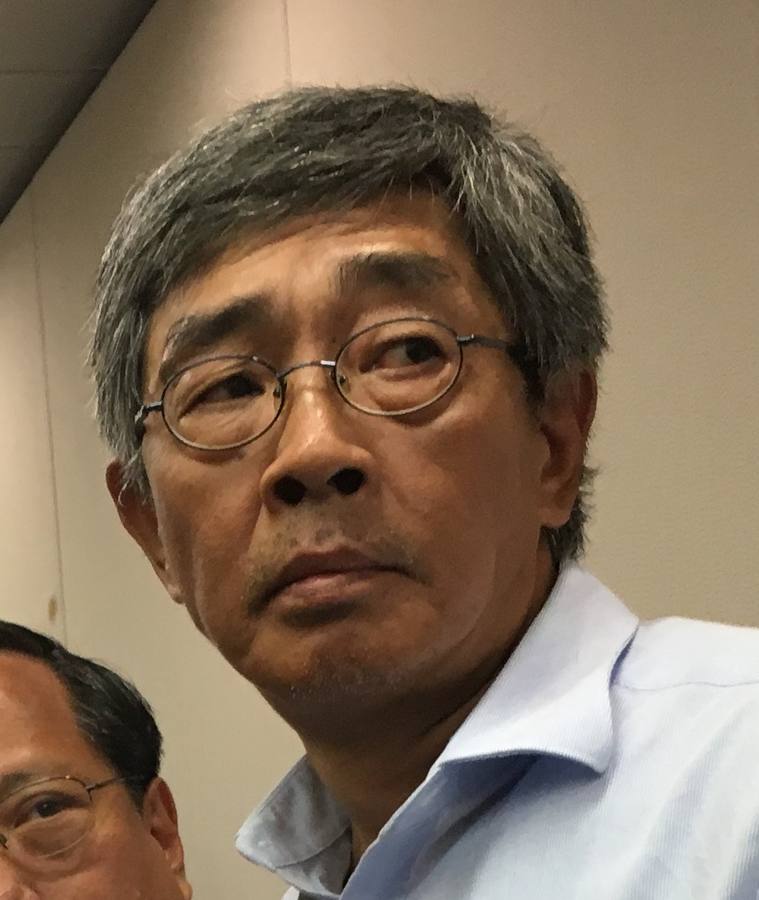
1. Fix the dates first: born December 1955, died in Taipei on 2 July 2026
Lam Wing-kee was born in British Hong Kong in December 1955, of a family originally from Maoming, Guangdong (the ancestral origin appears only in the Chinese Wikipedia and is archived as single-source), and attended Heung To Middle School. He spent his entire life doing one thing: selling books. From 1985 to 1989 he worked in distribution for the Hong Kong arm of the state-owned Chung Hwa Book Company; after the June 4 crackdown of 1989 he moved to Tien Yuan Bookstore; in 1994 he founded Causeway Bay Books, named after its district, and ran it as founder-manager for two decades. No authoritative public record of his exact birth date exists: the Chinese Wikipedia gives 16 December 1955, the English Wikipedia only December 1955, and no birth certificate or identity document of his has ever been published, so this page archives "December 1955" and marks the 16th as unverified. His death date, by contrast, is multiply corroborated: he died on the evening of 2 July 2026 at Mackay Memorial Hospital in Taipei's Zhongshan District, aged 70 — Reuters, the Associated Press (citing Taiwan's Central News Agency), Japan's Jiji Press and the Executive Yuan's memorial record all agree, and this page treats it as settled. That fact belongs at the head of the file, because most older reporting still describes him as "the bookseller in exile in Taiwan": that was his status from 2019 to 2026, not his ending.
His name appears in English reporting as both Lam Wing-kee and Lam Wing-kei; the first spelling is the one used in his own testimony and the U.S. congressional record, and this page standardises on it. He was not a political figure. When the affair broke in 2015 he was nearly sixty, a slight, bespectacled man who had sat behind the counter of an upstairs bookshop of a few hundred square feet for twenty years and was known to everyone in Hong Kong's book trade. The best gloss on him is his own, quoted by Martin Lee at a 2019 CECC hearing: "This isn't about me, this isn't about a bookstore, this is about everyone."
2. The shop: an upstairs bookshop and the mail-order line that kept it alive
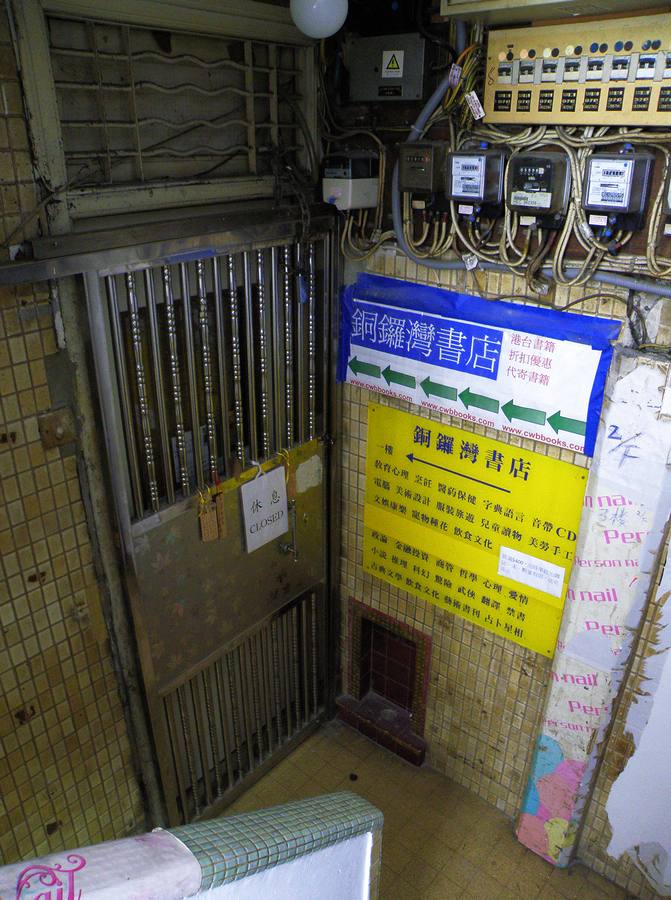
Causeway Bay Books was a classic Hong Kong "upstairs bookshop": perched in an old building off Lockhart Road to save rent, a few hundred square feet, surviving in the age of chain bookstores on regulars and distinctive stock. Half its stock was respectable — Hong Kong, Taiwan and mainland history and social titles. The other half was the Mighty Current catalogue of so-called "forbidden books": political-gossip volumes about the private lives, feuds and scandals of China's top leaders, much of it cobbled-together conjecture. Lee Bo himself acknowledged publicly that Gui Minhai's books contained a lot of conjecture and gossip and were produced for profit rather than ideology (archived as reported speech), and Lam told his Ningbo interrogators to their faces that most Mighty Current titles were nonsense that should not be taken seriously (per his own written account, via China Change's summary). In mainland China every one of those books was banned. In Hong Kong, selling them was entirely legal.
The business had a shadow line: mailing. Tens of thousands of mainland tourists and businesspeople poured into Hong Kong each month; some wanted the banned titles but feared carrying them across the border themselves, so the shop took orders and had books carried to Shenzhen and posted from inside the mainland. Lam regularly hauled suitcases of ordered books to Shenzhen himself. That line had already caused trouble years before: by his own account (retold in China Change's October 2026 memorial essay), he had once been stopped at the border, questioned for hours at a police station by state-security officers who concluded he was merely a small-time bookseller, had his books confiscated and was released; the mainland's 2016 official briefing separately states that in September 2012 he was administratively punished by Luohu Customs for carrying 24 publications into China. One version is his, the other is the authorities' post-hoc briefing; they are archived in parallel, and together they establish that well before October 2015, Lam Wing-kee and his mailing line were already on a list across the border.
3. The 2014 sale: new owners, the same manager — and who the real target was
In 2014 Mighty Current Media Company Limited acquired Causeway Bay Books. Mighty Current had been set up in 2013 by Gui Minhai, Lee Bo and Lui Por to publish and distribute political-gossip books about Chinese leaders; per published reporting, Gui and Lee each held about 34 per cent (Lee's shares were registered in his wife Sophie Choi's name) and Lui about 32 per cent. Gui, who wrote under the pen name Ah Hai, had authored some 200 books in ten years. After the acquisition the shop became Mighty Current's retail front, and Lam stayed on as manager running day-to-day business, mailing line included. This layering is the key to the whole case: of the five men who vanished, Gui Minhai — the writer and publisher — was the authorities' principal target; Lam was merely the man who sold and posted the books. Events later bore this out: apart from Gui, the other four were, it seems, intended to be processed and sent back to Hong Kong to keep quiet. Lam's refusal to cooperate was the one variable the script had not allowed for.
One piece of background cannot be skipped. After Hong Kong's 2014 Occupy Central movement, Beijing's reading of the city hardened sharply. China Change's memorial essay summarises the shift as the leadership coming to see Hong Kong as an "anti-communist base" and a springboard for "colour revolution", with "measured autonomy" to be replaced by "total control" — that is a commentator's summary, not a quoted official document, and this page flags it as such. But the cross-border seizure of a small bookshop's entire staff in the autumn of 2015, conducted at a scale and with methods grotesquely disproportionate to an "illegal business" case, stands as one of the earliest specimens of that new approach on the ground.
4. How five men vanished, one by one: October to December 2015
In order of disappearance, the five trace out a single map. First, Lui Por, Mighty Current's general manager and a shareholder: he last logged into the bookshop computer on 14 October 2015, and unconfirmed reports said he was taken from his wife's home in Shenzhen (Human Rights Watch dates his forcible disappearance in Shenzhen to mid-October). Second, Gui Minhai, shareholder, principal author and Swedish citizen: on 17 October 2015 he was led away from his holiday condominium in Pattaya, Thailand, by a man and vanished — Thailand is not a Chinese jurisdiction, so this was a cross-border seizure, pure and simple. Third, Cheung Chi-ping, the firm's business manager, taken in Dongguan, Guangdong, in mid-October (per Human Rights Watch). Fourth, Lam Wing-kee, taken at the Lo Wu crossing on 24 October 2015 — section 5. Fifth, Lee Bo, shareholder and chief editor, a British citizen: while his four colleagues were disappearing he had been briefing the media anonymously about the case, and on 30 December 2015 he was last seen near the company's warehouse in Chai Wan, Hong Kong — carrying none of the travel documents he would have needed to cross the border legally — and then he was in Shenzhen.
Five men, three jurisdictions: mainland China, Thailand, Hong Kong. Hong Kong erupted; pro-democracy groups and citizens marched repeatedly to demand their release, and a U.S. State Department spokesman said publicly that Washington was "disturbed by reports of the disappearances". On 4 February 2016 Guangdong authorities finally replied to Hong Kong police that Lui, Lam and Cheung had been subjected to criminal compulsory measures in connection with Gui's case — the first official admission that the men were in custody, nearly four months after Lui vanished. How Lee Bo crossed the border was a question the official account never answered.
5. 24 October 2015: Lo Wu, a seven-seater van, and a night in a prisoner's chair
Lam's own version, given at his 16 June 2016 press conference and repeated in his written testimony to the U.S. Congress, is the spine of this section. On 24 October 2015 he crossed at Lo Wu into Shenzhen, on his way to meet someone and handle bookshop business. At the checkpoint he was pulled aside by an officer; at least eleven men then put him into a seven-seater vehicle and drove him to a Shenzhen police station, where his documents were taken. He asked again and again what offence he had committed. No one answered. That night, officers went over his personal details while he sat all night in a prisoner's chair, not allowed to sleep. The mainland's official briefing of 5 July 2016 dovetails with his account at one point and evades it at another: Ningbo police stated that Lam "was preparing to go to Shenzhen to meet a person surnamed Hu, and was arrested by Ningbo police when entering through the Lo Wu crossing in Shenzhen" — the authorities thus admit he was arrested at the border checkpoint, and that the arresting unit was the police of Ningbo, a city in distant Zhejiang. The all-night chair, and the unanswered question of what his offence was, go unmentioned.
At about 7 a.m. on 25 October he was handcuffed, blindfolded and capped, and put on a train. After some thirteen hours (his press-conference figure is 13–14 hours; the memorial essay, working from his written account, says roughly ten — both are archived) the train reached Ningbo, and he was taken to a room of under 300 square feet on the second floor of a huge building, stripped, given prison clothes and medically examined. The room had a round-the-clock camera and every fitting padded — a suite designed, down to the details, to prevent suicide; outside were mountains on three sides and an electric gate, and the place had no name. He worked out that he was in Ningbo in the bleakest of ways: from a station light-box reading "Ningbo" glimpsed at the edge of his blindfold, and from the characters "Ningbo" printed on the soles of the room's plastic slippers. That night he asked again what he had done. No one answered.
6. Five months in Ningbo: six guard teams, dozens of interrogations, two "voluntary" waivers
On the afternoon of 26 October 2015, still not told why he was detained, Lam was made to sign documents waiving contact with his family and waiving the right to retain a lawyer. Only then did the interrogation proper begin: his position, the shop's business, why he mailed books to mainland readers. By his press-conference and written accounts, for the following five months he was watched around the clock by six rotating teams of guards (two at a time, in shifts), and interrogated by members of the "Central Investigation Team" twenty to thirty times, about forty minutes a session, on one unvarying charge: "illegal business operations" — posting books from Hong Kong into the mainland. His interrogators already held a mail-order ledger and demanded the identity of every buyer; they produced a stack of Mighty Current titles and demanded to know who had written them. All he could honestly say was that, apart from the few who used real names, he did not know.
His way of counting days says more about that existence than any summary: he pulled a thread from his clothing and tied a knot in it each day (per his written account, retold in the memorial essay). He thought about suicide — and noted that a room padded everywhere against suicide tells you the designers knew exactly what this isolation does to a person. By his own assessment, echoed in the memorial essay's comparison, he was not beaten, not shocked, not deprived of sleep for days on end — by the standards of "residential surveillance at a designated location", China's euphemism for secret detention, he was even comparatively well treated. It changes nothing about the nature of the thing: a man told no charge, allowed no lawyer and no word to his family, locked alone in a padded room whose only human contact was the men interrogating him.
Then came the scripted part. Per his account: first a confession letter admitting "illegal operation of book distribution"; then a repentance letter, which he struggled to fill a page with until his interrogator "Mr. Shi" listed the points for him to copy out; then take after take of videotaped confession and repentance — one take, two takes, three takes — until unseen reviewers higher up were satisfied; and once, a uniformed policewoman he had just passed in the corridor walked into the recording room in plain clothes and played the role of "witness". On another occasion two men ordered him to stand straight, slammed the desk and took turns cursing him, announcing that they were from the Beijing special task team and that by publishing these books he had defamed the national leaders — "we can exercise dictatorship over you for ten or twenty years, or even until you die, and no one in Hong Kong would ever know" (this threat survives in the memorial essay's English rendering of his written account and is archived as reported speech). And by his account, only after reaching Ningbo did he learn that his girlfriend in Shenzhen — a woman with nothing to do with the bookshop — had also been brought to Ningbo, as leverage over him. The mainland's official briefing later dwelt at length on his private relationship with the woman surnamed Hu (meeting online in 2014, promises of divorce and remarriage, and so on); this page treats that official narrative in exactly one way: its function in a police briefing issued after his press conference was to blacken the man's character, it has nothing to do with the "illegal business" charge itself, and that is precisely what it was for. The girlfriend's detention rests on Lam's account alone; it is flagged unverified and archived pending corroboration.
7. The season of televised confessions: Gui on CCTV in January, four men on Phoenix in February
The way the five men "returned" — on television — is the most era-defining tableau of the whole affair. On 17 January 2016 Gui Minhai appeared on China Central Television "confessing" to a 2003 Ningbo traffic case: a twelve-year-old road accident became the first public pretext for the entire operation, and he simultaneously appeared in Xinhua coverage saying he did not want Sweden to intervene. On 28 February 2016 Lui Por, Cheung Chi-ping and Lam Wing-kee appeared on Phoenix Television admitting they had helped Gui send books with "false content" into the mainland, pinning the illegal book trade on Gui and expressing remorse; on 29 February Lee Bo appeared on Phoenix as well, insisting he had crossed to the mainland voluntarily "by his own means" to assist an investigation and had not been abducted. At his June 2016 press conference Lam stripped the varnish off that February broadcast: the Phoenix "confession" had a script and rehearsals and was recorded under detention — his confession and repentance were exactly the material that had been taped, take after take, in that padded Ningbo room until superiors were satisfied; television merely aired the finished product.
The official line deserves to be fixed verbatim in the record, because it is the only complete account the authorities ever gave: Guangdong authorities confirmed in February 2016 that the five were under investigation; the standing mainland characterisation was that Gui was suspected of multiple offences and the other four of "illegal business operations" — mailing mainland-banned books from Hong Kong into China for profit. Against that characterisation this page sets two facts that cannot be argued away. First, selling and posting those books was legal in Hong Kong; the "illegality" rests entirely on mainland publishing controls, yet the arrests reached into Hong Kong and Thailand. Second, the four "illegal business" suspects were never tried at all — no indictment was published, no court sat, no verdict was issued; their "release" and "bail" hung on a word from the case-handling unit. An ordinary commercial case does not need a Central Investigation Team, a padded room and a televised confession. What needs those things is an exemplary killing — a chicken slaughtered to frighten the monkeys.
8. Shaoguan: the children's section, daily check-ins, and a tea party staged for cameras
In late March 2016 Lam was moved to Shaoguan in northern Guangdong. The mainland briefing's version: on 21 March Ningbo police, citing his good attitude in confessing, changed his residential surveillance to bail pending trial; on 4 April Lam, saying his relations with his wife and children were strained and life in Hong Kong was difficult, applied for a book-related job in Guangdong and was placed at the Shaoguan city library. Lam's version: he was installed in accommodation arranged by his handlers, worked at the library (the memorial essay, from his account, specifies shelving books in the children's section), could not leave a defined area of Shaoguan, and had to report daily to an assigned police officer — whom did you meet today, did you give anyone your address, any calls from strangers, any contact with Hong Kong media. The two versions agree on the Shaoguan library job and flatly contradict each other on "voluntary application" versus "placement"; both are archived, and readers may judge.
Two Shaoguan scenes belong in the record. First, per his account, he was taken to the Qilin Villa in Shenzhen to "take tea" with Lee Bo, Lui Por and Cheung Chi-ping — under surveillance and on camera the entire time: four men fresh out of secret detention, drinking tea together for the lens, raw material for the message that they were all fine. Second, one night at about 1 a.m., two women knocked at his door, apparently soliciting sex, wedging the door with a foot when he tried to close it, until he feigned a look into the corridor and slammed it shut (per his written account via the memorial essay — single-source). He judged it no accident: a man out on bail with two women in his room at 1 a.m. is a ready-made handle. And before he left Ningbo, "Mr. Shi" had played the bond card: he had personally vouched for Lam to win him bail, and Lam must cooperate or Shi himself would be ruined. In Shaoguan, Shi spelled out what cooperation meant after the return home: Lam would go back to work at the bookshop, Shi would stay in touch, and Lam would report on the situation in Hong Kong — in writing or photographs, especially the people who came to buy political books (per Lam's written account, via the memorial essay's translation). That sentence is the master key to the decision he made on 16 June.
9. 14–16 June 2016: the wrong computer, a night in Temple Street, and a cigarette at Kowloon Tong
After long negotiation Lam was allowed back to Hong Kong on one explicit condition: he was to bring back the computer hard drive holding the bookshop's customer order records, to serve as court evidence against those readers — his Geneva Summit text calls it a disc "containing a subscription list of 400 Chinese readers"; other reporting put the drive's contents at some 600 customers' names and 4,000 book titles, and both figures are archived in section 19. On 14 June 2016, at about 7 a.m., escorted by "Mr. Shi" and a Central Investigation Team section chief surnamed "Chen", he rode the high-speed train from Shaoguan to Shenzhen and crossed into Hong Kong, arriving around noon; as instructed, he went to Hong Kong police, cancelled his missing-person case and declared he needed no assistance. The two escorts, afraid of being photographed with him, split off, leaving him a phone and instructions to report his movements by text. That day he collected a customer-records computer from Lee Bo — and at home discovered it was the wrong one. Late that night he notified the team of the mistake and bought himself one more day.
That night he walked the Temple Street night market. His written account of that evening is the most moving passage in the whole file: he loved Hong Kong so much, he wrote — the little vendors, the fortune-tellers, the food stalls spilling onto the street, the faces of thousands of diners; he raised his phone and photographed whatever he liked, unafraid of being followed, because "tonight I was still a Hong Konger". After dinner with his sister and brother-in-law he walked Portland Street and Shanghai Street deep into the night, unwilling to return to the hotel; scrolling news on his phone until dawn, he learned for the first time that the disappearances had brought six thousand Hongkongers into the streets (the January 2016 march figure, also given as 6,000 in the memorial essay), led by legislators — strangers marching for the freedom and dignity of five unimportant men. His account asks: what is wrong with me — am I still a Hong Konger? The next day, 16 June at noon, he swapped the computer for the correct one and reached Kowloon Tong station, due to cross back to Shenzhen and deliver it. The appointed time passed. He smoked, and smoked again: if he did not return, would his colleagues be punished? His girlfriend was still on the mainland — was he being selfish? The last push came from a short poem by Shu Shing-sing that he had read in his youth, "A Desk": "I have never seen a desk on its knees, but I have seen scholars on their knees" (the lines survive here via the memorial essay's English rendering and may differ slightly from the original). He flicked away the half-smoked cigarette, changed his itinerary, and contacted Democratic Party legislator Albert Ho.
10. The 16 June 2016 press conference: eight months of black box, emptied out in one evening
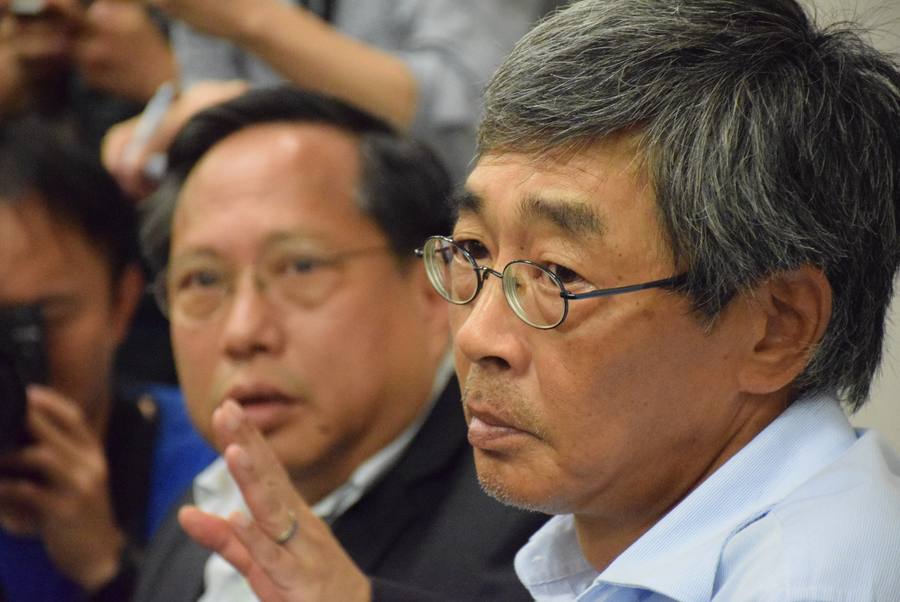
On the evening of 16 June 2016, with Albert Ho beside him at the Legislative Council, Lam Wing-kee spoke in Cantonese to the world's press for over two hours: seized in Shenzhen on 24 October; handcuffed and blindfolded and taken to Ningbo; held five months in a room under 300 square feet under 24-hour watch by six teams of guards; made to sign away his lawyer and his family; interrogated twenty to thirty times; his televised confession scripted and rehearsed; sent back to Hong Kong under orders to fetch the drive of subscribers' names and due back across the border that very day. He also disclosed the one thing his handlers had never meant him to say: Lee Bo had told him personally that Lee had been forced into a vehicle by several mainland men below the warehouse in Hong Kong in late December 2015 and taken to Shenzhen — meaning that at least one of the five had been seized on Hong Kong soil and carried across the border. He announced that he would not go back. He was clear that this was not about himself alone, but about the freedom and personal safety of everyone in Hong Kong.
The impact was immediate. On 18 June some 6,000 Hongkongers marched in support under the slogan "We are all Lam Wing-kee", and international media led with the story for days. For Beijing the damage was not that a bail-jumper had jumped; it was that the entire secret-detention narrative had been dismantled in public by its own protagonist. The authorities had spent eight months staging "voluntary return, confession and remorse"; in the final scene, the lead actor walked off the set and pulled the curtain open himself.
11. The official replies: Ningbo's briefing, Hong Kong's "no legal arrangement", London's "serious breach"
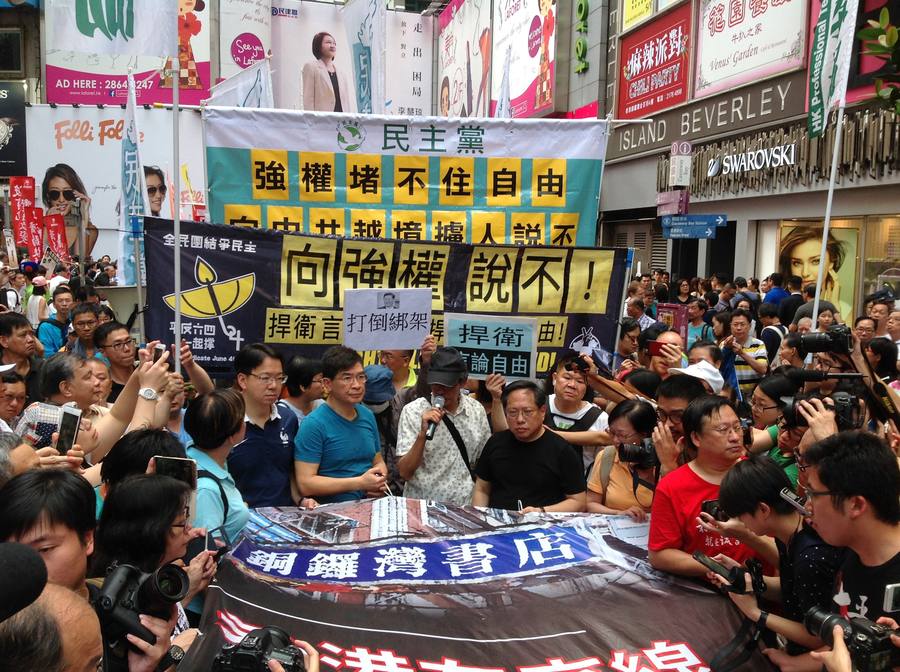
The mainland's formal response was the Ningbo police briefing delivered to a Hong Kong delegation on 5 July 2016, archived here in full substance from published renderings: that in September 2012 Lam had been administratively punished by Luohu Customs; that on 24 October 2015 he had been arrested by Ningbo police at Lo Wu as he entered to meet the woman surnamed Hu; that on 21 March 2016 his measure was changed to bail pending trial for his good attitude; that on 4 April he had himself asked for a job placement and entered the Shaoguan library; that on 2 June he had sought and received permission to return to Hong Kong for personal matters, guaranteeing compliance with bail conditions; and that on 16 June he had held his press conference and declared he would not return. On that last point Ningbo police characterised him as a bail violator suspected of "illegal business operations" who would be dealt with according to law — that is the official origin of his "wanted" status thereafter, and this page records honestly that no publicly released text of any wanted notice has ever been available for inspection: the status is attested by wire-service renderings ("he is still technically wanted in China", per the Taipei Times) and by Lam's own repeated public statements at Geneva and in interviews, which together make it solid, while the warrant document itself has no public record.
Hong Kong's government held the line that still existed then: the Secretary for Security, Lai Tung-kwok, stated publicly that there was "no legal arrangement for the transfer of a person to the mainland authorities", and Hong Kong police likewise said Lam would not be sent back. London went further than it ever had. In the Foreign Office's February 2016 six-monthly report, Foreign Secretary Philip Hammond wrote that the available information indicated Mr Lee had been "involuntarily removed to the mainland without any due process under Hong Kong SAR law", constituting "a serious breach of the Sino-British Joint Declaration on Hong Kong" and undermining One Country, Two Systems — the first time Britain had ever used "serious breach" of the treaty against Beijing. Foreign Ministry spokesman Hong Lei retorted that the British report interfered in China's internal affairs and that Lee had gone voluntarily. The U.S. State Department said it was "disturbed"; the EU and international rights organisations issued statements. As for any point-by-point official rebuttal of Lam's press conference by name, this check found none — a negative result recorded as such. Against Lam personally, the authorities' entire arsenal was the 5 July briefing, the wanted status, and the briefing's long detour through his private life, which had nothing to do with the charge.
12. Hong Kong after the press conference: a safe house, the fear of being followed, and an account written in one night
After the press conference, Lam was not a free man in any comfortable sense. Per the memorial essay, he moved into a safe house; one dusk in late July 2016, just over a month after breaking away, he sat down to write his experience, taking his title from Hemingway's The Old Man and the Sea: Man Is Not Made for Defeat. He wrote from sunset to deep night in a single sitting, some 18,000 Chinese characters, with the Ningbo room, his interrogator, the Shaoguan officer and the library director all in it — that account became the fullest first-person record of the case and the basis of the testimony he later filed with the U.S. Congress. In his February 2018 Geneva Summit address he summed up his own position in two short sentences: he was still wanted, and sometimes followed; and Gui Minhai, released the previous year but held in Ningbo, had been detained a second time a few months earlier when he tried to leave the country — the 20 January 2018 train seizure, see section 18.
The other side of those years belongs in the record too: he was not entirely alone. He marched in July 1 demonstrations, gave interviews to media from many countries, and in April 2017 travelled to Washington, meeting Chen Guangcheng among others. But Hong Kong was changing under his feet. Of the later transformation this page records only the one fact that bears directly on him: in February 2019 the Hong Kong government tabled the Fugitive Offenders amendment bill, which would allow case-by-case transfer of "fugitives" found in Hong Kong to the mainland. The memorial essay's comment is exact: with that law, Chinese agents would no longer need to risk international condemnation by abducting people — the Hong Kong government would hand them over "legally". And under the mainland's wanted characterisation, Lam Wing-kee was the bill's textbook target.
13. Bearing witness: Washington in 2017, Geneva in 2018
On 3 May 2017 Lam Wing-kee took his seat at a hearing of the U.S. Congressional-Executive Commission on China titled "Will the Hong Kong Model Survive?: An Assessment 20 Years After the Handover", alongside Joshua Wong, Martin Lee and Chris Patten among others. His prepared statement, "My Testimony Regarding the 'Causeway Bay Books' Event", was entered into the printed congressional record and runs from the five disappearances to the order that he carry the hard drive back so its 400 subscribers could be prosecuted. The hearing's chairman, Senator Marco Rubio, made an unusual personal undertaking to him from the chair: in substance, that if any hostility came Lam's way because of his appearance, the Commission would attribute it directly to retaliation by Beijing and let it shape how the United States dealt with the Chinese Communist Party (Rubio's words were longer; they are paraphrased here, not quoted). In February 2018 he addressed the tenth Geneva Summit for Human Rights and Democracy on behalf of colleagues who remained under surveillance and unfree, on how the Chinese government had broken One Country, Two Systems and its promises to Hong Kong; the Summit archives his remarks bilingually, including what he had learned in March 2016, before his transfer to Shaoguan, when he met Lee Bo, Lui Por and Cheung Chi-ping in Shenzhen: they too had been interrogated under intimidation and told that, denied any defence and with no court trial at all, they would be sentenced to five to ten years. That sentence, from his own mouth, is one more corroboration of the "never tried" fact.
14. 25 April 2019: he left Hong Kong before the extradition bill could pass
On 25 April 2019 Lam Wing-kee left Hong Kong for Taiwan, and never went back. The Taipei Times recorded the arrangements of the moment: Mainland Affairs Council Deputy Minister Chiu Chui-cheng said the government had approved a one-month stay and that any longer stay would require application under the law. The stay was then extended again and again: on 14 May the Immigration Agency extended it by two months, and a 15 July application extended it to 25 October (both per the published reporting cited by the Chinese Wikipedia — archived here as reported speech); thereafter he remained on work visas and similar instruments (per New Bloom magazine's December 2022 account). In a Voice of America interview after his arrival, he said plainly that he had never thought the Hong Kong government would handle things this way — the government that in 2016 had publicly promised there was "no legal arrangement" to hand him over was, three years later, building that very arrangement with its own hands. He left first because he knew better than anyone whose name stood first on the list.
In November 2022 he applied for permanent residency in Taiwan as a professional in arts and culture (per New Bloom and the Shin-Getsu News Agency, December 2022). Later still, the Chinese Wikipedia's nationality field records him as a Republic of China national from 2024, and the Executive Yuan's July 2026 memorial statement called him "the bravest new citizen of Taiwan" — taken together, he had completed settlement and, in all likelihood, naturalisation in his final years; but no official document or exact date of naturalisation is in the public record, and this page archives the point as such rather than fixing a date.
15. Reopening in Taipei: nearly NT$6 million raised by crowdfunding, a trademark lawyer's letter, and red paint four days before opening
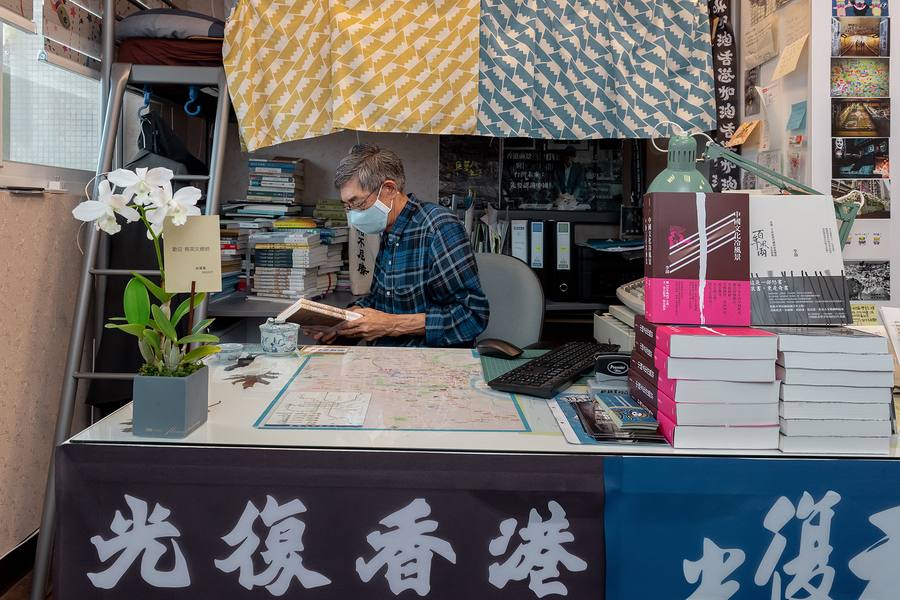
On the evening of 5 September 2019 he launched his reopening campaign on the Taiwanese crowdfunding platform flyingV: in under a day, by the afternoon of 6 September, it passed its NT$2.8 million target, and across the whole drive (September to November) it raised nearly NT$6 million (Radio Taiwan International's "nearly NT$6 million"; Agence France-Presse gives about US$200,000, half of it pledged in under a day — the two figures are different renderings of the same drive). The new shop stood on Nanjing West Road in Zhongshan District, near Exit 3 of MRT Zhongshan Station — another upstairs room, and his home as well: a folding bed went up against the wall by day and came down for him to sleep at night (the memorial essay's on-the-spot description from January 2020).
A week before the opening, pressure arrived in familiar shapes. On 20 April 2020 he received a lawyer's letter from a party claiming to act for a "Causeway Bay Books Company Limited" registered only that March, demanding he stop using the name Causeway Bay Books. On 21 April, as he sat alone in a café near Zhongshan Station, a man splashed red paint over him and fled; the paint covered him, but he was not injured (Associated Press). The AFP version adds that the attacker reportedly said Lam's crowdfunding had "damaged" Taiwan's relations with China, and that police were also investigating a death threat left on a government agency's Facebook page — that detail rests on the AFP line alone and is flagged single-source. No publicly reported judgment in the paint case was found in this check; its judicial outcome is flagged unverified, no public record. On 25 April 2020 at noon — exactly one year after his flight to Taiwan — Causeway Bay Books formally opened in Taipei (some reports date the reopening itself to 24 April, with the formal opening at noon on the 25th; both are archived). President Tsai Ing-wen sent flowers with a note invoking a proverb about justice and fairness (per AFP), and later in 2020 both Tsai and Vice President Lai Ching-te visited the shop (per Taipei Times reporting relayed by European news services). At the opening Lam said: Causeway Bay Books had been destroyed by China through violent means, and its reopening in Taiwan proved Taiwan was a place with freedom and democracy where people still had the right to read books (as reported by AFP).
16. The Taiwan years: a move, monthly losses, and a figure at every June 4 vigil
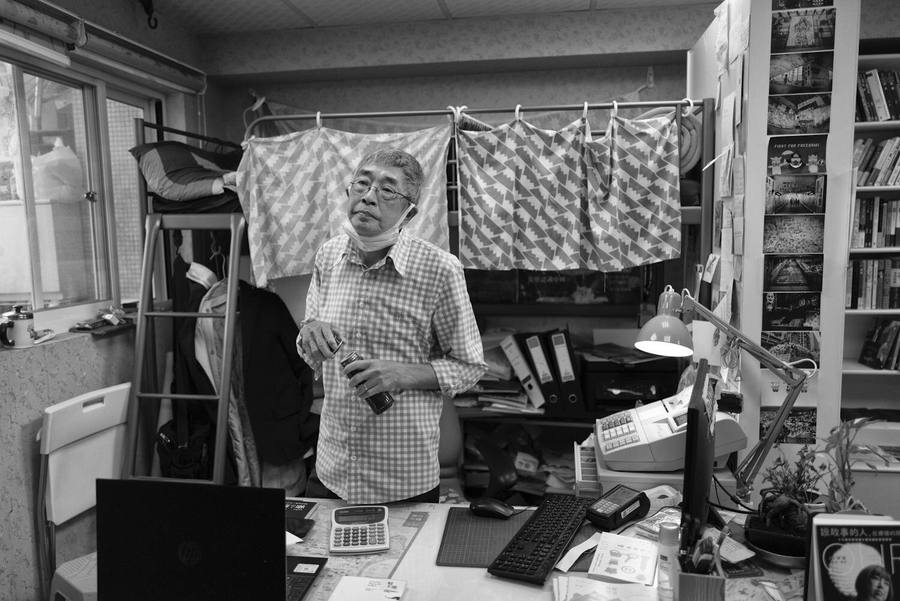
The Taipei Causeway Bay Books quickly became a landmark: Hong Kong emigrants came looking for a piece of the Hong Kong they had lost, Taiwanese readers came for books they could not read across the strait, authors held talks and forums there, and banners reading "Free Hong Kong" hung on the wall. It was also, permanently, a losing business — in June 2024, in the shop, he told a visiting reporter, "I am losing money every month" (the long feature, syndicated through outlets including the American CEO Club site, originated as a Los Angeles Times piece — archived here as reported speech). When his lease ran out and the landlord reclaimed the premises, the shop moved in or around 2024 to Zhongzheng District near National Taiwan Normal University (one source says "near NTNU", another says "moved to Zhongzheng District in 2024"; read together they describe the same move, archived in parallel rather than forced into one line). At sixty-eight and sixty-nine he was still sleeping in the shop and manning the counter. He remained a public figure in Taiwan: speaking at political events, urging Taipei to do more for Hong Kong exiles, and attending Taipei's June 4 Tiananmen vigils (per 2022 reporting). All the while his legal existence on the island rested on visas and work permits renewed one by one, until the permanent-residency application of 2022 and the settlement that followed (section 14) — Taiwan has no asylum law, and the fact that a man wanted by the CCP could lawfully exist there only on a stack of renewable paper is itself part of this file.
17. Illness and death: Taipei, 2 July 2026
Around 2024 Lam was diagnosed with lung cancer (the memorial essay, writing in October 2026, says it had read news of his diagnosis "two years ago" — 2024 is this page's inference, flagged as such). In 2025 the cancer recurred and advanced to stage four (lung adenocarcinoma), and treatment failed to hold it (South China Morning Post, via Reuters and AP). In June 2026 he told Taiwan's Central News Agency he had temporarily closed the bookshop because of his health and could not say when it might reopen (per AP). On 30 June he was admitted to Mackay Memorial Hospital in Taipei; on 1 July he fell into a coma; on the evening of 2 July 2026 he died, aged 70. The Central News Agency broke the news, Reuters and AP followed, and President Lai Ching-te posted a tribute on Facebook saying Lam's life bore "witness to the value of freedom of expression, and to the fear and suffering inflicted by authoritarian repression" (via ChinaForum's rendering of Lai's words). On the afternoon of 31 July 2026 a farewell service was held at Chi-nan Presbyterian Church in Taipei; Premier Cho Jung-tai attended and, on President Lai's behalf, presented a presidential commendation, received by a family representative; Cho called him "the bravest new citizen of Taiwan" and said Taiwan's resolve to defend democracy, human rights and freedom would never waver (Executive Yuan press release). He was buried on Taiwan's northern coast (the memorial essay says a cemetery on the northern coast; the Chinese Wikipedia names the Christian Peace Garden in Jinshan, New Taipei — the two are consistent, the garden's name resting on the Wikipedia alone, archived as such).
He never did go back to Hong Kong. The account he settled with himself at Kowloon Tong station on 16 June 2016 — go back, and you hand over the subscribers' names and spend the rest of your life as their informant — was paid off with his last decade of exile: rather a monthly-loss bookshop in a foreign city, a folding bed, red paint and a death far from home than a return on his knees.
18. What became of the other four: three men's silence, and Gui Minhai's ten years
This case file must not close on Lam alone. Lui Por and Cheung Chi-ping: on 4 March 2016 Lui returned to Hong Kong, asked police to cancel his missing-person case and refused to disclose anything; on 6 March Cheung did the same (Hong Kong police statements and AFP — some English-language reports give early April, archived as a discrepancy in section 19, with the police dates preferred here). Human Rights Watch recorded the chilling detail: within a day of returning, both men were taken back across the border — cancel the case, appear, say "safe and free", and go back. Lee Bo returned on 24 March 2016, told immigration officers he had gone to the mainland to assist the investigation into Gui and had not been abducted, and asked for his case to be cancelled; the next day journalists followed him as two unidentified men drove him in a van to a border crossing and back into the mainland. After that, there is no public word of Lui Por, Cheung Chi-ping or Lee Bo at all: whether they ever returned to Hong Kong again, where they live now, how their health stands — no public record on any of it. This page writes not one word of speculation.
Gui Minhai's trajectory is the fullest and the heaviest: held after his January 2016 CCTV "confession"; in October 2017 China's Foreign Ministry said he had "completely served" the sentence for the traffic offence and been released — but he remained confined in Ningbo, unable to leave; on 20 January 2018, travelling by train to Beijing for medical care accompanied by two Swedish diplomats, he was seized again in front of them by about ten plainclothes officers; and on 24 February 2020 the Ningbo Intermediate People's Court sentenced him to ten years' imprisonment plus five years' deprivation of political rights for "illegally providing intelligence to foreign entities", announcing that he had applied in 2018 to restore his Chinese citizenship and would not appeal (court notice and Amnesty International's statement). Sweden maintains he remains a Swedish citizen. Whether a man denied his family and a lawyer of his choice "restored citizenship" or "waived appeal" of his own will cannot be verified, and Amnesty's characterisation stands: tried in secret, no fair trial. This page does not compute a release date from the ten-year term, because the authorities never fully stated its start point; and as of this check there has been no public word of Gui Minhai since the February 2020 verdict — no public record. Five men of one bookshop: one sentenced to ten years and vanished into silence; three cancelled their missing-person cases and sank out of sight; one told the truth, lived ten years in exile and died in Taipei. That full ledger is what the Causeway Bay Books affair actually looks like.
19. Full timeline
December 1955: born in British Hong Kong (exact date: no authoritative public record). 1985–1989: book distribution at Chung Hwa Book Company's Hong Kong arm. After June 1989: moves to Tien Yuan Bookstore. 1994: founds Causeway Bay Books. Around September 2012: administratively punished by Luohu Customs (per the mainland's 2016 briefing); some years earlier he had also been questioned for hours by state-security officers at a border stop and released after his books were confiscated (his own account). 2013: Gui Minhai, Lee Bo and Lui Por found Mighty Current Media. 2014: Mighty Current acquires Causeway Bay Books; Lam stays on as manager. 14 October 2015: Lui Por last logs into the shop computer and is then taken in Shenzhen. 17 October 2015: Gui Minhai is taken in Pattaya, Thailand. Mid-October 2015: Cheung Chi-ping is taken in Dongguan. 24 October 2015: Lam Wing-kee is seized at the Lo Wu crossing and spends the night in a prisoner's chair at a Shenzhen police station. 25 October 2015: handcuffed, blindfolded and capped, he is trained to Ningbo and locked in a padded room in an unmarked building. 26 October 2015: made to sign waivers of family contact and legal counsel; interrogation begins. Late October 2015 to March 2016: about five months of solitary confinement in Ningbo, 20–30 interrogations, a confession letter, a repentance letter, repeated rehearsed tapings. 5 November 2015: his wife reports him missing to Hong Kong police; hours later he telephones that he is "safe", and police close the file. 30 December 2015: Lee Bo disappears inside Hong Kong. 17 January 2016: Gui Minhai "confesses" on CCTV. 4 February 2016: Guangdong authorities confirm three booksellers are under criminal compulsory measures. February 2016: the British Foreign Office's six-monthly report finds Lee Bo was involuntarily removed, a serious breach of the Joint Declaration. 28 February 2016: Lam, Lui and Cheung "confess" on Phoenix TV; 29 February, Lee Bo appears on Phoenix. 4 March 2016: Lui returns to Hong Kong and cancels his case; 6 March, Cheung does the same; both go straight back to the mainland. 21 March 2016: Lam's measure is changed to bail pending trial (official version) and he is moved to Shaoguan. 24 March 2016: Lee Bo returns to Hong Kong and cancels his case, returning to the mainland the next day. From April 2016: Lam works at the Shaoguan library under daily police check-ins; during this period he is taken to Shenzhen for a fully filmed "tea" with Lee, Lui and Cheung. 14 June 2016: Lam returns to Hong Kong, cancels his case and collects a customer-records computer — the wrong one. Night of 15 June: he notifies the team of the mistake and gains a day. 16 June 2016, noon: at Kowloon Tong station he decides not to return; that evening, with Albert Ho beside him, he holds his press conference and lays out the whole detention. 18 June 2016: some 6,000 marchers rally under "We are all Lam Wing-kee". 5 July 2016: Ningbo police brief that he violated bail and will be dealt with; Hong Kong's Secretary for Security Lai Tung-kwok restates around the same time that no handover arrangement exists. Late July 2016: in a safe house, Lam writes his account Man Is Not Made for Defeat in one night. 3 May 2017: testifies at the CECC hearing in Washington. 20 January 2018: Gui Minhai is seized again, on a train, in front of Swedish diplomats. February 2018: Lam addresses the Geneva Summit, describing himself as still wanted and sometimes followed. February 2019: the Hong Kong government tables the Fugitive Offenders amendment bill. 25 April 2019: Lam leaves Hong Kong for Taiwan. 14 May 2019: his Taiwan stay is extended by two months. 5 September 2019: the flyingV crowdfunding drive launches, passes NT$2.8 million in under a day and raises nearly NT$6 million in total. 24 February 2020: Gui Minhai is sentenced to ten years in Ningbo. 20 April 2020: Lam receives the trademark lawyer's letter. 21 April 2020: red paint is thrown over him in Taipei. 25 April 2020: Causeway Bay Books reopens in Taipei's Zhongshan District; President Tsai sends flowers. November 2022: he applies for permanent residency in Taiwan. Around 2024: lung cancer is diagnosed; the shop moves to Zhongzheng District near NTNU. 2025: the cancer recurs and reaches stage four. June 2026: the bookshop is temporarily closed for his health. 30 June 2026: admitted to Mackay Memorial Hospital, Taipei. Evening of 2 July 2026: dies in Taipei, aged 70; President Lai Ching-te posts a tribute. 31 July 2026: farewell service at Chi-nan Presbyterian Church; Premier Cho Jung-tai presents a presidential commendation on the President's behalf.
20. Archived in parallel: discrepancies between sources and unverified items
One, birth date: the Chinese Wikipedia gives 16 December 1955, the English Wikipedia only December 1955, with no third source; this page archives "December 1955". Two, the Shenzhen–Ningbo train journey: Lam's press-conference account gives 13–14 hours, the memorial essay working from his written account gives roughly ten; both stand. Three, the hard drive's contents: Lam's own Geneva text says a subscription list of some 400 Chinese readers; Global Voices, relaying Hong Kong reporting, says records of some 600 people and 4,000 book titles — plausibly "mainland subscribers" versus "all customer records", archived in parallel, not merged. Four, Lui Por's and Cheung Chi-ping's return dates: Hong Kong police announcements and AFP give 4 and 6 March 2016; some Anglo-American reports say early April; this page follows the police dates and archives the difference. Five, Gui Minhai's sentence: the ten years of 24 February 2020 are undisputed, but the authorities never fully stated the term's start point (the 2018 re-arrest or the original 2015 seizure), and nothing of his condition since 2020 is public; no release date is computed here. Six, the Taipei shop's move: one source says "near National Taiwan Normal University", another that it "moved to Zhongzheng District in 2024"; archived in parallel. Seven, the red-paint case: the death-threat detail rests on the AFP line alone, and no published judgment was found — unverified. Eight, his Taiwan naturalisation year: the Chinese Wikipedia's nationality field gives the Republic of China from 2024, and the Executive Yuan called him a "new citizen of Taiwan", but no naturalisation document or exact date is public — archived as such. Nine, the detention of his girlfriend surnamed Hu in Ningbo rests on Lam's account alone — unverified; the mainland briefing's narrative about her is an official character-smear line, recorded here only as to its existence and function, not adopted as fact. Ten, the formal institutional identity of the "Central Investigation Team", and the real names of "Mr. Shi", "Section Chief Chen", the guards and the interrogators: no public record of any of it. Eleven, the circumstances of his wife and children during his exile and final illness, beyond the family representative who accepted the commendation at his farewell service: no public record, and none is written here.
21. Verification and sources
The sources actually consulted for this page are as follows. First class, his own formal records: the content of his 16 June 2016 Legislative Council press conference (corroborated across Hong Kong Free Press and Global Voices' full rendering and multiple wire reports); his written testimony and the printed record of the CECC hearing of 3 May 2017 (official U.S. congressional PDF, including his full statement and Senator Rubio's remarks); the full text of his 2018 Geneva Summit address (archived bilingually on the Summit's site); and his account Man Is Not Made for Defeat as extensively quoted and retold in China Change's memorial essay "The Last Hong Konger" by Yaxue Cao (7 October 2026), whose author met Lam in person in 2017 — every detail sourced to his account is flagged with its relay level in the text. Second class, wire services and independent media: Reuters' death report of 2 July 2026 (read in full in its Japanese edition) and its post-press-conference interview with Lam (read via republication); the Associated Press on the April 2020 Taipei opening and the obituary of 3 July 2026 (read in full via multiple U.S. public-radio republications); Agence France-Presse on the opening and the paint attack (read via multiple republications); Voice of America's September 2019 feature "How Hong Kong's Most Wanted Bookseller Escaped to Taiwan" (read in full via GlobalSecurity's republication, including his stay arrangements and his own quoted remarks); the Taipei Times of 27 April 2019 on his arrival (the Mainland Affairs Council's statement and the "still technically wanted" characterisation); Radio Taiwan International on the crowdfunding and the opening (the nearly NT$6 million figure); Human Rights Watch's dispatch of 25 March 2016 (the record of Lui, Cheung and Lee returning to Hong Kong and going straight back); Amnesty International's urgent actions of February–March 2020 and February 2022 on Gui Minhai's sentence (ten years, five years' deprivation of political rights, secret-trial assessment); and New Bloom magazine and the Shin-Getsu News Agency, December 2022, on his permanent-residency application. Third class, official records: the British Foreign Office's February 2016 six-monthly report findings (read via full quotation in The Irish Times and AFP) and Foreign Ministry spokesman Hong Lei's rebuttal (People's Daily English edition); the Ningbo police briefing of 5 July 2016 (its substance read via the Chinese Wikipedia case page, including the Luohu Customs punishment, the bail change, the Shaoguan library placement and the existence of the Hu narrative); the existence of Guangdong authorities' 4 February 2016 confirmation (corroborated via the case pages and multiple reports); the Executive Yuan press release of 31 July 2026 (Premier Cho presenting the commendation; the "new citizen of Taiwan" wording — read in full); and Mainland Affairs Council statements (via the Taipei Times). Fourth class, used for discrepancy comparison only and never as factual authority: the English, Chinese and Cantonese Wikipedia entries on Lam Wing-kee and the Causeway Bay Books disappearances. Sources that could not be read in full (the original Phoenix TV broadcast of February 2016, the original Ningbo briefing document, any wanted-notice original) are flagged at the relevant points in the text, and no fact rests on their unseen content; negative results (no publicly released wanted-notice text, no named point-by-point official rebuttal of Lam's press conference, no published judgment in the paint case) are recorded as such.
22. Our Take
The thing to fix in the record about the Causeway Bay Books affair is the gash between its charge and its theatre. By the mainland's own account this was a mere "illegal business" case — posting banned books into China for money: five middle-aged booksellers, one shop of a few hundred square feet. If that were true, a Luohu Customs fine and a Ningbo court date would have sufficed, and the sky would not have fallen. What was actually deployed was something else entirely: a seizure in Thailand, a man spirited out of Hong Kong itself, a Central Investigation Team, a padded room, six teams of guards watching one sixty-year-old shop manager around the clock, his girlfriend held as a bargaining chip, a confession letter rewritten until superiors were satisfied and a televised repentance rehearsed until it looked real. A state does not stage that apparatus against a bookshop because the bookshop is dangerous; it stages it to make an example — so that every Hongkonger does the arithmetic: if a few gossip books cost this much, what would anything else cost? What Lam Wing-kee did on 16 June 2016 was to get the arithmetic publicly wrong: he not only refused to hand over the drive holding four hundred readers' names, he stood up and recited the interrogation room's script, director and lines to the world. A man cast as the slaughtered chicken in a warning to monkeys refused the role — the one time in the whole affair that the dictatorship's production was heckled off its own stage by its own lead actor.
Ten years on, the weight of this file is its closed loop. In 2016 Hong Kong's Secretary for Security could still stand before cameras and say there was no legal arrangement to hand a man to the mainland; in 2019 the same government set out to write that arrangement into law, and Lam left the night before it could reach him; what followed after 2020 is known to everyone — Apple Daily, the National Security Law, the case of the 47, and Albert Ho himself, the man who stood beside Lam at that press conference, sentenced in September 2026 to five years and two months for "inciting subversion" (per the memorial essay's footnote). Lam's last seven years in Taipei are the other half of the loop's answer: a loss-making upstairs bookshop, a folding bed, red paint, visas renewed one after another, and finally a hospital and a grave in a foreign land. He did not win Hong Kong back; he simply never knelt — in the words of the poem he chose, the desk never knelt, and neither did the scholar. A man who sold books all his life ended up guarding, to his death, no more than four hundred readers' names and the three words "I won't go back". It is exactly that "no more" which the CCP, with ten years, a cross-border abduction and a televised confession at its disposal, never managed to take from him. Gui Minhai is still in a room with no address, and Lui Por, Cheung Chi-ping and Lee Bo are sunk in silence — this case is nowhere near closed. But Lam Wing-kee's share of it was finished, by his own hand, in Taipei. This archive records it here.
视频证据Video Evidence
《香港失踪书商》(半岛电视台英语频道《101 East》纪录片)|2016|英文纪录片,含香港现场采访与实拍Hong Kong's Missing Booksellers (Al Jazeera English, 101 East) | 2016 | English documentary with on-location reporting in Hong Kong
《香港书商公开现身》(CNN)|2016|英文新闻报道,Ivan Watson报道,含记者会画面Hong Kong bookseller goes public (CNN) | 2016 | English news package by Ivan Watson, including press-conference footage
《台湾总统蔡英文探访流亡香港书商》(南华早报)|2020|英文新闻短片,蔡英文到访台北铜锣湾书店现场画面Taiwanese President Tsai Ing-wen visits bookseller who fled Hong Kong (South China Morning Post) | 2020 | English news footage of Tsai's visit to the Taipei bookshop