
第135案 | 耿潇男Case 135 | Geng Xiaonan
北京民营出版人、影视制片人耿潇男是瑞雅文化传播的负责人,经营民营出版近二十年,出版图书近两千种。她多年来公开声援许志勇、王怡、陈秋实等受迫害者;2020年7月清华大学法学教授许章润被以涉嫌嫖娼抓捕后,她第一时间向外发布消息、接受海外媒体采访,并在许被电商平台封禁后替他代购食品。此后警方踏勘其住所、秘搜公司仓库、先行抓捕员工。2020年9月9日,她与丈夫秦真被北京海淀警方以涉嫌非法经营罪刑事拘留,羁押于海淀区看守所,10月15日被正式逮捕。指控所涉非法出版物数量从最初约8000册升至20万册,临审前再追加数十万册。庭前她解聘了原聘律师尚宝军并被阻止会见律师。2021年2月9日,海淀区人民法院开庭并当庭宣判:她在全面认罪、请求对丈夫与员工从宽后,被以非法经营罪判处有期徒刑三年;秦真获刑二年六个月、缓刑三年;同案另有九名员工一同受审,结果无公开记录。美国笔会与中国人权捍卫者谴责此案为报复性定罪。她于2023年9月刑满释放,出狱后被禁止与旧同事友人联系,包括许章润;服刑监狱名称、罚金与判决书全文均无公开记录。Geng Xiaonan, a Beijing private publisher and film producer who ran Ruiya Culture for nearly twenty years and published close to 2,000 titles, had for years publicly supported persecuted figures including Xu Zhiyong, Wang Yi and Chen Qiushi. After Tsinghua law professor Xu Zhangrun was detained in July 2020 on a prostitution allegation, she released the news at the first moment, gave interviews to overseas media, and — after Xu was blacklisted by e-commerce platforms — ordered groceries on his behalf. Police then inspected her home, secretly searched the company warehouses and arrested employees first. On 9 September 2020 she and her husband Qin Zhen were criminally detained by Haidian police on suspicion of illegal business operations, held at the Haidian District Detention Center, and formally arrested on 15 October. The charged quantity of 'illegal' publications rose from about 8,000 copies to 200,000, with hundreds of thousands more added before trial. Before trial she dismissed her retained lawyer Shang Baojun and was blocked from meeting counsel. On 9 February 2021 the Haidian District Court tried and sentenced her the same day: after a total guilty plea asking leniency for her husband and staff, she received three years for illegal business operations; Qin Zhen received two years and six months, suspended for three years; nine employees stood trial with them, their outcomes a matter of no public record. PEN America and CHRD condemned the conviction as retaliatory. She was released in September 2023 on completion of the full term and was then banned from contacting former colleagues and friends, including Xu Zhangrun; the prison's name, any fine and the full judgment are all matters of no public record.
1. Who she was: the head of a private publishing house
Geng Xiaonan came to public attention not because of any single book but because of the position she had built over many years in Beijing's cultural world. Drawing together reporting by Chinese Human Rights Defenders (CHRD), PEN America, Radio Free Asia (RFA) and ChinaAid, she was a graduate of the Chinese National Academy of Theater — the English renderings of the school's name vary slightly between reports, and this page archives them in parallel rather than merging them into one form. She worked as an independent television producer, invested in the arts, was associated with Heaven Pictures, and co-founded with her husband Qin Zhen the film and television culture company Legend Tianhui (in Chinese, Chuanqi Tianhui). The identity for which she was best known was as the head of Beijing Ruiya Culture Communication Co., known in English-language reporting as Ruiya Books. Material cited by ChinaAid states that she served as editor-in-chief of Ruiya Culture from 2001 to 2018 and published nearly 2,000 books in that period, an average of more than 110 titles a year. That figure comes from a single reporting stream; this page archives it with its source attached and does not present it as a fact found by any court.
Ruiya was a private publishing planning company, and that status is the first key to the whole case. Under China's publishing system, private companies hold no publishing licence of their own and cannot obtain ISBN book numbers in their own name. They must cooperate with state-owned publishing houses that hold licences: the private firm develops the topic, edits, prints and distributes, while the book number and the formal final review belong nominally to the partner press. This cooperative model is the grey zone in which the entire private publishing industry survives. The structural consequence is that a charge of operating a publishing business without a licence can, as a matter of legal technique, be fitted onto almost any private publisher in China. The only real variables are when the enforcement apparatus chooses to move, with what force, and against whom. All of the controversy in this case rests on that background. On paper, the charge concerned business qualifications. In time, target and escalation, the case tracked Geng Xiaonan's public support, in the summer of 2020, for the Tsinghua professor Xu Zhangrun. This page therefore keeps the two lines strictly separate: the charge line contains only what the indictment and verdict, as reported, can support; the context line contains only speech and conduct supported by public reporting. No unproven trigger is written up as fact.
Even her age cannot be fixed from the public record, and this page refuses to pretend otherwise. CHRD's statement of 11 February 2021 described her as 51 years old at the time of her arrest, which would place her birth in about 1969 or 1970. ChinaAid's pre-trial reporting in early February 2021 described her as 47, which would place her birth in about 1973. The two figures differ by roughly four years. No identity document, household registration record or statement by Geng herself is publicly available to settle the question, so both versions are archived here, unmerged and unattributed to any conclusion. Her exact date of birth is a matter of no public record. What can be confirmed is that when she was taken away in 2020 she was in an active phase of her publishing and film career, and that she had mortgaged her home to found and sustain the company, which was running at a heavy loss; according to her friend Gao Yu, quoted by RFA on 9 February 2021, after the arrests the company's assets were left unattended. Those details come from a friend's account and are archived as such.
2. The supporter: what Geng Xiaonan had done before 2020
To understand the arrest of September 2020, the record must first establish the public role Geng Xiaonan had played for years before it. RFA's long report of 15 September 2020 stated that for years she had quietly helped dissidents and liberal intellectuals who had fallen foul of the authorities and lost their jobs or their freedom. The people named in that reporting whom she had assisted included the legal scholar Xu Zhiyong, who had called for Xi Jinping's resignation and was later imprisoned; Pastor Wang Yi of the Early Rain Covenant Church in Chengdu, sentenced in 2019 to nine years for inciting subversion of state power and illegal business operations; and the citizen journalist Chen Qiushi, who had entered Wuhan during its lockdown in early 2020 to report from the epicentre of the pandemic and then disappeared. CHRD's statement added that she had publicly raised the enforced disappearance of Chen Qiushi and had followed the cases of Xu Zhiyong and Ding Jiaxi. Most of this activity took place on social media: reposting, appealing, and arranging practical help for the families of people in custody. She belonged to no organisation and published no political programme. Her activism took the form of cultural-world connections, resources and visibility, directed towards specific individuals in trouble.
That role occupies a particular place in China's current political environment. She was not the person speaking at the front; she was the person standing behind those who spoke. After Xu Zhangrun was suspended and investigated, the fact that he could still be heard depended in part on such a support network; after rights lawyers lost their licences, their ability to live likewise depended on such networks. In a series of cases, the authorities' handling of these nodes has shown a comparable pattern: deal with the speaker first, then with the speaker's supporters, thereby raising the cost of support itself. Whether the Geng case belongs to that pattern is a matter of commentary and judgement, and this page confines it to the Our Take section. The factual section fixes only this: her long-standing, public support for a number of people punished by the authorities is corroborated across RFA, CHRD, PEN America and the published writings of the people concerned. It is not a narrative stitched together after her arrest.
The cultural salon and publishing network she ran kept her in wide contact with Beijing's universities, media and art world. The open letter issued on her behalf on 21 October 2020 was signed by Xu Zhangrun himself; by He Weifang and Zhang Qianfan, law professors at Peking University; by Guo Yuhua, a sociology professor at Tsinghua; by Hao Jian, a co-researcher at Harvard's Fairbank Center; and by the art critic Li Xianting — a list that is itself a cross-section of her network. The letter was issued by six friends and supporters and gave a dedicated contact address for the campaign. Those who signed were afterwards warned, threatened and questioned by state security officers about their connections with Geng Xiaonan and Xu Zhangrun, as ChinaAid reported on 6 November 2020. The supporters of the supporter were thus drawn into the case's perimeter — the first recorded layer of its spillover.
3. The Xu Zhangrun affair: from the 2018 essay to the July 2020 detention
Xu Zhangrun was a professor at Tsinghua University Law School, a scholar of jurisprudence and constitutional law. In July 2018 he published a long essay criticising the constitutional amendment that abolished term limits for the state presidency, together with a range of current policies. Tsinghua subsequently disciplined him: in 2019 he was suspended from teaching and from supervising students. In February 2020, as the epidemic exploded in Wuhan, he published an essay criticising the authorities' information controls and governance failures in the early stages of the outbreak; after it circulated he was briefly out of contact, his WeChat account was suspended, and his name became a sensitive word on Weibo. On 21 May 2020 he published an essay of some ten thousand words calling for political accountability, for the release of prisoners of conscience, and for an end to the political targeting of academics. In the early morning of 6 July 2020, Beijing police took him from his home on suspicion of soliciting prostitutes. He was released on 12 July, after a detention of about six to seven days — PEN America describes a six-day detention, RFA describes release a week later, and both formulations are archived here. After his release, Tsinghua Law School dismissed him for what it called moral corruption. He lost his post and his livelihood, and he was placed on an online blacklist: he could not receive public donations, and major e-commerce platforms set his name as a prohibited search term.
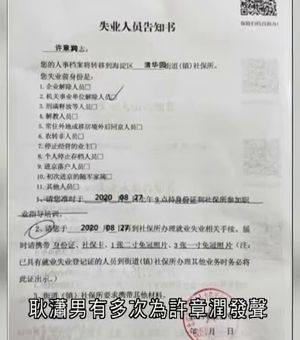
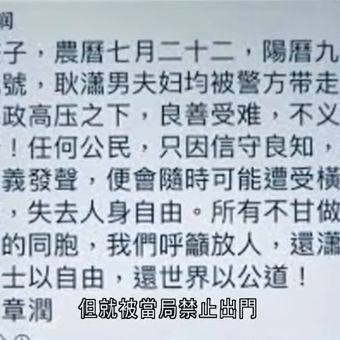
Geng Xiaonan's involvement in the Xu affair began on the day of his arrest. According to the open letter as relayed by ChinaAid, it was Geng who released the news of Xu's detention to overseas media on 6 July 2020, bringing the story into international reporting at the first moment. She gave interviews about his case to RFA, spoke continuously on social media, and after his release provided practical help in daily life: once Xu had been blacklisted by e-commerce platforms and could no longer shop for himself, Geng began, from 26 August 2020, ordering groceries online on his behalf. She discovered that Taobao, Tmall and Hema — three Alibaba-owned platforms — had set "Xu Zhangrun" as a prohibited search phrase. RFA's report of 15 September 2020 recorded that detail, and it stands as a concrete sample of how platform censorship reaches into the texture of an individual's daily existence. In a July 2020 interview she had already foreseen the risk to herself. PEN America quoted her words: the authorities' butcher's knife could fall at any time, everyone was saying she was in great danger, and she had retained a lawyer in case she was detained. That self-description is carried by two sources — PEN America's citation and the original RFA interview — and is archived accordingly. Foreseeing the risk and not stopping is the factual baseline that every later report and commentary about her returns to.
4. The August siege: verifiable warning signs before the arrest
The taking of Geng Xiaonan and her husband did not come without warning. RFA's report of 15 September 2020, based on the accounts of Xu Zhangrun and friends, records a clear sequence. On 14 August 2020, police from Beijing's Haidian District visited Geng's home, inspecting the exit routes and the location of the electricity breaker box. On 27 August, police secretly searched the warehouses in Beijing and neighbouring Hebei province belonging to the publishing company run by Qin Zhen, and warned the warehouse managers not to tell the couple about the search. On 6 September, several employees of the publishing company were arrested by police — Geng herself sent word of this to Xu Zhangrun. On 8 September, the Weibo accounts of Qin Zhen's company were shut down. In the early morning of 9 September, Geng messaged Xu that she was out running errands; thereafter both she and her husband were out of contact. Xu described the silence as definitely unusual. In early September, Geng had told RFA that she did not think these moves posed a great danger and that there was no need to report them — a judgement that events reversed within days. This page archives the judgement alongside the reversal, without retrospective editing.
The significance of the sequence is that it moves the starting point of the case back by almost a month before 9 September. A home visit to check escape routes and a breaker box; a secret warehouse search; employees arrested first; social media accounts closed. Taken together this is a procedure of gradual tightening around a business entity and a household. From the standpoint of an ordinary economic-crime investigation into illegal business operations, a secret search of warehouses and an inventory check can be explained. Inspecting a home's exits and breaker box, however, sits closer to preparation for an arrest operation. This page presents both readings in parallel — investigative necessity on one side, political siege on the other — with the evidence for each set out above, and leaves the weighting to the reader. China Digital Times published a case digest on 9 September 2020, later reprinted by China Heritage, which described this method as "siege tactics": pressure applied not through the speech itself but layer by layer through the compliance exposure of an associated business. That characterisation is media analysis; it is archived here with its source named and is not mixed into the factual narrative.
One further detail deserves to be fixed: the synchronisation of the information blockade. The news that employees had been arrested on 6 September reached the outside world because Geng herself messaged Xu before she was taken. The company's Weibo accounts were closed on 8 September, cutting its channel for speaking publicly. By the time the couple disappeared on 9 September, the channels through which the outside world could confirm facts had narrowed to friends' relayed accounts and the subsequent visits of a lawyer. That sequence also matters for understanding how the numbers in the accusation later changed, as the next sections record.
5. 9 September 2020: criminal detention and Haidian Detention Center
On 9 September 2020, Geng Xiaonan and Qin Zhen were criminally detained by the Haidian District branch of the Beijing Public Security Bureau on suspicion of illegal business operations, and held at the Haidian District Detention Center. This point is corroborated consistently by RFA, CHRD, PEN America, ChinaAid and China Heritage, and is among the most certain nodes in the entire case. One circulating error must be corrected here. The relayed text of CHRD's statement of 11 February 2021 gives the detention date as 9 September 2019, which contradicts every other source and the case chronology and is plainly a typographical error; this page uses 9 September 2020 and flags the error in the original so that later researchers do not propagate it. Similarly, a few relayed texts render Qin Zhen's name as "Qin Chen"; the correct name is Qin Zhen, its characters confirmed by the open letter and multiple reports.
In the first phase of detention, lawyer access was blocked. Material preserved by China Heritage records that, according to information posted by the Rights Protection Network on 22 September, counsel acting for Geng had been refused permission to meet the couple some four times. On 30 September 2020, the lawyer Shang Baojun finally met Geng Xiaonan at the Haidian District Detention Center — twenty-one days after she had been taken away. RFA's report of 30 September 2020 relayed Shang's account: her health was passable, but she looked haggard, and in twenty-one days she had undergone more than ten interrogation sessions. Shang also disclosed the accusation's original form: the police were relying on roughly 8,000 nutrition and cookery books published by the company to claim that Ruiya had been operating illegally from its inception. The defence response was that these were children's, nutrition and cookery titles, not political publications. As a friend surnamed Song put it in RFA's sentencing report of 9 February 2021, Geng Xiaonan was simply a publisher of children's books and cookbooks. That line of defence ran through the whole case: the titles named in the accusation were precisely the category least capable of involving sensitive content, which made the case present itself in its purest form as an offence of qualifications rather than of content.
One further record belongs to the detention period. In December 2020, while in custody, Geng was awarded the Lin Zhao Memorial Award by the Independent Chinese PEN Center, in recognition of her courageous efforts in promoting justice. PEN America confirmed the award and the awarding body in its statement of February 2021: the Independent Chinese PEN Center is a sister centre of PEN America within the PEN International network. The award shows that well before trial, the international literary and publishing world had already placed this case in the sequence of freedom-of-expression cases rather than treating it as a routine commercial compliance matter. The distance between that external characterisation and the domestic judicial definition of the case is one of the tensions this archive preserves; this page records the distance itself and does not resolve it for the reader.
6. The changing number: 8,000 copies, 200,000 copies, and "hundreds of thousands more"
The central number in this accusation exists in three versions in the public record, and this page archives them in parallel rather than merging them into a single conclusive figure. Version one, roughly 8,000 copies: after the lawyer's first meeting on 30 September 2020, Shang Baojun told the media that the police had initially relied on about 8,000 nutrition and cookery books as the basis of the illegal business allegation; ChinaAid's report of 23 October 2020 likewise stated that the original charge involved 8,000 illegal publications. Version two, 200,000 copies: the same ChinaAid reporting stated that the number cited later in the case had risen to 200,000, and RFA's sentencing report of 9 February 2021 stated that the couple were accused of illegally preparing 200,000 copies of books for publication. Version three, an increment of "hundreds of thousands": RFA's same report stated that, in the run-up to trial, the charges had been escalated by the inclusion of hundreds of thousands more books in the evidence list, making a harsher sentence more likely; PEN America's statement of 11 February 2021 likewise recorded that in the days before trial the authorities increased the severity of the charges and blocked Geng from meeting her lawyer. The three versions are not a simple matter of scribal error. Together they describe a curve that inflated as the proceedings advanced — from eight thousand to two hundred thousand, then an addition counted in hundreds of thousands, an increase measured in orders of magnitude.
Why does the number matter? Because under the sentencing structure of the offence of illegal business operations, Article 225 of the Criminal Law, the scale of operations and the quantity of publications determine the grading between "serious circumstances" and "especially serious circumstances", and with it the ceiling of the sentence. The sharp inflation of the charged quantity during investigation and prosecutorial review had the objective effect of pushing a qualifications case that might have ended in a fine or a suspended sentence into the zone of actual imprisonment. The defence and the campaign therefore raised an obvious question: between 8,000 cookery and nutrition books characterised as illegal operations and an accusation of 200,000 or several hundred thousand copies, was the difference a matter of newly discovered evidence, or of a sentencing target worked backwards? That question was put explicitly in the open letter of Xu Zhangrun and others, which argued that "illegal business operations" is a blanket charge used for political purposes and arbitrarily applied here. No public explanation by the prosecution or the court of how the number changed is a matter of public record. The full text of the judgment has never been published, so this page cannot verify the number of copies, the operating revenue or the illegal gains that the court ultimately found. What it archives is the three reported versions, together with the fact that the judgment is not public. Wherever a number is cited below, its version and source are named.
Two further quantitative facts are likewise matters of no public record. First, whether the court imposed a fine alongside the prison terms, and in what amount: none of the sentencing reports mentions one. Second, the individual outcomes for the nine co-defendant employees: RFA confirms that Geng, Qin Zhen and nine employees arrived together at the Haidian District Court at 9:30 a.m. on 9 February 2021 to stand trial, but public reporting does not set out each employee's conviction or sentence, and this page records them as no public record. Third, the specific date of prosecutorial indictment, the indictment's document number and the composition of the collegial bench are all matters of no public record. China's system of publishing court judgments online left no retrievable public text for this case. That absence is itself a gap the archive must face squarely: the primary judicial documents of this case simply do not exist in the public domain.
7. Formal arrest, the contraction of the defence, and the October open letter
On 15 October 2020, the Haidian District procuratorate approved the formal arrest of Geng Xiaonan and Qin Zhen. ChinaAid's report of 23 October 2020 gives that precise date; the formulations in CHRD and RFA — formal arrest in October, about a month after detention — are compatible with it. This page adopts 15 October as the formal arrest date and notes that its direct source is a single reporting stream. Before and after that point, the defence applied to the procuratorate to alter the compulsory measures. RFA's report of 23 October 2020 quoted defence lawyer Mo Shaoping: the defence had applied against approval of the arrests on the grounds that the alleged offence was non-violent, that Geng had a fixed residence in Beijing, that there was no possibility of her absconding, and that under the rules she should have been released on bail pending trial — but the procuratorate had not approved the application. Shang Baojun and Mo Shaoping both appear on the defence side of this case: in the early stage, meetings and public statements ran mainly through Shang Baojun, while the defence statement quoted by RFA in late October came from Mo Shaoping. Public reporting does not fully explain the division of labour or the phases of their mandates, and this page archives each lawyer at the reporting nodes where each appears.
On 21 October 2020, Xu Zhangrun, He Weifang, Zhang Qianfan, Guo Yuhua, Hao Jian and Li Xianting issued their open letter calling for the couple's immediate release. The letter made three points: that illegal business operations is an abused catch-all charge; that the real motive of the case was to punish Geng Xiaonan's speech and her acts of support; and that continued detention lacked necessity. Published by China Heritage on 22 October, the letter gave the English-speaking world a text signed by leading Chinese legal scholars. Three of the signatories were law professors, which made the letter not merely a campaign statement but a public dissent by members of a professional community from the application of the charge itself. The sequel is recorded by ChinaAid on 6 November 2020: state security officers warned, threatened and questioned the signatories one by one about their connections with Geng Xiaonan and Xu Zhangrun. Xu himself had published a separate long essay in Geng's defence on 24 September 2020 — its title as preserved by China Heritage is "I Am Compelled to Speak Out in Defence of Geng Xiaonan" — and earlier that month had addressed an open letter to those in power demanding her release. According to ChinaAid's sentencing report of 11 February 2021, before the trial the authorities placed Xu Zhangrun, who had been following the case closely, under house arrest.
The contraction of the defence in the later phase of the case is the most glaring entry in its procedural record. According to RFA and ChinaAid, before the trial Geng Xiaonan dismissed her defence lawyer Shang Baojun. RFA's formulation is that she had earlier fired her defence attorney, the rights lawyer Shang Baojun, and it notes that this is a demand commonly made by the authorities in political cases. ChinaAid's formulation is more direct: the authorities forced her to dismiss Shang. The two versions differ in the strength of their judgement on whether the dismissal was voluntary or coerced, and this page archives them in parallel. The fact that can be confirmed is that Shang Baojun left the defence before trial, and that Geng stood trial without the lawyer she had originally retained. The inside story of the dismissal is supported by no primary material in the public domain. PEN America also recorded that in the days before trial she was blocked from meeting her lawyer. Around the courtroom, the questioning of the letter's signatories and the house arrest of Xu Zhangrun formed a synchronised environment of pressure. Each of these procedural details, taken alone, admits of a case-specific explanation; taken together, they display the familiar shape of a systematically compressed defence space in a politically sensitive case. That characterisation belongs to the commentary section; the body of this page fixes only the sequence of facts.
8. 9 February 2021: trial and same-day verdict
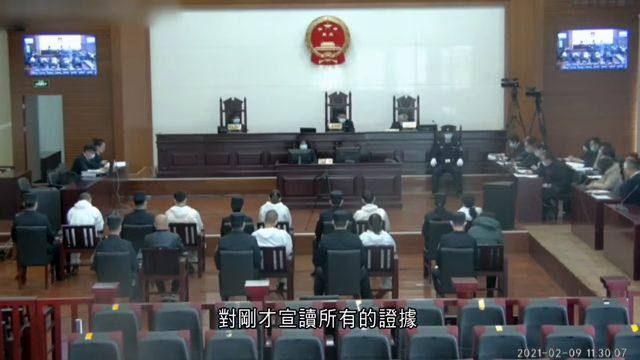
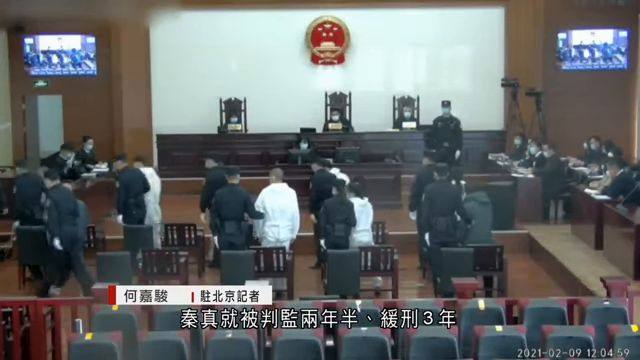
The trial's scheduling is fixed by public reporting at two points: on 3 February 2021, ChinaAid reported that the case of Geng Xiaonan and Qin Zhen was set for trial on 9 February at the Beijing Haidian People's Court. At 9:30 on the morning of 9 February, Geng Xiaonan, Qin Zhen and nine company employees arrived at the Haidian District Court together — eleven defendants in all, a composition recorded in RFA's same-day sentencing report. Trial and verdict were completed in a single day. The Haidian District People's Court convicted Geng of illegal business operations and sentenced her to three years' imprisonment; Qin Zhen received two years and six months' imprisonment, suspended for three years. On Qin's sentence the reporting is highly consistent: PEN America gives a suspended sentence of two and a half years; ChinaAid states explicitly two years and six months, suspended for three years; RFA gives a two-and-a-half-year suspended sentence. Any circulating version of "one year and six months suspended" contradicts all of these sources. This page does not adopt it and corrects the record expressly.
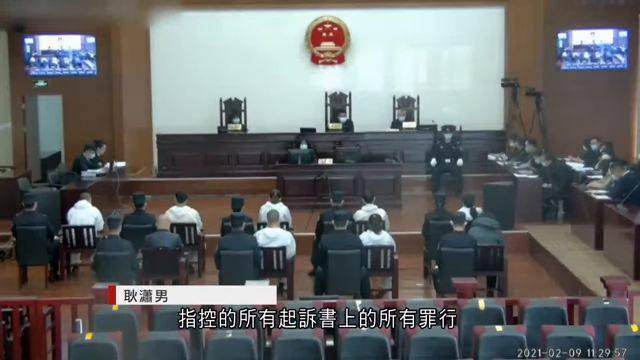
In court, Geng pleaded guilty. Reporting by RFA, based on a video recording of the trial, records that she said she pleaded guilty to everything in the indictment and to everything the prosecution had charged, that all of the evidence read out against her was correct, and that she was grateful for the precious opportunity in court to admit her mistakes and apologise. She had earlier dismissed her defence lawyer Shang Baojun. ChinaAid's report records that the prosecutor identified the couple as the publishing company's executives, responsible for its overall management and operations, and argued that both should therefore be treated as principal offenders; hoping to reduce the burden on her husband and on others connected with the two related publishing houses, Geng assumed responsibility and pleaded guilty to all charges, stating in her final submission that she pleaded guilty and accepted all the evidence presented in court. PEN America's formulation is that she pleaded guilty and asked for leniency for herself, her husband and her staff. The three reports corroborate each other on the core plot: the plea was total and unreserved, and it pointed explicitly at securing lighter treatment for her husband and employees.
How to understand that plea is the point at which this archive must exercise the most restraint. The facts that can be fixed are these. First, the plea came after her retained lawyer had been dismissed and after her access to a lawyer had been blocked. Second, the co-defendants included her husband and nine employees, and the outcome formed a clear gradient: she alone received an actual prison term of three years; her husband received a suspended sentence; the employees' outcomes were never published. Third, her circle of friends offered a highly consistent explanation. RFA quoted the journalist Gao Yu: the case was complicated, it involved her husband and about a dozen other people in the company, she had mortgaged her house to start the business, it had sustained heavy losses and its assets were left unattended — she had nothing left and no choice but to act as she did to obtain a more lenient outcome for everyone. Gao Yu drew the parallel with her own televised confession, made to stop the authorities from arresting her son. A second friend held that Geng's "mistakes" had nothing to do with the publishing company and that three years was far too harsh. CHRD's statement said her imprisonment was apparently in retaliation for her outspoken support of those persecuted for exercising their rights to free speech and a free press. These explanations are the judgements of friends and human rights organisations, and each is archived here under its owner's name. This page states equally plainly what cannot be shown: no public material proves the existence of any written bargain inside or outside the courtroom. "A guilty plea in exchange for her husband's suspended sentence" is a reasonable inference from the gradient of outcomes and the family relationship — it is not a fact established by documents, and an archive writes inference as inference.
The timing of the verdict carried one more layer of context. 9 February 2021 was the twenty-eighth day of the twelfth lunar month, two days before Lunar New Year's Eve. From arrest to judgment the case took five months, with investigation, prosecution and trial all closed out before the New Year. The international response to the verdict was swift. On 11 February, PEN America issued its statement condemning what it called an unjust and retaliatory conviction, saying the case illustrated Beijing's growing intolerance for diversity of thought, and calling for the conviction to be vacated and Geng released. Its research director was quoted to the effect that, even setting aside the pretextual character of the charges, publishing books is not a criminal endeavour and the conviction should offend booksellers, readers and writers everywhere. CHRD issued its statement the same day, condemning the sentencing, calling the trial and conviction a milestone in the escalation of the government's persecution of outspoken critics, and urging the authorities to honour their constitutional and international commitments and to release Geng and all those jailed for exercising free expression. ChinaAid, the South China Morning Post and The Guardian, among others, reported the verdict; the Post's headline itself set the sentence alongside her voicing of support for a Beijing critic. No report of the case in Chinese official media was found by this page, and that absence is recorded as no public record.
9. The paper charge and the political context: how the two lines are kept apart
The method this page applies to the case deserves a section of its own, because it determines the evidentiary standard of everything above. On the paper line, what the judicial process itself can establish is only this: the operating entity was Ruiya Culture and its related companies; the charge was the crime of illegal business operations — engaging, without a licence, in the publishing, printing and distribution of publications; the quantity of books involved passed through versions of about 8,000 copies, then 200,000 copies, then a further addition counted in hundreds of thousands; the defendant pleaded guilty in court; and the outcome was three years' actual imprisonment for Geng Xiaonan and two years and six months suspended for three years for Qin Zhen. Every item on that line is sourced in this page, and all of it is subject to the caveat that the full judgment has never been published — which means that even the paper line is reconstructed here from cross-verified independent reporting, not transcribed from the judgment itself.
On the context line, what the public record establishes is this. For years before the case, Geng publicly supported Xu Zhiyong, Wang Yi, Chen Qiushi and others. On 6 July 2020 she released the news of Xu Zhangrun's detention to overseas media at the first moment and gave interviews to overseas outlets. She ordered food for the blacklisted Xu and spoke publicly about platform bans. She stated on the record that she foresaw the risk to herself and had retained a lawyer in advance. In the month before her arrest, her home was inspected, her warehouses secretly searched, her employees arrested first and her company's accounts closed. After her arrest, the legal scholars who spoke for her were questioned and Xu Zhangrun was placed under house arrest. Before trial, her lawyer was dismissed and her meetings blocked. Every link in that timeline has an independent source, given item by item above. The degree to which the two lines coincide in time — the peak of her support measured against the start of the investigation in a matter of weeks — is a shape of facts that no honest archive can avoid.
Coincidence in time, however, is not proof of causation. This page does not write "she was sentenced because she supported Xu Zhangrun" as a statement of fact, because no published internal document, no testimony by case-handling personnel and no judicial instrument proves the decision chain. Equally, this page does not write "the case had nothing to do with speech and was purely economic enforcement", because that is plainly at odds with the timeline above, and whoever advances it bears the burden of explaining the coincidences away. The formulation used here is exact: multiple human rights organisations, international media and the defendant's friends unanimously regard the case as retaliatory handling of her support activities; that judgement is recorded here with its attribution; and the formal charge and sentence concern only publishing business qualifications. The distance between the two accounts is precisely the archival value of this case. A later reader is shown not a conclusion made on their behalf, but all of the material from which conclusions are made.
Coordinates from comparable cases can give that distance a frame of reference. In Pastor Wang Yi's 2019 judgment, illegal business operations was used alongside inciting subversion of state power. In 2017, the Guangxi Normal University Press editor Dai Xuelin and his partner were imprisoned under the same charge for distributing books published in Hong Kong and Taiwan — a precedent expressly noted in China Heritage's case digest. The use of illegal business operations in the publishing field is therefore no isolated anomaly: it is at once an instrument for enforcing publishing regulations and a charge that recurs in cases touching independent publishing and dissidents. This page records that spectrum so that the present case is not read as an unclassifiable accident but located on a traceable enforcement trajectory. As to the motive in this individual case, the evidentiary standard set out above still governs, and this page does not overstep it.
10. Three years inside, and the release of September 2023
After the verdict, public reporting falls silent for more than two years. Where Geng Xiaonan served her sentence, public reports give no prison name. One China Heritage article mentions that she served her time in a far-flung women's penitentiary but does not name it; this page therefore treats the specific place of imprisonment as no public record and archives only the unattributed description of a remote women's prison. Her health in prison, any sentence reduction, and family visits are all matters of no public record. Qin Zhen's circumstances during his probation period are likewise unrecorded in public sources. The blank itself matches the general shape of the prison years in politically sensitive cases: information channels narrow, families keep a low profile, and the outside world can only wait for the node at which the term expires.
A basic archival check of the term is possible. Geng was criminally detained on 9 September 2020 and sentenced to three years; with pre-trial custody credited day for day against the sentence, the term would expire on or about 8 September 2023. Public sources describe the release point as September 2023. The Xu Zhangrun Archive maintained by China Heritage states expressly that she was released in September 2023 after serving a three-year sentence in jail, and the archive also carries an entry titled "Celebrating Geng Xiaonan", dated 8 September 2023 — which coincides exactly with the date produced by the custody-credit calculation. This page therefore records the release as September 2023, and notes that the specific date of 8 September rests on the double indication of the China Heritage entry's date and the term calculation, not on any official release document; official release documents are a matter of no public record. Versions giving 9 September 2023 as the release date sit one day off the usual custody-credit computation; this page does not adopt them, and states its reason.
Release was not the end of the story. The China Heritage Xu Zhangrun Archive records that after her release Geng was banned from contact with any of her former colleagues and friends, including Xu Zhangrun, and a further China Heritage piece of October 2024 repeats that she is forbidden from contacting Xu. The legal form of the prohibition — whether it was a condition of probation or parole, a supervision requirement attached to deprivation of political rights, or a verbal instruction from state security officers — is not explained in public reporting, and this page records the form as no public record, fixing only the fact of the ban itself, attested in two places. Three years of imprisonment followed by a layer of social isolation means that the state's handling of her did not end when the term expired; it changed shape, from incarceration to everyday surveillance. Her work, her life and her public speech since release are, as of the writing of this page, matters of no public record. This page does not fill silence with invention: the disappearance of her name from public reporting after her release is itself part of the record.
11. Responses and reverberations
The reactions of the PEN network run through the whole case: the Lin Zhao Memorial Award during her detention and PEN America's statement after sentencing form a complete chain of positions from the publishing profession's own international body. PEN America's core arguments were two: that the case was retaliation for acts of support, and that publishing books is not a crime. The statement also stressed the procedural point alongside the substantive one — that in the days before trial the authorities had increased the severity of the charges and blocked her from meeting her lawyer. CHRD's statement placed the case in a wider sequence, calling the trial and conviction a milestone in the escalation of the Chinese government's persecution of its outspoken critics, and noting that she had raised the enforced disappearance of Chen Qiushi and followed the cases of Xu Zhiyong and Ding Jiaxi before the authorities began investigating her husband's and her publishing company. CHRD's narrative connects the opening of the investigation directly to her acts of attention; that is a human rights organisation's attribution, and it is archived here as such.
The academic and public reverberations centred on Xu Zhangrun. After Geng's detention he wrote repeatedly: a letter to those in power on 9 September 2020 itself, demanding her release; a long essay in her defence on 24 September; and the joint open letter of 21 October with five scholars. China Heritage built a dedicated archive entry around the affair, preserving the case digest, the open letter and later commemorative writings, which makes this one of the few cases of a Chinese publisher to leave a complete documentary chain in English-language scholarly publishing. In March 2021, the exiled scholar Teng Biao addressed the forty-sixth session of the UN Human Rights Council, naming Geng Xiaonan among a list of detained defenders and urging the international community to stand in solidarity with Chinese rights defenders; the statement was published by the International Service for Human Rights. The case thereby entered the public record of the UN human rights machinery within a month of sentencing — though as a naming in an NGO statement, not as any resolution or formal intervention by a special procedure. The two must not be confused, and this page distinguishes them expressly.
Inside China, the space for public discussion of the case was close to zero. Its traces on domestic social media were cut off when the company's accounts were closed; official media carried no public reporting; the court published no judgment. For researchers, the source structure of this case therefore presents a typical asymmetry: the record held by overseas human rights organisations, exiled scholars and foreign media is quite rich, while primary judicial and official material from inside China is entirely absent. This page's archival strategy is to present that asymmetry honestly — every key fact is labelled with its overseas source, the existence of domestic sources is not invented, and every missing item is marked "no public record", so that a later verifier can see at a glance which links are endpoints of verification and which are archive cabinets not yet opened.
12. The charge in law: illegal business operations and the licensing system
The offence of illegal business operations is set out in Article 225 of China's Criminal Law, which punishes, among other conduct, operating without a licence in goods subject to monopoly or licensing regimes, where the circumstances are serious: the basic range is up to five years' imprisonment or criminal detention, with a fine; where circumstances are especially serious, the range is five years and above, with a fine or confiscation of property. Publications enter this framework through the publishing regulations, which make publishing, printing and distribution licensed activities; to conduct a publishing business without a licence can accordingly be evaluated as illegal business operations. Judicial interpretations set thresholds of copy numbers, operating revenue and illegal gains for conviction and for escalation between grades — which is why each jump in the charged number recorded in Section 6 of this page carries direct legal weight. The figures of 8,000, 200,000 and hundreds of thousands are not rhetorical numbers; they are the graduations that decide whether a defendant faces the suspended-sentence zone or the imprisonment zone.
The other side of licensing is the structural position of private publishing. China does not permit private companies to found publishing houses. Private cultural companies may only register as "culture communication" or "book planning" firms and cooperate with state publishing houses for book numbers. This model has operated for decades, sustains a substantial share of the topics and sales in China's book market, and leaves almost every private publisher permanently in a technical state of unlicensed operation: their topics pass review, their books are printed in qualified plants and distributed through regular channels, but at the source of the licence they are always borrowers of another's name. Enforcement is therefore inherently selective — not a question of whether problems can be found, but of whom to investigate, when, and to what depth. Geng Xiaonan ran Ruiya for nearly twenty years and published close to two thousand titles; that operating history had never, before this case, been publicly reported as punished. That the arrival of scrutiny coincided with the arrival of her support activities is the empirical core of the entire dispute. This page states it at the level of institutions only: where a state of illegality has been generalised by the system itself, case-by-case enforcement must necessarily undergo examination of its motives. That is a commonplace of the rule of law, not a political position.
The contrast with the same charge in other publishing cases completes the spectrum. In the Dai Xuelin case, the defendants were imprisoned for distributing books published in Hong Kong and Taiwan — titles of explicit content sensitivity. In the Wang Yi case, illegal business operations appeared alongside inciting subversion, with church publications forming part of the evidence. The particularity of the Geng case is that the defence and multiple reports agree the books involved were children's, cookery and nutrition titles, unrelated to any sensitive content. If that account is accurate, this case sits at the end of the spectrum closest to a pure qualifications offence: nothing wrong with the content, procedure is everything. Its chilling effect on the publishing industry is correspondingly direct. The message it transmits is not "do not publish sensitive books" but "any operator may be investigated at any time" — and the trigger for investigation lies not in the books but in the person. This page records that analysis so that users of the archive — researchers, journalists, and publishers who come later — can place the case back in its institutional coordinates instead of reading it only as one person's misfortune.
Appendix: the company and the employees afterwards
The economic aftermath of the case is likewise preserved only in fragments. Gao Yu told RFA that the company Geng had mortgaged her house to found was carrying heavy losses and that, after the arrests, its assets were left unattended. Early reporting adds that during the investigation the authorities seized the accounts of Qin Zhen and of the publishing company: ChinaAid records that the investigation of the company began on the pretext of financial issues and led to the seizure of the accounts of her husband and their publishing house. Whether Ruiya Culture and the related film company were dissolved, transferred or resumed business after the case is a matter of no public record. The individual outcomes of the nine employees, who stood trial together on 9 February 2021, are a matter of no public record. Qin Zhen's three-year probation period expired on or about February 2024; his circumstances since are also unrecorded in public sources. This page lists these blanks in a separate appendix because they mark the other half of the price of such a case: the sentence falls on one person, while the bill is presented to a household and a business. What an archive can do is to fix the fragments that are known — the mortgaged home, the seized accounts, the unattended assets — each with its source attached, and to leave the unknown parts blank, to be filled if a first-person account or a judicial document ever becomes public. Until then, this page adopts no rounded narrative about the company's fate, whether sympathetic or accusatory.
14. Verification and sources
The key facts of this page and the path by which each was verified are as follows. Date, place and charge of detention: consistent across RFA's reports of 15 and 30 September 2020, CHRD's statement of 11 February 2021, PEN America's statement of 11 February 2021 and ChinaAid's report of 23 October 2020; the relayed CHRD text's erroneous year 2019 is corrected in Section 5 of this page. Formal arrest date of 15 October 2020: sourced to ChinaAid's reporting and compatible with the "arrested in October" formulations in CHRD and RFA; as the precise date rests on a single reporting stream, that is noted. Lawyer's meeting and the more than ten interrogations: RFA, quoting Shang Baojun. The three versions of the charged quantity: 8,000 copies in RFA's reporting of the lawyer's account and in ChinaAid's early report; 200,000 copies in RFA's sentencing report and ChinaAid's later reporting; the addition of hundreds of thousands in RFA and PEN America's statement. Trial and sentencing date and court: consistent across RFA, PEN America, CHRD and ChinaAid. Sentences: three years for Geng, consistent across all four; two years and six months suspended for three years for Qin Zhen, in ChinaAid's explicit text and in the "two and a half years suspended" formulations of PEN America and RFA, three sources in agreement. The age discrepancy: CHRD gives 51, ChinaAid gives 47; archived in parallel, unresolved. Ruiya tenure and output: material cited by ChinaAid gives editor-in-chief 2001–2018 and nearly 2,000 titles; single reporting stream, noted as such. Release: the China Heritage Xu Zhangrun Archive gives release in September 2023 on completion of the full term and records the contact ban; the specific date follows the archive's 8 September 2023 entry together with the custody-credit computation. The name of the prison, the amount of any fine, the outcomes for the nine employees and the full text of the judgment are all matters of no public record, and this page has offered no speculative filling for any of them.
Material not used, and the reasons, are also stated. A figure of "one year and six months suspended" for Qin Zhen appears in some second-hand relays; it contradicts every report from the primary nodes of the case and is not used. A release date of 9 September 2023 fits neither the custody-credit calculation nor the China Heritage dated entry and is not adopted as an exact date; only "September 2023", which has source support, is retained. For the year of her birth, the two sources differ by about four years and neither is adopted as a conclusion. The English names of the companies Legend Tianhui and Heaven Pictures are spelled differently across reports; this page fixes the Chinese names only. Wikipedia was used in this case solely as a finding aid and is not the sole source for any key fact.
视频证据 Video Evidence
耿潇男夫妇被判刑:她获刑三年(香港有线新闻)|2021年|中文原声Geng Xiaonan sentenced to three years (Cable News HK)|2021|In Chinese
Our Take
This commentary proceeds strictly from facts already fixed on this page. First, the case demonstrates a remarkably low-cost method of attack. There is no need to convict anyone of speech, and no need to prove that any book's content was objectionable. It is enough to open a qualifications review of a private publishing house in order to complete arrest, detention, trial and three years' deprivation of liberty. Given that private publishers in China's system generally hold no book numbers of their own, the method is replicable by design. Selectivity is its essence. Until the generalised problem of enforcement is addressed, every private publisher lives under the same risk, and when the risk materialises depends on what the operator said and whom they helped. Second, the timeline is the strongest archive this case possesses. The peak of Geng's support for Xu Zhangrun came in July 2020; the inspection of her home came in August; the secret searches and the arrests came in September. The authorities have never publicly explained why a licence review of a publishing company that had operated for nearly twenty years began at precisely that moment and escalated so quickly. This site does not explain it on the authorities' behalf, and it does not draw the conclusion on the reader's behalf either. It insists on printing the two timelines on the same page. That is the difference between an archive and propaganda.
Third, the gradient of the plea's outcome deserves an unflinching look: three years' actual imprisonment for the wife, a suspended sentence for the husband, separate handling for the employees. The company she had mortgaged her home to build sat unattended through her detention, its assets idle. A woman who had helped many people used a total guilty plea in court to buy her husband and her employees their way out of the detention centre. Whatever one makes of the sincerity of the plea itself, this structure — family and colleagues as leverage — recurs across cases of this kind, and recording it is how a later generation comes to understand the real weight carried by the words "pleaded guilty and accepted punishment" in a political case. Fourth, the contact ban after release shows that the design of the punishment was never only about three years. Cutting her off from Xu Zhangrun and her old network continues the dismantling of a support node that had functioned for years. Imprisonment confines a person; isolation dissolves a web. This site notes, finally, one plain fact. The books named in the accusation were, on the defence's account and that of multiple reports, children's books and cookery and nutrition titles. A woman who published cookbooks and children's books was sentenced to three years because — on any reading of the timeline — she ordered groceries for a law professor and spoke for him. That combination of facts needs no rhetoric. It is, by itself, the footnote to the state of publishing freedom in this era. This site archives the case here, for whoever comes to check.