
第131案 | 王美余Case 131 | Wang Meiyu
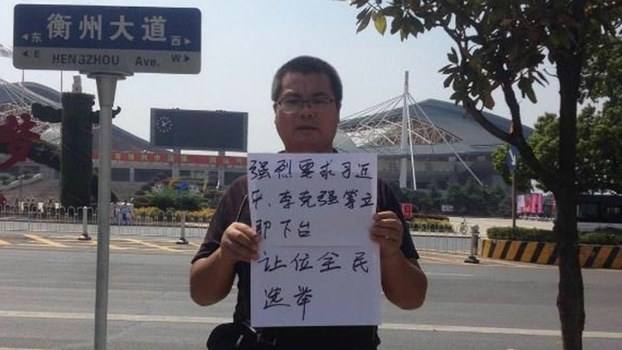
王美余(1981年生,湖南省衡阳市衡阳县关市镇人),多年前自家房屋被强拆、未获合理补偿后开始维权,夫妻二人被列为稳控对象。2018年夏秋,他在湖南省公安厅、长沙师范学院、衢州大道等处举牌,要求习近平、李克强立即下台、让位全民选举,并将照片发到网上,随即被衡阳警方拘押;2018年11月10日他上网披露被拘期间遭受三天三夜断水、电针折磨两个多小时至吐血的细节,此后多次赴长沙的湖南省信访办公室上访、举报警方酷刑。2019年7月8日,他在长沙火车站被衡阳市公安局十余人带走,7月9日凌晨被押回衡阳,7月10日17时以涉嫌寻衅滋事罪被刑事拘留、当晚送衡阳市看守所,7月11日警方搜家并出示拘留通知书。律师三次会见(7月17日、8月、9月初),他报告监室近三十人睡在地上、连卫生纸都没有;8月底前后他被转入单独关押。2019年9月23日凌晨,他死于衡阳市解放军第一六九医院,终年38岁;看守所政委电话通知死讯而未给死因,妻子曹曙霞认尸时见遗体面部受伤、七窍有流血痕迹,只被允许匆匆看一眼,警方施压要她接受「急性疾病意外」之说,她拒绝。当晚妻子与婆婆即被控制在家、手机停机或被扣押;9月25日夜,介入律师谢阳在衡阳酒店被持微冲的特警包围控制、次日被强制送离,另一路律师吴莉在北京被逼迁。赔偿开价有二百多万元(其母对《卫报》语)与二百九十八万元「买断」不再调查(法广报道)两说并列。至今无尸检报告、无独立调查、无人被追责,遗体最终处置无公开记录。中国人权捍卫者要求调查酷刑致死指控,美国国务院2019年度人权报告将本案列入「任意剥夺生命」一节。Wang Meiyu (born 1981; Guanshi Town, Hengyang County, Hengyang, Hunan) became a rights defender after his family home was forcibly demolished years earlier without reasonable compensation; he and his wife were listed as stability-control targets. In the summer and autumn of 2018 he held placards at the Hunan Provincial Public Security Department, Changsha Normal University, Quzhou Avenue and elsewhere, demanding that Xi Jinping and Li Keqiang step down at once and yield to universal elections, and posted the photographs online; Hengyang police detained him at once. On 10 November 2018 he published his account of that detention — three days and nights without a drop of water, electric needles applied for over two hours until he vomited blood — and thereafter petitioned repeatedly at the Hunan Provincial Letters and Petitions Office in Changsha, reporting the police torture. On 8 July 2019 more than ten Hengyang Public Security Bureau officers seized him at Changsha Railway Station; he was taken back to Hengyang in the early hours of 9 July, criminally detained at 17:00 on 10 July on suspicion of 'picking quarrels and provoking trouble,' sent to Hengyang City Detention Center that night, and on 11 July police searched his home and produced the detention notice. His lawyer met him three times (17 July, August, early September); he reported a cell of nearly thirty men sleeping on the floor without even toilet paper, and around the end of August he was moved into solitary confinement. In the early hours of 23 September 2019 he died at the PLA No. 169 Hospital in Hengyang, aged 38. The detention centre's political commissar telephoned the news without giving a cause of death; his wife Cao Shuxia, allowed only a brief glimpse at the identification, saw injuries to his face and blood from his eyes, ears, mouth and nose, and refused the police demand that she accept an 'accident' following an 'acute illness.' That evening she and her mother-in-law were placed under control at home and her phone was disconnected or confiscated; on the night of 25 September the intervening lawyer Xie Yang was held by submachine-gun-carrying special police in a Hengyang hotel and forcibly removed the next day, while a second lawyer, Wu Li, was being evicted in Beijing. The compensation offer survives in two parallel versions — more than two million yuan (his mother to the Guardian) and 2.98 million yuan as a 'buy-out' against any further investigation (RFI). There has never been an autopsy report, an independent investigation or any accountability, and the final disposal of the body is a matter of no public record. Chinese Human Rights Defenders demanded an investigation into the torture allegations, and the U.S. State Department's 2019 human rights report entered the case under arbitrary deprivation of life.
What Happened
The chain of facts in Wang Meiyu's case is not long, but every link bears weight. He was a man of Guanshi Town, Hengyang County, Hunan, born in 1981, whose family home was demolished years ago without reasonable compensation — the event that turned him into a rights defender (Chinese Human Rights Defenders, statement of 26 September 2019; Civil Rights & Livelihood Watch, statement of 24 September 2019). In the summer and autumn of 2018 he held placards at the Hunan Provincial Public Security Department, Changsha Normal University, Quzhou Avenue and elsewhere; the placards demanded that Xi Jinping, Li Keqiang and others step down at once and yield to universal elections, and he posted the photographs online (Civil Rights & Livelihood Watch, 24 September 2019). Hengyang police detained and interrogated him at once. By his own later account he was tortured: three days and nights without a drop of water, electric needles applied for more than two hours, until he vomited blood; after his release he was cut off from the internet for a long time, and only on 10 November 2018 could he write the experience down (Civil Rights & Livelihood Watch, quoting his own text). Afterwards he went repeatedly to the Hunan Provincial Letters and Petitions Office in Changsha to petition — reporting the very torture the police had inflicted on him (Chinese Human Rights Defenders).
On 8 July 2019 he was seized in Changsha by more than ten officers of the Hengyang Public Security Bureau — both Civil Rights & Livelihood Watch and Bitter Winter place the seizure at Changsha Railway Station. In the early hours of 9 July, at about 3 or 4 a.m., he was taken back to the Hengyang Public Security Bureau; according to the family's account, a deputy director locked him in an iron chair for a long time; at 17:00 on 10 July he was criminally detained and that night sent to Hengyang City Detention Center (Civil Rights & Livelihood Watch, 24 September 2019 — single-chain family details, archived in layers on this page). The police gave the family no notice during this period. On 11 July more than ten police searched his home and produced a detention notice naming the charge of "picking quarrels and provoking trouble"; his two young children were badly frightened and could not sleep at night (ibid.). His lawyer met him three times in all: on 17 July, when he described a cell of nearly thirty men sleeping on the floor with no toiletries and not even toilet paper; again in August; and — by his wife's account relayed to the lawyer — by the end of August he had been moved into solitary confinement; a third, final meeting followed in early September (Chinese Human Rights Defenders; Radio Free Asia via his wife).
In the early hours of 23 September 2019, Wang Meiyu died at the People's Liberation Army No. 169 Hospital in Hengyang, aged 38. That day the detention centre's political commissar telephoned his wife, Cao Shuxia, with the news and gave no exact cause of death (Chinese Human Rights Defenders, Chinese-language statement). Cao saw the body the same day: injuries to his face, and traces of blood from his eyes, ears, mouth and nostrils (ibid.). According to information Civil Rights & Livelihood Watch obtained locally in Hengyang, the police lifted the white sheet for her only briefly before taking her away (Civil Rights & Livelihood Watch, 25 September 2019). The police pressed her to accept that his death had been an "accident" following an "acute illness"; she refused (Chinese Human Rights Defenders; Radio Free Asia). His mother, Xiao Xiangrong, fainted when she heard the news (Civil Rights & Livelihood Watch, 24 September 2019).
The controls began the very evening the news broke: Cao Shuxia and her mother-in-law were placed under police control at home, and Cao's mobile phone was disconnected (Chinese Human Rights Defenders) — or, in Civil Rights & Livelihood Watch's version, confiscated, with personnel posted around the home (25 September 2019). On the night of 25 September, lawyer Xie Yang, who had come to Hengyang to offer the family legal help, was surrounded in his hotel room with activist Chen Yanhui by five or six special police officers carrying submachine guns, held overnight, and the next afternoon forcibly put on a high-speed train out of Hengyang (Civil Rights & Livelihood Watch, 26 September 2019; Chinese Human Rights Defenders). A second lawyer on the case, Wu Li, was meanwhile being evicted in Beijing on grounds including that her home was "too close to the Beijing municipal government"; on 27 September police arrived at her rented flat with a sledgehammer (Civil Rights & Livelihood Watch, 28 September 2019). At the same time, the family was being offered money: the Guardian, quoting his mother, put the offer at more than two million yuan; Radio France Internationale reported that officials had proposed 2.98 million yuan in compensation on condition that the family pursue no further investigation (both versions archived in parallel; see the compensation section of this page).
And then — nothing. No autopsy report was published, no investigation announced, no one held to account. On 30 September 2019 Human Rights Watch wrote his death into its account of seventy years of Communist Party repression; in March 2020 the U.S. State Department's 2019 human rights report listed the case among China's representative custodial deaths of the year. In the seven years since, the public record contains no further word on the case. The sections below lay out this short chain link by link: what is confirmed by multiple sources, what rests on a single chain of transmission, and what remains a matter of no public record — including three widely circulated claims for which this page's verification found no evidence at all, each addressed expressly in the Verification Note.
Beginning with a Demolished Home: A Rights Defender from Guanshi Town, Hengyang County
The public material on Wang Meiyu's earlier life is scant, and that scarcity is itself worth recording at the outset: he was not a famous man, nor an activist "discovered" only after his case broke, but an ordinary local petitioner who entered international reporting only by dying. The confirmable skeleton is this. Chinese Human Rights Defenders records that he was 38 and "began his civic activism after his home was forcibly demolished years ago" without reasonable compensation (CHRD statement, 26 September 2019, English and Chinese versions in agreement). Civil Rights & Livelihood Watch adds the geography and the texture: a man of Guanshi Town, Hengyang County, Hengyang, who had long followed human rights issues, supported other people's rights defence and taken part in local civic activities (statement, 24 September 2019); another of its reports gives his birth year as 1981, records that he had earlier been suppressed for collective rights defence, and that he and his wife had long been listed as "stability-control targets" (26 September 2019).
Together these fragments describe a beginning repeated thousands of times across grassroots China: a home demolished, compensation that cannot be agreed, petitions that go nowhere — until a man who only wanted his own family's due starts asking for other people's, and then starts asking why asking itself is treated as enmity. The four characters "stability-control target" are the key to his 2018 and 2019: they mean he was already on the local police list, his movements, his internet use and even his household circumstances under routine surveillance. Everything that followed — the placards, the photographs — happened inside that net. Nor was he ignorant of the price of a placard: by his own account, after the 2018 action, state security officers came to his home with threats and demanded a letter of repentance, and he refused to their faces (Civil Rights & Livelihood Watch, 24 September 2019, quoting his November 2018 account). Knowing the price and continuing is the connection between this man and the characterisation of his case: when he was seized in July 2019, what he was doing was travelling to the provincial petitions office to report police officers for torturing him. In the language of the local stability system, that is refusal to be controlled; in the language of the constitutional text, it is a citizen's complaint against state functionaries for unlawful conduct.
One limit of the record should be stated plainly. His birth year, 1981, rests on Civil Rights & Livelihood Watch alone, but it is consistent with the age of 38 recorded independently by Chinese Human Rights Defenders, the Guardian and Human Rights Watch, and is accepted on that cross-check. His education, his occupation, and the year and circumstances of the demolition of his home are, apart from the report that the couple had both lost their jobs because of his activism (Radio Free Asia via his wife; adopted by the U.S. State Department), matters of no public record, and this page does not invent them. The thinner a page must be about its subject's early life, the more plainly it should say why: not editorial omission, but the fact that the public world retains only this much.
Summer and Autumn 2018: Placards at Three Sites, and the Photographs Posted Online
Wang Meiyu became known to the outside world through a handful of photographs. In the summer and autumn of 2018 he held placards successively at the Hunan Provincial Public Security Department, Changsha Normal University, Quzhou Avenue and other places; the placards' core demand, as Civil Rights & Livelihood Watch relays it, was that Xi Jinping, Li Keqiang and others step down at once and yield to universal elections; he posted the photographs online (Civil Rights & Livelihood Watch, 24 September 2019). Chinese Human Rights Defenders' version differs slightly: in July 2018, in "various places," he held up signs calling for China's top leaders Xi Jinping and Li Keqiang to step down and for national democratic elections to be held, and then posted photos of his protest online (CHRD statement, 26 September 2019, English and Chinese versions). The shared core of the two accounts is hard fact — 2018, placards, several places, the demand for resignation and elections, photographs posted — while the itemised list of sites rests on Civil Rights & Livelihood Watch alone and is archived under its name.
The English-language accounts of the location contradict each other, and this page archives them side by side rather than merging them on the reader's behalf. The Guardian says he stood outside the Hunan provincial police department holding his sign (the Guardian, 27 September 2019, as excerpted by China Digital Times) — matching the first item on Civil Rights & Livelihood Watch's list. The U.S. State Department's 2019 human rights report, by contrast, places the placard outside Hengyang Normal University (U.S. Department of State, 2019 Country Reports on Human Rights Practices: China, March 2020) — a version found in no Chinese-language source, and plausibly a garbling in transmission of the "Changsha Normal University" on the Chinese list; this page records its existence without adopting it as a location. A later NGO written statement in the UN Human Rights Council's document system (A/HRC/44/NGO/55, 2020), recycling the State Department version, went on to misdate his death to 2018 — noted here, as in the Sources section, to show the reader something real: the file of a silenced case deforms as it is copied, and the point of archival work is to label each layer of copying separately.
The immediate consequence of the placards, on the consistent account of both Chinese Human Rights Defenders and Civil Rights & Livelihood Watch, was detention by Hengyang police — "briefly detained" and, he alleged, tortured in custody, in CHRD's words; "detained, interrogated, tortured, and barely survived," in the Chinese outlet's stronger phrasing — followed by months in which his contact with the outside world was cut off (CHRD statement). One internal inconsistency in the Chinese reporting must also be flagged: the same outlet's 26 September 2019 report on the lawyer Xie Yang dates the placard action to "the summer of 2019," conflicting with its own 24 September statement and with CHRD's 2018 chronology. This page takes the fuller 2018 version as its main line and archives the 2019 dating as that outlet's slip — in the summer of 2019, on every other source, what Wang was doing in Changsha was petitioning, not holding placards.
In His Own Words: Three Days and Nights Without Water, Two Hours of Electric Needles
The single most important first-hand document in this case is Wang Meiyu's own writing. On 10 November 2018, after months of enforced silence, he was finally able to get online and tell friends what his detention had involved, including a visit the security police had paid his home that week. Civil Rights & Livelihood Watch's statement of 24 September 2019 transcribed the account in full; this page excerpts only its shortest passage, in translation: five state security officers from the city and county, plus a man from the stability-maintenance office, had come to his house with threats and abuse and demanded letters of repentance and guarantee; of the earlier torment he wrote that they had given him not a drop of water for three days and nights, then tortured him with electric needles for over two hours until he vomited blood — and still he had not yielded (Wang Meiyu, account of 10 November 2018, as transcribed by Civil Rights & Livelihood Watch).
The evidentiary position of this text needs stating clearly. It is the subject's own account: no second, independent material corroborates the details of the electric needles, the water deprivation and the vomiting of blood, and the detaining side was never going to supply records. But it was written ten months before his death, by a man who risked re-arrest by writing it, and it interlocks with his subsequent conduct — he spent the following months repeatedly reporting "police torture" at the provincial petitions office. A man who fabricates torture does not ordinarily carry the fabrication, under his own name, to the provincial government's petition window. This page's treatment is therefore: the account is archived in full under its source; the truth of the torture allegation is left to the independent investigation that never happened; but the existence of the account is itself a confirmed fact, and it is the hardest material beneath the family's and the human rights organisations' later allegation of death by torture — because the death in the detention centre in 2019 was not the sudden death of a man with a blank medical file, but of a man who, ten months earlier, had accused the same police, in writing, of torturing him.
His course of action after the account, on CHRD's record, was to go repeatedly to the Hunan Provincial Letters and Petitions Office in Changsha to petition, reporting the torture the police had inflicted on him (CHRD statement, 26 September 2019). This detail is passed over in one line in most reporting; this page enlarges it deliberately. In the first half of 2019, what Wang Meiyu was doing was something entirely "inside the system" in procedural terms — complaining to a provincial petitions organ about city and county police. And the background against which he was seized in July 2019, on CHRD's assessment, was precisely a nationwide stability-maintenance drive to stop citizens petitioning in Beijing and the provincial capitals before National Day (ibid.). The man complaining about the police was seized, on his way to complain, by the police, under a charge that had changed its name to "picking quarrels" — that line is the key to 8 July 2019.
8 July 2019: Changsha Railway Station, the Iron Chair, and the Pre-Dawn Transfer
On 8 July 2019 Wang Meiyu was seized in Changsha. The place, on both Bitter Winter and Civil Rights & Livelihood Watch, was Changsha Railway Station (Bitter Winter, 26 September 2019; Civil Rights & Livelihood Watch, 26 September 2019, "taken back from Changsha Railway Station into criminal detention"). The hands were those of the Hengyang Public Security Bureau — more than ten officers, on the Chinese outlet's count (24 September 2019). CHRD records only that police "suddenly detained Wang again on July 8, 2019 in Changsha," and assesses the seizure as part of the nationwide pre-National Day crackdown to prevent petitioning in Beijing and the provincial capitals during the "sensitive" period (CHRD statement). A man from Hengyang County, petitioning in Changsha, seized across a jurisdictional line by Hengyang police — that line tells its own story: this was not a Changsha public-order incident, but the settling of a Hengyang account.
The following forty-eight hours are recorded by Civil Rights & Livelihood Watch alone, expressly from the family side, and are archived here as a single chain with their grade stated: at about 3 or 4 a.m. on 9 July he was taken back to the Hengyang Public Security Bureau, where a deputy director locked him in an iron chair for a long period; the police gave the family no notice in this period; the family says his last contact with them was before 6:30 a.m. on 9 July, after which his telephone rang unanswered; at 17:00 on 10 July he was criminally detained, and that night sent to Hengyang City Detention Center (Civil Rights & Livelihood Watch, 24 September 2019). Bitter Winter's version meshes with this with slight variance: he was sent to Hengyang City Detention Center on 10 July, detained for "picking quarrels and provoking trouble" (Bitter Winter, 26 September 2019). CHRD records that on 11 July Hengyang police informed the family that he was being held at Hengyang City Detention Center on suspicion of "picking quarrels and provoking trouble" (CHRD statement). The three dates are in fact three actions in one procedural chain — criminal detention and delivery to the centre on the 10th, notification reaching the family on the 11th — and this page layers them so, rather than writing them up as a contradiction.
The 11th also brought a search. On the family's account as relayed by Civil Rights & Livelihood Watch, more than ten Hengyang police came to Wang's home that day, searched it, and produced a detention notice fixing his charge as "picking quarrels and provoking trouble"; his two young children were frightened and did not dare sleep at night (24 September 2019). This page states its scope of acceptance: the existence of the search and the notice is obliquely corroborated by CHRD's record that police notified the family on 11 July; the number of officers and the children's fright rest on the outlet's family relay alone, Grade-C material, archived as reported. However the details settle, a 38-year-old man had vanished from a railway station in Changsha into a detention centre in Hengyang, on a charge capacious enough to hold placards, petitions and complaints alike — and his family learned where he was only when more than ten police arrived at their door with a search and a notice.
Three Lawyer Meetings: Thirty Men on a Cell Floor, Then Solitary Confinement
The only window the outside world had into the detention was the lawyer's meetings — three in all. CHRD's timetable: the first on 17 July, when he reported very poor conditions in the detention centre; the second in August; the third in early September, and the last (CHRD statement, 26 September 2019). The lawyer's name appears in no public source; this page records it as no public record.
The content of the 17 July meeting survives in a detailed version from Civil Rights & Livelihood Watch: a cell holding nearly thirty men, sleeping on the floor; very poor food; no toothbrush, toothpaste or towel, and not even toilet paper for the latrine; and on 18 July, when the family tried to deposit clothes, money and toilet paper, the detention centre refused to accept them (Civil Rights & Livelihood Watch, 24 September 2019, relaying the post-meeting account). The evidence grading is stated plainly: the date of the meeting and the "very poor conditions" are corroborated by both CHRD and the Chinese outlet; the headcount and the inventory of missing necessities rest on the outlet's single chain. Thirty men on a floor and not a sheet of toilet paper matter here not because they alone constitute an allegation of torture, but because they fix the daily waterline of the institution: the last seventy-seven days of a man who would be pronounced dead of "acute illness" were lived at that waterline.
After the August meeting, something changed. Radio Free Asia, relaying his wife Cao Shuxia: Wang had received two visits from a lawyer after being detained; the lawyer had heard that he was initially held in a large cell with dozens of other inmates; but by the time the lawyer visited again at the end of August, Wang had been transferred to solitary confinement (RFA, late September 2019, as relayed by China Digital Times and Human Rights Watch; the U.S. State Department report likewise records that "Wang's lawyers learned he was moved from a large cell with many other inmates to solitary confinement"). Between this relay and CHRD's count of three meetings there is a seam no public material can close: the wife's "two visits," followed by the end-of-August visit, may be the same meeting as CHRD's "early September" third meeting under different datings in different relays, or two adjacent visits — this page archives both versions side by side. What can be fixed is the trend, on which the sources agree: around the end of August he was moved from the large cell into solitary confinement — and solitary confinement means no cellmate could see him, so that from then on his physical condition existed only in the detention centre's own telling. A little over three weeks later, he was dead.
23 September: Dead Before Dawn at the No. 169 Hospital, One Glimpse of the Body, and the "Acute Illness" Account
23 September 2019 was a Monday. On the account of his wife Cao Shuxia as carried in CHRD's Chinese-language statement, she received a telephone call from the political commissar of Hengyang City Detention Center telling her that Wang Meiyu had died in the early hours of that day at the People's Liberation Army No. 169 Hospital in Hengyang, and the detention centre gave the family no exact cause of death (CHRD statement, 26 September 2019, Chinese version). The Guardian's version agrees: the wife received a police call saying he had died at a military hospital in Hengyang, and the officer on the phone offered no explanation of the cause of death (the Guardian, 27 September 2019, as relayed by China Digital Times). His exact time of death, when he was transferred from the detention centre to the hospital, and what treatment he underwent there are all matters of no public record — a detainee's medical trajectory on the day of his death ought to be among a detention centre's most basic record-keeping duties; in this case it is a blank.
Cao Shuxia saw the body that day. CHRD records that she saw injuries to his face and traces of blood from his eyes, ears, mouth and nostrils, and that the family inferred he had been beaten to death (CHRD statement, English and Chinese versions). The sentence she spoke to Radio Free Asia was afterwards quoted across the human rights press; this page gives only its gist and its shortest line: the body was "totally unrecognizable," like another person; she had not been allowed to bring her mobile phone in, there were many police officers present, and they stopped her from getting close (RFA, as relayed by China Digital Times; the same interview quoted by Human Rights Watch, 30 September 2019). The information Civil Rights & Livelihood Watch obtained locally in Hengyang adds the staging: the police lifted the white sheet and let the wife look only briefly before taking her away; she told local people that blood had come from all seven openings of his head, that there were bruises and injuries on his face and head, and that outwardly this was no ordinary death (Civil Rights & Livelihood Watch, 25 September 2019). The three versions differ in detail but share one skeleton: the viewing was strictly controlled, the body was injured and bleeding from the openings of the head, and the family disbelieved "ordinary death" on the spot.
The police's formal account to the family must also be layered precisely. CHRD records that police pressured Cao Shuxia to accept that Wang's death had been an "accident" following an "acute illness," and that she refused (CHRD statement). RFA's relay is shorter — police pressured her to accept the death as an "accident," and she refused (RFA via China Digital Times). This page must at this point correct a widely circulated claim: some second-hand materials specify the official explanation as "cerebral haemorrhage." In this verification, across CHRD's English and Chinese statements, Civil Rights & Livelihood Watch's statement and three reports, the Guardian, Bitter Winter, the RFA relay chain and the U.S. State Department's annual report, those words appear nowhere. The most specific official formulation in the public record stops at "acute illness" — and even that exists only in the family's relay, never confirmed in any official document, announcement or answer to journalists. This page archives accordingly: at the documentary level, an official cause of death does not exist to this day. His mother, Xiao Xiangrong, fainted on hearing the news; his wife, weeping on the telephone, told people she believed they had beaten him to death (Civil Rights & Livelihood Watch, 24 September 2019, recording the substance of her tearful call).
The Seventy-Two Hours After: A Family Placed Under Control, a Lawyer Held at Gunpoint, a Lawyer Evicted
What an institution does after a custodial death says more about the institution than the death itself. In this case every step of the following seventy-two hours is on record, and this page lays them out in time order. The evening of 23 September: Cao Shuxia and Wang's mother were placed under police control at home, and Cao's mobile phone was immediately disconnected (CHRD statement, citing the organisation's sources). The Civil Rights & Livelihood Watch version: the telephones of wife and mother could no longer be reached; well-sourced information indicated the two women had been placed under stability-maintenance control that same evening, the wife's phone confiscated by police, personnel posted around the Wang home strictly controlling comings and goings and especially wary of strangers and out-of-towners; a local friend who managed to visit was made to leave after a brief exchange (25 September 2019). "Disconnected" and "confiscated" are two relays of one fact, archived side by side: either way, from the evening of 23 September, a family that had just lost its son was cut off from the outside world. Rights defenders and activists across Hunan were warned and restricted from taking part in the matter, and one active citizen in Hengyang was already under control, reportedly required to stay silent because police suspected him of spreading the news (ibid.).
On the night of 25 September it was the lawyers' turn. Xie Yang, a lawyer of the "709 case," intended to intervene and provide the family with legal services; he had made contact with the family through an informed intermediary and sent a blank letter of entrustment into the Wang home — but the family was under such tight control that the signed entrustment could not be sent out (Civil Rights & Livelihood Watch, 26 September 2019). At about ten that night, Xie and an assistant surnamed Chen checked into the Shenlong Hotel on Zhengxiang North Road, Hengyang; at about eleven, as the two discussed the case in the room, five or six special police officers carrying micro-submachine guns burst in, ordering them not to move, then withdrew to stand guard in the corridor; officers identifying themselves as Hengyang Public Security Bureau state security personnel checked their identity cards and instructed the special police to keep watch, the room sealed, with hotel security and plain-clothes men posted at the lifts and stairwells; by about 1 a.m. on the 26th, both men's telephones went unanswered; on the afternoon of the 26th, police of both Hengyang and Changsha (Changsha state security reportedly having travelled down) forcibly put the two on a high-speed train out of Hengyang, warning them not to intervene in the case or bear the consequences — in the end, following Xie's pre-arranged itinerary, onto a train for Yongzhou (ibid.). The duration and the companion's identity differ between sources: CHRD gives fourteen hours out of contact, release at about 3 p.m. on the 26th, and names the companion as activist Chen Yanhui; Civil Rights & Livelihood Watch gives more than seventeen hours under control, the train at past four in the afternoon, and an "assistant surnamed Chen." Both are archived in parallel; their shared core is confirmed fact: a lawyer carrying an entrustment letter not yet signed spent the night guarded by gun-carrying special police in a hotel in the dead man's home city, and was then escorted onto a train.
A second legal team was being pressed by the same hand a thousand kilometres away. Civil Rights & Livelihood Watch records that Shandong lawyer Wu Li and another lawyer surnamed Hu actively intervened in the case and were in contact with the family when Wu's rented home in Beijing came under eviction pressure: on 25 September, shortly after she left Beijing, she received a call from the local Yunhe police station ordering her to move out immediately, on the ground that the flat was too close to the Beijing municipal government; at noon on 26 September, while she was working on the case in Hengyang, her landlord and agent relayed a further police demand to vacate, the reason now changed to subdivided partitions affecting building safety; that evening she was forced to hurry back to Beijing; on 27 September numerous police officers and auxiliaries, bringing a large sledgehammer, forced their way into her Tongzhou rented home and demanded she move out, and after much dispute she was compelled to leave on payment of the contract's breach compensation (Civil Rights & Livelihood Watch, 28 September 2019). The same report adds that a lawyer in the south who posted on social media that he was preparing to travel north in support received a call from his local police within ten minutes ordering him to cancel, followed by an inquiry call from his justice bureau (ibid.). This section rests mainly on the single chain of Civil Rights & Livelihood Watch, with the Xie Yang episode separately corroborated by CHRD's statement; the Wu Li eviction has no second source and is marked single-source accordingly. One case, seventy-two hours: a family cut off, an injured body no one may examine, the first lawyer escorted away by special police, the second lawyer evicted with a sledgehammer, and a lawyer who merely offered support silenced by telephone within ten minutes — that is not aftermath management; it is a complete silencing operation.
Two Figures for the Compensation: "More Than Two Million" and 2.98 Million
Running in parallel with the silencing was an offer of money. The compensation figure survives in the public sources in two versions, which this page sets side by side and never merges. Version one: the Guardian reported that Wang Meiyu's mother told the paper the family had been offered compensation of more than two million yuan, which the paper converted as about $220,000 (the Guardian, 27 September 2019, as relayed by China Digital Times; this page notes that the conversion does not match its own yuan figure — two million yuan at the exchange rate of the time was roughly $280,000 — and archives both the figure and the conversion as printed, without correcting another newspaper's arithmetic). Version two: Radio France Internationale's Chinese service reported that officials were said to have proposed compensation of 2.98 million yuan, as a "buy-out" to bar the family from pursuing any further investigation (RFI, 28 September 2019; its headline itself carries the character for "reportedly," marking the hearsay grade; the "picking quarrels" entry on Wikipedia cites this report). The U.S. State Department's 2019 human rights report adopted the 2.98 million figure, stating that his mother said she was offered 2.98 million yuan, about $420,000 (U.S. Department of State, March 2020).
The relation between the two figures cannot be established from public material: they may be different moments in one negotiation (an opening "over two million," later fixed at 2.98 million), different numbers heard by different relatives (mother versus wife), or an error in one relay. This page fixes only three things. First, the existence of an offer is multiply supported — the Guardian took it directly from his mother, and RFI's "buy-out" account appeared independently. Second, the specific figure of 2.98 million yuan has two chains behind it, RFI and the State Department. Third — and most important — in RFI's reporting this money was not condolence: its stated consideration was explicit, that there be no further investigation. Whether the family ultimately accepted any sum, or signed any agreement, is as of this verification a matter of no public record, and this page records exactly that: it writes neither "the family accepted compensation" nor "the family refused to the end." What can be written is that on 23 September itself, Cao Shuxia refused the "acute illness accident" account of the death — refusing a cause of death and accepting or refusing money are two different things, and an archive must not conflate them.
The Family: Cao Shuxia, Xiao Xiangrong, and Two Children Who Could Not Sleep
The family receives its own section because in this case the treatment of the family was not collateral damage but part of the procedure itself. First, employment: before Wang Meiyu died, he and his wife had already both lost their jobs because of his rights activism (RFA, relaying Cao Shuxia; adopted by the U.S. State Department). Then the search: on 11 July 2019 more than ten police searched the home and produced the detention notice, and the two young children were frightened and did not dare sleep at night (Civil Rights & Livelihood Watch, 24 September 2019, family account). The children's ages have one anchor from RFA: the elder was just 11 (RFA, as relayed by China Digital Times). Then the news of death: his mother Xiao Xiangrong fainted (ibid.); his wife, at the identification, was forbidden to bring in her mobile phone, was surrounded by police, and was not allowed near the body (RFA relay); after the identification she was pressed to accept the "accident" account, and refused (CHRD statement).
Then came the long end of it: from the evening of 23 September, wife and mother-in-law were held under control at home (CHRD and Civil Rights & Livelihood Watch in agreement). The U.S. State Department's 2019 report goes one step further, recording that Cao Shuxia and her two children were reportedly placed under house arrest after his death (U.S. Department of State, March 2020, with "reportedly" in its own wording, archived here at relay grade). After September 2019 the family vanishes entirely from the public record: whether Cao Shuxia ever spoke again, where the children go to school, how the grandmother's health is, whether the compensation was ever settled, where Wang Meiyu's body was finally laid to rest — all matters of no public record. This page's position on writing about families is the same as across this site: they are private people, not public figures, and their silence is a circumstance, not material; this section records only sourced facts of pressure. The one judgment to be left standing is this: from the search that terrified two children, to the severing of the whole family's contact with the outside world on the night of the death notice, this case never dealt with Wang Meiyu alone — the radius of the punishment was drawn out to his eleven-year-old child.
International Reaction: From CHRD's Statement to the U.S. State Department's Annual Report
The international reaction to this case was concentrated in a single week in late September 2019; it was not thin, but it stopped entirely at statements and reporting, and it bought no investigation. In time order: on 24 September, Civil Rights & Livelihood Watch issued a statement of strong protest demanding an independent investigation committee — including independent civilian investigators, lawyers, human rights defenders and the victim's family — to establish the cause of death, and a nationwide review of torture in detention centres (24 September 2019). On 25–26 September, Chinese Human Rights Defenders first reported the custodial death via social media and then, on 26 September, issued its bilingual statement demanding that the Chinese government investigate the allegations of torture and the death in detention, hold the perpetrators of torture and extrajudicial killing criminally accountable, and lift the physical restrictions on the family — pointing out China's obligations to investigate promptly and impartially as a party to the Convention Against Torture and a member of the UN Human Rights Council (CHRD, 26 September 2019). On 27 September the Guardian published its report, drawing on his mother and his lawyer and placing the case in the sequence of custodial deaths of Cao Shunli, Liu Xiaobo and Ji Sizun (the Guardian, 27 September 2019). Radio Free Asia published its interview-based report on Cao Shuxia in the same days (RFA, late September 2019). On 28 September RFI reported the 2.98-million-yuan "buy-out" (RFI, 28 September 2019). Freedom House's China Media Bulletin for September 2019 carried the case (Freedom House, September 2019).
On 30 September, Human Rights Watch, writing at the seventieth anniversary of the People's Republic, named the case in its commentary: 38-year-old Wang Meiyu had died less than three months after police detained him in Hunan, and his widow's words were quoted — he had gone in a healthy, normal man, and his body was totally unrecognizable (Human Rights Watch, 30 September 2019). In March 2020 the U.S. State Department's 2019 Country Reports on Human Rights Practices entered the case in its section on arbitrary deprivation of life: bleeding from the eyes, mouth, ears and nose, bruises on the face, the transfer from a large cell to solitary confinement, the 2.98-million-yuan offer to his mother, the couple's lost jobs, the reported house arrest of mother and children — the State Department's paragraph remains, in effect, the fullest English-language archival record of the case in any official file (U.S. Department of State, March 2020). Beyond that, the UN Human Rights Council's document system contains only an NGO written statement relaying the case, with errors of year and place in the relay (A/HRC/44/NGO/55, 2020, flagged in the main text of this page); there is no public record of any UN Special Procedures communication to the Chinese government on this case, and no public record of any foreign government imposing sanctions or accountability measures over it — both items are recorded here as no public record.
Not an Isolated Case: The Custodial-Death Pattern to Which This Case Is Documentarily Linked
This site's discipline is that pattern analysis uses only material with a direct documentary link to the case in hand, never generalities. Wang Meiyu's documentary links are unusually explicit, because the organisations that spoke at the time all placed him in a ready-made list. CHRD's statement wrote that his death followed a hardened pattern — detainees tortured to death in custody, the torturers and responsible officials enjoying essentially total impunity, families blocked from information, intimidated, and unable to investigate — and named the recent parallel cases in Liaoning, where after two activists died in suspicious circumstances in detention in October 2018 and January 2019, the authorities reportedly covered up the deaths, blocked information, intimidated the families and refused to investigate or prosecute (CHRD statement, 26 September 2019). The long list in the same statement includes Ji Sizun, the Fujian rights defender who died in July 2019, two months before Wang; the Uyghur scholar Muhammad Salih Hajim in 2018; Liu Xiaobo and Yang Tongyan in 2017; Peng Ming in 2016; Tenzin Delek Rinpoche in 2015; and Cao Shunli in 2014 (ibid.). The Guardian's sequence was broadly the same (the Guardian, 27 September 2019).
Two links in that list grip this case most tightly. The first is the precedent in Hunan itself: in 2012, Shaoyang democracy activist Li Wangyang, a year out of prison, was found dead in a hospital ward; the authorities called it suicide by hanging, and his body was cremated swiftly over his family's objections. Civil Rights & Livelihood Watch's statement on Wang Meiyu placed the two cases side by side directly, remarking that Hunan's authorities persecuting democracy and rights defenders to death was "not uncommon" (24 September 2019). Same province, same category of person, the same family disbelief, the same absence of any independent investigation. The second link is structural: in Cao Shunli's case, the whereabouts of the body were at one point unknown and the family was blocked from seeing it; in Wang Meiyu's, the identification was a single brief glimpse of a lifted sheet, with no telephone allowed in. Set side by side, these two links are not rhetoric: they show that none of this case's "anomalies" — no cause of death given, a time-limited viewing of the body, a family cut off, lawyers driven away, an offer to buy silence — was a Hengyang invention. They are a standard disposal procedure, run repeatedly, in many places, across many cases. Wang Meiyu is the procedure's umpteenth name; this site files Cao Shunli as its Case 120 and Wang Meiyu as its Case 131 on the same archival line for exactly that reason.
Current Status: No Investigation, No Conclusion, No Sequel
As verified by this site on 7 November 2026, almost everything that can be written in this case's "current status" is a negative. Investigation: no independent investigation has ever been announced; CHRD's demand of 26 September 2019 and Civil Rights & Livelihood Watch's demand for an independent committee both trail off into silence. Autopsy: no autopsy report or forensic conclusion has been made public; whether the family ever formally applied for an autopsy, and whether it was permitted, are matters of no public record. The body: its place of keeping after the identification, and the manner and date of its final disposal — including whether and when it was cremated, and where the ashes rest — are all matters of no public record. This site states expressly: second-hand materials in circulation speak of a "forced cremation of the body"; in this verification, across all primary and secondary sources, no basis for that claim was found, and it is treated here as no public record and not written into the factual layer. Responsibility: no officer of Hengyang City Detention Center or of the Hengyang Public Security Bureau has ever been publicly investigated, disciplined or prosecuted. Compensation: the existence of an offer is multiply supported (see the compensation section of this page); whether it was ever concluded, for what sum, and on what terms, is a matter of no public record. The family: after September 2019 there has been no public word of Cao Shuxia, Xiao Xiangrong or the two children. The authorities: no organ of the Chinese government, of Hunan Province or of Hengyang City has ever issued any public notice, statement or reply on this case.
That is all. A 38-year-old man held up placards, posted photographs and petitioned; in the summer of 2019 police took him from a railway station, and seventy-seven days later he died, injured, in a military hospital — and then his case, together with his family, was erased from the public world. What this page can do is to sort every surviving fragment of the period before the erasure by source and grade, and file it; what it cannot do, and will not do, is fill the blanks with imagination. The blanks themselves are part of this case's current status.
Our Take
To judge the Wang Meiyu case, begin with how "heavy" what he did actually was. He had no organisation, no funding, no weapon; even his slogans were held up by hand: one placard, reading that the supreme leader should step down and yield his place to universal elections; a few photographs, posted on the open internet; and then trips to the petitions window of the provincial government, to report that the police had beaten him. Those three acts — expression, documentation, complaint — are called citizens' rights in any constitution one picks up; on the detention notice in Hengyang they were called "picking quarrels and provoking trouble." If a regime must send more than ten officers across a city boundary to seize a man for holding up a placard, lock him in a cell where thirty men sleep on the floor, and then move him into solitary confinement, what it fears is plainly not what this man could do, but what would happen if the sentence on his placard could be said aloud in public. Wang Meiyu's entire "crime" was to lift a thought that could only be thought in private up in front of the Hunan Provincial Public Security Department.
The second account to settle is the completeness of the disposal of his death — because it is too complete to read as improvisation; it reads as a drilled procedure. The notification call gives no cause of death. The identification lifts the sheet for one glimpse, with no telephone admitted and no approach allowed. Four characters — "acute illness, accident" — are presented to the widow on the spot for her signature of assent. She withholds it, and that evening the whole family loses contact with the world, with watchers posted at the door. A lawyer enters the city carrying an entrustment letter, and special police carrying submachine guns are waiting for him at his hotel. A second lawyer is evicted in Beijing with a sledgehammer. Within days the compensation offer arrives, its condition being that there be no investigation. Every step has its personnel, its timestamp, its executors — a machine running this smoothly is not running for the first time. It ran when Li Wangyang's body was seized and cremated in Shaoyang; it ran when Cao Shunli's body could not be located in Beijing. In Wang Meiyu's case it did not even need to seize the body, because the earlier links sufficed: once the family is cut off, the lawyers cannot enter, and no photograph can be taken, the truth is left with a single, official version — and the authorities were too idle even to give that version documentary form. "Acute illness" was spoken to a wife who had just identified her husband's body, and having been spoken, it could cease to exist.
The third account is the 2.98 million. If RFI's report is accurate, the nature of that money, as the family would have heard it, admits no ambiguity: it was not buying a burial, it was buying silence — no investigation, no autopsy, no more lawyers entering Hengyang. A 38-year-old life, the father of two children, a household's whole income, is priced in this ledger at 2.98 million yuan, with a rider: take the money, and you may no longer ask how he died. This site cannot confirm whether the transaction was ever concluded — but the offer itself has already made its confession. An authority genuinely certain that a detainee died of acute illness does not need to spend nearly three million yuan buying "no investigation." A family whose man truly died of illness asks for the medical records; only a death that is not clean needs to be bought out. Seven years on, this case has no investigation, no conclusion, no accountability, and not even a public record of where the body went — the completeness of the silencing operation is its own verdict. This site lists Wang Meiyu as its Case 131 and Cao Shunli as its Case 120: five years and more than a thousand kilometres apart, and not separable from the same procedure. This site will continue to track any new public record in this case, and will add each item as it is verified.
Verification Note
This page was last verified on 7 November 2026. Evidence grading: Grade A, government and international-institution documents (the U.S. Department of State's 2019 Country Reports on Human Rights Practices: China, March 2020, whose Wang Meiyu passage compiles media and family accounts and is used here as an official archival record, with its relayed character noted item by item). Grade B, contemporaneous statements and reporting by international human rights organisations (Chinese Human Rights Defenders, bilingual statement of 26 September 2019; Human Rights Watch commentary of 30 September 2019). Grade C, contemporaneous news reporting and public statements by the subject and his family (the Guardian, 27 September 2019; Radio Free Asia's interview-based report on Cao Shuxia, late September 2019; Radio France Internationale, 28 September 2019; Bitter Winter, 26 September 2019; Wang Meiyu's own account of 10 November 2018). Grade D, Chinese-language rights-media reporting and statements (Civil Rights & Livelihood Watch: statement of 24 September 2019 and reports of 25, 26 and 28 September 2019, many details resting on single chains from the family and local sources). Key facts are given two or more independent sources wherever possible; single-source claims are attributed at each occurrence in the main text. The original pages of the Guardian and of Radio Free Asia could not be read directly in this verification; the content attributed to them was checked through China Digital Times' newsletter of 28 September 2019 quoting both, cross-checked against Human Rights Watch and the U.S. State Department report, and every detail surviving only in a relay chain is marked "as relayed" in the text.
The known conflicts of account in this case, and this page's treatment of each, are listed in full. (1) The wife's name: every contemporaneous source gives Cao Shuxia (曹曙霞). This site's commissioning brief originally rendered it "Cao Xiaomin"; verification shows that to be an error, and this page takes Cao Shuxia as its main line, recording the correction here. (2) The placard sites: CHRD gives "various places" in 2018; Civil Rights & Livelihood Watch itemises the Hunan Provincial Public Security Department, Changsha Normal University and Quzhou Avenue (summer–autumn 2018); the Guardian gives the front of the Hunan provincial police department; the U.S. State Department gives Hengyang Normal University — a version found in no Chinese-language source and plausibly a transmission garbling of "Changsha Normal University." All four are archived in parallel; the argument of this page rests on the itemised list and the core shared by the two organisations. (3) The year of the placards: the Chinese outlet's 26 September report writes "the summer of 2019," conflicting with its own 24 September statement and CHRD's 2018 chronology; this page takes 2018 as its main line and archives the 2019 dating as that outlet's slip. (4) The place and manner of the seizure: CHRD records only a detention in Changsha on 8 July; Civil Rights & Livelihood Watch gives more than ten Hengyang officers seizing him in Changsha, and both that outlet and Bitter Winter name Changsha Railway Station — the station detail has two sources in agreement and is accepted with attribution. (5) The dates of delivery to the centre and notification: the Chinese outlet gives criminal detention at 17:00 on 10 July and delivery to the centre that night; Bitter Winter gives delivery on 10 July; CHRD gives family notification on 11 July — layered on this page as one procedural chain: detention and delivery on the 10th, notification reaching the family on the 11th. (6) The iron chair: a deputy director locking him in an iron chair for a long period after the pre-dawn transfer on 9 July appears only in the Chinese outlet's family-side narrative — single chain, archived as such. (7) The count of lawyer meetings and the solitary confinement: CHRD records three meetings (17 July, August, early September); RFA, via the wife, records two lawyer visits and, at a further visit at the end of August, his transfer to solitary confinement — the seam between the two counts cannot be closed with public material, and both are archived side by side; this page treats as established only the trend on which they agree, the transfer to solitary confinement around the end of August. (8) The telephone: CHRD has Cao Shuxia's phone "disconnected," Civil Rights & Livelihood Watch has it "confiscated by police" — archived in parallel. (9) The duration of Xie Yang's control and his companion's identity: CHRD gives fourteen hours out of contact, release at about 3 p.m. on 26 September, and names the companion as activist Chen Yanhui; the Chinese outlet gives more than seventeen hours under control, the forced train departure at past four that afternoon, and an "assistant surnamed Chen" — both archived in parallel, their shared core (armed special police surrounding the hotel on the night of the 25th, forced removal from Hengyang the next day with a warning not to intervene) being confirmed fact. (10) The compensation figures: the Guardian, quoting the mother, gives more than two million yuan (its own conversion of about $220,000 does not match its yuan figure and is archived as printed); RFI gives 2.98 million yuan as a "buy-out" against further investigation, and the U.S. State Department adopted the 2.98-million figure — the two figures are archived in parallel, never merged and never reconciled by conjecture. (11) The official cause of death: CHRD and RFA both record police pressing the family to accept an "accident" following an "acute illness" (急病); the Guardian records that the notification call gave no cause at all. This site records an express correction: the version circulating in second-hand materials, that "the authorities said cerebral haemorrhage," is found in none of the sources checked in this verification and is not adopted; readers citing this page are asked not to repeat it. (12) Cremation of the body: the version circulating in second-hand materials, that "the body was cremated under pressure," is likewise found in none of the sources checked — the disposal of the body after the identification is a matter of no public record, and this page treats it as such, expressly, to prevent error from propagating. (13) The characters of his name: CHRD and Civil Rights & Livelihood Watch both write 王美余 (Wang Meiyu); a few second-hand English lists (such as the Wikipedia list of dissidents) write 王美雨, evidently in error; this page takes 王美余 as its main line. (14) The level of his home place: the Chinese outlet gives Guanshi Town, Hengyang County, Hengyang; English-language sources give only Hengyang, Hunan — this page takes the county-and-town level from the Chinese outlet with attribution. An NGO written statement in the UN system (A/HRC/44/NGO/55) misdates his death to 2018 in relaying the case; this page mentions it only as an instance of transmission error and adopts none of its content.
Matters of no public record: Wang Meiyu's exact time of death and the course of his transfer from the detention centre to hospital and of any treatment before death; the text of any autopsy report, death certificate or forensic conclusion; any official written announcement on this case; the keeping and final disposal of the body after the identification (including whether and when it was cremated, and where the ashes rest); the name of the lawyer who met him three times in 2019; whether the family accepted compensation or signed any agreement; the names of the Hengyang Public Security Bureau deputy director and of the detention centre's political commissar; the year and circumstances of the demolition of his home, and his education and occupation; the lives of Cao Shuxia, Xiao Xiangrong and the two children after September 2019; any record of a UN Special Procedures communication to the Chinese government on this case; and any record of any responsible person being investigated or held to account. Each of these is recorded on this page as "no public record," and none is filled in by conjecture.
Sources
Chinese Human Rights Defenders (CHRD): "China: Order Independent Investigation into Death in Detention of Hunan Activist" / 《中国政府必须立即对王美余非正常死亡事件进行公正调查》, bilingual statement issued 26 September 2019 (Chinese version updated 2 October 2019) — the principal source for this page's timeline skeleton, Cao Shuxia's identification of the body and refusal of the "acute illness" account, the control imposed on the family, the three lawyer meetings, and the placards and the petitioning against police torture.
Civil Rights & Livelihood Watch (Minsheng Guancha): statement 《彻查王美余死因 给国民以真相》, 24 September 2019 (the three placard sites; the transcription of his torture account of 10 November 2018; the details of the seizure, transfer, iron chair and search of 8–11 July; the content of the 17 July lawyer meeting; Xiao Xiangrong's fainting); 《王美余遗体七孔流血 多人被维稳》, 25 September 2019 (the brief glimpse at the identification; the control of the family and the province-wide stability measures); 《谢阳介入「王美余死亡案」遭特警包围》, 26 September 2019 (the hotel special-police episode; the blank entrustment letter; the background of his 1981 birth and the couple's status as stability-control targets); 《疑因介入王美余案吴莉被逼迁》, 28 September 2019 (the intervention of Wu Li and the lawyer surnamed Hu, and the forced eviction in Beijing).
The Guardian: report by Lily Kuo, 27 September 2019 (the placard outside the Hunan provincial police department; no cause of death given in the notification call; the mother stating a compensation offer of more than two million yuan) — the original checked through the excerpts in China Digital Times' newsletter of 28 September 2019.
Radio Free Asia (RFA): interview-based report on Cao Shuxia, late September 2019 ("totally unrecognizable"; not allowed to bring in a telephone or approach the body; the lawyer visits and the transfer to solitary confinement; the couple's loss of their jobs over his activism; the elder child aged 11) — checked through China Digital Times' relay and cross-checked against Human Rights Watch and the U.S. State Department report.
Radio France Internationale (RFI), Chinese service: report of 28 September 2019 (the report that officials proposed 2.98 million yuan in compensation as a "buy-out" barring further investigation); cross-checked through the citation in Wikipedia's "picking quarrels and provoking trouble" entry and the U.S. State Department report's adoption of the same figure.
Bitter Winter: "Suspicious Deaths During Detention Become the Sad Norm," 26 September 2019 (the arrest at Changsha Railway Station on 8 July; delivery to Hengyang City Detention Center on 10 July; the wife's account of the warning against taking photographs).
Human Rights Watch: "China's Communist Party Is as Shadowy and Repressive as When It Took Power 70 Years Ago," 30 September 2019 (aged 38; death less than three months after detention; the widow's words). U.S. Department of State: 2019 Country Reports on Human Rights Practices: China, March 2020 (the official archival compilation of this case: the placard site given as Hengyang Normal University; the 2.98-million-yuan offer; the transfer to solitary confinement; the reported house arrest of the mother and children). Freedom House: China Media Bulletin, September 2019 issue (the case as carried). UN Human Rights Council document A/HRC/44/NGO/55 (2020), an NGO written statement relaying this case with errors of year and name in the relay, cited on this page only as an instance of transmission deformation and adopted for no fact. No more than fifty words have been quoted from any single source on this page; facts are presented by paraphrase with attribution.