
第145案 | 哈木拉提·吾甫尔Case 145 | Halmurat Ghopur
哈木拉提·吾甫尔(Halmurat Ghopur,维吾尔文خالمۇرات غوپۇر),1960年3月生于乌鲁木齐,维吾尔族医学家:早年在上海中医药大学学中医,1988年赴圣彼得堡巴甫洛夫第一国立医科大学攻读免疫学与呼吸医学博士;主攻哮喘等呼吸系统疾病,主持二十六个以上课题、著书九部、发表论文一百五十篇以上,参与创办两家维药企业并推动创设新疆医科大学维吾尔医学系科。2005年他成为新疆首位国家自然科学基金杰出青年学者基金获得者,2011年获中国科学院院士候选提名,2013年起任自治区十二届人大常委,2016年还曾以受表彰者的形象出现在央视采访中。任职口径各源不一:中英文维基百科作新疆医科大学副校长(1998—2008)、校长(2008—2017)、2017年转任自治区药监局局长;自由亚洲电台、维吾尔人权项目与关注科学家委员会则作药监局检验监督部门负责人、新疆医科大学附属医院前院长,本站并列存档不强行合并。2017年夏,中国政法大学教授吴丹红发文指其为潜伏的「两面人」,称他因与校党委书记李兵(已于2017年3月以受贿三百万元获刑十年以上)的路线分歧而「陷害」对方。2017年11月,国安警察从他的办公室将他与电脑一并带走:据目击转述,警察当面称他「显露民族主义倾向」,并念出被监听的他与一名海外学生的微信往来;其兄迪里夏提·迪隆·吾甫尔2020年向加拿大国会作证时则称失踪日期为2017年12月10日,两说并列存档。2018年9月28日,自由亚洲电台报道:他出现在一部供全疆干部必看的官方「政治学习」影片中,片中称他因图谋在2030年前「建立穆斯林哈里发国」被判死刑、缓期二年执行,另有官方文件口径称其「潜伏三十三年、图谋建国自任领袖」;判刑时点据报在2018年初,但正式罪名、审判法院、审判日期与判决书全部无公开记录,官方从未就本案发布任何正式文件。本站任务简报所称「无期徒刑」与「泄露国家秘密」,经查无任何可靠来源记载,已在正文纠正存档。家庭代价惨重:其子、附属医院医生帕尔万·哈木拉提2019年11月被强迫失踪,其叔父与表亲2018年失踪,其母在悲痛中于2019年8月31日逝世,其兄2020年7月18日向加拿大国会提交证词请求释放全家。国际反应包括世界维吾尔代表大会2018年2月声明、关注科学家委员会致中国国家主席公开信、维吾尔人权项目2018年10月报告、新疆受害者数据库第253号条目与香港中文大学和声书院学生会2019年9月声援;本站以四种拼法检索CECC与USCIRF公开数据库,未检得其个人条目,不虚列。截至2026年11月,死缓的减刑或执行状态、关押地点、健康与探视情况全部无公开记录,他仍在押、下落不明、未获释。Halmurat Ghopur (Uyghur: خالمۇرات غوپۇر; Chinese: 哈木拉提·吾甫尔), born in March 1960 in Urumqi, is an Uyghur medical scientist: he studied Chinese medicine at the Shanghai University of Traditional Chinese Medicine and from 1988 took a doctorate in immunology and respiratory medicine at the Pavlov First State Medical University of St. Petersburg; working chiefly on asthma and other respiratory diseases, he completed more than 26 research projects, wrote nine books and published over 150 papers, co-founded two Uyghur pharmaceutical companies and helped establish the Uyghur Medicine department at Xinjiang Medical University. In 2005 he became the first scientist from Xinjiang to receive the National Natural Science Foundation's Distinguished Young Scholar Fund; in 2011 he was an academician candidate of the Chinese Academy of Sciences; from 2013 he sat on the Standing Committee of the regional people's congress; and in 2016 state broadcaster CCTV was still interviewing him as a loyal exemplar. The sources disagree on his posts: the two Wikipedias make him vice-president (1998–2008) and then president (2008–2017) of Xinjiang Medical University, moving in 2017 to direct the regional Food and Drug Administration, while RFA, UHRP and the Committee of Concerned Scientists make him head of the FDA's inspection and supervision department and former president of the university's affiliated hospital — this archive records the accounts in parallel and forces no merger. In the summer of 2017, law professor Wu Danhong published an article branding him a hidden 'two-faced official,' alleging he had framed the university's Party secretary Li Bing (sentenced in March 2017 to over ten years for a 3-million-yuan bribe) after disputing Li's hard line. In November 2017 state security police took him from his office together with his computer: on the eyewitness relay, an officer told him to his face that he had exhibited 'nationalistic tendencies' and read back his monitored WeChat exchanges with a student abroad; his brother Dilshat Dillon Hopur, testifying to Canada's Parliament in 2020, instead dated the enforced disappearance to 10 December 2017, and the two accounts are archived in parallel. On 28 September 2018 RFA reported that he had appeared in an official 'political study' film required viewing for all cadres in the region, in which he was said to have been sentenced to death with a two-year reprieve for plotting to 'create a Muslim Caliphate' by 2030, while another official document reportedly accused him of thirty-three years of concealed intent to found a state and lead it; the sentencing is reported to have occurred in early 2018, but the formal charge, the court, the date and any verdict document are all matters of no public record, and the authorities have never issued any formal document in this case. The 'life imprisonment' and 'disclosing state secrets' elements in the brief for this entry appear in no reliable source checked and are corrected in the body of the entry. The family's toll is severe: his son, hospital physician Palvan Halmurat Upur, was forcibly disappeared in November 2019; his uncle and a cousin disappeared in 2018; his mother died in grief on 31 August 2019; and on 18 July 2020 his brother submitted testimony to the Canadian House of Commons pleading for the family's release. International responses include the World Uyghur Congress's February 2018 statement, the Committee of Concerned Scientists' open letter to China's president, UHRP's October 2018 report, Xinjiang Victims Database entry 253, and a September 2019 statement by the Lee Woo Sing College student union at the Chinese University of Hong Kong; searches of the CECC and USCIRF public databases under all four transliterations retrieved no individual entry for him, and none is claimed. As of November 2026 the commutation or execution of the reported suspended death sentence, his place of detention, his health and any family access remain matters of no public record: he is still detained, his whereabouts unknown, and he has not been released.
1. First, the name: a medical scientist recorded under four spellings
Halmurat Ghopur's name is transliterated from the Uyghur خالمۇرات غوپۇر in at least four ways in the sources: Halmurat Ghopur, Halmurat Upur, Halmurat Wupur and Xalmurat Ghopur. The English Wikipedia enters him as "Halmurat Upur"; Radio Free Asia and the Uyghur Human Rights Project use "Halmurat Ghopur"; the Xinjiang Victims Database's scholars list uses "Xalmurat Ghopur." The Chinese rendering needs the same care: People's Daily Online, Sina and both Wikipedias write 哈木拉提·吾甫尔, while the brief supplied for this entry wrote 哈尔木拉提·吾甫尔, with an extra character. The difference is not pedantry: searching Chinese databases under the brief's spelling finds almost nothing, while the standard spelling reconnects him to his entire scholarly and institutional record. This archive follows the standard rendering and records the variant here. His identity can be stated in one sentence: an ethnic Uyghur, a doctor of medicine, a scholar of respiratory disease and Uyghur pharmacology, one of the longest-serving presidents of Xinjiang Medical University, later transferred to the regional drug-regulation system — who then vanished entirely from public life at the end of 2017.
Even his birth is recorded only to the month. The English Wikipedia gives March 1960, in Urumqi. His entry in the Xinjiang Victims Database (entry 253 in the scholars list, as republished by Uyghur Hjelp) preserves a partially redacted identity-card number whose date segment reads 19600306, pointing to 6 March 1960 — but the number is incomplete and its provenance is a database compilation, so this archive records "6 March" as a single-source, unverified reading and keeps "March 1960" as the formal line. The city, by contrast, is consistent across sources. A man born in the regional capital, educated and employed there for most of his life, was seized in an office in that same capital and has been held somewhere in or near it ever since: that geographical closed loop is the first fact this archive fixes.
2. Education: from a Chinese-medicine classroom in Shanghai to a laboratory in St. Petersburg
His training crossed three medical traditions, unusual among Xinjiang physicians of his generation. According to the English Wikipedia, drawing on his ResearchGate profile and Chinese sources: he studied Chinese medicine at the Shanghai University of Traditional Chinese Medicine; during his studies and early career he worked at the Xinjiang Chinese Medicine Hospital, the Uyghur Medicine Hospital and the hospital affiliated with Xinjiang Medical University; and in 1988 he went to the Soviet Union — a state that dissolved two years later — to study at the Pavlov First State Medical University of St. Petersburg, where he completed a doctorate in immunology and respiratory medicine. The Chinese Wikipedia agrees on the St. Petersburg doctorate. The archive grades this as follows: the degree and the St. Petersburg training are consistently reported and are adopted as fact; the year of the doctorate and the dissertation topic appear in no public source and are recorded as matters of no public record, without speculative filling.
That threefold training — Chinese medicine, Uyghur medicine, and Soviet-style modern immunology — set the course of his life's work: taking the empirical formulary of Uyghur traditional medicine and subjecting it to modern pharmacological and immunological validation, development and industrial production. In Xinjiang's medical world he was not a cloistered scholar but a builder: of departments, of companies, of cohorts of students. That matters for understanding what was removed in 2017. The man taken away was not only a professor; he was the standard-bearer of the modernisation of Uyghur medicine itself — and no second figure of comparable weight on that path has appeared in the public record since.
3. The scholarly career: asthma, twenty-six projects and two pharmaceutical companies
His research centred on respiratory diseases, above all asthma. The figures carried by his academic profile, as relayed by the English Wikipedia: more than 26 completed research projects, nine books, more than 150 articles in peer-reviewed journals, and multiple patents. His results were converted into pharmaceutical formulations produced and sold by two Urumqi companies he helped establish — Xinjiang Qikang Habo Uyghur Medicine Company Limited and Xinjiang Uyghur Pharmaceutical Co., Ltd. The Committee of Concerned Scientists, in its October 2018 open letter, corroborated his standing from another angle: he had received official accolades for developing a treatment for respiratory illnesses that combined Western and traditional Uyghur medicine. This archive grades the numbers as "profile figures": output counts rest on a single chain through his own academic profile, but they are consistent with the seniority of his posts; the patents and the company production have partial corroboration in a pharmaceutical-industry directory cited by Wikipedia.
In institution-building, he helped open the Uyghur Medicine department at Xinjiang Medical University and led research and the training of young doctors and scientists there. His legacy is therefore double-layered. One layer is paper and product — articles, patents, and Uyghur-medicine formulations that remained on pharmacy shelves after he disappeared. The other layer is people: the young Uyghur physicians and researchers he trained. What happened to that second layer after 2017 is visible in fragments: his son Palvan, a physician at the university's First Affiliated Hospital, was forcibly disappeared in November 2019 (see section 10); the Uyghur Human Rights Project counts at least six scholars of Xinjiang Medical University alone as interned, imprisoned or disappeared. A department head, his family and his colleagues were emptied out by the same machine, layer by layer, within three years — this archive records the three layers side by side, because any one of them alone understates the systematic character of the purge.
4. The honours: Distinguished Young Scholar, academician candidate, people's congress standing committee
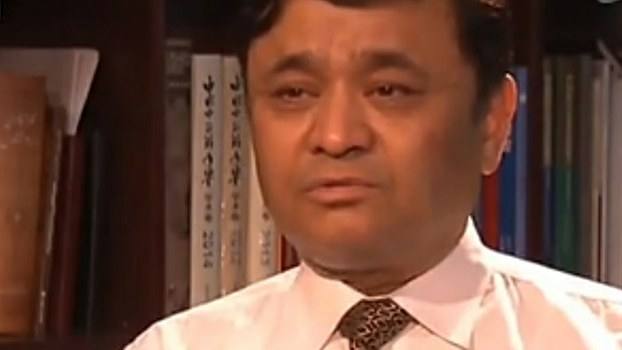
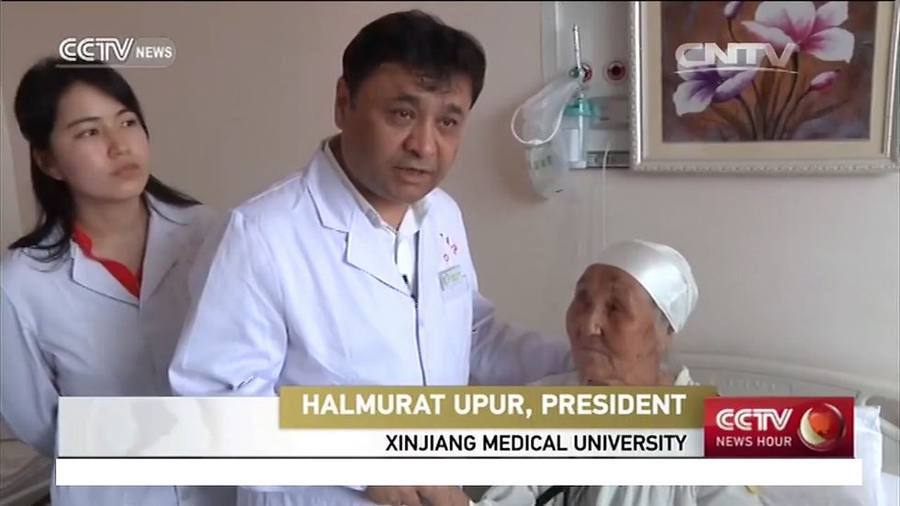
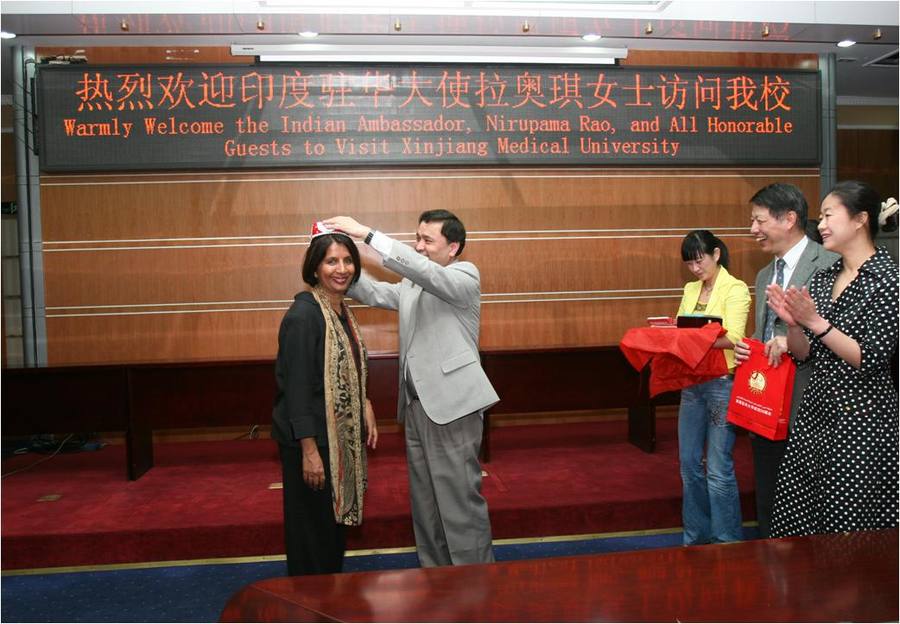
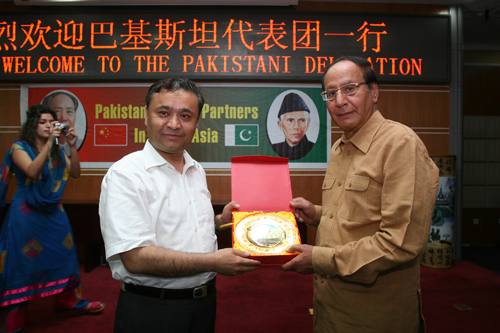
For most of his career, Halmurat Ghopur was a fixture of the establishment's own honours lists, and this archive records that in full, because it constitutes the case's central factual tension. According to the English Wikipedia, citing the National Natural Science Foundation of China's own system: in 2005 he was awarded the foundation's Distinguished Young Scholar Fund — the first scientist from Xinjiang to receive it. The Chinese Wikipedia adds: in 2008 he was nominated as a "Science Chinese" Person of the Year for his asthma research (Sina Tech carried the candidacy at the time); in 2011 he was nominated as a candidate in the Chinese Academy of Sciences academician election; and from 2013 he sat on the Standing Committee of the 12th People's Congress of the Xinjiang Uyghur Autonomous Region. As university president he received a stream of international guests — India's ambassador to China was photographed with him for the record — and travelled abroad to build partnerships. State broadcaster CCTV interviewed him on 19 August 2016, praising his contributions and his loyalty to the Communist Party; RFA's September 2018 sentencing report illustrated its story with a still from that very CCTV interview.
Lay the two dossiers side by side. First dossier: one of the state's highest honours for young scientists, an academician candidacy, a seat on the regional legislature's standing committee, a state-television portrait of loyalty. Second dossier, beginning barely a year later: state security police removing him from his office together with his computer; no charge shown to his family; a verdict "announced" to cadres through an internal film; a family that eight years on does not know whether he is alive, where he is held, or under what judgment. Both dossiers describe the same man. This archive adds no commentary to the juxtaposition, because none is needed: it is the most complete factual footnote available to the purge vocabulary of the "two-faced person" — a man the system spent twenty years certifying as one of its own could be recertified, within a year, as a death-row plotter of a "Caliphate," with neither certification ever required to produce checkable evidence.
5. The disputed titles: university president, hospital president, or drug-administration director
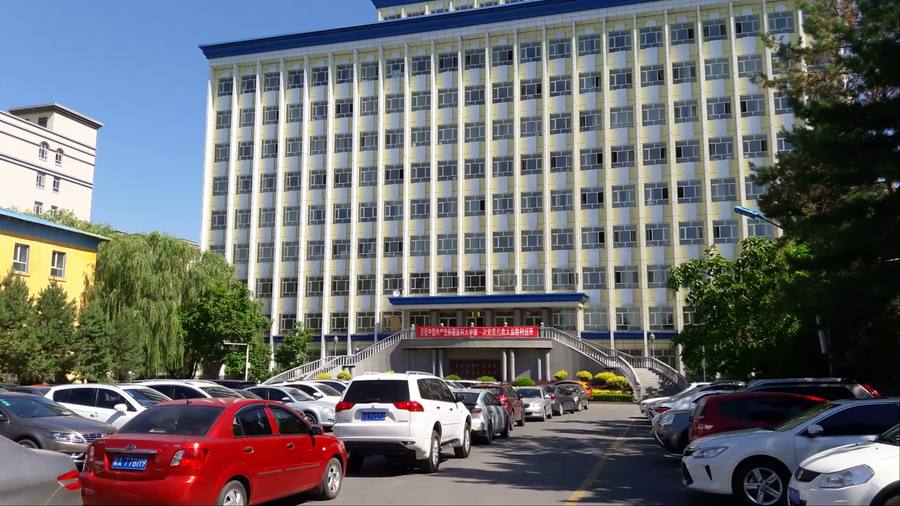
His exact posts are the most contested field in this record, and this archive sets the variants side by side rather than merging them. Account one (the English and Chinese Wikipedias, the Xinjiang Victims Database's medical list): vice-president of Xinjiang Medical University 1998–2008, then president of the university 2008–2017 — nine years as president — and in 2017 director of the regional Food and Drug Administration. Account two (both RFA reports, the UHRP report, the Committee of Concerned Scientists' letter, and Xinjiang Victims Database entry 253): at the time of his seizure he was president of the Department of Inspection and Supervision of the Xinjiang Food and Drug Administration, and before that president of Xinjiang Medical University Hospital. Account three (a 2018 compilation by the University of British Columbia's Xinjiang Documentation Project): "Vice Provost of Xinjiang Medical Institute" — matching no other source, and judged by this archive to be a transcription error, recorded but not adopted. Account four (a 2025 retrospective by Közet on the purge of Xinjiang's universities): calls him simply "president of Xinjiang Medical University," agreeing with account one.
This archive adopts as its main line "president of Xinjiang Medical University, 2008–2017; transferred to the regional drug-regulation system in 2017," which is supported by both Wikipedias and the 2025 retrospective and is consistent with the public record of his receiving foreign ambassadors and travelling as the university's president — while preserving account two in full. RFA's sources were local cadres and exiled Uyghurs; its "hospital president" and "inspection department" formulations may reflect translation slippage among the university, its hospital and the bureau, or posts he genuinely held concurrently or briefly. The public record cannot decide the question, and this archive does not force a unification. The dispute is not merely technical: anyone who later tries to trace his personnel file through a university's or a bureau's institutional history needs to know which roster each account points to. What an archive can do is nail down the provenance of each version — not pick the most convenient one.
6. Background: Xinjiang in 2017, the "two-faced people" vocabulary, and the Li Bing affair
The year of his seizure, 2017, was the year mass detention in Xinjiang escalated across the board. RFA and UHRP agree that from April 2017, Uyghurs accused of "extremist" and "politically incorrect" views were swept into political re-education camps in large numbers. UHRP's report of 22 October 2018, "The Persecution of the Intellectuals in the Uyghur Region: Disappeared Forever?", counted at least 231 Uyghur intellectuals forcibly disappeared, sent to camps or dead in custody between April 2017 and September 2018; its 2019 successor report raised the count to at least 386 — 101 students and 285 scholars, artists and journalists — including at least six from Xinjiang Medical University alone. Within the purge's vocabulary, "two-faced person" (liangmianren) was the label prepared specifically for Uyghur cadres and intellectuals inside the system: outwardly loyal, inwardly disaffected. The label is unfalsifiable by design — it indicts not an act but an interior state, and every protestation of loyalty can be re-read as deeper concealment.
The public groundwork against Ghopur personally preceded his arrest. As RFA reported in January and September 2018: in the summer of 2017, Wu Danhong, a professor at China University of Political Science and Law, published an article titled "We Must Be Vigilant Against Hidden Two-Faced Officials," which held that Li Bing, Party secretary of Xinjiang Medical University, had fought the "three evils" of terrorism, separatism and religious extremism, while Ghopur had criticised Li's approach. Li Bing had in fact been sentenced in March 2017 by a Xinjiang intermediate court to more than ten years in prison for accepting a bribe of 3 million yuan (about US$465,000); Wu's article alleged that Ghopur had framed Li, and that Ghopur, as a "two-faced official," had departed from Party guidelines by recruiting students "not fit to fill their positions" at the university hospital in pursuit of "murky intentions." The Committee of Concerned Scientists drew the conclusion in its October 2018 letter: there was evidence he may have been targeted because of professional disagreements with Secretary Li Bing. Separately, the Chinese Wikipedia, citing Taiwan's Liberty Times of 15 September 2019, reports that Li Pengxin, deputy Party secretary of the region, accused Ghopur of being a "two-faced person" — a single-chain report, archived here as such. Together these materials sketch a targeted removal prepared in print by an academic publicist before it was executed by the security apparatus, whose original spark may have been nothing more than a dispute between a university's two top men over how hard to wage the campaign against the "three evils."
7. Late 2017: taken from his office — WeChat, a confiscated computer, and a disputed date
The fullest account of the seizure is RFA's report of 12 January 2018 (by Kurban Niyaz). Its source was Zumret Tursun, a Uyghur activist exiled in Norway, relaying what one of her students had witnessed: state security police came to his office; Ghopur demanded to know why he was being taken; an officer told him he had exhibited "nationalistic tendencies" and read aloud monitored conversations from a messaging app — identified in the relay chain as WeChat — between Ghopur and a student studying abroad, correspondence he had kept on his phone without deleting it. The police said that for this reason they were confiscating his computer, and that he must come with them and cooperate with the investigation. RFA's second report, of September 2018, retold the same scene on "credible sources," with matching detail. This archive grades the episode as a single witness chain (student witness → Zumret Tursun → RFA), corroborated in substance by Xinjiang Victims Database entry 253, which likewise records the monitored WeChat conversations being read back and the computer confiscated, and archives it as the "reported course of the arrest." The archive also preserves the only on-record response ever given by a Chinese official in this case: a Han official at Xinjiang Medical University, speaking anonymously to RFA, said he had not heard Ghopur had been arrested, that it was "incorrect" to say so, and that Ghopur was "being investigated for breaking Party rules."
The date of the seizure is this record's second necessary parallel. RFA's two reports, UHRP and the World Uyghur Congress's February 2018 newsletter all say he was taken into custody in November 2017 and held at an unknown location under investigation for alleged "acts against the state." His brother Dilshat Dillon Hopur, in written testimony dated 18 July 2020 to the Subcommittee on International Human Rights of Canada's House of Commons, states precisely that his brother "was subjected to enforced disappearance on December 10, 2017." The November account comes through exile-activist and media chains; the 10 December date comes from his own brother. They differ by about a month, and the public record offers no way to decide between them: he may have been seized in November with the family confirming the disappearance in December, or one side's memory or relay may be off. This archive sorts the case at 15 November 2017 — the site's convention when only a month is secure — records both accounts in the text, and requires that any citation of the date carry the dispute with it. What can be fixed beyond dispute is this: by the end of 2017 he had been taken from his office, and he has never been seen in public again.
8. A "political study" film: how a suspended death sentence reached the outside world
His sentence became known to the outside world in a manner rare even in modern judicial history: not through a verdict, not through a family notification, but through an internal film. As RFA reported on 28 September 2018 (by Shohret Hoshur), it had learned that Ghopur appeared, alongside four other high-ranking Uyghur intellectuals, in an officially produced "political study" film made required viewing for all government cadres in the region; in the film he was said to have been given a suspended death sentence for plotting to "create a Muslim Caliphate" in the region by 2030. To check the story, RFA contacted the director of the political department of the Xinjiang Federation of Literary and Art Circles, who, anonymously, confirmed the punishment and said he had been sentenced for "attempting to split the country and using his position as a lecturer to carry out anti-government propaganda." Working a separate story on arrested Kashgar University professors, RFA also reached the police station in Bulaqsu township, Kashgar, where an officer said his department had recently viewed the film and that it stated Ghopur "was given a two-year suspended death penalty." UHRP's report relays a further official-document variant: that Ghopur planned "to create an independent country according to his own wishes and become its leader," and that "during the past 33 years he had this hidden intention" — thirty-three years reaching back to roughly the start of his studies in the Soviet Union: the whole span of his adult scholarly life.
The evidential structure of this chain must be stated plainly. The existence and content of the sentence reach the public at second and third hand from viewers of an internal film; RFA found two viewers (the federation official and the Kashgar officer) whose accounts agree; UHRP, the Committee of Concerned Scientists, the World Uyghur Congress and the Xinjiang Victims Database all subsequently carried the sentence in "reportedly" form; the Chinese Wikipedia, citing Hong Kong and Taiwan media including Sing Tao, dates the secret sentencing to early 2018. The institutions agree, but their common source is one: a film never publicly shown. This archive therefore fixes its formulation with the qualifier intact: "reportedly sentenced in secret in early 2018 to death with a two-year reprieve; the news emerged through the official political-study film channel and was publicly reported by RFA on 28 September 2018." And it records the substance of that procedure: for a death sentence imposed on a standing-committee member of the regional legislature and a university president, the authorities' chosen method of "publication" was to screen him to cadres as a negative teaching example — not to deliver to his wife, his children or his mother a single sheet of paper bearing his charge and his punishment.
9. The charge field: why this archive can only write "no public record"
The charge in this case is where this archive's discipline is tested hardest, because five labels circulate and not one of them is backed by a judicial document. In order: (1) "acts against the state" — RFA's January 2018 formulation for the investigation's grounds, a generic investigative label, not an indictment. (2) "Nationalistic tendencies" — the words spoken by police at the arrest: a political characterisation, not an offence under the criminal law. (3) "Separatist tendencies / attempting to split the country" — the September 2018 headline and the federation official's account, the closest to the criminal-law offence of separatism, but still film-and-word-of-mouth provenance. (4) "Subversion of the state" — the lead formulation of the Chinese Wikipedia entry, whose own citations run to Sing Tao and RFA; subversion and separatism are different offences, and the chain is internally inconsistent. (5) "Plotting a Caliphate / an independent country with himself as leader" — the film's and the official document's accusatory narrative: a story, not a charge. As for the "life imprisonment" and "disclosing state secrets" carried in the brief for this entry: this archive searched RFA, UHRP, the Committee of Concerned Scientists, the Xinjiang Victims Database, both Wikipedias and the Hong Kong/Taiwan relays, and found neither in any of them. The life term may result from conflation with the other intellectuals in the same film, who received "either death or life"; the state-secrets charge has no discoverable source at all. Neither is adopted; both are recorded here solely as corrections.
The formal archive statement for this field can therefore only be: formal charge, no public record; sentencing court, no public record; sentencing date, no public record beyond the "early 2018" reporting; whether a trial was held, whether he had a lawyer, whether he appealed — all no public record. What can be entered is three sentences: he was told at his arrest that the reason was monitored WeChat contact with a student abroad, read by police as "nationalistic tendencies"; the authorities' internal publicity characterised him in separatist terms wrapped in a "thirty-three years of concealment, plotting a state" narrative; and his reported punishment is death with a two-year reprieve. Set those three sentences beside the empty field, and you have the whole judicial truth of this case: a state sentenced its own university president to death without ever showing the world a single page of judgment. The blank is not a defect of this archive; the blank is the shape of the persecution itself.
10. The family: four disappearances in one household, and a mother's death
The impact on the family rests on one first-hand document: the written testimony of his brother Dilshat Dillon Hopur, dated 18 July 2020, to the Subcommittee on International Human Rights of the Canadian House of Commons. Dilshat, now of Oakville, Ontario, lists his family's disappeared one by one: his brother Dr Halmurat Upur, former president of Xinjiang Medical University, forcibly disappeared on 10 December 2017 (his date — see section 7); his brother's son, Dr Palvan Halmurat Upur, a physician at the First Affiliated Hospital of Xinjiang Medical University, forcibly disappeared in November 2019; his uncle Dr Ghalip Nasir, a professor at Xinjiang Normal University, disappeared in 2018; and his cousin Prof. Nayiljan Turghan, disappeared in 2018. Of all four, he wrote, he still had no idea of their whereabouts. The testimony records the family's other loss as well: their mother, shaken by two years of grief over the disappearance of her son and of her own brother Nasir, died on 31 August 2019 — a mother who died without knowing whether two of her closest kin were alive, and kin who, if they live, still do not know she is gone. Dilshat closed by begging the Canadian parliament to "be the voice of voiceless" and to press China to release his brother, his nephew and his other relatives immediately.
Beyond that document, the record on the family inside China is nearly empty: his wife's name and situation, no public record; anything about his son Palvan after November 2019, no public record; whether the family ever received an arrest or sentencing notice, was allowed a visit or a letter, or suffered confiscation or other collateral pressure — all no public record. One contextual voice is archived: Rukiye Todushi, former president of the Canadian Uyghur Congress, told media that Ghopur had been arrested purely because of his ethnicity — recorded here as an advocacy characterisation by an exile Uyghur political figure, labelled as such. What distinguishes this family among this site's cases is that its only speaker is a brother an ocean away; the immediate family inside Xinjiang has been silent for eight years — not because it has nothing to say, but because anything it said could become the next disappearance's reason. This archive sets down the brother's testimony in substance, marks the silence inside as "no public record," and fabricates no "family statement" of any kind.
11. International response: from the World Uyghur Congress to Canada's Parliament
The international response ran through three channels — the exile Uyghur network, scholarly organisations, and human-rights research bodies — and its timeline is as follows. On 12 January 2018 RFA's Uyghur Service first reported the arrest. The World Uyghur Congress's February 2018 newsletter carried a statement of grave concern: Ghopur had reportedly been arrested in November 2017 and taken to an unknown location over alleged "acts against the state," amid a roundup of Uyghurs not adhering to the Party's "increasingly narrow" norms of acceptable behaviour. On 18 October 2018 the Committee of Concerned Scientists wrote to China's president requesting a review of the case, Ghopur's immediate release, the dropping of charges and his return to his former post; the letter states that there was no apparent evidence supporting the charges and that he appeared to be one of thousands being severely punished simply for Uyghur ethnicity. On 22 October 2018 UHRP published "Disappeared Forever?", profiling him among the leading cases, alongside former Xinjiang University president Tashpolat Tiyip, as reportedly sentenced to death with reprieve; the report was presented the following day at an event titled "A Year in Attacks on Higher Education" at NYU School of Law hosted by the Scholars at Risk network — and this archive states the limit honestly: no standalone Scholars at Risk case page for Ghopur was found; his connection to that network in the verifiable record is that launch event, plus the entry carried in the network-associated journal Endangered Scholars Worldwide in its 2019–2020 reporting. In September 2019 the student union of Lee Woo Sing College at the Chinese University of Hong Kong issued a statement in his support — he had once visited the college (per the Chinese Wikipedia, citing Hong Kong's Apple Daily of 19 September 2019). On 18 July 2020 his brother's testimony entered the Canadian parliamentary record (section 10). The Xinjiang Victims Database carries him as scholars entry 253, and Uyghur Hjelp's list of detained medical professionals places him first.
Two negative findings belong in the record. First, searching the public databases and sites of the Congressional-Executive Commission on China (CECC) and of the US Commission on International Religious Freedom (USCIRF) under all four transliterations retrieved no individual political-prisoner or prisoners-of-conscience entry for him in this check: the CECC's annual reporting covers the detention of Xinjiang intellectuals in general terms, but an individual listing could not be verified, and this archive does not claim one — the CECC listing asserted in the brief for this entry is recorded as unverified. Second, no naming of him individually was found in US State Department or UN documents; his name travels in the international record as a leading case on lists of purged Uyghur intellectuals. The combined effect of all this advocacy must also be stated plainly: from 2018 to today, not one intervention has produced a single new fact about him — no visit, no photograph, no official reply; even the film that sentenced him has only ever been heard of, never seen outside the cadre screenings. In 2025 a long retrospective on the "two-faced people" purge of Xinjiang's universities (Közet) still carried his name in the same formulation as 2018 — reported by RFA to have received the same suspended death sentence as Tashpolat Tiyip — unchanged after seven years. The whole of the public record's "progress" on this case is that sentence, repeated.
12. Current status: after the suspended death sentence, eight years of silence
Under the general rules of China's criminal law — stated here as legal framework, not as a fact of this case — a death sentence with a two-year reprieve is commuted to life imprisonment at the expiry of the reprieve if the prisoner commits no intentional crime during it, and may later be reduced further to a fixed term. Which means: even if the authorities' own law had run its ordinary course, a change in Ghopur's legal status — a commutation ruling — should have occurred around 2020. As of November 2026 the public record contains no information that he was commuted, not commuted, or executed; no place of detention; no health record; no family-visit record; no word from him in any form. His name has been struck from no detention list and added to no release list; the current UHRP and Xinjiang Victims Database entries still count him among the detained. This archive's formal status line is: still detained, whereabouts unknown, not released; the subsequent legal status of the reported suspended death sentence is a matter of no public record.
The completeness of the silence deserves its own inventory in the archive: eight years since the seizure (counting from November 2017), and the record holds no published arrest document, no indictment, no verdict, no ruling, no prison or detention-house name, no photograph, no family meeting, no official statement — the sole official utterance on record being the 2018 denial of arrest coupled with an admission of a Party-discipline investigation (section 7) — and no follow-up reporting in domestic media: a man once celebrated on CCTV has evaporated from the official record. Meanwhile the companies he co-founded still produce and sell formulations built on his patents; students he trained have disappeared after him into the same system; his mother has died without his knowledge, if he lives; and his son has spent six years in disappearance. The last thing an archive can do is print the inventory of absences in full. In November 2026, that inventory is the current status of this case.
13. Archived in parallel: where the sources disagree
Under this archive's rules, disagreements among sources are not merged away; they are listed. (1) The Chinese name: the standard rendering is 哈木拉提·吾甫尔 (People's Daily Online, Sina, both Wikipedias); the brief for this entry wrote 哈尔木拉提·吾甫尔, archived as a variant. The English name has at least four transliterations (Ghopur / Upur / Wupur / Xalmurat Ghopur), all of which must be used in searches. (2) Birth date: March 1960 (English Wikipedia); 6 March 1960 (read from the partial ID fragment in the Xinjiang Victims Database entry — single-source, unverified); the Chinese Wikipedia gives only the year 1960. (3) Highest posts: president of Xinjiang Medical University 2008–2017 (both Wikipedias; Közet 2025); president of Xinjiang Medical University Hospital (RFA, UHRP, Committee of Concerned Scientists); director of the regional Food and Drug Administration (Chinese Wikipedia); head of the FDA's inspection and supervision department (the same RFA chain); "Vice Provost of Xinjiang Medical Institute" (the UBC compilation — judged a transcription error). (4) Date of seizure: November 2017 (RFA, UHRP, World Uyghur Congress); 10 December 2017 (his brother's testimony to Canada's Parliament); sorting fixed at 15 November 2017 with the dispute noted. (5) Charge labels: five parallel formulations — acts against the state / nationalistic tendencies / separatist direction / subversion of the state / plotting to found a state (section 9) — none supported by a judicial document; the brief's "life imprisonment / disclosing state secrets" appears in no checked source and is not adopted. (6) Form of the sentence news: the suspended death sentence is a unanimous "reportedly" across institutions whose common source is the relayed content of an internal political-study film; no institution has ever seen a verdict document; the "early 2018" sentencing date is the Chinese Wikipedia / Hong Kong-Taiwan media formulation, while RFA establishes only that the film was being screened to cadres before September 2018. (7) Motive for the arrest: the monitored-WeChat account (the witness chain) and the professional-dispute-with-Li Bing account (the Committee of Concerned Scientists, drawing on Wu Danhong's article) coexist and are not mutually exclusive; both are archived with their grades. (8) The "two-faced" accusation's provenance: Wu Danhong's summer 2017 article (relayed by RFA) and the Li Pengxin attribution (a single Liberty Times chain) are archived separately. (9) Matters of no public record: the formal charge; the sentencing court and date; any verdict or ruling document; counsel and appeal; place of detention; health; commutation status; his wife's name and situation; family visits and correspondence; any formal official statement of any kind.
14. Verification and sources
The core facts of this entry were cross-checked against the following independent sources; key facts rest on at least two, and single-source items are flagged in the text and in section 13. Primary reporting: Radio Free Asia's Uyghur Service, 12 January 2018 (reported by Kurban Niyaz: the office seizure, the confiscated computer, the monitored WeChat exchanges, Zumret Tursun relaying her student's eyewitness account, the university official's denial of arrest) and 28 September 2018 (reported by Shohret Hoshur: the political-study film, the suspended death sentence, the corroborating federation official and Kashgar police officer, the Wu Danhong article and the Li Bing background) — the first-hand news chains for both the arrest and the sentence in this case. Institutional reports and databases: UHRP, "The Persecution of the Intellectuals in the Uyghur Region: Disappeared Forever?" (22 October 2018) and its 2019 successor "Detained and Disappeared" (the 386-intellectual count; at least six at Xinjiang Medical University); Xinjiang Victims Database scholars entry 253 (accessible via the Uyghur Hjelp republication: the partial ID number, the suspended death sentence, the film as the source of the news, the detention-house presumption) and Uyghur Hjelp's list of detained medical professionals (updated 30 January 2023, listing him first). Scholarly and advocacy organisations: the Committee of Concerned Scientists' open letter of 18 October 2018 (the official accolade for his respiratory treatment, the Li Bing dispute, the demand for release); Endangered Scholars Worldwide's 2019–2020 reporting; the World Uyghur Congress's February 2018 newsletter. Family document: the written testimony of his brother Dilshat Dillon Hopur, dated 18 July 2020, to the Subcommittee on International Human Rights of the Canadian House of Commons (the 10 December disappearance date; the son's November 2019 disappearance; the uncle's and cousin's 2018 disappearances; the mother's death on 31 August 2019) — the only first-grade family document in this case. Career sources: the English Wikipedia entry "Halmurat Upur" (March 1960 birth; Shanghai University of Traditional Chinese Medicine; St. Petersburg from 1988; the Pavlov doctorate; 26 projects, nine books, 150-plus papers; the two companies; the vice-presidency and presidency; the 2005 Distinguished Young Scholar Fund) and the Chinese Wikipedia entry (nine years as president; the 2008 Science Chinese nomination; the 2011 academician candidacy; the regional people's congress standing committee from 2013; the 2017 FDA directorship; the Li Pengxin "two-faced" attribution; the September 2019 Lee Woo Sing College student-union statement); and Közet's 2025 retrospective on the university purge (naming him "president of Xinjiang Medical University" and pairing his reported sentence with Tashpolat Tiyip's). Negative checks: searches of the CECC and USCIRF public databases and sites under all four transliterations retrieved no individual entry for him (section 11); no standalone Scholars at Risk case page, no Amnesty International individual action file and no State Department naming were found, and none is claimed. Evidence grading: Grade A (documents of the detaining state) — none exist in this case; the Chinese authorities have never published any formal document about it, and that non-existence is itself an archival fact. Grade B (parliamentary records and institutional databases) — the Canadian testimony, the Xinjiang Victims Database, UHRP's reports. Grade C (media news chains and advocacy materials) — RFA's two reports (the sentence resting on the single common source of the internal film's relayed content), the Committee of Concerned Scientists' letter, the World Uyghur Congress newsletter. Grade D (single relays) — the Li Pengxin attribution, the 6 March birth reading, the "Vice Provost" formulation, each flagged where used. This entry was last verified on 11 November 2026; its status fields rest on the UHRP report pages, the Xinjiang Victims Database entry and retrospective reporting retrievable on that date.
15. Our Take
This archive's assessment is confined strictly to the facts of this case. First, what deserves to be fixed in the record above all is the manner in which the sentence was "published." A standing-committee member of a regional legislature and the president of a university was sentenced to death — with reprieve — and the fact was communicated not by verdict, not by family notification, not by any court announcement, but through a "political study" film screened to the region's cadres. In that procedure he is not primarily a defendant; he is teaching material. The first use of his death sentence was to show the living officials in the screening room exactly what disobedience costs. The judiciary here is not the purpose; it is the set design. Second, lay out the accusation's content. At the arrest, the reason spoken aloud by police was that his WeChat exchanges with a student abroad had not been deleted and had been monitored into "nationalistic tendencies." In the film, the narrative became "thirty-three years of concealment, plotting to build a Caliphate by 2030 and rule it himself." Thirty-three years is precisely the span from his departure for the Soviet Union to his arrest — his entire scholarly life. In other words, the narrative retroactively rewrites a whole career as a sleeper's history: every degree he earned, every department he built, every company he founded becomes evidence of "hidden intention." A regime that can invert a life in this way can convert any curriculum vitae into an indictment overnight — and that is exactly the demonstration this case was staged to provide to every intellectual inside the system. Third, measure the purge's depth: after the president's suspended death sentence, his son — a physician at the affiliated hospital — disappeared in November 2019; his uncle and his cousin disappeared in 2018; his mother died on 31 August 2019 in grief, never knowing the fate of her son or her brother. The punishment here does not fall on one person; it is a net drawn along the lines of kinship. Fourth, a word for the blank in the charge field. This archive searched the Chinese- and English-language institutional record and found no formal charge for him anywhere; the "life imprisonment" and "disclosing state secrets" circulating in the brief exist in no reliable source. This archive would rather leave that field empty, with five contradictory labels archived side by side — because that is the truth of the case: a death sentence that has run for eight years without a charge, against a man who cannot even find the object of his own defence. This archive records the case, and leaves the blank as it found it, for those who come after.
视频证据Video Evidence
《死亡来自中国》(Death by China,纪录片,导演彼得·纳瓦罗)|2012年|英文原声(哈木拉提·吾甫尔在片中短暂出镜)Death by China (documentary, directed by Peter Navarro) | 2012 | English (Halmurat Ghopur appears briefly)