
第123案 | 顾约瑟Case 123 | Gu Yuese
他不是家庭教会牧师,而是浙江省基督教协会会长、全国最大登记教会之一杭州崇一堂的主任牧师。2015年7月,他领导的省基督教协会给省民宗委写了一封公开信,称强拆十字架严重违宪。半年后,他先被免职,再被以涉嫌职务侵占刑事拘留、逮捕,取保九个月后又被第二次逮捕。案件从未起诉、从未开庭、从未判决,2017年12月24日被撤销——没有一纸文书解释抓人的理由。He was not a house-church pastor. He was chairman of the Zhejiang China Christian Council and senior pastor of Hangzhou's Chongyi Church, one of the largest registered churches in China. In July 2015 the provincial council he led sent the religious affairs authorities an open letter calling the forced removal of crosses a serious violation of the Constitution. Six months later he was removed from his pulpit, then criminally detained and arrested on suspicion of embezzlement; released on bail, he was confined at home for nine months, then arrested a second time. The case was never indicted, never tried and never adjudicated. On 24 December 2017 it was dropped — with no document anywhere explaining why he had been taken.
What Happened
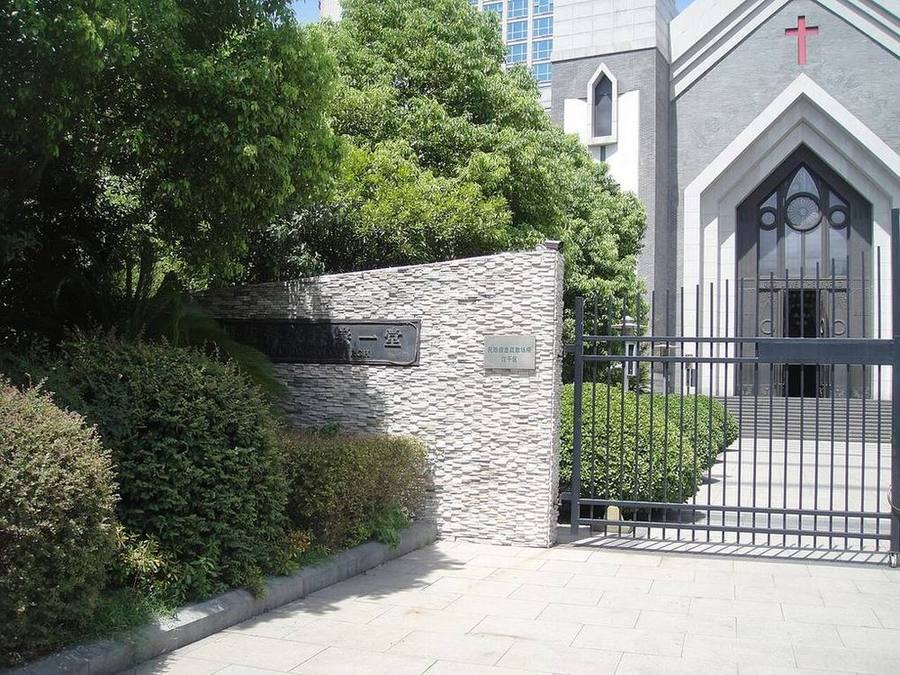
The most striking fact in the Gu Yuese case is not the size of the allegation. It is who the accused was. Gu Yuese was the senior pastor of Chongyi Church in Hangzhou, a congregation registered and approved under the state-sanctioned Three-Self Patriotic Movement. He chaired the Zhejiang China Christian Council and sat on the standing committee of the national council. He was, in other words, a leader produced by the official church system itself, a man the authorities had for years presented to foreign visitors as evidence that China permits religious freedom. In July 2015, the provincial Christian Council he led published an open letter opposing the forced demolition of church crosses. Six months later he was removed from his pulpit, then taken away by police, accused of embezzlement.
The order of events is the key to the whole case. On 18 January 2016, the Hangzhou Three-Self Patriotic Movement and the Hangzhou China Christian Council issued a notice removing Gu as senior pastor of Chongyi Church and naming Zhang Zhongcheng in his place. The stated reasons were administrative and deliberately vague: the change was said to move the church "one step closer towards the proper self-construction and management of church locations" and to sort out interpersonal relations between the provincial and municipal church organisations (as reported by Christian Times and other outlets quoting the official bodies). The notice mentioned no financial wrongdoing of any kind. Nine days later, on 27 January, Gu and his wife Zhou Lianmei both became unreachable, and their home was searched. Supporters and family reported that Gu had been placed under "residential surveillance at a designated location," a form of incommunicado detention in a secret location (ChinaAid, 29 January 2016; China Change, 30 January 2016).
On 29 January, the provincial and municipal official Christian bodies issued a public announcement that mentioned money for the first time: Gu, it said, was "assisting the relevant departments with an investigation" because he was suspected of embezzlement and other financial problems. The same day, ChinaAid published the text of the Hangzhou Municipal Public Security Bureau's criminal detention notice: Gu had been criminally detained at 4:00 p.m. on 28 January 2016 on suspicion of embezzlement (职务侵占), and was held at the Hangzhou Municipal Detention Center; the notice was numbered Hangzhou Public Detention Notice (2016) No. 001. One detail deserves to be preserved. The first information the family received spoke of residential surveillance at a designated location, while the formal police paperwork records ordinary criminal detention in a detention centre. The two accounts do not fully match. This page therefore layers them: the account of his being taken away and secretly held comes from family members and church sources relayed by ChinaAid and China Change, while the times, place and charge of the formal detention rest on the police notice itself, published in full by ChinaAid.
At 5:00 p.m. on 6 February 2016, with the approval of the Hangzhou Municipal People's Procuratorate, the public security bureau formally arrested Gu, again on suspicion of embezzlement, again at the Hangzhou Municipal Detention Center; the arrest notice was numbered (2016) No. 002 (arrest notice text published by ChinaAid; the Guardian's report of 7 February 2016 likewise confirms the formal arrest took place on Saturday 6 February). ChinaAid's reporting attached a figure to the case: it said Gu was accused of embezzling 10 million yuan, roughly US$1.6 million. This page must be explicit about the status of that number. It appears only in the ChinaAid reporting chain. Neither police notice states any amount. No official announcement ever named a sum, a transaction, or a destination account. The figure is therefore recorded here strictly as an allegation circulated by the accusing side's informal channels, never confirmed in any official document.
A few days after his arrest, a letter from Gu reached his congregation through his lawyers. It was dated 4 February 2016 and published by ChinaAid on 16 February. Its tone later became a controversy in itself, and a separate section below deals with it. On 31 March 2016, Gu was released on bail (ChinaAid; Christian Solidarity Worldwide statement of 4 April 2016; the U.S. State Department's 2016 International Religious Freedom Report). Release, however, did not mean freedom. The State Department's report states plainly that during the nine months he was out, authorities confined him to his home and barred him from meeting or communicating with others without permission. From 27 January 2016 to January 2017, in other words, the months nominally spent "outside" were months under control.
On 7 January 2017, Gu's family received a second arrest notice: he had been arrested again, on the same category of financial suspicion, and was again held at the Hangzhou Municipal Detention Center (Reuters, January 2017; Christian Post, 12 January 2017). ChinaAid reported that he had in fact been taken away sometime before Christmas 2016, with 7 January being the date the formal notice reached the family; this page records both data points side by side rather than forcing them into one. This second detention lasted nearly a year. During it came the episode of the dismissed lawyer, described below. Finally, on 24 December 2017 — Christmas Eve — according to a China Christian Daily report relayed by Christian Times, the case was dropped and Gu went home. A case that had opened with talk of ten million yuan, that had produced two arrests and well over a year of cumulative detention, ended without an indictment, without a trial, without a verdict, without an acquittal, and without any official explanation of why he had been taken or why he was let go.
He was never tried, and he was never convicted. That sentence is the floor of this case, and no narrative is allowed to rise above it or sink below it. A dropped case means, in law, that the allegation was never proven. The two years that were taken from him, the offices that were stripped, the pastoral team that was broken up, and the fear his family lived through are answered for by no document anywhere. This page is the companion, on the personal side, to this site's existing case page on the Zhejiang cross-removal campaign: that page records how the crosses came down, church by church; this one records what happened to the highest-ranking official-church leader who said, in writing and through official channels, that they should not.
Early Life and Chongyi Church: A Pastor Inside the System
Gu Yuese was born in Shangyu, Zhejiang, and raised in a Christian family. His birth year is not given in any reliable source this page could find: the English Wikipedia entry on Joseph Gu, ChinaAid's reporting, and China Change's long biographical account all record his origin and upbringing but no date of birth. After systematic searching, this page records the fact honestly: his year of birth is not in the public record, and no estimate without a source is offered.
His theological training took place entirely inside the official system. In the late 1980s and early 1990s he studied at Zhejiang Theological Seminary and then at Nanjing Union Theological Seminary (China Change, 30 January 2016; English Wikipedia, same). Nanjing Union is the national official seminary; Gu is reported to have been a student of the theologian Wang Weifan (single-source chain via Wikipedia, marked unverified here). From the 1990s until January 2016 he served as senior pastor of Chongyi Church — more than two decades in one pulpit.
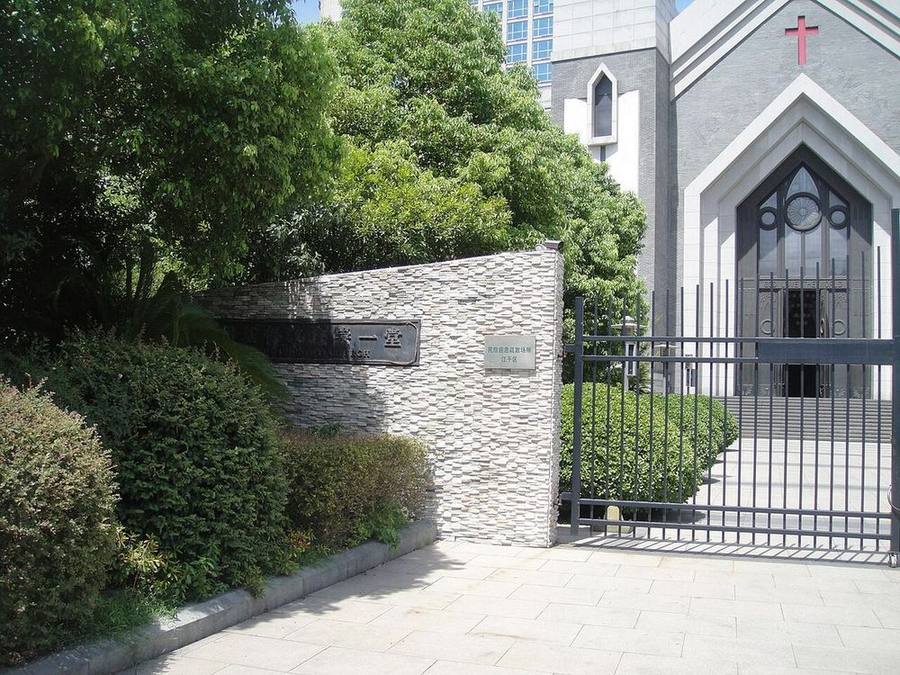
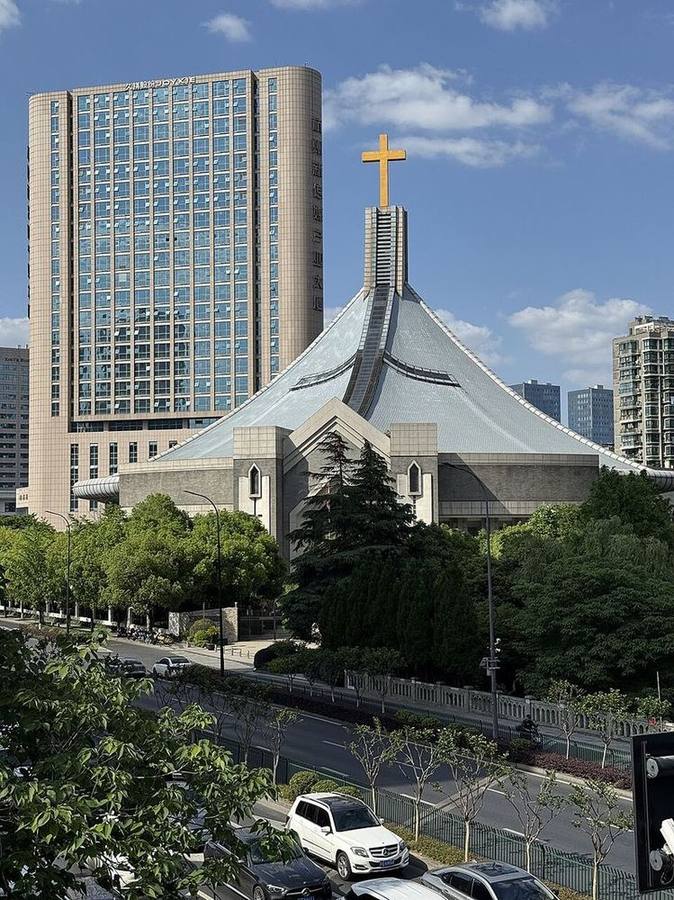
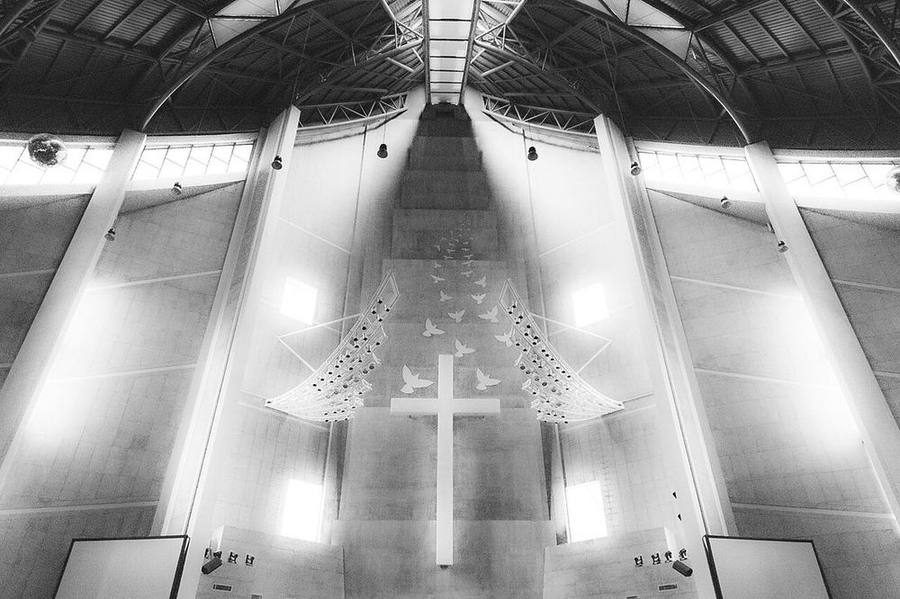
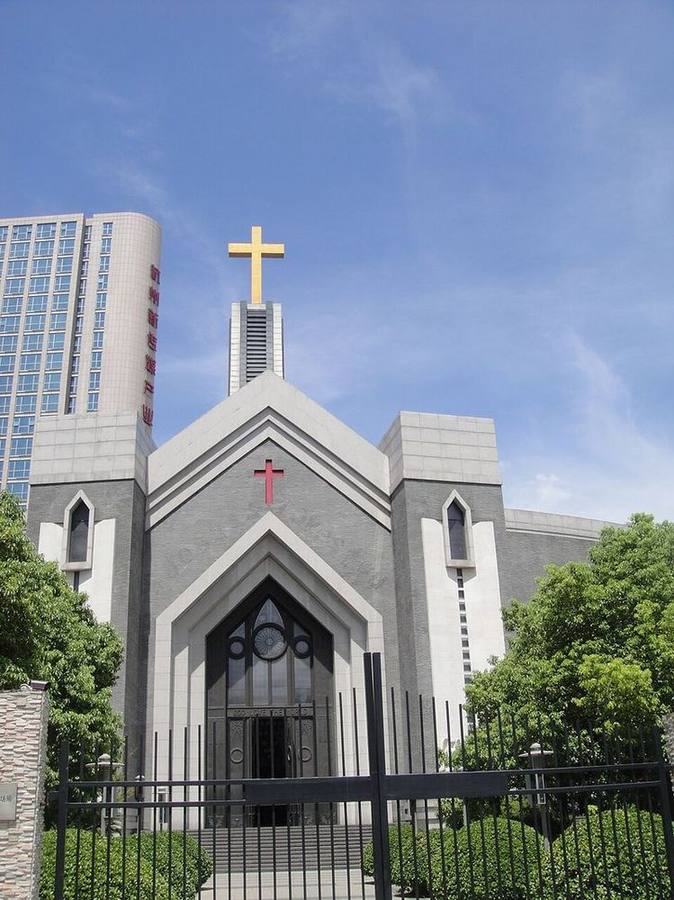
Chongyi Church is far older than its pastor. Its roots go back to 1866, when Hudson Taylor, founder of the China Inland Mission, established a base in Hangzhou. The Mission bought land at 77 Qingtai Street in 1901 and built the original Chongyi Church in 1902 (Wikipedia, "Chongyi Church"; China Change). In 1951 the church joined the newly formed Three-Self Patriotic Movement. During the "united worship" consolidation of 1958, congregations were merged and the Chongyi building was put to other uses, including as a railway materials warehouse and a railway hospital (China Change). The church reopened in the 1980s after religious policy loosened. In 2000 the Hangzhou municipal government agreed to a rebuilding on a new site. Ground was broken on 30 December 2003, funded by congregational donations of about 40 million yuan — some sources say 42 million, and this page keeps both figures — and the new church was completed on 5 May 2005. The building covers 12,480 square metres, and its main sanctuary seats about 5,500 people (church-published data; Wikipedia).
The size figures vary across sources, and this page layers them rather than picking one. Seating of roughly 5,000 to 5,500 is the most commonly cited figure; the Guardian in February 2016 described a church that "seats 5,000 people." Congregation size is most often given as about 10,000 members (Christianity Today, Christian Post, and others). Special gatherings ran higher: Franklin Graham preached at Chongyi to about 12,000 people in 2008, and a Luis Palau event in 2010 was estimated at 14,000 (church data chain). On any measure, Chongyi was one of the largest registered churches in mainland China, routinely described as China's first megachurch. Gu Yuese was the man who built it to that scale. He was the central figure in the new building project, and over the following decade Chongyi under his leadership became a flagship of the official church — a showcase repeatedly used to receive foreign religious delegations and visiting dignitaries, presented by the authorities as proof of their religious policy (China Change described it as a propaganda "poster child").
That background is what made the events of 2016 so shocking inside China. Gu was not an outsider confronting the system. For years he had acted as a mediator between the government and the churches, carrying believers' views to the religious affairs authorities and carrying the authorities' requirements back to the churches (China Change). He was widely respected among his fellow official-church clergy, invited across Zhejiang to preach and to preside at ordinations. In the words of the Wenzhou pastor who chronicled his fall, he was one of the rare figures respected by grassroots Christians and officials alike. It was this man — the mediator, the showcase, the insider — who declined to back down on the crosses.
Background: The Zhejiang Cross-Removal Campaign
From late 2013 into early 2014, Zhejiang Province pushed an urban renewal drive under the slogan "Three Rectifications and One Demolition," nominally aimed at illegal structures. In practice the campaign quickly centred on church buildings, and above all on the crosses on their roofs. The campaign was driven by the provincial party secretary at the time, Xia Baolong (Chinese Wikipedia, "Zhejiang cross-removal campaign"). On 28 April 2014 the entire Sanjiang Church in Wenzhou was demolished, an event that shook churches across China. Over the following two years the removals spread from Wenzhou across the province: work crews arrived with cranes, crosses were cut down and lowered away, some church buildings were declared illegal and demolished outright, and congregations kept night vigils to guard their crosses, re-erected crosses that had been taken down, and confronted demolition crews on rooftops. A number of believers were detained for exactly that resistance.
How many crosses were removed is a question this page answers in layers, because the totals differ by source and by what is being counted. Chinese Wikipedia records that by July 2015, crosses had been taken from some 1,700 churches in Zhejiang. ChinaAid's running counts at different points produced figures of roughly 1,500 to 1,800; its president Bob Fu said in early 2016 that "at least 1,800 crosses of churches were demolished since the campaign started" (as quoted by Christian Times). The U.S. State Department's 2016 International Religious Freedom Report used a broader measure: by the end of 2016, over 2,000 structures had been destroyed or demolished, including 600 crosses — a count that includes church annexes and other buildings and is therefore not in conflict with the cross-only figures, only wider in scope. Christianity Today in February 2016 put it at more than 1,500 Protestant and Catholic churches that had lost their crosses since 2013. This page's position is that all four figures are printed with their sources and their counting scopes, and that the widely repeated "about 1,800 crosses" figure travels mainly along the ChinaAid statistical chain and should be weighted accordingly; it is not an officially confirmed number.
The coercive side of the campaign is equally documented. In just the three months from July to September 2015, more than 250 lawyers, pastors and rights advocates in Zhejiang were detained or arrested for opposing the removals (Christianity Today, February 2016). The Beijing lawyer Zhang Kai, who provided legal help to churches, was taken away in Wenzhou on 25 August 2015 — the night before he was scheduled to meet David Saperstein, the U.S. Ambassador at Large for International Religious Freedom — and was later held on suspicion of gathering a crowd to disturb social order and of stealing and providing state secrets abroad. He appeared in a televised "confession" on Wenzhou television in February 2016 and was released on bail on 23 March 2016. In an environment in which even the churches' lawyer could be taken, the open letter of a provincial Christian Council chairman was the strongest statement the official church system was capable of making.
The July 2015 Open Letter: Speaking Through the System's Own Channel
In May 2015, Zhejiang church bodies had already issued a statement opposing draft new regulations on religious buildings and the removal of religious symbols (reported by several English-language outlets). The turning point came in July. On 10 July 2015, the Zhejiang China Christian Council sent an open letter to the provincial Ethnic and Religious Affairs Commission. Its language was extraordinary by the standards of official-church documents. As quoted in the Chinese Wikipedia article on the campaign, the letter said the forced removals had "seriously hurt the feelings of the province's more than two million Christians," called the campaign a "brazen trampling" of the policy of freedom of religious belief and a "serious violation of the Constitution," and stated bluntly that the Council's role as a "bridge" between the government and believers had been stripped of any meaning or reason to exist. It demanded that the practice stop immediately. The letter went out in the Council's name, and the Council's chairman was Gu Yuese. China Change, CSW and Christianity Today all describe it as the open letter of the Zhejiang Christian Council led by Gu, issued under his leadership and signature.
What happened to the letter's authors is itself part of the record. According to the Chinese Wikipedia account, the official seals of the Zhejiang Christian Council and the provincial Three-Self Patriotic Movement were subsequently taken away by the provincial religious affairs authorities — an official church body that cannot keep custody of its own seal has a "bridge" role in name only. Gu himself is reported to have come under control and investigation from that period (same source; marked unverified here; it can be read alongside China Change's report that the authorities investigated his personal affairs and initially "found nothing out of order," but the two accounts cannot corroborate each other and this page does not pretend otherwise).
Shortly before his removal in January 2016, Gu and his wife Zhou Lianmei left a short message for the Chongyi congregation, published by ChinaAid and printed in full by Christianity Today. It said, in substance: a rare, freezing cold would soon befall Hangzhou, and everyone should rely on the Lord's grace to stay well; Chongyi Church, too, was undergoing an unprecedented, chilling trial, which everyone must face together by the same grace. On its surface it was a word about weather and health. In the context of that January, no one in the congregation misread it. A few days later, husband and wife were both taken away.
This page insists on the precise character of the July 2015 letter, because the whole case turns on it. It was not a street protest. It was not a statement issued abroad. It was not even, formally, a personal opinion. It was a formal submission by a provincial official religious body to its supervisory government department, through exactly the channel the system reserves for such communication, resting its argument on the Constitution and on the state's own stated policy of religious freedom. If an intervention of that kind, through every proper channel, is answered with a criminal case, then what has been answered is not only one pastor. The road marked "raise it through normal channels" has been answered as well.
Removal First: The Pulpit Taken Before the Arrest
The procedural problem with the removal of 18 January 2016 was visible from the first day. Under the rules of the Chinese Christian Church, the affairs of a local congregation are managed by its own church council — and Chongyi Church's council knew nothing of the removal in advance (Chinese Wikipedia, citing Article 32 of Chapter Seven of the church rules; China Change likewise called the removal an act beyond the issuing bodies' authority). The notice was issued by the municipal-level church bodies and stated that it was made "at the request of the relevant provincial and municipal departments." It was not, on its own face, an internal church personnel decision. It was an administrative instruction delivered through church letterhead. A provincial council chairman and national standing committee member was stripped of a pulpit he had occupied for over twenty years by a notice that gave no substantive reason at all.
The reaction inside the church was immediate. Chen Yilu, vice-president of Nanjing Union Theological Seminary, said publicly that he was stunned that a provincial Christian Council president could be removed from his pastorate so casually, and asked: what kind of church system do we have in China — does the Chinese church have any "self" at all, and what will become of the Two Organisations? Chen Zhi, who headed the church bodies in Hunan Province, wrote an article titled "Who Is the Judas of the Hangzhou Church?", questioning whether the removal violated church regulations and accusing the Hangzhou bodies of colluding with forces outside the church to betray Gu (China Change, 30 January 2016; Chinese Wikipedia). Chongyi Church itself initially refused to accept the notice. Its staff hoped the wider church would not circulate a dismissal that had passed through no lawful process and no discussion by the church council, but the authorities moved quickly to make it a fait accompli (China Change).
What followed the removal was a dismantling. China Change's update of 31 January recorded that Chongyi's clergy and administrative team were broken up and scattered: Pastor Zhang Guoyong was transferred to Gulou Church, Pastor Luo Qiankun to Chengbei Church, and Gu's wife Zhou Lianmei to Sicheng Church; large numbers of plainclothes police were seen inside Chongyi Church, watching everything the office staff did; and at the first service led by the newly installed pastor, attendance was thin and strangers occupied the front row, applauding. These details rest on a single source — China Change, relaying a Wenzhou pastor's account — and are marked unverified on this page. They are recorded because their general direction matches later scattered reporting that Chongyi's team was dispersed as a unit, and because a complete archive preserves attributed claims alongside confirmed facts, clearly labelled.
The sequence of removal and arrest is, for this page, one of the key pieces of evidence about the nature of the case. If there had genuinely been a ten-million-yuan embezzlement to investigate, the normal legal order would have been to open a case, examine the accounts, and act on the findings. The actual order was the reverse: removal first, on stated grounds that mentioned no money at all; arrest nine days after removal; and the financial allegation surfacing in an official announcement only the day after the arrest. The charge followed the punishment, rather than the punishment following the charge.
Taken Away, Detained, Arrested: What the Paperwork Said — and Did Not Say
On 27 January 2016, Gu Yuese and Zhou Lianmei were taken away together and their home was searched (China Change; ChinaAid). Family members and church colleagues at first could not reach them at all. The information that then emerged was that Gu had been placed under residential surveillance at a designated location. In Chinese criminal procedure, that measure — used in cases said to involve state security and similar categories — is executed neither at the suspect's home nor in a detention centre. Families typically know only that a person has been taken, not where he is held, and lawyers face severe obstacles to access. Supporters and overseas church organisations describe it, without much exaggeration, as secret detention. Zhou Lianmei was later released, but no source available to this page gives the date of her release: ChinaAid and China Change both say only that she was believed to have since been released. This page records it plainly: the date of Zhou Lianmei's release is not in the public record.
The police documents trace a second path. The Hangzhou public security bureau's criminal detention notice (Hangzhou Public Detention Notice (2016) No. 001, dated 29 January 2016) states that, under Article 80 of the Criminal Procedure Law, the bureau criminally detained Gu Yuese at 4:00 p.m. on 28 January 2016 on suspicion of embezzlement, and that he was held at the Hangzhou Municipal Detention Center, whose address was given as 36 Yunxi Road, Renhe Town, Yuhang District, Hangzhou. The arrest notice (No. 002) states that, with the approval of the Hangzhou Municipal People's Procuratorate, the bureau arrested Gu at 5:00 p.m. on 6 February 2016, again on suspicion of embezzlement, again at the municipal detention centre. Both documents were published in full, with English translations, by ChinaAid, and the Guardian and Associated Press reporting matches them. This documentary chain is the highest grade of evidence in the case.
What the documents do not say matters just as much. Neither notice gives an amount. Neither identifies a single allegedly embezzled payment — no date, no destination, no account. Neither names an accomplice or an injured institution. The ten-million-yuan figure lives only in ChinaAid's reporting and in China Change's update ("Pastor Gu is accused of misusing 10 million RMB"), sourced to what family members and informed persons said investigators were claiming; it never entered any published official document. Even the name of the offence is unstable across the public record: the police notices say embezzlement in the occupational sense (职务侵占), while the provincial church bodies' announcement and some retellings say misappropriation of funds (挪用资金) — two distinct offences under different articles of the Criminal Law, with different elements. This page adopts the police notice wording as the formal charge and notes the discrepancy, because the discrepancy itself tells a story: the accusation, as publicly presented, was never carried by a single serious, consistent legal text.
One phrase in the 29 January church announcement also deserves attention: "assisting the relevant departments with an investigation." A provincial Christian Council chairman had in fact been criminally detained — a coercive measure against a suspect — yet the official church's announcement described him as a man assisting an inquiry. Ten days later the arrest notice made that fiction untenable. But the announcement's other half had already done its work: it invited the church system to accept in advance the conclusion that Gu had a money problem. As for evidence, it could remain forever forthcoming.
A Letter from Detention: One Text, Two Readings
On 4 February 2016, Gu Yuese sent New Year greetings to the Chongyi congregation through the lawyers he had retained, He Xiangyang and Xie Bingbing. ChinaAid published the full text on 16 February. The letter made three points. First, he greeted the congregation and asked them to support Zhang Zhongcheng, the pastor appointed to replace him, saying Chongyi was the Lord's church and that he believed God could bless Pastor Zhang and improve upon it. Second, he said he intended to cooperate with the investigation, and asked believers not to assemble or make inquiries, but to pray. Third came the sentence that has been quoted ever since: he believed, he wrote, that "this investigation is for my own benefit," and he asked the congregation to have faith in "our government and judicial department," which would work rigorously and lawfully, unearth the truth impartially, correct any mistakes that had been made, and guard against them if none had been.
The readings of this letter split immediately. Gu's supporters, including ChinaAid president Bob Fu, held that the letter was very probably coerced or orchestrated — produced to calm a congregation of ten thousand, to legitimise the appointed successor, and to wrap the prosecution in legality (the Guardian, 7 February 2016, quoting Fu; ChinaAid's own report noted that some believed Gu had been forced to write it). The reasoning is not complicated: every word an incommunicado detainee sends out through channels the detaining authority permits must be read as speech under detention, not as free expression. Others read the letter at face value, as a mediator's instinct to lower the temperature and protect his flock from a confrontation they could not win — consistent with the role Gu had played for years. The U.S. State Department's 2016 International Religious Freedom Report chose its words with care: Gu had released "what was said to be a confession letter," a formulation that keeps its distance from both readings.
This page prints both readings with their grounds, and adds a fact that no reading can dissolve. Whatever its origin, the letter's practical effect ran in one direction only: it discouraged the congregation from rallying around its pastor, it smoothed the transfer of the pulpit to the authorities' appointee, and its author was not heard from again, in any unfiltered sentence, for nearly two years. A detained man's published "voluntary cooperation" can never prove its own voluntariness. That is why this page records first the setting in which the letter appeared — one week after he was taken, under secret detention, conveyed by his lawyers, published by an aid organisation — and only then its contents.
Bail, House Confinement, and the Offices Removed One by One
On 31 March 2016, Gu Yuese was released. ChinaAid described the release as bail pending trial; CSW's statement recorded that he was released from detention and placed under residential surveillance. The two formulations point to the same condition: he was out of the detention centre, and his freedom had not come back with him. CSW chief executive Mervyn Thomas put it precisely at the time: CSW welcomed the news of his release, "but note with concern that he is not actually free as he is under residential surveillance." ChinaAid also offered a timing observation: the releases of Gu and of lawyer Zhang Kai on 23 March both appeared related to President Xi Jinping's trip to Washington for the Nuclear Security Summit (ChinaAid's assessment, unverified, recorded here as that organisation's judgement rather than as fact).
Life after release, according to the State Department report, was nine months of confinement at home, barred from meeting or communicating with others without permission. He never went back to Chongyi. The pulpit had a new occupant, the church council had been broken up, and his wife had been transferred to another church. Radio Free Asia later reported that he never returned to work at Chongyi after his release (relayed by Christian Post, January 2017). Meanwhile his official posts were removed one by one. Around 1 March 2016, the Zhejiang provincial Christian bodies issued the notice formally stripping him of the provincial council chairmanship and related posts on account of the case (Associated Press, 1 March 2016; a Reuters retrospective in 2017 dates the provincial council's removal of his chairmanship to February — the two dates correspond to different levels of office and different notices, and this page records both: the municipal senior pastorate was removed on 18 January, and the formal provincial removals were announced in late February to 1 March). Note the order once more: every one of these removals was completed during the investigation stage. No church body waited for a court's conclusion — because the point of the exercise was never located in a court.
The Second Arrest: The Same Allegation, a Year Later
At the end of 2016 the case tightened again. On 12 January 2017, Christian Post, citing ChinaAid, reported that Gu had been taken away sometime before Christmas, that his family received the formal arrest notice on 7 January, that the suspicion was again of the same financial category, and that he was again held at the Hangzhou Municipal Detention Center. Reuters' reporting at the same time confirmed the second arrest and added a scene-setting detail: a member of Gu's former congregation, attempting to visit the family home in mid-December, had been turned away — evidence that the household was already under close watch. The Hangzhou Christian Council, contacted by Reuters, said it was unaware of the situation. A year earlier, that same system had issued the notice removing him.
Less is publicly known about the second detention than the first, and what is known centres on his lawyers. In July 2017, Gu's lawyer Zhang Peihong received a written dismissal, signed in Gu's name, in considerate language to the effect of "the last thing I want is to get you involved because of me." The authenticity of that dismissal was questioned at once. Christian Times noted that the Communist Party had previously pressured imprisoned Christians into firing their lawyers, and that the voluntariness of a dismissal signed by a man who could not freely meet his own counsel could not be verified. ChinaAid further recorded that Gu's remaining lawyer, Xie Bingbing, had faced difficulties in the case that included being followed and stalked (ChinaAid reporting relayed by Christian Times; marked unverified here). This page's treatment is exact: the existence of the dismissal notice is supported by a reporting chain; whether it expressed Gu's free will cannot be confirmed from any public evidence, and it is filed as doubtful.
The end of the case arrived with the same opacity as its beginning. On 24 December 2017, according to a China Christian Daily report relayed by Christian Times, the case against Gu was dropped and he returned home to his family. The precise legal mechanism of that ending is not consistent across the reporting chains. Christian Times' headline and text say prosecutors dropped the charges, sourced to China Christian Daily's report that the case was dropped on 24 December; the ChinaAid and Radio Free Asia chains supply no text of any procuratorial document. This page searched for, and did not find, any published non-prosecution decision by the Hangzhou Municipal People's Procuratorate or any published case-revocation decision by the public security bureau. The page therefore states what multiple sources agree on — the case was dropped on 24 December 2017 and Gu was released — and records the rest as it is: the specific organ that terminated the case, and the form of the instrument that did it, are not in the public record. That gap is not a defect of this page. It is part of the case: a prosecution that seized one of the highest-ranking leaders of China's official church did not, at its end, owe the public a single sheet of paper.
Impact on His Family and His Church
Zhou Lianmei was the second person taken in this case. She was a Bible teacher at Chongyi Church and the co-signatory of the "freezing cold" message left for the congregation on the eve of the removals. On 27 January 2016 she disappeared together with her husband; their home was searched. Her later release was marked by no announcement, and its date remains outside the public record. She was then transferred away from Chongyi to work at Sicheng Church (China Change update, unverified). Within a few weeks, this family had simultaneously lost the safety of its home, the church it had served together for decades, and the husband's liberty. No reliable source available to this page discusses the couple's children, and the matter is recorded as not in the public record, with nothing added.
The blow to Chongyi Church was structural. Its senior pastor was removed and arrested. Two of its pastors were transferred to other churches, and the senior pastor's wife was transferred out. Its offices were watched by plainclothes police, and its new senior pastor was installed directly by the two official bodies. In the space of a few weeks, a congregation of some ten thousand watched the pastor they had known for over twenty years reclassified by his own organisation as a man with "economic problems" — without that organisation ever showing them a ledger, an audit, or a single item of evidence. When the second arrest came a year later, the congregant who confirmed it to Reuters did so anonymously. In the Hangzhou of 2017, even confirming the sentence "our pastor has been arrested again" required anonymity. That, too, is part of the impact.
The wider effect ran through the pastors of Zhejiang. ChinaAid president Bob Fu said in January 2016 that Gu would be the highest-ranking national church leader arrested since the Cultural Revolution — a judgement repeated by many outlets at the second arrest in 2017, and reflected in the Guardian's description of Gu as believed to be the most senior government-sanctioned clergyman arrested since that era. This page records the claim with its attribution: it is the assessment of Bob Fu and ChinaAid, relayed by international media, and the authorities never responded to it. The claim's circulation was itself the mechanism. When a provincial chairman known for moderation and cooperation can be taken on a financial allegation for writing one open letter, every pastor in the province who receives a demolition notice can price silence, and non-silence, for himself.
International Reaction
This page records only international reactions that actually exist and can be verified; it does not pad the list. First, the U.S. State Department issued a statement in early February 2016 calling for the release of Gu and of others including lawyer Zhang Kai (Christian Century, relaying the Christian Science Monitor's March 2016 reporting); the State Department's 2016 International Religious Freedom Report then carried the case in the main text of its China chapter, recording the detention, the February 4 letter, and the nine months of home confinement. Second, the international press followed the case continuously: the Guardian on 7 February 2016, the Associated Press on 1 March 2016, Reuters in January 2017, and agency reporting throughout; the Associated Press carried the supporters' characterisation that the case had been drummed up in retaliation for his opposition. Third, Christian Solidarity Worldwide issued statements in February and April 2016, calling for his release and linking the detention directly to his opposition to the cross removals. Fourth, ChinaAid followed the case from first to last and published the full texts of the detention notice, the arrest notice and the 4 February letter — the reason those primary documents survive at all. Fifth, religious media including Christianity Today, Christian Post and Christian Times reported the case in sequence, including its end. Beyond these, this page's searches found no dedicated statement on Gu's individual case from any United Nations body or from the European Union. If such a document exists, this page will be corrected on production of the original; it does not invent solidarity that did not occur.
None of these reactions changed the course of the case. When the statements were issued, he was in detention; after the summit-season release came nine months of confinement, and then a second arrest. But the reactions were not therefore meaningless. It is because of that day-by-day external record that the number of the detention notice, the hour of the arrest, the text of the letter, and the date the case was dropped survive today — the skeleton on which this archive page is built. The worst fate for a case of this kind is not criticism. It is being forgotten so completely that even its dates are lost.
After 2017: A Thin Record
After his release on 24 December 2017, Gu Yuese disappeared from public view. He did not return to Chongyi Church. He recovered no office in the official church bodies. He gave no public interview and published no public word. For this page, searches in Chinese and English across ChinaAid, Radio Free Asia, Reuters and the Christian press for any follow-up reporting produced, beyond republication of the December 2017 release news, nothing that can be cross-verified: no report of him preaching again, no reporting on his health, no reliable information on whether he remains under surveillance or under an exit ban, and no closing account in any official media of the supposed ten-million-yuan embezzlement case. The official silence is as complete as the private one. A case that had been launched with provincial church announcements and numbered police notices never received, in state or provincial official media, any published investigative conclusion — and never received a clarification that there had been nothing to conclude.
This page treats that blank according to archive standards: his current status is written as "released, not seen in public again, subsequent circumstances not in the public record," with no conjecture about his condition and no invention about his later years. It is worth stating why this particular blank differs from ordinary missing data. A public figure who led a church of ten thousand and regularly received foreign guests vanished, upon release, from every public channel at once. The vanishing is itself a datum, and it is recorded as one. As for Chongyi Church, the building remains open; its later personnel history falls outside this page, which records only what bears directly on the case of Gu Yuese.
Timeline
- 1866: Hudson Taylor of the China Inland Mission establishes a base in Hangzhou, the origin of Chongyi Church.
- 1901–1902: The China Inland Mission buys land at 77 Qingtai Street, Hangzhou, and builds the original Chongyi Church.
- 1951: Chongyi Church joins the Three-Self Patriotic Movement. In the 1958 united-worship period its building is used as a railway warehouse and hospital.
- 1980s: Chongyi Church reopens. In the late 1980s and early 1990s Gu Yuese studies at Zhejiang Theological Seminary and Nanjing Union Theological Seminary.
- From the 1990s: Gu serves as senior pastor of Chongyi Church for more than twenty years; he later also chairs the Zhejiang China Christian Council and sits on the national council's standing committee.
- 30 December 2003 – 5 May 2005: The new Chongyi Church is built and completed, funded by about 40 million yuan in congregational donations; the main sanctuary seats about 5,500.
- From early 2014: Zhejiang removes church crosses on a large scale under "Three Rectifications and One Demolition." On 28 April 2014, Wenzhou's Sanjiang Church is demolished in its entirety.
- May 2015: Zhejiang church bodies issue a statement opposing draft regulations on religious buildings.
- 10 July 2015: The Zhejiang China Christian Council led by Gu sends an open letter to the provincial religious affairs authorities, calling the forced removals a serious violation of the Constitution and demanding an immediate halt. The provincial church bodies' official seals are subsequently taken away by the authorities (Chinese Wikipedia).
- July–September 2015: More than 250 lawyers, pastors and advocates in Zhejiang are detained over opposition to the removals; lawyer Zhang Kai is taken away in Wenzhou on 25 August.
- Mid-January 2016: Gu and Zhou Lianmei leave their congregation the message that a "freezing cold" is coming and that Chongyi faces an unprecedented trial.
- 18 January 2016: The Hangzhou church bodies remove Gu as senior pastor of Chongyi Church; Zhang Zhongcheng succeeds him. The notice mentions no financial issue.
- 27 January 2016: Gu and Zhou Lianmei are taken away and their home is searched. Supporters report Gu is under residential surveillance at a designated location. Zhou is later released; the date is not in the public record.
- 28 January 2016, 4:00 p.m.: Hangzhou public security criminally detains Gu on suspicion of embezzlement at the Hangzhou Municipal Detention Center (Detention Notice (2016) No. 001).
- 29 January 2016: The Zhejiang and Hangzhou church bodies announce that Gu is assisting an investigation into suspected misappropriation and other economic problems. ChinaAid publishes the detention notice the same day.
- 31 January 2016: China Change update: Chongyi's pastoral team is broken up and transferred out; plainclothes police are seen inside the church (unverified).
- 4 February 2016: Gu's letter reaches the congregation through his lawyers, saying he believes the investigation is "for my own benefit" and asking believers to trust the government and judiciary and not to assemble or inquire.
- 6 February 2016, 5:00 p.m.: With the Hangzhou procuratorate's approval, Gu is formally arrested (Arrest Notice (2016) No. 002). The Guardian reports the arrest on 7 February.
- February 2016: The U.S. State Department issues a statement calling for Gu's release; CSW issues its statement.
- Late February – 1 March 2016: The Zhejiang provincial church bodies formally remove Gu from the provincial council chairmanship and related posts (Associated Press, 1 March 2016).
- 31 March 2016: Gu is released on bail, followed by nine months confined at home, barred from meeting or communicating with others without permission (U.S. State Department report).
- 7 January 2017: Gu's family receives a second arrest notice; he is arrested again on the same category of allegation and held again at the Hangzhou Municipal Detention Center. According to ChinaAid, he had been taken away before Christmas 2016.
- July 2017: Lawyer Zhang Peihong receives a dismissal letter in Gu's name, its voluntariness in doubt; lawyer Xie Bingbing is reported followed during the case (ChinaAid record, unverified).
- 24 December 2017: The case is dropped and Gu is released home. The specific organ and instrument that terminated the case are not in the public record.
- After December 2017: Gu is not seen in public again and recovers no office. His subsequent circumstances are not in the public record. Verified 5 November 2026.
Our Take
The Gu Yuese case earns its own page because it draws one line with unusual clarity. This pastor organised no protest, contacted no foreign organisation, and ran no house church. The totality of what he did was to write, in his capacity as chairman of a provincial official church body, an open letter to the supervising government department, resting his argument on the Constitution. Every channel the system had left him — the organisation, the seal, the open letter, the mediator's standing — he used, and he used nothing else. The system then took nine days to remove his office, detained him on a charge that named no amount, used a letter that could not prove its own voluntariness to calm his congregation, spent two years of "investigation" completing the punishment, and closed the file with a dropping of the case that no public document explains. It does not even owe him an explanation, and none was given.
The technique at the centre of the case is the substitution of a financial charge for a religious one. Had he been arrested for "opposing cross removals," the charge sheet would have read as religious persecution. Recast as embezzlement, the same act becomes anti-corruption and rule of law. But a genuine financial case has accounts, audits, an indictment and a hearing, and this case had none of them: two arrests, the better part of a year in continuous detention, and nine months of home confinement produced not a judgment but a quiet abandonment. The charge never intended to go to court. It only needed to exist. Guilt never had to be proven, because the punishment had already been fully executed under the name of investigation. That mechanism is the thing this case should be remembered for.
There is a further layer, addressed to everyone inside the official church. For years Gu was the authorities' showcase and their messenger — the man who carried word between believers and power. His fate demonstrates that "one of ours" status in this system provides no protection at all: the bridge is valued only while it obeys, and the moment a bridge begins to speak for the people on the other side, it is demolished faster than any cross. A provincial body's seal can be confiscated, its chairman removed over the head of his own church council, a ten-thousand-member congregation's elected leadership scattered — and the "self" in "Three-Self" is left, in this archive page, as nothing but a record of being disposed of at will. This page makes no plea on anyone's behalf. It preserves a complete precedent. The next time someone asks why believers do not "raise it through normal channels," this page is part of the answer.
Verification Note
This page was verified on 5 November 2026. Evidence is graded as follows. Grade one, primary documents: the Hangzhou Municipal Public Security Bureau criminal detention notice (Hangzhou Public Detention Notice (2016) No. 001) and arrest notice ((2016) No. 002), published in full by ChinaAid, recording criminal detention at 4:00 p.m. on 28 January 2016, formal arrest at 5:00 p.m. on 6 February 2016, suspicion of embezzlement, and custody at the Hangzhou Municipal Detention Center; and Gu's letter to his congregation of 4 February 2016, likewise published in full by ChinaAid. Grade two, official and quasi-official records: the Hangzhou church bodies' removal notice of 18 January 2016 and the announcement of 29 January 2016 (as relayed by multiple outlets), and the China chapter of the U.S. State Department's 2016 International Religious Freedom Report. Grade three, reliable media and human-rights reporting: the Guardian (7 February 2016), the Associated Press (1 March 2016), Reuters (January 2017), China Change (long report of 30 January 2016 and update of 31 January), CSW statements, and Christianity Today, Christian Post, and Christian Times relaying China Christian Daily. Disagreements and doubtful points are layered in the text: the 10-million-yuan figure appears only in the ChinaAid reporting chain and is treated as an accusers'-side allegation, never confirmed in official documents; cross-removal totals are printed in parallel with their counting scopes (roughly 1,500–1,800 crosses, versus over 2,000 structures including 600 crosses); the offence is named both embezzlement and misappropriation across sources, with the police notice wording adopted and the discrepancy noted; Chongyi's scale is presented in three layers — seating about 5,500, congregation about 10,000, special gatherings up to about 14,000; the specific organ and instrument that dropped the case on 24 December 2017 are not in the public record; Gu's birth year, the date of Zhou Lianmei's release, and any information about children are likewise not in the public record. Items marked unverified are single-source claims, including Gu's study under Wang Weifan, the details of the Chongyi team's dispersal, the reported following of lawyer Xie Bingbing, and the suggested link between the March 2016 release and the Nuclear Security Summit. Direct quotation from any single source does not exceed fifty words.
Sources
- ChinaAid, "Imprisoned pastor releases letter from prison claiming investigation is 'for my own benefit'," 16 February 2016, with the full texts of the Hangzhou public security bureau's criminal detention notice, arrest notice, and Gu's 4 February letter.
- ChinaAid, reporting of 29 January 2016 on Gu's placement under residential surveillance at a designated location, and January 2017 reporting on the second arrest.
- China Change, Pastor L, "Leader of Government-Sanctioned Mega Church in Hangzhou Held in Secret Detention for Opposing Cross Removal Campaign," 30 January 2016, with update of 31 January 2016.
- The Guardian, Stuart Leavenworth, "China arrests Protestant church leader who opposed removal of crosses," 7 February 2016.
- Associated Press, 1 March 2016, on Gu's removal from the provincial Christian Council posts (widely syndicated).
- Reuters, January 2017, on Gu's second arrest.
- U.S. Department of State, 2016 Report on International Religious Freedom, China chapter (as published via Refworld).
- Christian Solidarity Worldwide (CSW), statements of 2 February and 4 April 2016 on Gu's detention and release.
- Christianity Today, February 2016, "Pastor of China's Largest Church Jailed for Protesting Removal of Crosses," with the full text of Gu and Zhou's message to the congregation.
- Christian Times, "Prosecutors drop corruption charges against former pastor of China's largest official church," relaying China Christian Daily's report of the case being dropped on 24 December 2017.
- Christian Post, 12 January 2017, "Chinese Pastor Re-Arrested in 'Highest-Profile' Case Targeting Christians 'Since Cultural Revolution'."
- Chinese Wikipedia, "Zhejiang cross-removal campaign" (including quotations from the Zhejiang Christian Council's open letter of 10 July 2015, the confiscation of the church bodies' seals, and the removal procedure).
- English Wikipedia, "Joseph Gu" and "Chongyi Church" (church history, scale, and construction data).
- This site's case page: The Zhejiang Cross-Removal Campaign (Persecution Case No. 24).