
第149案 | 米日古丽·图尔荪Case 149 | Mihrigul Tursun
米日古丽·图尔荪,1989年生于新疆且末的维吾尔族女子,2015年5月带着两个月大的三胞胎回国探亲,在乌鲁木齐机场被扣、孩子被抱走,此后三年三度被关押、累计十个月,长子死于医院,她本人遭电击、被强迫服药并在不知情下被绝育,2018年获释后流亡美国并在美国国会作证。Mihrigul Tursun, a Uyghur mother born in Qiemo, Xinjiang in 1989, was stopped at Urumqi airport in May 2015 carrying her two-month-old triplets, lost her eldest son in hospital during the first of three detentions totalling ten months, was electroshocked, forcibly medicated and sterilized without her knowledge, and after her release in 2018 fled to the United States, where she testified before Congress.
1. First, the year: 1989, or the 1985 of the official rebuttal
Mihrigul Tursun's birth year is the first nail this archive drives, because two years collide head-on in the public record. Her own written statement to the United States Congress opens its self-introduction with the words "My name is Mihrigul Tursun and I am 29 years old" — that was 28 November 2018. Her written statement to the Uyghur Tribunal in London, signed 9 April 2021, states "I was born in 1989 in Cherchen County, in Southern Xinjiang." The English Wikipedia goes one step further — 28 December 1989, in Qiemo — but that exact month and day appear in that one place only, with no second source found; this archive records it as unverified and keeps "1989" as the formal line. On the other side stands a long Chinese official rebuttal article, "Things to know about all the lies on Xinjiang," carried by People's Daily Online on 29 April 2021, which states flatly: "Mihrigul Tursun, female, born in 1985." If 1985 were right, she would have been 33 on the day she told Congress she was 29. No adjudication from this archive is needed: the 1989 year is held together by two of her own sworn documents two and a half years apart and by the entire international media record (every 2018 report gives her age as 29; the 2021 Human Rights Watch and Stanford report's coverage gives 31, which fits 1989 exactly), while the 1985 year appears only inside a Chinese official text whose purpose is to demolish her testimony wholesale. This archive adopts 1989 and archives the 1985 claim alongside it. The brief for this entry said "born ~1989"; the check agrees.
Her birthplace carries one smaller discrepancy, fixed here as well. Both of her own statements say Cherchen — Qiemo County. But the citation read out when Citizen Power Initiatives for China gave her its 2018 Citizen Power Award says she "was born in Kuerle City." An advocacy organisation's award citation is not an identity document; this archive follows her own testimony (Qiemo) and archives the Kuerle variant. The point is not pedantry: her family lives in Qiemo, her parents' home is there, and her second and third seizures both happened at that home. The geography anchors the whole case.
2. Taken at twelve: Guangzhou's Xinjiang classes and Guangzhou University
Her story does not begin in a camp. It begins in a Guangzhou classroom. According to the written statement she submitted to Congress: at the age of 12 she was taken to Guangzhou for middle school, under the Chinese government's programme of moving Uyghur children to inner China at a young age — a policy she describes as one that takes thousands of Uyghur children away from their families and immerses them in Han Chinese institutions, far from their native language and cultural environment, in effect forcing them to deny their cultural identity. She says the constant discrimination and humiliation she experienced as a young Uyghur girl in a Han-majority school did not assimilate her; it made her more conscious of who she was. Her 2021 statement to the Uyghur Tribunal tells the same episode in almost the same words, adding that the programme's purpose was that the children embrace "the Chinese way of life." Two sworn narratives, two and a half years apart, addressed to two entirely different institutions, and the details hold together — that consistency is the first building block in this archive's assessment of her testimony as a whole. A fabricated life story rarely survives that kind of repeated, years-apart retelling without drifting.
After middle and high school she stayed in Guangzhou, studied economics at Guangzhou University, and then worked for a private company that did business with Arab countries. She spoke Uyghur and Chinese, and later added Arabic and English. At the time, those languages were her livelihood. A few years later they became the "evidence" turned over again and again in interrogation rooms: by her testimony, the questions that came back endlessly were "Who do you know overseas? Who are you close to? Which organization do you work for?" — and the interrogators tried to brand her a spy. A Uyghur girl from a farming county had read her way to Cairo; there was nothing wrong with that path. What was wrong, in the Xinjiang of after 2015, was that "has been to Egypt" and "speaks foreign languages" were enough, on their own, to get a woman stopped at an airport.
3. The Cairo years: study, marriage, triplets
When she went to Egypt is one of the small inconsistencies between her own accounts, and this archive fixes it here and gathers it again in section 18. Her written statement to Congress says: "On December 10, 2010, I left my homeland to study in Egypt," where she finally had the opportunity to study at the British University in Egypt. Her statement to the Uyghur Tribunal says she was enrolled in December 2011 at the British University in Egypt, in a business administration programme taught in Arabic. The difference of a year may be the gap between departure and enrolment, or an error of memory or translation; the public record cannot decide it, and the two accounts stand side by side. What can be fixed is this: in Egypt she met the man she married, an Egyptian (his name appears in none of the reliable sources this archive found — recorded as a matter of no public record, with no filling-in of any kind; the Chinese official rebuttal claims she had registered a marriage with an Iranian man in China in August 2010 and then with an Egyptian in Egypt in January 2012, a detail found only in that single official text and archived as single-source, see section 18); and in March 2015, in Egypt, she gave birth to healthy triplets — two boys and a girl — all of them Egyptian citizens.
The triplets' Egyptian citizenship is a thread that runs under the whole story. It was because the children were Egyptian citizens that the Egyptian Embassy in Beijing later had standing to intervene, and that she could eventually be released on the stated ground of taking the children to Egypt for medical care. And it was because the children were born in Egypt, and she had lived in Egypt, that in the Xinjiang of 2015 she counted as a person "returned from abroad." Her reason for going back to China could not have been more ordinary: a mother who has just delivered triplets cannot manage three infants alone, and her parents insisted she come home so they could help. To Congress she said she took her mother up on her offer of help; to the Uyghur Tribunal she said that on 13 May 2015 she set out for China with her three two-month-old triplets "to seek help from my parents." A mother carrying three nursing babies home to her parents — that is where this case starts, and it is the sharpest fact in it: everything that followed fell on that entirely ordinary decision.
4. 13 May 2015: Urumqi airport, and the first detention
The date of arrival is given two ways in her own telling, and this archive deals with it before telling the story. In her October 2018 interview with Radio Free Asia she said: "I entered the Urumqi airport with my three kids when they were about two months old, on May 13, 2015." Her Uyghur Tribunal statement likewise dates the journey to 13 May 2015 and the stop to border control at Urumqi airport. Only her written statement to Congress says "on May 4, 2015, I took my mom up on her offer … and left for China with my three two-month-old triplets." The 4th and the 13th are nine days apart; they cannot be the two ends of the same trip. This archive's treatment: 13 May 2015, supported by the two earliest-and-sworn accounts (the 2018 RFA interview and the 2021 tribunal statement), is the formal date and this entry's sort date; the 4 May account is archived in parallel. Two errors in the brief for this entry must also be corrected on the record. The brief placed the first detention "in Guangzhou/Urumqi" and gave its length as 37 days. Across her four principal accounts — the RFA interview, her oral and written congressional testimony, and her tribunal statement — and across all international reporting, the place she was stopped is consistently Urumqi airport; no source of any kind says Guangzhou airport. And no source gives 37 days: her own accounts put the first detention at between two and a half and three months. Guangzhou was the city of her schooling; conflating the two would corrupt the entire record, and this archive does not adopt the brief's version.
The airport scene she has told many times, with stable detail. The moment she reached the border-control counter she was taken into a separate room and interrogated for hours; the three babies were taken from her on the spot. She was asked repeatedly whom she had met and talked to in Egypt. Then she was handcuffed, a dark sack (in the tribunal version, duct tape over her mouth and a black hood; she says she was pushed getting into the police car, her nose broken and bleeding heavily) was put over her head, and she was taken to the basement of a detention centre. She was still breastfeeding; after the babies were taken she never nursed them again. In the basement she saw many foreigners behind iron fences. Because she spoke Arabic, the police ordered her to interpret for a Malaysian woman whose Uyghur husband had already been detained. When the woman said she wanted to contact the Malaysian embassy, by Tursun's account they beat her hard and told her the embassy could get involved only if she came out of there alive — "This is China and we can do whatever we want according to the local law." Tursun herself was interrogated for three days and nights, then locked in a completely dark room for seven days, then moved to an upstairs cell holding about thirty women, where they ate steamed buns and rice, had to sing red songs and read Chinese books. She noticed women held there simply for having more children than allowed, or for expired ID cards.
The length of the first detention is given three ways: her oral congressional testimony says she was released "after three months"; her written congressional statement likewise says "after three months, the Chinese authorities told me that I had been 'paroled'"; her oral evidence to the Uyghur Tribunal puts it at "two and a half months detention in number one prison in Urumqi" (per the tribunal transcript); and her written tribunal statement says only that "one day in July 2015, I was released on parole because my children were sick." Two and a half months and three months both land in July 2015, and this archive's formal formulation is "mid-May to July 2015, roughly two and a half to three months," with the discrepancy archived. The form of the release matters as much as its date: it was not a clearance but a parole. She was told she could stay with her sick children until they improved, that she remained under investigation, and her passport, ID card and mobile phone were all kept. Keeping those three items nailed her to Xinjiang: for nearly three years afterwards, she could not take a single step out.
5. The death of the eldest son: a death attested by the mother alone
This is the heaviest section of the case, and the one where this archive's discipline matters most. On release she went straight to the hospital. In her written congressional statement: her oldest son was in an emergency care facility, visible only through a glass window from far away — she could not even touch him to see whether he was breathing. The next day they gave her his dead body, saying he had been unable to breathe and they could not save him. In her account to CNN, as relayed by multiple outlets, the hospital was the Urumqi Children's Hospital and she was told her eldest son, named there as Mohaned, had died during surgery — the name rests on that CNN relay chain alone and is archived as single-chain. In her tribunal statement she adds: a doctor told her the boy had died of "health complications" and handed her the body; she saw that all three babies had been operated on in the neck area while she was detained, and was told they had been fed through tubes in their necks because they could not eat. She could not understand it: when they left Egypt, all three were breastfeeding without any problem. A four-month-old baby — her congressional statement says "while burying my four-month-old baby" — was gone: no medical record, no explanation, no sheet of paper anywhere saying why he had been taken into hospital, what operation had been performed, or what he died of.
This archive grades the evidence in this section with complete explicitness. The death itself rests on her consistent telling over many years and many settings, on the congressional record of her breaking down as that part of her testimony was read, and on interviews by CNN, the Associated Press and others: it is archived as fact in the form "according to her testimony" — during her 2015 detention one of her infant sons died in a hospital in Urumqi, and she was handed his body the day after her release. But the cause of death, why the hospital had the children at all, and what the neck operations were rest on her word alone: no medical records, no second witness, no independent verification material exists, and this archive marks the whole of it "family testimony, not independently corroborated." The Chinese government's position is a head-on denial: Foreign Ministry spokesperson Hua Chunying in January 2019 rejected her claim that her son died at the Urumqi Children's Hospital, and the 2021 official rebuttal goes further, stating that her son "did not die when receiving treatment in Urumqi" — read literally, a denial of the death itself. Yet the government has never produced any record of this child's whereabouts: if he is alive, where is he? The official texts do not answer. This archive's position is to nail both sides' exact words side by side: the mother says the child died and she received his body with her own hands; the government says it did not happen, and produces no evidence that the child lives. An archive cannot deliver a verdict in that stand-off; it can record precisely who said what, and who produced what. The two surviving children were also left damaged: she spent months seeking treatment for them, including eye surgery for her daughter, and by her 2018 testimony they have had health problems ever since.
6. Nearly three years on a blacklist: documents seized, an ID card that beeps, a husband who vanishes
After July 2015 she lived a life pinned in place. By her testimony, her ID card had been marked — in her congressional statement, "there was a black dot in my identity card, which beeped wherever I went — a hospital, pharmacy, and even a bus" — so the police checked the card and had to approve every step she took. The Citizen Power Award citation and many reports repeat the detail. She lived with her parents in Qiemo and could not get back to Egypt: every document she had was in the authorities' hands. Her husband had stayed in Egypt, where he was working. According to her October 2018 RFA interview, it was only after she reached Cairo that she learned from her husband's co-worker that he had come back to China in 2016 to bring his family home and had been detained at Beijing airport on arrival. She says she learned only in 2018 that he had been sentenced to 16 years, and that his family had never been notified — the grading of that claim, and of the government's counter-claim, is handled in full in section 12; here the timeline alone is fixed: she last saw her husband in 2015, and when she testified to Congress in November 2018 she closed by asking the members, if any of them went to China, to ask where her mother, father and siblings were — by that day, she did not even know her parents' whereabouts.
Almost nothing else about those nearly three years survives in the public record: whether she worked, where the children were treated, how the household lived — only fragments relayed at second hand. This archive records just two further matters that have a source. First, by her account to RFA, in the period at home before her final detention she could go out only with the permission of the local neighbourhood committee, which required her to report her comings and goings. Second, by her tribunal statement, when she came home from her final release — April 2018 — her parents were no longer there, and she was not allowed to ask where they were. In other words, during the years she was being cycled through detention, the same net had closed over the rest of her family; the part of the net that caught the others left no checkable record at all. That blank belongs in the archive in its own right: in this family, exactly one person lived to testify, and the fate of the rest can only be glimpsed at the edges of her testimony. It is what makes cases of this kind the hardest of all to document.
7. April 2017: the second detention, Cell 210 and the tiger chair
In April 2017 she was living at her parents' home in Qiemo when the police came and took her — the second time. She was taken first to the county public security organs (her tribunal statement's wording for the office varies slightly between renderings; this archive records it as the Qiemo county security bureau) and interrogated. Her oral congressional testimony says the interrogation ran four days and nights without sleep; her tribunal statement says three days and nights; the edited text of her RFA interview says she was tortured for seven days and nights without sleep by members of the national security department — three numbers, four, three and seven, archived in parallel (see section 18); what can be fixed beyond dispute is a multi-day sleep-deprivation interrogation. By her tribunal account, the beatings made her mouth and nose bleed, and the slaps cost her the hearing in her right ear — a detail her 2018 congressional testimony confirms in her own words: "I cannot hear in my right ear, caused by heavy beatings." Two of her sworn accounts, years apart, agree on the deaf ear. She was forced to take unknown medication twice, with guards checking inside her mouth with their fingers to make sure she swallowed; afterwards she felt lethargic, less conscious, and lost her appetite — and was interrogated in that state. She was shown other rooms where two completely naked women were being threatened with a police dog, and says she was scared to death. She was taken to the county hospital for a full examination — blood, urine, X-ray, ultrasound — and in the basement was put naked into a machine and given a vaginal examination that caused extreme pain. From that time, she says, her periods stopped for seven months.
Then she was sent to the camp. One female and two male officials examined her body while she was naked. Her head was shaved. She was dressed in a blue prison uniform marked with the number 54. An official told her that uniform was usually worn by serious criminals sentenced to death or life imprisonment — and that "54" sounds like "I die" in Chinese. She was thrown into an underground cell with no windows: an iron door on a computerised lock, one small hole in the ceiling for ventilation, never once taken outside for fresh air; an open toilet bowl in the corner with no lid and no paper; cameras on all sides, so that even the toilet area was watched; one light that was always on. This was Cell 210. One narrative-placement discrepancy must be recorded: in her written congressional statement, the long Cell 210 narrative follows the passage describing the third detention (January 2018), while in her tribunal statement Cell 210 belongs squarely to the second detention (April 2017), which is also where she dates the tiger-chair electrocution — 9 June 2017. Human Rights Watch's 2021 report and most media accounts likewise cite Cell 210 and the nine deaths under the 2017 detention. This archive follows the tribunal statement's placement (Cell 210 = second detention) and archives the congressional statement's different narrative order beside it. Such a divergence most plausibly arose in the preparation and translation of the written congressional statement — but this archive does not tidy it away on anyone's behalf; it nails both versions in place.
Cell 210's numbers never change across her tellings. When she first entered, there were forty other women, aged between 17 and 62; three months later, when she left, there were sixty-eight. The cell measured about forty square metres — her congressional statement says 430 square feet, roughly the same figure. At night, ten to fifteen women stood while the rest slept on their sides, rotating every two hours. Some women had not showered in over a year. Every morning at five a loud alarm woke them; the six blankets they shared had to be folded neatly and symmetrically, and if they were not, the whole cell was punished — blankets taken away, sleeping on the concrete floor. Before a breakfast of watery rice porridge they had to sing red songs praising the Communist Party and repeat lines in Chinese, among them "Long live Xi Jinping" and "Leniency for those who repent and punishment for those who resist." They were given seven days to memorise the camp rules and fourteen days to memorise a book of communist ideology; women whose voices were weak, who could not sing in Chinese, or who failed to memorise were denied food or beaten. Speaking Uyghur instead of the "national language" earned a slap and no food. In theory there were three meals a day; in practice sometimes there was no food at all, and when there was, it was mostly a steamed bun — smaller and smaller, hard or spoiled, thrown on the floor for them to pick up. There was never any fruit or vegetable.
Drugs were the cell's other regime. The women were forced to take unknown pills and drink a kind of white liquid: the pills caused loss of consciousness and reduced cognition; the white liquid stopped some women's menstruation, caused severe bleeding in others, and, she says, even death. The women were given no water, so when the medicines came round they drank to quench their thirst, caring little about the possibly lethal consequences. Her own forced medication was checked by a guard's fingers in her mouth. This whole "medication" narrative was among the first parts of her testimony to draw international attention: the Associated Press report of her public account on 26 November 2018 already carried it; the CECC's 2019 annual report quoted her at length, in its population-control chapter, on the pills, the white liquid and the injections; and in 2020 Adrian Zenz's research, built on Chinese government documents, confirmed a systematic state programme of sterilisation and coercive birth control in Xinjiang — the documented policy and her account of personal experience mesh at the level of the programme's existence. What any given injection she received actually contained remains unknowable on the public record, and this archive marks it "according to her testimony."
In Cell 210 she watched people die. She says nine women died in her cell in three months. The nights were the camp's busiest time: transfers between cells and removals of dead bodies happened at night, and in the silence the women could hear men in other cells groaning, beatings, screams, and chains dragging along the hallway floors — and the thought that those men could be their fathers or brothers was unbearable. She named two of the dead. One was Gulnisa, 62: red rashes all over her body, trembling hands, unable to eat anything — and the camp doctors pronounced her fine, because, Tursun explains, a camp doctor who said a detainee was sick would be seen as sympathising with the patient. One night Gulnisa was humiliated for failing to memorise her Chinese lines and went to sleep crying; that night she did not snore, and in the morning her body was cold — she had died in her sleep. The other was Patemhan, 23: her mother dead, her husband, father and brother all taken to the camps; her "crime" was attending a wedding in 2014 held according to Islamic tradition, with no dancing, singing or drinking — and by Patemhan's account all four hundred guests at that wedding were arrested and sent to the camps. When she was taken, her two children were left behind in the backyard. She had already spent one year and three months in the camp, agonising daily over where her children were; she bled heavily for over a month and was denied any treatment. One night, as she stood with the others, she suddenly collapsed and stopped breathing; masked men came in, dragged her out by her feet. The names and the manner of these two deaths rest on her testimony alone, and this archive records them as such; but the total — nine deaths — was taken up by Human Rights Watch's 2021 report, by CECC documents and by dozens of media outlets, and is the most widely carried figure in her entire testimony.
Her own worst session of torture carries an exact date: 9 June 2017. She was taken to an interrogation room holding an electric chair — the "tiger chair" — which clamped her wrists and ankles tight at the press of a button; a helmet-like device was put on her head; belts and whips hung on the wall. Each time they electrocuted her, her whole body shook violently and she could feel the pain in her veins. She says she would rather have died than go through more of it, and begged them to kill her. The interrogators hurled humiliating words and pressed her to admit her "wrongdoings" — she had taken part in no political activity abroad, and had nothing to admit. So they turned to her family: your mother died the other day; your father will serve a life sentence; your son died in hospital too; your daughter's eyes will stay crossed forever and she will be thrown into the street; your family is torn apart because of you. She cried and begged them to kill her; the last words she remembers are "Being Uyghur is a crime" — and she fainted. That same day, in pain and in the shadow of Patemhan's death, she passed out again. She woke in a psychiatric hospital in Urumqi, her right hand and left foot chained to the bed. Later that day her father and two policemen took her back to Qiemo — and the policemen moved in: two officers stayed in her home for seven full days, then rotated weekly, sleeping and eating with the family; by her account, when her father was out, the policemen sexually harassed her and her mother, and the women did everything they could to keep her father home. Her oral congressional testimony tells the same ending more briefly: released to a mental hospital because she kept having seizures and losing consciousness, taken home by her father, gradually recovering. The two versions differ in fullness, not in outline: the second detention ended in a psychiatric hospital after roughly three months — which squares with her overall ledger of three detentions totalling ten months.
8. The third detention: told she "had been sentenced," and offered three ways to die
The start of the third detention is the largest single discrepancy among her own accounts, so this archive fixes the dates before the narrative. Her written statement to the Uyghur Tribunal, signed in 2021, says: "In November 2017, I was detained for the third time and taken to a place like a prison, an internment camp." Her written statement to Congress, in 2018, says: "In January 2018, I was detained for the third time for no reason." The edited text of her October 2018 RFA interview dates the last detention to "[January] 2018" — the month supplied in brackets by the editors. The English Wikipedia, following the congressional account, gives January 2018. This archive forces no unification: the formal formulation is "November 2017 / January 2018 — the third detention," both accounts in parallel. One piece of arithmetic is recorded honestly, without being used to overrule a sworn statement: her second detention ended around August 2017 and the third ended on 5 April 2018, with her own duration for the third given as "more than three months" — a January start fits that figure tightly, a November start stretches it toward five months. The arithmetic is noted; it does not settle the question against her 2021 sworn testimony, and both dates stand.
The third detention, on her tribunal account: she was made to put on a yellow uniform (her congressional statement describes a blue prison uniform with a yellow vest, still numbered 54 — the two descriptions are archived side by side) and was told that she had been sentenced. They gave her a pen and paper and told her to write her will. She was offered three choices: die by taking lethal medication, hang herself, or be shot — and for the shooting she would have to pay 1,800 yuan, the price of three bullets. This time she was held alone in a cell. Afterwards she was sent to two other camps, where she saw women whose hands were injured from forced labour. In the narrative order of her congressional statement, the third detention also included being handcuffed at wrists and ankles, hooded in a black sack, taken to a hospital, stripped naked and put under a big computerised machine, while one female and two male officials examined her naked body. Two hours before she was told she would be released, she was given an unknown injection; she thought it would kill her slowly and began counting the minutes. She was still alive when the authorities handed her a statement to read aloud and sign while they filmed her. She later recited its text to Congress word for word: "I am a citizen of China and I love China. I will never do anything to harm China. China has raised me. The police never interrogated, tortured, or detained me." She was warned that she must return to China after taking her children to Egypt — and that she must not forget that her parents, siblings and other relatives were at the authorities' mercy.
On 5 April 2018 she came out of the cell and finally saw her two children — a date on which her congressional statement, her tribunal statement and her RFA interview all agree, one of the most firmly fixed dates in the whole case. She did not see her parents, and was not allowed to ask where they were. Three days later she left Qiemo with the children for Beijing, where she was stuck for about twenty days: three times the authorities refused to let her board her plane for allegedly missing documents; on the fourth attempt she was allowed to fly. On 28 April 2018 she landed in Cairo. The official Chinese account of her departure differs on both the date and the company: it says she left China on 21 April (the People's Daily rebuttal says 22 April) together with her husband and her two children — handled in full in section 13. The Egyptian Embassy's intervention is sourced to the Citizen Power Award citation and to Women Under Siege's reporting: because the two children were Egyptian citizens, the Egyptian Embassy in Beijing intervened, and she was finally allowed to leave China for Egypt; she was warned, the citation says, not to forget who she was and that her parents remained under China's "protection." Those relays run in the same direction as her own account of being warned to return, with her relatives held as leverage, and this archive records them as the "reported course" of her release.
9. The choice in Cairo, and 21 September 2018: landing in Virginia
In Cairo she faced a real dilemma, and in her congressional statement she laid out her reasoning in full. The authorities required her to return to China after delivering the children. Her parents and siblings might be in the camps; if she did not return, the authorities could kill them. But if she did return, she would die in a camp, the truth about the camps would rot in that dark cell with her, and the government could still keep her parents and siblings locked up or kill them. In the end she gathered her courage and decided to tell the world about China's hidden concentration camps, so that those who had tortured her and the others would be punished. One more thing hardened the decision: in Cairo she searched everywhere for her husband, and learned from his co-worker that he had been detained at Beijing airport in 2016 when he came to China looking for her (see section 12). A woman with two ailing children, a husband vanished, parents vanished, and nothing left but her own memory — she chose to speak the memory aloud.
On 21 September 2018 she landed in Virginia. She told Congress she was overwhelmed that day by joy and confusion in equal measure: had she already died in the camp and woken in heaven, or was she really in the free country she had always dreamed of? What followed came fast. In October 2018 RFA's Uyghur Service interviewed her at length in Virginia. On 26 November she addressed reporters at the National Press Club in Washington. On 28 November she walked into the United States Congress as a witness. From release to the witness chair took seven months; from landing in America, two. She settled in Virginia with her two children; Women Under Siege reported in 2019 that the family had been resettled there and was working through the U.S. asylum process. Her congressional statement ends with two concrete requests to the U.S. government. The first: protection for her and her children in the United States, because exposing the camps put their lives in danger even there. The second: a thorough medical examination and treatment — she had been forced to swallow many unknown pills and given injections in the camp, and she did not know what drugs her children had been given. The second request was answered, eventually, in a way she had never imagined. See section 11.
10. A witness in Washington: the Press Club, the congressional hearing, and a name written into a bill
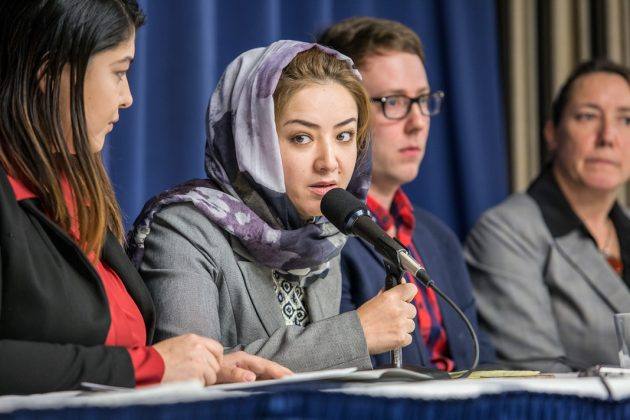
26 November 2018, the National Press Club. The Associated Press report that day — headlined "Woman describes torture, beatings in Chinese detention camp" — recorded that she told reporters she had been interrogated for four days in a row without sleep, had her hair shaved, and was subjected to an intrusive medical examination; that her hands bled from the beatings; that each time she was electrocuted her whole body shook violently and she could feel the pain in her veins; that she would rather have died than endure more, and begged them to kill her. The AP wire carried her testimony into the global news network; from then on her name travelled together with a handful of details — Cell 210, nine deaths, unknown pills — cited again and again by media around the world. Two days later, on the afternoon of 28 November 2018, the CECC convened its hearing "The Communist Party's Crackdown on Religion in China" in Room 106 of the Dirksen Senate Office Building, Chairman Rubio presiding, Cochairman Smith present. She was the day's only victim-witness, alongside a scholar and a religious-freedom expert. Her oral testimony, read through her interpreter Zubayra Shamseden, told the commissioners: over three years she had been taken to detention centres three times, ten months in total; in May 2015 she was arrested at the airport on her return, her two-month-old triplets taken away; after three months she was released to be with her sick children — and her oldest son had died in their hands; in April 2017 she was taken a second time, interrogated four days and nights without sleep, and after three months of seizures and lost consciousness was released to a mental hospital. Her full written statement was printed into the official congressional record (115th Congress, published 2019).
The aftershocks ran on a clear timeline. On 10 December 2018, International Human Rights Day, Citizen Power Initiatives for China presented her with its 2018 Citizen Power Award at a conference in the Rayburn House Office Building, its citation praising her "extraordinary courage and heroic action" in exposing the regime's atrocities against millions of Uyghurs. On 6 February 2019 Senator Tom Cotton retold her story in a speech at the Hudson Institute, quoting the interrogator's answer when she asked what crime she had committed — "you being a Uyghur is a crime." Section 4(10) of the Uyghur Human Rights Policy Act as introduced on 17 January 2019 — House bill H.R.649 and Senate bill S.178 alike — named her in the congressional findings alongside Kayrat Samarkhan and Omir Bekali: the bill's text states that detainees including these three described forced political indoctrination, torture, beatings, food deprivation and solitary confinement. The act, revised, passed and was signed into law on 17 June 2020 — her name thus stands in the findings of a United States statute. On 24 October 2019 she sat in the audience for Secretary of State Mike Pompeo's speech on China; the New York Times' account (preserved in a State Department FOIA-released media digest) recorded her reaction — she hoped the United States would take action, said it should impose sanctions on specific Chinese officials under the Global Magnitsky Act, and asked why America had not acted until now. That is the documentary basis for the "Magnitsky advocacy" item in the brief for this entry: it was not advocacy done on her behalf; she said it herself, in front of reporters. In 2019 her testimony was adapted by the Japanese manga artist Tomomi Shimizu into "What Has Happened to Me — A Testimony of a Uyghur Woman," which spread widely online — widely enough that Chinese officials felt it necessary to rebut it by name at a Xinjiang government press conference on 3 January 2020 (see section 13). On 19 April 2021 Human Rights Watch and Stanford Law School's Human Rights & Conflict Resolution Clinic published "Break Their Lineage, Break Their Roots," arguing that the Chinese authorities' acts in Xinjiang amount to crimes against humanity; the report cites her testimony twice — that she witnessed nine deaths in three months of detention, and her description of being stripped naked, forcibly examined, electroshocked and beaten, and of 40 to 68 women, chained at wrists and ankles, held in a roughly 420-square-foot underground cell in which they also had to urinate and defecate. And on 6 June 2021 she gave evidence in London to the Uyghur Tribunal, under a written statement signed 9 April 2021 — consistent with her 2018 congressional account in its main lines, fuller in detail. The several discrepancies between those two sworn narratives are precisely what section 18 of this entry exists to record.
11. Sterilization: what she learned only after a medical examination in America
When she testified in 2018 she knew only that she had been forced to swallow unknown pills, drink a white liquid and receive unknown injections, and that women in her cell had stopped menstruating or bled heavily. She did not know what the drugs had done to her. The answer came in 2019: on 10 August 2019 Nikkei Asia reported that doctors in the United States had determined that she had been sterilized. This archive fixes the relay chain link by link. The first public report was Nikkei Asia's interview-based story of 10 August 2019. The CECC's 2019 annual report then carried the finding in its population-control chapter: according to international media, authorities in Xinjiang had forcibly sterilized her without her knowledge while she was detained, and following her release and arrival in the United States, doctors confirmed she had been sterilized — citing Nikkei. Adrian Zenz's June 2020 study "Sterilizations, IUDs, and Mandatory Birth Control" cites the same Nikkei report and sets it against the systematic birth-suppression programme his government-document research confirmed. Separately, a Heritage Foundation commentary of 2019 relayed that she raised forced sterilization again that month at an Amnesty International conference in Tokyo — a second-hand relay, archived here as such.
The grading of this section must be kept in separate parts. First: "U.S. doctors confirmed she had been sterilized" is supported by two chains — Nikkei Asia's reporting and the CECC annual report's institutional adoption of it — and this archive records it as "reported as confirmed." But no underlying medical report has ever been published; the method of the sterilization (surgery, or the drugs), and during which of her detentions it occurred, are matters of no public record, and she herself has never claimed to have witnessed a sterilization operation performed on her — on the existing record, it was done without her knowledge and discovered afterwards by examination. Second: her "without her knowledge" is the mirror image of her medication testimony — a woman who was force-fed pills, whose mouth was pried open to check she had swallowed, who was put naked into a scanning machine, was in no position to give or withhold informed consent to anything. Third: the Chinese government's answer is that there is no sterilization record and that "her parents said she was fertile" (the 2021 official rebuttal). This archive sets the two evidence-forms side by side without adjudicating for the reader — an American medical examination reported by a major newspaper and adopted by a congressional commission, against a parental say-so relayed by the government that held those parents inside China, in the very position her testimony describes as leverage. The government has never produced a medical document of its own. She was twenty-nine, and had already lost one of her three children. Sterilization means she can never have another. This archive keeps that entry on the same page of the ledger as her son's death.
12. The husband: a fate the record cannot settle
Her husband is one of the case's largest open questions, because the two versions share no common ground at all. Her version: he is Egyptian; when she returned to China in 2015 he stayed in Egypt for work; she last saw him in 2015. According to her October 2018 RFA interview, after reaching Cairo she learned from his co-worker that he had returned to China in 2016 to bring his family home and was detained at Beijing airport. The English Wikipedia, drawing on her interviews, adds that she learned he had been arrested and sentenced to 16 years' imprisonment, that his family was not informed, and that she herself learned of it only in 2018. The Chinese government's version: Hua Chunying stated in January 2019 that her Egyptian husband left the country with her and her children in April 2018, returning to Egypt; the People's Daily rebuttal of 2021 likewise dates their joint departure to 22 April 2018. One account has the husband in a Chinese prison since 2016; the other has him on a plane to Cairo beside her in 2018. Both cannot be true. This archive searched the public record and found no verdict, no prison record, no Egyptian official statement and no independent third-party verification concerning this man at all. Even his name appears in no reliable source.
This archive's treatment of the section is therefore: the husband's fate is recorded as "no public record by which to decide." Her 16-year-sentence account is marked "her own account as relayed by media, not independently corroborated." The official "left together" account is marked "official single-source account, not independently corroborated." Two surrounding facts are fixed alongside. First, on arriving in Cairo on 28 April 2018 she immediately searched for her husband and learned of his arrest from his co-worker — a behavioural detail in her earliest RFA interview that has no place in a story where the husband had just flown to Cairo at her side. Second, in all her years of public testimony since — including a 2022 Christian Post interview about her children and their lost brother — she has consistently spoken on the premise that her husband is imprisoned, and no report has ever photographed or quoted a husband at her side in Egypt or America. Where neither side produces a document, the internal coherence of conduct and timeline is all an archive can record. This section is left exactly there, undecided, for those who come after.
13. China's denials: one sentence — "never in a camp" — and a rebuttal that kept growing
The Chinese government's response to Mihrigul Tursun grew in proportion to her fame, on the following timeline. In January 2019 CNN broadcast a report on the Xinjiang camps and those who had fled them, including her account of witnessing nine detainee deaths and of her son's death at the Urumqi Children's Hospital. At the Foreign Ministry's regular press conference on 21 January 2019, spokesperson Hua Chunying called CNN's reporting "totally fake" and a "deliberate lie," and gave the official version: Tursun had been criminally detained by the Qiemo County Public Security Bureau from 21 April to 20 May 2017, twenty days, on suspicion of inciting ethnic hatred and discrimination, during which she was found to have an infectious disease (the ministry text did not specify which; Xinjiang officials at a January 2020 press conference specified syphilis among others — the difference in detail between official texts is archived in parallel); apart from those twenty days she had been totally free in China, travelling in and out frequently; she had never been detained by Urumqi police, never been in prison, and never been "trained" in any vocational education and training centre; and her claim about her son's death at the Urumqi Children's Hospital was untrue. CNN replied that its reporting was consistent with the testimony she had given the CECC in November 2018, and that it had sought Chinese comment repeatedly. One internal contradiction inside the official record deserves to be nailed down: the Xinjiang government press conference of 3 January 2020 states that the Qiemo bureau terminated the compulsory measures against her on 10 May 2017 "out of humanitarian considerations," and the People's Daily rebuttal of 2021 likewise gives 10 May — while the Foreign Ministry's 2019 account, as carried by the English Wikipedia's summary of it, runs the detention to 20 May. The government's own texts disagree about whether she walked out on the 10th or the 20th; this archive archives both.
In December 2019 a Xinjiang government spokesperson, answering questions from the International Consortium of Investigative Journalists, returned to her case specifically: the alleged nine female deaths were "pure fabrications"; she had never been locked up by Urumqi police, never jailed, never put in a training centre; and she had lied, the spokesperson said, in claiming her younger brother was abused to death in a training centre — her brother Akber Tursun, on hearing her "lies," had spoken out publicly. On 3 January 2020 Xinjiang officials held a press conference in Urumqi at which Shimizu's manga was put to them by name; they restated the whole account and added a nationality detail: in March 2018 her Egyptian husband had told the Qiemo County Public Security Bureau that she had acquired Egyptian nationality, and after seeking her views and accepting her application to renounce her Chinese nationality, the bureau had deregistered her and her two children's household registration. On 29 April 2021 the People's Daily Online rebuttal carried the official line to its fullest form: born in 1985 (see section 1); a marriage registered with an Iranian in August 2010; no sterilization record, and "her parents said that she was fertile"; her son did not die while receiving treatment in Urumqi; and her brother Akbar publicly calling her a habitual liar. In addition, according to the publisher's introduction to her English-language memoir, the Chinese authorities produced a short film in which her parents, police officers and doctors speak against her and portray her testimony as false — recorded here as a second-hand publishing-source item.
This archive's treatment of the denials is to record them in full, item by item, because the denial campaign is itself part of this case's history. Three structural facts are noted without adornment. First, the core of the official denial is the formula "apart from twenty days of criminal detention, she was totally free" — and the existence of that April 2017 detention is the one point on which the government and Tursun do not actually disagree, since she too was taken that April; what is truly in dispute is the other nine-plus months. Second, the resources the state has spent rebutting her have escalated year by year: a Foreign Ministry press conference, a regional government press conference, a full-length official rebuttal article, family members presented to accuse her. A claim by an ordinary woman who "was never in a camp" has been answered by four tiers of state machinery over three years; the scale of the effort is itself a datum. Third, her family's on-camera accusations against her, and the section of her own testimony describing a brother forced to phone her with threats (see section 15), mirror each other in timing and form: which side's family statements were voluntary is something the public record cannot prove, and this archive archives both, with their contexts pinned down.
14. Where the international record actually lands — and three honest "not founds"
Under this archive's rules, this section accounts item by item for where she actually appears in institutional records, including the negative results. First, the CECC: she was a witness at the Commission's hearing of 28 November 2018, and her oral and written testimony stands in the official congressional hearing record; the CECC's 2019 annual report carries a named passage on her in its population-control chapter, covering the reported forced sterilization and the forced medication. But the distinction must be kept sharp: the CECC's Political Prisoner Database records cases of persons in custody, and the "representative cases from the prisoner database" submitted into the record that day by Chairman Rubio were other people's cases; this archive found no individual database entry for Tursun herself. Her CECC footprint is "witness plus named case in the annual report," not "prisoner-database case," and this archive does not inflate it. Second, USCIRF: searching the Commission's website and its FoRB Victims Database under the several transliterations of her name retrieved no individual entry for her — the matches retrieved belong to a similarly named different person (an entry for Memettursun Islam, unrelated to her). USCIRF chair Nury Turkel, testifying before the House in March 2023, named her in a list of camp survivors who have borne witness — a naming in testimony, not a case entry. This archive's conclusion: an individual USCIRF entry for Mihrigul Tursun was not found, and none is claimed. Third, the U.S. State Department's International Religious Freedom Reports: the China sections of the 2018 and 2019 reports describe the Xinjiang camps at length and name forced sterilization among the abuses, but in the searchable texts this archive found no naming of her individually, and it does not claim one. Fourth, Amnesty International: no individual action file or dedicated report on her was found; her appearance at an Amnesty conference in Tokyo in 2019 to speak on forced sterilization rests on the Heritage Foundation commentary's second-hand relay (see section 11) and is archived as such — not as an Amnesty case adoption. Fifth, Human Rights Watch: its April 2021 report with Stanford cites her testimony twice (see section 10) — that is formal adoption at the level of an institutional report. Sixth, the Uyghur Tribunal, the independent people's tribunal in London: she was its witness UTFW-006, testifying on 6 June 2021, her signed statement and the hearing transcript fully public; the tribunal's December 2021 judgment relied broadly on survivor testimony in finding torture and crimes against humanity in Xinjiang — this archive records only that she testified and her evidence is in its record, and does not dress the tribunal's general conclusions up as a ruling on her individual case.
15. The family's price, and pressure that crossed an ocean: the brother's voicemail
What she paid was not measured only in her own body. In the closing part of her congressional statement she described a voicemail left on the phone she had brought out of China, from her brother. In her retelling, he said: "How could you do this to your parents, to us? What kind of daughter are you? You should go to the Chinese Embassy right now and denounce all the things you said about the Chinese government … Tell them you were pressured by the Uyghur organizations in the United States to lie about your detention and torture in the camps and take back everything you said. Otherwise, China can get to you wherever you hide." Her judgment was that the Chinese government had forced her brother to leave that message. Her statement says she was terrified — that even hiding in America, the Chinese government's threats could still reach her, from so far away. This archive fixes the evidence-form plainly: the message's content is her retelling in congressional testimony; no recording is public; the "government coercion" is her judgment, recorded as such. But set this section beside section 13 — the brother Akbar presented by official channels to denounce her as a liar, the officially produced film of family members speaking against her — and a complete chain lies on the table: the voices of her relatives inside China reach the public record in one shape only, the shape of accusing her. Her congressional statement adds one more detail of the same period: several weeks before the hearing, a group of Chinese men had followed her outside in the United States, and kept following after she got into a car. That too rests on her account alone, and is archived as such.
The trauma belongs to the whole family. She told Congress in 2018: her two children have physical and psychological health issues; they are scared when someone knocks on the door and afraid of being separated from her. She still carries the scars of the beatings and the pain in her wrists and ankles from the chains; she cannot hear in her right ear; she is afraid of the dark and also of too much light or noise; police sirens make her anxious and set her heart racing; sometimes she is short of breath, her body goes numb and her heart aches; she still has nightmares; and even though she has been told she is safe, at night she still fears the Chinese police will knock on her door, take her away and kill her. Her 2021 tribunal statement ends in nearly the same words — fear, anxiety, a racing heart, nightmares, dread of the knock on the door. In January 2022 she told the Christian Post that she still had not told her two children the full details of what happened to their brother, and would wait until they were older — although she had earlier told CNN that when they grew up she would tell them the Chinese government had killed him. The distance between those two sentences is her actual life across these years: she has told the worst of it to the whole world, again and again, and still cannot bring herself to say it to her own son and daughter, now of school age.
16. Current status: settled in Virginia, a book in print, still speaking
Her present situation, as far as the public record can fix it, is as follows. She lives in Virginia in the United States with her two children — settled there after landing in September 2018, as reported by Women Under Siege in 2019 and the Christian Post in 2022. Her story was adapted into the Japanese manga in 2019 and spread widely; her memoir, written with the German journalist Andrea C. Hoffmann and published in English as "Place of No Return: How I Survived China's Uyghur Camps," later put her testimony into full-length book form. She has continued to tell it at universities, conferences and in interviews: testimony to the Uyghur Tribunal in June 2021; a Christian Post interview on the eve of the Beijing Winter Olympics in January 2022, in which she said she was "100%" supportive of boycotting those Games. The most recent public activity this archive's check could find is a Fox News Digital interview — conducted in Washington, reporting her as 35 years old, and noting that former Ambassador-at-Large for International Religious Freedom Sam Brownback interviewed her for his recent book; the various republications of that interview carry inconsistent dating, so this archive records it as "2025–2026, exact date unverified" and adopts only the underlying fact: she is still in the United States and still speaking publicly. Her U.S. legal status rests, on the record found, at this: 2019 reporting described her and her children as working through the asylum process; the Fox report's paraphrase says she eventually received refuge after her congressional testimony. No precise grant date or document is public, and this archive records the asylum outcome as a matter of no precise public record. Of her parents' and siblings' situation there is no independent public record beyond the officially staged statements; her husband's fate remains the stand-off of section 12. As of this archive's verification in November 2026 she is in the United States and still speaking. This entry archives her under the status "in exile," and — because her husband's and parents' fates remain unresolved and the transnational pressure on her has not stopped — carries the case in this site's Ongoing section (in Chinese, the site's 正在发生 column), which tracks cases whose story has not ended.
17. Full timeline
1989 Born in Qiemo (Cherchen) County, Xinjiang (the Chinese official rebuttal gives 1985 — not adopted, see section 1). c. 2001 Aged 12, sent to Guangzhou for middle school. Afterwards Studies economics at Guangzhou University; works in Guangzhou for a company trading with Arab countries. 10 December 2010 / December 2011 Leaves for / enrols in Egypt (the two accounts in parallel), at the British University in Egypt; marries an Egyptian man in Egypt. March 2015 Gives birth in Egypt to triplets, two boys and a girl, Egyptian citizens. 13 May 2015 (her congressional statement says she set out on 4 May) Arrives at Urumqi airport with the triplets; stopped at border control, the babies taken away; first detention begins. July 2015 "Paroled" because the children are sick; the next day she is handed her eldest son's body; her passport, ID card and phone are kept, her ID card marked; for nearly three years she cannot leave. 2016 (By her account as relayed by media) Her husband returns to China to find her and is detained at Beijing airport. April 2017 Taken from her parents' home in Qiemo for the second time; interrogated over successive days and nights at the county security bureau, forcibly medicated and intrusively examined, then sent to the camp and Cell 210. 9 June 2017 By her testimony, electroshocked in the tiger chair; faints again the same day; taken to a psychiatric hospital in Urumqi; afterwards brought home by her father, with policemen moving into the family home on rotation. November 2017 / January 2018 The third detention (the two accounts in parallel): told she "had been sentenced" and offered a choice of three ways to die; held alone, then moved to other camps. 5 April 2018 Released; sees her two children; her parents are not at home. c. 8 April 2018 Leaves Qiemo for Beijing with the children; refused boarding three times. 28 April 2018 Lands in Cairo (the Chinese government says she left on 21/22 April together with her husband — archived, not adopted). 21 September 2018 Arrives in Virginia, United States. October 2018 Gives RFA's Uyghur Service a long interview. 26 November 2018 Speaks publicly at the National Press Club in Washington; the Associated Press carries her account worldwide. 28 November 2018 Testifies before the CECC; her written statement enters the congressional record. 10 December 2018 Receives the Citizen Power Award. 21 January 2019 Foreign Ministry spokesperson Hua Chunying denies her testimony in full at the regular press conference, in open dispute with CNN. 6 February 2019 Senator Cotton retells her story in a Hudson Institute speech. 2019 The Uyghur Human Rights Policy Act, in both its House and Senate versions, names her testimony in its findings (the act becomes law on 17 June 2020). 10 August 2019 Nikkei Asia reports that U.S. doctors have confirmed she was sterilized. 24 October 2019 After attending Secretary Pompeo's China speech, tells the New York Times the United States should impose Global Magnitsky sanctions on specific Chinese officials. December 2019 / 3 January 2020 Xinjiang officials rebut her testimony, and the manga based on it, twice more. 9 April 2021 Signs her written statement to the Uyghur Tribunal; 19 April 2021 the Human Rights Watch and Stanford report cites her testimony; 29 April 2021 the People's Daily Online rebuttal appears. 6 June 2021 Testifies in London before the Uyghur Tribunal. January 2022 Christian Post interview: supports a boycott of the Beijing Winter Olympics. Afterwards Her English-language memoir with Hoffmann is published. 2025–2026 Fox News Digital interview; still speaking publicly in Washington (exact date unverified).
18. Archived in parallel: where the sources disagree
Under this archive's rules, disagreements among sources are not merged away; they are listed. (1) Birth year: 1989 (her congressional testimony's stated age of 29; her tribunal statement; the English Wikipedia's 28 December 1989 — the exact day found in Wikipedia alone, unverified); 1985 (the Chinese official rebuttal of 2021, single-side). This archive adopts 1989. (2) Birthplace: Qiemo/Cherchen County (both of her own statements); Kuerle City (the Citizen Power Award citation). This archive adopts Qiemo. (3) Departure for Egypt: left on 10 December 2010 (written congressional statement); enrolled December 2011 (tribunal statement) — possibly departure versus enrolment; archived in parallel. (4) The May 2015 return date: 13 May (RFA interview; tribunal statement); set out on 4 May (written congressional statement). This archive adopts 13 May and sorts by it. (5) Length of the first detention: three months (oral and written congressional testimony); two and a half months (her tribunal oral evidence); the release month is July 2015 on all accounts; formal formulation here: roughly two and a half to three months. The brief's "37 days" appears in no source found and is not adopted. (6) Place of the first stop: Urumqi airport (all of her accounts and all reporting agree); the brief's "Guangzhou airport" appears in no source found and is not adopted — Guangzhou was her schooling city. (7) Length of the second interrogation: four days and nights (congressional testimony); three days and nights (tribunal statement); seven days and nights (the edited RFA interview text). (8) Placement of Cell 210: the second detention (tribunal statement, including the 9 June 2017 electrocution date; followed by Human Rights Watch and others); the written congressional statement's narrative order places it after the passage on the third detention. (9) Start of the third detention: November 2017 (tribunal statement); January 2018 (written congressional statement, RFA interview, Wikipedia). (10) The third detention's uniform: yellow uniform (tribunal statement); blue uniform with a yellow vest, numbered 54 (written congressional statement). (11) Departure from China: landed in Cairo on 28 April 2018, travelling alone with her two children (all of her own accounts); left on 21 (in one text 22) April 2018 together with her husband and two children (Chinese official account). (12) The husband's fate: detained at Beijing airport in 2016 and sentenced to 16 years (her account as relayed by media, not independently corroborated); left with her for Egypt in April 2018 (Chinese official account, not independently corroborated) — head-on contradiction, no public record by which to decide. (13) The eldest son's death: died in a Urumqi hospital during her detention, his body handed to her the day after her release (her testimony; CNN names the Urumqi Children's Hospital and the boy as Mohaned); the government says her son did not die while receiving treatment in Urumqi — and has produced no record of the child's whereabouts. (14) The end of the April 2017 criminal detention: compulsory measures terminated 10 May 2017 (Xinjiang press conference of 2020; People's Daily rebuttal of 2021); detained until 20 May 2017 (the Foreign Ministry's 2019 account) — the official texts are internally inconsistent. (15) The infectious-disease detail: the Foreign Ministry's 2019 account says only "infectious disease," unspecified; Xinjiang officials in 2020 specified syphilis among other conditions. (16) Marital history: the official rebuttal claims she registered a marriage with an Iranian man in August 2010 — found only in that single official text, archived as unverified. (17) Matters of no public record: her husband's name and fate; the eldest son's medical records and any death certification; the original medical report of the sterilization and when it occurred; the independent situation of her parents and siblings; any document recording the outcome of her asylum case; any legal document of any kind from her three detentions.
19. Verification and sources
The core facts of this entry were cross-checked against the following sources. The subject's own testimony (the case's main line; its evidence-form is sworn or public testimony, and wherever it stands alone the text marks it "according to her testimony"): the official record of the CECC hearing "The Communist Party's Crackdown on Religion in China," 28 November 2018 (published by the U.S. Government Publishing Office in 2019; her oral testimony and full written statement — the stated age of 29, the Guangzhou schooling, the 10 December 2010 departure for Egypt, the 4 May departure account, three detentions totalling ten months, Cell 210, the nine deaths, the tiger-chair electrocution, the unknown pills and white liquid, the filmed forced statement, the 5 April 2018 release, the 21 September arrival in the United States, the brother's voicemail, "you being an Uyghur is a crime"); Uyghur Tribunal witness statement UTFW-006 (signed 9 April 2021; heard 6 June 2021 — the 1989 birth year, the December 2011 enrolment, the 13 May arrival in Urumqi, the two-and-a-half-months account, the 9 June 2017 electrocution date, the November 2017 start for the third detention, the yellow uniform and the choice of three deaths, the policemen living in the family home and the sexual harassment). Media checking and reporting: Radio Free Asia's Uyghur Service, the October 2018 interview and its "Behind the Walls" feature on three detainees (the 13 May arrival, the husband detained at Beijing airport in 2016, the last detention in January); the Associated Press, 26 November 2018 (the National Press Club account); CNN's January 2019 reporting and its public exchange with the Foreign Ministry (the son's death at the Urumqi Children's Hospital; the hospital did not respond to requests for comment); Nikkei Asia, 10 August 2019 (U.S. doctors' confirmation of the sterilization); the New York Times, 24 October 2019 (after the Pompeo speech, her call for Global Magnitsky sanctions on specific Chinese officials — retrievable via the State Department's FOIA-released media digest); the Christian Post, January 2022 (settled in Virginia; boycott support; the children not yet told about their brother); Fox News Digital (the most recent public activity; its dating unverified, see section 16). Institutional documents: the population-control chapter of the CECC's 2019 annual report (the sterilization as reported and confirmed after arrival in the United States; the forced-medication quotations); finding (10) of the Uyghur Human Rights Policy Act of 2019, H.R.649 and S.178 (her testimony named); Human Rights Watch and Stanford Law School, "Break Their Lineage, Break Their Roots," 19 April 2021 (her testimony cited twice); Adrian Zenz, "Sterilizations, IUDs, and Mandatory Birth Control," June 2020 (systematic policy confirmed from government documents; the Nikkei sterilization report cited); the Citizen Power Initiatives for China 2018 award citation (the Egyptian Embassy intervention; the Kuerle birthplace claim — the latter not adopted); Women Under Siege, 2019 (settled in Virginia, asylum in process, the embassy's assistance). Chinese official accounts (recorded in full in section 13): Foreign Ministry spokesperson Hua Chunying's regular press conference of 21 January 2019; the Xinjiang spokesperson's December 2019 answers to the ICIJ and the Urumqi press conference of 3 January 2020; the People's Daily Online rebuttal of 29 April 2021. Negative checks: searches of USCIRF's website and its FoRB Victims Database under the several transliterations of her name retrieved no individual entry for her (section 14); the searchable texts of the State Department's International Religious Freedom Reports contain no individual naming of her that this check could find; no Amnesty International individual action file on her was found; no individual Political Prisoner Database case entry for her was found at the CECC (her CECC footprint is that of witness and annual-report named case — see section 14); her husband's name, her son's medical records and the original sterilization medical report are all matters of no public record. Evidence grading: Grade A (documents of the detaining state) — only the government's denial texts exist; no affirmative judicial document (detention decision, verdict) exists in this case, and that non-existence is itself an archival fact. Grade B (parliamentary records and institutional files) — the congressional hearing record, the CECC annual report, the act's text, the tribunal's file. Grade C (media checking chains) — RFA, AP, CNN, Nikkei Asia, the New York Times, and the citation and checking of her testimony in the Human Rights Watch report. Grade D (single relays) — the son's name Mohaned, the Tokyo Amnesty conference item, the official-film item, the marital-history item — each flagged where used. This entry was last verified on 12 November 2026.
20. Our Take
This archive's assessment is confined strictly to the facts of this case. First, what must be fixed above all is how ordinary its starting point was: a mother who had just delivered triplets, carrying three two-month-old babies home so her parents could help her raise them. She had taken part in no political activity — even her interrogators could only circle the question "who do you know overseas?" What dragged her into a basement cell, on her own account and on the interrogation's own logic, was that she had been to Egypt, spoke several languages, and was Uyghur. When a regime treats having been abroad as suspicion in itself, it is not policing acts; it is policing people. Second, the line that runs through mother and children: she was still breastfeeding when the babies were taken at the airport; on her release she was handed the body of a four-month-old, with surgical marks on his neck that nobody explained — no chart, no cause of death, not one sentence of explanation. Years later she learned she had been sterilized, at twenty-nine, from a medical examination in America. This family first lost a child, then lost the possibility of any more children. This archive keeps those two entries on the same page, because they come from the same logic: take the mother first, then deal with the children. Third, the form of the Cell 210 testimony itself. The reason her account has held up around the world is not emotion; it is numbers and names: forty square metres, forty women growing to sixty-eight, rotating every two hours to lie down, six shared blankets, nine dead, and the names and deaths of Gulnisa and Patemhan. Retold to Congress in 2018, to a tribunal in 2021, and in interview after interview, those details barely move, and Human Rights Watch later cited them one by one. A survivor's memory that survives that kind of repeated cross-checking is itself part of the evidence. Fourth, the shape of the official response. Beijing's denial of her account is not a sentence but a multi-year project: a Foreign Ministry press conference, a regional government press conference, a book-length rebuttal article, and her parents and brother presented to accuse her. If she truly "was never in a camp," refuting her would take nothing more than records of her ordinary life across 2015, 2017 and 2018. What the government produced instead was characterisation after characterisation and a line-up of family statements. The scale of the denial measures the weight of the testimony. Fifth, this archive answers for its own blanks: her husband's fate stands in two colliding accounts, and this archive does not "confirm" the sixteen-year sentence on her behalf; her son's cause of death rests on the mother's account alone, marked as not independently corroborated; the start month of her third detention is contradicted between her own two sworn documents, and both stand. Those blanks do not weaken this record — nailing the blanks in place, and nailing down what can be proved, is exactly the line between an archive and a propaganda text, on either side. The last thing she remembers an interrogator saying, this archive preserves as she gave it: she asked what her crime was, and the answer was "you being an Uyghur is a crime." If a government wants to refute that sentence, what it needs to produce is not another rebuttal article, but evidence that her cell never existed. That evidence has never appeared.