
第127案 | 高兟Case 127 | Gao Zhen
高兟(1956年生于山东济南,当代艺术家,「高氏兄弟」中的兄长,中国公民、美国永久居民),与弟高强(1962年生)自1985年起共同创作。1968年10月1日,其父以「反革命」被带走隔离审查,约25天后死于关押,当局告以自杀,家人至今不知确切死因、从未获任何解释——这是兄弟二人毛泽东题材作品的家庭根源。涉案作品作于2005—2009年:《毛小姐》系列(2005—2006年)、《枪决基督》与《下跪忏悔的毛》(2007—2009年);把此类行为入罪的《英雄烈士保护法》2018年5月1日才施行,创设罪名的刑法第二百九十九条之一2021年3月1日才生效,均在作品完成之后多年。2024年6月高兟携妻儿回国,8月26日在河北三河燕郊被带走,次日家属收到拘留通知;其妻赵雅良与儿子高嘉(美国公民,时年6岁)同时被禁止出境,此后孩子连续两年无法返美入学。2024年11月17日警方再自其存放处取走118件作品;案件审查起诉期间两次退回补充侦查、三次延长,2025年6月10日三河市检察院起诉并建议顶格三年;2025年9月他在看守所晕厥、被警告可能动脉硬化有中风前兆,取保一再被拒。2026年3月30日三河市人民法院一日闭门审理,家属与美国外交人员被禁止旁听,他坚持无罪;2026年8月25日一审判处有期徒刑三年(法定最高刑),刑期至2027年8月25日,宣判次日他数次吐血送医。他已上诉至廊坊市中级人民法院;截至2026年11月6日,二审结果、妻儿边控是否解除均无公开记录,中国官方与美国国务院就本案的公开声明亦无公开记录。Gao Zhen (born 1956 in Jinan, Shandong; contemporary artist, the elder of the Gao Brothers; Chinese citizen and US permanent resident) has worked with his brother Gao Qiang (born 1962) since 1985. On 1 October 1968 their father was taken away as a 'counter-revolutionary' for isolation and examination and died in custody about 25 days later; the authorities said suicide, the family has never learned how he died and has never received any explanation — the family root of the brothers' Mao works. The works at issue were made in 2005–2009: the 'Miss Mao' series (2005–2006) and 'The Execution of Christ' and 'Mao's Guilt' (2007–2009). The Law on the Protection of Heroes and Martyrs that criminalised such expression took effect only on 1 May 2018, and the offence itself, Criminal Law Article 299a, on 1 March 2021 — years after the works were finished. Gao returned to China with his wife and son in June 2024 and was taken away in Yanjiao, Sanhe, Hebei, on 26 August 2024, the detention notice reaching his family the next day; his wife Zhao Yaliang and their son Gao Jia (a US citizen, then six) were simultaneously placed under exit bans, and the child has missed two years of school in New York. On 17 November 2024 police removed a further 118 artworks from his storage; the case was twice returned for supplementary investigation and three times extended before the Sanhe procuratorate indicted him on 10 June 2025, recommending the maximum three years; in September 2025 he fainted in detention and was warned of possible arteriosclerosis, a possible stroke precursor, while bail was refused again and again. On 30 March 2026 the Sanhe City People's Court tried him in one closed day, family and US diplomats barred; he maintained his innocence. On 25 August 2026 he was sentenced to three years, the statutory maximum, the term to end on 25 August 2027; the day after sentencing he vomited blood repeatedly and was taken to hospital. He has appealed to the Langfang Intermediate People's Court; as of 6 November 2026 the appeal outcome and the status of his wife's and son's exit bans are matters of no public record, as is any public statement on the case by Chinese authorities or the US State Department.
What Happened
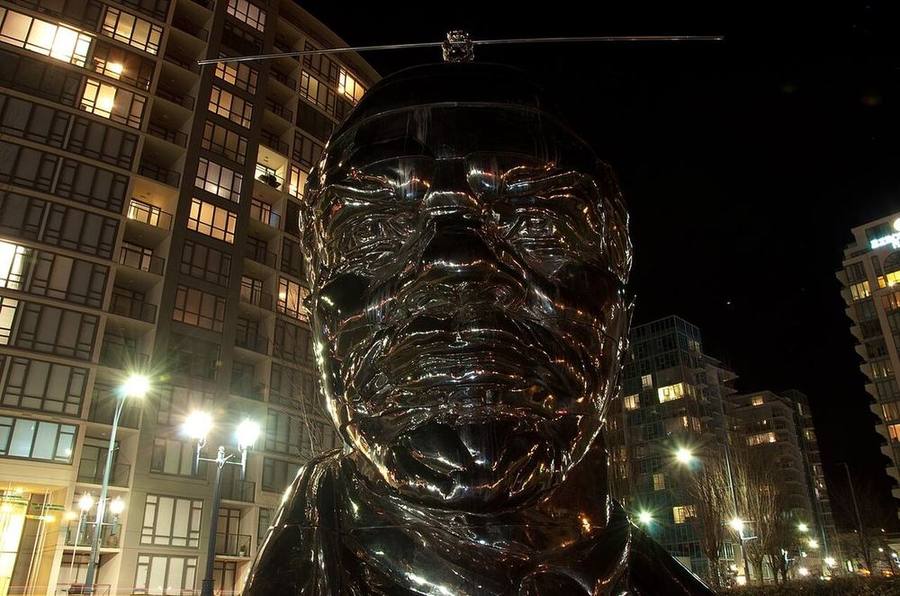
Two things about this case are persistently misstated, so this page states them first. Gao Zhen was not arrested over a single sculpture, and he was not seized at an exhibition. The indictment covered a body of work he and his brother Gao Qiang made between 2005 and 2009 — seventeen to twenty-one years ago — in Beijing's 798 Art District: principally the "Miss Mao" series, which gives Mao's likeness breasts and a Pinocchio nose; "The Execution of Christ," in which Mao-like figures aim rifles at Jesus; and "Mao's Guilt," a bronze of a kneeling, repentant Mao. When those works were made, no Chinese law made "infringing the reputation and honour of heroes and martyrs" a crime. The Law on the Protection of Heroes and Martyrs took effect on 1 May 2018; the criminal offence itself, Article 299a of the Criminal Law, took effect on 1 March 2021. On the prosecution's own timeline, every charged act of creation predates the offence — the earliest work predates it by sixteen years. In his closing statement to the court, Gao Zhen returned to this point again and again: is it lawful to convict sculptures made in 2005–2009 under an offence created in 2021? The court answered with the maximum sentence the offence allows: three years.
The outline is as follows. Gao Zhen and Gao Qiang, the Gao Brothers, have worked together since the mid-1980s and are internationally known for work centred on the Cultural Revolution and Mao's image. The family root of that work is 1968: during the Cultural Revolution their father, an ordinary worker, was taken away on 1 October 1968 for "isolation and examination" and died in custody some twenty-five days later; the authorities told the family he had committed suicide, and the brothers have never known whether he killed himself or was killed, and have never received any explanation. Gao Zhen acquired a US immigration status in the early 2010s (the accounts are layered in the text) and settled in New York in 2022. In June 2024 he returned to China with his wife Zhao Yaliang and their young son to visit family and sort belongings, staying about two months at a factory unit in Yanjiao where artworks were stored. Days before the family's planned return flight to New York, on the morning of 26 August 2024, police took him away in handcuffs in Yanjiao, searched his studio, and questioned his wife for hours; the next day the family received a detention notice from the Sanhe City Public Security Bureau naming the suspected offence as infringing the reputation and honour of heroes and martyrs. He has not been free since: two years in the Sanhe City Detention Center, an investigation returned twice for supplementary work, a trial postponed twice, bail refused again and again, a fainting episode in September 2025 after which a detention-centre doctor warned the family he might have arteriosclerosis, a possible precursor to a stroke. On 30 March 2026 the Sanhe City People's Court tried him in a single closed day, family and US diplomats barred; he maintained his innocence and read a closing statement that reads in places like a testament. On 25 August 2026 the court sentenced him to three years — the maximum. He was seventy years old and had already been detained for more than seven hundred days.
The case presses on more than one person. From the time of his detention, his wife and son have been barred from leaving China, on grounds relayed by the family and rights groups as "endangering national security"; neither has been charged with anything, and neither was a witness in the case (The Guardian editorial, 2026). Their son Gao Jia is a US citizen born in the United States, six years old when the family travelled in 2024; he has now missed two years of school in New York. A seventy-year-old father in a detention centre, a small child stopped at the border — this page records those as two separate lines, because in law they are two separate decisions, and in fact they are one lever.
The nature of the record must also be stated. The first-instance judgment has never been published, and neither the Sanhe court nor the Sanhe procuratorate has issued any public notice about the case that this page could find (no public record). The factual skeleton of this page is built from five independent bodies of material: wire and newspaper reporting (Reuters, the Associated Press, the New York Times, the BBC, The Guardian), whose information came mainly from Zhao Yaliang and from Shane Yi, a researcher with Chinese Human Rights Defenders; Human Rights Watch's statement of 7 October 2025; Amnesty International's three rounds of urgent actions (December 2024, August 2025, 2026); the Dui Hua Foundation's case updates of August and December 2025; and the most unusual source of all — the full text of Gao Zhen's own closing statement at his March 2026 trial, published in English translation by Human Rights in China (HRIC) on 17 September 2026, which quotes the indictment paragraph by paragraph. It is the only material that lets outsiders check the prosecution's wording line by line, and this page attributes it accordingly: passages quoted from the indictment are marked "as quoted in the closing statement," and assertions that rest only on Gao's own account are marked unverified and never blended with institutional sources.
1968: His Father's Death and Where These Works Come From
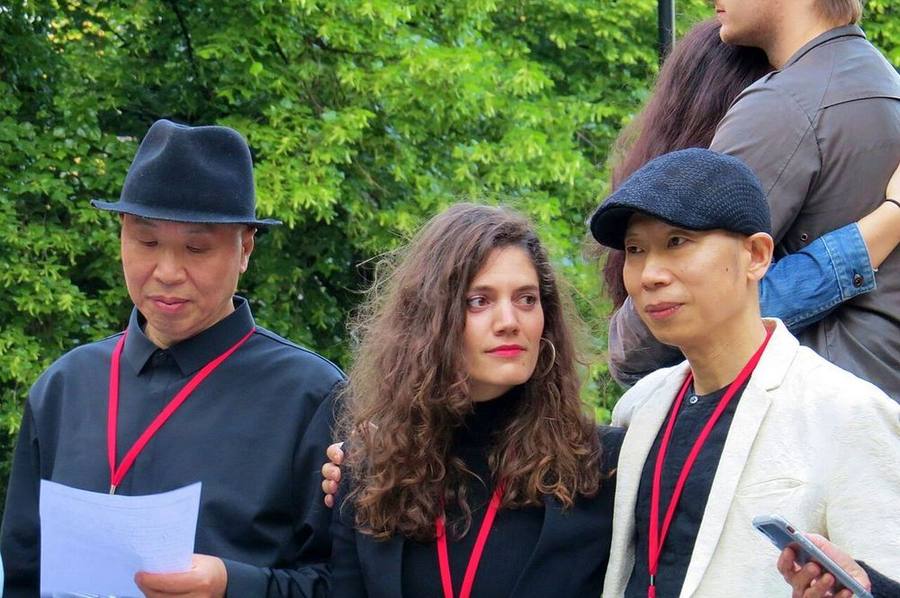
To understand the Gao Zhen case, begin in 1968, because the sculptures the prosecution charged are sculptures about that year. Gao Zhen was born in Jinan, Shandong, in 1956; Gao Qiang in 1962. When the Cultural Revolution began in 1966, Gao Zhen was ten and Gao Qiang four. In Gao Zhen's own later interview account (a Frontera interview transcript, an art-history oral source), on 1 October 1968 two of his father's co-workers came to the home and told the family that his father — a worker whose name appears in the interview transcript in the romanisation "Gao Chenwun"; no other public source confirms the Chinese characters, and this page does not fix them — had been "isolated for examination," that is, locked up; after some twenty-five days of continuing physical and mental torment, his father died unjustly. A US museum's 2010 introduction to the brothers' first American museum show agrees in substance: in 1968 their father was arrested as a "counter-revolutionary" and died in custody days later (Kemper Museum of Contemporary Art, 2010). Human Rights Watch's 2025 statement puts it most sparely: during the Cultural Revolution their father died after being taken into custody for being a "counter-revolutionary"; the family was told he had committed suicide.
How exactly he died is not agreed across sources, and this page archives the versions in parallel rather than merging them. First, the official account: suicide. Gao Zhen has said through an interpreter that the brothers still do not know whether their father actually committed suicide, as the authorities told them, or was killed during his incarceration (interview material cited in the Wikipedia article on the Gao Brothers; Artnet's biography is to the same effect). Second, the family's suspicion and accusation: the Los Angeles Times reported in 2010 that the brothers say he was tortured to death and that the authorities called it suicide. Third, the Dutch newspaper de Volkskrant's 2026 account: the brothers learned that their father had taken his own life in detention, a suicide condemned at the time as a "counter-revolutionary crime" (republished in translation by China Heritage, February 2026). One institutional webpage (the City of Richmond, Canada, public art registry) describes the father as having been "executed"; that wording conflicts with every interview and press source, and this page treats it as an isolated entry, archived as unverified and not relied on. The common, verifiable core is narrow: in 1968 the father was taken into custody as a "counter-revolutionary" and died there; the official word was suicide; the family never received any formal explanation, findings document, or rehabilitation record; and in the official archive the question has had no sequel for fifty-eight years.
What that left in the brothers was not a slogan but a specific artistic motif. Gao Zhen was twelve and Gao Qiang six when they lost their father. In Gao Zhen's own words in interview, the tragedy of that time caused them great mental and physical pain and had an enormous impact on their later lives and work. When they made the kneeling Mao in 2009, the Dutch account records that in the bronze, Mao kneels in remorse before a portrait of the brothers' parents (China Heritage, republishing de Volkskrant, 2026); The Guardian's editorial records that this work — which it calls Guilt — was shown only in private, never publicly exhibited. In other words, the sculpture the procuratorate lists as criminal evidence was, in its maker's own framing, a work in which a son who lost his father at twelve asks the man responsible to kneel and apologise to his dead parents. The legal documents later renamed it evidence of "distorting and vilifying a former national leader." This page records both namings of the same object.
One further parallel belongs in the archive. When the father was taken and died in 1968, there was no indictment, no trial, no judgment, and the family could not even learn how he died. When the son was prosecuted in 2024–2026, there were a detention notice, an indictment, a trial, and a verdict — the full paperwork of procedure — and only the direction of the conclusion was unchanged: the state still holds that the man who questioned that history is the criminal, while the history itself never enters the hearing. Gao Zhen put it directly in his closing statement, asking the court not to let his case become a contemporary version of a Cultural Revolution wrongful case (closing statement, HRIC translation). That is his rhetoric and is archived at the level of his own statement; but the two date-lines, 1968 and 2024, standing side by side in the record, are fact.
The Gao Brothers' Road: Jinan, 1989, 798, and New York
Gao Zhen's early career is known mainly from his own account in his closing statement, and this page marks it as such: in 1978, after the Cultural Revolution, he was admitted to the Shandong University of Arts and Design; on graduating in 1981 he was assigned to the Jinan Mass Art Museum to give art instruction, soon transferring to the Jinan Painting Academy for professional work, becoming the academy's youngest professional painter in his twenties and working in modern and contemporary art until his retirement in 2016. He also states that his work has been exhibited in museums and galleries worldwide, written into several histories of modern Chinese art, and collected by institutions including the Centre Pompidou in France and the San Francisco Museum of Modern Art. Those collection and exhibition claims are his own statement and have not been item-by-item independently verified by this page; they are archived as the subject's account. Of Gao Qiang's early life there is no reliable public record beyond his birth in Jinan in 1962.
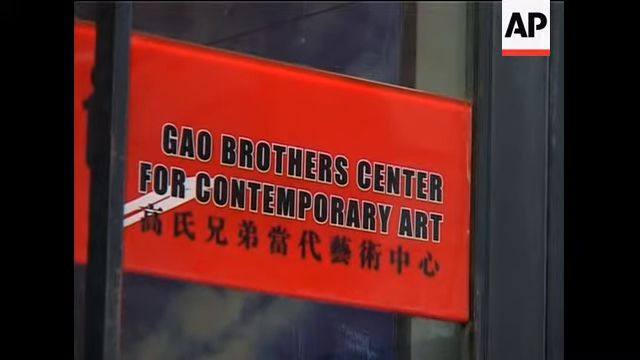
The brothers have worked together under the name "the Gao Brothers" since 1985 (Artnet biography; Kemper Museum introduction), part of China's 1980s New Wave generation. Their political troubles began early. In February 1989, during an art exhibition in Beijing, they signed physicist Fang Lizhi's open letter to Deng Xiaoping (ChinaAid, 2025; Radio Free Asia's 2024 report places the signing in the 1989 democracy movement); they were thereafter labelled dissidents and monitored. According to ChinaAid, they were barred from leaving the country from 1989 to 2003, the restriction lifted only in 2004; the Los Angeles Times reported in 2010 that they were denied passports and forbidden to leave mainland China for more than a decade, until 2003. The two years (2003 and 2004) are archived in parallel — they may mark the restoration of passports and the formal lifting of the ban at different points; no public document reconciles them, and this page does not force a single date. Thereafter the brothers could exhibit and work in China during the 2000s, despite harassment from the authorities (Human Rights Watch, 2025). In September 2010 the Kemper Museum of Contemporary Art mounted their first US museum exhibition, "Gao Brothers: Grandeur and Catharsis," running into January 2011 — a date that matters later, because the "Miss Mao" shown in that exhibition, as Gao Zhen would tell a Chinese court sixteen years on, was a single finished piece.
The US timeline has three layers and they must be kept apart. In his closing statement Gao Zhen says he immigrated to New York in 2012 as an "individual of extraordinary ability," travelling frequently between New York and Beijing over the following decade and staying mainly in Beijing's 798 Art District when in China. ChinaAid's 2025 report says he has been a US permanent resident since 2011. Human Rights Watch, Reuters, and other outlets agree that he relocated to the United States — settled in New York — in 2022, as he grew increasingly concerned over deepening repression. The accounts do not necessarily conflict: acquiring permanent residence (2011 in one account, 2012 in his own) and ending the shuttle to settle in New York (2022) may be separate milestones; but this page does not reconcile sources on their behalf. The year of status is archived as the 2011 account alongside the 2012 self-account; the 2022 settlement year stands on multiple consistent sources. His wife Zhao Yaliang is likewise a US permanent resident (Dui Hua Foundation, 2025); their son Gao Jia was born in the United States and is a US citizen (multiple sources).
In June 2024 Gao Zhen returned to China with his wife and child. His own account of that trip, in his closing statement, is that he stayed about two months at Factory Building 7-A in the Baishi Jingu Industrial Park in Yanjiao to organise his belongings, and that the unit's real function was a warehouse for stored items, artworks among them. Friends had warned him not to go to China, the Dutch account records (China Heritage, republishing de Volkskrant, 2026). The stay was meant to end with a flight back to New York — several reports note he was taken days before the family's scheduled return. At about 9 a.m. on 26 August 2024 (Radio Free Asia, September 2024, citing the Gao Brothers' Facebook post of 31 August), police rushed into his residence, took him away in handcuffs, searched the studio, questioned his wife for several hours, and confiscated books, computer hard drives, and sculptures and artworks relating to Mao Zedong. On the scale of the raid, Amnesty International's urgent action of December 2024 records that about thirty police officers raided his studio in Yanjiao town, Sanhe City, Hebei, photographed the artworks, and confiscated several sculptures, most of them created more than a decade earlier. Some wire reporting frames the place more loosely: Reuters in 2026 wrote of a detention during a visit from the US; the New York Times, as quoted in later summaries, placed the detention "in Beijing"; other reports write of a studio "outside Beijing." This page takes Yanjiao, Sanhe as its frame — the executing authority was the Sanhe police and the place of detention the Sanhe City Detention Center, on which the institutional record is consistent — while archiving the "Beijing" formulations in parallel as wire-service geography rather than deleting them.
Not One Sculpture: Three Bodies of Work and Two Dissemination Allegations
The full shape of the charge can only be assembled from the third and fourth paragraphs of the indictment as quoted, paragraph by paragraph, in Gao Zhen's closing statement — which is why this page insists it was not one sculpture. The indictment's third paragraph (in the HRIC translation of the closing statement) states that, as legally established, between 2005 and 2009 the defendant Gao Zhen, harbouring resentment toward a former state leader, conspired with others at a studio in Beijing's 798 Art District to maliciously create a large number of sculptures that distorted and caricatured the leader's heroic image; that the works were then shipped overseas for exhibition and media coverage under the name "Gao Brothers"; and that Gao later moved the sculptures to Factory Building 7-A in the Baishi Jingu Industrial Park, Yanjiao, Sanhe City, for storage. Gao Zhen states in reply that the timing and place of creation, the exhibitions, and the later storage are substantially accurate — he gave the same account across more than thirty interrogations — and that what he rejects outright are the characterisations "harbouring resentment" and "distorting and caricaturing," which he calls subjective presumptions of guilt rather than legal language. This page follows his own division: the course of conduct stands as admitted by the defendant; the motive characterisations stand as the prosecution's assertion, denied by the defendant; the two layers are never written as one.
The works, one by one. First, the "Miss Mao" series, made in 2005–2006 (closing statement). Gao's account of its construction is that its basic form derives from a cartoon doll sold in shops at the time — a "readymade" — its hairstyle borrowed from a widely recognised public figure, with Pinocchio's long nose and a pair of female breasts added, a synthesis of four deconstructed elements; he stresses that this is Pop Art's standard method, citing Duchamp's moustache on the Mona Lisa and Andy Warhol's treatment of Mao's portrait. The prosecution's and the rights groups' descriptions are blunter: "Miss Mao" is Mao given breasts and a Pinocchio nose (Human Rights Watch, 2025; Reuters, 2026). Both descriptions point at the same objects; the dispute is over whether the figure "is" Mao. Gao says the image is deliberately ambiguous and stands for every Chinese person who lived through that era; the prosecution says the works incorporate elements of the hero's image or directly replicate it. Second, "The Execution of Christ," and third, "Mao's Guilt" — both made between 2007 and 2009. Gao states that both works were modelled on Gu Yue, the character actor famous for portraying the leader, their inspiration drawn from Gu's screen image and a solicitation scandal; "The Execution" borrows the composition of Manet's "The Execution of Emperor Maximilian," with seven Gu Yue-like figures aiming rifles at a figure of Jesus modelled on a young Frenchman — eight individual sculptures in all, which, in his telling, is part of where the indictment's "large number" comes from. "Mao's Guilt" (also rendered in Chinese reporting as "Kneeling Mao in Repentance"), 2009, bronze, is a unique piece: a Mao-like figure kneeling in repentance. Gao's explanation carries his Christian faith: kneeling in repentance is the most devout posture a Christian can adopt, and by depicting Gu Yue in repentance he meant at once to express repentance for humanity's shared "original sin" and an indirect reflection on the Cultural Revolution — an act of intercession, not resentment. The prosecution's characterisation is the indictment's own: distortion and vilification of a heroic image.
The question of quantity is contested inside the indictment itself. Gao's closing statement devotes a passage to the words "a large number": "Miss Mao" did involve many experimental versions in different sizes, prototypes, defective pieces, and semi-finished work, but by the art world's convention only one finished version is selected for exhibition — the Kemper Museum show in 2010 displayed exactly one; "The Execution of Christ" and "Mao's Guilt" are each unique pieces on completion, so there is no basis for "a large number" at all; and to count experiments and rejects as a large number of criminal acts risks misleading the court into a heavier sentence. This is the defendant's own argument, archived at closing-statement level; the indictment's full text is not public and cannot be checked against it.
The indictment's fourth paragraph contains the dissemination allegations (as quoted in the closing statement): that Gao, in collusion with others, transmitted photographic images of the sculptures to the X platform for online dissemination, and authorised others to use an image for a book cover, thereby "seriously infringing the reputation of a former state leader and harming the public interest." Gao denies this wholesale, with specifics: the X account was registered by his younger brother Gao Qiang many years ago, he never posted the images in question, and a recent public statement by Gao Qiang corroborates this; and as for the book cover, he never authorised Rong Wei of New York's Boden Books to use the image — he explicitly refused the request, attended the relevant award ceremony precisely to deal with the matter in person, and his defence submitted Rong Wei's testimony, certified under the Hague Convention, to establish his innocence. All of this stands as the defendant's account and the defence's evidentiary assertions; how the prosecution proved dissemination and how the court found on it are matters of no public record, because the judgment is unpublished. This page flags the paragraph because it is the legal hinge of the case: the acts of creation happened in 2005–2009, and a prosecution that wishes to get around the calendar needs part of the case's weight to rest on "dissemination" — the very part the defendant denies most completely and on which the public record is thinnest.
One further detail from the closing statement belongs here — single-source and unverified, but archived because of what it would mean if true. Gao states that shortly after "The Execution of Christ" was completed in 2009, he placed one of the gun-holding Gu Yue figures on the ground floor of a café in the 798 Art District and invited Officer Hou from the neighbouring police station to look and judge whether the display was appropriate; Officer Hou and his superiors said there was no distortion or vilification and no problem. Seventeen years later, the Sanhe Public Security Bureau and the procuratorate charged the same work as malicious distortion and vilification (closing statement; the subject's own account; unverified). This page does not present that episode as an established fact. If it happened, what it shows is not one officer's open-mindedness but the arbitrariness of opposite official evaluations of identical conduct in different years: the work did not change; the year did.
How the Law Arrived: The Heroes and Martyrs Law, Article 299a, and the Retroactivity Dispute
Every date in this case's legal timeline has to be pinned down, because the case is an argument about dates. The Law of the People's Republic of China on the Protection of Heroes and Martyrs was adopted by the Standing Committee of the National People's Congress on 27 April 2018 and took effect on 1 May 2018; it protects the names, likenesses, reputations, and honour of heroes and martyrs and connects violations to civil, administrative, and criminal liability (Amnesty International urgent actions; IB Times, 2026, for the adoption date). The Civil Code of 2020, at Article 185, likewise writes civil liability for infringing heroes' and martyrs' reputation and honour into law (background supplied by this page). The criminal offence itself came later: Criminal Law Amendment (XI) added Article 299a, providing that insulting, defaming, or otherwise infringing the reputation or honour of heroes and martyrs, harming the public interest, in serious circumstances, is punishable by up to three years' imprisonment, criminal detention, public surveillance, or deprivation of political rights; the amendment took effect on 1 March 2021 (Chinese Human Rights Defenders, via IB Times; Human Rights Watch, 2025, confirms the offence was "introduced in 2021"). Some English reporting renders the provision as "Article 299(1)," a transcription variant of "Article 299a"; this page uses the formal Chinese numbering and notes the variant here.
Lay the two timelines side by side and the gap is the case. "Miss Mao" was made in 2005–2006: twelve to thirteen years before the Heroes and Martyrs Law, fifteen to sixteen years before the criminal offence. "The Execution of Christ" and "Mao's Guilt" were made in 2007–2009: nine to eleven years before the law, twelve to fourteen years before the offence. The summary given to Reuters after sentencing by Shane Yi of Chinese Human Rights Defenders was that the court had sentenced Gao to three years for artwork made as far back as 2005, some sixteen years before the law he was charged under even existed (Reuters, 25 August 2026, paraphrased here). The Dutch newspaper's commentary went further, saying the case suggests the law is now being applied retroactively for the first time (China Heritage, republishing de Volkskrant, 2026; commentary level). Gao Zhen himself put the question to the court directly: does charging him under an offence added to the Criminal Law in 2021, for sculptures created between 2005 and 2009 when that offence did not exist, comply with the law, and does it not violate the basic principle that what is not prohibited by law is permitted (closing statement)? It should be recorded that China's own Criminal Law, at Article 12, itself provides for applying the older and lighter law — where the law at the time of the act did not treat it as a crime, the law of that time applies. The existence of that article is what makes the retroactivity problem in this case not a commentator's invention but a contrast internal to China's own statute book. How the prosecution argued that Article 12 did not bar this prosecution — for instance, by connecting the case to later acts of storage or dissemination — cannot be checked, because neither the indictment nor the judgment is public; this page records only the outcome (indictment and conviction) and the defendant's rebuttal (see the dissemination section above), and does not write the prosecution's reasoning for it.
The law's enforcement landscape before this case is also part of the record. Human Rights Watch's 2025 statement offers a comparison: in 2023, stand-up comedian Li Haoshi made a joke about the People's Liberation Army that led to his company being fined 14.7 million yuan on heroes-and-martyrs grounds, though the comedian himself was not arrested. The difference in Gao's case is that the same body of norms was applied, by criminal conviction at the maximum term, to a famous artist's visual works made well over a decade earlier (this page's comparison of the two public records; the "first time" characterisation is archived at the level of the Dutch commentary and similar commentary, not as this page's independent finding). The sentencing signal was visible early: according to the Dui Hua Foundation's December 2025 update, the Sanhe procuratorate recommended three years — the maximum — at the moment of indictment on 10 June 2025. According to Gao's closing statement, the prosecutor handling the case told his defence lawyer that the case was highly sensitive and beyond his decision-making authority, requiring consultation upward, and at one point implied that if the sentence were around a year and a half he would advise Gao to accept a plea arrangement — after which an assistant prosecutor announced to Gao that three years was sought (the negotiation narrative rests solely on Gao's own statement and is unverified; the fact that the indictment itself recommended the maximum three years is independently recorded by Dui Hua citing CHRD, and the two layers are archived separately). The first-instance judgment matched the recommendation exactly: three years, not a day more, not a day less.
Why the Confiscation Figures Come in Threes: Several, More Than a Hundred, and 118
The number of artworks seized in this case appears in the public record in three figures from three different moments, and this page gives each with its source and date rather than merging them into one total. The first figure is "several": Amnesty International's December 2024 urgent action records that during the raid of 26 August 2024 police photographed his artworks and confiscated several sculptures, most created more than a decade earlier; Radio Free Asia's September 2024 report, citing the Gao Brothers' Facebook post, records that state security police confiscated books, computer hard drives, and sculptures and artworks relating to Mao, without a count. The second figure is "more than 100": the Observatory for the Protection of Human Rights Defenders (the FIDH–OMCT partnership), in its joint statement of 12 May 2026, states that when Gao was arrested officials confiscated more than 100 of his artworks, many of which had never been publicly exhibited in China. The third figure is the most precise and the latest to surface: "118 pieces" — Human Rights Watch's statement of 7 October 2025, citing Gao's brother Gao Qiang, records that Sanhe police took away 118 pieces of artwork, including sculptures, paintings, and photographs, from Gao's studio (storage site) in China on 17 November 2024.
The three figures are not necessarily contradictory: a seizure at the August 2024 raid (a first batch taken on site) and a further removal on 17 November 2024 (the remaining 118 pieces taken from storage wholesale) may be two stages of one confiscation, and a total of "more than 100" is compatible with the precise 118. But no confiscation inventory, seizure decision, or police notice is public against which to check any of this, and this page therefore records the sequence only: an on-site seizure of an unstated number in August 2024 (Amnesty; RFA); a removal of 118 pieces on 17 November 2024 (Gao Qiang, via Human Rights Watch); a confiscated total described as more than 100 works (FIDH, 2026). The complete catalogue of what was taken, where it is now held, whether it includes works never charged, and what will happen to it after judgment — confiscation, return, continued holding — are all matters of no public record. Three bodies of work were convicted; a lifetime's stored inventory was taken. The proportion belongs in the archive.
From Investigation to Indictment: Thirty Interrogations, Two Returns, Three Extensions
The procedural timeline, each step sourced. On 26 August 2024 Gao Zhen was taken away; the family received the detention notice the next day (Radio Free Asia, 2024). His formal arrest was then approved (Amnesty International's December 2024 urgent action confirms the arrest was approved; the exact approval date is a matter of no public record). His place of detention throughout was the Sanhe City Detention Center (multiple sources). During the investigation, according to his closing statement, investigators interrogated him more than thirty times and investigated at both his former employer, the Jinan Art Museum, and his former studio in Beijing's 798 district — the point he turns back on the indictment: the investigators knew perfectly well he was an artist, so why does the indictment list his occupation as "Supervisor" of a trading company? On 28 November 2024 the Sanhe Public Security Bureau concluded its investigation and transferred the case to the Sanhe City Procuratorate for review and prosecution (the indictment's procedural paragraph, as quoted in the closing statement). Thereafter the case was returned to the public security organ for supplementary investigation twice, for unclear facts and insufficient evidence, and the review period was extended three times because of the case's gravity and complexity (same source). Two returns and three extensions, in the prosecution's own procedural record — a hard fact for gauging the state of the evidence: in a case whose objects are physical sculptures that sat in storage for over a decade, and whose course of creation the defendant substantially admitted, the review-and-prosecution stage still twice found the facts unclear and the evidence insufficient.
One further detail of the indictment that Gao seized on is archived here because it concerns jurisdiction. The indictment describes him as "currently residing at Factory Building 7-A, Baishi Jingu Industrial Park, Yanjiao Development Zone, Sanhe City" and as "Supervisor of Sanhe Ruiyi Trading Co., Ltd." (the company name re-translated from the English rendering; unverified). His rebuttal: under the public security regulations on handling criminal cases, a place of habitual residence is where a citizen has continuously lived for more than a year after leaving his household-registration place; his habitual residence is in New York; the Yanjiao factory unit was a temporary stay of about two months in mid-2024 for organising belongings, in function a warehouse; and he had never heard of the "Supervisor" role. He argues the prosecution rewrote both his residence and his identity — first to settle jurisdiction over the case, and second to strip away his identity as an artist and recast the works as the "malicious creation" of a non-artist acting from resentment (closing statement; the defendant's own contention). The prosecution's response is a matter of no public record. Whatever the merits of that argument, the objective outcome is clear: the case was heard by the judicial organs of Sanhe, where the works were stored — not of Beijing, where they were made, and not of New York, where the defendant lived.
On 10 June 2025 the Sanhe City People's Procuratorate indicted Gao Zhen under Criminal Law Article 299a for infringing the reputation and honour of heroes and martyrs, and recommended a sentence of three years (Dui Hua Foundation, December 2025, citing Chinese Human Rights Defenders; IB Times, 2026, to the same effect, dating the indictment to June 2025). From the seizure in August 2024 to indictment took about nine and a half months; from indictment to trial took more than nine months more. The trial was originally scheduled for September 2025 and was then postponed twice; by December 2025, Dui Hua reported, the Sanhe People's Court had on 14 December 2025 again refused the defence's application to vary the coercive measures (bail), and had notified the lawyers that the trial was postponed for a second time, with a new date of 10 March 2026. The trial in fact took place on 30 March 2026 — twenty days after the December notice's date, for reasons that are a matter of no public record; this page archives both dates in parallel. The identity of defence counsel also varies by period in the reporting: in September 2024 Radio Free Asia confirmed the detention with his lawyer Qu Zhenhong; Dui Hua's August 2025 material refers to the defence efforts of the well-known lawyer Mo Shaoping; Gao's closing statement refers only to "my defence counsel," unnamed. This page records them by period and does not merge them into a single retainer asserted for the whole case.
Two Years in the Detention Center: Fainting, a Wheelchair, Forty Square Metres, and Refused Bail
Gao Zhen's conditions and health in the Sanhe City Detention Center reach the public record mainly through his family, relayed by rights organisations; this page archives them at that level, each item with its source. Human Rights Watch's statement of 7 October 2025 records that the family said the 69-year-old US permanent resident was in poor health and had fainted in September 2025; that after the faint, a doctor at the detention centre told the family he might have arteriosclerosis — a hardening of the arteries — and that it could be a precursor to a stroke; that he also suffers from a chronic back problem and had to sit in a wheelchair in meetings with his lawyer; and that he was held in a crowded cell of about forty square metres with fourteen other detainees. Despite the health problems, the authorities rejected his application for medical bail. Amnesty International's Canadian section added diagnostic detail in its 2026 material: reliable sources reported lumbar spine disease and fluid accumulation in his knees, and that he had collapsed several times in detention (Amnesty International, 2026 urgent action background). Dui Hua's December 2025 update corroborates from the procedural side: the defence applied before trial to vary the coercive measures, citing his deteriorating health, and the Sanhe court refused on 14 December 2025 — at least the second bail-type refusal documented in the public record (Gao's closing statement separately records that during the review-and-prosecution stage his counsel twice applied for bail pending trial and was refused both times; the two accounts concern different stages and are archived in parallel, not merged into one count).
Sentencing did not end the health line. Amnesty International USA's third urgent action in 2026 records that, according to recent information, on the day after sentencing — 26 August 2026 — Gao reportedly vomited blood several times and was taken from the detention centre to hospital for examination; the immediate symptoms later subsided, and the cause remains unknown. His brother Gao Qiang's letter to the US Congressional-Executive Commission on China, written around September 2026 and published on the Commission's website, adds that Gao had by then served two years in detention, including a period in solitary confinement; that in August 2026 he repeatedly fainted, including episodes associated with extreme heat and possible cerebrovascular problems; and that at the Sanhe City Detention Center he was suffering inadequate nutrition and insufficient access to medical care (all the foregoing from Gao Qiang's account; not independently verified, and archived as such). In the same letter Gao Qiang wrote that the family hopes he will live to be released in August 2027 but fears his condition may be so severe that he may not make it. His age milestones belong here: he turned seventy in May 2026 (FIDH's May 2026 statement gives 10 May 2026 as his 70th birthday, which he spent in detention). Taken at sixty-eight, sentenced at seventy to the maximum three years — the detention itself had already executed two-thirds of the sentence before any court pronounced it.
Wife and Young Son: The Exit Ban, the Missed Schooling, and an American Child's Two Years
The family line is why this page gives it a section of its own. At the same time as Gao Zhen was taken into custody, his wife Zhao Yaliang and their son Gao Jia were placed under exit bans. The Dui Hua Foundation's statement of 7 August 2025 dates the bans to 27 August 2024, the day after the detention (that statement dates Gao's detention itself to 27 August; the one-day difference forms part of the two-dates problem archived in the Verification Note). Amnesty International's second urgent action, of 12 August 2025, records that his wife is banned from leaving the country ostensibly on "national security" grounds, though no formal charges have been filed and no documentation provided to justify the measures; that their seven-year-old son is a US citizen with the legal right to leave, but is in practice unable to do so unaccompanied; and that the de facto travel ban had by then kept him out of school for a full year. Amnesty International's first urgent action, in December 2024, records that mother and son were stopped when they attempted to return to New York from Beijing, and that the wife was warned by police not to speak to the media about her husband's detention. ChinaAid's July 2025 report agrees: the wife was barred on grounds of "endangering national security" because of her association with him, and their seven-year-old US-citizen son could not return to New York for school.
The child's age advances across the sources in a way that cross-checks itself: six when stopped in 2024 (Amnesty International, 2024), seven in 2025 (Dui Hua; Amnesty International, 2025), and eight in 2026 (The Guardian's editorial, which names him as Gao Jia, an American citizen). The Guardian's editorial adds the legally decisive fact: neither mother nor son is accused of any wrongdoing, and neither was a witness in the case — they are held not because of anything they did or know, but because they are Gao Zhen's wife and son. The Dui Hua Foundation, in its executive director's name, argued that China's treatment of the child violates the UN Convention on the Rights of the Child, to which China is a party, and that exit bans more generally violate the ICCPR's provisions on freedom of movement (the Foundation's legal opinion, 7 August 2025, archived at the level of an institutional opinion). Gao Qiang's 2026 letter to the Congressional-Executive Commission records that the boy has been barred from returning home to New York for two years and longs to return to his home, his school, and a normal childhood in America (Gao Qiang's account).
This line has a footnote fixed to sentencing day itself: the person who told the world the verdict was the exit-banned wife. Reuters' sentencing report states plainly that Zhao Yaliang told Reuters about the three-year maximum sentence — the woman warned two years earlier not to speak to the media had become, two years on, one of this case's principal sources to the international public. This page records the fact without embellishment, and notes only what it shows at the factual level: the exit ban did not silence this family; it cost the family two years of a child's schooling instead. As of this page's verification on 6 November 2026, whether Zhao Yaliang's and Gao Jia's exit bans have been lifted, and whether the child has returned to school in New York, are matters of no public record; so is any change in their situation during the appeal.
30 March 2026: A One-Day Closed Trial and His Closing Statement
On Monday 30 March 2026 the Sanhe City People's Court tried Gao Zhen's case in a single day. The hearing was closed: the Chinese Wikipedia article on the Gao Brothers and multiple reports record that his family was barred from attending and the trial was held behind closed doors; the New York Times, as quoted in later summaries, reported that his family and US diplomats were barred from attending. Gao maintained his not-guilty position throughout (multiple consistent sources; in his own statement he records that he maintained his innocence). One procedural detail survives in his closing statement: at a pre-trial conference the defence applied for a renowned art critic (rendered in the English translation as Dr. Zhu Qi; the Chinese characters are unverified) to appear as a person with specialist knowledge and testify on the artistic character of the works — whether that application was granted and whether he testified are matters of no public record. The trial lasted one day and produced no verdict on the day; for nearly five months afterwards there was no further public word of the case, until sentencing.
What that trial left to the archive, above all, is the text of Gao Zhen's closing statement. Written on 28 August 2025 and revised into final form on 28 March 2026 (the statement's own dates, in the HRIC translation), it was published in English translation by Human Rights in China on 17 September 2026 under the title "A Helpless Defense and Confession." Its structure, summarised here in the original's order and attributed throughout rather than quoted at length, is this: he opens as a Christian, admitting his bewilderment that this misfortune has befallen him in frail old age rather than twenty years ago in his prime, since it is three sculptures made over two decades ago that put him in the dock; he sets his situation beside Socrates and Su Dongpo — both near seventy when tried, both prosecuted for words, both with young children at home, Su's case being the Crow Terrace Poetry Trial, the opening of China's literary inquisitions; he then dismantles the indictment item by item — the habitual-residence and "Supervisor" entries, the procedural record of two returns and three extensions, the more than thirty interrogations, the phrase "a large number," the imputed motive of "harbouring resentment"; he explains each work in turn (the readymade and Pop method, Gu Yue as model, Manet's composition, a Christian understanding of repentance); he denies the X-platform and book-cover allegations; he recounts the plea-negotiation episode (single-source, unverified — see the law section); he says that but for his six- or seven-year-old son, weeping day and night and begging God to let his father come home, and his refusal to let his own child suffer the loss of a father as he had in childhood, a few more years in prison would matter little to him against his convictions — that he had been willing to humble himself once for his son's sake and compromise against his conscience, and the prosecution denied him even that; and he closes by asking the court not to let the case set a precedent for "artistic imprisonment" in twenty-first-century China, ending with a Christian prayer. The statement's archival value is threefold: it is the defendant's defence; it is currently the only public relay of the indictment's text; and it is the autobiographical outline of a seventy-year-old man written while his health was failing in detention. This page uses it by paraphrase and attribution only.
After the trial Gao Zhen remained in custody awaiting judgment. FIDH's joint statement of 12 May 2026 noted the milestone: 10 May 2026 was his seventieth birthday, and he spent it in a Chinese prison. Between the trial of 30 March 2026 and sentencing on 25 August 2026 lie almost five months — within the forms of criminal procedure, a wait inside the trial time limit; in the life of the man concerned, five more months in a detention centre for a prisoner who had already been held nineteen months, had been warned of a possible stroke precursor, and was waiting for a judgment whose recommended sentence had been fixed at the indictment a year earlier.
25 August 2026: The Maximum Three Years, the Appeal, and Blood Vomited the Next Day
On Tuesday 25 August 2026 the Sanhe City People's Court in Hebei delivered its first-instance judgment: Gao Zhen was convicted of infringing the reputation and honour of heroes and martyrs (reported in English variously as "slandering" or "defaming" heroes and martyrs) and sentenced to three years' imprisonment, the statutory maximum for the offence; the two years already spent in detention were credited, and the term expires on 25 August 2027 (Reuters, 25 August 2026, sourced to his wife Zhao Yaliang and Chinese Human Rights Defenders; Amnesty International's 2026 statement and same-day BBC, AP, and Guardian reporting agree). The sentencing's public shape: the New York Times reported, as relayed in later summaries, that two of Gao's other brothers were able to attend the sentencing hearing — family barred from the trial itself were present, in other brothers' persons, for the verdict — and that he was found guilty and sentenced at that Tuesday hearing. The full judgment, its reasoning on sentence, and its findings on the retroactivity defence and on the dissemination evidence are all matters of no public record; the Sanhe City People's Court issued no public notice of the case that this page could find.
Gao Zhen decided to appeal both conviction and sentence (Amnesty International, 2026). According to the follow-up information in Amnesty International's Canadian and US urgent actions, the case has since moved to the Langfang Intermediate People's Court. As of this page's verification on 6 November 2026, whether the appeal has been heard and how it will be decided are matters of no public record. Until the appeal is resolved, Gao's legal position is that of a first-instance convict whose judgment is not yet final, his detention continuing. If the judgment stands unchanged, his term expires on 25 August 2027 — exactly three years after he was taken away, and twenty-one years after "Miss Mao" was finished.
What happened the day after sentencing has been placed in the health section; its position in the timeline is fixed here. On 26 August 2026 he reportedly vomited blood several times and was taken to hospital for examination (Amnesty International USA, urgent action). A man of seventy, just told he will spend another year inside, vomits blood within twenty-four hours of the verdict and is examined for an unknown cause — this entry stands in an international organisation's urgent-action document, not in a family's emotional account, and this page archives it alongside the September 2025 faint and the August 2026 repeated fainting episodes (Gao Qiang's account) as the complete documented sequence of his health in custody. No Chinese authority has made any public response to these health reports or to Amnesty International's appeals (no public record).
The International Response: Rights Groups, the Art World, 181 Signatories — and an Official-Level Blank
The international response is recorded here by actor, in layers. First, the international rights organisations. Amnesty International issued three rounds of urgent action in this case: the first on 5 December 2024 (UA 106/24), confirming his detention and approved arrest and the exit ban on his wife and child, and demanding his immediate and unconditional release and an end to the use of the Heroes and Martyrs Protection Law to stifle artistic creation; the second on 12 August 2025, headlined by a year in detention without trial and the child's full school year lost to the ban; and a third in 2026 after sentencing, demanding immediate and unconditional release, and pending release protection from ill-treatment, family contact, adequate independent medical care, an end to harassment of his family, and that they be allowed to leave China freely and safely, with an action deadline of 28 February 2027. Human Rights Watch published its dedicated statement on 7 October 2025, calling for the release of the unjustly charged US-resident artist; its Asia director's assessment, paraphrased here, was that the prosecution both violates Gao's basic rights and signals a step back toward China's painful past — that criticism of Mao's brutal legacy, once tolerated, now seems off-limits as Xi Jinping tightens ideological control. The FIDH–OMCT Observatory for the Protection of Human Rights Defenders issued a joint statement on 12 May 2026, keyed to his seventieth birthday, demanding immediate and unconditional release. The Dui Hua Foundation spoke twice: on 7 August 2025, decrying the exit ban on a seven-year-old American citizen, and on 30 December 2025, updating the postponed trial and the refused bail. Statements by PEN and other art-freedom organisations are reflected in the condemnations collected around the sentencing (as cited by Amnesty International and others); this page did not verify each such organisation's stand-alone text and therefore does not name them one by one or fabricate quotations for them.
Second, the art world and China's dissident community. Soon after the arrest, 181 Chinese artists, writers, activists, and scholars signed an open letter calling for Gao Zhen's release (Human Rights Watch, 2025). The letter drew the Cultural Revolution parallel directly, in substance: the Gao Brothers' father tragically lost his life in that time and the family has never received any explanation or justice, and today the Sanhe Public Security Bureau has labelled Gao Zhen's artistic creations evidence of a crime, repeating the persecutions of the Cultural Revolution (the letter, as relayed by Human Rights Watch; paraphrased here, not quoted verbatim). Early reporting also records a letter by creative figures (including a composer surnamed Ma and several other artists, named in Radio Free Asia's September 2024 report) calling for Gao's release and for repeal of the legislation banning insults to revolutionary heroes and martyrs, on the ground that it infringes the freedom of speech guaranteed — on paper — by China's constitution. A figure of more than 20,000 petition signatures circulating overseas appears only in news-aggregator retellings without an independently checkable source; this page marks it unverified and draws no conclusion from it. Gao Zhen's own letter to Ai Weiwei of 16 August 2025 was published by the Dutch journalist (China Heritage): in it he wrote, in substance, that he had known for years he was on his way to prison and counted himself fortunate that the destination arrived as late as it did (the subject's own letter, archived at that level).
Third, the international media. The New York Times, the BBC, and Radio Free Asia reported the detention in early September 2024; The Art Newspaper followed his deteriorating health in October 2025; de Volkskrant published its long account in January 2026; after the March 2026 trial The Guardian's editorial held that Gao Zhen was paying again for his country's painful history, and that the exit-banned mother and son — accused of nothing, witnesses to nothing — should be allowed to go home, with the artist who should never have been detained; and on sentencing day, 25 August 2026, Reuters, the Associated Press, the BBC, The Guardian, and the New York Times all filed within twenty-four hours, converging on three points: the maximum three years, works predating the law by well over a decade, and a closed trial. Chinese state-media coverage of this case was not found in this page's searches (no public record); responses by the Foreign Ministry or the Sanhe court to media enquiries are likewise a matter of no public record — several reports expressly record that the court did not respond to requests for comment.
Fourth, the official and intergovernmental level, where this page must be written with particular care. The US Congressional-Executive Commission on China (CECC) has a documented connection to the case: Gao Qiang's letter of thanks to the Commission, written around September 2026 and published on the Commission's website, thanks it for its work on political prisoners in China and in particular its advocacy for Gao Zhen — evidence that the Commission, at its level, spoke or acted on the case, though the letter itself is a family document, not a US government statement. The New York Times reported that US diplomats were barred from the trial, which itself evidences consular-level attention. Human Rights Watch's 2025 statement called on the US embassy in Beijing to seek access to Gao and to press for his return to the United States. As for a formal public statement on this case by the US State Department, the White House, or any other US government department, none was found in this page's repeated searches as of 6 November 2026 — no public record; and no stand-alone public statement on this case by any UN body was found within this page's searches either — no public record. This page records that blank as it stands, and does not fill it with the formula that "the international community unanimously condemned" the case: those who condemned it were rights organisations, the art world, and the media, while the public posture of the US government stops, on the verifiable record, at congressional-commission advocacy and diplomats turned away at a courtroom door.
The Brother in New York: A Photograph a Day, and a Letter to the US Congress
Only Gao Zhen was arrested in this case. Gao Qiang was not — a point that must be stated plainly, because "the Gao Brothers" is a single joint name and retellings often assume both brothers were charged. Gao Qiang is in New York, and his position is its own kind of sentence: the works the two men made together for forty years have been criminalised, and of the two names on them, only the one who flew home is in a detention centre. In the first days of September 2024 he answered Radio Free Asia's written questions with a single line of thanks for the attention (RFA, 2024); his public voice then grew steadily more open. The Dutch account of January 2026 records that from New York he posts a photograph of his brother on Facebook every day to keep attention on the case — after more than five hundred days of pre-trial detention, a handful of likes counted for a lot (de Volkskrant, paraphrased here). He is the source for the removal of the 118 artworks on 17 November 2024 (relayed by Human Rights Watch), the key witness on the X-account allegation (according to the closing statement, Gao Qiang has made a public statement on the account's ownership), and the author of the 2026 letter to the Congressional-Executive Commission reporting his brother's August fainting episodes and period in solitary confinement and asking the Commission to keep Gao Zhen's release a priority (letter published on the Commission's website). The Guardian's editorial quoted his judgement, in substance: this situation is exactly what those works were meant to critique (The Guardian editorial, 2026, paraphrased here; the verbatim line is not reproduced).
There is one more archival contrast between the brothers. In 1968, Gao Zhen at twelve and Gao Qiang at six lost their father together; in 2009 they together made the Mao who kneels before their parents' portrait; in 2024, one flew home and was taken, and the other stayed in New York and posts a photograph a day. The indictment's "others," with whom Gao Zhen is said to have conspired, include in creative fact his brother — but Gao Qiang stands outside Chinese jurisdiction, and so the entire criminal liability for jointly made works has landed on the one brother who boarded the flight home. This page records that structure and draws no legal conclusion from it: one body of joint work, and because one man travelled home, one man alone carries the maximum sentence for it.
Timeline
1956: Gao Zhen is born in Jinan, Shandong; 1962: his brother Gao Qiang is born in Jinan. 1966: the Cultural Revolution begins. 1 October 1968: their father is taken away for isolation and examination and dies in custody about twenty-five days later, the authorities saying suicide (Gao Zhen's interview account; museum and rights-group materials broadly agree; the cause-of-death accounts are archived in parallel). 1978: Gao Zhen enters the Shandong University of Arts and Design, graduating in 1981 into posts at the Jinan Mass Art Museum and then the Jinan Painting Academy (his own account). From 1985 the brothers work together as the Gao Brothers (Artnet and others). February 1989: the brothers sign Fang Lizhi's open letter to Deng Xiaoping and are thereafter treated as dissidents, barred from leaving the country for over a decade — the lifting of the ban dated 2003 in one account, 2004 in another, archived in parallel.
2005–2006: the "Miss Mao" series is made in Beijing's 798 Art District. 2007–2009: "The Execution of Christ" and "Mao's Guilt" are made; in 2009 Gao places a single figure from "The Execution" in a 798 café and, on his own account (unverified), is told by the neighbouring police station's officer that there is no problem. September 2010 – January 2011: the Kemper Museum of Contemporary Art stages the brothers' first US museum exhibition; a single finished "Miss Mao" is shown. In 2011 (ChinaAid) or 2012 (his own account, immigrating as a person of extraordinary ability) Gao Zhen acquires US permanent residence, shuttling between New York and Beijing for a decade thereafter. 27 April 2018: the Law on the Protection of Heroes and Martyrs is adopted; 1 May 2018: it takes effect. 1 March 2021: Criminal Law Article 299a takes effect and infringing heroes' and martyrs' reputation and honour becomes a crime. 2022: Gao Zhen settles in New York (Human Rights Watch and others).
June 2024: Gao Zhen returns to China with his wife and child and stays about two months at the Yanjiao industrial-park unit, organising stored belongings. About 9 a.m. on 26 August 2024 he is taken away in handcuffs in Yanjiao by the Sanhe police; the studio is raided by some thirty officers (Amnesty International), his wife questioned for hours, books, hard drives, and works seized; on the same day or the next, his wife Zhao Yaliang and son Gao Jia are placed under exit bans (Dui Hua dates the bans to 27 August). On 27 August the family receives the detention notice (Radio Free Asia); some sources date the criminal detention itself to 27 August (ChinaAid; Dui Hua), while Chinese Wikipedia dates it to 26 August — archived in parallel. On 31 August the Gao Brothers' Facebook page discloses the case; in early September the New York Times, the BBC, and Radio Free Asia report it. Formal arrest is approved; he is held at the Sanhe City Detention Center. On 17 November 2024 Sanhe police remove 118 artworks from his storage site (Gao Qiang, via Human Rights Watch). On 28 November 2024 the case is transferred to the Sanhe City Procuratorate (the indictment's procedural paragraph). On 5 December 2024 Amnesty International issues its first urgent action.
2025: during review and prosecution the case is returned twice for supplementary investigation and extended three times, and two defence applications for bail are refused (closing statement). On 10 June 2025 the Sanhe City Procuratorate indicts him and recommends three years (Dui Hua, citing CHRD). On 12 August 2025 Amnesty International issues its second urgent action (a year detained untried; the child out of school for a year). On 16 August 2025 Gao Zhen writes to Ai Weiwei (published by China Heritage). On 28 August 2025 he writes the first dated version of his closing statement (the statement's colophon). In September 2025 he faints in the detention centre; a detention-centre doctor warns the family of possible arteriosclerosis, a possible stroke precursor (family, via Human Rights Watch); the trial originally set for September 2025 is postponed. On 7 October 2025 Human Rights Watch calls for his release. On 14 December 2025 the Sanhe court again refuses to vary his coercive measures; the trial is postponed a second time, with a new date of 10 March 2026 (Dui Hua).
On 28 March 2026 Gao Zhen finalises his closing statement. On 30 March 2026 the Sanhe City People's Court tries the case in one closed day, family and US diplomats barred; he maintains his innocence. On 10 May 2026 he spends his seventieth birthday in detention (FIDH). On 12 May 2026 FIDH and partner organisations demand his release. In August 2026 he faints repeatedly in the detention centre (Gao Qiang's letter to the CECC). On 25 August 2026 the Sanhe City People's Court sentences him at first instance to three years, the term to expire on 25 August 2027; the news is given to Reuters by his wife Zhao Yaliang; he decides to appeal, and the case moves to the Langfang Intermediate People's Court. On 26 August 2026 he vomits blood several times and is taken to hospital for examination; the symptoms later subside, the cause unknown (Amnesty International). On 17 September 2026 Human Rights in China publishes the English translation of his closing statement. Around September 2026 Gao Qiang writes to the Congressional-Executive Commission reporting his brother's deteriorating health. As of 6 November 2026, the appeal outcome, the status of his wife's and son's exit bans, and his place of custody after sentencing are all matters of no public record.
视频证据 Video Evidence
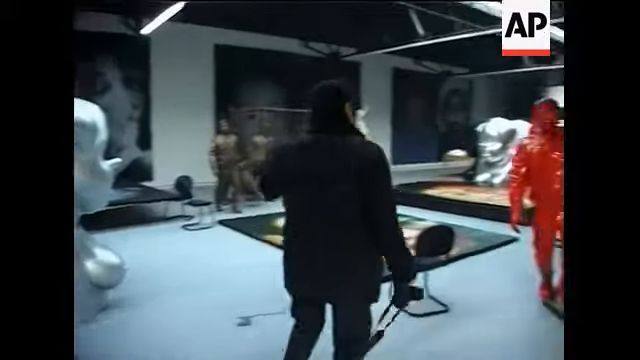
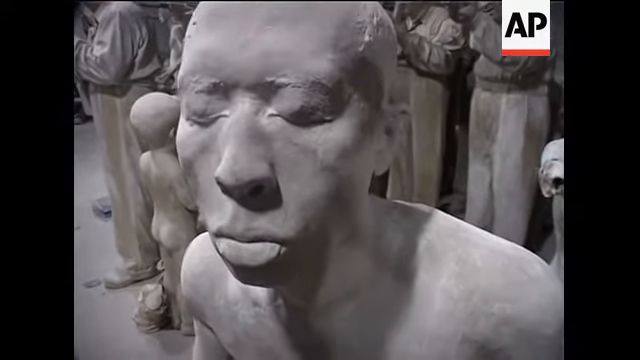
美联社早年报道:高氏兄弟的政治波普艺术与雕塑(美联社 AP Archive)|英文原声AP report on the Gao Brothers' politically charged pop art and sculpture (AP Archive)|In English
Our Take
This page's commentary is tied to this case's facts, and the first of them is retroactivity, stated plainly. The acts of creation for which Gao Zhen was convicted took place in 2005–2009. The statute supplying the normative frame, the Law on the Protection of Heroes and Martyrs, took effect on 1 May 2018. The criminal offence itself, Article 299a, took effect on 1 March 2021. When Gao Zhen made these sculptures, he could not have foreseen — under the criminal law or the administrative law of the time — that shaping Mao into a kneeling penitent would, well over a decade later, become an offence carrying up to three years. China's own Criminal Law, at Article 12, provides for the older and lighter law: where the law at the time of the act did not treat it as a crime, the law of that time applies. In this case the prosecution in substance proceeded around that article — the visible connective tissue in the public record is the indictment's reliance on the works' later storage and on alleged acts of dissemination, allegations Gao denies item by item, in a case whose judgment is unpublished, so no outsider can test which connection the court actually accepted. If a legal system may wait a dozen years, enact a new offence, and then reach back to punish old work, then "what is not prohibited by law is permitted" ceases to exist for every maker of anything: anything lawfully made today may become criminal evidence under some future statute. That is not rhetoric; it is the precedential structure this judgment has now established.
Second, the maximum and the closed door. The procuratorate recommended three years at the moment of indictment, and the court imposed three years, not a day different; the trial took one day, in secret, with family and US diplomats outside; and the nine and a half months before indictment included two returns of the file for "unclear facts and insufficient evidence." Taken together, these public facts show no visible independent weighing in the adjudicative stage: recommendation and judgment coincide, and the length of the process was spent on detention rather than on open testing of evidence. Gao Zhen's closing statement records that the handling prosecutor told his lawyer the case was "highly sensitive" and beyond his own authority — that passage rests on Gao's word alone and is unverified, and this page draws no conclusion from it; but the public facts need no help from it. A case the prosecution itself twice sent back for insufficient evidence ended with the heaviest result the offence allows.
Third, the child. The fact in this case most easily drowned by the format of a judgment is that a US-citizen child was barred from leaving China for two years and kept out of school for two years. Zhao Yaliang and Gao Jia are charged with nothing, are witnesses to nothing, and hold no state secrets; their only "problem" is their kinship to Gao Zhen. To handle an artist's old work by banning his wife and child from leaving delivers a message as clear as the sentence itself: the price is paid not only by the person who speaks but by those closest to him — above all by the child least able to pay it. This page records one coincidence of timing as fact: in 1968, Gao Qiang at six and Gao Zhen at twelve paid in childhood for their father's "crime"; from 2024 to 2026, Gao Jia, aged six to eight, was held inside the border for his father's. Collective punishment does not need to be written into the statute book; it operates in the form of administrative measures.
Fourth, the kneeling statue. "Mao's Guilt" asks that the man who did historic wrong kneel before those he wronged. The state's answer to that work was to hold its maker in a detention centre for two years and then sentence him to three, while to this day giving no explanation for the death of his father fifty-eight years ago. The party asked to repent has never repented; the man who asked for repentance has been convicted. In this page's judgement, the most important thing this case leaves to the archive is not that another offence has claimed another defendant, but this complete contrast: a man who lost his father at twelve spent a lifetime turning that death into art, and what he received was not a reckoning with that history but a reckoning with himself. Gao Qiang's observation — that the present situation is exactly what those works were meant to critique — is recorded in this archive because it is not a slogan; it is the shortest accurate description of this case's factual structure.
Verification Note
Last verified: 6 November 2026. Evidence grading: this page's facts are cited in layers by the nature of their sources. Grade A: independent wire and newspaper reports drawing on the same first-hand sources (Zhao Yaliang; Shane Yi of Chinese Human Rights Defenders) — Reuters (25 August 2026), the Associated Press, the BBC, The Guardian, the New York Times — together with formal documents of international bodies (Amnesty International's three urgent actions UA 106/24; Human Rights Watch's statement of 7 October 2025; the FIDH/OMCT joint statement of 12 May 2026; the Dui Hua Foundation's two 2025 statements). Grade B: the defendant's own first-person text — Gao Zhen's closing statement at his March 2026 trial, published in English translation by Human Rights in China on 17 September 2026; indictment passages relayed through it are cited as "as quoted in the closing statement," and assertions resting on his account alone are marked unverified throughout. Grade C: family accounts (Gao Qiang's letter to the Congressional-Executive Commission; Zhao Yaliang's account to Reuters; Gao Qiang's reports of the 118 works and of health episodes), each with its relay chain stated. Grade D: art-historical and biographical material (Kemper Museum's 2010 exhibition introduction; Artnet's biography; the Frontera interview; de Volkskrant's January 2026 long report). Key facts carry two or more independent sources wherever possible; single-source assertions are attributed in the text or marked unverified; conflicting accounts are archived in parallel and never merged.
Known conflicts and this page's treatment, item by item. (1) Date of seizure versus criminal detention: most sources (Amnesty International; Radio Free Asia; Chinese Wikipedia) give 26 August 2024 for the taking-away/criminal detention, with the detention notice reaching the family the next day; ChinaAid and the Dui Hua Foundation's August 2025 statement give 27 August as the criminal-detention date. This page takes 26 August as its frame and archives the 27 August version alongside; the exit bans are dated from Dui Hua's 27 August account. (2) Place framing: institutional documents consistently give Yanjiao town, Sanhe City, Hebei; the New York Times and other wires write "Beijing" or "outside Beijing." This page frames the case in Yanjiao/Sanhe and archives the wire formulations in parallel as geographic shorthand. (3) Confiscated works: "several" seized on site in August 2024 (Amnesty International); "118 pieces" removed on 17 November 2024 (Gao Qiang via Human Rights Watch); a total of "more than 100" (FIDH, 2026) — archived by period; no confiscation inventory is public. (4) Dating of the charged works: the indictment and most reporting give the group dating 2005–2009; the closing statement dates them individually — "Miss Mao" 2005–2006, "The Execution of Christ" and "Mao's Guilt" 2007–2009; Gao Qiang's letter to the CECC dates the three sculptures 2006–2009. This page frames the group as 2005–2009 and takes the individual dates from the closing statement, both archived. (5) Year of US permanent residence: ChinaAid gives permanent residence from 2011; Gao's own account gives immigration as a person of extraordinary ability in 2012; settlement in New York is consistently dated 2022. The three layers are recorded separately. (6) The brothers' exit restriction: ChinaAid gives restriction from 1989 to 2003, lifted in 2004; the Los Angeles Times gives more than a decade without permission to leave, until 2003 — archived in parallel. (7) Their father's death: the official account was suicide; the brothers have publicly said they do not know whether he killed himself or was killed (interviews); the Los Angeles Times relayed the family's view that he was tortured to death; one institutional webpage says "executed," which conflicts with every interview source and is treated here as an isolated entry, archived as unverified. (8) Trial date: Dui Hua's December 2025 update gave a new trial date of 10 March 2026; the trial in fact occurred on 30 March 2026 (multiple consistent sources); the twenty-day difference is archived in parallel, its reason a matter of no public record. (9) Prosecutors' names and the plea-negotiation narrative: these appear only in Gao Zhen's own closing statement (a prosecutor surnamed Li; assistant prosecutor Sun Yang; and their quoted words) — unverified, and flagged as single-source wherever the text touches them. (10) "More than 20,000 petition signatures": found only in news-aggregator retellings with no independently checkable source — marked unverified, no conclusion drawn. (11) Minor source variance: some Amnesty material phrases the first instance as "convicted in March 2026, sentenced in August," against Reuters and others dating both conviction and sentence to 25 August 2026; this page frames 25 August 2026 as the judgment date (conviction and sentence together) and archives the variance here. (12) Article numbering: some English reporting writes Criminal Law "Article 299(1)"; this page uses the formal Chinese numbering, Article 299a, and notes the variant.
Matters of no public record: the full text and reasoning of the first-instance judgment; the full text of the indictment (only the passages relayed in the closing statement are public); the exact date the formal arrest was approved; the complete inventory, current location, and post-judgment disposition of the confiscated works; the outcome of the defence application for an art critic's testimony; the appeal's hearing date and result; whether Gao Zhen's place of custody changed after sentencing; whether the exit bans on Zhao Yaliang and Gao Jia have been lifted and whether the child has resumed schooling; the diagnosis behind the post-sentencing vomiting of blood; any public response to this case by Chinese authorities (courts, procuratorate, Foreign Ministry, state media); any formal public statement on this case by the US State Department or other US government departments; any stand-alone public statement on this case by a UN body; and Gao Zhen's exact date of birth (1956 is established; the FIDH material gives 10 May 2026 as his 70th birthday). Each of these is recorded on this page as "no public record," without speculative filling.
Sources
Reuters: "Chinese dissident artist jailed for 3 years over Mao sculptures, family and rights group say," 25 August 2026 (read via SRN News republication); September 2024 detention reporting (via republications).Associated Press: "Chinese artist sentenced to three years in prison for Mao sculptures," August 2026 (via republications).BBC: "Gao Zhen: China jails artist over satirical Mao Zedong sculptures," August 2026; September 2024 detention reporting.The Guardian: news report on the August 2026 sentencing; editorial, "The Guardian view on culture in China: artist Gao Zhen is paying again for the country's painful history," 2026.The New York Times: "Gao Zhen, Artist Who Critiqued the Cultural Revolution, Is Detained in China," 2 September 2024; "Chinese Artist Sentenced to Three Years in Prison for Mao Sculptures," 25 August 2026 (read via Liao Yiwu's summary quotations).Human Rights Watch: "China: Free US-Resident Artist Unjustly Charged — Gao Zhen, Known for Provocative Mao Sculptures, Faces Trial After Yearlong Detention," 7 October 2025.Amnesty International: Urgent Action UA 106/24, first update, 5 December 2024; second update (ASA 17/0190/2025), 12 August 2025; third update, 2026; statement "China: Maximum sentence for artist Gao Zhen is an assault on artistic freedom," 26 August 2026; and the Canadian and US sections' urgent-action materials (including the 26 August 2026 vomiting-of-blood report and the transfer of the appeal to the Langfang Intermediate People's Court).Human Rights in China (HRIC): "HRIC Publishes Gao Zhen's Closing Statement: 'A Helpless Defense and Confession'" (with the relayed indictment passages and the full English translation), published 17 September 2026; statement written 28 August 2025, revised 28 March 2026.The Dui Hua Foundation: "Dui Hua Decries Exit Ban on Seven-Year-Old American Citizen," 7 August 2025; "Prisoner Updates 2025 #11: Dissident Artist Gao Zhen Denied Bail Again as Trial Is Delayed for Second Time," 30 December 2025.FIDH / OMCT Observatory for the Protection of Human Rights Defenders: "China: Artist Gao Zhen Detained Over Political Artworks," 12 May 2026.Gao Qiang: letter to the Congressional-Executive Commission on China (thanking the Commission for its advocacy for Gao Zhen and reporting his August 2026 fainting episodes and period in solitary confinement), c. September 2026, published on the Commission's website.Radio Free Asia: "China holds one of the Gao Brothers over 'insulting' Mao sculptures," September 2024.ChinaAid: "Renowned Artist Gao Zhen's Case Goes to Prosecution, Wife and Child Barred from Leaving the Country," 5 July 2025.De Volkskrant (Marije Vlaskamp): "Gao Brothers," 22 January 2026 (read in the English translation republished by China Heritage, February 2026, including Gao Zhen's letter to Ai Weiwei of 16 August 2025).Kemper Museum of Contemporary Art: introduction to "Gao Brothers: Grandeur and Catharsis," 2010; Artnet, Gao Brothers biography; Frontera, Gao Brothers interview transcript (Gao Zhen's account of his father's seizure and death in 1968).English and Chinese Wikipedia, "Gao Brothers" (used only to cross-check basic data such as birth years and the criminal-detention date; institutional sources govern in case of conflict, as noted in the Verification Note).IB Times (Singapore): "Who Is Gao Zhen? Chinese Artist Jailed for Satirical Mao Zedong Sculptures," 2026 (relaying CHRD information on the indictment date and the criminal provision).Ocula: "Chinese Artist Gao Zhen Jailed over Mao Sculptures," 27 August 2026. No more than fifty words have been quoted from any single source on this page; facts are presented by paraphrase with attribution.