
第134案 | 成蕾Case 134 | Cheng Lei
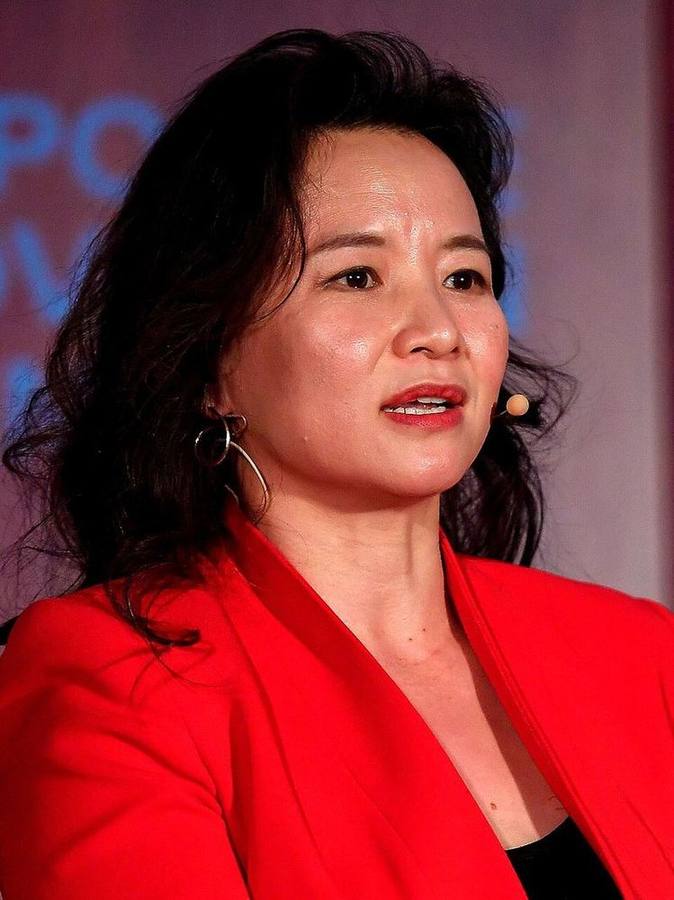
成蕾(1975年6月生于湖南岳阳,10岁移民澳大利亚,澳大利亚公民),昆士兰大学商学毕业,曾在墨尔本吉百利史威士与埃克森美孚从事财务工作,2002年入行央视英语频道,2003年起任CNBC中国记者九年,2012年回到北京成为央视英语频道(后CGTN)《环球财经》英文主播。2020年8月13日,她在北京被国家安全机关带走,澳方次日接到通知,8月27日首次领事视频探视,8月31日才由外长佩恩公开证实。她先经历六个月指定居所监视居住,2021年2月5日以涉嫌为境外非法提供国家秘密被正式逮捕,2022年3月31日在北京市第二中级人民法院闭门受审,澳大利亚驻华大使傅关汉被拒于法庭之外,法院当庭延期宣判,此后至少五至六次延期,她在不知判决结果的状态下继续被关押。2023年8月,她经领事渠道口述的「家书」公开,写道三年未见一棵树、一年只能站在阳光里十个小时。2023年10月11日,她刑满被驱逐出境,当日回到墨尔本与两个孩子团聚,外长黄英贤亲赴机场迎接;同一天中国国家安全部才首次公布:她以「为境外非法提供国家秘密罪」被判有期徒刑二年十一个月并驱逐出境,通报称其2020年5月经境外机构人员引诱、违反保密条款、通过手机提供工作中掌握的国家秘密,并称其自愿认罪认罚。而成蕾2025年回忆录给出的版本完全不同:她提前七分钟把李克强政府工作报告中八个字的内容短信发给彭博社的朋友,触犯了一份她称当时并不知晓的禁发令。判决书全文、宣判日期、所谓境外机构名称至今无公开记录。Cheng Lei (born June 1975 in Yueyang, Hunan; migrated to Australia aged ten; an Australian citizen) graduated in commerce from the University of Queensland, worked in finance for Cadbury Schweppes and ExxonMobil in Melbourne, entered journalism at CCTV's English channel in 2002, spent nine years as CNBC's China correspondent from 2003, and returned to Beijing in 2012 as an anchor of CCTV News — later CGTN — hosting Global Business. On 13 August 2020 she was taken by state security in Beijing; Australia was notified on 14 August, held a first consular video visit on 27 August, and announced the detention publicly on 31 August. After six months of residential surveillance at a designated location she was formally arrested on 5 February 2021 on suspicion of illegally supplying state secrets overseas. On 31 March 2022 she was tried behind closed doors at the Beijing No. 2 Intermediate People's Court; Ambassador Graham Fletcher was refused entry; the court deferred its verdict, and deferred it again at least five or six times, while she remained in custody without knowing the outcome. In August 2023 a letter dictated through consular officials was published — no tree seen in three years, ten hours of sunlight a year. On 11 October 2023 she was deported on completion of sentence and flew home to Melbourne, where Foreign Minister Penny Wong met her at the airport and she was reunited with her two children. Only that day did China's Ministry of State Security disclose her sentence — two years and eleven months for illegally providing state secrets to overseas parties — claiming she had been coaxed by an overseas organisation in May 2020, breached a confidentiality clause and sent state secrets by phone, and had voluntarily pleaded guilty. Cheng's own account, published in her 2025 memoir, is irreconcilable with that version: she says she texted eight words from Premier Li Keqiang's work report to a Bloomberg friend seven minutes before an embargo she did not know existed lifted. The judgment text, the date sentence was passed, and the name of the alleged overseas organisation have no public record.
1. Overview: The Day a State Television Anchor Vanished
Cheng Lei was not a dissident, an underground reporter, or a foreign correspondent parachuted into Beijing. She was the Chinese state's own English-language business anchor — the face of Global Business on China Global Television Network, the international arm of China's state broadcaster, a presenter whose job was to explain the Chinese economy to the world in fluent, Australian-accented English. In mid-August 2020 she disappeared. Colleagues could not reach her. Friends' messages went unanswered. Her profile page on the CGTN website was taken down and much of her past work was scrubbed from the site. Only weeks later did Australia's foreign minister confirm publicly what a small circle of officials already knew: Cheng Lei had been detained by Chinese state security.
What followed was three years and two months of near-total official silence. For most of that period, everything the world knew about her case fitted into a few lines. She was suspected of endangering national security. She had been formally arrested on suspicion of illegally supplying state secrets overseas. On 31 March 2022 she was tried behind closed doors at the Beijing No. 2 Intermediate People's Court, and Australia's ambassador was turned away at the door. The court deferred its verdict — and then deferred it again, and again, for more than eighteen months. Not until 11 October 2023, the day she was put on a plane home to Melbourne, did China's Ministry of State Security announce for the first time that she had been convicted and sentenced to two years and eleven months in prison, with deportation to follow. In other words, for 1,154 days an Australian citizen's fate hung on a judgment that no one outside the Chinese system had ever seen — a judgment whose very existence was only confirmed on the day it expired.
A note on method, because this case demands one. There are at least three accounts of Cheng Lei's case, and they do not agree. The first is the Chinese state's account, issued by the Ministry of State Security on 11 October 2023 and carried in near-identical wording by Xinhua, China Daily and People.cn. The second is the Australian government's record: a series of foreign-ministerial statements, consular reports and prime-ministerial remarks stretching from August 2020 to October 2023. The third is Cheng Lei's own account, given in interviews after her release and in full in her 2025 memoir. On the most important questions — what she actually did, what the alleged state secret was, whether she confessed freely — these accounts are irreconcilable. This archive does not merge them. Each claim below is attributed to its source, versions are preserved in parallel, and where no public source exists for a fact, this page says so plainly: no public record. That phrase appears often in what follows, and its frequency is itself part of the record.
2. Early Life: Yueyang, Melbourne, and an Accountant's Training
Cheng Lei was born in Yueyang, in China's Hunan province. Most Australian and Chinese reporting gives the year as 1975; her English-language Wikipedia entry gives June 1975. This archive records the year as settled and the month as resting on fewer sources. In 1985, aged ten, she migrated to Melbourne with her family so that her father could pursue a PhD — a detail confirmed by the University of Queensland's alumni office, by Australian media profiles, and by Cheng herself. She grew up as a classic child of migration: Mandarin at home, English at school, and a family that prized financial security above almost everything.
That family calculus shaped her first career. She had wanted to be a journalist, but her parents steered her toward accounting, and in 1992 she began a Bachelor of Commerce at the University of Queensland, graduating in 1995. The university's alumni profile and a 2015 profile in In the Black, the magazine of CPA Australia, both tell the story the same way: the commerce degree was the parents' choice, journalism was hers, and the tension between the two eventually produced a finance journalist who actually understood a balance sheet. After graduating she worked in Melbourne as an accountant and business analyst for Cadbury Schweppes and then ExxonMobil, until around 2000 — the University of Queensland records the two employers and the sequence, and no source contradicts it.
The detail matters for what came later. Cheng Lei's authority as a presenter rested on an unusual combination: bilingual fluency, a decade of formation in Australia, professional finance training, and firsthand experience inside Western corporations. When she returned to China in 2001 to build a media career, she carried all of it with her. The same combination — insider at a Chinese state broadcaster, passport-holder of a Western country, friend and colleague of foreign journalists — would later be read back to her by interrogators as evidence of divided loyalty.
3. First Career in News: CCTV-9 and Nine Years at CNBC
Cheng's break came in 2002, when she passed a screen test at CCTV-9, the English-language channel of China Central Television that would later become CCTV News and eventually feed into CGTN. A year later, in 2003, she moved to CNBC, the American business network, as its China correspondent, working between Shanghai and Singapore for nine years. The CPA Australia profile describes her flitting between the two cities; the University of Queensland's alumni page likewise credits her with nine years at CNBC Asia. In that decade she reported Chinese markets, macroeconomic policy and multinational business to a global audience, interviewing hundreds of chief executives and economists — the 2015 profile put the count at more than 300, including figures such as Bill Gates and Richard Branson.
One correction belongs here, because a garbled version of her biography circulates widely in Chinese-language social media: a string of near-identical articles claims she spent some twenty years "lurking" inside CCTV, sometimes with a return to CCTV dated to 2004. Those timelines contradict the verifiable record held by her university, her former employers and Australian media, and they arrive pre-loaded with a verdict of espionage that no public evidence supports. The documented sequence is simpler: CCTV's English channel in 2002–2003, CNBC from 2003 to about 2012, then back to Beijing in 2012. Twenty years in journalism, across three employers — not twenty years inside one state broadcaster.
4. The CGTN Years, 2012–2020
In 2012 Cheng returned to Beijing and to CCTV's English news channel — the operation rebranded in 2016 as China Global Television Network. The commissioning brief for this page gave her start as "2012/2013"; the University of Queensland alumni record and Australian media consistently give 2012, with the caveat that the CGTN name did not yet exist when she rejoined. This archive uses 2012. She anchored Global Business and other flagship programming, fronting the channel's effort to present a Chinese perspective in a global idiom. She was, by any measure, one of the most recognisable faces of Chinese state media abroad — an Australian citizen employed to personify China's openness to the world.
Her private life ran on the same dual track. Her two children lived with her in Beijing and attended school there; her partner, Nick Coyle, worked in the region. When the COVID-19 pandemic struck in early 2020, the children were sent back to Melbourne to be cared for by their grandmother. Family members later returned to this accident of timing again and again: had the children still been in Beijing in August 2020, they would have been left behind in a city where their mother had just vanished into a secret detention system. Reporting on the children's ages varies with the date of publication, and this archive preserves the figures as published rather than smoothing them: a March 2022 joint statement by Australian and American press organisations described them as 10 and 12; Australian Associated Press, reporting her August 2023 letter, gave 12 and 14; Reuters, at her release in October 2023, likewise gave 12 and 14. Their exact birth dates have no public record, and this page does not attempt to reconstruct them.
5. The Backdrop: Australia–China Relations and the Journalists' Exodus of 2020
Cheng Lei's detention cannot be archived honestly without its geopolitical frame. Australia–China relations had been deteriorating since 2018, when Canberra passed foreign-interference legislation and barred Huawei from its 5G network. In April 2020, Foreign Minister Marise Payne publicly called for an independent international inquiry into the origins of COVID-19. Beijing reacted furiously. In the months that followed, China imposed punitive tariffs on Australian barley, opened anti-dumping action against Australian wine, and obstructed imports of coal, lobster and timber, while warning Chinese tourists and students away from Australia. On 7 July 2020 — five weeks before Cheng was taken — Australia's Department of Foreign Affairs and Trade updated its travel advice to warn citizens explicitly of the risk of arbitrary detention in China on national-security grounds. Read in hindsight, the warning was a forecast.
Journalists felt the pressure first. In September 2020, weeks after Cheng's detention, the last two China-based correspondents of major Australian outlets — Bill Birtles of the Australian Broadcasting Corporation and Michael Smith of the Australian Financial Review — were visited at midnight by state security officers, told they were banned from leaving China, and informed they would be questioned about a national-security case: Cheng Lei's. Human Rights Watch's statement of 8 September 2020 records what followed. Birtles sheltered in Australia's embassy in Beijing; Smith took refuge in the Australian consulate in Shanghai. After a five-day diplomatic standoff, both men submitted to brief interviews accompanied by Australian diplomats and were allowed to board a flight to Sydney on the night of 7 September. For the first time since the Mao era, as commentators noted at the time, Australia had effectively no resident correspondents reporting from China.
Nor was Cheng the only Australian citizen in a Beijing cell. The writer Yang Hengjun, a Chinese-born Australian and former Chinese diplomat turned pro-democracy blogger, had been detained in Guangzhou in January 2019, charged with espionage, and would be tried behind closed doors in May 2021 at the same court — the Beijing No. 2 Intermediate People's Court — with Australia's ambassador likewise refused entry and the verdict likewise withheld, in his case for years. In August 2021, Reporters Without Borders (RSF) issued a statement grouping Cheng Lei with Yang Hengjun and the Swedish bookseller Gui Minhai: three holders of foreign passports, all journalists or writers, all held on espionage-type accusations. RSF's East Asia bureau chief said the message from Beijing was that no passport protected an independent voice. The same organisation ranked China 177th of 180 countries in its 2021 World Press Freedom Index and described it as the world's largest jailer of journalists, with at least 125 detained at that time. These are the institutional surroundings of Cheng's case: a period in which state-secrets and espionage charges were the standard instrument against journalists and writers whose work crossed the state.
6. The Alleged Act: Three Accounts, Kept Apart
What did Cheng Lei actually do? For thirty-eight months, the honest answer was that nobody outside the Chinese security apparatus knew. Beijing offered a charge label and nothing else. Canberra stated repeatedly that it was not privy to the evidence. Her family could only repeat that she was a business anchor whose work consisted of broadcasting economic news in public.
The first account is the Chinese state's, published by the Ministry of State Security on 11 October 2023 — the day of her release — and carried in matching language by Xinhua, China Daily and People.cn. In that telling, in May 2020 Cheng was "coaxed" by personnel of an overseas organisation; she violated a confidentiality clause signed with her employer; and she used her mobile phone to illegally provide state secrets she had learned at work to that overseas organisation. Beijing's state security bureau detained her in August 2020. The statement said she "truthfully confessed" and "voluntarily pleaded guilty and accepted punishment," and that the Beijing No. 2 Intermediate People's Court sentenced her to two years and eleven months for illegally providing state secrets to overseas parties, plus deportation, which was executed on completion of the sentence. What the statement does not contain is equally notable: the name of the overseas organisation, any description of the secret itself, the date of the alleged transfer beyond the month, and the date on which sentence was passed. Each of those items has no public record, and this archive marks them as such rather than filling the gaps with inference.
The second account is Cheng Lei's own, which emerged in full only with her memoir, Cheng Lei: A Memoir of Freedom, published by HarperCollins in June 2025. In her telling, the offence at the heart of the case was a text message. On 22 May 2020 she shared eight words — the substance of Premier Li Keqiang's announcement, in his annual Government Work Report, that China would set no economic growth target for that year — with a friend at Bloomberg, minutes before an embargo lifted. Her repeated formulation, in interviews and in the book, is seven minutes early. The report was read aloud by the Premier to the National People's Congress that same day; its contents were public within hours. She says she did not know an embargo time applied to the material, and she says something stronger: that a written document specifying the embargo time was produced retroactively, about a year later, after a prosecutor pointed out that the case needed one. That last claim is hers alone; no Chinese authority has ever responded to it, and this archive records it as her allegation, not as an established fact. The framing of "eight words, seven minutes" is corroborated as her consistent account by the Australian National University's published introduction to her book, by the Australian Institute of International Affairs' event materials, and by multiple reviews of the memoir — which is to say, it is well attested as what she says happened, while remaining unverifiable against a court record that has never been published.
The third strand is procedural, and it is also hers. Cheng has said that the surveillance of her began on or about 23 April 2020 — four days after Australia's call for a COVID-origins inquiry — and that investigators combed every message on her phone and every file on her devices. She has described signing, much later and in the presence of prosecutors and her lawyers, a leniency-related document; her description of the circumstances of that signature sits uneasily with the Ministry of State Security's phrase "voluntarily pleaded guilty." One further version must be preserved because it circulated widely at the moment of her release: several English-language reports in October 2023 stated that she had denied the allegations at her trial. That claim cannot be reconciled with either the ministry's account or her own later narrative, and no trial record exists in public to settle it. All three versions stand in this archive side by side. The absence of a published judgment is not a gap in our research; it is a fact about the case.
7. 13 August 2020: Detention, Notification, Announcement
Even the start date of this case arrives in two versions, and untangling them corrects an error in the brief from which this page was commissioned. The brief stated that Australia was notified on 27 August 2020. The record shows otherwise. Foreign Minister Marise Payne's statement of 8 February 2021 states plainly that Cheng "has been detained since 13 August 2020." Australian officials have consistently used 13 August as the detention date, and her family marks the anniversary on that day. The formal notification to the Australian government came on 14 August 2020 — the date the Committee to Protect Journalists' case file uses as the detention date, a conflation this archive notes because the two dates measure different things: the day she was taken, and the day Canberra was told. The 27th of August, meanwhile, was the date of the first consular visit, conducted by video link, as Agence France-Presse reported on 31 August 2020 — the same day Payne finally announced the detention publicly, more than two weeks after notification. So the sequence is: taken on the 13th, Canberra notified on the 14th, consular video contact on the 27th, public announcement on the 31st. Each date is attested; only their confusion is an error.
Of the taking itself, only Cheng's account exists. In her memoir, as summarised by reviewers, she was summoned to her office for an urgent meeting and found some twenty people around a long table; a Beijing State Security Bureau officer announced that she was under investigation for supplying state secrets to foreign organisations. She was blindfolded and driven to an undisclosed location. She has said she expected to be home within days and did not even clear the food from her refrigerator. No Chinese source describes the day at all; the official version simply begins, weeks later, with the fact of detention. That asymmetry — a first-person account on one side, silence on the other — recurs at every stage of this case.
Beijing's first public word came on 8 September 2020, when Foreign Ministry spokesperson Zhao Lijian said Cheng was being investigated for criminal activity endangering national security. By then CGTN had removed her biography from its website, the Birtles and Smith affair was unfolding (see Section 5), and Australia's travel advice warning of arbitrary detention had stopped being hypothetical. Within a month, a state broadcaster's missing anchor had become the emblem of a bilateral relationship in free fall.
8. Residential Surveillance at a Designated Location: The First Six Months
The first six months of Cheng Lei's detention were spent under Residential Surveillance at a Designated Location — RSDL. On paper, RSDL is a form of residential surveillance. In practice, authorised under China's Criminal Procedure Law for state-security and other specified cases, it permits investigators to hold a suspect for up to six months at a location that is neither the suspect's home nor a regular detention facility, with family notification of the place of custody withheld and lawyer access severely restricted. United Nations human rights experts have characterised the practice as a form of enforced disappearance incompatible with international human rights law — a characterisation the Committee to Protect Journalists quoted directly when it published Cheng's testimony in 2025. Human Rights Watch and Amnesty International have documented RSDL for years as the sharpest edge of China's pre-trial system in political cases: isolation without the legal status of arrest, in facilities run by the same security organs conducting the investigation.
Cheng's description of those six months is the fullest first-person account of RSDL by a foreign citizen to have emerged, and it comes from her memoir, her November 2025 video statement for the Committee to Protect Journalists, and interviews given around the book. She describes a padded cell with the lights permanently on and the curtains closed. For some thirteen hours a day she was required to sit on the edge of a hard bed. Two guards watched her in shifts of four hours, positioned at close quarters — she has used the phrase "body-odour sharing distance" — following and observing even toilet and shower visits. She was forbidden to speak to them. Every movement required permission. Interrogation sessions, paradoxically, were among the few occasions on which anyone addressed her by name, and she has described them as a perverse form of relief. Reviewers of the memoir, summarising her account, call the arrangement "solitary confinement with Chinese characteristics": never alone, and never permitted company.
Two details from this phase carry legal weight. The first is legal access. Cheng did not see a lawyer while in RSDL; accounts differ slightly on when counsel finally reached her — the memoir's reviewers and the Australian National University's event introduction say ten months after she was taken, some interview summaries say nine — and this archive preserves the range rather than a single figure. The second is sentence credit. When sentence was eventually passed, her six months of RSDL were credited as three months — two days of residential surveillance counting for one day of imprisonment, under the applicable crediting rule as she and her reviewers describe it. That arithmetic explains part of the gap between her nominal sentence of two years and eleven months and her actual detention of three years and two months, a discrepancy that confused early reporting of her release and that this archive flags deliberately: the Australian description "held for over three years" and the Chinese description "released after serving a sentence of two years and eleven months" are both accurate, under different counting rules.
When the RSDL maximum expired, she was moved to a detention facility — by her account, a short distance away — and into the long pre-trial phase. The Committee to Protect Journalists, relaying her 2025 testimony, describes the next cell: roughly three by seven metres, shared with three other detainees, watched by five cameras, with guards reprimanding the women through an intercom when they laughed. She read, by her count, some three hundred books across her detention. The monthly thirty-minute consular visit became her calendar, her news source, and eventually the channel through which her one public message would pass.
9. Formal Arrest: 5 February 2021
On 5 February 2021, after nearly six months of detention, Cheng Lei was formally arrested. Foreign Minister Payne confirmed the arrest in a statement on 8 February: Chinese authorities had advised that Cheng was arrested "on suspicion of illegally supplying state secrets overseas"; the Australian government had raised serious concerns at senior levels, including about her welfare and conditions; embassy officials had visited her six times since August, most recently on 27 January 2021, under the bilateral consular agreement; and Australia expected "basic standards of justice, procedural fairness and humane treatment to be met, in accordance with international norms." Beijing's foreign ministry spokesman Wang Wenbin replied the same day that China's judiciary handled cases in accordance with law, that the rights of the person concerned were fully protected, and that Australia should stop interfering. The two statements, laid side by side, set the pattern for the next two and a half years: Canberra complained of opacity and withheld evidence — Payne told Australian radio that Australia was "not privy to that evidence" — while Beijing answered every complaint with the formula of lawful process and a demand for non-interference.
The arrest also brought her family into public view. Her niece Louisa Wen, acting as a family spokesperson, spoke to the Australian Broadcasting Corporation about the toll on the children and the family's disbelief at the accusation. In the years that followed, family voices — Wen early on, and increasingly Cheng's partner Nick Coyle — became the principal public supplement to the official record, for a structural reason: the case was secret, her lawyers were bound by confidentiality requirements, and consular officials could not discuss what passed in their monthly half-hours. What the public learned about Cheng Lei's health, spirits and circumstances between 2021 and 2023 arrived largely in fragments carried out through those visits and released by the family at anniversaries and turning points. On the first anniversary of her detention, in August 2021, Reporters Without Borders renewed its call for her release alongside Yang Hengjun and Gui Minhai, noting that after six months of RSDL she had been moved to a Beijing detention facility and that — a full year in — no trial date had been announced.
10. The Closed Trial: 31 March 2022
Nineteen months after she was taken, Cheng Lei was tried at the Beijing No. 2 Intermediate People's Court on Thursday, 31 March 2022. The hearing was closed. Beforehand, Foreign Minister Payne had publicly called on Beijing to let Australian diplomats observe and to meet basic standards of fairness, procedural justice and humane treatment. On the morning of the trial, Ambassador Graham Fletcher presented himself at the court and was refused entry by court officials and police, on the stated ground that the case involved state secrets. Agency photographs of the ambassador being turned away, outside a court ringed by uniformed and plain-clothes police, became the defining images of the case. Fletcher told reporters that Australia could have "no confidence in the validity of a process which is conducted in secret," and that Canberra would continue to advocate for her rights under the two countries' consular agreement. Australian diplomats had last visited Cheng on 21 March and reported her holding up as well as could be expected; what happened inside the courtroom that day, beyond the presence of her lawyer, no Australian official witnessed.
Payne's official statement that day records the outcome in full, and it is worth pausing on how little it contains: Cheng had faced a closed trial on charges of illegally supplying state secrets overseas; at the end of proceedings, the court deferred its verdict; the ambassador had not been permitted entry. China's foreign ministry spokesman said the court would choose a date to announce the verdict, and justified the closure on the ground that the suspected crime involved state secrets. No official source gives the trial's duration; introductions to Cheng's memoir events describe a hearing of about ninety minutes, a figure that rests on her side of the record and is archived here as such.
The trial day also produced the case's strongest institutional response. The National Press Club in Washington and the National Press Club of Australia, joined by Australia's Media, Entertainment and Arts Alliance (MEAA) and the International Federation of Journalists (IFJ), issued a joint condemnation: Cheng, they noted, had held IFJ accreditation since 2009; she had been denied contact with her children, then 10 and 12; and the charges against her had "yet to be substantiated with any evidence" made public. The IFJ's Asia-Pacific director called the allegations "unstipulated" and the nineteen months of detention wholly lacking in transparency, and demanded the charges be dropped. MEAA's federal media president condemned her "arbitrary detention and the secretive trial process." It changed nothing in Beijing. It did fix, on the record and on the day, the judgement of the international journalism profession: whatever the verdict eventually said, the process that produced it had already failed the standards the profession recognises.
11. The Verdict That Would Not Arrive: April 2022 to October 2023
What followed the trial was not a verdict but a vacancy, renewed at intervals. On 13 August 2022, marking two years since the detention, the new Australian foreign minister, Penny Wong, stated that Cheng had faced her closed trial on 31 March and was "yet to learn the outcome," and that her two young children had had no contact with her since she was detained. The extensions accumulated. Sources count them differently, and this archive keeps both counts: her Wikipedia entry records that in April 2023 the sentencing date was pushed back by a further three months, "the fifth such delay"; the Sydney Morning Herald's reporting, carried by other outlets at her release, put the number at "at least six" postponements since the one-day trial. In January 2023 the same newspaper reported that Cheng's and Yang Hengjun's sentencing dates had been extended by three months to April, dashing family hopes of a January resolution and possible deportation; Yang's lawyer, Mo Shaoping, observed that the extensions could not strictly be called illegal, because there was no limit on the number of times the Supreme People's Court could approve them. The remark deserves its place in this archive: every individual step was procedurally clothed, while the cumulative effect was imprisonment without a published sentence, stretching past three years.
Diplomacy, meanwhile, was rebuilding the channel through which the case would eventually close. Australia's change of government in May 2022 brought the Albanese administration, which made Cheng's case a standing item in the "stabilisation" of relations with Beijing. In November 2022, Prime Minister Anthony Albanese met President Xi Jinping on the sidelines of the G20 summit in Bali — the first formal leaders' meeting in years — and raised the cases of Cheng and Yang. Ministerial contact resumed; Foreign Minister Wong raised Cheng's case in meeting after meeting with her counterpart Wang Yi. In Cheng's own later telling, Wong raised her case fourteen times, until a Chinese official asked why she kept naming one citizen — a detail archived here as her account. On 7 September 2023, Albanese met Premier Li Qiang on the sidelines of the East Asia Summit in Jakarta; Australian reporting afterwards identified the weeks around that meeting as the period when movement on her case first became visible. Two cautions belong in the record. Beijing has never acknowledged any connection between her release and the diplomatic thaw, and Albanese himself publicly denied that the release was part of any deal, describing it as the completion of China's judicial process. Both statements are preserved here; the chronology is a fact, its interpretation is not.
12. The Letter of August 2023: Ten Hours of Sun a Year
In August 2023, weeks before the third anniversary of her detention, the public finally heard Cheng Lei's own voice. During a consular visit she dictated a message to Australian officials; the transcript passed to her partner Nick Coyle, who released it to Australian media on 10 August 2023. The message itself is dated 27 July 2023. Reuters called it her first public statement since her detention; AFP and Australian outlets described it as a "love letter" to Australia. It was addressed, in her phrase, to "25 million people and 7 million square kilometres of land" — land abundant in nature, beauty and space. She wrote that she had not seen a tree in three years. She relived, in memory, every bushwalk, river, lake and beach, the swims and picnics and "psychedelic sunsets," and secretly mouthed the names of places she had visited and driven through.
The passage that travelled furthest concerned sunlight. In her cell, she wrote, the sun shone through the window, but she could stand in it for only ten hours a year. Once a year her bedding was taken out to air in the sun for two hours; when it came back warm, she wrapped herself in it and pretended she was being hugged by her family under the sun. She could not believe, she added, that she used to avoid the sun in Australia — though, knowing Melbourne weather, it would probably rain for the first two weeks after she returned. The letter closed with what she missed most: her children. Coyle read the letter aloud on the ABC's 7.30 programme. AAP reported the children as 12 and 14, not permitted regular contact with their mother; Coyle noted that her monthly thirty-minute consular visits were her only window on the world. Foreign Minister Wong called the message deeply moving and said Australia would keep advocating for her. The letter's effect exceeded every diplomatic statement that preceded it: an abstract consular case acquired a specific, countable deprivation — ten hours of sun a year — and within two months the case was over. Two years later, in her testimony for the Committee to Protect Journalists, Cheng gave the same figures — roughly ten hours of sunlight a year, one thirty-minute phone call with her family in over three years, not a single plant seen — and this archive accordingly treats the numbers as consistent first-person testimony, repeated across years, rather than a single interview's colour.
13. Release and Deportation: 11 October 2023
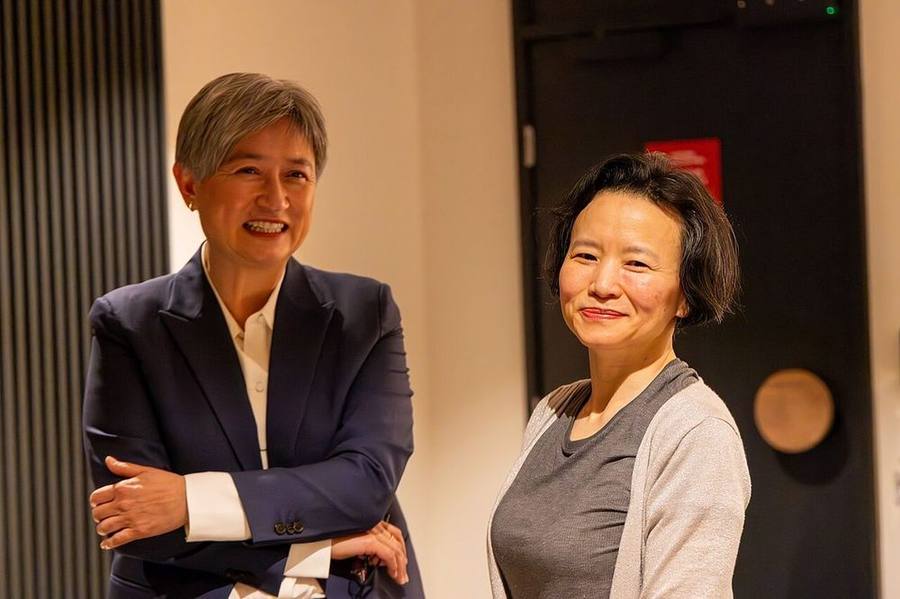
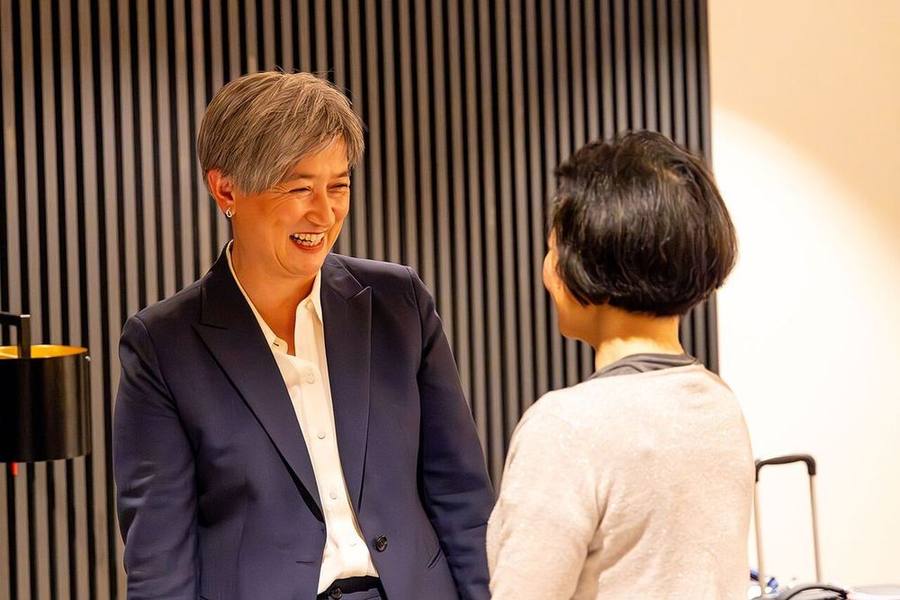
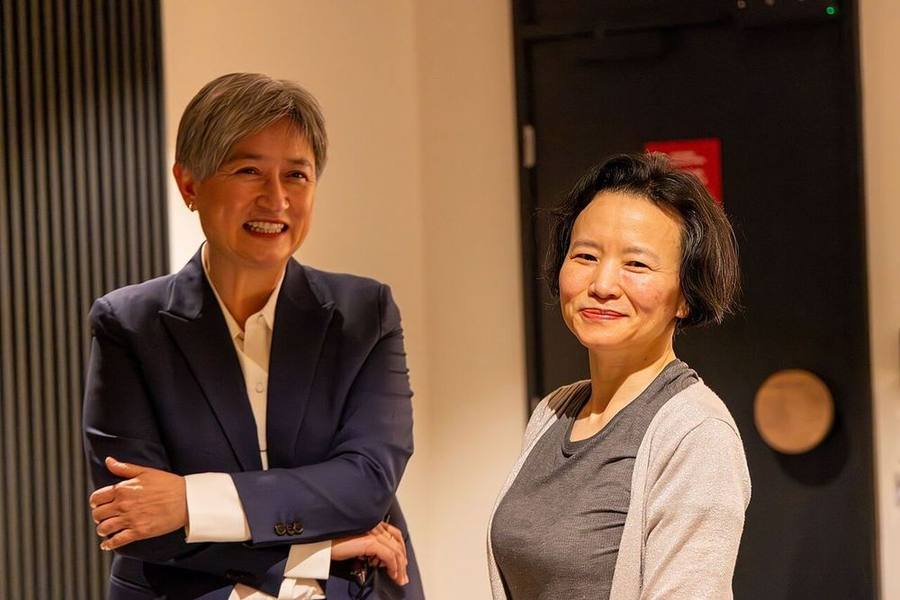
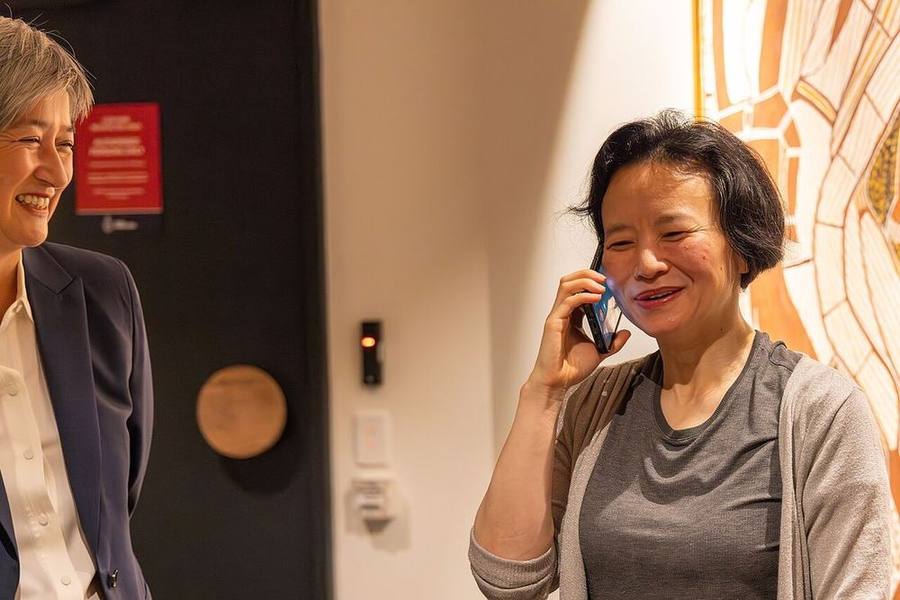
On Wednesday, 11 October 2023, Prime Minister Albanese announced that Cheng Lei had arrived home. He had spoken to her by phone that afternoon, he said, and welcomed her on behalf of all Australians; her return brought "an end to a very difficult few years" for her and her family; it was an outcome the government had sought for a long time, and she was, in his words, a strong and resilient person. Foreign Minister Wong met her at Melbourne airport — the photographs released by the Department of Foreign Affairs and Trade show the two embracing — and she was reunited with her two children and her family. Australian reporting afterwards established the mechanics: she had been flown out quietly on a commercial flight, accompanied by Ambassador Graham Fletcher, the same ambassador who had been turned away from her trial nineteen months earlier. Albanese said her matter had been concluded through the legal processes in China, denied that anything had been negotiated in return, and confirmed that he would visit China later that year; in early November 2023 he did so, the first Australian prime minister to visit in seven years.
The same day, in Beijing, the Ministry of State Security published its account of the case (set out in full in Section 6), and foreign ministry spokesman Wang Wenbin confirmed the sentence: two years and eleven months for illegally providing state secrets overseas, deportation executed on completion of sentence, judgment delivered "in accordance with the law," with consular notification and visitation rights, he said, respected throughout. It was the first time the Chinese state had ever publicly confirmed that she had been sentenced at all. International coverage of her homecoming repeatedly noted the corollary: until that day, the outside world — including, on the evidence of their statements, much of the time her own family — had believed she was still awaiting a verdict. The MEAA's statement welcoming her home put it bluntly: she had been tried in secret the previous year, "but at the time of her release, she was still awaiting a verdict," so far as anyone outside the system knew.
The arithmetic of the sentence deserves a footnote of its own, because it is the point on which the two national narratives most visibly grate. She was taken on 13 August 2020 and left China on 11 October 2023: 1,154 days, three years and two months. Her nominal sentence was two years and eleven months — shorter than the time she had already spent inside, with the six months of RSDL credited at half value. On what date the sentence was formally pronounced, neither government has ever said; there is no public record. The sequence that the record does support is this: detention first, in full; the announcement of the sentence last, on the day it expired. Whether one calls that "time served" or something else depends on the narrator, and this archive leaves the two labels where it found them.
14. Aftermath: Fragility, a Memoir, and a Second Career
A week after her return, Cheng gave her first interview, to Sky News Australia. Reuters' summary of it, published on 17 October 2023, recorded a woman oscillating between states: at times feeling "very fragile," like a newborn, and at times feeling she could fly. She spoke of seeing the whole of the sky again. In later interviews she returned repeatedly to the reunion with her children — by then teenagers — and to the unrecoverable arithmetic of three missing years in a child's life. She also converted her experience into advocacy: with Kylie Moore-Gilbert, the scholar formerly imprisoned in Iran, and Sean Turnell, the economist formerly imprisoned in Myanmar, she co-founded the Australian Wrongful and Arbitrary Detention Alliance, which supports families of Australians detained overseas — this according to the Australian Institute of International Affairs and other institutional biographies.
Public recognition followed. The Australian newspaper named her its Australian of the Year for 2023, and in 2024 she received the Australian Press Council's Press Freedom Award. She joined Sky News Australia as a presenter and columnist — returning to a studio, this time in her own country, and this time with her former employer's state among her subjects. In June 2024, during Premier Li Qiang's visit to Australia, Australian media reported that Chinese officials accompanying the delegation attempted to block television cameras' view of Cheng as she attended an event in Canberra in her capacity as a journalist; the incident drew wide coverage in Australia as an attempt to manage her image out of the frame of a state visit. Details are archived here as reported at the time; the episode is included because it shows her case continuing to cast a shadow over the bilateral relationship even after her release.
In June 2025, HarperCollins published Cheng Lei: A Memoir of Freedom. The book was written from memory — reviewers stressed that she had had no writing materials in detention and had carried the details out in her head — and it is the source of much of the first-person record in Sections 6 through 8: the seven-minute embargo breach, the surveillance that predated her arrest, the texture of RSDL, the circumstances of her plea documents. In May 2025 a stage work built from her experience, titled 1154 Days, premiered in Melbourne, with Cheng as co-creator and performer. A Chinese translation of the memoir, If the Walls Could Talk: Her 1,154 Days in a State Security Prison, followed, and she has discussed the book at length in Chinese-language media, including the Bumingbai Podcast. In November 2025 she recorded a video statement for the Committee to Protect Journalists describing the dehumanising, isolating character of her detention; institutional listings in 2026 describe her as a presenter at News24, Sky News Australia's rebranded successor, and as president of PEN Melbourne. Her trajectory completes a double transformation that this archive simply records: from state broadcaster, to secret defendant, to the most detailed living witness of the detention system that held her.
15. The Family Front: Melbourne, 9,000 Kilometres Away
Every archive of this case has two geographies. The Beijing geography is cells, courts and ministries. The Melbourne geography is a grandmother raising two children, and a partner running a campaign from airport lounges and borrowed desks. Nick Coyle operated the Free Cheng Lei campaign across three years, marking every anniversary — detention, arrest, trial, each deferred verdict — with public statements that converted the fragments brought out by consular officials into sustained pressure. When the sentencing date was extended again in January 2023, his exhausted public response was quoted across Australian media. Cheng's niece Louisa Wen had been the family's first public voice in February 2021. Between them, the family performed the function that the legal system's secrecy had abolished: they made the case narratable.
The ledger of the children's three years can be assembled from official statements, and it is bleak in proportion to its brevity. In August 2022 the Australian government stated that the children had had no contact with their mother since her detention. By August 2023, AAP's formulation was that they had not been granted regular contact. By her own testimony in 2025, across three years and two months she heard her children's voices once, in a single thirty-minute phone call. These are not contradictions; read in sequence, they describe a trickle of access so thin that each formulation strains toward hope. The children were, on the published figures, about nine and eleven when she was taken (their ages appear as 10 and 12 in March 2022; exact birthdays have no public record). No sentencing arithmetic — not two years eleven months, not 1,154 days — captures that side of the account, and this archive declines to pretend otherwise.
The one channel that did function, after its fashion, was the consular one. Payne's February 2021 statement counted six embassy visits in the first six months; Cheng's own later accounts describe the visits settling into a monthly rhythm of thirty minutes, conducted under supervision, in which Australian officials checked her welfare, carried family news in and fragments of her condition out, and eventually took down the dictation of the August 2023 letter. Both governments invoked the same bilateral consular agreement for opposite purposes: Canberra as the legal basis for demanding access and information, Beijing as proof — cited by Wang Wenbin on the day of her release — that her rights had been respected. The visits were real, and they mattered; Cheng has credited them with keeping her tethered to the world. But the record also shows their limits with unusual clarity. Thirty minutes a month of supervised conversation, a first video-link glimpse a fortnight after she vanished, and no access at all for her children: that was the full extent of the transparency the agreement could extract from a state-security case, for a citizen of a country that was simultaneously China's largest supplier of iron ore and the state broadcaster's own former anchor.
16. Reading the Case Institutionally: RSDL, State Secrets, and the Unannounced Verdict
Three features of this case repay the archivist's emphasis, because each generalises beyond it. The first is Residential Surveillance at a Designated Location. Legally a pre-trial measure rather than a punishment, RSDL nonetheless delivered the harshest segment of Cheng's three years: six months at an undisclosed location, without family knowledge of where she was, without a lawyer, under continuous close observation, in a regime UN experts have called a form of enforced disappearance. It is the front end of China's state-security process, it leaves almost no paper trail accessible to the outside, and Cheng's memoir is now one of the fullest accounts of it in any language.
The second is the elasticity of "state secrets." On the ministry's account, material covered by an employer's confidentiality clause sufficed. On Cheng's account, the material was the headline of a government work report broadcast to the nation the same day, and the document fixing its embargo time was created after the fact. This archive does not adjudicate between those accounts; it notes the structural point that both expose. The classification of the information — what made it secret, when it was classified, by whom — was never disclosed to anyone outside the prosecuting organs. Where the state is the sole certifier of its own secrets, the distance between "illegally providing state secrets overseas" and "texting eight words seven minutes early" can be travelled entirely inside one statute, without public scrutiny at any step. That, more than the sentence's length, is why the international journalism community treated the case as a landmark.
The third feature is the combination of a closed trial and an indefinitely deferred, ultimately unannounced verdict. Closure for state-secrets trials has a statutory basis, which Beijing cited. What has no real parallel in ordinary criminal process is the eighteen-month silence afterwards — at least five, by some counts six, extensions — culminating in a sentence disclosed only on the day it had been fully served, to a defendant who, on her own government's statement of August 2022, had not even been told the outcome herself. In such a sequence, the effective sentence is set not by the judgment but by the detention: three years and two months inside, retrospectively named as two years and eleven months plus credits. For researchers of Chinese criminal procedure, this case will remain a clean, fully documented specimen of that inversion — fully documented, that is, except for the judgment itself.
The contrast with the case that shadowed hers is instructive. Yang Hengjun, tried in the same court in May 2021, waited even longer: on 5 February 2024, nearly three years after his closed trial and five years after his detention, a Beijing court handed him a suspended death sentence for espionage — an outcome that Australian officials called harrowing and that reset the bilateral thaw Cheng's release had seemed to confirm. The two cases shared an architecture (Chinese-born Australian, state-security charge, closed trial at the same court, ambassador excluded, verdict withheld for years) and diverged only at the exit: hers ended in a sentence calibrated to time already served and immediate deportation, his in the gravest sentence short of execution, suspended. Any honest archive of Cheng's release has to hold both facts at once. Her freedom was real, and it was not a precedent.
17. What Has No Public Record
So that no reader mistakes silence in this page for resolution, the principal absences are gathered here. The full text of the Beijing No. 2 Intermediate People's Court judgment: no public record. The date on which the verdict and sentence were actually delivered: no public record. The name of the "overseas organisation" in the Ministry of State Security's account: no public record. The classification document designating the information a state secret, and its date: no public record — Cheng alleges it was created retroactively; the Chinese state has not responded. The location and operating unit of her RSDL site: no public record. The trial transcript and the full identity of her defence representation: no public record. Any written decisions refusing family visits during the detention: no public record. These absences are not failures of this archive's research. They are the measurable boundary of the case's publicity, and they are recorded as findings in their own right.
18. Verification and Sources
This page was cross-checked against the following. Australian government sources: Foreign Minister Marise Payne's statements publicly confirming the detention (31 August 2020), confirming the formal arrest (8 February 2021), and on the trial (31 March 2022); Foreign Minister Penny Wong's statement of 13 August 2022 marking two years of detention; Prime Minister Anthony Albanese's announcement and remarks of 11 October 2023. Chinese government sources: the Ministry of State Security statement of 11 October 2023, as carried by Xinhua, China Daily and People.cn; Foreign Ministry spokesperson Zhao Lijian's remarks of 8 September 2020 and Wang Wenbin's remarks of February 2021 and 11 October 2023. Wire and broadsheet reporting: Agence France-Presse, Reuters, the Associated Press, Australian Associated Press, the Australian Broadcasting Corporation including its 7.30 programme, the Sydney Morning Herald, The Australian, BBC News, National Public Radio, Radio Free Asia and Voice of America. Institutional records: the Committee to Protect Journalists' case file and Cheng's November 2025 video testimony; Reporters Without Borders' August 2021 statement and 2021 World Press Freedom Index; the joint statement of the National Press Clubs of the United States and Australia, MEAA and the International Federation of Journalists of 31 March 2022; Human Rights Watch's statement of 8 September 2020 on the departure of the Australian correspondents. Biographical details rest on the University of Queensland alumni office and CPA Australia's In the Black profile of 2015. Cheng Lei's own account is drawn from her dictated public letter of 27 July 2023 (released 10 August 2023), her first post-release interview with Sky News Australia as reported by Reuters on 17 October 2023, and her 2025 memoir, Cheng Lei: A Memoir of Freedom, together with reviews and institutional introductions based on the book; passages resting on her testimony alone are flagged as hers in the text. Wikipedia was used as a lead only, never as the sole source for a key fact.
Divergences preserved rather than resolved: the detention date (13 August 2020 per the Australian government; 14 August in the CPJ case file, identified here as the notification date); the number of verdict deferrals (a fifth delay recorded as of April 2023; "at least six" in Sydney Morning Herald-derived reporting at her release); the interval before she first saw a lawyer (nine to ten months across accounts); the children's ages (10 and 12 in March 2022; 12 and 14 in August and October 2023); and, above all, the nature of the offence, where the Ministry of State Security's account of induced disclosure and voluntary confession stands unmerged beside Cheng's account of an eight-word text sent seven minutes early. Corrections to the commissioning brief: Australia was notified on 14 August 2020, not 27 August (27 August was the first consular video visit; the public announcement followed on 31 August); Cheng rejoined CCTV's English service in Beijing in 2012, not 2013, the CGTN brand dating from 2016; and her birth is given in stronger sources as June 1975, the brief's year being correct.
视频证据 Video Evidence
成蕾获释返澳:获释后的首日(澳大利亚9号台新闻)|2023年|英文原声Cheng Lei's first day of freedom back in Australia (9 News Australia)|2023|In English
Our Take
What is most damning about the Cheng Lei case is not the length of the sentence. It is the sequence. A woman who had spent eight years as the polished face of China's state broadcaster was blindfolded at her own office, held incommunicado for six months under round-the-clock observation, arrested, tried behind a door closed to her own ambassador, and then kept in a cell for a further eighteen months without being told her verdict — until, on the day her time ran out, she and the world learned simultaneously that she had been sentenced to two years and eleven months for providing state secrets overseas. At no point before her release was the public told what the secret was, who received it, or when sentence had been passed. When secrecy is certified by the prosecutor, trials are closed to the defendant's own country, and verdicts can be deferred indefinitely and then simply never announced, what remains is not adjudication. It is detention with paperwork.
On Cheng Lei's own account — the only account of the act itself that anyone has ever published in detail — the conduct that consumed 1,154 days of her life and three years of her children's childhood was a text message of eight words, sent seven minutes before an embargo on a document her head of government read aloud on national television the same morning. This page cannot verify that account against a judgment no one has been allowed to read, and it does not pretend to. But that is precisely the point worth making: a system that can place "seven minutes" and "state secrets" in the same unpublished judgment, and never have to show its working, is not punishing disclosure. It is staging a demonstration — for every bilingual journalist inside the state media system, for every Chinese-born professional holding a foreign passport, for every reporter with a friend at Bloomberg — that the boundary of the permissible is wherever the security organs later decide it was. Cheng Lei wrote from her cell that she had not seen a tree in three years and could stand in the sun for ten hours a year. We record that figure not for its pathos but for its precision: it is the exact sunlight ration that this system allotted to a woman it never publicly tried. This site will keep tracking the unpublished judgment and cases like hers until the column marked "no public record" is filled in — by disclosure, or by history.