
Xu Lin (1963– )
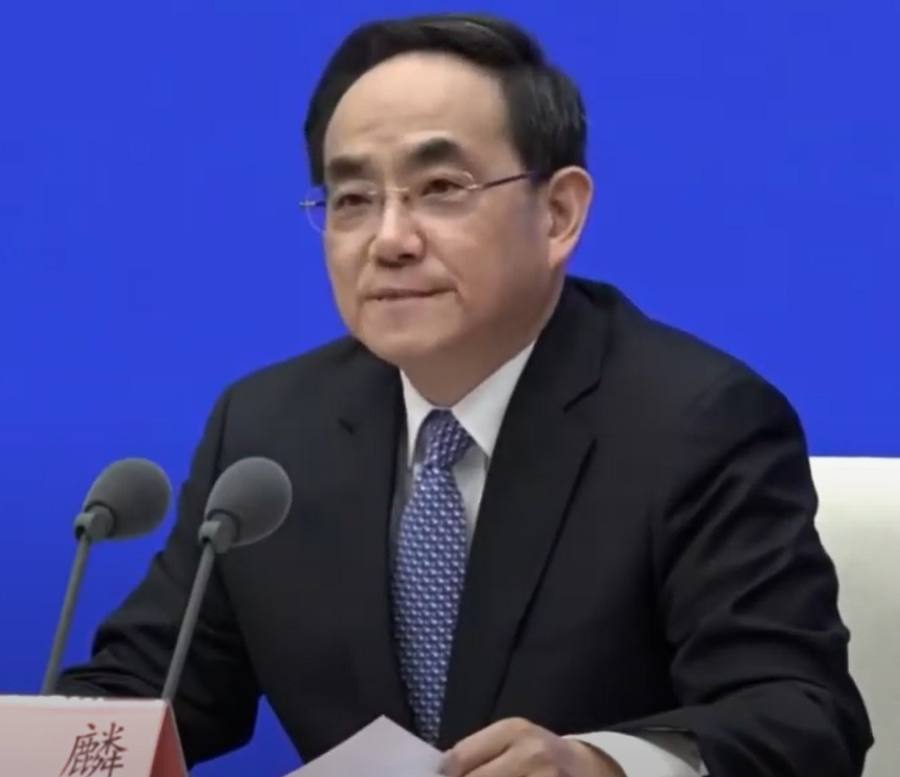
Xu Lin, born in Nanhui, Shanghai, in June 1963, rose in Shanghai from middle-school teacher through county posts, a state enterprise, and the civil-affairs and agriculture systems to the municipal standing committee, the Pudong party secretaryship and the municipal propaganda department; he moved to Beijing in June 2015 as a deputy director of the Cyberspace Administration of China (CAC) and on 29 June 2016 succeeded Lu Wei as CAC director, concurrently a deputy head of the Propaganda Department. The core of this file is the codification of censorship during his two CAC years: the NPC Standing Committee adopted the Cybersecurity Law on 7 November 2016 and it took effect on 1 June 2017, writing back-end real-name registration, data localization and critical-infrastructure review into national law; the CAC issued China's first National Cyberspace Security Strategy on 27 December 2016; the Internet News Information Service Provisions took effect with the Cybersecurity Law in June 2017, barring unlicensed public accounts from publishing news; MIIT's fourteen-month VPN access cleanup in 2017 saw providers shut down and Apple remove non-compliant VPN apps; the CAC investigated WeChat, Weibo and Baidu Tieba in August 2017 and imposed maximum fines on 25 September; and four rules on comments, forums, internet groups and public accounts followed in August–September 2017, requiring real names to post and making group owners answerable for their groups. Attribution runs in three tiers: his signed Qiushi article and his SCIO-era speeches attach to him personally; the CAC's strategies, rules and enforcement attach to his institutional tenure; and the 22 June 2017 audiovisual shutdown order against Weibo, ifeng.com and AcFun — issued by the broadcasting regulator SAPPRFT, not the CAC — and MIIT's VPN ban are attributed to their actual issuing agencies and never written as his personal orders. Zhuang Rongwen succeeded him on 31 July 2018; Xu directed the State Council Information Office (2018–2022), became director of the National Radio and Television Administration in June 2022, entered the 20th Central Committee that October, and has been Party secretary of Guizhou since 9 December 2022. Sanctions: none found — his name appears on no US, EU, UK or Canadian public sanctions list. A signed article under his Guizhou byline in March 2026 confirms he remains in post.
1. Thirty-Three Years in Shanghai: From Middle-School Teacher to Propaganda Chief (1963–2015)

Xu Lin was born in June 1963 in Nanhui County, Shanghai. Nanhui has since been folded into Pudong New Area, and the first half of his career was completed almost entirely on that ground. In 1982 he was teaching at Zhoupu Middle School in Nanhui and serving as secretary of the school's Youth League branch; he joined the Party that September. By his official biography he graduated from Shanghai Normal University, with his credentials earned in service — a postgraduate qualification followed by an MBA. It is the classic résumé of a Shanghai local cadre: no ministry start in Beijing, no elite-university halo, just seniority accumulated one district-level rung at a time.
The Nanhui rungs ran as follows: deputy secretary then secretary of the county Youth League committee, Party secretary of Sandun Township, head of the county Party committee's policy research office, then a seat on the county standing committee as deputy county magistrate. According to the Hong Kong Free Press's June 2016 profile, he was twenty-nine when he joined the county standing committee and became acting deputy county chief — fast for his cohort — and the mainland financial newspaper 21st Century Business Herald called him a "political star." This page archives such labels at the tier of press commentary, not fact; but they mark how Shanghai officialdom sized him up early: young, local, and seasoned at the grassroots.
In March 1995 he became deputy Party secretary of Jiading District, and two months later was sent to Tibet: from May 1995 to May 1998 he served as deputy Party secretary of Shigatse Prefecture and led the liaison group of Shanghai's first batch of aid-Tibet cadres. Three years in Tibet counted as a merit mark in Shanghai cadre selection, and his pace quickened on return: in July 1998 he joined the Shanghai Agriculture, Industry and Commerce (Group) Corporation — the municipal state enterprise running Shanghai's farm system and much of its food supply — rising through deputy chairman and deputy Party secretary to Party secretary, chairman and general manager in one. In March 2003 he became Party secretary and director of the Shanghai Civil Affairs Bureau, and later headed the Shanghai Agriculture Commission. League committees, a township, a state enterprise, civil affairs, agriculture: in his first twenty-five Shanghai years not one posting touched propaganda or the internet, but he had worked nearly every counter of local government.
The real leap came in 2007. In March 2007 Xi Jinping became Party secretary of Shanghai; two months later, in May, Xu entered the standing committee of the municipal Party committee, his first deputy-ministerial-level seat. Reuters, reporting his CAC appointment in 2016, made a point of this: the two men had worked together during Xi's brief Shanghai tenure. From February 2008 to May 2013 Xu was Party secretary of Pudong New Area — the heaviest economic portfolio among Shanghai's districts, a heavyweight seat even within the standing committee. In May 2013 he moved to head the municipal propaganda department, taking charge of an ideology portfolio for the first time. In June 2015 he was transferred to Beijing. Looking back, two of the thirty-three Shanghai years decided his later position: entering the standing committee under Xi in 2007, which put him within the top leader's field of vision, and taking the propaganda department in 2013, which gave him the matching qualification for the CAC. Both steps are documented in public personnel records; converting that overlap directly into proven personal patronage goes beyond the evidence, and Section 3 handles the question at its proper tier.
2. How This Page Attributes Responsibility: Three Tiers, and Three Corrections
Writing about Xu requires rules first — and one complication more than his successor Zhuang Rongwen presents: the problem of the agency next door. The tightening of 2016–2018 was not the CAC's work alone. The Propaganda Department set the general line; the Ministry of Public Security handled arrests and detentions; the Ministry of Industry and Information Technology (MIIT) controlled network access and the telecom licensing under which VPNs lived or died; and the State Administration of Press, Publication, Radio, Film and Television (SAPPRFT) held the audiovisual-program licenses. In any given week of that tightening, four agencies' actions landed on top of each other, and overseas reporting, for convenience, credited them all to "China's censors." If this page did the same, it would book other agencies' orders to Xu, or dissolve the CAC's own orders into anonymous system behavior. Neither is an archive.
This page therefore works in three tiers. Tier one, personally documented: his signed articles, public speeches and signed activities. In October 2015, still a deputy director, he published an article in the Party journal Qiushi pledging to uphold Party leadership over the internet and the media "without any equivocation" — Reuters quoted it when he took over in June 2016; it is the public text of his personal political position. In November 2020, as SCIO director, he publicly warned against "digitalisation diluting the Party's leadership" and against "the risk of capital manipulating public opinion," quoted in full by the South China Morning Post — words from his own mouth, archived at the personal tier. Tier two, institutional tenure: the strategies, rules, investigations and penalties the CAC issued or executed under him — the National Cyberspace Security Strategy, the Internet News Information Service Provisions, the comment-thread and group rules, the investigations and maximum fines against WeChat, Weibo and Tieba. These are booked to his tenure, and the text always says "the CAC under Xu," never "he ordered," because in the public documents all of them are institutional acts; not one deletion or account-ban instruction bearing his personal signature has been found. Tier three, same tenure, different agency: measures belonging to the same tightening whose executing agency was not the CAC — MIIT's VPN access cleanup, SAPPRFT's audiovisual shutdown order, public-security detentions of individual netizens. Each is labeled with its true issuing agency; they form the governing environment of his tenure, but the bill must not be charged to the wrong name.
Three claims in circulation are corrected here first, so that errors do not enter the file. First, "Xu became Chongqing's propaganda chief in 2018" — no record exists: his 2018 destination is documented in a formal State Council appointment; he became director of the State Council Information Office and never held any post in Chongqing. The claim is not adopted. Second, "Xu became Shanghai's propaganda chief in 2022" — likewise baseless: he held the Shanghai propaganda post from May 2013 to June 2015, and his new post in June 2022 was director of the National Radio and Television Administration; the claim misstates both the year and the office. Third, "Xu became president of the People's Daily in 2025" — no record exists: the People's Daily presidency has been held by Yu Shaoliang since September 2024, and Xu has been Party secretary of Guizhou since December 2022, with no People's Daily appointment at any point. Every post in the body of this page is sourced to a State Council appointment or removal, a Xinhua personnel release, or the SCIO's official biography.
3. A Year as Deputy: Lu Wei's Second-in-Command, and the Takeover of 29 June 2016

In June 2015 Xu moved to Beijing as deputy director of the Office of the Central Leading Group for Cyberspace Affairs and deputy director of the Cyberspace Administration of China, ranking first among three deputies. The CAC was then barely a year old, and its director, Lu Wei, was at the height of his power: traveling constantly, standing beside Xi Jinping at the Wuzhen World Internet Conference to receive heads of government and global technology chiefs, and known to international media as China's "internet czar." Xu's public profile that year was far lower. The weightiest personal statement of his that can be found is the October 2015 Qiushi article — a deputy director putting "Party leadership over the internet and the media, without equivocation" into a signed text, an article Reuters dug out and quoted when he succeeded Lu. For the archive, the value of that line is that it proves Xu did not drift passively into the CAC: before he ever held its top job, he had publicly claimed its governing logic as his own.
On 29 June 2016 Xinhua announced that Lu Wei would no longer head the CAC and that Xu Lin would succeed him, concurrently becoming a deputy head of the Central Propaganda Department. Contemporary international coverage is worth archiving side by side: the South China Morning Post headlined it "China's powerful internet tsar steps aside as another of Xi Jinping's close allies to take over"; Reuters called Xu a close ally of Xi and noted their Shanghai overlap; and the Council on Foreign Relations' analysis of 13 July 2016 observed that Xu had run Shanghai's propaganda apparatus — the work of pushing the Party's message — and that the promotion was the next rung on the same ladder. This page archives the "Xi confidant" label at the tier of commentators' classification: the checkable hard facts are Xu's entry into the Shanghai standing committee during Xi's seven months as Shanghai Party secretary in 2007, a career in which every key promotion fell within Xi's time in power, and a consistent ally characterization across reliable outlets. Turning a service overlap into a proven personal-loyalty bond exceeds the public evidence and is not adopted here; the media characterization and the career overlap are both recorded as found, and readers may weigh them.
What Xu inherited was an institution whose power and whose taint were expanding together: the CAC controlled content censorship, cybersecurity review and informatization promotion at once, and Lu's personalized style had made it internationally famous. Xu's manner was the opposite of Lu's — he gave almost no interviews to foreign media and performed at no international galas; the most visible products of his two years were not conferences and photographs but one law, one strategy and a stack of regulations. On 21 November 2017 the Central Commission for Discipline Inspection announced that Lu Wei was under investigation — a former director falling during his successor's tenure, which in Chinese officialdom sends a double signal to the incumbent: it validates the handover, and it reminds the whole system that the building has a new master. Lu was expelled from the Party in February 2018 and in 2019 sentenced to fourteen years for bribery. This page records that sequence because Xu's tenure cannot be understood without its starting point: he was brought in to close out the Lu Wei era, and his way of closing it was to rewrite a censorship system that had run on one man's personal clout into one that ran on statutory text and departmental rules. The intensity of censorship did not diminish; what increased was the paper trail. The inventory in the sections below is exactly that paper trail.
4. The Second Half of 2016: Real-Name Apps, the Portal News Ban, and the Passage of the Cybersecurity Law
Xu's first day in office happened to sit on a regulation's signature line: on 28 June 2016, the day before he took over, the CAC issued the Provisions on the Administration of Mobile Internet Application Information Services — issued, formally, under Lu Wei, but effective 1 August 2016 and enforced entirely on Xu's watch. Its core was two requirements: app providers must verify registered users' real identities under the principle of "real names at the back end, voluntary display at the front," and must keep user logs for sixty days. From that point, everything a netizen said inside a mobile app was, as a matter of regulation, tied to a real identity and retained for two months. This page labels the rule "signed off by the predecessor, implemented under Xu" — no more credit, and no less, than that.
In July 2016 the Beijing cyberspace administration re-imposed the rule that web portals may not gather or produce their own news and may only republish material from licensed sources; the portals' original-news operations were rectified. As a municipal office's action, this page books it at the cyberspace-system tenure tier. In September 2016 the CAC announced that 11,459 WeChat public accounts had been closed in the first nine months of the year, mainly for alleged rumor-mongering — a figure carried in Freedom House's reporting. It needs its caveat in plain view: nearly six of those nine months belonged to Lu Wei's tenure, so this page uses the figure only as the enforcement scale the CAC was publicly claiming at the start of Xu's term, not as a total booked to him.
The second half of the year's real weight was legislative. On 7 November 2016 the Standing Committee of the National People's Congress adopted the Cybersecurity Law of the People's Republic of China, effective 1 June 2017 — China's first comprehensive national statute for cyberspace. Legislative authorship must be stated plainly: the law was adopted by the NPC Standing Committee; it was not written by Xu or the CAC, and this page does not book its "enactment" to him. What the text did was fix the CAC's status in law: the national cyberspace authority coordinates cybersecurity work and related supervision; network operators must verify users' real identities, cooperate with public- and state-security investigations, and keep personal information and important data collected inside China within China's borders; procurement for critical information infrastructure must pass security review. In short, the statute issued the CAC a permanent enforcement license — and the man holding the director's chair when the license took effect was Xu Lin. Human Rights Watch pointed out repeatedly, before and after adoption, that the law obliges companies to prohibit anonymity and to monitor and report user activity — in effect pressing the duties of censorship and surveillance directly onto operators. From August 2016, implementing rules made editors-in-chief personally answerable for content. And on 27 December 2016 the CAC issued the National Cyberspace Security Strategy — released by the CAC under Xu, approved by the Central Leading Group chaired by Xi — stating in so many words the resolve to "firmly defend cyberspace sovereignty" and defining cyberspace as a new domain of national sovereignty. It was the first programmatic institutional text of his tenure, archived here at the institutional tier: issued by the CAC, approved by the leading group, published by the agency Xu headed. The three relationships are recorded exactly as they stand.
5. 1 June 2017: The Cybersecurity Law Takes Effect; News Licensing and Real Names Land Together
The first of June 2017 was the single heaviest day of Xu's tenure, because two instruments took effect at once. The first was the Cybersecurity Law: real-name registration, data localization and operators' censorship duties all acquired a statutory basis that day, and cyberspace and public-security enforcement at every level began citing its articles. The second was the CAC's own Internet News Information Service Provisions, published on 2 May 2017: providing internet news services to the public requires a license; gathering and republishing are licensed separately; and no organization or individual without a license — expressly including self-media operating through public accounts — may publish or republish news information. On 1 June the door to unlicensed news on public accounts was closed as a matter of written rule.
A week later came the provisions' first mass enforcement. On 7 June 2017 the Beijing cyberspace administration summoned Sina Weibo, Tencent, NetEase, Baidu and ifeng.com, and more than sixty public accounts famous for celebrity gossip and entertainment scandal — including the best-known entertainment-exposé accounts of the day — were closed across platforms. The CAC's public rationale was to promote socialist core values and a healthy, positive atmosphere; Global Voices' Advox project and other overseas reporting noted that the timing and manner of the closures showed the perimeter of censorship extending from political news into entertainment: even gossip now needed a license and compliance. This page archives the action at the institutional tier: the summoning office was Beijing's, the closures were executed by the platforms, and no instruction under Xu's personal name appears in the public documents; but the rule being enforced issued from the national CAC he directed, and the deployment fell within his tenure — booked to the tenure, not written as a personal order.
June holds one more event that has been chronically misattributed since, and it is flagged here before its full treatment in the next section: on 22 June 2017, the video services of Sina Weibo, ifeng.com and AcFun were ordered shut down, on the grounds that the three lacked an Information Network Audiovisual Program Transmission License and had carried large volumes of current-affairs programming that did not conform to state rules and social commentary spreading negative remarks. The order was issued by the State Administration of Press, Publication, Radio, Film and Television — not by the CAC. Reuters and the Associated Press reported the issuing agency correctly at the time. In Xu's file this event can only be written as "part of the same tightening, executed by the broadcasting system during his tenure"; to write it as a CAC shutdown, or as Xu's order, is simply wrong. Getting this one attribution right is what makes the rest of this page's attributions stand.
6. The Summer of 2017: The Year of the VPN, and a Shutdown Order That Must Be Kept Straight
For China's VPN users, 2017 was the hardest year on record — and its chain of prohibitions was likewise assembled by several agencies, no link of which can honestly be blurred. The first link was the Ministry of Industry and Information Technology: in January 2017 MIIT launched a fourteen-month cleanup and standardization of the internet network access-services market (running to 31 March 2018), ruling that no one may establish or lease VPNs or other dedicated lines for cross-border operations without approval from the telecom authorities — archived under MIIT's name in Freedom House's Freedom on the Net reporting and in extensive press coverage. The second link was execution: in June 2017 popular services including Green VPN notified users that they were ceasing service, with the South China Morning Post and the Associated Press reporting that providers had been ordered by the authorities to close; on 29 July Apple removed a batch of VPN apps that did not comply with Chinese rules from its China App Store, to widespread dismay. The third link is Xu's and the CAC's true position in the affair: the CAC was the coordinating authority for online content and security; the telecom-enforcement lever over VPNs sat with MIIT; and no CAC text banning VPNs appears in the public documents. But the CAC under Xu never raised any objection to the cleanup, and the Cybersecurity Law's provisions on network access and real names formed the legal environment in which the cleanup proceeded. The Associated Press's September 2017 reporting documented the cleanup's real impact on entrepreneurs, researchers and students, and quoted activists placing it within the most severe round of political tightening since 1989. This page's attribution for the VPN file stops exactly there: the banning document was MIIT's, the closures were executed by providers and app stores, and Xu's responsibility is at the system and tenure tier — the agency he headed was the coordinator of the control system of which the cleanup formed a part, and he never publicly opposed it. Writing "Xu ordered the VPN ban" into any archive would be a claim without evidence, and this page expressly declines to make it.
The other half of this section belongs to the 22 June audiovisual shutdown order, because it is the best available test case for attribution discipline. After the order, Sina's and Weibo's US-listed shares fell by roughly four to six percent, and AcFun issued a statement promising comprehensive rectification. Most overseas coverage folded the event into a single narrative of "the summer 2017 censorship escalation" — which is fair; what is not fair is booking it to the CAC out of convenience. The factual chain is this: the issuing agency was SAPPRFT; the legal basis was the audiovisual licensing system; the targets were the three platforms' unlicensed audiovisual services and their current-affairs content. That license-and-content dual track was territory the broadcasting system had run for over a decade, parallel to — not subordinate to — the CAC's authority. In the 2018 institutional reform the SAPPRFT nameplate came down and the National Radio and Television Administration was created in its place; and in a turn worth savoring, the man who walked into the NRTA director's office four years later, in June 2022, was Xu Lin himself — a story for Section 9. In his 2017 file, the shutdown order's correct place is as part of the governing environment of his tenure and part of the broadcasting system's record. It is not his order. This page spends these paragraphs not to exonerate him: precisely the opposite — only by stripping away what is not his can what is his, the investigations and maximum fines of the next section, be nailed down beyond argument.
7. Autumn 2017: Investigations, Maximum Fines, and "Whoever Builds the Group Answers for It"
On 11 August 2017 the CAC announced investigations into Tencent's WeChat, Sina Weibo and Baidu Tieba, on the grounds that the three platforms had failed in their duty to manage unlawful content spread by users, in suspected violation of the Cybersecurity Law. These were the CAC's first national-level cases under the new law, and their targets were the three platforms with the broadest reach among Chinese netizens; the signal mattered far more than the case facts: the law was not decorative. On 25 September the Beijing and Guangdong cyberspace administrations announced the outcomes — fines at the statutory maximum against all three. The CAC's notices did not publish a per-company sum; under the law's text, an operator that refuses to correct or whose case is serious faces a fine capped at RMB 500,000, and directly responsible managers up to RMB 100,000 — a few tens of thousands of US dollars. This page archives that figure as found and names its nature plainly: as money, a maximum fine is nothing to companies of Tencent's or Baidu's scale; its real weight was posture. Within a hundred days of the law's taking effect, all three major platforms had been publicly punished at the top of the scale — from then on, platform self-censorship would run in excess, never in deficit. Reuters quoted the CAC's accompanying pledge to implement the Cybersecurity Law in earnest and to strengthen territorial supervision and enforcement; that sentence issued from the institution of his tenure and is cited here at the institutional tier.
In the same season the density of rulemaking reached the rate Freedom House would later count: across 2017, new rules and guidelines flowing from the Cybersecurity Law appeared at a pace of nearly one every two days. Four of them bear dates and the CAC's nameplate squarely within Xu's tenure. On 25 August 2017 came the Internet Comment Thread Services Provisions, effective 1 October: comment services require real-name registration, the unauthenticated may not post, platforms must review comments before release on news and build credit files on users, and low-credit users are to be blacklisted and barred from re-registering. The same day brought the Internet Forum Community Services Provisions, extending real names to forums and their moderators. On 7 September came the Internet Group Information Services Provisions and the Internet Public Account Information Services Provisions, effective 8 October. Article 9 of the group provisions said it without cushioning: founders and managers of internet groups must discharge group-management responsibility — "whoever builds the group is responsible; whoever manages it is responsible." From that day, the risk attached to forwarding a single sentence in China could, as a matter of written rule, be traced along the identity chain to a named group owner. The public-account provisions extended news licensing, real names and credit management to every public-account operator. Together with May's news provisions, the four rules form a complete net: publishing news requires a license, posting a comment requires a real name, building a group requires assuming liability, opening an account requires leaving a file. The entire net was woven between May and September 2017 and issued by the CAC under Xu Lin. This page books it at the institutional-tenure tier — no public evidence shows him reviewing the articles line by line, but he was the issuing agency's responsible head, and this net is the principal institutional legacy of his tenure. It is still running today, long after his departure.
Two background events of that autumn also belong in the file. The first is the 19th Party Congress in October 2017, at which Xu was elected a full member of the 19th Central Committee — a CAC director seated on the Central Committee marks the post's real weight in the Party hierarchy. Censorship visibly escalated around the congress: Freedom House's reporting records that the messaging service WhatsApp was fully blocked in China on the congress's eve and that the cleanup of VPNs and circumvention tools tightened to its peak beforehand. WhatsApp's blocking was executed within the technical and telecom systems, and no written CAC instruction for it can be traced in public documents; this page archives it as tenure background only. The second event is the 21 November 2017 announcement that Lu Wei was under investigation — the predecessor's fall landing mid-way through the successor's term, already recorded in Section 3. One judgment belongs here: by the end of 2017 the CAC had completed its passage from Lu Wei's personalized power to Xu Lin's textual power, while the total volume of censorship — counted in closed accounts, investigated platforms and blacklisted commenters — did not shrink with the change of personnel. It merely acquired, for each act, a citation. That is the essential difference between Xu and his predecessor, and it is also what makes him harder to charge personally than Lu: in his tenure, the machine learned to run in the name of documents.
8. Four Years at the SCIO: From Controlling What China Says at Home to Controlling How China Speaks to the World (2018–2022)
The 2018 institutional reform converted the Central Leading Group for Cyberspace Affairs into a commission, and Xu continued as head of its office — the CAC — until 31 July 2018, when a cadres' meeting announced Zhuang Rongwen's succession. Xu's destination emerged three weeks later: on 21 August 2018 the State Council appointed him director of the State Council Information Office, while he remained a deputy head of the Propaganda Department. Taiwan's Central News Agency and the South China Morning Post read the move the same way at the time: Beijing was reshuffling its propaganda and internet leadership to improve China's international image, Xu was regarded as a pragmatic operator within Xi's circle of confidants, and some commentators speculated that his Shanghai style might soften the confrontational tone of external propaganda. This page archives such speculation at the commentary tier and fixes only the fact of office: he moved from the directorship of domestic censorship to the directorship of external release — the SCIO being the organ through which the Chinese government issues policy to foreign media, holds press conferences and publishes white papers. One man holding those two chairs in sequence connects, in a single career, the line of "what may not be said at home" with the line of "what the world is to hear."
Four entries from his SCIO years belong to his personal tier, all verifiable. In June 2020 he chaired the press conference releasing the white paper "Fighting Covid-19: China in Action" — presenting China's complete official narrative to Chinese and foreign journalists at the moment when the outbreak's origins and early handling were under global challenge. In November 2020, at the China New Media Conference in Changsha, he publicly warned the converging media industry to "resolutely guard against digitalisation diluting the Party's leadership" and to "resolutely prevent the risk of capital manipulating public opinion" — quoted in full by the South China Morning Post, and widely read in Hong Kong media against the timing of the Ant Group listing suspension; this page records what he said and leaves the reading to the press. On 4 December 2021 the SCIO published the white paper "China: Democracy That Works," which he presented to domestic and foreign media — its date falling days before the Summit for Democracy convened by US President Joe Biden, a counter-programming intent written on the calendar and noted by the New York Times at the time. Assembled, these records give the true outline of the second half of his career: he was no longer the man deciding which posts were deleted, but the man deciding in what face China would appear before the world. The logic of censorship never left him; it changed direction.
One institutional background of those four years must not be omitted: his SCIO tenure coincided with the great expansion of China's external-propaganda system and the peak of "wolf warrior" discourse, during which the foreign ministry's spokesperson system and the SCIO's release machinery operated at high frequency. This page's discipline applies here too: not every hard-line foreign-ministry statement was his utterance, and not every white paper was his personal composition — white papers are institutional documents. This page books to his name only the release activities he chaired, presented or attended as reported, and books the white papers' texts at the institutional tier. His SCIO term ended on 8 June 2022: the State Council removed him as SCIO director, and the same day the National Radio and Television Administration's leadership page showed him in place as its director and Party secretary — a third ministerial-level post in six years, still inside the propaganda system. The South China Morning Post headlined him a "Xi protégé"; Caixin placed the reshuffle within the propaganda system's pre-20th-Congress reorganization.
9. Half a Year at the NRTA, Then Guizhou: A Propaganda Veteran Sent to Run a Province (2022–2026)
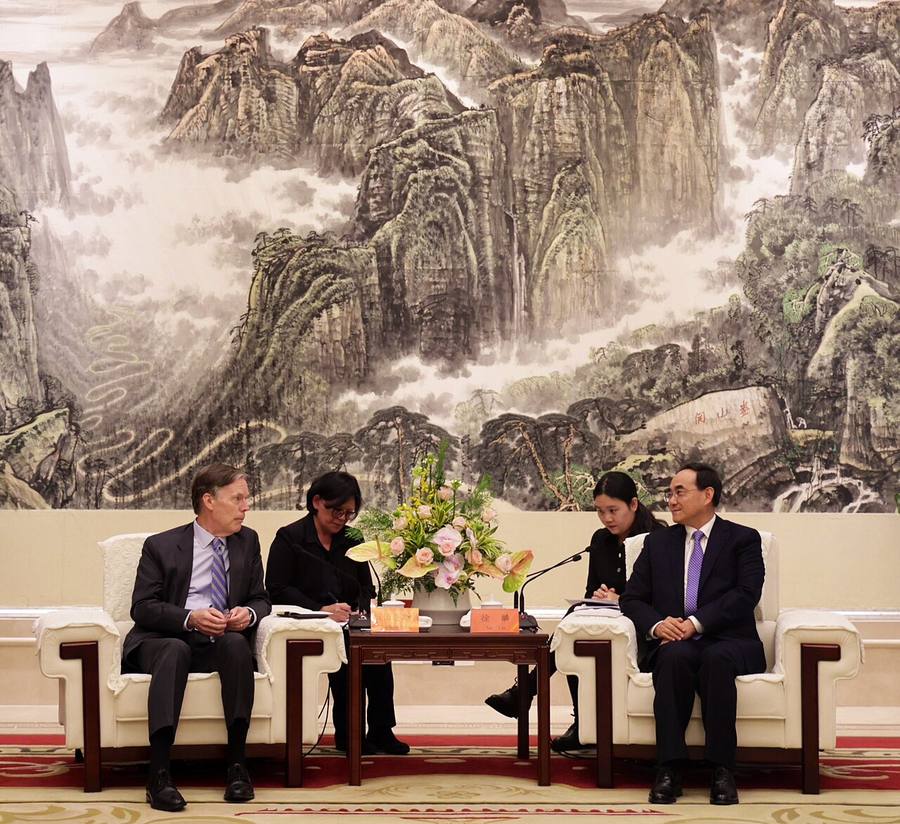
The National Radio and Television Administration governs licensing and content for television, radio and online audiovisual services — the successor body of the very broadcasting system that had ordered Weibo and AcFun shut down in June 2017. Xu took office on 8 June 2022, and his first public appearance in the post concerned producing television programs telling ordinary people's stories ahead of the 20th Party Congress, as the South China Morning Post reported. His NRTA tenure lasted only about eight months; the public record consists mainly of deploying 20th Congress publicity and audiovisual-industry administration, and no signature broadcasting event attached to his personal name was found in the sources searched. This page archives the half-year as it stands and pads nothing. The brevity had a reason: a larger appointment was already queued. In October 2022 he was elected to the 20th Central Committee at the 20th Party Congress; on 9 December 2022 Xinhua announced his appointment as Party secretary of Guizhou, succeeding Shen Yiqin; on 17 January 2023 the first session of the 14th Guizhou Provincial People's Congress elected him chairman of its standing committee; and on 3 February 2023 the State Council formally removed him as NRTA director, the post remaining vacant until Cao Shumin's appointment in May 2023.
The sequence — CAC, SCIO, NRTA, then a provincial Party secretaryship — has a plain reading in CCP personnel practice: rotating through three ministerial propaganda posts and then taking a province as its top leader is promotion, not exile. The South China Morning Post, reporting the Guizhou appointment, called him a firm advocate and enforcer of Xi's vision for the media and noted that Guizhou is China's big-data hub — a man who once ran the national internet sent to run the national big-data province, the symmetry of the appointment written on its face. Bloomberg, meanwhile, noted the other side: the Guizhou he took over was one of China's poorest and most indebted provinces, and in April 2023 the province signed a cooperation agreement with the state distressed-asset manager China Cinda as it sought state help to contain its debt risks. This page archives both faces at the fact tier: his Guizhou posting is a standard heavyweight appointment for a propaganda-system cadre, and the province he received presented anything but a standard brief — debt, growth and livelihoods, an examination in subjects entirely outside his lifelong specialty.
Only one point of discipline is needed for his Guizhou years as they touch this page's subject. A provincial Party secretary bears overall leadership responsibility for his province's propaganda, cyberspace and ideology work, and Guizhou's internet administration operates under his authority; but within the sources searched for this page, no nationally significant internet-censorship case or rule issued under Xu's personal name in Guizhou was found. His public Guizhou activity, as reported, runs to economic work, debt, education and warning-education meetings — in May 2024 he presided over a provincial warning-education conference directing officials to take the cases of fallen Guizhou officials Sun Zhigang, Li Zaiyong and Zhou Jiankun as a mirror. To write his Guizhou years up as a censorship file would be neither sourced nor honest. This page therefore fixes only his incumbent status and the facts above; the body of his censorship file rests permanently on his two CAC years — the period in which he left his deepest mark on China's space of speech.
10. Sanctions and Accountability: Three Blanks and One Comparison
The sanctions column begins with the search path, stated in the open: for this page we searched the US Treasury OFAC Specially Designated Nationals list and State Department designation releases, the European Union's financial-sanctions database, the United Kingdom sanctions list and Canada's Consolidated Autonomous Sanctions List, cross-checked against consolidated sanctions databases. The result is none found — Xu Lin's name appears on no public government sanctions list. Judicial proceedings: no public record. Domestic accountability: no public record. Not only is there no accountability; his career climbed steadily after he left the CAC, and he holds the Guizhou secretaryship today. The result gains its weight only in comparison with others in the same system: his predecessor Lu Wei was sentenced to fourteen years — for bribery, a charge unconnected with censorship; officials on the Xinjiang and Hong Kong files and executives of surveillance-technology companies have been designated by the United States — but no list has ever included a CAC director as a category, whether Lu Wei, Xu Lin or Zhuang Rongwen. International criticism of the CAC as an institution has never paused: Freedom House has rated China the world's worst environment for internet freedom year after year, Human Rights Watch documents the Cybersecurity Law's enforcement consequences annually, and Congressional-Executive Commission on China reports repeatedly name China's censorship apparatus — but the criticism lands on the system and the institution, while for the individual who ran China's deletion machine for over two years, the international file contains, beyond a résumé, almost no page prepared for him personally.
This page does not speculate on the reasons for the three blanks. It sets two verifiable facts side by side. First, existing sanctions practice concentrates its categories on executors of specific files — Xinjiang, Hong Kong, Tibet — and on military-industrial and surveillance-technology entities; the head of the content-censorship system has never been made a designation category of his own. Xu's CAC tenure also predates the 2019 Hong Kong and 2020 Xinjiang designation waves, and his principal "works" — one law, a stack of rules, one set of maximum fines — are difficult, within a sanctions narrative, to attach to a single identifiable victim. That is the other face of the "textual power" described in Section 3: when censorship operates in the name of regulations and institutions, personal responsibility dissolves in the lens of external accountability as well. Second, the personal material he has left is minimal: almost no foreign-media interviews, no intemperate remarks, no scandal, no public trace of overseas assets. A year and another year of documentary criticism, no name on any list, and a résumé consisting entirely of promotions — that state of affairs is itself part of the archive, and this page records it as found.
11. Status Verification (as of November 2026)

This page verified his current status by the following path. First, on 11 March 2026 Xinhua published a signed article by Xu Lin under the byline titles "Party secretary of Guizhou; chairman of the Standing Committee of the Guizhou Provincial People's Congress," recording that Guizhou's GDP had grown from RMB 1.83 trillion in 2020 to RMB 2.36 trillion in 2025 and setting out work on mineral resources, digital-intelligent industries and rural revitalization — the most recent public statement in his incumbent capacity found by this page. Second, the lists of current provincial leaders, still being updated in November 2026, and both the Chinese and English Wikipedia entries, show him as incumbent Party secretary of Guizhou, having taken office on 9 December 2022 in succession to Shen Yiqin. Third, no official notice or reliable media report of any departure, transfer, retirement or investigation concerning him was found in the sources searched. On this basis this page confirms: as of 12 November 2026, Xu Lin remains Party secretary of Guizhou and chairman of the provincial people's congress standing committee, his tenure approaching four years.
On age this page records facts only: born in June 1963, he turned sixty-three in 2026 and has not yet reached the customary retirement-age line for provincial Party secretaries. This page predicts neither promotion nor retirement and adopts no unsourced rumors of either. His health, family circumstances and personal assets have no reliable public record and are not supplemented here. Set beside the man who took over the CAC a decade ago, his public face has barely changed: offices, meetings, signed articles, and nothing else — a man who wrote China's internet censorship into statutory text, whose own public file remains thin enough to be a single résumé. The contrast between that thinness and his institutional legacy is recorded here side by side, without embellishment.
12. Verification and Sources
The posts and biographical facts in this page were cross-checked against multiple sources, principally: the SCIO's official English biography page for Xu Lin (born June 1963 in Shanghai; Party member since September 1982; MBA; deputy director of the CAC from June 2015 to June 2016; head of the Office of the Central Leading Group for Cyberspace Affairs from June 2016 to April 2018 and of the Office of the Central Cyberspace Affairs Commission from April to July 2018; director of the Cyberspace Administration of China from June 2016 to July 2018; deputy head of the Propaganda Department from June 2016; and the 21 August 2018 SCIO appointment release); the Chinese and English Wikipedia entries for Xu Lin (teacher and Youth League posts at Zhoupu Middle School in Nanhui, Sandun Township, the county policy research office and deputy county magistrate; deputy Party secretary of Jiading District in March 1995; Tibet posting May 1995–May 1998 as deputy Party secretary of Shigatse and leader of Shanghai's first aid-Tibet cadre group; Party secretary, chairman and general manager of the Shanghai Agriculture, Industry and Commerce Group; Shanghai Civil Affairs Bureau Party secretary and director from March 2003, later heading the municipal Agriculture Commission; municipal standing committee from May 2007; Pudong Party secretary February 2008–May 2013; Shanghai propaganda chief May 2013–June 2015; CAC director from 29 June 2016; SCIO director 21 August 2018; NRTA director 8 June 2022; 20th Central Committee member October 2022; Guizhou Party secretary 9 December 2022; provincial people's congress standing committee chairman 17 January 2023; removed as NRTA director 3 February 2023); Reuters, 30 June 2016 (the close-ally-of-Xi characterization, the two men's Shanghai service together, and the October 2015 Qiushi article's "Party leadership over the internet and media without equivocation"); the South China Morning Post's reports of 29 June 2016, August 2018, November 2020, 8 June 2022 and 9 December 2022 (the "close ally" headline framing, the image-reshaping reading of the SCIO appointment, the full quotation of the November 2020 Changsha remarks on digitalisation diluting Party leadership and capital manipulating opinion, the NRTA appointment and "Xi protégé" label, and the Guizhou appointment with its big-data-hub commentary); the Hong Kong Free Press profile of 29 June 2016 (county standing committee at twenty-nine; the 21st Century Business Herald's "political star" phrase); the Council on Foreign Relations analysis of 13 July 2016 (the Shanghai propaganda background and promotion path); and the China Media Project's August 2018 reporting (the 31 July cadres' meeting at which Zhuang Rongwen succeeded him, and his expected SCIO destination). Tenure events are sourced to: Freedom House's Freedom on the Net 2017 and 2018 China reports (the CAC's September 2016 announcement of 11,459 WeChat public accounts closed in the year's first nine months; the 28 June 2016 app-services provisions and their 1 August effect; new rules flowing from the Cybersecurity Law at nearly one every two days in 2017; MIIT's VPN cleanup campaign of 17 January 2017 to 31 March 2018; the Cybersecurity Law's 1 June 2017 effect with real names and data localization codified; the pre-19th-Congress escalation and the blocking of WhatsApp); the full text of the National Cyberspace Security Strategy and the DigiChina translation at Stanford (issued by the CAC on 27 December 2016, with its resolve to defend cyberspace sovereignty); the CAC's Internet News Information Service Provisions (published 2 May 2017, effective 1 June 2017); Global Voices Advox and Reuters/AP reporting of June 2017 (the Beijing cyberspace administration's 7 June summonses and the closure of more than sixty gossip accounts); Associated Press and Reuters reporting of 22 June 2017 and the public statements of Sina and AcFun (establishing that the audiovisual shutdown order issued from SAPPRFT, its license and current-affairs grounds, and the fall in Weibo's shares); MIIT's January 2017 cleanup notice and South China Morning Post and AP reporting from June to September 2017 (Green VPN and others receiving shutdown notices, Apple's 29 July removal of non-compliant VPN apps, and the cleanup's impact on research and business); the CAC's 11 August 2017 investigation announcement and 25 September 2017 penalty notices with Reuters' reporting (the WeChat, Weibo and Tieba cases and maximum fines; the Cybersecurity Law's caps of RMB 500,000 for operators and RMB 100,000 for responsible managers); the full texts of the CAC's four 2017 rules as carried by China Law Translate (the Comment Thread and Forum Community Provisions of 25 August 2017, effective 1 October; the Internet Group and Public Account Provisions of 7 September 2017, effective 8 October, including Article 9's "whoever builds the group is responsible"); Xinhua and State Council releases and New York Times reporting on the June 2020 and December 2021 white papers (his chairing and presenting of "Fighting Covid-19: China in Action" and "China: Democracy That Works"); his signed Xinhua article of 11 March 2026 (incumbent Guizhou byline and his own GDP figures); and Bloomberg's April 2023 Guizhou debt reporting as carried by Caixin. Current status was further cross-confirmed against the lists of current provincial leaders and the Xinhua and People's Daily reporting of the January 2023 Guizhou people's congress elections.
Corrections and qualifications applied to the briefing material for this page: (1) Birth — June 1963 in Nanhui, Shanghai, per the official biography; no public source gives a specific day, and none has been invented. (2) CAC tenure dates exist in three adjacent versions — Xinhua's announcement of the succession on 29 June 2016 (used for this page's tag year and sort date); the official biography's June 2016–July 2018 for the state directorship; and State Council formalities completed in August 2018 (the Chinese Wikipedia gives 7 August for his removal as state CAC director, the English Wikipedia's infobox gives 21 August, the date of the SCIO appointment) — the body of this page states them in parallel: he headed the Party-side office until Zhuang Rongwen's succession on 31 July 2018, with state-side formalities completed in August, and the three dates are not conflated. (3) The claims that he became Chongqing's propaganda chief in 2018, Shanghai's propaganda chief in 2022, or president of the People's Daily in 2025 were each checked and each fails: his Shanghai propaganda tenure was 2013–2015, his 2018 destination was the SCIO directorship, his June 2022 post was the NRTA directorship, and the People's Daily presidency has been Yu Shaoliang's since September 2024; all three claims are corrected in Section 2 and not used. (4) The 22 June 2017 shutdown of the Weibo, ifeng.com and AcFun video services was ordered by SAPPRFT, not the CAC; it is archived at the same-tenure, different-agency tier and is not booked to Xu or the CAC. (5) The VPN cleanup was issued by MIIT (its January 2017 notice and fourteen-month campaign); no standalone CAC VPN-ban text exists, and responsibility is graded at the system and tenure tier, not as his personal order. (6) The app-services provisions of 28 June 2016 were issued the day before he took office and implemented on his watch, and are labeled accordingly. (7) Sanctions — searches of the US, EU, UK and Canadian public lists return no listing, and the text says "none" as found; Freedom House, Human Rights Watch and CECC criticism of the censorship system and of the CAC as an institution exists and is real, but it is institutional criticism, not a personal sanction or proceeding against Xu, and the two are recorded separately. (8) His relationship with Xi Jinping is archived at the tier of "documented 2007 Shanghai service overlap plus multiple outlets' ally characterization," not as proven personal patronage. Matters for which no public source was found — his family and assets, the internal issuance of specific censorship instructions inside the CAC, and any date for his departure from Guizhou — are marked in the text as unrecorded or are not predicted. This page will be revised as new archives become public.
Contact: endccpworld@proton.me