
Li Shangfu (1958– )
Li Shangfu, born in February 1958 in Chengdu, Sichuan, of Xingguo, Jiangxi ancestry — his father Li Shaozhu was a Red Army veteran and senior Railway Corps officer who had helped build the Xichang Satellite Launch Center — entered the National University of Defense Technology in 1978, joined the Party in June 1980, and on graduating in 1982 was posted to Xichang as a technician. He spent thirty-one years there, becoming the centre's director in December 2003 and a major general in 2006, across the Chang'e 1 (2007) and Chang'e 2 (2010) launches; he then served as chief of staff (2013) and deputy director (2014) of the General Armaments Department, deputy commander of the new Strategic Support Force with promotion to lieutenant general (2016), and from September 2017 director of the CMC Equipment Development Department, succeeding Zhang Youxia, concurrently chief commander of the China Manned Space Programme; promoted to general in July 2019, he entered the Central Military Commission in October 2022 ranked first among its ordinary members, and on 12 March 2023 became State Councillor and Minister of National Defense — this page is indexed under 2023, the year he reached the defence ministry and vanished from it. The file runs on three lines. The equipment-and-sanctions line: the department is the PLA's procurement gatekeeper, and the ten Su-35s delivered in December 2017 and the S-400-related equipment delivered in 2018 on his watch brought the first-ever use of CAATSA Section 231 on 20 September 2018, against the department and against him personally; Federal Register Public Notice 10579 determined that the department had knowingly engaged in a significant transaction with a listed Russian defence-sector person and selected sanctions against its director Li Shangfu as its principal executive officer, placing him on the SDN list with a visa ban — a designation that followed him into the defence ministry and in 2023 froze the formal US–China defence-chiefs' meeting channel. The space line, with its correction nailed down first: Shenzhou spacecraft launch from Jiuquan and have nothing to do with Xichang; his link to the manned programme is the chief-commander post he held ex officio as equipment director in 2017–2022, and while the January 2007 anti-satellite test was conducted near Xichang during his directorship, any personal role has no public record and this page registers the overlap without assigning responsibility. The fall-and-conviction line: on 26 July 2023 the Equipment Development Department publicly solicited tips on procurement-bidding violations since October 2017; on 29 August he made his last public appearance; on 31 August the CMC discipline authorities opened a case against him (disclosed retrospectively on 27 June 2024); on 24 October the NPC Standing Committee removed him from all state posts by Presidential Order No. 14 without giving any reason. On 27 June 2024 the Politburo expelled him from the Party, the announcement finding serious violations of political and organisational discipline, improper benefits sought in personnel arrangements for himself and others, a huge amount of money and valuables accepted in suspected bribe-taking and money given to others in suspected bribe-giving, and severe contamination of the equipment sector's political environment; the CMC had already expelled him from the military and revoked his general's rank, and the Third Plenum ratified the expulsion on 18 July. On 7 May 2026 a military court convicted him at first instance of taking and offering bribes and sentenced him to death with a two-year reprieve, lifelong deprivation of political rights and confiscation of all personal property, with life imprisonment without commutation or parole to follow. It must be stated plainly: across the nearly three years from case-opening to verdict the authorities never published any specific sum, procurement project or counterparty in his case, and this page does not write them in or infer the correspondences. Sanctions status: no public record of removal from the US SDN list; no listing on the EU, UK or Canadian lists. Status: within the reprieve period of a first-instance suspended death sentence (running to about May 2028), with no official word since the verdict and no public record of where he is held or of his health.
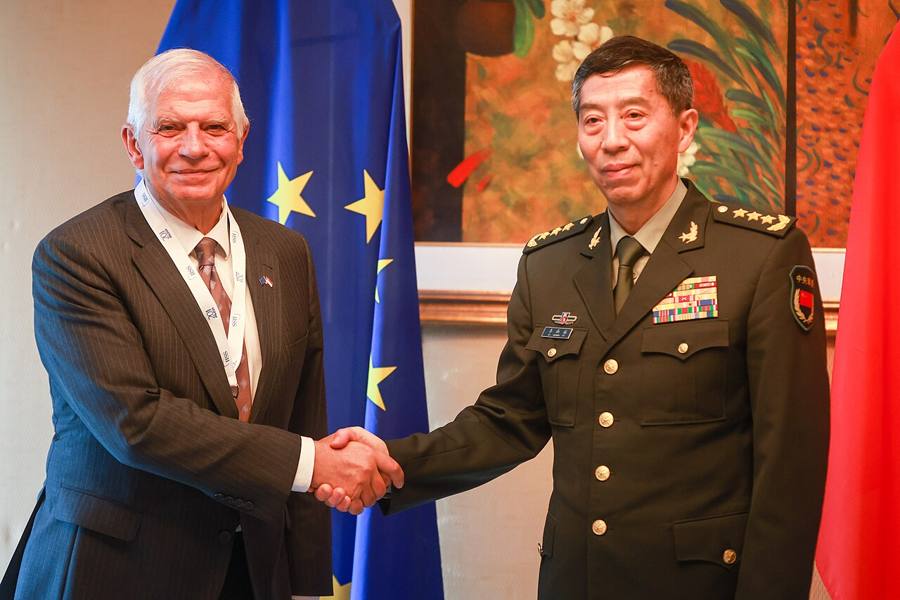
1. Born in Chengdu, of Xingguo stock: the son of a Red Army general (1958–1982)
Li Shangfu was born in February 1958 in Chengdu, Sichuan, with his ancestral home in Xingguo, Jiangxi. Xingguo is famous as a 'county of generals', a poor hill county that produced a large cohort of Red Army officers; his father belonged to that generation. Li Shaozhu (December 1911 – April 1995), of Xingguo, was born into a poor peasant family, became a Red Army veteran, and spent his later career in the PLA Railway Corps, rising to senior rank and overseeing or taking part in the construction of major projects including the Yingtan–Xiamen, Guiyang–Kunming and Chengdu–Kunming railways — and in the building of the Xichang Satellite Launch Center. That last item is worth registering at the outset: the launch centre where the son would spend thirty-one years was one the father's generation helped to build. Li Shaozhu died in Chengdu in April 1995, aged eighty-three; his wife was Gao Yinmei, and the couple had two daughters and a son, Li Shangfu. The evidence tier for the father–son link is stated as this page's discipline requires: it is cross-attested in the public entries and biographical materials for both men, while official career biographies of Li Shangfu (such as the one carried by People's Daily Online) do not themselves discuss his family background; this page adopts the link on the basis of a consistent public record with no contrary material, and does not present it as an official-biography statement.
Of his childhood and schooling there is nothing reliable to record — which school, what record, the public sources are silent — and this page does not invent it. The first fixable point is 1978: that year he entered the National University of Defense Technology, in the second intake after the restoration of the university entrance examinations; cadets were enlisted on entry, so his PLA service dates from then. He joined the Party in June 1980, while still a student. Graduating in 1982, he was posted as a technician to the Xichang Satellite Launch Center, deep in the Liangshan mountains. He later took a Doctor of Engineering in control theory and control engineering from Chongqing University; the years of that part-time study are not publicly recorded, and this page records the degree itself, which appears in his official biography. When the twenty-four-year-old technician walked into the launch centre, China's satellite programme was still in its infancy. He stayed thirty-one years. Those years are the whole of his first life, and the key to why he was later placed in charge of equipment procurement: he was not a combat-arms general but an engineer-bureaucrat of the equipment system.
2. How this page assigns responsibility: three tiers, and four corrections first
There are four easy errors in writing about Li Shangfu — two of them present in this page's commissioning brief, two in popular accounts. They are nailed down here before the narrative proceeds.
Correction one, to the brief: the brief asked whether there was any later trial news, to be marked unverified if there was none. Verification shows there is trial news, and it is official. On 7 May 2026 Xinhua announced first-instance verdicts in the cases of Wei Fenghe and Li Shangfu: Li was convicted of taking and offering bribes and sentenced to death with a two-year reprieve. Lianhe Zaobao followed up, Reuters' report was carried by multiple outlets, an MP-IDSA study cites the Xinhua announcement, and the Xinhua English text was published by the official China Military portal; this page has read it word by word. The status column therefore does not read 'case at the review-for-prosecution stage'; it runs to the first-instance verdict, and registers the blank that follows it. To pass off a 2024 state of affairs as the 2026 present would be the same error as writing rumour up into fact, and this page commits neither.
Correction two, to popular accounts: claims of the form 'Li Shangfu directed Shenzhou launches' fail on the launch site. Every Shenzhou spacecraft has been launched from the Jiuquan Satellite Launch Center; Xichang's missions are lunar probes, Beidou navigation satellites and other application satellites, with no launch-site connection to Shenzhou. Li's real links to the manned programme are two, and neither is the popular one. During his Xichang directorship (2003–2013) the centre flew the Chang'e lunar missions, not crewed flights. And from September 2017 to October 2022 he served concurrently as chief commander of the China Manned Space Programme — a post held ex officio by the director of the Equipment Development Department, under which the programme's management agency sits: Zhang Youxia held it as director, Li inherited it, and Xu Xueqiang inherited it from him. During his five years in that post, Shenzhou 12 through 15 flew and the Tiangong station was assembled — institutional-tenure facts about a programme-level administrative post, with launches still from Jiuquan. This page writes it that way and does not use the grafted-on formula 'the Shenzhou chief commander who came out of Xichang'.
Correction three, to popular accounts: on 11 January 2007 China conducted its first successful direct-ascent anti-satellite test, destroying its own Fengyun-1C weather satellite and generating a large debris field that drew strong international criticism; a US Congressional Research Service report records that the test was conducted near the Xichang space centre. Li Shangfu was then the Xichang centre's director. But no public material links the test's decision, organisation or execution to him personally: which unit developed the weapon, which formation conducted the shot and at what level it was approved have never been officially disclosed, and no external study names a launch-centre director in connection with it. This page's treatment: the overlap of date, place and tenure is registered at the institutional tier, and the personal-responsibility entry reads 'no public record' — neither inferred nor grafted. Together with correction two, this is a standing rule of this file: a space career is the easiest kind to mythologise, and an archive recognises only documents.
Correction four, to the brief and to biographical detail: the brief gave his birth as 1958, Chengdu. Verification: the official-biography formulation is born February 1958, a native of Xingguo, Jiangxi, born in Chengdu, Sichuan — all three elements coexist without contradiction, and all are recorded. No specific day of birth is publicly recorded; any secondary source giving one has no reliable basis and is not used. The brief's 2017 appointment as Equipment Development Department director checks out and is pinned to September 2017, when he succeeded Zhang Youxia.
The method itself is the one used across this site's people files, in three tiers. Tier one, the personally provable: his own documented record — appointments and promotions, the transactions named against him in a US government sanctions decision, the delivery facts of the Russian purchases, his public statements in office, the last-appearance record, and the complete punishment-and-verdict chain that landed on him, each resting on official documents or official reporting. Tier two, the institutional tenure: what the seats he occupied did while he occupied them — the Xichang centre's launch manifest under his directorship, the Equipment Development Department's procurement activity and its 2023 bidding clean-up, the defence ministry's external agenda during his seven months — written throughout as 'during his tenure' and 'the institution', never as his personal orders unless a document names him. Tier three, reporting and analysis: Reuters, the Financial Times, the Wall Street Journal and others on the investigation's scope, the reasons for his fall and the web of connections, each item attributed and tiered, single-source claims marked unverified. The peculiarity of this file is that its three largest episodes — the Russian purchases, the US sanctions, the bribery conviction — sit at three different evidence tiers: the purchases rest on a US government determination, the sanctions on a Federal Register notice, the conviction on a Chinese court's announcement; and it is the conviction, paradoxically, for which the authorities have published the fewest facts. Keep the tiers apart and that shape becomes visible: what in this file is solid, and what is empty.
3. Thirty-one years at Xichang: from technician to launch-centre director (1982–2013)
The Xichang Satellite Launch Center, in Liangshan, Sichuan, was established in 1970 and is one of China's earliest launch sites, specialising in geostationary-orbit satellites and lunar missions. In 1982 the twenty-four-year-old Li Shangfu arrived from the National University of Defense Technology and started as a technician. Over the next twenty-one years he rose through the centre's technical and command posts; public biographies are thin on the year-by-year detail of those two decades, recording long service and successive technical and leadership positions, and this page does not fill the years in. In December 2003, aged forty-five, he became the centre's director (a post also styled commander within the military), its commanding officer; in July 2006 he was promoted to major general.
His decade as director covered the missions that defined China's space profile to the outside world. On 24 October 2007 Chang'e 1 lifted off from Xichang — China's first lunar orbiter, the first step of the 'orbit, land, return' lunar programme; in the programme's published division of labour he held a launch-site-system chief-commander role, the launch-site system being one of the lunar programme's five systems, responsible for the launch site's organisation and execution. On 1 October 2010 Chang'e 2 followed from Xichang, with reporting consistently placing him in the launch-site command role. The dense cadence of Beidou navigation-satellite launches and of communications and meteorological satellites in those years also flew from Xichang. These are institutional-tenure and post-responsibility facts: a launch centre's director answers for the organisation and execution of its launches — that is the job — but this page does not convert each launch into personal 'merit', and records the tenure and the post, no more.
One further event of that tenure must be registered, with the boundary drawn in correction three above: the anti-satellite test of 11 January 2007. The test was conducted in the Xichang area, three years into his directorship; the external record consists of the Congressional Research Service report, congressional testimony and contemporary aviation-press reporting, while China's foreign ministry did not comment until 23 January, saying then that the test was not aimed at any country and that China stood for the peaceful use of space. The thousands of trackable debris fragments it created have remained in orbit ever since, a landmark episode in the militarisation-of-space debate. This page restates its treatment: the overlap is fact; a personal role has no public record. A launch-centre director's administrative authority over space activity in his region, and his possible involvement in a weapons test decided at higher level and executed by a weapons-system formation, are two different things; the public material does not connect them, and this page does not connect them either.
In 2013, after thirty-one years at Xichang, he left for Beijing. He had risen from technician to major-general director without a single posting in a combat formation or a political-work organ — a pure equipment-technocracy file. In the PLA's hierarchy of generals such a background long counted as marginal. But the military reforms of the 2010s moved equipment development to the centre of the institution, and a man who understood space and procurement, and had run a large front-line unit for a decade, began to come into view at higher levels. His next posting was to the equipment system's central hub.
4. General Armaments chief of staff, Strategic Support Force deputy commander: into the equipment hub (2013–2017)
In 2013 Li Shangfu became chief of staff of the General Armaments Department (GAD), succeeding Shang Hong. The GAD, then one of the four general departments, ran the PLA's weapons development, procurement, maintenance and space launch and tracking — the equipment system's central hub — and its director was Zhang Youxia. In 2014 Li became the GAD's deputy director, serving under Zhang. That superior–subordinate relationship matters to the later record: Zhang was his superior for years, and almost every key post Li took was one Zhang handed over (the GAD deputy directorship relative to the Equipment Development Department directorship, next section; the rumoured claims about the two men's relationship in 2026 are registered only at the single-source, unverified tier in Section Twelve). The reforms of late 2015 and early 2016 abolished the four general departments, the GAD's functions passing largely to the new CMC Equipment Development Department; at the same time, on 31 December 2015, the Strategic Support Force was created, grouping space, cyber and electronic-warfare capabilities. In 2016 Li became a deputy commander of the Strategic Support Force, and that August he was promoted to lieutenant general. The deputy command of that new force connects directly to a later 'first': he would become the first officer from the Strategic Support Force to sit on the Central Military Commission and its first defence minister.
The public record of those four years (2013–2017) is mostly procedural — equipment-work conferences, space-mission organisation, military-representative system events — and public reporting sheds little light on his specific decisions in that phase; this page records it at that granularity. What matters is the structural shift: by 2017 he had spent four years as chief of staff and deputy head of the equipment hub and a year as deputy commander of the newest service. The credentials for taking over the Equipment Development Department were complete.
5. Five years running the Equipment Development Department: the PLA's procurement chief, concurrently chief commander of the manned space programme (2017–2022)
In September 2017 Li Shangfu succeeded Zhang Youxia — who rose to a CMC vice chairmanship — as director of the CMC Equipment Development Department. The department inherited the GAD's core functions: planning for the whole PLA's weapons development, research and procurement, testing and certification, technical infrastructure and space launch and tracking administration. In plain terms, what the military buys, from whom, and by what procedure passes through this department's gate. The weight of the post can be read off its occupants' trajectories: his predecessor went from it to a CMC vice chairmanship; he went from it to the CMC and the defence ministry. At the 19th Party Congress in October 2017 he was elected to the Central Committee — his entry point into the Party's central leadership.
The concurrent post must be written out separately, with the boundary drawn in correction two: from September 2017 to October 2022 he was concurrently chief commander of the China Manned Space Programme. In that programme's management structure the chief commander is its senior administrative officer, held ex officio by the head of the equipment system, with the programme office inside the equipment department's system. During his tenure in that post the programme completed the key phase of space-station construction: the Tianhe core module launched in April 2021; Shenzhou 12, 13, 14 and 15 flew in succession from Jiuquan, crews rotating aboard; and by the end of 2022 the station's basic configuration was complete — officially declared completed on 31 December 2022, two months after he had handed the department and the chief-commander post to Xu Xueqiang. This page's formulation for that stretch is institutional-tenure: the station was built during most of his tenure as the programme's chief commander, which is a fact of timing; the programme's technical decisions belonged to its chief-designer system and its component systems, and this page does not write the station up as his personal engineering achievement. Equally, it does not tie the station programme to the procurement corruption of which he was later convicted: the Party announcement spoke of 'the military equipment sector' and named no project, and neither does this page.
The other line of his equipment tenure was foreign procurement, and its heaviest item was the Russian transaction. The contracts for Su-35 fighters and the S-400 air-defence system were concluded around 2015, before his arrival; but the deliveries fell within his tenure — ten Su-35s delivered in December 2017 and S-400-related equipment delivered in 2018 — and the conjunction of delivery dates, counterparty (Rosoboronexport) and his position as the department's director forms the entire factual basis of the sanctions in the next section. The nature of the responsibility should be stated precisely: he did not sign the contracts, and the decision was not his alone; it was state-level military procurement through an institution. But the legal construction of the US sanctions does not ask who signed a contract. It asks who heads the entity that conducted the 'significant transaction'. In September 2018 that answer landed on him personally, in the Federal Register.
On 31 July 2019 the CMC held a promotion ceremony at which Li Shangfu was made a general of the Ground Force. Rank, Party standing (Central Committee member) and post (head of a theatre-grade department) were now all in place; one step remained. At the 20th Party Congress in October 2022 he was re-elected to the Central Committee and entered the new Central Military Commission as a member, ranked first among its ordinary members — the ranking that, by convention, marks the incoming defence minister. The five equipment years were the main channel of his rise, and they were also the main scene of the criminal liability later found against him: the 'severely contaminated the political environment of the equipment sector' of the 2024 announcement points at the chair he occupied in those five years and the business it controlled. An archive must therefore record both faces in full: the station built and the Russian systems delivered in those years are real; so are the acts of taking and offering bribes that a court later found in his exercise of those functions. The authorities have never published which projects the latter correspond to, and this page leaves that seam exactly as it stands (see Section Twelve).
6. 20 September 2018: the first-ever use of CAATSA Section 231 lands on a Chinese equipment chief
The legal framework first. The Countering America's Adversaries Through Sanctions Act (CAATSA), in force from 2 August 2017, provides at Section 231 that the President shall impose at least five of the twelve sanctions listed at Section 235 on any person who engages in a 'significant transaction' with a person listed as part of, or operating for, Russia's defence or intelligence sectors. Rosoboronexport, Russia's state arms-export channel, is on that list. On 20 September 2018 the President signed Executive Order 13849 implementing the relevant authorities; the same day the State Department announced two actions: thirty-three Russian defence and intelligence persons were added to the Section 231 list, and — in the provision's first-ever application — the Equipment Development Department was determined to have knowingly engaged in a significant transaction with a listed person, and sanctions were imposed on the department and on its director, Li Shangfu.
The transactions relied on are stated identically in the State Department announcement and the Federal Register: Russia's transfer to China of ten Su-35 combat aircraft, delivered in December 2017, and S-400 surface-to-air missile system-related equipment, delivered in 2018, with Rosoboronexport as counterparty. The Federal Register notice of 5 October 2018 (Public Notice 10579) states the legal construction most fully: the Secretary of State had determined that the Equipment Development Department had knowingly, on or after 2 August 2017, engaged in a significant transaction with a person in Russia's defence or intelligence sectors, and had selected sanctions to be imposed on the department and on 'Li Shangfu, EDD's Director, who has been determined to be a principal executive officer of EDD', effective 20 September 2018. The measures selected against the department included denial of export licences, a prohibition on foreign-exchange transactions under US jurisdiction, a prohibition on transactions with the US financial system, and blocking of all property and interests in property under US jurisdiction; against him personally, additionally, placement on OFAC's Specially Designated Nationals list and a visa ban. He was not, in other words, named for any personal act of his own; he was sanctioned in his capacity as an institution's head — but the legal effects were purely personal: his name went onto the SDN list and travelled with him through the rest of his career, all the way into the defence ministry.
China's response, on the public record: the foreign ministry lodged a formal protest, and China reportedly summoned the US ambassador to protest; military spokesmen also objected. The sanctions' practical effect at the time was limited — the department had no direct US business, and whether he held any assets under US jurisdiction has never been publicly recorded — and their real weight appeared only five years later: in March 2023 a man still on the US SDN list became China's defence minister, a configuration without precedent in US–China military relations. In May 2023 President Biden, asked at the G7 summit, said his administration was considering lifting the sanctions on Li — that the matter was, in his words, under negotiation; the next day, 22 May, State Department spokesman Matthew Miller corrected the record at a briefing: the United States was not considering lifting them. China then declined the US proposal for an Austin–Li meeting on the margins of the Shangri-La Dialogue in Singapore, with Chinese statements and reporting consistently pointing to the unlifted sanctions; the US side stated publicly that the sanctions did not in law bar a meeting between the two defence chiefs. At the June 2023 Dialogue the two men managed a handshake at the opening dinner and no bilateral meeting. A 2018 sanctions decision thus froze, in 2023, the formal meeting channel between the American and Chinese defence chiefs — the heaviest international entry in his personal file, and the reason this page's sanctions column differs strictly from the 'no record found' of the He Weidong page: his sanctions not only exist, they changed how two great powers were able to talk to each other.
The current state of the designation, checked for this page: as of writing (November 2026), searches of OFAC public list information and of public reporting found no record of Li Shangfu's removal from the SDN list; neither his removal from office in 2023, his expulsion in 2024 nor his sentencing in 2026 was accompanied by any public US delisting action. This page accordingly records 'no public record of delisting', and no inference beyond it. Searches of the EU financial sanctions database, the UK Sanctions List and Canada's consolidated list found no listing of his name: his international sanctions record consists of exactly one designator, the United States, under exactly one authority, CAATSA Section 231.
7. Defence minister for seven months: the shortest tenure on record (March–October 2023)
On 12 March 2023 the first session of the 14th National People's Congress appointed Li Shangfu State Councillor and Minister of National Defense, promulgated by Presidential Order No. 2. He was the thirteenth defence minister, succeeding Wei Fenghe; he was also the first defence minister from the Strategic Support Force, and the first to enter the post carrying a live US sanctions designation. The Chinese defence minister is, institutionally, the military's external representative: he conducts military diplomacy, attends international security conferences and deals with foreign counterparts; operational command rests with the Central Military Commission, not with the minister. That institutional fact is stated first so that his seven months are recorded at the right tier: everything in them is at the 'representation' level.
The seven months of travel can be laid out in a complete line from the public record. His first foreign trip went to Russia: from 16 to 19 April 2023 he visited Moscow, meeting President Putin and Defence Minister Shoigu, and said in the meeting that China–Russia ties 'surpass the military-political alliances of the Cold War era' — the most widely quoted sentence of his tenure. On 28 April he attended the Shanghai Cooperation Organisation defence ministers' meeting in New Delhi and met India's defence minister Rajnath Singh, the first visit to India by a Chinese defence minister since the 2020 border clashes. In early June he attended the Shangri-La Dialogue in Singapore and on 4 June told the conference that a US–China war would be an 'unbearable disaster' — again widely reported; meanwhile, as the previous section records, no defence-chiefs' meeting took place because of the sanctions question. On 15 August he addressed the 11th Moscow Conference on International Security and held his third meeting of the year with Shoigu, then travelled on to Belarus to meet President Lukashenko. On 29 August, in Beijing, he delivered the keynote speech to the plenary session of the third China-Africa Peace and Security Forum and met a series of African defence leaders the same day. That was his last public appearance. Thereafter his name vanished from all public reporting.
Two structural facts about those seven months deserve registering in retrospect. First, US–China senior military communication was frozen throughout his tenure, and one direct technical cause of the freeze was the sanctions designation attached to his own name — not a policy formulation but the list itself. Second, nothing in his public agenda intersected publicly with the matters of which he was later convicted: the court's findings concern acts of taking and offering bribes in his equipment-department tenure (and, on the announcement's wording, in personnel arrangements), not anything in his seven months as defence minister; neither the announcement nor the verdict ties any specific act to the period after March 2023. This page fixes that temporal structure to block two common mis-writings: that he 'fell for corruption committed as defence minister', and that his fall followed directly from his US or Russia diplomacy. The official documents support the first half of the timeline (the equipment years as the main scene) and say nothing at all about the second.
8. Fifty-six days of disappearance and a removal order without reasons (July–October 2023)
This section's method is stated first: it records only the checkable public record and what each party actually said at the time; every inference is attributed. In retrospect the first public signal came before he vanished. On 26 July 2023 the CMC Equipment Development Department published a notice soliciting clues about violations in PLA equipment procurement bidding and evaluation since October 2017, listing eight categories of misconduct including favouritism by experts, leaking of secrets and manipulation of bidding, and launching a clean-up campaign. The notice named no one. But its start date — October 2017 — fell in the month after Li Shangfu took over the department (September 2017), a correspondence Reuters and AFP both pointed out in their reporting. Set beside the contemporaneous reporting on the Rocket Force leadership, the equipment-and-missile purge of summer 2023 begins, on the public record, at exactly this point.
After the 29 August appearance the absences accumulated into a chain of evidence: a Vietnam–China defence-cooperation meeting scheduled for 7–8 September on the border was cancelled on the Chinese side citing 'health conditions' for his attendance (Reuters, citing sources with direct knowledge); a meeting with Singapore's defence leadership did not take place; and in the television footage and Xinhua reporting of a CMC political-education meeting on 15 September he did not appear. At the foreign ministry's regular briefing on 11 September the spokeswoman gave no substantive answer to questions about him. Foreign reporting then escalated in steps: on 14 September the Financial Times reported that US officials believed he had been stripped of his post and was under investigation; on 15 September Reuters published an exclusive report, citing ten people familiar with the matter, that he was under investigation by the military's discipline authorities for corrupt procurement, that eight senior officials of the Equipment Development Department were also under investigation, and that Reuters had been unable to establish which purchases were under scrutiny; the Wall Street Journal cited a person close to decision-making in Beijing as saying he had been taken away for questioning the previous week — a single-source claim, marked unverified here and registered only as having appeared. The official response to all of it was of one kind only: no confirmation, no denial, name left standing — his name and titles remained on the defence ministry and CMC websites into October.
On 24 October 2023 the sixth session of the Standing Committee of the 14th NPC closed with a decision: Li Shangfu was removed from the posts of State Councillor and Minister of National Defense, Qin Gang was removed as State Councillor, and Li was simultaneously removed as a member of the state Central Military Commission. President Xi Jinping signed Presidential Order No. 14 promulgating it. The entire text of the decision is the removal list itself — no reason, no explanation, no valediction — and the foreign ministry, pressed the next day, said it had no further information to offer and referred questioners to the Xinhua report. From last appearance to removal: fifty-six days. From removal to any stated reason: eight months. The defence minister's post then stood vacant for more than two months, until the Standing Committee appointed Admiral Dong Jun, the former Navy commander, on 29 December 2023. With a tenure of seven months and twelve days, Li Shangfu became the shortest-serving defence minister in the history of the People's Republic. The final link of the procedural chain was not known to anyone at the time: as the June 2024 announcement retrospectively disclosed, the CMC Discipline Inspection and Supervision Commission had opened its case against him on 31 August 2023 — two days after his last appearance. When the reason-free removal order fell on 24 October, the case had already been open for fifty-four days; and the fact of the case itself was then withheld for a further ten months. This page pins those three blanks in place — fifty-six days of interrupted appearances, eight months of removal without reasons, a case-opening date disclosed ten months late — because in this file the temporal shape of the blanks is itself part of the facts.
9. 27 June 2024: the expulsion announcement — the whole of the official 'facts'
On 27 June 2024 a Politburo meeting adopted the CMC's report on the review of Li Shangfu's case and its proposed handling, and Xinhua published the announcement the same day. This page has read the full text on the defence ministry and People's Daily portals; its points, in order, are these. First, the case-opening date: the CMC's disciplinary and supervisory agency launched its investigation on 31 August 2023. Second, the discipline findings: he 'seriously violated political and organizational discipline' and 'sought improper benefits in personnel arrangements for himself and others'. Third, suspected bribe-taking: he took advantage of his posts to seek benefits for others and accepted a huge amount of money and valuables in return — 'suspected of the crime of taking bribes'. Fourth, suspected bribe-giving: he was found to have offered money to others to seek undue benefits — 'the suspected crime of offering bribes'. Fifth, residue: the investigation 'also found clues of Li's other violations'. Sixth, the political characterisation: as a senior Party and military official he 'betrayed the Party's original aspiration and its principles', failed the trust of the Party Centre and the CMC, and 'severely contaminated the political environment of the equipment sector in the military and the ethics of relevant industries', bringing enormous damage to the Party's cause, national defence and the armed forces, and to the image of senior officials, his violations being 'extremely serious in nature, with a highly detrimental impact and tremendous harm'. Seventh, the dispositions: expulsion from the Party (to be ratified by a Central Committee plenum), termination of his status as a delegate to the 20th Party Congress, and transfer of his suspected criminal case to the military procuratorial organs; the announcement notes that the CMC had earlier already expelled him from military service and deprived him of his rank of general.
The same day, by the same procedure, the Politburo dealt with his predecessor Wei Fenghe: two successive defence ministers expelled from the Party on a single day, a form of disposal without precedent in the Party's history. On 18 July 2024 the communiqué of the Third Plenum of the 20th Central Committee confirmed the expulsions of Li Shangfu (with Rocket Force figures Li Yuchao and Sun Jinming). On the NPC-deputy line the procedural record diverges, and this page registers both layers as they stand: on 4 March 2024 the NPC spokesman Lou Qinjian had already stated publicly that Li Shangfu was no longer an NPC deputy and could not attend the annual session; the formal removal record appears at 11 July 2024 (a PLA election-committee-level decision, dated thus in the Chinese Wikipedia from NPC website materials) and in the September 2024 credentials-committee report and Standing Committee announcement (14th NPC, No. 6, published 13 September 2024). This page therefore writes 'removed as a deputy in July 2024, with the Standing Committee announcement procedure completed in September', and registers the dating discrepancy rather than forcing a single date.
The announcement's blank belongs in the record beside the announcement. Set this text next to the US Federal Register notice in Section Six and the shapes are mirror images: the American decision specifies the transactions' dates, quantities, counterparty and legal basis, and says nothing about whether he personally profited; the Chinese announcement specifies his personal profiting and giving in characterisation — accepted a huge amount, gave money to others — and supplies not one figure, not one project, not one counterparty. How much is 'a huge amount'? Who are 'the others'? Did the money correspond to the Su-35s, the S-400s, or to domestic procurement programmes? The announcement does not contain a single word on any of it. In the two years that followed, up to the first-instance verdict, the authorities never supplemented it with a single specific fact (see the next section). The file thus takes, at its most critical point, a shape similar to He Weidong's and more extreme: in He's case nine men shared one formula and the personal particulars were blank; in Li's case the personal characterisations fill a whole paragraph and the facts are still blank. Reuters' September 2023 report of eight equipment-department officials investigated alongside him has never been confirmed, denied or particularised by any official text, and this page keeps it at the reporting tier to this day, unpromoted.
10. 7 May 2026: death with reprieve at first instance — a verdict, still without facts
On 7 May 2026 Xinhua published the first-instance verdicts (the English text carried by the official China Military portal among others, read word by word for this page): the PLA Military Court handed down first-instance sentences in the cases of Wei Fenghe and Li Shangfu, separately. Li was convicted of the crimes of accepting bribes and of offering bribes; Wei was convicted of accepting bribes. Both were sentenced to death with a two-year reprieve, deprived of political rights for life, with all personal property confiscated; the rulings state that no further commutation or parole will be allowed after their penalties are commuted to life imprisonment upon the expiry of the two-year reprieve. Lianhe Zaobao reported the verdicts on 8 May; Reuters' account was carried by multiple international outlets; an MP-IDSA study, citing the Xinhua announcement and Zaobao, notes that this was the first time in PRC history that defence ministers were sentenced to death (with reprieve), a severity exceeding the life sentences given to Guo Boxiong and Fang Fenghui. On 8 May the PLA Daily published an editorial commenting on the cases in political language — a collapse of faith, a loss of loyalty; an editorial is political positioning, not case fact, and this page files it at the commentary tier.
The length of the verdict announcement deserves registering: the Xinhua English text runs to under a hundred and fifty words. It gives no amount for the bribes taken or offered, no procurement project by name, no counterparty on either side, no account of the proceedings — when the trial was held, whether it was public, whether the defendants pleaded — and no public channel for a full judgment text. From the opening of the case on 31 August 2023 to the verdict on 7 May 2026, nearly three years, the case's public record consists of exactly three layers of official text: a removal list (no reasons), an expulsion announcement (characterisations, no facts), and a verdict notice (charges and sentence, no amounts, no facts). A former State Councillor, CMC member and defence minister has been sentenced to death with reprieve, and the verifiable factual content of his case available to the public — including to an archive site like this one — remains, to this day, zero. That is not this page's omission; it is the actual shape of the case's public record, registered here as it stands, with all 'never published' items collected in Section Twelve.
The verdict's legal status must also be stated precisely: the Xinhua formulation is 'first-instance' sentencing. What appellate procedure follows a first-instance military-court verdict in his case, and when the judgment takes effect, cannot be verified from public sources. From May 2026 to this page's writing (November 2026), Xinhua, the defence ministry and military media have carried nothing further about him — no second-instance report, no commutation ruling, no place of imprisonment. The two-year reprieve runs, by the verdict date, to about May 2028. This page's status column accordingly reads 'sentenced to death with reprieve at first instance, within the reprieve period'; it does not write 'final judgment', and it adopts none of the social-media claims that he has been executed, has died, or has been quietly commuted — none of which has any reliable source, and all of which are registered in Section Twelve.
11. His place in the chain: Li Shangfu within the Rocket Force–equipment purge
Li Shangfu's case was never a lone case. Set back into the purge chain that began in 2023, the timeline runs: in July 2023, reporting emerged that Rocket Force commander Li Yuchao and his leadership were under investigation, and the Equipment Development Department published its procurement-tip notice reaching back to October 2017; on 31 August 2023 the case against Li Shangfu was opened; on 29 December 2023 nine military NPC deputies were removed in one batch, many of them from the Rocket Force and the equipment system; on 27 June 2024 Li Shangfu and his predecessor Wei Fenghe — the Rocket Force's first commander — were expelled from the Party on the same day; in July 2024 the Third Plenum ratified the expulsions, in the same batch as those of former Rocket Force commander Li Yuchao and former chief of staff Sun Jinming; and on 7 May 2026 Li Shangfu and Wei Fenghe were sentenced to death with reprieve on the same day. The common denominator the official announcements supply is exactly one: procurement, personnel and the 'political environment' of the equipment and Rocket Force systems. The specific connections among the men in the chain — who bribed whom, who promoted whom — have never been published by the authorities in any verifiable form.
One reporting-tier claim must be registered here at the single-source, unverified tier: in January 2026 the Wall Street Journal reported that an internal briefing on the case of CMC vice chairman Zhang Youxia referred to Li Shangfu's case, alleging that Zhang had accepted large bribes to elevate Li. This page's treatment: first, that Zhang was Li's superior for years — GAD director to his deputy, and his predecessor at the Equipment Development Department — is a matter of public career record. Second, the specific allegation of bribe-for-promotion rests, at present, on the Journal's account of an internal briefing alone, with no official document and no second reliable outlet independently confirming it; this page marks it single-source and unverified, writes it into no conclusion, and does not use it to rewrite any earlier section. Archival discipline matters most exactly here: a superior's fall, if it comes, does not automatically rewrite a subordinate's file, and a subordinate's conviction does not automatically prove the allegation against the superior. Each layer is evidenced only at its own tier.
12. Status check (as of November 2026) and the register of unverified matters
The status check ran as follows. First, the last official texts concerning Li Shangfu in the public record are the Xinhua first-instance verdict announcement of 7 May 2026 and the PLA Daily editorial of 8 May 2026; from then to this page's writing there has been no further official word. Second, Chinese- and English-language searches pairing his name with appeal, second instance, commutation, execution, death and place of imprisonment returned no reporting by Reuters, the Associated Press, the South China Morning Post, Lianhe Zaobao, Caixin or comparable outlets on the verdict's taking effect, his place of detention or his health. Third, his US sanctions status was checked with no delisting record found (see Section Six). On that basis this page confirms: as of November 2026 Li Shangfu is within the reprieve period of a first-instance death sentence with a two-year reprieve (running to about May 2028), with no public record of where he is held or of his health, and no record of the lifting of his US SDN designation.
Unverified matters are registered here together and are not scattered through the body text as conclusions. One, the sums: at the case-opening, expulsion and verdict stages the authorities used only the characterisation 'huge amount' and have never published any figure; every numerical version circulating on social media is rejected. Two, the projects and counterparties: which procurement programmes the bribe-taking corresponded to, and to whom the bribes were offered, have never been officially published; claims tying the Su-35 and S-400 transactions directly to his bribery conviction have no support in any official text — the US sanctions decision found institutional transactions and never alleged personal profiteering — and this page makes no such link. Three, the circumstances in which measures were taken against him: when he was taken into custody relative to the 31 August 2023 case-opening, and the Wall Street Journal's September 2023 single-source 'taken away for questioning' account, are unconfirmed by any official text and are not adopted. Four, the 'eight equipment-department officials': reported by Reuters in September 2023, never confirmed or named by the authorities; filed at the reporting tier. Five, the Zhang Youxia bribe-for-promotion allegation: the Wall Street Journal's January 2026 single-source account of an internal briefing; unverified, see Section Eleven. Six, family and personal matters: there is no reliable public record concerning his spouse or children, and this page records none; his father Li Shaozhu's biography rests on public entries and is not expanded beyond them. Seven, health and death rumours: claims of death in custody or of execution, circulating during the rumour phase and after the verdict, have no reliable source and are not adopted. These seven items will be revised as new archival material becomes public.
13. Verification and sources
This page's biographical and service facts were cross-checked across multiple sources, principally: the official biography of Li Shangfu carried by People's Daily Online (born February 1958, of Xingguo, Jiangxi; entered the National University of Defense Technology in 1978, joined the Party in June 1980, posted to the Xichang Satellite Launch Center in 1982, Doctor of Engineering from Chongqing University; Xichang centre director December 2003, major general 2006, General Armaments Department chief of staff 2013, deputy director 2014, Strategic Support Force deputy commander and lieutenant general 2016, Equipment Development Department director September 2017); the Chinese and English Wikipedia entries for Li Shangfu and Li Shaozhu and the materials they cite (the father–son link; Li Shaozhu 1911–1995, his Railway Corps career and part in building the Xichang centre; the Chang'e 2 launch in October 2010; promotion to general July 2019; CMC membership October 2022 ranked first among ordinary members; the manned-space-programme chief command, September 2017 to October 2022, succeeded by Xu Xueqiang); China Daily, September 2017, on the Equipment Development Department handover; the Congressional Research Service report on the 2007 anti-satellite test (conducted on 11 January 2007 near Xichang; China's first official comment on 23 January); Xinhua and gov.cn on the 12 March 2023 appointments (Presidential Order No. 2) and on the 29 August 2023 China-Africa Peace and Security Forum speech, his last public appearance (People's Daily Online English report); BBC and Reuters reporting on his April 2023 Russia visit and meeting with Putin, the 28 April 2023 SCO defence ministers' meeting in New Delhi, and the 4 June 2023 Shangri-La speech ('unbearable disaster'). On sanctions: the text of CAATSA Sections 231 and 235; Executive Order 13849 of 20 September 2018; the State Department's sanctions announcement of 20 September 2018, cross-checked through the Baker McKenzie and JD Supra client memoranda and Reuters' report of 21 September 2018 (ten Su-35s delivered December 2017, S-400-related equipment delivered 2018, Rosoboronexport as counterparty, the first use of Section 231); the Federal Register, vol. 83 no. 194, State Department Public Notice 10579, in the original (determination that the Equipment Development Department had knowingly engaged in a significant transaction; sanctions selected against the department and against its director Li Shangfu as its principal executive officer; effective 20 September 2018); his inclusion in OFAC's SDN list; President Biden's May 2023 G7 remarks and State Department spokesman Matthew Miller's 22 May 2023 'not considering lifting' correction, as reported by multiple outlets; and the Pentagon's late-May 2023 statement that China had declined the proposed defence-chiefs' meeting, as reported by multiple outlets. On the disappearance and disposal: the Equipment Development Department's notice of 26 July 2023 soliciting procurement-bidding violation clues (via Reuters and AFP reporting of 27 July 2023 and the public record of the 2023 Rocket Force corruption case: the solicitation period runs from October 2017, eight categories of misconduct); Reuters' exclusive report of 15 September 2023 (ten people familiar with the matter: investigated for corrupt procurement, eight equipment-department officials also investigated, specific purchases unverified; the Vietnam meeting cancelled on health grounds); the Financial Times, 14 September 2023 (US officials' assessment that he was under investigation); the Wall Street Journal's 'taken away for questioning' account (single source, marked unverified in the body); the removal decision of the sixth session of the Standing Committee of the 14th NPC and Presidential Order No. 14 of 24 October 2023 (China NPC and gov.cn; Qin Gang removed as State Councillor the same day); the Standing Committee's appointment of Dong Jun as defence minister on 29 December 2023; NPC spokesman Lou Qinjian's answer of 4 March 2024 (Li Shangfu is no longer an NPC deputy, via Lianhe Zaobao); Xinhua's expulsion announcement of 27 June 2024, read in full on the defence ministry and People's Daily portals (case opened 31 August 2023; serious violations of political and organisational discipline; improper benefits in personnel arrangements for himself and others; a huge amount of money and valuables accepted, suspected bribe-taking; money offered to others, suspected bribe-giving; further violation clues found; severe contamination of the equipment sector's political environment; prior expulsion from the military and revocation of the general's rank; transfer to military prosecutors; plenum ratification to follow); the Third Plenum communiqué of 18 July 2024 confirming the expulsion; and the two dating layers for his NPC deputy removal, 11 July 2024 and the September 2024 announcement (Chinese Wikipedia from NPC website materials; the discrepancy is registered in the body). On the verdict: Xinhua's first-instance verdict announcement of 7 May 2026, read in full on the China Military English portal (Li convicted of accepting and offering bribes, Wei Fenghe of accepting bribes; both sentenced to death with a two-year reprieve, lifelong deprivation of political rights, confiscation of all personal property, life imprisonment without commutation or parole after commutation); Lianhe Zaobao, 8 May 2026; Reuters' account as carried by the New York Post and others in May 2026; the MP-IDSA study (citing the 7 May 2026 Xinhua announcement and Zaobao; first defence ministers sentenced to death with reprieve, exceeding the Guo Boxiong and Fang Fenghui life sentences); the PLA Daily editorial of 8 May 2026 (checked via the Wikipedia quotation, cited at the commentary tier); and the Wall Street Journal's January 2026 report of an internal briefing on Zhang Youxia mentioning Li Shangfu (single source, marked unverified in the body). On sanctions lists: his name appears on the US OFAC list; searches of the EU financial sanctions database, the UK Sanctions List and Canada's Consolidated Autonomous Sanctions List found no listing. On images: Wikimedia Commons maintains a Category:Li Shangfu with twenty-eight files, including Russian defence ministry photographs of the April 2023 Moscow visit delegation (a fifteen-file subcategory), Indian official photographs of the 28 April 2023 SCO defence ministers' meeting in New Delhi, a photograph of his meeting with the EU High Representative, and photographs from the August 2023 Moscow Conference on International Security — unlike the He Weidong page, public imagery of him is not scarce. However, each file's licence must be verified file by file on its licence page before use (Russian defence ministry material on Commons is typically CC BY 4.0; Indian government photographs are typically GODL-India), and this commission does not include downloading images; the status is therefore registered as 'candidate compliant sources exist; per-file licences to be verified by the image desk', and no image is embedded in this fragment. His official photographs and video stills released by Xinhua, the defence ministry and CCTV are official copyright and are not candidates; Reuters and AFP agency photographs are excluded as agency copyright.
Corrections made to the commissioning brief, on verification: One, the brief asked for later trial news to be labelled unconfirmed if none existed — verification shows this premise is outdated: a military court sentenced him at first instance to death with a two-year reprieve on 7 May 2026, announced by Xinhua and carried by Reuters and others; the body text and status column are written to the post-verdict state, with the 'first-instance' formulation and the blank after the verdict registered as they stand (Section Ten). Two, the brief's statement that his father was the PLA veteran Li Shaozhu checks out and is completed here: Li Shaozhu (1911–1995), Red Army veteran, senior Railway Corps officer, a participant in building the Xichang Satellite Launch Center; the evidence tier is cross-attestation in public entries and biographical materials, since official career biographies do not themselves discuss family background, and the body text says so. Three, the brief's reference to a Shenzhou-programme role must be narrowed: Shenzhou spacecraft launch from Jiuquan and have no connection to Xichang; his manned-space post was the programme chief command held ex officio as Equipment Development Department director in 2017–2022, and the body text is written to that formulation (correction two). Four, the brief's remaining particulars — born 1958; Equipment Development Department director 2017; CAATSA Section 231 sanctions in September 2018 over the Su-35 and S-400; CMC member; defence minister and State Councillor from March 2023; last public appearance 29 August 2023; removed 24 October 2023; expelled from the Party on 27 June 2024 with rank stripped and case transferred to military prosecutors — were each checked against the public record, adopted, and pinned to their documents and dates: sanctions effective 20 September 2018 (Federal Register Public Notice 10579); removal by the sixth session of the NPC Standing Committee and Presidential Order No. 14; case opened 31 August 2023 (disclosed retrospectively in the 2024 announcement). Five, the authorities have to this day published no sum, project or counterparty in his case, and this page adopts no circulating figure or claim. This page will be revised as new archival material becomes public.
14. Our Take
The most instructive thing in Li Shangfu's file is not the sentence — death with reprieve plus life imprisonment is among the heaviest penalties the PLA's internal justice has ever handed down — but the three things the same system successively made of one man. The first is called a model. The son of a Red Army general, an engineer who spent thirty-one years at a launch site in the mountains, climbed the technocratic equipment ladder rung by rung into the Central Military Commission and a State Councillor's seat. His trajectory marked what this military, in that decade, claimed to value most: modernisation, equipment, technology. The second is called a token. In 2018 the United States used CAATSA Section 231 for the first time, and named the institution he headed and the man himself; Beijing not only kept him, it promoted him five years later into the defence ministry, so that a US sanctions list came to block the meeting channel between the two countries' defence chiefs. A sanctioned man was deliberately placed in the post that most requires dealing with the sanctioning power; the designation was converted from a punishment into a prop of confrontation, and he was the prop. The third is called evidence. In the summer of 2023 came first a procurement-tip notice reaching back to the month after he took office, then fifty-six days of silent disappearance, a removal order without reasons, a case-opening date disclosed ten months late, an expulsion announcement full of characterisations and empty of a single figure, and finally a verdict notice of under a hundred and fifty English words announcing a suspended death sentence. He was found to have taken and offered bribes — if true, the classic monetisation of the procurement gatekeeper's chair he had occupied. But whether it is true, the public has never been given a single checkable item with which to judge: no amount, no project, no counterparty, no public trial, no published judgment. This page exists to pin all three things to one timeline exactly as they stand — how the model was raised, how the token was played, how the evidence was sealed inside texts that characterise everything and document nothing — recording what the documents say, and, where they are blank, recording the blank together with its length. A state disposes of its own defence minister by the same procedural logic it applies to ordinary people; the complete public text of the Li Shangfu case, laid end to end, is that logic's fullest single exhibition of itself.
Contact: endccpworld@proton.me