
第157案 | 萨依拉古尔·沙乌提拜Case 157 | Sayragul Sauytbay
萨依拉古尔·沙乌提拜,1976年生于新疆伊犁昭苏县的哈萨克族教师,先学医、后从教,2016年已是五所公办幼儿园的负责人,只因丈夫带着两个孩子去了哈萨克斯坦,她先被半夜传唤讯问了大半年,2017年11月又被四名武警以黑头套带进昭苏一座集中营强迫教汉语,在营里目睹一平方米的牢房、没有摄像头的黑屋与当众的性暴力,自己也被拖进黑屋坐过电椅;2018年3月她险被以被押者身份关押一至三年,遂越境逃往哈萨克斯坦,在扎尔肯特法庭的被告席上把营内实情当庭说出,换得缓刑与不予遣返,2019年获瑞典政治庇护,此后获美国国务院国际妇女勇气奖与纽伦堡国际人权奖,在伦敦维吾尔法庭以第一号事实证人身份作证,至今仍在流亡中发声。Sayragul Sauytbay, an ethnic Kazakh teacher born in Zhaosu County, Ili, Xinjiang, in 1976, trained first in medicine and then in teaching and by 2016 was running five state-run kindergartens; because her husband had taken their two children to Kazakhstan, she was first interrogated for the better part of a year, sometimes at night, and then, in November 2017, hooded by four armed police into a camp in Zhaosu County and forced to teach Chinese, where she witnessed one-square-metre cells, a camera-free 'black room' and a public rape, and was herself tortured in an electric chair; in March 2018, facing internment as a detainee for one to three years, she crossed into Kazakhstan, told the camp's story from a defendant's seat in a Zharkent court and won a suspended sentence with no deportation, received political asylum in Sweden in 2019, and has since received the U.S. State Department's International Women of Courage Award and the Nuremberg International Human Rights Award and testified as the Uyghur Tribunal's first fact witness, still speaking out in exile today.
1. Three things to pin down first: her birth year, her degree, and what kind of witness she is
Three points in Sayragul Sauytbay's file are the ones most often got wrong. First, her birth year. Paragraph 1 of the witness statement she filed with the Uyghur Tribunal in London states it plainly: she was born on 16 September 1976 in Zhaosu County, in the Ili Kazakh Autonomous Prefecture. The City of Nuremberg's official biography and China's own 2021 lengthy attack article also give 1976. English Wikipedia and a number of English-language profiles give 1977 instead. This file takes her own sworn statement — 16 September 1976 — as the main record and archives 1977 alongside it. Second, her education. She states that she studied at Xinjiang Medical University from 1993 to 1997 and then worked for several years as a doctor at a local traditional-medicine hospital. Chinese officials say the opposite: that she only attended a nursing course at a vocational school in Ili and was never a doctor. No third-party educational record is public, so both versions stand in this file, unsettled. But one thing should be said clearly: the weight of her case has never rested on the word "doctor." Her time teaching inside a camp, her border crossing, her trial and her exile testimony are all documented in court records and institutional files from several countries. The degree dispute is where Beijing chose to attack her credibility; it is not the load-bearing wall of this case.
Third, what kind of witness she is — and this must be stated precisely. She was not, at first, a detainee who escaped. By her consistent account in the Kazakh court, at the Uyghur Tribunal and in many interviews, in November 2017 she was conscripted as staff: because her mother tongue is Kazakh, her Chinese is fluent and she also speaks Uyghur, she was ordered into a camp to teach Chinese and indoctrination courses to detainees. But at the Tribunal she was equally direct about the other half of it: inside the camp she was "a detainee as well," the only differences being that she had her own room to sleep in and wore no handcuffs or shackles. She was later dragged into the black room and tortured in an electric chair. This file therefore classifies her as a conscripted-teacher witness who was herself rightless inside the camp and herself punished there. That position is exactly what gives her testimony its reach: detainees saw the cells and the classroom; because she had to teach, to sort files and to patrol at night, she saw how the camp was run.
2. From medicine to teaching: the first half of a Kazakh woman's life in Ili
By her Tribunal statement, she was born in Zhaosu County in 1976, entered Xinjiang Medical University in 1993, graduated in 1997 and worked for several years at a traditional-medicine hospital in her home area. She then changed careers, taught Chinese at a local school, married in 2004, moved to the rural town her husband came from, and worked at the same school as he did. From 2007 to 2009 she took a two-year course at Xinjiang Normal University, returned to the same school, taught, and took on administrative work. In 2016 she was appointed administrative director of five state-run kindergartens in the area. Interestingly, the Chinese embassy's denial articles supply a parallel set of details that broadly matches on this point: in April 2016, they say, she became principal of the central kindergarten in Chahanwusu Town, Zhaosu County. The institution names and job titles differ slightly between the two accounts, but on "in 2016 she was running kindergartens" accuser and accused are in rare agreement. She was also, at that time, a member of the Chinese Communist Party and a civil servant — a point Radio Free Europe's 2018 trial reporting made explicitly: in the Zharkent courtroom she was, technically, a Chinese state official testifying against her own state's camps. That is one reason the summer 2018 case stung Beijing as much as it did.
This biography matters because of who these events happened to. She was not a dissident and had no record of public protest. She was a minority woman who had worked her way up inside the system to run kindergartens. What pushed her toward the camp, the border and eventually the world's hearing rooms was not a political stance she started with; it was that after 2016 Xinjiang policy reclassified people like her as suspect — and the line was drawn according to where her husband and children had gone.
3. 2016: a family decides to leave together — and only three of them leave
By her Tribunal statement, in 2016 the Chinese government introduced new measures ending all mother-tongue schooling, whether Uyghur or Kazakh. She and her family decided to emigrate to Kazakhstan — the natural destination for ethnic Kazakhs, since Kazakhstan runs repatriation and fast-track citizenship channels for ethnic Kazakhs abroad. But she was a civil servant and could not get her own passport. So her husband went first with their two children, reaching Kazakhstan in the summer of 2016 and receiving Kazakh citizenship within a year, while she stayed behind in Zhaosu. The City of Nuremberg's official biography adds detail: husband and children left China in July 2016 under a pretext, she herself was refused permission to leave, and when the family did not return she was pressured to bring them back, was interrogated repeatedly and refused; at first she could still keep in touch with them, but from November 2016 the authorities cut the region's usual channels of communication with people abroad (per that biography).
Every date in this paragraph later became material for interrogation. A wife and mother, whose husband and children were on the other side of a border, became a person to be "talked to" in the county town where she had worked all her life. At the Uyghur Tribunal she explained the classification logic as she understood it: everyone locally was sorted into three groups — "dangerous," "medium" and "safe" — and her family, being in Kazakhstan, was classed as dangerous; Kazakhstan, she said she had learned, was on a list of twenty-six "enemy countries," and anyone with links to those countries, or who had travelled to them, was suspect. That classification scheme rests on her testimony alone and is archived as such. But the fact layer beneath it — that after her family left she was interrogated again and again — is corroborated across her 2018 court testimony in Kazakhstan, her post-2019 interviews and her 2021 Tribunal evidence, and is archived here as multiply sourced.
4. From January 2017: the season of midnight interrogations
By her written statement, the harassment began in earnest in January 2017: because her husband and children were in Kazakhstan, she was taken to police stations for interrogation on a number of occasions, some of them in the middle of the night. Questioned at the Uyghur Tribunal in 2021, she gave the frequency: sometimes once a month, sometimes once every two weeks, at different stations, some local and some further away. The demand at the centre of the questioning never changed — bring your family back from Kazakhstan. She did not know exactly where the orders came from, only that she had been categorised. Of the wider background she wrote just one line: the situation was extremely volatile, and people were being arrested and detained in large numbers across Xinjiang, including in her city.
This period takes up little space in her various tellings, but it is the key to how the case unfolded. When the phone call came in November 2017 she did not resist — she explained why herself in her statement: if she had resisted, there would have been severe consequences. In a person who has spent the better part of a year being taken in at night, obedience is not a character trait; it is a trained reflex. And that reflex is precisely what the system needed: ten months of police stations first, so that later, on a single night, one phone call could move her into a camp without any formal transfer order ever having to be shown. This file records that sequence deliberately: the camp did not fall out of the sky. Ten months of interrogation rooms were laid underneath it first.
5. One night in November 2017: a phone call, four armed police, a black hood
By her Tribunal statement, on a night in November 2017 she received a phone call at home from a man who ordered her to go to an address in the city centre immediately. She asked why, and who he was. He refused to answer, told her she must not ask questions and must obey at once, and added that she would be going to teach Chinese in the morning. She complied, went to the address, and texted "I have arrived" to a number she had been given. Four armed police then arrived by police car, placed a black hood over her head and drove her away. When the hood came off, she was inside a detention facility and was told she would be teaching detainees at its "education centre." Her first impression, recorded in her statement without ornament, was of a frightening, fascist-style camp. She was forced to sign a confidentiality agreement and was told repeatedly that breaking any rule meant death. That was the whole of her induction: no paperwork, no camp name, no appeal. The hood was both the instrument of transport and the camp's standard treatment for everyone entering or leaving — she confirmed at the Tribunal that she was hooded on the way out as well, which is why she will never know the camp's name, only that it stood in Zhaosu County.
She was chosen, as she later answered calmly at the Tribunal, because she speaks Chinese very well, as well as Uyghur and her Kazakh mother tongue. That was exactly what the camp needed: someone who could pour the words issued from above, unchanged, into the ears of Kazakh detainees. And the death threat in that secrecy agreement became a thread running through the whole case. When she spoke in the Kazakh court in 2018, her lawyer's central argument was precisely this: she had now described the camp in open court, and under the rules she had signed and China's secrecy logic, that alone could get her killed if she were sent back. The court accepted that the danger was real. The paper she signed in November 2017 was thus both a gag and, in 2018, part of the evidence that saved her from deportation.
6. How many people, and who: where the figure of 2,500 comes from
The figure she has given again and again is about 2,500 people. On 13 July 2018 she told the Zharkent court that the camp where she worked held 2,500 ethnic Kazakhs — testimony that, reporters noted, drew audible gasps in the courtroom — and that there were two other similar camps for Kazakhs in the area. Radio Free Europe's trial reporting matches that account. At the Uyghur Tribunal in 2021, questioned about the ethnic composition, she widened it: the detainees included Kazakhs, Uyghurs, Kyrgyz and others, with Kazakhs in the majority because the Zhaosu area is mainly Kazakh-populated. The two accounts are not contradictory: in 2018 she stressed the Kazakh majority she saw; in 2021 she completed the picture. This file archives the figure as "about 2,500, mainly Kazakh, with Uyghurs, Kyrgyz and others," explicitly as her own stated figure with no independent count behind it. The age range she remembers precisely: the youngest detainee was thirteen, the oldest eighty-four, and the majority were aged sixty to seventy — notably different from the young-adult profile of many camp reports; in her telling, this Zhaosu camp looked as if the older population of a herding county had been swept up wholesale. As for who they were, her list covers everyone: civil servants, workers, businesspeople, herders, peasants, intellectuals and locally famous figures — people from every part of society.
She also described an internal camp directive she said she had seen, phrased in terms of shoes: deal first with "the people who wear straw shoes," then with "the people who wear leather shoes" — straw shoes meaning ordinary people, leather shoes meaning civil servants and the better-off. She explained the same directive again under questioning at the Tribunal, consistently. This file archives it as part of her testimony, labelled as an internal instruction she reports having seen, with no original document public — unverified. The same label applies to the other document she described at the Tribunal: a classified central document, she said, setting out staged plans for assimilation and beyond, which she had signed for and which carried death for disclosure. Questioned on which authority issued it and whose signature it bore, she answered that it came from the central government and was signed, but that she had been watched, had little time, and did not remember the name. No original or image of that document has ever been made public. This file registers only that she made the claim — it does not treat the document's contents as established fact. See section 24.
7. What a "lesson" contained: from Xi Jinping's speeches to "Xinjiang has always been part of China"
By her statement, the so-called courses were all pre-arranged by the camp, and the teachers had no power to decide anything: Communist Party guidelines, policies and ideology, speeches by Xi Jinping, documents of the 19th Party Congress, Han Chinese customs — how people speak and behave at weddings and funerals — and a packaged account called the "History of Xinjiang in Three Parts," whose core claim was that Xinjiang has always been part of China. Teaching materials were handed out by the guards and collected back after every day's teaching, checked and kept by the camp. She taught classes of fifty to sixty detainees, who sat on child-sized small chairs, or on the floor when there were not enough chairs; for the elderly, sitting on those chairs was itself a torment, and shifting position brought punishment for breaking the rules. Two armed police accompanied each teacher and stood inside the classroom, and other police would enter without knocking and drag away detainees chosen for punishment. The camp rules, she told the Tribunal, were explicit and applied to teachers and detainees alike: no talking, no laughing, no crying, and no answering anyone's questions.
Read alongside the Qelbinur Sidik file (this site's case no. 153), a standard camp "teaching" system comes into view. Two teacher-witnesses, hundreds of kilometres apart, who never met, both signed secrecy papers before entering, both taught only issued political content, both had their materials collected and controlled, and both say their "students" were never once assessed. The differences are only in detail: Sidik taught pinyin and red songs; Sauytbay's material leaned more toward policy and "history." The match between two independent testimonies at the level of institutional skeleton is how files like these reinforce one another — not because one copied the other, but because the same machine was running off the same blueprint in different counties.
8. Twenty-four hours: slogans, red songs, invented confessions, and facing the wall
Her written statement preserves a nearly complete camp daily routine, and this file archives it item by item, because ledger-like detail of this kind is exactly what an archive is for. Wake at 6 a.m.; breakfast from six to seven. From seven to nine she taught; from nine to eleven she taught the same material again. From eleven to twelve came slogans: detainees held papers of slogans above their heads and repeated them thousands of times, and whoever repeated them most was counted a good performer — the slogans included "I am a Chinese," "I am proud to be a Chinese," "I love China," "My loyalty to the Chinese Communist Party," "The Communist Party gave me my life and my soul" and "There is no power except the Communist Party." Lunch and rest from twelve to two. From two to four, singing: "red songs" praising the Party, Chairman Xi and Han culture, from the national anthem to "Without the Communist Party There Would Be No New China" and "Unity Is Strength." From four to six, "self-criticism": detainees had to invent faults and crimes for themselves — she wrote explicitly that the people in the camp were innocent and had committed no crimes, yet were forced to find crimes in themselves. Dinner from six to eight. From eight to ten, everyone stood with hands pressed to a cold wall, facing it, to reflect more deeply on their crimes. From ten to midnight, the self-criticisms had to be written down and handed in the next morning. From midnight to one, the teachers patrolled the detainees. Sleep ran from one to six — five hours only.
The food came in two kinds only: rice and water, or vegetable soup with a small piece of bread. There was usually no meat, except on Fridays, when pork was served — and in her account that was not a treat but a test: the camp used Friday pork to check whether detainees had renounced their religion; those who refused faced harsher punishment or longer detention, so everyone ate out of fear. In all her time in the camp, she says, she did not know of a single detainee being released. Across this whole timetable, not one minute belonged to the detainee: eighteen waking hours filled with lessons, slogans, songs, confession and reflection, and the five hours of sleep spent on cement, inside a one-square-metre box — which is the next section.
9. One square metre: the cells, the plastic bucket, and sleeping on cement
By her statement, camp rules allotted each detainee one square metre: cells of sixteen or seventeen square metres held sixteen, seventeen or even twenty people, all handcuffed and shackled, watched around the clock by five cameras, one in each corner and one in the centre of the ceiling. To sleep, each person had to lie cramped inside that single square metre until sunrise, with no movement allowed; moving brought punishment. They slept on cement, and as a result people's bodies ached, swelled and could not get up. Some became constipated. Some had serious illness — she remembers a person with a neurological tumour who needed daily medicine to stay alive, but medicine was not allowed into the camp, the condition worsened, and the authorities did not care whether the seriously ill lived or died. A plastic bucket in each cell served as the toilet for everything; once full it was covered and only emptied the next morning, so once it was full, no matter how desperate you were, you held on until morning. She states she witnessed detainees developing bowel and kidney problems, infections and severe haemorrhoids from forced retention, until such conditions became commonplace. All detainees' heads were shaved, men's and women's alike.
There is a quality to this section worth naming: none of it is theatrical. No instruments, no blood — just a bucket, a cement floor and a one-metre square. And that is precisely why such details are so hard to invent and so revealing of what the camp was: it did not need to beat people every day, because it had compressed eating, relieving oneself and sleeping itself into calibrated humiliation and pain, and let time do the work. She said that although she was there as a teacher she was held under the same rules, apart from a separate sleeping room and the absence of shackles — and her night patrols let her see the cells from the management side as well. Two perspectives in one person is the reason this file treats her as the lead conscripted-teacher case.
10. The "black room": the one room without cameras, and the electric chair she was put in
By her statement, cameras were everywhere in the camp, corridors included — except for one room, called the "black room" or dark room, which existed for torture. During teaching hours, police would drag detainees selected for interrogation into that room, and the screams, crying and begging for help could be heard through the building almost without pause, day and night. Some were dragged back covered in blood with severe injuries; some had had fingernails pulled out. She saw chairs with nails pointing up from the seat, victims forced onto them, blood dripping from their bodies. And some who were taken into the black room never came back. Her own logic, as recorded in her statement, is careful: she had not seen a dead person — but if they were alive, where were they? This file archives it exactly so: the disappearances are her eyewitness account; "died under torture" is her inference, and she never presented the inference as sight. Neither does this file.
She was taken into the black room herself, over something absurdly small. One day, as new detainees were being brought into the camp in a line, she was ordered to help on guard duty. Among the newcomers was an elderly Kazakh herder woman arrested from her home in the mountains — not even allowed to put her outdoor galoshes over her soft leather boots, wearing only indoor clothes, shivering with cold and terror, her teeth chattering. In the line the woman saw Sauytbay, ran to her, threw her arms around her and poured out her story in tears: they said they had found a problem in her phone and arrested her; she was a herder who did not even know how to use a phone and did not own one; the accusations were fabricated; please rescue me. Embracing, speaking, crying — all three were expressly forbidden by camp rules. Sauytbay was accused of breaking the rules and taken to the black room. There, by her statement, she saw the instruments laid out for herself: an electric chair, an iron rod, an electric stick and a sharp, sword-like tool — if someone had only described them, she wrote, she would not have believed such instruments still existed in the twenty-first century. She was placed in the electric chair and electrocuted while the same question was put to her again and again: what did she say to you, what did you say to her? She drifted in and out of consciousness and believed she would die there and never see her children again. Hours later she was dragged back to her post and told plainly: when the bell goes at six the next morning, you will get up and teach as usual. She did. This episode appears both in her written statement and in her oral evidence at the Tribunal, and it is among the highest-grade first-person material in her testimony.
11. The hall: the heaviest passage in her testimony, and the one to handle most carefully
This section is written slowly, because it is the heaviest passage in all her testimony, and because its evidence grade must be stated plainly. By her written statement: one day, about a hundred people were assembled in a large hall. A young woman of twenty or twenty-one was brought in and forced to confess, in floods of tears, to a bogus crime she had not committed. Then, in front of everyone, police raped her in turns. It was, she said, a test of whether the watching detainees had been "transformed" — whether they had given up their humanity: staff watched the crowd closely throughout, and anyone who resisted, clenched their fists, closed their eyes or looked away was picked out for punishment. Under questioning at the Tribunal in 2021 she confirmed the account: about five or six policemen took part, all of them masked; she did not know who had ordered or planned it, but from how it unfolded it had plainly been arranged in advance. She also testified that at night police regularly picked young women, took them away, and brought them back to their cells the next morning — that sexual violence in the camp was routine. She has called what she saw in that hall the worst suffering she can imagine.
This file's archiving rule for this passage must be explicit. It is the eyewitness testimony of one witness, given in a written statement and under Tribunal questioning, consistent in its main details across both. No second witness has publicly testified to the same event, and there is no image or other physical evidence. It is therefore archived as "single-witness sworn testimony, uncorroborated," and readers should use it at that grade. Alongside it, an important early discrepancy must be recorded in parallel: in August 2018, just after her release, she was interviewed by Canada's Globe and Mail, whose account states that she did not personally see violence at the camp, but witnessed hunger and a complete lack of freedom. In her later Haaretz interview, her book and her Tribunal evidence, by contrast, she gave extensive first-person detail including the black room, the electric chair and the rape in the hall. The gap between those two records objectively exists. Possible explanations include fear and self-protection in the first days after release, interview conditions and length, and memory unfolding across repeated tellings — but this file cannot adjudicate between them. It does two things only: it lays the gap out in the open, and it archives the later detailed account at sworn-testimony grade. Hiding the gap would be the betrayal of the archive.
12. Medical files, injections and blood draws: what she handled, and what she inferred
By her statement, detainees were taken for a medical check-up before entering the camp and carried their own medical files in their hands as they were lined up to go in. Every detainee had a file recording blood type, infectious-disease status, five liver-function test results, detailed blood-test results and chest X-rays; a woman's file also recorded whether she had an IUD fitted, the dates it was fitted and removed, how many children she had, whether she had given birth, and her last period and cycle — in short, everything relating to her health. Besides teaching, Sauytbay was assigned odd jobs, one of which was organising and categorising these medical files: that, she told the Tribunal when it questioned her specifically on the point, was how she came to read their contents — her orders were not to study them, only to file them. She further testified that, in the name of preventing infectious disease, detainees were forcibly injected with medicine and forced to take pills, and made to agree to it; that the injections and pills seriously damaged health, damaged the nervous system and prevented birth — her evidence being the symptoms she observed, including that many women stopped menstruating; and that blood was drawn regularly. She herself was not subjected to these examinations; all the detainees were.
On the organ question, this site's rule requires a clear line — and it is the line she herself left at the Tribunal. Asked why the authorities were so interested in medical and reproductive data, she answered in terms of belief: she believed the goal was to make all the women infertile, and she believed they were also checking which detainees were healthy, for forced labour and for organ-harvesting purposes. That is a witness's belief and inference, not an eyewitness account: she described no surgery, no organ removal and no transplant arrangement that she had seen. This file therefore archives the regular blood draws, the forced injections and pills, and the construction of medical files detailed down to reproductive history, as matters within her sworn first-person and hands-on account. Those practices are preconditions for organ matching; they are not proof of harvesting. Her organ-related remarks are registered at "witness inference" grade, consistent with this site's organ-harvesting pages throughout. Writing inference up as eyewitness fact would fail her, the reader and the subject itself.
13. March 2018: hooded out of the camp — into interrogation, and "one to three years"
By her most recent account, given to The Diplomat in January 2026, she was taken out of the camp in March 2018 in exactly the way she had been taken in: hooded, driven out, and told to resume her job. The return to work was only an interlude. One day in March, she told the interviewer, they removed her from the camp, stripped her of her duties and subjected her to intense interrogation: she was pressured, beaten and tortured, and, using the fact that her family was in Kazakhstan as the pretext, they planned to imprison her in the camps as a detainee for one to three years. Earlier reporting broadly matches: the Globe and Mail's 2018 account says that after about four months in the camp she returned to her kindergarten, and a week later was removed from her post and told she "deserved punishment," would have to give up her job and be sent to a re-education centre for one to three years; another retold version puts the renewed threat three days after her release. This file archives the shared skeleton — out of the camp in March 2018, then facing a one-to-three-year internment threat — as multiply attested, and the interval detail ("a week later" versus "three days later") as unsettled between sources. Her own reasoning at the time, in the 2026 interview, was blunt: she was certain that if she went back into a camp she would die there and her body would never be returned to her family; she had committed no crime, so why should she die in a camp for no reason; and if she was to die, she wanted to see the children she missed day and night one last time. She decided to run.
Two older weights were already on her head, recorded in multiple sources: her passport had long since been confiscated and she had been told she would never be allowed to leave China; she had also been accused of spying for Kazakhstan (per several 2018 reports). In other words, in early April 2018 every legal exit was welded shut, and the road that stayed led to a camp cell. Her choice was made between those two. One further point belongs here, because it answers a Chinese official claim: Beijing's version says she was transferred to a primary school in Chahanwusu on 19 March 2018, asked the school for leave on 4 April, and left China illegally the next day. On the single point of "she left on 5 April," the Chinese account and her own and every trial report agree exactly. The dispute is only about where she had spent the previous five months. This file records that as it is: the date is common ground; the camp is the contested core.
14. Across the border on 5 April 2018, arrested on 21 May: keep the two dates apart
First, an error widespread in second-hand sources must be corrected: many reports and book blurbs give 21 May 2018 as the date she crossed the border. The Kazakh trial reporting, Radio Free Europe, the case file archived by the European Parliament's research service's sources, and her own repeated accounts make the sequence clear in two steps. On 5 April 2018 she crossed the Chinese-Kazakh border into Kazakhstan using false documents — a false passport, in some accounts. In court she did not deny the illegal crossing; she admitted that element outright. On 21 May 2018, after a report by the Chinese authorities, officers of Kazakhstan's National Security Committee arrested her for illegally crossing the border. Her husband and two children were by then Kazakh citizens: the family was reunited geographically, but legally it stood on the edge of deportation — under Kazakh law illegal crossing could bring a fine or a year in prison, ordinarily accompanied by expulsion. She applied for asylum in Kazakhstan and also appealed to the UN refugee agency. Her lawyer put the stakes to the court plainly: if she were sent back to China, she would face the death penalty for having exposed the camps in a Kazakh court — because under the secrecy rules she had signed in the camp, everything about the camps was a state secret, and speaking of them was disclosure.
From the start, the case was never only about her. Radio Free Europe's reporting at the time named the other layer of the trial: Kazakhstan was caught between its obligations to ethnic Kazakhs and domestic public opinion on one side, and its powerful neighbour China on the other; the trial in the border town of Zharkent was a test of how far Astana would go against Beijing. Several sources recorded one courtroom detail: Chinese diplomats sat in the front row (per Bitter Winter; this file notes that source's alignment and archives the detail as such). Her own posture in court was deliberately low: she admitted the illegal crossing, and said she would serve any sentence — in Kazakhstan. Just do not send her back. In the end, the court took that posture up.
15. The Zharkent trial: she speaks on 13 July, and on 1 August she is not deported
On 13 July 2018 she appeared before the Panfilov District Court in Zharkent. In that courtroom she gave the world its first systematic account from inside the camp system in her own voice: she testified that she had been a Communist Party member and a state official, that she had been forced to train and teach for a camp, that her camp held about 2,500 ethnic Kazakhs, and — in the substance of her words as reported — that what was officially called a training centre for Chinese ideology was in reality a prison in the mountains. She also said the thing that many outlets then quoted in substance: that discussing this camp in open court meant she was already revealing state secrets. That testimony was reported by Radio Free Europe, the Globe and Mail, Human Rights Watch and others, with a consistent skeleton — and it is the strongest link in this case's evidence chain after her own sworn statements, because her core account was not composed after she reached safety in exile. In July 2018, from a defendant's seat with her fate undecided, she already said what she has said ever since, and the main lines have not changed in the years since. On 23 July the prosecutor rejected a proposed plea agreement; throughout, her position remained: any sentence, but no deportation.
On 1 August 2018 the judgment came down: a six-month jail sentence, suspended, with a duty to check in regularly with the police — and no deportation. She walked out of court to her husband and children. The judge's reasoning took account of mitigating circumstances, including her two underage children (per the archived case file); several commentators noted that such handling of an illegal-crossing case was close to unheard of in Kazakh judicial practice. Human Rights Watch had publicly urged Kazakhstan not to deport her before the verdict, and refugee-rights bodies welcomed the outcome. This file's characterisation is as follows: this was the first time a Xinjiang camp witness testified in a foreign country's formal court with her own freedom as the stake, and won non-deportation. Her testimony thereby entered the official record of a foreign court — a record no party's publicity can alter. She was among the first people in the world to describe the camps publicly, and the first to do so publicly as someone who had worked inside one as a teacher — a "first teacher-witness" characterisation carried by The Diplomat, Radio Free Europe and multiple human-rights organisations, and archived here as such.
16. The family's price: a sister and two friends taken away, and threats that followed her across borders
The price of her walking out of court was booked to those still inside China. The Globe and Mail reported in August 2018 that shortly after her release she learned her sister and two friends still in China had been taken away. She told the paper she had just been released, had seen her children and was full of that reunion — and then, within about a day, confirmed that the three had vanished. She believed it was retaliation for her releasing information about centres that China treats as a state secret. Later accounts then diverge: Foreign Policy's follow-up reported that a few months later she received word through contacts in Xinjiang that her family had been released and were back home. This file archives both: the August 2018 taking-away, stated by her to international media the day after her release and tightly locked to the trial's timing, carries high credibility; the later release report rests on a single relayed account with no names or dates and is marked unverified. The three people's names and complete subsequent fate are in no public record, and this file does not fill them in.
The threats followed her to Kazakhstan, and then to Sweden. Foreign Policy reported that after the trial a small group of unidentified Kazakh-speaking men came to her house, warned her to keep silent, said they knew all about her and her family, and told her that if she spoke out again she would be taken to a camp. Bitter Winter reported that she and her lawyer Ayman Umarova both received death threats, that the activist Serikhzan Bilash, who had campaigned for her asylum, was placed under house arrest, and that she repeatedly received warnings of the kind: stop talking to foreign media about the camps, or your children will suffer the consequences. Those details rest mainly on Bitter Winter and her own statements and are archived as such. On 4 June 2021, at the close of her Uyghur Tribunal evidence, she added the most recent item herself, on the record: the day before, she had received a phone call from a Chinese number telling her they had the power to take her back; she asked them to switch to a video call, and they did not. Threats spanning three countries over years are thus anchored by her own on-the-record statement in a formal proceeding; the identity of those behind each individual threat is mostly in no public record, and this file does not guess.
17. Kazakhstan refuses asylum; Sweden takes her in: June 2019
The Zharkent judgment solved deportation; it did not solve status. She applied for asylum in Kazakhstan repeatedly and was refused repeatedly — the refusals tied to her illegal-crossing conviction — and her legal position hung unresolved: she was physically in Kazakhstan, but she had no ground under her feet. In June 2019, after the intercession of the United Nations, she flew to Sweden with her husband and two children, and Sweden granted her political asylum. Two date versions must be archived side by side: multiple sources and Wikipedia give 2 June 2019 for the flight to Sweden, while Bitter Winter gives 2:10 a.m. on 3 June 2019 for her departure from Kazakhstan. Both can be true at once — one may be the arrival date, the other the departure time — and this file archives both rather than forcing a choice. News of her arrival was reported by Kazakh outlets on and around 3 June 2019, consistent with that timeline.
One more thing in this section deserves a sentence, because it concerns Kazakhstan's place in the case: its court resisted deportation, but its asylum machinery would never give her a status. Her eventual safety came not from her husband's and children's country of citizenship, but from a northern European state with no ethnic or geographic tie to her, and from UN involvement. That outcome is itself the measure of the road open to a camp witness in Central Asia in 2018–2019: not being sent back was already everything local public opinion and one judge could give; an actual life had to be sought much further away. Her case became the first public template of a route later repeated by many Kazakh escapees — transit through Kazakhstan, settlement in a third country.
18. Book, interviews and screen: from Haaretz to The Chief Witness
Her public record after reaching Sweden runs in a clear line. In October 2019 Haaretz published journalist David Stavrou's long interview with her, in which her accounts of the cells, the slogans, the black room and the instruments entered international media at scale for the first time. In March 2020 Harper's published an edited transcript of those interviews — its editorial note describes her as having been "released" from the camp in March 2018, wording that differs from her own account of being taken out and then nearly interned, and this file notes the difference for the record. In mid-2020 the German edition of The Chief Witness appeared: her account as told to German journalist Alexandra Cavelius. The English edition was published by Scribe on 4 May 2021, and editions in Swedish and other languages followed. In February 2021 she was interviewed as a teacher-witness in the BBC's investigation into systematic rape and torture in the camps. On 4 June 2021 she testified before the Uyghur Tribunal in London as witness UTFW-001 — the first of all its fact witnesses — with a written statement of forty-five paragraphs and over an hour of questioning, the full file public. The core facts of this page are built on that document.
The English title, The Chief Witness, is not publisher's inflation. Her position really is the most unusual of any witness to this catastrophe: detainees can prove what happened inside the camps; she can prove how a camp was organised to make it happen — who issued the teaching materials, who stood in the classroom, how the files were built, who patrolled at night, why the black room had no cameras. Her telling also has one habit that archive workers learn to value: she separates what she saw from what she infers. The medical files, she handled — and she describes them in detail. The use of those files for organs, she never saw — and she said "I believe." That discipline is one reason her testimony has survived seven years of questioning from all sides. It must also be recorded plainly that the "classified central document" and its staged plans, which she described at the Tribunal, have never surfaced in any original; this file marked them unverified in section 6. The credible parts of her account do not need that document's help, and this file does not use it.
19. Awards, checked one by one: two confirmed, one year corrected, two with no evidence found
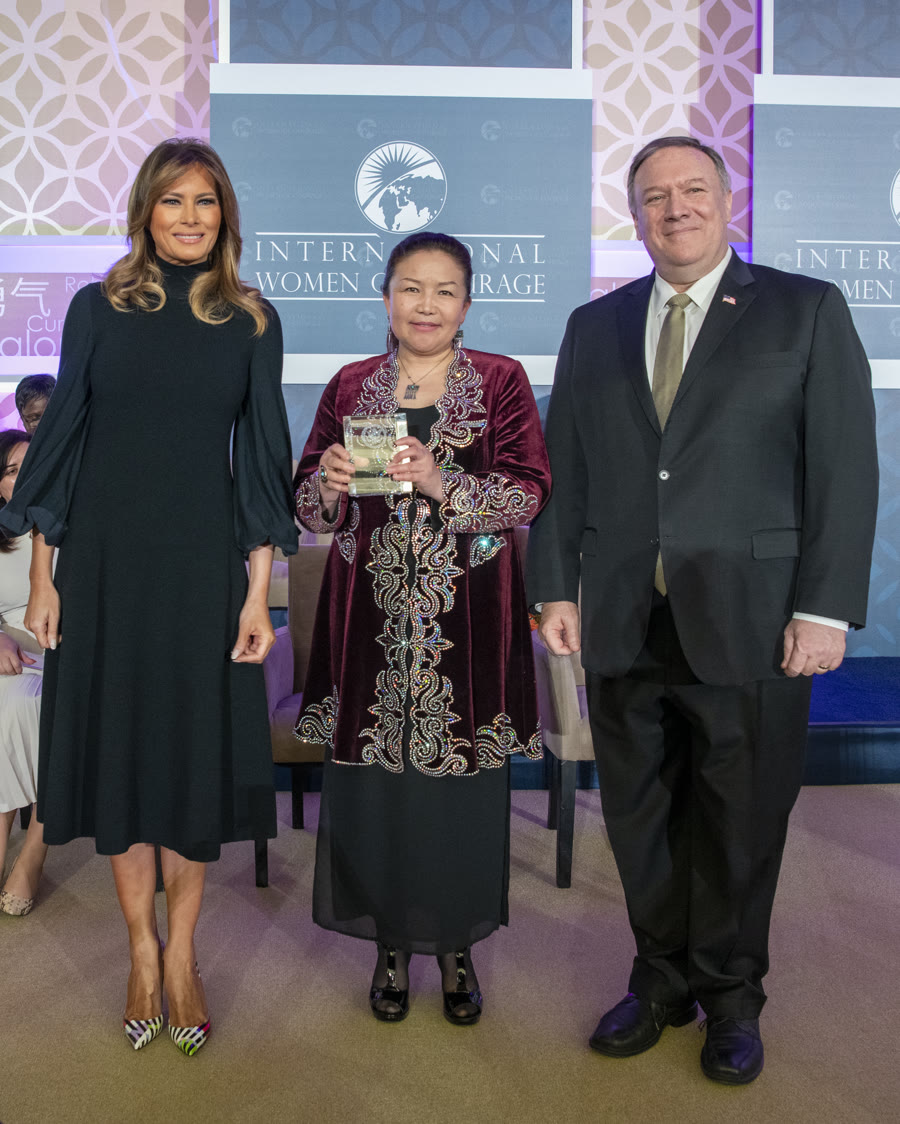
This file checked each of the four honours circulating under her name against primary sources, and the results must be reported exactly as found — two of them do not match the popular version. First, the U.S. State Department's International Women of Courage Award: confirmed. On 4 March 2020 Secretary of State Mike Pompeo and First Lady Melania Trump hosted the 2020 awards at the State Department, and she was one of twelve recipients. The State Department's Bureau of Educational and Cultural Affairs carries a recipient profile under the title "Sayragul Sauytbay — China, nominated by Kazakhstan," and Radio Free Asia and others reported the award the same day. The official U.S. government photographs of that ceremony are public domain; see the metadata for this page's image basis. Second, the Nuremberg International Human Rights Award: confirmed, but the year must be corrected. City of Nuremberg Human Rights Office documents state that on 28 February 2021 the award jury selected her for the fourteenth prize — the 2021 award. Because of the COVID-19 pandemic, the ceremony, planned for autumn 2021, was postponed and held on 15 May 2022 at the Nuremberg Opera House, where Mayor Marcus König and jury member Iris Berben presented her with the certificate and statue, and where she spoke and sang a song she had written herself. The accurate formula is therefore "the 2021 Nuremberg International Human Rights Award, presented on 15 May 2022." Calling it a "2022 award" repeats a common error, and this file does not.
Third, the supposed "2020 Right Livelihood Award" — the prize often called the Alternative Nobel Prize: no such award exists in her record. The Right Livelihood Foundation's official announcement names exactly four 2020 laureate groups: Iranian human-rights lawyer Nasrin Sotoudeh, U.S. civil-rights lawyer Bryan Stevenson, Nicaraguan indigenous-rights activist Lottie Cunningham Wren, and Belarusian activist Ales Bialiatski together with the Human Rights Centre "Viasna." Her name is not among them, and a search of the Foundation's official site for her name returns no result at all. She may conceivably have been nominated — nominations to that prize are not published — but the claim that she won it has no primary-source support, and several profiles listing it under her name are propagating an error. This file's conclusion: it is not recorded as an award she received; only this check is registered. Fourth, the supposed European Parliament Sakharov Prize nomination: likewise no evidence found. This file examined the European Parliament's Sakharov records for the relevant years: the 2019 prize went to Ilham Tohti, the finalists were Brazilian and Kenyan nominees, and the full 2019 nomination list published by Front Line Defenders does not contain her name; no other year's published nomination records contain it either. This file cannot exclude that an individual member of parliament once floated her name, but as an honour of record, "Sakharov Prize nomination" has no primary source. It is marked unverified and is not entered in her list of honours. Removing two unsupported honours in plain sight is precisely what makes the two confirmed ones stand firmer: her weight comes from testimony given in a defendant's seat in 2018, not from the length of an awards list.
20. China's named denials: from the embassy in Stockholm to a People's Daily long read
Unlike the subject of this site's case no. 153, Sayragul Sauytbay has been answered by name, repeatedly, by Chinese officials — and this file archives each response with its nature labelled. On 30 August 2019 the spokesperson of the Chinese Embassy in Sweden stated that she "has never worked in any vocational education and training center in Xinjiang, and has never been detained before leaving China," that she had illegally crossed into Kazakhstan in 2018 and been sentenced there, that she was suspected of credit fraud in China with unpaid debts, that "no government at any level in China has ever persecuted her," and urged Swedish Television not to give her a platform. On 7 July 2020 the same embassy returned to her by name, calling her a fugitive and a liar, and adding detail: that in April 2016 she had become principal of a kindergarten in Chahanwusu Town, that in March 2018 she had been removed from that post for incompetence and for encroaching on other teachers' interests to gain bonuses and transferred to a local primary school, and that she was suspected of fraud with debts unpaid, and had fled to evade legal punishment and fabricated lies to defame Xinjiang. In April 2021 People's Daily Overseas Edition, in its series on how "Xinjiang lies" are manufactured, listed her as the first case in its "fabricated personal experience" category, with three charges: that her education was faked (she had, it said, only taken a nursing course and had never been a doctor, and her account shifted between "teacher" and "victim"); that she had never worked or studied at any education and training centre; and the debt allegation — that in June 2015 and December 2016 she had obtained two loans totalling 470,000 yuan from the rural credit cooperative in Chahanwusu Town using a forged house-purchase contract and a forged guarantor's signature, that 398,000 yuan remained unpaid, that this constituted loan fraud, and that public security organs had listed her as wanted online.
This file's handling of this section is as follows. First, these are unilateral Chinese official allegations: their contents and sources are registered item by item, but they are not adopted as fact. The key documents — loan contracts, the wanted listing — have never been shown to any independent third party, and no systematic public reply by her to the debt and fraud charges is on record; the matter is archived as two opposed accounts, unverified. Second, one detail in China's denial matches her account exactly, as noted in section 13: she left China on 5 April 2018. On the date itself there is no dispute between the sides. Third, China's whole denial rests on one premise: that she was never inside any training centre at all. Standing against that premise is her testimony given in a Kazakh court in July 2018 with her freedom at stake, the Kazakh court's refusal to deport her, and her consistent sworn accounts in formal settings in several countries since. If a government truly held iron proof she had never entered a camp — say, her complete attendance and posting records for November 2017 to March 2018 — publishing the records would end the argument. In seven years, what has been published is her schooling and her debts. This file does not hand down a verdict beyond the evidence; it lays both sides out at their proper grades. Hers is sworn testimony plus a foreign court's record. China's is embassy statements plus a party-newspaper long read, without a single independently checkable document attached.
21. The Uyghur Tribunal and its judgment: witness number one
On 4 June 2021 she testified before the Uyghur Tribunal in London as witness UTFW-001. Her written statement runs to forty-five paragraphs, from her birth and education through the camp's twenty-four-hour routine, the black room, sexual violence and the medical files. In questioning, the panel pressed her on the camp's name (she did not know it, only that it was in Zhaosu County), the ethnic make-up of the detainees, the name of the medical documentation and how a teacher came to handle it, the origin and signature of the classified document (from the central government, signed, the name not remembered), the frequency and locations of rape, the three-tier classification of people and the seventy listed "offences," the purpose of Friday pork, and the camp's management layers. Her answers share one pattern: what she knows, she gives in detail; what she does not know, she says she does not know. Asked who had planned the rape in the hall, she said she did not know — but that from how it unfolded it had plainly been arranged. Asked who the senior officials were, she described only layers: superiors giving orders, subordinates and police carrying them out. On 9 December 2021 the Tribunal delivered its judgment, finding that the People's Republic of China had committed torture and crimes against humanity against Uyghurs (on the genocide charge, the Tribunal held its standard of proof was not met — this file records that as it stands). Her testimony forms part of its fact-witness evidence; the judgment made no separate finding on her individual experience, and this file does not inflate it into one.
Her circumstances while testifying also belong in the record: in 2021 her sister and other relatives were still inside China, and her asylum life in Sweden was not sealed off from threats. It was in those circumstances — under her real name, on camera, in a fully recorded proceeding — that she said again, and in more detail, what she had first said in Zharkent in 2018. Archival work on testimony runs on a simple rule: half of a testimony's value is its content, and half is the price of giving it. In her file the price column, from the defendant's seat in 2018 to the Tribunal in 2021, is written out in full.
22. Latest status: exile-government vice president, an Oslo speech, and the 2026 interviews
From 10 to 12 November 2023, the East Turkistan Government in Exile and its parliament in exile held their 9th General Assembly in Washington, D.C. She gave testimony-style remarks there and was elected vice president in the new leadership, with Mamtimin Ala as president; the organisation's announcement of 13 November 2023 and its assembly declaration both record this, with the taking-office date given as 11 or 12 November — both are archived. The organisation's nature must be labelled: it is an exile political organisation founded in 2004 advocating East Turkistan's independence, recognised as a government by no state. Her vice presidency is a public political role; it neither adds to nor subtracts from her evidentiary standing as a camp witness, and this file keeps the two things in separate columns. In November 2024 she attended the organisation's political action conference in Washington and spoke about her camp experience. On 29 April 2025 she gave the opening speech, as the exile government's vice president, at the Ethical Trade Conference in Oslo, urging Norway to face the China dimension of its trade relations — recorded both in the organisation's announcement and in an Asian News International report of 5 May 2025.
The two most recent public materials found in this check are these. On 21 January 2026 The Diplomat published Catherine Putz's long interview with her, in which she revisited the March 2018 interrogation and the one-to-three-year internment threat (section 13 of this file follows that latest account) and spoke of her worry that global attention is being diverted by other crises. In April 2026 Bitter Winter published a further interview in which she described learning Swedish, integrating, and continuing to speak out. Taken together: she still lives in Sweden with her husband and two children, still publicly active in the dual role of witness and exile-government vice president. The latest situation of her sister and other relatives inside China is in no public record. Whether threats against her are continuing, the 2026 interviews offer no new specific case, and this file records that as no public record. The case is not closed: no responsibility for the camp system has ever been accounted for, and she cannot go home.
23. Complete timeline
16 September 1976: born in Zhaosu County, Ili Prefecture, Xinjiang (her account; some English sources give 1977). 1993–1997: studies at Xinjiang Medical University (her account; Chinese officials say she took only a nursing course). After 1997: works several years at a traditional-medicine hospital in her home area, then switches to teaching. 2004: marries and moves to her husband's township; the couple teach at the same school. 2007–2009: further course at Xinjiang Normal University. 2016: appointed administrative director of five state-run kindergartens (Chinese account: principal of the central kindergarten in Chahanwusu Town from April 2016). 2016: as mother-tongue schooling is terminated by new measures, the family decides to emigrate to Kazakhstan; as a civil servant she cannot get a passport and stays. Summer 2016 (July, per the Nuremberg biography): her husband takes their two children to Kazakhstan; they receive Kazakh citizenship within a year. After November 2016: her usual communications with her family are cut (per the Nuremberg biography). From January 2017: repeatedly taken in for interrogation, sometimes at night, and pressed to bring her family back to China. One night in November 2017: ordered by phone to an address, hooded by four armed police and taken into a camp in Zhaosu County; signs a secrecy agreement and begins teaching inside the camp. During her time in the camp: dragged into the black room and tortured in an electric chair. March 2018: hooded out of the camp and told to resume her job; promptly removed from her post, interrogated, and told she will be interned for one to three years. 5 April 2018: crosses into Kazakhstan on false documents. 21 May 2018: arrested by officers of Kazakhstan's National Security Committee. 13 July 2018: appears before the Panfilov District Court in Zharkent and publicly describes the camp. 1 August 2018: receives a six-month suspended sentence, is not deported, and walks free. Around her release: her sister and two friends are taken away inside China. Thereafter: repeatedly refused asylum in Kazakhstan and repeatedly threatened. 2 June 2019 (departure from Kazakhstan in the early hours of 3 June in one account): flies to Sweden after UN intercession and receives political asylum. 30 August 2019: the Chinese Embassy in Sweden denies her entire account by name for the first time. October 2019: Haaretz publishes her long interview. March 2020: Harper's publishes the interview transcripts. 4 March 2020: receives the U.S. State Department's 2020 International Women of Courage Award in Washington. Mid-2020: the German edition of The Chief Witness is published. 7 July 2020: the Chinese Embassy in Sweden issues its second named denial. February 2021: the BBC's camp investigation carries her testimony. 28 February 2021: the Nuremberg jury selects her for the 2021 Nuremberg International Human Rights Award. April 2021: People's Daily lists her as its first case of "fabricated personal experience." 4 May 2021: the English edition of The Chief Witness is published. 4 June 2021: testifies before the Uyghur Tribunal in London (UTFW-001); the day before, she receives a threatening phone call from a Chinese number. 9 December 2021: the Uyghur Tribunal's judgment finds torture and crimes against humanity established. 15 May 2022: the Nuremberg award ceremony is held. Around 12 November 2023: elected Vice President of the East Turkistan Government in Exile. 29 April 2025: opening speech at the Ethical Trade Conference in Oslo. 21 January 2026: The Diplomat publishes her latest long interview. April 2026: Bitter Winter publishes an interview confirming she still lives in Sweden and keeps speaking out.
24. Archived in parallel: discrepancies between sources and unverified items
One, birth year: her Tribunal statement, the Nuremberg official biography and China's long article all give 1976 (her statement is precise to 16 September), while English Wikipedia and others give 1977; this file's main record is 1976. Two, education: she states a Xinjiang Medical University degree and years of medical practice; Chinese officials say she took only a nursing course and never practised; no third-party record is public, and both versions stand. Three, the crossing and arrest dates are widely confused: crossing 5 April 2018, arrest in Kazakhstan 21 May 2018; some second-hand sources merge them into a "21 May crossing," which this file has separated. Four, the camp's ethnic composition: her 2018 court account gave 2,500 ethnic Kazakhs; her 2021 Tribunal account gave a Kazakh majority with Uyghurs, Kyrgyz and others; the two are archived together. Five, the interval before the renewed internment threat in March 2018: "a week after returning to her kindergarten" in the Globe and Mail's account, "three days later" in a retold version; no figure is adopted. Six, the Sweden dates: arrival on 2 June versus departure from Kazakhstan in the early hours of 3 June; both archived. Seven, the early-versus-later testimony gap: the Globe and Mail's August 2018 account records that she had not personally seen violence, while her later interviews and sworn testimony contain extensive first-person accounts of violence; the gap objectively exists, its explanation cannot be determined, and both are archived (see section 11). Eight, the "classified central document" with its staged plans, the "straw shoes / leather shoes" directive, the twenty-six "enemy countries" and three-tier classification, and the "seventy offences" all rest on her testimony alone, with no original document public: unverified. Nine, organs: her statement that medical files served organ-harvesting purposes was framed by her at the Tribunal as "I believe" — an inference, not an eyewitness account — and is archived at that grade (see section 12). Ten, China's debt and fraud allegations: the amounts and dates come from unilateral Chinese articles; the underlying documents are not public and no systematic reply by her is on record: unverified. Eleven, awards: the 2020 Right Livelihood laureates list does not include her, and the published Sakharov Prize nomination records do not include her; both circulating claims are unverified and are not recorded as honours (see section 19). Twelve, the names of her sister and two friends, the exact date they were taken and their final fate, and the city in Sweden where she lives, are in no public record, and this file does not fill them in.
25. Verification and sources
The sources actually consulted for this check are as follows. First grade — her sworn and formal record: her Uyghur Tribunal witness statement and the hearing transcript of 4 June 2021 (UTFW-001, the Tribunal's official public PDF in full — forty-five statement paragraphs plus questioning, the backbone of this page's camp facts); contemporaneous reporting and archived files on the Zharkent trial in Kazakhstan — Radio Free Europe's July 2018 trial report (read in full via the ecoi.net archive), the Eurasianet case document (ecoi.net archive), and Human Rights Watch's statement of 30 July 2018. Second grade — independent long-form records: the Globe and Mail's August 2018 report (read via full republications, including its early "did not personally see violence" account); the Harper's edited transcript of the Haaretz interviews (March 2020, the magazine's site); Foreign Policy's Kazakhstan follow-up (via republication); The Diplomat's interview of 21 January 2026 (read via full republication; her latest account); Bitter Winter's 2018–2026 series (its alignment is explicit, and threat details resting on it are flagged in the text); the BBC's February 2021 camp investigation (her participation confirmed via multiple citations). Third grade — primary institutional documents: the U.S. State Department Bureau of Educational and Cultural Affairs' 2020 International Women of Courage recipient profile (at the time of this check the bureau page returned a technical-difficulties page; its title and inclusion are corroborated by same-day State Department reporting and Radio Free Asia); the City of Nuremberg Human Rights Office: her biography page, the 2021 award jury's reasoning document (28 February 2021) and the 2022 ceremony page (15 May 2022), all read in full; the Right Livelihood Foundation's official 2020 laureates announcement and laureate archive (read in full — she is not listed and a site search returns nothing; a negative verification result); European Parliament Sakharov materials: the European Parliamentary Research Service briefing on the 2019 prize and Front Line Defenders' 2019 nomination list (read in full — she is not listed; a negative verification result); the East Turkistan Government in Exile's assembly announcement of 13 November 2023 and its declaration. Fourth grade — Chinese official positions: the Chinese Embassy in Sweden's named spokesperson statements of 30 August 2019, 1 October 2019 and 7 July 2020 (read in full on the embassy site), and People's Daily Overseas Edition's April 2021 "Xinjiang lies" series, part nine (read in full). Fifth grade — comparison only: English Wikipedia (used solely for birth-year, date and spelling discrepancies, not as a factual source). Image-source verification is in the metadata: the U.S. State Department's official 4 March 2020 award photograph (public domain) has been located on its Wikimedia Commons file page; the Zharkent courtroom photographs are Getty agency copyright and the Nuremberg ceremony photographs are the photographer's personal copyright, and neither is used.
26. Our Take
The single most important fact about Sauytbay's case is where and when she first spoke. Not after she was settled in exile, and not from an awards podium, but on 13 July 2018, from a defendant's seat in a Kazakh courtroom — facing a year in prison plus deportation, and deportation meant return to a country where she had signed a secrecy agreement whose stated price for disclosure was death. She could simply have admitted the illegal crossing, said nothing about the camp, and courted the judge's goodwill. Instead she described the camp — to the judge, to the gallery, and to the Chinese diplomats in the front row. In the seven years since, in a London tribunal, in a book and on stages across the world, she has told the same set of facts dozens of times, and the main lines have never moved. The circumstances of a witness's first statement are often the hardest available measure of everything she says afterwards. Hers was a defendant's seat.
Beijing's reply to her is equally instructive. Her denial file is the most named and most forceful directed at any camp witness: three embassy statements and a party-newspaper long read listing her first. Yet all that fire is aimed at her perimeter — whether her degree made her a doctor, whether she owed 470,000 yuan, whether she was a competent kindergarten principal — while on the load-bearing part of her testimony, seven years have produced not one independently checkable item from the Chinese side: no record showing she was somewhere other than a camp between November 2017 and March 2018. Fighting a witness-credibility war over loan contracts is itself an admission of where the hard ground lies. Her side of the ledger, by contrast, is open: she admitted the illegal crossing; in formal settings she separates what she saw from what "I believe"; she even conceded, about the classified document most favourable to her own account, that she could not remember its signature. This page has laid out her early-testimony gap, the two honours that could not be verified, and every unverified item in full — for the same reason. Her case does not need decoration. Decoration would only wound it.