
第128案 | 董广平Case 128 | Dong Guangping
董广平(1958年4月13日生,河南人,前军人、前郑州市公安局警察),1999年因联署纪念六四十周年的公开信被开除警职,2001年以煽动颠覆国家政权罪判刑三年。2014年2月2日赴赵紫阳故乡河南滑县参加六四公祭,5月26日被刑拘、7月以寻衅滋事罪被逮捕,关押于郑州市第三看守所八个多月,2015年2月11日取保。2015年9月携妻谷书花与女儿逃往泰国,获联合国难民署难民认定,加拿大批准一家三口紧急安置、原定11月18日启程;泰国在11月10日已被难民署正式告知其难民身份、11月11日加方已签署接收文件,却于11月13日将他与姜野飞强制遣返中国(人权观察函件作11月14至15日周末,一并存档)。他在重庆被关押、秘审,2018年7月13日重庆市第一中级人民法院以煽动颠覆三年、偷越国境十个月合并判刑三年六个月,2019年8月2日刑满。2019年12月泅渡金门未果,2020年1月逃往越南河内躲藏两年多;2022年8月24日被越南警察带走失踪(8月22日说并列),约10月被送回中国关进郑州市第三看守所,2023年4月被郑州市中级人民法院以偷越国境判刑十一个月,10月20日刑满。2026年5月24日他自威海乘三点三米橡皮艇出海,25日晚抵韩国泰安外海,5月28日大田地方法院拒绝拘捕令,6月26日抵达多伦多,与2015年先行安置的妻女团聚。在加拿大为他公开奔走的是女儿董雪瑞(Katherine Dong),不是儿子——个别二手简报的「其子」说法经本站专门检索判定为张冠李戴。Dong Guangping (born 13 April 1958, from Henan; a former soldier and former Zhengzhou police officer) was dismissed from the police in 1999 after co-signing an open letter commemorating the tenth anniversary of the Tiananmen crackdown, and in 2001 was sentenced to three years for inciting subversion of state power. On 2 February 2014 he travelled to Hua County, Henan — Zhao Ziyang's home county — for a June Fourth public memorial; he was criminally detained on 26 May, formally arrested in July on the charge of picking quarrels, held at Zhengzhou No. 3 Detention Center for more than eight months, and released on bail on 11 February 2015. In September 2015 he fled to Thailand with his wife Gu Shuhua and their daughter, was recognised as a refugee by UNHCR, and Canada approved emergency resettlement for the family with departure set for 18 November; yet although UNHCR had formally informed Thailand of his refugee status on 10 November and Canadian officials had signed the acceptance papers on 11 November, Thailand forcibly returned him and Jiang Yefei to China on 13 November 2015 (Human Rights Watch's letter dates the return to the weekend of 14–15 November — archived in parallel). Held in Chongqing and tried in secret, he was sentenced on 13 July 2018 by the Chongqing No. 1 Intermediate People's Court to a combined three years and six months — three years for inciting subversion plus ten months for illegally crossing the border — and completed the sentence on 2 August 2019. After a failed attempt to reach Kinmen in December 2019 he fled to Viet Nam in January 2020 and hid in Hanoi for over two years; on 24 August 2022 (a parallel account gives 22 August) Vietnamese police took him away and he disappeared, he was returned to China around October 2022 and held at Zhengzhou No. 3 Detention Center, and in April 2023 the Zhengzhou Intermediate People's Court sentenced him to eleven months for illegally crossing the border, which he completed on 20 October 2023. On 24 May 2026 he set out from Weihai in a 3.3-metre inflatable boat, reached the waters off Taean, South Korea, on the evening of 25 May, saw the Daejeon District Court reject a detention warrant on 28 May, and arrived in Toronto on 26 June 2026, reuniting with his wife and daughter, who had been resettled there in 2015. The family member who campaigned for him publicly in Canada was his daughter Dong Xuelui (Katherine Dong), not a son — a 'son' version found in a secondhand brief was checked specifically by this page and judged a mistaken identity.
What Happened
The skeleton of Dong Guangping's case is a single number: five days. On 11 November 2015, Canadian officials signed the papers accepting Dong Guangping and his family of three at the immigration detention centre in Bangkok; the journey was set for 18 November — they were to fly to Canada to begin again as refugees recognised by UNHCR. On 13 November, the Thai authorities put Dong Guangping and his fellow returnee Jiang Yefei on the way back to China. Five days made the difference between a Toronto winter and a Chongqing detention centre. Everything that happened in the following eleven years — the three-and-a-half-year Chongqing sentence, the failed swim toward Kinmen, more than two years of hiding in Vietnam, the disappearance from a Hanoi street, eleven months in Zhengzhou, and finally the 3.3-metre inflatable boat on the Yellow Sea in May 2026 — is the aftershock of those five stolen days. Lay out the dates, and this case needs no rhetoric.
Dong Guangping was born on 13 April 1958 into a military family; his father was a general in the Chinese military. He enlisted in 1976 and later transferred to civilian work as a police officer with the Zhengzhou Public Security Bureau. According to the files of Amnesty International and Human Rights Watch, in 1999 he was dismissed from the police after co-signing an open letter commemorating the tenth anniversary of the Tiananmen crackdown; in 2001 he was sentenced to three years in prison for inciting subversion of state power. After his release in 2004 he did not go quiet. Around the Qingming festival of 2013 he joined the Zhengzhou activists Yu Shiwen and Chen Wei in planning a public memorial for the victims of June Fourth; on 2 February 2014 the group travelled to Hua County, Henan — the home county of Zhao Ziyang — and held the memorial there. On 26 May 2014 he was criminally detained by Henan police, first on suspicion of gathering a crowd to disrupt order in a public place and then on the changed charge of picking quarrels and provoking trouble; he was formally arrested in July and held in Zhengzhou No. 3 Detention Center for more than eight months. He was released on bail on 11 February 2015, and came home to learn that his young daughter — who had watched police take her father and search the home — had been so frightened that she repeatedly fainted, fell ill and dropped out of school (the family's account, relayed by Civil Rights & Livelihood Watch). In September 2015 he fled to Thailand with his wife and daughter.
In Bangkok the family of three applied to UNHCR and were recognised as refugees. On 28 October Thai immigration police detained Dong Guangping and Jiang Yefei for immigration offences; both men pleaded guilty and were fined 5,000 and 6,000 baht respectively, then transferred to an immigration detention facility (Front Line Defenders' case file). Around 6 November UNHCR opened an emergency channel and Canada approved urgent resettlement for the family; on 10 November UNHCR formally informed Thailand's National Security Council, Ministry of Justice, Immigration Department and Ministry of Foreign Affairs that the two men were refugees and that a third country had decided to accept them and their families for urgent resettlement (Human Rights Watch's letter of 18 November 2015 to Thai prime minister Prayut Chan-ocha). On 11 November Canadian officials signed the acceptance papers at the detention centre in Bangkok, and departure was set for 18 November. On 13 November Thailand returned the two men to China. The UN human rights office issued a briefing on 20 November expressing deep concern; Human Rights Watch called the return deliberate and premeditated. On 14 November Dong Guangping was criminally detained in Chongqing on suspicion of illegally crossing the border; on 26 November he and Jiang Yefei appeared on CCTV news "confessing" to border-crossing and human-trafficking offences (Amnesty International's account; Front Line Defenders dates the televised "confession" broadcast to 3 December — the two are archived in parallel below). For nearly three years after that he was cut off from the outside world: the lawyer his family retained was never once allowed to meet him, and neither the hearing nor the sentencing was notified to his family.
On 26 July 2017 a Chongqing court found him guilty of inciting subversion and illegally crossing the border (Amnesty International's account); almost another year passed before, on 13 July 2018, the Chongqing No. 1 Intermediate People's Court pronounced the sentence: three years for inciting subversion with one year's deprivation of political rights, ten months for illegally crossing the border with a fine of RMB 1,000, combined into three years and six months. On 2 August 2019 he completed the sentence and returned to Henan. Release was not the end: as he told reporters after reaching Canada in 2026, he could not draw retirement benefits, could not renew his passport, and lived under constant police surveillance. On 9 December 2019 he went into the sea at Shishi, Fujian, trying to drift to Taiwan's Kinmen Islands, and was picked up that night by a mainland fishing boat (ChinaAid's chain of detail). In January 2020 he crossed into Viet Nam and hid in Hanoi while the Canadian government negotiated with the Vietnamese for his release to travel to Canada. On 24 August 2022 Vietnamese police took him away in Hanoi; for months afterwards his whereabouts were unknown, and the Vietnamese government gave no substantive answer to inquiries from UN experts or from Canada. In May 2023 his family and supporters received credible information that he had been held since October 2022 in Zhengzhou No. 3 Detention Center. In April 2023 the Zhengzhou Intermediate People's Court sentenced him to eleven months for illegally crossing the border; on 20 October 2023 he completed that sentence and went home.
The last stretch of the road he travelled himself. In the early hours of 24 May 2026 he set out from Weihai, Shandong, in a grey inflatable boat 3.3 metres long with a 9.9-horsepower engine, initially aiming for Japan; fog and a dying phone battery — his navigation — forced him to change course for South Korea (his own account, in the Associated Press's retrospective of June 2026). At about 9:36 p.m. on 25 May a fishing vessel off Taean County spotted him and alerted the authorities, and the Coast Guard took him in. On 28 May the Daejeon District Court refused the prosecution's request for a detention warrant, holding in substance that sufficient grounds and necessity for arrest were difficult to recognise (the Korea JoongAng Daily and the Associated Press, in parallel renderings of the ruling). On 10 June the Taean Coast Guard referred him to prosecutors without detention for suspected violation of the immigration law; he was then moved to a refugee facility in Incheon, spoke by video call with UNHCR, and the Canadian diplomatic mission became involved. On 26 June 2026 he flew from Seoul and landed at Toronto Pearson Airport — the flight that never happened on 18 November 2015 finally landed, eleven years late. The sections below take each link of that chain apart and check it.
A General's Son in the Police: The Making of a "Disobedient Son"
Dong Guangping's origins are the first key to why the authorities found him so intolerable. He did not grow up outside the system; he grew up in one of its core families, and then walked out of it with his own hands. His place of birth is given in two versions: the Toronto Star's November 2022 report on his daughter's search and the Wikipedia entry give Zhengzhou; the long profile published by Civil Rights & Livelihood Watch on 3 August 2019 says he was "born in 1958 in Luohe, Henan, into a military family." This page's handling: the birth date, 13 April 1958, is agreed across sources; the birthplace is archived in both versions without adjudication. The details of his father's career rest, for now, on the Civil Rights & Livelihood Watch profile alone: it says his father was a Communist Party general who in the 1980s and 1990s served successively as political commissar of the 43rd Group Army, political commissar of the Henan Military District and a member of the Henan provincial party standing committee, and that several of Dong's siblings served in the military or in the system. That layer of detail is archived here as single-source and marked unverified. What can stand on multiple sources is only the skeleton: he came from a senior military family and himself served as a soldier and then as a police officer (the New York Times' May 2026 report, citing Sheng Xue and a UN experts' letter; the German Wikipedia gives thirteen years as a police officer, a single-source figure).
The Civil Rights & Livelihood Watch profile also supplies an earlier record of "punishments," and this page must first state its evidence level. It is a long Chinese-language feature written in an openly commemorative, eulogistic register. Its 1979 and 1989 sections — that he was sent by his father in 1976 to serve in a motor transport regiment of the 20th Group Army; that during the Xidan Democracy Wall period he circulated unofficial journals among his comrades and publicised the cases of Wei Jingsheng and Xu Wenli and was warned by the army; that in 1989, as a police officer, he supported the Beijing students, printed and distributed his own publicity material, was reprimanded by bureau leaders after June Fourth for refusing to repent, and was driven from the family home by his father; that his father later died of cancer without forgiving him — rest entirely on this one feature, with no independent corroboration from any second organisation or outlet. This page archives them as a single-source narrative from his own circle, to be read as "according to the Civil Rights & Livelihood Watch profile," not as cross-checked fact. But the direction of that narrative does not conflict with the hard skeleton of the institutional files: a general's son breaks with the authorities over the memory of June Fourth, loses his police post in 1999 and goes to prison in 2001 — the second half is documented by Amnesty International, Human Rights Watch and UN experts; the family detail of the first half remains at the single-source level. The honesty of an archive lies exactly in keeping those two layers apart rather than kneading them into one moving story.
The same layering applies to his activities after 1998. The Civil Rights & Livelihood Watch profile says that, as the tenth anniversary of June Fourth approached, he travelled repeatedly to Hong Kong for academic seminars and civil memorial events, brought commemorative materials back to the mainland, and posted them, together with his own writings, in many places; that in 2001, on a long trip to post such material, the items he carried were discovered by railway police and handed to state security; that he refused to plead guilty in court and was sentenced to three years for inciting subversion with one year's deprivation of political rights, and was dismissed from the police. That set of details likewise has only this one source. The institutional skeleton this page can confirm is: in 1999 his employment as a police officer was terminated after he co-signed a public letter and distributed articles, in different cities, commemorating the tenth anniversary of the crackdown on the Tiananmen protests (Amnesty International's July 2018 urgent action gives the fullest formulation); in 2001 he was imprisoned for three years for his peaceful activism (Amnesty International); and the UN experts' 2022 letter, as reported by the New York Times in 2026, likewise dates the dismissal to his signing in 1999 and the three-year sentence for inciting subversion after it. The point of dismissal therefore exists in two layers: the institutional files date the loss of his post to 1999, while the Civil Rights & Livelihood Watch narrative binds the dismissal to the 2001 sentence in a single section. This page takes 1999 as its main line and archives the profile's bundled narration alongside it. Whichever layer is taken, the direction of the facts is the same: he lost his post, and then his freedom, after commemorating June Fourth in his capacity as a police officer.
2014: The "Zhengzhou Ten" and the Hua County Memorial
The 2014 case begins with a place-name that is often misreported, and this page will state it precisely: the memorial was held neither in Zhengzhou nor in Gongyi. According to the Civil Rights & Livelihood Watch profile of 2019 and multiple reports from the time, around Qingming in 2013 Yu Shiwen, Chen Wei and Dong Guangping together planned a public memorial for the dead of June Fourth; on 2 February 2014 they travelled in person to Hua County, Henan — Zhao Ziyang's home county — and held the "June Fourth public memorial" there. Radio Free Asia's reporting on the "Zhengzhou Ten" cases described the commemoration as marking the twenty-fifth anniversary of the 1989 crackdown and honouring two late former leaders, Hu Yaobang and Zhao Ziyang — the two names most tightly bound to the memory of 1989. This page's account of the event stops at that layer: it was a civil memorial centred on the victims of June Fourth, held in Zhao Ziyang's home county; retellings that reduce it to a mere "memorial for Zhao Ziyang and Hu Yaobang," or that misplace it in Zhengzhou or Gongyi, are not followed, and Hua County and 2 February are the main line.
The arrests came not in February but on the eve of the twenty-fifth anniversary. On 26 May 2014 Dong Guangping was seized by Henan police and criminally detained on suspicion of gathering a crowd to disrupt order in a public place (Civil Rights & Livelihood Watch profile). The charge then changed. The profile records that it was changed to picking quarrels and provoking trouble, on which he was arrested; the UN experts' 2022 communication, as reported by the New York Times in 2026, records that he was detained in May 2014 and held incommunicado for months, was arrested that July on the charge of "picking quarrels and provoking trouble," and was released in February 2015. The two chains mesh procedurally: 26 May is the date of criminal detention, and July the point at which the formal arrest and the final charge landed. Front Line Defenders' November 2022 alert on the Viet Nam disappearance contains one sentence dating his detention to "July 2014," held incommunicado for over eight months; this page judges that to be a compressed formulation mistaking the month of formal arrest for the start of detention, archives the point here, and does not adopt it as the detention date. He was held at Zhengzhou No. 3 Detention Center (the profile and RFA's "Zhengzhou Ten" reporting agree: eight of the ten were held at Zhengzhou No. 3 Detention Center, the list including Dong Guangping, Yu Shiwen, Chen Wei, Hou Shuai, Jia Lingmin, Liu Diwei and the two defence lawyers Chang Boyang and Ji Laisong, while journalists including Shi Yu were also detained and some were later released on bail).
The length of this detention floats around eight months across the sources: the profile says "more than eight months," and in its section heading "eight and a half months detained, one year on bail"; Amnesty International says "more than eight months"; Front Line Defenders says "over eight months." The manner and date of release are comparatively clear: on 11 February 2015 he was released on bail pending trial (the profile, citing the family; Human Rights Watch's November 2015 letter summarises the episode as ten months of detention between 2014 and 2015 — a figure clearly longer than every other source, archived here as a summary error and not adopted). Whether an indictment or any judgment followed the bail is a matter of no public record. The hardest facts this round leaves the archive are three: the memorial was in Hua County, the criminal detention began on 26 May, and he was held in Zhengzhou No. 3 Detention Center and bailed on 11 February the following year — together with one family detail: according to Gu Shuhua and the family, relayed by Civil Rights & Livelihood Watch, he learned on coming home that his young daughter, having witnessed police seize her father and search the home, had been so frightened that she repeatedly fainted, fell ill and left school. That detail rests on a single relayed chain and is marked as such; but it explains the immediate motive for the family's flight in September 2015, and it is the starting point of the family section below.
September to 10 November 2015: Refugee Recognition in Bangkok
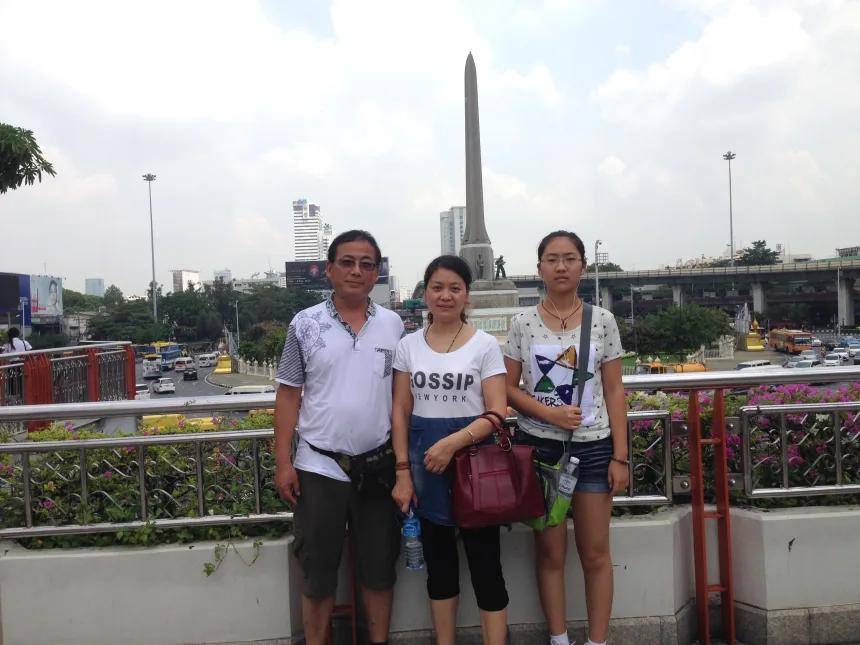
In September 2015 Dong Guangping travelled to Thailand with his wife Gu Shuhua and their daughter to apply for asylum at the UNHCR office in Bangkok (Front Line Defenders, Amnesty International and Human Rights Watch agree). The family of three were recognised as refugees by UNHCR — a point uncontested in every later document: UNHCR recognised them as refugees, and Canada agreed to accept the family of three for emergency resettlement. Thailand's legal position at the time needs stating for the reader: Thailand is not a party to the Refugee Convention, but people seeking asylum on Thai territory remain protected by the non-refoulement obligation under customary international law and under Article 3 of the Convention Against Torture, to which Thailand is a party — the legal framework jointly used by Human Rights Watch's and the UN human rights office's November 2015 documents, and the benchmark for the international-law assessment of this case.
On 28 October Thai immigration police detained Dong Guangping and Jiang Yefei in Bangkok (Front Line Defenders' case file). The ground was a visa problem: the two men had no valid visas, although both were registered as refugees with UNHCR's Bangkok office. Both pleaded guilty to the immigration offence; Dong Guangping was fined 5,000 baht and Jiang Yefei 6,000 baht, and they were then transferred to an immigration detention facility (Gu Shuhua's account names the place as Bangkok's Sathon immigration prison; Front Line Defenders calls it an immigration detention centre; the two formulations point to the same kind of facility, and the specific name is archived on Gu Shuhua's account). On Gu Shuhua's account, Dong held an "asylum-seeker certificate" issued by UNHCR at the time. This page notes a fine distinction of documentary level: the men's formal status in UN and Human Rights Watch documents is that of refugees whose determination was complete, while the paper Gu Shuhua remembers is called an asylum-seeker certificate — the two need not conflict, since certificates issued at different stages of a determination carry different names; this page takes "recognised refugee" from the UN documents as the legal-status formulation and archives Gu Shuhua's recollection of the document she saw alongside it.
The five days that followed are the most densely documented — and the hardest to accept — of the whole case. On Gu Shuhua's account, relayed by Civil Rights & Livelihood Watch: on 6 November UNHCR agreed to open an emergency channel; UNHCR representatives and Canadian diplomats visited Dong Guangping at the detention facility, the processing was accelerated, and the family of three were approved to travel to Canada as refugees. Human Rights Watch's letter supplies the exact date of the official notification: on 10 November, officials across the Thai government — including the National Security Council, the Ministry of Justice, the Immigration Department and the Ministry of Foreign Affairs — were explicitly informed that the two men had been granted refugee status by UNHCR and that a third country had decided to accept the two men and their families for urgent refugee resettlement. On 11 November Canadian officials signed the papers accepting the family of three at the Bangkok immigration detention centre, and arranged for them to leave Thailand for Canada on 18 November (Gu Shuhua's account). That is to say: before the refoulement occurred, the Thai government had not merely "not known" nothing — within forty-eight hours it had been formally notified by UNHCR and had watched the receiving state complete its signatures. Any account of this refoulement as an administrative oversight must first climb over the two files dated 10 and 11 November. This page's judgment is reserved for the Our Take section; the text here establishes only the facts.
13 November 2015: The Refoulement
On 13 November 2015 the Thai authorities returned Dong Guangping and Jiang Yefei to China. The date requires one layering: Amnesty International and Front Line Defenders both give 13 November; Human Rights Watch's letter of 18 November 2015 to Prime Minister Prayut Chan-ocha writes that the two men were forcibly returned "over the weekend of November 14–15, 2015." This page takes 13 November as its main line — two independent sources, and it meshes with the next link in the chain, Dong Guangping's criminal detention in Chongqing on 14 November (had the men left Thailand only on 14–15 November, a Chongqing detention on the 14th could not stand); Human Rights Watch's weekend formulation is archived as a deviation arising from time zones or the letter's summary style, and is not merged. The mechanics of the return — the flight, the handover point, the identity of the Chinese officers who received them — are matters of no public record, recorded here as such; the formulation used by Jiang Yefei's supporters and some reports, that the men were "taken from the Thai immigration centre by Chinese police" (the reporting chain cited by Wikipedia), is archived at the level of relayed account and is not promoted here into a settled detail of execution.
The family members who remained in Thailand, according to the UN human rights office's briefing of 20 November, afterwards left the country for third-country resettlement — that is, Gu Shuhua and the daughter travelled on to Canada. Amnesty International's urgent action of the time flagged the two men in its very heading as at risk of torture. China's public confirmation of the return appeared in late November: China confirmed that the two men had been repatriated and were detained (the common core of late-November wire reporting of 26–27 November 2015, whose details differ, from which this page takes only the shared element of confirmed detention). By 14 November — the day after the refoulement — Dong Guangping was already criminally detained by the Chongqing authorities on suspicion of illegally crossing the border (Gu Shuhua's account). Why Chongqing? Dong Guangping was from Henan and Jiang Yefei from Sichuan, yet both men's cases landed in Chongqing; the public record offers no explanation of the jurisdictional basis, and this page records that as a matter of no public record rather than filling it with speculation.
On 26 November the two men appeared on CCTV news (Amnesty International's June 2016 update: the two were last seen by the outside world on 26 November 2015 on the state broadcaster CCTV, "confessing" to human-trafficking offences and "admitting" that Jiang Yefei had helped Dong Guangping cross "illegally" into Thailand; Amnesty International's 2018 update gives the same date). Front Line Defenders' case chronology, by contrast, records that on 3 December the two men were broadcast on state television "admitting" guilt to "human trafficking," and its 8 December update repeats that date. The two dates stand a week apart and are archived here in parallel: one possible technical explanation is a CCTV news broadcast on 26 November and another programme or a repeat on 3 December, but with no programme recording available for checking, this page does not present the speculation as fact. What can be established as common ground is this: two men just refouled, completely cut off from lawyers and family, were presented on national television to "confess" — and the offences they were eventually prosecuted for never included "human trafficking" at all. The television charges and the courtroom charges were never the same set, a point the Chongqing section will have to check once more.
The Chongqing Case: Nearly Three Years of Isolation, a Secret Trial, Two Conviction Dates
The Chongqing detention is the most complete procedural black box in this case, and laying out the known time-points, the blanks are themselves the record: criminally detained on 14 November 2015 on suspicion of illegally crossing the border (Gu Shuhua's account); the place of detention given by Amnesty International's June 2016 update, confirmed by the family, as Chongqing No. 2 Detention Centre, and in the Civil Rights & Livelihood Watch profile as the Chongqing No. 2 Detention Center — the two sources agree; formally arrested in June 2016 on suspicion of subversion of state power (Gu Shuhua's account — the charge escalated from border-crossing to subversion); Amnesty International's March 2017 update formulation is that he stood charged with "subversion of state power" and "crossing the national border illegally," at risk of an unfair trial, and had still had no access to his family or to a lawyer of his choice. The issuing authority for the arrest warrant, the procuratorate's approval date, and the dates of the close of investigation and transfer for prosecution are all matters of no public record.
The trial stage produces this case's second pair of dates. Amnesty International's urgent-action update of 31 July 2018 is explicit: Dong Guangping was found guilty of "inciting subversion" and "crossing the national border illegally" on 26 July 2017 — while the sentence, forty-two months, was reported only on 13 July 2018 by a local branch of state media in Chongqing, "almost one year after his trial." Front Line Defenders' case page, by contrast, writes 13 July 2018 as the single day on which he was "tried, convicted and sentenced." The difference between the two accounts is what exactly happened on 26 July 2017 — a hearing, or a completed finding of guilt. This page's handling: Amnesty International's staged account is the main line — a hearing and finding of guilt on 26 July 2017, the term disclosed through state media on 13 July 2018 — and Front Line Defenders' compression of three acts into one day is archived alongside. Whichever account is taken, three points are common and certain: the hearing was not public and the family and lawyer received no notice of it; the outcome reached the outside world not through the family or counsel but through a local branch of state media; and from refoulement to the publication of the sentence he remained entirely isolated, the lawyer his family retained never once being permitted to meet him (Civil Rights & Livelihood Watch's summary at publication in 2019: from his return in November 2015 until his sentence was completed in 2019, the Chongqing authorities never allowed the family's lawyer to meet Dong Guangping).
The internal structure of the judgment is given most completely by Civil Rights & Livelihood Watch: on 13 July 2018 the Chongqing No. 1 Intermediate People's Court delivered its first-instance verdict, finding the crime of inciting subversion of state power established and sentencing him to three years in prison and one year's deprivation of political rights; finding the crime of illegally crossing the border established and sentencing him to ten months and a fine of RMB 1,000; and deciding to execute a combined term of three years and six months and the fine of RMB 1,000. Amnesty International's forty-two months corresponds exactly. This page flags one common simplification as an error: to write this case as "three and a half years for inciting subversion" is inaccurate — three and a half years is the combined execution of two crimes, inciting subversion itself carrying three years, with a further ten months and the RMB 1,000 fine for the border crossing; and the charge as framed during the investigation was heavier than the judgment: border-crossing at criminal detention, escalated to "subversion of state power" at arrest, and coming back down to "inciting subversion of state power" in the verdict. The label rose and then fell across the documents while the man sat in the same detention centre throughout. What of an appeal? Whether he appealed, and the appeal court and outcome, are matters of no public record. The name of the prison in which he served the sentence appears in a November 2022 ChinaAid report, which says he was released on 2 August 2019 from a Chongqing prison rendered in English as "Yudu Prison" — the report gives no Chinese name for the institution, and this page marks it unverified and does not supply one.
2019: Release, the Kinmen Swim, and Life Without a Passport
In August 2019 Dong Guangping completed his sentence. The release date carries a one-day discrepancy: Front Line Defenders' case page gives his release as 2 August 2019; Civil Rights & Livelihood Watch published on 3 August under a headline and text reporting his release as occurring "today," and preserved a detail that is hard to forget — that as late as the evening of 3 August, Gu Shuhua, in Canada, had still not managed a single phone call with her husband, knowing only through relayed word that he had been delivered to his mother's home in Zhengzhou. This page takes 2 August as its main line (Front Line Defenders' explicit date) and archives the 3 August "released today" formulation alongside; the two may correspond respectively to leaving prison and to arriving home, but no material proves that, and they are not merged. He was sixty-one when he came out.
His circumstances after release he described systematically himself after reaching Toronto in 2026 (the Associated Press's long retrospective of 30 June 2026): he could not draw retirement benefits, could not renew his passport, and lived under constant police monitoring; the summaries in multiple 2026 reports agree — continued surveillance and harassment and limited financial resources. A man who has served a full three-and-a-half-year sentence and then cannot obtain so much as a passport is under a second punishment beyond the judgment, one with no document and no expiry date. It was inside that predicament that he began, again and again, to try to leave. On 9 December 2019 he made his first attempt to leave by sea: a November 2022 ChinaAid report records that on 9 December he went into the water around Shishi, Fujian, intending to drift to Taiwan's Kinmen, and was picked up that night by a mainland fishing boat and afterwards detained by police — the report's rendering of the place of detention, in relayed form, gives Hebei, which plainly does not fit the geography of Shishi and Kinmen; this page judges that place-name in the relay to be doubtful, marks it unverified, and takes only the main stem: 9 December, an attempt to drift toward Kinmen from the Shishi direction, rescue by a mainland fishing boat. The summary formulation in the New York Times, CNN and other 2026 reporting is that in 2019 he tried to swim toward a Taiwan-controlled island, got into difficulty, was rescued by passing fishermen and was returned to the mainland. The precise method of the attempt — swimming, a flotation aid or a small craft — differs across the sources and is not refined here. The result agrees everywhere: failure, and the man back on the mainland.
A month later, in January 2020, he crossed the border into Viet Nam (Front Line Defenders, Human Rights in China and the Toronto Association for Democracy in China agree; the New York Times' 2026 report adds one detail — that after entering Viet Nam he video-called his family from a taxi — drawn from its interviews with his friends and family, and archived here as relayed account). He went into hiding in Hanoi, moving lodgings repeatedly over the following two years, waiting for one thing: for the Canadian government to negotiate with the Vietnamese side for permission for him to leave and travel to Canada to rejoin his wife and daughter (Toronto Association for Democracy in China, 2023 statements; the rescue appeal letter of January 2023 records that the Canadian government was then engaging Vietnamese officials to secure permission for his departure). His daughter Katherine Dong later told Canadian media that her father had lived a low-profile life in Viet Nam for those two years, describing himself as "very good," undisturbed by Vietnamese police (as relayed by ChinaAid). Those were the quietest two years of this case, and they were quiet not because he was safe but because everyone was waiting for a Vietnamese exit stamp. The stamp never came. The police came instead.
August 2022: The Second Disappearance, in Hanoi
In August 2022 Dong Guangping was taken away by Vietnamese police in Hanoi. The date produces this case's third cluster of disagreement: Front Line Defenders' alert of 30 November 2022, Human Rights in China's 2026 statement and both of the Toronto Association for Democracy in China's 2023 statements all give 24 August; the Canadian media chain on which the Wikipedia entry rests (CTV's February 2023 report and others) gives 22 August. This page takes 24 August as its main line — four institutional sources, three of them directly connected to the family and the rescue network — and archives 22 August as pending verification. He was taken from around his Hanoi residence, without warning or explanation (Toronto Association for Democracy in China, May 2023 statement). From then on he vanished from the world as he had after November 2015: family and acquaintances could not reach him from 24 August onward, learning only indirectly that Vietnamese police had taken him into custody (Front Line Defenders' alert).
The Vietnamese government's manner of response was, in its entirety, non-response. Front Line Defenders' alert records that, despite non-public efforts to clarify his fate and whereabouts with the Vietnamese government, the government provided no information at all, and on 10 November 2022 the family was driven to issue a public urgent plea. On 1 December 2022 the UN Working Group on Enforced or Involuntary Disappearances wrote to the Vietnamese government under its urgent procedure, calling on it to take all necessary measures to ascertain his fate and whereabouts; on 15 December three UN Special Procedures mandate holders — including the Working Group and the Special Rapporteur on the situation of human rights defenders — sent a formal communication to the Vietnamese government posing six questions, among them a request for detailed information on Dong Guangping's fate and whereabouts. Viet Nam was given sixty days to reply and did not reply within them (Toronto Association for Democracy in China, statement of 14 February 2023). Only on 15 March 2023 did the Vietnamese government give the Working Group a formulaic answer: they "have had no information regarding Dong Guangping in Viet Nam" (as quoted in the Toronto Association's May 2023 statement). A man who had lived in Hanoi for two and a half years with his departure under Canadian negotiation, taken from his home by police, and seven months later his government of residence says it has "no information" — the text of this page records only the words of that reply and their date; their character is left to the Our Take section.
Meanwhile the rescue effort in Canada went public. On 17 November 2022 Katherine Dong spoke out in Toronto (the Toronto Star and The Canadian Press): she was then a third-year student at the University of Toronto and a Canadian citizen, and had not seen her father for more than seven years; she delivered letters to the Vietnamese and Chinese embassies in Ottawa demanding to be told where her father was. On 18 January 2023 a group of Canadian human rights and democracy organisations wrote jointly to Canada's foreign minister, Mélanie Joly, asking the Canadian government to intensify its pressure on the Vietnamese and Chinese authorities; the signatories included the Toronto Association for Democracy in China, the Federation for a Democratic China (Canada) and Human Rights Watch's Canada arm, and the letter stated plainly the rescuers' assessment that it was almost certain Dong Guangping was now in Chinese custody. In February 2023 Canadian coverage continued (CTV, 14 February 2023), its headline pointing at "Vietnam's silence." None of those appeals produced news of him at the time. The news, when it came in May 2023, came in the worst possible form.
2023: Zhengzhou No. 3 Detention Center, Eleven Months, and 20 October
On 29 May 2023 the Toronto Association for Democracy in China issued a statement: family and supporters had received credible information confirming that Dong Guangping had been held in incommunicado detention since October 2022 at Zhengzhou No. 3 Detention Center in Henan Province; on the information received, he had likely been returned to China at some point in October 2022; and by the date of the statement he had been held for more than seven months with no charge or trial made public and no acknowledgement of the detention by the Chinese government. Which meant that the answer to the Hanoi disappearance was a second refoulement: Viet Nam had given nobody an answer, but the man was in Zhengzhou — in the same detention centre that had held him in 2014. The statement demanded his immediate and unconditional release and permission to travel to Canada to rejoin his family. No public material anywhere establishes the date, border crossing or manner of Viet Nam's handover of him to China; this page records that as a matter of no public record.
The trial, it turned out, had already happened before the news broke. Front Line Defenders' update of 16 November 2023 (relaying independent human rights monitors) supplies the closing facts: at some point in April 2023 Dong Guangping was tried by the Zhengzhou Intermediate People's Court and sentenced to eleven months in prison for "illegal border crossing"; on 20 October 2023 he walked out of a prison in Henan and returned home, his sentence completed. Human Rights in China's statement of May 2026 corresponds: in April 2023 a court in Zhengzhou sentenced him to eleven months for illegally crossing the border, and he was released in October 2023. The two sources differ slightly in institutional precision — Front Line Defenders names the Zhengzhou Intermediate People's Court, Human Rights in China says "a court in Zhengzhou" — and this page takes the Front Line Defenders version as its main line while flagging its relayed level. The exact hearing date, the prosecuting organ, whether he had a defence lawyer, and the full text of the judgment are all matters of no public record; and how the more than six months of detention from his return in October 2022 to the April 2023 sentencing connect procedurally is likewise a matter of no public record. Placing this round beside the earlier two, this page must state the point plainly: the "illegal border crossing" for which he was sentenced was the very crossing, in January 2020, by which he had fled the monitored predicament of his post-release life — the act of escape itself, extracted and sentenced a second time.
Between his release on 20 October 2023 and May 2026 the public record thins out again. The status that can be confirmed comes from his own 2026 retrospective and the summaries of the support network: he returned to his home in Henan and remained under surveillance, his finances and movement restricted. Whether in that period he was again summoned, warned or subjected to an exit ban is not a matter of itemised public record, and this page records it as a matter of no public record rather than inventing a daily life. But one background fact is mentioned repeatedly in the 2026 reporting and is essential to understanding the resolve of his final escape: in August 2023 another Chinese dissident, Kwon Pyong, an ethnic Korean, crossed the Yellow Sea to South Korea on a jet ski — and Dong Guangping's final escape was explicitly recorded by the New York Times as inspired by Kwon's journey (the New York Times report as cited by Wikipedia). A man of sixty-eight who prepared for an inflatable-boat crossing with, on one report's account, only a few hours of practice (a single-source detail in the reporting cited by the German Wikipedia) was not acting on impulse: he was a man for whom every lawful exit had been sealed, who had seen in the news the shape of one last exit.
May 2026: An Inflatable Boat on the Yellow Sea
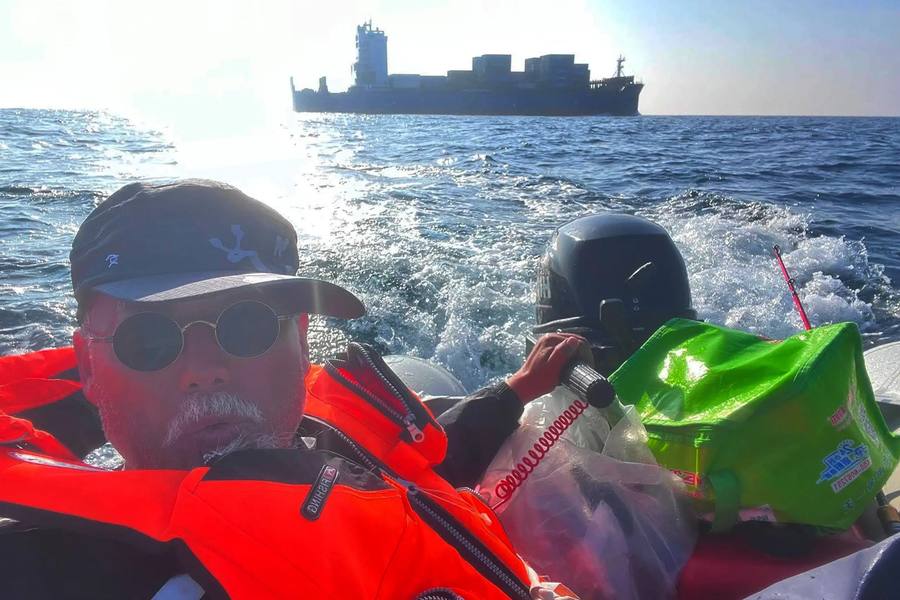
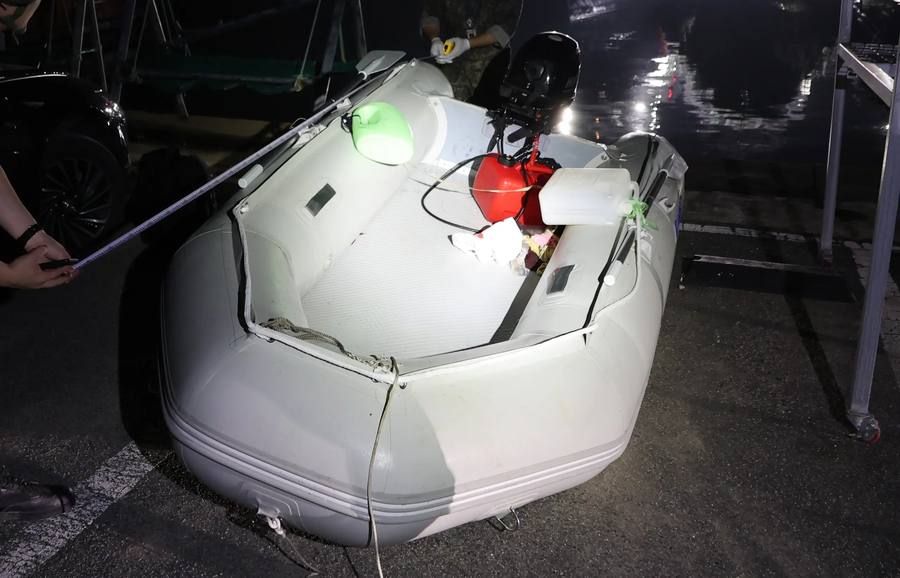
In the early hours of 24 May 2026 Dong Guangping put to sea from Weihai, Shandong. The specifications of the craft agree closely across sources: a grey inflatable rubber boat 3.3 metres (about 10.8 feet) long with a 9.9-horsepower engine (the South Korean Coast Guard, as relayed by the Korea JoongAng Daily, CNN and others; the Associated Press gives the same 3.3-metre boat). His original destination is a detail much reporting omits: by his own account after reaching Canada, given to the Associated Press, he had initially been aiming for Japan, because he was confident the Japanese government would not send him back to China; on 25 May fog closed in, the phone he relied on for GPS navigation ran to its last bar and his power bank died too, and he was forced to change course for South Korea. The duration and distance of the crossing therefore appear in two sets of figures: CNN and much of the British and American reporting give more than thirty hours and about 300 kilometres; the Associated Press's long retrospective and Human Rights in China's Weekly Brief give about forty hours and 190 miles (about 306 kilometres). The distance figures in fact agree (around 300 kilometres); the difference between thirty and forty hours is archived here in parallel — he set out in the early hours of the 24th and was rescued on the evening of the 25th, so the true time on the water falls between the two accounts, and no independently recorded hour count exists. The two are neither merged nor adjudicated.
The rescue, according to the South Korean Coast Guard and multiple reports: at 9:36 p.m. on 25 May a fishing vessel working off Taean County spotted him and reported him to the authorities, and the Coast Guard took him in; that he was utterly exhausted, and on one relayed account had lost consciousness by the time he reached Korean waters, comes from Sheng Xue as reported by the media (CNN citing Sheng Xue — a supporter's relay of his own account, flagged at that level). The position of the discovery carries its own pair of figures: the Korea JoongAng Daily's June reporting gives about ten nautical miles northwest of the Gyeokryeolbi Islands off Taean County, while some British and American reports give 38 nautical miles off the South Korean coast. Both are archived here without adjudication — the two may measure different things, a reported position versus a distance from the coastline, but with no original coast-guard bulletin available for checking, this page does not resolve them. What can be established is the landing point of the procedure: he was taken by the Taean Coast Guard for investigation on suspicion of violating the immigration law; his identity was confirmed to CNN by his Korean lawyer, Kim Joo-kwang, while the Coast Guard, citing privacy law, confirmed to the media only "a Chinese man in his sixties."
The Korean procedure is the first occasion in eleven years on which a court stepped between Dong Guangping and a refoulement. The Coast Guard applied for a formal detention warrant; on 28 May 2026 the Daejeon District Court (Seosan branch) refused to issue it, on the ground, in substance, that sufficient grounds and necessity for arrest were difficult to recognise (the Korea JoongAng Daily: the court found insufficient evidence of flight risk or destruction of evidence; the Associated Press: the court said it was "difficult to recognize sufficient grounds and necessity" for his arrest — the two renderings point to the same ruling and are set side by side here). On 10 June the Taean Coast Guard referred him to prosecutors without detention for suspected violation of the Immigration Act (Korea JoongAng Daily, 10 June; another of the paper's June reports at one point renders the discovery time as 9:36 a.m., contradicting its own May reporting of 9:36 p.m., and this page takes the evening time as its main line and notes the inconsistency here). He was then transferred through the Daejeon immigration office to the Incheon immigration office and placed in a refugee facility in Incheon. While in Incheon, UNHCR staff spoke with him by video call; a facility manager measured his height, weight and eye colour, and he later learned that this had been done at the request of the Canadian diplomatic mission — details from his own account to the Associated Press after reaching Canada, archived at the level of personal testimony. During his time in Korea, Human Rights in China issued a statement on 27 May 2026 urgently calling on the South Korean government and the international community to protect him and not return him, and Sheng Xue warned publicly that if he were sent back to China he would be arrested again, tortured, sentenced and imprisoned (her remarks as quoted in substance by the Korea JoongAng Daily). South Korea's Foreign Ministry's response on the individual case was that Korea handled it "in accordance with law and principle" (as reported by the Associated Press), without disclosing the details of the transfer arrangements. How the Korean prosecutorial and immigration proceedings were finally disposed of after his departure is a matter of no public record.
26 June 2026: Landing in Toronto
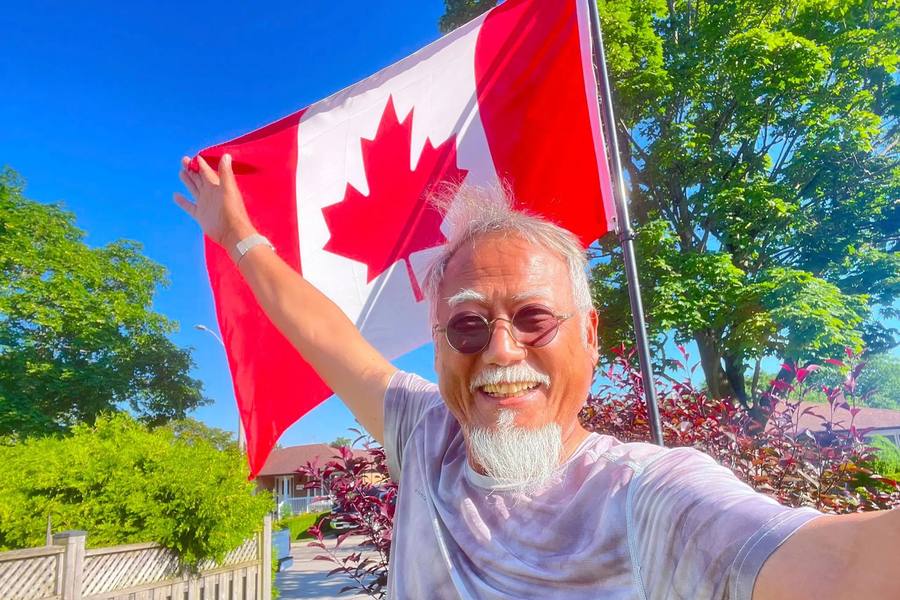
On Friday 26 June 2026 Dong Guangping flew from Seoul and arrived at Toronto Pearson International Airport. One point of dating requires explanation: the Toronto Association for Democracy in China's press release of Saturday 27 June 2026 records that he arrived "on Friday" — and 26 June was indeed the Friday; the Associated Press's report of 27 June records that Sheng Xue announced on social media that day that he had landed in Toronto on the Friday on an Air Canada flight; a small number of later reports place the arrival on 27 June, which was the date of the press release and the reporting, and this page does not adopt it as the arrival date. The press release records that he was accepted under Canada's Refugee Resettlement Program, that he arrived in visibly good spirits, thanked the Canadian government for its humanitarian gesture in accepting him, and was reunited with the family who had been settled in Canada under the same program in 2015; those who greeted him included Sheng Xue and Winnie Ng of the Toronto Association, and Winnie Ng said that as his contact person for eleven years she had held a deep conviction that he must be successfully brought to Canada, and that the rescue had been an international effort.
His own account to the media after landing filled in several pieces of the story that had previously existed only in summary (the Associated Press's long retrospective of 30 June 2026): he said that on arriving in Toronto he felt at home, and had tasted freedom for the first time in more than a decade; that he hoped to make a living, possibly as a truck driver or an Uber driver; that he planned to consult a lawyer about whether he could sue Thailand and Viet Nam; that he would go on pressing his call for constitutional democracy in China, which he stated as his ultimate goal. This page's handling of that set of statements: they are the public words of a man speaking to reporters in freedom, a level of testimony above any "confession" made in custody, but the elements that concern future intentions — litigation, employment — are statements of intent, not accomplished facts, and are archived as intent. He also said he believed the Canadian resettlement status his family had secured in 2015, before Thailand returned him to China, remained valid in his case — that is his own understanding; Immigration, Refugees and Citizenship Canada has not publicly commented on his individual case, and beyond the Refugee Resettlement Program named in the press release, the precise legal channel of his admission to Canada is a matter of no more detailed public record.
From 13 November 2015 to 26 June 2026 is ten years and seven months; from the family's joint flight to Thailand in September 2015, it is eleven years — the headline of the Toronto Association's press release runs, in substance, "after an 11-year attempt to flee China." Across those eleven years his wife and daughter built a life in Toronto from refugee resettlement, and his daughter went through secondary school and into the University of Toronto, while he himself served two prison terms in Chongqing and Zhengzhou, hid for two and a half years in Hanoi, and spent more than thirty hours adrift on the Yellow Sea. The Current Status field of this page can therefore set down one of this case's rare certainties: as verified in November 2026, he is in Toronto, Canada, living with his family, and his public activities and interviews are those of a free man; no public information indicates that Canada, South Korea or UNHCR has raised any objection to his resettlement.
The Family: Gu Shuhua, Katherine Dong, and Eleven Years Apart
The family thread of this case must begin by correcting a widely portable error: the child who campaigned for Dong Guangping in Canada is his daughter, not a son. This page searched specifically on the lead of "a son of Dong Guangping campaigning in Canada" and found no record of any son, by any name, appealing for him in Canada; every Canadian end of the family's appeals — the family's statements after the 2015 Thailand events, the public search for her father in November 2022, the joint appeal of January 2023, the welcome of June 2026 — is carried by his wife Gu Shuhua and his daughter Dong Xuelui. If any secondhand brief describes "his son Dong Shifan campaigning in Canada," it agrees with none of the primary or institutional record, and this page records the correction explicitly as a case of mistaken identity: Dong Xuelui, in English Katherine Dong (ChinaAid's November 2022 report gives "Dong Xuelui (Katherine Dong)"; the Toronto Star, The Canadian Press and the Toronto Association for Democracy in China's documents all give Katherine Dong; a few reports spell the name Catherine, and this page takes Katherine as its main line).
Gu Shuhua was the principal source of information in the early years of the case. The chain of key dates from the Thai detention — the signing of the Canadian acceptance papers, the departure arranged for 18 November, Dong Guangping's criminal detention in Chongqing on 14 November, the escalation of the charge to subversion in June 2016 — reached the outside world first through her, relayed by Civil Rights & Livelihood Watch and others. On the night of his release in August 2019 she sat in Canada by a telephone waiting for a call from a husband who had completed his sentence; late into the night she had received only the relayed word that he had been delivered to his mother's home in Zhengzhou, and she never did speak to him that night (Civil Rights & Livelihood Watch, 3 August 2019). One discrepancy of description must be archived: in one passage the Associated Press's long retrospective of June 2026 calls the woman settled in Canada in 2015 his "ex-wife," while the Associated Press's own associated reporting, the Toronto Association's documents and the overwhelming majority of sources say "wife." This page archives the divergence of wording side by side and does not adjudicate it — it may be a reporting slip, or it may touch on the family's private circumstances; either way it is not for outsiders to pronounce on the family's behalf, and the body of this page follows "his wife Gu Shuhua," the identity under which she herself spoke publicly for years.
Katherine Dong took up her mother's relay, and took it up in public. On the January 2023 rescue appeal's account, she was by then a Canadian citizen and a third-year student at the University of Toronto, and had not seen her father for more than seven years; on 17 November 2022 she delivered letters to the Vietnamese and Chinese embassies in Ottawa and spoke publicly, in the words widely quoted from her appeal in substance: please tell me where my father is. On 14 February 2023, after the Vietnamese government had refused to answer even the UN experts' questions, she responded publicly: the Vietnamese government went on tormenting her family by refusing to explain why it had arrested her father or what had happened to him; they would not answer her questions, would not answer the questions of Canada's prime minister and foreign minister, and now refused to answer the United Nations (her words as quoted in the Toronto Association's February 2023 statement, taken here in substance and not reproduced in full). She also preserved one detail that makes the sudden disappearance of August 2022 especially cruel for the family: across his two years in Viet Nam her father had kept in touch, describing himself as doing "very good" and undisturbed (as relayed by ChinaAid) — it was not a slow drifting apart; the calls stopped on a single day. On 26 June 2026 she was waiting for her father at Toronto airport. The last time father and daughter had lived together was in Bangkok in September 2015; she was then the child who had fallen ill and left school after witnessing the arrest and the search of the home — the "young daughter" of the Civil Rights & Livelihood Watch account of 2014 fits her line of age, but that profile does not name her, and this page records only that the two accounts align, without forcing them into a settled identification, however strongly they point the same way.
Of the other members of the family this page records only what has a source: his father has died (the Civil Rights & Livelihood Watch profile says the father died of cancer without forgiving him — a single-source narrative, layered as such above); on his release in 2019 he was delivered to his mother's home in Zhengzhou, his mother then living (Civil Rights & Livelihood Watch, 2019); the claim that a sister and a brother broke off relations with him rests on that one profile alone. This page's position on writing about families is the same as in all its cases: it records only sourced facts of pressure and appeal and does not consume the private details of a family's pain. But one judgment must be set down — the bill this family paid for his commemorative activism was invoiced across eleven years: a wife who spent eleven years being a detainee's family in two countries, a daughter who grew from a child frightened out of school into the named appellant of UN documents, and the invoices were issued, every one of them, by somebody else.
The International Response: From a Geneva Briefing to an Ottawa Appeal
The density of the international response in this case is rare among comparable cases, for one reason: twice, it collided with the clearest red line in international law, non-refoulement. The 2015 round, in chronological order: on 17 November 2015 The Guardian reported the United Nations' condemnation of Thailand's repatriation of the Chinese dissidents; on 18 November Human Rights Watch published its statement and its open letter to Prime Minister Prayut Chan-ocha, which set out point by point that the Thai government had been explicitly informed on 10 November of the two men's refugee status and of the third country's decision to accept them, that the return was therefore a deliberate, premeditated violation of rights contrary to customary international law and to Thailand's obligations under Article 3 of the Convention Against Torture, and which demanded that Thailand immediately stop returning any UNHCR-recognised persons, and that Thailand press China to drop the charges, release the two men and let them travel abroad to rejoin their families. On 20 November the UN human rights office, in its Geneva press briefing, said it was deeply concerned about Thailand's deportation of two recognised refugees, set out the non-refoulement principle as contained in Article 3 of the Convention Against Torture, and relayed UNHCR's account that the two refugees had been due to depart for a third country where they were to be resettled together with their families and that the reasons for the deportation remained unclear; the same briefing noted that the deportation came just over four months after Thailand had returned 109 ethnic Uyghurs to China. Amnesty International's Urgent Action UA 259/15 was updated continuously from November 2015 to 2018, its main line unvarying across updates: he was held incommunicado, at grave risk of torture, a prisoner of conscience who should be released. No systematic formal Thai government response to the 2015 refoulement was found in the public reporting consulted, and this page records that as a matter of no public record; and beyond the late-November confirmation of detention in wire reporting, no complete public text of a Chinese foreign-ministry response on the individual case is archived either.
In the 2022 Viet Nam round, the leading roles passed to the UN Special Procedures and to Canada. On 1 December 2022 the UN Working Group on Enforced or Involuntary Disappearances wrote to Viet Nam under its urgent procedure; on 15 December three Special Procedures mandate holders sent a formal communication posing six questions; Viet Nam did not reply within the sixty days given, and on 15 March 2023 replied to the Working Group only that it had "no information regarding Dong Guangping in Viet Nam" (Toronto Association for Democracy in China statements). On the Canadian side, on the rescue appeal's and the family's accounts: questions had been put to the Vietnamese side at the level of the Canadian prime minister and foreign minister without answer (Katherine Dong's public statement of February 2023), and the Canadian government had for some time been engaging Vietnamese officials to secure permission for his departure to Canada (Toronto Association and the joint appeal letter). Front Line Defenders' alert of 30 November 2022 characterised the Vietnamese handling as an apparent enforced disappearance and placed his situation on a growing Asian list of refoulements of human rights defenders from one country to another. In June 2023 Front Line Defenders' submission to the UN Universal Periodic Review filed this case under "transnational repression": taken away by Vietnamese police in August 2022 and incommunicado, with reports in May 2023 that he had been detained in a detention centre in Zhengzhou since October 2022. The response in the 2026 round was different in kind: a South Korean court refused the detention warrant; the Korean government answered that it had handled the case "in accordance with law and principle"; Human Rights in China issued its urgent appeal of 27 May 2026 that South Korea must not return him; and the Toronto Association's press release of 27 June 2026 announced the completed resettlement and expressly attributed the success to an international effort of human rights lawyers and activists in South Korea and Canada, supported by the governments of both countries. Beyond the foregoing, no sanctions by any foreign government in connection with this case are a matter of public record.
视频证据 Video Evidence
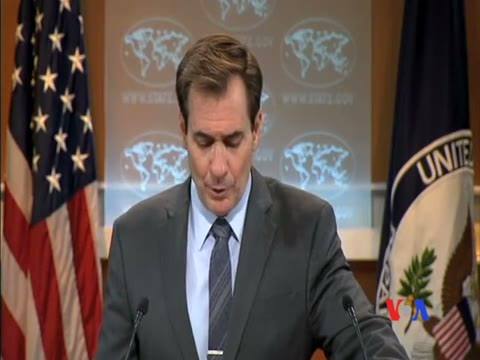
美国国务院回应泰国遣返中国难民事件,点名提及董广平等人的处境(美国之音粤语)|2015年|粤语原声The US State Department responds to Thailand's refoulement of Chinese refugees, naming Dong Guangping's case (VOA Cantonese)|2015|In Cantonese
Our Take
Assessing Dong Guangping's case, begin with the simplest arithmetic: papers signed on 11 November, departure on 18 November, refoulement on 13 November. The Thai authorities were not ignorant of his refugee status — on 10 November UNHCR formally notified the National Security Council, the Ministry of Justice, the Immigration Department and the Ministry of Foreign Affairs; they were not ignorant that someone was waiting for him — on 11 November Canada signed the acceptance papers inside the detention centre itself. To hand a man over with the file complete and five days to spare is not a bureaucratic failure; it is the delivery of a specific human being as a gift to Beijing. Human Rights Watch's words — deliberate, premeditated — are not too strong. The colder entry comes later in the ledger: eleven years on, Viet Nam performed the upgraded version of the same act. Thailand at least left a record of a deportation; Viet Nam left none at all — first it seized the man, then it told the United Nations it had "no information." When a government can answer "no information" about two and a half years of residence and one witnessed arrest, what it denies is not one man's whereabouts but the very idea that whereabouts must be accounted for.
The second account is China's own table of charges across the three rounds. Lay them out: commemorating June Fourth drew first "gathering a crowd to disrupt order" and then "picking quarrels and provoking trouble"; fleeing persecution drew first "illegally crossing the border," escalated at arrest to "subversion of state power" and brought back down at judgment to "inciting subversion" plus the border offence; and after he was returned from Viet Nam, the act of flight itself was sentenced separately, to eleven months. Not one of the three rounds accused him of harming anyone. The whole of his "criminal facts" is remembering a date, commemorating a group of the dead, and repeatedly trying to leave a country that forbade him to leave. A former police officer knows better than anyone what the elasticity of such charges means: when a label can be raised and lowered at the handlers' convenience, between picking quarrels and subverting the state, the label is no longer a description of conduct but an instrument for disposing of a person — fix the person first, choose the charge afterwards. This page has recorded the Chongqing judgment's structure split to the last component, and the rising and falling trajectory of the investigative charges, precisely so that readers can see that instrument at work: three years for inciting subversion, ten months for crossing a border, a fine of one thousand yuan — each item lawful, each item stamped, and together a complete price list for one refugee's escape.
The third account is the reason this page lists the case as its No. 128: in the end, this case was not lost. On 28 May 2026 the Daejeon District Court refused the warrant for his arrest — the first time in his life that a court stood between Dong Guangping and a return to China; on 26 June 2026, when he walked off the aircraft in Toronto, his wife and daughter were waiting in the arrivals hall. The ticket stolen eleven years earlier was, in this fashion, made good. This page will not dress that ending up as the victory of any system: what saved him was not the automatic goodwill of any state but a daughter who, after seven years without her father, kept writing letter after letter; a supporter, Sheng Xue, who did not change her role as contact person for eleven years; a Korean lawyer who held the case at the courthouse door in the forty-eight hours of the warrant application; a UNHCR video call and a Canadian mission's measuring of a man's height and weight. Every time the procedure worked, there were identifiable people pushing it from behind; every time the Thai and Vietnamese procedures failed to work, there were likewise identifiable people letting them fail. This page will continue to track his resettlement and life in Canada, and any progress of the litigation he says he is considering against Thailand and Viet Nam, verifying each item as it comes.
Verification Note
Last verified: 7 November 2026. Evidence grading — Grade A, documents of UN bodies (the UN human rights office's press briefing note of 20 November 2015; UNHCR's recognition and notification record as relayed in that briefing and in Human Rights Watch's letter; the December 2022 communications of the UN Working Group on Enforced or Involuntary Disappearances and three Special Procedures mandate holders, as relayed in the Toronto Association for Democracy in China's statements of February and May 2023, including the text of the Vietnamese government's reply of 15 March 2023 relayed through the same chain). Grade B, contemporaneous alerts and case files of international human rights organisations (Human Rights Watch's statement and letter to the Thai prime minister of 18 November 2015; Amnesty International's Urgent Action UA 259/15 in its successive updates, including those of June 2016, 2017, 11 April 2018 and 31 July 2018; Front Line Defenders' Dong Guangping case file in its successive updates, including November and December 2015, the Viet Nam disappearance alert of 30 November 2022, its June 2023 Universal Periodic Review submission and its completed-sentence update of 16 November 2023; Human Rights in China's statement of 27 May 2026 and its Weekly Brief). Grade C, contemporaneous and retrospective reporting by reliable outlets (The Guardian, 17 November 2015; the Toronto Star and The Canadian Press, 17 November 2022; CTV, 14 February 2023; The New York Times, 26 May 2026; CNN, 26 May 2026; the Korea JoongAng Daily, 28 May, 10 June and 16 June 2026; the Associated Press, 27 and 30 June 2026; the Toronto Association for Democracy in China's statements of 14 February and 29 May 2023, its joint appeal letter of 18 January 2023 and its press release of 27 June 2026). Grade D, Chinese-language rights-media reporting and family-relayed accounts (the long profile by Civil Rights & Livelihood Watch of 3 August 2019, including its early family narrative and the Thailand and Chongqing procedural details relayed from Gu Shuhua; ChinaAid's report of 15 November 2022, including Katherine Dong's Chinese name and the detail of the 9 December 2019 Shishi attempt). Key facts are given at least two independent sources wherever possible; single-source claims are attributed in place in the text and marked unverified. Conflicting dates and figures — Zhengzhou versus Luohe as birthplace; 13 November versus Human Rights Watch's "weekend of 14–15 November" for the 2015 refoulement; 26 November versus 3 December for the televised "confession"; the staged 26 July 2017 finding of guilt versus the 13 July 2018 pronouncement of sentence; 2 versus 3 August 2019 for the release; 24 versus 22 August 2022 for the Hanoi arrest; thirty versus forty hours for the 2026 crossing; ten versus thirty-eight nautical miles for the position of discovery; 26 June versus the erroneous 27 June for the Toronto arrival — are in every case archived in parallel, with this page's choice and its reasons stated, and are never blended into one clean story. The following were searched for and are matters of no public record, recorded here as empty rather than filled: whether any judgment followed the 2015 bail release in the 2014 case; the Chongqing case's arrest-approval authority, transfer-for-prosecution date, and any appeal and second-instance outcome; the exact Chinese name of his Chongqing prison (the "Yudu" transliteration is unverified); the date, border crossing and manner of Viet Nam's handover of him to China; the hearing date, defence arrangements and full judgment text of the 2023 Zhengzhou case; any systematic formal Thai government response to the 2015 refoulement; any public Chinese official response to the 2026 escape; and the final disposition of the Korean proceedings after his departure.
Principal sources: UN human rights office press briefing note (20 November 2015); Human Rights Watch, letter to the Thai prime minister and statement (18 November 2015); Amnesty International UA 259/15 (successive updates, November 2015–July 2018, and news release of 11 April 2018); Front Line Defenders, Dong Guangping case file (successive updates, 2015–2023); Civil Rights & Livelihood Watch (3 August 2019); Toronto Association for Democracy in China statements (14 February 2023; 29 May 2023) and press release (27 June 2026); Canadian joint rescue appeal letter (18 January 2023); ChinaAid (15 November 2022); Toronto Star and The Canadian Press (17 November 2022); Human Rights in China statement (27 May 2026); The New York Times (26 May 2026); CNN (26 May 2026); Korea JoongAng Daily (May–June 2026); Associated Press (27 and 30 June 2026). No single source is quoted at more than fifty words; all relayed material is attributed with its level.