
Zhang Gaoli (born 1946)
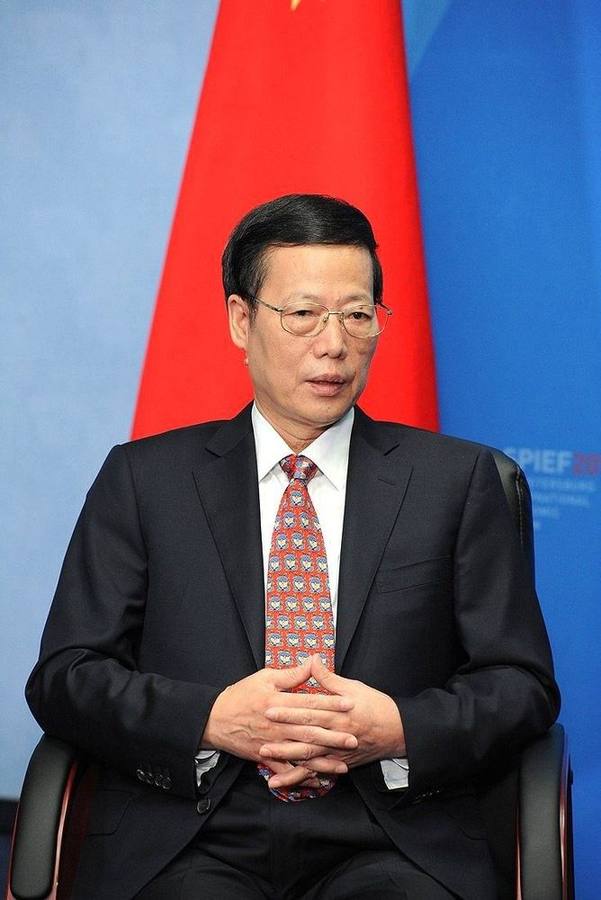
Zhang Gaoli, born November 1946 by his official biography (the current English Wikipedia entry gives 1947; this page archives both in parallel), a native of Jinjiang, Fujian, graduated in planning and statistics from Xiamen University's economics department, spent nearly fourteen years in the Maoming petroleum system in Guangdong, and then served successively as Guangdong economic commission chief, vice governor, Shenzhen party secretary, governor and party secretary of Shandong, and party secretary of Tianjin, before entering the Politburo Standing Committee in 2012 ranked seventh and serving as First Vice Premier from 2013 to 2018, concurrently heading the Belt and Road leading group and the leading group preparing the Beijing 2022 Winter Olympics. On 2 November 2021 tennis player Peng Shuai posted on her verified Weibo account an accusation that he had had sex with her in Tianjin more than a decade earlier and, about three years earlier, after his retirement, had coerced her into sex at his home while his wife Kang Jie stood guard outside the door — an allegation that has never been tested by any investigative or judicial process. The post was deleted within roughly twenty to thirty minutes; Peng then vanished from public view for more than two weeks; discussion inside China was comprehensively censored, with even searches for the word 'tennis' restricted; the WTA suspended all tournaments in China in December 2021 and lifted the suspension in April 2023 with none of its core demands met. Zhang Gaoli has never made any public response, has faced no public investigation, discipline, or sanction of any kind, and on 16 October 2022 appeared at the opening of the 20th Party Congress seated in the front row of the presidium — his first public appearance since the accusation. This page keeps the allegation, the official silence, and the documented censorship strictly in separate layers.
1. How this page is written: three layers, kept apart
Before 2 November 2021, Zhang Gaoli was a name with a curriculum vitae and almost no face. His official biography was complete, the state media archive about him ran to thousands of items, and virtually all of it was the formulaic prose of meetings, inspections, and instructions — a senior technocrat who had climbed every rung of the Chinese system in order and left almost no personal trace in public. After 2 November 2021, his name was permanently bound to another name, Peng Shuai, and to a long text that no longer exists inside China: the original post deleted, the screenshots deleted, the discussion deleted, the discussion of the deletion deleted. An archive page about this man therefore has a double task from the outset. It must lay out, year by year, the verifiable record of a politician who rose to seventh place in the Politburo Standing Committee and served five years as First Vice Premier — a record documented by his official biography on the Chinese government website, by Xinhua, and by decades of wire-service reporting. And it must record the storm of November 2021 in strictly separated layers of evidence: what Peng Shuai's post said (the allegation layer), what verifiably happened afterwards (the fact layer — deletion, disappearance, statements, suspension, reappearances), and what the various institutions said (the positions layer — the WTA, the International Olympic Committee, the Chinese Foreign Ministry, Amnesty International, Human Rights Watch). No layer may impersonate another. An allegation is not written up as a finding. A statement is not written up as a conclusion. Silence is not written up as innocence — and, with equal discipline, silence is not written up as guilt either.
This discipline is not a stylistic preference; it is dictated by the objective shape of the case. Peng Shuai's accusation has never entered any investigative process whatsoever. There has been no case filing, no hearing, no confrontation of witnesses, no published verification by any body of any kind. Zhang Gaoli has never responded — no admission, no denial, no lawsuit, no clarification. The official Chinese position, from Foreign Ministry spokesman Wang Wenbin's "I have not heard of this" on 3 November 2021 to Zhao Lijian's "not a diplomatic question" and his later hope that "certain people will cease malicious hyping, let alone politicisation," has been a refusal to concede that the matter constitutes a public event requiring an answer. In that landscape, any text that converts the allegation directly into a conviction is dishonest, and any text that converts "never investigated" into "cleared" is equally dishonest. What an archive can honestly do is put every piece of material back in its original place, labelled by source and by evidentiary rank, and let the reader see the whole pattern: that when a former world No. 1 doubles player named one of the seven men who had ruled China and accused him of coerced sex, the system's entire answer was deletion, silence, and — eleven months later — a front-row seat.
One more layer of honesty is required up front. The career sections of this page rest heavily on the official biography and state media reporting. Such material is generally reliable, and cross-checkable against wire reporting, on posts, dates, and rankings; it is structurally incomplete on controversies, such as the debt and vacancy problems of Tianjin's Binhai New Area development. Where controversy is involved, this page uses outside reporting — Bloomberg, Agence France-Presse, Reuters — and names it. As for the vast folklore about Zhang's family wealth, his children's businesses, and his factional patrons: nothing is included here that cannot be tied to a checkable published source, and anything widely repeated but not so tied is registered, in the disagreements section below, as having no public record. The first rule of this archive is simple: where there is no source, we write "no public record," and we do not guess.
2. Origins and education: a farming family in Jinjiang, economics at Xiamen
According to the official biography issued by the Chinese government website in 2013 and the Xinhua sketch released when he entered the Standing Committee: Zhang Gaoli, male, Han Chinese, born November 1946 in Jinjiang, Fujian Province; began work in August 1970; joined the Communist Party of China in December 1973 (some secondary accounts give November 1973; this page follows the official biography and notes the variant); graduated from the Department of Economics at Xiamen University with a major in planning and statistics. The current English Wikipedia entry, by contrast, gives his birth as November 1947. The one-year discrepancy is not unusual in the biographies of his generation of Chinese leaders, whose personnel files passed through decades of paper registration, but this page does not adjudicate between the two: the official record says November 1946, Wikipedia's current text says November 1947, and both are preserved. Where this page computes his age — for instance, describing him as about seventy-five in November 2021 — it follows the official 1946 date, which is also the date consistent with Reuters and Associated Press reporting at the time, which described him as 75.
Biographical reporting — including the leadership profile written by Cheng Li of the Brookings Institution for the Hoover Institution's China Leadership Monitor in 2012 — describes a childhood in an ordinary farming family in a Jinjiang village, the youngest of five children, educated at Jinjiang Qiaosheng High School. In 1965 he entered Xiamen University to study in the economics department's planning and statistics programme, graduating in 1970. Those study years straddle the outbreak of the Cultural Revolution in 1966, after which normal university teaching across China collapsed into political campaigning; what Zhang's own classroom experience in those years actually consisted of is not recorded in the official biography, and there is no public record from which to reconstruct it. This page therefore records his enrolment and graduation years and invents nothing in between. The choice of subject, though, deserves a note, because it turned out to be the template of a life. "Planning and statistics" was the cadre-training discipline of a planned economy, feeding graduates into planning commissions and statistical bureaux at every level. A farmer's son who read that subject, and who was then assigned on graduation to the petroleum industry, would spend the next four decades moving along a single track inside the system — petroleum, local economic management, provincial leadership, and finally the economic portfolio at the very top of the State Council. He never once left that track.
Family information in the public record is thin. His wife, Kang Jie, met him, according to biographical accounts, when both worked at the Maoming petroleum company in Guangdong; she was an employee of the same enterprise. In November 2021 her name entered the world's newspapers in a way neither of them could have anticipated: Peng Shuai's post stated that on the occasion about three years earlier, Zhang's wife had known what was happening and had stood guard outside the door — rendered in English-language reporting as the wife "standing guard" or "keeping watch." That remains a statement inside the allegation text, never tested by any process. Kang Jie has never spoken publicly since, and there is no public record that any institution has ever questioned her. This page registers her name and its position in the story here, and returns to it in the November 2021 sections below.
3. Fourteen years in Maoming petroleum: from labourer to company manager
On graduating in August 1970, Zhang was assigned to a logistics team of the Guangdong Maoming Petroleum Company, under the Ministry of Petroleum Industry. The official biography lists him as a worker in the company's logistics department in 1970–1971; biographical profiles fill in the texture — warehouse stocking and hauling concrete blocks as manual labour. From there he climbed the company's party and administrative ladder one step at a time: secretary in the production headquarters office; secretary of the Communist Youth League general branch in the company's political department and deputy secretary of its Youth League committee; from 1977, party general-branch secretary and political instructor of the No. 1 workshop of the oil refinery, then deputy secretary and secretary of the refinery's party committee; from 1980, member of the standing committee of the party committee of the Maoming Petroleum Industrial Company, head of its planning section, and deputy manager; and in 1984–1985, deputy party secretary of Maoming municipality while simultaneously manager of the Sinopec Maoming petroleum company. He had joined the Party in December 1973, in Maoming.
Two contexts make these fourteen years intelligible. The first is industrial. Maoming was one of southern China's major petrochemical bases, and its petroleum company was a large state enterprise under the petroleum ministry and later under Sinopec. In the administrative hierarchy of the planned economy, enterprises of that rank interlocked directly with local party and government organs, and the transfer of enterprise cadres into territorial administration was a standard personnel channel. The second context is generational. Zhang was not the only future top leader formed in the oil system — Zeng Qinghong, later Vice President of China, also began in petroleum — and Cheng Li's profile pointedly notes that both men built the early stages of their careers in the oil industry, which during the reform decades became one of the personnel networks running through energy, the provinces, and the centre. It must be said plainly, to keep the record clean: noting this background explains how an economics graduate moved from enterprise party work into territorial politics. It does not document any particular act of patronage. Stories about who "promoted" the young Zhang Gaoli circulate widely; none of them can be tied to a checkable published source, and this page does not carry them.
In archival terms, the Maoming years are the most conventionally documented part of his life: a continuous sequence of posts with continuous dates, matching the official biography item by item. But a trait that would define his entire career is already visible in the sequence. Worker, secretary, Youth League cadre, workshop party secretary, refinery party secretary, company standing committee member, deputy manager, manager, municipal deputy party secretary — there is no leap, no shortcut, no episode outside the organization, no business venture, no overseas posting. Chinese cadre biographies call this pattern "one step, one footprint." Its other face is that everything about the man — his relationships, his information, his instincts — was formed inside the system. That fact is not irrelevant to understanding the choice made in November 2021 — or rather, the choice the system made on his behalf.
4. Thirteen years in Guangdong: economic commission, vice governor, Shenzhen
In 1985 Zhang left Maoming to head the Guangdong Provincial Economic Commission, his first post in provincial-level economic management. In 1988 he became a Vice Governor of Guangdong. From April to July 1990 he studied in the training class for provincial- and ministerial-level cadres at the Central Party School — the standard biographical marker that a cadre has entered the pool being groomed for higher office. In 1992–1993 he concurrently directed the Guangdong Provincial Planning Commission while serving as vice governor. In 1993, aged forty-seven, he entered the standing committee of the Guangdong provincial party committee, joining the province's top decision-making circle.
The turning point of his Guangdong years came in 1997, when he became Party Secretary of Shenzhen, initially while still a provincial standing committee member and vice governor, then, from 1998, as Deputy Party Secretary of Guangdong while retaining the Shenzhen post; in 2000–2001 he also chaired the standing committee of the Shenzhen municipal people's congress. By the 1990s the Shenzhen party secretaryship, held concurrently by a provincial deputy secretary, was one of the weightiest territorial posts in China: the city was the flagship of reform and opening, the gathering point of foreign capital, exports, and the young technology industry. Biographical reporting credits Zhang with a supportive stance toward local technology champions such as Huawei during his tenure, and Shenzhen's aggregate output continued its rapid expansion under him. His Shenzhen years also fix a date-coordinate that later lists would seize upon. When the nationwide campaign against Falun Gong was launched in July 1999, Zhang was governing Shenzhen and concurrently serving as first party secretary of the Shenzhen garrison. Organizations campaigning on the Falun Gong issue — notably the World Organization to Investigate the Persecution of Falun Gong and the Minghui website — consequently placed him on their accountability lists, alleging that he implemented the persecution in Guangdong and Shenzhen and later in Shandong and Tianjin, with large numbers of practitioners detained and sentenced. This page handles that allegation exactly as it handles every allegation in it: it names the source, records the posts and periods the allegation rests on, notes that it is a one-sided accusation never tested by any judicial process and never answered by Zhang or by the Chinese authorities — and records the undisputed structural fact that, under the Communist Party's system of territorial responsibility, the party secretary of a jurisdiction bears overall responsibility for "stability" and suppression campaigns within it, a fact of institutional design that stands independently of any campaigner's narrative.
Taken together, the Guangdong thirteen years converted an enterprise cadre into a territorial ruler. Economic commission director, planning commission director, vice governor for economic work, party secretary of the showcase special economic zone: the sequence trained him as a pure "economic chief" — a man of projects, investment figures, and growth rates. In Shandong, in Tianjin, and later in the State Council, his public persona never left that role: speeches about development, inspections at construction sites, reports dense with statistics. Observers of Chinese official prose will notice something else about those decades. Zhang almost never published theoretical or policy essays under his own name and almost never gave interviews. In an era when senior leaders cultivated collected works and signature doctrines, his public personality was close to blank. At the time this was read as low-key pragmatism. After November 2021 it acquired a second meaning: when the accusation came, the public had no "private Zhang Gaoli" against which to set it — only a sequence of posts, and a man who had never spoken.
5. Shandong, 2001–2007: governor, party secretary, and the meaning of "first in charge"
At the end of 2001 Zhang left Guangdong, where he had worked for thirty-one years — fourteen in Maoming, seventeen in provincial government and Shenzhen — and was transferred to Shandong, as deputy provincial party secretary and acting governor, then governor. On 23 November 2002 he was promoted to Secretary of the Shandong Provincial Party Committee, becoming the "first in charge" of one of China's most populous provinces; from 2003 he also chaired the standing committee of the provincial people's congress, relinquishing the governorship. The years 2002 to 2007 were his first complete tenure as a provincial party secretary.
What the public record verifies about his Shandong tenure is mostly the procedural surface of economic administration: the province's output remained among the largest in China, and state media summaries of the period duly enumerated growth, revenue, and opening figures. The archivally more important point is the change in his institutional position. In Guangdong he had always been a member of a leadership team — vice governor, municipal secretary, with a provincial party secretary above him. In Shandong he became, for the first time, the person bearing overall responsibility for a province's party affairs, political-legal apparatus, propaganda, and personnel. Under the Communist Party's system, a provincial party secretary's responsibility for major events in his jurisdiction is total by design; that is both the meaning of the power and the premise of every later discussion of "responsibility in office." The years 2001–2007 were also years in which the suppression of Falun Gong continued at high intensity in Shandong. The World Organization to Investigate the Persecution of Falun Gong devoted a specific notice to his Shandong period, alleging that as governor and party secretary he drove the campaign, and citing a March 2002 speech at the fifth session of the province's ninth people's congress in which he linked the crackdown to consolidating political and social stability. This page records, per its standing rule: the accusation comes from a single overseas organization rooted in the Falun Gong movement; it has no judicial determination behind it and no official response; and the posts and dates it rests on match the official biography exactly.
In March 2007, in the personnel reshuffle preceding the 17th Party Congress, Zhang was moved to Tianjin. The function of the Shandong stop in his ascent is easy to state. Under the unwritten promotion rules of the system, service as a provincial party secretary had become a de facto threshold for entry into the Politburo and beyond. Guangdong had given him the credential "can run an economy." Shandong gave him the credential "can rule a province." With both pieces in place, the next step was a directly administered municipality and a Politburo seat.
6. Tianjin, 2007–2012: Politburo member, Binhai New Area, and the price of growth
On 25 March 2007 Zhang became Party Secretary of Tianjin, succeeding Zhang Lichang; after the 17th Party Congress that October he entered the Politburo — the standard pairing, since the Tianjin party secretaryship is held by a Politburo member. He served until 21 November 2012 and was succeeded by Sun Chunlan. His mayoral partners were Dai Xianglong and then Huang Xingguo. Huang was later purged in 2016 and in 2017 sentenced to twelve years in prison for bribery — an adjudicated fact, recorded in his judgment. This page records Huang solely as Zhang's principal administrative partner in Tianjin; the judgment's findings concern Huang's own conduct, and no public record connects Zhang to Huang's case or shows Zhang held to account over it.
The achievement narrative of Zhang's five and a half Tianjin years, in the state media version, has two pillars: the development of the Binhai New Area and growth rates that led the nation. Even Reuters' retrospective of November 2021 conceded the second pillar: under his watch, a once relatively sleepy directly administered municipality became China's fastest-growing region in 2011. Binhai had been designated a national-level development zone in 2006, before his arrival; his tenure was the peak period of debt-financed construction within it, above all the Yujiapu financial district and the Xiangluowan business district across the Hai River. Yujiapu was promoted as China's answer to Manhattan and a future global financial centre, with state media putting total investment at some 200 billion yuan. Agence France-Presse's on-the-ground report of May 2015 told the other side: more than three years after construction began, nearly all of the planned towers stood unfinished, many without exterior walls, above empty boulevards, facing a would-be largest hotel in Asia that was an empty shell; reporters applied the word "ghost town," and analysts asked whether the scheme was viable at all. Bloomberg's 2014 reporting supplied the financial underside: the Tianjin Binhai New Area Construction and Investment Group, the local-government financing vehicle tied to the developments, saw revenue fall 68 per cent in 2013, to an amount less than a third of the debt falling due in 2014 — some 20.7 billion yuan due that year, with a further 13.9 billion due the next. Industry voices quoted by Bloomberg said plainly that the point of such projects was the GDP number. This page prints the two sides side by side, as an archive should: fastest growth is a statistical fact; debt and vacancy are reported facts. A Tianjin tenure written as pure triumph, or as pure failure, would each be a falsification by omission. It should also be noted that in later years institutions did move into parts of Yujiapu and construction did proceed; what is recorded here is the state of the district as outside reporting found it in the two to three years after Zhang left office, not a final verdict on its fate.
The Tianjin years contain one more fact that November 2021 would illuminate from an unexpected angle. Peng Shuai's post stated that her first sexual encounter with Zhang Gaoli took place in Tianjin, more than a decade before the post — on the post's own timeline, when she was in her twenties and he was approaching the height of his career, governing Tianjin. The grading must be repeated exactly: this is the post's self-account, never tested. The archive records it here because it is the starting point of the entire allegation narrative, and because its time frame is consistent with Zhang's documented whereabouts — he was in Tianjin from 2007 to 2012. "Consistent with the public record" means only that the narrative does not collide with known facts; it does not mean confirmed, exactly as the authorities have never advanced any rebuttal of the "he was not in Tianjin" kind. Archival work stops at that line: lay out the text, lay out the dates, and state plainly that neither side's account has ever entered a process of verification.
By his last full year in Tianjin, Zhang had assembled the complete portfolio of a Standing Committee contender: Politburo member, party secretary of a directly administered municipality, and a provincial-level growth championship. In the succession arithmetic of the 18th Party Congress in 2012, he was among the territorial leaders with the most complete résumés in the field.
7. Seventh seat, First Vice Premier: the chief operating officer years, 2012–2018
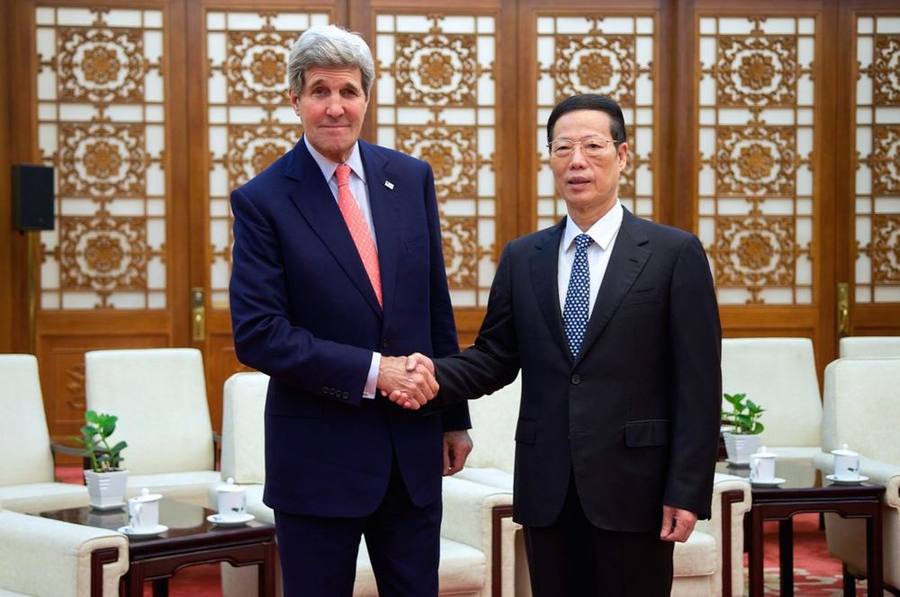
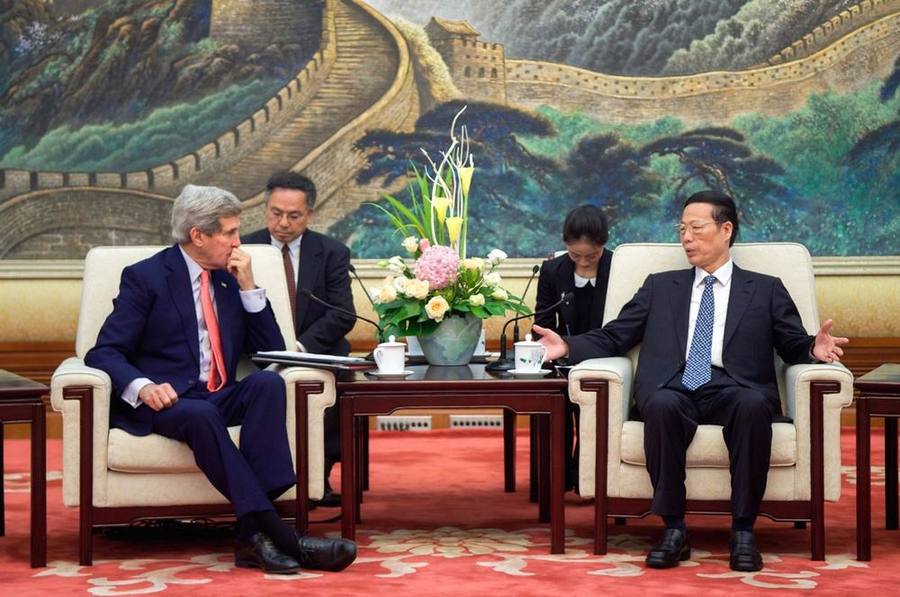
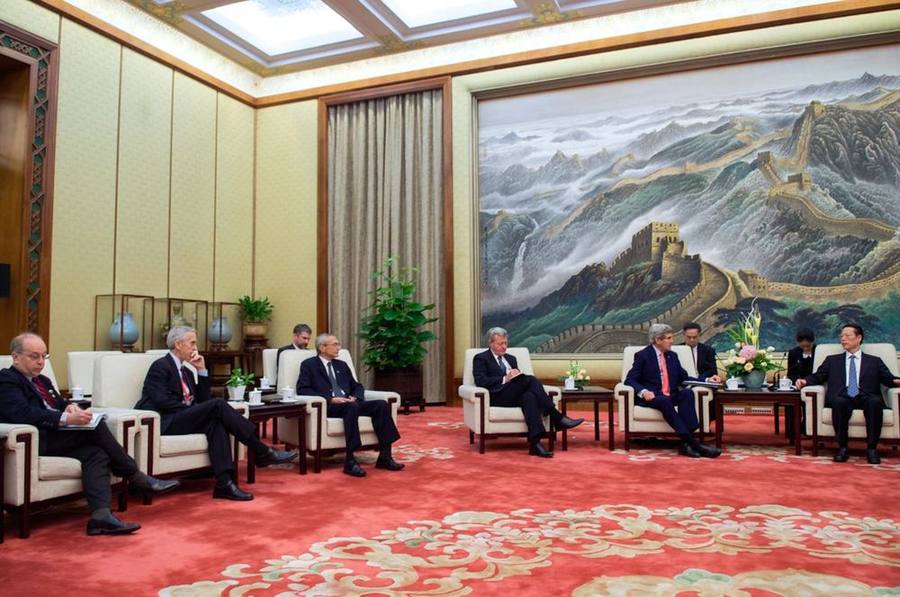
On 15 November 2012, at the first plenary session of the 18th Central Committee, Zhang Gaoli entered the Politburo Standing Committee, ranked seventh of seven — behind Xi Jinping, Li Keqiang, Zhang Dejiang, Yu Zhengsheng, Liu Yunshan, and Wang Qishan. His Standing Committee portfolio was the government system. On 16 March 2013 the first session of the 12th National People's Congress appointed him Vice Premier of the State Council, first in rank — First Vice Premier — making him Premier Li Keqiang's principal lieutenant. (Some reference works date the appointment to 15 March, the day of the congressional vote on the premiership slate; the government website's own biography page dates his vice-premiership from the 16 March session. The discrepancy is one of convention and does not affect the tenure: March 2013 to 19 March 2018, when Han Zheng succeeded him.) He left the Standing Committee and the Politburo after the 19th Party Congress in October 2017 and completed the government handover in March 2018, retiring from office.
As First Vice Premier his documented portfolio covered fiscal and economic operations, development and reform, natural resources, ecology and environment, housing and urban-rural development, and emergency management. His leading-group posts map the weight of the job. He headed the State Council's leading group for advancing the Belt and Road Initiative — Xi Jinping's signature external strategy, whose domestic coordinating machinery was entrusted to the first-ranked vice premier, a placement with both symbolic and operational meaning. He headed the leading group for the 24th Olympic Winter Games, presiding over the early preparations for Beijing 2022 until handing over to Han Zheng in 2018. He headed the leading group for the coordinated development of the Beijing-Tianjin-Hebei region, in which capacity he told a regional conference in April 2017 — days after the Xiongan New Area was announced — that property development in Xiongan would be strictly controlled and speculation guarded against, remarks carried by the government website. He was also a vice chairman of the National Energy Commission. On 31 July 2015, when Beijing won the 2022 Winter Games, Zhang was the senior official responsible for the organizing effort; Reuters records that at the organizing committee's launch he made a "solemn commitment" to a successful Games, and in 2016 he met International Olympic Committee President Thomas Bach and assured him the work was being done to make the Beijing Games "fantastic, extraordinary and excellent," in the words of the government's own English-language report. Read after November 2021, that meeting acquires a grim symmetry: five years later it was Bach who appeared at the other end of the video call staged to reassure the world about Peng Shuai — and the man Peng had accused was the same man who had once sat across from Bach as the guarantor of the Beijing Winter Olympics. This page states the connection because it is a documented fact of institutional history, indispensable background to understanding the IOC's handling of November 2021; it does not impute motives to either man.
How should the five vice-premier years be assessed? The state media formula is that he "assisted the Premier in managing economic work." The consensus of outside analysts at the time — in the Wall Street Journal, The Economist, and similar leadership coverage — was that he was the least personally distinctive of the seven Standing Committee members: an executor and coordinator, who left behind no reform bearing his name, no doctrine, and no factional label that could be confirmed on the record. This archive registers its own observation at the level of method rather than verdict: a man who sat for five years at the apex of power and handled two of the state's flagship projects, the Belt and Road and a Winter Olympics, left an unusually thin verifiable personal record. That thinness is itself information about how the system works — it rewards those who leave no trace. After November 2021, "leaving no trace" changed from a career virtue into something else.
8. Retirement and 1 July 2021: the last public picture before the storm
After stepping down in March 2018, Zhang entered the standard existence of a retired Chinese leader: no office, no public staff, appearances only in the ranked ceremonial ranks at major Party occasions. Reuters' long November 2021 profile took care to log his last public appearance before the accusation: on 1 July 2021, at the ceremony marking the centenary of the Communist Party, he sat on the viewing stands at Tiananmen alongside other retired leaders. The detail matters as a baseline. Before the accusation, Zhang was not missing, marginalized, or under a cloud; he was on the ordinary track of a retired elder, and everything was normal.
The same section of the archive must hold the other protagonist's pre-2021 public record, because part of the accusation's force came from who the accuser was. Peng Shuai, born in 1986 in Xiangtan, Hunan, was a former world No. 1 in women's doubles, winner of the Wimbledon doubles title in 2013 and the French Open doubles title in 2014, a former singles world No. 14 and United States Open semifinalist, and a three-time Olympian — by results, one of the most successful tennis players China has produced. She was not an anonymous account or a voice from nowhere, but a person with a fifteen-year international professional record, identifiable to the entire global tennis community. The long text that appeared on her verified Weibo account on the evening of 2 November 2021 was therefore never going to be treated, from its first minute, as ordinary internet rumour — a fact the censorship machine's response time that night, measured in minutes, silently conceded.
9. The night of 2 November 2021: what the post said — the allegation layer
Everything in this section belongs to the allegation layer: it is a summary of the long post published on Peng Shuai's verified Weibo account at about 10 p.m. on 2 November 2021, as reported by multiple media organizations from screenshots taken before its deletion. This page observes three limits throughout: it summarizes rather than reproducing the text in full; every material point is attributed as "the post stated"; and it makes no finding whatever about truth. The post, addressed to Zhang Gaoli in the second person, made the following points.
First, the beginning. The post stated that she and Zhang had met and had sex in Tianjin more than a decade earlier, when she was in her twenties and her career was rising while his was nearing its peak. Second, the break. The post stated that after Zhang ascended to the Politburo Standing Committee, he cut off contact with her for years. Third, the occasion about three years before — that is, counting back from November 2021, around 2018, after he had stepped down as vice premier. The post stated that he had her summoned, through the head of a tennis centre, to play tennis with him at a Beijing hotel used by the Party for retired officials (identified in detailed reporting as the Kangming, a facility hosting retired cadres); that later that day he took her to his home and forced her to have sex despite her repeated refusals, her fear, and her crying; and that his wife Kang Jie knew of the encounter and stood guard outside the door. Fourth, the relationship afterwards. The post stated that an on-off relationship resumed, that she developed feelings for him, and that it continued until a recent quarrel, after which he "disappeared" on her again, as he had before; learning that she could obtain no explanation, she decided to publish. The post stated that she knew she had no evidence, and that speaking would be like a moth flying into a flame or an egg hurled against a rock — self-destruction — but that she would speak the truth about them regardless. Fifth, the post contained extended passages of self-reproach and private address — she described her own sense of being a "bad girl" in the relationship and asked whether he had considered his wife's feelings. Journalists who read the screenshots at the time widely remarked that this texture made the text read like a long personal letter to its addressee rather than a composed public statement. This page records that widespread observation for exactly what it is — an observation about texture, which is not evidence and proves nothing either way.
One detail of language deserves a permanent place in the archive, because it later became the hinge of the retraction narrative. The post's own Chinese wording used expressions meaning that she was forced or pressured into sexual relations; it did not frame the charge under the Chinese legal term for sexual assault as a headline accusation. International media, translating and summarizing, almost uniformly rendered the matter as a "sexual assault allegation." The small distance between the original wording and the summary label was repeatedly exploited in Peng's later interviews (see Section 12), which denied a proposition — "I never said anyone sexually assaulted me" — that is not identical to the proposition the post itself advanced. This page accordingly uses "coerced-sex allegation" as its default term, as the closest rendering of the post's own words, and notes the international media convention here, once, so that no reader mistakes the summary for the source.
Two immediate circumstances belong not to the allegation layer but to the fact layer, and are recorded here because they frame everything after. First, the post existed, on Peng's own verified account: this is established by the flood of screenshots taken that night, by full-text archiving outside China, and by the fact that no official account has ever claimed the account was hacked. Second, the post was deleted quickly — within about twenty minutes according to Global Voices and NPR's Emily Feng, who posted the text to Twitter that night; within about thirty minutes, or "half an hour," according to the Associated Press and other outlets. Both timings are preserved in parallel in this archive; the discrepancy probably reflects different starting points for the clock, and this page does not merge them. What both versions jointly establish is the order of magnitude: minutes, not hours. By the time the post vanished, screenshots had already crossed to platforms beyond the censors' reach, and the comprehensive suppression operation began.
10. After the deletion: the breadth of the censorship — the fact layer
If the fate of the post itself was "deleted," what happened across the Chinese internet over the following weeks went far beyond one post. Each item below has an independent source, and they are listed one by one because the breadth and intensity of the suppression is itself among the most important verifiable facts of this case — the hardest available evidence of how the system regarded the matter.
(1) Commenting on Peng Shuai's Weibo account was disabled; searches for her account inside Weibo at times returned nothing, the account being reachable only by direct link; and she posted nothing further on it after 2 November 2021 (BBC investigation, February 2022). (2) Six further posts disappeared from her own timeline (same BBC comparison of her feed). (3) Other users' posts referring to her were removed — for example, a 3 November post by tennis commentator Ouyang Wensheng (BBC). (4) Keywords, homophones, coded references, and even related emojis were systematically blocked; monitoring projects such as FreeWeibo preserved lists of the censored terms from that period, and Global Voices reported that netizens' homophonic workarounds were deleted in their turn. (5) Search itself was throttled: Human Rights Watch's January 2022 briefing states in terms that the authorities maintained a media and internet blackout on the case and that words such as "tennis" and "Peng" were censored or had their search results restricted; the BBC's investigation found that searching "Peng Shuai" on Baidu surfaced only career coverage from 2020 and earlier, that Sogou returned only tennis-career material, that Douyin, Kuaishou, and Bilibili limited sensitive-term search, and that Zhihu at one point returned no results for her name at all. (6) Mainstream state media maintained collective silence about the event itself inside China: no domestic reporting of the accusation, none of the disappearance; only outward-facing outlets — CGTN and the Global Times, on Twitter, a platform blocked in China — published "she is safe" materials once international pressure mounted. This wall between the domestic and foreign information spaces is a standard technique of the Chinese information system, and the archive names it as such. (7) The single surviving exception has an archival irony that no novelist would dare: on 22 November the French Embassy in Beijing posted on Weibo expressing concern about the lack of information on Peng — and the post was not deleted. The BBC noted that it was, at that moment, the only search result for her name on the platform. A foreign embassy's expression of concern was the sole public trace, on the social network of a country of 1.4 billion people, of that country's most famous tennis player.
Suppression on this scale requires manpower, keyword infrastructure, and coordination across every major platform; that expenditure is itself a form of statement. This page's account remains, to this point, strictly in the fact layer — the objects, scope, methods, and exceptions of the censorship are all checkable. Whether the thing being protected was a leader's privacy, the regime's dignity, or the man himself is a question on which sources differ, and no conclusion of that kind is smuggled into the facts above. But any reader who reads the seven items consecutively will draw a conclusion of their own — which is precisely the use of an archive that lays its facts out straight.
11. "Where is Peng Shuai?": the missing weeks and the statements of every party
After the post was deleted, Peng Shuai vanished from public view: no posts, no appearances, and repeated attempts by the WTA to reach her through multiple channels produced no direct contact. Around 12 November the hashtag #WhereIsPengShuai took off globally on social media outside China, and leading figures of the tennis world — Naomi Osaka, Serena and Venus Williams, Novak Djokovic, Martina Navratilova, and many others — spoke out in sequence. What follows is the complete dated record of formal moves and statements, the positions layer of this archive, because in a case where the central figure cannot speak freely, the statements of the institutions around her are themselves primary documents.
3 November: Foreign Ministry spokesman Wang Wenbin, asked about Peng's whereabouts at the regular briefing, answered that he had not heard of the issue and that it was not a diplomatic question. 14 November: WTA Chairman and CEO Steve Simon issued a statement calling for a "full, fair and transparent investigation" into the allegation and for an end to the censorship of Peng; the same day he told reporters that sources had assured the WTA that Peng was safe, yet no one from the tour had been able to reach her directly; the Chinese Tennis Association told outside media that Peng was safe and under no physical threat. 17 November: Foreign Ministry spokesman Zhao Lijian said the matter was not a diplomatic issue and suggested the questioner contact the "relevant department." The same day, CGTN Europe posted on Twitter a screenshot of what it said was an email from Peng to Simon, in which the allegation of sexual assault was "not true," and which said: "I'm not missing, nor am I unsafe. I've just been resting at home and everything is fine." Simon answered the same day: the statement released by Chinese state media "only raises my concerns as to her safety and whereabouts," and he had "a hard time believing that Peng Shuai actually wrote the email we received or believes what is being attributed to her"; the WTA required independent and verifiable proof that she was safe. 19 November: Zhao told reporters he was "not aware of the situation." The same day, White House Press Secretary Jen Psaki said the United States was deeply concerned and joined calls for the Chinese authorities to provide independent, verifiable proof of Peng's whereabouts and safety; a spokesperson for the United Nations human rights office in Geneva likewise called for an investigation with full transparency into the allegation; the IOC, by contrast, said that experience showed "quiet diplomacy" offered the best opportunity for a solution and that it would not comment further. 20 November: Hu Xijin, editor of the Global Times, posted videos on Twitter purporting to show Peng dining with friends, saying she had been staying freely at her own home and did not wish to be disturbed. 21 November: official photographs showed Peng attending a junior tennis event in Beijing; the same day the IOC announced that President Thomas Bach had held a video call of about thirty minutes with Peng, in which she said she was safe and well, living at her home in Beijing, but would like her privacy respected at this time. No video of the call was released — only a still photograph. Amnesty International's China researcher Doriane Lau responded, in the organization's statements of that period, that a claimed statement that "everything is fine" should not be taken at face value, because Chinese state media have a track record of forcing statements out of people under duress or fabricating them outright — Amnesty cited the televised "confessions" of detained human rights lawyers Wang Yu and Jiang Tianyong — and demanded that Beijing prove Peng's safety and investigate the allegations effectively. Around 23 November, Zhao Lijian shifted ground, saying he hoped "certain people will cease malicious hyping, let alone politicisation," and pointing to Peng's public activities and the Bach call. On 30 November the European Union called for verifiable proof. On 1–2 December the IOC said it had held a second video call with Peng, on 1 December.
One further entry belongs in this section, in the fact layer, as a structural observation. Throughout this period the State Council Information Office, the Chinese government's own spokesman office, did not respond to Reuters' emailed questions. And Zhang Gaoli himself — the direct object of the accusation — said nothing through any channel: not even a one-line denial conveyed by a spokesman. Reuters' 24 November feature took its headline from exactly that absence: "Where is Zhang Gaoli? Chinese politician accused by tennis star Peng keeps out of sight." In archival terms this is the strangest structure in the whole case. The accuser disappeared for eighteen days, and the world asked where she was. The accused disappeared for far longer and far more completely — and no institution anywhere demanded to know where he was, because the system that protected him had also made the question itself impermissible. Protecting a man, in this system, means ensuring that questions about him never become questions at all.
12. The WTA suspension: sport's rarest boycott of China — and how it ended
On 1 December 2021 Steve Simon announced, with the full support of the WTA Board of Directors, "the immediate suspension of all WTA tournaments in China, including Hong Kong." The reasoning in his statement was widely quoted and deserves its place in this record: he could not in good conscience ask the tour's athletes to compete in China when Peng Shuai was not allowed to communicate freely and had seemingly been pressured to contradict her allegation of sexual assault; he repeated the call for a full and transparent investigation without censorship; and he recorded his concern about the risks to all players and staff if events were held in China in 2022. The economic scale of the decision was exceptional. China had hosted nine WTA events in 2019 with a combined prize purse of about 30.4 million dollars; the tour's broadcast and sponsorship contracts in China were widely estimated in the hundreds of millions; and the Shenzhen WTA Finals agreement (2019–2028) carried a prize fund of 14 million dollars a year. The WTA thereby became one of the very few major international sports bodies ever to abandon its largest growth market voluntarily, on grounds of a single athlete's safety and freedom of speech. The Sport and Rights Alliance and human rights organizations praised the decision at the time as a new standard for sports governance and called on the IOC to follow it. The men's ATP Tour and the International Tennis Federation did not follow: both issued statements of concern and took no comparable action — a contrast widely criticized at the time, and recorded here in parallel as part of the institutional record.
The suspension's aftermath ran along two tracks. The commercial track first. On 3 March 2022 the WTA announced a multi-year title sponsorship with the American medical technology company Hologic, and the tour was renamed the Hologic WTA Tour — its first title sponsor since the Sony Ericsson agreement ended in 2010. Reuters, reporting the New York Times' account, said the WTA's stance in the Peng case had helped land the deal; a Hologic senior executive described the stance as more a catalyst to the conversation than the deciding factor; the WTA declined to disclose terms. A correction to the framing in this page's original brief belongs here: the Hologic title era began in March 2022, three months after the suspension decision; at the moment the suspension was announced in December 2021, the tour had no title sponsor. The second track is the thaw. On 13 April 2023 the WTA announced that it was lifting the suspension and would resume tournaments in China that September. Simon told the Associated Press that the tour's two core demands — a meeting between the WTA and Peng herself, and a full and transparent investigation of her allegation — had, after sixteen months, convinced the organization they would never be met, and that continuing the same strategy no longer made sense. The WTA said it had been assured by people close to Peng that she was living safely with her family in Beijing, and that the Chinese Tennis Association had guaranteed the safety of players and staff. Tournaments in Guangzhou, Ningbo, Beijing, and elsewhere — seven events — resumed from September 2023. Peng Shuai never met the WTA. Her allegation was never investigated. The tour said, in its statements at the time and since, that Peng would not be forgotten. The archive records the full arc without decoration: a sports body wagered hundreds of millions of dollars on one silenced athlete, held its position for sixteen months, and then went back with none of its conditions met. How that arc should be judged divides commentators sharply; this page records its shape.
13. The managed reappearances: Lianhe Zaobao and L'Équipe
Peng Shuai's "return" after her disappearance proceeded up three steps, and the degree of control at each step is itself evidence that belongs in the record. The first step was state-media imagery: the 20 November restaurant videos, the 21 November photographs at the junior event, and the Bach video call the same day (see Section 11). The second step came on 19 December 2021, when Singapore's Chinese-language Lianhe Zaobao published a video interview conducted on the sidelines of a Winter Olympics promotional skiing event in Shanghai, where Peng had watched a freestyle competition alongside Yao Ming and other Chinese sports figures. She told the reporter that she had been living mainly at home in Beijing and was free to come and go. She said, in terms, that she needed to emphasize one extremely important point: she had never said or written that anyone had sexually assaulted her. She described the original post as a private matter surrounded by misunderstandings, and she said the email to Simon had been written by her, in Chinese, of her own will, and translated into English without substantive change of meaning. The reporter did not ask how or why the long, highly detailed post of 2 November had appeared, nor whether her account had been interfered with. The WTA responded the same day that the interview had not eased its concerns about her safety and freedom, and repeated its call for a full, fair, and transparent investigation without censorship.
The third step was the interview with the French sports daily L'Équipe, published on 7 February 2022 during the Beijing Winter Olympics — her first, and to date only, formal interview with a Western outlet. Its conditions must be recorded as carefully as its content. L'Équipe submitted its questions in advance to the Chinese Olympic Committee; the interview was arranged through that committee; the committee's chief of staff, Wang Kan, sat in on the encounter and interpreted; and the session lasted about an hour. In it, Peng said she had "never disappeared," explaining only that she had been unable to answer the flood of messages; she said she had never said anyone had sexually assaulted her, described the whole affair as a "huge misunderstanding," and said she did not want it hyped further; she also indicated she was effectively retiring from professional tennis. The same day, the IOC announced that Bach had dined with Peng on the weekend (5 February), together with former Athletes' Commission chair Kirsty Coventry, and Peng was photographed at Winter Olympic venues over the following days — freestyle skiing big air, figure skating, curling — in Bach's company. One of the two L'Équipe journalists, Marc Ventouillac, said afterwards, with unusual candour for an interviewer, that the encounter had done little to confirm that Peng was free. Steve Simon responded that the L'Équipe interview "does not alleviate any concerns" and that the WTA stood by the suspension.
Later analysts and reporters revisiting the record have repeatedly noted the textual point flagged in Section 9: in both interviews, the proposition Peng denied was "I never said anyone sexually assaulted me," while the original post's own words had described being forced into sexual relations. Denying a translated, summarized proposition is not logically identical to denying the post itself. But the symmetry of the archive's discipline requires the other half of the sentence in the same breath: there is no public evidence of what specific coercion, if any, lay behind those interviews. That the interview environments were controlled — pre-submitted questions, an official interpreter in the room — is a checkable fact. That their content was compelled is an inference that has never been proved. This page keeps the two in their separate layers and does not cross between them.
After the Winter Olympics, Peng Shuai withdrew from public view again. The WTA's April 2023 announcement spoke of assurances from people close to her that she was living safely with her family in Beijing. Since then, and up to this page's archiving in November 2026, retrospective coverage in international media has repeatedly noted the absence of public sightings and of any verifiable information about her life. Whether she is retired, where she lives, and whether she can travel or speak freely: no public record exists from which to confirm any of it.
14. The IOC's role: from Zhang's Winter Olympics to "quiet diplomacy"
The International Olympic Committee's position in this case can only be understood with Zhang Gaoli's résumé held up beside it. Between 2015 and 2018, the senior Chinese official facing the IOC across the table on Beijing 2022 preparations was Zhang himself: head of the Winter Olympics leading group, the man who made the "solemn commitment" at the organizing committee's launch and who in 2016 personally assured Thomas Bach that the Games would be "fantastic, extraordinary and excellent." When the crisis broke in November 2021, the IOC was the most accommodating of the major international institutions involved. On 19 November it declared that experience showed quiet diplomacy offered the best opportunity to find a solution, and that it would not comment further. On 21 November — ahead of any further WTA action — it announced the Bach video call, releasing a still photograph but no video, and framing its communiqué entirely in the language of reassurance: she said she was safe and well; she wished her privacy respected. The allegation itself was never mentioned. On 2 December it announced a second call. Human Rights Watch, Amnesty International, and athletes' organizations criticized this handling continuously, and their core charge deserves precise statement: the IOC treated "she is alive and can be produced on camera" as the resolution of the crisis, while declining to touch the substantive questions — whether she could speak freely, and whether the allegation should be investigated — and it did so while carrying a years-long organizing partnership with the very man accused. Human Rights Watch's January 2022 briefing also documented the censorship's export: at the Australian Open that month, fans wearing "Where is Peng Shuai?" T-shirts were initially told to remove them; Martina Navratilova called the decision "pathetic" and accused Tennis Australia of capitulating to China; the tournament subsequently reversed itself and permitted the shirts where they did not disrupt play. This page's account of the IOC stops at facts and at the published criticisms: the calls happened; the framing is a matter of its own communiqués; the organizing relationship is a matter of Zhang's résumé. Whether the IOC "protected" anyone is a commentators' judgment, not an archival finding.
15. Zhang Gaoli's silence, and the front-row seat of 16 October 2022
Now the lens returns to the subject of this page. After 2 November 2021, Zhang Gaoli's public record went blank for eleven and a half months. State media did not report him; no event list carried his name; inside China's internet, every connection between his name and the case had been severed. His "whereabouts" drew only scattered outside inquiries — Reuters' 24 November 2021 feature was built around exactly that question — and neither any Chinese institution, nor Zhang himself, nor his family produced so much as a single sentence in response. The State Council Information Office's non-response to Reuters' questions stands as the only recordable "official action" of that entire blank period.
On 16 October 2022, the 20th National Congress of the Communist Party opened in the Great Hall of the People in Beijing. Reuters reported that day that Zhang Gaoli had made his first public appearance since the accusation: he walked onto the presidium platform behind Xi Jinping and the other current and retired leaders and sat in the front row for the opening session and Xi's report. He was 75 (on the official birth date). He made no remarks and had no contact with media; Reuters noted in the same report that he had made no public comment on the accusation. In the choreography of Chinese congress politics, the ordering of retired leaders on a Party Congress presidium is never accidental: it is the system's public calibration of a man's standing. Commentators — among them the human rights lawyer and scholar Andréa Worden, writing on 27 October 2022 — read the appearance as a signal addressed simultaneously to domestic and foreign audiences: that Peng's allegations had, inside the system, been "dealt with," by being treated as never having existed; that Zhang was untouchable, would not be investigated, and would not be held to account. This page records the two strata separately, as always: the appearance is fact, documented by wire reporting and congress footage; the "signal" reading is commentary, attributed to its authors. But between fact and commentary there is a middle band that must be stated: from that appearance to the present archiving (November 2026), there exists no public record of Zhang Gaoli being subjected to any form of investigation, discipline, demotion in ceremonial standing, or public criticism. His name appears in none of the Central Commission for Discipline Inspection's published lists of fallen officials; no court or supervisory commission bulletin names him. The silent party eventually answered — with a seat. That sentence is rhetoric; every component beneath it is fact.
Since the 20th Congress, his public traces have returned to the retired-leader track: his name appears occasionally in the attendance ranks at major Party ceremonial occasions, and there is nothing else. The last state that public reporting can confirm is exactly this: alive, retired, unaccountable. His health, his family's internal response to the events, and whether any non-public "internal handling" ever occurred inside the Party — of all of this there is no public record, and this page does not speculate.
16. Archived in parallel: where the sources disagree, and what cannot be verified
Under this archive's rules, this section collects the points on which the underlying sources conflict, listing each version side by side, unmerged and unadjudicated.
(a) Year of birth. Official biography (government website; Xinhua): November 1946. Current English Wikipedia entry: November 1947. The main text follows the official biography, with the variant flagged in Sections 1 and 2. (b) Month of Party admission. Official biography: December 1973. Some secondary accounts: November 1973. The main text follows the official biography. (c) How long the post survived. Global Voices and NPR: about twenty minutes. Associated Press and other outlets: about thirty minutes, or "within half an hour." The order of magnitude agrees; the figures are preserved in parallel. (d) Date of the WTA announcement. The WTA's website and most reporting: 1 December 2021 (United States time); some Asian coverage, by time zone, gives 2 December. This page uses 1 December. (e) Dating of the first encounter. The post's own Chinese text and the various English renderings contain multiple internal time references, and reporting variously gives "more than a decade earlier" and, for a resumption of contact described in the post, "seven years ago"; transcriptions tend to select one reference each. This page uses the aggregate "more than a decade earlier, in Tianjin," and notes that the post's timeline has never been tested by any process. (f) The year of the "about three years ago" occasion. Counting back from November 2021 yields about 2018, coinciding with the year Zhang left the vice premiership, and much reporting renders it as "after he retired." The post gives no exact date; this page keeps the word "about." (g) Whether Peng Shuai's denials in the Lianhe Zaobao and L'Équipe interviews were voluntary or made under pressure. No public evidence permits a finding. The WTA and human rights organizations stated publicly that they did not believe she was free; Chinese officials and state media called the scepticism malicious hyping. Both positions are archived here in parallel; this page does not decide between them. (h) The truth of the allegation itself. It has never entered any investigative or judicial process, and no institution has made any finding. Throughout this page it is carried at the rank of allegation — the boundary that no honest account of this case may cross.
A number of widely circulated claims are, by the same rule, expressly NOT carried in this page, and are registered here so that no reader mistakes omission for oversight: figures for the Zhang family's alleged wealth; detailed maps of his children's supposed business interests; insider narratives of factional "protection" extended to him; and the continuing stream of social-media rumour about Peng Shuai's current residence and condition. For each of these the archive's entry is the same: no public record.
17. Verification and sources
Principal sources for this page, by class. Career record: the official biography of Zhang Gaoli published by the Chinese government website (2013); the full Xinhua biographical sketch as carried by Chinese embassy and China Development Gateway sites; Cheng Li's leadership profile in the Hoover Institution's China Leadership Monitor (2012). The November 2021 events and after: Reuters' feature "Where is Zhang Gaoli?" (24 November 2021) and its report of his 20th Party Congress appearance (16 October 2022); Associated Press coverage from November 2021 through April 2023, including its report of the WTA's lifting of the suspension (13 April 2023); Agence France-Presse's on-site report on Yujiapu, Tianjin (May 2015) and its Peng Shuai coverage; Bloomberg's 2014 reporting on Binhai financing-vehicle debt; the BBC's investigation "Peng Shuai: How China censored a tennis star" (February 2022); Global Voices' event reconstruction (4 November 2021); NPR reporter Emily Feng's contemporaneous transmission of the post's text. Institutional statements: the WTA's statements of 14 and 17 November and 1 December 2021 and its resumption announcement of 13 April 2023, all on the WTA website; IOC communiqués of 21 November and 2 December 2021; Amnesty International statements of 18 November and 2 December 2021; Human Rights Watch Daily Brief, 24 January 2022; Chinese Foreign Ministry regular briefing transcripts for November 2021 (Wang Wenbin; Zhao Lijian). Interviews: Lianhe Zaobao video interview, 19 December 2021; L'Équipe interview, 7 February 2022, with its journalists' subsequent published caveats. The English Wikipedia entries on Zhang Gaoli and on the disappearance of Peng Shuai were used as leads and for cross-checking only, never as the sole source for any material fact. Direct quotation from any single source on this page is kept under fifty words.
(This is a people-profile page; under this site's rules it carries no "Our Take" section. Last verified: 8 November 2026.)
Contact: endccpworld@proton.me