
Wu Zhipu (1906–1967)
Wu Zhipu, born in Qi County, Henan, in 1906 and a Party member from 1925, was one of the CCP's most senior indigenous cadres in Henan: chairman and governor of the province from May 1949 to July 1962. In 1957–58 he led the purge of provincial First Secretary Pan Fusheng and the 'Pan-Yang-Wang' group, in whose wake some 70,000 people in Henan were labeled rightists; in May 1958 he took Pan's place as First Secretary, published 'The Philosophy of the Leap Forward,' and was counted among the 'Kings of the Left.' Under him Henan became the first province to complete communization, while output was wildly inflated and procurement assessed on the fictions — a real 1958 harvest of 28.1 billion jin reported as 70.2 billion, and in Xinyang Prefecture a real 1959 harvest of about 2 billion jin aggregated upward to 7.2 billion against a 900-million-jin procurement quota. In the Xinyang Incident of winter 1959 to spring 1960, more than a million of the prefecture's 8.5 million people died unnatural deaths — archived here in layers: 1.07 million plus 80,000 beaten or driven to death by the perpetrators' own confessions, 1.05 million by the Center's internal check, at least one million by Yang Jisheng's Tombstone — amid information blockade, militia interception of famine flight, and violent anti-concealment searches, with Wu as the principal responsible provincial leader. Demoted in 1961 and transferred out of Henan in April 1962 — the month Henan rehabilitated Pan Fusheng — he was never criminally tried. Designated a 'capitalist roader' and struggled in the Cultural Revolution, he died in Guangzhou on 19 October 1967: 'of illness' in Chinese official accounts, 'tortured and died' in an English-language encyclopedia, both versions archived here unmerged. Rehabilitated in 1979 as a 'victim of the Cultural Revolution' and commemorated in an official centenary volume in 2006, he is held by archival researchers — Xu Ming, Yang Jisheng, Frank Dikötter — directly responsible for Henan's Great Leap catastrophe and its more than two million unnatural deaths.
1. A Peasant Son from Qi County and an Underground Party Member (1906–1937)
Wu Zhipu was born on 16 March 1906 in Zhao Village, Qi County, Henan, and was originally named Dianxiang. Qi County lies on the eastern Henan plain, a region that in the first half of the twentieth century cycled between famine and warlord fighting more relentlessly than almost anywhere else in China. That geography is worth noting at the outset of this file, because the province Wu would one day govern — and above all Xinyang Prefecture in its southeast — became the site of the largest famine mortality of the entire Mao era, in peacetime, under a government that claimed to have ended famine forever. In 1924 Wu entered the senior division of Kaifeng Provincial No. 2 Middle School, organized student activism there, and was expelled for it. In the spring of 1925 he joined the Communist Youth League, and in December of the same year he became a member of the Chinese Communist Party. He was nineteen, and among the earliest Communists in Henan.
In 1926 he went south to Guangzhou to study at the Peasant Movement Institute, the school run during the First United Front to train cadres for rural work. The training he received there framed village problems as problems of class mobilization and armed struggle, and the framing stayed with him. He returned to eastern Henan and worked underground through the years of the White Terror, serving successively as Party secretary of Qi County, as a member of the Kaifeng municipal committee in charge of organization, as Party secretary of Kaocheng County, and as head of the Yancheng work committee. Two traits visible in this early record recur throughout his career and matter for what followed. The first is an almost absolute identification with the line of the Center: a man who had survived the underground by discipline was not inclined, thirty years later, to report numbers his superiors did not want to hear. The second is a habit of treating rural questions as political questions first and questions of production second. Readers should note the evidentiary basis of this section: the details of Wu's early life come mainly from the memorial volume and chronology published after his death by official presses, and this page uses those sources only for posts and dates, not for their celebratory narrative.
Through the 1930s the Henan Party organization was repeatedly smashed and rebuilt, and Wu's movements are only partially documented. For several years the public record offers a list of posts without connected events. This page records that gap plainly: where no public source exists, we write "no public record" rather than fill the silence with plausible reconstruction.
2. A Military-Political Cadre in War and Civil War (1937–1949)
After the full-scale Japanese invasion began in 1937, Wu became a member of the Henan Provincial Party Committee and served as secretary of the Western Henan Special Committee, as head of the provincial Organization Department, and as secretary of the Eastern Henan Special Committee, at the same time commanding the Eastern Henan Guerrilla Third Detachment. From 1938, eastern Henan and the adjoining border region of Henan, Anhui and Jiangsu — the Yu-Wan-Su base area built by Peng Xuefeng and others — became one of the New Fourth Army's principal fields of operation, and Wu served as deputy commander of the New Fourth Army Guerrilla Detachment there. After the Southern Anhui Incident of 1941 he became director of the Political Department of the New Fourth Army's Fourth Division, concurrently the Huaibei Military District, and secretary of the West Huaibei prefectural committee.
In the renewed civil war he rose further: political commissar of the Yu-Wan-Su Military District, secretary of its Party committee, political commissar of the Eighth Military Sub-district of the Central China Military Region, head of the Propaganda Department and deputy secretary of the Central China Sub-bureau, and — as the Communists took the cities — Party secretary of Kaifeng, director of the Yu-Wan-Su Border Region Administrative Office, and mayor of Kaifeng. From August 1949 to October 1950 he also served as president of Zhongyuan University and of Henan University. By 1949, then, Wu Zhipu was one of the most senior indigenous cadres in Henan: he had run a base area's army and government, administered the provincial capital, and held provincial-level Party posts. That seniority is the essential background to the two facts that define his later career — that he held the governorship of Henan continuously for thirteen years, and that in 1958, when the provincial leadership split over the pace of the Great Leap, he was positioned to destroy the man above him and take his place.
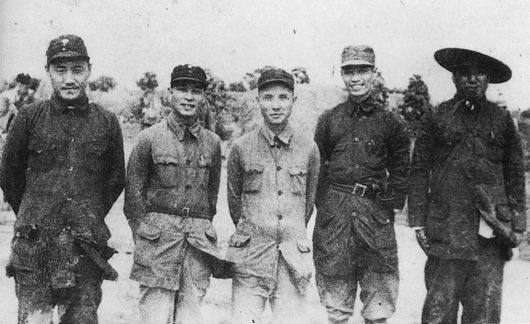
3. Master of Henan in the Consolidation Decade (1949–1957)
On the eve of the People's Republic, Wu served as a vice-chairman of the Central Plains Provisional People's Government, and then as vice-chairman and chairman of the Henan Provincial People's Government. In the official sequence of posts he became chairman of the Henan government in May 1949; when the institution was reorganized in January 1955 he continued as governor of the Henan Provincial People's Committee, and he held the governorship until July 1962 — thirteen years, making him both the first and one of the longest-serving heads of government in the province's modern history. Within the Party he served as Second Secretary of the provincial committee, under First Secretaries Zhang Xi and then Pan Fusheng.
Those were the years of land reform, the suppression of counterrevolutionaries, unified state purchase and sale of grain, and the collectivization of agriculture. As head of the provincial government Wu was the executor of each of these campaigns in Henan. During the collectivization "high tide" of 1955–56 the first recorded policy divergence appeared between the two men at the top of the province: Pan Fusheng was relatively cautious about the speed of the advance, while Wu pressed forward. Frank Dikötter, in Mao's Great Famine, notes that Pan had painted a grim picture of collectivization during the Socialist High Tide — a picture for which he would later be punished as a "right opportunist." At the time the disagreement was still a matter of tempo argued inside the committee room. But it established the alignment that would matter in 1957: a moderate First Secretary, and a Second Secretary whose instincts ran the other way and whose career, when the political weather changed, stood to gain from his superior's fall. Research on this decade of Wu's tenure remains comparatively thin, because the archives that have been opened and the memoirs that have been published concentrate overwhelmingly on 1957 and after. This page therefore records the posts and the one well-documented divergence, and does not pretend to a fuller account than the sources support.
4. The Anti-Rightist Campaign, the "Pan-Yang-Wang" Purge, and the Poisoning of Henan's Political Air (1957–1958)
The Anti-Rightist Campaign of 1957 turned the tempo dispute between Pan Fusheng and Wu Zhipu into a line struggle with a winner and a loser. The fullest account of the mechanics comes from Yao Jianfu, a former official of the Ministry of Agriculture, whose essay "An Unforgettable Bloody Case: The Inevitability Linking the Anti-Rightist Struggle and the Great Famine" (2008) was based on his 2006 interview with Wang Tingdong, one of the purged men. According to Yao's account, Wu, then Second Secretary, sought to have Pan labeled a "rightist" or even an "extreme rightist"; the Center did not approve that designation. But at the Second Session of the Eighth Party Congress in May 1958, Wu rose unexpectedly and denounced Pan as a "right opportunist" — and Mao Zedong, presiding, applauded. The applause settled the matter. Pan was removed, and Wu was appointed First Secretary in his place.
What exactly was Pan's "rightism"? Yao's summary of the charges is a catalogue of moderation: Pan held that rightists should not exceed two percent of those taking part in the movement; that the Anti-Rightist Campaign should not be extended below county level; and he defended a set of rural policies — private plots, privately raised livestock, contracting work and output to households, free markets, planting trees on small waste plots under individual ownership — whose practical purpose was to give peasants incentives to produce. Wu's campaign against the "Pan-Yang-Wang anti-Party clique" (Pan Fusheng; Yang Jue, a provincial secretary; and Wang Tingdong, a provincial committee member and deputy secretary-general) reclassified each of these as crimes of line: private plots became the "theory of the superiority of the small-peasant economy," opposition to unified purchase became a "rightist error," and the whole package was condemned as a program for developing capitalism. After the main purge came a supplementary "make-up lesson" of the Anti-Rightist Campaign across the province: some 70,000 people in Henan were labeled rightists, about fourteen percent of the national total of roughly 550,000, and about fifteen percent of the province's cadres.
The consequences of this purge for what happened next are stated with unusual bluntness by a man who lived through both events. Zhang Shufan, the prefectural commissioner of Xinyang, wrote in his posthumous memoir "The Xinyang Incident: A Painful Historical Lesson" that after the anti-Pan-Yang-Wang affair, "little Pan Fushengs" were hunted everywhere in the province; from then on everyone felt personally endangered, many people "told lies with their eyes wide open," and the winds of exaggeration and reckless command blew up across Henan. The point is structural, and this page underlines it: long before the grain figures were falsified on a mass scale, the political price of telling the truth had been deliberately raised. A First Secretary had been destroyed for speaking of low figures and for wanting to leave peasants a private plot; his replacement was the man who had denounced him. Every cadre in Henan could read that lesson, and in the harvest-reporting meetings of 1958 and 1959 they acted on it. The sources for this section are principally Yao Jianfu's interview-based essay and Zhang Shufan's memoir — testimony from the victims' side of the purge. The provincial committee's own campaign documents have never been published, and this page therefore attributes each claim to its source rather than presenting any side's account as uncontested fact.
5. Taking the First Secretaryship: "The Philosophy of the Leap" (1958)
On 18 May 1958 the Central Committee notified the Henan Provincial Committee: Pan Fusheng was removed as First Secretary, and Wu Zhipu would succeed him. In the formal sequence of posts Wu's tenure as provincial Party secretary runs from August 1958 to July 1961, concurrently with the political commissarship of the Henan Military District; from February 1959 he also chaired the provincial CPPCC. Party, government and army in Henan were now headed by one man — he remained governor throughout — and no institution at his own level existed that could check him.
Two months earlier, at the Chengdu Conference of March 1958, Wu had already staked out his position. Speaking for Henan, he proposed bringing production targets forward and achieving the "four transformations" within a single year. According to the conference record, Mao on 20 March responded to Henan's targets — the "four-five-eight" grain formula, universal water conservancy, elimination of the four pests, elimination of illiteracy — by saying Henan could be allowed to experiment for a year, and that if it worked, other provinces could follow the next year; Mao also cautioned that achieving all of it in one year might have "very great shortcomings," producing rough work and excessive strain on the population. Henan took the license and ignored the caution. In 1958 Wu published "The Philosophy of the Leap Forward and the Leap Forward of Philosophy" in the journal Philosophical Research (no. 6, 1958; reprinted in the Henan Daily on 19 October) — a provincial First Secretary writing the philosophical brief for the Leap in his own hand. Contemporaries grouped him with Sichuan's Li Jingquan and Anhui's Zeng Xisheng among the "Kings of the Left," the provincial chiefs competing to outbid one another in radicalism. Dikötter describes Wu as one of Mao's most zealous followers, heralding a "continuous revolution" to crush rightist opponents and leap forward.
In communization, Henan ran ahead of the whole country. In April 1958 the Chayashan "Sputnik" People's Commune in Suiping County was established — widely regarded as one of the first people's communes in China — and the Qiliying People's Commune in Xinxiang was another early model. On 6 August 1958 Mao inspected Qiliying and spoke approvingly of the communes; by the end of August, Henan had completed communization across the entire province, the first province in China to do so. Communization arrived together with the universal communal canteen: peasants' grain, cooking pots and in part their houses passed into collective hands; meals were eaten in the canteen, and grain was controlled by cadres. In a normal year the canteen could sustain an appearance of abundance. But the institution had a lethal property that only became visible when procurement emptied the stores: the peasant simultaneously lost every private means of survival — no stored grain, no pot, and no legal right to leave. This institutional chain, built first and fastest in Wu Zhipu's Henan and promoted nationally as Henan's experience, is the necessary premise for understanding why so many people starved in Xinyang eighteen months later.
6. The Fabricated Numbers: Inflated Output and Excessive Procurement (1958–1959)
The procurement system of the Great Leap contained a fatal mechanism: the state's procurement quota for each locality was assessed on the output that the locality itself reported. Report more, and more would be taken; report honestly, and be branded a rightist. In Henan this mechanism was driven to its extreme. The figures compiled by Yao Jianfu are as follows. Henan's actual grain output in 1958 was 28.1 billion jin; it was reported as 70.2 billion jin. For 1959 the sources differ on the actual figure — Yao gives 19.49 billion jin, another account gives 21 billion jin — while Wu Zhipu's official estimate stood at 45 billion jin. In both years the reported figure was more than double the real harvest. The American historian Ralph Thaxton, in Catastrophe and Contention in Rural China, records the same structure of fraud for the province — the 45-billion-jin claim against a real harvest at the 28.1-billion-jin level — although in secondary English transmission the two years' figures are sometimes conflated, and one widely copied reference even misprints the unit as "450 million jin," a hundredfold error against the Chinese sources' 45 billion. This page follows the Chinese primary transmissions: the core fact — real output less than half the reported figure, procurement assessed on the reported figure — is consistent across all sources, while the exact actual-harvest figure for each year is archived in parallel, unmerged.
Xinyang Prefecture was where the arithmetic drew blood. Xinyang's real grain output in 1959 was about 2 billion jin. County by county, the reported figures were padded upward and aggregated to 7.2 billion jin. Zhang Shufan, a secretary of the prefectural committee, argued that even 3 billion jin was the ceiling of honesty — and was punished for it. In the end the prefectural committee reported 5 billion jin to the province, and the province, working from the inflated figure, assigned Xinyang a procurement quota of 900 million jin: nearly half the prefecture's real harvest, before seed grain and fodder. When the quota could not be met out of a harvest that did not exist, the shortfall was reinterpreted as concealment by the peasants — "hiding output and dividing it privately" — and so the anti-concealment campaign began. The numbers were not statistical error; they were a transmission chain. The provincial committee set the tone at reporting meetings, the prefecture padded under pressure, the counties padded again, and every jin of fiction in the final figure had to be extracted, in physical grain, from the mouths of farming households.
The Lushan Conference of July–August 1959 briefly opened a chance to correct course. Instead, Peng Dehuai's private letter of opinion triggered the Anti-Right-Deviation Campaign, and the wind reversed. Wu Zhipu returned from Lushan carrying the east wind of anti-right-deviation: accounts of the period describe continued escalation in Henan, punishment for those who failed to deliver grain, and houses demolished in collection drives. Zhang Shufan's memoir records that in August 1959, when he reported Xinyang's real output honestly, the province was implementing Lushan's anti-right-deviation line — and the honest reporter promptly became the prefecture's model case of right deviation, held up for criticism as a warning to others. At the provincial standing-committee discussion of Xinyang's output, the figure climbed from the real harvest to 7.2 billion jin with eight of nine members in favor. This detail comes from later retrospective accounts and is archived here as such; but what it shows is important. The falsification was not one man's lie. It was a collective act performed by vote — under rules set, meetings chaired, and sanctions against dissenters imposed, by the provincial First Secretary himself.
7. The Xinyang Incident, Part One: From Anti-Concealment to Cannibalism (Winter 1959 – Spring 1960)
Xinyang Prefecture, in southeastern Henan on the borders of Hubei and Anhui, administered eighteen counties, the city of Xinyang and the town of Zhumadian in 1958, and was home to 8.5 million people. It was one of Henan's principal grain-producing regions. Between the winter of 1959 and the spring of 1960 it became the most completely documented — and one of the most lethal — local catastrophes of the Great Famine, known thereafter as the Xinyang Incident. Yang Jisheng opens Tombstone, his monumental history of the famine, with Xinyang: from the winter of 1959 to the spring of 1960, at least a million people starved to death there, one out of every eight residents.
The immediate mechanism was the anti-concealment campaign. After the autumn harvest of 1959, procurement was organized at every level — Center, province, prefecture, county — under the "four simultaneities": harvest, thresh, procure and store at the same time. When the quotas still could not be filled from a fictitious harvest, the authorities concluded that the grain existed and was hidden in peasants' homes. The anti-concealment campaign followed: house searches, raids on stored grain, and beatings to force disclosure. The most damning documentation comes from inside the apparatus itself. The collection Bloodbath: Confessions of the Xinyang Incident, edited by Yu Xiguang, gathers fifty-eight self-criticisms and confessions written afterwards by responsible officials of the provincial, prefectural, county and commune levels. By the perpetrators' own accounting, in the roughly six months from the post-Lushan anti-concealment drive to April 1960, some 1.07 million people in the prefecture starved or died of hunger-related disease; 80,000 were beaten to death or driven to death in the drive for grain; more than five million fell ill from hunger; over 50,000 households were extinguished entirely; more than 10,000 villages were destroyed; and 210,000-plus draft animals died. These are the figures of the responsible officials' own confessions — an internal accountability accounting, not an outside estimate — and they are of the same order of magnitude as Yang Jisheng's independent investigation (see the figures section below, where all versions are archived in layers).
The violence was not the excess of a few cadres. Yang Jisheng's account of Guangshan County records 2,241 people beaten, 105 of them fatally, and 526 cadres removed from their posts in subsequent discipline; in that county the great majority of commune-level cadres personally took part in beatings. Yang quotes the Xinhua reporter Lu Baoguo, who rode a long-distance bus from Xinyang to Luoshan and Gushi in the second half of 1959: corpse after corpse in the ditches outside the window, and no one on the bus daring to mention the dead; in Guangshan County a third of the population had died, while local leaders still ate well and drank fine liquor. Other testimony records people starving to death at the doors of full granaries, crying out to the Party and to Chairman Mao to save them: the grain was there, but without a requisition order from above, not a single jin could be released. At the famine's depth, Xinyang recorded cases of cannibalism; a classical-Chinese summary of the incident, compiled from the internal figures, states the outcome in seven characters — people ate people, and the dead were eleven or twelve in every hundred.
8. The Xinyang Incident, Part Two: Blockade, Militia, and the Ban on Fleeing Famine
What distinguishes Xinyang from an ordinary famine is that it was not only an absence of food. It was an absence of food combined with an organized system for preventing the news from getting out and the starving from getting away. Multiple accounts converge on the machinery: checkpoints on the roads out of the prefecture; militia posted at railway and bus stations; famine refugees intercepted, sent back, or taken into custody as vagrants; outgoing mail inspected and letters describing the disaster confiscated; cadres ordered to seal information, and visiting superiors shown model sites. At the Jigongshan meeting of 1959 the prefectural leadership defined three things to be stopped: the masses lodging complaints, people fleeing outward, and canteens closing down — the three natural symptoms of famine, each redefined as enemy activity to be suppressed.
The canteen was the hinge of the system. Once a canteen ran out of grain, regulations still forbade households to cook at home, and in some places private cooking was punished as sabotage of the canteen system — while procurement teams continued to search house by house for hidden grain. The starving were thus locked to the land: no food, no travel permit, no channel of complaint. Those who did escape were returned to their home villages under the household-registration system, and a home village without grain made repatriation close to a death sentence. Yang Jisheng records that many died of hunger or abuse in custody and in the course of forced return. Reporting on Tombstone in 2013, The Guardian made the same point for an international readership: in Xinyang, the city at the center of the disaster, those who tried to escape the famine were rounded up, and many died of starvation or brutality in detention.
How far did the blockade reach upward? According to Zhang Shufan's memoir, when the central investigation team on Xinyang — designated by Mao at the end of 1960 — arrived in Henan at the beginning of 1961, Wu Zhipu arranged for the investigators to be lodged in Yanling County, in Xuchang Prefecture, and the team never saw the starvation-stricken reality of Xinyang. This detail rests on Zhang Shufan's testimony alone; no public statement from Wu's side addresses it, and this page archives it under his name as its source. But it is consistent with the blockade's logic at every level of the incident: from county to province, the first institutional reflex was to control the flow of information, and only afterwards — if at all — to save lives. Not until 6 April 1960 did the Henan Provincial Committee submit to the Center its "Self-Critical Report on the Occurrence of Edema and Deaths in the Xinyang Region" — nearly half a year after mass death had begun.
9. The Death Toll, Archived in Layers
This page does not merge the death figures for Xinyang into a single authoritative number. It archives them by source, in layers. Layer one, the perpetrators' internal accounting: the confessions and self-criticisms collected in Bloodbath give 1.07 million starved or dead of hunger-related disease, with a further 80,000 beaten or driven to death. Layer two, the Center's internal check after investigation: the classical-Chinese summary of the incident records a verified figure of 1.05 million dead, out of a Xinyang population of 8.08 million — about eleven to twelve percent. The two layers are close in magnitude but independent in provenance. Layer three, Yang Jisheng's investigation in Tombstone: a population of 8.5 million, and from the winter of 1959 to the spring of 1960 at least one million starved to death — one in eight. Yang also cites Li Jian, the Central Control Commission official sent to Henan after the famine, whose finding was that the largest numbers of starvation deaths occurred in Xinyang and two other prefectures, Nanyang and Xuchang. Layer four, international media transmission: The New Yorker, in Pankaj Mishra's review, relayed Yang's figure as "a million people out of a population of more than eight million" fallen victim to Maoist experimentation; The Guardian in 2013 wrote of more than a million people wiped out by starvation and brutality over three years in the Xinyang area. Layer five, local proportions: the report, transmitted through the Xinhua reporter Lu Baoguo's recollection, that a third of the population of Guangshan County died.
The province-wide figures are layered in the same way. Xu Ming's study "Wu Zhipu and the Great Leap Forward Movement in Henan" (Twenty-First Century, August 1998) estimates that Henan, after the Leap's collapse and the great retreat of production, suffered more than two million unnatural deaths. At the national level, Yang Jisheng estimates roughly 36 million unnatural deaths in the famine; Dikötter estimates at least 45 million; the population decline confirmable from official statistics is smaller than either. The methods differ — perpetrators' confessions, demographic reconstruction, archival investigation — and this page's position is that the magnitude on which they converge is not in substantive dispute: over a million dead in Xinyang alone, over two million in Henan. The disagreements live in the hundred-thousands digit, and any presentation that elevates one of these figures into the sole truth is a falsification of the archive by simplification.
Finally, the dead whom no layer counts directly. The confession materials record more than 50,000 households extinguished and more than 10,000 villages destroyed. A household extinguished means no survivor to report the deaths and no witness to testify; that portion of the mortality enters every layer only by demographic inference. And the 80,000 beaten or driven to death deserve their separate line, because in most popular accounts they are folded silently into "starved." They did not die of a shortage of grain. They died of the violence used to extract it.
10. The Center Intervenes: Framing, Blame and Relief (1960–1961)
On 23–26 October 1960 Mao Zedong called in the leaders of the greater administrative regions to hear reports on agriculture, and Wu Zhipu reported on the Xinyang Incident. According to the chronology appended to the English edition of Tombstone, Mao attributed the disaster to the local level's "inadequate thoroughness of the democratic revolution." On 26 October Mao read a report on Xinyang by four central investigators and issued a short instruction; the verdict that followed framed the incident as a "counter-revolutionary restoration" in which class enemies had seized local power. The framing had a long shadow. It wrote the lesson of Xinyang as a story of bad men usurping power rather than of policy and procurement killing people; it converted the responsibility of the province's rulers into "failure to detect" and "having been deceived"; and it designated the prefectural and county levels as the stratum that could be criminally punished. Lu Xianwen, the Xinyang prefectural First Secretary, was in the end sentenced by the Henan Higher People's Court — judgment (63) Yu Fa Xing Yi Zi No. 15, of 1963 — one of the heaviest judicial traces left by an incident in which more than a million people died. Most provincial and prefectural principals, by contrast, wrote self-criticisms and made confessions, and were handled inside the Party.
Alongside the framing, the Center also acted in material terms: grain was transferred into Henan, detained refugees were released, canteens and procurement were reined in. Zhou Enlai is recorded in several accounts as arranging emergency grain transfers for the Henan disaster. In the winter of 1960 the Center issued its directive on rectifying the "five winds" — the Communist wind, the exaggeration wind, the commandist wind, the cadre-privilege wind and the blind-direction wind — and Xinyang underwent a rectification campaign in which Lu Xianwen and other prefectural cadres were dealt with. In January 1961 Wu Zhipu, on behalf of the provincial committee, began a self-examination of the leftist, reckless errors committed since the Great Leap. These measures stopped the dying from spreading further; but by the time they arrived, Xinyang's worst winter was already over.
Around the Seven Thousand Cadres Conference — the enlarged Central Work Conference of January–February 1962 — Henan's settlement entered its final stage. It must be stated plainly that no complete public record exists of Wu Zhipu's own speeches or of the discussion of his case at that conference, and this page does not invent them. What can be verified is the sequence of organizational actions taken around it, set out in the next section. At the conference itself, Liu Shaoqi delivered the Party's general verdict on the famine — thirty percent natural disaster, seventy percent man-made error. For Wu personally, accountability never went beyond intra-Party handling.
11. Removal, Cultural Revolution Persecution, and Death in Guangzhou (1961–1967)
In February 1961 the Center transferred Wen Minsheng, a Guangdong provincial secretary, to Henan as standing secretary, and Liu Yangqiao from Hubei as provincial secretary and secretary-general. In July 1961 Liu Jianxun, the First Secretary of Guangxi, was transferred in as Henan's First Secretary, and Wu Zhipu was demoted to Second Secretary. Liu Jianxun set about disaster relief and rectification, earning the popular title "Secretary of Disaster Relief." In April 1962 Wu was removed from all his Henan posts and transferred to the CCP Central-South Bureau as a secretary for culture and education. In the same month the Henan Provincial Committee issued its "Resolution on the Rehabilitation of Comrade Pan Fusheng's Right-Opportunist Error" — the man Wu had destroyed four years earlier was formally cleared, while Wu himself was simply transferred away. His governorship passed to Wen Minsheng in July 1962. Xu Ming's study records, with the hedge "it is said," that at a criticism meeting over the Xinyang Incident Wu confessed: "The debt I owe the fifty million people of Henan can never be repaid in my lifetime." The sentence is widely quoted; no minutes of the meeting have been published, and this page archives it as reported speech, at the evidentiary level of hearsay.
The transfer to the Central-South Bureau ended Wu's political life in fact, but no formal verdict closed his file: he retained his seat on the Eighth Central Committee, was not expelled from the Party, and was never publicly named and criticized by the Center. Then, in 1966, the Cultural Revolution reopened every old account. Because he bore "direct and grave leadership responsibility" for the Great Leap and the Xinyang Incident, Wu was designated a "capitalist roader" and fiercely denounced by rebel factions. Mass organizations in Henan set up a dedicated "Liaison Station for Seizing Wu Zhipu" and sent people to Guangzhou to drag him back to Henan for struggle sessions; the cross-provincial seizure failed, but inside the Central-South Bureau organs in Guangzhou he was repeatedly struggled against and put under supervised labor by local rebels.
On his death, the public record offers two versions, which this page archives in parallel and refuses to merge. Version one, the Chinese official and encyclopedic account: Wu Zhipu died of illness in Guangzhou on 19 October 1967, aged sixty-one. Version two, the English-language reference account: the Palgrave Encyclopedia of Imperialism and Anti-Imperialism (2021) states that Wu was tortured and died during the Cultural Revolution, partly because of his role in the famine; the English Wikipedia follows this account. The two versions differ on the nature of the death — natural illness, or death under persecution — not on its time and place, which agree: 19 October 1967, Guangzhou. Until Guangzhou's archives and the medical records of the time are opened, any presentation of either version as the sole fact goes beyond the evidence. What this page can state is the narrower, fully supported fact: he died during the period of his struggle sessions and supervised labor, at the age of sixty-one.
12. The 1979 Rehabilitation and the Two Posthumous Verdicts (1979–2006)
In 1979 the CCP rehabilitated Wu Zhipu and classified him as a "victim of the Cultural Revolution." The precise meaning of that verdict needs unpacking. What it revoked was the "capitalist roader" designation and the persecution inflicted on him after 1966, under the general post-Mao policy toward cadres wronged in the Cultural Revolution. It did not — and within its own terms could not — adjudicate his responsibility for 1958 to 1960. Yet in official commemorative writing the boundary is routinely blurred: after rehabilitation, Wu was written back into the ranks of the "old revolutionaries," and the earlier record faded. In 2006, the centenary of his birth, the Central Party Literature Press published the memorial volume Commemoration of the Centenary of Wu Zhipu's Birth; of its eleven parts, the first seven present his revolutionary career and contributions in each period, parts eight and nine carry the memorial and commemorative texts, and parts ten and eleven reproduce his handwriting and a chronicle of his life.
Against the official commemoration stands a parallel, archive-based accounting. Xu Ming's 1998 study reconstructs Wu's promotion of high targets, the exaggeration wind and excessive procurement in Henan, and estimates the province's unnatural deaths at more than two million. Yang Jisheng's Tombstone (Hong Kong, 2008) opens with a chapter entitled "Disaster Rises in the Central Plain," taking Henan and Xinyang as the starting point of the entire national catastrophe and naming Wu among its core responsible figures. Dikötter's Mao's Great Famine (2010), built on provincial archives, sets Wu against the man he destroyed: Pan Fusheng the purged moderate, Wu Zhipu the ascendant zealot. And Zhang Shufan's memoir preserves the folk verdict in a Henan rhyme: "Follow Pan Fusheng, eat a jin a day; follow Wu Zhipu, and suffer without end." None of this critical literature can appear in mainland publication alongside the official memorial volume: Tombstone is banned in mainland China, and Xu Ming's study appeared in a Hong Kong journal.
This site's archival method is to insist that the two questions are different questions. The rehabilitation document answers the question "how did the Cultural Revolution treat him?" The archival scholarship answers the question "what did he do between 1958 and 1960?" The first answer cannot cancel the second. A man classified in 1979 as a victim can simultaneously be the principal provincial leader responsible for an incident in 1959 in which more than a million people died. On this page both propositions stand, each labeled with its sources.
13. Beyond Xinyang: The Disaster Across Henan
Xinyang is the best-documented disaster zone in Henan, but it was not the only one. Li Jian, the Central Control Commission official who investigated in Henan, found that the three prefectures with the largest numbers of starvation deaths were Xinyang, Nanyang and Xuchang. Xu Ming's province-wide estimate of more than two million unnatural deaths implies that a further million and more died outside Xinyang under the same mechanism: output falsely reported, procurement assessed on the false figures, anti-concealment violence to extract grain that did not exist, canteens emptied, flight blocked. The machinery ran in every prefecture and county of the province; most localities simply left no confessions and no investigation files comparable to Xinyang's.
At the micro level, Ralph Thaxton's Catastrophe and Contention in Rural China follows a single village in the Luoyang region — Da Fo Village — through the famine and into the memory of resistance it left behind: how procurement teams entered the village, how the canteen distributed what remained, how villagers hid grain and dug wild vegetables, how cadres under pressure chose self-preservation. Village history of this kind complements Xinyang's macro figures, because it shows where a number approved by vote in a provincial committee meeting was finally cashed out: at the stoves and grain jars of individual households. No record connects Wu Zhipu personally to Da Fo Village, and this page cites Thaxton's book for one purpose only — to show the far end of the transmission chain of policies Wu chaired and enforced at provincial level, so that "the First Secretary bears leadership responsibility" does not remain an abstract organizational formula.
The aftermath lasted years. Liu Jianxun, succeeding in 1961, rebuilt Henan under the sign of relief: detained refugees released, private plots and household sidelines restored, procurement corrected — measures that were themselves a factual repudiation of his predecessor's policies. The provincial committee's 1962 rehabilitation of Pan Fusheng amounted to an admission, inside the Party's own system, that the comparatively moderate line destroyed in 1957–58 had been the correct one. But by the time these corrections were made, Wu Zhipu had already been transferred away. He never stood before Henan's cadres as its First Secretary to give a public, on-the-record accounting of the disaster. All that is documented is the reported sentence about a debt that could never be repaid.
14. The Henan Model, Exported
Henan under Wu Zhipu was not merely a province that suffered the Leap; it was a province that advertised it. The Chayashan "Sputnik" Commune in Suiping took its very name from the Soviet satellite, claiming for a Chinese village the prestige of having overtaken history first. Communes across the country were reported in the press as "launching satellites" — the era's term for announced record harvests — and Henan's reporting meetings, its canteen coverage, and its speed of communization were held up as proof that the province had found the road. When Mao stood in the Qiliying Commune in August 1958 and approved what he saw, the approval radiated outward through the whole system: other provinces sent delegations to Henan, and Henan's cadres understood that their First Secretary's standing in Beijing rested on the province's remaining, in the language of the time, "red and expert" — politically advanced and statistically spectacular.
This export function matters for assigning responsibility, because it dissolves the defense that Henan's leaders were passive executors of orders from above. The orders from above were real — the Leap was Mao's project, the Chengdu license to experiment was Mao's grant, and the reversal at Lushan that crushed the last chance of correction was Mao's doing. But within that frame, provincial leaders competed. Dikötter's account of the period is built around this competition: moderate leaders like Pan Fusheng were swept aside precisely because the system rewarded the Wu Zhipus, who bid higher, reported more, procured harder, and policed dissent earlier. The "philosophy of the Leap" article is the documentary trace of that competition: a First Secretary did not have to write philosophy to keep his post. He wrote it to advance — to convert a provincial administration into an ideological brand. The cost of the brand was paid in the prefectures, and in Xinyang it was paid in the currency this page has recorded: a procurement quota set at nearly half of a real harvest that the province's own inflated figures had conjured out of air.
It is also worth recording what Henan's radicalism did to the province's own information system before the famine even began. The supplementary Anti-Rightist Campaign of 1958 labeled some 70,000 people in a single province — a rate far above the national pattern — and the hunt for "little Pan Fushengs" taught every county and commune cadre the same curriculum: the man who reports a low figure will be replaced by the man who reports a high one, and the high figure will be believed because belief is safer. By the time the 1959 harvest was gathered, there was no channel left in Henan through which the truth about the harvest could travel upward intact. Each level of the chain — team, brigade, commune, county, prefecture — faced the same incentive and made the same choice, which is how a real harvest of two billion jin in Xinyang arrived at the provincial capital as a claim of five, and in some retellings seven, billion. Systems of this kind do not require a single liar at the top. They require a top that has made lying the condition of survival, and that was the specific, personal work of the campaign of 1957–58 that Wu Zhipu led and from which he took his office.
15. Memory, Silence, and the Unfinished Reckoning
Unlike some catastrophes of the Mao era, the Xinyang Incident was investigated while the corpses were still being counted, and the paper trail it left is unusually rich: investigation reports to the Center, a provincial self-criticism, fifty-eight confessions by responsible officials, a criminal judgment against the prefectural First Secretary, and a prefectural commissioner's memoir that survived to be published in a Party history journal in 1999. That an archive exists at all is why this page can be written at its present length and confidence. But the archive has a shape, and the shape has a politics. The documents were produced by a system deciding how much of the truth it needed in order to restore control, and they stop where the system's own survival began: at the provincial boundary. Below Wu Zhipu, men confessed, were demoted, were imprisoned. At Wu's level, the record thins to transfers, demotions and reported remarks. Above him, in the Center that set the targets, applauded the purge of the moderate, reversed course at Lushan and then framed the disaster as a counter-revolutionary restoration, the record was managed most carefully of all. The historian's task with such an archive is not to lament its gaps but to read them as evidence in themselves — and to say, as this page has tried to say at each step, exactly which facts stand on documents, which stand on testimony, and which stand on nothing public at all.
In Henan itself, public memory of Wu Zhipu remains double. The official centenary volume of 2006 commemorates a revolutionary of the underground, the base areas and the construction years; in the villages of the southeast, the rhyme preserved by Zhang Shufan — a jin a day under Pan, suffering without end under Wu — carries the other memory, the one that never found a publisher in the province where it was earned. Between those two memories stands the finding of the researchers: that the famine in Henan was not a visitation but a sequence of decisions, taken by identifiable men, in identifiable meetings, against warnings that were spoken aloud and punished. Wu Zhipu made more of those decisions, over more years, with fewer checks upon him, than any other person in the province. He acknowledged a debt he said he could never repay. The archive this page assembles — the figures in their layers, the confessions in their own words, the two versions of his own death left respectfully unmerged — is offered as the closest thing to a ledger of that debt that the public record currently allows.
16. Verification and Sources
The facts on this page were cross-checked across multiple independent sources. Principal sources: Xu Ming, "Wu Zhipu and the Great Leap Forward Movement in Henan," Twenty-First Century bimonthly, August 1998 — the source for the inflated Henan output figures, the transfer sequence, the reported "debt" confession, and the estimate of more than two million unnatural deaths in Henan. Yang Jisheng, Tombstone: The Great Chinese Famine, 1958–1962 (Hong Kong 2008; English edition 2012) — Xinyang's population of 8.5 million, at least one million deaths, the Guangshan County beating figures, and the October 1960 session at which Wu reported to Mao. Zhang Shufan, "The Xinyang Incident: A Painful Historical Lesson," Bainian Chao, no. 12, 1999 — the punishment of an honest output report and the memoir claim that the central investigation team was lodged in Yanling. Yao Jianfu, "An Unforgettable Bloody Case" (Berkeley digital collections) — the anti-Pan-Yang-Wang purge, the 70,000 rightists, and the detailed 1958–59 output figures. Yu Xiguang (ed.), Bloodbath: Confessions of the Xinyang Incident — the internal accounting of 1.07 million and 80,000 deaths. Frank Dikötter, Mao's Great Famine (2010) — the Pan–Wu contrast. Ralph Thaxton, Catastrophe and Contention in Rural China (Cambridge University Press, 2008) — the English-language scholarly transmission of the output fraud and the village-level record. The Guardian, 1 January 2013, and Pankaj Mishra's review in The New Yorker — international media transmission of the Xinyang death toll. The Palgrave Encyclopedia of Imperialism and Anti-Imperialism (2021) — the "tortured and died" version of Wu's death. The Chinese and English Wikipedia entries on Wu Zhipu were used only as leads for the sequence of posts and dates; every key fact was verified against the sources above.
Two corrections to the brief from which this page was commissioned are recorded here. First, Wu Zhipu was not Henan's First Secretary "1952–1962": he succeeded Pan Fusheng in May 1958 (formal tenure August 1958 – July 1961), having previously been Second Secretary; in 1952 he was governor and Second Secretary. Second, his governorship ran from May 1949 to July 1962, through the 1955 institutional renaming, not over any shorter span. Matters for which no public source exists — Wu's own speeches at the Seven Thousand Cadres Conference, the medical record of his death in Guangzhou, and any statement from Wu's side on the Yanling lodging of the investigation team — are marked on this page as "no public record" or archived under a single named source, with nothing supplied by invention. This page will be revised as new archival material becomes public; when a revision is made, the superseded wording is retained alongside the correction, so that the process of correction itself becomes part of the archive.
Contact: endccpworld@proton.me