
Wang Qishan (1948- )
The executor of Xi Jinping's anti-corruption campaign: CCDI secretary from November 2012 to October 2017, he ran twelve inspection rounds, full stationed coverage and the punishment of some 1.34 million people. The shuanggui system he operated was documented by Human Rights Watch as a machine of extra-legal detention and torture, with deaths in custody on his watch — yet he has never faced any accountability, and has no US or UK sanctions designation.
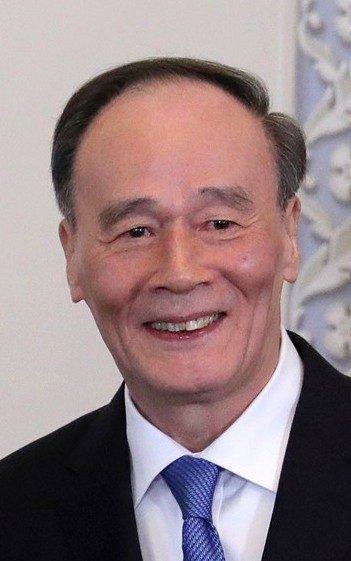
Career: a historian, a "firefighter", and a forty-year climb
Wang Qishan's birth record has to start with the conflict, not with a tidied-up answer. The official CCP resume formula is "born July 1948, from Tianzhen, Shanxi" — a statement of ancestral origin that gives a month and a year but no day and does not unambiguously state a birthplace. English-language Wikipedia and several English biographies give 19 July 1948, born in Qingdao, Shandong, with an ancestral home in Tianzhen, Shanxi. Encyclopaedia Britannica says he was born in Shanxi province. Cheng Li's elite file at the Brookings Institution gives Tianzhen in its main text, then footnotes that some unofficial biographers say he was born in Qingdao and that Tianzhen was his ancestral home. This site's treatment: the month and year — July 1948 — are the agreed, verifiable core; the specific day, 19 July, rests on biographical sources only; the birthplace is presented as disputed, with neither Qingdao nor Shanxi promoted to fact. Biographical sources also describe his father as an engineering professor; that, too, is second-hand and is noted here as background, not conclusion.
In January 1969 Wang was sent down to Fengzhuang commune in Yan'an County, Shaanxi (today's Baota District, Yan'an), as a rusticated youth. Xi Jinping spent 1969 to 1975 as a sent-down youth in Liangjiahe, in neighbouring Yanchuan County. Multiple profile writers record that the two men met in the Yan'an years; the much-retold details — Xi visiting Fengzhuang, the two sharing a kang bed — come from magazine profiles, not archival documents, and this site cites them at that level: acquaintance in the Shaanxi years is consistently reported by serious outlets; the intimate details cannot be independently verified and are not treated as established fact. The episode belongs in this file anyway, because forty years later it was Xi who, in 2012, handed Wang the discipline apparatus — and the personal trust behind that choice is part of how the campaign that followed must be understood.
From 1971 Wang worked at the Shaanxi Provincial Museum. In the 1970s he studied history at Northwest University; the official resume records him as a graduate of its history department, a historian by training who later held the title of senior economist, and on this the sources agree. After 1979 he moved through posts connected with the Institute of Modern History of the Chinese Academy of Social Sciences and then into the Central Committee Secretariat's rural-policy research office and the State Council's Rural Development Research Centre, spending years in the rural-reform research system headed by Du Runsheng. That background shaped the first main line of his career: he did not climb the ladder as a territorial administrator, rung by rung, but rose as a technocrat out of policy research and financial reform.
In the late 1980s he ran the China Agricultural Trust and Investment Corporation, among other posts. In 1989 he became a vice-governor of the China Construction Bank; in 1993, a deputy governor of the People's Bank of China; from 1994 to 1997, governor (president) of the China Construction Bank. His marriage is also a matter of public record from this period: his wife, Yao Mingshan, is a daughter of former Vice-Premier Yao Yilin; they have no children. Some foreign researchers count him a "princeling by marriage" on that basis; this site records the family connection itself, which is verifiable, and draws no further inference from it.
At the end of 1997 he was sent to Guangdong as a provincial standing committee member, and from 1998 to 2000 he served as executive vice-governor — just as the aftershocks of the Asian financial crisis hit. Guangdong International Trust and Investment Corporation (GITIC) was insolvent; it was closed in October 1998 and entered bankruptcy in 1999, then the largest financial-institution failure in Chinese history. Wang ran Guangdong's financial clean-up and the GITIC and Yuehai debt workouts, and it was there he acquired the label that followed him for twenty years: "the firefighter", the man sent in when something is already burning. From 2000 to 2002 he was back in Beijing as director of the State Council's Economic Restructuring Office. In November 2002 he became party secretary of Hainan and chairman of its provincial people's congress standing committee, sent to deal with the wreckage of the island's property bubble — but he stayed only about five months.
In April 2003, SARS was out of control in Beijing and Mayor Meng Xuenong was dismissed for covering up the epidemic. On 20 April 2003 Wang was rushed into the capital as deputy party secretary and acting mayor; under him, Beijing began publishing daily epidemic figures. In early 2004 he was confirmed (elected) as mayor, serving until he left the post on 30 November 2007. As mayor he was also executive chairman of the Beijing Olympic organizing committee, running the first half of the preparations for the 2008 Games; in March 2005 he apologized on live local radio to Beijing residents for a natural-gas supply shortage — rare behaviour for a senior Chinese official at the time, and widely reported. One boundary should be recorded at the same time: within the scope of this site's checking, no persecution event directly tied to this file's subject occurred under his Beijing administration. His ledger of responsibility begins in 2012, when he took over the discipline system; this section records ascent, nothing more.
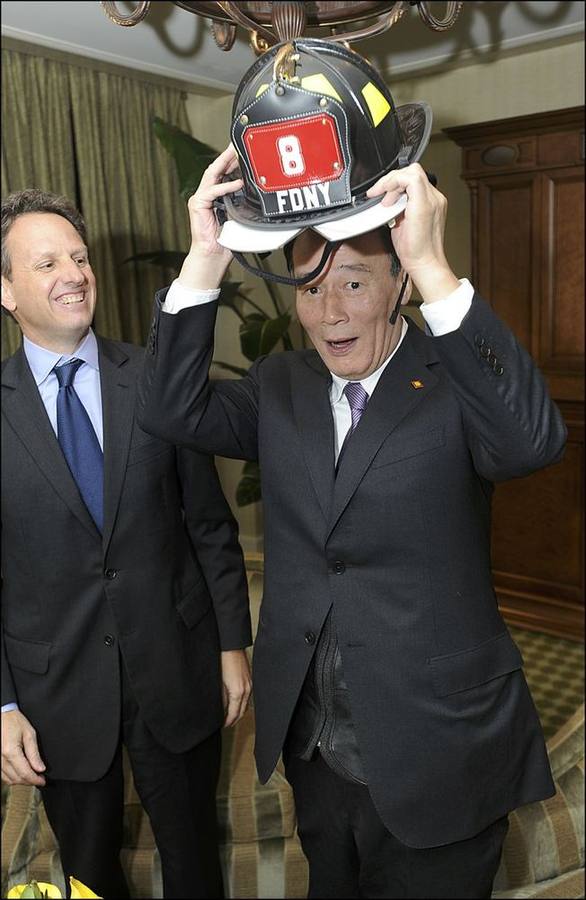
At the 17th Party Congress in 2007 he entered the Politburo. From 17 March 2008 to 16 March 2013 he was a Vice-Premier of the State Council in Wen Jiabao's cabinet, responsible for finance and commerce; in that role he co-chaired the US–China Strategic and Economic Dialogue on the Chinese side, dealing directly with Treasury Secretary Timothy Geithner and other US counterparts, and he chaired the organizing committee of the 2010 Shanghai World Expo. That made him the member of the leadership with the deepest experience of financial negotiation with the United States — remember it, because the expectations later attached to his vice-presidency, that he would "handle America", grew directly out of those years.
The CCDI and the campaign: the January 2013 plenum, and the machinery of a movement
On 15 November 2012, after the first plenum of the 18th Central Committee, Wang Qishan became a Politburo Standing Committee member and Secretary of the Central Commission for Discipline Inspection, with Zhao Hongzhu as his deputy secretary. He also led the Central Leading Group for Inspection Work, which dispatches inspection teams to provinces, central organs, state-owned enterprises and universities. He held the CCDI post for a full term, until Zhao Leji succeeded him after the 19th Party Congress on 25 October 2017. In the CCP's power structure, a discipline chief who sits on the Standing Committee lifts his institution to the apex: it can investigate provincial and ministerial cadres, and Politburo members too; in theory, apart from the Standing Committee itself, there is no one it cannot touch.
This page is anchored to January 2013 for a specific reason: the second plenary session of the 18th CCDI, held in Beijing on 21–22 January 2013. It was the opening plenum of Wang's first full year in the job, and he delivered the work report on behalf of the CCDI Standing Committee. Xi Jinping addressed the meeting, calling for a fight against both "tigers and flies" — senior and petty corrupt officials — and for power to be "confined in a cage" of rules. Human Rights Watch's 2016 report opens with a quotation from Xi at that same January 2013 CCDI meeting, about becoming good at using the rule of law to fight corruption and strengthening national anti-corruption legislation. Attribution matters, and this site states it plainly: those words were Xi's, not Wang's. But the meeting was Wang's plenum, the report was his report, and for the five years that followed it was the CCDI under his leadership that turned those words into arrest statistics. Slogan and execution must be kept separate in an archive — and they must be kept on the same page.
The scale of the campaign is recorded here in the discipline system's own published numbers. Figures released around the third CCDI plenum in January 2014 showed that discipline organs nationwide punished about 182,000 people in 2013, up 13.3 percent on 2012. Human Rights Watch's December 2016 report summarized the toll to that point: at least 140 "tigers" and thousands of "flies" punished since late 2012; it also cited 336,000 people punished within the party in 2015 alone, with about 14,000 transferred to the courts. The work report to the seventh plenum of the 18th CCDI in January 2017 stated that the CCDI had opened cases against 240 officials administered directly by the Central Committee since the 18th Congress — 3.6 times the figure for the 17th Congress period. On 8 October 2017, on the eve of the 19th Party Congress, the CCDI announced that about 1.34 million people had been punished since 2013. The official five-year summary compiled after the Congress (People's Daily, January 2018) gave the fuller breakdown: 440 officials at provincial-ministerial level or above investigated; more than 8,900 at bureau level; 63,000 at county level; 278,000 grassroots officials punished. These are the executing institution's own figures, cited here layered by source and date. This site neither vouches for them nor trims them — but they establish at least this: what happened was not piecemeal rectification. It was a movement covering the entire party, centrally dispatched by the discipline system, and the dispatcher was the subject of this page.
Alongside the numbers ran the build-out of the institution itself. In March 2013 the CCDI created its own Organization Department and Propaganda Department — making it, as a Jamestown Foundation China Brief analysis noted, the only party or state organ with its own organization and propaganda offices — and its internal discipline-inspection offices were expanded to twelve, each covering a portfolio of central organs, state enterprises or regions. The third plenum of the 18th Central Committee in November 2013 strengthened the "dual leadership" system over local discipline commissions, so that case-handling by a local commission answers primarily to the commission above it. The inspection system changed in kind under Wang: teams dispatched by the Central Leading Group for Inspection Work — roughly a dozen per round — embed in a target organization for weeks, hearing briefings, taking tip-offs and auditing accounts. From the first round in May 2013 through 2017, twelve rounds covered 277 party organizations, with repeat "look-back" inspections of 16 provinces and flexible inspections of four institutions; official summaries boasted that this was the first time full inspection coverage had been achieved within a single term. From 2014, the CCDI stationed discipline teams inside organs that had never hosted them, including the General Office of the Central Committee, the Organization and Propaganda Departments, the United Front Work Department, the National People's Congress and CPPCC offices and the State Council's General Office; by 2015 stationed supervision covered all central-level party and state organs. In October 2015 the CCDI issued revised integrity rules and a revised disciplinary-punishment regulation, codifying its own sanctioning basis.
Put together, what Wang did in those five years can be stated precisely. He converted an institution that had mostly issued documents and handled individual cases into a machine with its own personnel system, resident ears in every major organ, an army of roving inspection teams and a unified statistical voice. The instrument that machine used to extract cases was shuanggui — the subject of the next section. And every stage of that build-out was completed in meetings he chaired and documents issued under his authority. That is the first layer of institutional responsibility.
Shuanggui: the extra-legal detention system documented by Human Rights Watch
"Shuanggui" means, literally, the "two designations": a party member is ordered to explain himself at a designated place at a designated time. The most systematic account of how it worked in Wang Qishan's tenure is Human Rights Watch's report of 6 December 2016, "Special Measures: Detention and Torture in the Chinese Communist Party's Shuanggui System", and it is the backbone source of this section. The report is blunt: shuanggui functions beyond the reach of China's criminal justice system, and it gives the CCDI authority to summon any of the party's 88 million members to account at a designated location at a designated time. Those summoned are deprived of liberty for days, weeks or months, repeatedly interrogated and often tortured; detention typically ends when the detainee "confesses", after which some are transferred into the criminal justice system for prosecution.
The report's method needs stating, because it fixes the evidence grade. Between November 2015 and June 2016, Human Rights Watch interviewed 21 people: four former shuanggui detainees, seven family members of detainees, eight lawyers who had represented people held in shuanggui, a former anti-corruption procurator and an academic. It analyzed 35 detailed cases drawn from more than 200 Chinese media reports published between 1 January 2013 and 31 December 2015, and it mined the official court-verdict database: of 746 verdicts mentioning "shuanggui" and 956 mentioning the synonym "lianggui", it isolated 38 cases in which defendants expressly alleged torture during shuanggui interrogation. Interviewees' names were pseudonymized against reprisal. On 23 August 2016 Human Rights Watch wrote to the CCDI and three government departments with questions; by publication it had received no reply. This, in other words, is not the CCDI's account of itself, and not one exile's accusation: it is an investigation in which interviews, media cases and court verdicts corroborate one another — the verdicts mattering most of all, because the torture allegations in them were made by defendants in open Chinese courtrooms and written into official judgments.
The conditions the report documents are these. Shuanggui detainees have no lawyer, no judge, no family visits. They are not held in detention centres but in unofficial places — guesthouses and party training facilities. They are guarded around the clock and held in indefinite solitary confinement; from the moment they are taken, families often have no idea where they are or why — the report describes detention that begins as an enforced disappearance. A former police chief from Jiangxi told Human Rights Watch that for nine days and nine nights he sat in a tiger chair, urinating and defecating into adult diapers, interrogated in shifts for over a hundred hours without regard to day or night. A discipline-inspection officer, Li Peng, wrote in his own account that the indefinite isolation of shuanggui makes detainees' minds "collapse after three to five days" and "answer everything you ask". Party rules even require shuanggui facilities to be designed to prevent suicide — a detail the report singles out, because it shows the system's designers knew exactly how lethal the pressure inside those rooms could be.
The torture methods recorded include beatings, prolonged sleep deprivation, being forced to stand or hold stress positions for hours or even days, deprivation of food and water, and solitary confinement. The purpose was not punishment but confession — and the confessions then walked straight into court. Procurators joined "joint investigations", sitting in on shuanggui interrogations, or simply copied the shuanggui confession, or had the suspect repeat it, as prosecution evidence. When suspects tried in court to retract statements as torture-tainted, procurators threatened to send them back to shuanggui, and judges routinely refused to examine what had happened, ruling that shuanggui lay outside the justice system's jurisdiction. Human Rights Watch states expressly that it knew of no case in which a court acquitted a suspect or overturned a conviction because of misconduct during shuanggui. The torture therefore had no institutional exit: it happened in a place courts could not reach, while the confessions it produced passed into those same courts without friction and sent people to prison.
For deaths in custody, the report's appendix lists cases one by one. This site uses only deaths falling inside Wang Qishan's tenure — after 15 November 2012 — and gives the official account alongside the family's in each case.
Yu Qiyi, chief engineer of the Wenzhou Industry Investment Group, was taken into shuanggui on 1 March 2013 and held for 38 days. In the early hours of 9 April 2013, interrogators repeatedly forced his head into a bucket of ice water; he drowned, aged 42. Officials initially called it an accident; photographs released by his family showed a body covered in welts and bruises. The Zhejiang provincial public security bureau reassigned the case to Quzhou, away from Wenzhou, and on 30 September 2013 a Quzhou court convicted five Wenzhou discipline-inspection officers and one procurator of intentional injury, sentencing them to between four and fourteen years in prison. It was one of only two cases among the eleven deaths Human Rights Watch tabulated in which interrogators were prosecuted at all — the other, Ran Jianxin's, dates from 2010–2011, before Wang's tenure, and is excluded from his ledger below. Yu's family and lawyers also protested publicly that the trial was confined to the day of his death rather than the full 38 days of detention, that the lawyers were denied access to the complete case file, and that senior officials accused of directing the torture were never charged.
Jia Jiuxiang, a court official in Sanmenxia, Henan, died in April 2013 after eleven days in shuanggui. The official explanation was a heart attack; according to the report, a family member permitted to view the body said his face and head were swollen, with "obvious signs of having been beaten". The authorities promised an investigation; no result and no accountability were ever made public. Qian Guoliang, an official of the seismological service in Huangmei County, Hubei, died in June 2013 after convulsions in shuanggui and transfer to hospital; the official cause was a sudden heart attack, while his daughter alleged that his body bore bruises and injuries, including flesh on his buttocks so decomposed that bone protruded, and suspected torture. An autopsy was performed; its results were never released. Li Ming, a well-known Beijing film producer, died in shuanggui in Beijing in 2013–2014, officially of a heart attack; Hong Kong media, citing an "informed source", reported that interrogators had twice injected him with sedatives after he became agitated. That detail rests on a single source and is flagged here as unverified; what is documented is that his death appears in the Human Rights Watch appendix and that his body was returned to the family only on condition that no autopsy be conducted. Ding Ting, an official in Bengbu, Anhui, died in shuanggui in 2014; officials said he had hanged himself with his shoelaces, while initial autopsy findings cited in the report showed signs of strangulation, rib fractures and bleeding in the back, bladder and chest, and his wife maintained that he could not have caused internal bleeding himself. The discipline commission promised a further investigation; its results are not public.
Survivors' accounts belong in the record too. In early 2014, Zhou Wangyan, a former state-enterprise manager in Jiangxi, told the Associated Press that shuanggui interrogators forced his legs apart until his left thigh bone snapped with a loud crack; that he was deprived of sleep and food, nearly drowned, whipped with wires and forced to consume faeces. This site cites his account at the level of a named survivor's testimony to a wire service. Two Hunan officials, Xiao Yifei and Wang Qiuping, spoke to the Associated Press about shuanggui torture after their release in July 2014 — and were then re-arrested and sentenced to 13 and 20 years in prison. Human Rights Watch put that episode in its methodology section as the standing warning that explains why so few former detainees dare to talk. It also describes the system's self-protection in one stroke: those who name the torture are taken back by the system.
The boundary must be drawn just as clearly in the other direction. Wang Qishan did not invent shuanggui. The measure took shape in the 1990s and was written into the party's case-inspection work regulations in 1994. The shuanggui deaths of 2010 to 2012 — Ran Jianxin, Liu Yunfeng, Zhao Ge and others — occurred before he took office, and this site expressly does not book them to him. His responsibility is of a different kind: from November 2012 he was the system's supreme commander; under him the campaign pushed shuanggui's use to its historical peak; when Human Rights Watch's 2016 report named the system and called for its abolition, the man in the CCDI secretary's chair was him; and his documented response, at the time the report appeared, was regulation rather than abolition — measures such as videotaping interrogations — with no move to bring shuanggui under judicial review. Human Rights Watch's October 2017 statement recorded that pledge and noted that there was no way to confirm whether the protections had been implemented. A machine is booked to the person in whose hands it ran, in whose tenure it was enlarged, and who, after people died inside it, chose to fit the rooms with cameras rather than close them down. That is the fundamental reason this page exists.
Named cases and institutional build-out: Zhou Yongkang, Ling Jihua, Sun Zhengcai
This section records only publicly announced discipline-system acts: who was announced under investigation, on what date, by which body, and what sentence followed. Claims that Wang Qishan personally ordered any individual case are recorded, absent reliable sourcing, as having no public record. The CCDI's announcements are documented institutional acts; what attaches to him is leadership responsibility, not unverified personal instruction.
The Zhou Yongkang case was the campaign's summit. Zhou, a former Politburo Standing Committee member and secretary of the Central Political and Legal Affairs Commission, retired in November 2012. According to the timeline disclosed in the official December 2014 announcement, on 1 December 2013 the Standing Committee heard a CCDI report on clues concerning Zhou and decided to open a preliminary examination. On 29 July 2014, Xinhua announced that, Zhou being suspected of serious disciplinary violations, the Central Committee had decided the CCDI would open a formal case against him. It was the first time since 1949 that an investigation of a retired Standing Committee member had been publicly announced; the unwritten rule that former top leaders were untouchable was broken in that one-sentence dispatch. Zhou's son Zhou Bin and his associates in the petroleum system and in Sichuan had been picked off one by one beforehand — the classic CCDI sequence: the periphery first, the man himself last. On 5 December 2014 a Politburo meeting adopted the CCDI's investigation report, expelled Zhou from the party and transferred his case to the judiciary; the Supreme People's Procuratorate announced his arrest the next day. On 11 June 2015 the Tianjin No. 1 Intermediate People's Court sentenced him to life imprisonment for bribery, abuse of power and intentionally disclosing state secrets. This site has a separate page on Zhou Yongkang's own culpability; here only the discipline side is recorded. During Wang's tenure, the institution he led completed the verification, case-opening, investigation report and transfer of a former Standing Committee member, entirely inside the party-review framework of shuanggui — and from the moment Zhou lost his freedom at the end of 2013 until his formal arrest a year later, the legal status he was held under was never explained by any official source. That is what the shuanggui logic looks like at the very top of the system.
Two military cases are recorded together. Xu Caihou, a former vice-chairman of the Central Military Commission, was expelled from the party and transferred to military procurators on 30 June 2014; he died of bladder cancer on 15 March 2015 while under investigation, and military procurators decided not to prosecute. Guo Boxiong, also a former CMC vice-chairman, was announced under investigation in April 2015 and sentenced to life imprisonment by a military court on 25 July 2016. The announcements and dispositions of both cases fall within Wang's tenure and were handled by the CCDI together with the military discipline system; their announcement texts are public record.
The Ling Jihua case: Ling, Hu Jintao's former chief of staff as director of the General Office, was by then a CPPCC vice-chairman and head of the United Front Work Department. On 22 December 2014 the CCDI announced that Ling was under investigation for suspected serious disciplinary violations. His elder brother Ling Zhengce had been taken down first, in June 2014. On 20 July 2015 a Politburo meeting adopted the CCDI's report, expelled Ling from the party and from public office and transferred his case; the Supreme People's Procuratorate announced his arrest the same evening. On 4 July 2016 the Tianjin No. 1 Intermediate People's Court sentenced him to life imprisonment for bribery, illegally obtaining state secrets and abuse of power.
Su Rong, briefly: the former CPPCC vice-chairman was announced under investigation in June 2014 — the first national-level leader so announced after the 18th Congress, weeks before the Zhou Yongkang case was formally opened — and was sentenced to life imprisonment in January 2017.
The Sun Zhengcai case closed Wang's tenure. Sun, a Politburo member and party secretary of Chongqing, was widely tipped for the next Standing Committee. On 15 July 2017 Chongqing announced that Chen Min'er had replaced him; on 24 July 2017 Xinhua announced that the Central Committee had decided the CCDI would open a case against Sun for serious disciplinary violations. Wang's tenure ended three months later; the sequel — expulsion in September 2017 and a life sentence in Tianjin on 8 May 2018 — belongs to Zhao Leji's tenure, but the decision and announcement of the case fall inside Wang's, and this site books them by announcement date, noting the tenure boundary for everything after.
Institutional build-out and the big cases are two faces of one thing. Inspection teams found the clues; the CCDI reviewed them under shuanggui; the courts delivered the verdicts. Under Wang that pipeline ran more smoothly than it ever had. Stationed discipline teams put the machine's ears permanently inside every central organ; the 2013 dual-leadership reform made local commissions answer upward to the commission above rather than sideways to the local party committee — supervision power pulled upward, in the system's own language. A 2015 Jamestown Foundation analysis asked outright how far the campaign simultaneously functioned as a political purge. This site's position rests only on what can be verified: among those investigated were officials whose corruption was genuinely egregious, and also men who had politically fallen; the procedure that decided who was investigated and who was not was never public. Selectivity itself was the machine's most important power, and it lay in the hands of the discipline secretary and the general secretary he served.
The responsibility ledger: institutional and personal responsibility, kept separate
This site's findings on Wang Qishan are set out in four layers, each with its evidence grade stated. The layers are not to be blurred.
Layer one: institutional leadership responsibility, documented in files and announcements. From 15 November 2012 to 25 October 2017 he was CCDI secretary and head of the Central Leading Group for Inspection Work — the discipline system's highest official. Institutional acts completed by that system in his tenure include: twelve rounds of central inspections covering 277 party organizations; stationed discipline teams extended to full coverage of central-level party and state organs; expansion of the discipline-inspection offices and the creation of the CCDI's own Organization and Propaganda Departments; the 2015 revision of the disciplinary-punishment regulation; and the punishment totals the system published for itself — about 1.34 million people punished since 2013, among them about 182,000 in 2013 and 336,000 in 2015. None of this is "reportedly". It is in Xinhua and People's Daily copy and in CCDI plenum communiqués, the responsible body named is the CCDI, and the man chairing and signing off was him.
Layer two: responsibility for the shuanggui system's abuses, booked to the system he headed, under his leadership responsibility. The beatings, sleep deprivation, forced stress positions, tiger chairs, indefinite solitary confinement and confessions carried straight into court that Human Rights Watch's 2016 report documents — and the five in-tenure deaths in custody set out in the previous section, Yu Qiyi, Jia Jiuxiang, Qian Guoliang, Li Ming and Ding Ting (the Li Ming detail resting on a single source, as flagged) — were inflicted by discipline personnel at various levels. There is no public evidence that Wang Qishan personally ordered the torture of any individual detainee, and this site states that plainly: personal instructions, no public record. But shuanggui's survival, its expansion and its "regulate, don't abolish" handling all occurred in his tenure, in his plenum reports and in his public statements. When Human Rights Watch published its report in December 2016 and called expressly for abolition, the CCDI he led did not respond — the organization's letter of enquiry to the CCDI also went unanswered — and his own counter-measure, offered at the same period, was internal: videotaped interrogations and tighter procedure. In the language of an archive: the torture was not done by his own hands, but the room it happened in was his to command, the key to it was in his hand, and after men died inside it he chose to fit the room with cameras rather than demolish it.
Layer three: announcement responsibility for the named cases. The Zhou Yongkang case (formal investigation announced 29 July 2014), Xu Caihou, Guo Boxiong, Ling Jihua (investigation announced 22 December 2014), Su Rong, and Sun Zhengcai (case announced 24 July 2017) were institutional acts of the CCDI and the Politburo, evidenced by Xinhua dispatches, and they are booked to his tenure. As for the claim that "Wang personally decided to take down" any one of them — such narratives are plentiful and not one rests on a verifiable public document; this site records them uniformly as no public record and does not write them into the factual text.
Layer four, the layer most easily overwritten: political responsibility and historical judgement. It was at his plenum, in January 2013, that Xi Jinping said tigers and flies would be struck together; the campaign's political authorization came from the general secretary, and the building and running of its executing system came from Wang. The campaign did bring down officials guilty of corruption on a staggering scale, including a former Standing Committee member. It also conducted its business through an extra-legal detention system, so that millions of party punishments and tens of thousands of criminal cases rested on confessions obtained with no lawyer, no judge and the availability of torture. Both halves are fact, and an archive that drops either half is not an archive. This site's method is to write both in full and let judgement rest on the evidence: what he built and ran was a machine whose working method was the violation of the basic rights of the people it investigated — a finding for which the evidence includes a major human-rights organization's report and the Chinese courts' own verdict documents.
One related accountability item from after his tenure is recorded here to prevent misreading. Dong Hong, Wang's long-serving subordinate and a former head of a central inspection team under him, was announced under investigation by the National Supervisory Commission in October 2020 and sentenced in January 2022 to death with a reprieve for bribery. Dong's case belongs to Zhao Leji's tenure, and the investigating system was his successor's; it is not booked as an act of Wang's tenure. But "the graft-buster's own aide convicted of graft" bears directly on this page's subject, so it is filed here with its dates and its boundary stated. The 2020 case of Ren Zhiqiang, a businessman long close to Wang, is treated the same way: noted for attribution, not developed, and not booked to Wang.
Five years as Vice-President: a boundary that must be drawn
On 25 October 2017 Wang Qishan stepped down from the Standing Committee and the CCDI, and Zhao Leji succeeded him at the discipline commission. Before the 19th Congress there had been speculation that, at 69, he might break convention and stay on the Standing Committee; he did not. Months later he was elected a National People's Congress deputy from Hunan as an ordinary party member, and on 17 March 2018 the NPC session elected him Vice-President of the People's Republic of China — with a single vote against out of 2,970 cast — for a term ending on 10 March 2023, when Han Zheng succeeded him. He was the first vice-president since 1998 to hold no concurrent party office.
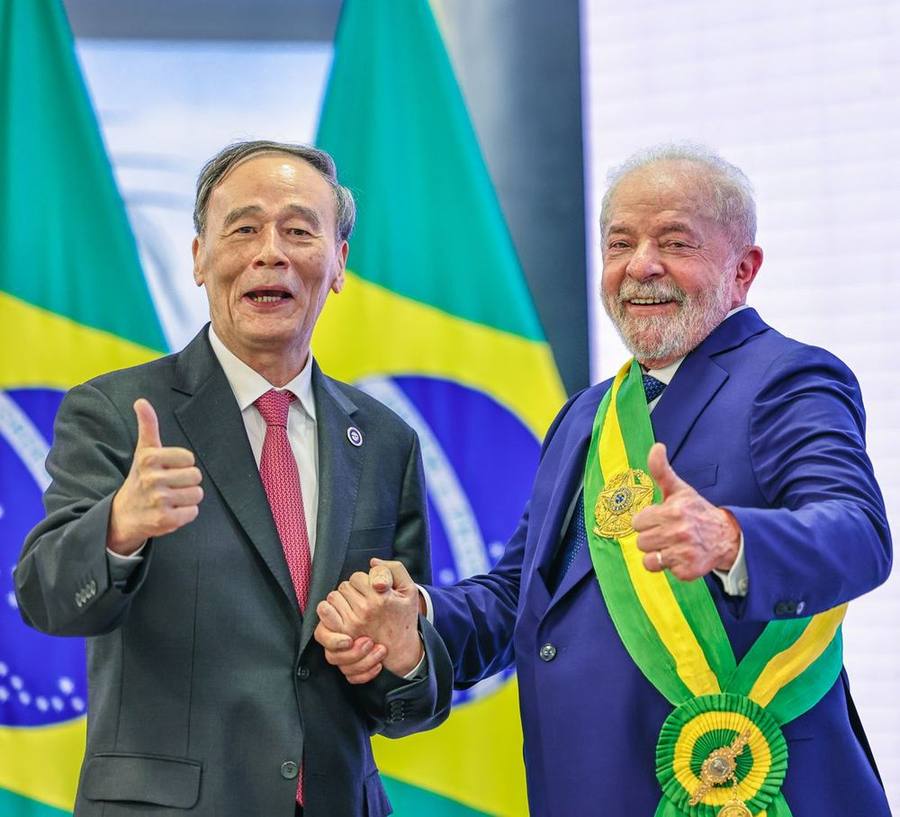
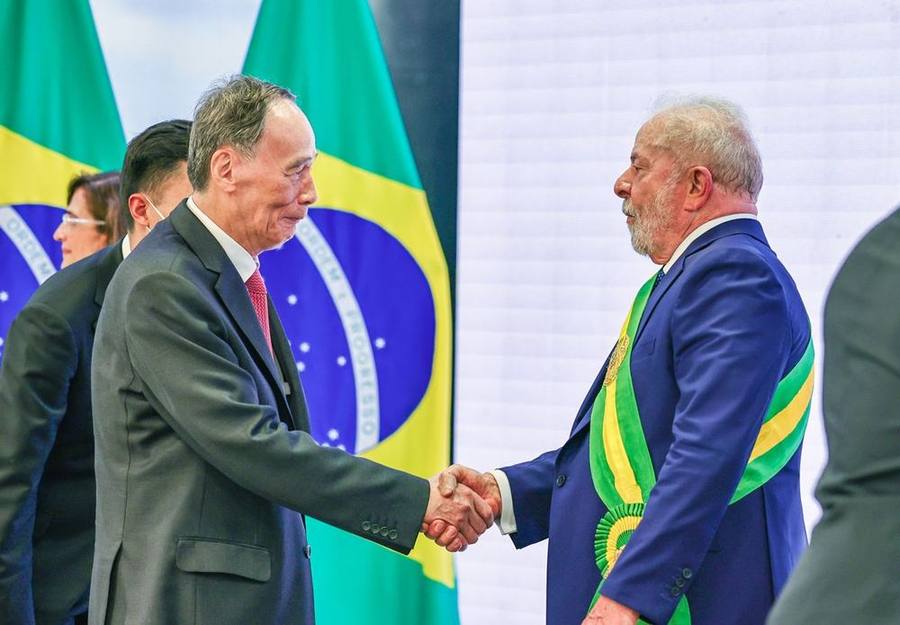
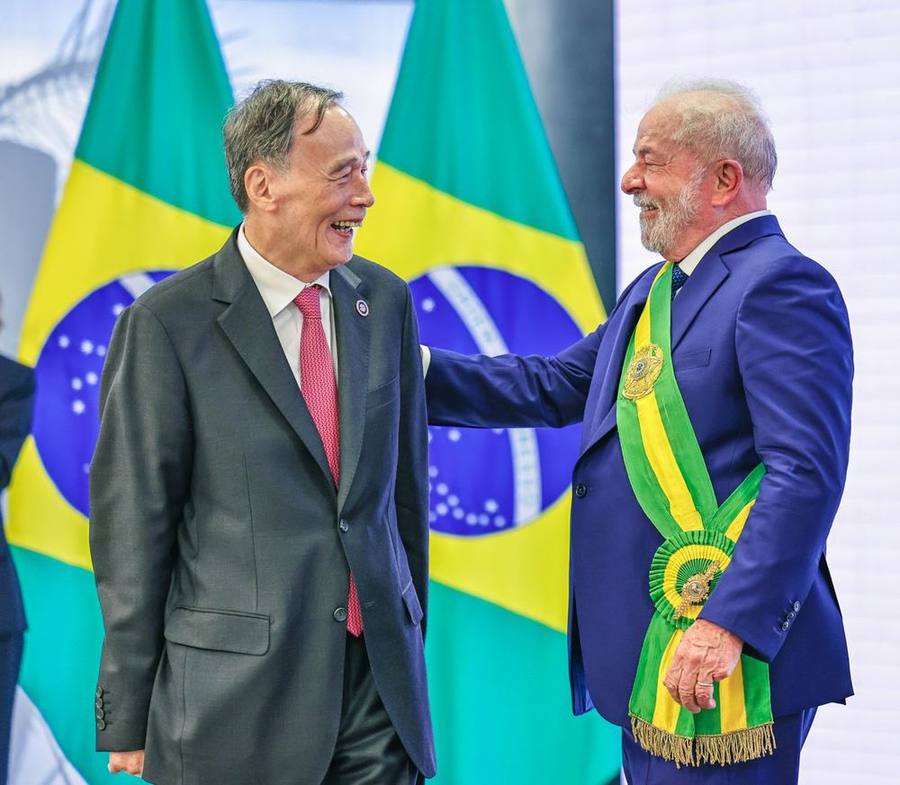
The vice-presidency is a ceremonial office under the constitution, ranked below the Standing Committee. The verifiable public activity of his five years is mostly protocol diplomacy: Switzerland and the Davos World Economic Forum, 21–24 January 2019, where he delivered a speech; Japan in October 2019 for Emperor Naruhito's enthronement; South Korea in May 2022 for President Yoon Suk-yeol's inauguration and the Philippines in June 2022 for President Ferdinand Marcos Jr.'s; London in September 2022 for the funeral of Queen Elizabeth II; Brazil in January 2023 for President Lula da Silva's inauguration. In November 2018 he met the visiting former US Secretary of State Henry Kissinger in Beijing — one of the very few items of his vice-presidency that touched US relations directly.
The boundary is drawn here. When he was elected, Reuters and other outlets widely expected that, on the strength of his Strategic and Economic Dialogue years, he would take charge of relations with the United States, above all the escalating trade dispute. Expectation is not record. Within the scope of this site's checking, there is no public record that he actually chaired or participated in the 2018–2020 US–China trade negotiations; the publicly identified Chinese negotiator was Vice-Premier Liu He. To convert "expected to handle America" into "handled America" is a common biographical sleight, and this site does not perform it. His vice-presidential activity is recorded within the range that official announcements support — ceremonial and symbolic diplomacy — and influence beyond that range is recorded as: no public record. The second boundary is equally important. The National Supervision Law of March 2018, the creation of the National Supervision Commission, and the replacement of shuanggui by liuzhi all happened after he left the CCDI, under Zhao Leji; this site's page on Zhao Leji records them in detail. Wang's connection to the supervision reform consists of one tenure fact only: the pilot supervision reforms in Beijing, Shanxi and Zhejiang were launched in November 2016, while he was still CCDI secretary, under a plan issued by the Central Committee's General Office with the discipline system involved in carrying them out; and around the publication of the Human Rights Watch report in December 2016 he spoke of constraining shuanggui through measures such as interrogation videotaping. The groundwork for the pilots is partly his. The legislation, the commission and the formal operation of liuzhi are not acts of his tenure — they are neither booked to him nor used to absolve him. Shuanggui ran for five years in his hands; liuzhi changed the sign on the door, not the extra-legal logic behind it.
Sanctions and accountability
On sanctions, this site writes only what it has checked, with dates. Checked by this site on 5 November 2026 against the full Specially Designated Nationals (SDN) list published by the US Treasury's Office of Foreign Assets Control on 28 October 2026, the string "Qishan" occurs zero times in that list. Checked against the UK Sanctions List published on 27 October 2026, Wang Qishan does not appear there either. The conclusion: as of the verification date, Wang Qishan has no US sanctions designation and no UK sanctions designation on record. This site does not speculate about the future; it records the state of the lists. If the lists change, this page will be updated with the new list date.
On domestic accountability the conclusion is equally clear: none. Wang Qishan has never faced party discipline, administrative accountability or criminal investigation over the torture, the deaths in custody or the selectivity of the shuanggui system. On the contrary, at the end of his tenure he received the leadership's highest official praise — the official summary pronounced the discipline work since the 18th Congress a marked success — and his election as Vice-President was itself the system's most formal mark of approval. Internationally, beyond the criticism of the system he led in reports by Human Rights Watch and others, no international judicial process touches him personally. In short: the man responsible for a system whose torture and deaths were documented in an entire report by an international human-rights organization has paid no price for it anywhere, at home or abroad. That absence is itself the most important fact in this section.
Current status
On 10 March 2023 Han Zheng succeeded him as Vice-President, and Wang Qishan retired. Public traces since then are sparse; the verifiable record is as follows. After retirement he served as honorary president of the Red Cross Society of China; on 10 October 2024 Han Zheng succeeded him in that role as well. In October 2024 he succeeded Zhu Rongji as honorary chairman of the advisory board of Tsinghua University's School of Economics and Management; on the evening of 25 October 2024 he met the board's members at the Diaoyutai State Guesthouse in Beijing and hosted a dinner for them — his clearest public appearance since retirement, reported through Xinhua and university channels. From then until this site's verification date of 5 November 2026, no reliable report of any further public activity by him was found within the scope searched. Rumours about his health and his circumstances circulate online from time to time; none rests on a reliable source, and this site neither files nor repeats them. The record is stated in one sentence: after October 2024, no public record.
Verification Note
This page was verified on 5 November 2026. Evidence is graded as follows. Grade one: official documents and dispatches — Xinhua and People's Daily reporting, CCDI plenum communiqués and work-report figures, court judgments and sentences — used for tenure dates, announcement dates, punishment totals and sentencing outcomes. Grade two: international human-rights investigation — Human Rights Watch's 2016 "Special Measures" report and its October 2017 follow-up statement — used for shuanggui's operating methods, torture allegations and deaths in custody; that report rests on 21 interviews, 35 media cases and 38 court-verdict documents, with its method published, and this site accepts its record while noting, case by case, where the official account and the family's account conflict. Grade three: serious news reporting and academic analysis — Reuters, the Associated Press, the Jamestown Foundation's China Brief, the Brookings Institution's elite files — used for institutional build-out and background; single-source claims are flagged in place in the text.
Conflicts and open questions are collected here. First, the birth record exists in three versions: the official resume gives only "born July 1948, from Tianzhen, Shanxi"; English biographies mostly give 19 July 1948, born in Qingdao; Britannica gives Shanxi. This site treats month and year as settled and leaves date and birthplace open and side by side. Second, the details of his youthful acquaintance with Xi Jinping in Shaanxi come from personality profiles and cannot be independently verified; the text states them at profile grade. Third, the "sedative injections" detail in the Li Ming death case rests on a single Hong Kong media source and is flagged in the text as single-source and unverified. Fourth, all punishment totals are the discipline system's own figures, listed layered by release date — about 182,000 for 2013, published January 2014; the 140 "tigers" figure is Human Rights Watch's December 2016 tally; about 1.34 million is the CCDI's October 2017 figure — and the different calibres are neither merged nor extrapolated. Fifth, whether he personally directed any individual case, and whether he in fact ran US policy as vice-president, are both recorded expressly as no public record.
Exclusions. In 2017 the exiled businessman Guo Wengui levelled a series of allegations against Wang Qishan and his family. Guo was a fugitive defendant in Chinese cases, his allegations were never corroborated by any independent body, and he was later himself convicted of fraud in the United States. This site classifies that body of claims as unverified allegations from an interested party: they are not relied on and do not appear as fact in the text; they are mentioned only here, to record the reason for their exclusion. Shuanggui deaths before 15 November 2012 — Ran Jianxin, Liu Yunfeng, Zhao Ge, Zhao Jianxin, Wang Zhongping and others — fall outside his tenure and are expressly excluded from his ledger in the text. The Dong Hong and Ren Zhiqiang cases postdate his departure and are noted for attribution only. Quotations are held to under 50 words per source throughout; the facts are paraphrased, not copied.
Sources
Human Rights Watch, "Special Measures: Detention and Torture in the Chinese Communist Party's Shuanggui System", 6 December 2016; Human Rights Watch, "China: Abolish Secret Detention But Ensure Rights Protections", statement of 18 October 2017. Communiqués and work reports of the plenary sessions of the 18th CCDI (second plenum, January 2013; third plenum, January 2014; seventh plenum, January 2017) and the CCDI's summary figures for the period since the 18th Party Congress, published 8 October 2017, via Xinhua and People's Daily. People's Daily, "Fact Sheet: China's 2017 anti-graft campaign", January 2018, compiling the five-year punishment and inspection data. Xinhua dispatches on the Zhou Yongkang (29 July and 6 December 2014), Ling Jihua (22 December 2014 and 20 July 2015) and Sun Zhengcai (24 July 2017) cases; published reporting of the judgments of the Tianjin No. 1 Intermediate People's Court against Zhou Yongkang (11 June 2015) and Ling Jihua (4 July 2016). Jamestown Foundation, China Brief: "Growing CCDI Power Brings Questions of Politically-Motivated Purge" (2015) and "The Emergence of the Wang Qishan Faction" (2016). Reuters reporting on the Yu Qiyi trial (October 2013) and on Wang's election as Vice-President (17 March 2018). Associated Press, Zhou Wangyan's shuanggui account (2014). Encyclopaedia Britannica and Cheng Li's Brookings Institution elite file, for the biography and the birthplace discrepancy. Official resume published via Chinese diplomatic missions (Xinhua, November 2012), for posts and dates. Public reporting of the October 2024 meeting of the advisory board of Tsinghua University's School of Economics and Management. Sanctions checks: US OFAC Specially Designated Nationals list, version of 28 October 2026; UK Sanctions List, version of 27 October 2026; both checked by this site on 5 November 2026.
Contact: endccpworld@proton.me