蒲城抗议The Pucheng Protest
Background: The death of a third-year student, and a county town:Pucheng County, under Weinan in Shaanxi Province, is an ordinary county town in northern China. At the centre of the events stood the Pucheng County Vocational Education Centre, a public vocational school with a new campus where students boarded. In the early hours of January 2, 2025, a third-year student surnamed Dang fell to his death from a dormitory building there. Official statements referred to him throughout only as Dang, publishing neither his full name nor his age; several overseas outlets described him as a 17-year-old, an age that does not appear in the official statement and is relayed here, attributed, on that basis. This site handles the dead student under a rule of restraint for minors: no identifying details beyond what the record requires, no home address or family particulars, and no rendering of the fall itself. A boarding student dying at night in a fall from his dormitory is grave enough on its own. What carried the case beyond one school and turned it into one of the most closely watched protests at the start of 2025 was what happened after the death: in the first days the family did not receive what they regarded as a complete explanation, and the information released by the school and investigators did not lay the questions to rest. From January 4, parents and local residents gathered at the school gate to demand answers; within days the gathering grew and clashed with the police deployed to hold order. This entry records that whole chain — death, doubt, official statement, protest and dispersal — and marks, link by link, what can and cannot be verified.
The night it happened: The official reconstruction:For the hours from the night of January 1 into the early morning of January 2, 2025, the only systematic public account is the statement issued on the evening of January 5 by the Pucheng County joint investigation team and carried in full by domestic outlets including CNR on January 6. The statement says that at about 3 a.m. on January 2 the school found that a student had fallen on campus, immediately called the 120 emergency line and the 110 police line, that officers reached the scene, that paramedics declared the student dead, and that teachers and students identified him as Dang, a third-year student at the school. Its reconstruction of the night before runs as follows: at about 10 p.m. on January 1, in a fourth-floor dormitory room, Dang, kept from resting by conversation between Guo, a first-year student sharing the room, and Xu, Guo's fellow townsman, quarrelled and came to blows with Guo. Dang then went downstairs with Chen, a student-council member, to report the matter to Lei, a deputy director of the school's moral-education office, who called Guo and Dang to the duty room, mediated, and sent both back to the dormitory. At about 3 a.m. on January 2, the statement says, a roommate surnamed Huang, getting up in the night, found a wooden stool placed beneath the dormitory balcony window, the sliding window open and its diamond-mesh screen removed, and Dang lying on the ground below outside. Every one of these details comes from the investigation team's one-sided reconstruction: the quarrel, the mediation, the stool and the removed screen are factual claims the team wrote into its statement, and this site attributes each of them as such rather than restating them as independently established findings. The statement published no specifics from the surveillance footage it said it reviewed, and it did not describe conditions inside the dormitory during the hours between the end of the mediation and the discovery of the fall.
The statement's conclusion: Death by a fall from height; criminal case ruled out:The concluding passage of the statement is only a few sentences long, yet it became the focus of everything that followed. The police, it said, had conducted a scene examination, reviewed surveillance footage, made inquiries and carried out an external examination of the body, and had determined that the student died from a fall from height and that, at present, a criminal case was ruled out; the family had been informed of the conclusion; responsibility of the relevant persons was being investigated and determined through due process, and follow-up work was under way. The investigating body behind the statement was a joint team the county Party committee and government had formed from the political-legal, public security, discipline-inspection and education authorities. Three points of wording need fixing for the reader. First, the statement's terms are death from a fall from height and a criminal case ruled out: it does not use the word suicide, and it gives no complete causal account of how the fall occurred; overseas summaries that render it as a finding of suicide or of a simple accident are paraphrases and do not exactly match the text. Second, the phrase external examination indicates the conclusion rested on an external-level examination; the statement does not say whether an autopsy was performed and publishes no examination report. Third, the sentence that responsibility was still being determined means accountability was unfinished when the statement appeared — yet, as of this site's latest check, no later public release of any accountability outcome by Pucheng County or higher authorities has been found, a gap recorded separately at the end of this entry. The statement also expressed grief for the student and condolences to the family, said the case showed weaknesses in the school's psychological care for students, promised strengthened mental-health and life education, and closed by urging the public not to make, believe or spread rumours. Those passages, like the conclusion itself, are primary material for understanding the official handling and are recorded here in their own sequence, not in excerpted form.
The family's doubts (I): The summons to school, the watched hours, and the viewing of the body:Set against the official statement is the family's account. The family narrative this site can locate comes chiefly from a long online post attributed to a relative of the dead student, quoted by the BBC in its report of January 9, 2025, and from family remarks relayed by Reuters and other outlets. None of it has been tested in any independent judicial process, and this site records it throughout as the family says, or according to the post, never blended with the official account. According to the post, on the day it happened the student's mother was notified to come to the school without being told why. On arrival she was kept waiting without seeing her child, was then taken by a teacher to a classroom and kept there, not allowed to leave. After several hours at the school she was taken directly to a funeral home to view the body, where she saw multiple bruises on her son, was stopped by the accompanying teacher when she tried to take photographs, and was afterwards refused on repeated requests to view the body again. The post also says she learned after reaching the school that her son had clashed with schoolmates before his death. On the bare existence of a clash, that detail echoes the official statement's quarrel and physical conflict; on its nature and consequences the two accounts diverge — the family suspected on this basis that the boy had been bullied at school, while the official statement describes a single dormitory dispute settled by a teacher's mediation. The reader should be clear about the status of these passages: the bruises, the watched hours in the classroom and the blocked photograph rest, at present, on the family's one-sided account and media relay alone, with no second-party public material to confirm or refute them. This site records them because they are the doubts the family raised publicly and which directly set off the protests that followed — not because this site can pronounce them fact.
The family's doubts (II): Phones, photographs, surveillance footage, and the suspicion of bullying:The family's second set of questions concerned control of information and evidence. According to the post attributed to relatives and relay by several outlets, the phones and smartwatches of students who knew what had happened were confiscated after the incident and photographs on them deleted; Reuters reported the family as saying that photographs on the dead student's own phone had been deleted, and as questioning the official explanation on that ground. On surveillance footage, the core demand of the family and the protesters was to see the recordings from the relevant hours; the official statement said only that police had reviewed footage, publishing neither the recordings nor any account of key frames to the family or the public. Whether, and to what extent, the school showed footage to the family has no consistent account in public reporting and is recorded here as no public record. Taken together, the two sets of doubts show that the family's distrust was rooted not only in the fall itself but in a chain of procedural experiences: summoned without being told why, movement restricted after arrival, viewing of the body obstructed, images belonging to themselves and to informed students confiscated or deleted, and footage reviewed only by the investigating authorities themselves. After such an experience, a statement offering a conclusion without displayed evidence was unlikely to make a family accept the words criminal case ruled out. This site's summary here is archival: every one of these procedural allegations traces to the family's account and media relay, and neither the school nor county authorities ever answered them item by item in public. But it is equally undeniable that these unanswered allegations are what turned a family's demand for an explanation into a county-wide gathering after January 4. That is why this site files Pucheng under Resistance rather than as a simple school incident: from the start, the protest's object was not only the cause of death, but a whole manner of handling — information sealed first, conclusion delivered after — as the public saw it.
January 4: Demanding an explanation at the school gate:Public reporting agrees on where the gatherings began: from January 4, 2025, the dead student's family came to the gate of the Pucheng County Vocational Education Centre to protest, demanding an explanation from the school and demanding the truth. Hong Kong's Ming Pao reported that local residents soon joined in support, and mourning, including flowers, appeared among the crowd; footage verified by the BBC and filmed at the school gate showed residents mourning the teenager. At this stage the gathering centred on the family, and its demands were specific and limited: release the surveillance footage, explain the death, let the family see the body, and produce an investigative process that could withstand scrutiny. The stage deserves its own place in the file because it shows the original form of such events: not political slogans and not organized mobilization, but a family asking for an accounting at a school gate, with bystanders standing beside them out of a plain parental instinct. Pucheng is a small county town, most of the vocational school's students come from the town and surrounding villages, and news of the death and of the family's treatment travelled fast through networks of acquaintances; once the family's long post and on-site video began circulating in local WeChat groups and on short-video platforms, the people at the gate were no longer only relatives and schoolmates. The limits of the evidence for this stage must also be marked: for January 4 itself there is no official statement and no verifiable media figure for crowd size, slogans or duration. This site records only the factual skeleton on which reporting agrees — that gatherings began on January 4 with the family protesting at the school gate for an explanation — and adds no unverified on-site detail. What shifted, hour by hour, on the night of January 4 and during January 5 is likewise thin in the public record; the next clearly documented turning point came on January 5.
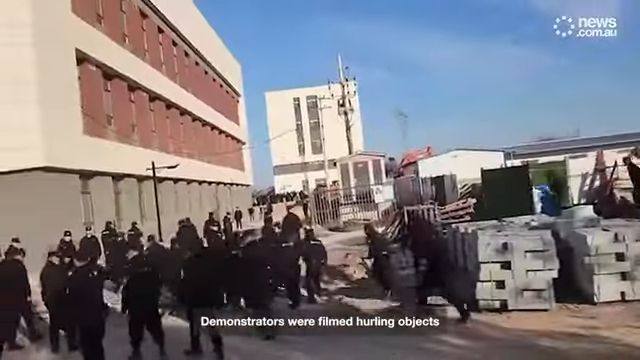
January 5: The uncle taken away, and the escalation:Two things overlapped on January 5. The first was the joint investigation team's statement, issued that evening and recorded above, formally announcing that a criminal case was ruled out. The second, disclosed by Ming Pao and relayed by several outlets, was that the dead student's uncle was taken away by police on January 5; people at the scene immediately shouted for his release, demanding that the detained relative be freed, and the situation escalated sharply. This site's wording on the second point stays restrained: that the uncle was taken away by police is supported by Ming Pao's reporting and multiple relays and can stand as a publicly reported fact; the further online claims that he was beaten rest only on self-media and circulated video of a kind that cannot be independently verified, and are not written here as fact, only listed in the verification notes. The sequence in which the two events landed deserves attention: the official conclusion and the taking of a relative fell on the same day. From the crowd's standpoint, what arrived first was not footage and not a fuller investigative account, but the words criminal case ruled out and the news that a relative had been taken away — and that sequence is itself the immediate background to the protest's growth that night. On the size and form of the night gathering, the BBC, working from online video, estimated participation in the thousands for the mourning and protest; observers who follow mass incidents long-term put the figure above ten thousand. The numbers question is handled side by side in the next section; what this section fixes is the timeline: the family's protest continued through January 5, the uncle's removal brought cries for his release, the official statement appeared that evening, the gathering grew further in the night and carried into January 6. The main scene of the Pucheng protest remained the vocational centre's gate and its surroundings; no reliable public material shows the protest moving at this stage to the county government or other sites, and online claims to that effect are not relied on here.
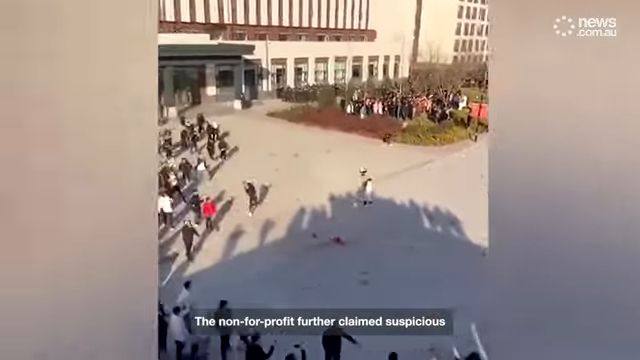
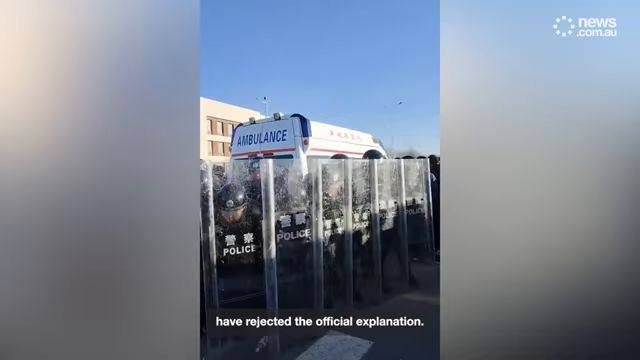
January 6: Renewed gathering, clashes at the gate, and the BBC-verified video:On the morning of January 6, demonstrators gathered again near the school gate. Video relayed across public reporting showed a family member on a school rooftop scattering paper money to the ground below, while the crowd of onlookers and supporters kept growing. The most important material from that day is a set of videos verified by BBC Verify: the BBC confirmed they were filmed at the Pucheng County Vocational Education Centre and that no earlier versions could be found online from before the protests. The verified pictures include protesters hurling objects at police, officers beating demonstrators with batons, one demonstrator wiping blood from his head, and a school staff member being shoved by shouting protesters. By January 6, in other words, the stand-off at the gate had moved beyond sitting and shouting into physical clashes involving thrown objects, batons and visible blood — a point that rests on the BBC's verification, unlike crowd sizes, which can only be estimated. The same day, Ming Pao learned from the Pucheng County Party committee's publicity department that the protest had been brought under control and the crowd dispersed, with the authorities describing some demonstrators as malicious; yet when the BBC contacted the Pucheng government's publicity department about the affair, the answer it received was a denial that any protests had taken place. Brought under control, dispersed, and never happened: three versions from the same local publicity system to different outlets, recorded side by side here without reconciliation. On the evening of January 6 a further widely relayed video appeared, in which the dead student's mother spoke on camera in dialect, urging people not to believe rumours, not to gather at the school again, and to leave a space of quiet for her child and the school. Nothing in the public record explains the circumstances of that recording — whether it was made voluntarily or after what kind of communication — and this site records only that the video appeared on the evening of January 6 and what it appealed for, without speculating on its origins. The mother's appeal, together with that day's dispersal, closes the protest in the public timeline: the BBC's January 9 report states that it had seen no further evidence of protest in Pucheng since then.
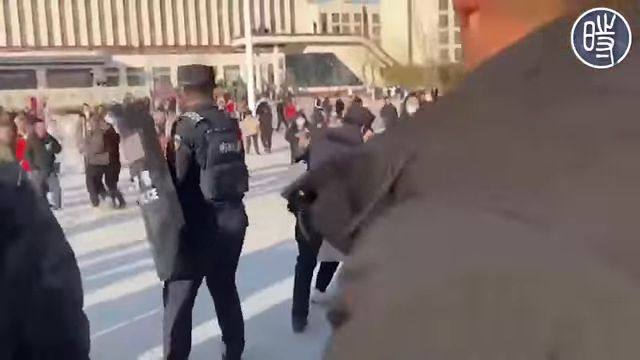
The numbers dispute: Hundreds, thousands, tens of thousands:The size of the Pucheng crowd is the most contested number in the whole case, and this site sets the estimates out by source level without offering a total of its own. The most conservative layer is the BBC's: the protests drew at least hundreds of people, and, judging from online video, the mourning and protest crowds were estimated in the thousands. Radio Free Asia relayed the estimate of Ge Ping (a pseudonym), who follows China's stability-maintenance system long-term, at more than ten thousand participants. Some overseas self-media and commentary accounts went further, speaking of tens of thousands or even fifty to sixty thousand; such figures come with no checkable counting method at all, and this site records them only as circulated estimates, never as a basis for the crowd size. Why should one gathering produce estimates two orders of magnitude apart? The reason sits in the facts: the gathering spanned several periods from January 4 to 6, people flowed in and out of the school gate and surrounding streets, no body ever counted the scene, domestic media stayed silent about the gathering itself, and the only available basis was the density visible in fragmentary video — the material most easily magnified or shrunk by standpoint. The archival conclusion can only be this: the crowd reached at least the hundreds and very likely the thousands, while claims of ten thousand and above remain unverified estimates. The treatment follows this site's standard for other resistance entries: numbers are given as ranges, with sources and method stated, and the largest figure is never made the headline. The same absence of official figures covers injuries and arrests: verified BBC footage shows blood, and several reports mention people being taken away in the clashes, but neither Pucheng County nor Weinan City ever published a count of the injured, a count of those taken away, or any list of dispositions. This site states it plainly: for injuries and detentions in this case there are no official numbers and no reliable count.
After the dispersal: Special police lodged in town, roads sealed, stability measures:That the protest was dispersed on January 6 does not mean Pucheng returned to normal that night. Radio Free Asia's reporting on the evening of January 7 offers a rare side view: its reporters telephoned two hotels in central Pucheng, and staff at both said the situation had calmed but the hotels remained full of special police and public-security personnel from neighbouring counties, with no rooms free. Staff at one hotel said many road sections in town were sealed — the expressway was open and Pucheng could be entered, but the roads toward the school were closed. Staff at both hotels said the outside police presence was there to handle the vocational student's death. Ge Ping, who follows the stability-maintenance system, told RFA that the arrival of outside special police indicated a high-level response requiring outside stability forces to be called in; that judgement is an interviewee's analysis, not an officially confirmed response level, and is recorded here as attributed analysis. Voice of America further relayed claims by citizen journalists in Shaanxi that the vocational centre had been placed under stability-maintenance measures, including sending some students home and warning students not to contact one another or join public demonstrations; that, too, is relay and was never confirmed by the school, and is recorded with its source marked. Put together, the fragments show the familiar second half of mass-incident handling in China: street gatherings gone, outside police lodged in town, controls around the site, and the school tightening information and contact internally. As for what happened to those taken away — release, administrative detention or anything else — no list or statement ever appeared in public channels; whether the dead student's uncle was released after being taken away, and when, likewise has no later public reporting. All of it is recorded here as no public record, with no outcome inferred from what usually happens.
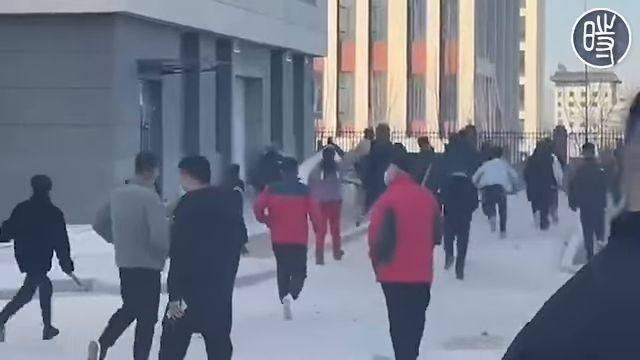
Information control: State-media silence, platform deletion, and the denial:The handling of information in the Pucheng case is itself part of the archive. The BBC reported that state media had been silent on the protests, and that clips and mentions of them had been largely censored from Chinese social media, as is usual for events the authorities treat as sensitive; the footage that escaped circulated mainly through X overseas and was verified location by location by the BBC. Domestic media did not ignore the death itself: CNR and others carried the joint investigation team's statement — but the statement's text covers only the death and the investigative conclusion, and says not one word about the gatherings from January 4 onward. The same event therefore existed in two versions, inside and outside the wall: inside, a closed narrative of a student fallen to his death, crime ruled out, please do not spread rumours; outside, an unfinished narrative of thousands gathered, batons and special police. No platform has published figures for how many posts and videos about Pucheng were deleted or throttled domestically, and this site invents no scale of deletion; it records the BBC's observation that clips and mentions were heavily censored, together with one checkable contrast — that the Pucheng government's publicity department, asked by the BBC, denied any protest had occurred, while the protest videos' location was verified by that same BBC. Denial and verification standing side by side are the most archivable contrast at this case's information layer. This site also states its own sourcing discipline for the entry: every on-site passage cited here comes either from the official statement's text or from named outlets — the BBC's verified video, Ming Pao, Radio Free Asia and their peers. Claims that circulated only on self-media accounts and cannot be cross-checked are placed, without exception, in the unverified list in the verification notes and kept out of the narrative.
International and media reaction: From the BBC and Reuters to overseas Chinese media:The Pucheng protest was among the first Chinese mass incidents of 2025 to receive systematic international coverage. The BBC published its report on January 9 built around verified video as the core evidence, confirming that the protest and the clashes with police had really taken place, and recording both state media's silence and the publicity department's denial; the report was widely republished and cited and became the basic factual draft for discussion of Pucheng abroad. Reuters' coverage centred on the family, relaying their challenge to the official explanation, including the claim that photographs on the dead student's phone had been deleted. Voice of America brought in a rights researcher's analysis: Lin Shengliang, founder of the China Human Rights Accountability Database, told VOA that local officials had expected the public to believe the official account and were caught off guard by the scepticism, and that the confrontation grew out of long-accumulated public dissatisfaction with society and distrust of government. Hong Kong's Ming Pao supplied first-hand disclosure of key nodes — the family protesting at the gate from January 4, the uncle taken away on January 5, and the protest brought under control and dispersed. Radio Free Asia, through telephone interviews with Pucheng hotels, documented the post-dispersal state of lodged special police and sealed roads. Overseas Chinese self-media and social accounts amplified crowd sizes and clash details in transmission, and a portion of those claims, unverifiable, have been downgraded throughout this entry. The shared limit of the international coverage must also be written down: no overseas outlet could enter Pucheng to report freely, and every overseas narrative rests on leaked video, telephone interviews and the family's online posts. That is both the reason the coverage is incomplete and the reason this site insists on marking the source level of every key fact.
Alongside Jiangyou: The pattern of a campus death, sealed information, and street protest:In later discussion, the Pucheng case is almost always placed beside the August 2025 protest in Jiangyou, Sichuan. The Jiangyou protest grew out of a school-bullying case in which parents and residents, dissatisfied with the official handling, took to the streets and likewise met large-scale police dispersal; this site records it in a separate entry, the Jiangyou Protest. The common pattern commentators drew from the two cases runs as follows: a minor is killed or bullied at school; the family cannot obtain, through normal channels, an investigative process or a display of evidence they can accept; officials answer doubt with a conclusion-first statement; information is deleted or throttled on domestic platforms; distrust spreads from the family to the watching community of parents; and the pressure finally erupts as a street gathering, which the handling side closes out with dispersal, lodged police and subsequent silence. In this pattern, what ignites protest is often not the dispute over how the original incident is characterised, but a plain and general identification among parents: every family that sends a child to a boarding school might be the next family waiting at a school gate for an explanation. Analysis of the wave of parent protests in the Jiangyou discussion likewise placed Pucheng on the same chain, tracing it back to earlier cases such as Chengdu No. 49 Middle School and Ningling in Henan, where student deaths drew gatherings. This site's stance toward the pattern analysis is to record it, not endorse it: the generalisation comes from public discussion in commentary and podcasts; it can explain why a protest spreads, but it cannot substitute for the facts of an individual case — and in Pucheng, not one of the family's specific allegations has yet been tested by any independent investigation. Archiving the two cases side by side is meant to let readers see a recurring structure, not to let either case's unverified claims borrow factuality from the pairing.
School and accountability: The statement's promises had no sequel:Return to the line of responsibility. The joint investigation team's statement left two matters explicitly unfinished: responsibility of the relevant persons was being investigated and determined through due process, and the education authorities would strengthen mental-health education. Since then, this site has searched public channels repeatedly under the relevant terms for the Pucheng vocational student's death — later statements, accountability determinations and the like — and has found no later statement, no list of sanctions and no published investigative conclusion: no public record of any school manager being disciplined, no published review of dormitory management or of the duty handling that night, and no public account of any follow-up concerning Guo or the other students involved. This site records the blank as what it is — no public record — rather than speculating about whether anything was handled internally; if internal handling occurred, it never entered the public record, and an archive can speak only to the public record. Closely related, the family's later situation likewise has no quotable public reporting: whether the family accepted any follow-up arrangements, whether they initiated any proceedings, and whether the mother spoke publicly again after her appeal video are all matters on which public channels hold no reliable material. This site does not inquire into, and publishes, no identifying information about the family and no speculation about their circumstances. On the school's side, apart from the relayed stability measures mentioned earlier, there is no public record of how the centre resumed teaching or what students were asked to do with the memory of the event. How a school handles its own responsibility and memory after a student has fallen to his death and a whole county has protested is, in the public archive, a silence — and that silence, set against the crowds once at its gate, is this entry's final contrast.
Latest verifiable status: No public record of new developments:As of the writing and final checking of this entry, the latest verifiable status of the Pucheng case can be stated honestly in one line: there is no public record of new developments. After the BBC's report of January 9, 2025 and Radio Free Asia's local interviews of January 7, follow-up tracking of Pucheng by named media essentially stopped; later mentions are concentrated in commentary on subsequent events such as Jiangyou, which cite Pucheng as a precedent, and in year-end roundups of 2025 protest events that list it among the year's mass incidents. Such citations confirm Pucheng's place in public memory but bring no new factual material. On the official side, neither the Pucheng County government nor the joint investigation team ever issued a second statement; the accountability determination was never published; the disposition of those taken away was never published; and no new public statement by the family has entered reliable reporting. This entry's checking discipline shows in its wording: wherever it says no public record, that is the result of searching, not a default for want of searching; and wherever reliable new material later appears, this site will update the entry and revise this section's content on review. Until then, the Pucheng file rests where January 2025 left it: a student fallen to his death, a statement ruling out a criminal case, a family's unanswered questions, several days of gatherings in the thousands, one dispersal — and after the dispersal, a long silence with no sequel.
Sources for this entry:Materials behind this entry include: the text of the statement issued on the evening of January 5, 2025 by the Pucheng County joint investigation team, carried in full by CNR on January 6, 2025 — covering the January 1 dormitory quarrel and mediation, the discovery of the fall in the early hours of January 2, the conclusion of death from a fall from height with a criminal case ruled out, responsibility still under determination, and the pledge to strengthen mental-health education; the BBC's report of January 9, 2025 and its Verify team's verification of footage from the Pucheng County Vocational Education Centre — protesters throwing objects, officers beating demonstrators with batons, a demonstrator bleeding from the head, a school staff member shoved, together with the mourning scenes, the estimate of crowds in the thousands, the observation of state-media silence and heavy censorship of clips, and the Pucheng publicity department's denial that protests had occurred; Reuters' reporting on the family's challenge to the official explanation and the claim that photographs on the dead student's phone were deleted; Hong Kong Ming Pao's disclosures on the family protesting at the school gate from January 4, the uncle taken away by police on January 5, and the protest brought under control and dispersed; Radio Free Asia's telephone interviews on the evening of January 7, 2025 with two Pucheng hotels — outside special police and neighbouring-county public-security personnel filling the hotels and road sections around the school sealed — and its combined reporting on the family's doubts and crowd estimates; and Voice of America's reporting carrying Lin Shengliang's analysis and the relayed stability measures at the school. The family's narrative comes chiefly from the long online post attributed to a relative and quoted by the BBC, and is used throughout under the family's attribution. Every key fact in this entry is marked by source level, and the official statement, named-media verification and the family's one-sided account are kept strictly separate in the text.
Verification notes:Six points in this entry require explicit notice. First, the date of the statement: the joint investigation team's only statement in this case was issued on the evening of January 5, 2025 and carried by CNR the next day; online versions dating it to January 3 or any other day conflict with the statement's text and CNR's report, and this site follows the evening of January 5. Second, the dead student's identity: the official statement gives only the surname Dang and third-year status, publishing neither a full name nor an age; the full name and the age of seventeen circulating in overseas reporting are not corroborated by any official material, so the text uses only Dang and third-year student, attributes the age to overseas reporting, and prints no identifying details beyond the record. Third, the cause of death: the official conclusion is death from a fall from height with a criminal case at present ruled out; the statement does not use the word suicide and publishes no autopsy or footage detail. This site neither rewrites the officials' conclusion as suicide or accident, nor rewrites the family's doubt as a finding of homicide or death by bullying; bullying appears in this entry throughout as the suspicion of the family and part of the public, not as an established fact. Fourth, the list of unverified circulated claims, none of which is written into the narrative: that the student was pushed from the building; that a parent of a student involved was a local official and that school and officials colluded to bury the truth; that a deputy principal was beaten by a crowd and an ambulance nearly overturned; expanded versions inconsistent with the relatives' post, such as the family confined in a hotel, the father also held, and dormitory power cut; claims of the county-government gate smashed and of crowds of fifty to sixty thousand, which have no counting basis; and a circulated document said to be a provincial leader's signed report on the mass incident. The claim that the uncle was beaten likewise rests only on self-media, and this site records only his being taken away, which named media support. Fifth, numbers and casualties: crowd size is given as the side-by-side range of hundreds to thousands, with ten thousand and above as unverified estimates; injuries and detentions have no official figures and no reliable count, and the later disposition of those taken away has no public record. Sixth, the family and any follow-up investigation: as of the final check, no named outlet has published follow-up tracking, and the accountability outcome was never released; the no-new-developments wording of the status section is written on that checked basis, and the entry will be reviewed and updated if reliable new material appears. This entry renders no detail of the fall and publishes no images of blood; its subject throughout is the protest and the handling, and nothing else.
视频证据Video Evidence
以下为蒲城抗议的影像资料汇编。Compiled footage of the Pucheng protests.
《陕西蒲城县民众聚集为无故坠亡学生发声,反抗警察暴力》(中国数字时代CDTV存档汇编)|2025年|中文原声"Pucheng residents gather to speak out for a student who fell to his death, resisting police violence" (China Digital Times CDTV archive compilation) | 2025 | In Chinese
蒲城民众就学生死亡之谜抗议,与警方冲突(news.com.au报道)|2025年|英文原声"Protestors in China hurl objects at police over death mystery" (news.com.au) | 2025 | In English