
第150案 | 王治文Case 150 | Wang Zhiwen
王治文,原中国法轮大法研究会义务联系人、铁道部工程师,1999年4月25日曾作为学员代表与总理朱镕基会面,同年7月被捕、12月26日被北京市第一中级人民法院以三项罪名判刑16年;他在前进监狱服刑十五年,出狱当天被送进洗脑班,此后十一年活在24小时监控之下,2016年赴美与女儿团聚时护照在广东出境环节被剪角注销,2025年10月16日在北京的医院里、在警察的镜头下去世,终身没能再走出国门。Wang Zhiwen, a Ministry of Railways engineer and volunteer contact person of the Falun Dafa Research Association, met Premier Zhu Rongji as a practitioners' representative on 25 April 1999; three months later he was seized from his bed, and on 26 December 1999 the Beijing No. 1 Intermediate People's Court sentenced him to 16 years on three counts. He served fifteen years in Qianjin Prison, was sent from the prison gate straight to a brainwashing centre, lived eleven more years under round-the-clock surveillance, had his passport cut and voided at the Guangdong border in 2016 as he tried to join his daughter in the United States, and died in a Beijing hospital on 16 October 2025, with police filming in his room, never having left China again.
1. Fixing the man and the year: a railway engineer, and three ages that interlock
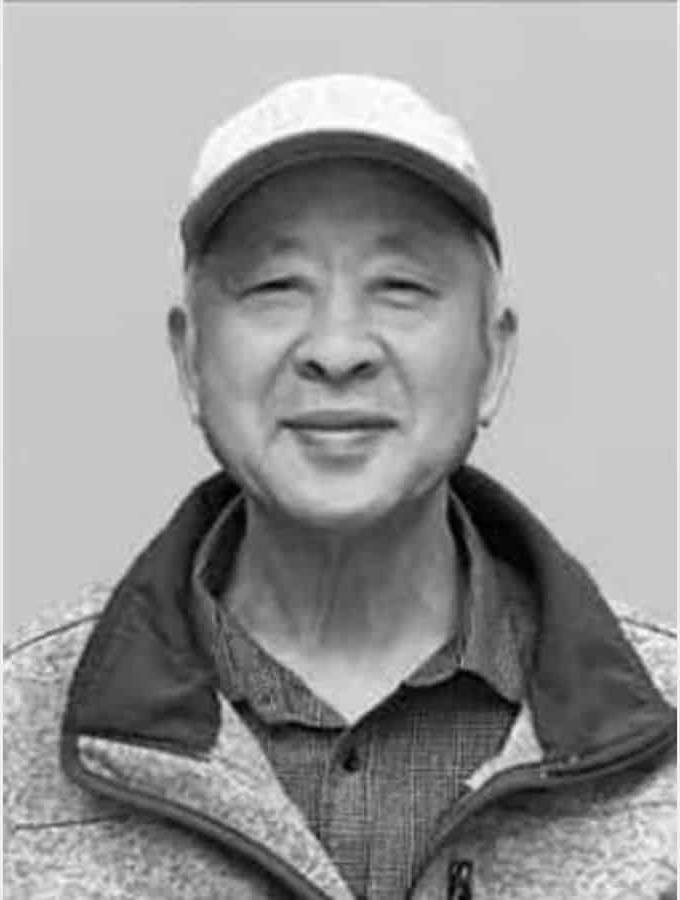
Wang Zhiwen was a Beijing man, and the public record holds no birth date for him — only a trail of ages scattered across twenty-six years of reporting. This archive lines them up first. On 26 December 1999, the day of his sentencing, Reuters, the Associated Press and the Washington Post all gave his age as 50, and Amnesty International's list of 23 March 2000 (AI Index: ASA 17/12/00) likewise entered "Wang Zhiwen, m, 50, former railways ministry official." In August 2016, when his exit from China was blocked, Minghui, the Falun Dafa Information Center and the International Society for Human Rights all gave his age as 67. In October 2025 his obituary recorded his death at 76. Fifty in 1999, sixty-seven in 2016, seventy-six in 2025: three figures from different institutions, a quarter-century apart, interlock exactly, and they point to a birth year of 1949. This archive accordingly fixes his years as 1949–2025. The brief for this entry carried an open-ended "1949– " because it was drafted before his October 2025 death was taken into account; having verified the obituaries, this archive closes the dates on the facts and explains the change here and in sections 13 and 14. His occupation is consistent across sources: an engineer in the Ministry of Railways system — "former PRC Ministry of Railways engineer" in the files of the US Congress's Tom Lantos Human Rights Commission and the US Commission on International Religious Freedom, an engineer at a Railways Ministry materials company in the wire reports, an engineer at the China Railway Materials Commercial Corporation in Minghui's telling; only the granularity of the employer's name differs. He was also a member of the Chinese Communist Party: the four defendants of December 1999 were uniformly described by Western wire services as four Falun Gong organisers who were themselves Party members, a fact the official propaganda of the day played up and this archive records plainly. The regime's first batch of heavy Falun Gong sentences fell on its own Party member, its own ministry engineer.
His name almost never appears alone in the record. It comes bound to three others — Li Chang, Ji Liewu, Yao Jie — fellow leading members of the former Falun Dafa Research Association, tried together on 26 December 1999 and sentenced the same day to 18, 16, 12 and seven years. For two decades afterwards the four names travel as a set through UN documents, US congressional files and Amnesty lists. This archive gives Wang his own entry because, of the four, his later trajectory is the most fully documented: prison gate to brainwashing centre, a passport issued and then voided by a database entry, a daughter testifying four times before a US congressional commission, and a death under guard in 2025. His file is the complete curve of how this persecution treated its "first batch" of convicts, from 1999 to 2025. The post-release fates of Li Chang, Ji Liewu and Yao Jie are far thinner in the public record; this archive does not pad their stories into his page, and names them only where the shared case requires it.
2. From engineer to research-association contact person: 1992 and 1993
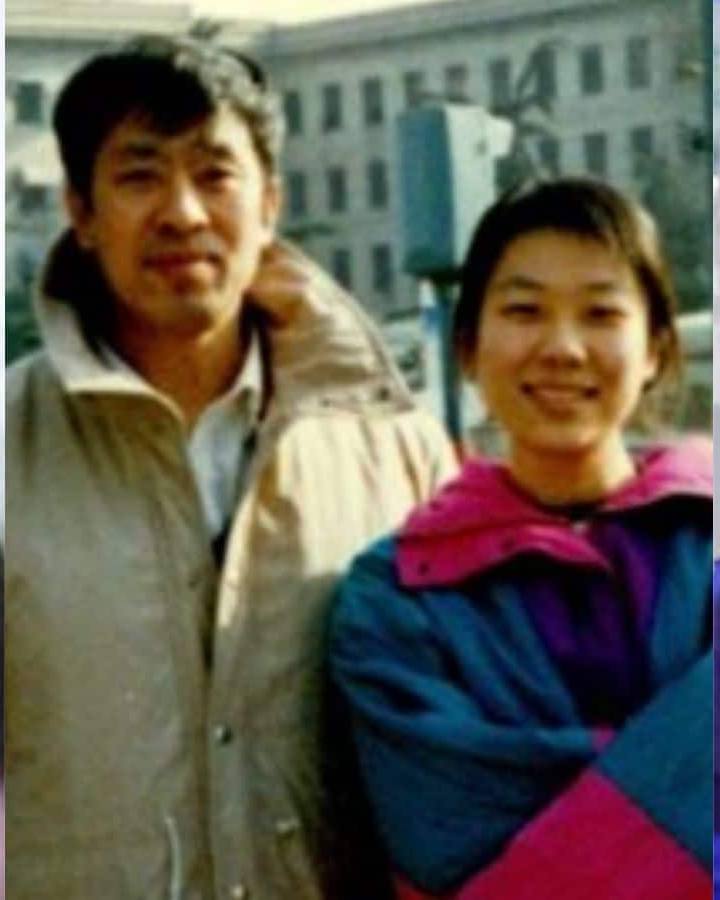
Per the family's campaign website (Free Zhiwen Wang, freemydad.org) and his daughter Danielle's congressional testimony, Wang and his daughter began practising Falun Gong in 1992 — the family site says father and daughter took up the practice in May 1992, and Danielle's December 2016 testimony likewise dates her own practice alongside her father to 1992. Falun Gong had been introduced publicly by Li Hongzhi that year and initially operated in the form of a qigong school. In 1993 the China Qigong Science Research Association formally approved a directly affiliated branch, the Falun Gong Research Branch — known as the Falun Dafa Research Association, the Falun Gong Research Association, or the China Falun Dafa Association — and Wang became one of its volunteer contact persons. The word "volunteer" is consistent across sources: an unpaid liaison and instructor role, coordinating practitioners, teaching the exercises and arranging activities in Beijing. In 1996 the association applied to withdraw from the China Qigong Science Research Association, the request was approved, and the "research association" ceased to exist as a registered organisation (Minghui's 2025 obituary carries a dedicated section on this history). Yet after 1999 every official charge and the judgment itself continued to use that defunct body as the organisational vehicle, converting Wang's contact-person role into the foundation of an "organising" offence. This archive fixes the time gap at the outset: the organisation he was convicted of "organising and using" had, in law, ceased to exist more than three years before his arrest.
Of the engineer's ordinary life the record preserves little, and this archive does not invent more: the family site says he raised his young daughter largely on his own, with relatives helping, and lived quietly. In December 1998 his daughter Wang Xiaodan, then 18, left for undergraduate study in the United States — the last time father and daughter lived in the same city under normal conditions. Over the next twenty-seven years she became a student, then a civil engineer, a wife, a US citizen; he became a convict, then a released man living under a guard post at his own door. Testifying in 2013, Danielle told Congress that at her wedding the family had set a chair for her father with a single rose on it, and that she kept that rose to hand to him when they met again. That rose, and a small polished tree branch he managed to send out of prison (see section 8), are the two anchors of this family's public story: in fifteen years, the branch was the only object that ever travelled from the father inside the walls to the daughter outside them.
3. 25 April 1999: the man who walked in to meet the Premier
To understand this case you have to go back to 25 April 1999. That day some ten thousand Falun Gong practitioners came to petition at the State Council's appeals office near Zhongnanhai in Beijing, after a Tianjin magazine attacked Falun Gong and Tianjin police detained practitioners who had gone to raise the matter. The Falun Dafa Information Center, Minghui and contemporary media agree that Wang Zhiwen was among the practitioner representatives who went in and met then-Premier Zhu Rongji. The requests were the release of the Tianjin detainees, legal publication of Falun Gong books, and a lawful environment for practice; Zhu ordered the detainees released that day, and the crowd dispersed peacefully in the evening. The episode was afterwards reclassified by the authorities as the "besieging of Zhongnanhai," and it became a core factual pillar of the prosecution of the four: Xinhua's sentencing report stated that Li Chang and others had "organised" the 25 April gathering of more than ten thousand practitioners in an "illegal sit-in demonstration," and Amnesty's list recorded that Wang was accused, among other things, of having organised activities "including the 25 April demonstration" and of holding state-secret documents. The same event — a petition conducted through the channel that still formally existed, with representatives received by the Premier, a commitment given the same day, and a crowd that went home by nightfall — was "petitioning" in April and evidence for a 16-year sentence in December. This archive records the juxtaposition without embroidery; it is the starting point of the case's entire legal story.
What followed that night is consistent in outline across sources: Jiang Zemin, the Party's leader, circulated a letter to the Politburo that night setting the line of defeating Falun Gong; in June the Party built the "610 Office" apparatus dedicated to the campaign. On the night of 19–20 July a nationwide arrest operation unfolded within hours, and the research association's contact persons were first in line. Wang was seized before the crackdown was publicly announced on 20 July and before Falun Gong was formally banned on 22 July by the Ministry of Civil Affairs and the Ministry of Public Security: arrest first, announcement second, legal ban third. UN and foreign-government documents have cited that sequence ever since, and this archive fixes it here because it is the first foundation stone for judging the procedure in this case.
4. July 1999: dragged from his bed
The arrest scene is described with unusual consistency: in the early hours of 20 July 1999, police burst into Wang's Beijing home and dragged him from his bed. The Tom Lantos Human Rights Commission's prisoner-of-conscience file reads, verbatim in substance, that he was "seized from bed on July 20, 1999" for his involvement and leadership in Falun Gong; USCIRF's religious-prisoners database uses the same formulation; the family site, citing neighbours' eyewitness accounts, says he was taken from his bed in the dawn hours and put into waiting police vans. Among the clothes family members hurriedly collected for him from the home was his daughter's red sweater — six months later she recognised it on television (see section 8). The date itself carries a dispute this archive records in parallel rather than resolving. Minghui and the Falun Dafa Information Center's 2025 obituaries both give 19 July 1999, saying he was arrested the day before the campaign formally began; the Chinese-language obituary material likewise says he was illegally detained by the 610 apparatus on 19 July. The US Congress, USCIRF, Amnesty's list and the 1999 wire services all use 20 July — the Washington Post recorded that the four were arrested on 20 July, two days before the ban. The likeliest reconciliation is that the sweep reached his home between the night of the 19th and the early hours of the 20th, the nationwide operation having begun during the night of the 19th. This archive sorts the case at 20 July 1999, the date carried by the US official files and the brief, prints both accounts, and merges neither.
For the five months between arrest and sentencing — where he was held, whether he ever saw a lawyer or his family — the public record is close to blank. The one fixable node comes from Amnesty International's March 2000 list: he was charged on 19 October 1999, the charge at that stage being framed around illegally obtaining and possessing top state secrets. From a July seizure to an October "formal charge," three months are missing from the legal paperwork; from the October charge to a 15 December prosecution filing and a 26 December trial and sentence, everything moved with unnatural smoothness. His daughter told Congress that from July 1999 she was never able to speak to her father at all — not a visit refused on a stated ground, but fifteen years in which no lawful channel of communication between this family and the man inside the walls was ever actually opened.
5. 26 December 1999: a nine-hour trial
On 26 December 1999 — a Sunday, the day after Christmas — the Beijing No. 1 Intermediate People's Court tried Li Chang, Wang Zhiwen, Ji Liewu and Yao Jie and sentenced them the same day. The timetable can be fixed from Xinhua's own account: the No. 1 Branch of the Beijing People's Procuratorate filed the prosecution on 15 December; on 26 December the court first sat in closed session on the illegal-obtaining-of-state-secrets count, because state secrets were involved, and then in open session on the remaining counts, pronouncing judgment that day. The Washington Post put the hearing at about nine hours; the Christian Science Monitor reported that Beijing had abruptly announced on Christmas Eve that the four would be tried two days later. The presiding judge was Ma Zirong — People's Daily Online's 27 December report quoted "presiding judge Ma Zirong" insisting the trial rested on fact and law. A Beijing-region investigation report by the World Organization to Investigate the Persecution of Falun Gong additionally names the prosecutor as Fang Gong, deputy chief procurator of the No. 1 Branch, and gives the judgment number as (1999) Yi Zhong Xing Chu Zi No. 2075; both details rest on that single advocacy investigation chain and are archived here as single-source, not as settled fact. The three counts and the sentences: organising and using a cult organisation to undermine implementation of the law; organising and using a cult organisation to cause death; and illegally obtaining state secrets, combined — Li Chang, 18 years plus five years' deprivation of political rights; Wang Zhiwen, 16 years plus four; Ji Liewu, 12 years plus two; Yao Jie, seven years plus one. The Associated Press observed at the time that these were among the harshest sentences handed to political or religious dissenters in China that decade. The sentencing was broadcast on national television; in the United States his daughter saw her father standing in the dock on a TV news programme — her first sight of him in more than half a year.
The Christmas timing was still being remarked on a quarter-century later. In the Falun Dafa Information Center's 2025 obituary statement, its executive director Levi Browde said the 26 December date was meaningful — one of the first examples of the regime strategically using the Christmas holidays for a high-profile dissident trial, when international policymakers and media would not be paying attention — and recalled seeing the photograph of Wang at his show trial as the gravest moment of that season. The Christian Science Monitor had made the same point on 28 December 1999, quoting Hong Kong rights monitor Frank Lu that the trial was very carefully managed at a very high level and timed to coincide with the Christmas holiday to minimise Western press coverage. On the day itself, the authorities cordoned off the courthouse — the UN Working Group's file records that the cordon was to ensure Falun Gong members could not stage the peaceful protests they had repeatedly held. The defendants' relatives called the trial unfair (Washington Post). A trial staged for the whole country to watch on television, which no citizen was allowed to approach and which was scheduled for the week foreign correspondents were on holiday: the programme record of this case says everything about what "open" meant here.
6. How the world characterised it at the time: a UN opinion, Human Rights Watch, and Amnesty's list
This is one of the few Chinese cases of its era to enter formal UN documentation within months of sentencing. Opinion No. 36/2000 of the UN Working Group on Arbitrary Detention (communication addressed to the Chinese government on 1 February 2000) deals specifically with Li Chang, Wang Zhiwen, Ji Liewu and Yao Jie. The Working Group held that their detention was arbitrary, in direct violation of Article 19 of the Universal Declaration of Human Rights (freedom of opinion and expression), falling within Category II of its methods of work — deprivation of liberty for the exercise of fundamental rights — and that the situation required remedy. In this archive's grading that is the highest tier: a UN expert body's formal opinion naming the individual. Human Rights Watch, on 27 December 1999, condemned the harsh sentences, called for the release of more than a hundred other Falun Gong members already formally charged, and urged the UN Commission on Human Rights to censure China publicly; its Asia division's Washington director, Mike Jendrzejczyk, was quoted across the media: these Falun Gong members should never have been arrested, much less given heavy sentences. The US State Department's 1999 Country Report on Human Rights Practices (released 25 February 2000) named him in its China chapter: former Public Security Ministry official Li Chang was sentenced to 18 years, former Railways Ministry official Wang Zhiwen to 16. As for Amnesty International's March 2000 report on the crackdown, the Falun Dafa Information Center relays its characterisation of this trial as the most high-profile Falun Gong case of that year and "grossly unfair"; this archive was unable to retrieve Amnesty's verbatim sentence on this case during the present check, so that wording is archived as the Center's relay of Amnesty, while Amnesty's own list document of the same month (ASA 17/12/00), directly retrievable, enters Wang by name with age, employer, court and sentence — solid top-tier corroboration of the case facts.
Two negative findings belong here so that no reader over-reads the international record. First, searching Radio Free Asia in English and Chinese retrieved no RFA feature devoted to Wang Zhiwen as an individual in this check: RFA's Falun Gong coverage is vast, but no individual entry for him could be verified, and none is claimed. Second, no resolution or record of the European Parliament or of FOREF (the Forum for Religious Freedom Europe) naming Wang individually was found; European Parliament resolutions of the 2000s addressed Falun Gong and religious freedom in China in general terms only. Both leads were carried in the brief for this entry; the honest finding is "individual entry not verified," and this archive prints that rather than dressing group documents up as personal ones.
7. Fifteen years inside: Qianjin Prison, toothpicks, and seven days without closing his eyes
The record of where he served carries three threads, which this archive keeps separate. Thread one: a February 2000 report by Hong Kong's Information Centre for Human Rights and Democratic Movement, relayed in a Minghui-published book, said Li Chang, Wang Zhiwen and Ji Liewu were then held in Beijing No. 1 Prison, and Yao Jie in Beijing Women's Prison. Thread two: Epoch Times / Global Tuidang Center reporting in 2014, relaying Minghui, said Wang was first shipped to Tuanhe Labor Camp and later transferred to Beijing's Qianjin Prison; the family site says he was sent to "a notorious labor camp in Tianjin" and later moved to Qianjin — the two accounts contradict each other on the place-name (Tuanhe is in Beijing's Daxing District; the family site says Tianjin), and this archive judges the earliest post-sentencing placement unresolvable on present sources, archiving it as disputed. Thread three, the one that can be fixed: Lin Shusen, who served in Qianjin Prison from 17 January 2001, wrote in his 2004 first-person account that former research-association members Wang Zhiwen, Li Chang and Ji Liewu were held in that prison at that time, Wang and others in its Seventh Division. Qianjin Prison belongs to the Qinghe Branch of the Beijing Prison Administration and sits near Chadian in Ninghe District, Tianjin — which explains the family site's "Tianjin": a Beijing prison on Tianjin soil. For the remaining decade-plus, Minghui's Qianjin Prison reporting, the insider accounts relayed by his daughter, and the Falun Dafa Information Center's obituary all place him there, and this archive fixes Qianjin as the prison where the substance of his term was served. The US congressional file records 5,475 days in custody in total — from 20 July 1999 to 18 October 2014, fifteen years plus the pre-trial months, consistent with every source's "released about a year early" from a 16-year term.
The material on what was done to him inside comes entirely through one chain — Minghui reporting relayed by family and insiders — and this archive prints it in that form, graded as such: neither independently verified nor deleted for being single-chain. Per Minghui's September 2009 report, relayed by the Epoch Times in 2014: four groups of four criminal inmates each were assigned to watch him around the clock; they would not let him sleep, and beat him if he closed his eyes; they forced him to sit on a bench for long stretches with his legs straight out, and beat him if he moved a muscle; and they jammed toothpicks under his fingernails, making him bleed profusely. His daughter, relaying what insiders told her, said he was savagely beaten and lost all of his teeth; that he was once deprived of sleep for seven straight days, with four inmate groups taking turns watching him, beating him whenever he closed his eyes, and on one occasion fracturing his collarbone. On the sentencing broadcast the family had already seen that his black hair had turned grey within months of his arrest (the ISHR statement also records that his hair turned grey within a few months under physical and mental mistreatment), his face tired and bruised; the family judged that he had aged ten years in half of one. The health ledger is partly fixed by US official files: both the congressional and USCIRF entries record that in prison he developed diabetes and high blood pressure and suffered a stroke shortly before his release. Put together, the substance is this: the "ringleader" the state had shown the whole country on television was then worked on for fifteen years as a model subject for forced "transformation," and what reached the outside was a handful of smuggled words — toothpicks, a bench, seven days without closing his eyes. This archive's formal line on the torture section is: reported by Minghui and relayed by the family, not verified on site by any independent body; but the pattern — sleep deprivation, four-group inmate watch teams — matches Lin Shusen's first-person account of Qianjin Prison's systematic sleep-deprivation regime for Falun Gong prisoners, so the pattern carries corroboration even where the individual details remain a single chain.
8. A daughter's fifteen years: a rose, a tree branch, and four trips to testify
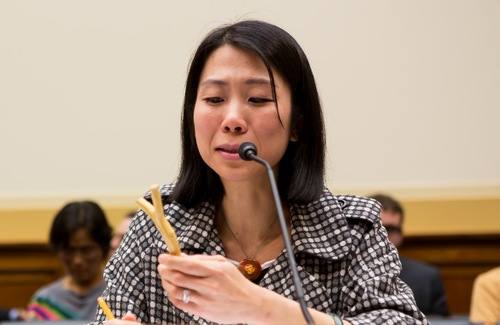
Wang Xiaodan — Danielle Wang — was 18 when she left for the United States in December 1998, and 19 and studying in America when her father was arrested. On 26 December 1999 she watched a television programme announce that her father had that day been sentenced to 16 years (Minghui's obituary). She went on to become one of the most frequently heard family witnesses in the US congressional record on China. On 5 December 2013 the House Foreign Affairs Subcommittee on Africa, Global Health, Global Human Rights and International Organizations held a hearing titled "Their Daughters' Appeal to Beijing: 'Let Our Fathers Go!'" (113th Congress, Serial No. 113-140), on the very days Vice President Joe Biden was visiting China. The five daughters testifying were Lisa Peng (daughter of Peng Ming), Grace "GeGe" Geng (daughter of Gao Zhisheng), Ti-Anna Wang (daughter of Wang Bingzhang), Bridgette Chen (daughter of Liu Xianming) and Danielle Wang. Introducing her, Chairman Chris Smith told the hearing that Wang Zhiwen was a Ministry of Railways engineer who had become a Falun Gong practitioner in 1992, seized from his bed on 20 July 1999 and sentenced to 16 years on 26 December; that since his arrest his daughter had campaigned through public events, hunger strikes and sit-ins at Chinese consulates; that she had not been back to China since arriving in the US in 1998; and that she had not spoken to her father since July 1999. In her testimony Danielle said that at her wedding a chair had been kept for her father with a single rose on it, and that she kept the rose safe to hand to him on the day they met again. At the hearing she also held up a small tree branch — a little object her father had polished with his own hands in prison and somehow sent out to her; Minghui's report of the day records her breaking down as she said that in fifteen years, this was the only thing she had ever received from him.
It was not her only testimony. December 2016 reporting records that she had by then testified four times before the Congressional-Executive Commission on China (CECC); the CECC's 2015 Annual Report, released on 8 October 2015, cited Wang Zhiwen's case by name among the evidence that the persecution of Falun Gong continued unabated (as relayed in Minghui's obituary). On 24 October 2014, six days after his release, practitioners held a press conference outside the Chinese Embassy in Washington demanding his immediate and unconditional release, at which Danielle described the torture her father had endured over fifteen years; the same day, Representative Chris Smith issued a statement — Mr. Wang should be freed immediately and allowed to reunite with his family — calling the campaign to eradicate Falun Gong one of the great atrocities of this century and demanding an end to arbitrary detention and torture and the closure of black jails and brainwashing centres. The Tom Lantos Human Rights Commission's Defending Freedoms Project opened a prisoner-of-conscience file on Wang; USCIRF's database of religious prisoners of conscience also carries an individual entry for him, marked "Not Adopted" — no member of Congress had formally adopted his case — and this archive records that status as it stands rather than inflating it. And the State Department's annual International Religious Freedom Reports kept naming him years after his release: the 2023 report, in its current text on the Department's website, states that Falun Gong practitioner Wang Zhiwen, imprisoned from 1999 to 2014, reportedly remained subject to an exit ban. A foreign government's annual report was still carrying his exit ban in the present tense in 2024 — the hardest continuing line in the international record on his status after 2016.
9. 18 October 2014: out of the prison gate, into a brainwashing centre
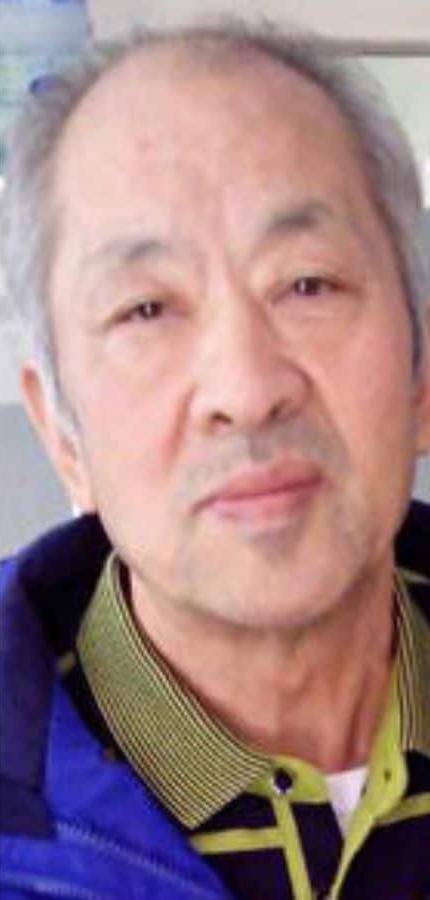
On 18 October 2014 Wang was released, about a year before his 16-year term would have expired — 15 years and three months served, 5,475 days counting from pre-trial detention. What happened on release day is fixed by his own open letter of 7 August 2016 and by multiple reports: he did not go home. He was taken straight to a brainwashing centre. The place-name varies by source: Minghui and the Washington press-conference coverage say a brainwashing centre in Changping District; his own account names it a legal-education centre in Changping run under Xicheng District (in the published translation, "Changping County (Xicheng District Law Education Center)"); the US congressional file, on the family's account, says a "brainwashing center" for ten days, with release to house arrest on 24 October; his own account says he was not allowed home until a week later, on 25 October. The one-day difference and the one-week-versus-ten-days difference are archived in parallel (see section 13), not merged. Inside, the authorities pressed him to renounce his beliefs — the thing fifteen years of prison had failed to extract, attempted once more as part of the release paperwork. Danielle spoke to her father by phone that October for the first time in fifteen years, briefly and with great emotion, and believed he was finally free. In fact his freedom from that day forward had exactly one form: the kind with men posted at his door.
The machinery of that surveillance is itemised in his own letter, which this archive preserves in substance: four infrared cameras installed near his apartment building, two people on duty around the clock in a water-pump house near the compound, arranged — his account says — by the state security apparatus; the watchers knew who visited him, and the neighbours knew of them; the neighbourhood committee and the property management also kept watch; his phone was tapped, he was followed when he went out, above all on days the authorities deemed "sensitive" — to the point that normal social contact with neighbours became nearly impossible. The first errand of his release was a passport application at the Xicheng District Exit-Entry Administration in November 2014: refused, with no written explanation, on the oral ground that he was still within his period of deprivation of political rights and therefore ineligible — a rule he checked online and could not find (his account). The October 2014 "release" must therefore be written in this archive as two events: a release on the legal text, and a transfer in fact — first a week in a brainwashing centre, then transfer to a home fitted with cameras. A sixteen-year sentence had been converted, without any new paper, into custody without a term.
10. 2016: a passport in hand, then "internally revoked"
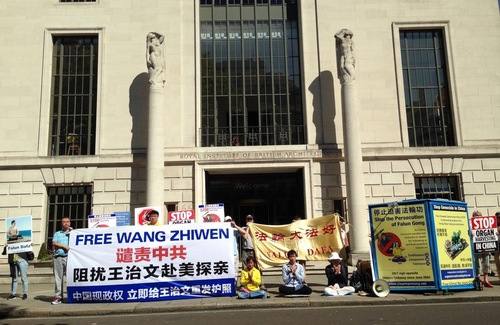
In January 2016 the picture shifted: applying online, he was issued a passport. What followed over the next months is preserved in his open letter as a numbered list — a first-person record of how the Chinese police apparatus works on a single man. (1) In February or March 2016, officers Li Yajun and Wang Tongli of Yuetan Police Station in Xicheng District came to his home and ordered him to hand over the passport, saying he could apply to use it when needed; he refused. (2) After a further failed attempt, the two officers told him that since he would not surrender it, "we have revoked your passport." (3) From July 2016 surveillance was sharply escalated: two people beside him day and night, following him to buy groceries, to walk, into the barber's chair, asking him as he ran errands, "Where are you going today?" (4) On the morning of Sunday 31 July, four officers came to his home — an Officer Liu of the Xicheng police, and from Yuetan station a deputy chief, Wang Tongli and an Officer Sun. Officer Liu, leading the talk, told him plainly: you cannot leave China, because you are still under deprivation of political rights; and from now on, every trip outside Beijing requires an application to the police station. Wang answered that the passport had been lawfully approved; that if a rule barred people under deprivation of political rights from holding one, they should show it to him, because no such policy could be found online. The officers called the visit "the bottom of the bottom line." (5) That same day, 31 July, he slipped the three men then on duty and travelled to Guangzhou for his US visa — followed by state security staff at the Guangzhou medical examination centre, granted the visa at the US Consulate General, and watched at his lodgings thereafter. On the night of 5 August, between 9 and 11 p.m., more than twenty people, local police among them, came to his rented rooms and pressed the landlord with a claim that more than ten people were conducting illegal activities there; they were turned back and proceeded no further. (6) On the morning of 6 August he took his passport and US visa to the exit-entry authorities for the exit formalities. The officer who checked the passport asked whether he had ever lost one: it showed in the online database as revoked — revoked internally by the police, with no specific reason.
The geography of the interception needs its own paragraph, because the brief for this entry placed it at Beijing airport, and no source supports that. Wang's own account puts the failed exit formalities in Guangzhou, where he had obtained his visa. His daughter's CECC testimony, as reported in December 2016, tells it as a journey: on 1 August the three of them flew to Guangzhou for the immigration process at the US Consulate; the next day they travelled to Dongguan intending to take a ferry to Hong Kong, were followed on the way, and at the ferry terminal were met by security agents — "when we tried to exit through customs, they said my father's passport had been canceled and they cut the corner off." And in the Falun Dafa Information Center's statement of 10 August 2016, Danielle's own quoted words compress the place to "the airport," where border officers insisted the passport had been cancelled and returned it only after cutting off a corner. Three versions — Guangzhou exit formalities, a Dongguan ferry terminal, "the airport" — most plausibly describe different moments or retellings of the same interception; what is certain is that it happened in Guangdong, on or about 6 August 2016, that the passport was invalidated on the spot by corner-cutting, and that the family was told the Ministry of Public Security had ordered the cancellation (Danielle to reporters). The Beijing-airport version appears in no source checked, is not adopted, and is corrected here on the record. The FDIC statement urged the US government to press Beijing at a high level to issue Wang a new passport and let him travel to New York to be with his daughter. The International Society for Human Rights, headquartered in Frankfurt, issued a statement condemning the travel denial and demanding he be allowed to leave. Amnesty International Canada's president spoke out publicly, and Canada's China Coalition had for years submitted Wang's case to the Canadian government as a representative Falun Gong case. Through mid-August 2016, protests followed in London, Munich, Paris, Zurich, Edinburgh, Oslo, San Francisco and Washington, demanding a new passport. The sum of all of it changed nothing. He was sent back to Beijing, and the men at his door stayed.
11. The home he never reached: 2016 to 2025, and a death under guard
After August 2016 the public record on Wang Zhiwen thins abruptly — and that thinness is itself part of the record. Three items can be fixed. First, his daughter kept testifying: the Falun Dafa Information Center's 2025 obituary quotes her CECC testimony on his condition after his return to Beijing — agents literally camping outside his front door 24 hours a day; not in prison, but monitored and followed as if he were; an extension of the persecution, in her words. Second, the Center's obituary summarises his released life as cameras tracking his every movement, regular police visits, neighbours recruited as informants, and orders to stay indoors on politically "sensitive days." Third, the State Department's 2023 International Religious Freedom Report still named him as reportedly under an exit ban — the ban in the present tense in a foreign government's formal report as late as 2023. Beyond that, from 2017 to 2025 nothing checkable about his health, his days, or any change in his situation was published at all: no photograph, no interview, no official syllable. A man whose sentencing had once been broadcast to the entire country lived eleven years under watch, and the public record gave him one repeated line a year.
In October 2025 the story ended in obituary form. Minghui reported on 21 October 2025 that Wang Zhiwen had died on 16 October 2025 at the Capital Medical University Affiliated Beijing Shijitan Hospital; the hospital's recorded cause of death was "cerebral infarction," which his daughter Danielle, in the United States, publicly doubted. Per Danielle, police were present at the hospital while her father was dying and video-recorded everything; the next day officers went to a relative's home, asked whether her father had left a will, searched the home, found his household registration booklet and house deed, and photographed the documents before leaving. The Falun Dafa Information Center's long obituary of 28 October 2025 added Danielle's own words from the campaign website: that she shared "with the greatest sadness" that her father had passed away on 16 October 2025 in Beijing; that in October 2025 he had been taken to a Beijing hospital against his will and died there under suspicious circumstances, with a group of police monitoring his room and even recording the final days of his life; and that in the months before his death local police had asked when she would return to China, claiming they would use all their power to enable her safe return — to which she answered that in all the years of persecution they had never done the family any favours, and that if they truly cared about her father they should have used that power to give him safe passage to the United States. Levi Browde's tribute for the Center said Wang's story epitomised the CCP's 26-year persecution of Falun Gong: an ordinary Chinese man sentenced in a show trial to 16 years and tortured, simply for helping organise fellow citizens to meditate; a man who held no grudges; and a regime that would not let even him live his life or reunite with his family, keeping him under strict surveillance even on his deathbed. The evidence label on the death must be printed in full, per this archive's rules: the fact and circumstances of the death rest, at present, on two Falun Gong-affiliated outlets — Minghui and the Falun Dafa Information Center — publishing on the daughter's and family's account, consistent with each other and complementary in detail. Searches in English, Chinese and Japanese found no confirmation or pickup by the Associated Press, Reuters, the New York Times or Radio Free Asia. Given the information environment inside China that absence is not surprising; but this archive's discipline is that what has not been independently confirmed is labelled not independently confirmed. The obituaries are archived as a family-sourced record, graded accordingly.
12. Full timeline
1949: Wang Zhiwen is born (year inferred from the age chain; month, day and birthplace not in the public record). 1992: he and his daughter begin practising Falun Gong (the family site dates it to May 1992). 1993: the Falun Dafa Research Association is established with the approval of the China Qigong Science Research Association; Wang serves as one of its volunteer contact persons. 1996: the association's withdrawal from the qigong association is approved and it ceases to exist as a registered body. December 1998: his daughter Wang Xiaodan, 18, leaves for university in the United States. 25 April 1999: some ten thousand practitioners petition in Beijing; Wang is among the representatives who meet Premier Zhu Rongji. Night of 19–20 July 1999: Wang is seized from his bed at home in Beijing (both dates archived in parallel). 22 July 1999: Falun Gong is formally banned. 19 October 1999: Wang is formally charged (Amnesty International's list). 15 December 1999: the No. 1 Branch of the Beijing People's Procuratorate files the prosecution (Xinhua). 26 December 1999: the Beijing No. 1 Intermediate People's Court tries and sentences the four the same day — Wang, 16 years plus four years' deprivation of political rights on three combined counts; Li Chang 18 years, Ji Liewu 12, Yao Jie seven; the sentencing is televised. 27 December 1999: Human Rights Watch condemns the sentences. 1 February 2000: the UN Working Group on Arbitrary Detention addresses its communication to the Chinese government; its Opinion No. 36/2000 later holds the four detentions arbitrary, violating Article 19 of the Universal Declaration. 25 February 2000: the US State Department's 1999 Human Rights Report names his 16-year sentence. 23 March 2000: Amnesty International's list (ASA 17/12/00) enters him by name. From January 2001: fellow prisoner Lin Shusen's account places Wang in Qianjin Prison, in the Seventh Division area (published 2004). September 2009: Minghui reports the Qianjin regime against him — four inmate watch-groups, sleep deprivation, toothpicks under his fingernails. 5 December 2013: Danielle testifies at the House Foreign Affairs subcommittee hearing "Let Our Fathers Go!" 18 October 2014: after 5,475 days, Wang is released from prison and taken the same day to the Changping brainwashing centre. 24/25 October 2014: he leaves the centre for his Beijing home and round-the-clock house surveillance (both dates archived); on 24 October Representative Chris Smith issues his statement demanding Wang's immediate release and reunion with his family. November 2014: his passport application is orally refused at the Xicheng exit-entry office. 8 October 2015: the CECC Annual Report is released, citing his case by name. January 2016: his passport is issued; in February–March Yuetan police demand its surrender, fail, and declare it revoked. 31 July 2016: four officers tell him at home that he may not leave China; the same day he slips his watchers and travels to Guangzhou for his visa. Evening of 5 August 2016: more than twenty people press at his Guangzhou lodgings. 6 August 2016: the exit is blocked — the passport is found "internally revoked" and is corner-cut and invalidated (three place accounts archived in parallel, section 10). 10 August 2016: the Falun Dafa Information Center urges high-level US pressure; statements by ISHR and Amnesty International Canada and protests in multiple countries follow. December 2016: Danielle testifies again before the CECC (reported as 8 December; her fourth CECC testimony). 2023: the State Department's International Religious Freedom Report still records him by name as reportedly subject to an exit ban. 16 October 2025: Wang Zhiwen dies at Beijing Shijitan Hospital, aged 76; per his daughter, police filmed his hospital room and the next day searched a relative's home over a will, photographing his household registration and house deed. 21 October 2025: Minghui publishes the obituary. 28 October 2025: the Falun Dafa Information Center publishes its long obituary. As of this archive's verification on 12 November 2026, no Chinese official channel has published anything about his death, and no independent mainstream outlet has confirmed it.
13. Archived in parallel: where the sources disagree
Under this archive's rules, disagreements among sources are listed, not merged. (1) Birth year: no direct record; inferred as 1949 from three consistent age reports (50 in 1999, 67 in 2016, 76 at death in 2025) — a high-confidence inference, but an inference, used in the title and flagged here. (2) Arrest date: 20 July 1999 (Tom Lantos Human Rights Commission, USCIRF, the 1999 wire services) versus 19 July 1999 (Minghui and Falun Dafa Information Center obituaries, 2025); sorted at 20 July with both printed; the likeliest reading is a seizure between the night of the 19th and the small hours of the 20th. (3) First place of post-sentencing detention: Beijing No. 1 Prison (Hong Kong Information Centre, February 2000); Tuanhe Labor Camp then Qianjin Prison (Epoch Times relaying Minghui); a Tianjin labour camp then Qianjin (family website) — three irreconcilable accounts; Qianjin is the multi-source-fixable prison from 2001 on. (4) The brainwashing centre's name and the homecoming date: "Changping District brainwashing centre" (Minghui, press-conference coverage) versus "Xicheng District Law Education Center (in Changping)" (his own letter); home on 24 October (congressional file; ten days then house arrest) versus 25 October (his own letter; one week). (5) The 2016 interception place: Guangzhou exit formalities (his own account); Dongguan ferry terminal (Danielle's CECC testimony as reported); "the airport" (Danielle's wording in the FDIC statement); the brief's "Beijing airport" appears in no source and is not adopted. (6) The passport's legal death, in two acts: his account records the checking officer's words — revoked in the database, internally, by police, for no stated reason; Danielle's accounts to reporters add the physical corner-cutting at the checkpoint and the claim that the Ministry of Public Security ordered the cancellation. Both acts are recorded in their sources' own words. (7) The son-in-law's surname: Jeff Nanarella (Minghui) and Jeff Nenarella (December 2016 coverage) both appear; archived in parallel. (8) Employer wording: Ministry of Railways engineer (US official files), a Railways Ministry materials company engineer (wire services), China Railway Materials Commercial Corporation engineer (Minghui) — one career at different granularity, carried here as "Ministry of Railways system engineer" with the variants on record. (9) The death's evidential status: announced by Minghui and the FDIC on the family's account, mutually consistent; independent mainstream confirmation: not found; Chinese official word: none. (10) Matters of no public record: birth month, day and place; his wife's name and situation (the public record shows only his one daughter speaking for the family across twenty-six years, and the obituary calls Danielle his only daughter); where he was held during the five months before trial and whether he saw a lawyer; any appeal or petition record; original prison medical files; year-by-year detail of his life from 2017 to 2025 beyond the surveillance summaries; and the arrangements for his remains.
14. Verification and sources
The core facts of this entry were cross-checked against the following sources; key facts rest on at least two, and single-source items are flagged in the text and in section 13. US official and congressional records: the Tom Lantos Human Rights Commission's Defending Freedoms Project file on Wang Zhiwen (arrest date, the three charges, 16 years plus four years' deprivation of political rights, 5,475 days, diabetes, hypertension and stroke, transfer to house arrest on 24 October 2014, the internally revoked passport of August 2016); USCIRF's religious-prisoners database entry (substantially the same material; adoption status "Not Adopted"); the transcript and record of the House Foreign Affairs subcommittee hearing of 5 December 2013 (113th Congress, Serial No. 113-140 — Smith's introduction, Danielle's testimony, the wedding-rose passage) and Representative Smith's office release of the same day, plus his statement of 24 October 2014 as carried in Minghui's Washington coverage; the State Department's 1999 Country Report (25 February 2000, naming the 16-year sentence) and its 2023 International Religious Freedom Report on China (naming him as reportedly still under an exit ban); the CECC's 2015 Annual Report's citation of his case (as relayed in Minghui's obituary). UN and international-organisation documents: UN Working Group on Arbitrary Detention Opinion No. 36/2000 (arbitrary detention, Article 19, Category II); Human Rights Watch's statement of 27 December 1999 (condemnation; the Jendrzejczyk quotation); Amnesty International's list of 23 March 2000, ASA 17/12/00 (age 50, employer, charged 19 October 1999, court, 16-year sentence, the 25 April matter). Official Chinese accounts: Xinhua's sentencing report of 26 December 1999 (preserved on a Chinese government office site — the 15 December filing, the closed-then-open sessions, the four sentences and deprivations) and People's Daily Online, 27 December 1999 (presiding judge Ma Zirong). Contemporary Western media: the Associated Press; the Washington Post (the nine-hour trial, all four defendants Party members, relatives calling the trial unfair); the Christian Science Monitor (the Christmas-timing analysis) — all retrievable through CESNUR's contemporary clipping archive. The subject's and family's own materials: Wang Zhiwen's open letter of 7 August 2016, published by Minghui (the brainwashing-centre week, the cameras and the pump-house watch post, the refused and then granted passport, the two Yuetan demands, the four officers of 31 July, the followed Guangzhou visa trip, the twenty-plus visitors of 5 August, and the "internally revoked" finding of 6 August — the only first-person document for the post-release years, graded A); the family campaign site freemydad.org (practice begun May 1992, the red sweater, the Tianjin account); Danielle Wang's congressional testimonies of 2013 and 2016 and her 2025 obituary words. Falun Gong-affiliated outlets: Minghui's reports of 26 October 2014 (the Washington press conference), 10 August 2016 (the FDIC border statement), 14 August 2016 (the letter), August 2016 (the worldwide protests), and 21 October 2025 (the obituary); the Falun Dafa Information Center's obituary of 28 October 2025 (the Zhu Rongji meeting, the relayed Amnesty "grossly unfair" characterisation, the Qianjin torture summary, the 2023 State Department line, the filmed deathbed and the will search, Browde's tribute); Epoch Times / Global Tuidang Center reports of 20 October 2014 and 11 December 2016 (the Tuanhe account, the relayed September 2009 Minghui torture details, the four CECC testimonies and the Dongguan ferry account); the ISHR statement of August 2016 as relayed by Minghui (the grey hair, the demand for exit); WOIPFG's Beijing-region investigation report (Fang Gong, the court panel, judgment number 2075 — single chain, archived, not adopted as settled); and Lin Shusen's 2004 first-person account (Qianjin's location and Wang's presence there in 2001). Negative checks: no RFA individual feature, no European Parliament or FOREF document naming him individually, and no US congressional resolution naming him personally were found, and none is claimed (general Falun Gong resolutions that do not name him are not counted as action on his case). Evidence grading: Grade A — the UN Working Group opinion, the congressional hearing record and official files, the State Department reports, Xinhua's official account, Wang's own letter. Grade B — the Human Rights Watch statement, Amnesty's list, Smith's office releases. Grade C — Minghui and FDIC reporting and obituaries (the obituaries being a family-sourced chain; the torture details an insider-relayed chain), the family website. Grade D — WOIPFG's court-personnel and judgment-number details, the Epoch Times' Tuanhe relay, each flagged where used. This entry was last verified on 12 November 2026.
15. Our Take
This archive's assessment is confined strictly to the facts of this case. First, look at the dates this case was made to keep. The arrest was timed before the ban was even announced; the sentencing was set for a Sunday, the day after Christmas; trial and judgment were completed in a single day, with the secrets count heard behind closed doors and the rest staged for the television cameras. That is not a judicial rhythm; it is a broadcast schedule — maximum deterrent value for the domestic audience, minimum reaction time for foreign correspondents. Four people, nine hours, fifty years of prison between them: averaged out, a man's whole life was worth about two hours in that courtroom. Second, look at how the charges were assembled. The first count punished "organising" — on behalf of an association that had legally ceased to exist in 1996. The second laid the deaths of more than a thousand practitioners, from illness and age across a movement of millions, at the door of four contact persons. The third, state secrets, was tried in secret, so that even the grounds of conviction could not be shown. Between them the three counts cover everything a volunteer liaison could possibly be: the contact person, the responsible person, the person who knew. He did not need to have done any particular thing; his role was the offence. Third, look at how the sentence was actually "served." Sixteen years on paper; fifteen years and three months in fact; then release day routed not home but to a brainwashing centre, and after that eleven years of door guards on 24-hour shifts, four cameras overhead, a tapped phone, tails on the street, and a passport annulled by an unexplained entry in a database. The judgment said "a fixed term of sixteen years." What was executed was a life term in instalments: from 20 July 1999 to 16 October 2025, twenty-six years, he did not spend one day unwatched — not even his last days in a hospital bed, with police standing in the room holding a camera. Fourth, look at the daughter's side of the ledger. What her father managed to send out in fifteen years was one small polished branch of wood. Her answers were four testimonies before a congressional commission, a rose left on an empty chair at her wedding, and flight after flight back to China to walk him out through the front door of the law: a real visa, a real passport, every step of the procedure completed — defeated in the end by one line in a database, "revoked," with no reason given and no one required to give one. This archive closes his file at the news of his death in 2025 with one conclusion the record will bear: the state's fear of this railway engineer outlasted his sentence, his release, and his life itself — it feared his voice, feared his exit, and feared, at the very end, the will he might have left behind. The record is archived here; those who come after may judge it.