
第162案 | 艾未未Case 162 | Ai Weiwei
艾未未,1957年生于北京,诗人艾青之子,一岁起随被打成右派的父亲流放北大荒与新疆,在石河子长大;他后来成了中国在国际上最有名的当代艺术家——「鸟巢」的艺术顾问、汶川遇难学生名单的公民调查者。2011年4月3日,他在北京首都国际机场被带走,秘密羁押81天:没有指控,没有律师,妻子只在第42天被准许在看守注视下见他15到20分钟。官方给的名目是「经济犯罪」,落地的是他妻子公司一张1500余万元的税单;他获释后被困北京四年、护照被扣,靠近三万名支持者借出的869万元打完两级税务官司,全部败诉。2015年7月22日护照发还,他当天前后的安排只有一个:离开。此后定居欧洲,柏林、剑桥、葡萄牙;2025年12月他十年来首次回国探亲三周,在机场被盘问近两小时后入境,平安返回欧洲——他的家与工作仍在海外,他的名字在大陆网络上仍不能公开出现。Ai Weiwei, born in Beijing in 1957, is the son of the poet Ai Qing: exiled as an infant with his father, denounced as a rightist, to Beidahuang and then to Shihezi in Xinjiang, where he grew up. He became China's most internationally famous contemporary artist — artistic consultant on the Bird's Nest stadium and organiser of the citizens' investigation that named the dead students of the Sichuan earthquake. On 3 April 2011 he was seized at Beijing Capital International Airport and held in secret for 81 days: no charge, no lawyer, and, on day 42, a single visit of fifteen to twenty minutes from his wife under the eyes of his guards. The official label was 'economic crimes'; the instrument that materialised was a tax bill of over 15 million yuan against his wife's company. After his release he was trapped in Beijing for four years with his passport confiscated, fought the tax case through both levels of court on 8.69 million yuan lent by nearly 30,000 supporters, and lost at every step. On 22 July 2015 the passport was handed back, and his plan had one item: leave. He has lived in Europe since — Berlin, Cambridge, Portugal. In December 2025 he returned to China for the first time in a decade, on a three-week family visit, admitted after nearly two hours of airport questioning and safely back in Europe afterwards — while his home and work remain abroad and his name still cannot appear openly on the mainland internet.
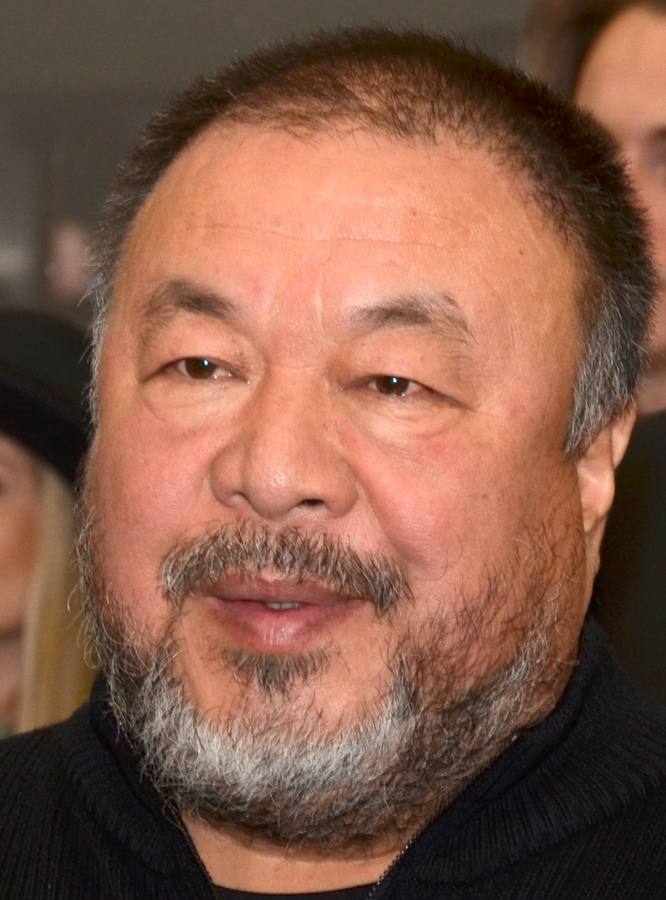
1. Fixing the coordinates: born in Beijing in 1957, vanished at Capital Airport on 3 April 2011 for 81 days
Ai Weiwei was born in Beijing in 1957. His exact birthday is contested in print: English-language references, Britannica among them, give 28 August, while the Chinese Wikipedia gives 18 May, and no birth document is publicly available for either; this page archives "1957" and logs the dispute in section 19 rather than picking a winner. He is the son of the poet Ai Qing — not a celebrity footnote but the key to his life. In the year of his birth his father was denounced as a rightist; from the age of one he was exiled with the family, and his childhood and adolescence were spent on a reclamation farm in Beidahuang and in a Production and Construction Corps company at Shihezi. When the secret police locked him up more than half a century later, everything that happened in that room had already happened to his father's generation, in different rooms.
The anchor date of this case is 3 April 2011. That morning, at Beijing Capital International Airport, Ai was stopped at border control as he was about to fly to Hong Kong, with Taiwan as the onward leg of his trip, and taken away. For 81 days his family did not know where he was, his lawyers could not see him, and there was no charge, no document and no address. The official label prepared for those 81 days was "economic crimes," and the instrument that eventually materialised was a tax bill of more than 15 million yuan issued against his wife's company. Yet according to Reuters' August 2011 interview with a source familiar with the detention, the interrogations in fact centred on his alleged role in the "Jasmine" protest calls, and on the threat that inciting subversion of state power could bring him ten years. Both accounts are archived side by side here; readers may judge. He was released on 22 June 2011, kept in Beijing with his passport confiscated for four more years, and only on 22 July 2015, when the passport was handed back, was he able to leave. He has lived in Europe ever since.
2. His father Ai Qing: one section, only what is necessary
Ai Qing (1910–1996), born Jiang Zhenghan in Jinhua, Zhejiang, was a leading modern Chinese poet, famous from the 1930s, who went to Yan'an in 1941 and joined the Communist Party the following year. In the Anti-Rightist Campaign of 1957, Ding Ling telephoned him and asked him to speak for her at a meeting; he did, and was himself branded a rightist: in December 1957 the Writers' Association party group expelled him from the Party and stripped him of all posts, with formal notice following in 1958. That April he left literary life for a state forest farm in Heilongjiang, in 1959 he was transferred to the Xinjiang Production and Construction Corps, and during the Cultural Revolution at Shihezi he was made to clean the village's communal latrines daily for years, work that left one eye nearly blind. He was rehabilitated in 1979 and died in Beijing on 5 May 1996. Ai Weiwei's memoir, 1000 Years of Joys and Sorrows (2021), writes the two generations into a single arc: a father exiled for twenty years over one spoken sentence, a son secretly detained for speaking. His remark that he had been in exile since birth recurs across his European interviews; it is his own self-description, archived here as such, not this site's rhetoric.
The family's itinerary, fixed from public sources: exiled to the 852 Farm in Beidahuang, Heilongjiang, in 1958, when Ai Weiwei was one; moved to Shihezi, Xinjiang, in 1961 (some Ai Qing chronologies date the transfer to 1959–60 — see section 19), living in a Corps company for some sixteen years; back in Beijing by the mid-1970s. His mother Gao Ying is a poet; CNN reported her as 93 years old when he visited her in December 2025. The father's file ends here: this page is Ai Weiwei's case, and Ai Qing's full record belongs to another part of this archive.
3. From the Stars group to twelve years in New York, 1978–1993
In 1978 Ai entered the Beijing Film Academy, in the class that also produced Chen Kaige and Zhang Yimou, and around the same time joined the Stars (Xingxing) group — Huang Rui, Ma Desheng, Wang Keping and others — the first openly avant-garde artists' group after the Cultural Revolution, which in 1979 mounted an open-air exhibition outside the National Art Museum and marched for artistic freedom. In 1981 he left for the United States, drifting through Philadelphia and San Francisco to New York, dropping out of Parsons School of Design, and supporting himself with portraits and odd jobs during a decade in the East Village, camera always in hand; the photographs later became New York Photographs 1983–1993. The American years gave him two things: fluent English, and a skill Beijing would come to find troublesome — he knew how to speak directly to international media, with no translator and no intermediary. In 1993, with his father gravely ill, he returned to Beijing. Ai Qing died in 1996.
4. The Beijing decade: Caochangdi, the Fake company and the Bird's Nest
In 1999 Ai built his studio-house at Caochangdi, on Beijing's north-eastern edge — his first architectural work, and the seed of the Caochangdi art district. In 2003 he founded the architecture practice FAKE Design; the tax case's subject, Beijing Fake Cultural Development Ltd., grew from the same practice, and its registered legal representative was his wife Lu Qing. That registration detail became crucial after 2011: the authorities maintained that Ai was the company's controller in fact and aimed the bill at him through it; Ai and the company's lawyers insisted throughout that he had no legal relationship with the company — not a shareholder, not an employee (his lawyer Xia Ling, as reported by AFP in November 2011). Both positions are archived here; this site does not adjudicate the corporate-law question.
In the 2000s, at the invitation of the Swiss architects Herzog & de Meuron, he served as artistic consultant for the 2008 Beijing Olympic stadium, the Bird's Nest — still his most widely recognised label worldwide. As the Games approached he publicly broke with them: he refused to attend the opening ceremony and criticised the Olympics as a propaganda exercise. The break was barely audible inside China and fully documented abroad; the European Parliament's resolution of 7 April 2011 noted it expressly — a man world-famous as co-designer of the Bird's Nest who was barred from exhibiting in his own country. The gap between that fame and that treatment is what turned an arrest into a global story.
5. The blog years and Charter 08: how he became a "dissident"
From 2005 Ai blogged on Sina — about art, and also about police beatings, forced demolitions, petitioners and public events, in blunt language, to an enormous readership. The authorities shut the blog in 2009, and he moved to Twitter, becoming one of the first Chinese artists to treat social media as a public square. He was among the first signatories of Charter 08; the European Parliament resolution called him one of its most prominent signatories. The chronology matters: his criticism was not a performance staged after his arrest, but a continuous public record of at least six years before it. After 2008 the criticism turned into organised investigation — and the next step was Sichuan.
6. The Sichuan citizens' investigation: naming the dead students, 2008–2009
In the earthquake of 12 May 2008, school buildings collapsed across Sichuan, and the number of dead students — and the corruption behind the "tofu-dreg" construction — became the page the authorities least wanted examined. No complete official list of the dead students was ever published. In February 2009 the Chengdu writer Tan Zuoren proposed that volunteers verify the students' names school by school and investigate the building quality; Ai organised a team of nearly fifty volunteers, and from 12 March 2009 posted each verified name — name, sex, age, school, class — on his blog. The running totals differ by source: the Taiwan International Documentary Festival's notes give 4,851 names verified by 2 September 2009; Artnet, citing the Global Times, gives 5,161 entries; the figure most often cited in Western reporting and in his own exhibition literature is 5,385. This page archives all three without merging them (see section 19). The point of the investigation was never the arithmetic: it was that when the state refused to produce a list, private citizens went door to door and asked for the names.
The list became a work: Remembering (2009), on the facade of the Haus der Kunst in Munich — thousands of school backpacks spelling out a sentence from a dead student's mother's letter, "She lived happily in this world for seven years" (a short quotation, under twenty words, archived verbatim). Tan Zuoren was detained on 28 March 2009 and on 9 February 2010 sentenced to five years for inciting subversion of state power — on facts that skirted the earthquake investigation entirely and rested on his writings commemorating June 4. That detour would be repeated on Ai Weiwei himself in 2011: the reason given in the interrogation room, and the charge printed on the tax bill, would again be two different things.
7. The Chengdu night: 12 August 2009 — a beating before a trial, and brain surgery in Munich
On 12 August 2009 Tan Zuoren stood trial in Chengdu, and Ai had travelled there to testify for the defence. At about 3 a.m., police entered the hotel rooms where he and ten volunteers were staying and held them there; in the process Ai was beaten — the U.S. Congressional-Executive Commission on China's case analysis records his account to wire services that police used force, striking him in the face; Amnesty International records that he was detained until the trial ended and beaten badly enough to require hospitalisation. The trial proceeded without him; no defence witness was permitted to testify.
A month later, in September 2009, while installing an exhibition in Munich, Ai suffered severe headaches; doctors diagnosed a cerebral haemorrhage and operated on him as an emergency on 14 September. He himself, and multiple wire reports, attributed the bleed to the Chengdu beating — the attribution is his and the reports', and this site flags it as such: the medical causation cannot be independently verified here, but the timeline — beaten in Chengdu in August, operated on for a brain haemorrhage in Munich in September — is multiply corroborated fact. It was the first time state violence landed on his body. The secret detention two years later would work mainly on the mind; Chengdu was the physical warning.
8. The Shanghai studio: built at the government's invitation, demolished on its order, 2010–2011
The studio at Malu, in Shanghai's Jiading district, existed because the local government had asked him to build it: about two years earlier Shanghai officials had invited him to put a studio on farmland there to anchor cultural development (multiple reports agree; the names of the inviting officials are a matter of no public record). The building went up; in the autumn of 2010 the notice came down: the structure was an illegal build without planning permission and would be demolished. Ai turned the demolition into performance: he announced a farewell banquet at the studio, serving ten thousand river crabs — hexie, river crab, being a homophone of "harmony," the netizens' jeer at censorship.
Around 5 November 2010, Beijing police came to his home and placed him under house arrest to keep him from Shanghai (his own account, given by telephone to British media). On 7 November the banquet went ahead without its host, attended by somewhere between several hundred and a thousand people (TIME put it at about 800, AFP-derived reports at over 400 — both figures archived); his house arrest was lifted the next day. In December 2010 he was stopped at Capital Airport and barred from leaving the country — he was travelling to a meeting in South Korea, and the reason given was national security; he told reporters he suspected the real purpose was to keep him from the Nobel Peace Prize ceremony for Liu Xiaobo in Oslo, though he had not been invited (his own stated suspicion, flagged as such). On the evening of 11 January 2011 the Shanghai studio was flattened in a single night, with no advance warning reaching him (designboom and other same-day reports). A building the government had commissioned, demolished by the government in one night, two years apart. Three months later, it was the man's turn.
9. The air of 2011: the "Jasmine" crackdown and at least 130 people
In February 2011, as protest movements swept the Middle East and North Africa, anonymous online posts called for Sunday "Jasmine" strolling protests in Chinese cities. Almost nobody actually turned out; the response was a nationwide crackdown. By Amnesty International's June 2011 count, at least 130 activists, lawyers, bloggers and ordinary internet users had since February been detained, forcibly disappeared, confined at home or harassed — the rights lawyers Teng Biao, Jiang Tianyong and Tang Jitian among the disappeared, Liu Xiaobo's wife Liu Xia under house arrest, Gao Zhisheng still missing. Amnesty pointedly noted that Ai Weiwei had not been involved in any "Jasmine" call at all. That point is nailed down here because it removes the handiest brick in the official narrative: he was not seized at a protest. He was seized at an airport, in the sixth week of the crackdown, three months after his Shanghai studio was demolished.
10. 3 April 2011: taken at the airport, the studio raided, four colleagues vanish in a week
On the morning of 3 April 2011, Ai Weiwei was stopped by border officers at Capital International Airport and taken away. In his later account to his biographer (relayed in the book Hanging Man and multiple media accounts), he was hooded in black and driven off — the hood detail rests on his own side's account alone and is flagged as such. The same day, Beijing police raided the Caochangdi studio and home, seizing computers and hard drives; his wife Lu Qing, eight studio staff and his lawyer friend Liu Xiaoyuan were taken in for questioning and released that night (Human Rights Watch's case record, archived via ecoi).
Over the following week, the people around him disappeared one by one. His assistant Wen Tao, a former journalist, was taken separately in Beijing on 3 April; his accountant Hu Mingfen was taken by police on 8 April; the designer Liu Zhenggang was taken by plainclothes officers on the night of 9 April, his wife reporting him missing; his cousin and driver Zhang Jinsong was detained on 10 April (all dates per Amnesty International's urgent-action update of 26 July 2011). Not one of the five families received any legal notification: where the men were held, on what suspicion, and for how long were all, and remain, matters of no public record. On 5 April, fifty hours after the seizure, his mother Gao Ying and his sister Gao Ge posted a handwritten missing-person notice on their neighbourhood street — the only instrument left to a mother at that point.
11. The official account (I): "economic crimes," nothing to do with human rights or free expression
The official words, fixed as given. On 6 April 2011 the party newspaper Global Times editorialised first, saying in substance that Ai liked to push at the edges and would sooner or later pay for his conduct (paraphrased here, not quoted). On 7 April, Foreign Ministry spokesman Hong Lei confirmed for the first time at a regular briefing that Ai was under investigation for suspected economic crimes, adding that the case had nothing to do with human rights or freedom of expression and that other countries had no right to interfere. On 12 April, after days of international calls for release, Hong added that Ai was a criminal suspect and that foreign support for him had left the Chinese people baffled and unhappy. The line never moved again: Xinhua's release notice said the Fake company had evaded a huge amount of tax and deliberately destroyed accounting documents; the Foreign Ministry said that during his bail year he could not leave Beijing without permission. No indictment, judgment or detention notice naming Ai Weiwei himself has ever been published — as of this check, the conclusion for all three documents is the same sentence: no public record. The entire legal facade of his 81 days consists of a spokesman's sentence and a Xinhua dispatch.
12. The international reaction: governments, the European Parliament, rights groups and the art world entire
The speed and scale of the reaction is what separates this case from the dozens of other disappearances that spring. On 4 April, U.S. State Department spokesman Mark Toner said Washington was deeply concerned; the U.S. Embassy in Beijing called the detention inconsistent with the fundamental freedoms and human rights of all Chinese citizens. British Foreign Secretary William Hague called on Beijing to urgently clarify Ai's situation and wellbeing and said he hoped for his immediate release. German Foreign Minister Guido Westerwelle demanded an urgent explanation of his fate; France, Australia and the EU delegation in Beijing added their concern, EU Ambassador Markus Ederer citing the increasing use of arbitrary detention against human rights defenders. On 7 April the European Parliament passed a dedicated resolution condemning the detention as unjustifiable and unacceptable and demanding his immediate and unconditional release. On 12 April the EU's High Representative Catherine Ashton called for the release of all those detained for exercising freedom of expression and said arbitrary arrests and disappearances must cease. Human Rights Watch demanded his release and an end to the crackdown on 6 April; Amnesty International issued successive urgent actions mobilising its membership worldwide.
The art world was this case's second, unique front. Ai's Sunflower Seeds was then on display at Tate Modern in London, and the museum put the words "Release Ai Weiwei" on the lightbox at the top of its building; Tate director Nicholas Serota joined artists Antony Gormley and Anish Kapoor in calling for his release, and his London dealer, the Lisson Gallery, said it was greatly concerned for his safety. In Hong Kong, protesters were already marching with his portrait on 10 April (per Reuters' photo caption that day), and the campaign spread to museums and universities around the world. Beijing's answer to all of it was a single phrase: interference in internal affairs. For 81 days Beijing gave no word of his whereabouts; the world asked almost daily.
13. The 81 days: two secret sites, more than fifty interrogations, and one visit by a wife
Conditions in detention are archived here in three distinct layers: first, Ai's own later accounts and his memoir; second, Reuters' detailed report of 10 August 2011 based on a source familiar with the events — the earliest and fullest account of the detention, given anonymously for fear of reprisal; third, the contemporary public statements of his family, his wife Lu Qing and his sister Gao Ge. What all three layers corroborate is written as fact; what rests on one layer is flagged item by item.
Per Reuters' source: he was held at two secret locations, the second for 67 days; he was interrogated more than fifty times, and the questioning centred not on tax but on his alleged role in the "Jasmine" calls; interrogators told him inciting subversion of state power could bring him ten years; they worked through the contents of his blog and Twitter account and told him that because he had criticised the government, society would be made to know him as a tax evader, a bigamist and a pornographer — that they meant to shame him. At the second site, two guards watched him twenty-four hours a day, their faces often inches from his, watching him even as he slept; he had to ask permission to drink water or use the toilet; he was not allowed to speak. The same account records that he was fed well and allowed long walks — archived here as well, because an archive keeps the details that cut against its own narrative too. He was told he was under "residential surveillance"; when he asked about a lawyer and whether his family knew where he was, he was told that could take up to six months.
His own account broadly matches, and adds the sensory register: a small room, one bed, one chair, two armed-police soldiers pacing in shifts inside the room around the clock, the light never off, every movement to be reported, sleep itself conducted under observation. His sister Gao Ge told reporters after his release that it amounted to a kind of psychological torture: a tiny room, constant light, two guards set very close to him at all times, watching constantly. In 2013 he rebuilt those 81 days as a work, S.A.C.R.E.D.: six life-size dioramas — eating, sleeping, showering, using the toilet, interrogation, surveillance — which viewers peer into through small windows, shown at the Venice Biennale that year (CNN's 2026 account confirms the work and its Biennale debut). It is the testimony he left the world about that room.
The lawyers' side of the ledger is blank throughout: Pu Zhiqiang and Liu Xiaoyuan never met him and never received any formal notification of his detention (Human Rights Watch's April 2011 case record). The family's side has exactly one entry: on 15 May 2011, the forty-second day, Lu Qing was taken to an undisclosed location and allowed to see her husband once — fifteen minutes by Amnesty International's account, about twenty by the Associated Press and The Guardian; both figures are archived. Two people supervised, one apparently in charge of Ai, the other taking notes; the place was not identified, the men who fetched her showed no credentials; conversation was restricted to family and health, the case itself off limits. She told AP afterwards that he looked physically well but tense and contained, his eyes puffy, like a different man; that he wore his own clothes and no handcuffs, and kept assuring her he was all right; and, via his sister, that he was getting the medication he needed. Those fifteen to twenty minutes were the family's entire contact with the outside world across 81 days.
14. Released on 22 June 2011: Xinhua's reasons, and a bail with no papers
On the evening of 22 June 2011 Ai Weiwei came home to Caochangdi. Xinhua's notice supplied the official reasons for release on bail pending trial: the Fake company had evaded a huge amount of tax and deliberately destroyed accounting documents; Ai had shown a good attitude in confessing his crimes, had expressed willingness to pay the taxes owed, and suffered from a chronic illness. The Foreign Ministry added the operative condition: for one year he could not leave Beijing without permission. Per Reuters' source, police added verbal conditions — no interviews with journalists, no meetings with foreigners, no internet or Twitter use, no contact with human rights activists, for a year. That set of conditions has never appeared in any official document; it is archived here as resting on Reuters' single source, unverified against any official text. That night, to the reporters waiting outside, he said only that he was home and could say no more (paraphrased).
Human Rights Watch's statement on the day of release put the procedural point plainly: Ai had never been formally charged with any crime, and no legal documents were ever issued for either his detention or his release. Legal comment followed in the same direction: Professor Wang Yujin of the China University of Political Science and Law said on 23 June that releasing him on bail showed the government could not find solid evidence of the alleged economic crime (as reported at the time; flagged as reported comment). The "trial" in bail pending trial never became a criminal trial at all. It became a tax lawsuit instead — see section 16. His four colleagues came out over the following two days: Zhang Jinsong on 23 June; Wen Tao and Hu Mingfen late on 23 June or in the early hours of the 24th; Liu Zhenggang on 24 June, released on medical grounds and kept under surveillance at home (Amnesty International; its U.S. section further reported that Liu had suffered a heart attack under interrogation and been sent to a Lanzhou armed-police hospital — a detail resting on that single organisational source and flagged as such).
15. The official account (II): the full ledger of the Fake company tax case
The tax case, fixed in sequence. In June 2011 the Beijing Local Taxation Bureau first demanded more than 12 million yuan from the Fake company (multiple reports). On 1 November 2011 the formal bill landed: back taxes, late fees and fines totalling more than 15 million yuan — AFP and others give 15 million, about US$2.4 million; some reports give 15.22 million; both figures are archived. The South China Morning Post's breakdown put 8.45 million as the alleged back taxes and late payments, with a fine of about 6.6 million. The authorities' factual claim: the Fake company was controlled by Ai Weiwei in fact, had evaded a huge amount of tax and had deliberately destroyed accounting documents. Ai's side's factual claim: he was not the company's shareholder, employee or legal representative and had no legal relationship with it; the assessment rested on accounts the police had seized from his studio; the tax authorities refused to produce their evidence or hold a proper hearing; and the whole case was political retaliation. He had been told as much by his interrogators in detention (Reuters' source, section 13), and he said it openly to AFP: the case was meant to silence him.
Then came the case's most moving act. Under tax procedure, without depositing a bond there is no right even to apply for administrative reconsideration. In early November 2011 Ai publicly appealed to supporters to lend him the bond money, promising repayment when the case ended. Within ten days nearly 30,000 supporters had lent him over 8.69 million yuan by bank transfer, remittance and online payment (the total he announced on the evening of 13 November); some travelled to Caochangdi in person and threw banknotes folded into paper planes over his courtyard wall. He said the money had shown him he was not alone (paraphrased). The Global Times, for its part, warned that the collection might amount to illegal fundraising (as reported at the time).
16. The 8.45-million-yuan bond and two levels of court, November 2011 – September 2012
On 15 November 2011, after the tax bureau refused a jointly held guarantee account and threatened to hand the case to the police if the deadline passed, Ai paid the 8.45 million yuan of supporters' loans directly into an account designated by the bureau; an agreement signed the next day confirmed the money as security during the appeal (the South China Morning Post and AFP corroborate each other on this sequence). Administrative reconsideration failed, and the Fake company sued the Beijing tax bureau, alleging unlawful evidence-gathering, account examination and penalty procedure, and demanding a public hearing. On 20 June 2012 the Chaoyang District Court heard the case with Ai himself barred by police from entering the courtroom — his bail year had not yet expired, and police were stationed permanently outside his home. On 20 July the court dismissed the suit; his lawyer Pu Zhiqiang called the ruling totally without reason. On 27 September 2012 the Beijing No. 2 Intermediate People's Court upheld the original decision on final appeal — the last court open to him. He told reporters the court had refused to respect the facts and had given his side no chance to present its case (paraphrased). He thereafter stated publicly that he would not pay the remainder of the bill; the 8.45-million bond was absorbed against part of the assessment. Whether the balance was ever collected, and how the accounts were closed after the company's business licence was revoked in October 2012 for failure to re-register (as reported), are matters of no public record. In 2013 he repaid his supporters' loans one by one (his own announcements and multiple reports; no complete public repayment ledger exists).
17. Four years trapped in Beijing: bail lifted, the travel ban, and flowers in a bicycle basket
On 21 June 2012 the bail year expired and the bail was lifted; he could leave Beijing again — but police informed him at the same time that he remained barred from travelling abroad because he was suspected of other offences, including spreading pornography, bigamy and illicit foreign-currency exchange. None of those suspicions ever became a public charge or document; the conclusion remains the same sentence: no public record. His passport had been held since 2011 and applications for a new one went nowhere; cameras watched the gate of the Caochangdi studio, he was followed when he went out, and his phone and internet were monitored (his own statements and multiple reports). From November 2013 he began placing a fresh bouquet of flowers every day in the basket of a bicycle outside his studio, in protest at the confiscated passport — a gesture he kept up for some 600 days, until the passport came back (AFP; the 600 days is his and the reports' round figure). Through those four years he could not leave the country, and exhibited anyway: S.A.C.R.E.D. in Venice in 2013 and the vast Alcatraz installation in San Francisco in 2014 were both made under remote direction from Beijing. The man could not get out; the work did.
18. 22 July 2015: the passport comes back — departure, and ten years in Europe
On 22 July 2015 police handed his passport back. He posted a photograph of himself holding the red document, captioned in substance: today, I got my passport (short paraphrase). No official explanation for the timing was ever given. He left at once: first to Germany for medical checks, building a large studio in a former Berlin brewery, then in September to London for the Royal Academy's major exhibition of his work — the first time in four years he had stood in one of his own exhibitions abroad. His bases over the following decade are a matter of complete public record: Berlin (2015–2019; announcing his departure, he said Germany was not an open culture); Cambridge (from September 2019, where his son attends school and where he keeps a base); and Portugal (from the start of the Covid pandemic in 2020, buying land and building a studio near Montemor-o-Novo in the Alentejo — telling The Guardian in 2023 that he intended to stay in Portugal long-term, "unless something happens"). His exile-era work and public activity include the refugee documentary Human Flow (2017), Coronation (2020, on Wuhan and Covid) and Cockroach (on the 2019 Hong Kong protests), and exhibitions across Europe and the Americas — registered here as current-status background, not as this page's subject.
On 3 August 2018 his main Beijing studio, "Zuoyou," in the Zuoyou arts district, was demolished without notice to him. He had rented the former factory since 2006; the lease had expired the previous autumn and the demolition formed part of a wider redevelopment of the area (his studio manager Ga Rang, to AFP). Ai and his team said the deadline for vacating had not yet been reached, no notice of the demolition date had been given, and large numbers of works were still inside when the machines arrived. Both accounts are archived. The Caochangdi Fake studio was not affected at that time (per The Art Newspaper). For a man three years into exile, a Beijing studio came down — the mirror image of Shanghai in January 2011: that time, the demolition was the overture to an arrest; this time, the man was already beyond reach.
19. Archived in parallel: discrepancies between sources and unverified items
(1) Birth date: English Wikipedia and the Britannica line give 28 August 1957; the Chinese Wikipedia gives 18 May; no third authoritative source — the year only is archived. (2) Days detained: the mainstream figure is 81 (3 April to 22 June); a few European institutional profiles give 82, apparently an inclusive count of both end dates — 81 is adopted. (3) Flight destination: most sources give Hong Kong, many adding Taiwan as the onward leg; some plays and secondary books give Taipei direct — archived as Hong Kong with an onward Taiwan leg. (4) Length of the wife's visit: Amnesty International gives 15 minutes; AP and The Guardian give about 20 — archived in parallel. (5) The driver's name: Amnesty's English text romanises Zhang Jingsong, Reuters and AP romanise Zhang Jinsong, and the underlying Chinese character (jin, "vigour," versus jin, "advance") has no authoritative public source — the text uses Zhang Jinsong and registers the variant here. (6) The Sichuan name-list totals: 4,851 (as of September 2009), 5,161 and 5,385 — different cumulative points and final-total claims, not merged. (7) The tax bill: 15 million versus 15.22 million yuan, in parallel; the composition (8.45 million taxes and late fees plus a fine of about 6.6 million) follows the South China Morning Post's breakdown. (8) The year of the move to Xinjiang: the Chinese Wikipedia's Ai Weiwei entry gives 1961 for the family's arrival at Shihezi; Ai Qing chronologies give a 1959 transfer to Xinjiang with arrival in the Shihezi reclamation area in August 1960 — in parallel. (9) The release conditions (no interviews, no foreigners, no internet, no human-rights contacts): Reuters' single source only; no official text is publicly available — unverified. (10) Liu Zhenggang's heart attack under interrogation: Amnesty International USA only — single source. (11) The exact detention locations, any detention or indictment documents naming Ai Weiwei himself, and the final settlement of the balance of the tax bill: all matters of no public record. (12) The organiser biography printed for him at Portugal's Contextile biennial in 2026 states that he "lives and works in Beijing, Berlin, Cambridge and Lisbon" — not fully consistent with CNN, The Guardian and other reporting that he is based in Portugal; the biography is institutional boilerplate, this page follows the news reporting and registers the boilerplate here.
20. Current status: an eleventh year in Europe, and the December 2025 trip home
This site's verified conclusions on his current status, each with its basis. First, he remains based in Europe for his life and work: a 2023 Guardian profile confirmed his settlement near Montemor-o-Novo, Portugal, and his intention to stay long-term; his book On Censorship was published in Britain in January 2026 and he was in Cambridge on a UK book tour in February 2026 (Index on Censorship, Spring 2026); his large exhibition Button Up! opened in Manchester on 3 July 2026, with The Art Newspaper stating plainly that he is now based in Portugal while his son studies in Cambridge; and from September to November 2026 he is the invited artist of the Contextile biennial in Guimarães, Portugal. Second, he still holds a Chinese passport and has not renounced Chinese nationality (the Guardian's February 2026 interview, as relayed — flagged as relayed). Third, in mid-December 2025 he returned to China for the first time since leaving in 2015: travelling with his son, he was inspected and interrogated for almost two hours at Capital Airport — the questions were simple ones, how long he meant to stay and where else he meant to go — then admitted, spent three weeks in Beijing, and visited his 93-year-old mother Gao Ying; the visit was smooth, with no detention or obstruction (CNN's long report of 22 January 2026, read in full). CNN also noted that his name and work remain largely censored on mainland social-media platforms. Fourth, this check found no public record of his resettling in China, being arrested or charged, or having his passport confiscated again; asked by The Guardian in February 2026 whether he had been scared to go back, he answered that he had not (per the interview's headline). One family visit is not the end of an exile: his home, his studio and his son's schooling are in Europe, his re-entry still runs through two hours of border questioning, and his name still cannot appear openly in his own country. This site therefore determines: his exile abroad continues, this case belongs on the Ongoing wall, and his status is recorded as "in exile overseas (based in Portugal)." Should a public record of his resettlement in China appear, this page will be re-judged at once.
21. Full timeline
1957: born in Beijing; his father Ai Qing is denounced as a rightist the same year. 1958: exiled with the family to Beidahuang, Heilongjiang. From 1961: some sixteen years at Shihezi, Xinjiang. 1978: enters the Beijing Film Academy; takes part in the Stars group. 1981: leaves for the United States. 1993: returns to Beijing as his father falls ill. 1996: Ai Qing dies. 1999: builds his Caochangdi studio. 2003: founds FAKE Design. 2005: begins blogging. 2008: artistic consultant on the Bird's Nest, and publicly breaks with the Olympics; launches the citizens' investigation after the Sichuan earthquake. From 12 March 2009: publishes the dead students' names day by day. 12 August 2009: beaten by Chengdu police and held until the Tan Zuoren trial ends. 14 September 2009: emergency brain surgery in Munich. November 2010: held under house arrest for several days; the river-crab banquet proceeds without him. December 2010: barred from leaving the country on national-security grounds. 11 January 2011: the Shanghai studio is demolished. From February 2011: the "Jasmine" crackdown; at least 130 people detained or disappeared. 3 April 2011: seized at Capital International Airport; the studio raided; four colleagues taken within the week. 7 April 2011: the Foreign Ministry confirms investigation for "economic crimes"; the European Parliament passes its resolution the same day demanding release. 15 May 2011: his wife is allowed one supervised visit. 22 June 2011: released on bail pending trial; the four colleagues follow over the next two days. 1 November 2011: the tax bill of over 15 million yuan is issued. 15 November 2011: the 8.45-million-yuan bond is deposited. 20 June 2012: the tax suit is heard, with Ai barred from the courtroom. 21 June 2012: bail lifted, the travel ban continued. 20 July 2012: the suit is dismissed at first instance. 27 September 2012: the appeal is dismissed, final. October 2012: the Fake company's licence is revoked (as reported). May 2013: S.A.C.R.E.D. is shown in Venice. From November 2013: daily flowers in a bicycle basket protest the confiscated passport. 22 July 2015: the passport is returned; he leaves for Europe. 3 August 2018: the Zuoyou Beijing studio is demolished. September 2019: moves to Cambridge. From 2020: based principally in Portugal. 2021: the memoir 1000 Years of Joys and Sorrows is published. Mid-December 2025: a first return to China in a decade — three weeks, admitted after nearly two hours of airport questioning. January 2026: On Censorship is published in Britain. July 2026: the Manchester exhibition opens; he remains based in Portugal.
22. Verification and sources
Sources actually consulted for this check are as follows. First rank, official and quasi-official records: the full text of the European Parliament resolution of 7 April 2011 on the case of Ai Weiwei (the Jasmine crackdown, Charter 08, the Sichuan list, the Chengdu beating and the Shanghai demolition are all recorded in it); the U.S. Congressional-Executive Commission on China's case analysis of the 2009 Chengdu trials (the 3 a.m. hotel detention, the blow to the face, the blocked witnesses); Xinhua's release notice and the Foreign Ministry's statements, as relayed and cross-corroborated by Human Rights Watch, Amnesty International and multiple wire services; and the existence and substance of the Global Times editorial, via multiple reports. Second rank, human-rights documentation: Human Rights Watch's statements of 6 April and 22 June 2011 (no lawyer access, the wife's single visit on 15 May, never formally charged, no detention or release documents — the key procedural facts); Amnesty International's 2011 urgent-action series and its update of 26 July 2011 (the day-by-day seizure dates of the four colleagues, the order of their releases, the count of at least 130 people in the crackdown, the fifteen-minute visit) and Amnesty USA's note on Liu Zhenggang's medical release. Third rank, wire-service depth reporting: Reuters, 10 August 2011, on conditions inside the detention (the source-based account — two sites, 67 days, more than fifty interrogations, the subversion threat, the close-watch regime, the release conditions — each item flagged in the text with its source layer); AP, 16 May 2011, on the wife's visit (the twenty-minute figure and Lu Qing's account), and its 2012 tax-litigation series; AFP's November 2011 tax-bill and bond reporting, its July 2015 passport-return report, and its August 2018 studio-demolition report. Fourth rank, long-form and current-status reporting: CNN, 22 January 2026, "Ai Weiwei quietly returns to China after a decade," read in full (the three-week visit, nearly two hours of airport questioning, the 93-year-old mother, the continuing censorship of his name on mainland platforms); The Guardian's 2023 Portugal profile and its February 2026 return-visit interview (consulted via reporting and relay); Index on Censorship's Spring 2026 interview (Cambridge in February 2026, the Portugal base); The Art Newspaper, 3 July 2026, on the Manchester opening (now based in Portugal); Smithsonian magazine's January–February 2024 Portugal feature. Fifth rank, used only for discrepancy comparison and never as factual authority: the English and Chinese Wikipedia entries on Ai Weiwei and Ai Qing (birth date, the Xinjiang transfer year, the name-list totals). Negative results are recorded honestly: the exact detention locations are a matter of no public record; no detention notice, indictment or judgment naming Ai Weiwei himself is publicly available; the final disposition of the balance of the tax bill has no public record; and no official text of the 2011 release conditions has ever been published.
23. Our Take
What deserves to be fixed in this case is the crack, running from first to last, between the official label and the actual operation. On the official account, this was an economic-crime case: a company controlled by an artist had evaded tax. But for a tax case they deployed the following: an airport interception, a black hood, two address-less secret locations, two soldiers watching a 53-year-old diabetic eat, sleep, shower and use the toilet, more than fifty interrogations circling "Jasmine" and the crime of subversion, his accountant, driver, assistant and designer picked up one by one and held for over two months, and a wife permitted, on day forty-two, fifteen minutes of family talk under the eyes of two minders, one of them taking notes. A tax case needs none of that. What needs all of that is an exhibition staged for everyone watching — whose theme was that no matter how famous you are internationally, no matter which museum's walls your work hangs on, if we wish it, you can be made to vanish from the world for 81 days, and nobody need be given so much as a piece of paper.
And the reason that exhibition ultimately failed is written into its own design. The specimen they chose was too famous: Tate Modern put "Release Ai Weiwei" on its roof, the European Parliament passed its resolution within four days, and nearly thirty thousand ordinary Chinese people lent 8.69 million yuan in ten days and threw banknotes folded into paper planes into his courtyard — that was Chinese society's vote on the tax bill, cast in 2011. More damaging still were the procedural self-contradictions the case left behind: a man released for his "good attitude in confessing," then held in his own country for four more years on three suspicions that were never charged; a tax lawsuit, completed through both levels of court, at which the plaintiff's central figure was barred from the courtroom by police. The simplest question was never answered: if it was really a tax case, why was he never allowed a lawyer, why was the place of detention never disclosed, and why did the interrogation room ask about nothing but politics? Ai later rebuilt that room as a model and let the world's viewers press their faces to its little windows. This page keeps the same window open. In December 2025 he flew back to Beijing, was questioned at the border for nearly two hours, was let through, spent three weeks with his family and returned safely to Europe; some conclude from this that the page has turned. This site does not judge it so: for a man whose name still cannot appear openly on his own country's internet, the exile has not ended — and its end should be reckoned from the day his name can be written freely there, not from the mood of a border desk.