
Zhang Youxia (1950– )
Zhang Youxia, born in Beijing in July 1950 of Weinan, Shaanxi ancestry, enlisted in December 1968, joined the Party in May 1969 and graduated from the PLA Military Academy's Basic Department at junior-college level. His father Zhang Zongxun — a founding general of 1955 who had marched in the Autumn Harvest Uprising and the Long March, served as a deputy commander of the First Field Army and directed the General Logistics Department — was both a fellow townsman of Weinan and a First Field Army comrade of Xi Zhongxun; Zhang Youxia was therefore widely regarded as Xi Jinping's closest military ally, a label this page files at the commentary tier while recording the fathers' overlap itself as hard fact. He served twenty-six years in the 14th Army's 40th Division, rising from a soldier in the 119th Regiment to division commander, fought in the 1979 Sino-Vietnamese War and, as the 119th Regiment's commander, at Laoshan in 1984 — one of the last two combat-tested officers on the Central Military Commission. He then commanded the 13th Group Army and the Shenyang Military Region (2007–2012), was promoted to general in 2011, became director of the General Armaments Department and a CMC member in 2012 — doubling as chief commander of the manned space programme, announcing the successful Shenzhou-10 and Shenzhou-11 launches — and in January 2016 became the first director of the reorganised CMC Equipment Development Department, handing over to Li Shangfu in August 2017. This page is indexed under 2022 for the reasons set out in Section Six. Its file runs on three lines. The equipment line: he held the PLA's armaments gateway for nearly five years, and from 2023 the equipment system became the epicentre of the military purge — but the authorities have never published any specific personal act from his equipment tenure, and this page records the institutional remit and the structural facts only, without writing the system's old accounts up as personal findings. The Taiwan and supreme-command line: on 25 October 2017 he became a Politburo member and CMC vice chairman, ranked second, adding the state vice chairmanship in March 2018; when the August 2022 live-fire exercises encircled Taiwan he sat inside the CMC, the supreme command body, but the executing formation was the Eastern Theater Command under Lin Xiangyang, no official document names any individual commander of the exercises, and his personal role in them has no public record — this page records the institutional tier only. On 23 October 2022, retained at seventy-two past retirement age, he became the first-ranked vice chairman, reappointed to the state post on 11 March 2023; his on-record posture in the term includes 'no mercy' for Taiwan independence at the Xiangshan Forum (October 2023) and the Taiwan red line drawn to Jake Sullivan in person (August 2024). The fall line, which must be segmented: his last verifiable public appearance was on 22 December 2025, announcing promotion orders at a general-promotion ceremony in Beijing — the first-day formulation 'not seen since the 20 November Moscow talks' was corrected by Reuters itself, and this page follows the corrected version. His absence from a Central Party School study session on 20 January 2026 triggered speculation, a phase containing only the verifiable absence and overseas inference, with no official announcement. On 24 January 2026 the defence ministry formally announced that, by decision of the Party Central Committee, he was under investigation for suspected serious violations of discipline and law — from that date the investigation rests on an official document. A PLA Daily editorial of 25 January accused him of trampling on the CMC chairman responsibility system, at the political-positioning tier. On 28 August 2026 the NPC Standing Committee removed him as state CMC vice chairman and terminated his NPC deputy qualification. On 21 September 2026 the Politburo's notice found that he had become estranged from the Party in heart and mind, formed cliques, been disloyal and dishonest to the Party, used his position to help others obtain promotions and accepted huge sums of money, with political and economic problems intertwined; it expelled him from the Party, the CMC having already expelled him from the military, and transferred his case to military prosecutors. On 29 October 2026 the Fifth Plenum ratified the expulsion. The notice names no specific crime and publishes no specific act or sum; the Wall Street Journal's reported closed-door allegations — nuclear leaking and the sale of Li Shangfu's promotion — appear nowhere in the official notice, the nuclear claim was directly contradicted by US officials cited in the New York Times, and the coup, gunfight and death stories are all unsubstantiated; this page marks them all unverified and registers them together. Sanctions: no public record — his name appears on no US, EU, UK or Canadian public sanctions list; what the United States sanctioned under CAATSA in September 2018 was the Equipment Development Department as an institution and its then director Li Shangfu personally, more than a year after Zhang had left that post, and this page corrects the conflation expressly. Status: his case rests at the review-for-prosecution stage, with no indictment, trial or verdict announced and no public record of where he is held or of his health.
1. Son of a founding general: the princeling starting point (1950–1968)
Zhang Youxia was born in July 1950 in Beijing, of Weinan, Shaanxi ancestry. His father, Zhang Zongxun, belonged to the deepest stratum of the Communist military: he took part in Mao Zedong's Autumn Harvest Uprising of 1927, completed the Long March, commanded the 358th Brigade of the Eighth Route Army's 120th Division in the war against Japan, and served in the northwest during the civil war as a deputy commander of the First Field Army — the formation in which Xi Zhongxun, Xi Jinping's father, served as political commissar. In the PLA's first conferral of ranks in 1955 Zhang Zongxun was made a general; he later served as a deputy chief of the General Staff and as director of the General Logistics Department (1973–1978). The two fathers were fellow townsmen from Weinan and comrades in the same field army — the double overlap, fathers as townsmen and comrades, sons in the same court, is the substrate of Zhang Youxia's later standing. This page's discipline is the one used across this site's people files: the fathers' overlap is hard fact; 'Xi Jinping's closest military ally' is a commentary-tier label from media and scholarship, recorded as such. But it is equally a matter of record that when he fell in 2026, Reuters, the New York Times and virtually every other outlet defined him by exactly that label — the label's ubiquity is itself part of the archive.
He is a princeling of the classic type: born into a senior-cadre household in Beijing, educated at Beijing Jingshan School, his first eighteen years incomparable to those of an ordinary soldier's family. Yet his file differs from those of many princeling generals in one respect: after enlisting in December 1968 he did not stay in a Beijing staff office or a capital guard formation. He went to the 119th Regiment of the 40th Division of the 14th Army in Yunnan, on the Vietnamese border, and stayed in front-line units for twenty-six years, climbing from soldier and staff officer to division commander. His father's mantle gave him the starting line; it did not, on the public record, spare him the grassroots. That record later became his hardest political capital: in a high command where real combat experience had died out by generation, he was one of the very few who had actually fought and commanded a regiment in battle.
2. How this page assigns responsibility: three tiers, and four corrections first
The easiest errors in writing about Zhang Youxia are four: the years of his armaments tenure, whose the August 2022 exercises were, the day he actually vanished from public view, and which parts of the 2026 story rest on official announcements and which on rumour. This page nails down four corrections before proceeding.
Correction one: the Equipment Development Department years. The commissioning brief for this page gave '2015–2017'; checked against the sources, that is imprecise. Xinhua's official biography groups his posts as director of the General Armaments Department in the 2012–2016 block (its itemised lines run 2013–2015, a grouping by congress terms) and director of the CMC Equipment Development Department in the 2015–2017 block. The hard institutional date is this: the Equipment Development Department was created on 11 January 2016 in the military reform, replacing the General Armaments Department; Zhang was its first director, serving from January 2016 to August 2017, when Li Shangfu succeeded him in September 2017. The English Wikipedia's infobox gives January 2016 to August 2017 for the post, while its 'commands' line gives 2015–2017 — both datings circulate, the discrepancy arising from biography-grouping versus the institution's actual creation. This page anchors on the institutional dates: General Armaments Department, October 2012 to January 2016; Equipment Development Department, January 2016 to August 2017 — nearly five years over the whole armaments gateway — and registers the discrepancy.
Correction two: command of the August 2022 exercises. During the exercises Zhang was a vice chairman of the Central Military Commission — ranked second, behind Xu Qiliang — inside the supreme command body. But theater-level execution and command belonged to the Eastern Theater Command, whose commander was Lin Xiangyang. The English Wikipedia's article on the 2022 exercises fills its infobox 'commanded by' field with Xi Jinping, Xu Qiliang, Zhang Youxia and Wei Fenghe — an editorial grouping by the article's editors, not an official document: no official announcement or statement ever named any individual commander of those exercises. Multiple reliable outlets consistently report that the coordinating and planning role belonged to He Weidong, who had left the Eastern Theater and held no public post (see this site's He Weidong file) — itself a reporting-tier claim. This page's treatment mirrors that file: the formal chain of command is written as the official record has it, personal roles at the reporting tier with sources named; for Zhang, only the institutional-tenure fact is recorded — the exercises occurred during his CMC vice chairmanship and he was a member of the CMC leadership — neither upgraded into personal command nor erased for want of a naming document.
Correction three: the date of the last appearance. In their first-day reporting of the 24 January 2026 investigation, Reuters and other outlets wrote that he had not been seen in public since 20 November 2025, when he held talks with Russia's defence minister in Moscow. Reuters corrected itself on 26 January: Zhang and Liu Zhenli had both appeared with Xi Jinping at a CMC general-promotion ceremony on 22 December 2025 — and Xinhua and the Chinese government portal's report of that day states it plainly: at the ceremony Zhang Youxia announced the promotion orders signed by Xi, for Eastern Theater commander Yang Zhibin and Central Theater commander Han Shengyan, while Zhang Shengmin presided. The English Wikipedia's downfall section, which says he disappeared 'after November 2025', is likewise imprecise. This page takes 22 December 2025 as the last verifiable public appearance, with the 20 November Moscow talks recorded separately as a major appearance before it. The correction matters: from last appearance to investigation announcement is one month, not two, and the narrative of a long disappearance before announcement — true of He Weidong's seven months — does not fit Zhang's case at all. His case ran at the opposite tempo: absent from one meeting, officially under investigation within days (see Section Eight).
Correction four: the 2026 events are written in three segments, tiers never blended. Segment one, before 24 January 2026: his absence from the 20 January opening of a Central Party School study session for provincial and ministerial leading cadres triggered speculation — a verifiable absence plus overseas inference, with no official announcement; this page marks it unverified. Segment two, 24 January 2026: the defence ministry formally announced that, by decision of the Party Central Committee, Zhang Youxia and Liu Zhenli were placed under investigation for suspected serious violations of discipline and law — from that date the investigation rests on an official document, not rumour; but the announcement contains only that formula and no specific act of any kind. Segment three, 21 September 2026: the Politburo's notice supplied characterisations and punishment — estranged from the Party in heart and mind, forming cliques, disloyal and dishonest to the Party, using their positions to help others obtain promotions and accepting huge sums of money, political and economic problems intertwined — with expulsion from Party and military and transfer to prosecutors; the notice still names no specific crime and publishes no specific act or sum. Every concrete allegation circulating outside those three segments — the Wall Street Journal's report of a closed-door briefing alleging nuclear leaks and the sale of Li Shangfu's promotion, the overseas stories of a coup, a hotel gunfight, a death — remains at the reporting and rumour tier; and the nuclear-leak story was, in addition, directly contradicted by the New York Times of 3 February 2026, citing current and former US officials, who said Zhang was neither a US spy nor had leaked China's nuclear secrets to the United States. The commissioning brief for this page was drafted on the assumption that '2025–26 investigation rumours are unconfirmed and must not be written as fact'; the official announcement chain has since superseded that assumption, and this page writes accordingly: what the announcements say is written as announced, and nothing beyond them is written as fact. That is the brief's own discipline — never state a purge without an official announcement — applied now that the announcements exist: the discipline lands on refusing to write in any detail the announcements do not contain.
The method itself is the one used across this site's people files, in three tiers. Tier one, the personally provable: his own documented record — appointments, promotions, combat service, the institutional remit of his armaments tenure, his public activities and statements as vice chairman, the last-appearance record, and the punishment chain that finally landed on him. Tier two, the institutional tenure: what the seats he occupied did while he occupied them — the equipment system's procurement order and space programme under and after him, the CMC's Taiwan-direction exercises and reform agenda during his vice chairmanship — written throughout as 'during his tenure' and 'the institution', never as his personal orders unless a document names him. Tier three, reporting and analysis: Reuters, the Wall Street Journal, the New York Times, the South China Morning Post, the Jamestown Foundation, CSIS and others on his roles, factional placement and the reasons for his fall, each item attributed and tiered, single-source claims marked unverified, and mutually contradictory reporting registered side by side without adjudication.
3. Twenty-six years in Yunnan: a regimental commander who had actually fought (1968–1994)
Zhang Youxia enlisted in December 1968 and was assigned to the 6th Company of the 119th Regiment, 40th Division, 14th Army, stationed in Yunnan. In 1971 he moved to the regimental headquarters' training section as a staff officer; commissioned in 1976, he returned to the line as commander of the regiment's 8th Company. The setting of that career was the Vietnamese border: the 14th Army held the Yunnan sector facing Vietnam. When the Sino-Vietnamese War opened in February 1979, the 14th Army was one of the main forces on the western front, fighting in the Lào Cai direction; Zhang served through it at company and regimental-staff level, and on his wartime performance was promoted to training-section chief and then chief of staff of the 118th Regiment, deputy commander of that regiment in 1981, and commander of the 119th Regiment in 1983.
In 1984 he led the 119th Regiment in the Battle of Laoshan. Laoshan was the main-peak position on the Yunnan sector of the border; after Chinese forces retook it in April 1984, Vietnamese forces counterattacked in strength. The engagement most often cited at the analysis and reporting tier is the Vietnamese offensive of 12 July 1984, in which, Jamestown's 2026 retrospective notes, Zhang coordinated indirect fire in the Songmaoling sector to keep his regimental headquarters from being overrun — the detail of that specific action rests on Chinese social-media and encyclopedia retellings, and this page files it at the reporting tier, taking as its fact layer only what the official biography and multiple consistent sources support: regimental commander of the 119th from 1983 to 1984, leading it at Laoshan. After Laoshan he was promoted at once to deputy commander of the 40th Division, but the reform-era rule that officers above regimental level required academy training sent him to the Basic Department of the PLA Military Academy (September 1984 to July 1986, in the official biography), after which he resumed the deputy command, was made division commander in 1990, and held the post until 1994. His ranks along the way: colonel when ranks were restored in 1988, senior colonel in 1990.
Set that record in the PLA's whole coordinate system: the 1979 and 1984 campaigns were the only large-scale combat the PLA fought after 1979. Officers who had fought in both and still climbed to general were, by the time he entered the CMC in 2017, down to a handful; by 2025 he and Liu Zhenli were the only two members of the CMC with combat experience — and when both were placed under investigation on the same day in January 2026, Jamestown and CSIS analyses made the same point in the same words: Beijing had lost the last combat-tested leaders of its high command. That sentence is an analysis-tier judgement and is cited as such; but the structural fact beneath it — combat experience in the high command ending there — is supported by the service records themselves and needs no inference. His twenty-six years in Yunnan, soldier to division commander, two wars, a regimental command made famous at Laoshan, are the first foundation stone of this file, and the reason every analysis reaches for when explaining why he was retained past retirement age — a reason the authorities themselves never stated.
4. From Chongqing to Shenyang: group army commander and military region commander (1994–2012)
In 1994 Zhang Youxia left the 14th Army system in which he had spent twenty-six years to become deputy commander of the 13th Group Army at Chongqing, studying in a combined-arms command course at the National Defense University from March 1996 to January 1997 and attaining major general in 1997. In August 2000 he became commander of the 13th Group Army, serving a full five years. In December 2005 he became deputy commander of the Beijing Military Region. Promoted to lieutenant general in July 2007, he became commander of the Shenyang Military Region that September and was elected to the Central Committee at the 17th Party Congress the same year — army command, military-region command and Central Committee seat inside three years, the threshold of the high leadership.
The Shenyang Military Region was one of the seven military regions, covering the three northeastern provinces and facing the Korean Peninsula and the Russian Far East, with major ground-force group armies, air-force units and much of the defence-industrial heartland inside its jurisdiction. His five years in command there (September 2007 to October 2012) are documented mostly at the procedural level — exercises, inspections, disaster relief — and this page records them at that granularity. The tenure was dug up again more than a decade later: the Wall Street Journal reported on 25 January 2026 that Xi Jinping had dispatched a task force to Shenyang to investigate Zhang's tenure as military region commander, the team staying in local hotels rather than military bases, on the reported reasoning that it wished to avoid his local network. That claim rests on the Journal's informed sources, a single reporting line the authorities have never confirmed; this page registers it here and fixes its tier in Sections Nine and Eleven — it can show where the investigation's reach extended, not what it found.
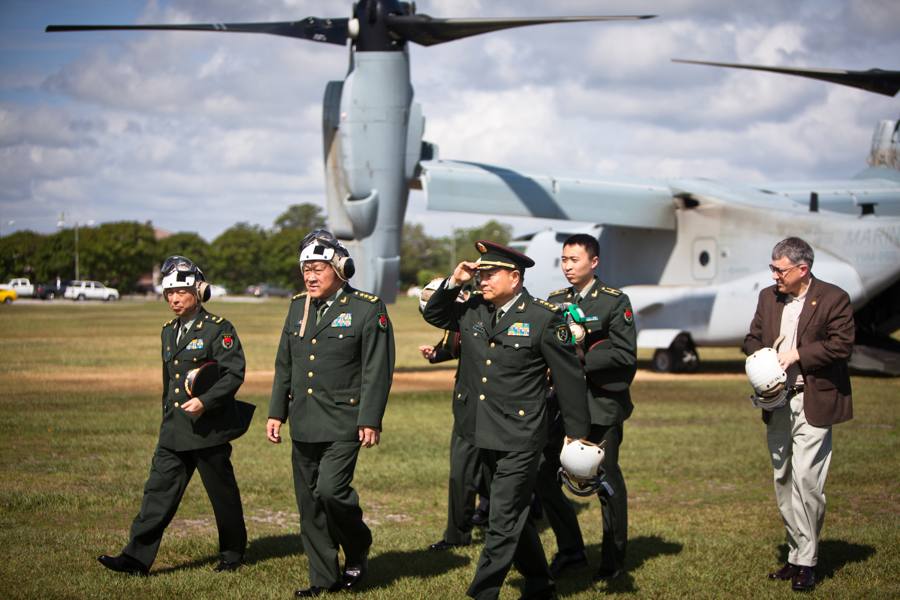
In July 2011 he was promoted to general — fifty-six years after his father's generalcy in 1955, a father-and-son pair of full generals. In May 2012 he accompanied Defence Minister Liang Guanglie on a visit to the United States, touring Marine Corps Base Camp Lejeune in North Carolina — the US Marine Corps' official photograph of that visit later entered Wikimedia Commons and remains one of the few compliantly usable images of him (see the image check in Section Twelve). That autumn, in the PLA reshuffle preceding the 18th Party Congress, he succeeded Chang Wanquan as director of the General Armaments Department, and his career turned from field command to command of the entire armaments system.
5. Armaments supremo: the General Armaments Department, the Equipment Development Department and the manned space programme (2012–2017)
In October 2012 Zhang Youxia became director of the PLA General Armaments Department; in November 2012 the First Plenum of the 18th Central Committee made him a member of the Central Military Commission. The General Armaments Department was one of the four general departments, controlling the research, development, procurement, maintenance and test ranges of every weapon the PLA fielded — the largest single procurement purse in the military budget passed through it. By convention its director simultaneously served as chief commander of China's manned space engineering programme. In June 2013 he announced, in that capacity, the successful launch of Shenzhou-10; in October 2016 he did the same for Shenzhou-11, by then as director of the CMC Equipment Development Department. Both entries belong in this file because they mark the other face of the armaments post: not merely a procurement officer, but the military's chief commander of a flagship national programme.
In January 2016 the military reform abolished the four general departments and created fifteen CMC functional organs; the General Armaments Department was reorganised as the CMC Equipment Development Department, with Zhang as its first director, serving until August 2017, when Li Shangfu succeeded him. His nearly five years over armaments coincided with the PLA's equipment surge: carriers, destroyers, stealth fighters and anti-ship ballistic-missile test ranges advancing in parallel. The South China Morning Post reported in November 2021 that he had headed the anti-ship missile testing programme, including a weapons-testing range fitted with a mock-up US aircraft carrier — filed here at the reporting tier: it describes the kind of programme his armaments tenure supervised, and is not an allegation of personal misconduct. When he stepped down in August 2017 there was no public sign of any problem with his equipment record; weeks later he rose to a CMC vice chairmanship at the 19th Congress, which was at the time the leadership's own verdict on that tenure.
The real archival weight of this stretch settled on it only afterwards. In July 2023 the Equipment Development Department publicly solicited leads on procurement and bidding violations dating back to October 2017; the Rocket Force corruption case and the Li Shangfu case detonated in sequence; when Li was expelled from the Party in 2024, the official notice said he had seriously polluted the political ecology of the military equipment sector. The equipment system thereby became the epicentre of the purge — and Zhang Youxia was Li's predecessor, the Equipment Development Department's founding director and its organiser. Analysts at Jamestown, CSIS and elsewhere broadly connect his fall to the equipment system's old accounts; Jamestown's analysis even notes that the 2023 equipment back-check at one point stopped at Li Shangfu and spared Zhang. This page's discipline: that connection is an analysis-tier inference. The September 2026 official notice writes no specific equipment-tenure act against his name; its charges are the collective formula of cliques, disloyalty, promotion-selling and dereliction. This page records only the structural fact — the man who ran armaments for nearly five years was later taken down on a collective formula, while the authorities have never published what, in his equipment tenure, he is supposed to have done wrong. The shape is the same as in He Weidong's file: every procedural step documented, the factual core left blank.
6. First term as CMC vice chairman: ranked second, and August 2022 (2017–2022)
On 25 October 2017 the First Plenum of the 19th Central Committee made Zhang Youxia a member of the Politburo and a vice chairman of the Central Military Commission, ranked second of the two vice chairmen, behind Xu Qiliang. In March 2018 the first session of the 13th National People's Congress made him a vice chairman of the state CMC (the starting day of the state post is given as 19 March 2018 by the English Wikipedia and 18 March by the Chinese Wikipedia; this page records the month and registers the discrepancy). He also served on the Chinese side of the Russia–China intergovernmental commission on military-technical cooperation — President Vladimir Putin mentioned the role to his face when they met in Moscow on 7 December 2017; the Kremlin-released photographs of that meeting later became the source of his Wikipedia infobox portrait.
The first term's public activity ran mainly along the track of external military engagement: meeting the Korean People's Army's General Political Bureau director Kim Su Gil in August 2019; in January 2022, at a meeting of the military's disciplinary officials, calling for innovative measures to eliminate corruption (as reported by the South China Morning Post); meeting Pakistan's army chief Qamar Javed Bajwa in June 2022. These are the daily face of a vice chairman's office, not policy manifestos, and this page records them as such. The one episode of the term that requires the chain of responsibility to be taken apart is the August 2022 exercises.
On the evening of 2 August 2022 US House Speaker Nancy Pelosi arrived in Taipei; from 4 to 7 August, and then by extension, the PLA conducted large-scale live-fire exercises in six sea and air areas around Taiwan, executed by Eastern Theater Command forces, with Rocket Force missiles fired into waters east of Taiwan and some reported overflying Taipei — the episode known internationally as the Fourth Taiwan Strait Crisis. Zhang Youxia was then a vice chairman of the CMC: the CMC was the decision and supreme-command body for those exercises, and he sat inside it — an institutional-tenure fact. Three boundaries must be drawn. First, the theater level: the executing formation's commander was Lin Xiangyang; announcements and operations ran in the theater's name, and any formulation of the type 'Zhang Youxia commanded the Taiwan-encirclement exercises' jumps the chain of command — this page does not use it. Second, the personal-role level: no official document names any individual commander of the exercises; the coordinating and planning role consistently reported by multiple reliable outlets belongs to He Weidong (reporting tier; see Section Five of his file), and no public material assigns any comparable personal role to Zhang — his personal role in the exercises has no public record. Third, the collective-responsibility level: as a CMC vice chairman he bore leadership-level responsibility for the CMC's Taiwan military agenda during his tenure, and this page records that level as it stands, including the whole 2022–2026 stretch in which post-exercise patrols, median-line crossings and encirclement drills became the cross-Strait norm while he was vice chairman. This page is indexed under 2022 because two nodes fall in the same year: August brought the Fourth Taiwan Strait Crisis, and October brought his retention at seventy-two, past retirement age, and elevation to first-ranked vice chairman — the first node marks what the supreme command body he sat in did, the second marks how far the top leadership's trust in him then ran. Barely three years later that trust was withdrawn by investigation notice; the contrast between the two ends is this file's main line.
7. First-ranked vice chairman: retained past retirement, a public agenda, and the last autumn (2022–2025)
On 23 October 2022 the First Plenum of the 20th Central Committee settled the new CMC: Xi Jinping as chairman, Zhang Youxia and He Weidong as vice chairmen, Zhang ranked first. Under the Party military's unwritten age convention, a CMC vice chairmanship normally ends around sixty-eight; Zhang, born in July 1950, was seventy-two in 2022. The US Department of Defense's 2022 China Military Power Report and its 2023 official profile both noted that he had been expected to retire in 2022 and that his retention reflected Xi's desire to keep a close and experienced military adviser — a US government publication's assessment, cited here at the analysis tier. On 11 March 2023 the first session of the 14th National People's Congress reappointed him a vice chairman of the state CMC, completing the Party and state pair for a second term. He was now the highest-ranking uniformed officer under Xi Jinping, and he held that place for more than three years, until January 2026.
His public agenda in this term draws a clear line. Taiwan and external posture: on 30 October 2023 he told the Beijing Xiangshan Forum that the PLA would show no mercy toward any Taiwan-independence separatist moves (as reported by the South China Morning Post); in April 2024, at the Western Pacific Naval Symposium in Qingdao, he called for abandoning Cold War mentality and promised firm countermeasures against unreasonable provocations; on 29 August 2024, at the August 1 Building, he met US National Security Advisor Jake Sullivan — the first meeting between a senior US official and a CMC vice chairman since 2018 — at which, per the White House readout, the two sides recognised progress in military-to-military communications and planned a theater-commander telephone call, while Zhang, per Xinhua and the Associated Press, demanded that the US correct its strategic understanding of China, respect China's core interests and treated Taiwan as the red line of the relationship. Equipment and readiness: in August 2023 he told senior officers that ensuring the quality of weaponry should be a top goal (South China Morning Post); in October 2024 he oversaw readiness drills in Hebei. Travel: Russia in November 2023, meeting Defence Minister Sergei Shoigu and President Putin; Vietnam in October 2024, meeting Party General Secretary Tô Lâm, President Lương Cường, Prime Minister Phạm Minh Chính and Defence Minister Phan Văn Giang; Pakistan in November 2024, meeting army chief Asim Munir. And the discipline posture: in November 2025 he published a signed article in the People's Daily on the key tasks of defence modernisation which, as relayed by Reuters and other outlets, demanded a crackdown on 'fake loyalty' and 'two-faced men' and the elimination of the military's accumulated ills — two months before the PLA Daily turned almost the same loyalty vocabulary on him. This page sets that juxtaposition down as fact and adds no rhetoric to it.
The appearance record of late 2025 has to be pinned month by month, because it fixes where the disappearance begins. On 3 September he attended the eightieth-anniversary ceremony and parade for the victory over Japan, seated in the front row on the Tiananmen rostrum — independent video analysts noted that his seating departed from protocol and that CCTV's evening-news parade coverage carried no shot of him; the readings of seats and camera cuts are observation-tier, and this page records only the fact of attendance. Through the Fourth Plenum of 20–23 October he remained in post as CMC vice chairman while He Weidong and eight others were expelled on its eve and Zhang Shengmin was elevated at the plenum itself — Zhang Youxia was by then the only surviving 2022-vintage vice chairman besides the chairman. On 20 November he held talks in Moscow with Russian Defence Minister Andrei Belousov, the Russian defence ministry reporting that the two sides would implement the important agreements of their leaders — his last reported external engagement. On 22 December, at a promotion ceremony in Beijing, Xi Jinping presented certificates of order promoting Eastern Theater commander Yang Zhibin and Central Theater commander Han Shengyan to general; Zhang Youxia announced the promotion orders and Zhang Shengmin presided, Xinhua and the government portal reporting the same day — his last verifiable public appearance. One month and two days separate that frame from the investigation notice; in the frame he is still standing beside Xi, reading out promotion orders. That one-month gap — the entire buffer this system allows its highest general — is among the most archival facts in this file.
8. January 2026: five days of absence, then the announcement lands
This section follows the segmented discipline of correction four in Section Two. First, the verifiable facts. On 20 January 2026 the Central Party School opened a study session for provincial and ministerial leading cadres, chaired by Xi Jinping; Zhang Youxia and Liu Zhenli were absent — an absence for which, at their rank, no routine explanation exists, and overseas observers began speculating at once. Neither man appeared at any public activity in the days that followed. At 3 p.m. on 24 January the Ministry of National Defense announced that Zhang Youxia, Politburo member and CMC vice chairman, and Liu Zhenli, CMC member and chief of staff of the Joint Staff Department, were suspected of serious violations of discipline and law, and that the Party Central Committee had decided to place both under investigation. Xinhua carried the announcement the same day. Reuters, the Associated Press, Agence France-Presse and the New York Times all led with it, their positioning consistent: the most senior serving officer ever publicly placed under investigation under Xi; only the second sitting CMC vice chairman taken down since the end of the Cultural Revolution — the first being He Weidong, three months earlier — and, in many analyses, the most consequential fall in the military leadership since the Lin Biao affair of 1971.
On 25 January the PLA Daily published its editorial, 'Resolutely Win the Tough, Protracted and Overall Battle Against Corruption in the Military', stating that Zhang and Liu, as senior cadres of the Party and the military, had seriously betrayed the trust of the Party Centre and the CMC, seriously trampled on and undermined the CMC chairman responsibility system, and seriously fostered political and corruption problems affecting the Party's absolute leadership over the military and endangering the foundations of its rule. The editorial's tier must be marked: it is political positioning and characterisation rhetoric, not a case-facts notice — the 'trampling on the chairman responsibility system' charge did not reappear in that wording in the 21 September punishment notice, which substituted estrangement from the Party (as Jamestown's side-by-side analysis sets out in detail). This page cites the editorial at the political tier only and infers no charge from it.
The procedural blank that followed is equally part of the record: from 24 January to 28 August, a full seven months, the authorities issued nothing further about him — no removal notice, no deputy-qualification handling, not one sentence of explanation. The exact date and manner in which measures were taken against him have never been announced. The South China Morning Post reported on 24 January that he had been taken away on 19 January, that senior officials had been briefed on his case on 23 January, and that he was accused of corruption, of failing to rein in close associates and relatives, and of failing to flag problems to the Party leadership at the first instance — details resting on that newspaper's sources, filed here at the reporting tier and marked unverified, their existence registered and nothing more. Set this section beside He Weidong's 'seven months of disappearance' and the shapes are mirror images: He vanished for seven months and then received a single double-expulsion notice; Zhang was officially under investigation five days after his first absence, and then blanked for seven further months under the name of an open investigation until the removal and expulsion documents landed in sequence. Different tempos, the same substance: the process is not public, the milestones fall when the authorities alone decide, and all that outsiders can verify is the dates on which documents land.
9. August to October 2026: removal, double expulsion and plenum ratification
On 28 August 2026 the Standing Committee of the 14th National People's Congress removed Zhang Youxia as a vice chairman of the state Central Military Commission — Liu Zhenli's state CMC membership was removed the same day — and an NPC Standing Committee announcement the same day terminated the NPC deputy qualifications of a batch of personnel including both men. Xinhua published the decisions and Reuters reported them the same day, noting pointedly that the decision concerned only his state CMC post and that no formal public instrument stripping his Party CMC post had yet appeared — the sequencing itself is archived here because it shows the disposal being landed in stages: investigation in January, state-post removal in August, Party and military expulsion in September, plenum ratification in October. Hong Kong's Ming Pao additionally reported on 31 August that a Politburo meeting had removed his Party military posts and expelled him from the Politburo, with Xinhua's leadership directory already shrunk — a media-reporting-tier item, registered for the record and not upgraded to documentary fact.
On 21 September 2026 the Politburo issued its notice, carried by Xinhua: investigation had found that Zhang Youxia and Liu Zhenli had become estranged from the Party in heart and mind and had crossed red lines and bottom lines, seriously violating political, organisational, integrity, work and lifestyle discipline; under political discipline, they had formed cliques and been disloyal and dishonest to the Party; under organisational discipline, they had used their positions to help others obtain promotions, among other things, and accepted huge sums of money; and the notice concluded that the two men's political and economic problems were intertwined, that corruption and self-enrichment coexisted with dereliction of duty, and that the impact was extremely negative. The Politburo decided to expel both men from the Party; the CMC had already decided to expel both from the military; and their suspected offences were transferred to military prosecutors for review and prosecution. The Jamestown Foundation's close reading of 29 September makes three points, cited here at the analysis tier: first, this was the first disciplinary notice on a senior officer since the 20th Party Congress to use the characterisations 'forming cliques' and 'disloyal and dishonest to the Party', loyalty charges absent from the notices on Li Shangfu, Wei Fenghe and He Weidong alike; second, the notice ties clique-building directly to the sale of promotions and calls the political and economic problems intertwined, yet never names a single specific crime; third, the notice says nothing at all about the Wall Street Journal's reported nuclear-leak allegation — while the older notices on Zhou Yongkang and Ling Jihua both stated leaking matters expressly, so that where the authorities have found leaking proven they have a precedent of saying so. The silence is therefore itself part of the evidence state; this page archives it as it stands and reads no party's meaning into it.
From 26 to 29 October 2026 the Fifth Plenum of the 20th Central Committee sat, and ratified the Politburo's expulsions of Zhang, Liu and the others; the plenum confirmed the expulsion of thirty-three Central Committee members and alternates in all, sixteen of them military — the largest single-plenum expulsion toll of the post-Mao era on the counts carried by multiple outlets and Jamestown's plenum analysis — and elected Zhang Shengmin to the Politburo. With that, of the seven men who had formed the CMC in October 2022 — Xi Jinping, Zhang Youxia, He Weidong, Li Shangfu, Liu Zhenli, Miao Hua and Zhang Shengmin — five had been expelled from the Party and the military and transferred to prosecutors, leaving only the chairman himself and the discipline chief who rose by investigating his colleagues. From last appearance to double expulsion: nine months. From the expulsion to this page's writing, the authorities have published nothing further: no indictment, no trial, no verdict, and no public record of where he is held or of his health.
10. Sanctions: none — what was sanctioned was the department he founded and the successor who followed him, not the man
The sanctions column begins with the search path: in preparing this page, the US Treasury's OFAC Specially Designated Nationals list, the EU financial sanctions database, the UK Sanctions List and Canada's Consolidated Autonomous Sanctions List were all checked for his name, and none returned it; the result is no public record. On judicial pursuit: apart from the Chinese Party and military punishment and the transfer to military prosecutors, no court or jurisdiction anywhere has publicly charged him. On international human-rights accountability: none — no international tribunal, foreign court or sanctions regime has opened any proceeding against him personally, whether over CMC-level responsibility for the August 2022 exercises, the escalation of cross-Strait military intimidation, or the procurement record of his armaments tenure.
The item in this column most easily written wrong is the 2018 sanction, and its timeline must be nailed down. On 20 September 2018 the US State Department announced CAATSA sanctions on the CMC Equipment Development Department and on its director, Li Shangfu, because the department had bought Su-35 fighters and S-400 air-defence equipment from Russia's principal arms exporter. Three facts fix Zhang Youxia's relation to that event: the purchases at issue occurred in Li Shangfu's tenure; Zhang had left the department in August 2017, more than a year before the sanction was published; and the sanction text names the institution and Li Shangfu personally, nowhere Zhang. In other words: the department he founded and first directed was later US-sanctioned, his successor was listed, and he himself appears on no public sanctions list of the United States, the European Union, the United Kingdom or Canada. Circulating accounts that blend the two events are corrected here expressly. Set beside Li Shangfu — who went on to become defence minister carrying the sanction on his name, was expelled in 2024, and was sentenced by a military court in May 2026 to death with a two-year reprieve, on the case-tracking record in public reporting — Zhang's file shows the other configuration: the two posts for which he is best known internationally, armaments supremo and first-ranked CMC vice chairman, left his name on no foreign sanctions list at all; every measure of accountability against him has been taken inside the system, in proceedings whose facts are not public. This page records that state of affairs as it is, without explaining any government's motives for it.
11. Status check (as of November 2026) and the register of unverified matters
The status check ran as follows. First, the last central-level official document concerning Zhang Youxia in the public record is the Fifth Plenum communiqué of 29 October 2026; from then to this page's writing, Xinhua, the defence ministry and military media have published nothing further about him. Second, Chinese- and English-language searches pairing his name with indictment, trial, sentencing and death returned no reporting by Reuters, the Associated Press, the South China Morning Post, Lianhe Zaobao or comparable outlets that he has been indicted, tried, sentenced or has died. Third, his age is computable: born July 1950, he turned seventy-six in July 2026. On that basis this page confirms: as of November 2026 his case remains, in the public record, at the 21 September 2026 stage of transfer to military prosecutors for review and prosecution, with no public record of where he is held or of his health.
Unverified matters are registered here together and are not scattered through the body text as conclusions. One, the nuclear-leak story: the Wall Street Journal reported on 25 January 2026 that a closed-door briefing to senior officers on 24 January had alleged that Zhang was under investigation for forming political cliques, for promoting Li Shangfu in exchange for large bribes, and for leaking core technical data on China's nuclear weapons to the United States, with some evidence said to come from Gu Jun, the former general manager of the China National Nuclear Corporation, himself placed under investigation, and that Xi had dispatched a task force to Shenyang to examine Zhang's military-region tenure. The whole account rests on the Journal's informed sources; the official September notice says nothing about leaking; and the New York Times reported on 3 February 2026, citing current and former US officials, that Zhang was neither a spy for the United States nor had leaked China's nuclear secrets to it. Sullivan, in the Times' January reporting, added that his 2024 meeting with Zhang had touched on nuclear issues only in general terms, in the presence of some twenty Chinese officers, and that Zhang had said nothing sensitive. The two accounts contradict each other; this page registers both side by side, adjudicates neither, and fixes the matter as unverified. Two, the coup and gunfight stories: after the January announcement, overseas circulation alleged a planned coup and a gunfight at a Beijing hotel; the Observer and other outlets note that none of it has been substantiated, and the mid-2025 stories of Zhang seizing power during an absence of Xi from public view rest on no reliable evidence either. None is adopted. Three, the death stories: social-media claims after January 2026 that he had died or been gravely harmed have been confirmed by no reliable outlet, and fact-checking write-ups conclude his status is 'under investigation', not deceased. None is adopted. Four, the date of his being taken away: the South China Morning Post's account of a 19 January detention and a 23 January briefing of senior officials is a single-source reporting-tier item, never officially confirmed, and is not upgraded. Five, the contest over causes: K. Tristan Tang's Jamestown analysis of 26 January 2026 conjectures that Zhang and Liu fell because they differed with Xi over the timeline for a Taiwan invasion capability — resisting the 2027 target in favour of a steadier path to readiness by 2035, and acting on that difference against the chairman responsibility system — while CSIS, Japan's National Institute for Defense Studies and others put the main line through equipment-system corruption and the sale of promotions. All of these are analysis-tier conjectures, none proven by any document, and this page registers their existence and their sources only. Six, dating discrepancies: the state CMC vice chairmanship's first starting day is given as both 18 and 19 March 2018, and the Equipment Development Department tenure as both January 2016 and, by biography grouping, 2015; both are flagged in the body text. These six items will be revised as new archival material becomes public.
12. Verification and sources
This page's biographical and appointment facts were cross-checked across multiple sources, principally: Xinhua's official biography of Zhang Youxia of 25 October 2017, republished in full by People's Daily Online (male, Han, born July 1950, of Weinan, Shaanxi; joined the PLA in December 1968, the Party in May 1969; junior-college graduate of the PLA Military Academy's Basic Department; itemised posts from soldier in the 119th Regiment of the 14th Army's 40th Division, training-section staff officer, 8th Company commander, 118th Regiment training-section chief, chief of staff and deputy commander, 119th Regiment commander, 40th Division deputy commander and commander, 13th Group Army deputy commander and commander, Beijing Military Region deputy commander, Shenyang Military Region commander, General Armaments Department director, to CMC Equipment Development Department director); the Chinese and English Wikipedia articles on Zhang Youxia and the materials they cite (born in Beijing, ancestry in Yantou village, Weinan; father Zhang Zongxun; combat in 1979 and at Laoshan in 1984; major general 1997, lieutenant general 2007, general July 2011; General Armaments Department director October 2012, CMC member November 2012; Equipment Development Department director January 2016 to August 2017; party CMC vice chairman 25 October 2017, state CMC vice chairman March 2018; first-ranked from October 2022, state reappointment March 2023; state-post removal 28 August 2026, Party and military expulsion 21 September 2026, Fifth Plenum ratification 29 October 2026); the Zhang Zongxun article (1908–1998; Autumn Harvest Uprising and Long March; commander of the 358th Brigade; deputy commander of the First Field Army; general in 1955; director of the General Logistics Department 1973–1978); the Japan Institute of International Affairs profile of Zhang Youxia, drawing on the same Brookings Cheng Li file (the 1968–1994 service in the 14th Army's 40th Division, the combat record, the Shenzhou-10 and Shenzhou-11 chief-commander roles); Shenzhou-11 launch reporting (Space.com and others, 17 October 2016, Zhang announcing the successful launch as chief commander of the manned space programme) and Shenzhou-10 reporting (China National Space Administration English site, June 2013, the crew reporting to chief commander Zhang Youxia). For the CMC tenure: the government portal and Xinhua report of the 22 December 2025 general-promotion ceremony (Yang Zhibin and Han Shengyan promoted, Zhang Youxia announcing the orders, Zhang Shengmin presiding — the last-appearance anchor, and the basis for correcting the first-day 'not seen since 20 November' formulation, which Reuters' own 26 January correction acknowledges); the Russian defence ministry's 20 November 2025 report of the Belousov–Zhang talks, preserved via GlobalSecurity; the White House readout of the 29 August 2024 Sullivan–Zhang meeting with Xinhua and Associated Press reporting of the same day; South China Morning Post reporting of November 2021 (the anti-ship missile test range), August 2023 (the weapons-quality address), October 2023 (the Xiangshan Forum 'no mercy' remarks) and April 2024 (the Western Pacific Naval Symposium); and the US Department of Defense's 2022 China Military Power Report assessment of his beyond-age retention, checked via the Wikipedia citation. For the exercises: Xinhua's authorised announcement of 2 August 2022 and the Eastern Theater spokesman's statements (see the sources in the He Weidong file); the 'commanded by' infobox grouping of the English Wikipedia's 2022 exercises article, whose non-official character this page has flagged; and Reuters' October 2022 analysis assigning He Weidong the coordinating role, at the reporting tier. For the disposal: the defence ministry's investigation announcement of 24 January 2026, carried by Xinhua and archived and cited by Japan's National Institute for Defense Studies Commentary No. 417, CSIS's February 2026 purge assessment and the Jamestown Foundation; the PLA Daily editorial of 25 January 2026 (the chairman-responsibility-system charge, political tier); Reuters, AP, AFP and New York Times reporting of 24–26 January 2026 (the most senior serving officer investigated under Xi; the second sitting vice chairman since the Cultural Revolution; the gravest fall since Lin Biao); the South China Morning Post of 24 January 2026 (the 19 January detention account, reporting tier); the Wall Street Journal of 25 January 2026 (the closed-door briefing's three allegations, reporting tier); the New York Times of 3 February 2026 (US officials denying the espionage and nuclear-leak accounts); Jamestown's Tang analysis of 26 January 2026 (the 2027-timeline divergence thesis, analysis tier) and its 29 September 2026 close reading of the expulsion notice (estranged from the Party in heart and mind; forming cliques; disloyal and dishonest to the Party; helping others obtain promotions and accepting huge sums; political and economic problems intertwined; corruption and self-enrichment coexisting with dereliction of duty; no specific crime named; nothing on leaking); Xinhua's 28 August 2026 NPC Standing Committee decisions and announcement, with Reuters' same-day report (removal from the state CMC vice chairmanship and termination of the deputy qualification, the Party CMC post not yet formally stripped in public at that point); Ming Pao of 31 August 2026 on the Politburo removals, at the reporting tier; Xinhua's 21 September 2026 Politburo expulsion notice, relayed the same day by CNA and The Times; and the Fifth Plenum communiqué of 29 October 2026 (ratification of the expulsions, thirty-three confirmed in total, Zhang Shengmin elected to the Politburo; Jamestown's plenum analysis). For sanctions: the US State Department's CAATSA determination of 20 September 2018, whose objects were the Equipment Development Department as an institution and its then director Li Shangfu, over the Su-35 and S-400 purchases, checked against Reuters' same-day reporting and the Equipment Development Department article's citation; and searches of the OFAC SDN list, the EU financial sanctions database, the UK Sanctions List and Canada's Consolidated Autonomous Sanctions List, none of which returns Zhang Youxia's name. Image-source check: two compliant routes were found — first, the US Marine Corps official photograph USMC-120509-M-PH073-074 (Camp Lejeune, 9 May 2012, Liang Guanglie and Zhang Youxia on tour, photographed by Cpl. Bryan Nygaard, a US military work in the public domain), held on Wikimedia Commons, a cropped version of which illustrates the body of the English Wikipedia article; second, the 'Zhang Youxia (2017-12-07)' photograph series sourced from the Kremlin's official site coverage of that day's Putin meeting, held on Commons and used as the infobox portrait — the file page itself could not be fetched during this page's preparation (access refused), so the image desk should re-verify the Kremlin material's CC BY 4.0 licence marking on Commons before build. All other portraits and activity photographs of him released by Xinhua, the defence ministry and CCTV are official copyright and unusable; Reuters, AFP and Getty photographs are agency and library copyright and unusable. This fragment embeds no image itself; the compliant sources are registered as above.
The corrections this page makes to its commissioning brief, itemised: one, the brief's Equipment Development Department tenure of 2015–2017 is corrected to General Armaments Department director, October 2012 to January 2016, and Equipment Development Department director, January 2016 to August 2017, the department having been created on 11 January 2016; the source of the discrepancy is registered. Two, the brief's 'CMC vice chairman from October 2017, re-elected March 2023' checks out and is completed: party CMC vice chairman ranked second on 25 October 2017, state CMC vice chairman in March 2018, elevated to first-ranked on 23 October 2022, state reappointment on 11 March 2023 — the renewal occurred at both Party and state levels. Three, the brief's 'son of Gen. Zhang Zongxun' is confirmed, with the name's characters corrected to 张宗逊 — a founding general of 1955 and former director of the General Logistics Department; the princeling identification stands. Four, the brief's 1979 and 1984 combat claims check out against the official biography's posting nodes (his 119th Regiment command coinciding with the Laoshan campaign) and multiple consistent accounts, and are adopted, with specific battle-detail claims demoted to the reporting tier. Five, the brief's instruction not to credit Zhang with theater command of the August 2022 exercises checks out as correct, and the body text writes the episode in three layers — CMC institutional tenure, theater execution, no public record of a personal role. Six, the brief's statement that Zhang is not under US sanctions, to be contrasted with Li Shangfu, checks out, with one layer added: the Equipment Development Department as an institution was itself sanctioned in September 2018, but after his departure and without his name; Section Ten nails that timeline down. Seven, the brief's working assumption that 2025–26 investigation rumours lacked official confirmation has been superseded by the official announcement chain of 2026 — investigation on 24 January, state-post removal on 28 August, double expulsion on 21 September, plenum ratification on 29 October, all official documents — while what remains unverified is every concrete allegation beyond the notices (nuclear leaking, coup, gunfight, death, the detention date), each tiered item by item in the body text. Eight, on the brief's instruction to check his latest verified appearance: it is the general-promotion ceremony of 22 December 2025, and the first-day 'not seen since 20 November' formulation has been corrected by Reuters itself; this page follows the corrected version. This page will be revised as new archival material becomes public.
13. Our Take
What is worth recording in Zhang Youxia's file is not how much money he is alleged to have taken — as with He Weidong, the authorities have published not one concrete figure — but the way his career forms a complete before-and-after: how this system uses a man, and how it takes him back. He held the scarcest assets in the PLA's high command: real battlefield experience, forty years climbed from the ranks, five years over the entire armaments gateway. In 2017 he entered the CMC; in 2022, at seventy-two, he was retained past every age convention and raised to first-ranked vice chairman. The reason was never stated, and everyone could read it: the top leadership needed a man who genuinely understood war and could hold the military steady, sitting in that chair. A little over three years later the same man was taken down on the characterisations of estrangement from the Party, clique-forming and disloyalty. Set the two ends side by side and the conclusion is hard to escape: his combat record and professional weight were never a shield, only parameters of a period of use; and when the period ended, not one word of the vocabulary used to characterise him concerned military professionalism — every word concerned loyalty.
Consider, next, the procedure used against him. He Weidong vanished for seven months before any notice; Zhang was officially under investigation five days after his first absence — faster, it seems, yet not one degree more transparent: the investigation notice contains a single formula, the removal instrument gives no reason, and the expulsion notice supplies characterisations under five heads of discipline without one testable fact. The silence inside the 21 September notice deserves particular archival attention: the nuclear-leak allegation the Wall Street Journal reported with such confidence appears nowhere in it — and by the authorities' own precedent, in the Zhou Yongkang and Ling Jihua notices, proven leaking was stated expressly. That silence admits two readings, and this site chooses neither for the reader: either the leak story was baseless and could not survive being written into a formal instrument, or something else is at stake that cannot be stated. Either way the conclusion is the same: the composition of charges against a first-ranked CMC vice chairman is left, in the end, to be guessed from what the documents say and do not say — which is not justice, and does not even meet the factual accounting a Party disciplinary process owes on its own terms.
Finally, look at the group photograph of that CMC. In October 2022 seven men stood on the platform: Xi Jinping, Zhang Youxia, He Weidong, Li Shangfu, Liu Zhenli, Miao Hua and Zhang Shengmin. In under four years, five of the seven had been expelled from the Party and the military and transferred to prosecutors; of the two remaining, one is the chairman himself and the other the discipline secretary who rose by investigating his colleagues. All five of the fallen were men Xi Jinping personally selected for that commission — Zhang Youxia the closest of them all, bound by fathers who were townsmen and comrades-in-arms. This page was not built to spectate at another general's fall. It archives the complete chain as it stands: son of a founding general, Laoshan regimental commander, armaments supremo, the beyond-age first vice chairman, five days of absence, one investigation notice, double expulsion nine months on — what the documents say is recorded, and where the documents are blank, the blank is recorded too. A system that can make its first-ranked vice chairman disappear without a sound one month after he read out promotion orders beside its leader raises, for every neighbouring state, a question those states must answer for themselves: whether its chain of command can be trusted in wartime. What this file can supply is the part of that question that can be nailed to fact.
Contact: endccpworld@proton.me