
Yin Li (1962– )
Yin Li, born in August 1962 in Jinan, Shandong, with native place in Linyi, took his medical bachelor's and master's at Shandong Medical University and a public-health doctorate at the Russian Academy of Medical Sciences; he entered the State Council Research Office in 1993, was recalled from a Harvard School of Public Health visiting scholarship by the SARS outbreak of 2003, and rose through director general of international cooperation and vice-chairman of the WHO Executive Board to Vice Minister of Health in 2008, handling the industrial-gelatin capsule scandal as drug administration chief in 2012. Parachuted into Sichuan in March 2015 as deputy party secretary and propaganda chief, he was elected governor on 29 January 2016, succeeding the fallen Wei Hong — the first provincial governor to swear the constitutional oath with his hand on the text — and his tenure covered the 2017 Jiuzhaigou magnitude-7.0 earthquake (25 dead by the peer-reviewed tally) and the Mao County landslide, ending with Sichuan's official declaration in November 2020 that all its counties had exited poverty. On 1 December 2020 he became party secretary of Fujian, where he chaired the province's response to the September 2021 Putian–Xiamen Delta outbreak and called the situation serious and complex and the task urgent and onerous. He entered the Politburo on 23 October 2022 and succeeded Cai Qi as Beijing party secretary on 13 November 2022. The core of this file is what happened exactly fourteen days later: campus gatherings at Tsinghua and Peking Universities and the Liangma River memorial protest on 27 November, police marching in to disperse the crowd at about 2 a.m. on the 28th, and on 28–29 November massed police checking passers-by's phones for VPNs and Telegram; on 29 November police summoned Cao Zhixin, Li Siqi, Li Yuanjing and Zhai Dengrui and confiscated their devices, criminally detained the four women on 18–23 December, and formally arrested them on 19 January 2023 for picking quarrels, holding them at Chaoyang District Detention Center — with no public record of their cases' outcome. Attribution runs in three tiers: the clearance and arrests attach to the institutional tenure of the Beijing municipal party committee; no personal protest statement or arrest order by Yin appears in the public record and none is invented here; the zero-COVID policy itself, the central political-legal call against hostile forces and the 7 December New Ten Measures were central decisions, not his. December 2022 in Beijing — tightening first to a record 5,006 cases a day, then the abrupt national exit and overwhelmed fever clinics — also sits on his tenure ledger, with the academic models of 1.3–2.6 million national deaths cited as models only, never as a Beijing toll. On 18 April 2023 the Changfeng Hospital fire killed 29 people; he went to the scene and ordered a citywide campaign, while the State Council investigation's 41 accountable officials stopped at a vice mayor; that summer's floods killed 33 and left 18 missing, likewise with no accountability reaching municipal leaders. Sanctions: none found — his name appears on no US, EU, UK or Canadian public sanctions list. He remains Beijing party secretary and a Politburo member, verified to November 2026.
1. A medical family and a Moscow doctorate: a public-health man's starting point (1962–1993)
Yin Li was born in August 1962 in Jinan, Shandong, into a family of medical researchers and clinicians; his native place is Linyi. His résumé stands out among his Politburo generation: he is neither a career organisation-department cadre who climbed rung by rung, nor a provincial satrap, but a health professional through and through — first trained as a doctor, then trained in how to run a country's health system, and finally pushed by that system into running a capital city of more than twenty million people. Most of the ledger this page keeps for him is about public health: three epidemics, a fire and a flood. Understanding where he comes from is the precondition for reading those entries.
In 1980 he entered Shandong Medical University from Shandong Provincial Experimental High School, read medicine for six years, graduated in 1986 and stayed on for a master's in social medicine and health management, completed in 1988. Early Chinese profile reporting attributes to his student years a remark that was quoted about him for decades afterwards: a doctor can only save people one at a time; what he wanted was public health — a system that keeps more people from falling ill, or catches them when they do. The remark comes from Chinese media profiles and is archived here as reporting, not as a verified transcript; but it fits the next thirty years of his career without a seam. From the very beginning, the direction he chose was not the clinic. It was the system.
In 1988 the State Education Commission selected him for study in the Soviet Union, at the Institute of Social Hygiene, Economics and Health Care Management of the Russian Academy of Medical Sciences, where he completed his doctorate in 1993. Two things about that sojourn matter, and this page records only the first as fact. The fact is the training itself: he was one of very few officials in China's health system formed inside the Soviet school of health economics, and he watched at close quarters, in Moscow, as a great power's health system collapsed and was rebuilt — this page notes the biography and does not attribute his later policy choices to it. The consequence is structural: a doctorate of that kind does not lead to a county or a city. It leads to the centre, to the research and staff organs of the State Council, which is exactly where he landed in 1993.
2. From the State Council Research Office to Vice Minister of Health: SARS called him home (1993–2015)
His decade at the Research Office of the State Council was staff work on education, science, culture and health policy, including international-department posts. No public signature event from those years is on record, and this page archives them as résumé only. The turn came in 2002–2003. In September 2002 he went to the Harvard School of Public Health as a visiting scholar. When SARS broke out in China in early 2003, he was summoned home, returned in April, and in May became deputy director (at director-general rank) of the General Office of the Ministry of Health, sitting in as a health-system official at the experts' symposium convened by Premier Wen Jiabao. The date is worth fixing: an epidemic pulled him out of a Harvard classroom, and from then on almost every step of his rise was set on a public-health hinge.
In October 2003 he became director general of the ministry's Department of International Cooperation. From January 2004 to May 2005 he sat on the Executive Board of the World Health Organization and was elected its vice-chairman — a height few Chinese health officials have reached inside WHO's governing bodies, and a matter of public record. In July 2006 he took over the ministry's General Office; in September 2008, aged forty-six, he became a member of the ministry's party group and Vice Minister of Health, the youngest vice minister in the ministry at the time. In February 2012 he concurrently headed the State Food and Drug Administration, and on his watch the system handled the scandal of drug capsules made with industrial gelatin: firms were investigated and capsule products pulled in mass inspections — a governance entry, archived here at the public-reporting level without embellishment. In November 2012 he was elected an alternate member of the 18th Central Committee; after the April 2013 merger of agencies he served as a deputy director of the National Health and Family Planning Commission and deputy director general of the China Food and Drug Administration.
The archival character of this decade should be stated plainly. Between 2003 and 2013 he was among the most internationally fluent and professionally credentialed officials in China's health bureaucracy — and he had never governed a single county or city for a single day. In March 2015 the centre parachuted him into Sichuan, a province of more than eighty million people, as deputy party secretary, and in May he also took the provincial propaganda portfolio. From health expert to deputy party secretary to governor, his career changed gear; and this page's bookkeeping changes with it. From this station onward, he answers for concrete consequences in concrete places.
3. How this page assigns responsibility: three tiers, kept apart
Writing Yin Li poses a different problem from writing his predecessors in Beijing. Cai Qi's tenure produced publicly deployed campaigns such as the 2017 evictions; Chen Jining's produced municipal-government documents such as the forty-day safety campaign. Yin's core event — the Beijing protests of late November 2022 and the arrests that followed — produced no public document in his name at all: no speech by him, no signed article, not even a quotable municipal statement. That does not mean he was absent. The secretary of the Beijing municipal party committee is the capital's first responsible official; the municipal public security bureau and the party's political-legal apparatus sit inside the committee system he leads. The dispersal, the phone checks, the summonses, the criminal detentions and the formal arrests ran, in his second and third weeks in office, through the party apparatus under his leadership. This page therefore keeps its three tiers. Tier one, the personally documented: his own signed or on-record statements, remarks and on-site command — the fullest entry is the Changfeng Hospital fire, after which he went to the scene, addressed a citywide leadership meeting and ordered a citywide hazard campaign. Tier two, institutional tenure: actions executed by the Beijing party committee and its political-legal and police systems while he was secretary — the Liangma River dispersal, the street phone checks and the arrest chain of the Liangma participants are recorded here, in the language of "during his tenure" and "the municipal committee system," never dressed up as orders he personally issued item by item. Tier three, the centre: the dynamic zero-COVID policy itself; the central political-legal system's late-November 2022 call to strike at "hostile forces"; the 6 December central turn and the 7 December New Ten Measures. Those decisions were not made in Beijing and were not his, and this page assigns them to their own level, item by item. The two disciplines are one: do not take the centre's ledger onto his page, and do not wipe the municipal committee's ledger off it.
4. Six years in Sichuan: propaganda chief, successor to a fallen governor, and the night of Jiuzhaigou (2015–2020)
One detail of his Sichuan appointment deserves its own line in the archive: he arrived in March 2015 as deputy provincial party secretary, and in May 2015 he also became head of the provincial party committee's Publicity Department. A health expert's first working portfolio in the province was propaganda — newspapers, television and the management of public narrative. Chinese media noticed the appointment at the time. This page records the fact and its dates only: within this page's search scope, no nationwide censorship or persecution campaign personally launched by him in that portfolio has been found; there is no public record, and the page says so, rather than treating the nature of a propaganda post as evidence of specific acts.
In January 2016, Governor Wei Hong resigned after coming under a party investigation for suspected serious discipline violations. On 22 January the standing committee of the provincial people's congress appointed Yin acting governor; on 29 January the provincial legislature elected him governor. Xinhua and Caixin both recorded that he was the first provincial governor in China to swear the constitutional oath at inauguration with his hand on the Constitution. Succeeding a fallen man was the first "firefighting" appointment of his career. He served alongside provincial party secretary Wang Dongming and, from March 2018, Peng Qinghua, until he left Sichuan in December 2020.
The heaviest night of his Sichuan tenure was 8 August 2017. At 9:19 p.m. a magnitude-7.0 earthquake struck Jiuzhaigou County in Aba Prefecture. A peer-reviewed disaster study (Natural Hazards and Earth System Sciences, 2018), synthesising official reporting, put the final toll at 25 dead — a later English Wikipedia tally gives 29, and the discrepancy is noted in Section Fourteen — with 525 injured, 6 missing, more than 176,000 people affected and over 73,000 houses damaged to varying degrees. The Sichuan provincial government activated its earthquake emergency response that night, stood up a provincial relief headquarters, and at its first meeting, at 6 a.m. the next day, assigned five tasks: search and rescue, restoring power, communications and roads, relocating victims and evacuating visitors, monitoring secondary disasters, and publishing information while maintaining stability. Some 60,000 tourists were evacuated within twenty-four hours. As governor, Yin was the head of government of that provincial response machinery, and the organisational ledger of the relief effort sits on his gubernatorial tenure. Six weeks earlier, on 24 June 2017, a high-mountain landslide at Mao County had buried more than eighty people (the figure is the aggregate of contemporary official bulletins and public reporting, archived here as reporting; no single authoritative final toll was located). This page classifies both entries as disaster governance, not persecution: earthquakes and landslides are not man-made, and the speed and organisation of the response are matters of public record. They belong in the file because a governor's record cannot consist only of epidemics — these two disasters were the largest tests of life and death that Sichuan's people underwent on his watch.
Two further Sichuan entries are of a different nature and are kept apart. The first is poverty. On 17 November 2020 Xinhua reported that the Sichuan provincial government had declared the last seven impoverished counties, all in Liangshan Yi Autonomous Prefecture, removed from the poverty list, clearing every county in the province. Liangshan had counted 881,000 people in poverty in 2013; over five years the campaign built more than 10,000 kilometres of rural roads and relocated 350,000 residents into government-funded housing. This page archives those figures at the official-data level, and places beside them the other half of the record: the scale and manner of the relocations have been discussed by overseas human-rights observers, but within this page's search scope no case record on forced relocation in Sichuan meeting a reliable-sourcing standard was found, so no such charge is made — the official number and the absence of a case record are filed side by side. The second entry is the pandemic's opening: from January to March 2020 Sichuan, in step with every province, activated a Level-I public-health emergency response, with lockdowns, screening and transport controls across the province, and Yin chaired the provincial government's deployment as governor. That belongs to the tier of provincial execution under a centrally unified deployment; this page records the tenure fact and does not rewrite the national prehistory of zero-COVID as his personal policy.
5. Two years in Fujian: the Putian Delta outbreak and a party secretary's pandemic ledger (2020–2022)
On 1 December 2020 Xinhua announced the adjustment of Fujian's leadership: Yin Li succeeded Yu Weiguo as secretary of the Fujian provincial party committee. On 27 January 2021 he was also elected chairman of the standing committee of the provincial people's congress. His public record across the Fujian years concentrates on a single subject — the pandemic. He arrived carrying the résumé of "the party secretary who understands public health best," and Fujian's pandemic ledger therefore attaches to him more directly than to most provincial chiefs: not because he ordered any particular street sealed, but because the province's deployment meetings were chaired by him, its tone was set by him, and the public record preserves his own words.
On 10 September 2021, Xianyou County in Putian reported local cases whose preliminary sequencing showed the highly transmissible Delta variant. The outbreak spread to Xiamen and Quanzhou. The National Health Commission reported 59 new locally transmitted confirmed cases for 13 September, every one of them in Fujian; within four days, three Fujian cities had logged 102 community infections. Putian and Xiamen launched citywide testing; Xiamen moved schooling online, closed cinemas, gyms and bars, told residents not to leave the city for non-essential reasons, and saw roughly 60 percent of its flights cancelled (Reuters and Xinhua English reporting). In mid-September, at a meeting of the provincial leading group for COVID-19 response, Yin said the situation was "serious and complex, and the task of prevention and control is urgent and onerous" — a remark preserved through the South China Morning Post's reporting and the most-quoted personally documented entry of his Fujian pandemic record. Fujian's controls thereafter took the form of zoned management plus mass testing and did not become a Wuhan-style citywide lockdown; this page records the proportion as reported and does not inflate it.
The timing of the Fujian chapter matters to the file. In the autumn of 2021 the Putian response was being replicated around the country as a model answer under dynamic zero-COVID, and in the official narrative Fujian's handling was a top-of-the-class performance. This page's archival position matches the one it took on Sichuan poverty: official effectiveness figures are filed at the official level. But the other side must be filed too — the costs of that model answer, the mass testing, the exit controls and the daily price paid inside sealed zones, were borne by ordinary Fujian residents; and that cost structure, two postings later, would appear at national scale in the last fortnight of his first month in Beijing. In 2022 Fujian went through the same motions again in the spring Omicron wave around Quanzhou: mass testing, zoned closures, transport controls. On 13 November 2022 he left Fujian for Beijing, and Zhou Zuyi succeeded him.
6. Fourteen days into Beijing: from the Politburo to the capital's top chair (October–November 2022)
On 23 October 2022, at the first plenum of the 20th Central Committee, Yin Li, aged sixty, was elected to the Politburo for the first time, rising to deputy-national rank. Twenty days later, on 13 November, Xinhua announced that he would succeed Cai Qi as secretary of the Beijing municipal party committee; the same day, Zhou Zuyi took over Fujian. Cai Qi had risen at the 20th Congress to the Politburo Standing Committee and the senior secretaryship of the Secretariat, as one of Xi Jinping's closest aides. Handing the capital to a health specialist with no Beijing service record at all was widely read in contemporary personnel commentary as "the right specialist for the moment": Beijing was sinking into its worst Omicron wave in three years, and both the zero-COVID policy and public patience were near breaking point. Caixin framed its report as a former provincial party chief taking over as Beijing's new boss and sketched his Fujian and Sichuan record; that "right specialist" reading is archived here as media commentary. The hard facts are only two: he took office on 13 November; fourteen days later, the capital's streets saw public protest of a kind Beijing had rarely witnessed since 1989.
The epidemic curve he inherited was climbing steeply. By late November Beijing's daily infections were setting records: 5,006 cases were reported for the Wednesday covered in a 30 November Bloomberg report — the highest in three years of pandemic. Makeshift hospitals and designated facilities were nearing capacity; whole districts sat in de facto silence; residents feared the virus, but feared still more being classified a close contact and shipped to a quarantine facility in poor conditions. Inside those same fourteen days, cracks of loosening appeared. On 11 November the centre issued the "Twenty Measures" optimising controls. In late November, Chaoyang District began allowing some low-risk patients to isolate at home for a week — according to Bloomberg, a substantive retreat from the national rule that every positive case went to a government facility. Those loosenings belong to the mixed tier of central direction and municipal execution, and this page files them there. On the other side of the crack lay the night of 24 November: a fire in a high-rise residential building in Urumqi that killed ten people (Al Jazeera and other reporting), in which much of the public believed that long lockdown and sealed passages had delayed escape and rescue. That fire lit the weekend that followed.
7. The White Paper night: the Liangma River, the campuses, and the 2 a.m. dispersal (27–28 November 2022)
The timeline is fixed day by day. Beijing's protest began on the campuses on 27 November: around midday, students at Tsinghua University held up blank sheets outside a canteen and hundreds joined them, chanting for free speech; that evening, slogans and graffiti echoing the Sitong Bridge protest appeared at Peking University, and by around midnight one to two hundred people had gathered. The same day, students protested at more than fifty universities nationwide, and crowds came out in Shanghai, Chengdu, Wuhan and Guangzhou — this was a national event, and this page records only its Beijing chapter. According to the English Wikipedia's protest article, synthesised from multiple media accounts: that evening, Beijing protesters gathered on both banks of the Liangma River, sang the national anthem and listened to speeches, while a line of police cars waited across the canal; at about 1 a.m. on 28 November an official came to talk to the riverside crowd; at about 2 a.m. police marched in and the crowd was dispersed, and the police presence continued through 28 November.
From the daytime of the 28th into the 29th, the clearance changed form: no longer dispersing crowds, but making gathering impossible. Reuters reported on 29 November that police in Beijing and Shanghai were patrolling the sites where further gatherings had been mooted, and that their presence through Monday night ensured no new gathering formed; residents and social-media users said officers in those areas were asking passers-by for their phones, checking whether they had virtual private networks or the Telegram app installed — the very tools weekend protesters had used to coordinate. Al Jazeera's account filled in the same picture: police used the mass-surveillance system built up over years to identify participants; multiple sources described random phone searches in which officers looked for banned apps and for words like "demonstration" or "protest" in chat histories; people who had attended weekend rallies received police calls demanding accounts of their movements. AFP journalists recorded streets in Beijing sealed by hundreds of police vehicles and officers. What this section can document is a mechanism, not a slogan: cameras, phones and follow-up calls — a clearance system that needs no public order to function, running flawlessly in the municipal party secretary's third week.
The centre's own framing must be written into this section separately, so the ledger is not miskept: around 29 November, the Communist Party's central political-legal apparatus met and demanded a resolute, law-based crackdown on "infiltration and sabotage by hostile forces" (Al Jazeera summarised it as the top security body calling for a crackdown on hostile forces). That was a statement at the level of the Central Political and Legal Affairs Commission, not of the Beijing municipal committee, and no evidence shows it came from Yin personally; this page files it at tier three. But the other half must be written too: the hands that executed that framing on the ground, in Beijing, were the political-legal and police systems led by the municipal committee. The framing was central; the arrests were Beijing's. Here, the two tiers each keep their own place, and neither covers for the other.
8. The arrest chain: from confiscated phones to "picking quarrels" (29 November 2022 – 2023)
The Liangma crowd went home. The accounting did not. At about 11 a.m. on 29 November, Beijing police came to the home of Cao Zhixin, an editor who had gone to the Liangma River with friends two days earlier to mourn the Urumqi dead. The record that follows is cross-checked between Jiang Xue's long investigative account published by China Change on 18 February 2023 and the joint statement issued on 8 March 2023 by PEN International, PEN America and twenty-three other organisations: on 29 November, Cao Zhixin, writer Li Siqi, accountant Li Yuanjing, teacher Zhai Dengrui and other Liangma participants were summoned and questioned, their phones, computers and tablets confiscated, and they were then released. As friends were taken away one by one, Cao recorded a video account and entrusted it to friends to publish if she disappeared; it was released on 16 January 2023 and became the best-known first-hand artefact of the chain. In it, she said some friends had been forced to sign blank criminal-detention notices that listed no charge — a detail archived here as carried by the PEN statement.
On 7 December, ten days after the protest, the centre issued the New Ten Measures and zero-COVID exited overnight — but the arrests continued. On 18 December, Chaoyang District police criminally detained Li Siqi and Li Yuanjing; on 22 December, Zhai Dengrui; on 23 December, five or six Beijing officers knocked on Cao Zhixin's door at her family home in Hengyang, Hunan, and took her away. Beyond the four, other Liangma participants were detained in the same sweep, some later released on bail; those targeted were mainly two circles — the group of young women friends around Cao, and a small community of bar owners and musicians around Liangma (per the China Change investigation). On 19 January 2023 the four were formally arrested; the charge had shifted from "gathering a crowd to disrupt order in a public place" to "picking quarrels and provoking trouble." They were held at Beijing's Chaoyang District Detention Center. On 20 January, the day before Lunar New Year's Eve, Cao met her lawyer for the first time, after twenty-nine days in detention. The sentence they then faced was up to five years, or ten if the offence was deemed serious.
The international response is on the record: on 17 February 2023 the European Union publicly called for the four women's release, saying their detention disregarded due-process requirements; on 8 March, International Women's Day, PEN International, PEN America and twenty-three other organisations jointly demanded their immediate and unconditional release and the dropping of all charges, stating that the detentions appeared to be solely in retaliation for attending the 27 November memorial and for using Telegram. After that, no authoritative public development in the four women's cases entered this page's search scope: no public trial report, no published judgment, no official notice of release. This page files their subsequent fate as "no public record" — and states plainly that the blank is itself a record: a case in which four peaceful participants were formally arrested for "picking quarrels" does not, in the end, account to the public even for its own outcome. Every link of the chain — the police station that summoned them, the Chaoyang branch that detained them, the detention centre that held them, the procuratorate that approved the arrests — sits inside Beijing's political-legal sequence, inside his tenure as secretary. Within this page's search scope, Yin Li was never recorded saying a single word about the four women, about the Liangma River, or about the White Paper protests. Set that beside the Changfeng fire, where he went to the scene and spoke on the record, and the contrast is complete: this time, the capital's first responsible official left the public record nothing but silence.
9. The endgame of zero-COVID: tightened first, then released all at once — December 2022
Running in parallel with the arrest chain was the collapse of the policy itself — and this time the man in the secretary's chair was, on paper, the best-qualified public-health official in the building. On 6 December, Beijing announced that negative test results would no longer be required to enter supermarkets, parks, office buildings and most other public venues, and that dine-in service would resume (subject to a 48-hour test and a health-code scan); from the day before, hospitals and public transport had already dropped the 48-hour test requirement (Caixin and Global Times reporting). On 7 December the State Council's joint mechanism issued the New Ten Measures: routine mass testing abolished, centralised quarantine abolished, eligible positive cases allowed to isolate at home, health-code checks drastically shrunk. Dynamic zero-COVID, enforced for three years, ended on paper that day. The Associated Press's March 2023 investigation reconstructed the sequence: on 6 December Xi Jinping instructed that controls change; the next day the ten measures were announced; and in an internal document dated 28 October, obtained by the AP, Wu Zunyou, the China CDC's chief epidemiologist, had criticised the Beijing city government's excessive controls as having "no scientific basis" — a criticism aimed at the Beijing of the fortnight before Yin took office, archived here at the AP-investigation level.
The price of the abrupt exit appeared at once. Beijing was among the first cities in the country swallowed by the infection wave: fever clinics queued around the block, pharmacy shelves of fever medicine were stripped, hospitals and the funeral system came under strain, and one crematorium in Tongzhou District was handling 140 to 150 bodies a day against a normal workload of about 40 (Beijing Youth Daily figures, carried by overseas reporting). The national academic models must be kept strictly separate from any Beijing figure: a modelling study published in Nature Communications in 2023 estimated that about 97 percent of China's population — some 1.4 billion people — was infected during December 2022, and that at an infection fatality ratio of 0.1 to 0.2 percent, COVID-19 deaths across China in December 2022 and January 2023 could be expected to reach 1.3 to 2.6 million. That is a model estimate, not an official count, and still less a toll for Beijing alone; this page uses it only to scale what "abrupt exit" meant nationally, and never enters it into any individual's death ledger. The official count of China's COVID-19 deaths remained below 90,000. Between those two numbers lies what the country did not get in December 2022: a prepared exit.
Attribution, again, in tiers. The decision to exit zero-COVID was the centre's: Xi ordered adjustments on 10 November, the turn was set on 6 December, the document issued on 7 December. It was not made in Beijing and was not Yin's, and this page does not record the national exit as his decision. But three entries are Beijing's, and his. First, in the last fortnight before the release, Beijing's controls tightened, on his watch, to their record peak — the de facto standstill at 5,000 cases a day and the full makeshift hospitals — and the internal criticism of scientifically baseless over-control overlaps in part with his tenure. Second, Beijing's own early loosening on 6 December and the local execution after 7 December — expanding fever clinics, rationing medicine, absorbing the funeral-system surge — were carried out by the municipal government under the municipal committee he led: institutional tenure. Third, and this is the entry this page names outright: the one provincial-level party secretary in China who could least plausibly claim no professional judgement about epidemics happened to be sitting in the Beijing secretary's office during the two weeks in which zero-COVID collapsed, and the public record holds not one professional judgement from him about that collapse — no warning, no explanation, no review. In Fujian he had said "serious and complex." In Beijing, that December, he said nothing at all.
10. The Changfeng Hospital fire: twenty-nine lives, and accountability that stopped at a vice mayor (April 2023)
At 12:57 p.m. on 18 April 2023, fire broke out in the east inpatient building of Beijing Changfeng Hospital in Fengtai District; the flames were out in about half an hour. The official final toll was 29 dead — 26 of them inpatients, most elderly and with limited mobility, plus a nurse, a caregiver and a patient's family member — and 42 injured. The preliminary finding was that sparks from interior renovation work had ignited volatiles from flammable paint. That day Yin Li and Mayor Yin Yong went to the scene to direct firefighting and treatment of the injured and convened an on-site meeting on the aftermath; that evening they chaired a further deployment meeting. On 19 April, at a citywide meeting of leading cadres, Yin said the fire had caused enormous loss of life and property, that it was painful and the lesson profound, and he ordered a citywide campaign of safety-hazard investigation and rectification — Radio Free Asia's reporting characterised his remarks as a public apology. Those actions are tier one, personally documented: he went, he spoke, he ordered the campaign. This page records that tier as it stands, because it is exactly what sets up the contrast that follows.
The accountability ran a different course. On the day of the fire police criminally detained twelve people, including the hospital's director and construction-side personnel; on 6 May the Supreme People's Procuratorate placed the case under its supervision, and the number criminally detained rose to fifteen. On 25 October 2023 the State Council's accident investigation team published its report: this was a major work-safety liability accident, caused by the hospital's unlawful renovation, failed construction safety management and long-standing fire hazards, compounded by local party committees, government and departments failing to carry out their duties. Police opened cases against 20 suspects, and discipline-inspection organs held 41 public officials accountable — the list included Jin Wei, a municipal party standing committee member and vice mayor (reported as receiving an administrative demerit), and officials at Fengtai District and municipal health-commission level. The list stopped at a vice mayor. The party secretary was not on it; the mayor was not on it. In February 2026 the Fengtai District Court sentenced nineteen defendants, including Wang Wenjie, to prison terms ranging from two years to six and a half years (per the Chinese Wikipedia entry, from public reporting).
This page frames the Changfeng section on both its faces. On one face: direct responsibility for the fire lay with the hospital and its contractors; the investigation report is a complete official text; the 41 officials held accountable and the 19 people sentenced are real entries, and this page does not attribute a construction spark to the municipal committee. On the other face: the report itself wrote of local party and government duties "not carried out" and of fire hazards that had "long existed" — existed, that is, in a hospital in the capital, in the Beijing of his fifth month in office — and the blade of accountability stopped, neatly, one rung below the top. On 19 April he had said the lesson was profound. In the public record thereafter, he bore no disciplinary consequence of any kind for those twenty-nine lives. The contrast with Section Eight is now complete, and it is not this page's rhetoric: it is the juxtaposition of two public lists. Protesters were formally arrested for "picking quarrels"; accountability for a fire that killed twenty-nine stopped at a vice mayor.
11. The July floods and the Beijing that followed: a summer of thirty-three deaths (2023–2026)
From 29 July to 2 August 2023 the remnants of Typhoon Doksuri stalled over North China and Beijing received its heaviest recorded rainfall. On 9 August, Vice Mayor Xia Linmao told a press conference the city's toll: 33 dead, including five rescue workers, 18 missing, nearly 1.29 million people affected, 59,000 homes collapsed and almost 147,000 seriously damaged, with Mentougou and Fangshan districts hit hardest. A flood is a natural disaster, and this page does not record it as anyone's crime. But by the same standard applied at Jiuzhaigou, the ledger of response and disclosure sits at the tenure level: the death toll was revised upward step by step, from 11 on 1 August to 33, and the rhythm and wording of release were held by municipal press conferences — a matter of public fact. Within this page's search scope, no accountability after the floods pointed at any Beijing municipal leader; reconstruction and flood-control deployment proceeded under the municipal committee and government, at the governance level.
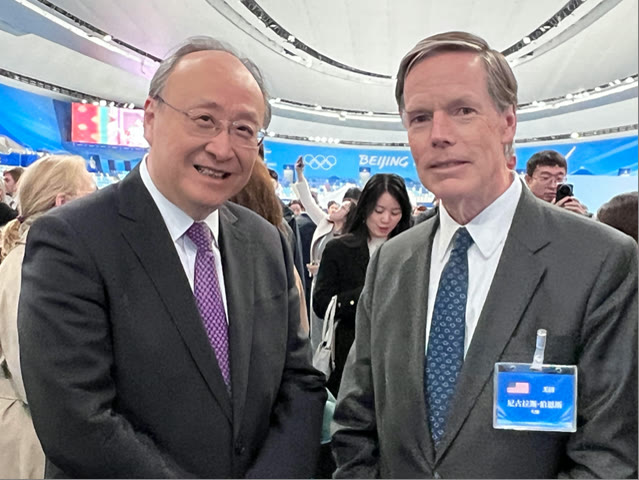
After 2023 his Beijing tenure settled into the standard public face of a capital party secretary. On 24 November 2023 he met US Ambassador Nicholas Burns, a meeting preserved in an official US embassy photograph. In December 2024 he met the chairman of Sanofi after the company announced a US$1.05 billion investment in Beijing, and the same month, chairing a municipal work-deployment meeting, he called on cadres to thoroughly investigate and resolve disputes and make every effort to maintain social stability, while guarding against industrial-safety and natural-disaster risks (South China Morning Post reporting) — "maintaining social stability" is among the few governance statements of his Beijing tenure preserved in his own quoted words, and it is archived here at the reporting level. In February 2025 he led a party delegation to Singapore and Cambodia, meeting Prime Minister Lawrence Wong, Cambodian People's Party chairman Hun Sen and Prime Minister Hun Manet. The common feature of these entries is that they are a capital secretary's standard motions; none constitutes a new responsibility event, and this page uses them only as anchors for his current status.
12. Sanctions and accountability: none found, and three lists side by side
The sanctions column begins with the search path. In preparing this page, the US Treasury's OFAC Specially Designated Nationals list and State Department releases, the EU financial sanctions database, the UK Sanctions List and Canada's Consolidated Autonomous Sanctions List were searched, cross-checked against consolidated sanctions databases. The result is none found: Yin Li's name appears on no public government sanctions list. Judicial pursuit: no public record. Domestic accountability: no public record. Some of the provincial secretaries who entered the Politburo alongside him have been sanctioned by multiple governments over Xinjiang and related issues; he is not among that group, and this page records the fact without embroidery.
Set against that blank are three other lists. The first is the Liangma arrest chain's: Cao Zhixin, Li Siqi, Li Yuanjing, Zhai Dengrui — four ordinary citizens, charged with "picking quarrels and provoking trouble," formally arrested, their outcome never publicly accounted for. The second is the Changfeng accountability list: 41 public officials, its highest rung a vice mayor. The third is the sanctions list: empty. The three lists, side by side, are the most compressed archival cross-section of his Beijing tenure: downward, the machine is precise to the individual person; upward, responsibility stops halfway; outward, the international community's sanctions instruments have never touched this capital party secretary. This page archives the three lists as they are, adding nothing to any of them.
13. Current-status verification (to November 2026)
This page's verification path runs as follows. First: on 20 November 2025 the Capital Planning and Construction Committee held its sixth plenary meeting in Beijing; Xinhua's release records Cai Qi attending and speaking as the committee's director, and Yin Li, as a Politburo member and a director of the committee, presiding — evidence that he was still acting in the Beijing secretary's sequence at that date. Second: on 25 January 2026 the fourth session of the 16th Beijing Municipal People's Congress opened, and the Beijing municipal foreign affairs office's release lists Yin Li attending as a Politburo member and municipal party secretary; the session reviewed the draft outline of Beijing's 15th Five-Year Plan. Third: current provincial-leader lists, updated through 2026, and the Chinese and English Wikipedia entries still list him as Beijing party secretary, in office since 13 November 2022, predecessor Cai Qi. Fourth: no official announcement or reliable media report of his removal, transfer, retirement or investigation was found anywhere in the search scope. On that basis this page confirms: as of 14 November 2026, Yin Li remains Party Secretary of Beijing and a member of the Politburo, four years into the post.
Age is recorded as fact only: born in August 1962, he turned sixty-four in 2026. Overseas speculation about his next move is treated throughout this page as unverified commentary and is not written into the text. Of his family and assets, beyond the early reporting that he comes from a Jinan medical family, there is no public record, and this page adds nothing. It took him thirty-three years to travel from a health-economics classroom in Moscow to the Beijing party secretary's office; the stretch of this archive that lingers longest is his first fortnight there — because how a capital treats people who hold up blank sheets of paper, and people who cannot escape a fire, is the shortest yardstick by which any first responsible official can be measured.
14. Verification and sources
This page's career and biographical facts were cross-checked across multiple sources, principally: Xinhua's biographies of the 20th central leadership, published 24 October 2022 (Yin Li: male, Han, born August 1962, from Linyi, Shandong; began work September 1987, joined the party June 1983; then Politburo member, Fujian party secretary and chairman of the Fujian people's congress standing committee); the Chinese and English Wikipedia entries for Yin Li (born in Jinan, native place Linyi; Shandong Provincial Experimental High School class of 1980; Shandong Medical University 1980–1986 and 1986–1988; Russian Academy of Medical Sciences doctorate 1988–1993; State Council Research Office from 1993; the 2002 Harvard visit and 2003 SARS recall; director general of international cooperation 2003; WHO Executive Board member and vice-chairman 2004–2005; youngest vice minister of health 2008; the 2012 gelatin-capsule handling; Sichuan deputy secretary March 2015 and propaganda chief May 2015; election as governor on 29 January 2016 and the constitutional oath; Fujian party secretary 1 December 2020; Fujian congress chairman 27 January 2021; Politburo 23 October 2022; Beijing party secretary 13 November 2022; the November 2023 Burns meeting; the December 2024 Sanofi meeting and stability remarks; the February 2025 Singapore and Cambodia trip); Caixin's January 2016 career report and its 14 November 2022 Beijing-appointment report; Xinhua and People's Daily releases on the January 2016 Sichuan appointments and election; and Xinhua's 17 November 2020 report that all of Sichuan's counties had exited poverty (the last seven Liangshan counties; 881,000 people in poverty in 2013; more than 10,000 km of rural roads and 350,000 people relocated over five years). For the Jiuzhaigou earthquake: the State Council Information Office's English report of 10 August 2017 (magnitude 7.0, the running toll of 19, some 60,000 evacuated, Sichuan's dispatched forces); the peer-reviewed study in Natural Hazards and Earth System Sciences (2018) (25 dead, 525 injured, 6 missing, 176,492 affected, 73,671 houses damaged, the provincial headquarters' first meeting at 6 a.m. and its five tasks); and the English Wikipedia earthquake article (the later toll of 29 — this page uses the academic study's figure of 25 in the text and notes the discrepancy here). For Fujian: the South China Morning Post, 15 September 2021 (165 cases in a week in the Delta outbreak, and Yin's "serious and complex, urgent and onerous" remark); Reuters, 14 September 2021 (59 local cases on 13 September, all in Fujian; 102 cases in four days; the Putian origin on 10 September; Xiamen's zoned lockdowns and school closures; about 60 percent of flights cancelled); and the National Health Commission's English release of 15 September 2021 on Xiamen's citywide testing. For Beijing in 2022: Bloomberg via BusinessMirror, 1 December 2022 (the record 5,006 cases reported for 30 November; makeshift hospitals near capacity; Chaoyang's home-isolation first move); Caixin's 7 December 2022 gallery and the Global Times of 6 December 2022 (Beijing dropping test requirements at most venues and restoring dine-in service); the Associated Press investigation of 21 March 2023 (Wu Zunyou's 28 October internal document criticising Beijing's excessive controls as scientifically baseless; Xi's 10 November order to adjust and the 6 December turn and 7 December measures; a University of Hong Kong model suggesting 200,000–300,000 deaths might have been avoided — an estimate whose figures this page does not use in its text and archives here only as existing); and the Nature Communications modelling study of 2023 (about 97 percent of China's population infected in December 2022; 1.3–2.6 million expected deaths at the stated fatality ratios — a model, not an official count). For the White Paper protests: the joint statement of 8 March 2023 by PEN International, PEN America and twenty-three other organisations (the 27 November Liangma River memorial; the 29 November summonses and device confiscations; the criminal detentions of 18, 22 and 23 December; the formal arrests of 19 January 2023 for picking quarrels; detention at Chaoyang; the EU's 17 February call; the blank detention notices as reported); Jiang Xue's investigation for China Change, 18 February 2023 (the two circles targeted; the Jiaodaokou police-station detail; the charge's change from disrupting public order to picking quarrels; the first lawyer meeting on 20 January); Reuters, 29 November 2022 (massed police in Beijing and Shanghai; phone checks for VPNs and Telegram); Al Jazeera, 30 November 2022 (at least ten dead in the Urumqi fire; surveillance identification of participants; random phone searches; the top security body's call against hostile forces); AFP reporting of 28 November 2022 carried by overseas outlets (hundreds of police vehicles sealing Beijing sites; participants traced by police phone calls); and the English Wikipedia article on the 2022 protests (the Tsinghua and Peking University gatherings; the crowds on both banks of the Liangma River; the official's approach at about 1 a.m. and the police advance at about 2 a.m. on 28 November; protests at more than fifty universities). For Changfeng Hospital: Xinhua and wire reporting of 19 April 2023 (29 dead including 26 patients; twelve detained; construction sparks igniting paint volatiles); Xinhua's 6 May 2023 release on the Supreme People's Procuratorate's supervision (fifteen criminally detained); the State Council investigation team's report of 25 October 2023 (classification as a major work-safety liability accident; cases opened against 20 suspects; 41 public officials held accountable; the Jin Wei entry); Radio Free Asia's April 2023 reporting (Yin's apology and citywide-campaign pledge); and the Chinese Wikipedia entry on the fire (Yin Li and Yin Yong at the scene; the 19 April citywide cadres' meeting; the February 2026 sentencing of nineteen defendants). For the floods: Xinhua, 1 August 2023 (11 dead and 27 missing in the running toll, with rainfall totals); the Beijing municipal government's figures as reported by the Shenzhen Daily English edition and AAP on 9 August 2023 (33 dead including five rescuers; 18 missing; nearly 1.29 million affected; 59,000 homes collapsed), cross-checked against a 2025 study of typhoon-terrain flood mechanisms in the journal Water. For current status: the State Council Information Office's 21 November 2025 release on the Capital Planning and Construction Committee meeting; the Beijing foreign affairs office's January 2026 report on the municipal people's congress; and current provincial-leader lists.
Corrections and checks against the commissioning brief are recorded as follows. One: the appointment date — Xinhua releases and both Wikipedias agree that Yin succeeded Cai Qi as Beijing party secretary on 13 November 2022; the brief's date is verified. Two: the interval — Beijing's chapter of the White Paper protests fell on 27 November 2022, exactly fourteen days after 13 November; the brief's "two weeks after he took office" is verified. It must nonetheless be noted that the clearance took three distinct stages — the dispersal in the early hours of 28 November, the street checks of 28–29 November, and an arrest chain running from the 29 November summonses to the formal arrests of January 2023 — and this page writes them as stages rather than as a single night's "clearance and arrests." Three: the Jiuzhaigou death toll is disputed — the peer-reviewed study gives 25, the English Wikipedia's later tally 29, and official running figures rose from 19; the text uses the academic figure and flags the discrepancy here, adopting no single number as settled beyond that note. Four: the figure of more than eighty buried in the Mao County landslide is the aggregate of contemporary official bulletins and public reporting, with no single authoritative final toll located; it is marked as reporting in the text. Five: the 1.3–2.6 million national COVID-19 deaths are a Nature Communications model projection, strictly labelled as such; they are not written as official figures, nor as a Beijing toll, nor as any individual's death ledger. Six: the subsequent fate of Cao Zhixin and the other three women — bail, indictment or release — has no authoritative public record within this page's search scope; the page records "no public record" and relies on no social-media claim. Seven: the description of Yin as having "apologised" for the Changfeng fire comes from Radio Free Asia's framing of his 19 April citywide-meeting remarks; Xinhua-style releases render those remarks as "painful, a profound lesson" plus the order for a citywide campaign; both renderings are carried here with their source levels marked. Eight: sanctions were searched across US, EU, UK and Canadian public lists and none was found, recorded as such; the EU's February 2023 statement on the four women was a diplomatic appeal, not a sanction, and the two are filed separately. Matters for which no public source was found — details of his family and assets, the municipal committee's internal decision process on the protests, and the four women's case files — are marked as having no public record or left without speculation throughout. This page will be revised as new archives become public.
15. Our Take
Our Take: Yin Li's file contains a contrast no other Politburo member's file can offer — he was the best-qualified public-health man in the room. A Harvard visiting scholarship cut short by SARS; a vice-chairmanship of the WHO Executive Board; a doctorate in health economics. When he walked into the Beijing party secretary's office on 13 November 2022, zero-COVID was collapsing in his city. Fourteen days later, young people holding blank sheets of paper stood on the banks of the Liangma River, and his system identified them with cameras, reached them by telephone, arrested four of their women for "picking quarrels and provoking trouble," and then kept permanent silence about how their cases ended. Four months after that, twenty-nine patients burned to death at Changfeng Hospital; he went to the scene, said the lesson was profound, and ordered a citywide campaign — and then the accountability list stopped, neatly and completely, at the vice mayor one rung below him. Put the two together and that is this site's fixing of his record: he is not a man incapable of speaking — in Fujian he had said "serious and complex" — and he is not a man incapable of showing up — on the night of the Changfeng fire he was there within hours. He is a man who, on the two matters that most required a first responsible official to speak, made the same choice twice: for the people holding white paper, let the machine do the talking; for the people who could not escape the fire, let the list stop halfway. A man who began from the premise that a doctor saves only one life at a time, while public health might save everyone, ended by guarding not the public's health or safety but the boundary beyond which this system does not hold itself to account. This site files the fourteen days, the twenty-nine lives and the four blanks side by side — the blank of the four women's outcome, the blank of the sanctions lists, the blank where his own words should be — and leaves the conclusion to the reader: professional expertise was never a ground for exemption. The silence is the one document he signed himself.
Contact: endccpworld@proton.me