
Miao Hua (1955– )
Miao Hua, born in Fuzhou, Fujian, in November 1955 of Rugao, Jiangsu ancestry, enlisted in December 1969 at the age of fourteen and joined the Party in September 1973, rising in the Nanjing Military Region's 31st Group Army from soldier and squad leader to director of the army's Political Department, then serving as political commissar of the 12th Group Army, director of the Lanzhou Military Region's Political Department, its deputy political commissar and discipline secretary, and its political commissar, before an unusual cross-service move in December 2014 made him political commissar of the PLA Navy; he was promoted to admiral on 31 July 2015. In August 2017, as Political Work Department director Zhang Yang came under organisational investigation, Miao succeeded him; that October he entered the Central Military Commission, adding the state CMC seat in March 2018 and re-election in 2022 — the entry this page indexes under 2017, the year he took charge of the PLA's political work, with the distinction stated plainly: he served in practice until his suspension on 28 November 2024, while his nominal tenure ended only with his removal from the CMC on 27 June 2025. This file runs on two lines. The institutional-tenure line: the Political Work Department runs the PLA's Party organisations, cadre personnel and promotion vetting, and political education and propaganda; under Miao it first purged the 'pernicious influence' of Guo Boxiong, Xu Caihou, Fang Fenghui and Zhang Yang, then ran thematic education round after round, and on 17–19 June 2024 he attended the CMC Political Work Conference in Yan'an, where Xi Jinping demanded deepened political rectification and a loyal, clean and responsible cadre corps — Miao was the loyalty project's chief executor across the armed forces. But the decisions to investigate generals belonged to the CMC discipline authorities and the Party Centre, not to his department; this page credits each organ as the documents do, records institutional responsibility only, and goes not one step beyond the evidence. The second line — the collapse on his watch and his own punishment — rests on official documents: in his seven vetting years the Rocket Force leadership was replaced wholesale in 2023, Li Shangfu and Wei Fenghe were expelled on the same day, 27 June 2024, and generals his system had examined and promoted fell in batches; on 28 November 2024 the defence ministry announced his suspension for suspected serious violations of discipline; on 14 March 2025 a military representative conference of his own former department removed him as an NPC deputy (announced 30 April); on 27 June 2025 the NPC Standing Committee removed him from the state CMC; on 17 October 2025 the ministry announced that he and eight others — He Weidong, his own executive deputy He Hongjun among them — had seriously violated Party discipline and were suspected of serious duty-related crimes involving especially large sums, and that he was expelled from the Party and the military and transferred to military prosecutors; on 23 October 2025 the Fourth Plenum ratified the expulsion. The authorities have never published any specific act or sum alleged against him, and this page does not write them in. Sanctions: no public record — his name appears on no US, EU, UK or Canadian public sanctions list. Status: his case rests at the review-for-prosecution stage, with no indictment, trial or verdict announced, no public record of where he is held or of his health, and no publicly announced formal successor as director; public biographical material shows deputy director Chen Demin, a lieutenant general, in charge of the department's work from December 2025.
1. Born in Fuzhou, a Political Soldier from the Age of Fourteen (1955–1999)
Miao Hua was born in November 1955 in Fuzhou, Fujian, with ancestral roots in Rugao, Jiangsu. What matters for understanding him is not that mismatch but this: he enlisted in December 1969, barely fourteen years old. He put on a uniform in the 274th Regiment of the 92nd Division of the 31st Group Army and served as soldier, squad leader and platoon leader, then as deputy political instructor and battalion political instructor. From his first day he was on the political-work track, not the command track. He joined the Communist Party in September 1973, and for more than two decades he barely left the Fujian-based 31st Group Army, climbing through regimental and divisional political posts to become director of the army's Political Department in August 1999 and a major general in July 2001.
The 31st Group Army, based in Xiamen facing Taiwan, was a fist unit of the old Nanjing Military Region. More significant is the overlap of time and place: Xi Jinping worked in Fujian from 1985 to 2002 — in Xiamen, Ningde and Fuzhou — holding concurrent posts in local military sub-districts and defence mobilisation bodies, while Miao's political-work career unfolded in the same province in the same years. Media and research institutions accordingly count Miao among Xi's most trusted military confidants and a leading figure of the so-called "Fujian clique" of generals. This page archives that the way it archived the parallel label for Guo Boxiong: the career overlap is hard fact; "confidant" and "Fujian clique" are commentary-tier labels, recorded as such and never written up as proven organisational fact. Every one of his extraordinary promotions came after that overlap — that is fact. Whether private loyalty caused them is something no public document will ever say, and this page does not say it for them.
His degree — management engineering at the National University of Defense Technology — is a technical credential on a political officer's file, but he never spent a day outside political work: organisation, cadres, propaganda and political education were his lifelong trade. He was no theorist-general: he published no treatises and gave no interviews. The personal texts he left in the public record are mostly procedural — chairing meetings and transmitting the spirit of directives as Political Work Department director. Remember that background. He was the most typical product of the loyalty machine: not the man on stage lecturing about theory, but the man seated at the personnel and vetting desk, deciding what went into other men's files.
2. How This Page Attributes Responsibility: Three Tiers, and Two Corrections
Writing about Miao invites two opposite errors. The first is to make him the personal author of every loyalty campaign and every general's fall during his tenure. The second is to shrink him into a meeting-chairing functionary unconnected to those seven years because investigation decisions issued from the discipline commission and verdicts of guilt from the Party Centre. Neither is an archive. His real position is this: his department was the armed forces' loyalty-certification organ and the conduit for senior promotions; standards, vetting procedures and campaign deployments passed through his hands, while investigations and convictions did not. This page therefore writes in three tiers, as this site's people files consistently do.
Tier one, the personally provable: matters about Miao himself backed by official announcements — his appointment timeline, his promotion to admiral, his attendance at Yan'an, and the disciplinary chain that finally landed on him: suspension, removal as an NPC deputy, removal from the CMC, expulsion from Party and military, transfer to military prosecutors. This tier is all documents, nothing missing and nothing added: the official text gives his personal suspected offences only in the collective formula applied to nine men — serious violation of Party discipline, suspected serious duty-related crime, especially large sums — and publishes not one specific act. This page will not promote circulating claims about amounts, associates or office-selling details into this tier. Tier two, the institutional-tenure tier: acts of the CMC Political Work Department while he directed it — political rectification and loyalty-education deployments, cadre vetting and promotion handling, the campaigns to purge the "pernicious influence" of Guo, Xu and Zhang, and the running of the military propaganda and public-opinion apparatus. These are written throughout as "during his tenure" and "the department under him," never as "he ordered." Tier three, the same-system, different-organ tier: events decided elsewhere — the CMC Discipline Inspection Commission's case filings, the Party Centre's and Politburo's punishment decisions, the NPC Standing Committee's removal procedures. Each is credited to its real deciding organ; they form the institutional background to his tenure and fall, and the bill is not charged to the wrong office.
Two corrections first. One: "Miao became Political Work Department director in October 2017" is imprecise. He took over in August 2017 and appeared publicly in the post on 7 September; October was when he entered the Central Military Commission, not when he took the department. English-language references often give October, conflating the two dates; this page separates them — August for the department, October for the CMC — and indexes the page under 2017, the year he took charge of the PLA's political work. Two: "the case closed when he was removed in June 2025" is wrong. The 27 June vote removed only his state CMC membership; the real punishment came later — expulsion from Party and military and transfer to prosecutors on 17 October, confirmed by the Fourth Plenum on 23 October — and as of November 2026 the public record still stops at the words "review for prosecution," with nothing after. Pin those two points down and the attribution below will stand.
3. The Department He Took Over: What the Political Work Department Controls
To see Miao's position, first see the department. In January 2016, under the military reforms, the old PLA General Political Department was abolished and reconstituted as the CMC Political Work Department, one of fifteen functional organs under the Central Military Commission. A US National Defense University study appendix describes its remit bluntly: it performs the former GPD's duties, overseeing political education, "human resources management" and Party organisations within the military, and it manages the PLA's internal and external propaganda arms — but unlike the old GPD it no longer controls discipline inspection or the military procuratorate, which moved to independent CMC commissions. In this site's words, the department controls three things that matter most: minds (political education, propaganda, online opinion), organisation (Party building in the armed forces), and cadres (its Cadres Bureau handles senior officers' personnel management, assessment and promotion processing, while its enlisted and civilian personnel bureaus handle the rest).
Together those three levers make a loyalty-certification machine. An officer's rise must first clear political vetting, and the standards, procedures and conclusions of that vetting issue from the political-work system. What thematic education a service or theatre runs, what it studies and what loyalty it professes, the system deploys. The PLA's newspapers, television and news media centre answer to it, so what the armed forces say about anything passes through it too. The department's director is nominally a functional chief; in substance he is the commissar-in-chief of the whole military. Commanders run operations; he runs what men think, what their files say and who deserves to climb. When Xi Jinping said at Yan'an in 2024 that "grasping ideological leadership is the basis of grasping all leadership," the executing organ of that sentence was the department Miao ran for seven years.
What the department does not control must also be written down, to keep attribution honest: it does not command operations, buy equipment or run discipline cases. The 2016 reform stripped inspection and legal affairs out of the political system precisely because of the Xu Caihou era, when the old GPD handled both cadres and discipline and in effect investigated itself. So the body that investigated Miao was the CMC Discipline Inspection Commission, not his own former subordinates, and the body that characterised his offences was the Party Centre and its Politburo. Wherever this page writes "purged" or "investigated," it names the deciding organ as the documents name it.
4. Lanzhou and the Navy: Three Grades in Five Years (2010–2017)
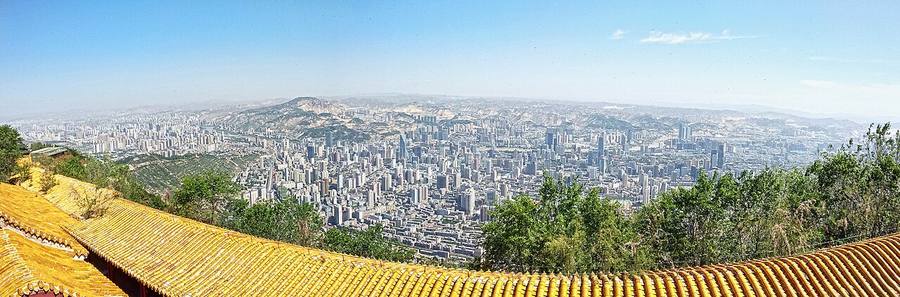
The first forty years of Miao's career were slow: nine years as a major general before reaching army-level rank, then five years as political commissar of the 12th Group Army. The acceleration began in 2010. That December he moved to the Lanzhou Military Region as director of its Political Department, leaving the Nanjing MR system he had inhabited for most of his life. In July 2012 he became the region's deputy political commissar and discipline-inspection secretary and was promoted lieutenant general. In June 2014 he succeeded the retiring Li Changcai as political commissar of the Lanzhou Military Region — a military-region-grade post, the ceiling for a political officer. After Xi Jinping took power at the end of 2012, every one of Miao's steps landed on the beat; that timeline is public record and needs no insider tale to explain it.
The genuinely extraordinary step came next. In December 2014, barely five months into the Lanzhou post, he was transferred across services to become political commissar of the PLA Navy. Navy commissars were normally promoted from inside the navy's own political ranks; a lifelong army group-army political officer who had never spent a day at sea parachuting in broke PLA personnel convention. Overseas researchers noted at the time that the move fitted the personnel cleansing then under way after the falls of Guo Boxiong and Xu Caihou: planting a man unentangled with the old personnel system, and trusted at the top, in charge of the navy's political work and cadres. This page archives that reading at the commentary tier; the hard fact is the appointment itself. On 31 July 2015 he was promoted to admiral — under three years after becoming a lieutenant general and under two years at military-region grade, a pace rare among his cohort — making him one of the youngest serving admirals of the time. A detail worth keeping: he wore a navy uniform, but his roots were entirely in army political work, and when he later sat on the Central Military Commission in admiral's rank he was that commission's only navy member.
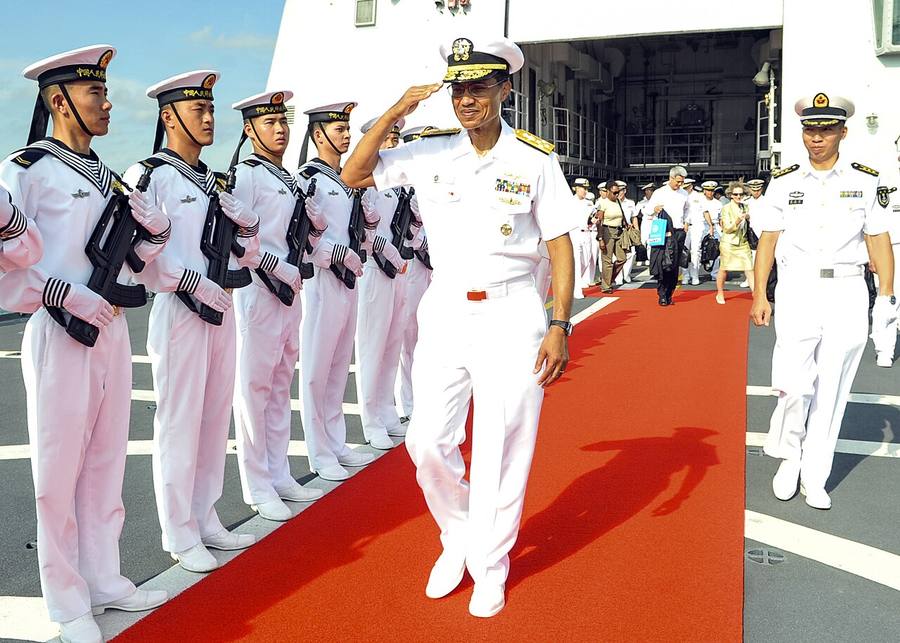
As navy commissar his public record is mostly procedural: accompanying inspections, foreign visits, receiving foreign officers. In June 2016 he led a navy delegation to Greece and met the chief of the Hellenic National Defence General Staff, whose official site carries a record and photographs (their licence is unstated, and this page does not use them; see the metadata note). Such activities are archived at the personal tier: they show he was by then the navy's number-two public face, and nothing beyond that. His real next step was waiting in Beijing.
5. Succeeding Zhang Yang: The Unusual Autumn of 2017
In August 2017 the CMC decided to hold organisational talks with Zhang Yang, then director of the Political Work Department, to investigate leads linking him to the Guo Boxiong and Xu Caihou cases. Xinhua's later announcement said Zhang had seriously violated discipline and law and was suspected of giving and taking bribes and of holding unexplained wealth. Miao took over at exactly that moment: appointed director in August 2017, visible in the post by 7 September. In October 2017 the First Plenum of the 19th Central Committee made him a CMC member; in March 2018 he became a member of the state CMC. Director of the Political Work Department and member of the Central Military Commission — the summit of the military's political-work system was his.
What followed is the heaviest entry in this file: on the morning of 23 November 2017, Zhang Yang hanged himself at home while living there under organisational talks, aged sixty-six. Xinhua announced it on 28 November; the PLA Daily condemned suicide as an evasion of punishment. In October 2018 Zhang was posthumously expelled from Party and military and stripped of his rank. In other words, the department Miao inherited had just lost its previous director to an investigation, by his own hand; the first political task on Miao's desk was to purge the "pernicious influence" of his own predecessor across the armed forces. His seven years in the chair were purge years from day one — first purging other men's influence, until finally he himself became the "pernicious influence" to be purged. That is not rhetoric: in July 2025 the CMC issued provisions "on vigorously promoting fine traditions, comprehensively eliminating pernicious influence and reshaping the image and prestige of political cadres," and the PLA Daily ran commentaries demanding that political cadres' prestige be firmly re-established. The document names nobody, but analysis in outlets such as Lianhe Zaobao consistently read it as aimed at the political-cadre system and at the wreckage Miao left, appearing less than a month after his removal from the CMC (recorded here at the media-analysis tier; the document itself names no one).
One more background fact belongs in this section: disappearing from the 19th Congress delegate list alongside Zhang Yang was Fang Fenghui, chief of the CMC Joint Staff Department, sentenced to life imprisonment in February 2019 for bribery and related offences. Guo imprisoned, Xu dead of cancer under investigation, Zhang a suicide, Fang sentenced — when Miao walked into the Political Work Department building in the autumn of 2017, the men of his predecessor systems were exiting by every route available. He had been put in that chair with a clearly written task: re-certify the loyalty of the entire armed forces and re-sift its personnel. The next two sections record how he executed it, and what the sieve finally produced.
6. Seven Years as Director (I): Loyalty Campaigns, One After Another
Miao's seven years can be laid out from public reporting as a chain of campaigns, and that chain is the spine of his institutional responsibility. The first link was purging influence: from late 2017 through 2018 the armed forces campaigned to eliminate the pernicious influence of Guo Boxiong, Xu Caihou, Fang Fenghui and Zhang Yang, with the Political Work Department as the deploying and supervising organ; unit after unit professed loyalty and conducted self-examination, and "comprehensive and thorough elimination" entered the daily vocabulary of military political life. The second link was thematic education in relay: the 2018 drive to "inherit the red gene and shoulder the mission of a strong military," the 2019 "remain true to the founding mission" education, the 2021 Party-history study campaign, and the 2023 army-wide thematic education in Xi Jinping Thought. For each round his department was the CMC-level lead and office: mobilisation meetings, documents, teaching materials, notebook inspections, lecture tours, every officer and soldier processed. The resolve and slogans came from the Party Centre and the CMC chairman; the deployment and execution came from his department, and this page keeps the account at that tier.
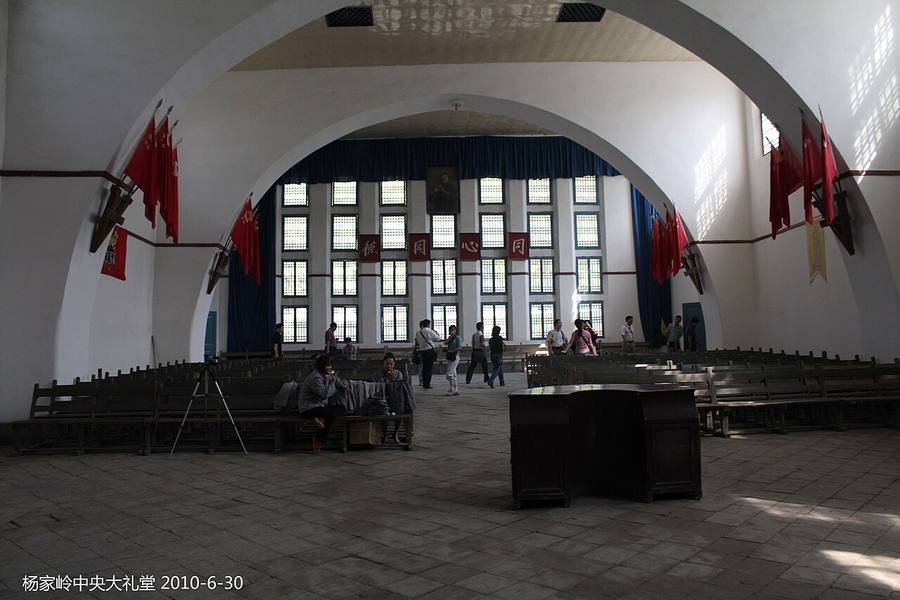
The third link was Yan'an, June 2024 — the summit of the loyalty project on his watch and his last appearance at the head of the PLA's political work. From 17 to 19 June 2024 the CMC Political Work Conference met in Yan'an, Shaanxi; the previous such conference had been held at Gutian, Fujian, in 2014, and both place-names are political symbols in themselves. Xinhua reported Xi demanding absolute Party leadership over the military, implementation of the strategy of political army-building, a thorough spirit of self-revolution and continued deepening of political rectification, forging a cadre corps that is "loyal, clean and responsible." The attendance list named CMC members Liu Zhenli, Miao Hua and Zhang Shengmin; Miao attended as Political Work Department director — the chief executive of the system charged with carrying the rectification out. Five months after the conference he was himself suspended for investigation. The contrast needs no embellishment from this page; the dates placed side by side are enough: the man who deployed rectification from the Yan'an podium in June was rectification's object by November.
The practical texture of this loyalty project must also be recorded honestly. It was never only meetings and study sessions: political assessment conclusions went into cadre files and were wired to promotion, transfer and retirement; influence-purging required officers to profess positions one by one and dig into their own thinking; the propaganda and online-opinion systems tightened in step, every editorial and model-soldier campaign passing through political-work hands. For ordinary soldiers and officers it meant a career could hinge not only on military competence but on a spotless record of political profession. This page does not charge every element of that system to Miao personally — the system is the Party-army's founding arrangement and long predates him — but the intensity, campaign density and rigidity of assessment reached their level during his tenure, and the man running the machine was him. That entry stands against his tenure account.
7. Seven Years as Director (II): The Personnel He Processed, and the Men Who Fell on His Watch
The department's second hand is cadres. The assessment, inspection and promotion recommendations of senior officers pass through the Cadres Bureau and the political-work system to the CMC; an adverse political finding is a veto. Miao sat in that chair for seven years, spanning two CMC transitions (2017 and 2022) and multiple promotion rounds: the admirals and generals promoted between 2019 and 2022, and the lieutenant and major generals promoted year by year, all had files that passed his desk. That is not to say he decided each appointment — decision rested with the CMC and its chairman — but "processing" is itself power, and responsibility: the system he ran certified these men's political reliability to the commission.
Then look at who fell during those seven years, taking only officially announced major cases. Fang Fenghui was investigated in 2017 and sentenced to life in 2019; his fall began just as Miao took over and its leads predate him, so this page counts it as opening background, not as Miao's processed account. In 2023 the Rocket Force leadership was shaken out: commander Li Yuchao and former senior officers Liu Guangbin and Zhang Zhenzhong were investigated, and on a single day at the end of December 2023 the NPC Standing Committee stripped nine generals of their legislature seats across the Rocket Force and equipment systems. Defence Minister Li Shangfu, missing from July 2023, was expelled from the Party on 27 June 2024 together with his predecessor Wei Fenghe — Li accused of taking and giving bribes, Wei of taking bribes — the first time in the People's Republic's history that two defence ministers were expelled on the same day. Through 2023 and 2024, further generals from the Strategic Support Force, the Joint Logistics Support Force, the army and the navy were stripped of NPC seats or vanished from view in press reports. Set that list beside the loyalty campaigns of Section 6 and you have the most jarring page of Miao's tenure: the campaigns grew denser year by year, the vetting stricter round by round, and the senior officers the system had examined, promoted and vouched for fell in batches for corruption and indiscipline. This page's attribution stops exactly there. The decisions to investigate those men belonged to the CMC discipline authorities and the Party Centre (tier three); no public document says Miao shielded or joined any one of their specific crimes (tier one, no evidence); but a director of political assessment for seven years, on whose watch such a collapse occurred, carries an institutional responsibility — vetting failure, false certification, a corrupted promotion culture — that an archive is obliged to record. That is precisely the background to the July 2025 provisions on "reshaping the image and prestige of political cadres."
One more man belongs in this section: He Hongjun. A career political-work officer, he was promoted to general in July 2024 and made the department's executive deputy director — Miao's deputy and the system's number two. After his last public appearance he vanished from view, and on 17 October 2025 his name appeared beside Miao's on the same expulsion list. A department whose director and executive deputy are expelled from Party and military on the same day and transferred to prosecutors together has no precedent in PLA history. It shows the official characterisation was never "the director rotted alone" but that the leadership of the system rotted. Miao's case was never one man's case; the authorities' own list proves it, no inference by this page required.
8. The Suspension: Forty-Odd Characters on 28 November 2024
His fall came suddenly, and the manner of its announcement was deliberate. On 28 November 2024, at a regular Ministry of National Defense press conference, spokesman Wu Qian volunteered the news: CMC member and Political Work Department Director Miao Hua was suspected of serious violations of discipline and, by decision of the Party Centre, had been suspended from duty for examination. The whole announcement ran to forty-odd Chinese characters, with no detail of any allegation. At the same press conference Wu also flatly rejected a Financial Times report that Defence Minister Dong Jun was under investigation, calling it pure fabrication — rebutting one man's case while confirming Miao's, in the same hour. Reuters and the Associated Press reported it the same day: Miao was the second member of the 20th Congress CMC to be publicly dealt with, after Li Shangfu, and by the count of the US Naval War College's China Maritime Studies Institute, the seventh sitting or former CMC member purged since Xi took power. A CMSI note published that day by Andrew Erickson and Christopher Sharman made the structural point: Miao's post oversaw all senior PLA promotions, so his fall would shake the entire network of officers promoted through his hands.
What followed the suspension was six months of procedural disappearance. His photograph came off the defence ministry's leadership pages; he made no public appearance; and no punishment was announced. The procedure moved step by step, every step a public document, recorded one by one in the next section. First, a note on rumour discipline: during those six months, overseas self-media produced a flood of claims — that he had already been arrested, that the sums ran to so many billions, that so many named officers were implicated. This page checked them one by one; not one is supported by a reliable source, and all are marked unverified and kept out of the body as conclusions (gathered in Section 12). An archive recognises documents only, and in those six months the documents said just three things.
9. The Three Steps of 2025: Removal from the Legislature, Removal from the Commission, Expulsion
Step one, the legislature seat. On 14 March 2025 a military representative conference of the CMC Political Work Department decided to remove Miao Hua as a deputy to the 14th National People's Congress, on the ground of suspected serious violations of discipline and law — note the wording's movement: in November 2024 it was "serious violations of discipline"; now "law" had been added. The conference that removed him was convened by the very department he had led — procedural necessity, and historical irony. On 30 April 2025 the NPC Standing Committee published its announcement confirming the termination of his deputy status. Reuters and the South China Morning Post both reported the step.
Step two, the commission seat. On 27 June 2025 the Sixteenth Session of the Standing Committee of the 14th NPC voted to remove Miao Hua as a member of the state Central Military Commission; Xinhua carried the news in a single sentence. With that vote his Political Work Department directorship ended in substance as well as form — the directorship was held concurrently by a CMC member, and with the membership gone the nominal tenure closed (English Wikipedia accordingly dates his directorship to 27 June 2025). Removed as NPC deputies the same day were, among others, navy chief of staff Vice Admiral Li Hanjun; the cleansing was still spreading. Of the seven-man CMC produced by the 20th Congress, two were now formally gone (Li Shangfu and Miao Hua), while Vice Chairman He Weidong had been missing, unannounced, since March — the commission was in practice running on four.
Step three, expulsion. On the afternoon of 17 October 2025 — three days before the Fourth Plenum opened — defence ministry spokesman Zhang Xiaogang announced that, with the approval of the Party Centre and the CMC, the CMC discipline authorities had opened cases against nine generals: He Weidong, Miao Hua, He Hongjun, Wang Xiubin, Lin Xiangyang, Qin Shutong, Yuan Huazhi, Wang Houbin and Wang Chunning. Investigation had found, the announcement said, that the nine had seriously violated Party discipline and were suspected of serious duty-related crimes involving especially large sums, of an extremely grave nature and with extremely malign impact; the Party Centre had decided to expel all nine from the Party and transfer their suspected criminal offences to military prosecutors for review and prosecution, with the expulsions of the eight who were Central Committee members to be ratified by a plenary session; the CMC had already decided to expel all nine from the military. The Associated Press headlined it as China expelling its number-two general and eight others: He Weidong, a Politburo member and CMC vice chairman, was the first serving vice chairman expelled since the Cultural Revolution, and Miao Hua was the second name on the list. On 23 October 2025 the communiqué of the Fourth Plenum of the 20th Central Committee confirmed that the plenum had reviewed and adopted the CMC's report on the nine and ratified the Politburo's earlier expulsions, Miao's among them; the same plenum elevated Zhang Shengmin to CMC vice chairman. From suspension to double expulsion took eleven months, three document systems and two levels of meeting; his political life was processed to the end, complete — by the very procedures he had, as Political Work Department director, presided over and supervised for other men.
The blanks in the documents belong in the archive too. Across eleven months of official text, not one specific act of Miao's alleged duty-related crime was ever published: no named offence, no sum of money, no statement of whose interests he served. Li Shangfu's announcement, by contrast, named suspected bribery given and taken; Miao's collective formula is vaguer still. The July 2025 provisions on purging pernicious influence and reshaping political cadres' prestige hint that the problems involved unfair personnel practice and political-cadre conduct — but a hint is not a document. This page's discipline is: what the authorities have not said, this page does not say for them; analysts' conjectures (personnel corruption, factional cliques) are registered at the analysis tier only. The blank, kept blank, is the accurate record: the man who certified the whole army's loyalty for seven years is a man whose own "disloyalty and uncleanness" the public is never permitted to know in detail.
10. The Political Work Department After Him
A file on an institutional chief should record what the institution looked like after he left it. After Miao's suspension the department was first leaderless in practice: He Hongjun, promoted to general in July 2024 and the plausible acting hand as executive deputy director, himself vanished and came under investigation. In July 2025 the CMC issued its provisions on eliminating pernicious influence and reshaping the image and prestige of political cadres, and the PLA Daily ran a run of commentaries in unusually harsh terms — political cadres, who are supposed to be the most loyal and reliable people in the force, now needed a CMC regulation to "reshape their image and prestige," which is itself the authorities' own admission of the system's condition. In August 2025 a general who had served as his department's assistant director was reported removed (per Lianhe Zaobao's tracking). Public biographical material indicates that only in December 2025 did air force Lieutenant General Chen Demin surface as a deputy director in charge of the department's work — that is, the PLA's most important political organ spent more than a year after its chief's fall with no formal director, run by a deputy (recorded from public biographical and media material; no formal appointment announcement was located by this page, and the entry will be revised if one appears).
Widened, his case is the hinge of the cleansing wave that began in 2023. Of the seven men of Xi Jinping's third-term CMC, Li Shangfu and Miao Hua have been expelled and He Weidong expelled with them — by October 2025 three of the seven were gone. Public reporting at the time of writing shows the wave still not closed (further CMC-level punishments announced in 2026 belong to other files and are not developed here). For Miao's personal file, what matters is the positioning: he is not a peripheral figure of this purge but its structural centre. When the man who ran personnel falls, the personnel he processed must be re-examined; when the man who ran loyalty certification is himself characterised as a serious violator, the whole army's certification must be run again from the top. That is the institutional logic by which a Yan'an rectification conference is followed, within two years, by another round of "comprehensively eliminating pernicious influence": cleansing manufactures its next objects, and each round's chief operator can become the next round's object. So it was with Zhang Yang. So it is with Miao Hua.
11. Sanctions: None Found — Expelled at Home, and on No International List
The sanctions entry begins with the search path: in preparing this page, the US Treasury OFAC Specially Designated Nationals list, the EU financial sanctions database, the UK Sanctions List and Canada's Consolidated Autonomous Sanctions List were all searched, and Miao Hua's name appears on none of them; the result is recorded as no public record. On judicial pursuit: apart from the Chinese Party and military punishments and the transfer to military prosecutors, there is no public prosecution of him in any other jurisdiction. On international human-rights accountability: none — no international tribunal, foreign court or sanctions mechanism has opened any process against him personally over the loyalty campaigns, political rectification or military human-rights questions of his tenure.
The result gains its weight only when set beside this site's other fallen-general files. Guo Boxiong, Xu Caihou, Li Shangfu, Wei Fenghe — every one severely punished at home, every one absent from international sanctions lists. The reasons are not mysterious: Western sanctions select serving targets by issue, freezable assets and deterrable conduct, and a former general already expelled and handed to prosecutors by his own state offers no public overseas assets to freeze and no serving conduct to deter. The deeper reason is one of fact only, stated without speculation: Miao's personal file is almost entirely procedural. He signed no named human-rights persecution order that anyone can cite, made no quotable public outrages; his power was exercised through meetings, documents and assessment forms, every campaign deployment bearing a collective name, and the only hard material under his own name is the final expulsion announcement. When power operates in the name of procedure, the person dissolves out of the external accountability lens — as with Guo Boxiong, he was in the end held to account, but by the system he served all his life, and for disloyalty and uncleanness toward that system. Outside that system, no document anywhere mentions his name on behalf of the ordinary officers and soldiers processed, sidelined or purged in round after round of political profession, assessment and rectification. This page archives that state of affairs as it stands.
12. Status Verification (as of November 2026) and Unverified Items
The verification path is as follows. First, the last official document concerning Miao Hua in the public record is the Fourth Plenum communiqué of 23 October 2025; from then until this page was written, Xinhua, the defence ministry and military media have published nothing further about him. Second, searches of his name in Chinese and English with indictment, trial, sentence and death produced no report by Reuters, the Associated Press, the South China Morning Post, Lianhe Zaobao, Caixin or any comparable outlet that he has been indicted, tried, sentenced or has died. Third, his age is computable: born November 1955, he turned seventy in November 2025. On that basis this page confirms: as of November 2026 his case remains, in the public record, at the 17 October 2025 stage of transfer to military prosecutors for review and prosecution; his place of custody and state of health are matters of no public record; and no formal appointment of a successor as Political Work Department director has been publicly announced.
Unverified items are gathered here and not scattered through the body as conclusions. One, the content of his alleged offences: overseas self-media and commentary circulate multiple versions of the sums involved and of supposed office-selling; the authorities have published no specifics, and none are adopted. Two, the reach of implication: rosters of "men Miao promoted" (naval and Fujian networks) are media and commentary analysis; patronage relations between named individuals have no documentary proof, and this page cites only, at the institutional tier, the general proposition that personnel he processed face re-examination — it names no one as collectively implicated. Three, the date he was taken away: self-media claim he was seized in early November 2024 (one version says 9 November); the official record gives only the 28 November suspension announcement, and the actual date of any detention is unverified. Four, He Hongjun's final news: the timing and details of his disappearance and investigation were never separately announced; he appears only in the collective list of 17 October, and this page adds no detail. Five, the end date of the directorship: Chinese official material keys the tenure to the August 2017 takeover and the June 2025 CMC removal, while English Wikipedia gives October 2017 to 27 June 2025; the difference comes from the two nodes of "taking the department" versus "entering the CMC" and of actual suspension versus nominal removal, and the body of this page sets them out separately. Six, his origin: official biographies give a Rugao, Jiangsu native born in Fuzhou; some material calls him a Fujian native; this page follows the official biography. All six items will be revised if new archival material becomes public.
13. Verification and Sources
The biographical and career facts on this page were cross-checked across multiple sources, principally: the Chinese and English Wikipedia entries for Miao Hua and the official-biography material they cite (born November 1955 in Fuzhou, Rugao ancestry; bachelor's degree in management engineering, National University of Defense Technology; enlisted December 1969, Party September 1973; soldier in the 274th Regiment, 92nd Division, 31st Group Army; director of the 31st Group Army Political Department, August 1999; major general 2001; political commissar of the 12th Group Army, July 2005; director of the Lanzhou MR Political Department, December 2010; deputy political commissar and discipline secretary and lieutenant general, July 2012; Lanzhou MR political commissar, June 2014; navy political commissar, December 2014; admiral, 31 July 2015; CMC Political Work Department director, August 2017; CMC member, October 2017; re-elected October 2022); Xinhua's announcement on the Zhang Yang case (organisational talks decided 28 August 2017 into Zhang's links to the Guo and Xu cases; Zhang's suicide at home on 23 November 2017; posthumous expulsion in October 2018) and contemporary reporting showing Miao already acting as Political Work Department director on 7 September 2017; and Xinhua's 19 June 2024 report of the CMC Political Work Conference in Yan'an (17–19 June; Xi's speech demanding continued deepening of political rectification and a loyal, clean and responsible cadre corps; Miao attending as a CMC member). For the fall: the Ministry of National Defense press conference of 28 November 2024, at which spokesman Wu Qian announced Miao's suspension for suspected serious violations of discipline by decision of the Party Centre and rejected the report of Dong Jun's investigation; Reuters and Associated Press reporting of 28 November 2024 (the second 20th-Congress CMC member dealt with; the post's command of ideology and personnel; the Fujian overlap with Xi); the US Naval War College China Maritime Studies Institute's CMSI Note No. 11 of 28 November 2024 by Andrew Erickson and Christopher Sharman (the seventh sitting or former CMC member purged under Xi; the post's oversight of all senior promotions; the extraordinary trajectory of the 2014 cross-service navy appointment, the 2015 admiral promotion and the 2017 CMC entry); NPC Standing Committee announcements and Xinhua reports of 2025 (the Political Work Department military representative conference's removal decision of 14 March 2025, the confirmation announcement of 30 April, and the removal from the state CMC at the Sixteenth Session on 27 June 2025); Reuters, 27 June 2025 (removal from the CMC; his photograph already taken down from the defence ministry leadership page); the defence ministry release of 17 October 2025 by spokesman Zhang Xiaogang (cases opened against He Weidong, Miao Hua, He Hongjun, Wang Xiubin, Lin Xiangyang, Qin Shutong, Yuan Huazhi, Wang Houbin and Wang Chunning; serious violations of Party discipline; suspected serious duty-related crimes involving especially large sums; the Party Centre's decision to expel them and transfer the suspected offences to military prosecutors; the CMC's prior decision to expel them from the military; ratification pending for the eight Central Committee members); Associated Press and Bloomberg reporting of 17 October 2025 (the nine expulsions; He Weidong as the number-two general); and the communiqué of the Fourth Plenum of the 20th Central Committee, 23 October 2025 (adoption of the CMC report on the nine, ratification of the expulsions including Miao's, and Zhang Shengmin's elevation to CMC vice chairman). For institutional functions: the US National Defense University Press appendix on the CMC reforms (the Political Work Department's inheritance of the GPD's political education, human-resources and Party-organisation duties and its control of the propaganda arms; discipline inspection and the military procuratorate removed to independent CMC commissions; Zhang Yang's replacement by Miao in September 2017 — the month discrepancy against the Chinese record of an August takeover is registered in the body); and published structural material on the department (organisation, cadres, propaganda, internet-opinion and personnel bureaus). For the aftermath: Lianhe Zaobao, 25 July and 13 August 2025 (the CMC provisions on comprehensively eliminating pernicious influence and reshaping political cadres' image and prestige, the PLA Daily commentaries, and scholarly analysis reading them as aimed at the problems Miao left and the political-work system's rectification — the document names no one, and this page cites the link at the analysis tier); the Jamestown Foundation's October 2025 analysis (the 17 October disposal of the nine and the political-work and personnel-network connections; analysis tier); and public biographical material (Chen Demin's service from December 2025 as a deputy director in charge of the department's work, pending formal appointment confirmation). For sanctions: the US Treasury OFAC Specially Designated Nationals list, the EU financial sanctions database, the UK Sanctions List and Canada's Consolidated Autonomous Sanctions List were all searched with no listing found. For the image: no compliant public-domain photograph was found — his most widely circulated images are an Agence France-Presse photograph from Pyongyang in October 2019 (agency copyright, not usable) and Xinhua and military-media portraits (official copyright, not usable); the Hellenic National Defence General Staff's photographs of his June 2016 Greece visit carry no stated licence and are not treated as compliant; the US Department of Defense and navy public image libraries were searched with no photograph of him located. This fragment accordingly registers no compliant image and embeds none.
Corrections and checks against the brief's original material: One, the brief gave his directorship as 2017–2024; checking shows actual service from August 2017 to the suspension of 28 November 2024, with nominal tenure ending at the CMC removal of 27 June 2025 — the body and the status field write the two separately, and the index year 2017 is retained. Two, the brief required the post-2025 steps to be verified one by one; the official document chain is complete — suspension on 28 November 2024, removal as an NPC deputy decided on 14 March 2025 and announced on 30 April, removal from the CMC on 27 June 2025, expulsion from Party and military with transfer to prosecutors on 17 October 2025, and plenum ratification on 23 October 2025 — and all five steps are carried in the body with their sources. Three, international sanctions were searched and no public record found, stated plainly with no suggestive phrasing. Four, the loyalty campaigns and the purges of his tenure are held strictly to their tiers: campaign deployment and cadre processing at the institutional-tenure tier; investigation decisions credited to their actual organs (the CMC discipline authorities, the Party Centre, the NPC Standing Committee); no public document shows Miao personally ordering the investigation of, or shielding, any specific general, and this page makes no such assertion; the link between the July 2025 influence-purging provisions and Miao is media analysis of an unnamed document and is marked as such. Five, the authorities have published neither the specifics nor any sum for his alleged offences, and this page adopts no circulating figure or story. Six, as of November 2026 there is no indictment or trial announcement, and the body and status field say so. This page will be revised as new archival material becomes public.
14. Our Take
The thing most worth recording about the Miao Hua case is not how much money another admiral may have taken — the authorities have not even published that account — but the job he held: he was the armed forces' chief certifier of loyalty. For seven years, the political professions of millions of soldiers had to pass muster, and the promotion of thousands of officers had to clear his system's political assessment; who had ideological problems, who was not loyal enough to the leader, his apparatus decided. And the result? The certifier himself was characterised as a serious violator of discipline and law, the cadres he personally processed fell in batches, and his own deputy was expelled on the same day he was. The total report card of that certification mechanism, after seven years of operation, is that it could not certify its own chief — or, more precisely, that what it ever certified was never loyalty but obedience and alignment; and when the standard of certification is obedience upward, the certifier's own corruption is the hardest of all to detect, because nobody dares to certify the certifier.
Then count the campaign account of those seven years. Purge this man's influence, purge that man's; rectification round after rectification round; and less than six months after the Yan'an conference closed, the man who had deployed rectification from its podium was rectification's object, and the CMC had to issue new provisions to "comprehensively eliminate pernicious influence" once more. This site does not oppose anti-corruption in a military — an officer corps where posts are bought and sold deserves to be cleaned out. What this site points to is the mechanism's structural absurdity: it has no independent supervisor, no open procedure, no record in which the examined may answer; it has only campaign after campaign from above and announcement after announcement, each vaguer than the public's need to know. Guo Boxiong's sums were never published, Miao Hua's alleged acts were never published, Zhang Yang died at home without a complete public investigative conclusion. In such a mechanism the four characters "eliminate pernicious influence" can be pointed at anyone, including the man who was pointing them yesterday. That is not the rule of law; it is the self-circulation of the purge, and Miao Hua's file is its most complete specimen: on arrival he purged his predecessor; after his fall, his successors purge him.
Finally, the ordinary people. This page concerns a powerful political-work admiral, but the shape his system took in the lives of ordinary soldiers was a form filled in again and again, a profession of loyalty minuted again and again; it was a career ended by one adverse political assessment, a family's file shadowed by a father's careless remark. The machine he ran certified loyalty upward and manufactured fear downward. Now the machine has ground up its own chief operator, and the machine itself turns exactly as before. This site builds this page not to spectate at a general's fall but to archive, exactly as it happened, how that machine works, where responsibility sat and what it cost: who stood in what position, what passed through his hands, what happened on his watch, and how he was finally disposed of. What the documents say is recorded; what they do not say is recorded as a blank. The blank itself is this system's truest confession.
视频证据Video Evidence
以下为与本页人物直接相关的机构新闻影像与档案影像。Institutional news and archival footage directly related to this page's subject.
《中国调查最高军事将领,九名高级军官在最新反腐行动中受处分》(WION)|2025|原声:英语报道;2025年10月国防部通报何卫东、苗华等九名将领被开除党籍、军籍China Probes Top Military General, Punishes 9 Senior Officers in Latest Corruption Crackdown (WION) | 2025 | Audio: English report on the October 2025 announcement expelling nine generals, Miao Hua among them, from the Party and the military
Contact: endccpworld@proton.me