
Lin Xiangyang (1964– )
Lin Xiangyang, born in Haikou town, Fuqing, Fujian, in October 1964, enlisted in 1982 and graduated from the PLA Army Infantry Academy — a Ground Force command-line officer: a deputy commander of the 31st Group Army, commander of the 47th Group Army from 2016, first commander of the newly formed 82nd Group Army from 2017, commander of the 72nd Group Army from 2019, commander of the Eastern Theater Command Ground Force from April 2020, promoted to lieutenant general that July, commander of the Central Theater Command from August 2021, promoted to general on 6 September 2021, and in January 2022 successor to He Weidong as commander of the Eastern Theater Command, elected to the 20th Central Committee in October 2022. This page is indexed under 2022, the year he took the Eastern Theater chair and the encirclement exercises fell inside his tenure. Its file runs on two lines. The Taiwan line, with the command chain fixed: in the August 2022 live-fire exercises around Taiwan after the Pelosi visit, the executing formation was the Eastern Theater Command, its spokesman throughout was Shi Yi, and its serving commander was Lin Xiangyang, so theater-level formal command responsibility falls inside his tenure; He Weidong, already out of the post, was reported by Reuters and other reliable outlets to have played a coordinating and planning role, recorded here in parallel at the reporting tier; no official document names any individual commander of the exercises, and Lin's personal decisions and orders within them have no public record. The Joint Sword series that followed (April 2023, May and October 2024) was likewise executed by the Eastern Theater Command inside his tenure and is recorded at the same institutional tier. The fall line, which rests on an official document and is not rumour: on 17 October 2025 the defence ministry formally announced that Lin, together with He Weidong, Miao Hua, He Hongjun, Wang Xiubin, Qin Shutong, Yuan Huazhi, Wang Houbin and Wang Chunning, had seriously violated Party discipline, was suspected of serious duty-related crimes involving extraordinarily large sums, and was expelled from the Party and the military and transferred to military prosecutors; the Fourth Plenum confirmed the Party expulsion on 23 October, and on 22 December 2025 Yang Zhibin succeeded him as Eastern Theater commander and was promoted to general. The notice is a single collective text for nine men; not one specific act, sum or charge attaching to Lin personally has ever been published, the date measures were taken against him and his last 2025 appearance are likewise without official record, and overseas analysis dating the Eastern Theater's command vacancy from March 2025 diverges from the Jamestown Foundation's account — both are registered side by side and marked unverified. Sanctions: no public record — his name appears on no US, EU, UK or Canadian public sanctions list, although he was the serving theater commander of the August 2022 exercises, the clearest name on the formal command chain, and was never designated by any government. Status: his case rests at the review-for-prosecution stage, with no indictment, trial or verdict announced and no public record of where he is held or of his health.
One. A Ground Force officer raised in the Fujian forces (1964–2016)
Lin Xiangyang was born in October 1964 in Haikou town, Fuqing, Fujian. Fuqing is a famous emigrant-sending coastal county facing the northern mouth of the Taiwan Strait. He enlisted in 1982, at eighteen, graduated from the PLA Army Infantry Academy, and followed the most orthodox of Ground Force infantry-command routes, climbing from junior troop-leading posts one rung at a time. The public biographies say very little about his years as a platoon, company and battalion commander; the first senior post that can be pinned down is deputy commander of the 31st Group Army of the former Nanjing Military Region. The 31st Group Army, stationed at Xiamen across the strait from Taiwan, was the Nanjing Military Region's fist formation for the Taiwan direction — He Weidong and Miao Hua both came out of the same army, and Lin Xiangyang is the third man from that well. To understand his later posts, remember this origin: he was not a general polished in staff offices but an operational officer whose decisive promotions happened in a front-line Taiwan-facing formation.
At the 3 September 2015 parade marking the seventieth anniversary of victory in the war against Japan, he served as a formation leader, and public reporting credits him with parade-leader roles at two major parades. Such details look trivial, but in the PLA's personnel language they are not: parade leaders are serving generals, and being chosen is itself a mark of combined political and military trust. Set beside his Fujian origin and his 31st Group Army record, his image before 2016 is already clear — a front-line officer regarded as reliable, able to lead troops and presentable, standing at the threshold of group-army command.
One widely repeated claim is registered here at its proper tier: some reporting says he studied in Russia in his early career. The claim appears in background sketches accompanying his promotion coverage, with no verbatim confirmation in an official biography; this page registers its existence and does not adopt it as fact. Likewise, his Party-admission date and the detailed sequence of his early posts have no complete record in the public sources checked, and are registered as no public record found, without speculation. The archival rule is simple: pin down what the skeleton supports, leave the rest blank — and the blank itself is information.
Two. How this page assigns responsibility: three tiers, and three corrections first
Three things are most easily got wrong about Lin Xiangyang: when he was promoted to general, whose the August 2022 exercises were in the command chain, and whether his 2025 fall was rumour or official announcement. This page nails the three corrections down first, then unfolds the record.
Correction one: he was promoted to general in September 2021, not January 2022. On 6 September 2021 the Central Military Commission held a promotion ceremony in Beijing at which Lin Xiangyang was promoted to general together with Wang Haijiang, Dong Jun, Chang Dingqiu and Xu Xueqiang; Xinhua reported it the same day and the list can be checked. His post at the moment of promotion was commander of the Central Theater Command, which he had taken over from Yi Xiaoguang that August. What happened in January 2022 was a change of post: a lateral move from the Central Theater to the Eastern Theater Command, succeeding He Weidong. Conflating the promotion with the transfer is the commonest error in second-hand sketches; this page records them separately — lieutenant general in July 2020, general in September 2021, Eastern Theater commander in January 2022, three events at three points in time.
Correction two: theater command responsibility for the August 2022 exercises falls inside his tenure, but the word "command" must be unpacked. The decision tier was the Party Centre and the Central Military Commission; the public texts are only the Xinhua authorised announcement and foreign and defence ministry statements, and no document names an individual decision-maker. The execution tier was the Eastern Theater Command's forces, speaking through spokesman Shi Yi. The theater commander was Lin Xiangyang. At the same time, several reliable outlets — Reuters' analysis of 27 October 2022, the South China Morning Post and the Jamestown Foundation — consistently reported that He Weidong, already out of the theater post, played a coordinating and planning role in the exercises. This page's treatment is identical to, and fully consistent with, the He Weidong page: the formal chain is written as the official record shows it, the coordinating role is written at the reporting tier with its sources named, and the two tiers are never mixed. Any account that has He Weidong commanding the exercises "as Eastern Theater commander" fails on dates; any account that treats the exercises as nothing to do with Lin Xiangyang erases the fact that he was sitting in the chair.
Correction three: his 2025 fall is not a rumour — it is an official announcement — but the announcement's granularity stops where it stops. On 17 October 2025 a defence ministry spokesman formally announced that nine officers — He Weidong, Miao Hua, He Hongjun, Wang Xiubin, Lin Xiangyang, Qin Shutong, Yuan Huazhi, Wang Houbin and Wang Chunning — had seriously violated Party discipline, were suspected of serious duty-related crimes involving extraordinarily large sums, and were expelled from the Party and the military, with their cases transferred to military prosecutors. Lin's name stood fifth, his post given as commander of the Eastern Theater Command. On 23 October the Fourth Plenum confirmed the Party expulsions. This page therefore does not write "reportedly investigated"; it writes "officially announced as expelled". But everything beyond the notice — when he was taken away, what acts are alleged, what sums are involved — has never been published by the authorities, and circulating versions are all marked unverified and gathered in Section Eleven. The treatment is structurally identical to this site's Zhang Youxia page: what the notice contains is written as the notice; what it does not contain is never filled in.
The method itself has three tiers, as throughout this site's People section. The first is the personally verifiable tier: matters concerning Lin himself that rest on official biographies or official reporting — the appointment and promotion timeline, public activities, and the sanction chain that finally landed on him. The second is the institutional-tenure tier: what the chairs he sat in did during his tenure — the encirclement exercises, the Joint Sword series and the normalised patrols of the Eastern Theater Command under him — always written as "during his tenure" and "the institution", never as his personal orders, unless a document names him. The third is the reporting and analysis tier: Reuters, the Jamestown Foundation, the Center for Strategic and International Studies and others on his role and on the background to his fall, each item labelled with its source and tier.
Three. Three group armies: a troop-leading record rare among his generation (2016–2020)
In 2016 Lin Xiangyang rose to command the 47th Group Army, having been a deputy commander of the 31st Group Army. The 47th, under the former Lanzhou Military Region and stationed at Lintong, Shaanxi, was an old formation with historic designations reaching back to the Nanniwan brigade tradition. Moving from the coastal 31st Group Army to command in the northwest was a cross-theater, cross-direction appointment, and personnel watchers noticed it at the time.
Only a year later he moved again. In the 2017 reform that cut and rebuilt the group armies, he became the first commander of the newly formed 82nd Group Army, built largely from the former 38th Group Army and stationed at Baoding, Hebei, guarding the approaches to the capital — one of the Ground Force's weightiest formations. A first commander carries the burden of creation: a new number, a staff to build, units to fuse, a training syllabus to run from zero. Two years after that, in April 2019, he took a third group army — the 72nd, stationed at Huzhou, Zhejiang, inside the Eastern Theater Command's ground-force order of battle, his direction swinging back to the Taiwan Strait. To have commanded three group armies in succession, across the northwest, the centre and the east, one of them raised by his own hand, is a record extremely rare among his contemporaries, and it is the biographical foundation analysts cite for his later two-step leap to theater command.
Read as a whole, his ascent used no political-work or staff-office springboards at all — every rung was a hard troop-command post. That sets him apart from both of the other 31st Group Army men in his story: He Weidong climbed the reconnaissance and staff line, Miao Hua the political-work line, Lin Xiangyang the pure military-command line. In October 2025 all three lines ended in the same announcement on the same day. This page returns to that convergence in Section Nine.
Four. Theater army commander, Central Theater commander, and the general's stars (2020–2022)
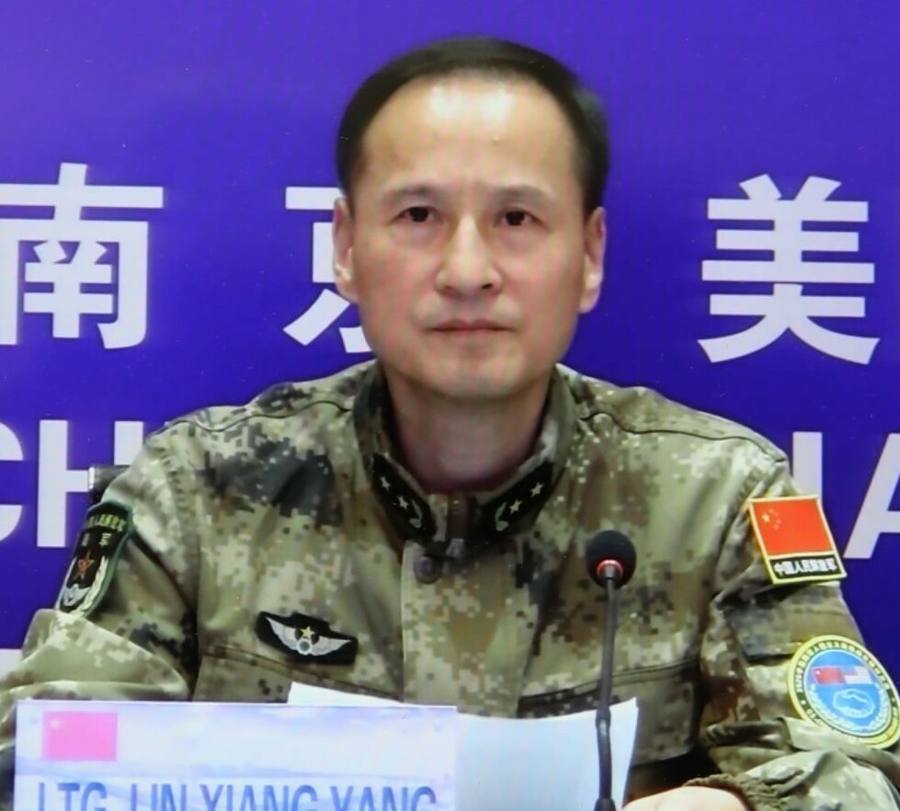
In April 2020 Lin became commander of the Eastern Theater Command Ground Force — the service command that runs the theater's group armies, among them the 72nd, the very formation he had just handed over. He was promoted to lieutenant general in July 2020. That year he also appeared, in his theater-army capacity, in imagery from the US–China Disaster Management Exchange; the Jamestown Foundation's 2025 retrospective used exactly such a photograph, captioned as sourced to the United States Army, as its title image — the one compliant image route this page's check was able to confirm exists (see Section Twelve and the metadata).
In August 2021 he stepped up again, succeeding Yi Xiaoguang as commander of the Central Theater Command — the theater guarding the capital region and central China. At fifty-six he was among the youngest theater commanders then serving. On 6 September 2021 the Central Military Commission promoted him to general, one of five officers raised that day: fourteen months from lieutenant general to general, five years from group-army commander to theater commander. The speed of that curve shows where he stood in 2021 — a representative of the new generation of theater commanders Xi Jinping's military reform had been deliberately raising.
But the Central Theater was only his springboard. In January 2022 he moved laterally to the Eastern Theater Command, succeeding He Weidong. The Eastern Theater is the formation charged with the Taiwan and East China Sea direction, and in wartime it is the executing headquarters for military action against Taiwan. Personnel commentary at the time read the appointment plainly: a general who had served in the Eastern Theater's ground force and in two front-line Taiwan-facing group armies, the 31st and the 72nd, was being brought back to sit over the strait. He Weidong, on leaving, would have no public post until entering the Central Military Commission that October; Lin took over the single most sensitive chair in the PLA. Six months later that chair faced the largest live-fire exercise since the theater system was created.
Five. August 2022: the man in the theater commander's chair
First, the exercises themselves, in full. On the evening of 2 August 2022 Nancy Pelosi, Speaker of the US House of Representatives, arrived in Taipei — the first visit by a sitting Speaker since 1997. That same evening Eastern Theater spokesman Shi Yi announced that the command would conduct joint combat-readiness patrols and live exercises in the sea and airspace around Taiwan, and a Xinhua authorised announcement set major military exercises with live firing in six zones around the island from noon on 4 August to noon on 7 August, some zones intruding into the territorial-sea baselines claimed by Taiwan. On 4 August the exercises began: Eastern Theater ground forces fired long-range live rounds into the Taiwan Strait; Rocket Force units launched multiple conventional missiles into waters east of Taiwan, with Taiwan's defence authorities and multiple outlets recording missile trajectories overflying Taipei; naval and air forces rehearsed joint blockade and joint strikes against land and sea targets, and large numbers of aircraft and vessels crossed the so-called median line. The exercises, scheduled to end on 7 August, were extended; on 10 August Shi Yi announced that the theater's forces had successfully completed all tasks and would henceforth organise regular combat-readiness patrols in the Taiwan direction. The international community calls the episode the Fourth Taiwan Strait Crisis; its blockade format and live-fire scale had no precedent, a judgement on which reporting across the spectrum agrees.
Now the responsibility chain, restricted to the layer that touches him directly. The decision sat at Party Centre and CMC level, with no document naming an individual. The public voice and the executing forces belonged to the Eastern Theater Command, speaking through Shi Yi. The theater commander was Lin Xiangyang, the political commissar He Ping. Under the formal chain, theater command responsibility for these exercises falls inside Lin's tenure: under the theater system, the drafting of exercise plans, the organisation of force movements and contingency handling belong to the theater headquarters, and the commander bears overall responsibility — that is the office itself, not an inference. But the boundary must be written with equal clarity: no public document records his individual decisions or orders during the exercises item by item, and this page invents no command detail for him. The coordinating and planning role that Reuters and others attributed to He Weidong belongs to the central-level reporting tier and runs parallel to, not against, the theater execution tier; this page keeps both. Only with both layers written down is the section nailed shut: in August 2022, when the missiles overflew Taipei, the Eastern Theater's commander was surnamed Lin, not He — and the man surnamed He, according to multiple reliable outlets, coordinated the same exercises from another level.
The exercises' legacy also lands in his tenure ledger. After August 2022, median-line crossings, encirclement exercises and combat-readiness patrols became the strait's new normal, and the so-called median line was in practice unilaterally erased — the starting point of that shift is the exercise of his first year in the chair. Every subsequent Eastern Theater exercise announcement issued in a spokesman's name was issued, nominally, under his command, until 2025. The next section follows that normalisation curve through the nodes of his tenure.
Six. Joint Sword and the normalised patrols: his Taiwan curve (2023–2025)
From 8 to 10 April 2023 the Eastern Theater Command ran combat-readiness patrols around Taiwan and the Joint Sword exercise, against the background of President Tsai Ing-wen's US transit and meeting with Speaker Kevin McCarthy; the exercise included the Shandong carrier group and simulated joint precision strikes on key targets on the island. On 23–24 May 2024, three days after Lai Ching-te's inauguration as Taiwan's leader, the command ran Joint Sword-2024A around the island and toward Kinmen, Matsu and the other offshore islands, officially framed as punishment of Taiwan-independence separatist forces. On 14 October 2024 it ran Joint Sword-2024B, a single-day exercise launched at night rehearsing sea-air readiness patrols, blockade of key ports and areas, and strikes on sea and land targets. Every one of these was announced by an Eastern Theater spokesman, executed by theater forces, and falls inside Lin Xiangyang's tenure as theater commander — the tenure-tier facts are clean.
This page's characterisation of the period is deliberately tight. The political decisions for the exercises sat at the centre; the theater owned the plans and the execution. The public record contains almost no Taiwan statement in Lin's own name — he appears in public almost exclusively in appointment and ceremony reporting, the portrait of a theater commander who did not speak. The contrast with his predecessor is marked: He Weidong, as a CMC vice chairman, spoke publicly and often, while Lin's public record is abnormally thin. But a thin public record is not a light responsibility: a theater commander bears overall responsibility for his direction's exercises and patrols, and every escalation of military pressure across the strait in 2023 and 2024 landed, in execution, in the theater under his command. The archive records exactly that structure — a man who rarely spoke, sitting for three years and nine months at the operating position of a machine that kept raising the pressure.
The 2025 record breaks. On 1–2 April 2025 the Eastern Theater Command ran the Strait Thunder-2025A exercise, still announced in the theater's name. But as to Lin himself, the sources checked for this page cannot pin down the exact date of his last public appearance in 2025: overseas analysis drawing on a Center for Strategic and International Studies assessment, relayed through second-hand reporting, holds that the Eastern Theater had no serving commander from March 2025 onward, while the Jamestown Foundation records his public disappearance considerably later. The two accounts diverge, both sit at the analysis and reporting tier, and this page registers them side by side and adopts neither. What can be pinned down is only the two endpoints in official documents: the expulsion announcement of 17 October 2025, and his successor's public appearance on 22 December 2025. Between those endpoints — when he was taken away, when he ceased to perform his duties — the authorities have published nothing. That blank, too, goes into the archive.
Seven. Central Committee member: the summit of his political rank (2022–2025)
At the 20th Party Congress in October 2022, Lin Xiangyang was elected a full member of the 20th Central Committee. Election to the Central Committee is the standard political rank-marker for a theater commander under the reformed system, but set into his biography it completes the summit: the general's rank, the principal Taiwan-facing theater, and Central Committee membership, all held together at fifty-eight, among the most favoured officers of his cohort. Public reporting and research-institution personnel tracking frequently listed him as a potential candidate for the next Central Military Commission — such forecasts belong to the analysis tier, and this page registers their existence without endorsing them.
His Central Committee tenure stayed close to his military brief: congress and plenum attendance, exercises and commemorative events with theater forces. In 2023 the Eastern Theater's political commissar changed, Liu Qingsong taking the post as Lin's counterpart — Liu's absence from the 2025 Fourth Plenum and his initially unexplained whereabouts afterwards are a separate thread; this page registers only the fact that the two men shared one theater leadership team, and does not enter Liu's sequel into Lin's ledger. In October 2024 Lin turned sixty, by service custom already near the retirement line for a theater commander, yet no retirement or transfer was announced. In coverage of the 3 September 2025 parade marking the eightieth anniversary of victory over Japan, this page found no verifiable record of his attendance; the result is registered as a negative search, and no inference about his status at that date is drawn from it — the parade's overall commander is by custom the Central Theater commander, and for an Eastern Theater commander absence from parade reporting carries none of the signalling weight it carried for high-exposure figures such as He Weidong or Zhang Youxia.
Eight. 17 October 2025: one notice with He Weidong and Miao Hua
On the afternoon of 17 October 2025, three days before the Fourth Plenum opened, defence ministry spokesman Zhang Xiaogang announced that, with the approval of the Party Centre and the Central Military Commission, the CMC discipline and supervision organs had opened investigations into nine officers — He Weidong, Miao Hua, He Hongjun, Wang Xiubin, Lin Xiangyang, Qin Shutong, Yuan Huazhi, Wang Houbin and Wang Chunning; that the nine had seriously violated Party discipline, were suspected of serious duty-related crimes involving extraordinarily large sums, of an extremely serious nature with an exceptionally vile impact; that the Party Centre had decided to expel all nine from the Party and transfer their suspected offences to military prosecutors for review and prosecution, the expulsions of the eight who were Central Committee members to be ratified by a plenary session; and that the CMC had already expelled all nine from the military. Xinhua carried the text the same day. Lin stood fifth on the list and was its only theater commander — He Weidong was a CMC vice chairman, Miao Hua and He Hongjun the Political Work Department's director and executive deputy director, Wang Xiubin executive deputy director of the CMC Joint Operations Command Center, and the rest service and People's Armed Police chiefs. That a front-line theater commander appeared on the same list as the military's central-organ chiefs shows the purge's reach extending, in the same stroke, into the operational command line.
On 23 October 2025 the communiqué of the Fourth Plenum recorded that the plenum had confirmed the Politburo's prior expulsions of He Weidong and the others; Lin's expulsion, as one of the Central Committee members among the nine, was confirmed within that procedure. For the following two months the Eastern Theater commander's chair was, publicly, empty, while the command went on issuing exercise announcements in its spokesman's name. On 22 December 2025 the CMC held a general-promotion ceremony in Beijing at which Yang Zhibin and Han Shengyan were promoted to general, and Xinhua's report confirmed Yang as the new commander of the Eastern Theater Command and Han as the new commander of the Central Theater Command — Yang, an air-force officer, had been an Eastern Theater deputy commander. With that, the succession chain closed on paper: He Weidong (2019–2022), Lin Xiangyang (2022–2025), Yang Zhibin (from December 2025).
The notice's blank is archived alongside the notice itself. The 17 October text is one set of characterisations shared by nine men; of Lin's individual case — what dates, what acts, what sums, connected to whom — it contains not one word. Whether his shared 31st Group Army background with He Weidong and Miao Hua bears any causal relation to the notice, the authorities have never said. The Jamestown Foundation's October 2025 analysis observed that seven of the nine had served in the former Nanjing Military Region and Eastern Theater area and read the purge's centre as personnel-management disorder and suspected duty-related crime — an analysis-tier reading of the list's structure, cited here at that tier and not written up as an official conclusion. The PLA Daily's subsequent editorial criticism of the group was couched in political language and belongs to the political-positioning tier; no personal charge is inferred from it. This page's discipline is the same as on the He Weidong page: what the authorities have not said, this page does not say for them.
Nine. The nine names, and the 31st Group Army line
Spread the list of nine out and its structure shows. He Weidong oversaw the personnel direction, on the reporting tier; Miao Hua and He Hongjun ran the Political Work Department, the apex of officer evaluation and promotion across the PLA. Wang Xiubin sat in the CMC Joint Operations Command Center, the operational command hub. Lin Xiangyang held the Eastern Theater Command, the operational forces for the Taiwan direction. Qin Shutong and Yuan Huazhi were political commissars of the Ground Force and the Navy, Wang Houbin commanded the Rocket Force and Wang Chunning the People's Armed Police. Personnel line, command line, service lines — one list took all of them. The Jamestown analysis adds a biographical thread: several of the nine had served for long periods in the former 31st Group Army — He Weidong rising from a reconnaissance company, Miao Hua growing up in that army's political-work system, Lin Xiangyang a former deputy commander of the army, Wang Xiubin with service there as well. Xi Jinping worked in Fujian from 1985 to 2002, in the same place and period as that army's officers — hence the labels "Fujian clique" and "31st Army men" in media and scholarly description of this group. This site's archival discipline is unchanged: the biographical overlap is hard fact, the faction label is commentary tier, and the two are recorded separately. The official notice uses no faction language at all and publishes no instance of any of the nine advancing another; this page writes no "gang" finding, and simply lays the list's composition and the biographical convergences out as they are.
For Lin personally the thread carries one further, concrete meaning: the channel that promoted him and the list that purged him were built by the same system of men. When he leapt two grades in 2021, the CMC's personnel direction was, on published accounts of the division of labour — reporting tier — the line of He Weidong and Miao Hua; in 2025 he fell on the same day as the apex of that line. This page draws no inference that his promotions were improper — the authorities have published not one word on the propriety of his promotion procedures — and registers only the structural fact: the top of the personnel machine and a theater commander it had raised were cleared in a single notice, and that, in itself, is a key to the character of this round of military purge.
Ten. Sanctions: none — the commander of the encirclement exercises is on no international list
The sanctions column begins with the search path. For this page, the US Treasury's OFAC Specially Designated Nationals List, the EU financial sanctions database, the UK Sanctions List and Canada's Consolidated Autonomous Sanctions List were all searched; Lin Xiangyang's name appears on none of them, and the result is recorded as no public record. On judicial pursuit: apart from the Chinese Party and military sanctions and the transfer to military prosecutors, no prosecution in any other jurisdiction is on public record. On international human-rights or war-responsibility accountability: none — no international tribunal, foreign court or sanctions mechanism has opened a proceeding against him personally, or listed him, over theater command responsibility for the August 2022 exercises, over the Joint Sword series that followed, or over any other matter from his tenure's escalation of military coercion across the strait.
The result deserves to be set beside August 2022 — and in his case it is sharper than in He Weidong's. He's exercise role exists only at the reporting tier, so the absence of his name from sanctions lists can still be explained by the difficulty of pinning personal responsibility to paper. Lin is different: he was the serving theater commander during the exercises, the clearest name on the formal command chain, and the action in which missiles overflew Taipei and exercise zones ringed the island happened inside his theater tenure. Yet no Western sanctions system ever listed him: in every government's policy language the exercises were characterised as status-quo-breaking coercion, and that characterisation was never converted, by any government, into a personal designation of the commander. By the time his own state expelled him in October 2025 and transferred him to prosecutors, he was a former general with no serving conduct left to deter. This page archives the state of affairs as it stands: a serving theater commander of the Taiwan exercises carries an international accountability record of zero, and the only accountability that has ever landed on him comes from the very system he served — in a charge that, to this day, consists of a collective formula of a few words.
Eleven. Status verified to November 2026, and the unverified register
The verification path is as follows. First, the last central-level official document concerning Lin Xiangyang in the public record is the Fourth Plenum communiqué of 23 October 2025 confirming his Party expulsion; Xinhua's 22 December 2025 report of the general-promotion ceremony, by naming Yang Zhibin as Eastern Theater commander, closed his tenure from the side. Second, searches of his name in Chinese and English together with indictment, trial, sentencing and death return no report from Reuters, the Associated Press, the South China Morning Post, the Lianhe Zaobao or any other reliable outlet that he has been indicted, tried, sentenced or has died. Third, his age is computable: born in October 1964, he turned sixty in October 2024. On this basis this page confirms: as of November 2026 his case remains, in the public record, at the 17 October 2025 stage of "transferred to military prosecutors for review and prosecution", with no public record of where he is held or of his health.
The unverified items are registered together here and are not scattered through the body as findings. One: the date and manner of the measures taken against him — never announced; overseas analysis holding that the Eastern Theater had no serving commander from March 2025 and the Jamestown Foundation's later dating of his public disappearance diverge, both are analysis and reporting tier, and neither is adopted as a finding. Two: the content of his alleged offences — versions concerning specific acts, sums, properties and implicated persons are numerous, the official notice offers only the nine-man collective formula, and all are rejected. Three: the contest over why he fell — personnel-disorder, corruption and factional-clearance readings all circulate in analysis, none is proved by any document, and their existence alone is registered. Four: the detail of his personal role in the exercises — his specific decisions, orders and contingency handling in August 2022 and in each Joint Sword exercise have no public record; this page records theater-commander tenure responsibility only and invents no command detail. Five: early-career detail — his Party-admission date, junior-post sequence and the Russia-study claim have no verbatim official-biography confirmation and are flagged in the body. Six: his health — no public record. These six items will be revised when new archives open.
Twelve. Verification and sources
This page's biographical and post facts were cross-checked across multiple sources, principally: Xinhua's 6 September 2021 report of the CMC general-promotion ceremony (Wang Haijiang, Lin Xiangyang, Dong Jun, Chang Dingqiu and Xu Xueqiang promoted, Lin identified as Central Theater commander — the anchor for the promotion date and post); the Xinhua authorised announcement of 2 August 2022 (live firing in six zones, 4–7 August) and Eastern Theater spokesman Shi Yi's statements of 2 and 10 August 2022 (the exercises' opening, completion of tasks and regular patrols to follow); Caixin and The Paper personnel reporting on his commands of the 47th, 82nd and 72nd Group Armies and of the Eastern Theater Command Ground Force (2016–2021); the Chinese and English Wikipedia entries for Lin Xiangyang and the materials they cite (born October 1964 in Haikou, Fuqing; PLA Army Infantry Academy; enlisted 1982; lieutenant general July 2020; Eastern Theater commander January 2022; expelled October 2025); the defence ministry's notice of 17 October 2025 in full (the list of nine and its collective characterisation, Lin fifth) and Xinhua's same-day release; the Fourth Plenum communiqué of 23 October 2025 (confirmation of the Party expulsions); Xinhua's 22 December 2025 promotion-ceremony report (Yang Zhibin as Eastern Theater commander, promoted to general); Reuters' personnel analysis of 27 October 2022 (the coordinating role attributed to He Weidong — reporting tier, held in parallel with this page's command chain, not against it); the Jamestown Foundation's October 2025 purge analysis and its Eastern Theater leadership retrospective (the nine-list structure and the 31st Group Army thread — analysis tier; its title image is Lin at the 2020 US–China Disaster Management Exchange, captioned as sourced to the United States Army); and the Center for Strategic and International Studies assessment of a 2025 Eastern Theater command vacancy, relayed at second hand (analysis tier, registered alongside the Jamestown dating without adjudication). Sanctions: the OFAC SDN List, the EU financial sanctions database, the UK Sanctions List and Canada's Consolidated Autonomous Sanctions List were searched, with no listing found. Image-source check: the title photograph of the Wikipedia entry shows him at a US–China military exchange event, and the Jamestown Foundation's use of the same image captions its source as the United States Army — works of the US military are in principle public domain, making this the one compliant image route this check confirmed to exist, though the image desk must re-open the Commons file page and confirm its licence marking before any use. All other portraits and activity photographs located are Xinhua, defence-ministry or CCTV official photographs under official copyright, or Reuters, AFP and Getty agency photographs, and are not usable. This fragment itself embeds no image; the compliant route is registered as above.
Corrections made to the commissioning brief's raw material, item by item. One: the brief asked whether his promotion to general fell in January 2022 — it did not; it fell on 6 September 2021, when he was Central Theater commander, and January 2022 is when he took over the Eastern Theater Command. Two: the brief's career sketch listed only the 72nd Group Army and the Eastern Theater ground force; the verified record must be completed — deputy commander of the 31st Group Army; commander of the 47th Group Army (2016); first commander of the 82nd Group Army (2017–2019); commander of the 72nd Group Army (2019–2020); commander of the Eastern Theater Command Ground Force (2020–2021); commander of the Central Theater Command (2021–2022) — the Central Theater command, the very post he held when promoted to general, being wholly absent from the brief. Three: the brief asked whether he was a member of the 20th Central Committee — verified: he was elected in October 2022, and the Fourth Plenum's confirmation of his expulsion presupposes that membership. Four: the brief directed that removal reporting around the Fourth Plenum and the Miao Hua circle be marked unverified — that direction has been overtaken by an official document: on 17 October 2025 the defence ministry formally announced his expulsion from the Party and the military and the transfer of his case to prosecutors, which is documentary fact, not rumour; what remains unverified is only what lies outside the notice — the date he was taken away, the alleged acts and sums, and the reasons for his fall — each flagged at its tier in the body. That is the intent of the "no official announcement, no statement as fact" discipline: now that the announcement exists, the discipline falls on never filling in beyond it. Five: the brief described him as the incumbent Eastern Theater commander — corrected: his tenure ended in October 2025 and Yang Zhibin succeeded him, publicly, on 22 December 2025, and this page is written of a former commander. This page will be revised as new archives open.
Thirteen. This site's commentary
The weight of this page concentrates in ten days of August 2022. Discussion of those exercises usually settles on two names: the political level that ordered them, and He Weidong, reported to have coordinated and planned them. The man who actually sat in the theater commander's chair, whose name stands clearest on the formal command chain, is the one least often mentioned. This site's commentary first fills that cell: the point of an archive is that the clearest name on a formal chain of responsibility should not be dropped from the narrative merely for lacking drama. In the week the missiles overflew Taipei, the Eastern Theater Command's commander was Lin Xiangyang — a documentary fact that needs no reporting tier to hold it up.
Then look at the whole arc: three group armies, two theater commands, fourteen months from lieutenant general to general — an ascent built entirely of hard troop-command rungs, reaching the summit in five years. And then a fall at the same tempo: no warning, no defence, no individualised charge, only a notice shared by nine men and one formula — sums extraordinarily large. When the system promoted him it published no reasons; when it cleared him away it published no reasons either. The archive sets the two ends side by side and needs no further rhetoric: a general's entire public life is the interval between an appointment order and a punishment notice, and of what happened inside that interval — the August 2022 exercises, the Joint Sword rounds of 2023 and 2024, the unknown date in 2025 on which he stopped performing his duties — the archive can pin down only the nodes, and honestly leaves the rest blank. This page is written so that whoever looks up August 2022 in years to come finds first the right name and the right command chain; and so that they can see how this system uses a man who leads troops, and what it leaves written on him at the end — a collective characterisation and nothing more. This page records the tenure from January 2022 to October 2025.
Contact: endccpworld@proton.me