
Jia Qinglin (born 1940)
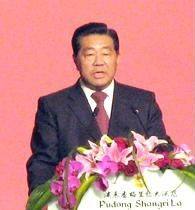
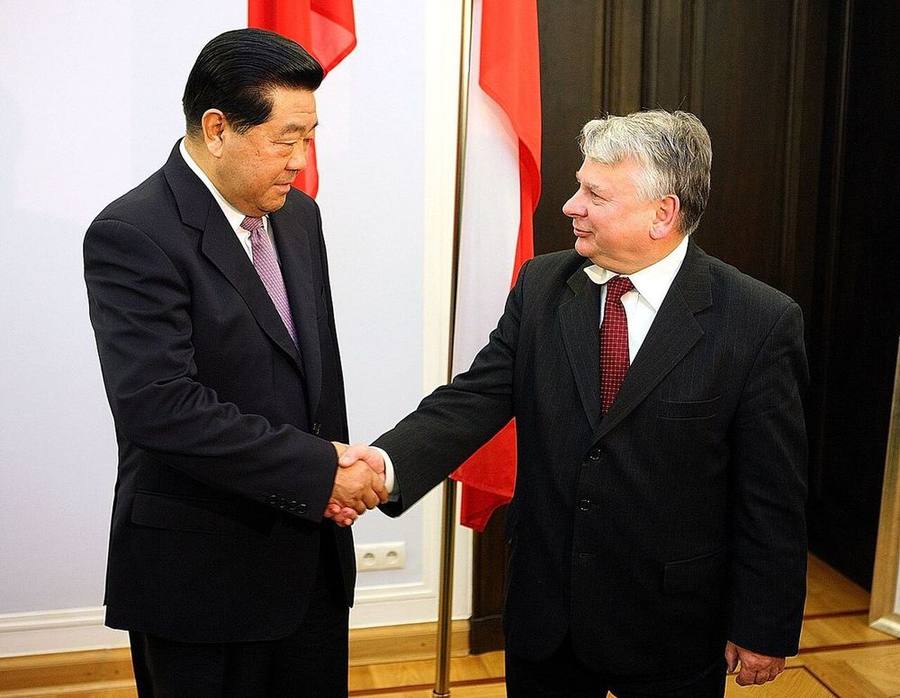
Jia Qinglin, born 13 March 1940 in Jiaohe, Hebei (now Botou), is an engineer who entered Fujian's leadership in 1985, served as its governor and Party secretary (30 December 1993 – 28 October 1996), transferred to Beijing in 1996, and was Beijing Party secretary and Politburo member from 25 August 1997 to 22 October 2002, before entering the Politburo Standing Committee (ranked fourth) in 2002 and chairing the CPPCC National Committee from 13 March 2003 to 11 March 2013. The weight of his file comes almost entirely from Beijing in 1999: the 25 April Zhongnanhai gathering took place under his rule; after the crackdown began on 20 July and Falun Gong was formally banned on 22 July, WOIPFG — citing the People's Daily of 24 July 1999 — records that on 23 July he chaired an enlarged Beijing Party standing-committee meeting demanding that Party organizations throw themselves into the political struggle against Falun Gong, and he repeatedly promoted the campaign in public thereafter. Beijing under him was among the harshest municipalities in the suppression; the death of Beijing lecturer Zhao Xin, whose cervical vertebrae were fractured in Haidian detention custody in 2000 and who died paralyzed that December, is documented in independent sources including a Yale University Press monograph. Fujian must be kept separate: the Yuanhua Group was founded in Xiamen in 1994 and its network formed partly under his rule, and many of his former subordinates were convicted — but the Xiamen court's 2012 judgment defines the principal crime period as 1996–1999, mostly after his departure, no public judgment has ever found Jia or his wife Lin Youfang involved, and the Jiang Zemin protection thesis in outlets such as the Washington Times remains a media claim. From 2004 practitioners sued him for genocide and torture in Spain, Austria and Ukraine, with no conviction on record; his international sanctions record is none. The 2016 Panama Papers showed his granddaughter Li Zidan taking over the offshore company Harvest Sun for one dollar in 2010 while a Stanford freshman and holding Xin Sheng Investments — with ICIJ expressly noting no evidence that Jia himself held any interest. Retired since 2013, he appears only at state ceremonial occasions; the 3 September 2025 parade's retiree list still carried his name, aged 85.
1. A Farmer's Son from Botou and the Engineer's Road (1940–1985)
Jia Qinglin was born on 13 March 1940 in Jiaohe County, Hebei, a county later absorbed into Botou. His official biography describes an ordinary farming family. From 1956 to 1958 he studied industrial-enterprise planning at Shijiazhuang Industrial Management School; from 1958 to 1962 he studied electric-motor and appliance design and manufacturing at Hebei Engineering College. After graduating he joined the Complete Plant Bureau of the First Ministry of Machine-Building Industry as a technician, and for more than two decades he worked inside the machine-building system — policy research, import-export and complete-plant administration — until in 1983 he became director and Party secretary of the Taiyuan Heavy Machinery Plant. Among the CCP's top leaders he belongs squarely to the "engineers in power" generation: no revolutionary pedigree, no military background, only an industrial-management résumé and steady promotion through the organizational system.
That early record matters for understanding everything that followed. Jia was not formed as the initiator of any campaign. His route to the center was the channel opened in the 1980s when the Party, pursuing younger and better-educated cadres, promoted technocrats in batches into provincial leadership; his 1985 posting to Fujian was a product of that channel. And his ability to survive, unscathed and still rising, two great storms of the 1990s — the Yuanhua case and the Beijing succession — rested not on any administrative record but on the patronage of General Secretary Jiang Zemin. Virtually every serious biographical account lists that relationship as the first explanatory variable of his career, and every promotion recorded below should be read against it.
2. Eleven Years in Fujian: From Deputy Secretary to Party Secretary (1985–1996)
In 1985 Jia was transferred to Fujian as a provincial standing-committee member and deputy Party secretary, later concurrently heading the provincial Organization Department and the Party school. In 1990 he became vice-governor and acting governor, and in 1991 governor. On 30 December 1993 he succeeded to the secretaryship of the Fujian Provincial Party Committee, the province's top office; from 1994 he also chaired the Standing Committee of the provincial People's Congress, until he left Fujian in October 1996. Those eleven years covered Xiamen Special Economic Zone's fastest expansion: foreign capital poured in, customs and border trade boomed, and local revenue and smuggling rents grew side by side. Lai Changxing founded the Yuanhua Group in Xiamen in 1994, and his smuggling network took shape in precisely this period — a temporal overlap that forms the unavoidable archival background of Jia's Fujian tenure. How far the overlap goes, and at what level responsibility can be assigned, must be layered by evidence, as the next section does.
A second Fujian-era fact belongs in the file: the consolidation of his relationship with Jiang Zemin. Multiple biographical accounts report that Jiang, on inspection visits to Fujian, formed a strong impression of Jia, who thereby entered Jiang's promotion lists. No official document supports this; it is archived here at the grade of "consensus media and political-observer reporting, officially unconfirmed." It matters because it simultaneously explains two later events: why, after Chen Xitong's fall in 1995, the most sensitive post in China — Beijing — went to a man of undistinguished seniority; and why, when the Yuanhua fire reached Fujian's old leadership in 1999, the investigation's boundary stopped precisely at his level.
3. The Yuanhua Case: Tenure Overlap, the Timeline of Exposure, and the Boundary of "Not Found"
The chronology must be fixed first, because popular accounts of Jia and Yuanhua go wrong precisely on chronology. Lai Changxing founded the Yuanhua Group in Xiamen in 1994. The Xiamen Intermediate People's Court's 2012 judgment against Lai defined the operative figures as follows: smuggling and bribery committed between 1996 and 1999, goods worth roughly US$3.3 billion in the court's accounting (other accountings in renminbi run higher), some US$1.7 billion in evaded duties (about RMB 13.9 billion in another accounting), and bribes paid to 64 officials. In April 1999 the Center established a special investigation (the "420" task force); Lai fled to Canada that year, was deported in 2011, and was sentenced to life imprisonment in 2012. Jia Qinglin was Fujian Party secretary from December 1993 to October 1996, and governor before that. In other words: the founding of Yuanhua and the construction of its network (1994–1996) fall within his rule of Fujian; but most of the court-defined crime period (1996–1999) postdates his departure, and the exposure and task force came three years after his transfer to Beijing. To book the whole Yuanhua case as "a scandal of Jia's tenure," or conversely to say that because he left early he had nothing to do with it, are both falsifications of the timeline.
Then the level of formal findings. The Yuanhua investigation cut deep: Vice Minister of Public Security Li Jizhou received a suspended death sentence; Fujian deputy public-security chief Zhuang Rushun and many others were imprisoned; Xiamen customs and local officials fell in batches. But no public judgment or official communiqué has ever found that Jia Qinglin himself took bribes or joined the smuggling, and there is no public record that he was ever placed under investigation or questioned. His wife Lin Youfang was reported by Hong Kong, Taiwan and overseas media to have been "implicated," with reports that investigators had touched on business dealings connected to her; equally, no official conclusion, charge or judgment has ever pointed at her. The Jiang-protection thesis — that Jiang ordered investigators not to cross Jia's level — appears in reporting such as the Washington Times', citing politically connected sources, and in a large body of political analysis; it has strong explanatory power and fits Jia's subsequent rise, but it remains a media claim, not the conclusion of any investigating body. This page archives the matter in three separate layers: first, established findings — the Yuanhua network formed in the province he governed and many of his former subordinates were convicted; second, timeline facts — the principal crime period and the exposure postdate his departure; third, unestablished matters — whether Jia or his wife was involved has no official finding, and the protection thesis is media reporting. The three layers may not impersonate one another.
4. Taking Beijing: The Capital After Chen Xitong (1996–2002)
In 1995 Beijing Party Secretary Chen Xitong fell in a corruption case (he was sentenced to sixteen years in 1998), shaking the capital's officialdom. In 1996 Jia was transferred in as deputy Party secretary, vice-mayor and acting mayor; he became mayor in 1997, succeeded as Beijing Party Secretary on 25 August 1997, and entered the Politburo at the Fifteenth Party Congress. He held Beijing until 22 October 2002, concurrently mayor until February 1999, when Liu Qi took the mayoralty and Jia continued as Party secretary alone. As first-in-command of a directly administered municipality and a Politburo member, he bore the highest leadership responsibility for the capital's Party affairs, political-legal apparatus, police and stability-maintenance system. That structure of responsibility is the premise for judging his position in the next section: the repression carried out in Beijing after 1999 did not happen in some subordinate jurisdiction of which he was unaware; it happened in a capital whose Party standing committee he chaired and whose political-legal system reported to him.
His signature public project in Beijing was the fiftieth-anniversary National Day celebration of 1999, for which, as host Party secretary, he directed the capital's preparations and accompanied Jiang Zemin and other leaders atop Tiananmen. The same year 1999 was the opening year of the Falun Gong suppression: its first half brought the 25 April Zhongnanhai gathering and the decision to ban; its second half brought celebration security and the mass interception and arrest of petitioning practitioners. Archivally, the two were faces of a single machine in Beijing: the celebration required "absolute stability," the suppression required the capital to move first, and the municipal Party secretary presided over both.
5. 25 April, 20 July, and the Suppression in Beijing (1999–2002): The Direct-Evidence Layer
On 25 April 1999, more than ten thousand Falun Gong practitioners petitioned collectively outside the State Council appeals office by Zhongnanhai — the "25 April" incident — in Beijing. Premier Zhu Rongji met practitioner representatives that day and the gathering dispersed peacefully. Jiang Zemin then drove the decision to eradicate: on 10 June 1999 the Center created the Leadership Group for Handling the Falun Gong Problem and its office, the "610 Office"; in the early hours of 20 July a coordinated nationwide arrest of Falun Gong assistance-center organizers began; on 22 July the Ministry of Civil Affairs announced the banning of the Falun Dafa Research Society and the Ministry of Public Security issued its prohibitions, formally outlawing the practice. Every link of that decision chain was forged in Beijing while Jia was its Party secretary; the decision itself was Jiang's and the Center's, which the evidence establishes clearly, and this page does not rewrite a central decision as a municipal one.
Jia's own verifiable acts are the Beijing Party Committee's endorsement and mobilization after the ban was announced. According to the investigative report of the World Organization to Investigate the Persecution of Falun Gong (WOIPFG), citing the People's Daily of 24 July 1999: on 23 July Jia chaired an enlarged meeting of the Beijing municipal Party standing committee, demanding that Party organizations and members at every level take a clear-cut stand and throw themselves resolutely into the political struggle against Falun Gong. Thereafter, according to the same report, he repeatedly attacked Falun Gong and demanded the campaign's advance at municipal CPPCC and People's Congress sessions and at political-legal and religious-work meetings, received the national anti-Falun Gong touring report delegation to raise morale, and counted the struggle against Falun Gong among Beijing's priority tasks. The evidence grade must be stated plainly: WOIPFG is an investigative body closely aligned with the Falun Gong movement and its report is a one-side source; but its core item — the 23 July standing-committee meeting and Jia's chairing endorsement — is anchored to a cited People's Daily report of the day, and it fits exactly the verifiable historical pattern of every provincial Party committee endorsing and mobilizing in the same week. On that basis this page records "Jia, within days of the ban, chaired the municipal mobilization meeting, publicly endorsed the campaign, and continued to promote it in public settings" as directly documented responsibility. The claim that he personally ordered any specific arrest or act of torture has no reliable source, and this page does not carry it.
6. The Consequences Layer in Beijing: Figures, Cases, and the Limits of Attribution
The severity of the suppression in Beijing can be layered from several kinds of sources. WOIPFG's accounting holds that by October 2005 Beijing's verified Falun Gong deaths from persecution ranked among the highest of the directly administered municipalities, with 49 of the deaths, or their causes, falling before Jia's departure in November 2002 — figures from the Falun Gong-affiliated verification system, never acknowledged by the authorities, and labeled here by their provenance. A 2003 Congressional Research Service report and contemporary Amnesty International records supply the national frame: in the campaign's first three years, tens of thousands of practitioners were detained or sent to re-education through labor, and human-rights organizations recorded hundreds of deaths in custody. Among Beijing cases, one of the most completely documented outside practitioner sources is Zhao Xin: a lecturer at the Business School of Beijing Technology and Business University, arrested on 19 June 2000 while practicing Falun Gong exercises in Zizhuyuan Park, who sustained multiple fractured cervical vertebrae and grave injuries in custody at the Haidian detention center, was left paralyzed, and died on 14 December 2000, aged thirty-two — a case recorded in Maria Hsia Chang's scholarly monograph Falun Gong: The End of Days (Yale University Press, 2004), among other non-practitioner sources. The deaths of Wang Lixuan and her eight-month-old son are cited repeatedly in overseas litigation materials, but their evidentiary base lies mainly within the practitioner system; this page records them as "appearing in litigation and investigation materials, independently verified only to a limited degree," and does not grade them with the Zhao Xin case.
Beijing's suppression also had a national consequence layer: from 1999 to 2002 practitioners from across China kept traveling to the capital to petition, and very large numbers were intercepted at Tiananmen Square and in the appeals system, arrested, and repatriated to continued detention at home; practitioner sources put those arrested in Beijing in the hundreds of thousands, a figure that cannot be independently verified. This page confirms only the structural fact — the front line of petition interception was Beijing, the executing organs were Beijing's police and political-legal system, and the years were Jia's as Party secretary. On 23 January 2001 a self-immolation incident occurred in Tiananmen Square; the authorities attributed it to Falun Gong practitioners and used it to escalate the propaganda war, while Falun Gong representatives denied responsibility and alleged a frame-up. The incident occurred in Jia's Beijing; both sides' claims stand in the record; this page archives the event and the dispute without drawing a conclusion the evidence cannot carry. Taking this section together with the last: Jia's responsibility for the Beijing suppression is responsibility at the level of "highest local leader plus public mobilizer," supported by the public record of meetings and speeches; attributing individual torture deaths, one by one, to his personal orders exceeds the evidence. This page is unambiguous at both ends.
7. Standing Committee Member and CPPCC Chairman (2002–2013): Master of the United Front Machine
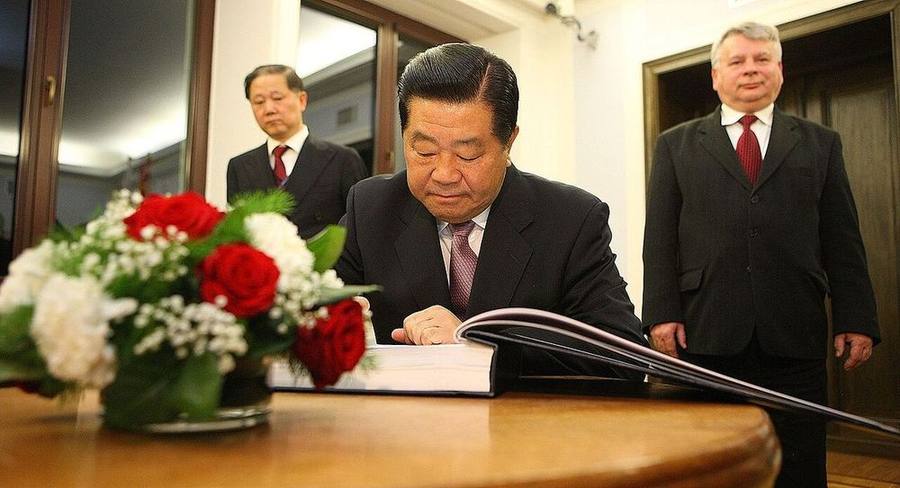
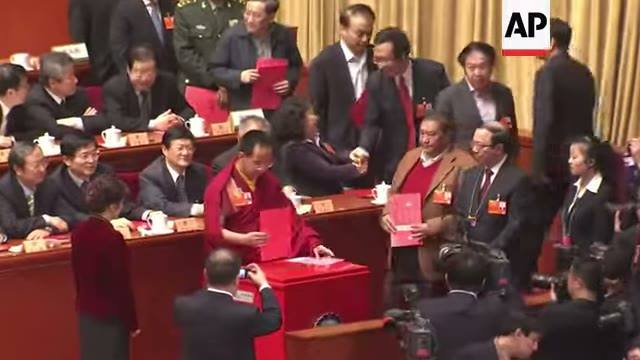
In November 2002, at the Sixteenth Party Congress, Jia entered the Politburo Standing Committee, ranked fourth. On 13 March 2003 he was elected chairman of the Tenth CPPCC National Committee, was re-elected to the Eleventh in 2008, and served until 11 March 2013; his Standing Committee tenure ended at the Eighteenth Congress in November 2012. The CPPCC chairmanship is fourth in the Party's order of precedence, and its function is the united front: binding the democratic parties, religious circles, ethnic constituencies, and Hong Kong, Macao, Taiwan and overseas-Chinese communities into the Party's leadership framework. In persecution-archive terms, Jia in this phase no longer directly commanded any locality's police or political-legal apparatus; his connection to repression became systemic and symbolic: the CPPCC system echoed the official line on Falun Gong in its sessions — WOIPFG notes that at the first session of the Tenth CPPCC in 2003, which Jia chaired, Li Guixian's speech contained anti-Falun Gong passages, breaking the practice of his predecessor Li Ruihuan's tenure; the claim is single-sourced to that organization and labeled as such here — and on his many foreign tours he met practitioner protests and lawsuits in Spain, Austria, Ukraine, Hungary, Hong Kong and elsewhere (see Section 9).
His Taiwan and Hong Kong roles also belong in the file. The CPPCC chairman is the Party's senior ceremonial officer for Taiwan united-front work; Jia repeatedly received Taiwan delegations and presided over Straits Forum-related activities, articulating the line of "placing hope in the people of Taiwan," and in June 2006 he spent three days in Hong Kong for return-anniversary events. These duties are not themselves persecution events, but they are necessary to the archive's understanding of his power: he was the man who held the "unity" instrument while others held the "struggle" instrument of the same regime — on the mobilization platform in the domestic suppression system, on the rostrum in the united-front system. This page therefore writes his record in two distinct segments: for Beijing 1999–2002, documented mobilization responsibility in a suppression; for the CPPCC decade 2002–2013, systemic and symbolic complicity. Neither segment is merged into, or diluted by, the other.
8. Family-Wealth Reporting and the Panama Papers: Offshore Companies in a Granddaughter's Name
The public record on the Jia family's wealth comes principally from the Panama Papers of April 2016. The International Consortium of Investigative Journalists (ICIJ), The Guardian and partner outlets disclosed that Jia's granddaughter Li Zidan (Jasmine Li) in December 2010, just entered as a freshman at Stanford University, became sole shareholder of two British Virgin Islands companies — Harvest Sun Trading Limited and Xin Sheng Investments Limited — with Harvest Sun transferred to her for one dollar by Zhang Yuping, founder of the luxury-watch distributor Hengdeli Holdings. The two offshore companies were the parents of two Beijing consulting firms, a structure that kept Li's family surname off mainland business-registration documents. At disclosure, Jia was still the sitting fourth-ranked Standing Committee member. ICIJ stated expressly that nothing in the documents suggested the politicians in question held any beneficial interest in their relatives' companies. The Panama Papers therefore prove that "Jia's granddaughter held offshore companies shortly after reaching adulthood"; they do not prove that Jia himself held assets or illicit gains.
Beijing's response was blockade and dismissal: the Foreign Ministry spokesman called the reporting "groundless" and refused comment, and discussion of the Panama Papers was extensively deleted inside China. Beyond that, more specific figures for the Jia family's wealth — properties, equity stakes, totals — circulate in Hong Kong, Taiwan and overseas Chinese-language media, almost all of them unverifiable single-source rumor; this page adopts none of them and marks the category "unverified." The archival significance of this section lies not in fixing any amount but in recording a structural fact: the third generation of an official who came from a farming family and lived his whole life on a state salary became, at eighteen or nineteen, the beneficiary of an offshore structure — and that fact remains unreportable and undiscussable inside China to this day. As to Jia personally, this page finds only what the evidence reaches: offshore holdings by a close relative, documented at file level by ICIJ and major international media; personal corruption by Jia himself, found by no official or judicial body. Both sentences stand at once.
9. Lawsuits Abroad: Spain, Austria and Ukraine (2004–2006)
Jia Qinglin is among the senior CCP officials sued in multiple countries over the Falun Gong suppression. On 2 September 2004, fifteen Falun Gong practitioners filed a criminal complaint at Spain's National Court against Jia, who was about to visit, accusing him of genocide and torture committed while he was Beijing Party secretary between 1999 and 2002; the filing, submitted by attorney Carlos Iglesias, was reported by Spain's Europa Press agency and others. A parallel suit was filed in Austria the same month. On 31 October 2006 practitioners petitioned Ukraine's Supreme Court against the visiting Jia, charging genocide, torture and active participation in the persecution. The subsequent public record is this: no case produced a conviction, an executed arrest or an extradition; and after Spain narrowed its universal-jurisdiction legislation in 2009 and again in 2014, the space for such cases effectively closed. Around 2010 a Spanish court issued rulings advancing a separate Falun Gong case against five other CCP officials including Jiang Zemin; reports differ on its relation to the Jia case, and this page does not transfer another case's rulings into Jia's file.
These lawsuits must be assessed with restraint: they were attempts by victims to use universal jurisdiction, and an indictment's accusations are not a court's findings. But they became a fixed part of Jia's international profile — wherever he traveled thereafter, protests and complaints followed, which was unusual among his generation of Chinese leaders. On sanctions proper, the record is entirely blank: no sanctions regime — American, European Union, British, Canadian or other — contains any public designation of Jia Qinglin. This page therefore enters "none" in the sanctions field, with the search scope stated as public sanctions lists and major media reporting; "no sanctions" and "multiple lawsuits" are different things, and both are archived here side by side.
10. Retirement and Late Appearances (2013–2025)
In November 2012 Jia left the Politburo Standing Committee at the Eighteenth Party Congress; on 11 March 2013 Yu Zhengsheng succeeded him as CPPCC chairman and Jia retired, aged seventy-three. Since then no office or public political activity of his has been reported; his rare appearances are confined to national ceremonial occasions, where official retiree lists intermittently include his name. The most recent verifiable appearance is the military parade of 3 September 2025 marking the eightieth anniversary of the end of the Second World War in Beijing: the retired leaders listed as attending included Li Ruihuan, Wen Jiabao, Jia Qinglin, Zhang Dejiang and Yu Zhengsheng, attested by official broadcast footage and subsequent reporting, when he was eighty-five. Beyond this, his post-retirement residence, health and family circumstances have no reliable public record; this page archives them as "no public record" and adopts no internet rumor. A man once ranked fourth in China now exists publicly as a single line in a list of names — the standard ending of CCP elder politics, in which the controversies of the Yuanhua years and the suppression years alike are consigned, in the official narrative, to silence.
11. A Layered Table of Responsibility: What Is Documented, What Is Tenure Alone
This page closes by gathering Jia's connections to persecution events by evidentiary strength, enforcing this site's rule for people pages: a tenure connection must not be written as a personal order, and the absence of a personal order must not erase the responsible officeholder. Level one, directly documented by files or multiple public records: chairing the Beijing Party standing committee's enlarged mobilization meeting after the July 1999 ban and publicly endorsing the campaign (the People's Daily report as cited by WOIPFG, cross-supported by the verifiable pattern of every provincial committee mobilizing in the same week); continued public speeches promoting the suppression throughout his tenure (same source chain). Level two, office responsibility — structural facts that need no personal order to stand: during his 1999–2002 tenure as Beijing Party secretary and Politburo member, the arrests, labor-camp sentences, repatriations and custody deaths executed by Beijing's police and political-legal system occurred within the jurisdiction and apparatus he led, and he bears the highest local leadership responsibility; independently sourced cases such as Zhao Xin's belong at this level. Level three, partial tenure overlap without any personal finding: the Yuanhua network's formation period (1994–1996) overlaps his rule of Fujian and many of his former subordinates were convicted, but the court-defined principal crime period postdates his departure, neither he nor his wife has ever been officially found involved, and the Jiang-protection thesis is media reporting only. Level four, systemic and symbolic: during his 2003–2013 CPPCC chairmanship, the consultative system's echoing statements and united-front functions do not constitute direct responsibility for specific persecution events. Level five, family matters: his granddaughter Li Zidan's 2010 offshore holdings are documented at file level by ICIJ; no document connects them to assets of Jia himself. This table is the page's conclusion: the weight of his file comes almost entirely from Beijing in 1999 — not from Fujian, and not from the CPPCC decade.
12. Verification and Sources
The facts on this page were cross-checked across multiple sources. Principal sources: the official CCP biography (Xinhua, carried by CCTV International and People's Daily Online) — birth date, native place, Party entry, education and the full sequence of posts, including the exact tenures of Fujian Party secretary (30 December 1993 – 28 October 1996), Beijing Party secretary (25 August 1997 – 22 October 2002) and CPPCC chairman (13 March 2003 – 11 March 2013) — cross-checked against the post tables cited by English Wikipedia. The Lai Changxing case: Xinhua's account of the Xiamen Intermediate People's Court's 2012 judgment (roughly US$3.3 billion in smuggled goods, some US$1.7 billion in evaded duties, bribes to 64 officials, 1996–1999) and the Washington Times' and Irish Times' 2012 reporting (Li Jizhou's suspended death sentence; media claims of Jia's wife being implicated; the origin of the Jiang-protection thesis) are cited in separate layers, and media claims are never upgraded into findings. The suppression background: the Congressional Research Service report RS20333 (2003), Maria Hsia Chang's Falun Gong: The End of Days (Yale University Press, 2004; the Zhao Xin case), and the 2012 Congressional-Executive Commission on China hearing record supply national-scale and case-level anchors outside practitioner sources. Jia's direct connection to the Beijing suppression: WOIPFG's investigative report on Jia Qinglin, citing the People's Daily of 24 July 1999 on the 23 July standing-committee meeting — flagged here for its one-side provenance and its citation chain. The overseas lawsuits: Europa Press reporting of September 2004 as carried by Minghui, and WOIPFG litigation records — plaintiff-side sources, used only to establish the filings, dates and charges, never their characterizations, and paired with the recorded absence of any conviction. The Panama Papers: ICIJ's disclosures and The Guardian's April 2016 reporting (Li Zidan, Harvest Sun, Xin Sheng, the one-dollar transfer, and ICIJ's disclaimer regarding the politicians' own interests), archived alongside the Foreign Ministry's "groundless" response. Post-retirement appearances: multiple reports of the retired-leader attendance list at the 3 September 2025 parade. Matters lacking reliable sourcing — personal orders by Jia for specific torture cases, any official finding against his wife in the Yuanhua case, all rumored totals for the family's wealth, and independent verification of the Wang Lixuan case — are marked "unverified" or recorded as "no public record," and nothing has been written in to fill them. This page will be revised as new archival material becomes public.
Contact: endccpworld@proton.me
视频证据Video Evidence
以下为与本页人物直接相关的机构新闻影像与档案影像。Institutional news and archival footage directly related to this page's subject.
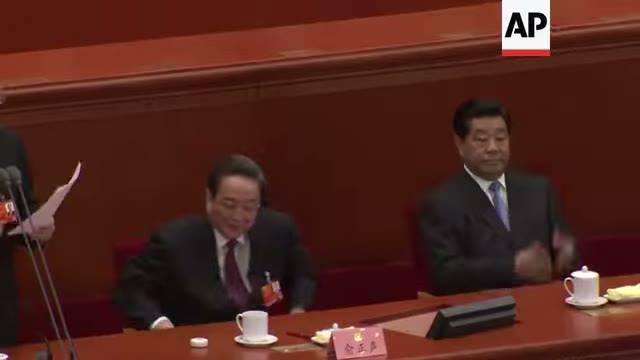
《全国政协选出新一届主席和常委会,贾庆林连任主席》(AP)|2008年影像|原声:英语报道CPPCC elects Jia Qinglin as chairman for a second term (AP) | footage 2008 | Audio: English