
Guo Boxiong (1942– )
Guo Boxiong, born in Liquan, Shaanxi, in July 1942, worked at Factory No. 408 in Xingping from 1958, enlisted in 1961 and joined the Party in March 1963, rising from soldier to chief of staff of the 55th Division of the 19th Army and serving in turn as the army's chief of staff, deputy chief of staff of the Lanzhou Military Region, commander of the 47th Group Army, deputy commander of the Beijing Military Region and commander of the Lanzhou Military Region. In September 1999 the Fourth Plenum of the 15th Central Committee added him to the Central Military Commission (CMC) and he was promoted to general and made executive deputy chief of the General Staff — the entry this page indexes under 1999, with a correction stated plainly: he did not become a vice chairman in 1999. Only on 15 November 2002 did he enter the Politburo and become a vice chairman of the Party CMC, adding the state CMC vice chairmanship on 16 March 2003 and holding the Party post until 15 November 2012; alongside Xu Caihou he was one of the two highest serving officers under CMC chairmen Jiang Zemin and Hu Jintao, running the commission's daily work for a decade. This file runs on two lines. The institutional-tenure line: his vice-chairman decade overlapped the consolidation of the post-1999 persecution of Falun Gong and the expansion of China's transplant industry, in which the military hospitals of the General Logistics Department system formed the heaviest bloc — Kilgour, Matas and Gutmann's 2016 update recorded the No. 309 Hospital transplant centre's self-reported income rising from RMB 30 million in 2006 to RMB 230 million in 2010, and paragraph 69 of the London China Tribunal's 2019 judgment named the militarisation of medical services and the many military and police hospitals in transplantation as organisational evidence for its finding of forced organ harvesting. Attribution is held in three tiers throughout: the suppression decision was Jiang Zemin's, executed through the '610' system by public security and the political-legal apparatus, not the PLA; no public document names Guo as ordering organ harvesting or the persecution of Falun Gong practitioners; this page records institutional-tenure responsibility and his decade of silence, and goes not one step beyond the evidence. The personal line is backed by a judgment: he used the vice chairman's post to obtain benefits for others in promotions and reassignments and took bribes in especially huge amounts personally, jointly and through his family. His son Guo Zhenggang's investigation was announced on 2 March 2015; Guo himself was placed under investigation by the CMC discipline commission, with Politburo approval, on 9 April 2015, expelled from the Party and transferred to military prosecutors on 30 July 2015; the procuratorate completed its investigation on 5 April 2016, the military court docketed the case on 3 May, and on 25 July 2016 it sentenced him to life imprisonment for bribery, with deprivation of political rights for life, deprivation of his rank of general and confiscation of all personal property; the specific bribe total has never been officially published. Sanctions: none found — his name appears on no US, EU, UK or Canadian public sanctions list, and he has never been pursued in any court over persecution or transplantation. Status: serving his life sentence; his prison and his health are matters of no public record, and claims such as confinement in Qincheng are unverified.
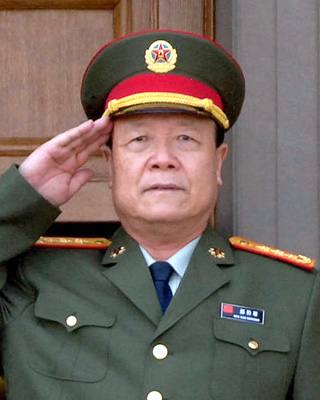
1. A Shaanxi Worker's Son, Forty Years to a Military Region Command (1942–1999)
Guo Boxiong was born in July 1942 in Liquan County, Shaanxi. His is the résumé of a farm-country boy from the Shaanxi–Gansu borderland: in 1958, aged sixteen and just out of middle school, he went to work at Factory No. 408 in Xingping — a military plant, so his connection with the armed forces began on a production line. He enlisted in 1961 and joined the Party in March 1963, and for the next two decades he never left the PLA's northwestern ground forces: the 55th Division of the 19th Army, from soldier, deputy squad leader and squad leader up through platoon, company, battalion and regiment, until by 1981 he was the division's chief of staff. From September 1981 to July 1983 he studied at the PLA Military Academy — the only formal schooling on his record — then returned as chief of staff of the 19th Army; in the great retrenchment and reorganisation of 1985 under Deng Xiaoping he rose to deputy chief of staff of the Lanzhou Military Region, a post he held for five years.
From 1990 the rungs came faster: three years commanding the 47th Group Army, deputy commander of the Beijing Military Region from 1993, and in 1997 commander of the Lanzhou Military Region — a military-region command in full, one step below the summit. The résumé carries no combat laurels and no foreign training; it was built entirely out of seniority and alignment, with more than a decade of his career rooted in the Lanzhou command and the northwest army system as his lifelong base. To understand his later position, hold on to that base: he was neither a technocrat nor a political-work cadre, but a field-army officer who had climbed from the ranks, and when Jiang Zemin brought him into the CMC in 1999 his seniority, his network and his northwestern foundation were all in place. As for the "Jiang Zemin confidant" label, this page archives it at the tier of commentary: the checkable hard facts are that his breakthrough promotion of 1999 came while Jiang chaired the CMC, that every key appointment of his career fell within the Jiang and Hu years, and that researchers and media consistently paired him with Xu Caihou as Jiang's proxies in the military. Turning a career overlap into proven personal loyalty exceeds the public evidence and is not adopted here; the characterisation and the overlap are both recorded as found.
2. How This Page Attributes Responsibility: Three Tiers, and Three Corrections
Two opposite errors are easy to make with Guo Boxiong. The first is to write everything the military system did after 1999 — the transplant expansion of the army hospitals, the military's accompaniment of the persecution era — as the personal orders of one man. The second is the mirror image: because no order bearing his signature can be found, to write him up as a mere profiteer who sold offices and had nothing to do with the human-rights catastrophes of his era. Neither is an archive. His true position is in between: he was one of the two highest serving officers of that system for a decade, and what the system did on his watch belongs on his tenure's account; but which of those things he personally ordered requires a document before it can be asserted.
This page therefore works in three tiers. Tier one, personally documented: matters backed by a judgment, an official notification, or a public text of his own activity — and at its core there is exactly one: the sale of offices for bribes, as found by the military court. He used the vice chairman's post to obtain benefits for others in promotions and reassignments, and accepted bribes directly, jointly with others, and through his family; he confessed during the procuratorate's investigation, pleaded guilty at trial, and did not appeal. That tier is iron. Tier two, institutional tenure: the conduct of the CMC and the four general departments during his years as a CMC member and vice chairman — the systemic corruption of the promotion system, the corruption cases of the General Logistics Department system (Gu Junshan's case among them), the scaling-up of transplant business in military hospitals, and the transplant participation of the military medical system as established by independent investigators and the China Tribunal. The wording for this tier is always "during his tenure" and "the military system while he was a vice chairman," never "he ordered." Tier three, same era, different system: matters whose decision and execution both lay outside the PLA chain of command — Jiang Zemin's personal decision to suppress Falun Gong, the Central "610 Office" created on 10 June 1999, the arrests and labour-camp sentences executed by public security and the political-legal system, and the civilian transplant system supervised by the health authorities. Each is labelled with its true decision-makers and executors; they form the era's background to his tenure, and the bill must not be charged to the wrong name.
Three widely circulated claims are corrected first. First, "Guo was CMC vice chairman from 1999 to 2012" — wrong by three years: in September 1999 he became a CMC member; the vice chairmanship ran from 15 November 2002 to 15 November 2012 in the Party commission and from 16 March 2003 to 14 March 2013 in the state commission, and this page uses those dates throughout, with the index year 1999 marking his entry into the CMC. Second, "Guo took RMB 80 million in bribes" — or any other specific figure: baseless. The military procuratorate and the military court said only that the amount was "especially huge" or "extremely huge"; the exact sum has never been published, the figures circulating overseas have no reliable source, and this page adopts none of them. Third, "Guo ordered the harvesting of Falun Gong practitioners' organs" — supported by no public document: the strongest transplant evidence points to the participation of the military medical system as an institution, and to researchers' allegations about Jiang Zemin's decision-making role (graded in Section 6); no public material lands the order on Guo personally. This page adopts neither that claim nor its evasive opposite. Only with those three points fixed do the attributions below stand.
3. September 1999: The Month He Entered the Military Commission
September 1999 was the threshold month of Guo's life, and the source of this page's index year. Three things landed on him at once: the Fourth Plenum of the 15th Central Committee added him to the Central Military Commission; the NPC Standing Committee appointed him to the state Central Military Commission; and he was promoted to general — the PLA's highest serving rank. At the same time his post became executive deputy chief of the General Staff, first deputy to the chief of the general staff, placing him inside the core of the whole army's daily operations. The step from Lanzhou Military Region commander to CMC member crossed the line between a theatre command and the supreme headquarters.
That timing has to be set beside another line from the same summer before his place at the top can be judged. On 25 April 1999 Falun Gong practitioners petitioned in Beijing in their thousands; Jiang Zemin wrote to the Politburo that night setting the line. On 10 June 1999 the Central "610 Office," built specifically to run the suppression, was created. On 20 July nationwide arrests began, and on 22 July Falun Gong was formally banned. In other words, when Guo entered the CMC the suppression had already been launched for two months and the decision was already complete — his name is on neither the decision-makers' list nor the executing system's roster. He was put into the top of the army after the persecution machine had started. For the following thirteen years, most of that machine's running time overlaps his years on the commission: he was not the man who lit the fire, but he was the man in charge of the army's house while it burned next door — and that house, it later emerged, was doing the largest business of all in transplants. That measure, exactly, is this page's whole characterisation of his relation to 1999: no more, and no less.
4. Ten Years as Vice Chairman: The Highest Serving Officer Under Two Chairmen (2002–2012)
In November 2002 came the 16th Party Congress. On 15 November the First Plenum of the 16th Central Committee made Guo a Politburo member and a vice chairman of the Party's Central Military Commission. On 16 March 2003 the First Session of the 10th National People's Congress made him a vice chairman of the state commission. Two rosters, one chair: the CMC vice chairmanship is the highest substantive post a serving Chinese officer can hold; the chairman is the Party's general secretary, and the commission's daily work rests on the vice chairmen's shoulders. Guo served alongside Cao Gangchuan and later Xu Caihou; after Jiang Zemin gave up the Party CMC chairmanship in September 2004 and Hu Jintao succeeded him, Guo and Xu became the effective managers under Hu's nominal chairmanship, and they served out a second full term — re-elected to the Politburo and the Party CMC in October 2007, re-appointed to the state CMC in March 2008 — until Guo stepped down from his Party posts on 15 November 2012 and his state term expired in March 2013.
The personal activities his decade left in the public record are mostly military diplomacy and inspections. In July 2006 he visited the Pentagon and met Defense Secretary Donald Rumsfeld — then the highest-level Chinese military visit to the United States in more than five years. On 5 November 2007 he received Defense Secretary Robert Gates in Beijing; the US Department of Defense photograph of that meeting is his most widely circulated compliant public image (see the image note in this page's metadata). Such activities are archived at the personal tier: they establish that in the Hu years he was one of the Chinese military's highest faces to the outside world, and nothing more. Across the decade he gave almost no interviews and published almost no theoretical writing in his own name; like his colleague Xu Caihou, his power was exercised in meeting rooms, not in texts. That trait later made external accountability hard to attach to him personally, as Section 11 records.
One other face of the decade must be entered: personnel. A CMC vice chairman wields decisive influence over the promotions and assignments of the army's senior generals — and that is precisely the channel his court conviction later established as criminal: obtaining benefits for others in promotions and reassignments in exchange for bribes. In other words, the act of his that a court proved most fully was not operations, not equipment, but the sale of offices — who became a general and who received a lucrative post had become a priced commodity. His partner Xu Caihou, who ran political work and cadres, was the other half of the same business. The decade in which the two vice chairmen controlled personnel is described in the Party's own later anti-corruption narrative as the PLA's most corrupt period; that a deputy director of the General Logistics Department such as Gu Junshan could loot the logistics system for years, surviving repeated reports, was a product of that personnel umbrella — with the attribution for that point set out in Section 8.
5. The System Beneath Him: Four General Departments, the Logistics Department and the Military Hospital Network
To grasp the institutional-tenure tier, first see what sat beneath his chair. Before the 2016 reforms, the PLA's architecture ran: the CMC; beneath it the General Staff, General Political, General Logistics and General Armament Departments; beneath them the seven military regions, the navy, air force and Second Artillery, and the academies and hospitals of each service. The General Logistics Department (GLD) ran the army's logistics, including its health system: the PLA General Hospital (the 301 Hospital) and its clinical branches, the general hospitals of the seven military regions, the teaching hospitals of the three military medical universities, and the hospitals of each service — a medical network self-contained and separate from the civilian health system. Its administrative chain ran upward from the GLD's health organs through the GLD to the CMC. From 1999 to 2002 Guo was executive deputy chief of the General Staff, and from 2002 to 2012 a CMC vice chairman; throughout his years at the top, the military hospital network sat under the CMC leadership. That is institutional fact, not inference.
What that network did after 2000 can be checked against public figures. Military hospitals — above all their licensed transplant centres — saw an explosive growth of business in the 2000s. China then had no effective voluntary donation system, and the officially reported national total of roughly 10,000 transplants a year did not square with hospital-by-hospital accounting: that mismatch is the core finding of the 680-page 2016 updated report by Kilgour, Matas and Gutmann, who tallied the beds, staffing and self-reported volumes of more than 700 Chinese transplant institutions and estimated the real annual volume at between 60,000 and 100,000 operations. Military hospitals held a share of that business disproportionate to their size. The report records, hospital by hospital, that the No. 309 Hospital attached to the PLA General Hospital system (presented publicly as the PLA General Hospital's Second Affiliated Hospital) stated its transplant centre's income had grown nearly eightfold in five years; that transplant-related revenue at Daping Hospital of the Third Military Medical University in Chongqing rose from RMB 36 million in the late 1990s to nearly RMB 1 billion by 2009; and that Changzheng Hospital of the Second Military Medical University in Shanghai reported large numbers of "emergency liver transplants." Those figures come from the hospitals' own websites and annual-report-type materials, archived and cited by the researchers; Chinese officials have never answered them item by item, and this page archives them at the grade of "researchers' hospital-by-hospital tally, neither officially confirmed nor officially refuted in detail." Whatever final total is eventually adjudicated, the hospitals' own reported material suffices to prove one thing: during Guo Boxiong's decade as CMC vice chairman, the military medical system made organ transplantation into a pillar revenue business, while the only official account of organ sources for most of that period — executed prisoners — never added up against the volumes.
6. Military Hospitals and the Transplant System: Exactly How Far the Evidence Goes
This section lays the evidence out by grade, skipping no step. Grade one, official admission: Chinese health officials publicly acknowledged that transplant organs had long come mainly from executed prisoners — an admission on the record in statements by Vice Minister of Health Huang Jiefu and others; in 2015 the authorities announced that the use of death-row organs had ended and the system had moved to voluntary donation. Grade two, independent research: the first Kilgour–Matas report of 2006, their 2009 book Bloody Harvest, Gutmann's 2014 The Slaughter, and the three men's joint 2016 update — whose method was to work backward from hospital beds, surgical teams, training scale and self-reported volumes to totals, supplemented by recorded investigative calls to hospital personnel; whose conclusion was that real transplant volumes far exceeded official figures, that the gap could not be explained by death-row prisoners and voluntary donors, and that Falun Gong practitioners were, in their assessment, the principal source of organs. Grade three, quasi-judicial finding: in 2018–2019 the London-based independent people's tribunal known as the China Tribunal, chaired by Sir Geoffrey Nice KC, who had prosecuted Slobodan Milošević at The Hague, held five days of public hearings and heard more than fifty witnesses; its unanimous final judgment of June 2019 found that forced organ harvesting had been committed for years throughout China on a significant scale, over a period of at least twenty years, and continued; that Falun Gong practitioners had been one source of organs and probably the main source; and that crimes against humanity had been committed against Falun Gong and Uyghurs (a genocide finding was not made, on its evidential standard). Paragraph 69 of the judgment addresses the army directly in substance: the militarisation of medical services, and the large number of military and police hospitals involved in transplantation operating under a "do as you are told, or else" discipline, supported the conclusion that the country's organisational structure, including the military, backed the expansion of transplantation. Two qualifications belong in the same paragraph of this page: the China Tribunal is a non-governmental people's tribunal with no legal jurisdiction in any domestic or international court, and the Chinese government rejects the forced-harvesting allegations outright. This page cites it at the grade of "independent tribunal finding, not an official court judgment," and does not dress it up as an international court ruling.
Grade four, single-source allegations aimed at the military's decision level, must be labelled separately. The World Organization to Investigate the Persecution of Falun Gong (WOIPFG) published a recording of a 30 September 2014 telephone call in which Bai Shuzhong, former head of the health department of the PLA General Logistics Department, is said to state that the order to harvest organs from Falun Gong practitioners came from Jiang Zemin. That recording has a single organisational source and has not been independently authenticated; this page marks it unverified and registers only its existence and its target — which, even on its own terms, is Jiang Zemin, not Guo Boxiong. With all four grades laid out, the conclusion that can land on Guo is only this. First: his decade as CMC vice chairman overlaps broadly with the expansion of transplant business in military hospitals and with the peak period of the forced harvesting found by the China Tribunal, and the military medical system sat under CMC leadership — institutional-tenure responsibility stands. Second: no public evidence shows him personally ordering, approving or knowing of specific harvesting acts, and this page makes no such assertion. Third: no public evidence shows him correcting, investigating or even publicly addressing the organ-source question of his own hospital system at any point in his tenure — a man who directed the armed forces for a decade kept a decade of silence about the most internationally charged business of the hospitals beneath him, and that silence is entered in the file as it stands, without embellishment.
7. The Army in the Persecution Era: The Role the PLA Actually Played
To state the PLA's place in the post-1999 persecution accurately, what was not its work must first be stripped away. The suppression of Falun Gong ran on this chain: Jiang Zemin decided it personally; the Central Leading Group for Handling the Falun Gong Issue and its "610 Office" coordinated it, with political-legal figures such as Li Lanqing and Luo Gan executing; and public security, state security, the procuratorate, the courts, re-education-through-labour camps and prisons did the arresting and holding. In the years that followed, the suppression in Xinjiang and the arrests of rights defenders likewise fell mainly to public security, the People's Armed Police and the political-legal system. The Armed Police is a separate armed-force sequence from the PLA (nominally under the CMC, operationally commanded through its own system); booking Armed Police suppression actions to a PLA vice chairman would be the same accounting error in another uniform. Within the sources searched for this page, no instruction, speech or article on suppressing Falun Gong in Guo Boxiong's personal name was found — he was not a commander of that line, and that fact is nailed down first.
But the PLA did not stand outside its era; it had three checkable institutional roles. The first is transplantation, as set out above: the military hospital system was the most highly organised and most secretive bloc in the transplant industry, and secrecy and obedience are the army system's defining attributes — which is why the China Tribunal singled out "militarisation" as a head of evidence. The second is internal purge and accompaniment: after the 1999 ban, service members who practised Falun Gong were discharged and dealt with, and the army's propaganda system took part throughout in the anti-Falun Gong campaign. Scattered public reporting supports the existence of this role, but case files at scale are far less complete than for the public-security system, and this page records only the institutional role and the limits of the material, inventing no cases. The third is the grey zone of logistics and detention: researchers and WOIPFG allege that the General Logistics Department system played a core operational role in organ allocation and detention facilities; the evidence for those allegations is chiefly recordings and inference, a grade below the hospital-by-hospital volume tallies, and this page marks it at the tier of researchers' allegations, not findings. With the three roles laid out, his position is clear: he was neither the persecution's decision-maker nor its political-legal executor, but the most profitable and most secretive medical line of the persecution era grew for ten years inside the military system he directed. That line, and that line alone, is this page's whole reason for filing him here under the index year 1999.
8. A System for Selling Offices: Military Corruption in His Tenure, Seen Through the Gu Junshan Case
His personal crime cannot be viewed in isolation, because selling offices is never a one-man business. One specimen suffices. Gu Junshan became a deputy director of the General Logistics Department in December 2009, in charge of the whole army's infrastructure, barracks and land — at a time when military real estate and land disposal were the largest rent-seeking opening in the system. Caixin's January 2014 series exposed the "general's mansion" he had built on expropriated land in his home town of Puyang, Henan, and the golden Buddha statues, fine liquor and multiple properties seized from his home. He had been removed in 2012 and investigated, after years of reports that went nowhere, and was only formally pursued once Xi Jinping's military anti-corruption drive began. On 10 August 2015 a military court convicted him on five counts — embezzlement, accepting bribes, misappropriating public funds, offering bribes and abuse of power — and sentenced him to death with a two-year reprieve, stripping his rank of lieutenant general. Gu's promotion and protection had occurred under the CMC of Guo and Xu: a GLD deputy directorship is appointed through the CMC, and a general who survives years of reports in a lucrative post does so because the top of the personnel chain does nothing — or shelters him. For Xu Caihou, an official notification expressly found that he accepted bribes to assist Gu Junshan's promotion, and that finding is on the official record; for Guo, no official text of the same grade naming a personal link to Gu was found in the sources searched, so this page books the matter at the tenure and system tier and does not write it as Guo personally sheltering Gu.
Above Gu stood the two vice chairmen themselves. Xu Caihou was investigated in March 2014 and died of bladder cancer on 15 March 2015; the military procuratorate declined to prosecute him and confiscated his illicit gains — he never lived to see a verdict. Guo's court finding is far more complete: the military court found that he used his post to obtain benefits for others in promotions, reassignments and the like, and accepted bribes personally, jointly with others, and through his family, in especially huge amounts and in especially serious circumstances; all illicit money and property was recovered. He confessed the bribery facts during the military procuratorate's investigation, pleaded guilty at trial and said he would not appeal. The sale of offices is therefore not an outsider's surmise but a fact he admitted with his own mouth and a court adjudged. One detail deserves its place in the file: the official notifications never published his bribery total. How many offices a vice chairman who controlled the army's personnel for a decade sold, and for how much, remains part of a state secret — the regime that accused him chose to publish a characterisation and not a number, and this page records that blank as found, filling it for neither side.
9. The Fall: From His Son's Arrest to Expulsion from the Party (2015)
His fall began with his son. Guo Zhenggang, a deputy political commissar of the Zhejiang provincial military district, had been promoted to major general only in January 2015. In February 2015 he was taken away for investigation; on 2 March the military published a list of fourteen senior officers under investigation, and his name was on it, while his wife Wu Fangfang was also investigated over a real-estate project. Reuters reported at the time, citing two sources, that Guo Boxiong himself was also under investigation and that the son's fall was a signal to the father. Rumours in overseas Chinese-language media that Guo himself was being investigated had circulated for months before. On 5 March, General Liu Yuan, the military's leading anti-corruption figure, answered a reporter's question about the Guo case with a single phrase — "you know" — which was widely carried in the press. This page archives that moment at the tier of press record: a weather vane, not a document.
The document followed. With the Politburo's approval, on 9 April 2015 the Commission for Discipline Inspection of the Central Military Commission opened an investigation into Guo Boxiong. On 30 July 2015 a Politburo meeting considered and adopted the military discipline commission's review report, decided to expel Guo Boxiong from the Communist Party, and transferred his suspected bribery offences and leads to the military procuratorate for handling according to law. Xinhua's notification that night stated that Guo had used his post to obtain benefits for others in promotions and the like, and had accepted bribes directly or through his family, seriously violating Party discipline and being suspected of the crime of bribery, in serious circumstances and with a malign influence. He was the fourth member of the 17th Central Committee's Politburo to be expelled, after Bo Xilai, Zhou Yongkang and Xu Caihou; in rank and post he was the highest-ranking military officer to fall in Xi Jinping's anti-corruption campaign, and the highest-ranking general pursued in decades. Between the opening of his case on 9 April and his expulsion on 30 July his name vanished from public view for nearly four months — a retired vice chairman of three years' standing, dragged down first by his son and then finished off by a document.
10. A Closed Trial and a Life Sentence (2016)
The judicial process moved quietly. On 5 April 2016 the military procuratorate announced that investigation of Guo's suspected bribery case was complete and the case had been transferred for prosecution; Guo had confessed the bribery facts, and the sums involved were "extremely huge." On 3 May 2016 the military court formally docketed the case. On 25 July 2016 Xinhua reported that the military court had delivered its first-instance judgment: finding the amount of his bribes especially huge and the circumstances of his crime especially serious, and crediting his truthful confession after being brought in, his admission of guilt and remorse, and the full recovery of the illicit money and property, the court sentenced Guo Boxiong to life imprisonment, deprivation of political rights for life, and confiscation of all personal property, with the illicit gains turned over to the state treasury; his rank of general was also stripped. Guo stated in court that he accepted the judgment and would not appeal. The trial was closed because military secrets were involved; the official notification published neither the date and place of the hearing nor the specific amount of the bribes — three blanks that Caixin, Reuters and the Associated Press all noted in their reporting.
The verdict's weight is visible only in sequence. Xu Caihou died before trial; Zhou Yongkang and Bo Xilai were civilian Politburo figures; Guo Boxiong was the first former CMC vice chairman to pass through the full process of investigation, prosecution and trial and be sentenced to life imprisonment, and the highest-ranking officer sentenced in the anti-corruption campaign Xi Jinping launched at the end of 2012. The People's Daily's commentary that day framed the case as a demonstration of Party control of the army and of governing the military by law. This page pins the other face to the same sheet: the trial was about money, not human rights. The transplant expansion of the army hospitals of his decade, and the military system's role in the persecution era, appear nowhere in the indictment; the trial was closed on military-secrets grounds, the amount undisclosed, the transcript unpublished. For the archive, the judgment proves his personal crime of selling offices, and at the same time proves the boundary of the accountability: the regime settled only his debt of loyalty and cleanliness to the system, and not what the system did to ordinary people in those years. Both sentences must stand together; either one alone is incomplete.
11. Sanctions: None Found — A Man Sentenced to Life at Home and on No International List
The sanctions column begins with the search path, stated in the open: for this page we searched the US Treasury OFAC Specially Designated Nationals list and State Department designation releases, the European Union's financial-sanctions database, the United Kingdom sanctions list and Canada's Consolidated Autonomous Sanctions List, cross-checked against consolidated sanctions databases. The result is none found — Guo Boxiong's name appears on no public government sanctions list. As to judicial pursuit: apart from the Chinese military court's bribery judgment, no prosecution or proceeding in any other jurisdiction is on public record. As to international human-rights accountability: none — no international tribunal, foreign court or sanctions mechanism has ever opened a proceeding against him personally over the persecution of Falun Gong, forced organ harvesting, or his CMC tenure.
The result gains its meaning only in juxtaposition. Among the men who fell in his period, Zhou Yongkang and Bo Xilai likewise appear on no international sanctions list; while after 2019 the United States, under the Global Magnitsky Act and other instruments, designated a series of officials and entities on the Xinjiang and Hong Kong files — the logic of those lists being to select targets by issue and by present sanctionability. A retired general already serving life in a Chinese prison offers a designation neither an asset-freezing handle nor a behavioural deterrent. The deeper reason is stated here as fact, not conjecture: his personal file is exceptionally thin — no signed human-rights directive in public, no quotable intemperate remark for foreign media, and evidence chains on transplantation and persecution that stop at the institutional tier and at the decision tier (Jiang Zemin, the "610" system, the health system), while the only hard evidence filed under his own name is a bribery judgment. When wrongdoing operates in an institution's name, the person dissolves in the lens of external accountability — a sentence that fits him more exactly than any civilian censorship official, because the military system's secrecy is stronger than any civilian system's. He was, in the end, held to account — but by the system he had served all his life, on a charge of disloyalty and uncleanliness toward that system; for the victims outside the system, no document anywhere has ever mentioned his name. This page archives that state of affairs as found.
12. Status Verification (as of November 2026) and Unverified Items
His current status was verified by the following path. First, the last official information about Guo Boxiong in the public record is the military court's verdict notification of 25 July 2016; in the ten years since, Xinhua and the military media have published nothing further about him. Second, searches of his name together with imprisonment, prison, health and death in Chinese and English returned no reporting by Reuters, the Associated Press, the South China Morning Post, Caixin or any comparable reliable outlet of a release, death, medical parole or sentence reduction. Third, his age is arithmetic: born in July 1942, he turned eighty-four in July 2026. On this basis this page confirms: as of November 2026 Guo Boxiong remains serving his life sentence, with no public record of any change in the status of his punishment; the specific prison in which he is held: no public record; his health: no public record.
Unverified items are gathered here rather than scattered through the text as conclusions. One, place of imprisonment: overseas Chinese-language self-media and some reporting claim he is held in Beijing's Qincheng Prison — Qincheng is indeed the famous prison for senior officials, but for Guo personally this page found no official or reliable-media source confirming it; marked unverified. Two, health: in January 2002 the South China Morning Post, citing sources, reported that he was in hospital being treated for prostate cancer — that report predates his vice chairmanship by the better part of a year and is now more than two decades old; it can prove neither the condition then nor, still less, his condition today, and the periodic rumours since of illness or critical condition have no reliable source; all marked unverified. Three, the bribery total: multiple figures circulate, the authorities have never published one, and none is adopted (see Section 2). Four, reports that his younger brother Guo Boquan was investigated in March 2015: Guo Boquan was then head of the Shaanxi provincial civil affairs department, and media reports of his being taken for investigation in 2015 do exist, but no public conclusion to the matter was found; this page records only that the reports exist and that the outcome is unverified. Five, his enlistment year: the official biography gives 1961, while some English-language materials give 1960; this page follows the official biography's 1961 and registers the discrepancy here. Six, his son Guo Zhenggang's rank: the military's 2 March 2015 list and reporting of his posts support major general, while some English materials render the rank as rear admiral, a difference of translation convention; this page uses major general. Each of the six items will be revised if new archival material becomes public.
13. Verification and Sources
This page's biographical and career facts were cross-checked across multiple sources, principally: Xinhua's official English biography as carried by CNTV (born 1942 in Liquan, Shaanxi; joined the Party in March 1963; began work in 1958; joined the PLA in 1961; PLA Military Academy graduate; worker at Factory No. 408, 1958–1961; service in the 55th Division of the 19th Army rising to divisional chief of staff, 1981–1982; study at the PLA Military Academy, September 1981–July 1983; chief of staff of the 19th Army, 1983–1985; deputy chief of staff of the Lanzhou Military Region, 1985–1990; commander of the 47th Group Army, 1990–1993; deputy commander of the Beijing Military Region, 1993–1997; commander of the Lanzhou Military Region, 1997–1999; CMC member, state CMC member and executive deputy chief of the General Staff, 1999–2002, added at the Fourth Plenum of the 15th Central Committee and appointed by the NPC Standing Committee; Politburo member, Party CMC vice chairman and state CMC member from 2002); the Chinese and English Wikipedia entries for Guo Boxiong (Party CMC vice chairmanship 15 November 2002–15 November 2012; state CMC vice chairmanship 16 March 2003–14 March 2013; rank of general conferred 1999, deprived 2016; expulsion from the Party on 30 July 2015; life sentence on 25 July 2016; spouse He Xiulian; son Guo Zhenggang and daughter Guo Yonghong; younger brother Guo Boquan); and National People's Congress communiqués (the 16 March 2003 decision of the First Session of the 10th NPC appointing Hu Jintao, Guo Boxiong and Cao Gangchuan vice chairmen of the state CMC; the March 2008 reappointment of Guo Boxiong and Xu Caihou by the 11th NPC). For the fall and trial: Reuters, 2–3 March 2015 (Guo Zhenggang's investigation announced on 2 March, his recent promotion to major general, and two sources confirming Guo Boxiong himself was under investigation); the Xinhua and Central Commission for Discipline Inspection notification of 30 July 2015 (case opened on 9 April by the CMC discipline commission with Politburo approval; the 30 July Politburo decision expelling him from the Party and transferring him to the military procuratorate; the charge of using his post to obtain promotion benefits for others and accepting bribes directly or through his family); the Associated Press, 31 July 2015 (the expulsion, the office-selling charge, and the background of Xu Caihou's death); Xinhua via People's Daily Online, 5 April 2016 (the military procuratorate's completion of the investigation, transfer for prosecution, Guo's confession, and the "extremely huge" sums) and 25–26 July 2016 (the military court's findings of promotion-and-reassignment favours and huge bribes taken personally and jointly, the guilty plea and decision not to appeal, the closed trial on military-secrets grounds, the 3 May docketing, deprivation of political rights for life, deprivation of rank, and confiscation of all personal property); Caixin Global, 26 July 2016 (the highest-ranking military official to fall in Xi's campaign, aged 74, the time and place of trial unpublished); and the Hoover Institution's 2015 analysis of the Guo case (the 30 July expulsion, the "personally and through his family" bribery formulation, and the juxtaposition with Xu Caihou). For the corruption system: Caixin's January 2014 Gu Junshan series and its in-depth report of 21 August 2015, and Xinhua's report of 10 August 2015 of Gu Junshan's suspended death sentence (deputy director of the General Logistics Department; five counts of embezzlement, bribery, misappropriation of public funds, bribery-giving and abuse of power; death sentence with two-year reprieve; rank of lieutenant general stripped). For transplantation and the military medical system: the China Tribunal's final judgment and summary of June 2019 (chaired by Sir Geoffrey Nice; five days of hearings and more than fifty witnesses; the findings of large-scale forced organ harvesting sustained over at least twenty years with Falun Gong practitioners as probably the main source; the crimes-against-humanity finding and the absence of a genocide finding; paragraph 69 on the militarisation of medical services and military and police hospital participation; and the tribunal's own statement that it is a people's tribunal without jurisdiction); Kilgour, Matas and Gutmann, Bloody Harvest/The Slaughter: An Update, 22 June 2016 (the hospital-by-hospital tally of more than 700 transplant institutions; the estimate of 60,000–100,000 transplants a year; the No. 309 Hospital transplant centre's self-reported income growth from RMB 30 million in 2006 to RMB 230 million in 2010; the Daping Hospital revenue growth; and the Changzheng Hospital emergency liver transplant records); and the Victims of Communism Memorial Foundation's analysis of the China Tribunal judgment (the 17 June 2019 judgment's main points and its inferential logic). For the persecution decision: Falun Dafa Information Center materials and US Congressional-Executive Commission on China records (the creation of the "610 Office" on 10 June 1999, the arrests of 20 July, the ban of 22 July, and the consistent journalistic record of Jiang Zemin as the supreme decision-maker). For sanctions: the US Treasury OFAC Specially Designated Nationals list, State Department releases, the EU financial sanctions database, the UK Sanctions List and Canada's Consolidated Autonomous Sanctions List were all searched with no listing found, cross-checked against consolidated sanctions databases. For the image: Wikimedia Commons, "Gates meets guo.jpg" — Guo Boxiong meeting US Defense Secretary Robert Gates in Beijing on 5 November 2007, photographed by a US Department of Defense employee in the course of official duties, public domain, and compliant for use; the Associated Press photograph of 9 March 2012 is an agency-copyright image and is not usable.
Corrections made to the brief's original material, after checking: One, the brief gave his CMC vice chairmanship as 1999–2012; checking shows that in September 1999 he became a CMC member and executive deputy chief of the General Staff and was promoted to general, while the vice chairmanship ran from 15 November 2002 to 15 November 2012 (Party) and 16 March 2003 to 14 March 2013 (state); the body of this page is written on the corrected dates, and the index year 1999 and sort date of September 1999 are retained with their meaning corrected to his entry into the CMC. Two, the brief's account of the 2015 investigation and expulsion and the life sentence of 25 July 2016 was verified against Xinhua, Reuters, the Associated Press and Caixin without discrepancy; the nodes of 9 April 2015 (case opened), 5 April 2016 (investigation completed) and 3 May 2016 (case docketed) are public-record additions by this page. Three, international sanctions were searched and none found, and the text says so plainly, with no suggestive phrasing. Four, the transplantation material is kept strictly to its evidential grades: the China Tribunal's judgment and the three researchers' update establish and tally the institutional participation of the military medical system, and no public material names Guo Boxiong as personally giving an order; the body is written at the institutional-tenure tier, and WOIPFG's single-source claim about the Bai Shuzhong telephone recording is marked unverified, with its target noted as Jiang Zemin rather than Guo. Five, the bribery amount has never been officially published, and this page adopts no circulating figure. Six, his place of imprisonment and health have no reliable public record; the metadata and Section 12 both say "no public record," and the Qincheng claim and illness rumours are gathered and marked unverified in Section 12. Seven, the enlistment year appears as both 1960 and 1961 in the materials; this page follows Xinhua's official biography (1961) and registers the discrepancy. This page will be revised as new archival material becomes public.
Contact: endccpworld@proton.me