
Dong Jun (1961– )
Dong Jun, born in Yantai, Shandong, in October 1961, entered the Dalian Naval Academy in 1978 and is a PLA Navy admiral: director of the Naval Command's Military Training Department, deputy chief of staff of the North Sea Fleet, deputy commander of the East Sea Fleet, deputy chief of staff of the Navy, deputy commander of the Southern Theater Command, and deputy commander of the Navy. Named the Navy's ninth commander in August 2021 and promoted to admiral on 6 September 2021, he presided institutionally over the launch of the carrier Fujian on 17 June 2022. Hu Zhongming succeeded him as Navy commander on 25 December 2023, and on 29 December 2023 the seventh session of the Standing Committee of the 14th NPC appointed him Minister of National Defense — the fourteenth holder of the office and the first from the Navy — succeeding Li Shangfu, removed on 24 October 2023. This page writes only the verifiable official chain and fixes three points first. First, the boundary of the office: China's defence minister holds no operational command; command rests with the Central Military Commission, and Dong's layer of responsibility is military-diplomacy representation and public statement, not battlefield command. Second, the two missing chairs: every defence minister since 1993 has concurrently been a state councillor, and every defence minister under Xi Jinping a CMC member; Dong is neither, and was never added through November 2026 — a fact verifiable from public rosters. Third, the November 2024 report and its denials, registered side by side: on 27 November 2024 the Financial Times, citing current and former US officials, reported he was under investigation for corruption; Foreign Ministry spokesperson Mao Ning called it 'chasing shadows' the same day; the next day, 28 November, at the defence ministry's regular press conference, spokesman Wu Qian called the reports 'pure fabrication', said the rumour-mongers were ill-intentioned, and at the same conference announced Miao Hua's suspension for suspected serious disciplinary violations (the brief's 'Wu Qian denial on 27 November' misstates the date and the division of labour, and is corrected here). In April 2025 the Financial Times added that Dong had undergone an initial investigation but appeared cleared — equally single-sourced and unverified. The service chain never broke: the June 2024 Shangri-La speech warning that separatists would end up in self-destruction; a video call with Pete Hegseth in September 2025 and a meeting in Malaysia that October; the SCO defence ministers' meeting in April 2026; an official visit to Brunei on 28 July 2026 (published by Brunei's Ministry of Defence); a Beijing Xiangshan Forum address in September 2026; absence from the Cebu ADMM-Plus on 28 October 2026 (publicly explained by spokesman Zhang Xiaogang on 29 October as obstacles created by the Philippine chairmanship); and arrival in Rome on 16 November 2026 for talks with Defence Minister Guido Crosetto (European media relaying a defence-ministry statement). Early-November 2026 'taken away' claims by individual overseas self-media have no official or reliable-media source, conflict with the travel reporting, and are registered as unverified and not adopted. Sanctions, checked item by item: Dong Jun's name appears on none of the US OFAC, EU, UK or Canadian public lists; the man sanctioned by the US under CAATSA in 2018 is his predecessor Li Shangfu (with the Equipment Development Department), and that designation must not be transferred to Dong. Status conclusion: as of 17 November 2026 no official removal, case-filing or suspension document names him; he is in office.
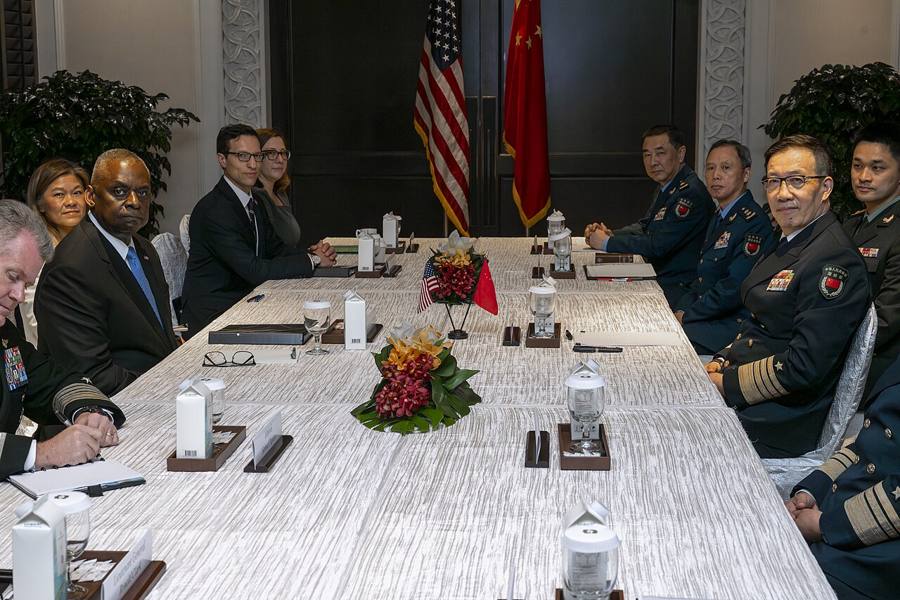
I. Method: the official chain only, report and denial side by side, four corrections first
This page follows the method this site set for Zhang Youxia: write only the verifiable official chain — appointment, tenure, officially reported activities and statements, each pinned to a date — and demote anything that rests on a single foreign-media line without an official document behind it, marking its source and tier, never writing it as fact. His case differs fundamentally from those of Zhang Youxia and Li Shangfu: those pages are built around official case-filing and punishment documents; Dong Jun has none — the most sensational item about him is precisely the one the authorities denied. The spine of this page is therefore two parallel chains: a complete, month-by-month record of service from Navy commander to defence minister, never interrupted; and the record of the forty-eight hours in November 2024 when a report and its denials collided head-on. Both chains are archived as they stand, with no adjudication between them. That is this page's discipline.
Four corrections are pinned down first. Correction one: the date and the division of labour of the denials. The tasking brief and many relays give "Wu Qian denied it on 27 November 2024"; checked, that is inaccurate. The timeline is: the Financial Times report was published on 27 November; the same day, Foreign Ministry spokesperson Mao Ning, answering questions at the Foreign Ministry's regular press conference, called the report "chasing shadows" — the first denial, from the Foreign Ministry. The next day, 28 November 2024 (a Thursday), at the Ministry of National Defense's regular press conference, spokesman Wu Qian called the reports that Dong was under investigation "pure fabrication" and said the rumour-mongers were ill-intentioned — the second denial, from the defence ministry, delivered at the same press conference that announced Miao Hua's suspension. English renderings of Wu's words appear as "pure fabrication" (AFP, Radio Free Asia) and "sheer fabrication" (Reuters); the Chinese formulation is 纯属捏造. Conflating the two denials into one person on one day is the most common displacement in the circulation of this story; this page records two days, two spokespeople, two press conferences.
Correction two: the timing of the Navy command. Public accounts give both August and September 2021: he was named commander of the Navy in August 2021, and on 6 September 2021, at the CMC ceremony promoting officers to admiral, he appeared publicly as Navy commander and was promoted to admiral. This page records appointment in August, public presentation in September, tenure ending in December 2023, with Hu Zhongming succeeding him at a promotion ceremony on 25 December 2023 (the English Wikipedia list of Navy commanders gives 26 December; this page records late December and registers the discrepancy). Correction three: rank and service. He is a naval admiral, not an army general; he is the first defence minister from the Navy — all thirteen predecessors came from the ground forces — as news agencies and the US Naval War College's China Maritime Studies Institute brief of 30 December 2023 consistently confirm. Correction four: the November 2026 "taken away" claim. It originates with a handful of overseas Chinese-language self-media outlets and tabloids, argued from his absence at the Cebu ADMM-Plus of 28 October and from his not appearing at meetings during the Russian defence minister's visit to Beijing; but the Cebu absence has a formal explanation on record from defence ministry spokesman Zhang Xiaogang on 29 October (attributed to the Philippine chairmanship's arrangements), and a report of his travelling to Italy followed on 16 November. This page registers the claim in the unverified column of section XI; it is not written into the career record and is not used for the status conclusion.
The tiering follows this site's people-section practice. Tier one, the personally verifiable layer: official appointment documents, officially reported public activities, and statements he made in office. Tier two, the institution-and-tenure layer: the Navy's expansion milestones during his command and the defence ministry's external agenda during his ministership — always written as "during his tenure" and "the institution", never upgraded to personal orders. Tier three, the reporting and analysis layer: the Financial Times' and Reuters' reports citing anonymous officials, and analyses of his appointment's significance by bodies such as the US Naval War College, each with its source named and single-source items marked unverified. This page has no fourth tier: with no official punishment document, no punishment is written; with no sanctions-list entry, each list is recorded as checked and empty.
II. Yantai and the Dalian Naval Academy: the making of a naval officer (1961–2013)
Dong Jun was born in October 1961 in Yantai, Shandong. Across the Bohai Strait from the Liaodong Peninsula, Yantai is a principal port of the North Sea Fleet and a shipbuilding city. Of his family background there is no public record, and this page speculates about none. In 1978 he entered the Dalian Naval Academy, the most orthodox route of formation for a naval officer. The academy is the Navy's first undergraduate institution, training command officers for the surface fleet; successive Navy commanders have disproportionately come from it, and it is nicknamed within the service the Navy's cradle. He entered in 1978 and joined naval service on graduation. The public record of his first three decades of service is extremely spare: director of the Naval Command's Military Training Department, deputy chief of staff of the North Sea Fleet, commander of Unit 92269, and similar posts. Note the shape of that record — training, staff and headquarters billets predominate; there is no public record of his having commanded a ship, and the Naval War College brief likewise notes that no public information establishes his branch specialisation or whether he ever held a ship command. This page registers the blank as it stands: he is an admiral who rose rung by rung through staff and headquarters posts, not a surface-warfare commander who came up through a captain's bridge.
His promotion rhythm was conventional: rear admiral in July 2012, vice admiral in July 2018, admiral in September 2021. Nine years from rear admiral to admiral is a normal-to-brisk ladder for a peacetime naval officer, and every step had a corresponding post; none was an exceptional leap. From 2013 his posts begin to enter the verifiable public reporting sequence, and that year marks the turn from headquarters toward the fleets and the theater commands.
III. Fleets, theater command and naval headquarters: four steps to the command (2013–2021)
In 2013 Dong became deputy commander of the East Sea Fleet, whose area faces the East China Sea and the Taiwan Strait — the fleet standing opposite Taiwan. In December 2014 he returned to naval headquarters as deputy chief of staff of the Navy. In January 2017 he moved to deputy commander of the Southern Theater Command — the heaviest step in his record. After the 2016 reforms the theater commands are the joint operational headquarters; the Southern Theater faces the South China Sea, and a deputy commander with a naval background there is in practice inside the joint command of the South China Sea direction. The Naval War College brief singles out exactly this: he reached the Navy command on a background of theater joint operations, which was unusual among successive Navy commanders. He served more than four years as Southern Theater deputy commander (January 2017 – March 2021); during that tenure, in October 2017, he visited the Philippines as part of a delegation led by State Councillor and Defence Minister Chang Wanquan — one of his few public military-diplomacy appearances before the defence ministership.
In March 2021 he became deputy commander of the Navy; in August 2021 he was named commander of the Navy, succeeding Shen Jinlong, who had served more than four years; and on 6 September 2021, at the CMC ceremony at which Xi Jinping presented promotion orders, Dong appeared as the Navy's ninth commander and was promoted to admiral. Read together, the four steps — fleet deputy commander, Navy deputy chief of staff, theater deputy commander, Navy deputy commander — form a route laid out in full for succession to a service chief, with no idle rung. He was sixty in 2021, exactly at the last-watch age line for a naval officer; the arrangement the system had made for him looked, at the time, like the standard terminal posting of a service commander. No public voice foresaw that a little over two years later he would step up once more, to take over a defence ministry whose previous occupant had just fallen.
IV. Two years commanding the Navy: the Fujian launch and an expanding fleet (2021–2023)
Dong's two-plus years as Navy commander coincided with the most watched phase of China's naval hardware expansion. The emblematic node is 17 June 2022: China's third aircraft carrier, Fujian — its first catapult-equipped carrier, of more than 80,000 tonnes — was launched and named at Jiangnan Shipyard in Shanghai, at a ceremony hosted by the Navy, with Dong at the institutional top of the service as its commander. This page's treatment of such nodes follows the site's standing discipline: Fujian's authorisation, design and construction decisions long predate his tenure and belong to the state and CMC level; what fell within his tenure is the public node of the launch, and institutional responsibility is recorded as "during his tenure as Navy commander", not as something he personally promoted or approved. Likewise, the fleet's far-sea training deployments, carrier-group operations around Taiwan and normalised South China Sea presence during his tenure were all published in the name of the Navy or the theater commands; no document names him as personally ordering any of them, and this page registers them at the institutional layer only, without item-by-item expansion.
From 14 to 19 December 2022 he presided over a conclave of the Navy's most senior officers (recorded in the Naval War College brief). Beyond that, his public activity as commander consisted of unit inspections, exercises and routine hosting of foreign counterparts; his style was low-key, and he made almost no policy statements to the media — a marked contrast with his defence-ministership, in which every sentence he uttered was carried on international pages. On 25 December 2023, at a CMC promotion ceremony, Hu Zhongming was promoted to admiral and succeeded him as Navy commander. Four days later, Dong's next appointment was announced.
V. 29 December 2023: the fourteenth defence minister, filling a fallen man's vacancy
To understand Dong's appointment, the vacancy he filled must first be set out plainly. His predecessor Li Shangfu became state councillor and defence minister in March 2023, disappeared from public view after his last appearance at the end of August, and on 24 October 2023 the sixth session of the Standing Committee of the 14th National People's Congress removed him as state councillor and defence minister — with no official reason given. The defence ministership then stood vacant for more than two months. On 29 December 2023 the seventh session of the Standing Committee of the 14th NPC appointed Dong Jun Minister of National Defense. The same day, the deputy status of several generals caught up in the Rocket Force and equipment-system cases was terminated — the appointment took place against the background of the largest military anti-corruption purge since 2013, then unfolding across the equipment and Rocket Force systems. The Naval War College brief's characterisation: Dong ended a four-month leadership gap (counted from Li Shangfu's August disappearance) and was the first naval officer to head the Ministry of National Defense; one commentator called the appointment the PLA's "biggest surprise of 2023".
The appointment text itself contains a detail this page registers verbatim: the 29 December appointment conveyed one office only — Minister of National Defense. His predecessor Li Shangfu had in March 2023 taken the state councillorship and the defence ministership together at the National People's Congress; and every earlier defence minister — Wei Fenghe, Chang Wanquan, Liang Guanglie — had likewise been a state councillor and a member of the CMC. Dong received the ministership alone in December 2023. Commentary at the time largely assumed the CMC seat and the state councillorship would follow; the March 2024 NPC session did not add them, and no later NPC Standing Committee session or Party meeting ever did. This "never added" is not a space for speculation about oversight; it is a public fact sustained for nearly three years, and the next section records it on its own.
He was sixty-two on taking office. His first external engagement as defence minister was a video call with Russian Defence Minister Sergei Shoigu on 31 January 2024 — his debut was with Russia, and that ordering is itself part of the record; section VIII takes it up.
VI. The two missing chairs: neither CMC member nor state councillor
This section records a fact verifiable purely from public rosters, with no inference about motive. Every defence minister since 1993 has simultaneously been a state councillor; every defence minister under Xi Jinping has simultaneously been a member of the Central Military Commission, holding the first member's place after the chairman and vice-chairmen. Dong Jun has neither: he is not on the CMC roster produced in October 2022 (the member's vacancy left by Li Shangfu was never filled by Dong after Li's expulsion), and he is not on the State Council's roster of state councillors. During the March 2024 NPC session an empty chair at a State Council meeting prompted speculation of a last-minute hitch preventing his taking the seat — the speculation is speculation; this page records only the roster fact: through successive CMC personnel changes and additions in 2025 and 2026 (including Zhang Shengmin's elevation to vice-chairman), Dong never entered the CMC, and the State Council's composition never changed to include him.
The meaning of the fact is written in two layers. The institutional layer: the defence minister as such holds no operational command — command rests with the CMC — but predecessor ministers participated in CMC decision-making as members; Dong, outside the CMC, has no seat in the highest military decision body, and the external-representative function of his office is further separated from any decision function. Analyses (the South China Morning Post of May 2024 among them) conclude from this that he may hold an executive rather than a decision-making position; this page registers that as the analysis layer. The record layer: this site's people section fixes each subject's true coordinates in the power structure before anything else. Dong's coordinates are: the highest rank (admiral), a complete service pedigree (Navy commander) — and the lowest Party and military standing of any defence minister of his era; he is not even a person who attends CMC meetings as a member. Fixing those coordinates is what allows every public statement of his in the sections that follow to be weighed correctly: his words represent the Chinese military's position, but he himself is not in the room where decisions of war and peace are made.
VII. What the defence ministership is: the outward face, not a headquarters
The easiest misreading for a foreign reader is to equate China's defence minister with the US secretary of defense. The two offices are far apart: the US secretary is the military's administrative head, second only to the president in the chain of command; China's defence minister heads a constituent department of the State Council, and the Ministry of National Defense itself, after the 2016 reforms, is principally the apparatus of external engagement and defence mobilisation — operational command runs from the CMC through the Joint Staff Department and the five theater commands, and does not pass through the ministry. Dong's public agenda in office presents the office's real work surface in full: attending multilateral forums (the Shangri-La Dialogue, the Beijing Xiangshan Forum, the SCO defence ministers' meeting, the ADMM-Plus), bilateral meetings and calls with foreign defence ministers, speeches stating the military's positions at forums, and hosting visiting defence ministers. That work list is the whole of his verifiable "doings".
Accordingly, this page fixes his responsibility more tightly than for theater or CMC figures: the PLA's "Joint Sword-2024A" exercise around Taiwan in May 2024, the coast guard and naval actions around Second Thomas Shoal and Sabina Shoal in the South China Sea in 2024, and the successive air and naval patrols across the Taiwan Strait all occurred during his ministership — but their executing bodies were the Eastern Theater Command, the coast guard and the Southern Theater Command respectively, and no public document attaches command responsibility to the defence minister. This page does not record those actions as commanded or ordered by him personally. His verifiable connection to them is that he defended and drew lines for them at the Shangri-La Dialogue and similar venues — a responsibility of public statement, recorded in the next section. Separating "representing" from "commanding" is not leniency toward him; it is what archival accuracy requires: an archive that miswrites the chain of command lets the real decision-makers walk free.
VIII. 2024: the Shoigu call, the Shangri-La speech, and the refusal to meet Austin
On 31 January 2024 Dong held a video call with Russian Defence Minister Sergei Shoigu, his first external engagement as defence minister. Beyond the two sides' pledges to elevate military relations, the transcript released by the Russian Defence Ministry records Dong as stating that China would continue to support Russia on the "Ukraine issue", and that despite pressure from the United States and the European Union, China would not abandon its established policies and the outside world would not interfere with normal China-Russia cooperation. When the remark was raised at a subsequent press briefing, Foreign Ministry spokesman Wang Wenbin said China's position was unchanged and that it provides military aid to neither side of the conflict. The two official records stand side by side here: if the Russian transcript is accurate, the statement is the weightiest external commitment uttered in his tenure; the Chinese spokesman's clarification marks the boundary of the official line. This page adjudicates neither; it registers that the sentence was recorded by the counterpart's official channel, in his first external engagement, in his capacity as China's defence minister.
On 11 April 2024 he met Vietnamese Defence Minister Phan Van Giang near the China-Vietnam border in Lào Cai province, and the two ministers signed a memorandum establishing an emergency hotline between the two militaries. On 26–27 April he attended the SCO defence ministers' meeting in Almaty, Kazakhstan, met the defence ministers of Pakistan, Iran, Russia, Kyrgyzstan and Belarus, and called on Kazakh President Kassym-Jomart Tokayev. On 16 April he held a video call with US Defense Secretary Lloyd Austin, their first contact. On 31 May, on the margins of the Shangri-La Dialogue in Singapore, he met Austin face to face for more than an hour — the first in-person meeting of Chinese and US defence chiefs since November 2022; the Pentagon's readout said Austin raised the PLA's activities around Taiwan and China's support for Russia's defence industry, and that the two sides agreed to resume military-to-military communication. The same day he also met the EU's foreign policy chief, Josep Borrell.
On 2 June he delivered the speech "China's Approach to Global Security" at the fifth plenary session of the Shangri-La Dialogue — the most important public statement of his tenure, registered here item by item: the Taiwan question is "the core of China's core interests"; the prospect of peaceful reunification is being eroded by Taiwan-independence separatists and foreign forces; "anyone who dares to separate Taiwan from China will only end up in self-destruction" and be shattered to pieces; Taiwan separatists will be "nailed to the pillar of shame in history"; and on the South China Sea, China had maintained sufficient restraint in the face of infringement and provocation, but "there are limits to this restraint". The speech came a week after the PLA's "Joint Sword-2024A" exercise around Taiwan; its timing and wording make it the first-hand text of his public endorsement, as defence minister, of military pressure on Taiwan. On 14 October, Russian Defence Minister Andrey Belousov visited Beijing and Dong held talks with him, the two sides pledging to deepen strategic collaboration. On 20 November he attended the 11th ADMM-Plus in Vientiane, Laos, where he met Indian Defence Minister Rajnath Singh — a meeting held against the background of the two militaries' completed disengagement after the 2020 border clashes. The same day he declined Austin's request for a meeting, citing the recent US arms sales to Taiwan (the Pentagon had announced two proposed sales on 25 October); Austin publicly called the refusal "a setback for the whole region". Defence ministry spokesman Wu Qian then stated the position publicly: the United States could not damage China's core interests on the Taiwan issue while conducting exchanges with the Chinese military as if nothing had happened. At what level the refusal was decided there is no public document; this page records it as "the defence ministry's public position" and invents no detail of his personal decision.
IX. 27–28 November 2024: report and denial collide — the forty-eight hours
This section is the verification core of the page; the two chains are set out side by side, hour by hour. The reporting chain: on 27 November 2024 the Financial Times published a report citing current and former US officials familiar with the matter, stating that Defence Minister Dong Jun had been placed under investigation for suspected corruption as part of the wide-ranging anti-corruption campaign sweeping the PLA's top ranks; the report noted that, if true, he would be the third successive (former) defence minister investigated after Wei Fenghe and Li Shangfu, while acknowledging that it was unclear what corruption allegations he faced. Reuters followed the same day: two US officials told Reuters they believed Dong was being investigated for corruption, while another senior US official urged caution about the report and did not confirm its accuracy — the disagreement sits inside Reuters' own reporting, and this page registers it as it stands. When the report appeared, Dong's last public appearance had been on 21 November at the ADMM-Plus in Vientiane.
The denial chain: on 27 November itself, at the Foreign Ministry's regular press conference, spokesperson Mao Ning called the report "chasing shadows" (捕风捉影; rendered "groundless" in some English coverage). On 28 November, at the Ministry of National Defense's regular press conference, spokesman Wu Qian did two things at the same podium: first, he announced that CMC member and Political Work Department director Miao Hua was suspected of serious disciplinary violations and, following a decision by the Party Central Committee, had been suspended from duty pending investigation — an announcement with official-document force; second, answering on the Dong report, he called the reports "pure fabrication", said the rumour-mongers were ill-intentioned, and that China expressed its strong dissatisfaction with such slanderous behaviour. The juxtaposition of the two acts at one press conference is the key context for weighing the denial: the same spokesman, at the same conference, gave a formal disposition for Miao Hua and a total denial for Dong Jun — the distinction in the official line that day is clear and verifiable. This page fixes the forty-eight hours thus: the report exists, sourced to anonymous US officials and published by the Financial Times and Reuters; the denials exist, from two spokespeople at two press conferences, worded "chasing shadows" and "pure fabrication" respectively; the report has never been corroborated by any official document, and no official document has ever walked the denial back. How later facts test the denial is the subject of the service chain in sections X and XI.
A later link in the reporting chain must also be registered, lest the archive keep only the first half: on 10 April 2025, in a report on the investigation of CMC Vice-Chairman He Weidong, the Financial Times stated that Dong had undergone an initial investigation but appeared to have had his case cleared. That claim likewise rests on that newspaper's single line of sourcing; Chinese officials have never confirmed that any investigative procedure against Dong ever existed, and this page marks it unverified, at the same tier as the original November 2024 report. In other words, between the Financial Times' own two reports the line had already moved from "under investigation" to "case apparently cleared", while the official line from beginning to end has been one sentence: pure fabrication. The archive keeps all three texts and declares no winner for any side — the only arbiter available is later fact: a senior general formally placed under investigation cannot, in the two years that follow, keep travelling abroad, hosting forums and meeting the US defence secretary. On which side the later facts stand, the service chain of section XI will speak for itself.
X. 2025: the year after the denial — the service chain never broke
The public record of 2025 is the first answer sheet against which to test the November 2024 collision. Dong's official activity that year was as dense as in 2024. On 8–9 April 2025 he attended the Central Conference on Work Related to Neighboring Countries in Beijing, appearing in CCTV footage alongside the CMC leadership (noted in the Jamestown Foundation's April 2025 analysis of He Weidong; a public-imagery record). In May 2025 he was absent from the Shangri-La Dialogue in Singapore — China sent a PLA National Defense University delegation instead; it was his first absence from that forum as defence minister, and Reuters and others reported it. No official reason for the absence was given, and this page records the absence alone, without speculation; the activity that followed proves that absence did not mean suspension: on 9 September 2025 he held a video call with the new US Defense Secretary Pete Hegseth, their first contact, in which, per the Pentagon, Hegseth stated that the US has vital interests in the Asia-Pacific while making clear it does not seek conflict with China; from 17 to 19 September he hosted the 12th Beijing Xiangshan Forum, speaking at its opening on remembering the lessons of the Second World War and opposing hegemonic logic, and meeting the defence ministers of Vietnam, Uruguay and Somalia on its margins; on 31 October he met Hegseth face to face in Malaysia, the two agreeing to set up military-to-military channels to deconflict and de-escalate problems, after which Hegseth publicly called the relationship "never better"; on 1 November he attended the 12th ADMM-Plus in Kuala Lumpur and held talks with the defence leaders of South Korea, Japan and Australia.
Set this year's chain beside November 2024 and the conclusion needs no rhetoric: for a senior general formally placed under investigation in November 2024, the year 2025 should have been a year of disappearance, removal and notification — the trajectories of Li Shangfu and Miao Hua were exactly that. Dong Jun's 2025 was instead a year complete with calls, forums, meetings and foreign travel. This page's characterisation is deliberately restrained: the public service chain proves that, as of the end of 2025, no effective official disposition had landed on him; whether the Financial Times' claimed "initial investigation, since cleared" ever existed is beyond outside verification, officials have never acknowledged it, and this page maintains its unverified registration. The archive can prove a resulting state, not a closed-door process.
XI. Status check, 2026: still in office — the latest node is Rome
The status check is registered month by month, every item with a checkable source. On 28 April 2026 Reuters reported Dong attending the SCO defence ministers' meeting in Kyrgyzstan and holding talks with defence officials of Iran, Russia, Pakistan and Belarus; Xinhua published the same day. In May 2026 President Trump paid a state visit to China (13–15 May), accompanied by Hegseth; Reuters' Shangri-La report of 30 May mentioned that Dong had met Hegseth during Trump's visit. In late May and early June he was absent from the Shangri-La Dialogue for the second consecutive year — the Chinese defence minister's keynote slot was dropped from the programme for the second year running and China sent a lower-profile delegation; Singapore's Defence Minister Chan Chun Sing publicly objected to characterising the Chinese delegation as "low-level". The absence is fact; its reason has no official explanation, and this page registers it as an unexplained absence, adopting no speculative account.
On 28 July 2026 Brunei's Ministry of Defence officially published that Dong, as China's Minister of National Defense, had paid an official visit to Brunei: he received a general salute, inspected a guard of honour, and held a bilateral meeting with Halbi bin Mohd Yussof, Coordinating Minister for National Security, Minister at the Prime Minister's Office and Minister of Defence II — a foreign government's official channel directly confirming his office and activity. On 16 September 2026 Reuters reported his opening address at the 13th Beijing Xiangshan Forum, in which he called the world a "fragile moment" and urged vigilance against latent manifestations of hegemony and militarism; on 17–18 September Xinhua reported his meetings, at the forum's close, with defence officials of North Korea, Mauritania, Gabon and Somalia. On 28 October 2026 the 13th ADMM-Plus met in Cebu, the Philippines; Dong did not attend, and China was represented by its defence attaché in Manila. On 29 October, at the defence ministry's regular press conference, spokesman Zhang Xiaogang explained that the ADMM-Plus is the Asia-Pacific's highest-level defence dialogue mechanism, but that the Philippine side, as rotating chair, had allowed "a certain self-serving politician" to act recklessly and create obstacles to China's participation. That is the official explanation of the absence, and this page registers it in the official chain; that Philippine Defence Secretary Gilberto Teodoro had been placed on a Chinese sanctions list in June 2024, and his position as this year's chair, is background the reader may weigh — this page states facts only.
In early November 2026, building on that absence, a number of overseas Chinese-language self-media outlets and tabloids published speculative pieces claiming he might have been taken away, quoting anonymous self-media figures saying he "could no longer be contacted", and noting that when Russian Defence Minister Andrey Belousov visited Beijing on 3 November it was CMC Vice-Chairman Zhang Shengmin who met him. None of those claims comes from an official channel or a reliable news agency; this page marks them unverified rumour, registering their existence and tier and adopting none of their conclusions. On 16 November 2026 the European outlet Rapporteur, citing a statement published by China's Ministry of National Defense, reported that Dong had arrived in Italy at the invitation of Defence Minister Guido Crosetto; that Crosetto and Dong held talks on 16 November on bilateral relations, military-to-military ties and the international and regional situation; that Crosetto called it the first visit by a Chinese defence minister to Italy in more than eighteen years; and that on 17 November Dong was to travel to Brindisi to visit a newly delivered Italian naval logistics vessel. At the time of this page's verification, the ministry's own website text of that release had not been directly retrieved, so this node is registered as "European media relaying a defence-ministry statement" — a tier below direct Xinhua or foreign-government publication — and the image desk and later batches should re-verify the original text. Even on the most conservative reading, however, Brunei's official publication of July and Xinhua's reporting of September suffice to confirm that he remained continuously in office through the second half of 2026, with the Rome trip as the latest reported activity in office. On the whole official chain, this page's status conclusion is: in office; no official change.
XII. Sanctions, checked item by item: four lists, four blanks — with the predecessor contrast
This section sets out the checking path and results in full, in the same form as this site's sanctions verification for Chen Mingguo: an empty result is also a conclusion, but which lists were checked, and when, must be written down. One, the United States: the OFAC Specially Designated Nationals List and the consolidated sanctions lists were searched; Dong Jun's name does not appear, and the State Department has issued no public sanctions decision against him personally. Two, the European Union: the EU financial sanctions database and the successive China-related sanctions regulations (including the Xinjiang and Russia-related rounds) were searched; his name does not appear. Three, the United Kingdom: the UK sanctions list (the OFSI consolidated list) was searched; his name does not appear. Four, Canada: Canada's consolidated autonomous sanctions list was searched; his name does not appear. All four searches are as of 17 November 2026. The conclusion: Dong Jun personally has not been publicly designated by the United States, the European Union, the United Kingdom or Canada.
The contrast item must be pinned down at the same time, to prevent confusion. His predecessor Li Shangfu is the one who was US-sanctioned: in 2018 the CMC Equipment Development Department purchased Russian Su-35 fighters and S-400 air-defence systems, and on 20 September 2018 the US State Department designated the department and its then director, Li Shangfu, under CAATSA. Li carried that designation into the defence ministership, was removed in 2023, and was expelled from the Party and the military in 2024. Chinese-language references to a "current/former Chinese defence minister under US sanctions" have always meant Li Shangfu; Dong Jun has never appeared in any sanctions instrument. A second common confusion is between institutions and persons: a number of PLA institutions — the Equipment Development Department, various defence-industrial firms and academies — appear on US lists of various kinds; none of that makes a serving or succeeding head of such an institution personally designated. This page's conclusion is kept to one sentence: as of the verification date, Dong Jun personally stands blank in all four jurisdictions' public sanctions lists — a state in sharp contrast to his predecessor's — recorded as it stands, with no explanation of motive offered for either side.
XIII. Disputes, unverified items, and sources
Unverified items and corrections, registered one by one. One: the investigation report (Financial Times, 27 November 2024) — sourced to anonymous current and former US officials, corroborated by no official document, with two tiers of official denial on record; marked unverified and archived side by side with the denials. Two: the "initial investigation, case cleared" claim (Financial Times, 10 April 2025) — a single-line follow-up from the same newspaper, with no other source; officials have never acknowledged any investigation; marked unverified. Three: the November 2026 "taken away" claim — from overseas Chinese-language self-media and tabloids, anonymously sourced, and in direct conflict with the report of his 16 November travel to Italy; marked unverified and not adopted. Four: date of birth — public sources give only October 1961; some web materials give the year alone; this page follows the multi-source October reading. Five: the month of his Navy appointment — named in August 2021, publicly presented at the promotion ceremony of 6 September 2021; the two readings coexist because of the announcement point, as marked in the text. Six: Hu Zhongming's succession date — the promotion ceremony fell on 25 December 2023; some lists give 26 December; this page records late December. Seven: the "support Russia" formulation in the Shoigu call of 31 January 2024 — it comes from the Russian Defence Ministry's released transcript; the Chinese Foreign Ministry's line is that China's position is unchanged and no military aid is provided; the two are registered side by side, unadjudicated. Eight: the decision level of the refusal to meet Austin — the defence ministry spokesman's public statement is verifiable; the personal decision detail has no public document and is not invented. Nine: the reasons for his absences from the Shangri-La Dialogue in 2025 and 2026 — officials gave none; registered as unexplained, with no speculation adopted. Ten: the defence ministry's original text on the Italy trip — verified at checking time through European media relay; the original awaits the image desk's supplementary check, and its tier is marked in the text. Principal sources for this page: the appointment decision of the seventh session of the Standing Committee of the 14th NPC and Xinhua's report of 29 December 2023; the China Maritime Studies Institute's Dong Jun brief of 30 December 2023 (CMSI Note #2, US Naval War College); Xinhua and China Military Online reporting of his 31 January 2024 Shoigu call, his April 2024 SCO and ASEAN activities, his 31 May 2024 Austin meeting, his 2 June 2024 Shangri-La speech, his October 2024 Belousov talks and his November 2024 Vientiane meetings; US Department of Defense readouts of 16 April 2024, 31 May 2024 and 9 September 2025; Reuters reports of 27–28 November 2024, 28 April 2026, 30 May 2026 and 16 September 2026; AFP and Radio Free Asia reporting of 28–29 November 2024 on Wu Qian's denial ("pure fabrication"); the Financial Times' original report of 27 November 2024 and its follow-up of 10 April 2025; Brunei's Ministry of Defence official release of 28 July 2026; Xinhua's Xiangshan Forum reporting of 18 September 2026; Philippine and European media reporting of 29 October 2026 on Zhang Xiaogang's explanation of the Cebu absence; Rapporteur's report of 17 November 2026 on the Italy visit; and the OFAC list, the EU financial sanctions database, the UK OFSI list and Canada's autonomous sanctions list, all searched in November 2026. Advocacy and self-media materials are used only to register the rumour tier and are not sources for facts in the text. This page will be revised as new records become public.
XIV. Editorial comment
This is the first profile in this site's people section whose subject is still in office and has been publicly defended by an official denial. Its difficulty lies not in scarcity of material but in surplus of temptation: the temptation to write rumour as one more link in a purge, and the temptation to write a denial as a certificate of innocence. This site does neither. The archive does one thing: it joins the official chain link by link — appointment, rosters, forums, meetings, journeys abroad — so that anyone, at any time, can judge for themselves whether, in a given stretch of time, a senior general had vanished or was serving as usual. The archival value of those forty-eight hours in November 2024 lies precisely in the control case they left behind: at one and the same press conference, the name Miao Hua was followed by "suspended pending investigation", and the name Dong Jun by "pure fabrication"; in the two years that followed, Miao Hua's name disappeared from public reporting, while Dong Jun's appeared in official releases from Brunei, Kuala Lumpur and Brindisi. The contrast needs no commentary; time completes it by itself.
What this page truly exists to record is his position itself. A defence minister who is neither a CMC member nor a state councillor is the system's recalibration of what the office of defence minister is: outwardly, he is the man who said "self-destruction" from the Shangri-La podium, the Chinese counterpart on every foreign defence minister's card; inwardly, he is not in the room where decisions are made. His hard-line statements should therefore be read more carefully, not less: they are not a decision-maker showing his hand, but a voice the system has calibrated — what is said, when, and to whom, all of it set in advance. To archive such a figure whole — every public statement, every appearance and every absence, the two chairs he never received, and the way the rumours about him and the denials of them coexist — is all an archive can do for a man still in office: it does not predict his ending, it does not vouch for the authorities, and it does not testify for the rumours. It simply keeps the chain complete. If the chain one day breaks, this page has already written down the coordinates: the day it broke, and where the last appearance before the break took place.
Contact: endccpworld@proton.me