
Chen Jining (1964– )
Chen Jining, born on 4 February 1964 in Gaizhou, Liaoning, with ancestral home in Lishu, Jilin, took his bachelor's and master's at Tsinghua's Department of Civil and Environmental Engineering and his PhD at Imperial College London, remaining at Imperial as a researcher until 1998; back at Tsinghua he chaired his department, served as vice president and executive vice president, and was president of Tsinghua University from February 2012 to January 2015. In January 2015 he became party group secretary of the Ministry of Environmental Protection and on 27 February 2015 its minister — the youngest in the State Council — overseeing the first enforcement of the revised Environmental Protection Law and the rollout of central environmental inspections from the Hebei pilot; he publicly thanked Chai Jing for her smog documentary Under the Dome, and when the propaganda system banned the film a week later he never mentioned it again. On 27 May 2017 he became vice mayor and acting mayor of Beijing under Party Secretary Cai Qi, was elected mayor in January 2018, and served until October 2022. The core of this file is November 2017: on the evening of the 18th, fire at the Jufuyuan apartments in Xinjian Village, Xihongmen Town, Daxing District, killed 19 people (including 8 children) and injured 8, most of them migrant workers; on the 19th Cai Qi ordered door-to-door inspections; on the 20th the municipal Work Safety Committee launched a forty-day safety campaign that cleared migrant housing across the capital in mid-winter. Beijing never published a total — wire services reported thousands evicted, The China Quarterly tens of thousands, and a commentary by Wu Qiang estimated over 200,000 within a week (unverified); more than one hundred intellectuals petitioned against the campaign as unlawful and unconstitutional, and on 27 November Cai Qi himself said it must not be carried out simplistically. Attribution runs in three tiers: the campaign attaches to the institutional tenure of the municipal government, whose first responsible official, as acting mayor, was Chen; no personal clearance order or signature statement by him appears in the public record, and none is invented here; Cai Qi's deployment and corrective remarks attach to Cai personally. Beijing's Omicron controls of April–October 2022 (multi-round testing of some twenty million people, zoned lockdowns, suspended dine-in service) also sit on his mayoral ledger, while the late-November 2022 protests and December's end of zero-COVID came after he left office and are not charged to him. On 23 October 2022 he entered the Politburo, and on 28 October 2022 he succeeded Li Qiang as Party Secretary of Shanghai, where he remains. Sanctions: none found — his name appears on no US, EU, UK or Canadian public sanctions list; accountability for the Daxing fire stopped at the detained building operators and never reached the municipal government.
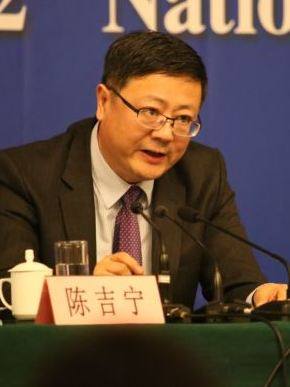
1. The Scholar's Road: From Gaizhou to the Presidency of Tsinghua (1964–2015)
Chen Jining was born on 4 February 1964 in Gaizhou, Liaoning, with an ancestral home in Lishu, Jilin. Of his generation of technocrats, his start was the purest academic one: he entered Tsinghua's Department of Civil and Environmental Engineering in 1981, took his bachelor's in 1986 and a Tsinghua master's in environmental engineering in 1988, then left for Britain — briefly at Brunel University, then from 1989 at Imperial College London, where his doctorate, completed in 1993, modelled the activated-sludge process at the heart of sewage treatment. He did not come home at once: he stayed at Imperial for six years as a postdoctoral researcher and assistant researcher, returning to Tsinghua only in 1998.
The ladder back home was climbed inside one department: vice chair of Environmental Science and Engineering in 1998, chair from 1999 for seven years; vice president of the university in 2006, executive vice president in 2007, dean of the Graduate School from 2010; and on 20 February 2012, president of Tsinghua University, succeeding Gu Binglin. The best-known episode of his presidency stands in pointed contrast to this file's main subject: in 2014, when Tsinghua environmental students and internet users fought a running battle against paid posters to defend the scientific accuracy of the Baidu Baike entry on PX (paraxylene), Chen publicly praised the students for defending a factual encyclopedia entry with facts — a detail Xinhua's system still mentioned approvingly when he moved to the environment ministry in January 2015. The image of a university president encouraging students to hold a public record straight is the main impression he left before entering politics. This page archives it not because it offsets anything that follows, but because an archive's rule is the whole picture: the same man would later stand on both sides of the lectern and the municipal government.
On 28 January 2015 Tsinghua announced his departure as president; the same day he became party group secretary of the Ministry of Environmental Protection. A month later, on 27 February 2015, the NPC Standing Committee appointed him Minister of Environmental Protection, succeeding Zhou Shengxian. Fifty-one years old, a career academic with no experience governing any locality and no prior administrative post in any government, he was the youngest minister in the State Council and the ministry's first chief drawn directly from scholarship. Reuters and the South China Morning Post read the appointment the same way at the time: smog had become a national political problem, and Beijing wanted someone who knew the field and did not look like a bureaucrat to take the hottest seat in the cabinet. The appointment was the watershed of his career: from here on he was no longer a scholar but an official answerable for concrete outcomes, and this file's ledger starts here.
2. How This Page Attributes Responsibility: Three Tiers, Kept Apart
The difficulty in writing about Chen Jining is not a shortage of material. It is a structural fact: his most important responsibility event — the Beijing evictions of November 2017 — occurred while he was acting mayor, in a term whose party secretary was Cai Qi. In a Chinese municipality the party committee leads and the secretary decides; the mayor runs the government system. But the municipal government is not a mailroom: the campaign was launched by a document of the Beijing Municipal Work Safety Committee, an organ of the government system, and the clearances on the ground were executed through the government's administrative chain, of which the mayor is the first person responsible. This page therefore keeps the three tiers it uses throughout. Tier one, the personally documented: his own signed speeches, public statements and decisions made in his name. Tier two, the institutional tenure: actions launched and executed by the municipal government and its organs during his mayoralty, acting period included — the forty-day campaign and the 2022 pandemic controls are booked here, phrased as "the Beijing government under his mayoralty," charged to the mayor's tenure, never dressed up as item-by-item personal orders. Tier three, others in the same tenure: Party Secretary Cai Qi's deployment remarks, central-level population planning, the propaganda system's deletions and silences — the other half of the event's power structure, each item named to its actual author, never booked to Chen Jining; and, by the same rule, never used as a reason to wipe the government's ledger off his tenure either. The two disciplines are one: do not take others' accounts, do not shed your own.
3. Two Years as Environment Minister: Teeth for the Law, One Week of Under the Dome, and the Central Inspections (2015–2017)
Chen took over the environment ministry on the effective date of a law: the revised Environmental Protection Law, in force from 1 January 2015, was the statute officials themselves advertised as having grown teeth — daily-compounding fines, seizure powers, production halts. The attribution first: the revision was adopted by the NPC Standing Committee in April 2014, before his time; the legislation is not his. Its enforcement began with him. Within weeks of taking office he was publicly vowing that compliance would become the norm and that the ministry would dare to get tough. Two institutional moves of his tenure are documented: the central environmental inspection system, piloted in Hebei at the end of 2015 — inspection teams descending on a province, summoning and holding local officials to account under a "party and government alike" principle, then rolled out nationwide in batches — which became the most consequential tool of Chinese environmental governance for the following decade, pushed from inside the ministry during his tenure; and an internal restructuring of the ministry announced in March 2016, alongside campaigns against falsified monitoring data. This tenure's archival character is governing record, not persecution record, and this page files it as such, neither inflated nor erased.
One week of those two years must nonetheless be recorded separately, because it rehearsed the posture of every tenure that followed. On 28 February 2015, the day after he formally became minister, Chai Jing's self-funded smog documentary Under the Dome went online and passed a hundred million views within days. At his National People's Congress press conference in early March, Chen said publicly that he had watched the film in full and thanked Chai Jing for raising environmental awareness from the standpoint of public health — the highest-level official goodwill the film ever received, preserved in the full press-conference transcript and booked here to tier one, his own words. Within a week the wind reversed: the propaganda system issued its ban, the film was taken down across platforms, coverage was shut down, and an employee of a Shanghai media outlet was suspended for leaking the directive. After that, Chen never mentioned the film in public again. This page's attribution is exact: the takedown order came from the propaganda system, not the environment ministry, and there is no evidence it came from him personally, so it is not booked to him; but his turn from public thanks to complete silence is equally in the public record — he chose not to speak. That is not a crime. It is an archival fact: the first blank space left by a scholar-turned-official under system pressure, the same blank space he would leave again after the Daxing evictions, at far higher cost to others.
On 27 June 2017 Li Ganjie succeeded him as environment minister; his next post had been announced a month earlier. Looking back, the ministry years left chiefly an enforcement legacy — inspections, penalties, data discipline — filed in official narrative as achievement and in this page's taxonomy as neutral governance record. His entry into the human-rights archive begins with the next stop, Beijing.
4. Six Months in Beijing and the "11·18" Fire: Xinjian Village, 18 November 2017
On 27 May 2017 the Standing Committee of the Beijing Municipal People's Congress appointed Chen Jining vice mayor and acting mayor of Beijing; he simultaneously became a deputy secretary of the municipal party committee. The party secretary was Cai Qi, who had moved from the mayor's office to the secretary's at the end of 2016 — Chen was filling the mayor's chair Cai had vacated. That seating plan fixed Beijing's power terrain for five years: Cai, an old associate of Xi Jinping, held overall authority as secretary; Chen, an outsider and a technocrat, ran the government as mayor. The fire and the evictions six months later happened inside that arrangement, and attribution must seat both names, each in his own place.
On the evening of 18 November 2017, fire broke out in the Jufuyuan apartments in Xinjian Village, Xihongmen Town, Daxing District. The two-storey building was a classic urban-fringe "three-in-one": workshops and a cold-storage facility on the ground floor, warren-like rental rooms above. Official and multiple media accounts put the population at around four hundred people, almost all of them workers from elsewhere in China — restaurant staff, couriers, vendors, cleaners. The fire started in electrical wiring in the basement cold store, and the smoke filled the stairwells. The final official toll: 19 dead, including 8 children, and 8 injured. Xinhua's report of 19 November confirmed the 19 deaths; peer-reviewed research in The China Quarterly established that 17 of the 19 dead had no Beijing household registration. In the days after the fire, nearly twenty people were criminally detained, including the building's operators, landlord and electricians — the farthest point official accountability for the fire ever reached. In the six years since, within this page's search scope, no government leader at any level has been publicly held to account for the fire or for the evictions that followed it.
The season matters to the record: in late November, Beijing's nights are already around freezing. Buildings like Jufuyuan were dangerous precisely because they were cheap — the only housing in a city of more than twenty million that people earning a few thousand yuan a month could afford. The fire exposed a long-standing governance debt: "three-in-one" premises carpeted the urban fringe, their hazards were common knowledge, and the authorities had mostly looked away, because the city ran on the people who lived in them. That background decides how the next forty days should be judged: the hazard was real. The chosen remedy was to expel the people.
5. Forty Days: The Great Cleanup and the Winter Evictions (20 November – End of December 2017)
The timeline, day by day. On 19 November, the day after the fire, Party Secretary Cai Qi ordered inspections of every household and every village — the formulation is preserved in The China Quarterly's research and is booked to Cai personally. On 20 November the Beijing Municipal Work Safety Committee issued the document launching a forty-day citywide campaign, the "Major Investigation, Major Cleanup and Major Rectification of Safety Hazards," aimed at industrial compounds, rental compounds, wholesale markets, warehousing and logistics bases, construction sites and underground spaces: anything judged hazardous was to be shut down, demolished and cleared. The issuing organ belonged to the municipal government system, and the campaign's administrative execution chain was the government's — at whose head, as acting mayor, sat Chen Jining. That is the documentary basis on which this page books the forty days to his institutional tenure: not conjecture, but the issuing organ and its line of command.
What the campaign looked like on the ground is preserved in extensive contemporary footage and reporting: districts, townships and villages posted move-out notices with deadlines as short as three days, some a single night; enforcement teams and security guards entered villages in groups; cutting water and electricity was a standard tool; bulldozers levelled whole rows of rental housing and small workshops; the expelled dragged woven bags and suitcases through sub-zero streets looking for vehicles and rooms, while rents on the city's fringe doubled within days — NewsChina's English edition recorded one detail: single rooms around Hejiaying rose from 450 yuan a month in mid-October to over 1,100 yuan by 22 November. Feijiacun, a migrant village near the 798 art district in the northeast, was demolished wholesale and its residents staged a rare street protest. Across the urban-rural fringe of Daxing, Changping, Chaoyang and Tongzhou the scenes formed one continuous belt. An official figure, quoted in later legal commentary, gives the campaign's density: in its first two days, inspectors logged 9,497 hazard sites across the city.
On scale, honesty is mandatory: Beijing never published a total for the people cleared out, and every figure is an estimate. This page archives three, labelled by kind. First, the conservative wire-service figure from the time, Associated Press and Reuters: thousands driven from their homes. Second, the peer-reviewed figure in The China Quarterly: tens of thousands displaced. Third, the estimate by scholar Wu Qiang, published on the China Change website on 3 December 2017, that more than 200,000 migrant residents were expelled within a single week — an essayist's estimate, never verified by any official or independent count, archived here as unverified, evidencing the magnitude of the shock contemporaries felt, not citable as fact. Beyond the three figures, the structural facts are certain: the campaign ran forty days, covered the whole urban fringe, fell in deep winter, and made no transitional arrangements — a legal analysis in the Michigan Journal of International Law checked the procedural requirements one by one and found that those cleared generally received no proper notice period, no compensation and no relocation plan. In December, the artist Hua Yong, who had been posting video of the evictions, was taken away and later released on bail — reported by the BBC and The Art Newspaper. That a man who filmed the scene was detained is itself part of this campaign's archive.
The criticism is likewise on record. On 24 November, more than one hundred Chinese intellectuals — among them Cui Weiping, He Weifang, Zhang Lifan and Wu Qiang — signed an open letter calling the use of safety checks to expel migrant workers unlawful, unconstitutional and a grave trampling of human rights, and demanding an immediate stop. Civil rescue followed at once: volunteers compiled lists of homes willing to take the expelled, and offices and warehouses were opened as temporary shelter; the lists spread widely on social media, and some relief efforts were subsequently obstructed, as contemporary reporting and participant accounts record and this page files at the reporting tier. On 27 November Cai Qi stated publicly that the campaign must not be carried out simplistically or over-broadly, that the work should show humane care, and that people must be given reasonable time to move — booked to Cai personally. It was the official system's only half-public admission that the campaign had gone too far, and it is worth noting who said it: the party secretary, not the mayor.
Where, then, was Chen Jining during those forty days? Within the public reporting and official releases searchable for this page, the result is: no signature public statement by him on the Daxing fire or the clearance campaign has been found; no clearance directive issued in his personal name has been found; the municipal government's public face on the campaign was the work-safety system and the officials in charge of it. The point must be read both ways. On one side, it leaves any claim that "Chen Jining ordered the evictions" without evidence, and this page does not adopt it. On the other, he was acting mayor, the first person responsible for the municipal government: the campaign's issuing organ sat under him, its execution chain ran under him, and in forty days he never publicly halted it, corrected it, or said one word for the people being expelled — the single corrective sentence of 27 November was not his either. His archival portrait here is therefore double-layered: the evictions were not his personal order, but they happened under his government, with the administrative machine he led, and what he left in the public record was silence. Set beside the silence after Under the Dome, this time the price of the blank space was paid by tens of thousands, perhaps more, looking for somewhere to sleep on winter nights. That, stated exactly and without dilution, is the core of this page's accounting for him.
6. "Low-End Population": The Documentary Status of Four Words, and the Official Denial
In Chinese public discourse the evictions carry a more stinging name: "clearing out the low-end population." The documentary status of that phrase must be stated precisely, or this page would repeat the error it exists to correct. The facts: "low-end population" (diduan renkou) was not invented by internet users — in the planning and industry-relocation discourse of the preceding years, formulations about "low-end industries" and "low-end population" had appeared in official documents and official-media contexts in the Beijing region; the Michigan Journal of International Law's analysis notes that earlier municipal-level documents had identified the less-educated and low-income as the principal population group to be regulated. In September 2017 the centrally approved Beijing Urban Master Plan (2016–2035) fixed a cap of 23 million permanent residents, and relieving the capital of non-capital functions was settled state policy: the population the campaign would fall on was already written into the planning texts. But this must be written with equal clarity: the forty-day campaign's public documents are written entirely in the language of safety; no public document has ever named "clearing the low-end population" as the campaign's objective; and once the campaign began, Beijing officials explicitly denied that any "clearance of the low-end population" existed, insisting the campaign targeted hazards, not people, while official media published denials that the fire was being used as a pretext. This page places the two sides side by side, unmerged: the phrase has an official paper history; the campaign has an official denial. The gap between the composition of the expelled — almost entirely migrant workers without local registration — and the official claim of "hazards only, no distinction of persons" is left for the reader to weigh against the scene record. This page does not print "low-end population" as the campaign's formal name, and it will not erase the controversy on the officials' behalf either.
7. The Rest of the Mayoral Ledger: Relocation, the Population Cap and the Air (2017–2022)
In January 2018 Chen was elected mayor by the Beijing Municipal People's Congress. The remaining four-plus years of his mayoralty are filed in this page's taxonomy mainly as governance record, itemized briefly. Population control: Beijing's permanent population was held under the 23-million cap during his tenure, and wholesale markets, logistics bases and general manufacturing continued to be relocated out of the city; the winter of 2017 was not an isolated episode but the crudest single surfacing of that relocation line — this page marks that reading as structural analysis, resting on the master-plan text and years of relocation reporting. Air quality: on the official monitoring figures, Beijing's annual average PM2.5 concentration fell year by year during his tenure, reaching 33 micrograms per cubic metre in 2021, when officials declared a milestone in air-pollution control — the achievement most often cited from his mayoralty, and one matching his professional background; it is archived here at the official-data tier, its merits not litigated. The Olympics: the Beijing 2022 Winter Games were held under pandemic closed-loop management in February 2022; as mayor he was the host city's head of government, and he afterwards received the Silver Olympic Order from the IOC, a matter of public record at the honours tier. The three entries share one feature: they are governance, not persecution. This page records them so that Section Five's eviction ledger stands the firmer — a municipal government demonstrably capable of cleaning a city's air and staging an Olympics cannot plead incapacity as an explanation for what it did, in the winter of 2017, to the weakest group of people in it.
8. 2022: The Omicron Spring, Citywide Testing, and the Last Half-Year of His Mayoralty
The final year of his mayoralty was zero-COVID's most strained year, and Beijing's chapter of it is booked to his tenure, in order. In late April 2022 the Omicron variant reached Beijing and a cluster formed in Chaoyang District. On 25 April, Chaoyang's 3.45 million residents and those who worked in the district began three rounds of nucleic-acid testing; the next day testing was extended to eleven districts and some twenty million people, in three consecutive rounds — a testing scale the Associated Press described as unprecedented for Beijing. The morphology of control took shape in parallel: buildings and compounds with cases were sealed entire; an area of roughly two by three kilometres in Chaoyang was designated a control zone, its residents confined to their compounds and ordered to work from home; blue metal fencing went up along the streets and police stood at the gates; entertainment venues, gyms and cinemas closed citywide. At the end of April, primary and secondary schools moved online ahead of schedule; from 1 May, dine-in service was suspended across the city; through May, whole districts worked from home, dozens of subway stations were closed and bus routes skipped stops. On 12 May, rumours of an imminent citywide "static" lockdown swept Beijing; the municipal government's spokesman held an emergency denial, calling a lockdown an unnecessary panic, and supermarkets extended their hours — the denial itself proves that a Shanghai-style total lockdown existed in Beijingers' expectations as a real possibility, and that Beijing in the end did not go there. For comparison with other cities the distinction must be kept exact: Beijing 2022 was citywide testing plus zoned lockdown, not a Shanghai-style sealing of the whole city, and this page does not inflate it.
Attribution follows the same tiers. "Dynamic zero" was a central-level general policy; it originated neither with Beijing nor with Chen Jining personally. But the rounds of citywide testing, the drawing of sealed and controlled zones, the suspension of dining and in-person teaching, and the health-code pop-ups that restricted the movement and return travel of Beijing residents were decisions made and executed by the Beijing municipal government during his mayoralty, booked to the institutional-tenure tier. His own public role in this period consisted mainly of the standard official-release imagery of inspections and supply deployments; no signature pandemic statement in his personal name has been found in the public record, and this page archives that as found. The time boundary is nailed down once more: he left Beijing for Shanghai on 28 October 2022; the late-November protests at universities and compound gates across Beijing, and the 7 December "ten measures" that ended zero-COVID, all occurred under acting mayor Yin Yong and party secretary Cai Qi (with Yin Li succeeding Cai as secretary in early December after Cai entered the Standing Committee) — they have nothing to do with Chen Jining. Charging him with November's Beijing would be the same species of error as unloading 2017's evictions onto someone else, and this page commits neither.
9. Four Years in Shanghai: Politburo Member, Investment Front Desk, and a Quiet Record (2022–2026)
In October 2022 the 20th Party Congress closed. On 23 October the first plenum of the 20th Central Committee elected the new Politburo, with Chen Jining among its members; on 28 October Xinhua announced his appointment as Party Secretary of Shanghai, succeeding Li Qiang, who had entered the Politburo Standing Committee and would become premier the following spring. Bloomberg's coverage framed the appointment as the Beijing mayor taking over Shanghai and noted its fit with Xi Jinping's pattern of staffing key posts with associates and technocrats; the "associate" characterization is archived at the media-commentary tier, while the checkable hard fact is the ladder: environment minister, mayor of the capital, Politburo member, Shanghai party secretary — four steps in eight years, among the fastest ascents of his official generation.
In Shanghai his public image has concentrated heavily on the economy and opening: meeting former Taiwan president Ma Ying-jeou in April 2023; JPMorgan Chase chief executive Jamie Dimon in May 2023; Tesla chief executive Elon Musk in June 2023, encouraging him to invest more in the city; US Commerce Secretary Gina Raimondo in August 2023; a US Senate delegation led by Majority Leader Chuck Schumer in October 2023; and US Secretary of State Antony Blinken on 25 April 2024. Every one of these meetings is in the public reporting of Reuters, Bloomberg or the South China Morning Post, and together they are the principal type of his Shanghai record: a city still scarred by its 2022 lockdown sent him to stand at the front desk of investor reassurance — a use of him directly continuous with his English-speaking, foreign-educated, mild-mannered scholar's résumé. One disciplinary entry belongs in the file: in July 2023, when Dong Yunhu, chairman of the Standing Committee of the Shanghai Municipal People's Congress, was placed under investigation, Chen chaired the municipal committee meeting conveying the central decision — a procedural record of him acting as secretary; the case itself was the Central Commission for Discipline Inspection's, and is not booked as his personal action. Within this page's search scope, no signature persecution or censorship event personally launched by him in his Shanghai tenure has been found: no public record, and this page writes exactly that — it neither fills his Shanghai years with his Beijing ledger nor issues him a certificate of spotlessness. Shanghai's speech controls and stability machinery run on as institutional routine; this page's discipline is to record checkable, specific responsibility, not atmosphere.
On his next step: since 2024, foreign commentary has repeatedly speculated that he is a leading candidate for the Politburo Standing Committee at the 21st Party Congress in 2027. All such material is handled on this page strictly as unverified commentary, noted here only as existing, never written into the factual text. His health, family and personal assets: no public record, and this page adds nothing.
10. Sanctions and Accountability: None Found, and a String of Contrasts
The sanctions entry begins with the search path: for this page, the US Treasury's OFAC Specially Designated Nationals list and related State Department releases, the EU financial sanctions database, the UK Sanctions List and Canada's Consolidated Autonomous Sanctions List were searched and cross-checked against consolidated sanctions databases. The conclusion is none found: Chen Jining's name appears on no public government sanctions list. Judicial pursuit: no public record. Domestic accountability: no public record — and more than none: after the 2017 evictions he was confirmed and elected mayor, and in 2022 he rose into the Politburo. The contrast gives the entry its weight. Criminal liability for the Daxing fire stopped at the building's operators and electricians; the campaign's brutality drew even an official half-correction, spoken by Cai Qi, yet the chain of accountability never climbed a single rung — no district head, no vice mayor, and certainly not the mayor. In this site's gallery of officials he is therefore a specific kind of specimen: a responsibility event measured in tens of thousands of people, documented in video and criticism and covered at length by international media, whose personal file, in the column for consequences, is blank. The criticism was written year after year; the name is on no list; the résumé holds only promotions. That condition is itself the archive, and this page preserves it as found.
11. Current-Status Verification (to November 2026)
This page verified his current status by the following path. First, in January 2026, during South Korean President Lee Jae Myung's visit to China, Lee met Chen Jining in Shanghai, recorded in the Delhi Policy Group's Indo-Pacific Monitor of January 2026 — proof that he was still acting as Shanghai party secretary at that date. Second, during 2026 he also met British Prime Minister Keir Starmer and Serbian President Aleksandar Vučić, as recorded from public reporting in the English Wikipedia entry, a continuous run of public activity. Third, current provincial-leader lists (still updated in November 2026) and both Wikipedia entries list him as Shanghai party secretary in office, appointed 28 October 2022, predecessor Li Qiang. Fourth, within the search scope, no official announcement or reliable media report of his removal, transfer, retirement or investigation has appeared. On that basis this page confirms: as of 13 November 2026, Chen Jining remains Party Secretary of Shanghai and a member of the Politburo, four years into the Shanghai post.
Age is recorded as fact only: born in February 1964, he turned sixty-two in 2026 and has not reached the customary retirement line for Politburo members. This page does not predict his future and credits no unsourced promotion rumour (the Standing Committee speculation of Section Nine is labelled commentary). Compared with the scholar who entered government eleven years ago, his public record now carries a complete ladder of power: Tsinghua president, environment minister, mayor of the capital, party secretary of Shanghai — and in that record the heaviest page, the forty days of November 2017, contains not one word from him. This archive stores the blank and the event side by side. That is all it can do, and it is why it exists.
12. Verification and Sources
The posts and biographical facts on this page were cross-checked across multiple sources, principally: the Ministry of Environmental Protection's official English biography page for Chen Jining (born 1964; entered Tsinghua 1981, bachelor's 1986; Imperial PhD 1993; returned to Tsinghua 1998 as department vice chair, chair 1999; vice president 2006, executive vice president 2007; president from January 2012; MEP party group secretary January 2015, minister February 2015); Imperial College London's official alumni page (1993 doctorate; remained as researcher until 1998; Tsinghua vice-president and executive vice-president sequence); the Chinese and English Wikipedia entries for Chen Jining (born 4 February 1964 in Gaizhou, Liaoning, ancestral home Lishu, Jilin; Tsinghua master's 1988 and the Brunel–Imperial trajectory; Tsinghua presidency 20 February 2012 – 28 January 2015; environment minister 27 February 2015 – 27 June 2017, succeeded by Li Ganjie; Beijing mayoralty 27 May 2017 – 28 October 2022 under party secretary Cai Qi, succeeded by Yin Yong; Shanghai party secretary from 28 October 2022, succeeding Li Qiang; 20th Politburo membership; Silver Olympic Order; the 2023 meetings with Ma Ying-jeou, Dimon, Musk, Raimondo and Schumer, the 2024 Blinken meeting, and the 2026 Starmer and Vučić meetings); Xinhua releases of 28 January 2015 (MEP party secretary appointment and the PX-entry report), 27 May 2017 (Beijing People's Congress appointment), 19 November 2017 (19 dead in the Daxing fire) and 28 October 2022 (Shanghai appointment). For the fire and evictions: Made in China Journal (Australian National University), its November 2017 running record and the May 2018 essay "Beijing Evictions, a Winter's Tale" (fire on 18 November; 19 dead including 8 children; some 400 residents; nearly twenty detained; the forty-day campaign launched 20 November; the intellectuals' petition); the peer-reviewed study in The China Quarterly, "Spatial Governance in Beijing: Informality, Illegality and the Displacement of the 'Low-End Population'" (17 of the 19 dead were migrants; Cai Qi's 19 November door-to-door order; the campaign's full name; tens of thousands displaced; Cai Qi's 27 November statement that the campaign must not be simplistic and people must be given time to move); the legal analysis in the Michigan Journal of International Law, vol. 39 (water and electricity cutoffs and other coercive means; absence of notice, compensation and resettlement; the official figure of 9,497 hazard sites logged in the first two days; the earlier appearance of "low-end population" in municipal-level documents; the 23-million population cap); NewsChina's English edition, January 2018 (electrical-fault cause of the fire; Hejiaying rents rising from 450 to over 1,100 yuan; the 22-million resident control target); Wu Qiang's commentary on China Change, 3 December 2017 (the estimate of over 200,000 expelled within a week — archived here as unverified); BBC reporting of 24 November 2017 (official media denying a clearance of the "low-end population") and The Art Newspaper, 19 December 2017 (Hua Yong's detention and release on bail; the Feijiacun demolition and protests; eviction estimates ranging from thousands to hundreds of thousands); a European civil-society solidarity statement (tens of thousands expelled in winter conditions; water and power cutoffs). For the 2022 pandemic period: Associated Press reporting of 25–26 April 2022 (3.45 million in Chaoyang tested in three rounds; extension to eleven districts and some twenty million people; fenced control zones and home confinement; entertainment closures); Al Jazeera, 26 April 2022 (advice against leaving the capital for the May Day holiday; venue closures); Caixin's photo record of 25 April 2022 (sealed and controlled zones designated); and NewsChina and AP reporting on the May suspension of dine-in service, home working and the official denial of a citywide lockdown — this page uses only facts consistent across multiple sources and no single social-media account. For Shanghai: Bloomberg's appointment report of 28 October 2022; South China Morning Post reporting on the Dong Yunhu case and the Raimondo and Schumer meetings; the Delhi Policy Group's Indo-Pacific Monitor, January 2026 (the Lee Jae Myung meeting in Shanghai). Current status was further cross-checked against current provincial-leader lists and the November 2026 state of both Wikipedia entries.
Corrections and checks applied to the original brief for this page: (1) Fire date: Xinhua, the BBC and The China Quarterly agree on the evening of 18 November 2017; some English secondary material says "19 November fire," a confusion of time zones and report dates, corrected here to 18 November, consistent with the official "11·18" designation. (2) Fire location: Xinjian Village, Xihongmen Town, Daxing District, the Jufuyuan apartments; renderings in some English material as "Ximen township" or "Jiugong township" are mistranslations and were not used. (3) Eviction scale: no official total was ever published; the Associated Press figure of thousands, The China Quarterly's tens of thousands, and Wu Qiang's commentary estimate of over 200,000 within a week are archived side by side with their kinds labelled, and no single figure is presented as settled. (4) "Low-end population": the phrase has a prior history in official planning discourse, but the forty-day campaign's public documents contain no such wording and officials explicitly denied it; the text archives both faces of that status and does not print the phrase as the campaign's formal name. (5) Chen Jining's relation to the campaign: no personal clearance directive or signature statement by him appears in the public record; the text attributes the campaign at the institutional-tenure tier (the issuing organ was the Beijing Municipal Work Safety Committee of the government system, and he was then acting mayor) and does not write it as his personal order; Cai Qi's 19 November deployment and 27 November corrective statements are archived to Cai personally, not to Chen. (6) Doctorate year: the official biography and Imperial College give 1993, while the English Wikipedia article text also carries 1992; the discrepancy is noted in the career line and the official record followed. (7) The late-November 2022 Beijing protests and the December end of zero-COVID occurred after he left office and are expressly severed from his tenure in the text. (8) Sanctions: searches of US, EU, UK and Canadian public lists found no listing, and the text states "none" accordingly; international criticism of the 2017 evictions genuinely exists but is press and scholarly criticism, never converted into personal sanctions or pursuit against him, and the two are recorded separately. Matters without public sourcing — his family and assets, the municipal government's internal decision process on the campaign, his unpublicized activity in Shanghai — are marked as no public record or left without speculation throughout. This page will be revised as new archives become public.
Contact: endccpworld@proton.me