
李先念家族:四名子女与女婿刘亚洲——有位置、无版图,一案无官方文本The Li Xiannian Family: Four Children and Son-in-Law Liu Yazhou — Positions, No Footprint, and One Case with No Official Text
The Li Xiannian family: Li Xiannian (1909–1992) ran China's finances for 26 years and was President of the PRC from 1983 to 1988. His four children — daughters Li Jin and Li Ziyang, both doctors (Li Ziyang later vice-president of the Chinese Association for Female Doctors); only son Li Ping, deputy chief of staff of the Beijing Military Region and a major general; and youngest daughter Li Xiaolin, chairperson of the Chinese People's Association for Friendship with Foreign Countries from 2011 to 2020 — each held a post inside the system, and none has any public record of business activity, shareholding or disclosed wealth; Li's house rule, reported by the South China Morning Post in 2014, was that he would break the legs of any child who went into business. His son-in-law Liu Yazhou (Li Xiaolin's husband), an Air Force general and political commissar of the PLA National Defence University (2009–2017), vanished in 2021; Ming Pao and Sing Tao Daily reported in 2023 that he had been doubly expelled and given a suspended death sentence for serious corruption, in effect life imprisonment — no Chinese authority has ever announced anything, and this dossier grades the case B throughout: reported, not officially confirmed. Name warning: the youngest daughter is Li Xiaolin 李小林, not Li Peng's daughter Li Xiaolin 李小琳 of the power sector, whose ICIJ offshore record belongs to a different woman and a different family.
Contents
- 1. The source: Li Xiannian, from carpenter's apprentice to president
- 2. Lin Jiamei: a doctor who became first lady
- 3. Eldest daughter Li Jin: the thinnest file
- 4. Second daughter Li Ziyang: the women doctors' association line
- 5. Only son Li Ping: the Academy of Military Sciences and the Beijing Military Region
- 6. Youngest daughter Li Xiaolin: nine years at the friendship association
- 7. Son-in-law Liu Yazhou (I): the writer-general's rise
- 8. Son-in-law Liu Yazhou (II): the 2021 disappearance and the reported 2023 sentence
- 9. Business and wealth audit: a family with no findable footprint
- 10. Verdict: positions, no footprint — and one case with no official text
- Documented gaps (stated plainly)
- Sources
Most families in this series suffer from too much material of uncertain quality. The Li Xiannian family is the opposite extreme, beyond even the Deng Xiaoping family: the first generation held the presidency, the second generation each held a post whose institution can be named — a hospital, the armed forces, the friendship association — yet the moment one asks where the money is, whose name is on which company, and where the judgment is, the archive does not merely thin out; it stops. This family's gravest "fall from grace" is one the state has never acknowledged happened. This page sets out, person by person, every post, date, turning point and latest verifiable status that can be found, registers every gap as a gap, and places the reporting on Liu Yazhou side by side with the official silence — because those two things together are the true shape of this family in the public record.
1. The source: Li Xiannian, from carpenter's apprentice to president
Li Xiannian was born on 23 June 1909 into a poor peasant family in Huang'an County, Hubei (now Hong'an). He had three years of old-style schooling and worked as a carpenter's apprentice as a teenager. He joined the Chinese Communist Party in December 1927, rose through the Fourth Front Army from soldier to army political commissar, took part in the Long March, commanded the Fifth Division of the New Fourth Army in the war against Japan, and led the Central Plains breakout of 1946. After 1949 he returned to his home province as Hubei party secretary, provincial government chairman and mayor of Wuhan, governing Hubei until 1954. (Sources 1, 2) Two points in this early record matter for the family story: he was a gun-barrel commander who moved, unusually, into finance and economics after 1949; and Hubei and Wuhan, his first power base, recur in the early postings of his family members.
In 1954 Li moved to Beijing as Vice Premier of the State Council and concurrently Minister of Finance. He held the finance portfolio until 1970 and the vice premiership until 1980 — twenty-six years at the centre of fiscal, banking and trade policy, as the principal executor of Chen Yun's economic system. He entered the Politburo in 1956 and its Standing Committee in 1977, serving also as a party vice-chairman (1977–1982). In the Cultural Revolution he was among the handful of economic officials never toppled: he joined the February 1967 protest of the old marshals, was pressured, but kept his seat. After Mao's death he backed Hua Guofeng as Hua's chief economic adviser and took part in the decisions surrounding the arrest of the Gang of Four. (Sources 1, 2) By the late 1970s his curriculum vitae was the most complete of any living elder — Red Army, base area, provincial power, central finance, Standing Committee — and that completeness is precisely what put him in the presidency in 1983.
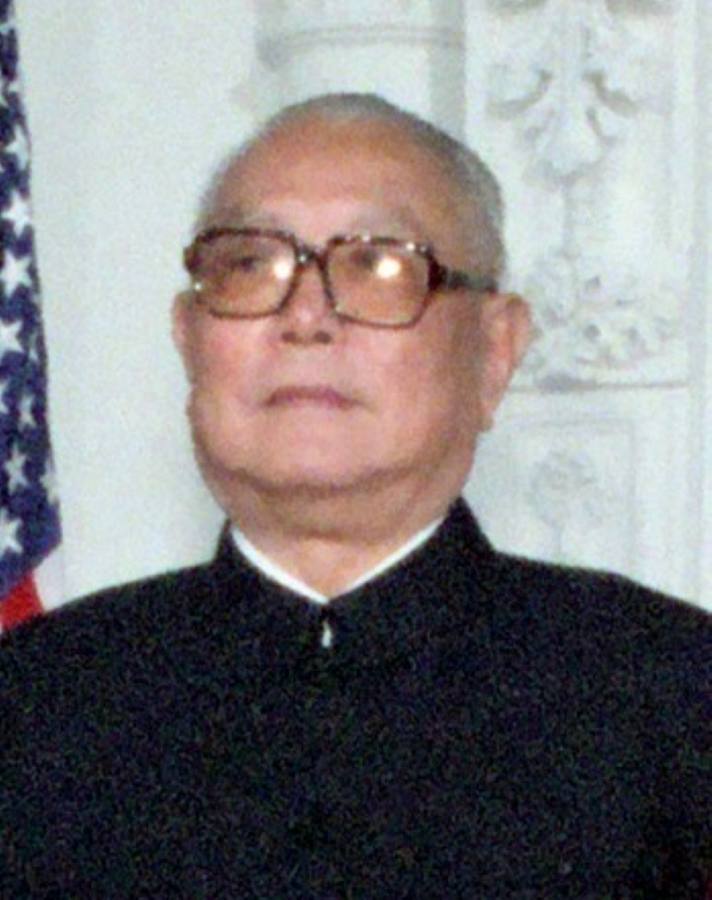
On 18 June 1983 the first session of the Sixth National People's Congress elected the 74-year-old Li Xiannian President of the People's Republic of China, the first holder of the office since its restoration under the 1982 constitution. In July 1985 he paid a state visit to the United States and met President Reagan — the first visit to the US by a PRC head of state; this page's photograph, from the Reagan Library and the US National Archives, was taken before the White House state dinner on that visit and is A-grade imagery. He stepped down as president on 8 April 1988, succeeded by Yang Shangkun, and the same month became Chairman of the CPPCC National Committee, a post he held until his death. He died in Beijing on 21 June 1992, aged 82, two days short of his 83rd birthday; his ashes were scattered, in accordance with his wishes, in the Dabie, Daba and Qilian mountains. (Sources 1, 2, 3)
A dossier of this family must also state plainly what kind of power its source wielded. Among the Eight Elders, Li Xiannian is consistently classified by scholars and biographers as a conservative on both the political and economic axes: a believer in orthodox central planning who worked to block marketisation and preserve state control over large parts of the economy; a patron of leftist theorists such as Hu Qiaomu and Deng Liqun; a figure recorded as instrumental in the falls of the liberals Hu Yaobang and Zhao Ziyang; and, in 1989, an elder recorded in multiple biographical and scholarly accounts as enthusiastically advocating military suppression of the Tiananmen protests. (Sources 4, 5) These characterisations come from academic research and major biographies and are labelled here as the research consensus, not as official findings — but they bear directly on this page's subject: from its source onward, this family's power was of the regime's innermost, most conservative core, not of any marginal or excluded branch. That is the context in which the second generation's universal possession of posts, and the archive's rapid descent into silence after 1992, have to be read.
2. Lin Jiamei: a doctor who became first lady
Lin Jiamei, born on 21 June 1924 in Danyang, Jiangsu, was Li Xiannian's second wife. Li's first wife, Shang Xiaoping, was the mother of the eldest daughter, Li Jin; Lin Jiamei's three children were Li Ziyang, Li Ping and Li Xiaolin. No official Chinese source has ever published the family's composition as a list; that reconstruction rests on the Lin Jiamei reference entry and its cited materials, and is recorded here at that grade. (Source 6) Lin graduated from Tong De Medical College in Shanghai in 1949 and followed a complete medical-administrative career: paediatrician at the Hubei Provincial Hospital, vice-president of the Wuhan Women and Children's Health Institute, member of the State Council's Family Planning Commission, chief of the Women and Children's Health Bureau in the Ministry of Health, and in later years president of the Chinese Association for Female Doctors and a consultant to the China Children's Development Center. During Li's presidency (1983–1988) she was the nominal presidential spouse, while foreign reporting treated Zhuo Lin, wife of the paramount leader Deng Xiaoping, as the de facto first lady — a dual arrangement noted in the foreign press of the time. (Source 6)
Two points about Lin Jiamei belong in the record. First, apart from Li Xiannian himself she is the only member of the spouse generation with a complete public professional curriculum vitae, and that career lies entirely inside the public-health administration: no corporate post, shareholding or business role under her name could be found in official or major-media sources, registered here as no public record found. Second, her longevity is itself part of the family's time span: she turned 100 on 21 June 2024, an event noted in Chinese social-media and some press items; as of this page's verification date no official or major-media obituary has appeared, and her status is registered as "turned 100 in 2024; no obituary reported since", with nothing inferred beyond that. Of her three children, both daughters with medical careers followed her into her own professional world — Li Ziyang would later become vice-president of the very association of women doctors that Lin had led — a visible intergenerational hand-over inside a professional body, though a professional post is not a business footprint, as the next sections show person by person.
3. Eldest daughter Li Jin: the thinnest file
Li Jin, the eldest daughter, was Li Xiannian's child by his first wife Shang Xiaoping. Her public file is the thinnest in the family: Chinese biographical compilations and repeated secondary accounts describe a medical career, including service in a Guangzhou Military Region general hospital or comparable military medical institution; her husband is said to have gone into business after leaving his post and settled in Guangdong; some accounts say she died early, in 2012. Every one of these items rests only on Chinese secondary compilations — no official curriculum vitae, no institutional notice, no major-media profile — and this page registers the whole of it at B-grade or below: "multiple secondary accounts consistently describe her as a doctor who lived quietly, with no public record of office-holding", without adopting any specific year as settled. (Source 7) The variant writing of her name (李进 / 李晋) was flagged in the opening statement.
Writing this section short is itself part of the method. The commonest defect in red-family dossiers is the manufactured curriculum vitae, in which every child is given a career assembled from self-media copying one another. What can responsibly be written about Li Jin is three sentences: she was the eldest daughter, by the first marriage; secondary accounts consistently describe her as a doctor who kept a low profile throughout her life; and she has no public record of business activity, shareholding, investigation or litigation. A further negative result is registered: in Bloomberg's 2012 investigation of the descendants of the Eight Elders, in the ICIJ offshore databases, and in the major media's successive princeling-wealth reports, her name does not appear. Not found is not proof of innocence — but an archive site can only write what it found and what it did not find, and Li Jin belongs to the category of the cleanest and emptiest files.
4. Second daughter Li Ziyang: the women doctors' association line
Li Ziyang, the second daughter and Lin Jiamei's eldest child, followed her mother's road exactly: medicine, clinical and medical-administration work, and eventually the vice-presidency of the Chinese Association for Female Doctors — the association her mother had served as president. That mother-and-daughter succession inside one professional body is one of the few institutional hand-overs in this family that public material can actually point to. Chinese biographical accounts add that she received a third-class merit citation and, after retirement, helped build or support organisations of women physicians; those details sit at the secondary-compilation grade and are registered as such, not asserted as audited fact. (Sources 7, 8) Her other public role is that of family rememberer: the most widely circulated accounts of Li Xiannian's late-life guilt toward his mother, and of his house rule that any child who went into business would have his legs broken, entered the public record largely through her recollections — which means the family's most famous "family discipline" materials originate in family testimony, a grade this page flags again when the rule is quoted in Section 9.
Li Ziyang's business and controversy record is negative on every axis searched: no company, no disclosed shareholding, no investigation and no lawsuit on public record. Her public identity stayed entirely inside the medical-professional system. Against her elder sister she has one more checkable layer — an association office; against her younger sister Li Xiaolin she never entered the core of the party's power or diplomatic machinery. This page's verdict on her is one sentence: a second-generation professional, her post checkable, her footprint non-existent. Her birth year and the exact start and end dates of her posts have no consistent public source, and this page leaves them blank rather than filling them in.
5. Only son Li Ping: the Academy of Military Sciences and the Beijing Military Region
Li Ping, the only son, was Lin Jiamei's second child. Chinese biographical compilations give him the most connected trajectory of the three stay-at-home siblings: he joined the army as a teenager (one account says at sixteen), studied at a military academy, worked at the Academy of Military Sciences for some eight years, moved through a succession of postings, and ended as deputy chief of staff of the Beijing Military Region with the rank of major general. (Sources 7, 8) Every stop on that itinerary rests on secondary compilations and biographical features — the PLA has published no personal curriculum vitae for him and no promotion notice could be found — so the whole paragraph is graded B: credible in direction (multiple accounts agree and none contradicts another) but impossible to nail down in detail, with no primary text for any specific year or post. A practical warning is recorded for readers and future citers: Li Ping is an extremely common name, and any "Li Ping" material that cannot be anchored simultaneously to "son of Li Xiannian" and to the Beijing Military Region does not belong on this page.
The substance of this section is what it shows about the family's place inside the military system. The father was a founding military leader of marshal rank in all but formal conferral; the only son reached a military region's deputy chief of staff and a major general's stars; the son-in-law reached the political commissarship of the National Defence University and full general's rank. Both of the family's military lines — son and in-law — ran through staff, political-work and academy channels inside the system; neither line leads to an arms-trading company or a military-industrial firm. Searches of major media and the offshore databases found no company, shareholding or commercial post under Li Ping's name, and no record of investigation or discipline. His current status has no checkable public reporting and is registered as no public record found. The contrast with Liu Yazhou is worth noting here and developed in Section 8: two soldiers of the same family and the same system, one whose file ends with service compilations and lifelong quiet, the other whose file ends in 2021 — followed by official silence and Hong Kong reports of a sentence that would end his life in prison.
6. Youngest daughter Li Xiaolin: nine years at the friendship association
Li Xiaolin, the youngest daughter, has the fullest public curriculum vitae of the four children and the highest international profile. Her education is recorded in multiple sources: study at Wuhan University, then a master's degree in history from the University of California, Los Angeles. She then spent essentially her whole career inside one institution, the Chinese People's Association for Friendship with Foreign Countries (CPAFFC): from 1990 to 1992 she served as first secretary at the Chinese embassy in the United States — the only posting of her career outside the association; on her return she headed the association's Americas department as deputy director and then director, became a vice-chairperson and deputy party secretary, served from 2007 to 2011 as vice-chairperson and party secretary, and in September 2011 succeeded Chen Haosu as the association's chairperson and party secretary. She stepped down in April 2020 and was succeeded by Lin Songtian — a tenure of eight and a half years. She was simultaneously a member of the 12th CPPCC National Committee and a deputy director of its Foreign Affairs Committee. (Sources 9, 10, 11) The name warning bears repeating once more at the head of her own section: she is Li Xiaolin 李小林 of the friendship association, not Li Xiaolin 李小琳 of the power sector.
What the CPAFFC is determines the weight of this section. Founded in 1954, the association is nominally a "people's organisation" but works under the Foreign Ministry's guidance as a core executing body of the party's united-front and "people-to-people diplomacy" system, cultivating foreign local governments, parliaments, friendship organisations and social elites. In October 2020 the US State Department publicly characterised the CPAFFC as a Beijing-directed body tasked with co-opting and malignly influencing American state and local leaders to advance the PRC's global agenda. That characterisation was issued about six months after Li Xiaolin had left the post and targets the institution, not her personally; this page records the timing honestly and does not transfer an institutional designation onto an individual — while also recording that her eight and a half years at its head were the association's most outwardly active period, that she travelled constantly and met foreign leaders and friendship-organisation heads as the most recognisable face of Chinese "people-to-people diplomacy" of those years, and that her chairmanship's engagements with American elite figures such as Bill Gates are on public record. (Sources 12, 13)
Li Xiaolin's business and wealth record matches her siblings': no company, no disclosed shareholding, no published wealth figure. She entered public discussion through position, never through money — and the chairmanship of the friendship association was, of all the posts the second generation received, the one with the most substantive function: it carries no administrative rank worth boasting about, but it commands a real machine of foreign contacts. One further fact is registered here because the next sections depend on it: after her husband Liu Yazhou disappeared in 2021 and was reported sentenced in 2023, no public statement by Li Xiaolin on the matter exists; Ming Pao's 2023 reporting quoted a source on her situation, which this page does not adopt as fact, registering only the negative result — no public statement by her. Her public appearances dropped sharply after she left the chairmanship in April 2020, and her current status cannot be fixed from authoritative sources; this page says so plainly.
7. Son-in-law Liu Yazhou (I): the writer-general's rise
Liu Yazhou was born on 19 October 1952 in Fenghua, Zhejiang (his ancestral home is given in some accounts as Suxian, Anhui); his father, Liu Jiande, was a deputy political commissar of the Lanzhou Military Region's logistics department. He enlisted in 1968, was later recommended to study English in the foreign-languages department of Wuhan University, began publishing while a student, and there met and married Li Xiaolin — the marriage that brought him into the Li Xiannian family. His career overlays two lines, military writer and political-work general: platoon leader and staff posts, a secretaryship in the PLA Air Force's political department, director of the political department of the Beijing Military Region Air Force, political commissar of the Chengdu Military Region Air Force, deputy political commissar of the Air Force, and from December 2009 to February 2017 political commissar of the PLA National Defence University, China's highest military academy. He rose to the rank of Air Force general and sat on the Central Commission for Discipline Inspection. (Sources 14, 15) That a general known for outspokenness held the political commissarship of the National Defence University for nearly eight years was itself a distinctive personnel fact of the Hu Jintao years.
Liu's writings and public statements are indispensable background to his fate. He made his name with reportage and strategic commentary, including a well-known study of the 1949 Kinmen campaign, and a stream of essays on strategy and reform. In a 2010 interview with Phoenix Weekly he praised the American democratic system, criticised a system that tolerates no dissent, and argued that China would have to democratise within a decade — remarks without parallel from a serving general of his rank, which caused a sensation at home and abroad. In December 2016 his essay "Great Critics Are Often Great Patriots" circulated widely on WeChat and in overseas reposting. (Sources 14, 16) Two earlier episodes are registered at the reporting grade: during the 1989 Tiananmen events he was reported to have been investigated for sympathy with the protesters and later cleared; and in 1992 he visited Taiwan quietly in a writer's capacity, reported as a precedent-setting visit by a serving party-member officer. Taken together the portrait is clear: he was not a son-in-law who coasted on his father-in-law's seat — his rise had real talent and real work behind it — but the marriage was plainly part of his network and political shelter, and his outspokenness, in the context of Xi Jinping's military purges, was the most dangerous label a general could carry.
8. Son-in-law Liu Yazhou (II): the 2021 disappearance and the reported 2023 sentence
This section carries the most delicate evidence grade on the page, and its rule is stated first: every sentence here about Liu Yazhou being investigated or sentenced is "reported", grade B, with no official text behind any of it. The official position to this day is silence — no confirmation, no denial, no notice. The factual layer comes first: Liu retired on leaving the National Defence University in February 2017, appeared publicly and published for a time afterwards, and from about 2021 vanished completely from public view; his name ceased to appear in any public reporting, and accounts of his books being withdrawn and his articles deleted circulated widely in the overseas Chinese-language world. The disappearance is observable fact. Its explanation belongs to the reporting layer.
The reporting chain, in full, is as follows. On 24 March 2023 Hong Kong's Ming Pao reported that Liu Yazhou was suspected of a serious corruption case, involving the amassing of huge wealth in the name of foundations and associations, and might be sentenced to death with a two-year reprieve — a suspended death sentence which under Chinese judicial practice is normally commuted to life imprisonment after the reprieve period, which is why overseas summaries generally render his fate as "effectively life". The same report quoted a source on the position of his wife Li Xiaolin; this page does not adopt those details. On 13 April 2023 Hong Kong's Sing Tao Daily reported that the Central Military Commission's discipline-inspection body had completed its investigation of Liu around the 2023 Spring Festival, and that he had been expelled from both the party and the military ("double expulsion") and transferred to the military judicial system. Since then, media and analytical summaries outside China have generally described him as sentenced in 2023 to a suspended death term now being served as life imprisonment, and the English Wikipedia entry on Liu Yazhou states his status in those terms with Hong Kong media as its source. (Sources 14, 17, 18) This page's registration of the whole chain is precise: multiple Hong Kong outlets reporting in sequence, with consistent timing and circumstances, no contradictory version, and a fit with the independently observable fact of his 2021 disappearance — credibility at the higher end of B-grade. But it is not A-grade: there is no military discipline-inspection notice, no military court judgment, and not one word from Xinhua or the PLA Daily.
Three reasons require this grade distinction to be nailed down rather than blurred. First, the series' own rule: the Wu Xiaohui case, elsewhere in this series, rests on a Shanghai court judgment whose sums, sentence and charges can be quoted word for word — that is A-grade. The Liu Yazhou case cannot establish even whether a trial took place; to write the two with the same certainty would be archival fabrication. Second, motive attribution must be kept separate from fact: overseas commentary widely reads the case as a political purge of princelings and military dissenters under Xi Jinping, citing Liu's outspoken record, his red-second-generation in-law status and the case's opacity. That is commentary-grade attribution; this page registers its existence and its logic without adopting it as a finding. Likewise the Ming Pao allegation of wealth amassed through foundations and associations is an allegation inside a report, with no published sum, account or adjudicated finding that anyone can check, and this page extends no figure from it. Third, the boundary concerning Li Xiaolin and the rest of the family: no public material accuses Li Xiaolin herself of any offence; her name appears in the reporting only in her identity as Liu Yazhou's wife. Before a son-in-law's reported case is written up as a family's judicial stain, that boundary has to be written first. As of this page's verification date in November 2026, the official status of the Liu Yazhou case remains, in four words: no public record. This page prints the reporting in full and the silence in full, and discounts neither.
9. Business and wealth audit: a family with no findable footprint
This section performs the audit this series requires for every family — corporate posts, disclosed equity, offshore records and wealth estimates, person by person. Li Jin: nothing on public record under any of the four heads. Li Ziyang: nothing. Li Ping: nothing. Li Xiaolin: no corporate post, no disclosed equity, no wealth estimate; the offshore head requires a specific exclusion — the ICIJ offshore database does contain a "Li Xiaolin" entry, but it documents Li Peng's daughter Li Xiaolin 李小琳 of the power sector and her husband Liu Zhiyuan, their Liechtenstein foundation and British Virgin Islands company. It is a different woman, and this page excludes it expressly: any account that hangs that offshore record on this family has confused two homophone names. Liu Yazhou: no corporate post or disclosed equity on public record; the only wealth-adjacent material anywhere is the single Ming Pao allegation of March 2023 about wealth amassed in the name of foundations and associations — no sum, no particulars, no second independent source developing it — registered here at its exact grade, an allegation inside B-grade reporting, and not stated as fact anywhere on this page. (Sources 17, 19)
The material most often quoted to explain this blank is the house rule. On 17 March 2014 the South China Morning Post published the story under the headline "'I'll break your legs if you go into business': former president's career advice to children", reporting Li Xiannian's warning to his children; the saying also circulates in China through Li Ziyang's recollections, in a form close to: "In my family, Li Xiannian's family, whoever dares to go into business, I will break his legs." (Sources 8, 20) This page's evidence registration for the saying is B-grade: a major newspaper's report and family recollection corroborate each other, and the content matches the observable fact that none of the four children ever did go into business — but it is also part of the family's self-narrative, and must be quoted with that nature attached. With fact and narrative separated, the section's conclusion can be stated cleanly: Li Xiannian held the state's purse strings longer than any other source figure in this series — finance minister from 1954 to 1970 — yet in the thirty-odd years of public record since his death, his four children have left behind not one company, not one shareholding, not one wealth estimate. Whether that outcome is credited to the house rule, to timing — the children came of age before the princeling business wave took shape, and Li died in 1992 just as the Deng family's third-generation capital operations were beginning — or to the archive's own opacity, the archival fact itself stands: no footprint can be found, and that is the whole of this page's conclusion about footprint, not one inch more.
10. Verdict: positions, no footprint — and one case with no official text
The verdict, audited person by person. "Positions": Li Ziyang had the vice-presidency of the Chinese Association for Female Doctors; Li Ping had the deputy chief of staff post of the Beijing Military Region and a major general's rank; Li Xiaolin had the chairmanship of the friendship association for eight and a half years and a CPPCC National Committee seat; Liu Yazhou had the political commissarship of the National Defence University for nearly eight years and a full general's rank. Every one of those posts can be named with its institution and its years, even where the fine detail rests on B-grade material. Li Jin is the honest exception: among the four children, her "position" amounts to a single secondary-source line — doctor in a military hospital — and this page lists her as such rather than promoting her into the pattern. "No footprint": across four children and one son-in-law, not one has a commercial asset fixed by a judgment, a regulatory document or a listed-company announcement. The family's entire public record touching money consists of one house rule and one allegation inside one Hong Kong newspaper report. Against the hub-type dossiers of this series (Chen Yuan and the China Development Bank) and its transaction-type dossiers (Wu Xiaohui and Anbang), the contrast could not be sharper: those families' problem is too much footprint and too many documents; this family's problem is too few documents — so few that even the sentencing of a full general can be carried out without leaving a single text open to the public.
That last sentence is this page's real landing point, and the fork between this dossier and the Deng Xiaoping family's "positions, no footprint" verdict. The Deng family's blank is a blank left by restraint. The Li family's blank contains an additional layer of institutional silence: if the reporting is true, a full general, a Central Discipline Inspection Commission member and a former president's son-in-law was investigated between 2021 and 2023, doubly expelled and sentenced to death with reprieve — and none of it passed through any level of official confirmation, leaving the public to assemble a general's remaining life from two Hong Kong newspapers. That way of handling a princeling case — done, but never said — is itself an archival fact about this system, and it is why the most important section of this dossier will remain at B-grade forever unless the state chooses to speak. This page ends here: everything found is here, everything not found is here; the reporting graded as reporting, the official silence recorded as silence, side by side — that juxtaposition is the whole shape that Li Xiannian's family can responsibly be given in 2026.
Documented gaps (stated plainly)
1. No official curriculum vitae exists for any of the four children: the postings of Li Jin, Li Ziyang and Li Ping rest entirely on Chinese secondary compilations and biographical features, their birth years mostly lack consistent sourcing, and this page leaves those fields blank — later citers must not fill them in from this page. 2. The Liu Yazhou case has no official text of any kind: the date of investigation, the composition of the charges, any sum of money, the date of judgment and the place of imprisonment are all without A-grade sourcing; everything recorded here is at the Hong Kong reporting grade, and if an official notice is ever published this page must be revised to follow it. 3. Li Xiaolin's public status after April 2020, Li Ping's current status, and Lin Jiamei's circumstances after her 100th birthday in 2024 cannot be fixed from authoritative sources and are registered as no public record found. 4. The family's third generation has no reliable public record at all; this page sets no third-generation section and does not speculate. 5. The house rule's earliest attestation is family recollection and the South China Morning Post report of 2014; no contemporaneous primary text is archived, and the saying must be cited with that grade attached.
Sources
- Li Xiannian's official biography and obituary record (Xinhua and party-history materials): Hubei posts, finance minister and vice premier tenures, presidency and CPPCC chairmanship, death on 21 June 1992.
- English Wikipedia, "Li Xiannian", and the academic and biographical sources it cites (used for cross-checking leads, never as sole authority).
- Reagan Library / US National Archives: records and imagery of Li Xiannian's July 1985 state visit and the White House state dinner (source of this page's photograph).
- The New York Times obituary of Li Xiannian, 23 June 1992 (Sheryl Wu Dunn).
- Academic and biographical research on Li Xiannian's conservative positioning, his blocking of marketisation, his patronage of leftist theorists and his advocacy of military suppression in 1989 (research consensus, labelled as such).
- English Wikipedia, "Lin Jiamei", and its cited materials (birth, education, public-health posts, her three children by Li Xiannian).
- Chinese biographical compilations and features on the postings of Li Jin, Li Ziyang and Li Ping (B-grade secondary layer, flagged wherever used).
- Li Ziyang's published recollections (the house rule and accounts of Li Xiannian's last years; family-testimony grade).
- English Wikipedia, "Li Xiaolin (politician)" (CPAFFC chairpersonship, September 2011 – April 2020; CPPCC National Committee membership).
- Scottish Government First Minister briefing papers containing Li Xiaolin's curriculum vitae (embassy first secretary 1990–1992; CPAFFC Americas department and vice-chairperson posts; chairperson sequence).
- CPAFFC published materials and its list of successive chairpersons (Chen Haosu – Li Xiaolin – Lin Songtian).
- US Department of State, October 2020 public characterisation of the CPAFFC (institutional level; issued after Li Xiaolin's departure).
- Public reporting of Li Xiaolin's chairmanship engagements, including her meeting with Bill Gates at the 2013 Global Vaccine Summit in Abu Dhabi.
- English Wikipedia, "Liu Yazhou", and the Hong Kong media sources it cites (biography; National Defence University tenure; the reported 2023 sentence).
- California State University ScholarWorks biographical note on Liu Yazhou (National Defence University political commissar; Air Force general; successive political-work posts).
- Phoenix Weekly's 2010 interview with Liu Yazhou and its republication at home and abroad; Liu Yazhou, "Great Critics Are Often Great Patriots" (December 2016), circulating text.
- Ming Pao, 24 March 2023 (Liu Yazhou suspected of serious corruption; possible suspended death sentence; the foundations-and-associations wealth allegation) — B-grade, never officially confirmed.
- Sing Tao Daily, 13 April 2023 (military discipline-inspection investigation completed; double expulsion and transfer to military justice reported) — B-grade, never officially confirmed.
- ICIJ Offshore Leaks database, "Li Xiaolin" entry — verified to concern Li Peng's daughter Li Xiaolin 李小琳, and expressly excluded from this family.
- South China Morning Post, 17 March 2014: "'I'll break your legs if you go into business': former president's career advice to children" — the house rule (B-grade).
This page will be revised as new archives open; if an official text on the Liu Yazhou case ever appears, Section 8 must be rewritten from it at once.